Category Archives: Readers Workshop

A Book for Women, Young and Old and In-between

I am always on the look out for books that will hook my readers and mentor texts that will inspire my writers.

But when I saw the title The Radical Element, 12 Stories of Daredevils, Debutantes & Other

My Radical Granddaughters

It’s never too early to give girls hope.

Dauntless Girls, I thought of my own three daughters, my daughter-in-law, and my two granddaughters. (Well, not so much the debutantes, but definitely the daredevils and the dauntless.)

We need books where our girls see themselves –where they feel empowered to take on the world. In a brochure I got from @Candlewick, it states:

To respect yourself, to love yourself, should not have to be a radical decision. And yet it remains as challenging for an American girl to make today today as it was in 1927 on the steps of the Supreme Court. It’s a decision that must be faced when you’re balancing on the tightrope of neurodivergence, finding your way as a second-generation immigrant, or facing down American racism even while loving America. And it’s the only decision when you’ve weighed society’s expectations and found them wanting.

So today, I write to celebrate the book birthday of The Radical Element edited by Jessica Spotswood.

Screen Shot 2018-03-13 at 12.54.36 PM

Jessica writes:

. . . Merriam-Webster’s definitions of radical include “very different from the usual or traditional” and “excellent, cool.” I like to think our heroines in these twelve short stories are both. Our radical girls are first- and second- generation immigrants. They are Mormon and Jewish, queer and questioning, wheelchair users and neurodivergent, Iranian- American and Latina and Black and biracial. They are funny and awkward and jealous and brave. They are spies and scholars and sitcom writers, printers’ apprentices and poker players, rockers and high-wire walkers. They are mundane and they are magical.

. . .

It has been my privilege to work with these eleven tremendously talented authors, some of whom are exploring pieces of their identities in fiction for the first time. I hope that in some small way The Radical Element can help forge greater empathy and a spirit of curiosity and inclusiveness. That, in reading about our radical girls, readers might begin to question why voices like these are so often missing from traditional history. They have always existed. Why have they been erased? How can we help boost these voices today?

I have only read a few of these stories so far, but they are a wonderful blend of adventure and courage.

Here’s what three of the 12 authors have to say about their stories:

From Dhonielle Clayton, “When the Moonlight Isn’t Enough”:

1943: Oak Bluffs, Massachusetts

What encouraged you to write about this moment in history?

 I wanted to write the untold stories of hidden black communities like the one in Martha’s Vineyard. I’m very fascinated with black communities that, against all odds and in the face of white terrorism, succeeded and built their own prosperous havens. Also, World War II America is glamorized in popular white American culture, however, we learn little about what non-white people were doing during this time period. 

 In researching this topic, did you uncover any unexpected facts or stories?

I didn’t find as much as I wanted because historians focused on white communities and the war effort, leaving communities of color nearly erased. I had to rely on living family members that experienced this time period and a few primary sources detailing what life was like for black nurses in the 1940s. 

 How do you feel like you would fare during the same time period?

The one thing I trust is that black communities have been and will always be resourceful. Accustomed to being under siege, we have developed a system of support. I think I would’ve fared just fine. 

From Sara Farizan, “Take Me with U”:

1984: Boston, Massachusetts

What encouraged you to write about this moment in history?

I’ve always been fascinated with the 1980’s. Even with all its faults, it is the period in time that stands out for me most in the 20th century. The music, the entertainment, the politics, the fear and suffering from the AIDS virus, the clothes, and the international events that people forget about like the Iran/Iraq war.

In researching this topic, did you uncover any unexpected facts or stories?

It was hard to look back on footage from news broadcasts about the Iran/Iraq war. I felt embarrassed that it seemed this abstract thing for me when really my grandparents came to live with my family in the States during the year of 1987 to be on the safe side. I was very young, and didn’t think about why they had a year-long visit, but looking back, I can’t imagine how difficult that must have been for them. Fun not so heavy fact: Gremlins, Ghostbusters, Purple Rain came out in the summer of ’84. And so did I!

How do you feel like you would fare during the same time period?

I think I would know all the pop culture references and my hair is already big and beautiful so that would work out great. My Pac-Man and Tetris game is strong, so I’d impress everyone at the arcade. However, I’m not down with shoulder pads and I don’t know if I would have been brave enough to come out of the closet back then.

From Mackenzi Lee, “You’re a Stranger Here”

1844: Nauvoo, Illinois

What encouraged you to write about this moment in history?

My story is set in the 1840s in Illinois and is about the Mormon exodus to Utah. I was raised Mormon, and these stories of the early days of the Church and the persecution they suffered were very common place. It took me a while to realize that, outside of my community, no one else knew these stories that were such a part of my cultural identity. I wanted to write about Mormons because its such a part of my history, and my identity, but also because, when I was a kid, there were no stories about Mormons. There are still no stories about Mormons–it’s a religious minority that has been largely left out in our current conversations about diversifying our narratives.

In researching this topic, did you uncover any unexpected facts or stories?

Ack I wish I had a good answer here! But honestly not really–I already knew so much of what I wrote about because I’d gone to a Mormon church throughout my youth.

How do you feel like you would fare during the same time period?

Badly! The Mormons went through so much for their faith, and as someone who has had a lot of grief as a result of the religion of her youth, I don’t know if I could have handled having a faith crisis AND being forced from my home multiple times because of that faith. Also cholera and heat stroke and all that handcart pulling nonsense is just. too. much. I didn’t survive the Oregon Trail computer game–no way I’d survive an actual trek.

Radical_Element_social_media_quotes_4


Amy Rasmussen teaches readers and writers at a large suburban high school in North TX. She loves to read and share all things books with her students. In regards to this post, Amy says, “It’s Spring Break for me, and I’ve been idle. Kinda. Three of my grandkids arrived at the spur of the moment, so I’ll use that as an excuse for posting late today.” Follow Amy @amyrass and @3TeachersTalk.


Why Workshop? Because Kids Deserve It!

When I first watched the Rita Pierson TED Talk titled Every Kid Needs a Champion, I found myself shouting, “Yes! This lady gets it!”  Our job is to help kids feel connected at school- to ensure that kids feel safe and taken care of while also giving them the best educational experience possible.  This TED Talk catapulted me into thinking- How Screen Shot 2018-03-07 at 10.40.19 AMcan we do things even better? How can we reach more kids?  How can we ensure that every student feels connected to their school and their teacher? Don’t misunderstand me- I work with the best teachers around, who love kids and are passionate about the work they are doing in their classrooms.  However, we can always do more and get better, right?

I am a high school administrator, that is lucky enough to work with the English department.  We serve almost 3,000 students on a daily basis. It’s my job to ensure that every kid has a champion, someone they trust and feel has their best interest at heart.  It’s also my job to ensure that we are providing the best educational experience possible for our students because our students deserve that. James Comer said, “No significant learning can occur without a significant relationship.”  That’s where the workshop model comes in. The workshop model provides us with the opportunity to give students choice in what they read and an authentic environment to write about things that hold value to them. It provides an avenue for our teachers to get to know students on a deeper, more personal level because students are ingrained in work that matters to them.  Teachers are able to work one-on-one with students through reading and writing conferences. Teachers are able to have in depth conversations over current events through philosophical chairs and classroom debates. Students talk about what they’re reading on a daily basis. Students improve their writing because they have great mentor texts and a teacher who is writing with them and modeling writing for them.  In short, we know our kids better because we have implemented the workshop model.  We are also able to teach all the skills we need to through choice reading and providing authentic writing opportunities for our students.

I love Amy Rasmussen’s blog post, So You Don’t Think Workshop Works?  5 Reasons You are Wrong, because she makes key points about why the workshop model can and does work in classrooms everywhere.  I found that as we made the shift away from a more traditional classroom structure to the workshop model, we encountered some people that questioned its effectiveness and its validity.  Some questioned how it would impact our state testing scores (they’ve gone up and we are closing the gaps for our students), some questioned whether students would actually be reading and learning the required TEKS in our classes (they definitely do and on an even deeper level than before), some questioned whether or not you could teach a PreAP or AP class through the workshop model (I see it happen on a daily basis).  It’s important to know your why and your purpose. When you know and believe that the workshop model is what is best for students, because of the positive impact it has for them both academically and relationally, it’s easy to defend.

As the workshop model has become more pervasive, and people notice the positive results happening within our department and in our district, we have received lots of requests for campus visits (which we love!), and I get asked quite often about how and why we made the shift to the workshop model in our department.  I thought I’d share my top tips for implementing and sustaining the workshop model in hopes that it helps you carry on the great work.

  1. Teammates.  You need a team of people who “get it” and believe that building student relationships is the key to success in education.  You need a team that understands workshop and why it’s essential in the English classroom, or at least a team that is willing to learn.  Hiring and retaining the best teachers around will help make your workshop thrive.  If you have an administrator, or teachers, that don’t understand the value, send them the Three Teachers Talk blog!  Point them towards professional authors such as Kyleen Beers, Penny Kittle, Jeff Anderson, Donalyn Miller, Kelly Gallagher, etc.  Have them attend conferences so that they are able to immerse themselves in the work.  Take them on learning walks so they can see it in action, or utilize technology to view workshop from afar.  It has been my experience that you have to see it in action to truly understand the work.  You need to talk to students to understand the impact it is having on their educational experience.
  2. Professional Learning Communities.  Whether you have a team of 6, 3 or 1, PLCs play an essential role in getting the workshop up and running and then also sustaining the workshop model.  Teachers need to collaborate with others. We need to talk about the work we are doing, how our students are doing, what engages them, and even what frustrates them.  We have to learn from each other.  At my school, we team within our school, our district, and even with teachers in other districts.  Additionally, I love blogs and Twitter and consider them a vital part of my learning community. I strongly encourage you to connect with as many people as you can while you are navigating the wonderful world of workshop.
  3. Conferring. Andrea Coachman, a Three Teachers Talk guest blogger and also the English Content Coordinator in my district, wrote a post about Accountability Through Conversation which details our district’s journey of implementing the workshop through one of the most Screen Shot 2018-03-08 at 5.47.07 PMimportant aspects- talking with our students.  This area was a big learning curve for us.  The tendency is to think that having a teacher table or holding daily student conferences is an elementary concept, but in reality it’s what’s best for students at all levels.  The teachers I work with would say that conferencing with students has been a game changer.  They know their students strengths and weaknesses in reading and writing better than before, and they are able to target specific skills that each student needs.

  4. Money. Every school allots a certain amount of budget money to each department.  It really doesn’t matter if it’s a lot or a little, but you need to commit to spending your budget money on professional development for teachers and also books!  Teachers must have the training they need to run the workshop. It’s always a good idea to send them to professional development where they can learn from the experts. My teachers always come back and share with the department, so we all benefit from their learning.   If money is an issue, apply for grants and scholarships to help teachers attend professional development. There are also a plethora of professional books written to help teachers with workshop- check out 10 Pedagogical Must-Reads for Workshop Teachers.  Another important component of the workshop is having classroom libraries; they are a key component because our students must have a selection of books to choose from.  We have been lucky that our Media Resource Specialist has purchased many of our classroom libraries.  However, our teachers are also great about adding to their own libraries as well.
  5. GRIT.  Angela Duckworth wrote Grit which examines why some people fail and others succeed.  She defines grit as a combination of passion and perseverance for a singularly important goal.  It takes a lot of work to get the workshop up and running because the teacher is creating mini lessons based on their students needs, helping students find choice books, modeling writing with mentor texts, and conferencing with students.  We are in year 3 of implementation and are still learning and adjusting each day.  It’s a marathon, not a sprint.  

Workshop works and it’s worth it.  At 7:30 AM this morning, I was on hall duty, and a group of students came walking by, and said, “I love starting my day with English class.  It’s so fun- we read, we write, and we talk about it all. My teacher is the best! It’s the best way to start the day.”


The Battle of the Canon

I recently found myself entrenched on a familiar battlefield. After making what I thought was an innocuous statement about needing more texts that my AP Literature students would enjoy reading that would also represent “literary merit,” and noting some contemporary texts that would meet these criteria, another teacher began to lecture me on the necessity of requiring students to read canonical British literature.

Her unyielding tirade provided some insight into what it must feel like to be a student in that class – in which choice is something the teacher makes, books are taught (not students), and the teacher is the sole purveyor of knowledge.

Before I continue, let me say that I truly believe that this teacher truly believes that she is doing what is best for her students. Her primary argument, in fact, was that we are doing our students a disservice if we do not expect them to read “hard texts.”

To her, rigor means old. She explained that if students are not struggling to decode classic books such as Beowulf or Cantebury Tales, they are not being challenged enough. She said that any book they read that’s not canon is a waste of their time.

But herein lies the rub: many students from different English classes eat lunch in my classroom, and I listen to their honest conversations about school. I watch as they use Sparknotes to fill out question packets on classic texts. When the focus is on a specific book, and the assessments are designed to elicit responses about the plot, students do not have much incentive to read the book. Thus, they find answers they need online and wait for the teacher to tell them what they should have learned from the text.

While I held back from sharing such observations, I did agree that students benefit from reading challenging texts. MRIs have recorded all of the brilliant ways the brain lights up with activity when reading the works of Shakespeare! However, I offered the suggestion that students need not read full novels as a whole class to receive this benefit. I often pull excerpts from classic texts to analyze in class so that the focus is on the writing craft and on ourselves as readers. We explore passages in depth to build reader confidence, look for literary devices and discuss their functions, and connect to theme. I provide them with incentive to read other than “because it’s tradition,” and – more importantly – I encourage them to find their own reasons for connecting to texts.

Screen Shot 2018-03-05 at 9.10.07 PMAmy Rasmussen and I have engaged in numerous conversations about the magic that happens when students choose the books they read for our AP English classes. Sure, students will often choose a contemporary text if given the chance because it’s easier for them to read and it seems more relevant to them. What’s wrong with that? Books like The Kite Runner and Never Let Me Go have been referenced by the College Board on the AP Literature and Composition exam®, so why do some teachers still cling to the classics as if nothing written after the turn of the 20th century has merit?

My students regularly start with more contemporary books like The Help or The Road and then choose, for various reasons, to explore books from the canon. Often, they have built confidence due to the work we do together in class with shorter texts and from their own choice reading, and they feel comfortable taking on a challenge. Sometimes, they decide that they want to read books they’ve always heard about. I currently have students who have chosen to read Wuthering Heights, Oliver Twist, and Les Miserables on their own. When we have book talks and the students begin speaking with excitement about the books they’re reading, you better believe that others will want to read these books, too. I’ve seen it happen for several years in a row; students read more canonical texts due to choice than they ever would if the books were strictly assigned.

Many of us speak and write about the benefits of a workshop classroom, and the idea of choice in reading has been explored by leaders in education such as Kelly Gallagher and Penny Kittle. So why are some teachers so afraid to let go of their perceived control? What do they think will happen if a student walks out of high school without reading Beowulf? I would rather see my students leave my classroom having read several books they chose to read than having faked their way through a list of classics, and based on the honest feedback I get from my students, they prefer it this way, too.

I left the battle of the canon feeling that we had reached a stalemate. Until I can convince nonbelievers of the benefits of choice in the AP classroom, I will continue to provide a safe space for any students to come in and talk about books, even as some Sparknote and Google their way through the classics.


Amber Counts teaches AP English Literature & Composition and Academic Decathlon at Lewisville High School. She believes in the power of choice and promotes thinking at every opportunity. She is married to her high school sweetheart and knows love is what makes the world go around. Someday she will write her story. Follow Amber @mrscounts.

Making the Leap: How one text supports another.

cactus2

This past summer I took advantage of an extraordinary opportunity. I mentioned it in my first ever blog post and my thoughts about that experience are unwavering.  The Summer Institute reinforced some of my already held readers/writers workshop beliefs and clarified many others.

One experience was particularly profound.  Meggie Willner and I found it so evocative that we based an entire professional learning presentation around it that we presented at our district  Profession Learning Day in August and even submitted a similar presentation for consideration at TCTELA this year.  Unfortunately, we weren’t selected for TCTELA, but Meggie and I still talk about how much this lesson taught us and how we still reach back to that lesson as this year moves forward.

On Day 7 of the institute, Amy presented us with a piece called “The Cactus,” by O’Henry.  I’m not intimately familiar with O’Henry’s works, but Meggie is and her opinion is a favorable one.  Amy took us through the exercise of discovering the beautiful language and writer’s moves that exist in the piece and we shared our thoughts and “workshopped” the text the way we should with our students.

At some point, Amy stated that this was a text we needed to present to our STAAR Camp students and Meggie and I simultaneously turned to each other in fear.

Meggie 2

Our initial thoughts were identical.  We knew our students very well and we knew that this text was far too difficult for them to conquer.  Meggie and I weren’t sure that we could shepherd them through this text and as soon as the session ended, we hustled up to our classroom to find something with which we were more comfortable and something we felt would engage the kids.

We quickly found a story called “Checkouts,” that was both easier to dig through and thematically similar to “The Cactus,” and away we went.  The lesson went beautifully, the students engaged with the story and we were able to guide them through discovering the writer’s moves and the thematic ideas in the text.  Meggie and I both agreed that we made the right decision for our kids.

Early on Day 8 Amy said something to the effect of: “I noticed many of our teacher teams chose not to use “The Cactus” in their lessons yesterday and went with texts that were less complex.” (I’m paraphrasing this because I don’t remember the exact words Amy used, but I remember feeling my face turn red and Meggie and I slow-turning to each other with matching looks of horror.)

Meggie1

Amy continued her thought by telling us how important the complexity of the text was to our readers and how texts that our kids would encounter on the STAAR test would match the complexity of “The Cactus.”

As soon as that morning’s session ended, we scurried up to our classroom with our tails between our legs and sat down to develop a plan to present “The Cactus” to our students.

We planned the activities that are typical of workshop to go with this piece. We drafted  questions that we thought might prompt their thinking and help them engage the text.  We looked at the text with an eye towards anticipating the places they would struggle with the language.  Looking back, we prepared well for this lesson.

Our preparation paid off when the students dug into the text. If you haven’t read “The Cactus,” please take my word for it that there are many difficult to understand words and this is what made us feel apprehensive. To our great joy, a piece that we thought would stump them turned out to be accessible and engaging and they found insight and nuance in its words. They floored us!!!

We discovered something too: our idea to present them first with “Checkouts” provided a scaffold to “The Cactus.”  They were able to digest the complexity of the more difficult text because they were comfortable and familiar with its thoughts and themes.  They trusted us because we built that relationship with the more easily accessible text. They learned that they don’t have to have understanding of every single word in the text to experience mastery of the text.  They can still engage in the nuance of theme and voice and other important skills. Once they found success engaging “The Cactus,” we could see their confidence build and they were able to enjoy the text in the same way as the adults in the room; as readers.

This is such an important lesson for me to learn.  Often, I take for granted that the students will engage with a text or just assume that they won’t.  My thinking, instead, should be about I can move them into a text by using what they already know or what they are interested in.  This may be obvious to other teachers, but I’m not a trained reading and writing teacher and I still have many lessons to learn.

Charles Moore still can’t figure out how to stay off of Amazon.com on snow days.  He is currently reading Warcross by Marie Lu and Truly Devious by Maureen Johnson and keeps his eyes open for suggestive cacti. His almost daily musing can be found on his twitter page @ctcoach

The Upside Down of SparkNotes

My ninth period class sometimes feels like the Upside Down, you know, the terrifying parallel universe kids get sucked into in the Netflix series Stranger Things. They seem to keepcalm_shutupfunction in perpetual chaos. Every day I whack-a-mole them into their current book, notebook work, mentor text, draft, or just away from their phones.
In another teaching universe, I might anticipate 9th period with fear and loathing. But I don’t. Despite the daily ruckus, there is no malice in their behavior. In the universe of RWW, we can muddle through these chaotic moments together, (mostly) with humor and (mostly) without the rank-pulling that commands student compliance. And sometimes, these moments even provide a portal to the universe of important conversations.

This class has a number of self-proclaimed non-readers. Luke considers reading a “hobby” that some people enjoy and others don’t (and shouldn’t have to do). Lani regularly describes herself as “not much of a reader.” Miles’s stance is more ambivalent. He wants to know stuff, but sees reading as inefficient for doing so. I ask, “What ruined reading for you?” He answers without hesitation: “SparkNotes.” He elaborates, “It’s just a faster way to get the information.” Classmates nod their heads in agreement.

INFORMATION?!? I recoil.

By “information,” they mean what they will be held accountable, by quiz or discussion. When I remind them that we don’t do that in RWW, they explain — gently, mercifully — that now it’s just a habit. They look genuinely sorry for me, as if they just told me there is no Santa Claus. Or that SparkNotes is Santa Claus. Which maybe it is: the Santa Claus of the Upside Down, that parallel universe where reading resides for many of our students.

In their practice-revolutionizing book Disrupting ThinkingKylene Beers and Robert Probst distinguish between “aesthetic” and “efferent” reading. The former is about how a text affects our thoughts and emotions and the latter about the information we can extract from it. In classrooms where the efferent is favored over the aesthetic, SparkNotes is a useful substitute. Miles and his classmates have learned to reside here, to the extent that efferent reading is their natural stance in their English classrooms.

Beers and Probst do not discount efferent reading out of hand. It certainly has its place when information or efficiency is the goal. SparkNotes is a means to this kind of extrinsic end that drives so much of how we measure “success.” Can we blame our students for using a resource to reach that end more efficiently?

Aesthetic reading doesn’t lend itself to extrinsic reward, making it incompatible as a means to the end of racking up points toward the reward of an A. But here is the very reason why we must stand by its importance: the aesthetic stance is what invites the emotion and empathy that brings qualitative value to students’ reading experience, that honors the power and the beauty of the written word, that opens a window into the lives of others. And, which encourages the “compassionate thinking” that Beers and Probst define as so critical to our students’ reading lives.

My 10th-grade RWW students were given the option of book circles. In planning for rolling out their choices, I tried constructing elaborate lessons to reveal the beauty of a text so that students would have to admit to its aesthetic power. What I should have realized sooner is that a lesson like this was beside the point.

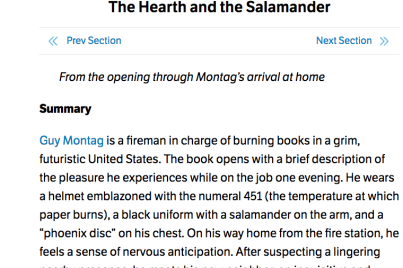
SparkNotes_F451_screenshotThat day, the SparkNotes summary of the first chapter of Fahrenheit 451° (one book circle choice) was their writing prompt. There was some confusion: Were they supposed to write about whether they were going to choose that book? Or to predict what the book might be about? This prompt is like any other daily writing, I told them. Just write what it brings to mind.

I’m not creative enough to make a lesson into a mystery. When students finished writing to this (rather uninspiring) prompt, I told them straight up: Now, here’s the source text for this SparkNotes summary. Please, just listen.

And I read aloud the beginning of Fahrenheit 451°. 

It was a pleasure to burn. 

By the time I reached the description of Guy Montag as a “conductor” of the symphony of flames that silenced the voices of the books he burns, there was also silence in the room. More students than I expected opted for the book circle, reading Fahrenheit 451°. I don’t know whether these choices resulted from an aesthetic reading of the book’s opening, but isn’t it pretty to think so?

Kathleen Maguire teaches Sophomore English, Senior Advanced Writing, and AP Language & Composition in Evanston, a suburb just north of Chicago. When she’s not grading papers or reading books to recommend to students, she tries to keep up with her yoga and her 10-year-old son, Jude (not in that order). She tweets at @maguireteach.


Creating Conversations That Move

In my work as a literacy coach, I have the privilege of working with teachers as they implement elements of reading and writing workshop into their classrooms. Right now I’m working with a team of 7th grade ELA teachers in book clubs centered around social issues.

You know that feeling you have when you unleash your students into the world of small group discussions? You’re excited because you know they’re smart and they’ve actually been reading the book. But you’re nervous because, well, they’re kids. And you’re not in control and that’s always a little nerve-wracking.

That’s how we felt on the first day of book club discussions last week. Students were engaged in their book club texts, reading with vigor. As a class, they had discussed the ways how books can be windows, mirrors and doors. Students had learned about point of view and perspective. On this day, they were to talk in small groups about what they’d read so far.

Screen Shot 2018-02-07 at 11.30.58 AM

We provided students with a stack of questions from the Table Topics cards I learned about in a tweet from Tricia Ebarvia and we stepped back to watch the magic. Soon we noticed that, well, there wasn’t a lot of magic.

To be fair, it was magic-ish. Students were eager to share. With some nudging from teachers, students used the vocabulary from the perspective mini-lesson. But these normally talkative kids just didn’t have much to say beyond “I really like this” or “It’s interesting.” Before we resorted back to teacher-driven “discussion,” we took a deep breath and went back to our roots, to the core of what we know works in a workshop classroom: Choice. Time. Explicit teaching.

We were on the right track: Students made choices about the texts they were reading. We had carved out time for their reading to “float on a sea of talk” (Britton, 1983) . But, we’d forgotten about the teaching! Sometimes we teachers get so busy setting up the conditions for success, we forget the key to it.Screen Shot 2018-02-07 at 11.31.07 AM

Armed with this realization, we developed a plan. We needed to explicitly teach students the art of conversation. So this week when we get back (after snow days and sick days!), we’re going to try a new approach.

Models: We know that when students are learning something new, they need a model to begin to envision how success might look. We are going to watch a video of 4th grade students having a book club discussion. Together we’ll create an anchor chart in our reading notebooks titled What We Notice About Good Book Club Discussions. I know, though, that having this list of traits isn’t going to be enough for the thinking to transfer to action.

Naming the Moves: We know from Katie Wood Ray that naming things gives them power and makes the moves accessible. So as students think about the kinds of moves they notice the students from the video making, we will go back and name them. Inspired by the moves Joseph Harris outlines in his book Rewriting: How to Do Things With Text, we decided we want students to be able to:

  • Agree & Explain
  • Connect & Explain
  • Counter & Explain
  • Ask Clarifying Questions

The first three are moves we’d like to introduce in the next writing unit when we focus on using evidence in their own writing (modeled after the super smart work happening in the National Writing Project C3 Writers Program). We decided to bring these moves into the discussions as a way to front-load. As students discuss what they notice, we’ll be intentional about using this language to name those noticings. 

Nurturing: We know that as students first try out these moves, they’ll need support. We don’t want to develop an over-reliance on thinking stems, but we want to help bridge theory into action. We will invite students to paste the sentence stems handout into their Writer’s Notebooks and to keep it handy as they talk. We are reminded that when you first learn something, it’s okay to feel a little clumsy, but the only way to get better is to keep practicing.

I’m excited to spend time talking with students tomorrow, to dig into texts, and to teach them how to uncover their thinking.

Angela Faulhaber works as a literacy coach in the Cincinnati, OH, area. She loves connecting with other educators, including on Twitter @angelafaulhaber. Her perfect day includes snuggling with her three kids, talking about school with her math teacher husband, and eating nachos with her girlfriends. 


Who Else Have I Been Failing?

Among the countless ideas borrowed from the inimitable Penny Kittle are quarterly reading reflections (although by the time I got around to it with my sophomores, they wrote quarter(ish) reading reflections). I offered students a collection of reflective questions, generated from Penny’s work:

  • What has worked well for you so far in your independent reading?
  • What was challenging for you?
  • What might be helpful to overcome those challenges?
  • What reading goals will you set for next quarter/semester?

I love this work for the way it asks students to focus on themselves as readers, not just as students earning a grade. It also informs my plans, especially for students who are still meandering through workshop: fake readers and serial abandoners and the like. Much of what I found was unsurprising:

Students can be hard on themselves …

At home I read fairly inconsistently and met the goal of 2 hours a week infrequently. Looking back at this that is pretty pathetic; I did the math and figured out that reading that reasonable amount every week for me is the same as if I were to read just one minute for every waking hour.   — Robert P.

… and on their authors.

I have to say that Big Little Man was the most challenging because its story was quite confusing to me  … I had to piece events in order and figure out if it was a flashback or not. This confusing puzzle kept me up nights. I understand that he is adapting to the American life as a Filipino Man, but please explain it in order from Day 1.   — Dylan L.

Learning happened …

Even though I read only 2 books this quarter I feel that my habits are disappearing and that I’m becoming a better reader with each book. I feel that I am reading a lot faster and not stumbling on lines as much as I did all my life.  — Jacob V.

… and choice is emphatically good …

I’M NOT READING THE BOOK BECAUSE I HAVE TO. I’M READING THE BOOK BECAUSE I ENJOY IT AND WANT TO. [emphasis NOT added]        — Maluboo D.

… except when it’s not. 

Because I no longer have a criteria for choosing books, I no longer feel the desire to choose a book.   — Darielle W.

KeepCalmReadOn

Growing up in Delaware, Darielle had always chosen books by authors of color, “not because of their past, but because of their color, sadly. Although my past relates a lot more to an author of Caucasian, and privileged descent.” When she moved to Chicago seven years ago, her experience — and her understanding of her own identity — became more complicated. Reading books by African American authors became a way for her to “learn to be more like the people who looked like me … to appear more black, to fit in with them so that I could rid myself of the title ‘the whitest black girl I know.’ To understand how I am really seen by others.” Darielle’s book choices became even more fraught when she developed a relationship with a white boy.

I began to feel as if I was no longer black enough to read about these things. I’d suddenly felt guilty and unworthy of reading anything that had to do with the African American experience … which is very unfortunate because [these] books are all I’ve read or wanted to read since I moved here 7 years ago.

For all her reading life, Darielle had been trying to find a mirror. Amy Rasmussen deconstructs this reading metaphor in this post. Don’t we all search for mirrors in books, especially as young readers? What we read is about who we are. What others observe us reading tells them about who we are.

I thought about my past conversations with Darielle and realized how I had been failing her. Every time I asked her if she was still reading How It Went Down. Every time I asked her why it was hard for her to remember to bring her independent reading to class. Every time I playfully called her “the book sampler.”

Who else have I been failing? What is really behind the avoidance behavior of my other “fake readers” and “serial abandoners”? The answer, I see now, is far more complicated than finding the right book for them. The answer is about who they are, how they see themselves, and how they fear others will see them. 

In our RWW classrooms, students “get to” choose what they read. Shana examines the complexity of choice in this post. For some (read: many?) students, this freedom is heavy. What we choose to read sends a message about who we (think we) are. And what we choose not to read, or what we cannot decide to read, sends another message loud and clear. And now I’m listening. 


Kathleen Maguire teaches Sophomore English, Senior Advanced Writing, and AP Language & Composition in Evanston, a suburb just north of Chicago. When she’s not grading papers or reading books to recommend to students, she tries to keep up with her yoga and her 10-year-old son, Jude (not in that order). She tweets at @maguireteach.

Promoting Community in the Workshop Classroom–and Out!

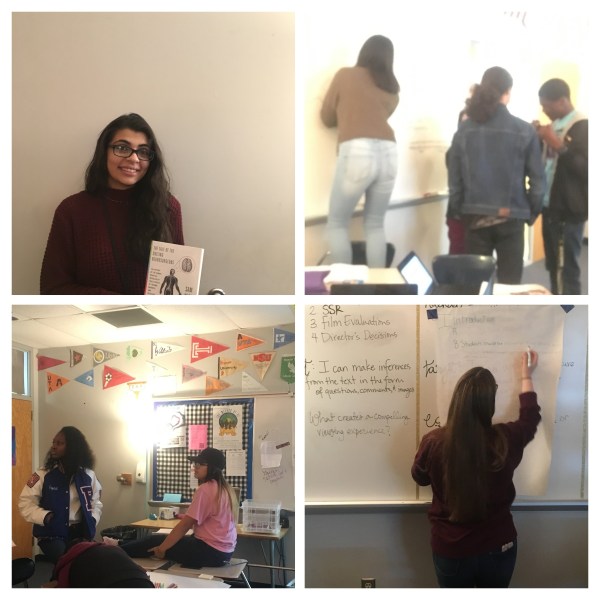
IMG_6878-COLLAGEThere were about two weeks of school when we came back that I wondered if I was doing something wrong.  It seemed like I had WAY too much time on my hands, and I wasn’t quite sure if I was just forgetting about responsibilities, and therefore shirking them in some way, or if I actually was managing my time better.

(Scoffs) Of course, it wasn’t the latter.  I simply FORGOT that I was in grad school.  This past week, as grad school classes started up again, I thought, “Ohhhh yeahhhh, that’s what was missing.”

I have questioned my life choices many times throughout this graduate student plus full-time (and then some) teacher season.  However, it is increasingly amazing to me the fact that teaching is more a study in behavioral psychology than it really is in any content.  The questions we ask ourselves are never just, What should I teach next?  Rather, they are loaded questions like, What can I teach next that will engage students, help them reach their potential, and provide a learning experience that will last beyond my classroom?

For this reason, my current class–focusing on social and emotional components of learning–is rocking my world.  The ore I read, the more I realize that it is my job not only to encourage healthy social and emotional characteristics in individual students, but also with each other.

So as my students are gain their reading strides this year, I’m pushing them to talk to each other about it more than ever before.  Here are some way I’m promoting community in my classroom, even among different class periods.

The Reader Hall of Fame:  This was my colleague’s idea, so I cannot take credit at all.  She started taking pictures of her students with their first finished book, and then she adds a small strip of paper with each new title they finish.  It looks AWESOME, and it really allows a constant brag-on-the-students feel to the classroom.  Students love coming in and seeing the new developments of their friends, the titles they’re reading, and the PAGE COUNT.  Yes.  They compare page counts like nobody’s business.

Book Clubs: This semester I am doing my first round of book clubs with my AP group.  Last semester, the students begged for book clubs.  They wanted to be able to read with their friends, which I think is a totally worthy desire that I do not mind milking for all it’s worth.  My goal is to come up with discussion questions along with the students that will promote discussion about life and the world, as well as education (our thematic topic for this unit).

Whole Class Reading Challenge:  Daniel Pink is haunting me in my sleep for this one–re: extrinsic motivation is not sustainable.  I know. However, when it comes to high school seniors, you sometimes have to pull out all the stops.  I follow Brian Kelley on Twitter (@briank) and he so graciously shared this reading challenge bingo with me.  I told my seniors each time they complete seven squares as a class–each square completed by a new student–they could bring to class.  When we complete three cycles, they can have a movie day.  I’m a sucker.  Feel free to troll me on Twitter.

Red Thread Notebooks, Technology Style:  This semester, my colleague and I are trying to get our seniors communicating across class periods, and even between our two classes.  In order to do this, we are going to take Shana’s Red Thread Notebooks, and take them to FlipGrid and possible Canvas discussion boards.  I hope to have different boards for big topics like LOVE, DEATH, FAITH, FREEDOM, on FlipGrid and allow time in class for students to respond to those boards and each other, referencing their current reading.

#bookstagram:  I love this hashtag on Instagram, and it provides a great way to connect to students in their own world.  I want to show a few photos from the hashtag to students in support of my book talks, and then offer an opportunity for students to #bookstagram their own book, or search the hashtag for their next read.

“Why I Read” Wall:  I’m a sentimental freak when it comes to second semester seniors.  They roll their eyes constantly as I say, “Do you REMEMBER when you said you would never read?!  Look at you now!”  Last week, tears streamed down my face–single ones, thank you–as I told them I believed in them and I’m so glad they’re here.  Beyond the sentimentality simply being my personality, it is also a teaching tactic that requires teenagers to reflect.  This is a skill I never thought would be so difficult to teach, but it is!  I want students to think of reasons why they read, and create a little notecard to hang in the hallway.  We could even steal their pictures from the Reader Hall of Fame and put them out there.  This would provide an amazing message for all the students who come into my classroom’s corner of the world that reading is more than just assignment.

And that’s the dream right there, folks.

So how do you promote community across classrooms through reading?


Jessica Paxson teaches English IV, AP Lang, and Creative Writing in Arlington, TX.  She runs on coffee and exaggeration, a deadly combination at 7 in the morning. Her students frequently describe her as “an annoyingly cheerful person who thinks all her students can change the world.”  Yep, pretty much. 

Creating a Culture: the workshop journey begins

“Mrs. Turner, I’m mad at you…”

This was the voice that greeted me the other morning before the first bell to begin school had even rung. I was surprised. Garrett is one of our seniors–a kid who I had taught for two years and who often called me Mom (and sometimes Dad, just to be funny). We are close, and I didn’t know why he’d be mad.

“I finished that book and now I don’t have anything to read and I can’t stop thinking about what happened in Winger and I’m mad at you.”

Ah…now I get it. You see, this young man was an avowed non-reader three years ago. He was almost proud of it–he wore it like a badge. Garrett was not alone. My classroom seemed to be filled with young men and young women who had lots of “better” things to do than to pick up a book. Many (almost proudly) said that they hadn’t read a book since they stopped AR testing in elementary school. Frustrated with lower reading scores than I thought appropriate and encouraged by industry greats like Kelly Gallagher and Penny Kittle, I was determined to change my kids into readers, one kid at a time.

I set out to fill my classroom with books. I bought used books, I bought books from Goodwill, I took donations from friends and family members–there were books everywhere!

IMG_3924

Then I took a bigger leap and decided to give up 12 minutes of my instructional time every day. We’re in 53 min classes 4 days a week with 39 minute classes on Fridays–251 min of instructional time; 12 minutes a day 5 days a week is roughly 20% of my instructional time. I believed the literature, though, and, more than that, I believed in the power of books. I’ve been a lifelong avid reader, and as the kid who took a book everywhere (and always had a spare book in the car), I’ve always used books as an escape but also as a way to help me work through whatever issue I was facing.

So back to my grand experiment. Through trial and error, lots of book talks, and lots of reading conferences, we started to see a change. All of a sudden (though actually after quite a lot of intentional hard work), I had 90% of my students reading and excited about it. There were several days a week when even my toughest audience would request more time to read. Garrett, for example, tore through Gym Candy by Carl Deucker, then Runner, then Payback Time, then Swagger. Swagger had the biggest impact, I think. Now it wasn’t just about the sports narrative–he was getting to something with meat and weight. He was also getting a little obsessed with Carl Deucker. After some encouragement and more than a little coercion, he tried Kevin Waltman’s High School Hoops series–Next, Pull, Slump, and Quick. It was somewhere in the middle of Slump when he admitted that maybe he didn’t just like to read Carl Deucker books–maybe he actually liked to read. (For ideas about using great sports writing as a hook for your students, click over to Shana’s mini-lesson.)

Now Garrett’s a senior, and he’s in my room about once every two weeks looking for something new to read. He’s not alone, either. It seems that there’s a constant stream of kids in and out of my room looking for a new book. I get comments in the hall about something new that someone is reading, or a former student stops me at lunch to recommend the book that he just finished. Another student might stop by in tutorials to ask if I’ve read anything about a particular topic that she’s struggling with. I’m not alone, either. My other colleagues in the English department are experimenting with different ways to institute independent reading time in their classes. It doesn’t look the same in any of our classes, but the bottom line is that our kids are getting time to read, and in that time, they’re getting time to think. It’s moving into other departments as well–one of the History teachers is toying with the idea of incorporating some reading time into his class as well. The funny thing is that we’re starting to see results on test scores, too. The Reading component average for ACT scores at my school is slowly moving up–progress! We are creating a community of readers at my school, and, in the process, creating a community of thinkers.

If you are looking for some books that are sure to jump-start even the most reluctant reader, check out this post from Jackie! Charles Moore also has a great list of books and an inspiring story of his own journey here.


Do you have a story of a reading workshop success? I’d love to hear it! I’m also always looking for books that grab your most reluctant readers so that I can be ready with ammunition!

Sinead Turner has been trying to find a balance between reading ALL of the books and reading/grading essays–reading is just more fun! She teaches English 11 and AP English Language & Composition in Alabama at a small Catholic school and has three beautiful girls, a saint of a husband, and a menagerie of animals. She’s also sticking her toe into the proverbial Twitter water at @SineadWTurner.

3 Ways to Utilize Audio and Visual Recording with our Readers and Writers

There is much debate regarding the use of digital technology in the classroom. For teachers, cell phones and other technology are both frustrating helpful when it comes to student use. They have the potential to be distracting and disruptive, as we all know, but tech is useful when it comes to some classroom activities, such as keeping a next reads list, or looking up word gaps. I love the idea of using them for the powers of good, so recently, I tried asking my students to use their mobile phones just for the purpose of recording, and to try to ignore the notifications that might come across as they used them.

I’m always looking for new strategies to help the readers and writers in my classroom, and in the past few weeks I’ve tried a couple of different applications. Using cell phones and iPads is simple, and it meets one of the simple rules I am trying to follow when it comes to working with students: meet them where they are.

Recently, while my grade nine students were in the thick of drafting informational essays, I asked them to read their essays aloud, and listen to the flow, the choppiness, the parts that sound great, and the parts that “just don’t sound right.” While I’ve asked students to read their own work aloud before, this time I asked them to record themselves, and then after, to listen to their voices while reading, keeping a pencil in their hands, pausing the audio and editing and revising as they go.

My students were reluctant at first, but once they got over the initial awkwardness of listening to their own voices, they indicated that it was a simple and useful strategy for revision. It’s one that can be used in other classes, and doesn’t require any other tools or even other people for help.

Another strategy we employed using recording technology was focused on the use of video recording. Before my students had started writing informational essays, we studied informational texts, using the Nonfiction Notice and Note signposts, along with the Book Head Heart strategy found in the works of Kylene Beers and Robert Probst.

IMG_4387

When students learn reading strategies and skills, it’s important to be able to see just where they are in the learning process, but it takes time to thoroughly check in with each and every one of them. So with this unit, our ninth grade English teacher team decided that it would be great if students could demonstrate their learning through a think-aloud. Doing this in class would take a lot of one-on-one time, so we asked students to demonstrate their thinking and reading skills on their own, and to use the video recording capabilities on their iPads and cell phones.

videothinkaloud

A screen shot from a video-think-aloud

Because we, as teachers, had modeled the think-aloud strategy in our classes many times, students knew exactly what we meant, and were able to demonstrate their understanding of the strategies and skills necessary when reading magazine articles. They annotated, exposed their initial confusion, shared their process of finding understanding, and demonstrated a multi-draft reading of the articles they had chosen. It was a successful method of assessment, and I plan to utilize it again. Students had a chance to showcase their thinking and understanding, and it wasn’t a one-off opportunity. They had the chance to try multiple takes with their recordings, so the pressure was off and they could easily share their thinking.

Our most current rationale for the utilization of video in class is with our new short novel unit, in which we formed book clubs. We are squeezing in a shared text at the beginning of second semester with Of Mice and Men. While all of my students are reading the same text, they are split up into groups of three and four so they can form their book clubs. One of the summative assessments with this unit is a small group discussion that they will record. They will need to demonstrate some academic, sustained, literary discussion in their videos, and are practicing in class, leading up to the recorded discussion. I’ll be able to have five small-group discussions going on at the same time in my class, which means precious class time isn’t frittered away with transition times between discussions, for example. Students will be thinking, reading, and discussing, and I’ll be able to watch the video later, when the pressure is off, and I can truly assess the conversation. I’ll try to remove the guess-work because I can slow down the speaking and listening assessment portion of it all.

annotation OMAM

One student has heavily annotated in preparation for the recorded small group discussion.

These are just a few ways to allow students to use the simple technology that is available to them. Kids know how to make movies and to splice audio, so there is little need to instruct regarding the technical details. They can use the audio and video to showcase their skills.

It’s also a timesaver as far as the classroom goes, and it takes some of the stress off of students who have test anxiety or who struggle when it comes to on-demand assessments.

While it’s not a student-recording, I will share one last recent use of video in class. I played the video in this NPR article about a murmuration of starlings as an inspiration for a quick write this week. I played it without sound, and hit replay several times. My students were fascinated and wrote some fun responses. One was even moved to write music: img_5972.jpg

I love how my students are constantly surprising and impressing me. They are unexpected and wonderful.

I’d love to hear more about how teachers and students are using laptops and cell phones for the power of good in the comments below!

Julie has been teaching secondary language arts for nineteen years, spending the first fifteen in rural Central Oregon, and the last four in Amman, Jordan. She’s thrilled to report that she and her family will be moving across the agua to Managua, Nicaragua next year, where a new adventure will begin.

Follow her on twitter @SwinehartJulie

Follow her blog https://adventuresinhighschoolworkshop.wordpress.com/