One Concept That Makes Me a Better Teacher: Tempo

Earlier in the Spring I spent a Saturday morning at the new football stadium in Katy, Texas listening to football coaches speak about various aspects of the sport.  That’s right, in January, high school football coaches get together to talk football… for fun.

The speakers presented their philosophies of offense or defense and talked about schemes and personnel.  I loved how, universally, they were: bright, confident, and eager to share their knowledge.

Just like with teachers, collaboration helps grow the profession. Coaches know the importance of sharing insight.  Its something I love and appreciate about the profession.

One speaker, from a school down here by us, presented on the topic of “Tempo.”

Tempo is the offenses ability to change how fast or how slow they snap the football.  In layman’s terms, its a way for an offense to give themselves an advantage over the defense and can be brutally effective when used to full effect.  Often times, tempo can dictate who is going to win or lose a contest.

The same can be true in our classrooms.

Often times, I find myself racing along, pushing the students through this concept or that; when necessary circling back around to re-teach when needed or tie-in an idea that supports our current work. I like to think of workshop pedagogy as weaving a tapestry made of many different threads of many different types and colors.  Sometimes we pull in this string or that one.  Whichever combination of threads that most effectively addresses our students’ needs.

I’m continuously amazed at how well the students facilitate this complexity in their learning.

Penny Kittle and Kelly Gallagher talked about their process in ” target=”_blank” rel=”noopener”>this amazing podcast. They explain it far better than I ever could.

Momentum

I am a big believer in using momentum in my instruction.  When the students see success in their literacy, I want to capitalize on those feelings of success by moving on to the next idea quickly. Any lull or pause in our movement forward is an opportunity to stop and lose focus. I don’t like “catch up days.”  Every day, in my mind, we should move our literacy forward.

Tempo

What I don’t do often enough, is take a deep breath and slow down.  I’ve found, this year, that I don’t take time to do the “fun” workshop activities. I’m talking about activities that build morale and allow the kids to laugh and, dare I say it…. play.

When they get to approach an activity as “play,” they can find success they haven’t found before:

Or they might find a fun way to learn its okay to come up a little short:

Either way, they are engaged in facilitating their own growth!!!

The assessments I’ve asked them to complete show me so many gaps in their skill sets that I can’t ever find enough time to address them all. But being hard-headed and driving forward without ever taking a moment to relax, we miss out on some of the fun that workshop can facilitate.

I have quantitative data that shows my students are reading and writing more than my previous senior classes and I have the anecdotal information they share with me about reading and writing more than any previous year in their education.  This is important to consider and it is valuable data to analyze as I work towards the end of this year and start thinking about next year.

The data tells me something else.  My students are burned out.  They are done; not just with their writing and reading, but with their thinking. Maybe I moved them too fast through our work in the fall and early spring.  Maybe the world they exist in is so far removed from the one I experienced at that age, that I have no real understanding of their stress levels.

I have to ask myself, what am I trying to accomplish and can I get that done operating the way I operate right now.

“Tempo,” I tell myself, “slow down.”

I have to do a better job keeping our tempo in mind as we finish out their high school education.

I’ll mix in more Poet Moments.  I’ll take more time to let them explore their own voices through narrative work that isn’t for a grade and is for fun.  I’ll change the mode from individual drafting of language to more group feedback. Generally, I’ll ratchet down the intensity of our work and lighten up on the speed with which we attack it.

What are some of the “fun” workshop activities that I can mix into my lesson plans that still hold value and have rigor?

Charles Moore is currently reading Before We Were Yours and The Glass Sword. He spends his newly freed up afternoons waiting to get his kids off the bus and tending to his beloved pool.  He just completed the GRE and hopes to start graduate school in the fall at U of H. One more thing, he recently took his Student Council class to a ropes course leadership facility and it was one of the best days of his teaching career.  Two of the many videos he took are included in this post.

Using Technology to Extend Reader’s Advisory

While I do teach one class of Senior English and one class of AP Capstone Seminar, the majority of my job is actually as the Teacher Librarian in our Senior School (Grades 6-12). As a Teacher Librarian, I spend a lot of time focusing on Reader’s Advisory as students stop by the library looking for a book to read.

Reader’s Advisory can take some time and is often about asking the right questions. While some students come to the library with a clear picture of what they want to read, more often than not, students have a vague notion of what they are looking for or have no idea at all. Sometimes when students enter the library they have a clear goal in mind, but more often I come across students mindlessly wandering the shelves because they want a book (or have been told they have to get a book), but really have no clue what they are looking for. These students may be in a reading rut and nothing is inspiring them. When I encounter these students, I always start with questions such as: what is the last thing you read that you really enjoyed? What did you like about that book? What didn’t you like about the book? Sometimes the questioning period is short and I have just the right book for the student, but sometimes the process can take much longer with every suggestion I give being turned down. While my role in Reader’s Advisory can be an important one, often the best advisors when it comes to helping students find their next great read is not me, rather it is their peers. While it is important that we as teachers and librarians are reading the books our students are reading and while it is important that we are able to recommend books to students, it is also equally as important that we are creating a culture of reading in our libraries and in our classrooms where our students are sharing the books they love with their peers and where they are engaging in Reader’s Advisory by recommending books to each other.

To read some more great ideas about creating a culture of reading in your school and your classroom, check out Melissa Sethna’s post on the first steps you can take in transforming a culture.

While some of the best Reader’s Advisory between students happens in the casual conversations in the library or in the classroom or in the excited moments when a student just has to share this amazing book he or she has been reading, technology can also help us extend our reading culture beyond the walls of the classroom and the school itself. At our school, we have been using technology in an exciting way to help extend the conversations around books beyond the school walls.

Over the past few years, our English department has been using Biblionasium and Goodreads to broaden our reading community and to help our students engage in discussions about reading and to connect to Reader’s Advisory moments in larger communities.

biblinasiumgood

Some of our Grade 6 and 7 students using Biblionasium to write reviews and recommendations about their favourite books.


With our Grades 6 and 7 students, we have introduced Biblionasium. Biblionasium is a free social book sharing platform for younger students (there is a paid version, but the only real added feature to this version is that it allows you to link your Biblionasium class with your library catalogue). It allows teachers to create online reading communities. At our school, our Grade 6 and 7 students all belong to our online Biblionasium community that has been set up by their English teachers and by myself. On Biblionasium, students can log the books they have read by placing them on their own virtual bookshelves, can write reviews of these books, can place books on the group’s virtual book shelf to allow other students to see them, and they can also recommend books to other students. As well, the teachers in the group can send book recommendations to the whole class or to specific students. Because it is a program designed for elementary students, Biblionasium confines students to the class that was set up by the teachers and students can not interact with other users on the site. This allows students to engage with their classmates in their Biblionasium group, but does not open them up to a larger community of strangers.

goodreadsgood

Page 1 of many (we have had this group going since 2014!) of our Grades 8-12 Goodreads reading group Recommended Reads bookshelf.

With our Grades 8-12 students, we have moved from Biblionasium to Goodreads, another free platform. While many teachers use Goodreads for their own reading, they may not realize that is also allows you to create groups that you can use in your classes. It is this feature we use with our students. We have created a private group for our Grades 8-12 students and for teachers at our school. Much like the Biblionasium group, this group is a place for our students to place the books they have read on their shelves, to share books on the group shelves, to recommend books to each other and to write reviews. The group itself if private, which means only our students and teachers can access it and our shared bookshelves. Unlike Biblionasium, however, the reviews that the students write on Goodreads are visible to the larger Goodreads community. While this may not be ideal for younger students, for our older students it has extended their Reader’s Advisory community in many profound ways. When they write book reviews for the Goodreads community, they are contributing to a larger global discussion about books and when they are looking for book recommendations, they can tap into the reviews and suggestions of a huge community of passionate readers. This not only gives them the experience of writing for a real audience, and access to many amazing mentor texts for book reviews written by other people in the Goodreads community, it also gives them membership into a vast group of people who love to talk about books. This year one of my Grade 11 students discovered that Emma Watson, her favourite actress, is extremely active on Goodreads and, in fact, runs her own feminist book club through the site. My student quickly joined this club and was soon reading her way through Emma’s reading list and engaging in amazing online conversations with other members of Emma Watson’s book club. She was soon bringing these conversations into the classroom and quickly had a whole crew of students – male and female- avidly reading Emma Watson’s recommended books and debating them every chance they could get. I tell you, there is nothing as exciting as walking into a classroom full of students planning their Alias Grace Netflix binge watching session because they just finished reading the book with Emma Watson’s bookclub and they need to watch the Netflix series to see if it did it the book justice in order to join in on the conversation going on in the Goodreads group on this very topic.

Using technology to extend the classroom reading community can have some challenges and does require a certain amount of work with students in regards to interacting with others in the digital environment. The use of technology through reading community sites like Biblionasium and Goodreads can be a powerful way to have students extend their reading community, explore new books and recommended reads, and share their recommendations and critiques with a larger community.

Pam McMartin is a Senior English Teacher, English Department Head and Senior School Teacher Librarian in Tsawwassen BC, Canada. She is also addicted to Goodreads and spends decidedly too much time stalking people’s virtual bookshelves in search of her next great read. She is always looking to expand her Goodreads family, so feel free to add her as a friend. Besides on Goodreads, you can follow her thoughts on Twitter at @psmcmartin.


Champions Finish Strong

pexels-photo-332835.jpeg

About this time, every year, I begin to feel that itch, that urge to chuck everything I’m working on right now and start planning for next year. Maybe it’s the feeling of spring in the air, but I always find myself frustrated with how I spent my time this year and wanting to start fresh and clean for next year. So, as I move into test review mode, I begin my wish list for this year and vow to do better in August. It goes something like this:

     I wish that I had conferenced more…next year I’ll conference and here’s how…

     I wish that I had done a better job with writer’s notebooks…next year those notebooks are going to be cute and organized and here’s how…

     I wish that I had frontloaded this idea more in August….next year I’m going to frontload so hard and here’s how…

     I wish that I had taught this title instead or offered more choice here…next year I’m going to revamp every lesson plan and here’s how…

I think it’s pretty easy to recognize the “I wish” road as a treacherous one to travel down. But, honestly, for me, that urge to start planning for next year in the middle of this year is the real danger.

See, all of the end of the year countdown clocks act as siren songs, pulling me into the excitement of planning for a new school year: new pens (because they help me plan better), PD books (I’m starting with 180 Days), Google Folders (because I’m nerd, this will never not make me happy). I’m getting antsy just thinking about it.

And so I find myself eased into bright, happy, shiny thoughts about how perfect next year will be. I look forward to the excitement of a brand new group of students, of a summer spent immersing myself in practice, of all of the hope a new year of school brings.

And I know these are dangerous waters. I also coach volleyball, and, in that context, I would immediately recognize this behavior as problematic. Whenever my team thinks about Tuesday night’s game before Monday night’s game, we have a rough night. We can’t think about the district tournament in October until we’ve handled August. I would put a clamp on that kind of thinking right away on the court. And so, I’m realizing I also have to lock down my mid-April urges to plan for next year.

Why?

Because, in a nutshell, champions finish the way they start.

I think we have to approach the end of the year the same way we started it – fired up, focused on the tasks at hand, bringing that same excitement and hope and enthusiasm to each LONG day of testing and test prep. Don’t our students sitting in our classrooms right now deserve that? Don’t they deserve to know that we’re happy to see them each day they enter our classrooms, not counting down the days until they leave? Don’t they deserve more than filler? Don’t we deserve to be present in the moment, enjoying where we are right now in our journeys together?

But what is there to be excited for during testing season?

Great question. I teach in TN – testing has been… rough… this week.

However,  I’m particularly excited about three activities between here and our AP Lang and Comp test. These are pretty common activities among AP Language teachers, so I’m not presenting anything new here or even my own ideas (good teaching is good stealing according to Harry Wong), but sharing some ideas that have worked for me. They are tried and true ways to keep students involved, interested and invested on this downhill dash to the test:

1. Rhetorical analysis – Role playing. We’re currently role playing as Abigail Adams writing a letter to her son John Quincy. Students pair up (one is Abby, the other is a dear friend there to offer advice) and craft a letter to her son, encouraging him to take advantages of all of his opportunities. Then we read and analyze her actual letter to him. This is a pretty common AP lesson, but it’s new to this class. The simple act of role playing really deepened our discussion of rhetorical analysis and provided lots of AHA moments along the lines of “You’re right! She DIDN’T sit down and think ‘I need four rhetorical questions and one use of asyndeton. She thought about her large and small goals and worked from there!’” Students left with a better understanding of what to notice in a RA and how to organize their essay around ideas instead of devices. Surprisingly, these letters also showcased an almost aggressive level of voice. It was productive and fun – the perfect way to spend a test prep day.

Here are some examples culled from today’s writings.


  1. Synthesis – Pinwheel discussion. Again, more role playing. Students jigsaw a few short texts related to a topic and then come to a center table to discuss a single question in front of the whole class. They are encouraged to identify the attitude of the author and then converse with that attitude as that author. Unsurprisingly, they really get into it. The activity has them intentionally synthesizing  multiple perspectives on the fly and on their own in front of an authentic audience, reinforcing the idea of synthesis as conversation and elaboration.

3. Argument  – Speed dating. Five to six thought-provoking prompts are posted on the board one at a time. Students have four or five minutes to brainstorm claims, evidence, organizational structures and a theses. We whip around the room, sharing insights and approaches, curating a list of universal nouns or excellent pieces of evidence, creating ideas that students can tuck away in their back pockets before the test. I love this activity. There’s such great community in the sharing of ideas while also mimicking the time crunch of the written portion of the test.

Hopefully, none of the ideas feel like test prep. Hopefully, it’s just more learning. Hopefully, we find ourselves excited to be in English, fully present in the moment, enjoying our productive time together. The thoughts and ideas for next year can percolate until the end of May.

Sarah Morris teaches AP Language & Composition and Film as Literature in Murfreesboro, Tn. She plans on watching two episodes of Buffy the Vampire Slayer for Friday’s Film as Lit lesson. She realizes how very lucky she is that this falls under the category of  “Something She Gets To Do At Her Job For Money!!!!” She tweets at @marahsorris_cms.

It’s better with Verse! Short and sweet book clubs encourage readers to try new format.

Student voice and student choice have been the priority this school year as we try to foster healthy, robust reading lives in our students. They have been introduced to many titles through plenty of book talks and book recommendations, so they know there are a ton of choices out there for them, but this level of choice also means we haven’t had too many shared texts.

This spring I thought it might be fun to squeeze in some shared texts and build up our reading community with deliberate talk about books. I wanted us to be able to finish in just a couple of weeks, so we are engaging in book clubs with books written in verse.

In keeping with the priorities of student voice and student choice, I provided many titles for students to choose from as they entered into this short unit. These are all books that we have multiple copies of and can be found in our classroom libraries.

Before spring break my students were given a little time to get to know a book they hadn’t seen before, and then share that book with a partner. It took just a couple of minutes for each exchange, and then both partners switched books and started again. After a few rounds of sharing books, I allowed students to flip through the remaining titles that had seemed interesting but they hadn’t had the chance to hear about yet.


They had handouts for note-taking during this activity, and when we were done, they put the notes in their readers/writers notebooks so they would have easy access after the break.

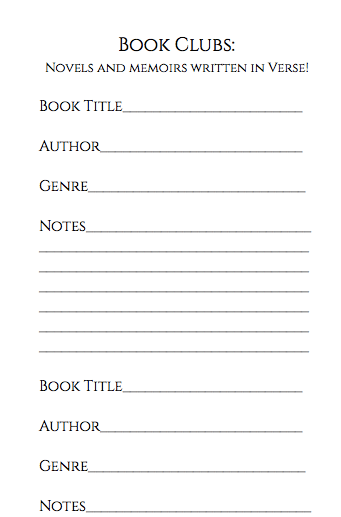
book club notes - verse

When we returned from spring break, students reviewed their notes and listed their top five choices. I assigned and handed out the books, putting between two and four students in each group.

IMG_6872

These are the titles students chose from.

The assignment was pretty straight-forward.Screen Shot 2018-04-17 at 3.37.17 PM

Students were directed to annotate for the fiction and/or nonfiction signposts found in Notice and Note and in Reading Nonfiction, (depending on their titles) the Book Head Heart framework and questions found in Disrupting Thinking, and some poetry vocabulary (listed below).


After they started reading, but before they were too many pages in, a few students had questions about how to annotate a book written in verse. They had annotated other texts before, but for some reason this type of text had some obstacles. IMG_7697 2

I decided to do a quick, fun example of annotating a narrative poem with a simple children’s poem by Shel Silverstein. Cloony the Clown has many of the fiction signposts, poetic devices, and we talked about the Book Head Heart framework. Finding the signposts and annotating together was fun. It took less than fifteen minutes to share the example in class, and my students seemed much more comfortable with annotating their book club books when we were done with the activity.

Students then used their annotations to spark discussion, and regularly use them during the week to practice their sustained conversation.

They will be assessed next week in the form of a video-discussion, where they will meet in their book groups. Using iPads, they will record their thoughtful discussions, referring to annotations, making connections with the text, and sustaining academic conversation for around twenty minutes.

What I’ve heard and seen so far has been encouraging. Students are sharing, referring to lines and stanzas, and feel accomplished that they have read a complete text in such a short amount of time. Some of them are on their second or third-draft reading, which I think is a great strategy and habit to reinforce. They are truly getting to know their books, and in the process learning about story, poetry, and close reading.


Some students were able to read their book club book in an hour or two, and then get right back to their other choice reading. Others are encouraged by the progress they are quickly making in a full-length book because it often takes them longer than a few days to read most of a book. That’s one of the many great things about books written in verse – it doesn’t take a long time to read them, but they are rich with language, story, character, and they hold student interest. With the variety of types and titles, there really is something for everyone.


I borrowed an idea from this amazing post from Buffy J Hamilton regarding connecting text to the world around us. Next week, as one of the finishing activities in this short unit, students will each bring in a current event article which somehow relates to their books, and use these articles to launch new conversations about their books, connecting the text to themselves and to the world around us.

I’m pleased with the way these books clubs are progressing. My students don’t seem to feel intimidated by the length or weight of the books, and they tend to agree that the books are relevant and thought-provoking. While some of them have enjoyed books written in verse before their book clubs, for others this is one of their first experiences with a book written in verse. So for some students, this unit validates and supports their reading experience, and for others, it opens a door to a new form.

I encourage others to try some “unconventional” types of text for book clubs. Graphic novels, short stories, and poetry collections are all ideas I’m kicking around for future book club units, and I’m wondering how other teachers have incorporated different types of texts in their classes, and encouraged new conversation. Please leave your ideas and experiences in the comments below!

Julie has been teaching secondary language arts for nineteen years, spending the first fifteen in rural Central Oregon, and the last four in Amman, Jordan. She’s thrilled to report that she and her family will be moving across the agua to Managua, Nicaragua next year, where a new adventure will begin.

Follow her on twitter @SwinehartJulie

The Trouble with Grading by Abigail Lund

I sit down at my desk. It’s the end of quarter 3 and it’s time for the dreaded report cards — the time where I average the homework grades, find missing assignments, and vigorously come up with something to say. My computer flickers on and my online gradebook comes to life. It happily tells me many students are receiving A’s and B’s and then, as if it is the Ghost of Christmas Past, the dreaded F appears. John Doe: English Language Arts Quarter 3: F. I stare blankly at the screen.

This very moment I had been dreading the whole quarter. What does this F tell me about John Doe? Does it say how much he’s improved in reading over the quarter? Does it say if he knows how to compare two texts or write an introduction to an opinion writing piece? More so, does it tell me about his cooperation with others and his big heart?


A year ago this is how I graded, this vicious, unnerving cycle of grading. Then I found Twitter. Twitter is a beautiful tool, and after a bit of digging I realized that there were other classrooms out there that were gradeless (an amazing Twitter community for all of this is Teachers Going Gradeless; @TG2chat). I wasn’t the only crazy person – so I took the plunge.  The past seven months of a gradeless classroom has changed my perspective and gives my John Does a fighting chance

Gradeless doesn’t mean a lack of assessment. It means giving students an opportunity for success through practice, voice, and self-reflection. A gradeless classroom is multi-faceted and is constantly changing.

In my experience, it offers students more practice, collaboration, observation, conferring, and gives more time to accomplish what I, as a teacher, was asking for previously. Gradeless classrooms take the pressure off of points and focuses on learning and growth (which happens for kids at different times). According to the Organization for Economic Cooperation and Development (OECD), researchers concluded that “after around four hours of homework per week, the additional time invested in homework has a negligible impact on performance.” This very fact was the first step into my gradeless classroom. As teachers, our time is often consumed with grading endless amounts of homework in hopes that our kids will average a decent score at the end of the quarter, but with my gradeless classroom I spend my time on more things of value.

When I finally had this mind shift, I allowed for more student reflection on work, which has a positive affect, and I eliminated graded homework. Previously I spent a lot of time assessing students’ homework. When I decided to move to gradeless I moved more towards rubrics and conferencing, which naturally moved away from homework. Students reflect on the work they have done. Through reflection and rating of their understanding, I am able to confer with them more effectively during our conferencing and small group times – far more than homework ever did.

images.jpgBy ditching homework students have more opportunity for self-reflection and practice without the pressure of having every piece of their work graded. Students take more risks and ask more questions, because there isn’t the fear of failure. For example, student practice work and homework becomes less about getting the right answer and more about the exploration of the process. In the day to day students are meeting in small groups, reflecting on learning using rubrics, and analyzing strong mentor models.

Eventually, as the learning processes unfold, I formally measure students’ understanding through using my State’s standards: student exceeds standard, meets the standards, or does not meet the standard. This assessment occurs after students have had ample time to ask how they need to improve and what they need to learn. There isn’t a specific algorithm for when this assessment occurs, but by meeting with students weekly you will get a strong sense of what your students know and how you can push them towards meeting the standard.

When I started caring LESS about the percentage and MORE about my students learning, I began to let go of control. Gradeless means more attention to detail. As a teacher, I am able to observe student work and evaluate it with a greater purpose in mind. When evaluating, I use standards based grading, which is district initiative. This lends itself greatly to my gradeless classroom because it eventually assesses students on skills and not percentage based scales. Standards-based and gradeless are not synonymous but are blended very easily. If you are thinking about going gradeless, standards based is a route you may want to go, but there are other avenues as well.

This can also be done by creating standards-based rubrics and face-to-face conversations for assessment. It allows for my students to work through projects together to begin with, and after gaining confidence, they often being to soar through the second quarter. Through this gradual release, I am able to create lessons that are multi-faceted and allow students to know what I am expecting, the standards, and how to achieve them.

Some questions come to mind

What will my report cards say if my district isn’t like yours and has percentage based grading?

An encouraging word I was gradeless before my district moved this way. Unfortunately when it comes to report cards you will have to average your students’ work. However, this doesn’t have to be done in the traditional sense of a composite score of homework, assessments, and projects. This can be done with observation notes, through assessing what your students really DO know, and using your knowledge of your students to grade them fairly.

How do you keep track of your students’ progress?

In my classroom I have my students send their work via Google-classroom. This gives me a portfolio of work to draw from when I am assessing with our standards. My students are rated on a 1-4 scale (1: not progressing 2: progressing with guidance 3: grade-level achievement 4: achieving above grade-level). Also students rate themselves on their understanding weekly. I am able to pull from those examples to compile an understanding of where my students’ understanding is.

How did I explain this to my students’ parents?

For the most part my parents were very much on board when I decided to go gradeless, this was probably because we were also going to standards based grading scales, which was a district decision that they communicated to parents. I was very upfront at the beginning of the year, explaining the gradeless philosophy, and had a lot of support from my parents.  With a gradeless classroom I believe that I am talking more to my students than I ever did before, and this translates to home as well. Keeping an open conversation going about student progress keeps parents happy, whether it is concerning grades or not.

Going gradeless is an ever-changing, flexible way of teaching. This isn’t perfection but what in education is? My hope is that my classroom would be a place where students can explore, desire education, and create. My greatest desire is that my students would be known and their ideas & thoughts would be validated. The place I have chosen to start is to know my kids by name and not by a letter.

Abigail Lund teaches 4th grade ELA and math to her fabulous kiddos in Cincinnati. She loves coffee about as much as her husband and cat… and is a self-proclaimed lifetime learner. Catch up with daily happenings and ramblings on Twitter @mrsablund.

Story Generates Story, and More

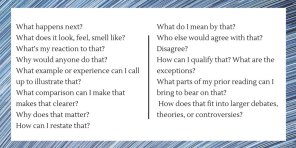
This past weekend, Tom Newkirk tweeted about writiNewkirk Self-Promptsng fluency and the value of “self-prompting,” and he included a list of a dozen+ prompts that foster such fluency. For Tom, these prompts “swirl in his head” as he writes. For our students, we need to build the habit of prompting questions into their process. Whether through daily writing, regular conferring, or sheer faith in the possibility, many students this year have discovered the true generative nature of writing — a sentence begets a sentence, begets a sentence, and so on. Alas, too many have not.

Our students hear from published poets and slam poetry veterans (our school librarians put on a magnificent Poetry Week every year) about lengthy revision processes. They view interviews with their favorite authors who explain the grueling evolution from idea to draft to revision to “finished” piece. They read lots of writers on writing about the toil of the work. Still, more students than I care to admit still believe in some divine inspiration behind the magic of words on a page, which one either receives or does not. And, to try to write without this inspiration (as in, every day in their Writer’s Notebooks) is a futile endeavor.

Tom’s recent tweet seemed divine in its timing. The day before, as an in-school field strip, 10th-grade English classes participated in a workshop with storytellers from Chicago’s 2nd Sstory_line_awk-e1523848925727.jpgtory, an organization that holds storytelling events, workshops, and education in the value of story — in both the telling and the listening — as the source of human connection. The name 2nd Story refers to the very nature of story as generative: one shares a story of their own experience, which inevitably reflects some aspect of the universal, and then invites others to do the same.

Presenters shared their own stories, which included universals such as losing our youthful belief in things magical, facing our greatest fears and living story_line_rightto tell, proving we’re capable of what others believe we are not. Then they got students up out of their seats in parallel lines or inside-outside circles, so humans faced other humans, screen-free. First, students shared one-sentence stories based on prompts like “I felt [insert emotion] when …” or “Tell about a time when you … broke or ruined something … told a lie … received a gift you really wanted (or not) …” Lines and circles shifted and rotated to maximize the quantity of faces in contact.
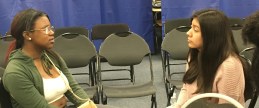
Sure, it was awkward and scary at first for many — if not most — of these 15- and 16-year-olds, who may or may not have met before. Gradually, though, as stories even as brief as one sentence were shared, it became less so.

In one of the two workshop rooms, students talked in pairs, sharing their stories by kelly_empathyjpg.jpgelaborating on one of the prompts from the first part of the exercise. I could hear the energy in the room even before I was fully in the door. Moving through pairs of students, I could hardly hear the stories themselves, but no matter. story_lean-in.jpgWhat mattered was that students were hearing them from their partners, many of whom started out as strangers (different classes were blended into one workshop). And not just hearing, but listening. They began, literally, to lean in, closing distances through shared stories and the natural empathy that results. When we return to our regular classrooms this week, students will begin recording their stories on FlipGrid, listening to and commenting on one another’s without the high stakes and vulnerability (even unfamiliarity) of face-to-face, real-time human interaction. Which reminds me …
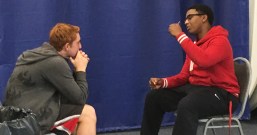
story_engagement.jpgI’d like to pause briefly to offer this qualifier: On-demand, face-to-face, forced interaction with strangers is not every 10th grader’s cuppa tea. (Heck, it’s not every adult’s cuppa, either.) In fact, several students literally waited it out on the sidelines. But even these reticent, reluctant, and even recalcitrant folks couldn’t help but listen — and be drawn into — the stories of others. And maybe even, as a result, classmates who were still strangers became less “other” than they had been 90 minutes earlier. I’m even holding onto the possibility that the stories heard that day will sustain their generative power and elicit even more — not only more stories, but more listening, more “leaning in,” more empathy, even more inspiration: not from any divine spirit, but from engagement with each other and with the work of writing — and speaking — their truth.

Growing Writers: Making Use of Student Mentors

My mentee Sarah, a new-to-the-district teacher in the midst of an intense co-teaching experience (where on an average day seven adults supported thirty students with an expanding continuum of needs), was filling me in on the narrative her students would be drafting. Support for students while drafting is critical. Sarah’s students would need questions answered, ideas suggested, and gentle encouragement: just-in-time support. Which is why I blurted out, “We should see if the AP Lit. kids will help!”.

Why AP Lit. kids? Why not?! By the time they reach AP Literature in our building, these students have completed two advanced English courses and a college level composition course (AP Language). Skilled, these students know what good writing looks like and how to produce it. But more than that, the AP Lit. kids could be–as Shana coined and Amy embellished on–living mentor texts.  

As living mentor texts, the AP Lit. kids’ stories differ from the current story of this particular classroom and the many stories of the students in it; the AP Lit. students are further along the learning journey. No one would be comparing the writing generated by Sarah’s students to these mentors, and there’s comfort–safety–in that. 

I did worry a little, though. While our AP Lit. students successfully provide feedback for writers in the advanced sophomore course, routinely mentoring them, I didn’t know how this would translate to a co-taught classroom. Would our living mentor texts help the sophomores optimize their skills and ultimately their stories as writers? 

Steps of the Experience

Before escorting the seniors to Sarah’s room, I briefed them on the parameters of the narrative writing assignment. After coaching the seniors to listen, paraphrase, question, ask to look at the writing, offer suggestions, and celebrate strengths, we headed to Sarah’s classroom. Following introductions, the seniors began moving about the room, neatly engaging the sophomores in conversation about their writing, inviting them to story-tell. Of course, my worry was needless. 


Reflections on the Outcome

Sarah certainly saw the power of their interactions:

“I saw my students open up so much more. Students who were nervous or uncertain about asking me questions or getting feedback were so much more willing to talk to peers. The students seemed to look up to these upperclassmen. Even if the seniors said the same thing I did as a teacher, the students took the senior’s perspective so seriously and really engaged with the process fully. Even if it was only a few minute conversations, the students really appreciated having someone who could check in with them right away. A lot of the base level questions could be answered more efficiently since there were more “experts” to share. Especially in a large class of 30 like mine was, it is hard for the teacher to get to spend quality time each student. This allowed for more contact time with each student.”

When Sarah later collected her students’ reflections on what type of feedback they found most helpful for their narrative essay, so many noted their living mentor texts.

“The AP people helped a lot. They just were there when I needed help or was stuck.”

“The peer mentors helped me see where I could transition or use better words.”

“Having an upperclassman helped me see how other people might do the essay which helped me think of new ways to write.”

“The AP students were new eyes and that helped me get over my writer’s block.”

“I liked that other students from another class saw my paper. It wasn’t pressure like a teacher grading but I still got feedback.”

Wanting to know what impact being a living mentor text had on the senior volunteers, I asked them to reflect on the experience.

Emily felt both “inspired to stop taking her English skills so lightly” and “inspired to use [her skills] to their full potential.”

Claire noted that “[the students] seemed really appreciative of [her] help, and seemed like they really wanted to talk about their writing. In helping and talking to them, [she] realized that [she does] have the ability to be a writer.”

Kyler reflected that “[t]he goal is getting students to revise and revise until they feel they’ve created something great. The smiles that came across some students’ faces when [he] told them [he] loved a part of a sentence or a comparison were fulfilling…The world of writing is something [he] really enjoy[s], and to share that joy by helping others consider the impact they can have is always a joyful experience.”

Screen Shot 2018-04-14 at 10.21.43 PMWhile Sarah and I loved the story of her classroom those two days, we experienced less success the next attempt. But we’ll try again. We’ll schedule the AP Lit. students more specifically, we’ll partner students according to need, we’ll invite the AP Lit. mentors to support the sophomores throughout the writing process. We’ll even explore digital mentoring through Google Docs. Sarah’s optimistic that increased access to our living mentor texts would increase confidence in her writers, helping them to grow. And, I am too.

Next Steps


IMG_1718

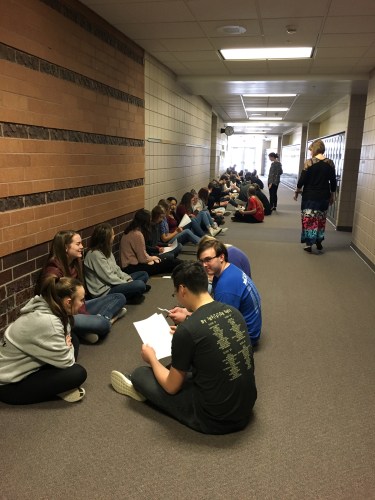
Ap Lit. students work with Honors II sophomores. Also pictured my teaching partner Amanda who teaches AP Lit. and one of my mentors Ann who first began the practice of AP Lang. and AP Lit. students mentoring honors students. 

My fellow AP and advanced teachers plan to expand the current mentoring as well. AP Lit. students and AP Lang. students will continue to guide our advanced sophomores; yet starting next fall we hope our advanced sophomores will mentor our advanced ninth graders (who are in different buildings). What a way to use writing to  foster connection!


I know there are exceptional peer writing tutor programs out there. But in these times of budget cuts and burgeoning class sizes, tapping into resources like Emily, Claire, Kyler, and the others who serve without expectation of reward is powerful. Many of the students–mentors and mentees–recognized the value in the stories of others and in their own. Their perspectives on writing, on others, and on themselves shifted, ever just so slightly.

It’s a small way to change the world. Or at least grow writers.

Kristin Jeschke teaches AP Language and Composition and College Prep seniors at Waukee High School in Waukee, Iowa. She loves when her former students eagerly volunteer their services for the underclassmen yet upstream, and she loves serving as mentor to her two favorite mentees, Abbie and Sarah. Follow her on Twitter @kajeschke. 

Using Narrative to Frame Discussion

Confession: I don’t always make space for narrative in my classroom.

I was inspired by Lisa and Amy’s posts about their NCTE presentation, specifically using narrative as an approach to interpreting data.  In AP Language especially, we discuss the use of appeals to develop and support an argument, but I have never used narrative methods as a way to enter the conversation.

We have been working on the synthesis question lately, holding what I call “synthesized discussions” (Socratic Seminars with multiple texts, centered around a topic) where students enter the conversation, using the sources to launch their original argument, just as they are asked to do on the AP exam.  Students took a short Google forms poll about topics they were most interested in covering and the top 3 were relationships in the digital age, artificial intelligence, and gun violence, specifically in Chicago.  With such a timely, complex, and sensitive issue, I was inspired to think about the people behind the statistics and data–who are the community members of Chicago most impacted?

Before our synthesized discussion, we used the poem Weekend Calculus, from Chicago’s NPR affiliate WBEZ called “Every Other Hour,” a series in which gun violence and all of its ripple effects documented.  We used the poem as a mentor text, examining how the narrative was crafted, then had time to journal–quiet time to decompress from the weighty topic.  After, we examined the moves made by Angie Thomas in The Hate U Give when Starr witnesses her childhood friend become a victim of gun violence.

I told students:  All of these statistics are people.  Individuals like you, like your friends and neighbors–what are their stories?  Who are these people we typically only interpret as numbers?

I challenged students to write a brief flash fiction piece in preparation for discussion, in addition to reading the assigned articles.

I ask that students post their narrative in a discussion thread, versus a closed assignment, so they could read each other’s narratives before class. When I arrived at school at 6:30 am, I had a message from a student waiting for me:

screenshot-2018-02-27-at-12-19-03-pm.png

HEART EYE EMOJIS, right?

What is more beautiful than a student recognizing the great work of their peers AND being interested in a timely topic?  I quickly retooled my plans for the rest of the week to extend this conversation and create space for sharing student stories in small and large groups, not for the sake of revising, but to show these numbers as people, as individuals with stories not just news figures.

I was amazed.  I noted examples of moves we had been working on in our creative and academic writing. 

From engaging opening lines:  A flash of light. A loud bang.  All before my world fell apart.

To understanding of AP terms like asyndeton:  Anxiety consumes me.  I can’t stop at a red light without my heart beating out of my best, I can’t look at a black car without convulsing and panicking, I can’t hear loud noises without rushing for cover, I can stop shifting my eyes around and around my surroundings, I can’t I can’t stop worrying at night. I can’t stop my brain from thinking the worst.

There were moving examples of intentional syntax choices, sensory details, fast-paced dialogue, and craft that could have been taken from any young adult book.

Most importantly, I noticed evidence of compassion in my students. We took time to share narratives before our discussion.  Students put themselves in the shoes of the narrative characters their peers created, helping them to see the data we are bombarded with as a collective of unique individuals.  Concern for the human lives that make up the data was portrayed through their responses in discussion the following day, which they prepared for by reading a range of articles . 

There was less judgment and more concern for Chicagoans in nearby neighborhoods.  There was more gratitude for the advantages students have been gifted, and more passion to pursue social justice.  There was accurate data interpretation, but above all else, there was compassion and concern.
The NCTE presentation by Three Teachers Talk inspired me to create space for narrative practice for my writers while also creating a space to talk about the scary stuff that happens in our community, our nation, and the world.  After all, our goal is to foster the development of caring, engaged citizens.  My students left me feeling hopeful and confident in their generation.  

I challenge you to review the presentation slides and incorporate narrative as a way to access data, create community, and address our nation’s shortcomings.  Please share the unique ways you use narrative with your students–I would love to learn from you.

Maggie Lopez is leaving Chicago for  Salt Lake City this summer.  She and her husband look forward to a change of pace and new adventures, but she is most eager to learn from new students and colleagues.  180 Days from masters Penny Kittle and Kelly Gallagher will be her cross country read!

Racing to the Finish Line: What Does Your Workshop Practice Need Most Right Now?

My Spring Break brain is still turned on. Fortunately, this means I’ve been very good at sleeping the past few days. Unfortunately, it means my capacity to focus and otherwise try to be brilliant is at an all-time low for April. It would seem my enthusiasm is likewise dormant, as I’m struggling to harness my usual oompah-pah for school, running, parenting, you name it.

What to do? What to?

b1ae4985-4a2c-4306-ac08-4838ccd725ff

The view from my driveway during Spring Break.


I could stare at a thermometer and attempt to inch the mercury up with nothing by my sheer will and determination to curtail this never-ending winter.

I could establish a formal countdown of the school days as I’ve noticed several students and colleagues have done. (Ok, ok. I’ve done this already. There are exactly 40 days left of school.)

I could count and recount how many summative writing assessments I have left to grade, even if it’s likely true that I’m spending more time counting than I am actively providing feedback to my students.

So. There. Where does that leave me? Counting a lot, apparently, which is something I don’t particularly enjoy.

Still Thursday. Still 40 days to go. Still staring out the window at the 42-degree rain.

So. There. Where does that leave us?

For that, I look to you, dear readership of Three Teachers Talk.

help me

This is an all call for a bump in creativity, a burgeon to our daily workshop flow, a change of pace. Do you need more book recommendations for your classroom? Workshop friendly prep for an AP test? Ideas for mentor texts in a specific area of study? Blog posts that commiserate your struggles, or successes, or both? What can the writers and contributors at Three Teachers Talk focus on to help you most in the coming weeks? How can the writers at Three Teachers Talk help make these last few weeks of the 2017-2018 school year all kinds of amazing in your classroom?

When your inbox pings with a post from 3TT, what insight would tickle your fancy, make your day, or just help ease the stress of wrapping up the year in a workshop classroom? We’ve got writers who teach from Foundational Freshmen to AP Language/Literature, coach current teachers, prepare pre-service teachers, and everything in between.

We all need a little help now and then, so we’d love to hear from you:

Please take a moment to fill out this quick survey and let Three Teachers Talk help move your workshop practice forward to round out this year and/or get you rolling for the next.

And as always, remember the rich archive of posts on a variety of topics that you can search on the right side of the screen at threeteacherstalk.com. You can search by keyword, contributor, and/or topic. The special sauce for your next few weeks of teaching may already be right here!

As a collaborative community of educators, we look forward to hearing from you and pointedly adding to the amazing wealth of workshop knowledge that Three Teachers Talk readers and writers share. Have a great weekend!


Screen Shot 2017-05-01 at 8.44.22 PM

Also, a friendly reminder, if you would like to write a guest post for Three Teachers Talk, please send your ideas to me at lisadennibaum@gmail.com. We are always looking for fresh voices, ideas, and experiences. Thanks!

Moving from Assigner to Teaching Along Side My Students

Hi, my name is Kristin and I’m a recovering assigner.

I can easily blame the system that taught me. Numerous years of forced writing assignments, inauthentic essay prompts, and unfair expectations with little to no chance to confer.

What I am describing is not just my own experience of high school in the mid to late 90’s but even my own classroom (I’m a work in progress). It wasn’t until this group of wonderful educators and the amazing work of Penny Kittle and Kelly Gallagher did I even begin to understand there was more to writing than the pattern of assigning, “teaching”,  and correcting. It started slowly last year through personalized writer’s notebooks, engaging quick writes, and dabbling in mentor texts to help us grow readers and writers.  But I still didn’t feel “there”– I didn’t feel ready for the complete jump into writer’s workshop.

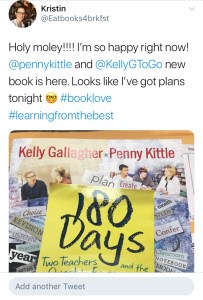
Fast forward to March– State testing is winding down and I have Kelly Gallagher and Penny Kittle’s new book, 180 Days: Two Teachers and the Quest to Engage and Empower Adolescents in my hands.

Image-1 (1)

Their recent book takes a look at the question “How do you fit it all in?” but does it with such thoughtfulness, insight, and in a way that makes their readers stop and think about their own practice. For me, it really made me think about how I needed to move from assigning narrative writing to immersing my students in the art of narrative writing.

After reading 180 Days the first time (I’m planning on rereading with my PLC as a book study), I was struck by how Penny and Kelly take different laps during their writing units, with each lap building off the last until students have shown a deeper level of development of their writing than our traditional 4×4 setup (read a book, take a test, write a paper, and repeat each term) allows us to do.

So, how has my life changed?

What my narrative unit was before:

  • I would diligently create a beautiful assignment, even including criteria for success so the students knew exactly what was needed in their narrative.
  • Students were given some choice in what they wrote (but it was choice in disguise–it still had to connect to the novel we recently read)
  • I gave students time in class to work and would start each day with a mini-lesson but it was based on what I thought needed to be taught, not in a responsive way through conferring or using a baseline assessment.
  • Usually five days later, the narrative was due. Some students used their 43 minutes each day to stare at a blank screen and eventually passed in an attempt at a story. Some loved this type of activity but passed in a narrative that was underdeveloped or without any organization. Some didn’t pass in anything at all–they would rather take the zero than take the risk.
  • While they were writing, I spent my time catching up with my grading and walking the room, begging my reluctant writers to get something on the page.

What my narrative unit is now/moving towards:

  • We started last week with multiple low-stake narrative activities in their writer’s notebooks using engaging mentor texts like “Hands” by Sarah Kay, 36-word stories using Visa commercials (Amy R. wrote about a very similar activity here), and writing alongside excerpts from some great young adult books from our classroom library.
  • This week, students will choose which pieces they want to work with and during our work time to expand them based on the day’s mini-lesson and practice revision skills (especially since my students think their first draft in their only draft–still trying to break this habit). We’ll also continue using mentor texts but use them for imitation work– “borrowing” great lines or ideas from actual writers!
  • After a well-deserved spring break, we will take a final lap with narratives the last week of April. I’m still deciding this piece– I want to see how the beginning of this week goes and see where we need to go next as we move towards the break.  I’m trying to be more responsive as a teacher, which is hard as a Type A planner. At the same time, I think this will benefit both myself and my students because I’m teaching the kids and skills in front of me versus just assigning the same narrative prompt year after year.

Although it’s only been a week in, these are some of the things I know so far:

  • My students have never been this engaged (in terms of their writing lives). How do I know this? Their notebooks are out and ready to go each class. They are passing their notebooks around the room, asking their peers to read what they worked on in class. We end our classes with “beautiful words” and they fight over who gets to share this time.
  • My closeted writers are finally finding their space in my classroom. They are sharing their work with others, giving advice to their peers, and even sharing their personal work with me (I had tears in my eyes when one of my painfully shy students handed me her poetry journal she brought from home–she thought I would like to read them this weekend. Be still, my teacher heart!).
  • Where my students are! Skimming through their notebooks has helped me see where they are starting and where we need to go. In the past, I wasn’t seeing their work until the end, which Kelly Gallagher calls gotcha grading. Now, I know where I want to and need to go to help my students with this type of writing.
  • And the best part- I’m writing. Whatever the students are writing, I’m writing alongside them and using my document camera to show my students my typos, my revisions, and myself. Narrative writing can be so personal. To see my struggle but also share parts of myself and my life has helped us connect in ways only stories can.

Although I still have a long way to go to shed the title of assigner, I feel so much hope that I am finally moving in the direction I’ve watched so many other teachers move towards. I’m reminded of what a wise educator has said about teaching– it’s making your practice 5% better each year. In this little way, I feel that my practice is becoming better because of the resources I have at my fingertips (like this group) and finally making the jump into the deep end of the workshop pool. 

What are some of your favorite things to engage and move your narrative writers? What advice do you have for those who are moving from assigners towards writer’s workshop?


Kristin Seed has been teaching for ten years at both the middle school and high school level in Massachusetts. Her passion is reading and leaving piles of books in every room of her house. You can find her chasing after her five-year-old son and now a 13 week old Golden Retriever, Abby. Follow her adventures on Twitter @Eatbooks4brkfst.