Category Archives: Writers Workshop

Getting Invigorated by Good PD

11863319_864585353577385_5354103936493098384_n.jpg

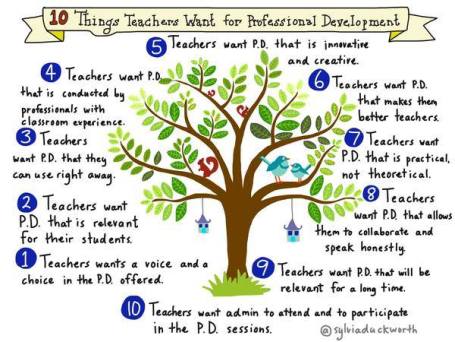
I love this accurate graphic about PD by Sylvia Duckworth.

Last Friday, I was fortunate enough to attend some of the best professional development I’ve been to in a while–and it was free!

At the end of the day, I left my 3TT friends a seven-minute WhatsApp message of out-of-breath enthusiasm, describing my day’s learning.  That’s how you know it’s been a good day.

The conference I attended is held annually to celebrate our Masters’ students’ impending graduation and entry into the field of teaching.  The all-day event features presentations by both preservice and practicing teachers, academic coaches, and principals.

Before the conference, speakers are invited to conduct an inquiry into one aspect of their practice, then present on their methods, findings, and insights.  I attended four absolutely wonderful sessions, and filled up six pages in my notebook with ideas and quotes and just joy–and I’d love to share them with you all.  Today I’ll share ideas gleaned from my morning session, and tomorrow I’ll share what I learned from the afternoon portion of events.

Session One:  On Independent Reading

In my head, I called this session “What you do after you’ve read Book Love,” because it was full of amazing ideas that I’m certain would be Penny Kittle-approved.  One presenter, Andy Patrick (@MrPatrickELA), absolutely blew my mind with the ways he’s clearly innovated independent reading.

Idea:  Reverse Reading Rates–Andy explained that when students chose a challenge book, they took a new reading rate and then used their findings to determine how long it would take them to finish the book.  The students could set a completion goal, Andy could touch on this goal in his conferences with them, and when the book was finished, students reflected on their reading process.  Since I’ve struggled with reading rates and accountability, I just loved this idea.

Quote:  “I never let them off the hook” when they tell me they don’t like reading.  Andy followed this fantastic one-liner up with his philosophy that they just weren’t reading the right books, and it was his job to help his students find them.

Just Joy:  I left this session absolutely impassioned thanks to Andy’s flurry of ideas.  He tossed out strategies like using quotes about the joy of reading as quickwrite prompts, his determination to get colleagues on board with teaching reading across the curriculum, and how great teachers of reading cannot excel unless they are real readers themselves.  YAAAAAAAASSSSSSS was the prevailing word in my notebook after that session!

Session Two:  Strategies for Reading, Writing, and Grammar

After leaving the first session, I had no idea how any other speakers could top that.  Luckily, I was just as inspired by three preservice teachers who’d done their internships in middle school ELA classrooms, and who shared their optimism for our profession in the form of their research.

Idea:  Say Something Journals–Sierra shared that many of her seventh graders weren’t engaged in reading independently or as a whole class, and she wanted a way to spark their interest in their texts.  She created journals, simply folded out of notebook paper, in which students could practice recording their internal reactions to something while reading during class.  When they were reading shared texts, she had students trade journals and giggle about the similarities and differences in their reactions.  The journals culminated in getting the reader to “say something” about the “something” they believed the writer was trying to “say.”  I loved Sierra’s emphasis on the transactional nature of reading, rather than a linear interpretation of a book’s message.

Quote:  “Why don’t they just capitalize their i’s?!” said Tori, who struggled with getting her 8th graders to use grammatical conventions in their writing, even after conferences and practice sessions in which students proved they knew what they were supposed to be doing.  Tori’s presentation was characterized by her sheer love of grammar and her bewilderment about why the heck kids could study mentor texts, send flawless text messages, and yet still refuse to obey the conventions of standard English.

One student’s response?  “Well, I just think capital I’s aren’t very cute.”

Just Joy:  Charity brought sophistication and high expectations to her 8th graders by teaching them about what critical literacy is and then working with them to practice it when reading nonfiction texts.  She focused on helping students develop discussion skills to practice thinking, reading, writing, and speaking within a critical literacy framework, all while reading place-based texts they helped her select.

I think my jaw was on the ground throughout the whole of this brilliant young teacher’s presentation–I want my daughter in her classroom someday, I kept thinking to myself.  What a treat to end my morning by feeling so hopeful about the new talent entering our profession!

Stay tuned for Part II of this post tomorrow, and please share with us in the comments–what have you learned from strong PD sessions you’ve attended?

Shana Karnes lives in West Virginia and teaches sophomore, junior, and senior preservice teachers at West Virginia University.  She finds joy in all things learning, love, and literature as she teaches, mothers, and sings her way through life.  Follow Shana on Twitter at @litreader.


Writers Workshop at the College Level

I have had so much fun reading student work this week.

There. I said it. I actually ENJOYED grading…for once!

Like Amy, I learned about the world, my students, and their funds of knowledge.  Grading has been going well for me this week.

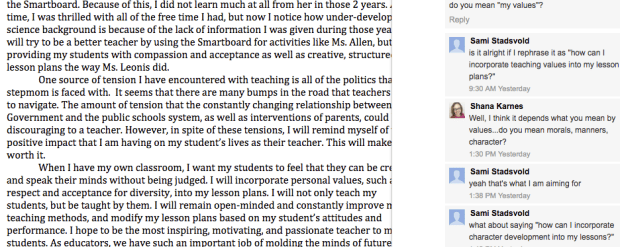
Well, I wasn’t really grading so much as giving students feedback on their final papers, which are due on Monday.  We’ve been engaging in a virtual writing workshop, in which I start a dialogue with students about their writing via comments on their Google Docs, and they reply, revise, and we re-read.

Screen Shot 2017-04-21 at 6.13.47 AM

I taught a mini-lesson via email on what I noticed the whole class might need to know (shorter paragraphs, most recently, as well as the power of the single-sentence paragraph).

In class, I’ve taught mini-lessons on seamlessly weaving in references to outside texts, developing a writing voice, and crafting an “I believe” credo statement.  We’ve read each other’s writing, as well as our course readings, not just for content but for craft.

Students had choice in their topic, genre, and process.  They described their teaching philosophies, educational experiences, and literacy histories through cartoons, lists, stories, essays, pictures, and poems.

We worked for about six weeks this semester on this writing, all of which was ungraded.  It will eventually constitute 10% of their course grade, and when I calculate that number, I’ll factor in student growth, effort, and style–not just the final product.

With great success, my students engaged in writers workshop–at the college level.

I knew that this was a new experience for them for several reasons.  Many students emailed me to ask if they could send me extra drafts, or began their pleas with an apology for being a bother, or panicked when they first saw the sheer volume of my comments.

But when they realized my feedback was a balance of suggestions, praise, or exclamations of delight, they relaxed.

When they realized that I would read as many drafts of their writing as they wanted, and that we had built-in class time for peer review, they relaxed.

When they realized that questions were welcome, and not an indication of ignorance or a lack of preparedness, they relaxed.

They relaxed into becoming teacher-writers, which is something we all believe every teacher should make a part of her practice.

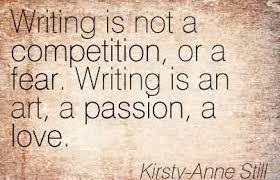
imgresWriting–at every level, from kindergarten to college and beyond–should be therapeutic, pleasurable, engaging, challenging, and every bit of the art form that it is.

Writing should not be painful, terrifying, or crippling.  It should serve as a way for our students to continue their learning, rather than as an end measure of what they know.

By keeping these values at the heart of my teaching, I’ve felt like I was back in my high school English classroom for the past few weeks.  There was fun, noise, creativity, debate, and even dance parties and craft supplies when we assembled portfolios, in my college classroom.  In addition to being enjoyable for everyone, this workshop mentality helped produce some outstanding writing that I’ll be so proud for my students to showcase in their final admission portfolios.

Shana Karnes lives in West Virginia and teaches sophomore, junior, and senior preservice teachers at West Virginia University.  She finds joy in all things learning, love, and literature as she teaches, mothers, and sings her way through life.  Follow Shana on Twitter at @litreader.
A Lot of Dancing, Please — Guest Post by Billy Eastman

My beautiful and vivacious and pernicious six-year-old daughter frequents a Kindergarten class. She pretends her way through life these days; it’s a problem. But, a problem I refuse to address. Because, one day, that problem with vault her to success in something.

Violet uses a wheelchair. She doesn’t use it all the time. Most of the time, she traverses time and space with arm crutches — but at school, she uses her wheelchair so she doesn’t become fatigued from chasing other small people around.

The other day, an adult at Violet’s school admitted something to me:  she caused Violet to school hallwaytip over in her wheelchair in the hallway (Don’t worry, no daughters were harmed in the making of this short narrative). Really, Violet wasn’t hurt, but the big person was distraught.

I thanked her. For tipping my daughter’s wheelchair over in the hallway. You see, they were dancing. An educator was dancing with Violet in her wheelchair. They were spinning and twirling and tipping and falling. I prefer that.

So, this is what we should prefer in our classrooms as well:  possibilities, no limitations, risk and reward, fear and excitement, falling down, getting up and saying “I’m OK, and some dancing (at least on the page). A lot of dancing, please.

Random undiscernibly identifiable adult:  please continue to dance with Violet in the hallways.

Teachers:  dancing is better than walking in straight lines with bubbles in your mouth.

And, this clearly applies to reading, writing, and thinking—which is what I was writing about this whole time.

Billy Eastman is a curriculum coordinator for English Language Arts and World Languages and Culture in League City, TX. He enjoys talking with folks and finding ways to make smart ideas happen. Follow Billy on Twitter @thebillyeastman


I really like grading papers

I have something to tell you, and you’re not going to like it:


I enjoy grading papers.


I do.


miranda sings haters back off

I learned about Miranda Sings from paper grading.

When I grade papers, I learn about the world.  I ask questions I never thought I’d ask.  I become more informed.  Grading papers, when it is going well, is like reading a really, really, really long newspaper.


Some of the things I’ve learned from student papers:


  1. Superstar quarterback Tom Brady wasn’t a top draft pick back in the day.
  2. The NFL has a lot of strange rules and has an even stranger escalating fine scale for the strange rules.  
  3. In some states there’s a different minimum wage depending on whether you receive tips or not.
  4. The Denver Broncos have a home field advantage because they are used to breathing in that Mile-High air.
  5. The Jets had a miserable season and we’re still pointing fingers all over the place as to who is to blame.
  6. Disney Channel shows are NOT what they used to be.
  7. It will be difficult, but not entirely impossible, for Donald Trump to build a wall against the Mexican border.
  8. Caffeine has some health benefits.
  9. There are child YouTube celebrities.


It’s fun to grade papers when students know they have something they want to share.  Getting students to that point, however, requires some heavy lifting.


  • I model and post my brainstorms.  If I am asking 100 students to come up with new ideas, I have to come up with some fresh ideas, too.  I share my brainstorming at the beginning of a unit and continue to post and share brainstorms throughout the unit, and students who feel stuck take to or modify my original ideas.  This is not unlike the editorial meeting where the editors toss out a variety of ideas and writers pick up the assignment.
  • I try to develop a “yes” culture that empowers risk-taking.  My students are age-young and experience-young.  They don’t know that there are culturally hip, feminist publications like Teen Vogue or analytical commentary pieces like those in Vulture.  They don’t know that The Economist blends news pieces and opinion pieces.  Or that published writers often figure out what they want to write as they write it.  I have a lot of teaching to do around the words “Yes,”  “Try it!” and “Other writers already do something like this.”
  • I meet writers slightly above eye-level.   As teachers, writers, and readers, I think it’s partly our responsibility to share knowledge and resources with our students.  If they wrote about cell phone addiction last year (and they all did, they all do), then this year I have to talk to you about privacy and apps on your phone.  If you’re reading the MARCH graphic novel series, I have to tell you about the time a Harvard professor was arrested for trying to break into his own home.  When they ask me “Is that real?” “Did that really happen?” I know I’ve struck writer’s notebook gold.


How do you help students brainstorm new topics so that you aren’t reading the same paper hundreds of times over?


Amy Estersohn is a middle school English teacher in New York.  She defers to her students’ judgment on good YouTubers.  She tweets at @HMX_MSE

Goodbye Days: a Craft Study and a Gorgeous Grand Slam

I love language. I love sharing my love of language with students.

When I read a book, I often dog-ear the pages, thinking of how I might use a passage to help my writers. Sometimes a book just does me in — so many beautiful words I cannot keep up. It’s a bonus if the story does me in.

Like Goodbye Days by Jeff Zentner. 30649795

If you haven’t read this book, oh, you’ll want to. Zenter’s first book, The Serpent King, kissed my soul. Goodbye Days took a hammer to it.

In a good way.

I started marking passages at page 36. I think because I forgot to think about it. Just read the first line of this YA novel:  “Depending on who — sorry, whom — you ask, I may have killed my three best friends.”

Mini-lesson opportunity one (whom), two (parenthetical with the dash), three (participial phrase), and four (voice)– all in one sentence.

The first time I really thought about using language from YA novels to teach my writers was in a class at UNH Literacy Institute taught by Penny Kittle. She showed us mentors of sentences and passages, pulled from the books she introduced to her students. She talked about how these craft studies also could serve as quickwrite prompts and book talks. A triple play.

Since then, Shana (who sat with me in Penny’s class) and I upped the ante:  some of our favorite mentors are hard-hitting home runs. But the following passage from Goodbye Days –It’s a gorgeous Grand Slam.


Excerpt from Goodbye Days by Jeff Zentner (p36)

     I feel like I’m watching something heavy and fragile slide slowly off a high shelf. My mind swirls with mysteries. The eternities. Life. Death. I can’t stop it. It’s like staring in the mirror for too long or saying your name too many times and becoming disconnected from any sense of yourself. I begin to wonder if I’m even still alive; if I exist. Maybe I was in the car too.

     The room dims.

     I’m tingling.

     I’ve fallen through ice into frigid black water.

     I can’t breathe.

     My heart screams.

     This is not right. I’m not fine.

     My vision narrows, as if I’m standing deep in a cave, looking out. Spots form in front of my eyes. The walls are crushing me.

     I’m gasping. I need air. My heart.

     Gray, desolate dread descends on me — a cloud of ash blocking the sun. A complete absence of light or warmth. A tangible, mold-scented obscurity. A revelation:  I will never again experience happiness.

     Air. I need air. I need air. I need air. I need.

     I try to stand. The room pitches and tosses, heaving. I’m walking on a sheet of Jell-O. I try again to stand. I lose my balance and fall backward, over my chair, thudding on the hardwood floor.

     It’s one of those nightmares where you can’t run or scream. And it’s happening to me this moment in the dying light of this day of dying. AND I AM DYING TOO.


What writing mini-lessons could you teach with this passage?

Why I Returned to Hard-Copy Grading

tumblr_maccshmi241rvog5q.gifGrading, grading, grading.

Sigh.

As the kids say, I literally cannot even.

Where do I begin?

Grading, to me, is one of the necessary evils of education–along with mandatory monthly fire drills, whole-building staff meetings, and standardized tests.  I have disliked it for the duration of my teaching career, as I have disliked all of those things, but I still have not found a way to avoid it.

When I left the high school classroom last May, one of the things I was happiest to let go was grading.  (That and those damned fire drills.)

But I didn’t expect to come to loathe grading even more when I began teaching college students.

There were a few reasons I disliked grading in my new job:  first, I found that, by dint of the course designs I inherited, that the only “grades” given were at the very end of the semester.  This meant that what little formative feedback was built into the course wasn’t seen as valuable–by the students nor the other instructors I was working with.  I sat in meetings where a colleague complained about “having to do all that reading and write all those comments for nothing” (“nothing” being no grade).  I thought to myself, wow, you’re missing the whole point of formative feedback.

Another thing I loathed was that most everything was electronic.  Any assignment due was expected to be turned in via email/eCampus/Google Drive two days prior to the class meeting, and the instructor was to give feedback and a grade before class began on Friday.  This meant that the only feedback about a student’s work was always only given by the instructor, and that students never saw one another’s work.

So, as the semester moved along, I began to make some changes to the course design:  more formative feedback, more frequent turn-in checkpoints for large assignments, lots of ungraded, low-stakes drafting of ideas in class.  We all hobbled to the end, adjusting assignments and expectations as we went.

But over the winter break, as I reflected and gathered the many post-its of ideas I’d stuck here and there, seeking to refine our syllabus and clarify our goals, I thought of one major change I could make that would solve a lot of my problems with the course.

Return to paper.

img_7291Good, old-fashioned, print-it-out-and-bring-it-to-class-and-turn-it-in assignment submission.
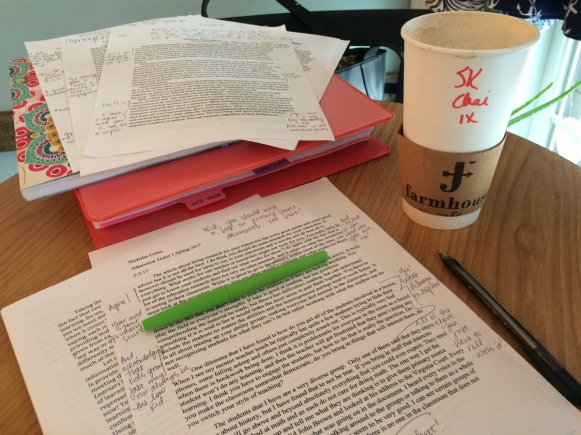
This practice has had a few key benefits for me so far this semester.  First, I am seeing much more clarity of thought in my students’ talk in class–I suspect because they’re treating their weekly one-pagers as first drafts of their thinking, and then re-reading them, as evidenced by their frequent typo corrections or asides to me in the margins.

Second, the issue of opacity between students’ assignment submissions is gone.  Each class meeting, I try to build in a time to share our writing, whether by trading papers, using our papers as an artifact to support some talk, or asking students to comment on one another’s work.  I ask students to read not just for content, to glean multiple perspectives, but also to read for structure, to see how other writers think through the issues we’re grappling with.  As a result, I’ve seen a great deal of growth in how students structure their writing, as well as a transformation in the confidence of their writing voices as they engage with (and often question) the ideas in the texts we read.

Third, we’ve been reading Visible Learners this semester, which encourages the practice of documentation for the purpose of reflection.  By having concrete documentation of our thinking in the form of hard-copy papers, as well as hard-copy documentation of responsive thinking in the form of my comments or their peers’ in the margins, it is much easier to trace patterns and progress in our thinking.

Fourth, I’ve found that removing laptops or tablets from the equation when students share work actually improves the quality of their conversation.  I’ve been reading widely about how detrimental our devices can be to our talk, so I’ve made a conscious effort to reduce our screen time in class.  Fewer devices lead to more robust dialogue, which leads to better thinking and writing and time together overall.

Finally, my students are now accustomed to receiving frequent formative feedback and have come to expect and welcome it.  Initially, the students were a little wary when they saw my scribbles, assuming they were all corrections, but then were delighted when they actually read the feedback a peer or I had left.  Now, they hunger for the moments when a friend hands them back their paper with a handwritten note, or I return assignments the next class.

C4ErTFNVcAA9ku9 2

Switching to hard-copy grading has improved a great deal of my work with my students, and although I still haven’t come to love grading, I am enjoying it a lot more this semester.

Now to tackle that huge stack of one-pagers that’s been staring at me all morning…!

Shana Karnes lives in West Virginia and teaches sophomore, junior, and senior preservice teachers at West Virginia University.  She finds joy in all things learning, love, and literature as she teaches, mothers, and sings her way through life.  Follow Shana on Twitter at @litreader or join her for the Slice of Life Writing Challenge here.

FTC guideline affiliate links

Quick Writes That Work

QUICK WRITE

It appears daily on my agenda and often sparks great writing, discussion, and even revision. My bestie Erin said it beautifully: “Quick writes produce pure honesty and they’re a good place for me to “talk” with my students.” The writing is low stakes, the creativity can be high, and we can “talk” with our kids and provide feedback on issues and ideas, over syntax and conventions. Plus, it helps with the endless struggle for volume, volume, volume.

But sometimes, quick writes can end up feeling a bit routine, which is not cool as I am trying to keep writers excited about their writing and producing more and more of it.

writers-block

So, because I’m sometimes known to Google my life (Last weekend my foot hurt after a run and the Mayo Clinic suggested I might have cancer, so there’s that.) I often head to the internet for curricular inspiration.

There are countless sources online that will lead you to quick write topics, if that’s what you are in the market for, and I am often in the market for someone’s fresh thinking to get my students writing when I haven’t left enough time to plan or the same old quick write feels bland.

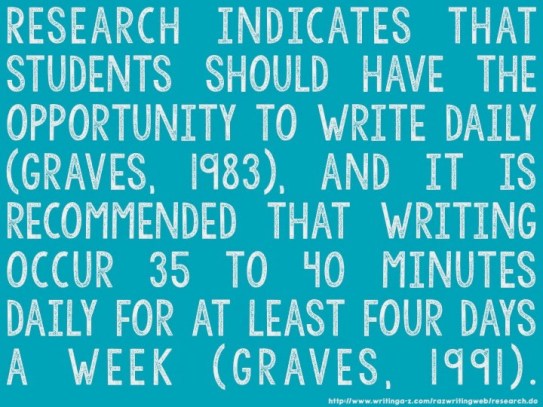
graves

Quick writes are just the start! 

For example, I was inspired to write this post after I saw our friend Gary Anderson tweeting a journal topic of the day on Twitter. I’ve used several, and loved writing along with my students on his thought provoking prompts.

Here are a few reflections I have on quick writes. The process, their power, and providing writing opportunities to our kids every day.

  1. Link your quick write to what you’re work on in class that day, an essential question you’re studying, or relevant topic to your study. Or don’t! Quick writes can lead naturally into a mini lesson. They can also put that mini lesson on hold as students take off into small group and then passionate/uproarious/contentious whole class discussion. I’ll often have my students go back into their notebooks after discussion to add to their thinking, so even if they didn’t share, they are working with the ideas that class is chewing on and writing more.
  2. Let students write about what inspires them. At the beginning of the year, many students balk at the “opportunity” to write about whatever they like, but by the time you’ve established a rapport and let your students know that they belong to a community of writers, many are excited to be given time to get their thoughts on paper. And when you have them take some time to revise at the end of the writing and share their ideas or powerfully written lines with others, they take more seriously the production of that work.
  3. Give limited choice to guide writing toward a necessary discussion for that day’s mini lesson or topic of discussion. When I do want the quick write to lead into the mini lesson, I try not to lead too much. I want kids to write and discover. I don’t want to slip back into old habits of guiding students to a fixed answer. They feel duped, I feel cheap, the whole thing is a mess. So, when I am heading in a specific direction, I really try to give choice in these instances. Our mini lesson in American Literature the other day was on bias for our argument writing unit. I could have had them write about where they see bias and how it impacts an argument’s credibility. Totally fine. Instead, I asked them to choose:
    • Write on any topic from the perspective of someone who is heavily biased toward a particular outcome. Then, write the same appeal from the opposing viewpoint.
    • Consider the bias of an author you’ve read or a story you know well. How did the bias serve the author? How did the bias impact the story?
    • Defend, challenge, or qualify the idea that media bias is detrimental to a functioning democracy.
  4. Early on, I stole something I heard Amy say during the professional development she and Shana ran at Franklin last year. I always remind my students to “write as much as you can, as fast as you can, as well as you can.”Amy taught me that kids need to outwrite their inner critics, and I’ve coupled that with the discovery that, often times, a student’s inner critic sounds an awful lot like…a teacher. We need to help retrain kids to see the first quick draft of anything as just that, a quick draft. I scrap half of what I write when I consider it for revision. This is something new to most kids, who train themselves to pour writing out on a page and see that as the first, last, and only draft. We work to write quickly, revise in the moment, and later, choose some pieces for further expansion, refinement, and polishing. But in the six or seven minutes I am giving them to write, their job is to write in that moment and to keep moving.
  5. Remind students to write and respond as they see fit. Students can write, jot, draw, change colors, compose a poem…Students often limit themselves unconsciously by the “rules” they have been taught over the years. Quick writes are a place to explore, not fit in the lines or a box. Unless you want to write in boxes.

  6. Have students respond to quotes, images, poems, videos, their own writing (we are doing this today!), the writing of other students, current events, lists, song lyrics, letters to the editor, overhead conversations…You get the idea. Students can creatively explore just about anything and should. Their opportunities for creative expression are often too few and far between. We can be the place where questions, emotions, fears, innovations, and discoveries find a safe place to take root.

Some of my recent favorite topics are below. These are quick writes that generated some fantastic discussion in small groups and whole class debriefs.


From Gary Anderson a few weeks back, I had students choose one and write:

Today…
I am concerned about…
I am upset about…
I do not understand…
I wish I could change…
I am grateful for…


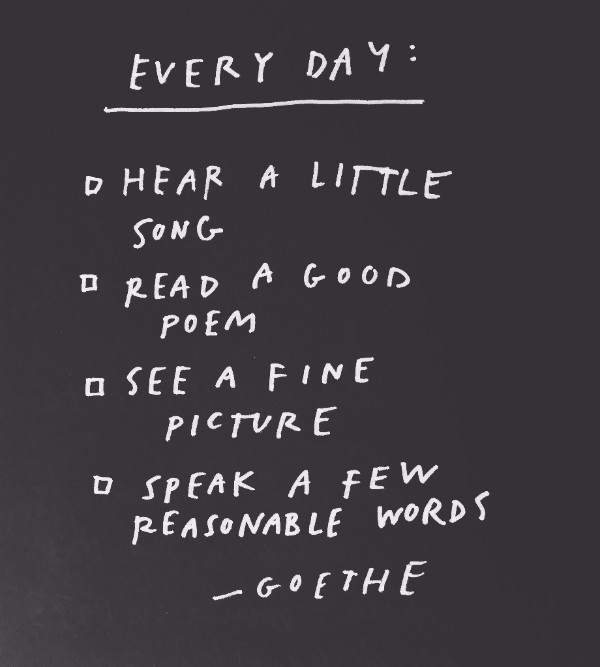
From Austin Kleon’s blog that I started following last week, students took this image in a thousand directions and one class even had a collegiate level discussion on the implications these suggestions (directives? nudgings?) could have for society:

goethe


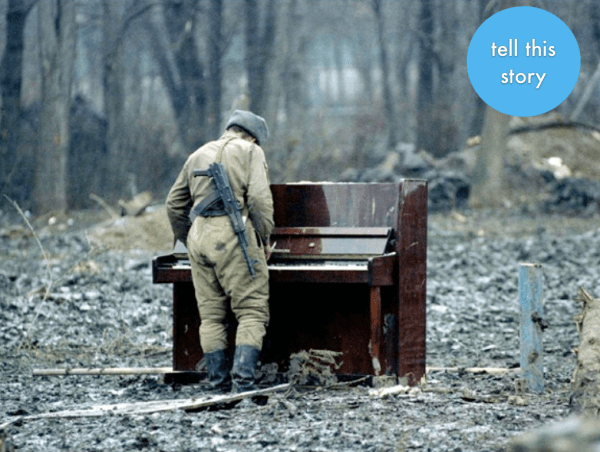
I will sometimes choose several images and have my students respond to one, or try to tie them together, or imagine they are the photographer, or…whatever best suits our purpose for that day. The exploration of the human condition is reason enough to put pen to paper. “Tell this story” is a great search term to yield a wide variety of results.

tell-this-story-2


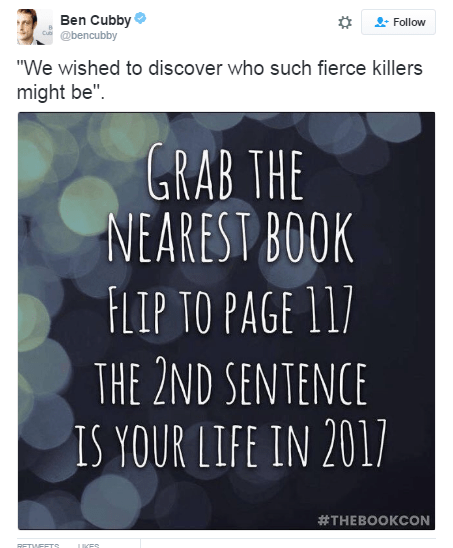
Quick writes can even be 2-3 minute reflections on the simplest of reading adventures. At the start of the new calendar year, I had my kids search for what their lives would hold in 2017, according to their independent novels.

quick-write

Have a favorite quick write topic that gets the pens moving in your classroom? Please share your ideas and insights in the comments below! 

Lisa Dennis teaches English and leads a department of English educating gods and goddesses at Franklin High School near Milwaukee. She has no fewer than six quick write journals going at once, mostly due to her inability to settle on spiral vs. bound. She added to Goethe’s list that we should smile at the thought of someone each and every day. Follow Lisa on Twitter @LDennibaum 

Stop the Slaughter: Lifeless Literary Analysis

Teaching is a reflective practice. If you’re doing it right, that is.

We question, we research, we dig deep to update, invigorate, and refresh our work on a daily basis. And while this can be utterly exhausting (I think we need to investigate the ingenious cultural practice of siestas), it’s also exciting. As we push ourselves to grow and change as teachers, we impart that commitment to be better to our students.

I remember when I was student teaching several (cough, cough) years ago. The English and Social Studies departments shared an enormous office, and I was lucky enough to be afforded some space in that room to work. The fresh-faced 21 year old with boundless energy and enthusiasm for making a difference and connecting with “kids” (I was teaching 18 year olds. I’m pretty sure I was in elementary school with one of my students).

Then, I met *Mr. Pumblechook. (Names have been changed to protect the identities of very nice, well meaning people whose educational practices make me shutter.)

Pumblechook was a social studies teacher with perhaps six or seven years under his belt. He had a bright smile, hearty laugh, great expectations for his students (I had to. Thanks Dickens) and a file cabinet.

But this, ladies and gentlemen of the jury ( got serious quick, didn’t I?)this was no ordinary file cabinet. For in this file cabinet was a collection of folders. And in those folders were lesson plans.

One folder for each day of the year containing (because I pretended to be impressed with his organization and asked to see): a lesson plan, several worksheets to make copies of (even leftover handouts from the year before), and overhead slides of prewritten notes.

Was I student teaching in 1962? No.
Was I student teaching under a dictatorial regime? No.

This was 2002, people. Suburban Milwaukee.

And every time I tell this story to fellow educators, they nod, and I hear similar stories of educators from days gone by. Worksheet after worksheet, recorded lessons from first hour played to subsequent hours, teachers knitting in the back of the room, and countless acts of readicide across the land. Is seems Mr. Pumblechook had good historical precedent for imparting knowledge to children by opening up their brains and pouring in the same ideas year after year without regard to their role in that programming or real world applications of classroom material.

Enter: My classroom last week.

My AP students are armpit deep (my quip to convey complexity over the waist, but less perilous than the nose) in literary analysis. I wrote last week about our journey with diction analysis, as we got down and dirty with how an author conveys meaning with words.

Along my merry way I skipped, confident in this unit that I’ve taught several times, the tweaks I’d made in planning it for this year (updated mentors, current event references, jokes that students last year hadn’t heard yet – he he), and last year’s solid AP test scores. Not quite a folder for each day, but not too terribly far off either.

Then, I read Rebekah O’Dell’s post from Moving Writer’s, “Three Reasons Literary Analysis Must be Authentic.”

Gulp. Authentic.

I (shamefully) hadn’t really thought of that. I was preparing my students for the AP Language test. Wasn’t that authentic enough?

Of course, the skills of analysis are invaluable. Critical thinking across the curriculum is bolstered by the development of analysis skills which help students recognize patterns, decode information, compare and contrast concepts, classify elements under examination, and utilize inferences to support ideas. As one of the elements utilized by the College Board to determine students’ readiness for college level curriculum in English, rhetorical analysis is obviously important. The traditional essay format is required to pass this test and the analytical skills necessary to do so are a benefit to students far beyond the classroom.

But here’s the rub…

Even AP readers are looking for students to write outside the box. Yes, the skills of analysis must be present. But top scoring papers are those that challenge convention, take risks, and (I’m hanging my head in shame here) speak to a more authentic and far-reaching audience.

O’Dell’s post, like literary providence, reminded me that I needed to climb out of my car with tinted windows (I’m in here doing my thing. Nothing to see here) and pick up a mirror to reflect why I was doing what I was doing.

Her 3 key reflections on teaching literary analysis hit me right between the pencils. She reminds us that:

  1. Our job isn’t to produce English teachers.
  2. Writers need models in order to write.
  3. The traditional academic, literary analysis essay hurts student writing.

So,  am I hurting my students with what I’ve been doing? Absolutely not.
Could it be better? Absolutely, Mr. Pumblechook, because they might be better at formulaic writing with what I’ve been working on, but we’ve taken some steps back in their growth as authentic writers.

To address each of O’Dell’s points, which I felt compelled to do immediately (I had the mirror up and didn’t like what I was seeing), I changed some plans for this week and next.

  1. Our job isn’t to produce English teachers: I have to tell myself this more and more. O’Dell reminds us that 2% of college students major in English, and of those 2%, only 1% will enter professional academics.

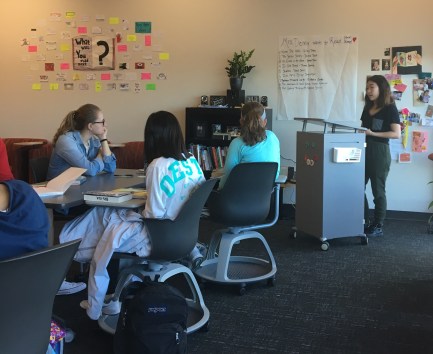
    It did occur to me though, that our students will need to engage with the world around them and likely need to synthesize ideas in order to share them. As such, I had my kids choose editorials on current events and topics of interest to present 1-2 minute speeches on. They needed to make claims about how the author achieved his/her purpose through DIDLS.The fluency of their writing for these speeches has blown me away. We’d been “writing analysis” last week, but none had the same voice, passion, or deep analysis that these had. Speaking the analysis had the power to remove the formula. Students concentrated on engaging their audience in a way that a practice AP prompt could not replicate.

    When my students sat down to write a full AP analysis practice today, I reminded them of how they had to work to capture the audience of their peers through their speeches, and that the nameless/faceless AP writers still wanted that same engagement. They want students to be successful on the test. This exercise seemed to solidify that and afford my kids the opportunity to reignite that natural voice we have been working with all year.

    img_0180

    Katie presents her editorial analysis speech this morning

    speech-form

    A quick Google form that I fill out as students are speaking provides immediate feedback via email 

    speech-feedback

    A sample of the detailed feedback on both content (helps with literary analysis prep) and public speaking (a real life skill for all)

    img_0179

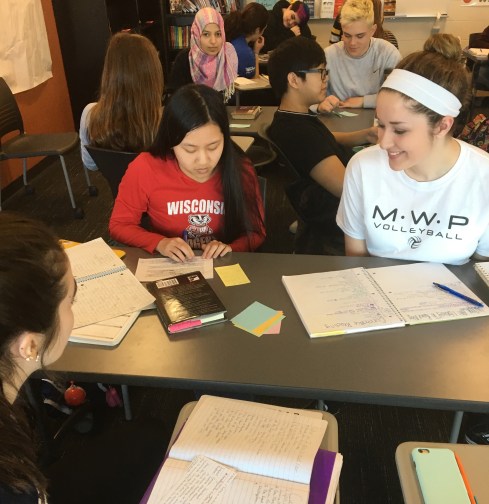
    Students give peer feedback on the rhetorical analysis they heard, as well as the speech overall. 

  2. Writers need models in order to write: I’ve been using student samples from AP to accompany the prompts we’ve been analyzing for years. That’s honestly helpful. I have students score them and discuss with peers what constitutes a high, middle, and unacceptable essay according to AP so they can apply or avoid the same ideas.

    However, those high scoring essays were always met by my students with comments that suggested that top scoring essays held some undefinable magical quality.

    What is it? Style.

    Those essays, as I said earlier, not only develop complex ideas, but they do so in a way that keeps the reader engaged.To work with this, I’m going to share with my students some of the literary analysis that O’Dell’s post links to as well. The Atlantic‘s “By Heart” where authors share their insights on their own favorite passages in literature, is a website that makes literary analysis real, full of voice, and peppered with references to texts/authors my students know.
    My post a few weeks back on Arts and Letters Daily is another place we’re going to explore. How do writers write about texts without using a five paragraph essay? How can we, as Penny Kittle says, stand on their shoulders as writers and work to write as they do?

    al-daily

  3. The traditional academic, literary analysis essay hurts student writing: We want our students to be able to master the structure and form, but yet we want them them to break free of it too.I’ve often told my kids over the years that you have to know the rules in order to effectively break them.

    Maybe it’s true. Maybe, I just don’t have them break them soon enough and get to that authentic voice for an authentic audience.Because there, in the place where they have something to say with confidence, passion, precision, and critical thoughts developed by honed skills, will they bridge the gap between possessing the skills we want them to master and making their writing shine with the creative use of those same skills.

And now…it’s Wednesday morning and the lovely Tricia Ebarvia just ran a post about authentic audience through blogging. I’m headed there next.

I should just carry a mirror. I need it. Always.

How do you help move students move beyond the traditional literary analysis? We’d love to hear your ideas in the comments below! 


Lisa Dennis teaches English and leads a department of English superheros at Franklin High School near Milwaukee. A joke her students haven’t heard yet, but soon will, is:  Why did the librarian miss the conference? She was overbooked. Her students are sure to chuckle, if not pumblechook (used as a verb with creative credit to Dickens), at that one. 


Mini-Lesson: The Simultaneity of Instants by Jessica Paxson

I am an anti-bandwagon jumper.  I tend to think if everyone is flocking toward something, I’m likely too cool for it.  I attribute that to my father, and I’ve discussed it before, but that’s beside the point.  

18143977.jpgThis year, as I made the venture to RWW, I knew I would need to read lots of buzz-worthy books, simply for the purpose of recommending.  Needless to say, I have slowly been broken down from my rigid ways. It’s because of this anti-bandwagon mentality that I am so late to the Anthony Doerr party, particularly in respect to All the Light We Cannot See.  

I decided to tackle this novel over Christmas break because of how many people had recommended it to me.  I was reluctant, but of course, Doerr drew me in with his utterly gorgeous descriptions of difficult cultural situations, the relationships between characters, and the flawless knitting together of a nonlinear storyline.  

So.  I’m a fan.  Likely at least two years after everyone else, but better late than never, right?

I was specifically intrigued by one of the chapters near to the end, entitled, “The Simultaneity of Instants.”  This chapter reminds me a little bit of the montages that occur at the end of a movie or a season finale in which all characters come together for a final appearance.  The only difference with this chapter is that they did not come together in the same place, but simply in the same moment.  I thought this would be a great way to coach my students through describing an important moment with a bird’s eye view.  

Objective: Students will describe an important moment in their life by also providing a glimpse into that same moment for other “characters” in their story.

Mentor Text

Lesson: First, students will begin by writing about a specific moment that they remember vividly.  You could draw from many different forms of pre-writing for writing about memories, but a few of my favorites are Writing Territories and Blueprinting.  After students decide on a moment that was important to them, we will do a quick draft for about 10 minutes.  

Next, students will begin to brainstorm about what other people might have been up to at that very moment.  The key here is for students not to get hung up on what actually happened, but to simply imagine that moment in time from a broader scope.  

Finally, after brainstorming simultaneous instants, it’s time to weave them together.  This is the moment in which Doerr’s writing as a mentor text will be unequivocally valuable.  Students will ask, “Well, how do I know which moment to put where?”  And I’ll say, “What does the mentor text do?”  And on and on until we have pieces of writing of which the students never imagined they would be capable.

I hope to do this along with my students, and I’m particularly imagining a Simultaneity of Instants starting with the Presidential Inauguration, or Obama’s farewell wave, or something to that effect.  I may already be blubbering as I brainstorm.  

Follow Up:

I teach Seniors and Creative Writers.  While my CWers will work on this concept soon, I may save this for my Seniors until their end of year MGPs (anyone want to help me plan?).  I think an imaginary Simultaneity of Instants as they walk across the stage.  This will end up resembling an end-of-an-era-montage, and I can’t wait to see what they come up with!

Jessica Paxson is an English IV and Creative Writing teacher in Arlington, TX. She also attempts to grapple with life and all of its complexities and hilarities over at www.jessicajordana.com. Follow her on Twitter or Instagram @jessjordana.

Writing Heals. Writing Assignments Do Not

Last week I learned a valuable truth:  Even when we think they are not listening, sometimes students get it.

Let me back up.

The week before last I attended a department meeting where our district ELA coordinator shared the National Writing Project’s Case for Good Instruction, information I learned at my National Writing Project Summer Institute in ’09. It details the differences between When Writing is Assigned and When Writing is Taught. The discussion around me was interesting and peppered with excuses. I left wondering how teachers would answer these questions if they were on a quiz. How would you?

In your ELA class, do students:

  • have opportunities to create topics that matter to them?
  • understand audience and purpose for papers because they are specifically identified in assignments?
  • see you spending time teaching writing skills and strategies?
  • get writing models, assignments, and strategies to guide each of the different writing tasks?
  • reflect on significant growth — or lack of it — in specific writing skills?
  • hear words of encouragement cheering them on to revise, edit, and improve — and to correct drafts and then resubmit?
  • think about what they write through brainstorming, free writing, role-playing, discussion, or other prewriting activities?
  • celebrate what they, and you, write and make efforts to display and publish it?

I think the biggest excuse we give for leaning on assignments rather than acting on instruction is TIME.

“I can’t let students choose topics because they don’t know what to choose.”

“I can’t teach this novel if it takes so long to write a paper.”

“I can’t do my research paper if I give them time to resubmit. It already takes so long to grade the finished product.”

Maybe you are right. Maybe we have to give up things that we think are best practices for things that are better practices.

Student choice in writing topics is better practice.

Writing instruction with effective models, strategies, time to talk, and time to write are better practices.

Helping students revise, edit, and improve their writing during the writing process with a keen sense of audience and purpose are better practices.

conferringwithjulyssaOur students need time. They need our time. They need our attention and our careful consideration about the things that matter to them. We may have to let some things go in order to give our students what they need.

We learn valuable truths when we do. Last week my students performed (or presented) their poetic arguments. We spent weeks choosing topics, watching video performances, analyzing lyrics for structure and craft, thinking, drafting, talking, revising, studying models, reading each other’s writing, giving feedback, practicing mini-lessons on concrete details and using abstract language to create jaw-dropping imagery.

We were a community of writers, united in a task uniquely our own.

And that is the difference between When Writing is Assigned and When Writing is Taught.

During all that time, I didn’t think Stephanie was listening. She sat at her table, barely talking, sometimes writing, always sad. Then right before Christmas break I sat down and we talked. She showed me her draft, and it scared me. I knew she’d been depressed — her grandmother died at the beginning of the year, and the light left Stephanie’s eyes. I listened to her share her sorrow, her anxiety, the weight of her world , and I gave her my cell phone number with the promise she would call if her boots got too heavy. Thankfully, they didn’t.

Every one of my students who presented their poems sparkled with pride as they faced their classmates, even the ones whose knees knocked in fear. They wrote from their hearts about issues that matter to them personally. They wrote the most important arguments about mistaken perceptionholding grudges, self-hate and self-love, parental control and uncontrolled parents, lying and how we’re programmed to labelBlack Lives Matter and dying white privilege. They wrote about better education and the stress of getting educated, absent fathers, loving fathers, and parentless children and alcoholics who should have put down that drink at 21.

They wrote about sticking together.

And they wrote about self-destruction and depression and monsters. So many of them wore grooves in the floor with the spikes that hold them in place until the sadness drags them down under. They broke my heart.

writing-heals-quote

Writing to heal is better practice.

Please enjoy Stephanie’s poem. She calls it “Smile.”


Many students chose video presentations over live performances. I published several this morning on the 3TT Facebook page. Take a look.

Please share your thoughts on teaching writing. Leave a comment.


Amy Rasmussen lives in north Texas and teaches AP English Language and English 3 to the Fighting Farmers at Lewisville High School. She adheres to the words of Emerson: “We aim above the mark to hit the mark,” and Jesus Christ: “Love one another.” Imagine a world if we all love higher and harder than we think we can. Follow Amy on Twitter @amyrass.