Category Archives: Writers Workshop

Every Teacher a Reader. Every Teacher a Writer.

Do any of you follow the Middle and High School Secondary ELA group on Facebook?

Now, I am not trying to pick any fights, but I’m just going to say it:  Some of the comments drive me straight over a rocky cliff. Honestly, I tend to get a little snarky if I spend too much time there. (Sorry, not sorry.)

Today an ELA teacher posted “Writing sucks.” What?! I sure hope a student never hears her say that. Yesterday a teacher posted this question:

“Silent reading…have you built it into your routine? For how long? Do you find your struggling readers or non-readers (at home) love this time? I currently have built it in for the first 15 minutes since I know many of my 6th grade sts do not read at home. I think it works, but just brainstorming other ways to do things for next year. Just curious what you all do! I would be curious if HS teachers still give time to silent read, too.”

I had a hard time reading the thread with comments like “They won’t read, or forget their books… It turns into wasted time.”

Of course it does, if teachers do not establish the all out importance of reading, the benefits of reading, the time commitment to grow as readers; if teachers do not walk the talk of readers, share their reading lives, promote books and match books to kids and beat the drum of reading. Every. Single Day. We have to help students value reading.

The same holds true for writing. We have to help students value writing. We have to help students value the struggle of writing well.

Are we teacher-writers who model the difficult task of writing? Do we share the struggle of getting thoughtful ideas on the page and revising and revising and revising to convey the meaning we intend to the audience we intend? Writing well means we make intentional choices and we develop the habits of writers. Read Donald Murray’s “Habits of Writing,” and then internalize his last line: “Consider my habits of writing, but develop your own by studying what you did when the writing went well, and make what you discover your own writing habits.” (If you really want to build your writer-mojo, I suggest Murray’s books, The Essential Don Murray:  Lessons from America’s Greatest Writing Teacher, and Learning by Teaching.)

We can learn to write well. We can learn to teach writing well as we discover our own writing habits and guide students into developing their own. But this will never happen if we do not write.

readerswriters

I’ve written about walking our talk before — and I believe it more every day. I think we owe it to our students to be actively engaged in the learning process the same way we ask them to be actively engaged. I can never be a good enough reader. I can never be a good enough writer.

So, this summer I commit to keep working on my craft. I will read. I will write.

If you are reading this post, I know I am preaching to the choir. I know you already share at least some of my beliefs about reading and writing. Thank you for that!

I invite you to share your reading and your writing, to amplify our collective voices as teachers who read and write, and walk our talk — even during the summer. Shana posted our summer posting plans yesterday. I hope you’ll join us on our Facebook page, our Instagram feed, and on Twitter. And as Austin Kleon famously asserts:  Show your Work!

Let’s spread it far and wide!

Amy Rasmussen lives in north Texas and teaches AP English Language and English 4 (new prep in ’17. She loves talking books, daughters’ weddings (two this year), and grandbabies (five). She also loves facilitating PD for other teachers making the move into a workshop pedagogy. Amy adheres to the words of Emerson: “We aim above the mark to hit the mark,” and Jesus: “Love one another.” Imagine a world if we all aim higher. Follow Amy on Twitter @amyrass. And she really hopes you will follow this blog!

Stay Gold, Ponyboy. Authentic Literary Analysis: Poetry in Two Voices – Guest Post by Elizabeth Oosterheert

Over the past several months, social media has been a buzzing hive of Tweets, articles, and teaching resources for The Outsiders, as S.E. oosterHinton’s beloved classic celebrated fifty years of resonating with readers of all ages around the globe.
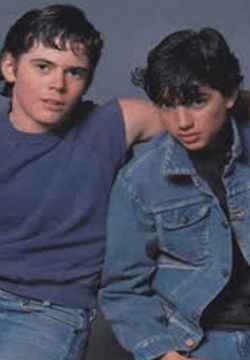

In using The Outsiders as a whole class text this spring with a seventh grade class composed of nearly all boys, I began to explore juxtaposing the beauty and power of poetry during National Poetry Month, and authentic literary analysis. How could I use poetry as an analytical catalyst?

The answer came in an approach that I love because it promotes several of the pillars of writing workshop:

  • Student agency/ownership of the writing process
  • Collaborative writing and thinking
  • Mentor texts as models for writing craft moves
  • Opportunities for teachers to participate in workshop as writers

Poems in Two Voices are an excellent way to invite creative literary analysis, since by definition, they challenge student writers to take on the personas of fictional characters and to look at a literary work through the lens of their chosen character’s perspective.


As an invitation into learning about Poems in Two Voices, I shared a poem that I wrote from Johnny and Pony’s point-of-view during our workshop time, as well as poems written by former students.

Seventh Grade Literature
The Outsiders
“The End of Innocence: A Poem in Two Voices” by Mrs. O.

ooster2

Ponyboy Curtis Johnny Cade
Nature’s first green is gold, her hardest hue to hold. Nature’s first green is gold, her hardest hue to hold.
Gold was my mother. She was beautiful. Nothing gold can ever stay. My life has been black.
Gold is my brother Soda. Movie star handsome. He kind of radiates. I pulled a silver switchblade, thinking it was for the best. Disaster from then on.
Beauty was the sunrise in Windrixville. There was a silent moment when everything held its breath. I did, too. I remember Pony’s voice as he read Gone With the Wind. Dallas is gallant, going into battle like those Southern gentlemen.
I thought things could only get better, but we went from ice cream sundaes at Dairy Queen to the red Hell of the church on fire. We started it with our cigarettes. I was a hero for a moment. Instead of being beaten down, I was giving life. Pony said Jerry thought we were sent from Heaven.
Johnny never thought of himself. We can’t live without him. The gang needs him. I don’t want to die now. Sixteen years ain’t long enough.
Sixteen years on the street, and you can learn a lot. But all the wrong things, not the things you want to learn. Sixteen years on the street, and you can see a lot.  But all the wrong sights, not the sights you want to see.


Then leaf subsides to leaf… Then leaf subsides to leaf…
We had a rumble, but in the midst of the fight I realized, I don’t hate the Socs anymore…None of us should have been there, throwing punches with a gang of future convicts. Useless…fighting’s no good. I tried to tell Pony that. I have to get the words out while I still have a pulse.
Johnny was so quiet, I thought Dallas and I were too late. I thought Johnny was already dead. “We’re all proud of you, buddy.” That’s what Dallas said. I loved Dallas. I wanted to die with his words in my ears.
Johnny was trying to talk to me. I leaned in,  close to his burns, his closed eyes. “Stay gold, Ponyboy. Stay gold.”
The pillow sank a little, and Johnny died. I see something on the horizon. Light.
So Eden sank to grief,

So dawn goes down to day.

Nothing gold can stay.

So Eden sank to grief,

So dawn goes down to day.

Nothing gold can stay.

After sharing my poem, and giving students the opportunity to read several student written poems aloud, we wrote the following list of writing craft moves:

Writers of Poems in Two Voices…

  • Look back at passages in the text where the characters they’ve chosen are actually speaking, or where they can “hear” their thoughts.
  • Base their poems on a specific passage in the book, or make their writing a more general reflection of everything that they’ve read so far.
  • Might give a voice to a character who doesn’t speak often or is silent. This allows creative license as a writer. For example, what would Bob say if he could speak to Johnny or Pony about what happened in the park? What would Johnny say to the children he rescued from the church in Windrixville?
  • “Steal” lines or word choices from the book such as a favorite Again and Again, or golden line
  • Sound like the character being represented
  • Decide which lines will be read in unison, and which ones will be read individually
  • Include important details from the novel to illustrate close reading
  • Practice reading poems ALOUD with coauthors to work on timing and inflection


Two voice poetry allows students to powerfully express how a text has changed their thinking about the world, gives them the opportunity to write with a coauthor, and to present their poetry to others.  It works beautifully with any book. My students loved revisiting favorite scenes in The Outsiders, and we’ve also written narrative poetry, found poetry, and whipstitch poetry together.

The end of the year is the perfect time to utilize poetry as an analytical tool.

How do you use poetry with your students? Please add your ideas and questions to the comments below!


Elizabeth Oosterheert teaches middle school language arts and directs the 8th Grade Theatre Troupe at Pella Christian Grade School in Pella, Iowa.

She loves reading and writing with middle schoolers.


Screen Shot 2017-05-01 at 8.44.22 PM

Care to join the conversation? We’d love to add your voice! Please email guest post ideas to Lisadennibaum@gmail.com.

Author Bios – A Follow-up

I collected these papers 20 minutes ago, and I am smiling so hard that my second period class coming in asked me what was going on.

A few days ago, Amy wrote a post about students writing their own author bios. It was an idea that snuck up on me a few weeks back when Amy Poehler’s author bio made me laugh out loud.

Following much the same format that Amy detailed earlier this week, I introduced the idea to my students of writing our own author bios by reminding them of what they have heard from me one thousand times before over the course of this year:

“We are readers and writers.”

To reflect this persona, I shared with my AP Language students a quick writing prompt that is turning out to be one of the best writing assignments of the whole year.

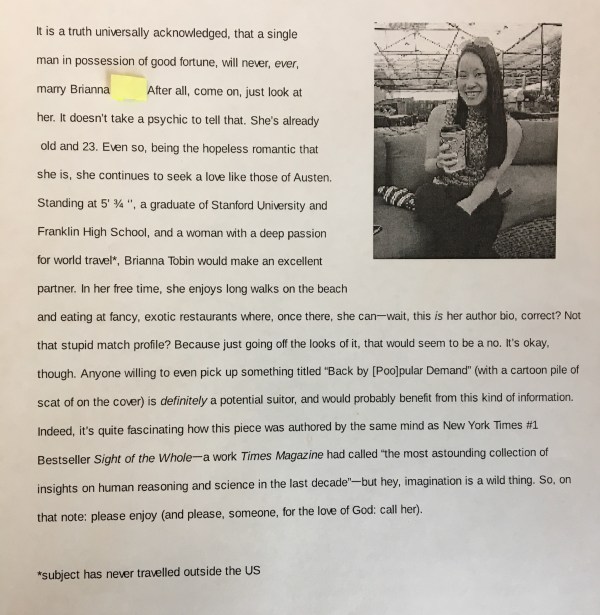
When Brianna turned her piece in this morning, she had a huge smile on her face. “I had SO much fun doing this.” Brianna, as studious, driven, brilliant, and stressed out as they come, was beaming ear to ear. What a testament to the power of writing with self reflective purpose.

To facilitate this assignment we:

  1. Looked over several sample bios from our book club books, some texts off my shelves, and a few internet suggestions.
  2. Students talked at their tables and came up with a list of “look fors” in this type of writing. I was impressed by not only the length of the list, in terms of what they noticed, but some of the insight. “If you are going to write a funny book, be funny. If you’re writing about the Nazi’s, that’s not a good idea.” True, true. Style and form must match purpose. I love it.
  3. Students then drafted both a current and a future author bio. The future bios were far and away the best. Students really embraced how wildly accomplished they will be as readers and writers after college. Additionally, this group is apparently going to rule the world.
  4. Peer feedback came next, with an inclusion of Shana’s “Push and Pull” feedback strategy. It was wonderful to see the details and voice emerge from their pieces. Celina had a line about winning the Nobel Prize, an Oscar, and a Grammy. I suggested she tell us what she won the Nobel for, who she co-starred with for her Oscar win, and how many albums she sold for the Grammy. “Oooo! I helped kids in the Sudan by supplying them with books (Mrs. Dennis swoons), Brad Pitt came out of retirement to play my dad in the movie, and I sold a record to every high school student in America, Spain, and the Ukraine.” Yes, yes, yes!
  5. Students took the peer and teacher feedback, went off to polish one of their bios, get an author picture, and turn in a final draft.
  6. These are HOT off the presses and I am so proud of their voice and creativity.

If you only look at one example, check out this first one. Brianna had me laughing out loud. No wonder she was beaming ear to ear.

img_2524

From line one, this piece had me laughing out loud. Brianna could not be a more serious student, but this work let her voice shine. I LOVE it from start to finish. 

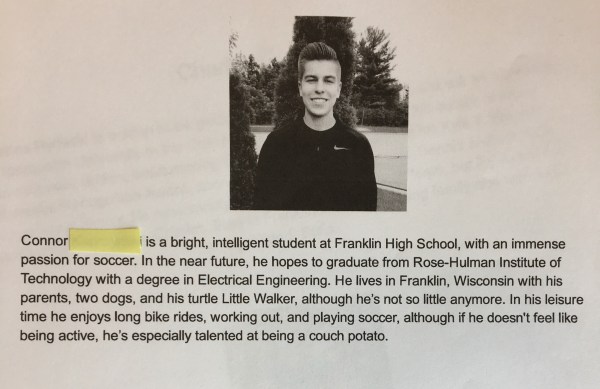
Connor is a pretty quiet kid in class. His writing fluency has improved A LOT this year. And look at that smile! 

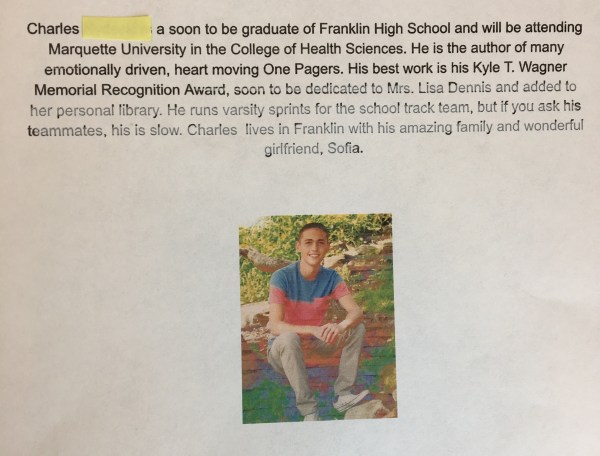
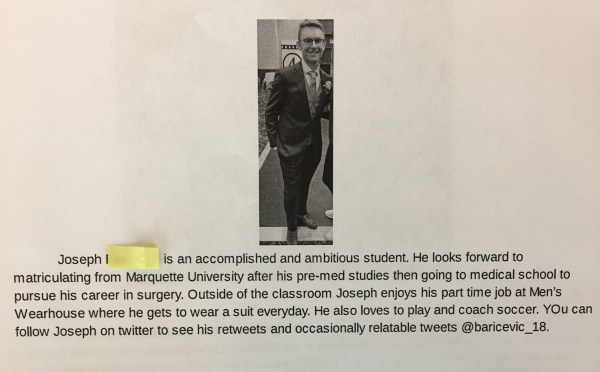
Charlie just won the most prestigious scholarship Franklin offers, because of his service, incredible heart, academic achievements, and being an all-around amazing person. He really opened up in his one pagers this year. I could not be more proud of this young man. 

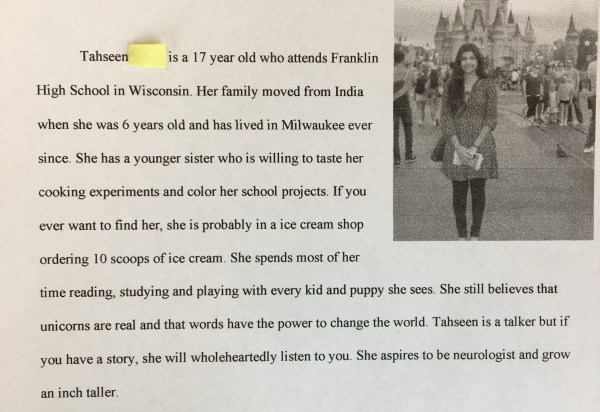
Tahseen is a very serious young woman, but the little quips in here brought out her true voice. 

JJ too had a ways to go with his writing fluency and voice development. I’m seeing it now! 

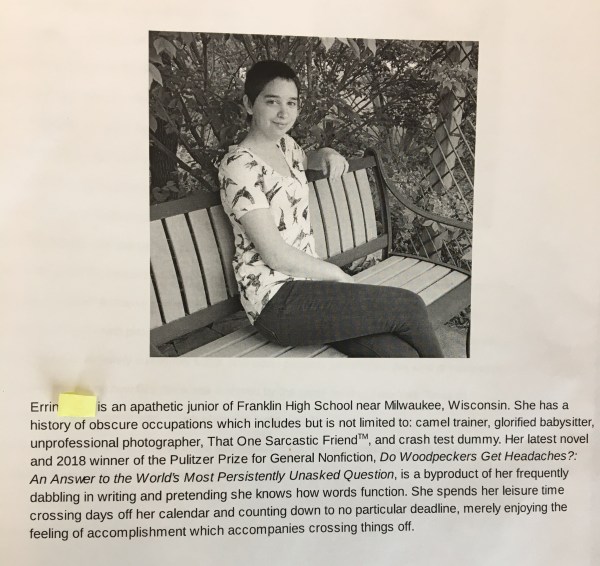
Errin is a young woman whose name you will know someday. I am SURE of it. She had this shirt on in class this morning. The picture was taken before 7:00am. 

Lisa Dennis teaches English and leads a department of incredible English educators at Franklin High School near Milwaukee. She delights in writing in the third person, claiming it’s akin to an existence in parallel universes. Follow Lisa on Twitter @LDennibaum 

An Idea: Author Bios and Some Focus, Wit, & Polish

I stole this idea from Lisa. She said it was okay that I write about it first. Bless her.

I finally feel like I’m getting a little of my writing mojo back. If you’ve been following my posts lately, you know I’ve had a hard time. I loved my student teacher, but I missed my students and how they inspire me to want to write and share.

It hasn’t been easy taking back my classroom. I am much more intense than Mr. G, and this translates to mean for some of my students. It’s true I grade hard, expect a lot, teach bell to bell. It’s not that he didn’t — maybe it’s just that I’m 50+, and he’s close to half my age. Whatever the reason, reinvigorating relationships hasn’t been easy.

Kind of casually one day, Lisa suggested she wanted to write author bios with her students next year. She said she’d read a few she wanted to use as mentor texts, thinking this little writing task would be a way to help her students develop their identities as writers. What a fantastic idea!

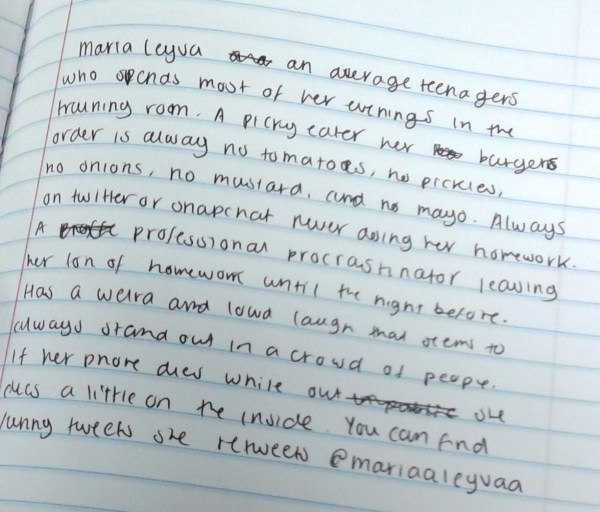
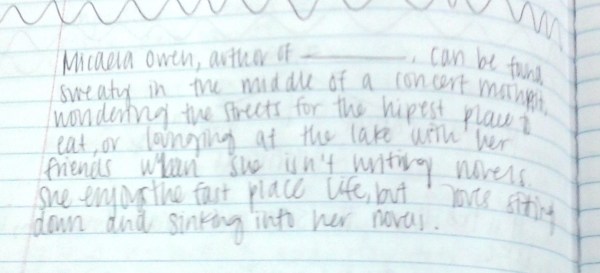
So last week for our writer’s notebook time, we wrote author bios, short, little, quippy, quirky writing that states who we are and why we write. (We still need work on the why we write part.)

booksforauthorbiosI prepared first by reading the inside back covers of some of my hardback YA literature. I chose four bios with similar elements:  Andrew Smith, Winger; Julie Murphy, Dumplin‘; Heather Demetrios, I’ll Meet You There; and Jason Reynolds, All American Boys. {Bonus: four book talks, along with the author intros. Boom.]
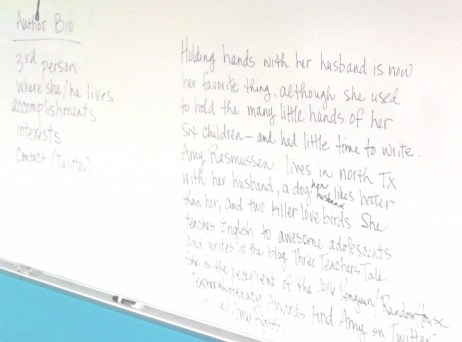
I explained the task:  We’re going to read four short author bios and then write our own. Listen to each one carefully, so we can pull out the similarities within each one.

We charted the elements of the bios on the board and then drafted our own.

authorbio

We spent five minutes on the writing, two minutes on revision, and six minutes sharing with our peers. We laughed. We wondered if the authors wrote their own book cover bios. We discussed our writing process.

“It would have been easier writing about someone else,” one student said.

“I need more time to think of how to say things,” said another.

“This would be fun to do at the beginning of the year,”

“I don’t do anything!”

“I’ve never won anything!”

“I cannot write that I am interesting when I am not interesting.”

“Can we write about what we want to do in the future instead?”

Oh, yeah, we stirred the pot, and ideas bubbled out. Throughout their questioning, my response remained:  Be creative.

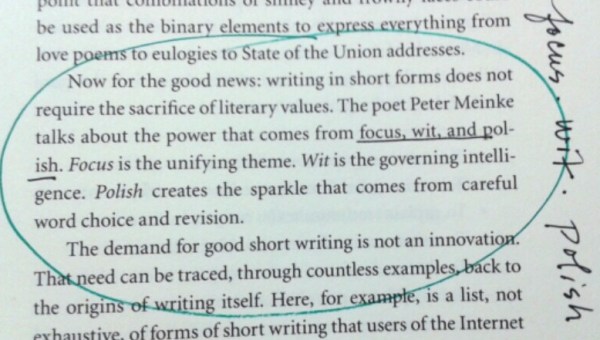
One of the best books I’ve read on writing is How to Write Short: Word Craft for Fast Times by Roy Peter Clark. I marked it up with lesson ideas:  “the whole chapter would make a great lead in rhetorical analysis” and “on annotating: read before starting 1st book club” and “use b/f narrative –teaches analysis with song lyrics” and “parallel structure & compound sentences!”

This paragraph from the introduction is a great reminder for all types of writing — and writing instruction:

How to Write Short

Focus, wit, and polish. My students and I talked about our identities as writers. We talked about the time it takes to develop our voice, our craft, our meaning.

As they read their author bios to one another, the cough of community clamored just a bit, and in a few minutes the whole classroom caught it.

MariaLauthorbio

MariaCSkyauthorbioMicaelaauthorbioTreyauthorbioI reminded students as they write over the next few days — finishing their multi-genre projects, their last major grade — to write with intention, to write in a way that shows the answer to the last question I’ll write on the board this year:  How have you grown as a reader and a writer?

In the fall, I will do this exercise again. We will write our author bios at the beginning of the year, on day one, maybe. We will spent a good deal more time on them, and we’ll return to them again and again as we practice the moves all writers make to produce effective, convincing, creative writing. We will publish our writing with our bios. Hopefully, this will help us keep our sights on Focus, Wit, and Polish in all aspects of our writing.

How might you use this author bio writing activity? What tasks do your writers do that help them take on the identities of writers? Please leave your ideas in the comments.

Amy Rasmussen lives in north Texas and teaches AP English Language and English 3 at Lewisville High School. She loves talking books, daughters’ weddings (two this year), and grandbabies. Facilitating PD for other teachers making the move into a workshop pedagogy delights her. Amy adheres to the words of Emerson: “We aim above the mark to hit the mark,” and Jesus: “Love one another.” Imagine a world if we all aim higher. Follow Amy on Twitter @amyrass.

Varying Paragraph and Sentence Length for Effect

The formula is simple.


Pair a simple, declarative sentence in its own paragraph with a longer, more detailed paragraph to follow.  The two paragraphs set against each other will balance the other’s flavors out nicely.


Practice it mercilessly in workshop and use sparingly in finished work.


As you can see from this blog post, an entire essay or article that’s filled with long-short paragraph variations is going to tire, frustrate, and bore readers easily.   It will also become predictable, just like predicting that LeBron James is going to score 20 points in a game.  The good news, however, is that once you introduce the trick, you can invite readers to look for it across their reading.


Mentor texts used: An article about Alec Baldwin’s Donald Trump impersonation from The New York Times and a chapter from The Nix by Nathan Hill (hardcover pgs. 482-492) Note:  read over these mentor texts before using to see if they are appropriate for your students.  

Teaching this technique – version A:


  1. Invite students to freewrite off of each of these starting sentences from these mentors: “It takes seven minutes” or “Today was the day he would quit Elfscape.”
  2. Have students share their work.
  3. Reveal first two paragraphs of the Times article and page 482 from The Nix.  (Note: the vocabulary on this page of The Nix is tough, so I would suggest using it as an example of the technique only.)  
  4. Identify ideal locations for this technique (leads, beginnings of chapters and sections.)
  5. Practice this technique in a freewrite or on a piece in progress.


Teaching this technique – version B:


  1. Have students read the New York Times article and flash-skim the chapter from The Nix.  Unless you want students to read a sentence that extends for ten pages…
  2. Ask students about how and why these two authors decided to begin paragraph 1 simply and laden paragraph 2 with all the details.  Why might an author decide to describe a character’s decision to stop playing an online role playing game with zero periods?  Why might the Times author give us excruciating detail about Alec Baldwin’s Trump makeup?  To what extent are these “characters” portrayed similar?  Or are the purposes here different?
  3. Invite students to “hack” their own writing or another expository piece (e.g. a history or science textbook) to mimic the long-short style.  Is this an improvement?  Is the writing worse?  Why or why not?


Amy Estersohn teaches middle school English in New York.  She has never played an online role playing game and only pretends to know how to play paper and dice role playing games, so reading The Nix wasn’t easy.  Follow her on Twitter at @HMX_MsE.

6 Takeaways from Student Self-Assessments

51W731EdIWL._SY344_BO1,204,203,200_After completing self-assessments in Tom Romano‘s classes in college, and finding them invaluable, I’ve always made them a large part of my teaching arsenal.  At the end of every year, we spend a few days on SAs, or they’re part of the final exam, or they’re what we share as a last-day-of-class celebration.
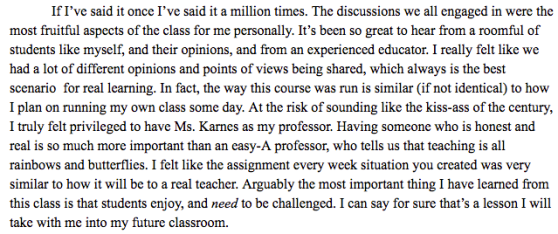
This semester, my students wrote three self-assessments, with the last one counting as the final exam.  In this particular SA, I asked students to do five things:

  • Evaluate our course materials and routines
  • Discuss your growth as a teacher, thinker, writer, reader
  • Write your teaching credo
  • Give me some advice about what to keep/change next year
  • Make a list of strategies, frames of mind, and ideas you’ll use in teaching

As finals week drew to a close and I was crushed by grading, I looked forward to reading these self-assessments.  Students didn’t hold back on the advice or evaluation portions, used their signature writing voices with abandon as they discussed their growth and beliefs, and made me fill my notebook with pages of ideas and strategies as I read their lists.

In addition to just being fun to read, I also learned a great deal from their honest words.  While I took a whole book full of ideas away from these amazing and inspiring future teachers, I’ll spare you and just share six lessons I learned from reading their self-assessments for this semester.

What we read matters.

Without exception, every student extolled the virtues of our central text, Paul Gorski’s Reaching and Teaching Students in Poverty: Strategies for Erasing the Opportunity Gap.  I highly recommend this excellent text as reading for any teacher, especially Gorski’s vehement statement that all students, no matter their background, need appropriate challenges when learning.

Screen Shot 2017-05-12 at 7.30.12 AM

Lily cements my belief that a strong central text really helped anchor our course.

By studying a text I was so passionate about, my students could feel my enthusiasm, and I believe it was contagious.  A strong central text anchored our lively class discussions and students’ weekly one-pagers.

Trust your pedagogical instincts.

Our students are champions when it comes to complaining–their stamina is literally unending.  “But I don’t want to write this.”  “ANOTHER paper?!”  “MORE writing?”  “Why are we doing this again?”

All of these gripes can really wear a teacher down.  But, teachers usually know what is best for our students–we know that a high volume of writing will help our students become better writers.  We know that writing about our reading will help our students become better readers.  We know that constant practice with critical thinking will help our students become more literate and conscientious citizens (and teachers, in my case).

Screen Shot 2017-05-12 at 7.07.47 AM

Aaron grudgingly admits that despite the onslaught of papers and projects, he grew in his thinking and learning.

So, despite the eye-rolls or sighs, I kept at it with what my gut was telling me.  I knew that, no matter how much of all of our time it took, students needed to do a lot of reading, writing, and talking about their thinking, with a lot of feedback from their peers and from me, all while remaining appropriately challenged and engaged in learning.  I kept at it and resisted the frequent temptation to revise my syllabus, and students appreciated it–and grew.

Frequent, low-stakes writing often provides the most space for growth.

While the big assignments of the semester may be what most teachers consider the bread and butter of teaching writing, I believe the opposite.  Those long essays or projects, in my experience, are more likely to stress out all parties involved.  For me, the short stuff is where the growth happens, and exponential growth is what leads to student success in writing long and complex pieces.

Screen Shot 2017-05-12 at 7.09.01 AM

Anetta extols the value of informal weekly writings.

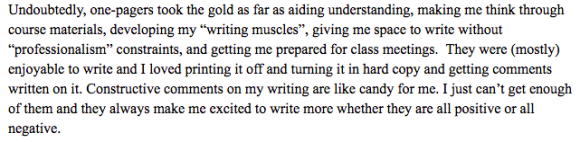
My students wrote six major papers this semester–none of which were shorter than six pages, and some that were up to twenty–but where they really displayed the biggest leaps in learning were in their one-pagers, submitted weekly.  Every single student except for one told me that I should keep one-pagers and that, despite how much they sucked/were annoying/ruined their Sunday nights, they were the most valuable part of the class for their growth.

All students crave challenge.

As Gorski reinforced for my students this semester, all learners crave a challenge.  Nobody wants to be bored, and by engaging students in complex tasks of reading and writing, nobody in my classes will be.  With small- and large-scale assignments scattered throughout the course, frequent opportunities for revision, and detailed feedback, all students felt that they could succeed, and had ample opportunities to practice and prove that they could.

Screen Shot 2017-05-12 at 7.05.54 AM

Ryan vows to replicate the challenge of high expectations in his own classroom.

Feedback is invaluable.

It is a lot of work.  A LOT.  I know.  But every student valued, appreciated, and grew because of thorough feedback protocols on any formal paper.

Screen Shot 2017-05-12 at 7.11.12 AM

Erin was appreciative of the attention her writing received.

Students did a lot of writing I never graded–in notebooks, in drafts, in groups.  But what they turned in, I spent a great deal of time commenting on, and while it was definitely arduous, I know I’ll keep it a condition of my classes in the future…fueled by lots of coffee.

Creating conditions for safe student growth is paramount.

Kevin became something of a celebrity in our class with his frequent questions, hilarious asides, and opinionated comments.  He never held back, and because he was welcomed into dialogue with open arms by myself and other students, he really flourished as a learner for one of the first times in his academic career.

Screen Shot 2017-05-12 at 7.05.03 AM

Kevin, with his signature writing voice, reminds me that a safe learning environment is the most important thing we can give students.

By creating a community of trust and engagement and low-stakes learning, Kevin felt safe to take risks and grow.  It’s what I want all students to be able to achieve, and is one of the most powerful reminders about teaching and learning I can think of.

What have your students taught you about your teaching?  Will you utilize self-assessments this year?  Please share in the comments!

Shana Karnes lives in West Virginia and teaches sophomore, junior, and senior preservice teachers at West Virginia University.  She finds joy in all things learning, love, and literature as she teaches, mothers, and sings her way through life.  Follow Shana on Twitter at @litreader.

When rubrics are unintentional ruBRICKS – Guest Post by Julie Swinehart

My fourteen-year-old son surprises me with some of the things that come out of his mouth. I won’t repeat them all here (you’re welcome), because sometimes I’m astounded in a way that makes me laugh, but doesn’t necessarily make me think.

But the other day, he did make me think.

We were at the kitchen table. I was reading my students’ online readers notebooks while he was working on homework. Responsibly, he checked the rubric that accompanied the assignment he was working on, but by doing so, he seemed to get more frustrated instead of finding clarity.

I looked over at him, eyebrows raised in silent question. His response was, “This rubric is more of a brick than a help!” and he went on to explain that it felt like he was weighed down by the rubric rather than feeling like it provided guidance.

I immediately understood his comparison. Rubrics as bricks, hobbling students,

brick

“This rubric is more of a brick than a help!”

confining them to strict definitions and requirements, weighing them down instead of allowing them to soar.

Rubrics as brick walls on paper, wordy, unclear, sometimes too demanding, confining creativity instead of providing a place from which to let creativity flow.

I then turned my thoughts to my own teaching and to my own students. Have I unintentionally weighed down my students with a brick of a rubric?

Have the rubrics I’ve attached to my class assignments served as brick walls, stifling creativity, rather than as foundations that my students could use as guides for demonstrating what they know and what they can do?

Have the rubrics I’ve provided my students allowed them to show that they can exceed and see things in a way that I, as the teacher, never imagined?

During this school year my thinking and teaching style has evolved dramatically. I’ve moved away from a more traditional method, in which my students read the same texts, responded to the same writing prompts, learned the same skills, and turned in the same assignments, all at the same time. I used rubrics for most of their assessments, and while my students demonstrated their learning, I inadvertently didn’t really allow for a ton of creativity.

This year, my students are reading different texts, sometimes have individualize due dates that they have chosen, and are turning in very different assignments from each other.

This year, I’ve also still used some rubrics, and I think there are some good ones out there. But in response to the advice of one my colleagues, I started the slow move to a more holistic approach to scoring guides.

I still include the standards and learning targets for students on the task sheet, and I describe what an exemplary, middle, and poor quality product will look like, include, or omit. But I find that the more holistic scoring guide approach allows for the student choice and creativity that is essential in the workshop model.

It’s not as prescriptive as a rubric can be, and instead of being a document made of bricks that build walls around and confine creativity, it serves more as foundation of sorts, something students can build from, and also demonstrate their learning through their own creative ideas.

A holistic scoring guide does not provide all of the answers that a rubric holds. There aren’t as many words on the paper, which means that students have to think about what they are going to do, rather than simply tick some boxes of requirements in order to get the grade.

I’m enjoying the holistic scoring guide approach, and my students are still doing well with the change. They demonstrate creativity, they show their learning, and they allow their personalities to shine through in their work.

Workshop is about student choice, and I think some rubrics unintentionally stifle the choice that we are so eager and willing to provide.

I’m going to be careful from now one, doing my best to ensure that the assignments I give allow for student agency, and doing my best to ensure that my students aren’t weighed down or walled in by unnecessary bricks.


Julie has been teaching secondary language arts for eighteen years, spending the first fifteen in rural Central Oregon, and the last three in Amman, Jordan. A recent convert to the workshop model, she likes to blog about and share her learning and experience with others.

Follow her on twitter @SwinehartJulie

Follow her blog https://adventuresinhighschoolworkshop.wordpress.com/


iconCare to join the conversation? We’d love to add your voice! Please email guest post ideas to Lisadennibaum@gmail.com.

3 Ways Paper Built a Classroom Community

This year, I’ve gotten away from a focus on online reading, writing, and grading, and returned to paper.

I’ve always kept certain things hard-copy–the writer’s notebook, one-pagers, and book talks–but when I started working with college students, Google Drive became my best friend.  I used Slides to keep myself organized in class, Sheets to keep track of my grades, and Docs to collaborate with my students as we worked on their writing.

However, after a semester of forgotten deadlines, regrettably disconnected class sessions, and lackluster writing voices, I wanted to switch things up.

So, beginning in January, my students printed a one-pager about the week’s writing and brought it to class.  When they gave presentations or shared their thinking, I asked them to bring a tangible artifact to represent their work.  Any time we shared or offered up our thinking, we wrote notes to one another and signed them with our names.

These three practices, along with an emphasis on slowing down our thinking and being more deliberate in our work, language, reading, and interactions, made this semester one of my favorites in a ten-year career of teaching.

Sharing Hard-Copy Writing — I tried to build in class time weekly for us to pass one-pagers around and leave feedback.  While this didn’t happen every week, it allowed for students to hear each other’s writing voices, discover new modes for representing their thinking, and come to a more dialogic understanding of the week’s readings rather than a “right or wrong” frame of mind.  In her self-assessment for the course, Erin writes about the benefits of reading one another’s work:

Screen Shot 2017-05-05 at 9.08.29 AM.png

Paper as an Artifact of Thinking — “I began writing this by going back and re- reading my writing from the beginning of this course. I still believe in some of the statements I made in my first one pager related to the beauty in the simplicity of a child’s world,” img_8673Hanna began her self-assessment.  Her ability to look back at her earliest writings as an artifact of who she was as a thinker 16 weeks ago allowed to her to launch into a detailed reflection on her growth over the course.
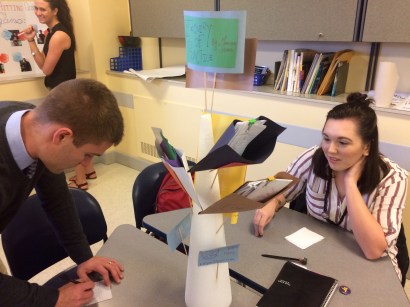
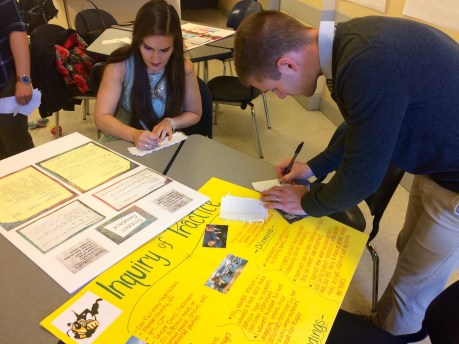
In keeping with that theme, I asked my students to bring in an old-fashioned poster or trifold to share the thinking of their final projects.  While they’d be turning in a more formal paper or Prezi during finals week, I wanted everyone to get to share their process tangibly.  We engaged in a gallery walk during our last class period together, and the students enjoyed showing off their own thinking and comparing it to their fellow teachers’.

As they read, they jotted ideas in their own notebooks for how they might modify their own thinking before submitting it in final form.  This type of physical engagement with one another’s work yielded far more interaction in terms of thinking and feedback than last semester’s format, in which I requested students send me three Google Slides about their work that we’d all share.

img_8672

Keepsake Feedback — Keeping with the hard-copy theme, I devised a few new feedback protocols for students to give one another comments they could hang on to.  While sharing the fruits of our semester-long inquiries, I asked students to engage in a “push and pull” with the writer.  On one side of a piece of paper, they “pushed” the writer on some things they might take a little further or explain in more detail.  On the other side, they told the writer what they had “pulled” from their work to enhance their own thinking.

In this way, students received feedback on these informal “drafts” of their thinking from their peers and from me, three weeks before they needed to finalize their assignment.  When they turned in their notebooks at the end of the semester, I saw that many students had taped in their peers’ feedback to hang onto as both advice and encouragement.

img_8676

By making our thinking visible this semester in the form of hard-copy papers that represent our thinking, posters or 3D representations of our ideas, and written feedback we can hang onto, I noticed a marked growth in my students’ progress.  Their writing evolved throughout the semester to not only take on different forms, but also in its sophistication of content.  My students all got to know one another well, even those in my class of 30.  They learned about a diversity of perspectives and ideas beyond mine or their own that helped banish the idea of a “right or wrong” binary.

I really enjoyed my teaching, grading, and students this semester…and it was all thanks to paper.

How have you balanced integrating technology and keeping it old-school to help your students see one another’s thinking? Please share in the comments! I’d love some more ideas for next year.

Shana Karnes lives in West Virginia and teaches sophomore, junior, and senior preservice teachers at West Virginia University.  She finds joy in all things learning, love, and literature as she teaches, mothers, and sings her way through life.  Follow Shana on Twitter at @litreader.

Where I’m From, With a Twist – Guest Post by Margaret Egler

During the process of writing this poem, I had to make many decisions. Since this poem is not about myself, it was difficult to include details and experiences. I interviewed Tommy and he told me where he came from and his passions in life. When Tommy began to tell me about his memories, I pictured them in my head and pulled out words/pictures I thought related to that particular story. I struggled at times trying to put my all into this poem; writing about someone is a lot more difficult than it looks. — Darcy

Writing in general is a lot more difficult than it looks.  And for juniors and seniors in high school, the stakes for writing well are high: college admission essays, standardized writing tests, artist statements, scientific reports —  not to mention, massive group texts!Screen Shot 2017-05-01 at 8.44.22 PM.png

As writing teacher, I’m constantly on the lookout for authentic writing experiences that give students new perspectives — on themselves and others. I’m also drawn to the economy and intentionality of poetry as a way to help students both appreciate the beauty of words and make them aware that each word needs to earn its place in a piece of writing.  For my first semester students, I’ve used Kelly Norman Ellis’ “Raised By Women” poem to launch writing college essays, finding that the short bursts of images and details provide insightful golden nuggets that can be then mined for longer personal narratives.

For my second semester students, I wanted to create a similar experience with poetry, but I didn’t have the imperative of a college essay to focus our attention.  I teach at a project-based high school where I share a team of students with a teacher in another discipline. This year, my biology partner and I wanted students to interview stakeholders for our inter-disciplinary project on protected environmental spaces.  

A new idea for poetry was born! Taking Willie Perdomo’s moving and gritty “Where I’m From” poem as a mentor text, I twisted the usual process of using this poem to write about one’s own home. Instead, I randomly partnered students up and asked them to write a first-person “Where I’m From” poem about the other person’s life.

This poem had its ups and downs. Something that worked well was that it was cool seeing a perspective of another person. Sometimes we get too stuck in our own world and just don’t put into perspective how someone’s life is. — Gabriel

Once they found their partner, I gave the pairs a series of questions based on Perdomo’s poem to prompt them into conversation and let them loose around the school to interview each other:

— Describe the landmarks around your home

— What tunes do you listen to?

— What are the “sayings” of your family?

— What languages are spoken in your home?

— What streets do you live on?

— Who are the people in your life?

When students returned from their interviews, they began drafting their poems, but with certain structures that guided the structure of their poems.  For example, they were required to write six stanzas and to use an anaphoric line at the beginning of each stanza (e.g., “Where I’m from…” or “If you knew…”). We also discussed the importance of  concrete and sensory details as tools to make writing interesting.  As they got underway, students soon realized they didn’t have enough information to fill out the stanzas or they lacked specific details. So back they went to their partners to delve more deeply into their lives.

Screen Shot 2017-05-01 at 8.10.36 PMFinally, I would like to thank Isaiah, Victoria, Andrew, and Margaret for helping me make this poem the best version possible. I would also like to give a big shout out to Holly for answering all of my annoying, pestering questions and letting me represent her through this poem. — Hannah

In the process, students underwent an intensive cycle of writing with prodding questions
from their peers and me about the content of their poems, (“Which specific beach do they go to?” What specific dish does their grandma make? What does it smell like?”). What emerged was a deep desire to respect and honor their partner’s emotional life through details and word choices.

I wrote to capture the way Betty would have written it. It was very difficult to write in the shoes of someone else and talk about their life. — Andrew

As a visual touch to their poems, students traced their own self-portraits and scanned them into photoshop to play around with color and line.  When they were done, their writing partner assembled the final poem using InDesign to create a visually compelling and creative piece of art.


Margaret Egler teaches 11th and 12th grade humanities at High Tech High in San Diego, CA. This project had many inspirational sources: Kelly Williams, Paul Lopez, Kalle Palmer, Jeremy Farson, Stephanie Lytle, Kaleb Rashad, and, post hoc, Chris Emdin (“Help students dig into themselves to mine their own brilliance”). Thanks especially to the Margarita Whales and Kalle Flowers for sharing their brilliance.


Screen Shot 2017-05-01 at 8.44.22 PMCare to join the conversation? We’d love to add your voice! Please email guest post ideas to Lisadennibaum@gmail.com.
Learning from Other Teachers

5054c4145eaf8a4c41c3bbd1d1954cdd.jpgI have so much hope for our profession, our students, and our society.

In a pretty pessimistic world, want to know why I’m so optimistic?

Because I believe in our future teachers.  After an entire school year of working with preservice educators, I have seen so much energy, excitement, and engagement from every single one of my students.  Every challenge that comes their way–whether in the form of an assignment, a tough reading, or grappling with a seemingly unsolvable education issue–only reaffirms their desire to help their students.  They just careso much.

A fantastic conference I attended last week was a wonderful reminder of all of that hope I have for teachers and teaching and learners and learning.  We’re here because of love–love for who and what and how we teach.  Yesterday, I shared my learning from the morning sessions of that conference, and today I’d like to share the ideas, quotes, and joy I heard in my afternoon sessions.

Session Three:  On Teaching Writing & Knowing Our Students

This amazing session was led by three preservice teachers who interned in high school ELA classrooms in our community.  Each of them spoke about their struggles and successes with so much passion that I was left feeling proud to be a teacher by the end of their talks.

Idea:  Audio Recording Peer Feedback–I absolutely loved Katie N.’s idea of having students record their feedback to peers.  After a semester of struggling to get her students to view themselves and one another of being capable and worthy of giving authentic, valuable feedback, she hit upon the idea of having students read one another’s papers ahead of time, prepare some comments, and then record a few minutes of thoughts, responses, suggestions, and connections.  I can’t wait to have my students try this idea!

Quote:  “When I conferenced with my students, so many of them really surprised me!!”  Danielle focused on looking for patterns in her students’ extracurricular involvement and how it might connect to their engagement, motivation, and success in schools.  She had lots of preconceived notions about how her athletes, club members, or student body leaders might act in the classroom, and many of them were wrong.  She loved the experience of being surprised by her students when she took the time to confer with each of them multiple times.

Just Joy:  Katie P. was interested in taking a whole class novel study far beyond the book.  While reading A Separate Peace with her students, she encouraged her students to read the novel through a critical literacy lens, identify social issues they could connect to their own school community, and then take action to improve the state of those issues.  As a result of her teaching, the students in her class created a club focused on improving mental health by participating in mindfulness activities like meditation, yoga, and deep breathing.

As she spoke about this new awareness of mental health issues in a school that had been plagued by student suicides, Katie teared up–as did many of us in the room listening to her speak.  I was so impressed and inspired by the power this young teacher realized she had to change a school community.

Session Four: On Evaluating Ourselves

In this session, led by a mix of teachers and school leaders, speakers presented on ways in which they looked at their own teaching, their whole classroom, or their entire school community; identified a problem; and then attempted to fix their issue.  Many of their inquiries resulted in some amazingly ambitious goals–one principal wanted to find a way to improve her students’ poor attendance, which was often caused by factors stemming from a community plagued by poverty; a group of teachers formed a committee to implement more responsive, sensitive discipline into their elementary school; and an academic coach shared ways she’d aggressively procured free technology into her school for teachers and students to use to improve learning.

I loved all these school leaders’ ideas, but I found one presenter’s approach to strengthening pedagogy incredibly effective and easy to implement.  Josh Karr, a high school math teacher, simply emailed his colleagues and invited them to form an informal PLC to evaluate themselves.

Idea:  Record Your Teaching–Josh invited his whole faculty, via email, to video record one of their lessons, watch it alone, and then bring a small clip to share with a partner in their mini-PLC after school.  Thirteen teachers agreed to participate, and showed up, quite nervously, with their recordings.  They paired up, regardless of content area or grade level, and worked together to analyze their videos, give and get feedback, and talk through some questions they had.  I loved this super easy, low-stakes idea to self- and peer-evaluate our teaching in such a welcoming way.

Quote:  “We laughed at how many teachers didn’t even have students in their videos.”  Josh told a funny story about how several of the teachers’ video cameras had only been pointed at the teachers themselves, and how they didn’t realize this narrow-minded view until they started talking with colleagues.  It was a real revelation for many of these teachers to realize that, wow, their worldview wasn’t very student-centered.  I was so uplifted by hearing Josh speak about how this simple activity prompted these teachers to stop looking at themselves for evidence of good teaching, and to begin looking at their students instead.

Just Joy:  Josh talked about what an inspiring thing it was to be part of this tiny community of teachers within his school, which included teachers from all content areas, and even the band director.  He gave me such hope when he shared how the teachers’ video recordings had evolved over the weeks to include more students, more difficult class periods, and more and more vulnerable learning.

I loved hearing how teachers of all levels of experience and expertise were willing to open themselves up to their colleagues for the sake of improving their students’ learning opportunities.  It’s a hard thing, in this profession, to invite criticism of our teaching when our  work can sometimes be thankless.  I can’t wait to try this idea with my students and colleagues alike.


Check out Part I of this post from yesterday, and then please leave us a comment:  what strategies, ideas, or frames of mind might you try out in your classroom?  Will you share some fantastic lessons you’ve gleaned from good conferences in the comments?

Shana Karnes lives in West Virginia and teaches sophomore, junior, and senior preservice teachers at West Virginia University.  She finds joy in all things learning, love, and literature as she teaches, mothers, and sings her way through life.  Follow Shana on Twitter at @litreader.