Category Archives: AP Language

News You Can Use

I find most of what’s reported on the news today to be either deeply disturbing, horribly demoralizing, or downright exhausting. It almost feels like the past few months have been less of an end to summer/start of fall and more of an obstacle course of the absurd, obscene, and disappointing.

However, in the unending quest to inform our future electorate, we forge on. Articles of the week, hot topic debates, impassioned student speeches on the criminality of injustice, and an endless stream of quick writes to vent some of the hot, hurt feelings.  Then there are the daily discussions on the struggles we face, the struggles of those we need to know more about, and the struggles to balance it all when sometimes we just want things to feel whatever definition of “better” might help us through.

In the face of all of this, here is a recent success I had that championed choice and voice (coupled with a bit of creative reflection) around some of the news that might get overlooked in the whirlwind of our current news cycle.

News You Can Use

  1. Students selected an article from several that I had re-tweeted in recent weeks with our class hashtag –#fhslanglife. Topics varied widely and I simply went through and briefly highlighted the focus of each article in an effort to pique interest. Here are a few I included. Student response was awesome. We could have easily talked about these articles for the full 86 minute class period:

Are my students reading pieces on the economy, info-graphics, and authors (even authors they love) on their own? Not often. Are they talking with gusto about the relativity of these pieces, sharing insights on author craft, and talking about topics that impact them in the here and now when they are offered up as choice? You bet.

  1. Then, inspired by the Three Teachers Talk Twitter chat earlier this week with Tom Newkirk (#3ttchat), I stole a quick idea (the very foundation of Twitter chats,yes?). I love the quick and dirty nature of professional educators hurling greatness at one another in rapid succession and a maximum of 140 characters. For this week, I was immediately able to implement the single line, or as I told my students, “THAT line. You know the one” craft analysis. Based on the awesome insights of my fellow chatmates, I asked my students to do their reading and zero in on THE sentence that made the piece.

  2. Students read for 10-15 minutes, jotting down reflections and searching for “the one.” Once they were finished, I challenged them to respond in their notebooks in a creative approach they didn’t usually use. A dialogue, letter, poem, etc.

  3. After sitting silently for roughly 30 minutes, I had students get up and connect with someone from the other side of the room. Get the blood flowing a bit. They were to connect with someone who read the same piece and debrief. Ideas flew around the room.

  4. We then came together to share and here is a sampling of what I heard throughout the day:

  • From Ward’s piece on raising her son, Kaitlin pulled out: ” I hope I love him enough in the time I have with him, that while he can be a child, I give him the gifts of a childhood: that I bake chocolate chip cookies and whisper stories to him at bedtime and let him jump in muddy puddles after heavy rains, so he can know what it is to burst with joy. “
  • The info-graphics brought Nhan’s attention to: “We can trace the US story through stereotypes.”
  • After looking over the maps detailing climate change, Karan wrote a dialogue between President Trump and an environmentalist.
  • Several students brought up questions about college vs. career after reading about the jobs of their future.
  • Jerry Khang (who told me to publish his last name so you all know who he is even before he’s famous) read the John Green piece and wrote the following poem in about 4 minutes flat:

Books are a closer look into a person’s soul. 
We find ourselves deteriorating, gloomy, and so dull. 
But when we are able to read, to relate, to medicate our minds, 
We’re temporarily fixated on happiness in a short burst of time. 


When we provide students with relevant, yet challenging reading material, choice, time to write, time to think, and time to talk, 30 seemingly innocent minutes reading an article and writing about it can be beautifully rich, engaging, and rewarding.

And beautiful is something I think we could all desperately use right now.

Lisa Dennis teaches English and leads a department of incredible English educators at Franklin High School near Milwaukee. Her social media scrolling is driven largely by searching for class related articles and pumpkin soup recipes. Follow Lisa on Twitter @LDennibaum 

Shouldn’t Students Know How to Assess Their Independent Reading?

I have a love/hate relationship with the word authentic.

A few years ago when I participated in the North Star of TX National Writing Project, I wrote my action research goal to align with North Star’s definition of authenticity: “authenticity is connecting student learning with significant audiences, tasks, and purposes.” Of course, I still believe in this definition; I just struggle with redefining it for the individual students in my classroom.

Let’s take self-selected, independent reading for example. How do we ‘authentically’ assess this reading? Shana’s written about this topic lately in posts about too much measurement and alternatives to reading logs. She even started this google doc, a resource for assessing independent reading sans reading logs. There are some great ideas there.

I’m still not satisfied.

A few weeks ago I wrote about shifting control to invite more learning in which I write about shifting the finding to my students, giving them the opportunity to find mentor texts and create text sets we will study in class. I know this empowers students — they want to feel some element of control.

I decided to take the same idea of shifting and apply it to how I might assess student choice reading. Quite simply, I asked students to help me figure it out.

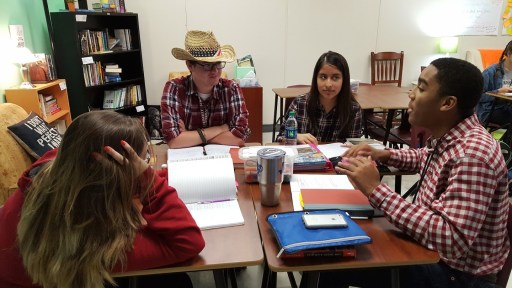
First, I reminded my readers why I am so adamant about independent reading and determined to hold them accountable. Then, I invited students to talk about how I might actually do it and asked that they write down their ideas. They seemed eager to help me figure it out. I listened in — grabbing my camera just in time — to capture some pretty rich conversation.

These are the ideas my class generated.

  • have reading partners that check each other
  • write a summary of what we’e read once a week (Me: “You really want to write more? Them: “No.”)
  • talk about our books for a minute or two*
  • record ourselves reading aloud (I asked:  “The whole book?” They said smiling: “Why not?”)
  • read together
  • summarize in a Google Classroom Q & A
  • pick a line from the page and write about how you feel about the line*
  • write about first impressions when we start a book
  • set reading goals then determine if we meet them by our reading rates*
  • write small summaries (Me: “You really want to write more? Them: “No.”)
  • talk about our books*
  • check for annotations
  • find our reading style
  • do book talks*
  • read novels in groups (Me: “We already do Book Clubs six times a year.” Them: “Oh, yeah.”)
  • write a blog post every week — what page we’re on and something we learned, not a summary because we can find those online
  • require us to finish at least one book every two weeks
  • book talks with our table — explain it to them*
  • write book summaries (Me: “What’s with the summaries?”)
  • check annotations
  • expand on quotes*
  • keep a reading log
  • write a one page summary every week (Me: “For real? a summary?”)
  • keep a reading log
  • create a sticky note system where we mark each hour, a start and end for that day
  • provide an incentive — candy? (Me:  “This will never happen.”)
  • give us due dates, but some will find this stressful
  • give grades to persuade and motivate (Me: “Exactly what I don’t want to do.” and under my breath: Can we give grades a rest already?)
  • write summaries? (Me, sighing: “At least you questioned it.”)
  • show progression through a book rather than setting a due date

And then these two responses:

  • The only way to actually PROVE someone is reading is if they read aloud.
  • You can’t really force [reading] upon someone; people need motivation.

Honestly, I was hoping for more. Something more — shall I say — authentic.

See? Students don’t really know how to assess pleasure reading either. Maybe that’s the whole point.

On that list above, the ideas with the asterisks? — those are things we already do. Plus, more. We study craft in our choice books:  sentences and passages. We pull ideas for expository and argumentative writing from our books. We review literary terms and analyze ways writers use them to enhance and craft meaning. We even occasionally swoon over a particular passage (well, I usually model swooning. It’s hard to get 17 year olds to swoon.)

I still do not know how to “grade” choice reading, and I’ve decided that it’s okay. Maybe I’ll take participation grades when I see students moving through their books at a fairly decent pace or after I confer with them and check for understanding. Maybe I’ll just keep listening in as my readers talk about their reading and lean over shoulders reading as they update their book lists in their notebooks.

I do know this:  The more I make everyday a reading day, a day we celebrate our lives as readers, the more students want to identify as readers.

And somedays they surprise us with their enthusiasm:

Michael came to class on Monday raving about his book. I pretty much shouted “Stop talking until I get my phone and can record you!”

How’s this for authentic reading assessment?

Please share your thoughts on assessing readers in the comments. Have you shifted yet?

Amy Rasmussen loves to read, and she loves her readers. The first book she remembers falling in love with was Anne of Green Gables, but her first memories of recall vaguely  The Boxcar Children. Amy models her reading life with her senior English and AP Language students by reading about books, talking about books, writing about books, and spending money on books for her readers to explore and enjoy. She firmly believes:  “It takes just one right book to make a reader. It’s just that every reader probably needs a different just right book.” Follow Amy on Twitter @amyrass and @3TeachersTalk


5 Lists of Books and More Space for Talk

I am a collector. I collect bookmarks I don’t use and tweets with headlines I think I’ll read later. I collect cute little pots I think I’ll eventually make home to plants, and notebooks I’m afraid to mess up with a pen (from my pen collection, of course.)

I also collect lists. Doesn’t everyone?

I collect lists of books thinking this will keep me from buying more books. Sometimes it works. Not often.

We’ve shared several lists of books on this blog:  Coach Moore’s list of books he read this summer, Shana’s Summer Reads to Stay Up Late With, Amy E’s Refresh the Recommended Reading List, and Lisa’s Going Broke List just to name a few.

I like reading lists about books. This helps me stay current on what my students might find interesting or useful. Often, I find titles that help me find the just right book for that one students who confuses “reading is boring” with “I don’t read well,” or “I don’t know what I like to read.”

With one heartbreaking event after another in our country lately, I keep thinking about the importance of reading to help our young people grow into compassionate citizens who more easily understand their world. Did you see the results of yet another study? Reading makes you feel more empathy for others, researchers discover.

Of course, we don’t need another study to tell us this. Many of us see it in our students.

I see it in my students. My students who enjoy reading also enjoy talking about their

Bookclubdiscussion

My students chose from nine different books for their book clubs. Once they chose, we had five different book clubs happening in one class. At the end of our second discussion day, I had students combine groups and talk with one another about the major themes, make connections, and share a bit about their author’s style.

reading. They relate to one another more naturally as they talk about their books, the characters, the connections. They welcome conversations that allow them to express their opinions, likes and dislikes. They learn much more than reading skills through these conversations.

My AP Language students recently finished their first book club books. I left them largely without a structured approach to talking about their reading. My only challenge on their first discussion day was to stay on topic:  keep the conversation about the book for 30 minutes. They did. I wandered the room, listening in as I checked the reading progress of each student.

On the final discussion day (three total), I reviewed question types and used ideas from Margaret Lopez’ guest post Saying Something, Not Just Anything, and asked students to write two of each question types:  factual, inductive, analytical prior to their book club discussions. This led to even richer conversations around their reading.

I remember reading a long while ago about how conversations about poetry could invite opportunities for solving big problems. I don’t know if this is the article I read, but the poet interviewed in this article asserts it, too:

I think we know the world needs changing. Things are going awry left and right. I firmly believe that in our very practical, technological, and scientific age, the values of all the arts, but of poetry in particular, are necessary for moving the world forward. I’m talking about things like compassion, empathy, permeability, interconnection, and the recognition of how important it is to allow uncertainty in our lives.

. . .Poetry is about the clarities that you find when you don’t simplify. They’re about complexity, nuance, subtlety. Poems also create larger fields of possibilities. The imagination is limitless, so even when a person is confronted with an unchangeable outer circumstance, one thing poems give you is there is always a changeability, a malleability, of inner circumstance. That’s the beginning of freedom.

When we invite our students to read, and then open spaces for them to talk about their

bookclubdiscussion2

This group had hearty discussions around Hillbilly Elegy by J.D. Vance. It’s Western Days. They don’t always wear hats and plaid and boots, even in Texas.

reading, we provide the same opportunities that discussions around poetry do. Maybe not on the micro scale of ambiguity and nuance, but most certainly on the macro scale of possibilities. Our students are social creatures, and we must give them spaces to talk.

So I collect lists of books I think my students may like to read, with the hope of engaging them in conversations — with me and with one another — around books. (A couple of years ago, Shana and I had students create book lists as part of their midterm.)

Here’s five of the book lists I’ve read lately. Maybe you will find them useful as you curate your classroom libraries and work to find the right books for the right students, so they can have the conversations that help them grow in the empathy and understanding we need in our future leaders, right or left.

6 YA Books that are Great for Adults

50 Books from the Past 50 Years Everyone Should Read at Least Once

The Bluford Series — Audiobooks

20 Books for Older Teen Reluctant Readers

43 Books to Read Before They are Movies

Oh, and if you haven’t read Lisa’s 10 Things Worth Sharing Right Now post in a while, now, that’s an awesome list!!

Amy Rasmussen loves to read, watch movies with her husband, and tickle her five grandchildren. She’s in the market for a lake house and likes to shop thrift stores for books and bargain furniture. Someday she’ll be disciplined enough to write a book about teaching. For now, she teaches senior English and AP Lang and Comp at her favorite high school in North TX. Follow Amy on Twitter @amyrass, and, please, go ahead and follow this blog.

Blackout Poetry with a Twist

Early in the school year, I’m always on the lookout for new ways to gather diagnostic data on my students, without uttering the words diagnostic, data, quiz, baseline, or any other term that reduces my students to plot points on a spreadsheet or numbers in the gradebook.

We know the power of conferring in learning about our students in countless ways, but what to do when, say as an AP teacher, we need to know students’ understanding of analysis terms or their ability to apply those terms in order to really dig into authentic analysis through study of mentor texts?

The idea of a vocabulary quiz makes me shutter. Conferring long enough with each student to get a good understanding of his/her knowledge of syntax, imagery, figurative language, etc. would take weeks. Submitting annotations on our first go-around seems cruel to both students and to me.

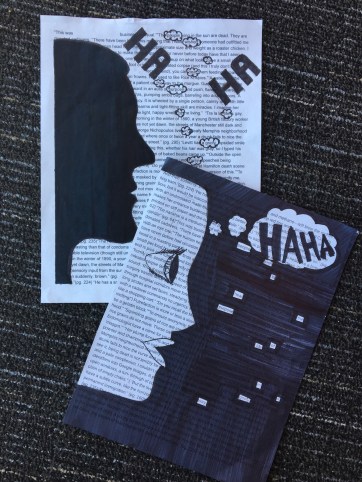
So this year, my colleague Sarah and I decided to try something different. We wanted an understanding of how students would go about identifying the purpose of a piece and img_6137provide appropriate text evidence of the basic terminology of analysis: syntax, imagery, diction, figurative language, and detail. We wanted students to use their left and their right brains. We wanted to students to work together to solve a problem.

Enter, the blackout poem.

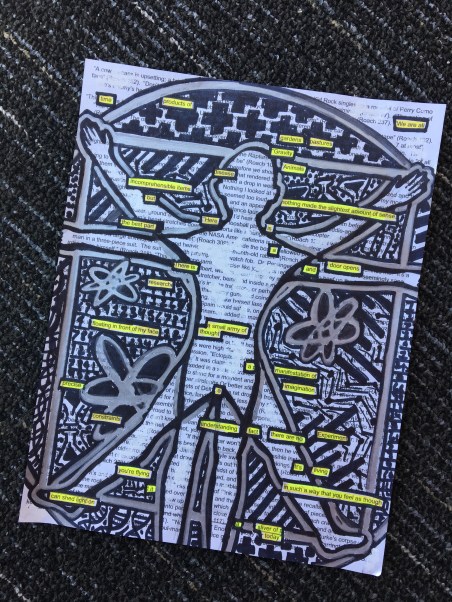
Traditionally, black out poetry makes meaning out of the words provided by a single page of text. Whether it be from a book, article, essay, etc., a poem is created from the words that live on the page by blacking out all other words and leaving just the ones that create meaning for your given purpose. Additional images are sometimes included.

We decided to turn this upside down a bit. Students would create their page of text from the text evidence they pulled from their reading (In this case, their choice of Mary Roach books from our summer homework assignment) and a poem to illustrate their claim of purpose from that reading.

And this, is some of what we got:

Below, are the steps we took in guiding students through this unique assignment. It could work for jut about any reading, and I would love to try it when students have read a variety of perspectives on a given topic.

img_6132

  1. Students read their choice of Mary Roach books over the summer and kept track of instances where they felt she purposefully utilized DIDLS (Detail, Imagery, etc.).
  2. We then partnered up or formed groups of three to discuss what we found and what we thought it meant. We were working toward specific purpose claims for each text.
  3. Students shared examples of the various instances of craft from Roach’s texts and as they did so, they typed those quotes onto a shared Google document. Their final task with that original quote document was to decide on a claim of purpose for the text(s) they read.
  4. Once finished, students printed that document of quotes so I could take a look. I’ll use it as a jumping off point for review that’s needed with specific elements of analysis.
  5. The kids then eliminated all of the formatting for their quote document, so they were left with a page full of quotes from their texts. Essentially, they created the page of text for their blackout poem, instead of using an existing one from the book.
  6. We then talked about how to communicate their claims of purpose poetically. Simply finding the words from their purpose was not going to be poetic, it was going to sound like a thesis. We brainstormed ways to convey the purpose through related ideas and involve more imagery, figurative language, etc. in our own work.
  7. Finally, we put the poems under the document camera and each group explained their claim for Roach’s purpose in the text, how it influenced their poem, and read their work to us. We snapped at the end of each reading.

I love that this work got students talking about a text, using text evidence, attacking an assignment with both sides of their brains, and enthusiastically supporting one another’s work by sharing with the class. Their creations went well beyond finding and explaining examples, to creation. Poetry from nonfiction for the win.


Lisa Dennis teaches English and leads a department of incredible English educators at Franklin High School near Milwaukee. Her favorite insight from Mary Roach (courtesy of the book Gulp) is that our mouths fill up with saliva before we vomit in order to protect our teeth. We have so much acid in our stomachs that our teeth would be irreparably damaged when we puke, if our saliva didn’t protect them. Science. Incredible. Follow Lisa on Twitter @LDennibaum 


Shifting Control to Invite More Learning

569059I admit to liking control. I won’t go far as to say I’m a control freak, but I am freakishly close. As I age I realize I like more and more things in neat little rows, even my To-Do lists must be lined up perfectly, so I can make tiny check marks with my Precision pen.

I am ridiculous.

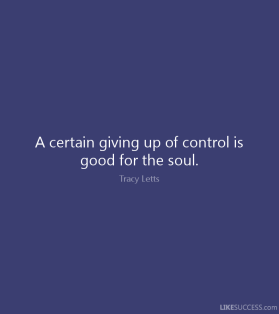
The hardest part of teaching for me is letting go. It’s also been the best thing for my teaching.

To be an effective workshop teacher, we step aside so our students can step in. They want to know their opinions, ideas, and choices matter. They’re hungry for it. We’ve written a lot about choice reading on this blog, and I know many of us advocate for self-selected independent reading, protecting sacred reading time like an O line protecting our quarterbacks.

I wonder what other choices we offer our students. How else do we invite them to own their learning?

Recently, I read this post “The Inspiration in Front of Your Eyes” by George Couros. He begins:

Often when working with educators, I try to give relevant examples of ideas that can be implemented into learning but get very specific to either a class or grade level.  My focus is not adding something to the plate of an educator but replacing something they currently do with something new and better than what they may have been doing before.  For example, instead of a teacher spending hours searching a video to explain a concept in math, or even creating it themselves, why not have the students find the concept and say why it is powerful, or having the students create some form of multimedia to explain the concept themselves? The flip is putting the learning into the student’s hands, which can lessen the work for the educator.

Deeper learning for the student, less work for the teacher.  Sounds good to me!

Couros goes on to explain the importance of being observant and connecting ideas we find in the world, and reshaping them to facilitate deeper learning for our students. Of course, this resonated. This is how we find mentor texts like author bios and user manuals. But Mr. Couros got me thinking about shifting the finding to my students.

Then before school a week ago Monday, I saw Kristen Ziemke‘s Padlet, Take a Knee. And I got another spark to shift my instruction.

I’d never used Padlet before, so while my students shuffled in to first period, I quickly made an account and created a board. I put one thing on it:  Kwame Alexander’s poem, Take a Knee, which I knew was the perfect quickwrite for the day after so many NFL players knelt in protest.

After we wrote and shared and talked in small groups and as a class about the issue. One student said, “I just don’t know enough about it to know what I believe.”

The perfect intro!

I suggested we make a text set that could help us understand the why’s and who’s and what’s of this hotbed of a topic, and I issued the challenge:  As a class of individuals with a wide variety of beliefs and backgrounds, we’d search for articles that would address all sides. We’d use Padlet as our storage space. Then we’d use the text set we build together for our learning in class.

With their phones and iPads, students went to work, and in the 10 minutes I gave them in class, they talked. Students talked about where to find information that “wasn’t biased,” “would tell them the truth,” “will help me want to know more.”

I leaned in to these conversations, teaching terms, suggesting sites, encouraging objectivity — and why it is important for our understanding of human needs and desires.

Our Padlet What’s the Argument is not complete. We haven’t had a chance to return to it yet, but we will. Maybe we’ll use it as we learn to ask better questions in preparation for whole class discussions. Maybe we’ll use it as we learn to synthesize information from a variety of sources. Maybe we’ll use it to spark ideas for the arguments we’ll post on our blogs. It doesn’t matter.

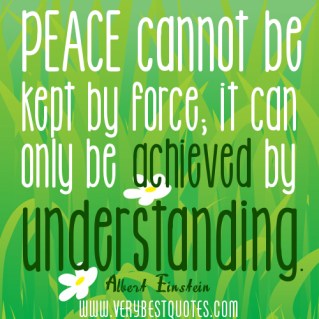
When we return to our Padlet, or even create another one that coincides with whatever peace-cannot-be-kept-by-force-it-can-only-be-achieved-by-understandinghotbed topic fires up the nation (sadly, there are so many), my students will know I value their input. They’ll know that helping them make sense of our world is as important to me as helping them love books and become good writers.

And maybe they’ll remember to look at all sides of the issues, to see into the hearts and minds of those we may disagree with so we can find a space for conversations.

If my giving up control makes space for that, I’ll take it every chance I get.

What ideas to do have to flip the learning into students’ hands, let go of control, and invite deeper learning? Please share in the comments.

Amy Rasmussen is a neat freak in her classroom but not her bedroom closet. She loves sharing books with student readers and reading students’ writing. She is the mother of six, grandmother to five, and wife to one very patient man. She teaches senior English and AP English Language at a huge and lovely senior high school in North Texas. Follow her on Twitter @amyrass

#TwitterTeacher

I’m late to the party. This I know. But my enthusiasm for this soirée is genuine, and it fueled some of my first day success.

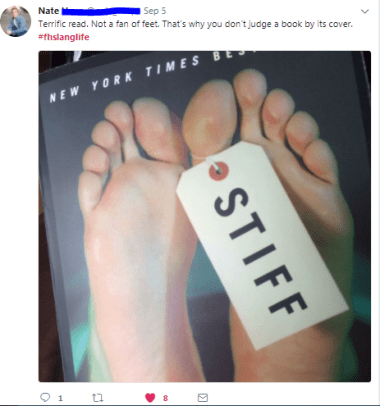
In an effort to build community as quickly as possible this school year, and to get to know our students a bit over the summer, my colleague Sarah Sterbin and I decided to add some technological play to our AP Language summer homework. Using the hashtag #fhslanglife, students were asked to share their reading life twitter4throughout the summer.

They could snap photos of their trips to the bookstore, their feet in the sand and a book in their hands, and their smiling faces reading the summer away.

They could quip about quotes from required and choice reading, make suggestions to peers on what to read next, comment on the insights of others, follow my reading adventures, and the list goes on.

As often happens with open ended assignments, we got a wide variety of participation. Tweets ebbed and flowed throughout the summer, but each time a student posted, I made it a priority to comment, retweet, like, and/or tag an author to promote connections across the world of reading. When Ishmael Beah, Allen Eskens, and Matthew Desmond interact with your students over the summer, I call that a solid win for starting to build readers and a community with enthusiasm around reading.

twitter5

On the very first day of school, and in the few days that followed, as we quickly collected summer work, set down to work with a quick writes, set up writers’ notebooks, organized editorial speeches for our first speaking opportunity, and took in the surroundings of our room, I asked students to use our hashtag to share their excitement about the work ahead. I love what they chose to share.

twitter3twitter1twitter 2twitter6

Tweeting is a quick and easy way to build community. I sometimes display current tweets our daily PowerPoint/Syllabus to keep the movement afoot, and I love to hear students’ reactions as they come in the room to see their humor, insights, and recommendations on the big screen.

Twitter

How do you use social media to promote reading and writing lives? Please leave your brilliant ideas in the comments below!


Lisa Dennis teaches English and leads a department of incredible English educators at Franklin High School near Milwaukee. Her latest tweet suggests that she thinks about reading 24/7. Follow Lisa on Twitter @LDennibaum 

Inviting Controversy, and Often

“If you could, keep any type of content that has to do with race and gender possibly politics out of any classroom discussion, videos, papersor anything of that sort. Its very controversial. . . It’s very debatable , especially when we have different values/ethics on subjects .”

If you can look past all the errors, perhaps you can see why this student’s message cut into my brain a bit. I invite open dialogue, so that a student felt comfortable emailing me with such a request took some of the edge off. Some. Of. It.

But really?!

Once my heart slowed a bit, and I got over the audacity of this child (Can you even imagine telling a teacher what is and is not appropriate to discuss in class?) I realized one important thing:  I am right on target.

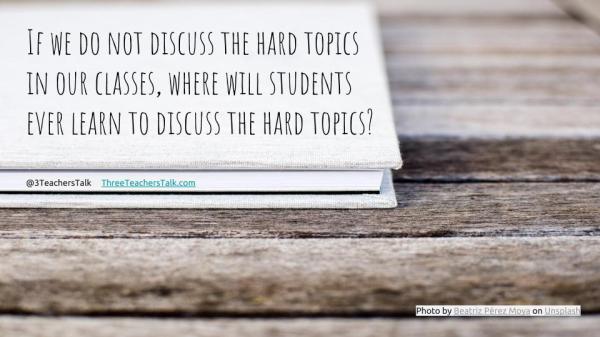
Hard TopicsIf we do not discuss the hard topics in our classes, where will students ever learn to discuss the hard topics? Sure, we can hope they debate social, economic, and political issues in their homes, but we know many families do not have meals together much less conversations. And it’s the conversations, varied and diverse, that can help us view the world in a different light — sometimes a cleaner, clearer, more empathetic and compassionate light. I think we need more of this light.

Here’s part of my response:

I appreciate your concern about controversial topics; however, English is a humanities class, and as such, we should learn about the humanities. That means all the messy topics that make us human. We should invite controversial topics into the classroom. The classroom becomes a microcosm of the world outside of school. If we cannot learn to discuss and debate in polite conversation here, how can we expect to ever discuss and debate politely as adults?

I see it as my job to be sure we think and feel and share as individuals with diverse backgrounds, cultures, and interests. I will continue to use texts, including poems, that give us voice to our lives and thinking.

Side note:  The poems in question were ones I shared as quickwrite prompts to spark thinking for the college application essays students would soon begin writing, “Raised by Women” by Kelly Norman Ellis and “Facts about Myself” by Tucker Bryant. I still don’t see the controversy.

Yesterday I saw a post on a Facebook group I follow where ELA teachers often ask for help. One person posted:  “One of my students challenged me today to include more literature that is relevant to what they are seeing in the world right now. . . What should I include?”

I refrained from responding:  EVERYTHING in my Twitter feed.

We all know the importance of helping students see the relevance in the texts we study, and I don’t know the context of that student’s request, but I wonder if sometimes students believe relevance means:  reflects what I already believe and feel, instead of: often challenges what I already think and feel.

Maybe we need to do a better job of explaining why we must challenge our own beliefs, get out of our echo chambers, and at least acknowledge the opinions of those who differ from our own.

Maybe I failed my student because I didn’t explain enough at the get go.

Today he got his schedule changed. Right after I found this infographic, an argument for the humanities.

We’ll study it in class real soon — after we discuss Jared Kushner’s Harvard Admissions Essay and finish writing our own. (See what I did there?) Then we’ll brainstorm the most debatable topics we can think of — DACA, Black Lives Matter, Confederate monuments, everything A Handmaid’s Tale, gender rights, gay rights, women’s rights, and more rights– and engage in the critical, and oh, so vital discussions that help us understand what it means to be human.

How do you invite these critical conversations into your classroom instruction? Please share in the comments.

Amy Rasmussen is a trouble-maker. Tell her not to do something, and she will do it — especially if it leads to expanding the minds and improving the learning experiences of today’s youth. She teaches Humanities/AP Language and Composition and senior English at a large, diverse, and truly wonderful high school in North TX. Her hobbies are searching for controversial topics that spark debate, reading and sharing banned books, and challenging the status quo. And she loves the readers of this blog. Follow Amy on Twitter @amyrass and @3TeachersTalk; and please join the conversation over on Facebook at Three Teachers Talk.

3 Ideas for Better Book Talks

I should have written this post yesterday. Yesterday was 9/11, and I always try to incorporate some lesson about the events, emotions, and effects of that day into whatever our focus is in class. It’s important we always remember.

My students are juniors and seniors. 9/11 is history to them, and few of my students like to read historical fiction. They choose YA off of my “Teen Angst,” “There Might Be Kissing,” and “You Just Can’t Get Over It” shelves most often. (I suppose most of the books I book talked today fit in that last category though. I’ll be moving a few later.)

Without really meaning to, I shared three books with students on Monday in three different ways. Thus, the idea for this post on engaging students in reading by mixing up our book talks.

  1. Read a poignant, exciting, or particularly intriguing passage from a book.

Over the weekend, I read The Memory of Things by Gae Polisner. I found this a touching story about love and loss and resilience — all topics my students can relate to. What does it mean to be responsible? How do we fight our fears and struggle through the tragedies that terrify us?

In my book talk, I spoke about the characters in the book:  a young man trying to prove his worth to his dad, and a young woman who we learn is in conflict with hers — both struggling with the realities in NYC on the tragic Tuesday of 9/11.

I read the first few paragraphs aloud:

“I move with the crowd, away from downtown Manhattan.

We travel swiftly but don’t run, panicked but steady, a molten lava flow of bodies across the bridge.

A crash of thunder erupts–another explosion?–and the flow startles and quickens. Someone near me starts to cry, a choked, gasping sound, soon muted by a new wail of sirens rising at my back.

I stop and turn, stare frozen. People rush past me:  faces twisted with shock and fear, mouths held open in O’s, others only eyes where their noses and mouths have been covered with knotted sleeves against the toxic, burning reek.

I search fro Kristen or Kelly, or Mr. Bell, but I lost them all as soon as we got to the bridge.

I don’t see anyone I know from school.

I don’t see anyone I know.

I press my sleeve to my nose– Don’t think, Kyle, just move!–but feel stuck gaping at the place where the city has vanished beyond the thick brown wall of smoke.

Two planes have hit, one building is down, and my dad is in their somewhere.”

There’s a lesson in imagery in there I may return to sometime. We are writing narratives right now, so I bookmarked this for later. For now, it’s a good teaser and an effective book talk.

2. Show a movie trailer — but play up on how the book is always better.

My students love videos. They admit to spending their entire lives on YouTube, so any chance I get to show a video clip I take.

If you’ve read Extremely Loud and Incredibly Close, maybe you feel like I do about the movie:  I loved it, but the book just gives us so much more detail, description, characters, and craft to love. Oh, how I love the craft in this book by Jonathan Safron Foer.

For my book talk, I first flipped through the book, showing student how Foer plays with white space, page markings, and photo essays — all which play into how he develops the plot and constructs meaning. I talked about the parallel plot line and how the movie makers diminish, change even, the important second storyline. I explained how this book taught me more about author’s craft than anything I’ve ever read. Then, I showed the movie trailer.

(Book trailers work as effective book talks, too. You’ll find a bunch here and here and here. We even have a few ideas about book trailers in our archives on this blog.)

  1. Use a passage as a quick write prompt or as a craft study. 

Have you read The Red Bandanna: A Life, a Choice, A Legacy by Tom Rinaldi? Just a few pages in, and your heart will swell.

As I read the books I know I will share with my readers, I mark passages that make me think and feel. Important moves for any reader. I model these moves as I share books and writing ideas with my students. This passage from The Red Bandanna tears me to shreds every time.

The Red Bandana

In my senior English classes, I talked about the heroics of Welles Crowther, the main character in the book, and then students wrote in response to the questions:  What do you carry, what truth could it possibly contain? What meaning could it hold?

In my AP Language class, we talked in our groups about the word choice, the interesting syntax, the tone, and then students wrote their answers to those questions, trying to imitate the writer’s rhythm and descriptive language.

In all my classes, we talked about 9/11, our thoughts, our feelings, and why they matter to the lives we live now. We made connections to texts and to one another as we shared our thinking and our writing. That to me is an added bonus of an effective book talk.

I know my students will read more the more I talk about books. I am the salesperson, and they are the often skeptical customer. I’ve learned that mixing up how I talk about books matters.

And getting students interested in reading pretty much anything these days matters most of all.

Do you have ideas on mixing up our book talks? Please leave your ideas in the comments.

Amy Rasmussen loves to read, watch movies with her husband, and tickle her five grandchildren. She’s in the market for a lake house and likes to shop thrift stores for books and bargain furniture. Someday she’ll be disciplined enough to write a book about teaching. For now, she teaches senior English and AP Lang and Comp at her favorite high school in North TX. Follow Amy on Twitter @amyrass, and please, go ahead and follow this blog.

Want to RENEW! Get the book by @ShawnaCoppola

I have never written a book review. (Okay, maybe that’s not true. I think I remember writing one in 4th grade over a biography of Marie Curie, the first biography I ever read.)

I have never written a review of a teaching book. But I am going to try.

I am a teaching book junkie. I have stacks of them, but I rarely read the whole of them. I cannot even tell you why, and I admit there is great irony here because as I write this, I am also trying to write my own book for teachers (I have been for four years, sigh.) If I ever get it written, I hope you’ll read it.

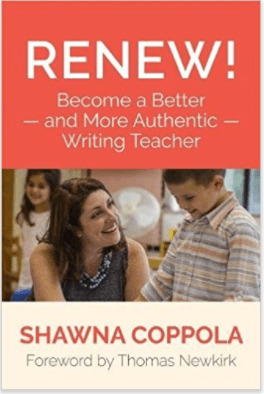
In the mean time, I have to tell you about Shawna Coppola’s new book RENEW!

I read the whole of this book in one afternoon! Thank you, Shawna, for writing so much of my own thinking about “Becoming a Better — and More Authentic — Writing Teacher.”

Shawna’s voice sings with passion and positivity. She paints the pages with possibilities! I know, I am gushing (and that’s probably too many p’s.) But here’s the thing —

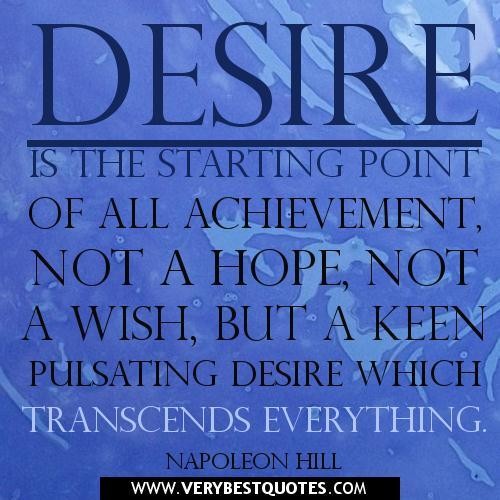
I know so many ELA teachers who do know know how to teach writing. I know many more who are not confident teaching writing. I know even more who are not writers themselves, so it’s no wonder that teaching writing is difficult. Teaching writing is hard. A book like RENEW! not only gives us a starting place, it gives us desire.

desire-is-the-starting-point-of-all-achievement-not-a-hope-not-a-wish-but-a-keen-pulsating-desire-which-transcends-everything-napoleon-hill

I am doing a lot of thinking lately around the idea of transcending. How do we go beyond our limits into something more, something better, something real and sustaining?

Let me share with you some of the passages I marked in RENEW!. I think you’ll see why this book is a must read for any teacher who needs a bit, or a lot, of renewal when it comes to teaching students to write.

“. . . if we are truly willing to honor the individuality of our student writers, the RENEW!uniqueness of each community of learners, and the ever-changing nature of our global landscape, we must continually rethink, revise, and renew our practice. Otherwise — to paraphrase Dewey — we rob “today’s students of the tomorrow today’s students deserve” (10).

“Broadening our ideas about what writing “is” can be scary, as if we are opening up a Pandora’s box. But in all reality, continuing to teach our student writers through a narrow, outdated lens — one that, in overvaluing written composition, does not accurately tell a story about the world of writing beyond most schools and classrooms — harms their development as writers by limiting the kinds of composing they are exposed to and encouraged to practice” (51).

“Teaching our writers how to develop their own tools is infinitely more sustainable than using preexisting tools. Quick survey:  How many of you use the graphic organizer your sixth-grade teacher taught you to use to write a persuasive piece? That graphic organizer may have been helpful to you then (although I doubt it was helpful to 100 percent of your classmates), but how useful is it you now?” (62).

“What message or “story” are we sending our student writers with a single overall score? Not only does it imply that their worth as a writer can be whittled down to one letter or number (which itself can mean different things for different teachers and even within different units of study), but that the worth of writing itself can be whittled down this way” (73).

“. . . readers of writing are human, an done person’s response to a composition may not perfectly align with another’s (If it did, what a drab, boring world we’d be living in!)” (79).

“Which is more likely to help students learn:  offering them specific feedback about their work, behavior, or performance, or slapping a score on a piece of paper?” (82).

“. . .when we engage in a semi-regular habit of writing, we can much more genuinely speak to those incredibly fantastic moments that writers experience on occasion, like the amazing feeling of completing a particularly difficult draft or writing something that makes a reader spontaneously laugh out loud. Anyone who’s ever taught a group of students of any age knows that when we are faking our way through something, or at the very least “phoning it in” by only engaging on a superficial level with what we are purporting to teach, students can smell our lack of authenticity a mile away. They know, even subconsciously, that they are being sold a decidedly moldy bill of goods” (92).

That’s all well and good, right? But here’s the beauty of Shawna Coppola’s book — she gives us the research that supports each of her positions AND she gives charts and graphs and resources to help us rethink, revise, and renew our approach, instruction, and practice as we become better teachers of writing. This book is chock full of everything good when it comes to writing instruction. It is a book I will return to again and again.

I hope you’ll read it. I hope you’ll share it with every ELA teacher you know. Really, it is just that good.


Amy Rasmussen lives in north Texas and teaches AP English Language and English 4 (new prep in ’17.) She loves talking books, daughters’ weddings (two this year), and grandbabies (five). She also loves facilitating PD for other teachers making the move into a workshop pedagogy. Amy adheres to the words of Emerson: “We aim above the mark to hit the mark,” and Jesus: “Love one another.” Imagine a world if we all aim higher. Follow Amy on Twitter @amyrass. And she really hopes you will follow this blog!

Thinking Differently to Do More Thinking

I think most teachers would agree, no matter our content, our number one goal is to help students develop as critical thinkers. And in a world where technology rules much of their lives, impatience governs their actions, and emotions overcrowd the adolescent brain, this can be daunting.

We must keep trying.

Every day we see see headlines spouting fake news, and more and more we see headlines shouting “This news is fake.” We see sites on how to spot fake news, and analyze fake news. We have access to lessons on fake news — Google “lessons on fake news, and you’ll find 5,250,000 resources. We even see the hashtag #fakenews (a fabulous lesson on paradox btw).

A few months ago I read this article at Forbes. Then clicked through and read this one at BuzzFeed. I shared them with my students. We had an interesting discussion, but one comment left me thinking:  “So, basically, everyone’s making stuff up. How are we supposed to believe anything?”

If we are not helping our students find answers to this question, we are doing a disservice to our students — and by extension a disservice to ourselves. What kind of world will we grow old in if we do not help the students in our classrooms today, determine fact from fiction, identify bias, value diversity of thought, be open to new ideas, support their opinions, and seek to understand before passing judgment?

First, we have to be willing to step outside our comfort zones and seek to understand other perspectives. (If you haven’t seen Outside Your Bubble, it’s an interesting starting place.)

Plato

Next, we must school ourselves on rhetoric. And then, we must weave it more overtly into all aspects of our instruction.

As English teachers, we have a prime opportunity:  let go of the nine weeks novel study where we focus on characters, conflict, plot, and theme. Bring in speeches and essays and news articles that invite discussion about the use of language. At the very least balance the study of both.

A few weeks ago a group of teachers from a neighboring district visited my classroom. They observed as my students and I read two blog posts about the Fearless Girl and the Raging Bull statues: Seriously, the guy has a point, and an opposing view, No, the Wall St. Bull Sculptor Doesn’t Have a Point. The discussion was rich. The thinking was richer.

At the end of the class, I chatted with these teachers. We talked about the routines in my workshop classroom, the book talks I conducted, the way I transitioned from one thing to the next. Then, the conversation turned to novels. One teacher asked how long I spend on novels. I don’t. I responded. My students read novels in book clubs where they facilitate the discussion. They talk of plot and themes and author’s craft. They bring meaning to the text, based on their experiences reading the books. (I am not opposed to novels. I am opposed to spending too much time on them.)

I hesitate to challenge anyone on what they do in their classrooms. I do not know their students. I do not know their routines or their motivations, the goals they hope to accomplish as they instruct their students, or the limitations put on them by mandated curriculum.

I do challenge the idea that studying a novel for “a long time” like this teacher told me, is a valuable use of the limited time we have with our students. Our students’ need to navigate the language of their world is too great to spend week after week with a book “they really like” that “I read to them.” We must put the focus on the needs of the reader and not the book.

What our students need right now — what our country needs right now — is critical thinking around a wide variety of texts. We need a focus on how language works to persuade and to manipulate and to cause outrage. Really, that’s our best, and maybe, our only hope.

As we go into summer (I’ve got three days left), I hope we will think about how we might shift our thinking about the needs of our learners. As we read by the pool, vacation with family, attend conferences and trainings, work our part-time jobs, I hope we will think about language and how it can either make or break the communication that is so vital to a society, a society that will thrive on diversity, respect individuality, and foster empathy and productivity.

Teacher friends, that is our job. And I think it’s our duty.

Amy Rasmussen lives in north Texas and teaches AP English Language and English 3. She loves talking books, daughters’ weddings (two this year), and grandbabies. Facilitating PD for other teachers making the move into a workshop pedagogy keeps her focused on her own learning. Amy adheres to the words of Emerson: “We aim above the mark to hit the mark,” and Jesus: “Love one another.” Imagine a world if we all aim higher. Follow Amy on Twitter @amyrass.