Tag Archives: teaching

Students Who Write by Ear by Amy Estersohn– an #NCTE17 Preview

The following is a sample of what I’ll be presenting with Three Teachers Talk at #NCTE17, session C.26, Friday at 12:30, room 274.

Tom Newkirk’s book, Minds Made for Stories, encouraged me to think about students as natural storytellers.

So I dug through their writers’ notebooks to see storytelling in action. During my dig, I wasn’t looking for detail or dialogue or finished pieces.  I wasn’t reading for apostrophes or paragraphing or numbered and dated pages, either.  I instead wanted to know where writers were already practicing storytelling, and what tools and strategies they were already using.

One the ways I noticed that student writers tell stories is that they listen to their inner ear.  This emerged when I read half-baked, quarter-finished crime stories where a student could hear a bought cop addressing a group of criminals.  I noticed it when I heard a writer list the annoying sayings her mother used.  I noticed it again when writers took on a Ken Burns-ish important-sounding narrative voice to discuss an important world issue.

Some students can really hear when they write.

So the first thing I did was I turned that observation back to the students: did you notice how you hear the character in this section?  That observation then became an expectation.  In your writing, you should be able to hear your character or narrator speaking.  When you revise, ask yourself if you still hear your characters or your narrators.  If you don’t, mark the text for a future revision.

There are also ways that writers can practice hearing stories.  The easiest way is just to choose a good piece to read out loud to the class.  For middle school, I’d recommend the first few pages of a Kate DiCamillo’s Because of Winn Dixie or Jason Reynolds’ Ghost.   For high school, I’d probably choose a text like Laurie Halse Anderson’s Speak or A.S. King’s Glory O’Brien’s History of the Future.  You can read the book in your voice or cue up the audiobook, and ask students to discuss what they noticed and then practice some imitations.

You can also invite students to imitate characters they already know.   It’s always fun to try to imitate a sibling’s voice or a young child’s voice.  I invited students to imitate boastful and outrageous LaVar Ball, a parent of an NBA player, after I provided examples of what he has said.  Students embraced the opportunity to play around with LaVar’s voice in their writers’ notebooks.

AmEstudent notebook

Another idea would be to collect some of the voices of nonfiction: this includes Deborah Heiligman’s Vincent and Theo, Candace Fleming’s Giant Squid, some Mary Roach, and whatever nearby textbook or magazine is in sight.  Work backward: what do these voices sound like?  Whom do I imagine is telling me this story?

I could even see students doing multimedia work with voice by tape recording themselves.

I’m going to assume for a moment that teaching voice is probably not new to you.  But what might be new is teaching voice and playing with voice as an element of storytelling instead of housing it within a certain genre or a certain unit.

Will you be at #NCTE17?

Sarah Raises Hand

I hope to see you there!


Amy Estersohn is a middle school English teacher in New York.  She writes book reviews at teachingtransition.wordpress.com and is deeeeeelighted to serve on the CYBILS book award committee for middle grade fiction.  


Ready or Not, #NCTE17, Here We Come

Sometimes November is too much fun.

I keep telling myself that as I plan for my six children, two new son-in-laws, and five little grandkiddos to come home for Thanksgiving — not two or three days after I get a good night’s sleep and recover from the extraordinary time I expect to have at NCTE this week — but one, less than 24 hours!

Oh, I am excited. No question about that. There is nothing like family for the holidays, especially my big and boisterous one. But the getting ready? Just a little crazy.

I already know my refrigerator is not big enough, and I don’t have enough beds. (How can I put my daughters’ new husbands on the floor? Would their mothers put my daughters on the floor?) I’ve been on a mad hunt, shopping on Facebook Marketplace, for enough beds. Thank God I live in a huge metroplex with lots of people selling lots of stuff.

I won’t even mention how my sweet husband decided we needed new carpet, which if you’ve ever done that deal in a small home packed with 32 years of “Oh, I might need that” you know what an exhausting move-and-shove-and-throw-that-out time that is.

So, all that to say this:  Who is ready for NCTE?

My heart is, but my head is not. Neither are my presentations. (Did you notice that s? I did it to myself: I’ve got THREE. NCTE with this 3TT writing team, a 5 minute Ignite spiel, and my first ever CEL.) Shana’s promised to remind me how I feel right now when proposals come due for 2018. Frantic does not quite cover it. Can I take another day off? I just took off Friday. Instead of putting slides together, I bought a trundle bed.

If you will be in St. Louis, I hope you will find me. Flag me down. Wave across the room. Introduce yourself. Come to one of my sessions and say, “Hi!” Shake my hand or give me a hug. I could use a hug or two or twelve.

Reclaiming Narrative and Amplifying Our Voices_ Using Story to Invite Fearless Inquiry and Intellectual Challenge for Our Students and Ourselves

NCTE is my favorite conference. It fuels me for the whole year. I cannot wait to get there.

I remember the first session I attended at NCTE last year — a Thursday workshop tribute to Thomas Newkirk. So many of the teacher leaders I admire spoke on how Tom’s work has influenced and strengthened their’s: Tom Romano, Jeff Wilhelm, Penny Kittle and so many others.

Tom’s been a blessing to my work, too. I am a better teacher and a better person because I know Tom Newkirk. Penny Kittle told me once, “Tom is the smartest person I know.” I have to agree. He is so wise. He is kind, too.

Tom Newkirk is our session chair!

Writing that out still gives me a thrill. (I refuse to call it pressure. Tom Newkirk will be listening to us talk about narrative. HE IS AN EXPERT ON NARRATIVE! He wrote a book about narrative! Okay, maybe a little pressure.)

So, all this to say:  Who is ready for NCTE?

I will be.


Are you ready? What are you most excited about at NCTE? Please share in the comments.

Amy Rasmussen is not usually a procrastinator. She keeps lists so she can mark things off lists. Someday soon she will get her act together — certainly before 12:30 on Friday. Amy teaches AP Lang and English IV at a large senior high in north TX. Follow her @amyrass and @3TeachersTalk.

Please, Add Your Questions about Narrative– #3TTchat tonight 8ET/7CT

Last week I asked my students the same question I often ask teachers when I facilitate professional development workshops:  What do students today need?

My students talked in their table groups and then shared their ideas. Most said in one way or another:  We need to feel validated and to share our voices.

I don’t know of a better way to accomplish both then by infusing narrative into every aspect of my teaching.

Tonight is our inaugural #3TTchat with our guest Tom Newkirk, author of Minds Made for Stories and the new book Embarrassment: And the Emotional Underlife of Learning (among others).

Screen Shot 2017-10-23 at 6.02.59 AM

If you are a regular reader of this blog, you’ve certainly noticed we’ve focused on narrative, specifically Newkirk’s books, lately. I wrote about how teaching itself embraces the drama of story and later shared some of the quotes that resonated enough to change the way I talk about writing with my students — and the way I teach it. Lisa shared her beautiful argument Narrative Writing: Giving Voice to the Stories that Matter Most.

We are shoulders deep into planning our session for NCTE:  Reclaiming Narrative and Amplifying our Voices:  Using Story to Invite Fearless Inquiry and Intellectual Challenge for Our Students and Ourselves. (We present Friday at 12:30. We hope you will come!)

If you haven’t had a chance to read Tom’s books, we hope you will still join us as we chat with him on Twitter. And if you have some time between now and then, or any time really, perhaps you’ll find value in this Heinemann podcast with Tom about Embarrassment and how it is the “true enemy of learning,” or a sample chapter of Minds Made for Stories. You’ll see why we at Three Teachers Talk have made such a fuss.

In preparation for our chat tonight — and for our presentation at NCTE, we’d love for you to ask some questions about infusing narrative into our teaching practices, or just share with us some of your favorite ideas or best experiences with students and narrative reading or writing. We’d love to include you in the conversation tonight and in St. Louis at #NCTE17.

While you’re thinking:  This is the quick write my students and I will write today: What’s your story?

18 Quotes & a Call for Connection

We all know the value of mentor texts. We use them for read alouds, to model thinking, to dig deep and find meaning, to teach an author’s moves, sentence structure, and more. Some of us collect them, storing them safely among other valuable collections.  We keep a stash for studying craft, earmarking books in the hopes of remembering why we saved that page for later.

I have 11.8K tweets “liked” –many saved to read later and think about how I can share them with my readers and writers. I am a constant planner.

I also have a constant need for connection and a way to grow. Maybe that’s why Twitter swallowed me when I first signed on in 2011. Even my children, teenagers then, complained I was “always on the iPad.”

Sometimes it helps to take a step back. Evaluate our surroundings. Get a better grip.

Awhile ago I learned a thing or two about myself. I learned what drives me. Tony Robbins has a TED Talk called Why We Do What We Do I found helpful, as did this quiz What is your driving force? (I’ve shared both with students, and we’ve had interesting and insightful conversations.)

My driving needs are connection and growth. No wonder I have an obsession with mentors. No wonder I like to write and share what I learn and how I teach. No wonder I like you to read this blog and to share what you learn and how you teach. You are my Personal Learning Connection.

Screen Shot 2017-10-23 at 10.21.54 PM

Sometimes teachers get lucky. We work in departments that feed our needs. We find colleagues in Facebook groups and Twitter feeds. We reach out to living mentor texts (Shana coined that term a few years ago) who help us reach higher toward the goals we set for ourselves.

I am blessed to have many living mentor texts. My colleagues on this blog for sure. (We have an ongoing WhatsApp chat that keeps us grounded and sane. Mostly.) And many of you readers who’ve reached out with questions in emails, trusting that I might have answers for your questions. You’ve mentored me, too.

I am blessed to call Penny Kittle and Donalyn Miller both friends and mentors. They’ve shaped me in too many ways to say. There’s Katie Wood Ray and Tom Romano (thanks to Shana’s friendship) who’ve shared experiences and stories over meals at NCTE. There’s all the teacher-writers of the stacks of professional books that weigh down the shelves nearest my desk in my classroom and my bed. They mentor with each page.

And there’s Tom Newkirk — who, as Penny put it, is “the smartest man I know.” I met Tom at the UNH Literacy Institute when Shana, Jackie, and I took his class on Boys and Literacy. He is caring, kind, and oh, so brilliant. When I read his books, I feel his passion for literacy and learning — and I feel smarter.

I wrote last week about teaching as if teaching is story, thoughts that sparked while reading Minds Made for Stories. The sparks continue.

Three Teachers Talk will present at NCTE on Friday, November 17 at 12:30 pm. We titled our session: “Reclaiming Narrative and Amplifying Our Voices: Using Story to Invite Fearless Inquiry and Intellectual Challenge for Our Students and Ourselves.” Tom Newkirk is our chair. How amazing is that?

In preparation for our our presentation, Tom’s agreed to join us for the first ever #3TTchat on Twitter, Monday, October 30 at 8ET/7CT. We will discuss the power of narrative in all types of writing as explained in Minds Made for Stories — and Tom’s new book Embarrassment:  And the Emotional Underlife of Learning

I pulled some quotes from Minds Made for Stories last night in prep for that chat. I think you’ll see the genius in Tom’s thinking and what it can do for us as reading and writing teachers. I thank Tom, a true living mentor text, for shifting my thinking about the way I talk about writing with my students, the way I view writing with my students. The way I teach writing.

From Part I of Minds Made for Stories:

“[Narrative] is the “mother of all modes,” a powerful and innate form of understanding” (6).

“Narrative is there to help us “compose” ourselves when we meet difficulty or loss. It is there to ground abstract ideas, to help us see the pattern in a set of numerical data, to illuminate the human consequences of political action. It is home base” (5).

“Photosynthesis is a story; climate change is a story; cancer is a story, with antecedents and consequences. To the extent these phenomena can be told as stories, readers will have a better chance of taking in the information” (11).

“We don’t read extended texts through sheer grit, but we are carried along by some pattern the writer creates. Even if our goal is to learn information, we don’t do that well if that information is not connected in some way — and as humans the connection we crave is narrative” (13).

“. . . the ‘hamburger’ format with the opening and closing paragraphs being the two buns and the body being the meat. . . is a disservice to students, and to nonfiction writing, but also an insult to hamburgers. . .” (16).

“. . . when we strip human motives from our teaching, I suspect we make learning harder and not easier” (17).

“Nonfiction. . .is all about moves, motion through time. Not static structures” (17).

“Even writing that takes a form we would not call narrative (e.g., the lab report) still is built on narrative, a causal understanding of the world that is as basic to us as, well, our intestines. This claim is true for even the most specialized academic writing; even research reports must tell a story” (19).

“[Narrative] is part of our deep structure as human beings” (27).

“If we view [narrative] as a deep structure of thinking and understanding, it affects all discourse and plays a much bigger role; we have literary minds, primed for story” (28)

“Yes, we need to teach students the conventions of various genres, and we can’t assume that because they can read and write fictional stories or autobiographical pieces that they can write arguments or reports. Only a magician would think that. But it does mean that the narrative thread, the anecdote, the story of human interest, the apt metaphor are crucial tools in all forms of discourse — as they speak to our need for causality and story. They form a deep structure” (28).

“Narrative is not a type of writing, or not merely a type of writing. It has deeper roots than that. It is a property of mind, an innate and indispensable form of understanding, as instinctive as our fear of falling, as our need for human company. Good writers know that and construct plots–itches to be scratched–that sustain us as readers. We are always asking, “What’s the story?” (34).

#3TTchat-2

“Voice is a constant, a human presence, a sensibility, a character, a narrator and guide” (38).

“Openings should be read very slowly, reread if possible. So much is happening. So many commitments are being made–which is why writers often find them so nerve-racking to write. Openings establish the topic, suggest the problem to be examined, convey sense of the narration and tone of the piece, risking at any millisecond that the reader will go elsewhere” (42).

“. . .in all analytical writing there needs to be conflicting perspectives, contending solutions, weaknesses and strengths, even good guys and bad guys. If these positions can be attached to spokespersons, so much the better. Writing is dialogic, involving multiple voices, orchestrated by the author. To comprehend a text is to be attuned to this conflict” (42).

#3TTchat-3

“I am not contending that literary analysis or argument looks like narrative fiction. But arguments that sustain reading must have a dramatic core, a plot. Like a good piece of music, there needs to a be a pattern of tension and resolution, problem and solution, anticipation and fulfillment. When done well, the sensation of reading doesn’t feel like we are working in a tightly contained form, tyrannized by a thesis, the stern father who sits at the head of the table and rules over all. Rather, we feel a mind at work; the sensation is of a journey that may take us to a thesis but invites new questions along the way” (49).


I hope you will join us in our Twitter chat next Monday. Let’s value our connections and share our stories as teachers, writers, and individuals striving to learn and grow and change for the betterment of our students and ourselves. Let’s celebrate the learning we’ve experienced with our students this fall.

We need to be living mentor texts for one another.

This work is hard. When we connect and share, we make it easier.

We already know it is worth it.

Amy Rasmussen connects with friends on Twitter @amyrass and @3TeachersTalk and on Facebook and Instagram. She’d also like to connect her students’ blogs to yours — wouldn’t it be great if they read and commented on each others’ writing? (Email amyprasmussen@yahoo.com if interested.) Amy teaches senior English and AP Language at a large senior high school in Lewisville, TX (Go Farmers!). 

What if We Teach as if Teaching is a Story?

Sometimes I feel like a fraud. I spend all this time thinking, talking, teaching, and writing about workshop, and I love it, honestly– but sometimes teaching beats me up. You know?

Students ignore my feedback on their writing. They refuse to capitalize their i’s. They grab a random book off the shelf during reading time, thinking I won’t notice. They lie.

And usually I shake it off, tighten up the gloves, push off the ropes, and go for another round. But sometimes I don’t wanna.

When I get like this, and thankfully, it’s not too often, I have to stop and remind myself I possibleam teaching children. Teenagers, yes, but still kids who are not intentionally trying to drive me to an early retirement. They just don’t feel the passion for books, reading, writing, and language like I do — yet. Many have played the game of school so long they don’t see that they could actually like it if they’d play a different way.

Teaching is a puzzle, isn’t it? That’s what makes responsive teaching so important. We have to keep trying so all students have the learning experiences they need to grow, to change, to become.

Last week I attended a professional development meeting with George Couros, author of the Innovator’s Mindset. I jotted tons of Couros’ quotes in my notebook, all important to the kind of teacher I keep striving to become:

“How do you cultivate questions of curiosity and not compliance?”

“Data driven is the stupidest term in education.”

“Your childhood is not their childhood. Nostalgia is what gets us stuck.”

“Relationships matter! Nobody in this room is as interesting as YouTube. If you are all about the content, you are already irrelevant.”

“You need to make the positives so loud that the negatives are hard to hear.”

“Would you want to spend the whole day learning in your own classroom?”

“Every day is where your legacy is created.”


I think the workshop classroom IS the innovator’s classroom. It’s process over product and the whole kit ‘n caboodle.

8-characteristics-of-the-innovators-mindset

We are the risk takers in Secondary ELA. We advocate for choice and challenge. We confer with students, reflecting on their needs and on our practice — maybe more than those teachers who reuse lesson packets with their novel studies. We improve our instruction by networking and sharing ideas on mentor texts (check out this thread), assessments, mini-lessons, and how to match students with the just right books. We start with questions and often end with them as well.

No wonder it is hard.

Lately, I’ve been rereading Tom Newkirk’s book Minds Made for Stories (3TT is presenting at #NCTE17 on narrative with Tom as our chair.), and I keep coming back to this little bit on page 43:

Two Absurdly Simple Rules for Reading and Writing

If we had to pass on advice, under the limitation of twitter characters, here would be my advice for writers and readers:

  1. Read as if it is a story.
  2. Write as if it is a story.

More than ninety characters to spare.

Now, what does that have to do with this post on one teacher’s weariness, some student attitudes, and workshop as innovator’s mindset? Maybe everything.

What if we teach as if teaching is a story?

Newkirk asserts, “Reading. . . is not a treasure hunt for the main idea; it is a journey we take with a writer.” He explains that in reading we seek patterns of anticipation, tension, and resolution. We seek experiences.  He states, “. . . it makes basic sense to read dramatically, even when what we read does not easily fall into any dramatic genre… we can dramatize just about any text. We can ask what is at stake. What problem, issue, “trouble” is prompting the writing? What needs to be solved? What are the contending positions or alternatives?” In reading we take action as we link ideas. “Good writing has a sense of motion, pace, anticipation, and . . . “plot.” Critical reading is all about friction–trouble” (44).

Newkirk asserts that this provocation is equally valuable in our own writing: “What situation . . .calls for explanation? What problem [will] my writing solve?” These questions imply “a need to have our say” in response to the “tension, a friction, a puzzle, and incompleteness” our questions provoke. He writes, “If we’re only saying, “Me, too” or “I agree,” endorsing what everyone believes, arguing for the obvious, making no “news,” there would be no call to continue the conversation. Nothing is caused” (44-45).

There’s so much more in this book by Newkirk, and maybe it’s a stretch to think of teaching as if teaching is a story, but try this little exercise:  read that bit from Tom’s book again through the lens of teaching instead of reading or writing. Do you see it?

Workshop teacher-friends, we are on a journey. Many of us take risks on our campuses, going against the norms of traditional practices, feeling the tension when we offer ideas in planning meetings. We feel the friction from students set in routines that have left them weak in literacy skill and lacking in desire. We cause friction. We generate energy. We dramatize everything we love about books and authors and reading. We foster stories of change as young people begin their own journeys into more robust reading and writing lives.

And when we think it’s not working, we must remember we asked for it. (I asked for it.) We “caused” because we care enough to take the path that leads to student growth. I’ll end with this by Newkirk:

“Our best chance to grow, perhaps our only chance, is to travel.”

Amy Rasmussen teaches AP Lang and senior English at Lewisville High School just north of Dallas. She loves to cause a bit of trouble, share her love of books (Have you read John Green’s new one yet? Sooo good!), go on long drives with her handsome husband, hug her grandkids, and share her passion for workshop instruction. Follow Amy on Twitter @amyrass and @3TeachersTalk — and if you’d like to contribute to Three Teachers Talk, send her an email, amyrasmussen7@gmail.com. We are looking for regular contributors.

On Substitutes in a RWWorkshop Classroom

We’ve all been there:

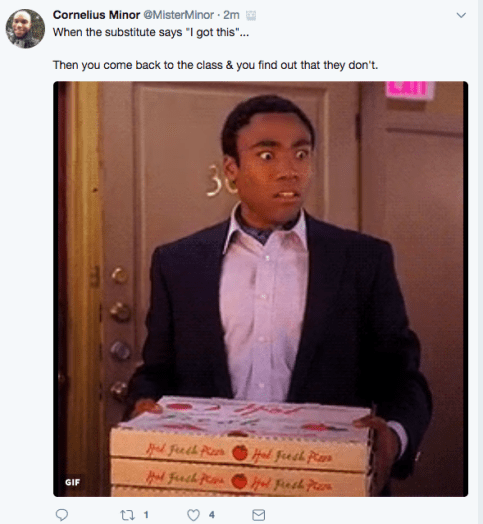
tweet by Mr Minor

If you don’t follow @MisterMinor, you’re missing out. He’s a master teacher, and a master at gifs. No justice in this screenshot.

We carefully craft lesson plans, sometimes with step-by-step instructions, and descriptions of each students’ temperament scrawled in the margins of our rosters; sometimes leaving flow charts to indicate transitions from activity to activity, hoping if are meticulous in our details, and we leave a timer, and sternly warn our students: “Be on your best behavior,” even just a bit of reading and writing will happen when we need a substitute.

When I first started teaching, it rarely did.

I’d never thought to write about a workshop classroom in the hands of a substitute until I got an email from a 2nd year teacher who is newly implementing workshop in her sophomore English classes. Just so happens I got her email the same day I saw Mr. Minor’s tweet.

My new friend wrote:  “How do you approach substitute plans? Do you chalk it up as a loss? Do you leave detailed plans with the idea that once students have developed routines, they should still be able to follow them with another adult in the room?”

If you know me, you know I never chalk anything up to a loss — even in the days when my precise plans didn’t work, I tried to save the day.

Sometimes it depends on the substitute. Just like pretty much everything, some are better than others. Sometimes we are just grateful someone picked up the call. Sometimes our substitutes are used to being left with crowd control, so they think that’s the job.

I speak from several years experience. When I returned to college to finish my degree, I substituted at my children’s high school. I loved the teachers who left me detailed plans, the teachers who held their students accountable for being on task when they were not physically in the classroom. I could always tell the teachers who had established rapport with their students, built relationships of trust, practiced routines, and set expectations for completing work while they were out. I substituted for five years –about half of the teachers I subbed for fit this category of awesome.

Effective workshop teachers are these teachers. Of course, I didn’t know what a workshop pedagogy was back then, and I never subbed in a readers-writers workshop classroom, but the culture in the classroom is the same.

When our students “buy-in” to the community we create around reading and writing everyday, they are more likely to be on task when we leave them in the care of a substitute teacher. Some classes can even facilitate the workshop themselves.

Here’s my tips for leaving instructions for your substitute teachers:

1.Encourage substitutes to stick to your routines. For example, my students read for 15 minutes at the beginning of every class period. I ask my substitute to monitor this sacred reading time by walking the room and when necessary waking up the sleepers, and asking the phone-addicted to put away their devices. (I have to do this everyday myself. Some teens can be so slippery.) And depending on my students’ stamina, sometimes I ask my sub to double the reading time. Many students thank me for it.

  1. Invite substitute teachers to share their reading lives. This is a good fill in for a planned book talk. Ask them to take five minutes and share their favorite books. If they don’t have favorites (sad but sometimes true), ask them to instruct your students to turn and talk about their books, maybe with focused ideas like “Describe the main character,” or “Imagine your book was being made into a new movie, who would be cast as the characters?” I’ve had substitutes borrow books from my classroom library. They’ve left me notes  — and usually bring the books back, eventually.

  2. Invite substitutes to write with your students. Leave a favorite poem or short passage, or if the substitute has access to technology, a video clip that students can read or watch and write a response to. Of course, this ties back to routines. My students and I write almost every day. Sometimes our quickwrites spark ideas for further writing. Sometimes they spark thinking about a topic we’ll explore in a longer reading task. I’ve had some substitutes love writing what my students write. These are the ones I want again.

  3. Trust substitute teachers to facilitate your workshop. Maybe they cannot teach a mini-lesson, but they can give students a reading passage to read and discuss in small groups. They can give students a handout with a short writing task and prompt a discussion around topics students may choose to write about. If we’ve taught our students how workshop works, they will know what to do, even if the substitute is unsure.

  4. Follow up with your students when you get back. This has made the biggest difference in my students staying on task when I am out. If they know I will hold them accountable for the workshop the day before, they are more apt to not take a vacation day when I am gone.

Having a successful substitute experience all comes back to our community. If we’ve built a culture of readers and writers working together to reach individual goals, we can trust our students will keep on learning without us for a day or two.

Go ahead. Take a break if you need it.

How do you ensure learning in your workshop classroom when you leave your students with a substitute? Please share in the comments.

Like every teacher she knows, Amy Rasmussen lives tired. Leaving feedback for student writers, and reading books to share with teen readers, keeps her up way too late. Add in her 5:30 am workout, and no wonder she’s beat. Amy teaches senior English and AP Language at the home of the Fighting Farmers in North Texas. When she’s not yawning, she’s attending her grandson’s baseball games, trying to quit her online shopping addiction, and writing on this blog. Follow Amy on Twitter @amyrass & @3TeachersTalk; and please join the conversation over on Facebook at Three Teachers Talk.


Inviting Controversy, and Often

“If you could, keep any type of content that has to do with race and gender possibly politics out of any classroom discussion, videos, papersor anything of that sort. Its very controversial. . . It’s very debatable , especially when we have different values/ethics on subjects .”

If you can look past all the errors, perhaps you can see why this student’s message cut into my brain a bit. I invite open dialogue, so that a student felt comfortable emailing me with such a request took some of the edge off. Some. Of. It.

But really?!

Once my heart slowed a bit, and I got over the audacity of this child (Can you even imagine telling a teacher what is and is not appropriate to discuss in class?) I realized one important thing:  I am right on target.

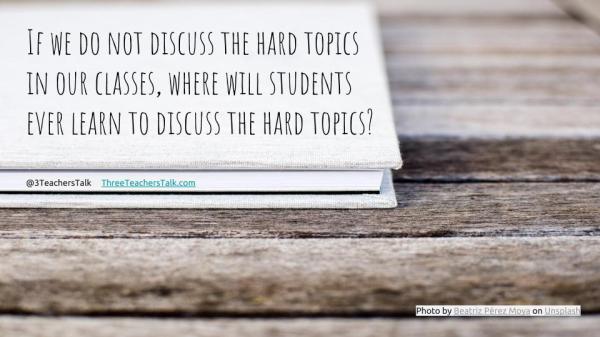
Hard TopicsIf we do not discuss the hard topics in our classes, where will students ever learn to discuss the hard topics? Sure, we can hope they debate social, economic, and political issues in their homes, but we know many families do not have meals together much less conversations. And it’s the conversations, varied and diverse, that can help us view the world in a different light — sometimes a cleaner, clearer, more empathetic and compassionate light. I think we need more of this light.
Here’s part of my response:

I appreciate your concern about controversial topics; however, English is a humanities class, and as such, we should learn about the humanities. That means all the messy topics that make us human. We should invite controversial topics into the classroom. The classroom becomes a microcosm of the world outside of school. If we cannot learn to discuss and debate in polite conversation here, how can we expect to ever discuss and debate politely as adults?

I see it as my job to be sure we think and feel and share as individuals with diverse backgrounds, cultures, and interests. I will continue to use texts, including poems, that give us voice to our lives and thinking.

Side note:  The poems in question were ones I shared as quickwrite prompts to spark thinking for the college application essays students would soon begin writing, “Raised by Women” by Kelly Norman Ellis and “Facts about Myself” by Tucker Bryant. I still don’t see the controversy.

Yesterday I saw a post on a Facebook group I follow where ELA teachers often ask for help. One person posted:  “One of my students challenged me today to include more literature that is relevant to what they are seeing in the world right now. . . What should I include?”

I refrained from responding:  EVERYTHING in my Twitter feed.

We all know the importance of helping students see the relevance in the texts we study, and I don’t know the context of that student’s request, but I wonder if sometimes students believe relevance means:  reflects what I already believe and feel, instead of: often challenges what I already think and feel.

Maybe we need to do a better job of explaining why we must challenge our own beliefs, get out of our echo chambers, and at least acknowledge the opinions of those who differ from our own.

Maybe I failed my student because I didn’t explain enough at the get go.

Today he got his schedule changed. Right after I found this infographic, an argument for the humanities.

We’ll study it in class real soon — after we discuss Jared Kushner’s Harvard Admissions Essay and finish writing our own. (See what I did there?) Then we’ll brainstorm the most debatable topics we can think of — DACA, Black Lives Matter, Confederate monuments, everything A Handmaid’s Tale, gender rights, gay rights, women’s rights, and more rights– and engage in the critical, and oh, so vital discussions that help us understand what it means to be human.

How do you invite these critical conversations into your classroom instruction? Please share in the comments.

Amy Rasmussen is a trouble-maker. Tell her not to do something, and she will do it — especially if it leads to expanding the minds and improving the learning experiences of today’s youth. She teaches Humanities/AP Language and Composition and senior English at a large, diverse, and truly wonderful high school in North TX. Her hobbies are searching for controversial topics that spark debate, reading and sharing banned books, and challenging the status quo. And she loves the readers of this blog. Follow Amy on Twitter @amyrass and @3TeachersTalk; and please join the conversation over on Facebook at Three Teachers Talk.

Guest Post: Find the Light in the Darkness: My English Classroom Post-Harvey

I’m a teacher. My job is to teach children-teenagers-everything English. It is what I was Clear Creek ISD June 2017 (1)called to do 10 years ago. So as I sit here in the aftermath of Hurricane Harvey, I can’t help but think about what I will teach my students when we return to school and our new normal.
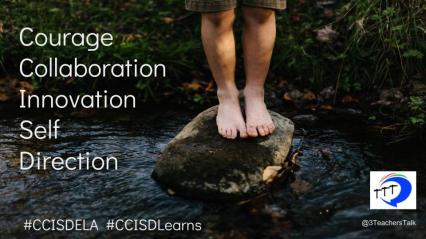
What can my English classroom offer a student who has possibly lost everything in a horrific storm? A student who is staying in a shelter wearing donated clothes because all he could carry out of his flooded house was a duffle bag and the clothes on his back? A student who has braved the tragic conditions to save others from their nightmare of rising water and tangible fear? A student who didn’t flood, but is watching his friends and family suffer the stress of life-altering devastation?

Staying indoors for 5 days straight offers ample time for reflection, so the answers to my questions have come. My classroom has not changed–it is quite possibly the one stable place that Harvey couldn’t touch. Not that he didn’t try. My classroom will remain a safe place for my students to write through the pain they feel. It will be a microcosm for the amazing unity we are seeing in our area. It will allow my students to talk to their peers about shared emotions. It will give students the opportunity to write to process, to share, and to unite. It will be a place where tears are shed and spirits are renewed. It will be a place where students can learn about compassion and what it means to be a community through real-world experiences right in our backyard.

I am not sure I could think of a stronger classroom than that.

And I will lead the way as I always do–through modeling with my own Harvey experience. And when I do, it will probably look something like this:

As I sit here writing these words, I am not even sure what emotions I’m feeling anymore. Fear. Shock. Disbelief. Fear. Sadness. Guilt. Fear.

I don’t think I will ever forget this storm. The fear I felt Saturday night as the rain and wind ripped through my neighborhood is indescribable. At one point, I just wrapped my arms around my sleeping three-year-old daughter and hugged her close to my chest- not to comfort her, but to comfort me. I needed stability because I had absolutely no control over what was ensuing outside my window.

Texts poured in throughout the night- friends and family checking in and reporting the surreal nightmare unfolding before our eyes. Water ferociously crawled up my yard, and I watched with panic. My Facebook newsfeed couldn’t refresh fast enough as I saw new friends reporting flooding with every second’s update. I finally fell asleep at about 4:00 in the morning as the howling wind died down to a soft roar, and the water stayed a few feet away from my house.

What I woke to on Saturday morning is what still sits in my gut. The national news channels- national, people- like CNN and The Weather Channel- were in a place so near and dear to my heart. The place where I went to elementary school. The place where I slept over at friends’ houses. The place my husband and siblings went to high school. The place that taught me what it means to be a teacher. The place I spent the first six years of my teaching career. The place where SO many of my friends and beloved former students live. The place that had been hit like a freight train by this natural disaster called Harvey.

There is something very eerie about seeing familiar places and faces on the national news.

I saw images of my friends on rooftops being rescued by more of my friends selflessly putting themselves at risk to save others. I saw even more of my friends and their babies, some only days old, riding in boats to their safety and riding away from the lives they had known before the storm. I commented on all that I could, but with each comment, my words felt less and less valuable. How many times can you say, “I’m so sorry. I’m praying for you.” before it means nothing?

I received more texts from friends and family far and wide.

“I saw Dickinson on the news. Are you okay? What can we do?”

The scenes I watched on TV and social media were shocking. But the weird thing was, I didn’t cry. All day, I held it together. Probably because I didn’t want to worry my daughters. And probably because I was numb to what was going on–I just kept saying that I couldn’t believe what I was seeing.

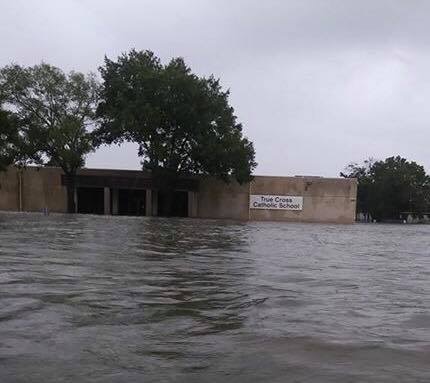
Until one picture came across a text. My childhood friend had been out all day on his boat rescuing people in Dickinson and knew I would want to know how our elementary school, the school my two daughters currently attend, fared in the storm. That’s when I lost it.

TrueCrossCatholicSchool

Once the tears started, it all came rushing forward. I cried for my girls who no longer have a school. I cried for my friends who no longer have a home. I cried for my former students who lost everything. I cried for my sister whose husband drove her suburban up on a trailer at 2am as the waters rose fast beneath his feet threatening to enter their home. I cried for my family who no longer has a church. I cried for my coworkers as I read their terrifying scenarios of rescues from rooftops. I cried at the thought of the stories I haven’t heard yet. I cried because I am stuck at home, flooding all around me, unable to get to those who need me–even if it is just to give a hug to say what my words can’t seem to express.

But behind the tears is an incredibly proud spirit that knows we will bounce back–as a community, as a state, as a nation. We will pick ourselves up and pick up those who can’t find the strength along the way.

It is very easy to let the guilt creep in as I think about why my house was spared in the flood. But I have chosen to focus on the answer instead of the question. I know why I was spared- so I can help.

I will help my students cope through reading and writing. I will listen to their stories and cry right alongside them, all the time reassuring them that we will get through this. I will teach them that through dark times, we must look for the light. I will be that light for them if they can’t seem to find it anywhere else.

I will help my friends clean up and start over. I will volunteer my time to tearing out soaked sheet rock and ripping up soggy carpet. I will offer my home to the ones who are now homeless. I will hug them and catch their tears on my shoulders as they try to pick up the pieces and move on.

I will help my daughters clean up their school and the teachers there (one of whom is my sister) replenish their classrooms. I will help the school rebuild and crawl out of the hole of destitution Harvey has created.

And through all of this, I pray that I will help the world see that there is hope for humanity. If you can’t see it, just come on down to my community and watch because it is in full force all around me.

Now move out of the way, Harvey, we have work to do.


Bio: Megan Thompson is the Department Head of English at Clear Creek High School. She teaches AP Literature and Composition and Pre-AP English I. When she isn’t teaching, she spends most of her time chasing around her daughters, Aubrey (5) and Maycee Jo (3), and spending time with her husband of 7 years. Follow Megan @teacher_mmt

Guest Post: A Houston Teacher’s Heart

What do you do when a hurricane slams you in the face after four days of school?Clear Creek ISD June 2017 (1)

This was the best first 4 days of school I’d ever had. Tuesday saw us independent reading with self-selected books for the first 10 minutes of class. A habit we will cherish through June. We were moving in and out of our notebooks by Wednesday. Groups were discussing and reporting their thoughts back to the whole class. A community was rising in all four of my senior English classes. My inclusion para-professional and I had worked through the mountain of paperwork and conferred about this student and that one. I had plans to video a class for a whole week to use for who knows what. Who could believe that senior English students could move so far so fast. Our potential was limitless.

My district sent out a message Thursday evening that school would be cancelled on Friday. Some coaches met up at school that evening to stow away hurdles, high jump mats, and benches. We lamented our missed football scrimmage and wondered when we would resume school.

The hurricane projections said it would hit hundreds of miles away and would only be a category 3. We knew the “dirty side” of a hurricane was not a fun place to live, but a few days of rain and maybe a little wind was all I mentally prepared for.

Friday, I went to school to grab my laptop and a couple of teacher books so I could finish my lesson plans, review the game plan for next week’s game against Pearland, and whatever else needed attention. Having been through hurricanes and heavy rain before, I thought maybe we would go back to school on Tuesday at the latest.

Our football staff has a group text that is mostly silly memes and rude jokes. Now it reads like a timeline of the storm.

As I look back on the text threads, there is a definite change in tone on Friday evening when the rain started. We went from making fun of each other to being seriously concerned for one another. The rain fell Friday night but none of us had water in our houses or were flooded in. I even got out of the house to drive around on Saturday. I went to the grocery store for eggs and drove around a bit to see what was what. We spent the day planning for our week one football game and watched the news as the storm worked its way closer.

Saturday night was when it started getting scary. A flood, a deluge of water fell on our city. My wife and I didn’t sleep. It was one of the scariest most nerve wracking nights of my life. 15 inches of rain fell in 3 hours and we were constantly up and down watching the water levels in the street rise and making sure our flooded pool wasn’t about to merge with our kitchen. The coaches’ group chat filled with pictures of rising water and reports from all over south and west Houston. I’m sure we are all too macho to admit it, but we felt that fear collectively and it was a relief for us to know that we weren’t alone in this storm.

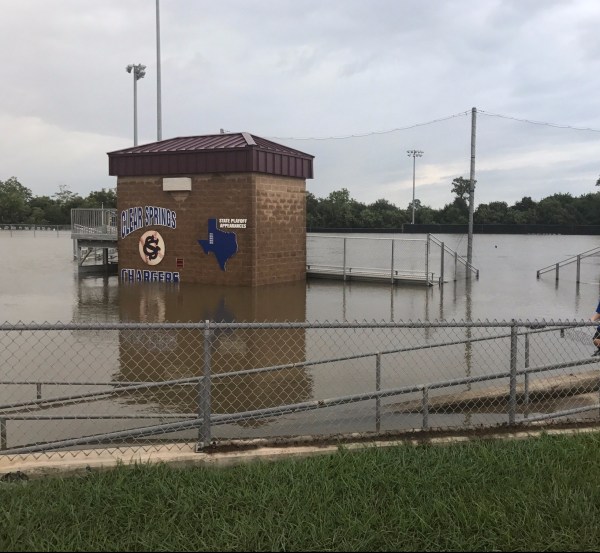
When the sun rose on Sunday, my house was still dry and the electricity was on. Others weren’t so lucky. Neighborhoods within a quarter mile of my house were completely flooded out and many of our students don’t have a home to go back to anymore. I’m sure you saw reports on TV of water rescues happening in League City. Those are our kids. I see those families at parent night and sub varsity football games. We shop at the same grocery store and order pizza from the same place. My twitter feed filled with images from our community of families who were rescued in boats and won’t see their houses for weeks.flood

Despite the destruction we endured this weekend, I can’t help but think toward the future. It will take some time, but the flood waters will abate and the roads will clear. At some point, we will reopen our schools. We will ask the students and teachers to come back and the process of building will resume.

Even those whose houses didn’t flood will bear the scars of this terrifying natural disaster. And those whose houses did flood will be consumed by it.

Where will that process even begin? What will I say to them? What can I reasonably expect them to produce?

I have no idea how to answer most of these questions. All I know is that I’m going to tell them that I love them over and over. My classroom will be a refuge from the aftermath of the storms. We can be safe together. We can write about our pain and share our fears. My Student Council class will work to bring some normalcy back to people’s lives whether through food drives, donations, or lending a hand to those who need it. I’m going to give my linebackers the biggest hugs they’ve ever gotten and I’m going to tell those boys, who think they are men, that I love them.

Harvey’s footprint will always be seen on this school year for these students and teachers.

Maybe we can learn about survival and community and love. I think my classroom is the perfect place for those lessons. I hope I’m up to it.

Charles Moore is the senior English team lead at Clear Springs High School in League City, TX. He enjoys leisure swimming, reading, and coaching linebackers. Follow Charles on Twitter @ctcoach

Want to RENEW! Get the book by @ShawnaCoppola

I have never written a book review. (Okay, maybe that’s not true. I think I remember writing one in 4th grade over a biography of Marie Curie, the first biography I ever read.)

I have never written a review of a teaching book. But I am going to try.

I am a teaching book junkie. I have stacks of them, but I rarely read the whole of them. I cannot even tell you why, and I admit there is great irony here because as I write this, I am also trying to write my own book for teachers (I have been for four years, sigh.) If I ever get it written, I hope you’ll read it.

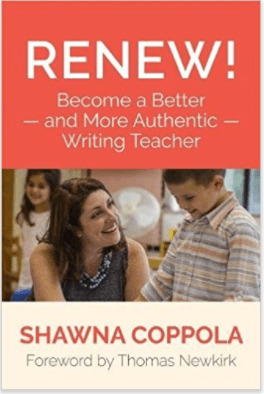
In the mean time, I have to tell you about Shawna Coppola’s new book RENEW!

I read the whole of this book in one afternoon! Thank you, Shawna, for writing so much of my own thinking about “Becoming a Better — and More Authentic — Writing Teacher.”

Shawna’s voice sings with passion and positivity. She paints the pages with possibilities! I know, I am gushing (and that’s probably too many p’s.) But here’s the thing —

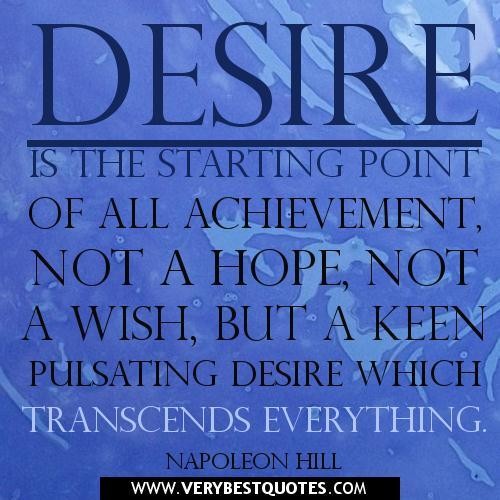
I know so many ELA teachers who do know know how to teach writing. I know many more who are not confident teaching writing. I know even more who are not writers themselves, so it’s no wonder that teaching writing is difficult. Teaching writing is hard. A book like RENEW! not only gives us a starting place, it gives us desire.

desire-is-the-starting-point-of-all-achievement-not-a-hope-not-a-wish-but-a-keen-pulsating-desire-which-transcends-everything-napoleon-hill

I am doing a lot of thinking lately around the idea of transcending. How do we go beyond our limits into something more, something better, something real and sustaining?

Let me share with you some of the passages I marked in RENEW!. I think you’ll see why this book is a must read for any teacher who needs a bit, or a lot, of renewal when it comes to teaching students to write.

“. . . if we are truly willing to honor the individuality of our student writers, the RENEW!uniqueness of each community of learners, and the ever-changing nature of our global landscape, we must continually rethink, revise, and renew our practice. Otherwise — to paraphrase Dewey — we rob “today’s students of the tomorrow today’s students deserve” (10).

“Broadening our ideas about what writing “is” can be scary, as if we are opening up a Pandora’s box. But in all reality, continuing to teach our student writers through a narrow, outdated lens — one that, in overvaluing written composition, does not accurately tell a story about the world of writing beyond most schools and classrooms — harms their development as writers by limiting the kinds of composing they are exposed to and encouraged to practice” (51).

“Teaching our writers how to develop their own tools is infinitely more sustainable than using preexisting tools. Quick survey:  How many of you use the graphic organizer your sixth-grade teacher taught you to use to write a persuasive piece? That graphic organizer may have been helpful to you then (although I doubt it was helpful to 100 percent of your classmates), but how useful is it you now?” (62).

“What message or “story” are we sending our student writers with a single overall score? Not only does it imply that their worth as a writer can be whittled down to one letter or number (which itself can mean different things for different teachers and even within different units of study), but that the worth of writing itself can be whittled down this way” (73).

“. . . readers of writing are human, an done person’s response to a composition may not perfectly align with another’s (If it did, what a drab, boring world we’d be living in!)” (79).

“Which is more likely to help students learn:  offering them specific feedback about their work, behavior, or performance, or slapping a score on a piece of paper?” (82).

“. . .when we engage in a semi-regular habit of writing, we can much more genuinely speak to those incredibly fantastic moments that writers experience on occasion, like the amazing feeling of completing a particularly difficult draft or writing something that makes a reader spontaneously laugh out loud. Anyone who’s ever taught a group of students of any age knows that when we are faking our way through something, or at the very least “phoning it in” by only engaging on a superficial level with what we are purporting to teach, students can smell our lack of authenticity a mile away. They know, even subconsciously, that they are being sold a decidedly moldy bill of goods” (92).

That’s all well and good, right? But here’s the beauty of Shawna Coppola’s book — she gives us the research that supports each of her positions AND she gives charts and graphs and resources to help us rethink, revise, and renew our approach, instruction, and practice as we become better teachers of writing. This book is chock full of everything good when it comes to writing instruction. It is a book I will return to again and again.

I hope you’ll read it. I hope you’ll share it with every ELA teacher you know. Really, it is just that good.


Amy Rasmussen lives in north Texas and teaches AP English Language and English 4 (new prep in ’17.) She loves talking books, daughters’ weddings (two this year), and grandbabies (five). She also loves facilitating PD for other teachers making the move into a workshop pedagogy. Amy adheres to the words of Emerson: “We aim above the mark to hit the mark,” and Jesus: “Love one another.” Imagine a world if we all aim higher. Follow Amy on Twitter @amyrass. And she really hopes you will follow this blog!