6 Ways to Confer in the Crowded Classroom

“My biggest struggle right now is that I have 36 students in each class (60 min periods). There’s not an empty seat in the room! Any ideas?”

Maybe this sounds like you. I’ve been there –trying everything to make workshop work in my over-flowing freshman and sophomore classes. Last year I had 38 sophomores in my 8th period. Talk about ending the day exhausted.

My principal said at the first of this year: “40 is the new 30” regarding class sizes. Most teachers I know deal with bulging class sizes every day. We have to adjust to the new normal.
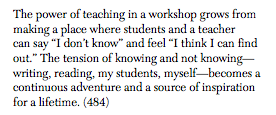
In the Middle: New Understandings about Writing, Reading, and Learning. 2nd ed. Portsmouth, NH: Heinemann, 1998.

Last week I read this English Journal article from 2000 (timely with Nancie Atwell recently winning that awesome teaching award), and I was reminded of how Atwell talks about the tension in a workshop classroom.

I’ve said it many times before:   readers and writers workshop is constant motion, and sometimes the tension becomes a tight rope under my feet as I try to provide my students with the best instruction possible.

I believe it’s student conferences that steady the bouncing rope, but how do we confer with all of our students regularly when our classes are so large?

A few weeks ago, I wrote this post about reading conferences in high school. Mrs. Thompson wrote that plea at the top of the page in the comments. I’ve thought about it ever since.

These are black board speech bubble brooches. How cool is that? See gadgetsin.com

These are black board speech bubble brooches. How cool is that?
See gadgetsin.com

I am fortunate to have small classes this year, but balancing the tension is still not easy. Below I share six ways I confer with students. I had to be inventive to confer with those rowdy 38 sophomores. Maybe some of these ideas will help my friend Mrs. Thompson.

1. Start before the Bell. Several of my students enter my room two or three minutes before the bell rings. When I am behind in my conferences, which is more often than I’d like, I can talk to a few more students a day when I begin before the bell.

2. Go to Them. My students sit in small groups with their desks clustered in fours and fives. When I want to speak to students individually, I go to them and kneel beside their desk. We talk in hushed tones for a maximum of two and a half minutes. If a student wants to talk longer, before the end of class I pass her a sticky note with an invitation to come in during my lunch. Sometimes she does.

3. Bundle Them Up. Instead of speaking in hushed tones, when I know the topic of the conference will benefit all students in a small group, we speak a little louder. This way I can easily turn to the other three or four students and invite them into the conversation. “You might want to try that, too.”  or “Do you have a question similar to Mark’s?”

4. Make it Voluntary. I know I am not the only one with students who need to talk before they’ve really even started. When I begin conferences with an invitation — “If you’re having trouble getting started, meet me at the sofa, and let’s talk” I can spend five minutes with five to six students, often clarifying ideas or validating their thinking. Once I model how to talk about their work, students learn to effectively give one another feedback. I can leave them talking and confer with a few other students. Five to ten minutes later, I return to the couch. More often than not, these students are now ready to work on their own. They just needed some talk to get them started.

5. Group Them through Feedback. I learned this one from Penny Kittle. Say you are reading through student drafts, and you see the same trouble spots over and over again. Make a note on the bottom right corner, maybe a code like TH if you’re seeing not-so-powerful thesis statements. Then during conference time, ask everyone with a TH on their paper to meet you at the center table. You save time by re-teaching or doing a mini-lesson on thesis statements only with those students who need the refresher. (This works for reading conferences with my most resistant readers, too.)

6. Keep it Silent. Sometimes I get more information about what my students need when they write it out instead of talk about it. I’ve learned to give some of my quiet students the option to confer most often in silent conversations. I leave them notes. They leave me notes back. This is similar to Chris Tovani’s conversation calendars, which when I tried to do with the whole class, challenged my ability to be consistent. When I make the notes optional, those students who want this type of conference take advantage of it — and I can read student notes and respond after the class period.

Do you have other ideas for conferring with students in large classes? Please leave a comment.

©Amy Rasmussen, 2011 – 2015

How to Teach Writing

I might have actually reblogged this post before today, but I was searching through the TTT dashboard and found a draft I’d written reflecting on it. I miss conversations with Tess Mueggenborg, one of the best teachers I know. She pegs my thinking here, exactly. I don’t even need to share my reflections, but I would love to hear yours. Please leave your thoughts in a comment.

profmueggenborg's avatarProf. Mueggenborg

Want to create successful writers?  Want to raise them from seedlings, make them strong and resilient and capable of writing oak trees of essays, not saplings of deadwood?  The key has nothing to do with writing.  If a teacher wants to help their students to become successful writers, they must make their students into successful readers.  If a student isn’t a reader, they’ll never be a writer – no way, no how.  The reading should be both academic and for pleasure: students need to bask in the glow of words for fun, and struggle with a snarling sentence when needed.  They should delight in diction and syntax, but never be quite satisfied with them as-is – every student should always ask, “why this way?” and “why not like this?”.  And no, they probably don’t need to know what “diction” and “syntax” mean: we don’t need to understand the nuclear reactions…

View original post 85 more words

Shelfie Saturday

sticker,375x360.u1


I love Monday mornings.

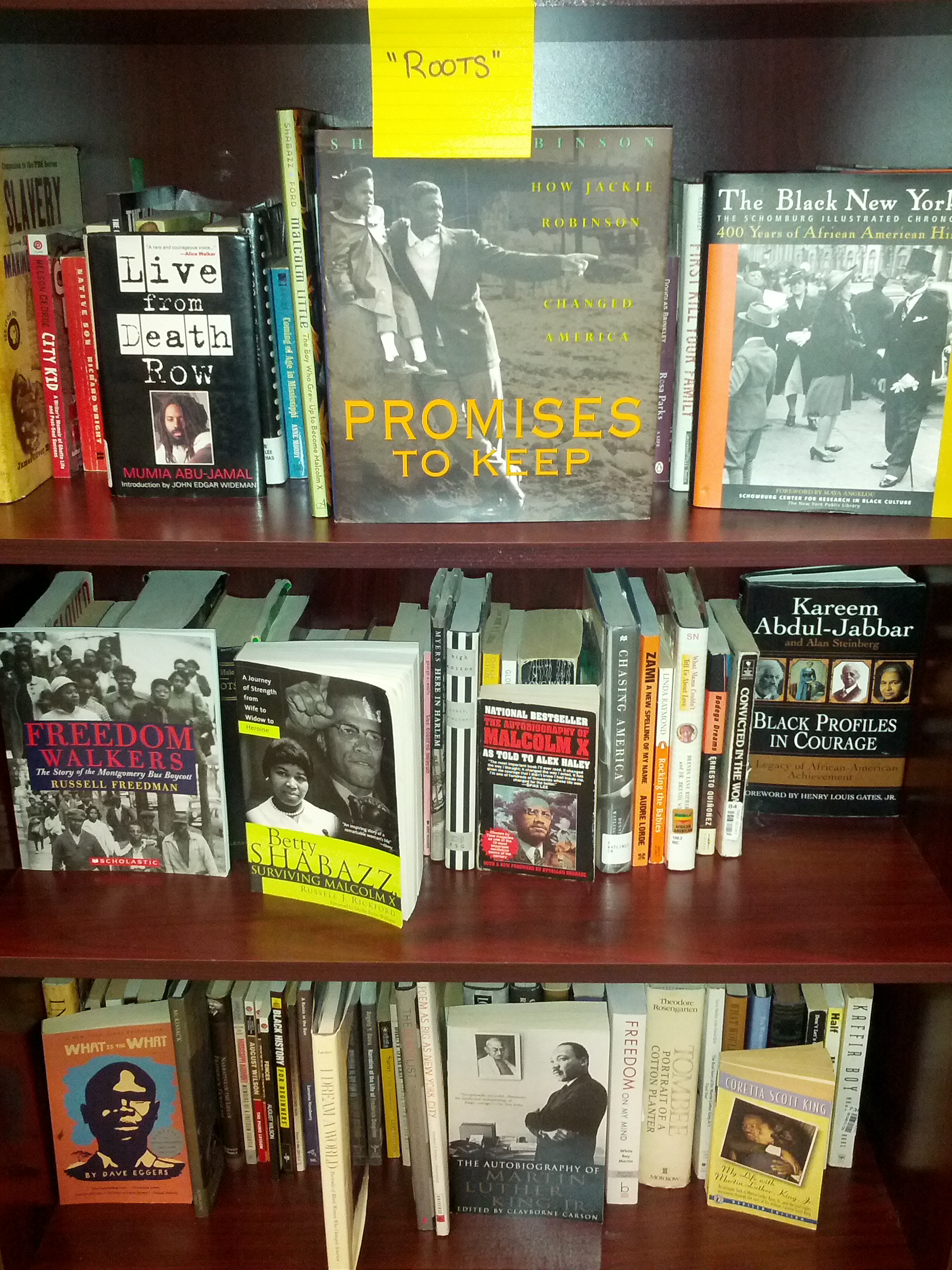
Monday signifies a new week, new possibilities, and new literature!  At the start of every week, I take time to display different books on each themed shelf.  This provides readers an opportunity to explore new titles on an ongoing basis.  Some books are brand new to Room 382 while other books have occupied our shared space for years; yet feel fresh and enticing when they are uniquely displayed.

Students (and guests) are continually gazing at our Francis Gittens Lending Library and enjoy, not only the vast array of literature to choose from, but how easily accessible it is to find what they are looking for. Gone are the days of ‘genre shelving’ and in are the days of ‘theme shelving’.  Whether students are just emerging into the world of literature or they are deeply rooted in their love for reading; our scholars need to feel supported.  By clustering books via theme, students (regardless of their comfortability with literature) know exactly where to go to get more of what they want!

Many students find their heritage fascinating and want to explore it beyond their current ideologies, beliefs, and familiarities.  So, they peruse the shelves in which they see themselves; racially, culturally, geographically, athletically, and so on.  They find comfort in exploring the lives and stories of those they’ve met before in history class or via conversations taking place within their homes.  They also take pleasure in learning more about who they are within the context of society, and on an even larger scale, within the world; simultaneously honing in on their more localized and individual existence.

All adolescents are searching.  They search for identity.  They seek to understand.  They thrive on building connections.  They strive to be enlightened.  And many times, students stumble upon exactly what they didn’t know they were looking for!  I love that.

Be it non-fiction, fiction, poetry, fantasy, science-fiction, auto/biography, graphic novels, screen plays, what have you; genre holds much less weight when the stories, characters, and settings transcend our students into a world full of exploration.

Here, our ever growing and ever evolving “Roots” shelves allow us to embark on a genre free yet culturally rich journey!

Some of our collective favorites include: Mumia-Abu Jamal, Jackie Robinson, Malcolm X, Betty Shabazz, Dr. MLK, Jr. and his lovely wife


Join the conversation by posting your own shelfies!  Share a shelfie with #shelfieshare and let us know if it’s a #classroomshelfie, #bookstoreshelfie, or other miscellaneous find.

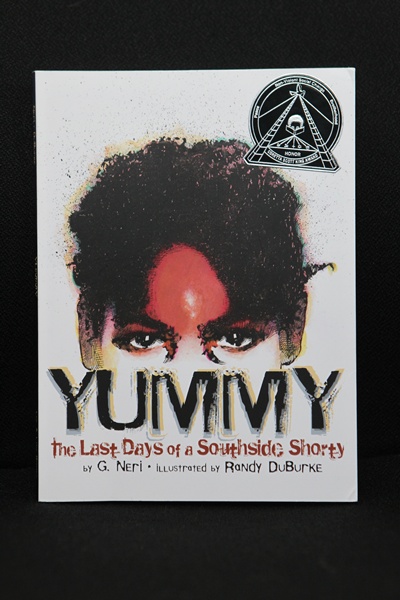
G. Neri’s Yummy


yummy

Synopsis

In this award-winning graphic novel, Robert “Yummy” Sandifer’s life becomes interwoven with other true events from a period in time where Chicago’s south side was running rampant with gang activity and violence. The year: 1994. Yet, its relevance still holds weight today in urban communities throughout our country. Unfortunately.

Narration and Writer’s Craft

Through third person narration, eleven year old Roger, guides us through the ongoings, thoughts, chaos, family ties, brotherhood, fears, ponderings, love, realities and insecurities most young adolescent males experience.

Roger lives on Normal Street.  He addresses what many readers are already thinking:  But I guess “normal” is different to different folks.

In studying craft, this one liner opens up dialogue, the use of language and repetition, and the importance of quotation marks in varying situations.  Throughout the entire story, you are greeted with on-point vernacular, literary devices, and a storyline that pulls at the heart strings.  (Just ask my students.)

Additionally, the incredible illustrations allow us the luxury of experiencing Yummy’s journey through his eyes, Roger’s eyes, and the eyes of all of those that take part in the journey.

It’s pretty loaded.

 Essential Ideas and ThemesYummy: The Last Days of a Southside Short

This gritty exploration of Yummy’s life forces readers (of all ages) to question their own understandings of good and bad, right or wrong, yes vs. no.

It searches for truth.

It provides us with the inner-workings of [the downfall of] self-worth and naturally asks us to question it.

Ultimately, we are challenged to think on a macro level about society; why are so many of our youth feeling forced into a life where statistics are alarmingly glaring?


Yummy is a piece that everyone needs to read.  It’s important.  It’s relevant.  It affords us a window into the lives of so many of our youth.  No wonder it has won just under 30 honors and awards.  This is one piece of literature you cannot afford to miss.

For more books by G. Neri feel free to visit his website: http://www.gregneri.com

——-

Yummy Time

Here is the cover of TIME Magazine’s issue detailing the story of Robert “Yummy” Sandifer.  Tragic and important.

Today We Draw

A Five Day Checklist:

Chancellor visit. (Check!)

Superintendent visit. (Check!)

A posse of outside principals observing. (Check!)

Our CBO (community based organization) pulled out = no counseling…or any other services…for students.  Teachers are now ALL of that. (Continual check!)

End of the Cycle (think semester) and the accompanied wildness. (Checking…all week long!)

*THIS WEEK.  Yes, in one week.  And, it’s Wednesday only.

 —–

The above is an email I composed to Amy, Jackie, and Shana in one of our most recent communications. In response, Amy wrote:  You’ve got the world on your shoulders this week, E!  And, it wasn’t until I was greeted with this affirmation that I realized it most definitely felt that way.  I was too busy moving through it to take a moment’s pause and acknowledge the intensity of it all.   The. Weight. Of. The. World.

It got me thinking.  If I felt this way, I couldn’t imagine how students were feeling as they were the reason for all of the visits.  They were the ones ‘on display’.  I just kept it business as usual with our Readers Writers Workshop flow; rigorous expectations, Writer’s Notebooks being utilized, Independent Reading occurring, questions being raised; chuckles here and there.  Yet, it felt off.  As I looked around the room, it occurred to me that students have taken on the weight of the world too.

They’ve been trying to articulate their thoughts wrapped around their chosen literature when the Chancellor asked them about their favorite books.  They’ve tried to be loyal to our collective work and answer the Superintendent’s question about rubrics (aside from the thought provoking work they’ve been creating) knowing that we are currently exploring with our pens and ideas sans a rubric.  They have tried to find comfort in their movement over the last six months, but these pressures have made them second guess themselves.  And the reason I know?  They’ve told me.

Yet, their resilience astounds me.  So, I dug deep.

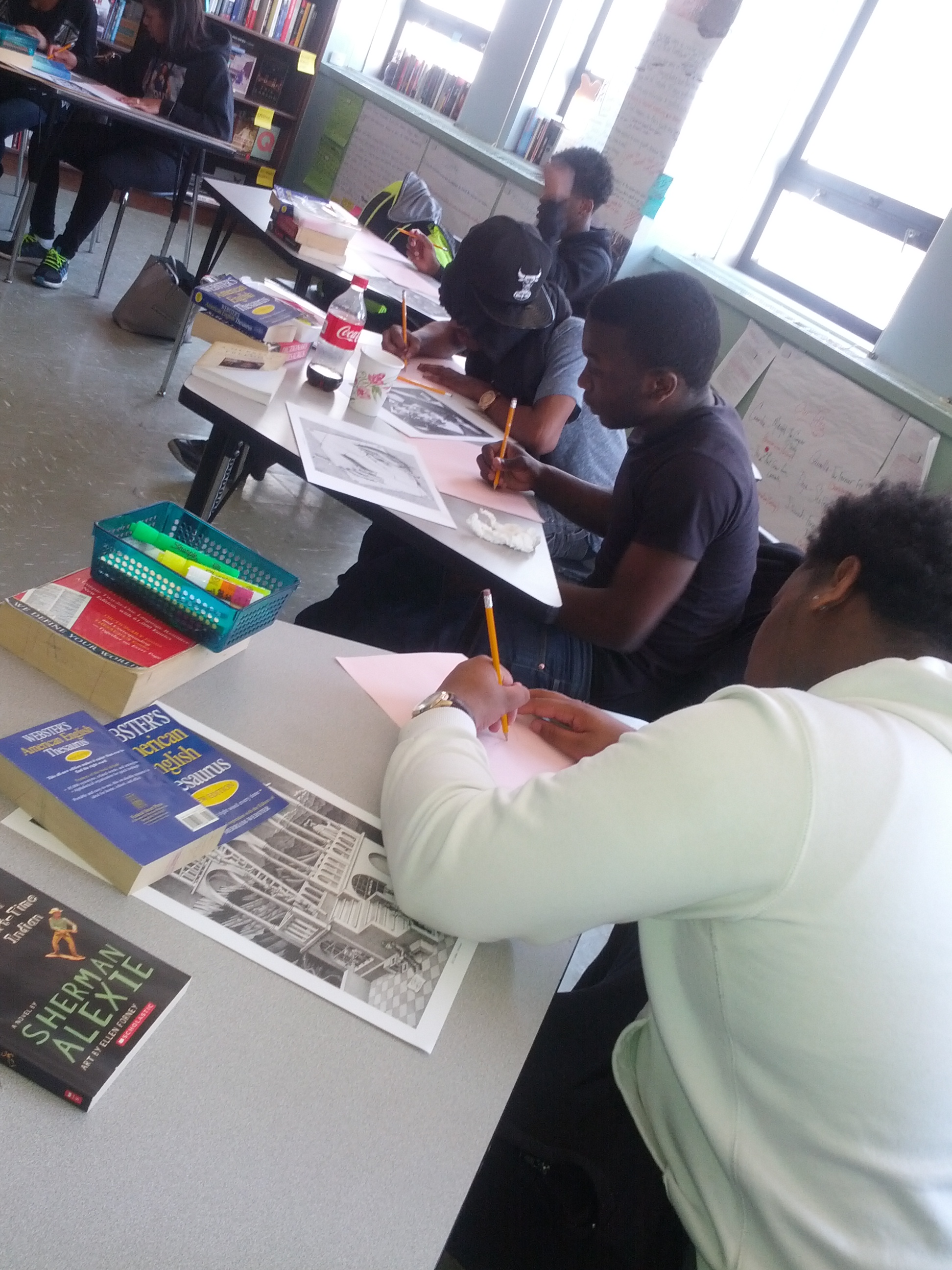
We needed a collective breath.  With all of the tension and uncertainty swirling about Room 382, we needed a class period full of calming zen.  I channelled my extraordinary experience at #UNHLIT13, as I was guided by Penny Kittle in sketching an already created piece of art.  Aside from my internal voices loudly telling me that there was no way I was going to be successful at this; I tried.  And regardless of how my sketch came out I knew the most important lesson is that I didn’t give up.

Calmly, yet intensely, sketching.

Calmly, yet intensely, sketching.

So, today we draw.

The weight lifted immediately and you could feel the energetic life seeping back into 382.  Students were riddled with questions: Wait.  We’re just going to draw today?  You mean, no writing?  We can do that?!  

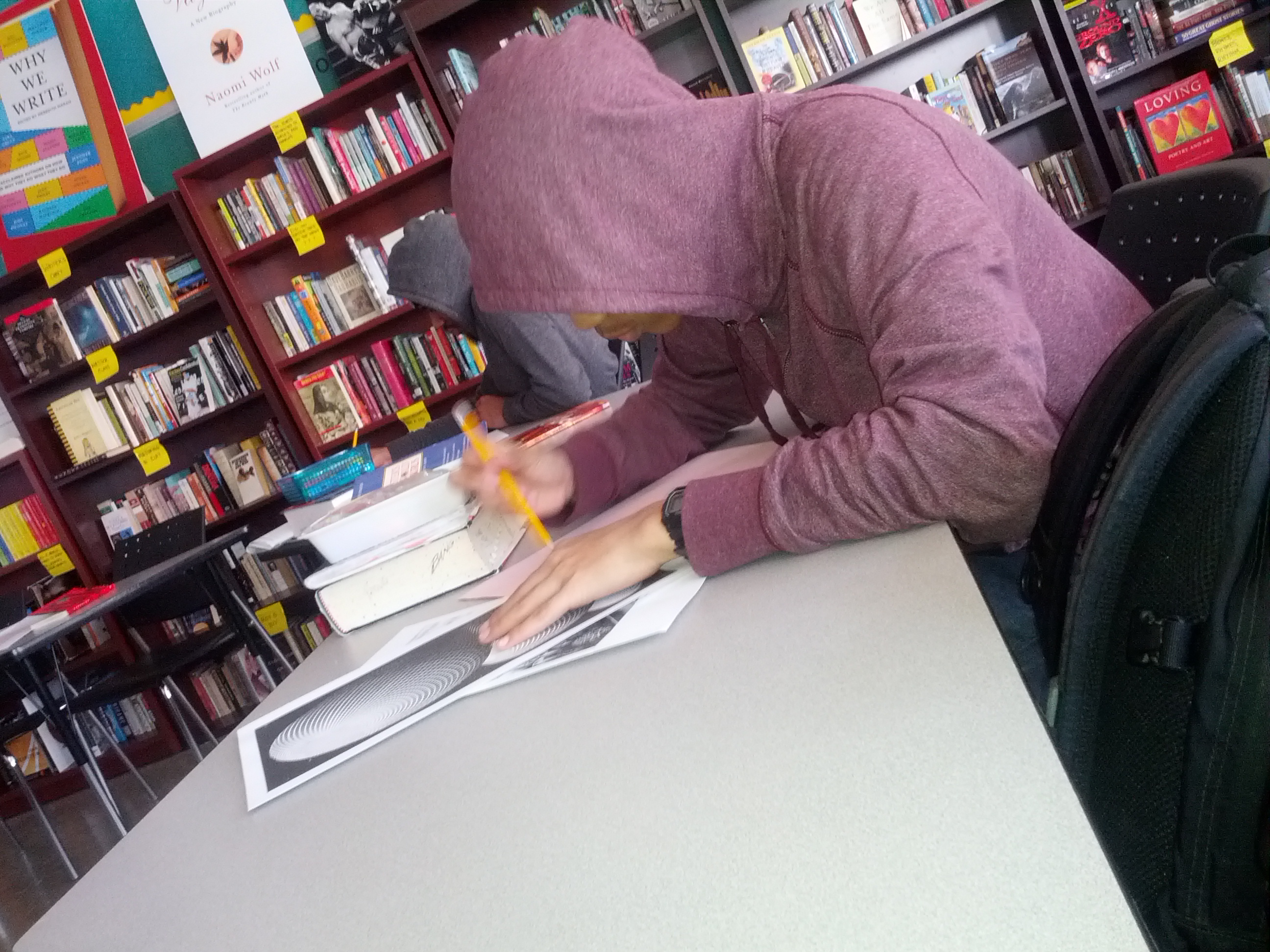
And, while some questions made me laugh and others prompted me to reflect, students were back.  So, everyone grabbed their newly sharpened pencils, chose the drawing that spoke to them most, and got to it.  I mean, really got to it.

Hoodies up.  Concentration in full effect.

Hoodies up. Concentration in full effect.


It was important for me to voice my intention: Folks as we partake in this together, I need you to know that I am wildly uncomfortable with all things drawing!  For the last six months I have asked you to find strength and courage in reading and writing that has challenged you to the core.  Today, I do the same.  (Deep breath)  Here I go…

While students zoned in, I followed their lead.  I sketched under the document camera so students could watch me struggle…and I mean struggle.  Yet, while drawing/sketching isn’t my forte, I needed students to watch me play with a level of discomfort they are not used to observing.  Students engaged in non-literacy conversation (as Shana brilliantly suggests here) while honing in on their focus.  Students approached me to lend their expertise on how to curve lines or align measurements or see the artist’s sketch with a different perspective.  It was exhilarating being the student!

Some of our masterpieces!  My attempt at creating a balcony.

Some of our masterpieces! My attempt at creating a balcony.

All said and done, here’s what I know.  The RWW is about so much more than always reading and writing; it allows the space to explore, mess up, build community, redefine rigor, and just enjoy.  On this given day, the latter is my favorite.

How do you find ways to calm the tension within your learning environment using the Readers Writers Workshop model?


Four Ways to Formatively Assess in Workshop

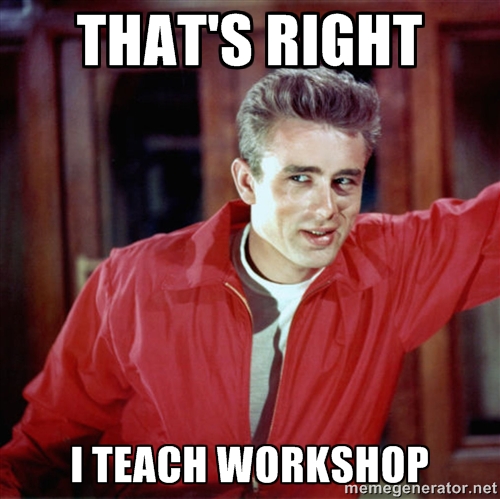
dtrfyguhujSometimes I wake up in the morning, thinking about what I’ll be teaching and learning that day, and feel like a rebel.  That’s right–I think to myself, feeling inexplicably cool–I teach workshop. Yeahhhhh.  Even though this is the most research-based, data-driven form of instruction I’ve encountered in my teaching career, a successful workshop is still such a rarity that I feel like I’m breaking all the rules by employing it every day.  I’m a rebel with a cause.

Still, when I stop feeling like James Dean and reality bites me in the butt, I know I need to be practical and follow the rules by putting some grades in the gradebook–once per week is the suggestion at our school.  If I had it my way, I’d go gradeless and celebrate the myriad acts of literacy within the confines of a classroom.  That’s not possible right now.  I needed another solution, and I think I found it in Amy, right here on this blog.  She writes powerfully about formative assessments in this post.  Her thinking mirrors mine:

I know when I am learning a new skill, I want to be able to practice–free from judgment–so that I might build some confidence before I am formally evaluated.  The same is true for kids.  We should give them opportunities to practice and build confidence.

One grade per week, when I’m grading to evaluate, is impossible.  We don’t master a different skill every single week.  Mastery requires practice.  So, I’ve focused lately on formative assessment for eight out of the nine-week grading periods, and summative for just one.  Here are the four categories I see formative assessment broken down into, and how I put them in the gradebook.

IMG_5605

Un-gradeable, amazing writing

1. Writer’s notebooks – I collect writer’s notebooks every two weeks, and students can receive up to 20 points per collection.  If all of our prompts and exercises are present, and I can see the student’s effort, he or she gets the full 20/20.  I also ask students to mark for me anything they’d like feedback on.  I check to see the status of their to-read, wondrous words (vocab), and cool craft (quotes) sections, but I also look for a telltale pink sticky note.  If I see one, I read the marked piece and write back–just feedback.

2.  Reading logs – Our reading logs are quite messy; you can see one example here.  There are arrows everywhere, new reading rates scribbled in, and tons of titles being read every week.  When students complete their reading goal of two hours per week–determined by individual reading rates–they get 10 points, every week.  Reading logs show me the big picture of a class’s progress, while conferences help me go deeper.  The reading log lets me know, at a glance, who’s soaring and who’s not–helping to give my conferences direction.

IMG_6904

Word play

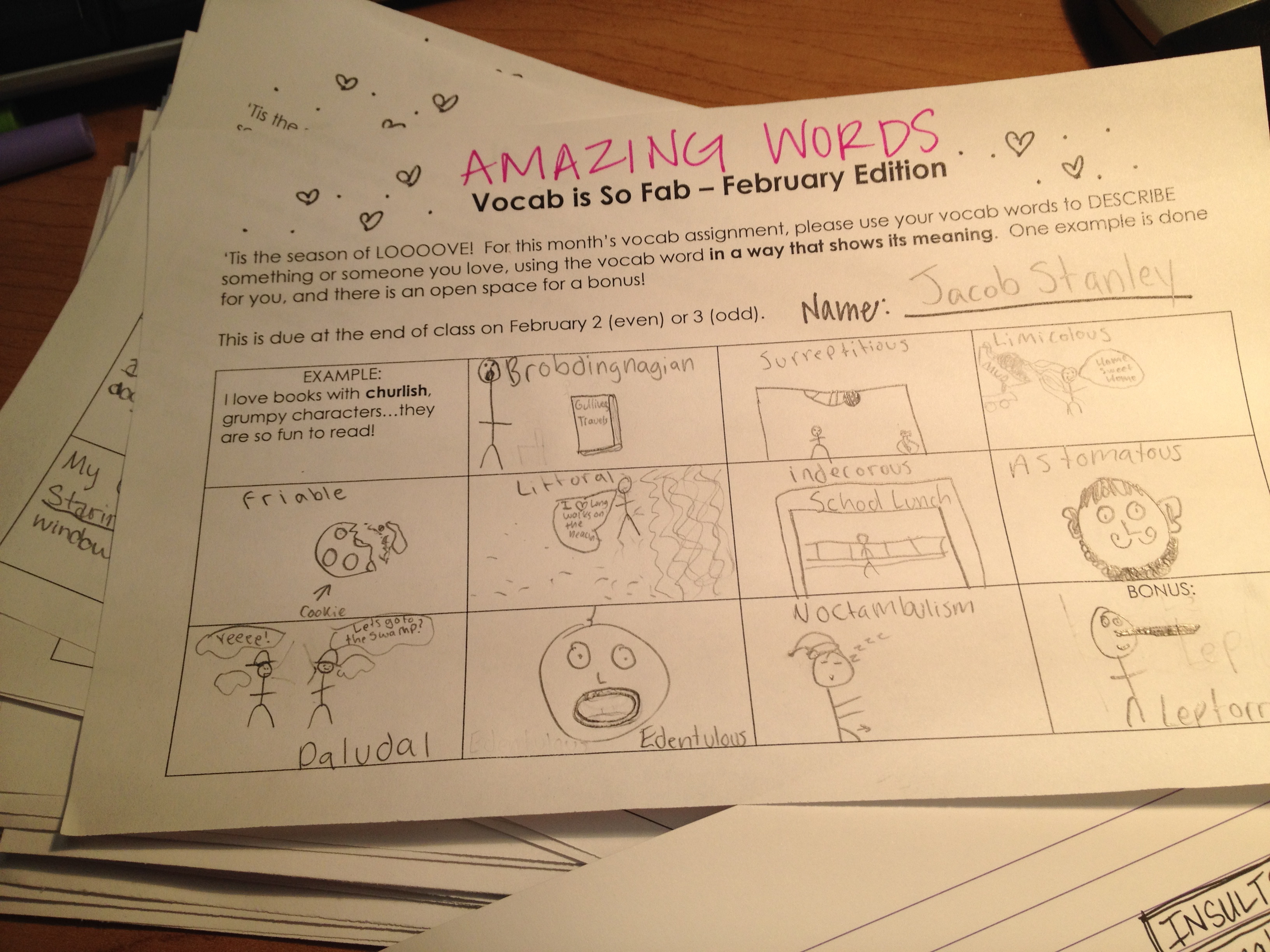
3.  Vocabulary – I still remember my orange Sadlier-Oxford vocab books from high school.  Those well-worn paperbacks were the source of many a cramped hand and a frantic fifteen minutes of homeroom before English class.  I know from personal experience that I don’t retain new words by completing fill-in-the-blank exercises–I learn by reading widely.  So, I ask my students to maintain a “wondrous words” section in their notebooks, writing down unfamiliar or unknown words as they read.  Then, I give them a different activity to complete with those words every two weeks.  The activities are worth 10 points each, and run the gamut from writing stories using the words to drawing pictures illustrating their meanings.

4. Honest self-assessments – When we finish a unit of any kind, usually about once a month–a writing unit, a reading unit, a book club, a challenge–I pass out a half-sheet with self-assessment questions on it.  I begin each half-sheet with a disclaimer:  “Be honest.  There’s no judgment here.  I just want to know why you were as successful as you were with this unit, and to know how I can help others be successful in the future.”  Students answer very truthfully, sometimes humorously so.  If their answers are thorough, they receive 15 points.

These four formative assessments total about 115 points per month.  With 9-week grading periods, students’ grades therefore are made up of about 2/3 formative assessments (230 points or so) and 1/3 summative assessments (100 points or so).  Well over half of the formative assessments are credit for the simple acts of doing the assigned reading and writing–no evaluation of those acts, just credit for the effort.  I value practice and process over product–and this grading system reflects that.

How do you handle grading, formative assessment, evaluation, etc.? Please share in the comments!

See the #Storify of #engchat March 23, 2015 — Fantastic Resources for Poetry

Thanks to @Drama_Chick for this Storify.

For one very fast hour this evening, Twitter blew up with the talk of poetry as English teachers near and far shared ideas for immersing their students in the beauty of words. So many fantastic resources and such great thinking! Thank you to everyone who participated, and thank you for taking a look here even if you didn’t.

I remembered one thing I wanted to share and didn’t. It comes from the book  A Surge of Language–Teaching Poetry Day by Day by Wormser and Cappella. I modify this list a bit and use many of these questions with my AP Language students as we look at non-fiction passages for rhetorical analysis.

Ten Questions to Ask About Words

1. What word intrigues you most?

2. Is there a word that confuses you?

3. What word surprises you?

4. What word seems most metaphorical?

5. Is there a word that seems unnecessary?

6. What word is most important?

7. What is the most physical word in the poem?

8. What is the most specific word in the poem?

9. What is the strongest sound word in the poem?

10. What is the most dynamic verb in the poem? (12)

I believe that poetry can make us better humans. If every person immersed himself in beautiful language, we’d all find much more peace. Be more kind. Loving. Genuine.

Let’s try it.

Challenge on.

They Taught Me the Lesson Here: It’s About Time

Please tell me I am not the only one in a rush. Every spring I feel this pressure to teach more, do more, assign more. I know part of it is the AP exam date creeping closer and closer. I know my students are still not ready.

We still struggle with rhetorical analysis. Most students are getting better at recognizing devices in the texts of others, but when they try to analyze the effect? Well, the light bulb is still quite dim. And I have to practically beg to get students to add a device or two in their own writing. So many are afraid to take risks or to explore with words and sentences.

As a way to help students play with language, I turned to POETRY. (Yes, even in my primarily non-fiction AP Language class.)

We read Meg Kearney’s “Creed” poem together, and we talked through the moves she makes to craft it.

Students noticed the sound devices, the contradictions, the little story, the concrete details. They did a fine job of noticing.

But we have to do much more than notice. And that’s the hard part.

I found this “Creed” assignment by a Mrs. Rothbard online, which fit my hopes for my students exactly, and I asked students to read and study the poem themselves and then mirror the moves of our poet.

I still cannot believe how difficult this was for some of my students. Some simplified the assignment and just wrote their own lovely poems. Others made beautiful lists of their personal beliefs — but that was not the assignment. Others modeled Kearney’s first few lines and then rambled on about angst-filled beliefs that the student writers didn’t even care about when they read them to the class. (Note to self: Revision workshop must last much longer next year.)

But, some…some student writers took ownership of their own craft and composed lovely poems, modeled after our writing coach and poet Meg Kearney.

Here’s the links to JerashiaGuillermoNaWoon, Doreen, Josh, and Sydney-Marie‘s blogs where they posted their poems. They’d love it if you’d read them and maybe leave a comment (actually, they will probably die because they think publishing to the WWW makes them anonymous–so much scarier to read their poems aloud in class, which is a topic of another post I need to write.)

I learned some valuable things as a result of this writing task, and I am glad that my students talked to me about what worked and didn’t work for them. I am glad I took the time last week to let them talk.

The comment that will guide our learning the rest of the year came from a table in the back when one of my quiet ones said:

“Could we slow down? We need more time to write with you in the room to help us.”

Yes, I know that.

If I want to truly help my students grow as critical readers and writers, I must devote the time to letting them think, draft, read, write, revise, re-do, share, and all of this again and again with me in the room as their coach, their mentor, and their cheerleader.

My students need to talk to me and to their peers like I talk to my husband and my collaborators when I am writing.

I thought I had this down by now. But what I think is enough time is obviously not what my students think is enough time, so I’ll listen, and starting today.

Class time will be different.

©Amy Rasmussen, 2011 – 2015
Shelfie Saturday

One of the foundations of a strong reading and writing workshop is providing students access to a wide variety of excellent mentor texts.  You may provide access to those books through your classroom library, school media center, or public library–but how do you know which books to purchase?  How do you predict which titles will be most popular with teens?  How do you know which authors will teach your students the most about writing?

sticker,375x360.u1We hope to offer you a few answers to these questions on Shelfie Saturdays.  Here, we’ll share shots of our classroom library shelves, bookstore tables, yard sale treasures, and more.  We hope these will act as examples of which books to buy, how to shelve them, and which ones to get into the hands of your readers.

So, to get us started, here’s one of my most popular library shelves–the Award Winners shelf.  This shelf houses winners of the Printz Award for Young Adult Literature, the Pulitzer Prize, the Man Booker Prize, the National Book Award, and more.  I also include nominees for all of those awards, as well as honorable mentions.  The genres are varied–YA, nonfiction, general fiction, even multigenre.  The books are at a range of difficulty levels–some have complex narrative structures, others are very long, and others are tough only because of their dense topics.

FullSizeRender[1]

I asked a few students why they liked this shelf so much.  Mylana said, “I want to challenge myself sometimes.  Whenever I read for fun I usually choose fiction, so I like to pick a nonfiction book that’s long but not boring.  I know I can find that on this shelf.”

I asked Garrett how he chose books on this shelf.  He said, “I pick books on this shelf because I hear about them on GoodReads or because they’re made into movies.  So I go to this shelf and pick the ones with the coolest covers.  The length is challenging, but if I get far enough in I won’t give up as a point of pride.”

Students gravitate toward The Goldfinch, Jellicoe Road, Grasshopper Jungle, The Round House, and Why We Broke Up more than any other texts on this shelf.  Again and again, I hear the same refrains during conferences regarding award-winning books–this book was hard, but I finished it because I just couldn’t put it down.  Award winners are shelved so for a reason–they’re the best writing has to offer in a given year, and are incredibly valuable teachers for the young readers and writers in my classroom.

Join the conversation by posting your own shelfies!  Share a shelfie with #shelfieshare and let us know if it’s a #classroomshelfie, #bookstoreshelfie, or other miscellaneous find.

Why I Applaud The Student Who Reads Only Two Books

imageedit_5_2583117499Author, teacher, and reading-writing workshop guru Nancie Atwell recently won the $1 million Global Teacher Prize. I have been a fan of Atwell’s work since I read her book In the Middle during my first year of graduate school. In fact, I was star struck two years ago when Atwell sat on the floor next to me during an NCTE workshop (note my shoulder proudly photo bombing Shana’s picture of the goddess herself). While I have subscribed to Atwell’s philosophy since I began my career in education, I was shocked to read in the media coverage that her students on average read 40 books per year.

My students do not.

Don’t get me wrong; the majority of my students read a large amount, yet while I could calculate the average, it would grossly misrepresent the true value of their accomplishments. I have some students who breathe books and complete them at breakneck speed. They add leaves to our book tree at an astonishing rate, yet admittedly not all my students are like that. By the end of the year, some have only completed two or three independent books in total. As a first year teacher (last year), I felt like I had failed these students. As far as I was concerned, the good teachers didn’t run into this problem. They only spoke about the record-breaking kids, not the ones that kept me wracking my brain for a solution. It felt like I was the only teacher who had the two-book-reader.

Last year, mine was TJ. TJ couldn’t seem to make it through a book. Many of my hesitant readers have learning disabilities or attention deficit disorders; in past classes, they have felt little success in reading whole class novels. When they arrive in my classroom they are resistant to choosing their own independent reading books. TJ was no exception; he had ADHD and struggled to focus on his reading both in and out of class. I’d watch him stare at a page for five minutes straight without being able to settle his mind and read a line. During conferences TJ discussed his book and claimed he was interested in it, yet he moved at a snail’s pace. By the end of his foray with Jarhead, I couldn’t imagine him undergoing the same tedious process with another book. I thought he’d quit. But he didn’t. Through reading conferences, daily reading time, and check-ins with his parents, I was able to help TJ develop a routine and gradually become a reader. Yet the greatest influence was TJ’s friends. Seeing so many of his peers reading on a daily basis motivated TJ to continue working towards his goals.

By the end of the year, TJ had read two independent reading books and three whole class reads, “more books than [he] had ever read before.” This was a feat arguably equal to if not mightier than some of my students who read 80 or more books. TJ developed persistence and stamina even if he couldn’t keep up with many of his peers. He was proud of his accomplishments and determined to become a better reader the following year. As a teacher, that’s what I want for my students—to push them to succeed and accomplish more than they thought they were capable of.

We all have those students (or maybe it’s still just me) but we must praise and hold these students in high esteem. We must brag about their successes and triumphs just as much as we praise the work of our highly motivated readers. After all, every book is a learning experience and an accomplishment.

Do you have a “two-book reader”? What is your story, and how did you work to motivate that student?