Category Archives: Writers

PD Book Review: BETWEEN THE LINES by Michael Anthony and Joan F. Kaywell

Between the Lines by Michael Anthony and Joan F. Kaywell is frank teacher-to-teacher talk about how you can run a reading/writing workshop in a high school environment even when school administrators aren’t invested in “low-brow” reading.  This book is the pep talk you need if you want to steer your classroom towards workshop but are tied in by constraints.


This book lays out the following:


  1. Ways to fit in independent reading and writing inside a highly scripted (and highly controlled) curriculum.betweenthelines
  2. How to talk to administrators about the value of the work.
  3. Example lessons and Common Core-aligned activities centered around independent reading.
  4. Suggestions for connecting independent reading to whole-class novels.
  5. Models of authentic student responses …. And examples of “phony, lookalike, and limited letters.”
  6. Examples of teacher prompting, and means of assessment.
  7. Specific advice for building up classroom libraries.
  8. Detailed appendices of awards for YA books to follow and popular YA books for classroom library collections.  (This list is almost 20 pages long!)


The implications are clear: even if there are a lot of things in this book you can’t do, there is something here that you can incorporate.  Can the movie on the day before vacation and do some booktalks or play some book trailers instead.  Spend less time reviewing quizzes and more time sharing reading responses.  Be proactive about book donations and procuring used books.  Talk to administrators about repurposing homerooms and study halls as time for independent reading.


Since Anthony and Faywell’s attitudes are all about flexibility, I would add three considerations to any teacher using this book to implement new routines around independent reading and writing:


  1. Anthony and Faywell ask students to fill out reading logs and include a signature from an adult who is accountable for that reading.  I feel iffy on logs to begin with, and even more iffy on asking teens who are old enough to drive for an adult “reference” for their reading progress.   Adult signature gives an air of “I don’t trust you” and “You are not yet fully responsible for your own growth.”
  2. Anthony and Faywell’s reading accountability is based on peer-to-peer correspondence and peer-to-teacher writing.  Casual correspondence is lovely, especially if you do not have time to confer with readers.   However if writing were the only way I was holding readers accountable to independent reading, I would think about opening up the reading response beyond just I think/I wonder/I notice approaches to new genres and styles.  If you are already committed to teaching impartial literary analysis and other “old school” writing modes, why not open it up when it comes to the fun stuff?  Why not invite the reader to become creative and revise the ending or to be critical and write a review?  Why not retell part of the story from another character’s point of view?  Why not allow for students to journal about reading and their feelings towards reading?  Why not write a comic?
  3. I would have liked to have seen more attention to graphic novels and magazines in this book, as these texts include valuable reading experience and are closer to the brain candy that teens are likeliest to reach for once they leave our classrooms.  


Amy Estersohn is a middle school English teacher in New York.  Her best reading experiences as a kid happened without adult knowledge or supervision.  Follow her on twitter at @HMX_MSE


The Savior Complex

The Savior Complex

The lesson was going great. Discussions were facilitating deep thinking, work was getting done, kids were talking about their reading without my prompting.  Then I saw him: Head down, possible drool pool hiding beneath the pillow he constructed out of his arms.  As I went to gently shake him awake, I thought, Shoot–how did I miss that?  I had been furiously conferencing with other students and must have been turned the other way.  Almost simultaneously, I heard a student–who generally favors the hyperbolic statement–say, It is so freezing in here.  I HATE THIS CLASS.  

And then it started to go.

Matthew Quick’s character, Bartholomew Neal, would call it the angry man in his stomach.

Oskar Schell would claim he was getting heavy boots again, and might pinch himself for his shortcomings.

Julia Cameron dismisses it as the Inner Critic.

The Bible would call them lies spun by the enemy.

Either way, the moment I hear a negative comment, see a student who has slipped through the cracks for five minutes, or stare at all the red in my grade book for hopeful graduating seniors, I can’t seem to quiet that voice–whatever you choose to call IT–no matter how many times I attempt to smother or extinguish the flame.

IT says: You’re the worst teacher on the planet.

What makes you think you can change the world, or even one class period, one student?

They say you’re doing a great job, but what does anyone really know?  Don’t they just see what you present to them?

And worst of all, God didn’t place you here, He probably just forgot for awhile, and this is where you ended up.

Amateur.  Inadequate.  Soft.  Never Enough.

Forget the fact that I know all these thoughts are false.  They plague my mind daily, hourly, sometimes even by the minute.  So what is it that allows me to take the few negatives as failures, even when juxtaposed with many more positives?

In response to one of my messages one day, my friend and trusted mentor, Amy, called it The Savior Complex.  We want to save all the students–ALL OF THEM.  And by save, I mean engage, facilitate growth in life and learning, help them to feel loved and valued, encourage their ambitions and challenge them each and every day.

Seems doable.  (Not that I set lofty goals or anything.)

It’s my goal in these last few weeks to focus on the positive and deal with the negative.  I don’t want one to replace the other.  I don’t want to only see the positive, because that would take away the growth.  I just want to give each one its due in contributing to what I speak to myself each day.

Just like I tell my students:  Don’t say anything to yourself that you wouldn’t dream of saying to someone else.

How do you deal with that Angry Man in your stomach or the Inner Critic?  Let me know in the comments!

P.S. (Can 11 weeks qualify as “a few?”)

Note: This post was originally published on Jessica Jordana.

Jessica Paxson is an English IV and Creative Writing teacher in Arlington, TX.  She frequently feels as though someone made a mistake in allowing her to hold the futures of over 100 teenagers in her jittery, over-caffeinated hands for the past two years.  If you enjoy watching her make a fool of herself by being unbearably vulnerable, you can catch more of that over at www.jessicajordana.com. Follow her on Twitter or Instagram @jessjordana.

Assigned Reading often Fails where Choice Reading Soars

Sometimes things just hit me wrong. A joke that’s more cutting than cute. A meeting where complaining is the conversation. A book that gets ruined in the rain. A comment on social media that shows we are ignorant or arrogant or just right out rude.

I get asked often about whole class novels. If you’ve read this blog awhile, you know I am not a fan, not a fan in the traditional teacher-makes-all-the-choices-and-all-students-read-the-same-book-at-the-same-speed kind of fan. I do think there’s a place for a shared novel experience. I also think there’s a place for a lot more conversation about the pros and cons of it.

If you read the posts in the NCTE Connected Community Teaching and Learning Forum, perhaps you saw this one Whole Class Novel Studies, which began with this request for help:
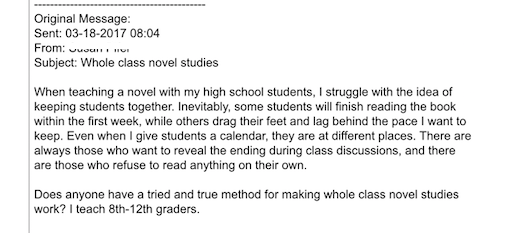
Wholeclassnovel

This teacher shares a legitimate concern. I would imagine that most of us who reflect upon our practice and want to do what’s best for students have at some point shared this struggle.

Those of us who read Penny Kittle’s Book Love (or perhaps we came to similar conclusions on our own) understand that every room of readers means many readers reading at a variety of reading rates. And we know it’s not just because students aren’t interested, are too busy, seem apathetic. It just makes sense:  students will be at “different places in their books” because students are all different.

We keep trying to make them all the same.

In response to this teacher’s query, four very helpful teachers shared what works for them. There are some good ideas here. Then, this response, which made my head nod:

Wholeclassnovel2

Followed by this one, which…well, you’ll see:
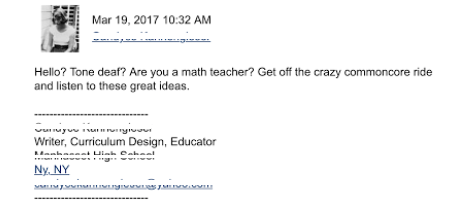
Wholeclassnovel3

Did a professional just dis another professional? Did a curriculum designer and educator on a public ELA forum just dis Dick Allington, one of the lead researchers on reading acquisition and best practices in literacy instruction?

This is just wrong. Wrong on many levels.

Now, I know that Mr. Allington was being sly in his comment here. He wanted to furrow some foreheads and force some frowns. I’m sure. And it worked to instigate some important discussion, which many of us would like to see more often.

One person commented from the perspective of a parent:

“When my son received the summer reading list to prepare for his first year in high school, Amy Tan’s Joy Luck Club topped the list. Being the rule follower I am, I forced that copious and joyful reader to trudge through that text. He didn’t read a thing in English class for the next four years. A brilliant reader and thinker, totally disenfranchised. As Allington said, he didn’t read the text.

“…the abusive pedagogy of the whole class novel described here is oppressive and culturally irresponsible. Sure, there are strategies that teachers can employ that mediate the boredom and disengagement. There are methods that utilize a whole class novel as a shared or mentor text and as a model for instruction or springboard for discourse. And there are a few teachers that can engage the readers throughout a methodical plodding through a classic text. But the question remains: what exactly is taught with the whole class novel? Are you teaching the novel itself? The habits of mind to diffuse any text? Or the student? When do they do their own thinking, independent practice, with influential and engaging texts?”

Shona, you won my heart. My four sons were very similar to yours. All avid readers but not when it came to reading for school.

Yetta wrote this comment:

“Richard Allington is raising a very important curricular issue.  Why should readers only read books chosen by other folks? Self selection of books is a concept that needs to be part of every class concerned with reading development including fiction and non fiction.

Book clubs, reading discussion groups, etc. are organized by many teachers to involve and support students with self selection of reading materials.”

Followed by Yvonne:  “Self-selection works. I was/am always surprised by what students choose to read. Students  amaze me.”
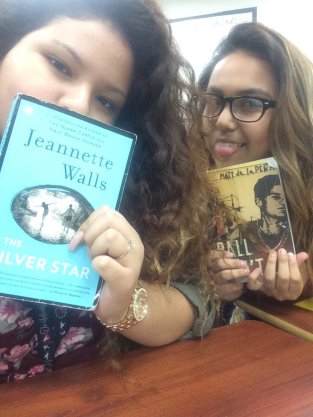
LeslieandYoly

Leslie and Yoly with their favorite reads of the fall

Me, too. And students will read more when they have choice. When we couple volume with instructional practices that teach students what readers do when they get stumped or confused or even bored, using mini-lessons and shorter whole class texts, we help students learn how to navigate and improve their own reading lives.

Shona continues, quoting from the work of Louise Rosenblatt, a researcher who has shaped much of my work:

“A history of the teaching of English (Applebee, 1974, 1996) reports in all periods dissatisfaction at the lack of success in achieving the humanistic goals of literature teaching that school profess and the failure to understand that the traditional approach conflicts with these aims. Literature is treated as primarily a body of knowledge about literary works rather than as a series of experiences. To produce readers capable of critically evoking literary works for themselves and deriving the pleasures and insights claimed for literary study evidently requires different methods and a different educational climate from the from the traditional teacher-dominated explication of literary texts” (p. 71).”

Think about this for a second:  What does Rosenblatt mean by a “series of experiences”? Ones the teacher carefully crafts through engaging and interesting novel studies, or experiences each student knows how to create for him or herself

Reading in English classes cannot be about the books. Reading in English classes must be about the readers. 

I know what some may say. I’ve heard it a lot:  “But I loved English is high school. I read every book. I wrote every paper on every book. I enjoyed the discussion around those books. That’s why I wanted to become a teacher.”

Yes, I know. Me, too. And you know what (and this is embarrassing to admit):  It wasn’t until I was a teacher myself, dragging sophomores through To Kill A Mockingbird in 1st through 3rd period and juniors through The Scarlet Letter in 6th and 7th when I had this epiphany:  “There are some students who are so different than I was when I was in school. They don’t read. They don’t do their homework.”

How naive. How sad that I was so unprepared for the readers I would face in my classroom.

In Lisa’s post last week, among other things, these few sentences rang true for me, too: “Students bought any books they needed for independent reading, and I happily progressed with assigning reading, providing study guides, giving content quizzes, lather, rinse, repeat. This is what I knew. This is what I had experienced myself. This is how I was taught to teach.”

Assigning reading

Providing study guides

Giving content quizzes

For the first three years of my career, this is how I taught, too. I thought I was supposed to teach great literature — and then test on it — instead of helping students become readers who engage with great literature.

I believe we can do both. I believe when we keep the student — his abilities and needs, her interests and desires — as the pilot of our pedagogy, we can do both.
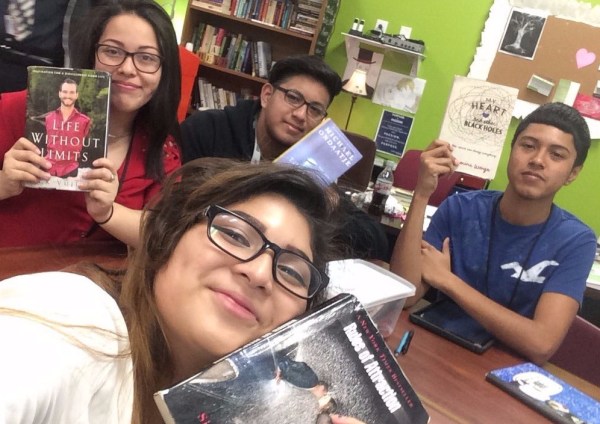
the quiet table reads

My quiet table — readers all.

I know you can click on that link at the top of this post and read the thread on the NCTE forum about whole class novels. I hope you do. In case you don’t, I’ll quote a bit of what Dr. Paul Thomas wrote:

“Teaching ELA/English involves a unique (compared to other disciplines, although somewhat shares by math) tension between our obligations to teaching disciplinary content (knowledge such as Fitzgerald wrote The Great Gatsby as a part of American literature) and also literacy skills . . .

“And thus many high school teachers become trapped in teaching, for example, The Scarlet Letter to make students experts on that specific novel and/or the work of Hawthorne, all as part of gaining so-called cultural knowledge of American literature.

“In that pursuit, often the process negatively impacts students’ eagerness, joy in reading and writing because, as Yetta and others have noted, assigned reading often fails where choice reading soars.

I appreciate Dr. Thomas delineating disciplinary content and literacy skills in such a way. Perhaps this distinction is at the core of the tension between what often seems like two sides of our field: #teamstudentchoice and #teamteachercontrol.

Dr. Thomas goes on to caution against “demonizing” those who choose one approach over the other, and this is where, I’ll be honest, I might be a bit like Screwtape, except in a good way.

My writers and I hold fast to our tag line:  Mentors with Insights, Ideas, and Resources for Secondary Readers & Writers Workshop. We write this blog to encourage others to take a chance on choice, to share student reflections and accomplishments, to promote current books and diverse authors, to show how choice works, and research matters. And sometimes it’s hard to not speak up and speak out a whole lot more.

This semester I have this amazing student teacher. (Anyone in north TX hiring?) He’s brilliant, proactive, a natural. He “gets” our students, and they love him. Throughout the fall semester, Joseph observed my classroom. After “hello” the first thing Joseph said to me was “I have never been in an English class like this. I was so bored with English is high school.” Joseph has stepped right into a workshop pedagogy and embraced its benefits, as a student and as a teacher.

But I share Joseph with a teacher down the hall. He joins her each afternoon and mostly watches as she assigns reading, provides study guides, and gives content quizzes. Heavy boots walk back to my classroom every single day.

And this makes crazy.

We can do so much more. We owe our students so much more.


Maybe we can help each other out:  How do you have critical conversations about choice and workshop and the wonders of books with your colleagues? Please share in the comments.


For more from Dr. Thomas see his post “We Teach English” Revisited. For more on the research around student learning and choice, see Rosenblatt, Krashen, Allington, LaBrant, and this post on Donalyn Miller’s blog.


Amy Rasmussen lives in north Texas and teaches AP English Language and English 3 to the Fighting Farmers at Lewisville High School. She adheres to the words of Emerson: “We aim above the mark to hit the mark,” and Jesus Christ: “Love one another.” Imagine a world if we all love more than we think we can. Follow Amy on Twitter @amyrass.

FTC guideline affiliate links

Getting Feedback From Your Toughest Critics

Remember what it’s like to be a student, constantly wondering if your teacher likes you, worrying about your next assignment and your next grade?


Me too.


I give out periodic “teacher progress reports” to my students to coincide with the progress reports I have to fill out for them.


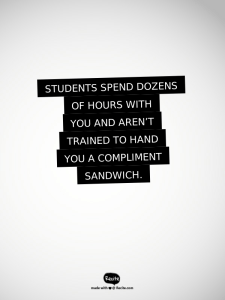
These “progress reports” are an opportunity to hear raw student voices enter the way I think about our work together and the way I plan future lessons and future units.   Unlike your principal, students spend dozens of hours with you and aren’t trained to hand you a compliment sandwich.

recite-1hilvei

Here’s some of what I learned by going through student responses:


Students really, really, really like independent reading time.   It’s clear from student feedback that independent reading is an important routine to their days.  Some wrote about how they look forward to coming in from lunch to a silent classroom for some reading.  Others wrote about how they enjoyed the time to do something they enjoyed.  Many students asked me for more independent reading time.  Aside from giving out candy (most popular suggestion #1) and going outside to play for class sometimes (most popular suggestion #2), more reading topped the list.  Some students even ask me if we’ll ever spend a whole period reading.


They love to write when they know what I am — and am not — grading for. One of the beauties of setting up strong workshop routines is that there’s always a good sub plan in the wings.  If I am going to be out of class for a period or two, I assign a “free choice” writing assignment.  Students are responsible for handing in a writing piece on a topic or genre of their choosing, and they are graded only on their attention to the grammar and mechanics concepts that we’ve reviewed in class.  By making the assessment so literal, students play with form, content, and message: I collect memoirs, mob stories, text message conversations (with graphics!), screenplays, journal entries,  epic fantasies, and more.


Students love “ghost grades” on major assessments.  I give students the option of a “ghost grade” on a draft for a major project.  That grade serves as a) a minimum final grade, and b) a benchmark for future improvement with concrete feedback on what needs fixing.  Students enjoy making changes and watching that lower “ghost grade” improve in the final draft.  This ghost grade helps make some of their writing progress visible as far as the literal gradebook is concerned.


Do you do elicit feedback from your students?  If so, what have you learned from that feedback?


Amy Estersohn is a middle school English teacher in New York.  She will probably never give out candy, but she will, on occasion, give out emoji stickers, which students pretend not to care about.  (But they do.)  Find her on twitter at @HMX_MSE

Reframing Independent Reading: We Can Start By Not Grading It

imgres-1.jpgAll week, I’ve been thinking about Pernille Ripp’s exasperated plea, “Can we please stop grading independent reading?”  (I imagine that she initially had an exclamation point at the end of that post, like, COME ON, people, but then deleted it to be nice.)
Still, I am one of those people she is exasperated with.  Or I was while in the high school classroom, dedicatedly printing log sheets and grading reading every week for three years, using a complicated system of reading rates and conferences to give a number grade that reflected reading growth and sustained progress.

One year, I abandoned this system in the third quarter, just to see what would happen–would kids stop reading if I removed the accountability of a weekly reading grade?

Yes, yes they would–and they did.  So I re-instituted weekly grades, which, combined with a quarterly assessment, combined to 20% of my students’ total grade.  I was happy that this much of my course grade was dedicated to independent reading, but I didn’t realize that the grades I was mandating weren’t really creating independent readers at all.  (In hindsight, I should have begun the year without reading grades and created an authentic community of readers who weren’t motivated by reading logs.)

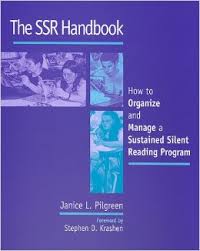
imgres.jpgAfter I read Pernille’s post, while thinking about this idea (read: beating myself up for slaughtering kids’ love of reading), I pulled out one of the most memorable texts I read while in college–Janice Pilgreen’s The SSR Handbook.  In the foreword, Stephen Krashen writes:

Free voluntary reading means reading what you want to read, with no book reports, no questions at the end of the chapter, and not having to finish the book if you don’t want to.  Sustained silent reading provides children with an opportunity to do free voluntary reading in school.  Is this a good idea?  Yes.

Pilgreen lists eight components of a successful SSR practice:

  1. Access – to many reading materials (books, newspaper, magazines, comics)
  2. Appeal – the materials are interesting and appropriate for the students
  3. Conducive Environment – the space in which students may read is comfortable and welcoming
  4. Encouragement – teachers and peers encourage students to read through discussions, modeling, and more
  5. Staff Training – teachers should have practical approaches in place for helping kids become readers
  6. Non-Accountability – no records, no monitoring, no “task-oriented” attitudes toward reading
  7. Follow-Up Activities – thoughtful, creative, interactive ways in which students discuss their reading lives authentically
  8. Distributed Time to Read – a volume of time that consistently occurs during which students read freely in school

When I think now about these eight simple factors, I see them clearly through the lens of workshop teaching.  To me, the components translated to my real-world readers workshop classroom look like this:

  • a classroom library brimming with high-interest books;
  • a reader-friendly community built not only into a welcoming physical space, but one in which daily reading, talk, conferring, and encouragement happen;
  • a teacher-leader who is the best reader in the room, who can model fluent reading and recommend a wide volume of books to students;
  • a lack of graded formative assessment and an emphasis on summative assessments for learning, not of learning.

This means no reading levels, no required number of books per year, no structured programs in place, no minimum number of minutes of reading done per week.  This means relinquishing control.  This means a lot of modeling, conferring, and progress monitoring to encourage student growth and lifelong learning.

This means thinking about independent reading as truly independent–independent of grades and of accountability.  This means reframing independent reading in school as an authentic, student-centered activity in which the readers take the lead and teachers merely help provide coaching and guidance.

If these ideologies are in place, teachers will know if kids aren’t reading (by simple observation and conferring).  We can adjust our instructional practices from there, without the damaging effects of punitive grades.  We can still give a grade for summative student self-assessments of independent reading growth (student-led is the key, here) to satisfy those mandatory gradebook updates, but if students are to become real readers we, as teachers, cannot be the ones holding them accountable for their progress.

There are many other kinds of reading that happen in language arts classrooms in addition to independent reading:  whole-class study of texts; small-group book clubs; close reading studies of poetry, articles, essays; explorations of mentor texts; analyses and syntheses of plays and novels and writing of all sorts.  This is where the work of learning to become a better reader can come in (which can be very enjoyable!), which lends itself to skills-based reading assessments.

In contrast, independent reading and all its many joys and struggles and spaces for success and failure are not, as Pernille says, “gradeable skills but instead a child practicing habits to figure out how to get better at reading.”  If we want to nurture this practice, we cannot keep grading it–and that’s the first step to reframing our thinking about independent reading.

Shana Karnes lives in West Virginia and teaches sophomore, junior, and senior preservice teachers at West Virginia University.  She finds joy in all things learning, love, and literature as she teaches, mothers, and sings her way through life.  Follow Shana on Twitter at @litreader or join her for the Slice of Life Writing Challenge here.


Letting Go in the Name of Book Love

letting go

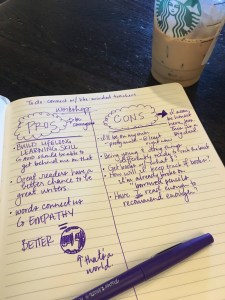
I am a super fan of Pro/Con lists, although the true reflection of these lists never seem to govern my life as much as the making of them does.  Let me explain.

I can always think of a million reasons not to do something, but if I’ve already decided I want to do it, the Pros generally outweigh the Cons because of just that–weight.  Sometimes the reasons TO do something are fewer, but are so weighty that they can’t be ignored.

Workshop was that for me.

pro con

This is a real picture of my real notebook.  Please don’t judge the fact that I give myself pep talks within my P/C Lists.


Here are a few Cons of workshop from my list at the beginning of this year:

  • I’ll be on my own, pretty much.
  • I’m young, and everyone will think I’m just trying to rock the boat.
  • WHERE WILL I GET THE BOOKS?!!
  • Once I get those books, likely via my own dwindling bank account, how will I keep track of the books?  I already go broke on borrowed pencils–and those cost…well… can anyone break a penny?
  • What if I haven’t read enough to recommend enough?

Sure, all of these were true then, and are still true now.  However, I think the weight of the Pros on this list were hard to ignore:

  • I could truly build something that would become a lifelong skill that carries students through the rest of their lives as learners.
  • Great readers have the potential to be great writers.  You can’t do what you’ve never seen (at least not well).
  • Reading in builds empathy.  Reading far and wide builds empathy far and wide.

To be honest, the biggest fear on that list of Cons was the idea of losing books.  We teachers, just as Lisa pointed out yesterday, are notorious for going broke for the cause.

I started workshop anyway.  As soon as I met 3rd Period this year, Terri-Rose quickly became the actualization of my worst nightmare.  On the first day when we checked out books, she insisted on taking three home to peruse because she couldn’t make a decision.  My first endeavor into workshop, I wasn’t quite sure if that was a thing.  I gritted my teeth and slowly expelled a perfectionistic breath, attempting to inhale a free spirit (something which usually doesn’t hover near me much less inhabit my own body).  She held three of my shiny new bestsellers bought with my own money after the small grant I obtained already ran out.  I told her she could do that as long as she signed them out and brought two of them back to me the next time.  I glanced over my shoulder to my then-meager amount of books after the first checkout.  Who knew 300 books could go so quickly?  I might never see them again.  

But, you know what, I did.  Most of them.  Terri-Rose still hasn’t learned to make a decision.  Whenever she finishes one book, she takes two more.  She’ll get halfway through one, and then give it back to me.

I’ll ask, “You didn’t like this one?”

She’ll say, “I do, but I want someone else to be able to read it while I finish this other one.” We developed a system with her book marks.  She likes to use candy wrappers (always pristine) to mark her place, so she’ll hand me the candy wrapper, and I’ll put a sticky note on it with the book title and page number to hand back to her when she’s ready for that book again.  It’s a nice system.

The other day, she came into class raving about a book.  It’s a normal occurrence.  She’s never quiet about something she loves–a quality I’m hoping to channel more in the future.  She wanted to barrel her way through Everything, Everything because the movie is slated to release in May.

Then came the request.

“Mrs. Paxson, I have this pen pal in Weatherford and we’ve started talking about books.  I told her about Everything, Everything, and the movie coming out and now she really wants to read it.  Would it be okay if I mailed it to her to read and then she mails it back before school is over?  I can even ask her to write a review for it before she sends it back!”

The exhale and inhale was quicker this time, mostly because I was leaping for joy inside at the desire to share the Book Love.  I agreed to the terms of her proposal, and I can’t wait to get the book back with a long distance review.

All of those Cons, like I said before, still stand true.  I’ve lost some books this year–probably five or six.  But the weight of the Pros have grown heavier with success and small triumphs–more than I ever thought they might.

As I think of Terri-Rose, unable to make a decision, reading books halfway through and two at a time, always sharing with friends before she’s even close to done, I’m reminded of my own reading life.  It’s a real one, not one for a grade or to check a box.

Then I think: Holy crap–it works.

What moments have surprised you with sharing #BookLove and watching it grow?

Jessica Paxson is an English IV and Creative Writing teacher in Arlington, TX.  She frequently feels as though someone made a mistake in allowing her to hold the futures of over 100 teenagers in her jittery, over-caffeinated hands for the past two years.  If you enjoy watching her make a fool of herself by being unbearably vulnerable, you can catch more of that over at www.jessicajordana.com. Follow her on Twitter or Instagram @jessjordana.


Going Broke Buying Books

Disclaimer: There are countless ways to save money when securing books for your classroom library. I, however, often lack the patience for such measured and responsible procurement of texts. This is my story (and possibly my defense should my husband discover just how much I spend on books).


My husband Nick is a dear man. He has to be, to put up with the amount of time, energy, and hard earned cash I devote to this passion called teaching.

In the 14 years I’ve been at this, or rather the 2 years I’ve been building a genuine classroom library, I have probably spent $4, 398,291 (hyperbolic numbers are my favorite, because I’ve never been good at math).

It often happens before I know what I’m doing. Like those poor souls who sleepwalk and end up in the middle of a busy road in their pajamas, I find myself “just putting a book in my Amazon cart so I remember the title,” or “checking Thriftbooks for a minute (or 27), to see what’s new.”

Hi. My name is Lisa, and I buy a lot of books for other people’s children. 

doryThis “problem” sort of took me by surprise. With my head hanging low, I must admit there was a time, not too long ago, when there were very few books in my classroom. There were very few books in my life period, besides the ones I “taught” year after

year. My classroom was rich in many valuable thoughts, inquiries, and experiences before workshop, but it was not full of books.

How, as a teacher of literacy, had I allowed my classroom to become devoid of the very tools of reading I kept suggesting to my students would be their salvation in the face of collegiate ambitions, thematic exploration, and aspirations of world domination?

Apparently, it wasn’t important to me.

Ugh. That reflection looks ugly in print.

I didn’t purposefully create a text desert in my classroom, of course. If someone had said, “Hey, Dennis. You teach English. Where are all the books?” I would have smiled and pointed to the textbooks and countless copies of Uncle Tom’s Cabin. Students bought any books they needed for independent reading, and I happily progressed with assigning reading, providing study guides, giving content quizzes, lather, rinse, repeat. This is what I knew. This is what I had experienced myself. This is how I was taught to teach.

But then, one day, a big rock fell on my head. I dreamt of rows upon rows of bookshelvesryan gosling lining the walls of my classroom and students clutching copies of countless titles to their bosoms. Ryan Gosling walked into the room and said, “Hey girl. I really love the work you’re doing for public education. Let’s get those kids reading more. Cool?” When I came to, I was blushing, but more importantly, I knew that my students needed more choice. More challenge. More access to books.

Ok. Not really. But the conclusions I came to after some workshop research, training by the lovely workshop team of Three Teachers Talk, and logical reflection about how I wanted my students to view reading, that part is true.

There is still a very important place for whole class novel work in my classroom. There is still a place for short lists of books with a central theme to get kids working in book clubs. There is still a place for the classic and contemporary. But there is also now a place for a lot more choice right in my classroom, always located just a few steps away.

And though we might not want to believe that we have to hold our kids’ hands and walk them to our bookshelves, instead of trusting them to take their own time to go to the library or while away the hours at the local bookshop, at least in the beginning, we do. We need to make the books so wildly available, that kids can’t help but wade through them in the course of our time together.

Think of elementary classrooms. Books upon books, upon teachers reading aloud books. If books aren’t at home, they are certainly at school, and when kids are learning to read, they are showered with books. Why not shower them with texts when we are trying to reignite that love of reading?

Given time to read, talk about books, formative and summative work around independent novel study, goal setting, book challenges, quick writes on choice reading, daily book talks, a teacher who pours passion about books all over their every class period AND shelves of books three feet away, progress in building and rebuilding readers is very possible, and even, probable.

We can teach children to read, but for reading to become a habit, they need ready access to books. We also know, they need choice, choice, and more choice (thank you a million times for your brilliance, Donalyn Miller).

When it comes down to it, we might not want to believe our students evade the reading we ask them to do, but they often do. Many fake read very, very well. Others simply smile, or avert their gaze, or defiantly say, “I didn’t do it” or “I’m just super busy.”

I’ll put it this way, my dentist hands me floss, but I don’t use it as often as I should. There. I said it. I am a college educated, do-gooder, who knows she should floss…every day. I do not floss every day. I know my teeth will suffer for it. I know when I go to the dentist I feel bad for having to say that I could probably floss more. I know it’s with the best intentions for my own self-interest that the professional tells me to do it, but…I don’t do it. I’m just super busy.

Perhaps a bad analogy, but our students don’t always make the right choices when it comes to reading. They prioritize other things. If my dentist were handing me floss every day, chances are good, I’d get in the habit. Should he have to? No. Should I just do it on my own because I know it’s good for me, of course. But, I’m flawed. We all are.

So, at least for awhile, I’m going to care enough about my students’ teeth, er, reading habits to make it highly visible, readily accessible, and as entertaining as I can.

The payoff just this week is real:

  • Josh is a super smart kid who hadn’t been devoting time to reading. He, like so many others, used to love to read, but had fallen out of the habit. With our 10-15 minutes of reading a day, and my suggestion that he add just 10 minutes before falling asleep each night, Josh is back into books. Major texts, in fact, and just book talked The Name of the Wind by Patrick Rothfuss to our a class. A little bit here and a little bit there made the reading a habit again. I bought the book and handed it to one of his peers who flew through it too.
  • I saw Brianna standing at the bookshelf yesterday morning. Sort of swaying back and forth. I skipped over (ok, I was skipping in my head, but I was excited to help her find something magical).
    “What are you in the market for, my dear?”
    “Uh…I’m not sure. I just read Think Like a Freak: The Authors of Freakonomics Offer to Retrain Your Brain. It was really good, but I might be over nonfiction for a while.”
    “Makes sense. How about a really good story? Try this. Oooo! And this…and I had someone read this one last month. And…this (The Help). Have you read this one yet? Take a look at the reviews in the front from past readers. This is a great book.”
    Brianna was 20 pages into The Help and picked up the book between activities in class that day.
  • The somewhat shocked and surprised smile on JJ’s face when, after book talking Jodi Picoult’s Small Great Things: A Novel last week, I put in his hands a copy of her incredible new release. He had asked for my copy a few days later when he finished his latest read, but it had already been checked out. He looked crestfallen. When I saw it yesterday on the new release cart in the library, I checked it out, and hunted JJ down during our resource period. “Wow. Thank you!
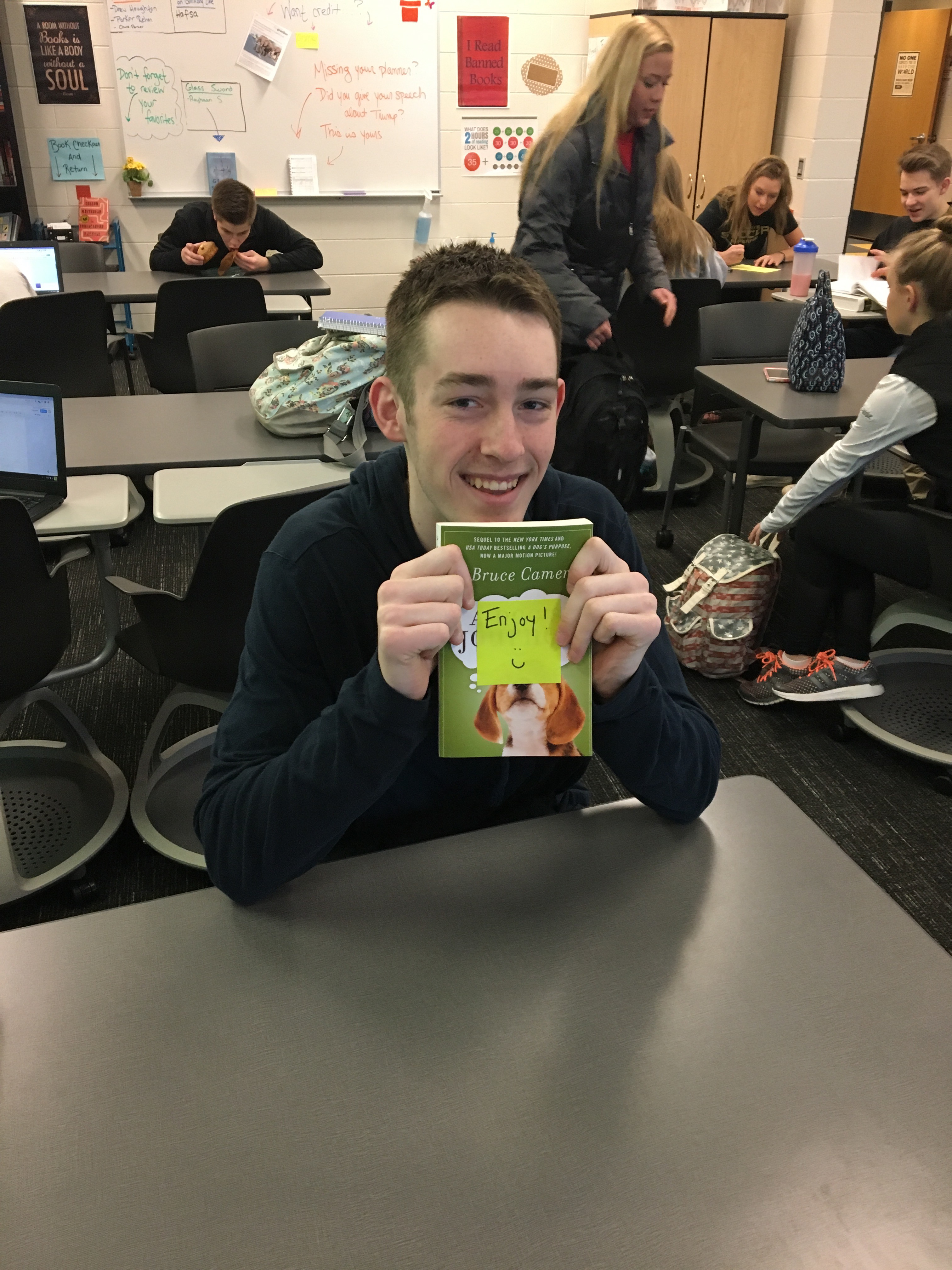
  • And this…You might remember Nathan from a few weeks back after he finished A Dog’s Purpose:
    img_0266
    I was at Barnes and Noble and used one of my gift cards to buy the sequel A Dog’s JourneyI think this smile is worth the expense:

Truth be told, I’m very lucky to work in a district that has put a huge amount of money into funding the classroom libraries of our English department as we’ve moved to workshop. And there are countless ways to put on your thrifty teacher cap and get the texts rolling into your room if your district isn’t yet on board with choice reading:

  • Write letters to your local bookstores and appeal to their sense of community pride, favorable Yelp reviews, and goodwill to all.
  • Loiter in bookstores and flash your teacher credentials. Sometimes a pleading jessicasmile and/or a small purchase will secure some free or discounted books.
  •  Apply for grants (Nothing says #booklove like free books…next year).
  • Rummage, thrift, estate sale your way through the summer.
  • Gather some research on classroom libraries and get it in the hands of your administrators. You might be surprised.
  • Ask Shana for books. She loves to give away books to fellow workshop teachers.
  • Befriend authors via social media! Jessica is trying her hand at scoring some Matthew Quick books through Shana’s connection. No shame, Jessica! Twirt (twitter flirt, I believe) away!

You don’t necessarily have to spend your own money on books, but I do. Something inside of me saying that I need more. I need more variety. I need more to recommend. I need more books.

I keep telling my husband that I’m helping to inform, inspire, and impassion the electorate. I’m also in charge of the money, so my little addiction should be able to continue a little while longer.

I consider you all my support group in this matter. Thank you for your support.

How do you surround your students with books? What titles have you added recently that keep flying off your shelves? We’d love to hear from you in the comments below. 

FTC guideline affiliate links

Lisa Dennis teaches English and leads a department of friends at Franklin High School near Milwaukee. Her latest classroom library purchases were The Hate U Giveby Angie Thomas, American Street by Ibi Zoboi,  and Violent Endsthe story of a school shooting told from various perspectives and written by 17 YA Lit. authors.  Follow Lisa on Twitter @LDennibaum. 

Beyond Hillbilly Elegy: Books for Country Boys

IMG_1959

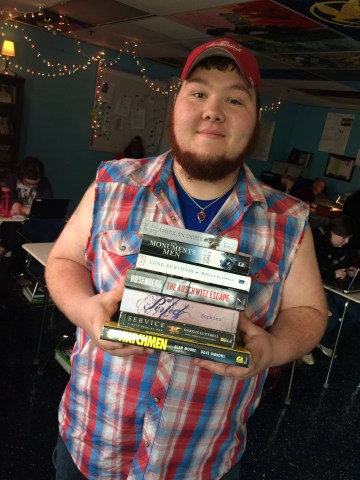
Bull with a few of his favorite books

I’ve been thinking about one of my former students recently, wondering how he’s doing.  His name was Logan, but everyone–his family included–called him Bull.

I’ve been thinking about him because I had him in class for two years, and it took me a long time to realize I’d been recommending all the wrong books for him.

With the recent popularity of a book like Hillbilly Elegy (which has caused quite a stir here in Appalachia) I’m reflecting on how it’s a book I probably would’ve recommended to Bull.  Like the many other “country” books I’d offered him, figuring the text had a character he could actually relate to, I think Bull would’ve hated it, as many of my friends here in West Virginia have.  I haven’t had a chance to read it, but my peers and students alike who have say it’s too much of a stereotype of Appalachian culture, that it paints Appalachia much too negatively, and that it in no way captures the beauty of our mountains, music, or lifestyle.

I had a hard time getting Bull interested in reading, but boy, he’d write.  He wrote beautifully about the country he lived in, the simplicity of his family life (he showed me videos of teaching his barefooted three-year-old brother how to operate a push plow on their farm), and his love of hunting.

I think no book can capture the kind of love that a kid like Bull has for his own heritage, and I didn’t realize that when I offered him book after book that I thought had a “similar” kind of character for a protagonist.

But, in his reading life, Bull was a different kid last year.  He was a senior, about to enter the real world and acutely aware of his need to be prepared for it.

When I talked to him at the end of last school year, he described his junior year reading life as “shitty.”  I asked him why, and he said, “cuz I was lazy.”  He read two books all year, and when I talked to him about this, he laughed sheepishly.

Last year, he’d read 13 books and was in the midst of his 14th–Monuments Men by Robert Edsel–when I went on maternity leave.  I think he read 17 books by the end of the school year.  Before I left, I talked with Bull about his reading life.  We’d discovered his love of war books with American Sniper.  “My great grand-pap was in Vietnam, and I want to read about what he went through,” Bull explained, gesturing to his stack of books.

I also asked him how he felt about reading.  “It calms me,” he told me.  “It gives me something to do.”

It calms me.  I still remember him saying that to me, sitting in my classroom with the back door open, where a spring breeze wafted in and the sounds of kids eating lunch outside could’ve been a huge distraction.  But as Bull reflected on what reading did to him, the act of thinking about books took him away from our classroom and into a place of relaxation.

I loved watching reading transform Bull.

From war biographies, Bull moved to war fiction, then to books in verse, then to graphic novels, then to a variety of nonfiction titles.  He eschewed books about country life, popular fiction, and YA novels all year.

I’m thinking about Bull now as I reflect on the mirrors, windows, and doors we ask students to walk through in their reading lives.  I’m thinking about him as I reflect on Pernille Ripp’s plea for us to stop grading independent reading.  I’m thinking about how I approached Bull first with books I thought of as mirrors, but he was craving windows and doorways all along.  I’m thinking about how his whole junior year, he got 2/10s on reading logs, and I’m thinking about what a colossal mistake that was on my part.

So, last spring, I asked Bull to compile a list of his favorite books, and the draft has been sitting in my WordPress sidebar ever since.  I share it with you now to remind you that this list, a list for “any country boy,” in Bull’s words, is a list of books set far beyond the mountains of Appalachia–and represents a story that can never be told with an independent reading grade.

  1. Lone Survivor by Marcus Luttrell – “This was an amazing book.  It was a true story of a Navy SEAL, and his whole team got attacked in an ambush and he was the only one that lived.  Just the things that he gives you is like standing in war–it’s just amazing how something can give you so much detail that it seems to be real.”
  2. Article 5 by Kristen Simmons – “It was the end of the world basically, and there are a few kids running away from the people who were going to kill them.  It was also a really detailed book so I could imagine what the new world looked like.  I liked that book a lot.”
  3. Perfect by Ellen Hopkins – “This book was all about everything people give up to be perfect.  The whole time I was reading it, I just thought, nobody’s perfect–what is wrong with these people?  But it made me understand everybody else better.”
  4. The Auschwitz Escape by Joel Rosenberg – “Hitler ruled this book.  It was about war from a prisoner’s point of view, and it gave lots of detail about what he went through and what Hitler forced him into.  I would never have wanted to be part of World War II as a soldier or a prisoner.  That was some crazy shit.”
  5. Symphony for the City of the Dead by M.T. Anderson – “This one was really hard to understand compared to the other WWII books I read.  I picked it for my challenge book, and it was about what happened in Russia during World War II.  It taught me more about writing than about war, honestly.”
  6. Watchmen by Alan Moore – “This was my first graphic novel and I liked that it was and was not about war, at the same time. It was kind of about the cold war, but through the fighters’ eyes and not the politicians or the history books.”
  7. The Blind Side by Michael Lewis – “Well this book was nothing like the movie, but I wanted to read the book after I saw the movie.  It’s about a football player that came right out of the Bronx, basically had no mom, and he just went from clear down to about nothing to making millions of dollars a year playing in the NFL.  I got inspired by him how you can come from nothing to the NFL and you can do anything you put your mind to.”

Bull now works for the water company here in West Virginia, still lives on a farm…and still reads.  And the song of his reading life is so much broader than a hillbilly elegy.

Shana Karnes lives in West Virginia and teaches sophomore, junior, and senior preservice teachers at West Virginia University.  She finds joy in all things learning, love, and literature as she teaches, mothers, and sings her way through life.  Follow Shana on Twitter at @litreader or join her for the Slice of Life Writing Challenge here.

Booktalk this now: THE PLOT TO KILL HITLER by Patricia McCormick

The story behind the story.  At this year’s ALAN workshop (you should go!!! free books!!!! lots of authors!!!!!!)  I heard Ryan Graudin, author of Wolf By Wolf, talk about her research of Dietrich Bonhoeffer.  


Dietrich who??!!!


Oh, you know, this guy who was part of a larger group planning to publicize Hitler’s misdeeds to the broader world and to kill him.


Ryan’s book is all about an underground resistance that planned to kill Hitler.  Her book is fantasy.  


The Plot to Kill Hitler, Patricia McCormick’s biography of Dietrich Bonhoeffer, is as real as it gets.

plot-to-kill-hitler

Whom this book is for.  Readers who have a basic, elementary school-level understanding of Hitler and concentration camps know enough to follow this story from beginning to end: McCormick takes care of readers from there.


The topic is heavy, but the short chapters and brisk pacing make this 150-page piece perfect for middle and high school readers as well as mature elementary school readers.  If your school already does a holocaust unit, this book will provide a new point of view.


More sophisticated readers will make connections between Bonhoeffer and Martin Luther King and can debate the relative merits of a pure nonviolent approach to more direct and retributive forms of protest.  One of the most fascinating parts of this book for me was seeing how Bonhoeffer, a deeply religious emotional young man, transformed from a social justice scholar and Gandhi acolyte to a subversive and aggressive warrior.


How to booktalk it. Not too much preamble.  Just read the 2-page prologue out loud to the class, where Bonhoeffer knows he is about to be captured by Nazis and races to hide his incriminating papers in a ceiling panel and leaves a deliberately fake diary to throw the Nazis off his path.


You should also know… I struggle to match quality middle grades nonfiction with readers.  Some of the most fantastic middle grades nonfiction titles require a lot of patience and background knowledge.  Some are so laden down with information that there isn’t enough of a story to keep readers going.  Other terrific nonfiction titles are awkwardly sized and aren’t easy to carry down the hallway.  This book avoids all of those possible pitfalls.


Amy Estersohn is a middle school English teacher in New York.  Despite her observations that nonfiction books tend to be harder to carry around than fiction books, she has seen students lug around the 10-pound “Hamilton” book — you know, the one with all the pictures of the original cast.    Since you were asking, she won lottery tickets to see “Hamilton” during its first week on Broadway.  Really.  Twitter handle: @HMX_MSE

Why I Returned to Hard-Copy Grading

tumblr_maccshmi241rvog5q.gifGrading, grading, grading.

Sigh.

As the kids say, I literally cannot even.

Where do I begin?

Grading, to me, is one of the necessary evils of education–along with mandatory monthly fire drills, whole-building staff meetings, and standardized tests.  I have disliked it for the duration of my teaching career, as I have disliked all of those things, but I still have not found a way to avoid it.

When I left the high school classroom last May, one of the things I was happiest to let go was grading.  (That and those damned fire drills.)

But I didn’t expect to come to loathe grading even more when I began teaching college students.

There were a few reasons I disliked grading in my new job:  first, I found that, by dint of the course designs I inherited, that the only “grades” given were at the very end of the semester.  This meant that what little formative feedback was built into the course wasn’t seen as valuable–by the students nor the other instructors I was working with.  I sat in meetings where a colleague complained about “having to do all that reading and write all those comments for nothing” (“nothing” being no grade).  I thought to myself, wow, you’re missing the whole point of formative feedback.

Another thing I loathed was that most everything was electronic.  Any assignment due was expected to be turned in via email/eCampus/Google Drive two days prior to the class meeting, and the instructor was to give feedback and a grade before class began on Friday.  This meant that the only feedback about a student’s work was always only given by the instructor, and that students never saw one another’s work.

So, as the semester moved along, I began to make some changes to the course design:  more formative feedback, more frequent turn-in checkpoints for large assignments, lots of ungraded, low-stakes drafting of ideas in class.  We all hobbled to the end, adjusting assignments and expectations as we went.

But over the winter break, as I reflected and gathered the many post-its of ideas I’d stuck here and there, seeking to refine our syllabus and clarify our goals, I thought of one major change I could make that would solve a lot of my problems with the course.

Return to paper.

img_7291Good, old-fashioned, print-it-out-and-bring-it-to-class-and-turn-it-in assignment submission.
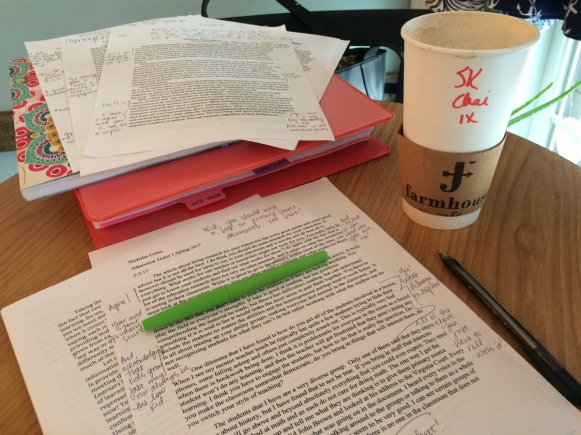
This practice has had a few key benefits for me so far this semester.  First, I am seeing much more clarity of thought in my students’ talk in class–I suspect because they’re treating their weekly one-pagers as first drafts of their thinking, and then re-reading them, as evidenced by their frequent typo corrections or asides to me in the margins.

Second, the issue of opacity between students’ assignment submissions is gone.  Each class meeting, I try to build in a time to share our writing, whether by trading papers, using our papers as an artifact to support some talk, or asking students to comment on one another’s work.  I ask students to read not just for content, to glean multiple perspectives, but also to read for structure, to see how other writers think through the issues we’re grappling with.  As a result, I’ve seen a great deal of growth in how students structure their writing, as well as a transformation in the confidence of their writing voices as they engage with (and often question) the ideas in the texts we read.

Third, we’ve been reading Visible Learners this semester, which encourages the practice of documentation for the purpose of reflection.  By having concrete documentation of our thinking in the form of hard-copy papers, as well as hard-copy documentation of responsive thinking in the form of my comments or their peers’ in the margins, it is much easier to trace patterns and progress in our thinking.

Fourth, I’ve found that removing laptops or tablets from the equation when students share work actually improves the quality of their conversation.  I’ve been reading widely about how detrimental our devices can be to our talk, so I’ve made a conscious effort to reduce our screen time in class.  Fewer devices lead to more robust dialogue, which leads to better thinking and writing and time together overall.

Finally, my students are now accustomed to receiving frequent formative feedback and have come to expect and welcome it.  Initially, the students were a little wary when they saw my scribbles, assuming they were all corrections, but then were delighted when they actually read the feedback a peer or I had left.  Now, they hunger for the moments when a friend hands them back their paper with a handwritten note, or I return assignments the next class.

C4ErTFNVcAA9ku9 2

Switching to hard-copy grading has improved a great deal of my work with my students, and although I still haven’t come to love grading, I am enjoying it a lot more this semester.

Now to tackle that huge stack of one-pagers that’s been staring at me all morning…!

Shana Karnes lives in West Virginia and teaches sophomore, junior, and senior preservice teachers at West Virginia University.  She finds joy in all things learning, love, and literature as she teaches, mothers, and sings her way through life.  Follow Shana on Twitter at @litreader or join her for the Slice of Life Writing Challenge here.

FTC guideline affiliate links