Category Archives: Writers

Guest Post: A Different Take on News That Is Fake (It’s Not…It’s Manufactured Via a Profit-Making Monopoly)

A few days ago, my husband posted the following on his Facebook page. His message ties to my post yesterday, and it sparked even more of my thinking about the importance of critical thinking. You may find it does so, too.


“You can see the skies. They look like they’re upset about what mankind has been doing, and they’re threatening the Earth with storms. The clock says it’s daytime, but dark night is strangling the sun.”  No Fear Shakespeare, Macbeth, Act 2, scene 4.

All this fuss and vicious finger pointing about fake news. Sheesh. Let me suggest, my friends, without being too obnoxious, it isn’t fake at all, rather, it is manufactured.

Well, yes, manufactured.

It starts with a “mined” or “harvested” raw resource (supposedly the facts or the “truth” [air quotes]), then it goes through various refinement processes until finally there’s a “bombshell of the day” or “breaking news” or “blockbuster movie or TV series” product at the end of the value chain designed to get and hold our attention across multiple channels and media. But, when the news and/or entertainment finally hits the airwaves (the shelves of our eyes and ears) there are two things to try to keep in mind:

  1. The owners of the bulk of news and entertainment makers and distributors devolve into a VERY small group of companies–a monopoly of sorts–that are controlled by 20 to 30 so Billionaires, that make ALL the decisions on what/who gets reported and not reported, filmed and not filmed, bullied and not bullied, even elected and not elected, etc. (Please see the list of companies below.)

  2. The content of news and movie/TV entertainment is extremely curated and molded. Why? Because the goal no longer is to keep news and entertainment separated. It is unnecessary since there is no external moral code to dictate what is right and wrong, good and bad, virtuous or vice. Today, those considerations are dictated by who is in charge of controlling the minute by minute, hour by hour, daily, weekly, monthly and yearly newsfeed, entertainment and educational narrative in order to make . . . MONEY!

Manufactured news must be carefully designed to inform and entertain in order to fuel the “attention to profit” revenue engine.

Buying this?

If so, may I suggest to never forget the money trail IS the only thing that matters at the end of the month/quarter. It seems, today, that there are NO altruistic incentives in news or entertainment. Either the media outlet makes a profit or they’re gone. And, the political, moral views of those who control the content are intricately tied into the “profitable” audience that pays for a certain point of view or worldview to win or triumph.

And the battle lines are drawn very profitably by these news and entertainment media manufacturing monopolists.

The funny thing is that unless we are willing to see behind the curtains (there are multiple layers of curtains) there is a assembly line or “value chain” that narrows down ideas, slants perspectives, and cherry-picks management teams to promote, or hold to, a certain bias, then we are most unwittingly duped no matter what political or moral side we’re on. We’ll argue until we’re toxically bloated that we’re right, but there’s ALWAYS another story behind the story behind the story that may undo our “I’m right and you’re wrong” arguments.

Consider this:  All those thousands of TV channels we thought represented diversity and fairness, uh, no. . .

What I’m going to share is quite eye-opening (at least I think so). All we hear about is how horrible Rupert Murdoch and Fox News are, but let’s look at the top companies (unranked) that own 90% of the media (including News Corporation aka Rupert). It seems fair to me that any and all could read through this and be able to conclude that there’s more to the “facts” than we’re being told when it comes to who/what controls what we see, hear, and read every day in news and entertainment. And, all of which, today, in my opinion, are manufactured one and the same:

  1. Comcast ($55 billion…ish) owns or has it’s hands in . . .ready?

NBCUniversal; twenty-four television stations and the NBC television network; Telemundo; USA Network; SyFy; CNBC; MSNBC; Bravo; Oxygen; Chiller; CNBC World; E!; the Golf Channel; Sleuth; mun2; Universal HD; VERSUS; Style; G4; Comcast SportsNet (Philadelphia), Comcast SportsNet Mid-Atlantic (Baltimore/Washington, D.C.), Cable Sports Southeast, Comcast SportsNet Chicago, MountainWest Sports Network, Comcast SportsNet California (Sacramento), Comcast SportsNet New England (Boston), Comcast SportsNet Northwest (Portland, Ore.), Comcast Sports Southwest (Houston), Comcast SportsNet Bay Area (San Francisco), New England Cable News (Boston), Comcast Network Philadelphia, Comcast Network Mid-Atlantic (Baltimore/Washington, D.C.); the Weather Channel (25 percent stake); A&E (16 percent stake); the History Channel (16 percent stake); the Biography Channel (16 percent stake); Lifetime (16 percent stake); the Crime and Investigation Channel (16 percent stake); Pittsburgh Cable News Channel (30 percent stake); FEARnet (31 percent stake); PBS KIDS Sprout (40 percent stake); TV One (34 percent stake); Houston Regional Sports Network (23 percent stake); SportsNet New York (8 percent stake).

They also own: Comcast Interactive Media; Plaxo; Universal Studios Hollywood; Wet ‘n Wild theme park; Universal Studios Florida; Universal Islands of Adventure; Philadelphia 76ers; Philadelphia Flyers; Wells Fargo Center; iN DEMAND; Music Choice (12 percent stake); SpectrumCo (64 percent stake)

(Note: Some of these companies/titles have or will change hands, but no new hands have shown up during the past 20 years. It is still the same group of Billionaires and companies incestuously fleshing it out for profit.)

  1. Time Warner ($29 billion…ish)

One of the largest media holding company with the Warner Brothers Television Group; Warner Brothers Television; Warner Horizon Television; CW Network (50 percent stake); TBS; TNT; Cartoon Network; truTV; Turner Classic Movies; Boomerang; CNN; HLN; CNN International; HBO; Cinemax; Space; Infinito; I-Sat; Fashion TV; HTV; Much Music; Pogo; Mondo TV; Tabi; CNN Español the Cartoon Network, Adult Swim, Turner Classic Movies, CNN and Headline News and CW.

TW also owns: Warner Brothers (which owns DC Comics); Warner Brothers Pictures; New Line Cinema; Castle Rock; WB Studio Enterprises, Inc.; Telepictures Productions, Inc.; Warner Brothers Animation, Inc.; Warner Home Video; Warner Premiere; Warner Specialty Films, Inc.; Warner Brothers International Cinemas

  1. News Corporation (Rupert Murdoch) the largest market cap at $40 billion…ish

Owns Fox Broadcasting Company; television and cable networks such as Fox, Fox Business Channel, National Geographic and FX; print publications including the Wall Street Journal, the New York Post and TV Guide; the magazines Barron’s and SmartMoney; book publisher HarperCollins; film production companies 20th Century Fox, Fox Searchlight Pictures and Blue Sky Studios; numerous websites including MarketWatch.com; and non-media holdings including the National Rugby League. FX; SPEED; FUEL TV; Fox College Sports; Fox Movie Channel; Fox Soccer Channel; Fox Soccer Plus; Fox Pan American Sports; Fox Deportes; Big Ten Network; National Geographic U.S.; Nat Geo Adventure; Nat Geo Music; Nat Geo Wild; Fox International Channels; Utilisima; Fox Crime; NEXT; FOX History & Entertainment; the Voyage Channel; STAR World; STAR Movies; NGC Network International; NGC Network Latin America; LAPTV; Movie City; City Mix; City Family; City Stars; City Vibe; the Film Zone; Cinecanal; Elite Sports Limited; BabyTV; STAR India; STAR Taiwan; ESPN STAR Sports; Shine Limited. Hulu.com (32 percent minority share). HarperCollins Publishers; the New York Post; the Daily News; News International (the Times; the Sunday Times; the Sun); News Limited (146 newspapers in Australia); Dow Jones (Wall Street Journal, Barron’s, SmartMoney, Factiva, Dow Jones Newswires, Dow Jones Local Media, Dow Jones VentureSource). Fox Filmed Entertainment; Twentieth Century Fox Home Entertainment; Twentieth Century Fox Television; Twentieth Television; Fox Television Studios

  1. General Electric media holdings keep changing, but it sorta includes television networks NBC, MSNBC, NBC Sports, Telemundo, 27 television stations in the United States and many cable TV networks, including the History Channel, and Sci Fi Channel. It also owns the popular web-based TV website Hulu. (Sorta means they co-own a lot of things with other media behemoths)
  2. Disney ($55 Billion)

Owns the ABC television network; cable networks including ESPN, the Disney Channel, SOAPnet, A&E and Lifetime; 277 radio stations, music- and book-publishing companies; film-production companies Touchstone, Miramax and Walt Disney Pictures; Pixar Animation Studios; the cellular service Disney Mobile; and theme parks around the world. And, don’t forget they own Marvel Studios now!

They also own dozens of cable networks, and with the Disney channel they control millions of kids’ eyeballs — and moms’ pocket books.

  1. Viacom owns 160 cable channels including MTV, VH1, CMT, Logo, Nickelodeon, Comedy Central, TV Land, Spike TV, Tr3s, BET and CENTRIC

They also own numerous studio brands including Paramount Pictures, Insurge Pictures, MTV Films and Nickelodeon Movies.

  1. Bertelsmann ($20 billion…ish)

Owns Random House (with over 200 imprints in 15 countries, including the Ballantine Publishing Group, the Bantam Dell Publishing Group, Broadway, the Crown Publishing Group, the Doubleday Broadway Publishing Group, Pantheon, Random House U.K., Transworld, Sudamericana, C. Bertelsmann, Karl Blessing Verlag, Goldmann, Siedler Verlag, Wolf Jobst Siedler Verlag, Plaza & Janes (50 percent), Grijalbo Mondadori (50 percent), the Knopf Publishing Group, the RH Adult Trade Publishing Group, RH Audio, RH Children’s Books, RH Direct, Inc., the RH Information Group, RH International, RH Large Print, RH Value Publishing, and Waterbrook Press; Gruner + Jahr (285 print titles in 20 countries)

  1. We mustn’t forget Social Media:  Facebook with over 1.5 billion people who primarily get their news and entertainment from the Facebook feed they unwittingly created for themselves, warmly cocoons them within a pleasant “me, me, me” echo chamber.

(Source: Freepress)
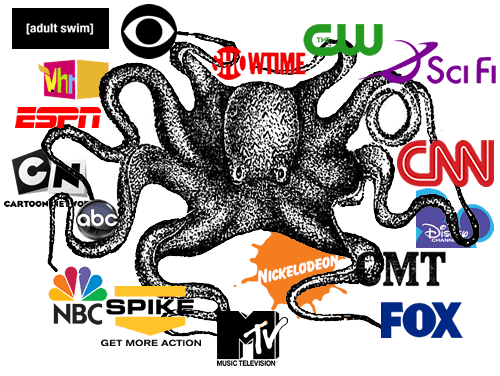
Getting the picture (pun intended)?

I’m a Cinephile, lover of movies, and I’m going to share some stats on movie gross earnings vs product costs that provide some perspective on how what we see/hear is manufactured to keep our attention in order to make a profit.

This daily, highly-touted, data-set got underway in the mid ’70’s when the first summer Blockbuster hit the big screen. It went like this:

Da…dum

Daaaaa…dum

Da-dum, da-dum, da-dum (faster and faster)

It was Spielberg’s, Jaws, and it grossed $470 million on a production budget of $7 million; 67 times the initial investment.

Another more recent example:

Beauty and the Beast, the 2017 metaphor of love, sacrifice and atonement, grossed $900 million, but cost $300 million to make; a 300% return.

It used to be that we’d only hear about the “box office” earnings at certain times of the year, but now we hear about how big, or bad, the “weekend box office” will be, or was, year around. (WARNING: They’re just marketing to us, but now it’s designed to cocoon us in a world of news and entertainment that gets us hooked.)

Don’t believe me? Well, here is a stat to chew on:

Only 2 to 3% of us go to movies in theaters, but 90% of us watch them or TV series (we’ve heard about) in our own homes on DVD, network TV, or streamed TV.

Ready for some more hype that hooks us into the “manufactured media” consumption loop?

Manchester By The Sea grossed $72.6 million, but cost $8.5 million. (BTW, what in the heck was that Oscar-winning movie supposed to achieve???)

La La Land, an absolutely delightful look at the quest for fame and love, grossed $442 million worldwide on a production budget of $30 million.

Historical Hype? (no ranking order)

My Big Fat Greek Wedding (and who didn’t like this laugh fest?) is the highest gross earnings to cost movie: $369 million against $6 million.

Star Wars grossed $775 million against a $40 million budget.

Mrs. Doubtfire grossed $441 million against a $38 million budget.

Slumdog Millionaire grossed $378 million against a budget of $15 million.

There’s Something About Mary grossed $370 million against a $31 million budget

The Hangover grossed $467 million against a budget $36 million.

The Passion of Christ grossed $612 million against a budget of $35 million

The reality is that these movies, based on these numbers, are portrayed as making a profit at the Box Office.

They didn’t.

Movies, in MOST cases, only become profitable after they hit DVD and TV.

NOW, go back to that list of news and entertainment companies and note how many of them own the advertising networks, the movie studios, the news stations, and the TV networks and subscriber channels. And remember that without the TV outlets 2/3’s of their profits disappear.

See the cross-channel, total-immersion system?

Manufactured — end to end — news and entertainment designed to monopolize our eyes, ears, minds, hearts–and pocket books.

And the vast majority of it has NOTHING to do with facts or truth. Well, okay, the weather and sports seem to be based in truth most of the time (unless you think there’s a conspiracy in the NFL, NBA, MLB, NHL, MLS, etc. haha)

And on that sports analogy…from the Witches in Macbeth:

“Fair is foul and foul is fair.”

Sources: SLATE, Hollywood’s Profits Demystified; Freepress, Who Owns the Media?; CNBC, Entertainment, Most Profitable Movies of All Time

Curtis Rasmussen is a lover of great movies, great marketing, and people who don’t fit in. He practices reaching across the aisle to befriend people of the opposite persuasion, politics, or affiliations. Curtis is a marketing strategist and writer who lives in Dallas, Texas, with his wife, Amy, his dog Jag, and his youngest child of seven, Zach. 

Thinking Differently to Do More Thinking

I think most teachers would agree, no matter our content, our number one goal is to help students develop as critical thinkers. And in a world where technology rules much of their lives, impatience governs their actions, and emotions overcrowd the adolescent brain, this can be daunting.

We must keep trying.

Every day we see see headlines spouting fake news, and more and more we see headlines shouting “This news is fake.” We see sites on how to spot fake news, and analyze fake news. We have access to lessons on fake news — Google “lessons on fake news, and you’ll find 5,250,000 resources. We even see the hashtag #fakenews (a fabulous lesson on paradox btw).

A few months ago I read this article at Forbes. Then clicked through and read this one at BuzzFeed. I shared them with my students. We had an interesting discussion, but one comment left me thinking:  “So, basically, everyone’s making stuff up. How are we supposed to believe anything?”

If we are not helping our students find answers to this question, we are doing a disservice to our students — and by extension a disservice to ourselves. What kind of world will we grow old in if we do not help the students in our classrooms today, determine fact from fiction, identify bias, value diversity of thought, be open to new ideas, support their opinions, and seek to understand before passing judgment?

First, we have to be willing to step outside our comfort zones and seek to understand other perspectives. (If you haven’t seen Outside Your Bubble, it’s an interesting starting place.)

Plato

Next, we must school ourselves on rhetoric. And then, we must weave it more overtly into all aspects of our instruction.

As English teachers, we have a prime opportunity:  let go of the nine weeks novel study where we focus on characters, conflict, plot, and theme. Bring in speeches and essays and news articles that invite discussion about the use of language. At the very least balance the study of both.

A few weeks ago a group of teachers from a neighboring district visited my classroom. They observed as my students and I read two blog posts about the Fearless Girl and the Raging Bull statues: Seriously, the guy has a point, and an opposing view, No, the Wall St. Bull Sculptor Doesn’t Have a Point. The discussion was rich. The thinking was richer.

At the end of the class, I chatted with these teachers. We talked about the routines in my workshop classroom, the book talks I conducted, the way I transitioned from one thing to the next. Then, the conversation turned to novels. One teacher asked how long I spend on novels. I don’t. I responded. My students read novels in book clubs where they facilitate the discussion. They talk of plot and themes and author’s craft. They bring meaning to the text, based on their experiences reading the books. (I am not opposed to novels. I am opposed to spending too much time on them.)

I hesitate to challenge anyone on what they do in their classrooms. I do not know their students. I do not know their routines or their motivations, the goals they hope to accomplish as they instruct their students, or the limitations put on them by mandated curriculum.

I do challenge the idea that studying a novel for “a long time” like this teacher told me, is a valuable use of the limited time we have with our students. Our students’ need to navigate the language of their world is too great to spend week after week with a book “they really like” that “I read to them.” We must put the focus on the needs of the reader and not the book.

What our students need right now — what our country needs right now — is critical thinking around a wide variety of texts. We need a focus on how language works to persuade and to manipulate and to cause outrage. Really, that’s our best, and maybe, our only hope.

As we go into summer (I’ve got three days left), I hope we will think about how we might shift our thinking about the needs of our learners. As we read by the pool, vacation with family, attend conferences and trainings, work our part-time jobs, I hope we will think about language and how it can either make or break the communication that is so vital to a society, a society that will thrive on diversity, respect individuality, and foster empathy and productivity.

Teacher friends, that is our job. And I think it’s our duty.

Amy Rasmussen lives in north Texas and teaches AP English Language and English 3. She loves talking books, daughters’ weddings (two this year), and grandbabies. Facilitating PD for other teachers making the move into a workshop pedagogy keeps her focused on her own learning. Amy adheres to the words of Emerson: “We aim above the mark to hit the mark,” and Jesus: “Love one another.” Imagine a world if we all aim higher. Follow Amy on Twitter @amyrass.

Stop Teaching. I’m reading.

SCENE: My classroom


AMY is holding onto a clipboard and attempting to drink from a thermos of coffee while still Looking Important.  She surveys the room of readers and stops at a student who has read an uncharacteristically large amount from the past day.  She stops at the student’s desk.


AMY: How’d you do that?


STUDENT looks up from book.


STUDENT: Do what?


AMY: You know, how did you read 50 pages since the last time I saw you?


STUDENT (shrugs): I don’t know.  I just did.


STUDENT returns to book.


Some teachers might find exchanges like these evidence of an unsuccessful conference with an uncommunicative student. Some teachers might want to go into further questioning: “Well, when did start reading?  How long did you read?  Where were you? Are you on your way to achieving a reading goal?” but it’s easy for that kind of reading conference to quickly turn into an episode of Law and Order: Minors After Midnight pretty quickly.


Instead, I tend to find conferences like these home run victories.  This student is looking to end this conversation so that he can get back into reading.  Isn’t that the best compliment of all?

When-do-we-need-to-stop

Granted, if every interaction with the student went like the above, I’d probe further.  However, I look for three key ingredients when I evaluate these kinds of exchanges:

  1. Is this student reading at an increased volume than he or she usually does?  
  2. What’s the student’s body language like before the conference?  Is it a “please don’t talk to me right now” vibe?
  3. Does the student act unsurprised by the idea that he or she read a lot?  


If the answer to the three above questions is “yes,” I score that conference as a major reading victory, because:

  1. I already de-incentivize book volume and page count.  Students gain no reward for claiming they have read 20 pages when really they have read 2.  This way, I trust when I see students reading more that that reading is their honest performance.
  2. Students should like reading more than they like talking to us.
  3. The student might not be able to accurately recall his or her extended reading period because he or she entered a state of flow.  I don’t know how I managed to watch three episodes back-to-back of Survivor over the weekend.   Students who don’t know how they managed to read a lot might not know because they entered a state of flow.


Okay, so where do you teach this reader in future conferences?  They can’t all be this non-verbal.


  1. Use this book as a benchmark of reading excellence for that student.  Ask that student in a few months, “How does the book you are in right now compare to your experience of reading book XYZ?”
  2. Help the student find more books like it using tools like Amazon.com, goodreads, or by talking to other readers. I am always amazed at how few students know how to look up another book by the same author.
  3. Ask the student what mattered to them most about the experience of reading the book.  Ask about the book, but ask about their feelings while reading, too.  Keep in mind that for some readers a distinctive literary pattern emerges across their reading — say, books about kids with cancer, books about troubled homes, books about the apocalypse, books with strong female characters battling high school drama.   For others, it might be about feelings — they liked or disliked a character, they enjoyed the world the author built for them, etc.

Amy Estersohn is a middle school English teacher in New York and a 2016 recipient of the NCTE Gallo Grant.  And she hates being interrupted in the middle of a good book.  Follow her on twitter @HMX_MsE.

5 Lessons from Public Teaching

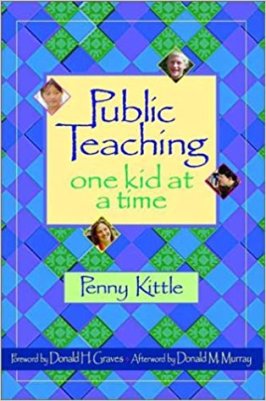
51A2WRYQAZL._SX312_BO1,204,203,200_.jpgThis week I tackled a title that’s long been on my to-read list:  Public Teaching: One Kid at a Time by Penny Kittle.  Published in 2003, it’s Penny’s first book, and has a foreword by Don Graves and an afterword by Don Murray.

(Yeesh…no pressure for when the rest of us thinking about writing our first books, right?!)

I loved this book, a collection of short essays plus an interview with Penny at the end.  It was readable, honest, and spectacularly well-written, as everything by Penny is.  I smiled as I read every page–except for the pages where I was crying.  Even in those essays I found myself impressed by the cleverness of Penny’s craft, both in her teaching and writing.

I bookmarked lots of pages and quotes to share with my preservice teachers this fall, but here are five lessons I took away from the reading that I believe are relevant to teachers of all content areas.


No one is perfect.

Penny begins her book with several amusing essays on mishaps from murderous crickets to accidentally-transparent skirts.  She eases us into the notion that even she, the great Penny Kittle, has had some missteps in her career, then launches into a few gut-wrenching essays on what she reflects on as her more weighty teaching failures:  a student we never say the right thing to, one we lose patience with, one we never teach to love learning or reading or writing.

We all have memories of those students, and Penny honors this with her writing.  I loved these vulnerable, humble essays that remind me we all ride a rollercoaster of success when it comes to our teaching.

Classroom management is a myth.

Penny tells the story of a novice teacher, struggling to manage her classroom, making wrong turn after wrong turn as a battle with her students escalates.  She has this to offer:

“Classroom management is really about the management of the heart and soul of your students.  The only ‘technique’ that works is a full-hearted human response to their lives, and to the conditions of school.  In some schools students sit in rows and listen, then rush to their next class, to sit and listen even more.  Try to understand the conditions in your particular school and view the entire day through their eyes. … You aren’t bad.  Your students are children, preoccupied with myriad distractions.  It is a natural state.  School is often the unnatural one.”

This advice was so much better, for me, than the age-old wisdom I got from mentors when I first began teaching and a lesson would crash and burn:  “don’t take it personally.”  I did take it personally, and still do, when I lose a class’s attention or a lesson falls flat.  When I learned the lesson Penny teaches here–“You must teach the students, not the content.  I want every student in my class to know that he or she is more important than what I am teaching”–I had far fewer of those flat moments and many more roundly satisfying ones.

Novice teachers need mentors, not critics.

We’ve all heard the statistics that half our teachers will leave the profession within three years.  As Penny says, “teaching, like marriage, is best when you make it past the courtship.”  The first few years are hard, and what makes them easier is exactly what improves my marriage:  talk.  As a young teacher simultaneously full of ambition and anxiety, I became more even-keeled when I found mentors.  I talked with them, they empathized, they advised.  I felt more prepared for my work, but I also felt less alone when I found a group of peers to encourage and support me.  “We have to mentor new teachers, listen to them, and I guess, hold hands once in a while,” Penny remarks.

Less is more.

“Somehow we decided that four short stories is better than one rewritten four times, and it’s a huge mistake.”

Penny’s assertion about the way many teachers conceive of writing is so true to my own learning experience, and as a result, my own early teaching experience.  I’ve been interested in the idea of simplifying my instruction for a while, and of course, Penny helped me see more clearly how to do it–with revision.

“I needed to have them linger longer over less,” she says, then backs it up with stories about an entire day’s work spent on fragments, the slow process of discovery learning, the work and power of weeks of revision on one genre of writing.  We have to jettison some things if we really want students learning, to keep it simple, to remember that less is more.

Teachers need to write.

By joining a writer’s group of teachers at her school, writing an essay for the local paper with her students, and carving out the time from motherhood to write, Penny learned to be a much better teacher by writing.  Her peer and student readers, as well as her editors, taught her to “be positive.  Encouragement works; criticism hurts.  Be careful with words.”

It’s hard to learn this lesson if you’re not a writer yourself, and Penny shows us her journey to becoming one throughout her essays.  She describes the early days of her writing group this way:

“Their criticism stung.  I didn’t like it.  You have to be careful when you’re correcting someone’s work.  I don’t think I was careful enough with my students all those years before.  It was so easy to just tell them what wasn’t working and think that was helping.  In writers’ group I learned quickly that compliments showed me what I could do and gave me confidence, criticism confirmed my fears and left me frustrated.  When I confidently approached a piece to revise it, I was playful.  When I went back to one in frustration, I usually made it worse.”

We become better teachers when we do what we’re asking our students to do–it’s only then that we can really know what we’re asking of them.  I highly recommend reading Public Teaching, doing some writing (how about with us?), and reflecting on your teaching by doing both.

43ccacd3aa51c2341980e1e34e34cba6.jpgAs we near the end of the school year, I hope you can find truth in one of Penny’s final statements:  “In my experience, it isn’t the stress that’s left the greatest mark, it is the joy.”
Shana Karnes teaches sophomore, junior, and senior preservice teachers at West Virginia University.  She finds joy in all things learning, love, and literature as she teaches, mothers, and sings her way through life.  Follow Shana on Twitter at @litreader.

Author Bios – A Follow-up

I collected these papers 20 minutes ago, and I am smiling so hard that my second period class coming in asked me what was going on.

A few days ago, Amy wrote a post about students writing their own author bios. It was an idea that snuck up on me a few weeks back when Amy Poehler’s author bio made me laugh out loud.

Following much the same format that Amy detailed earlier this week, I introduced the idea to my students of writing our own author bios by reminding them of what they have heard from me one thousand times before over the course of this year:

“We are readers and writers.”

To reflect this persona, I shared with my AP Language students a quick writing prompt that is turning out to be one of the best writing assignments of the whole year.

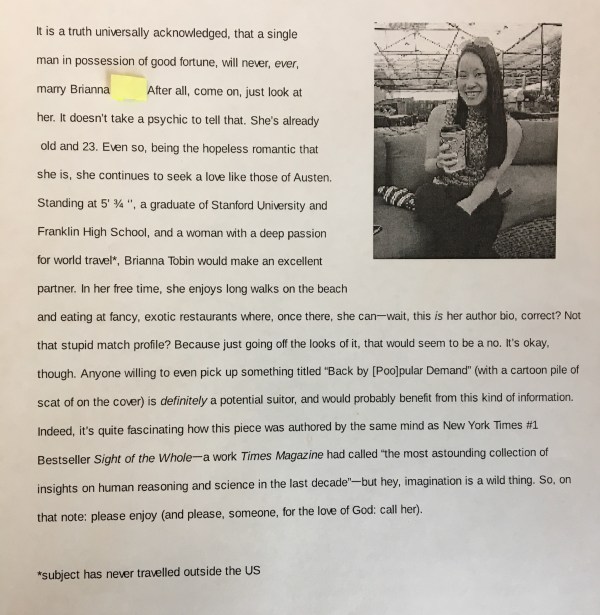
When Brianna turned her piece in this morning, she had a huge smile on her face. “I had SO much fun doing this.” Brianna, as studious, driven, brilliant, and stressed out as they come, was beaming ear to ear. What a testament to the power of writing with self reflective purpose.

To facilitate this assignment we:

  1. Looked over several sample bios from our book club books, some texts off my shelves, and a few internet suggestions.
  2. Students talked at their tables and came up with a list of “look fors” in this type of writing. I was impressed by not only the length of the list, in terms of what they noticed, but some of the insight. “If you are going to write a funny book, be funny. If you’re writing about the Nazi’s, that’s not a good idea.” True, true. Style and form must match purpose. I love it.
  3. Students then drafted both a current and a future author bio. The future bios were far and away the best. Students really embraced how wildly accomplished they will be as readers and writers after college. Additionally, this group is apparently going to rule the world.
  4. Peer feedback came next, with an inclusion of Shana’s “Push and Pull” feedback strategy. It was wonderful to see the details and voice emerge from their pieces. Celina had a line about winning the Nobel Prize, an Oscar, and a Grammy. I suggested she tell us what she won the Nobel for, who she co-starred with for her Oscar win, and how many albums she sold for the Grammy. “Oooo! I helped kids in the Sudan by supplying them with books (Mrs. Dennis swoons), Brad Pitt came out of retirement to play my dad in the movie, and I sold a record to every high school student in America, Spain, and the Ukraine.” Yes, yes, yes!
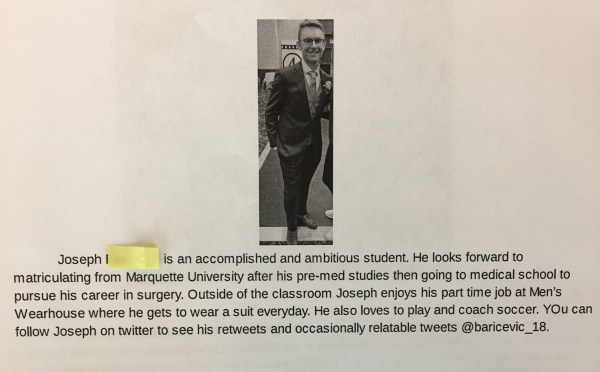
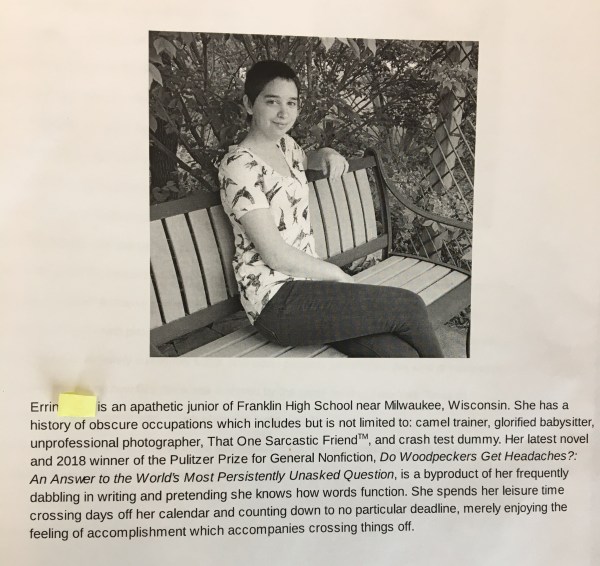
  5. Students took the peer and teacher feedback, went off to polish one of their bios, get an author picture, and turn in a final draft.
  6. These are HOT off the presses and I am so proud of their voice and creativity.

If you only look at one example, check out this first one. Brianna had me laughing out loud. No wonder she was beaming ear to ear.

img_2524

From line one, this piece had me laughing out loud. Brianna could not be a more serious student, but this work let her voice shine. I LOVE it from start to finish. 

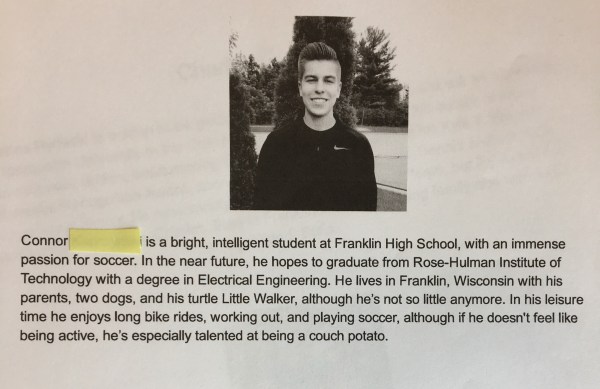
Connor is a pretty quiet kid in class. His writing fluency has improved A LOT this year. And look at that smile! 

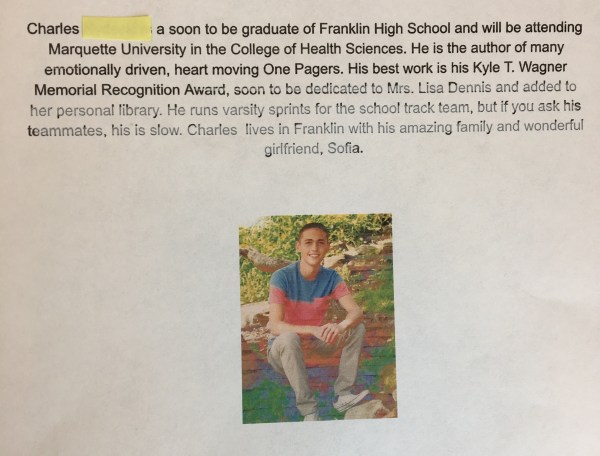
Charlie just won the most prestigious scholarship Franklin offers, because of his service, incredible heart, academic achievements, and being an all-around amazing person. He really opened up in his one pagers this year. I could not be more proud of this young man. 

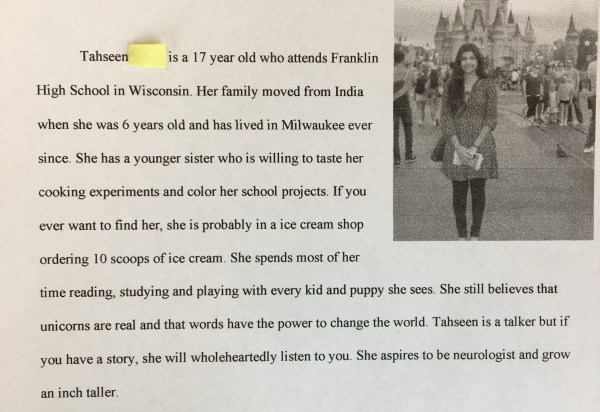
Tahseen is a very serious young woman, but the little quips in here brought out her true voice. 

JJ too had a ways to go with his writing fluency and voice development. I’m seeing it now! 

Errin is a young woman whose name you will know someday. I am SURE of it. She had this shirt on in class this morning. The picture was taken before 7:00am. 

Lisa Dennis teaches English and leads a department of incredible English educators at Franklin High School near Milwaukee. She delights in writing in the third person, claiming it’s akin to an existence in parallel universes. Follow Lisa on Twitter @LDennibaum 

An Idea: Author Bios and Some Focus, Wit, & Polish

I stole this idea from Lisa. She said it was okay that I write about it first. Bless her.

I finally feel like I’m getting a little of my writing mojo back. If you’ve been following my posts lately, you know I’ve had a hard time. I loved my student teacher, but I missed my students and how they inspire me to want to write and share.

It hasn’t been easy taking back my classroom. I am much more intense than Mr. G, and this translates to mean for some of my students. It’s true I grade hard, expect a lot, teach bell to bell. It’s not that he didn’t — maybe it’s just that I’m 50+, and he’s close to half my age. Whatever the reason, reinvigorating relationships hasn’t been easy.

Kind of casually one day, Lisa suggested she wanted to write author bios with her students next year. She said she’d read a few she wanted to use as mentor texts, thinking this little writing task would be a way to help her students develop their identities as writers. What a fantastic idea!

So last week for our writer’s notebook time, we wrote author bios, short, little, quippy, quirky writing that states who we are and why we write. (We still need work on the why we write part.)

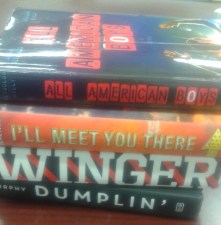
booksforauthorbiosI prepared first by reading the inside back covers of some of my hardback YA literature. I chose four bios with similar elements:  Andrew Smith, Winger; Julie Murphy, Dumplin‘; Heather Demetrios, I’ll Meet You There; and Jason Reynolds, All American Boys. {Bonus: four book talks, along with the author intros. Boom.]
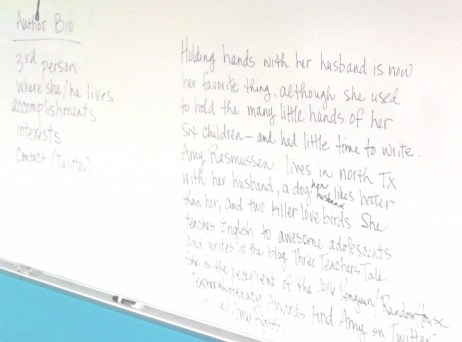
I explained the task:  We’re going to read four short author bios and then write our own. Listen to each one carefully, so we can pull out the similarities within each one.

We charted the elements of the bios on the board and then drafted our own.

authorbio

We spent five minutes on the writing, two minutes on revision, and six minutes sharing with our peers. We laughed. We wondered if the authors wrote their own book cover bios. We discussed our writing process.

“It would have been easier writing about someone else,” one student said.

“I need more time to think of how to say things,” said another.

“This would be fun to do at the beginning of the year,”

“I don’t do anything!”

“I’ve never won anything!”

“I cannot write that I am interesting when I am not interesting.”

“Can we write about what we want to do in the future instead?”

Oh, yeah, we stirred the pot, and ideas bubbled out. Throughout their questioning, my response remained:  Be creative.

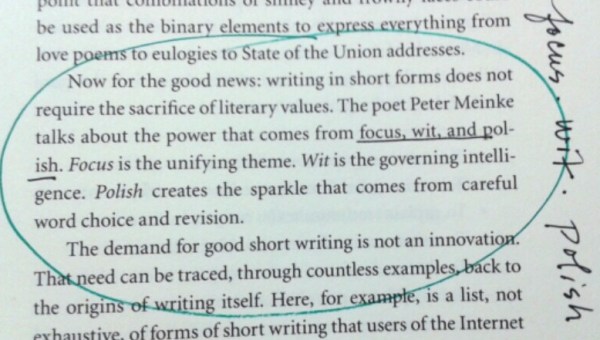
One of the best books I’ve read on writing is How to Write Short: Word Craft for Fast Times by Roy Peter Clark. I marked it up with lesson ideas:  “the whole chapter would make a great lead in rhetorical analysis” and “on annotating: read before starting 1st book club” and “use b/f narrative –teaches analysis with song lyrics” and “parallel structure & compound sentences!”

This paragraph from the introduction is a great reminder for all types of writing — and writing instruction:

How to Write Short

Focus, wit, and polish. My students and I talked about our identities as writers. We talked about the time it takes to develop our voice, our craft, our meaning.

As they read their author bios to one another, the cough of community clamored just a bit, and in a few minutes the whole classroom caught it.

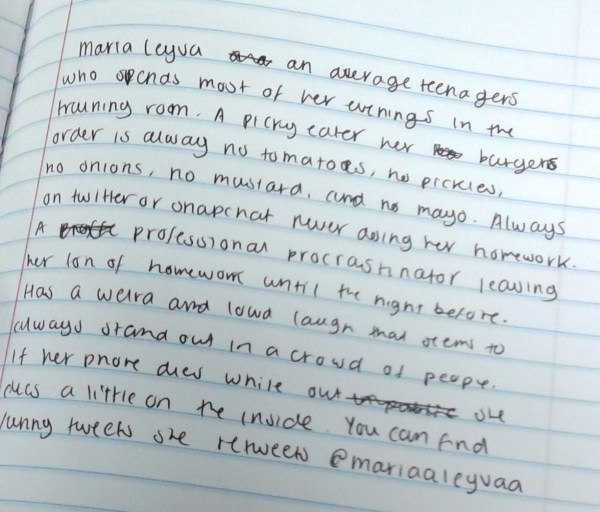
MariaLauthorbio

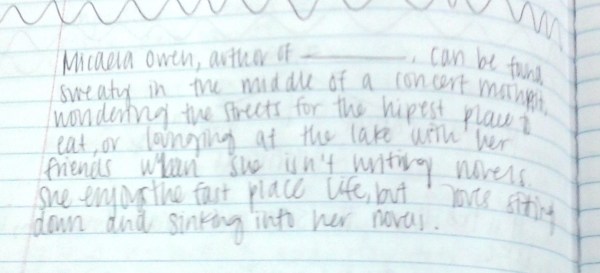
MariaCSkyauthorbioMicaelaauthorbioTreyauthorbioI reminded students as they write over the next few days — finishing their multi-genre projects, their last major grade — to write with intention, to write in a way that shows the answer to the last question I’ll write on the board this year:  How have you grown as a reader and a writer?

In the fall, I will do this exercise again. We will write our author bios at the beginning of the year, on day one, maybe. We will spent a good deal more time on them, and we’ll return to them again and again as we practice the moves all writers make to produce effective, convincing, creative writing. We will publish our writing with our bios. Hopefully, this will help us keep our sights on Focus, Wit, and Polish in all aspects of our writing.

How might you use this author bio writing activity? What tasks do your writers do that help them take on the identities of writers? Please leave your ideas in the comments.

Amy Rasmussen lives in north Texas and teaches AP English Language and English 3 at Lewisville High School. She loves talking books, daughters’ weddings (two this year), and grandbabies. Facilitating PD for other teachers making the move into a workshop pedagogy delights her. Amy adheres to the words of Emerson: “We aim above the mark to hit the mark,” and Jesus: “Love one another.” Imagine a world if we all aim higher. Follow Amy on Twitter @amyrass.

Varying Paragraph and Sentence Length for Effect

The formula is simple.


Pair a simple, declarative sentence in its own paragraph with a longer, more detailed paragraph to follow.  The two paragraphs set against each other will balance the other’s flavors out nicely.


Practice it mercilessly in workshop and use sparingly in finished work.


As you can see from this blog post, an entire essay or article that’s filled with long-short paragraph variations is going to tire, frustrate, and bore readers easily.   It will also become predictable, just like predicting that LeBron James is going to score 20 points in a game.  The good news, however, is that once you introduce the trick, you can invite readers to look for it across their reading.


Mentor texts used: An article about Alec Baldwin’s Donald Trump impersonation from The New York Times and a chapter from The Nix by Nathan Hill (hardcover pgs. 482-492) Note:  read over these mentor texts before using to see if they are appropriate for your students.  

Teaching this technique – version A:


  1. Invite students to freewrite off of each of these starting sentences from these mentors: “It takes seven minutes” or “Today was the day he would quit Elfscape.”
  2. Have students share their work.
  3. Reveal first two paragraphs of the Times article and page 482 from The Nix.  (Note: the vocabulary on this page of The Nix is tough, so I would suggest using it as an example of the technique only.)  
  4. Identify ideal locations for this technique (leads, beginnings of chapters and sections.)
  5. Practice this technique in a freewrite or on a piece in progress.


Teaching this technique – version B:


  1. Have students read the New York Times article and flash-skim the chapter from The Nix.  Unless you want students to read a sentence that extends for ten pages…
  2. Ask students about how and why these two authors decided to begin paragraph 1 simply and laden paragraph 2 with all the details.  Why might an author decide to describe a character’s decision to stop playing an online role playing game with zero periods?  Why might the Times author give us excruciating detail about Alec Baldwin’s Trump makeup?  To what extent are these “characters” portrayed similar?  Or are the purposes here different?
  3. Invite students to “hack” their own writing or another expository piece (e.g. a history or science textbook) to mimic the long-short style.  Is this an improvement?  Is the writing worse?  Why or why not?


Amy Estersohn teaches middle school English in New York.  She has never played an online role playing game and only pretends to know how to play paper and dice role playing games, so reading The Nix wasn’t easy.  Follow her on Twitter at @HMX_MsE.

3 Ways to Offer Choice and Challenge in Reading

Yesterday I got the opportunity to write for our state NCTE affiliate, the West Virginia Council of Teachers of English!  Their best practices blog is full of great stuff–definitely check it out, and follow @WVCTE on Twitter for more ideas and resources.

Here’s my offering for their blog–and I’d love to know how you offer your students choice and challenge in their independent reading.  Please share in the comments!


I can be a bit of a lazy reader.

I get impatient while reading, waiting for the plot to pick up, and abandon books with gusto.  I leap from mystery to mystery, romance novel to short fiction, and toss in the stray nonfiction book when I’m feeling curious.

When I first began making choice reading a priority in my classroom, many of my students were lazy readers, too.  They gobbled up YA fiction in droves, but balked when I booktalked a classic, or an award-winning piece of fiction, or any nonfiction.  Some of them refused to move beyond their genre of choice for a whole year.

I knew, when I committed to choice reading, that it went far beyond just YA.  I knew that all kids were capable of reading sophisticated texts, making complex choices about when and how and what to read, and that all readers have a hunger for a challenging, engaging read.  But I wasn’t seeing my students living out those expectations, so I built in some structures to help them get there.

Reading Challenges — I began scaffolding students up to more difficult reading choices with reading challenges.  I read about these in Book Love by Penny Kittle, but wanted to put my own spin on them as far as making very specific challenges went.  So, the first reading challenge involved picking a book outside your comfort zone (which required a fun day of work identifying our own reading zones); the second challenge involved reading a nonfiction book, the third involved reading an award winner, and so on.

By working as a whole class to try new books out simultaneously–me reading along with my students–everyone felt comfortable getting uncomfortable.  We were all struggling along together, trying to decipher the vocabulary in a new book, or the structure of a new genre, or the style of a new kind of writer.  I built in mini-lessons on these things, but I think it was most helpful that we talked about these issues in the light of being real readers–not “struggling” readers.

Authentic Writing about Reading — When I first joined GoodReads many years ago, I realized how much my reading life was improved by just quickly taking the time to rate what I’d thought of a book.  Before that, I’d start and finish books and never really think about them again.  Soon, I began writing short book reviews, and then long ones, first just for myself, and then for the benefit of other readers.  I began reading more book reviews to get a sense of what I might talk about other than writing and characters.

I wanted my students doing something similar, so we began studying book reviews–popular, funny ones on Goodreads and Tumblr; professional ones in the New York Times and the New Yorker; even famed reviewers like Roger Ebert, whose writing moves about film we applied to books.  Students began tweeting at authors, writing reviews informally in their notebooks and formally for our school paper and giving their own booktalks to one another.

Nurturing a Real Reading Life —  No longer were kids feeling confined to books I handed them.  They began to choose books more independently, armed with information about their tastes, their peers’, and what was popular in general.  I began to see more students reading books that didn’t come from my classroom library, more students talking to one another about books, and a bigger variety of books being read in general.

In my own reading life, I modeled these challenges.  I read The Great Gatsby, Walden, and a few other classics for the first time in years, and truly appreciated them more during these second reads.  I wrote book reviews on Goodreads, the Nerdy Book Club, and Three Teachers Talk.  I tracked my reading in my notebook, on GoodReads, and on Twitter, setting goals and trying to take a moment to jot down, in quick review form, WHY I liked or didn’t like a book.

These practices not only helped me become a better reader; thePicturey helped my students grow as readers, too.  Anna’s favorite book of all time became the award-winning A Constellation of Vital Phenomena, while Connor was blown away by Ta-Nehisi Coates’ Between the World and Me.  These books and more were chosen, read, and evaluated independently, without the confines of assignments or the too-broad sea of “your choice” to hold them back.
Shana Karnes teaches sophomore, junior, and senior preservice teachers at West Virginia University.  She finds joy in all things learning, love, and literature as she teaches, mothers, and sings her way through life.  Follow Shana on Twitter at @litreader.

Where Dioramas Go to Die

I picked up my first pedagogy book of the year this week and I can’t put it down. Disrupting Thinking by Kylene Beers and Robert Probst is living up to its name. It’s 1950’s Louise Rosenblatt Reader Response Theory meets a desperate modern need to educate kids to be responsible consumers of information in order to compassionately embrace the viewpoints of others.

The first few chapters have felt like the perfect “Now what?” for someone that has recently made the move to workshop.

My kids are choosing what they read. Now what? 

I’m devoting class time for students to build this habit. Now what? 

My students are reading more and more. Now what? 

The “now what” is to really think about the how and why we read. The text details insights on building responsive, responsible, and compassionate readers who will interact with a text, rather than just extract from it, question the text, and open themselves up to the text in order to see other points of view.

Cue the angelic choir and parting clouds. I’m ready.

But, I am also guilty of not always facilitating this type of reader response. Not on purpose, of course, but just out of difficulty in dealing with the daily grind.

We read. We talk. We mini lesson. We write. We rearrange the order. We repeat.

However, somewhere in there, we also lose a lot of readers. The once enthusiastic elementary kids, with their literal cartwheels about books, often come to us as vacant vessels of readicide. How does this happen? Beers and Probst suggest that “we have made reading a painful exercise for kids. High-stakes tests, Lexile levels, searches for evidence, dialogic notes, and sticky notes galore – we have demanded of readers many things we would never do ourselves while reading. We have sticky-noted reading to death” (46).

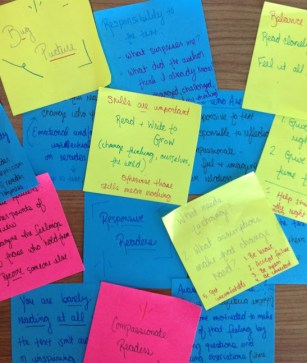
Now, ironically, I’ve written quite a few sticky notes around the insights in this book…postitI like to organize my thoughts this way. And, in no way am I suggesting that pulling ideas from a text is malpractice. At the end of the day, of course we need students to think deeply about their reading and demonstrate that thought through talk, written reflection, and/or analysis of some kind.

But what is appropriate? What is too much? What kills a desire to read as opposed to igniting it?

In search of some renewed inspiration, Disrupting Thinking had me laughing out loud as it got me thinking about why and how I interact with texts:

Seriously, as you finished the book you most recently enjoyed, did you pause, hold the book gently in your hands and say to yourself, ‘This time, this time, I think I’ll make a diorama’?…Do you write summaries of what you read, make new book jackets, rewrite the ending, take tests over every text? Any text? Do you want your reading level put on a bulletin board for all to see. Do you even know your damn reading level? (Beers & Probst 46)

So, how do we balance professional responsibility, a love of content, a desire to build up students as readers and writers, and the knowledge that a lot of what we’ve done (or still do) in our classrooms actually exhausts, irritates, and/or alienates our students from reading?

Unfortunately, I don’t have all the answers. This is a reflective process in action.

What I do know, is that Disrupting Thinking has me…thinking about it. A lot. It also has me vowing to put a few things into practice and promote a few others in my classroom:

  1. Promote Responsive Readers through more and more opportunities to talk about choice books. I’m guilty of still trying to “make sure kids are reading,” when in fact, most often, they are cutting corners in that reading if we are trying to “catch” them. Book clubs, conferring, and talk through reflective notebook writing promote low stakes opportunities to share insights on texts.  With mentor texts to support skill instruction, the thinking can be applied to choice reading, but doesn’t necessarily mean that I should be looking to choice reading as a summative data point.
  2. Promote Responsible Readers by working to find a balance between supporting/celebrating reading and “holding students accountable.” This is an imperfect science to be sure. I find that the more I talk with students one on one, the more they have to say, and the more I can directly intervene to move them forward to more challenging books, deepen their understanding of why I want them to keep reading in the first place, and celebrate their successes as independent readers. Save the evaluation for skills based cold reads when the curriculum demands the assessment we as teachers need, while keeping in mind that many students don’t see those assessments as their responsibility to reading, and I would argue, nor should they.
  3. Promote Compassionate Readers, again, through talk. When I read something that is changing my perspective on the world, myself, or life in general, I want to share that with someone. I want to share that with many someones. I also know, that to grow in my reading life, I need to read a wide variety of books…books that challenge my long held beliefs and understandings (or misunderstandings) of the world. Again, this is where helping students to diversify their reading lives is so very important.
  4. Talk, Talk, Talk! I’ve been asking my students two questions this week to drive their book club discussions: How is this changing me? How is this changing my view of the world? These two questions invite personal connection and reflection. I can’t wait to hear my AP students’ book club discussions!

Lisa Dennis teaches English and leads a department of incredible English educators at Franklin High School near Milwaukee. Her thinking has been disrupted and she’s loving it. Follow Lisa on Twitter @LDennibaum 

ruBRICKS Part II – A Follow-Up Guest Post by Julie Swinehart

Blogging, writing, talking, being part of the conversation about what it means to be an educator in 2017, it’s all easier to do than to actually live it and breathe it and teach it. We can talk about theory, we can read our guiding texts, we can attend professional development conferences around the world, participate in twitter chats, and we can all talk the talk.

Walking the talk is the hardest part.

Theory doesn’t always meet practice. But we try. I try.

I recently wrote about the idea of rubrics – that they should serve more as a foundation than a weight or a wall pinning students in. That they should allow for creativity rather than limiting imagination.

One way that I have tried to allow for student voice and creativity is with the most important thing I can help my students learn.

The topic is the habits of a healthy reading life.

If my students learn to read literary nonfiction, classic novels, and short stories, it will be fantastic. But it’s fantastic only if they actually choose to read these texts on their own. Most importantly, they need to have a habit of reading, to discover the reader within themselves.

This winter I realized that I wasn’t sure that my students knew what the endgame was. So we talked about it. We talked about what it looks like to have a healthy reading life, and we brainstormed the attributes of a healthy reading life.

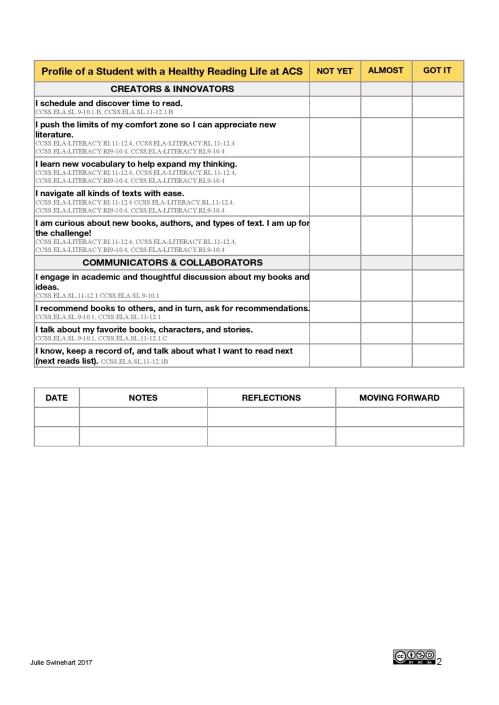
I did my best to organize their ideas into categories and indicators that made sense. I used our school’s student profile to help with the organization. The six categories are Respect and Integrity, Global Awareness, Reflective Thinking, Critical Thinking, Creators and Innovators, and Communicators and Collaborators.

From that, I created a rubric.

I think the process for this rubric can be re-created with other standards and goals, and can be simplified to a simple yes/no checklist, or a one point rubric for student self-reflection.

healthyreadinglifeprofile-page-001

healthyreadinglifeprofile-page-002

I know, I know… There are still problems with the document. But I think the point is that the ideas in it originally were theirs. The ideas belonged to the grade nine students.

While it’s an intimidating double-sided checklist in its entirety, it is easy to split into the six sections, which means we can examine just one section of a student’s reading life at a time. At that point it becomes smaller and quite manageable, and it’s not a brick wall of text.

I can print just one section at a time, and use it as an exit ticket or as a prompt for a reflective quick write. It doesn’t weigh students down when they simply examine only two or three indicators about their habits of reading.

The document still needs to be refined, and maybe all of the Common Core standards I’ve attached to the indicators aren’t exactly right; it’s still a draft, a work in progress. But this rubric, one that could be revised to a simple yes/no checklist, has been the catalyst for some seriously authentic and relevant conferences with my students.

Because I used their criteria and ideas, it’s not a brick wall, and it doesn’t confine my students between narrow rails. Instead, it’s a conversation starter, a tool for goal-setting while conferring, and it’s something that shows my students what to strive for.

It shows them what this readers workshop is all about: healthy reading lives.

I think the takeaway here is that teaching is always a work in progress, as is learning. Setting goals is important for students and for teachers. Creating authentic scoring guides continues to be one of my goals. This year I created one about the topic that I think is the most important of all – the healthy habits of reading. Next year we will tackle the habits of being a writer.

I will keep talking the talk – that means I am learning and reflecting on my practice. I will also keep trying to walk the talk, which I think has to include student input, because student voice is so essential to readers workshop, and is of course essential to building the habits of healthy reading lives of students.

We can’t weigh them down with our “help” – our rubrics and scoring guides should serve as foundations for growth, which is what I think this one does.
Nothing’s perfect, and we teachers have to be okay with that. We will continue to read, learn, discuss, and to walk the talk. Walking it and living it is a work in progress, and our students are better because we keep trying.


Julie has been teaching secondary language arts for eighteen years, spending the first fifteen in rural Central Oregon, and the last three in Amman, Jordan. A recent convert to the workshop model, she likes to blog about and share her learning and experience with others.

Follow her on twitter @SwinehartJulie

Follow her blog https://adventuresinhighschoolworkshop.wordpress.com/


iconCare to join the conversation? We’d love to add your voice! Please email guest post ideas to Lisadennibaum@gmail.com.