Category Archives: Writers

What Will You Teach Into?

I am a week away from bringing my second daughter into the world, and after yesterday’s horrific shooting in Texas, I find myself revisiting the same fears I’ve often had when I consider my progeny. Primarily, I wonder: what kind of world am I bringing my children into?

As I fretted about this to my husband last night, he reassured me with statistics about how unlikely it was that either of our daughters would ever be involved in a shooting, an act of terror, a horrific trauma.

That’s not what I’m worried about, I told him–not that they’ll die or be injured by one of these awful events. I’m much more worried about the world they are going to have to live in, day in and day out.

A world where a 26-year-old makes a conscious decision to attack a church full of people. A world where this incomprehensible event has become common enough that it is, less than 24 hours later, already being reduced to a sound bite: “This isn’t a guns situation. This is a mental health problem.” A world where a conversation about terror and murder has become more binary than complex. It is; it is not.

I don’t want my girls growing up in a world that doesn’t know how to talk about, seek to understand, or attempt to solve these unexplainable problems–problems that certainly cannot, to me, be boiled down to a single cause or effect.

do want them growing up in a world where we try to talk about these things. A world where these conversations are never taken for granted, where they continue to happen, no matter how difficult and painful, as Kylene Beers writes in “Once Again:”

“Honestly, though, I don’t want tomorrow to be easier. My fear is that this day you face tomorrow has become too easy. My fear is that your students won’t expect that this horrific killing will be discussed. My fear is that tomorrow is just another Monday.”

As a teacher, a mother, and a citizen, I cannot agree more with Kylene. I feel more powerless in the latter two of those roles than I do in my work as a teacher, though, for I feel that teaching is where I can make a difference. I feel it is where we can all make a difference.

This week and every week, I hope teachers are having difficult conversations with our students. I hope we are not shying away from the ease of ignoring our nation’s pain in favor of teaching about comma splices or symbolism or character development. I hope our time with students is deliberately geared toward talk about these incredibly complex, nuanced topics. Kylene says it well:

“No one ever told you that you’d need to know how to sit with children or teens to talk with them about people in churches getting killed by a gunman or little kids in a school getting killed by a gunman or families at a concert getting killed by a gunman. No one. And you didn’t sign up for that. You didn’t. But they will watch you and they will listen for what you say and what you don’t say.”

I hope you are grappling with this and asking yourself:

For what purpose am I teaching?

And I’m talking about a larger purpose than the day’s essential question or the target content standard. I’m talking about how the day’s lesson fits in with the culture of the classroom, the messages we want kids internalizing day in and day out, the life lessons we want them to learn as painlessly as possible.

One of the texts my students and I study that helps us learn to frame instruction this way is Peter Johnston’s excellent Opening MindsIn class on Friday, we discussed Johnston’s closing claims (p. 123-124) about research-based instructional design:


  1. Our singular focus on academic achievement will not serve children or their academic development well.
  2. The individual mind is important, no doubt, but as the center of the academic universe, it is overrated.
  3. We have to take seriously the fact that the adult is not the only teacher in the room.
  4. Children’s social imaginations should be taken more seriously. They are the foundation of civic society.
  5. Our interactions with children in the classroom influence who they think they are and what they think they’re doing.
  6. Making meaning is good. Doing meaningful things is better.

We spent time unpacking each claim, wondering how to apply it to our varied content areas and age groups, but dwelled on the last claim:

Making meaning is good. Doing meaningful things is better.

We were reminded that none of us became teachers so we could fix comma splices. We became teachers because we wanted to change the world–our world, and our students’ worlds–for the better.

This Monday morning, I want us to keep that goal in mind as we teach and plan and reflect on how we’ll spend our time with young people. How will we make sure that our work together is meaningful?

quotes-about-doing-meaningful-things-3

If you don’t already see your work as a teacher as powerful, if you don’t see your role as one of an agent of change, try looking at this familiar work in a new way. Your interactions with children in your classroom influence them in powerful ways. You have the unique power of being able to help them develop their social imagination, their empathy skills, so they’ll never reduce a tragedy to a single cause with an unimaginable effect.

You have the power to choose: what will you teach into this week? Making meaning? Or making life meaningful?

Shana Karnes is a worrywart in the best of times, but an idealist in the worst of them. She is grateful every day to work with amazing preservice teachers at West Virginia University, to be mom and wife in a beautiful family, and to be able to write and think and learn with her friends here at Three Teachers Talk. Connect with Shana on Twitter at @litreader

News You Can Use

I find most of what’s reported on the news today to be either deeply disturbing, horribly demoralizing, or downright exhausting. It almost feels like the past few months have been less of an end to summer/start of fall and more of an obstacle course of the absurd, obscene, and disappointing.

However, in the unending quest to inform our future electorate, we forge on. Articles of the week, hot topic debates, impassioned student speeches on the criminality of injustice, and an endless stream of quick writes to vent some of the hot, hurt feelings.  Then there are the daily discussions on the struggles we face, the struggles of those we need to know more about, and the struggles to balance it all when sometimes we just want things to feel whatever definition of “better” might help us through.

In the face of all of this, here is a recent success I had that championed choice and voice (coupled with a bit of creative reflection) around some of the news that might get overlooked in the whirlwind of our current news cycle.

News You Can Use

  1. Students selected an article from several that I had re-tweeted in recent weeks with our class hashtag –#fhslanglife. Topics varied widely and I simply went through and briefly highlighted the focus of each article in an effort to pique interest. Here are a few I included. Student response was awesome. We could have easily talked about these articles for the full 86 minute class period:

Are my students reading pieces on the economy, info-graphics, and authors (even authors they love) on their own? Not often. Are they talking with gusto about the relativity of these pieces, sharing insights on author craft, and talking about topics that impact them in the here and now when they are offered up as choice? You bet.

  1. Then, inspired by the Three Teachers Talk Twitter chat earlier this week with Tom Newkirk (#3ttchat), I stole a quick idea (the very foundation of Twitter chats,yes?). I love the quick and dirty nature of professional educators hurling greatness at one another in rapid succession and a maximum of 140 characters. For this week, I was immediately able to implement the single line, or as I told my students, “THAT line. You know the one” craft analysis. Based on the awesome insights of my fellow chatmates, I asked my students to do their reading and zero in on THE sentence that made the piece.

  2. Students read for 10-15 minutes, jotting down reflections and searching for “the one.” Once they were finished, I challenged them to respond in their notebooks in a creative approach they didn’t usually use. A dialogue, letter, poem, etc.

  3. After sitting silently for roughly 30 minutes, I had students get up and connect with someone from the other side of the room. Get the blood flowing a bit. They were to connect with someone who read the same piece and debrief. Ideas flew around the room.

  4. We then came together to share and here is a sampling of what I heard throughout the day:

  • From Ward’s piece on raising her son, Kaitlin pulled out: ” I hope I love him enough in the time I have with him, that while he can be a child, I give him the gifts of a childhood: that I bake chocolate chip cookies and whisper stories to him at bedtime and let him jump in muddy puddles after heavy rains, so he can know what it is to burst with joy. “
  • The info-graphics brought Nhan’s attention to: “We can trace the US story through stereotypes.”
  • After looking over the maps detailing climate change, Karan wrote a dialogue between President Trump and an environmentalist.
  • Several students brought up questions about college vs. career after reading about the jobs of their future.
  • Jerry Khang (who told me to publish his last name so you all know who he is even before he’s famous) read the John Green piece and wrote the following poem in about 4 minutes flat:

Books are a closer look into a person’s soul. 
We find ourselves deteriorating, gloomy, and so dull. 
But when we are able to read, to relate, to medicate our minds, 
We’re temporarily fixated on happiness in a short burst of time. 


When we provide students with relevant, yet challenging reading material, choice, time to write, time to think, and time to talk, 30 seemingly innocent minutes reading an article and writing about it can be beautifully rich, engaging, and rewarding.

And beautiful is something I think we could all desperately use right now.

Lisa Dennis teaches English and leads a department of incredible English educators at Franklin High School near Milwaukee. Her social media scrolling is driven largely by searching for class related articles and pumpkin soup recipes. Follow Lisa on Twitter @LDennibaum 

After the Hurricane, a Crusade for my Readers — Guest Post by Charles Moore

Lightning woke me at 4:30 this morning. Friday is my “sleeping late day.” I usually roust Clear Creek ISD June 2017 (1)myself around 5:30 and head to the bus barn to pick up a bus for the varsity football game. The much needed rest was not coming today. Please forgive my anxiety with storms these days. It doesn’t seem to abate. Nor do my thoughts of teaching and coaching and facilitating our Student Council.
Last week was Homecoming Week in Charger Nation. This means dress-up days, a
parade and a carnival. Throw in a day of PSAT testing for fun. It was the end of the first nine weeks grading period; a grading period interrupted by something called Harvey. Heck, we can talk about my son’s soccer practice and robotics meetings. My daughter missed her dance class to be a member of the Homecoming Court. You’ve never seen a girl smile so big as when she rode in the back of that convertible holding a tiara on her lap for dear life.

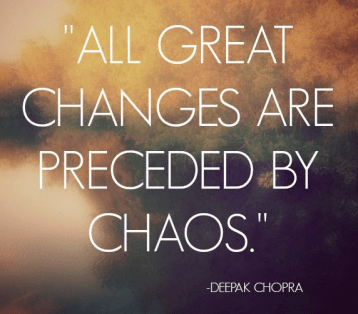
There is a hurricane metaphor in here somewhere, but I can’t find it. The best word for last week is: chaos.

Chopra chaos quote

And yet…I never stop thinking, just like this morning, about my job. Really, I can’t stop thinking about how I do my job and how I can get better at it.

I can’t stop thinking about how I’ve changed as a teacher these last couple of years. Specifically, I’m thinking about how learning about workshop has made me a better teacher, coach, and Student Council Sponsor. My whole approach to this teaching life changed. I ask the kids to take more stake in their learning. I demand that they explore and discover and use me as a resource. It works.

This initial nine weeks was crazy. What with our natural disaster and the recovery and the fact that it was going to only be eight weeks long to begin with. Somehow we made it.

Workshop did that.

What workshop didn’t do was make my students readers. Most of them just didn’t read the first nine weeks of school and their teacher didn’t do a good job engaging them in their self-selected books.

I vowed to change that in the second nine weeks. I sat down with each class roster and noted the progress of every single student in each of my classes. I studied them. I conferred with them about their reading lives. Data emerged. I found that my students fell into one of two categories: Reader or Non-reader. Now that’s an earth shattering breakthrough, I know. The important thing about it is that I knew which one each student was.

So I went to work moving kids out of the books that bogged them down and into books that could engage them. To move them, though, I had to get into their heads and learn about their thinking. What interested them? Not just cars and cliques or dragons and swords, but what themes and what sorts of characters grabbed their attention.

I looked at their college essays and talked to them about what was happening in their lives. I engaged them in talk of who they thought they were. I assigned quick writes about their life as a reader and asked what appealed to their thinking. I checked the progress of my non-readers every day.

Constant Conferring was crucial. Every. Single. Day.

Coach Moore Book Talk List

Keeping a visible record of book talks

Also, I committed to book talks. Every single day.

This is hard for someone who doesn’t have a lot of time to read during this time of year. But I found ways to get books in front of them. I might talk about a book on Monday and then read a short selection from it on Tuesday. Rinse and repeat.

I went down to the school library and checked out books that I’ve read that aren’t in my classroom library. They love it. I tell students over and over, “I need you to finish that one quickly because its on my ‘Next to Read’ list.” I have at least 30 books on that list.

Our results vary. Some kids jumped straight into a new book and took off while others still struggle to find time outside of class. Some students tell me how they find time to read on the bus to their cross country meet or at work at the tanning salon. Most of them are trying and I think that’s really the most I can ask of them. It’s not, however, all I can demand of myself.

I crusade to make them life-long readers and writers. I will not relent. I want them to find the joy in reading that I know is there and if we have to do the hard work together, then I’m all in.

Charles Moore is a senior English teacher at Clear Springs High School in League City, TX. He enjoys leisure swimming, reading, and coaching linebackers. Follow Charles on Twitter @ctcoach and read Charles’ other posts here and here.

Story, Self-Generosity, & Student Success: #3TTchat with Tom Newkirk

For our inaugural #3TTchat last night, we were privileged to be joined by the great Tom Newkirk. This bright light of literacy scholarship talked with us about reading, writing, and assessment in the context of two of his most recent books: Minds Made for Stories: How We Really Read and Write Informational Texts and Embarrassment: and the Emotional Underlife of Learning.

Just as his books are, Tom’s tweets were full of one-liners of wisdom and wordplay as he engaged in the chat with teachers, instructional specialists, and writers:

Many of us, in thinking about this question, highlighted the importance of identity in our reading lives–how do I see myself in books? How do I find myself in books?

Our next question asked how we taught students to do this very thing: make connections between people’s stories and their stances and beliefs:

As we pondered this question, many of us offered up the value of having students read books that they couldn’t see themselves in–moving from mirrors to windows. We connected this to moving from recognition to empathy.

Q3 focused on specific reading practices to help students view their reading lives dynamically; Tom encourages his readers to hone in on beginnings:

Book clubs, multigenre projects, studying mentor texts, modeling our reading lives, and crafting reading and writing autobiographies were all journey-focused practices chat participants offered up.

As we shifted toward talk about writing, we wondered how we might best help students read like writers in order to strengthen their own written products. Tom offered his view that variety is key:

Avoiding becoming stuck in one genre was a theme of the night–mixing narrative with nonfiction, blending story and poetry, lab reports and literary devices, all through studying provocative, unconventional mentor texts and practice, practice, practicing imitating their craft moves.

Q5 wondered specifically about genres of writing that might help students do this, and Tom replied that any genre containing “trouble” was a good place to start:

Ideas included memoir, commentary, op-eds, origin poems, author bios, annotated lists, letters, and straightforward exposition and essays. In short, the opportunities for emphasizing narrative are endless!

We shifted toward thinking about assessment, and our conversation focused on celebrating student successes rather than emphasizing shortcomings:

We railed against grades, but honed in on emphasizing process over product, using student work as mentor texts, and teaching students to have a growth mindset when it comes to goal-setting and their reading and writing lives.

Finally, we wondered about takeaways, and Tom’s just about made us weep:

His ideal teacher voice is one of kindness and encouragement, as were so many of our chat participants’: “writing is a living process;” “your voice matters;” “everyone has something to say that matters;” “there is no one correct way to write.”

Together, #3TTchat told a story of leading students to success in reading and writing through encouragement, patience, and self-generosity.

All we can say is thank you to Tom and our many participants for helping us write that story.

We are so looking forward to talking more about the role of narrative in informational reading and writing at NCTE this year. This topic has been a long time in the making–starting with some thinking at NCTE in 2014, then growing with our reading of Minds Made for Stories, and growing some more when we took a class with Tom Newkirk at the UNH Literacy Institute. We hope you’ll join us in St. Louis for more thinking about this important topic!

Shana Karnes, unfortunately, will NOT be able to attend NCTE this year, breaking her 8-year attendance streak for the important reason of having her second baby. While waiting impatiently to meet Baby Jane, Shana teaches preservice teachers at West Virginia University, works with practicing teachers through NWP@WVU, and participates in Halloween festivities strictly for the candy. Follow Shana on Twitter at @litreader or find more of her writing on the WVCTE Best Practices Blog.

Please, Add Your Questions about Narrative– #3TTchat tonight 8ET/7CT

Last week I asked my students the same question I often ask teachers when I facilitate professional development workshops:  What do students today need?

My students talked in their table groups and then shared their ideas. Most said in one way or another:  We need to feel validated and to share our voices.

I don’t know of a better way to accomplish both then by infusing narrative into every aspect of my teaching.

Tonight is our inaugural #3TTchat with our guest Tom Newkirk, author of Minds Made for Stories and the new book Embarrassment: And the Emotional Underlife of Learning (among others).

Screen Shot 2017-10-23 at 6.02.59 AM

If you are a regular reader of this blog, you’ve certainly noticed we’ve focused on narrative, specifically Newkirk’s books, lately. I wrote about how teaching itself embraces the drama of story and later shared some of the quotes that resonated enough to change the way I talk about writing with my students — and the way I teach it. Lisa shared her beautiful argument Narrative Writing: Giving Voice to the Stories that Matter Most.

We are shoulders deep into planning our session for NCTE:  Reclaiming Narrative and Amplifying our Voices:  Using Story to Invite Fearless Inquiry and Intellectual Challenge for Our Students and Ourselves. (We present Friday at 12:30. We hope you will come!)

If you haven’t had a chance to read Tom’s books, we hope you will still join us as we chat with him on Twitter. And if you have some time between now and then, or any time really, perhaps you’ll find value in this Heinemann podcast with Tom about Embarrassment and how it is the “true enemy of learning,” or a sample chapter of Minds Made for Stories. You’ll see why we at Three Teachers Talk have made such a fuss.

In preparation for our chat tonight — and for our presentation at NCTE, we’d love for you to ask some questions about infusing narrative into our teaching practices, or just share with us some of your favorite ideas or best experiences with students and narrative reading or writing. We’d love to include you in the conversation tonight and in St. Louis at #NCTE17.

While you’re thinking:  This is the quick write my students and I will write today: What’s your story?

Narrative Writing: Giving Voice to the Stories that Matter Most

I’m a fan of literary mic drops. It’s often those last lines of text that make me smile, sigh, or chuck a book across the room. In conjunction with my unending impatience, I often find myself paging ahead to the conclusion of a text to see how the author and I will part ways. What profound bit of wisdom will end the conversation we’ve been having? How will we part? Do I get to hug this book tighter as I read because I know the beautiful place we’re heading together? Have I glimpsed a future I can’t stomach? Do I need to consider ending the relationship early?

Often, I am rewarded:

“Isn’t it pretty to think so?”
“Go, my book, and help destroy the world as it is.” 
“He loved Big Brother.” 
“In a place far away from anyone or anywhere, I drifted off for a moment.”
“All was well.”
“Are there any questions?”
“I wish I felt confident that I have the best words, but I’m glad I wonder whether they’re worth saying” 
“And he was feeling not-unique in the very best possible way.” 

“I don’t know where there is, but I know it’s somewhere, and hope it’s beautiful.” 

haunted

So it goes with my journey alongside Tom Newkirk in his Minds Made for Stories. Spoiler alert, I paged ahead. Spoiler alert, Mr. Newkirk did not disappoint.

In a text deliciously layered with reminders that narrative is the very foundation of our understanding of the world and our place in it, not merely a cute exercise for the early grades, Newkirk ends with:

“But as humans, as time-bound mortals, we must tell stories” (146).

Yes. Humans must tell stories. We must tell stories to explain how we got here, why we need one another, what we’ve suffered and celebrated here. We must tell stories to share who we are, what we need, and where we should never go again.

Creation stories. Quest stories. Comedic stories. Sob your eyes out stories. Monster stories. Our stories. And if our classrooms aren’t the place where these stories are born, or shared, or honored, or revered, where will they gain footing? Where will they take flight? So often, students already feel their ideas aren’t worth much. If we don’t support their experiences, wonderings, and desires to connect to their own humanity (or encourage them to have such desires), who will?

If we are in the business of promoting the beautiful stories of creative thinkers , how can we look at our students and say that their beautiful stories must fit within the constructs of our unit-based curriculum? The stories of our students, their questions, their pain, their searching, must find a home in our classrooms before these same students are convinced that their stories don’t matter. Likewise, if our students are convinced that they must fit their stories into the structural mold that we give them or that the grammatical difficulties therein supersede the story’s worth, our students will continue to be finishers rather than learners, with passions dulled and attention diverted to less complicated or messy endeavors.

In a world of Everything is an Argument a mantra I readily subscribed to when I took over the AP Language and Composition classes at our school almost a decade ago, I needed to read Minds Made for Stories. I needed to remember, as Newkirk says, that narrative is a “property of mind, an innate and indispensable form of understanding, as instinctive as our fear of falling, as our need for human company.” It is “a foundational mode of understanding” (34) that demands so much more attention than it’s afforded as a unit of study or structured paper our students pump out once a year.

In fact, narrative is at the very core of every significant argument and every engaging expository text I’ve ever taught, read, witnessed, or created. Without the drama of human experience, argument falls short and exposition falls flat.

Not long ago, I was listening to a podcast recommended to me by my husband. We were driving home from Lambeau Field, in the pouring rain, after the Packers had lost their first game of the season without Aaron Rodgers, whose broken collarbone will haunt the state of Wisconsin for at least the next nine weeks (See? Narrative).

Anyway, the podcast, Under the Skin, is produced by Russell Brand (stick with me here, I promise we’ll get through this together), who will not be everyone’s cup of tea, but whose brilliance (it was a surprise to me too) extends far beyond raunchy comedy. In this episode, Brand is interviewing Yuval Noah Harari, author of Sapiens: A Brief History Of sapiensHumankind. Throughout this conversation, Harari and Brand explore the idea that life is built on fictional stories that create our nonfiction existence, and if deeply examined provide the cooperative construction for all of civilization as we know it.

Harari hypothesizes that fiction, or in our case narrative, helps determine what the shared goals and values are of a specific group, and thereby their role in or purpose as it relates to society. All of our shared fictions (corporations, money, countries), in other words, are the bedrock of large scale human cooperation.

So if story, whether it be fiction or nonfiction,  is at the very core of who we are, how we interact, what we seek, and what unites or divides us, how can we limit it to a six week unit, the focus of which is a hook to capture the audience, transitions to move seamlessly between chronological points of interest, and the use of narrative techniques as scored on a rubric?

We can’t. It’s unconscionable.

However…we need grades. I get it. I live that too. Gah.

But what Newkirk has awakened within me, with his reminder that narrative is “not simply a structure or plan or outline,” but rather a “deeply embodied invitation to movement” (50), is that narrative needs to be a part of my daily practice and needs to be freed from our check-listed systems of construction. If I am to stroll about my classroom and pontificate on the value of our lives as writers, then I need to provide more opportunity for and reminder of the importance of story within that work. Narrative as a part of all writing, not just a stand alone.

In other words, I can’t on the one hand see the inescapable connection between human experience and our desire to share it, and then tell my students that their narrative writing needs to live neatly in the confines of an MLA formatted page that shall not exceed x number of pages.

Narrative writing needs to weave it’s way into everything we create.

Our students need to be given opportunity to tell stories, their stories and the stories of fellow humans, in a way that connects us to our past, highlights the questions that matter to us in the present, and hopefully provide answers to the issues that will impact our futures.

It can all start with a quick write. In the low stakes freedom that is a blank page in one’s writers notebook. Let students give voice to their stories without the pressure of our expectations and rules. If we value these stories (fiction, nonfiction, fantasy, political opinion, context for expository poetry, and the like), and give them a place to grow, our students will value them too.

-Three Teachers Talk (1)

We as “time-bound humans” must allow narrative to run boundless through our classrooms. If it defines our lives; it must not be relegated to a neatly packaged composition assignment dictated by the Common Core. Rather, it must be woven into our talk, our choice, our writing.

Narrative gives voice to the parts of us that make us human. Let’s give it a more powerful, empathetic, educated, diplomatic, and beautifully crafted voice.


Lisa Dennis teaches English and leads a department of incredible English educators at Franklin High School near Milwaukee. She can’t wait to meet Tom Newkirk in St. Louis at NCTE and have a truly embarrassing fangirl moment. Follow Lisa on Twitter @LDennibaum 

Shouldn’t Students Know How to Assess Their Independent Reading?

I have a love/hate relationship with the word authentic.

A few years ago when I participated in the North Star of TX National Writing Project, I wrote my action research goal to align with North Star’s definition of authenticity: “authenticity is connecting student learning with significant audiences, tasks, and purposes.” Of course, I still believe in this definition; I just struggle with redefining it for the individual students in my classroom.

Let’s take self-selected, independent reading for example. How do we ‘authentically’ assess this reading? Shana’s written about this topic lately in posts about too much measurement and alternatives to reading logs. She even started this google doc, a resource for assessing independent reading sans reading logs. There are some great ideas there.

I’m still not satisfied.

A few weeks ago I wrote about shifting control to invite more learning in which I write about shifting the finding to my students, giving them the opportunity to find mentor texts and create text sets we will study in class. I know this empowers students — they want to feel some element of control.

I decided to take the same idea of shifting and apply it to how I might assess student choice reading. Quite simply, I asked students to help me figure it out.

First, I reminded my readers why I am so adamant about independent reading and determined to hold them accountable. Then, I invited students to talk about how I might actually do it and asked that they write down their ideas. They seemed eager to help me figure it out. I listened in — grabbing my camera just in time — to capture some pretty rich conversation.

These are the ideas my class generated.

  • have reading partners that check each other
  • write a summary of what we’e read once a week (Me: “You really want to write more? Them: “No.”)
  • talk about our books for a minute or two*
  • record ourselves reading aloud (I asked:  “The whole book?” They said smiling: “Why not?”)
  • read together
  • summarize in a Google Classroom Q & A
  • pick a line from the page and write about how you feel about the line*
  • write about first impressions when we start a book
  • set reading goals then determine if we meet them by our reading rates*
  • write small summaries (Me: “You really want to write more? Them: “No.”)
  • talk about our books*
  • check for annotations
  • find our reading style
  • do book talks*
  • read novels in groups (Me: “We already do Book Clubs six times a year.” Them: “Oh, yeah.”)
  • write a blog post every week — what page we’re on and something we learned, not a summary because we can find those online
  • require us to finish at least one book every two weeks
  • book talks with our table — explain it to them*
  • write book summaries (Me: “What’s with the summaries?”)
  • check annotations
  • expand on quotes*
  • keep a reading log
  • write a one page summary every week (Me: “For real? a summary?”)
  • keep a reading log
  • create a sticky note system where we mark each hour, a start and end for that day
  • provide an incentive — candy? (Me:  “This will never happen.”)
  • give us due dates, but some will find this stressful
  • give grades to persuade and motivate (Me: “Exactly what I don’t want to do.” and under my breath: Can we give grades a rest already?)
  • write summaries? (Me, sighing: “At least you questioned it.”)
  • show progression through a book rather than setting a due date

And then these two responses:

  • The only way to actually PROVE someone is reading is if they read aloud.
  • You can’t really force [reading] upon someone; people need motivation.

Honestly, I was hoping for more. Something more — shall I say — authentic.

See? Students don’t really know how to assess pleasure reading either. Maybe that’s the whole point.

On that list above, the ideas with the asterisks? — those are things we already do. Plus, more. We study craft in our choice books:  sentences and passages. We pull ideas for expository and argumentative writing from our books. We review literary terms and analyze ways writers use them to enhance and craft meaning. We even occasionally swoon over a particular passage (well, I usually model swooning. It’s hard to get 17 year olds to swoon.)

I still do not know how to “grade” choice reading, and I’ve decided that it’s okay. Maybe I’ll take participation grades when I see students moving through their books at a fairly decent pace or after I confer with them and check for understanding. Maybe I’ll just keep listening in as my readers talk about their reading and lean over shoulders reading as they update their book lists in their notebooks.

I do know this:  The more I make everyday a reading day, a day we celebrate our lives as readers, the more students want to identify as readers.

And somedays they surprise us with their enthusiasm:

Michael came to class on Monday raving about his book. I pretty much shouted “Stop talking until I get my phone and can record you!”

How’s this for authentic reading assessment?

Please share your thoughts on assessing readers in the comments. Have you shifted yet?

Amy Rasmussen loves to read, and she loves her readers. The first book she remembers falling in love with was Anne of Green Gables, but her first memories of recall vaguely  The Boxcar Children. Amy models her reading life with her senior English and AP Language students by reading about books, talking about books, writing about books, and spending money on books for her readers to explore and enjoy. She firmly believes:  “It takes just one right book to make a reader. It’s just that every reader probably needs a different just right book.” Follow Amy on Twitter @amyrass and @3TeachersTalk


18 Quotes & a Call for Connection

We all know the value of mentor texts. We use them for read alouds, to model thinking, to dig deep and find meaning, to teach an author’s moves, sentence structure, and more. Some of us collect them, storing them safely among other valuable collections.  We keep a stash for studying craft, earmarking books in the hopes of remembering why we saved that page for later.

I have 11.8K tweets “liked” –many saved to read later and think about how I can share them with my readers and writers. I am a constant planner.

I also have a constant need for connection and a way to grow. Maybe that’s why Twitter swallowed me when I first signed on in 2011. Even my children, teenagers then, complained I was “always on the iPad.”

Sometimes it helps to take a step back. Evaluate our surroundings. Get a better grip.

Awhile ago I learned a thing or two about myself. I learned what drives me. Tony Robbins has a TED Talk called Why We Do What We Do I found helpful, as did this quiz What is your driving force? (I’ve shared both with students, and we’ve had interesting and insightful conversations.)

My driving needs are connection and growth. No wonder I have an obsession with mentors. No wonder I like to write and share what I learn and how I teach. No wonder I like you to read this blog and to share what you learn and how you teach. You are my Personal Learning Connection.

Screen Shot 2017-10-23 at 10.21.54 PM

Sometimes teachers get lucky. We work in departments that feed our needs. We find colleagues in Facebook groups and Twitter feeds. We reach out to living mentor texts (Shana coined that term a few years ago) who help us reach higher toward the goals we set for ourselves.

I am blessed to have many living mentor texts. My colleagues on this blog for sure. (We have an ongoing WhatsApp chat that keeps us grounded and sane. Mostly.) And many of you readers who’ve reached out with questions in emails, trusting that I might have answers for your questions. You’ve mentored me, too.

I am blessed to call Penny Kittle and Donalyn Miller both friends and mentors. They’ve shaped me in too many ways to say. There’s Katie Wood Ray and Tom Romano (thanks to Shana’s friendship) who’ve shared experiences and stories over meals at NCTE. There’s all the teacher-writers of the stacks of professional books that weigh down the shelves nearest my desk in my classroom and my bed. They mentor with each page.

And there’s Tom Newkirk — who, as Penny put it, is “the smartest man I know.” I met Tom at the UNH Literacy Institute when Shana, Jackie, and I took his class on Boys and Literacy. He is caring, kind, and oh, so brilliant. When I read his books, I feel his passion for literacy and learning — and I feel smarter.

I wrote last week about teaching as if teaching is story, thoughts that sparked while reading Minds Made for Stories. The sparks continue.

Three Teachers Talk will present at NCTE on Friday, November 17 at 12:30 pm. We titled our session: “Reclaiming Narrative and Amplifying Our Voices: Using Story to Invite Fearless Inquiry and Intellectual Challenge for Our Students and Ourselves.” Tom Newkirk is our chair. How amazing is that?

In preparation for our our presentation, Tom’s agreed to join us for the first ever #3TTchat on Twitter, Monday, October 30 at 8ET/7CT. We will discuss the power of narrative in all types of writing as explained in Minds Made for Stories — and Tom’s new book Embarrassment:  And the Emotional Underlife of Learning

I pulled some quotes from Minds Made for Stories last night in prep for that chat. I think you’ll see the genius in Tom’s thinking and what it can do for us as reading and writing teachers. I thank Tom, a true living mentor text, for shifting my thinking about the way I talk about writing with my students, the way I view writing with my students. The way I teach writing.

From Part I of Minds Made for Stories:

“[Narrative] is the “mother of all modes,” a powerful and innate form of understanding” (6).

“Narrative is there to help us “compose” ourselves when we meet difficulty or loss. It is there to ground abstract ideas, to help us see the pattern in a set of numerical data, to illuminate the human consequences of political action. It is home base” (5).

“Photosynthesis is a story; climate change is a story; cancer is a story, with antecedents and consequences. To the extent these phenomena can be told as stories, readers will have a better chance of taking in the information” (11).

“We don’t read extended texts through sheer grit, but we are carried along by some pattern the writer creates. Even if our goal is to learn information, we don’t do that well if that information is not connected in some way — and as humans the connection we crave is narrative” (13).

“. . . the ‘hamburger’ format with the opening and closing paragraphs being the two buns and the body being the meat. . . is a disservice to students, and to nonfiction writing, but also an insult to hamburgers. . .” (16).

“. . . when we strip human motives from our teaching, I suspect we make learning harder and not easier” (17).

“Nonfiction. . .is all about moves, motion through time. Not static structures” (17).

“Even writing that takes a form we would not call narrative (e.g., the lab report) still is built on narrative, a causal understanding of the world that is as basic to us as, well, our intestines. This claim is true for even the most specialized academic writing; even research reports must tell a story” (19).

“[Narrative] is part of our deep structure as human beings” (27).

“If we view [narrative] as a deep structure of thinking and understanding, it affects all discourse and plays a much bigger role; we have literary minds, primed for story” (28)

“Yes, we need to teach students the conventions of various genres, and we can’t assume that because they can read and write fictional stories or autobiographical pieces that they can write arguments or reports. Only a magician would think that. But it does mean that the narrative thread, the anecdote, the story of human interest, the apt metaphor are crucial tools in all forms of discourse — as they speak to our need for causality and story. They form a deep structure” (28).

“Narrative is not a type of writing, or not merely a type of writing. It has deeper roots than that. It is a property of mind, an innate and indispensable form of understanding, as instinctive as our fear of falling, as our need for human company. Good writers know that and construct plots–itches to be scratched–that sustain us as readers. We are always asking, “What’s the story?” (34).

#3TTchat-2

“Voice is a constant, a human presence, a sensibility, a character, a narrator and guide” (38).

“Openings should be read very slowly, reread if possible. So much is happening. So many commitments are being made–which is why writers often find them so nerve-racking to write. Openings establish the topic, suggest the problem to be examined, convey sense of the narration and tone of the piece, risking at any millisecond that the reader will go elsewhere” (42).

“. . .in all analytical writing there needs to be conflicting perspectives, contending solutions, weaknesses and strengths, even good guys and bad guys. If these positions can be attached to spokespersons, so much the better. Writing is dialogic, involving multiple voices, orchestrated by the author. To comprehend a text is to be attuned to this conflict” (42).

#3TTchat-3

“I am not contending that literary analysis or argument looks like narrative fiction. But arguments that sustain reading must have a dramatic core, a plot. Like a good piece of music, there needs to a be a pattern of tension and resolution, problem and solution, anticipation and fulfillment. When done well, the sensation of reading doesn’t feel like we are working in a tightly contained form, tyrannized by a thesis, the stern father who sits at the head of the table and rules over all. Rather, we feel a mind at work; the sensation is of a journey that may take us to a thesis but invites new questions along the way” (49).


I hope you will join us in our Twitter chat next Monday. Let’s value our connections and share our stories as teachers, writers, and individuals striving to learn and grow and change for the betterment of our students and ourselves. Let’s celebrate the learning we’ve experienced with our students this fall.

We need to be living mentor texts for one another.

This work is hard. When we connect and share, we make it easier.

We already know it is worth it.

Amy Rasmussen connects with friends on Twitter @amyrass and @3TeachersTalk and on Facebook and Instagram. She’d also like to connect her students’ blogs to yours — wouldn’t it be great if they read and commented on each others’ writing? (Email amyprasmussen@yahoo.com if interested.) Amy teaches senior English and AP Language at a large senior high school in Lewisville, TX (Go Farmers!). 

3 Twitter Genres to Try With Students

Screen Shot 2012-12-05 at 8.50.52 AMI’m always fascinated by new writing genres, and Twitter has been offering them up left and right lately. From 280-character tweets to the proliferation of threads, group chats to hashtags, and thoughtful questions posed through photo tagging, I’ve been delighted by the new things happening on Twitter.

I started thinking about Twitter-as-genre when 280-character tweets first began to appear. This delightful literary allusion caught my eye, and I would love to share it with students in the context of a discussion about the power of poetry and brevity:

https://twitter.com/squarelyrooted/status/914128443515609088

What a wonderful quickwrite it would make to take some of the most-liked tweets Twitter has to offer and redesign them to be twice as long. I would also do this same exercise with powerful quotes or poems, excerpts from students’ choice reading books, or lines from pieces of writing we were trying to workshop, with an eye for editing length, diction, and tone.

A week or so after I noticed that delightful bastardization of William Carlos Williams’ work, my poor phone couldn’t hold a charge because of all the notifications my Twitter app was sending. Leigh Anne Eck tagged several workshop teachers in a question about our favorite metaphors for the writer’s notebook, and then Tricia Ebarvia wondered about mentor texts for place. What resulted were rich Q&A threads that kept me thinking about notebooks and beautiful writing for days.

https://twitter.com/triciaebarvia/status/919325738221924352

Getting students to pose questions via Twitter, using a hashtag or a photo tag to ask specific audiences, could have delightful results. Lisa’s #fhslanglife has resulted in a beautiful collection of book recommendations, motivational sound bites, and literacy-related links, and the replies to the threads linked above are chock-full of some great resources and ideas. I’d love to have students pose questions related to their argumentative and research writing by tagging classmates, stakeholders, or experts in their queries.

Lately, when I scroll through my own Twitter profile, I notice a trend that shows that I’m part of certain writerly communities. Most recently, #WhyIWrite, #NaNoWriMo2017, and the ever so useful #5amWritersClub have been where I’ve spent lots of my virtual Twitter time. Not only do these groups motivate me–I’m more likely to get more work done once I’ve checked in with my early-bird writer pals–they are a study in a particular kind of writing craft.

#5amwritersclub tweets, for example, are supremely gif-heavy, while #NaNoWriMo tweets have historically been slightly frantic and often unintelligible. The #WhyIWrite hashtag spurred a wide variety of forms, from direct answers to sketches in notebooks to lengthier answers like mine. I’d love to invite students to join a regularly-tweeting writing community, but I’d also study the craft of that community’s tweets with them to see what moves make for an engaging contribution to the conversation.

Twitter is a versatile, valuable collection of writing genres–for teachers and students. I hope, if you’re not already there, that you’ll be joining us in Twitter land soon. At the very least, please join us next Monday, when we’ll be chatting with the amazing Tom Newkirk about narrative, NCTE, and his latest book, Embarrassment.

Screen Shot 2017-10-23 at 6.02.59 AM.png

We hope you’ll give these three Twitter teaching ideas a try and share how they go! Let us know on Facebook, Twitter, or in the comments.

Shana Karnes is getting impatient to become a mom of two girls–in three short weeks! She loves her work with practicing and preservice teachers at West Virginia University, through the College of Education and NWP@WVU. Find Shana on Twitter or at the WVCTE Best Practices Blog.

#WhyIWrite is Why I Teach

As I sat down with my notebook bright and early this National Day on Writing (well, to be honest, it was so early it wasn’t bright out at all, because it was dark), I sketched out a large “WHY I WRITE” across a two-page spread.

download.png

As I jotted down reasons, I began to notice that my responses were synonymous with another WHY in my life: why I teach.

Why do I teach? To change the world. To make people smile. To spread the joy of reading and writing. To cultivate empathy. To get to feel good at something. To create a world that wasn’t possible before the act.

I write for all those reasons, too. Every morning at five (have you checked out #5amwritersclub?), and every time I meet with my students, and every time I feel compelled to say something to myself and no one else.

But I feel compelled, so strongly, to share a writing reason far beyond the confines of my notebook. It’s a reason I received from one of my students, in a random email just bursting with joy and passion for teaching.

Elizabeth sent me this email at 11:19 last night, gushing with lengthy detail about a series of lessons she’d just taught. She’d been experimenting with writing beside her students, leading them into writing poetry about a topic of their choice, in a poetic mode of their choice. They’d worked through a series of lessons as individuals, in pairs, in groups, and as a whole group to craft their writing, evaluate what was important about it, and teach one another whatever they felt most confident about. Elizabeth called it “the height of [her] pedagogy to this date.”

But it was the final lines of her email that propelled me out of bed, eager to grab my notebook and write. Her words made me thrilled to get to see her in class today. They made me want to bring her books of poetry to share with her students and new pens and a big hug and every other manner of teacher/writer joy I could think of.

Here’s what she wrote:

By the end, they asked excitedly to share their poems, and I knew that they had created something they were proud of. What greater measurement can there be of student investment than pride in their work? What greater hook to the essence of why we write?

It was a lesson that made me remember that they are worth this world tilting, burnt out, drudgery of exhaustion. They are worth it.

Elizabeth got to the heart of why we write, and why we teach:

It is worth it. Our students and our work are worth it. Every day.

Do not forget, when you feel like your world is tilting and you are burnt out beyond belief, that we do change lives, that we do show students the essences of why we read and write, and that we do teach children to have pride in themselves, their work, and their words. It is powerful, important work, and is the core of what we do. It is worth it. You are worth it, my friends.

Shana Karnes is so lucky to work with amazing preservice and practicing teachers at West Virginia University. She is three weeks away from welcoming her second daughter into the world, two weeks away from teaching her last class of the semester, and about a week away from no longer fitting into ANY of her maternity clothes. Find Shana on Twitter at @litreader or on the WVCTE Best Practices blog.