Category Archives: Writers

March Madness – A Book Bracket that Breaks a Few Rules

As I write this post, I can’t help imagining what it will feel like at this time Thursday night when I am up to my eyeballs (finally) in all things Spring Break. I’m envisioning an episode of This is Us, an adult beverage, and perhaps some Easter candy the bunny just won’t get a chance to deliver. Maybe I’ll throw caution to the wind and rent a movie, stay awake for the entire thing, and put extra butter on my popcorn. Don’t try and hold me back, friends – I’m going to let ‘er rip. This girl is going to calorically navigate every day of this vacation.

Because let’s face it, sometimes we need to break the rules and revel in what feels good. Sometimes we need to abandon the stress, irritation, and seemingly endless march of…March.

Sometimes we need to break the rules.

Now I know, if I were you, I would be reading on in great anticipation of a reflective post that smacks at the very heart of pushing aside what’s prescribed and going instead with the deeply personal, life-altering, philosophy-bending, workshop work that fuels lives rich in reading, writing, and empathetic connections across our school communities.

Well…did I mention I am only four class periods away from vacation? 344 total class minutes. 18 total hours on the clock. 27 miles there and back to my nice warm bed. Dozens of warm smiles and well wishes for a well-deserved break to all my lovely students and colleagues.

Some will voyage to lands far and wide. Some will go on great adventures.

I will gladly go to my couch. My brain is fried.


As such, I wanted to share with you my experience with a March Madness Book Bracket, in the hopes that if you haven’t tried this yet, you’ll consider it for next year, or even better, you will ditch the March Madness component and just create your own Book Battle for April or May of this year to stir up passions around the current favorite titles in your classroom.

Personally, this idea came from two places:

  1. A random picture I saw on Twitter at some point that highlighted the excitement around a classroom book battle.
  2. March Madness Hoopla (punny is as punny does) here at Franklin High School.

Our school is blessed with a great number of hugely passionate, committed, and just all around awesome teachers and administrators across the building. This past month, Franklin saw the advent of our annual March Madness school-wide event. The incomparable Pat Gain, AP Environmental Science teacher to the stars, organizes an extravaganza the brings the whole school together in excitement, friendly competition, and support of Franklin’s Relay for Life and Best Buddies. Students earn raffle tickets for possible school spirit, teams organize to battle it out on the court, and the entire school gathers for a pep rally to watch the championship games and other fun at week’s end. This year, it inspired me to jump on the bandwagon and create a book bracket in my room.

IMG_9931.jpg

After the fact, I found this awesome March Madness Book Bracket that includes book trailers, printable brackets, a bracket reveal video, and the wherewithal to organize it all way ahead of time and share it so classes across the world can vote. You can vote in their championship matchup between The Hate You Give and Scythe right now! These people have t-shirts. It’s legit.

Meanwhile, I’ll be over here with my humble pie and share with you what I did and what I want to try to do for next year.

First, a disclaimer. I said I broke rules. I did. But it still worked.

  • There was no actual bracket to fill out.
  • I don’t know a lot (enough, much, anything) about basketball.
  • My bracket had no actual lines.

But it all worked out. Check it out below.

Mrs. Dennis March Madness Book Bracket 2018…

  1. Each of my classes did a quick write on their favorite read so far this year. We chatted after writing, reminisced about great books, added to our “I Want to Read” lists, and then put some titles up on the board. Over the course of a few days, the suggestions for awesome books grew, and I picked 16 that represented the most consistently raved about and most passionately advocated for in each class.
  2. I matched up the books somewhat appropriately in logical pairings. Two classics up against one another. Two historical fiction texts. Two books in verse. Etc.
  3. I printed images of the book covers for each title and set up a rudimentary book bracket on the back wall.
  4. A Google Form shared on Google Classroom gave my students the opportunity to vote in any/all of the matchups they felt compelled to vote for. I also shared this Google Form with other members of the English Department and encouraged them to share the link with their students and to vote for their own favorites.
  5. After the initial matchups, I was left with eight books in illogical pairings, so I had students vote for their top four choices one week, their top two the next, and now we’ve arrived at Championship Week.
  6. Before voting each round, students lobbied for the books they felt should move on to the next round. Which were the most worthy of advancing? Which changed student thinking? Which were the page-turners? It was awesome to hear kids going to the mat for their choices, and even when their favorites lost, they continued to try and sway people to still give the book a try. It did make it to the Big Dance after all.

Franklin March Madness Book Bracket Every Year From Now On…

  1. Start the whole process earlier. Give students a chance to pick up a book or two from the bracket and add fuel to the fire of how many kids have a book in the race.
  2. Complete actual brackets for some random and cheap prizes from my Kelly Gallagher-inspired Bag of Fun Crap.
  3. Random pairings. I love the idea from the link above to let the chips fall where they may and let books battle au natural. This eliminates my perceived issue of illogical matchups. Brackets are made to be busted!
  4. Measure twice, cut once. My book covers were almost too big. I had to move furniture! The hallway may be a more appropriate space and would promote the matchups to a wider audience as well.
  5. My pithy neighbor Brandon suggested that tape between the matchups would make it look a lot more like an actual bracket. Touché.
  6. Expand the empire and work to involve more students, more grade levels, more opinions, more passionate pleas for books to advance. More. Madness.

IMG_0107.jpg

My March needed a bit of madness and I look forward to doing it again next year. Though we didn’t have any actual brackets to fill out ahead of time, or league sanctioned seeding, or even actual matchups past the first round, the results involved a whole lot of passionate talk and writing around books.

When students hustle in the room to see which books are winners, as opposed to hurridly taking one last glance at their phones before the bell rings, I consider it a slam dunk.

(He he…told you I needed a vacation).

Our bracket is down to The Nightingale by Kristin Hannah and When Breath Becomes Air by Paul Kalanithi. Which one would be your winner? Which books could go the distance with your classes this year? Please leave your comments below!


Lisa Dennis teaches English and leads a department of incredible English educators at Franklin High School near Milwaukee. Her knowledge of basketball is limited, but her support of underdogs is fierce. Let’s Go, Loyola! Follow Lisa on Twitter @LDennibaum. 

An Intervention Change Up and a Plug for Summer Learning

brady-cook-314868-unsplash

Photo by Brady Cook on Unsplash

I bet I am more ready for summer than you. No, really. I am SO ready.

It’s not that I don’t like my job. It’s not that I am not having tons of great learning experiences with my students — they are doing beautiful things. It’s not that all things testing come crushing in this time of year (TELPAS, STAAR, AP) and make me daydream of working at a spa folding towels. It’s really none of that. It’s not even that I need a vacation — although I do. Did we already have Spring Break? (Oh, yeah, we did.)

It’s this:  Last summer I had one of the most amazing, awe-inspiring experiences of my teaching life. And I get a do over this summer.

Last summer I got to work with a powerhouse group of ELAR teachers in Clear Creek ISD with my friend and collaborator, Billy Eastman. I met Coach Moore who now writes on this blog and many other true blue educators dedicated to doing the work of workshop instruction and determined to do right by their readers and writers.

I could go on and on and on. But I won’t because Billy and I already did.

We wrote about our planning and implementation of that summer learning in this article “An Intervention Change Up: Investing in Teacher Expertise to Transform Student Learning,” recently published in English Journal.

I hope you’ll read it. Think about the intervention routines on your campus. Are they good for all students? Will they increase confidence in the hearts and minds of your readers and writers? Will they help students gain skills — or reinforce their lack of them?

And what about teachers? What’s in that work for you?

I’d love to know your thoughts. And if we can help, please let us know that, too.

Amy Rasmussen teaches English IV and AP English Language and Composition at a large senior high school in North TX. She is grateful to the North Star of TX Writing Project and Penny Kittle for showing her the benefits of choice and challenge; otherwise, she would probably still be dragging students through Dickens’ novels and pulling her hair our over plagiarized essays. Thank God she learned a better way. Follow Amy @amyrass and @3TeachersTalk. And please join the Three Teachers Talk Facebook page if you haven’t already. Join the conversation and share the good news of your workshop classroom.

Standing, spellbound, among Giants…

So that’s that. I’m almost exactly two years in.

I jumped head first into workshop practice at the start of the fourth grading quarter of the 2016-2017 school year. This was about the same time I asked to try my hand at sponsoring our Student Council on top of coaching football in the fall and soccer in the spring.

I learned I’m a glutton for punishment.

Two years of workshop practice elapsed and I still quake at my lack of knowledge and experience.

I’m still a novice; yet I’m motivated now more than ever before.

Thinking about starting the journey? Look here.  Also, check out this amazing post! This blog contains a wealth of knowledge and when it was introduced to me two years ago, I was smitten.

I think we can all agree that Workshop is both exhilarating and terrifying. It’s kind of like standing in front of one of the largest living organisms on the planet.

Recently, I traveled across California on a site seeing adventure that shared some symbolism with my workshop journey.

As my family and I wound upward in elevation through a mountain forest ten days ago, we started noticing giants. They stood out from the other bits of foliage not just in their massive size, but also in their presence. The sensations reminded me of the amazing teachers I’ve met. Have you ever noticed how some teachers have almost an aura about them? I feel it every day before school, between classes, at meetings or even just walking down the hall.

tree3

Standing among those behemoths was exhilarating. I’m a big guy and these ancient giants made me feel like a tiny speck, a flea at their feet. I’ve never felt so insignificant, small, or helpless. If you haven’t stood next to one, you can’t possibly understand the deep sense of awe, unless you know truly transcendent teachers, as I do.

The same feelings that massive trees evoke pour out of my mind as I reflect on my journey with workshop; which I do often.

Maybe you are like me and sometimes feel overwhelmed by the complicated and time consuming process of delivering workshop style instruction day in and day out.

Many of my peers tell me how much they love this pedagogy, but also remark how much preparation is necessary to be true to what the students need most. They are so right!!!

Despite the struggle.  Despite the time and stress…in me:

bane

So the following ideas are what work best for me:

  1. Engage the professionals around you – I learn more from the professionals around me than I do from anywhere else. Our impromptu hallway discussions are invigorating and refreshing.  Teachers learn best from teachers.

  2. Engage the professionals in your professional library – There exists an avalanche of information for us to access.  Of course Kittle, Gallagher, Romano, Newkirk, Anderson, Atwell and so many others should be studied and reviewed yearly.  There are many new and notable books that I’ve experienced just this year:

  3. Engage the professionals on social media- For so long I was afraid of social media and its potential impact on my professional life.  I felt it was for the kids and better left alone.  Boy was I wrong.  Social media leverages collaboration in a way that nothing else has ever done.  Twitter chats are so much fun to follow, much less participate in.  Check this out.

  4. Engage in reflecting on your own work- Take time to write about your experience.  I’ve found writing about this journey to be cathartic and energizing.  Its more than writing though, its recording my place in this movement.  We are changing the world by advocating for literacy to emerge in the forefront of education.

Charles Moore is currently neck deep in Fates and Furies and is engrossed finding more books for his library. 

Five Ways Your Classroom Library will Sell Itself (Without taking up valuable class time!)

Classroom libraries are essential in the workshop model, as kids who have access to books will naturally read more books. I’m beyond thrilled that my school has invested so much into our classroom libraries. Now that the books are here, it’s time to get the students to read them!

classroom library fall 17

This is what my classroom library looked like in the fall of 2017.


Book talks are an essential way for teachers and students to discover new treasures hidden in classroom libraries, but they aren’t the only way.

Speed dating, student led book talks, and book tastings are all excellent methods for students to learn about books and develop healthy next reads lists, but they all take time.

Below are five ways to “book talk” without using valuable class time:

  1. These are quick, easy to photocopy book recommendations written by students. I keep a stack of them on a shelf with the books, and as students return books they read and loved, they can choose to fill in the recommendation form. I’m sure there are more beautiful recommendation forms out there, but this is what we have, and it works.

2. Mini-whiteboards are easily changed-out, and both students and teachers can quickly feature new and different titles. It takes moments, and the written “grab” can be copied from the inside flap or the back of the book.

  1. themed book display

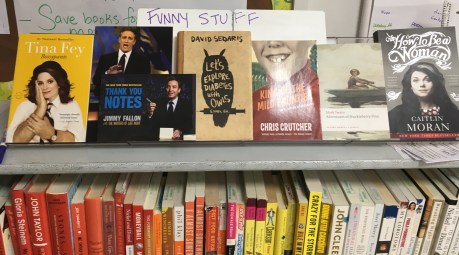
3. Themed book displays are easy to curate.  All that’s necessary are a few display stands and either some mini-white boards or some heavy paper that can be switched out. I rotate my display about once a week, and sometimes my students ask me to “do a theme” with the display. I try to oblige. This one focused on humor, but anything is possible. I’ve currently got a music theme going, and it’s fun to find themed collections based on other random ideas – animals, travel, even the color of the covers. Imagination is the only limitation with this one.


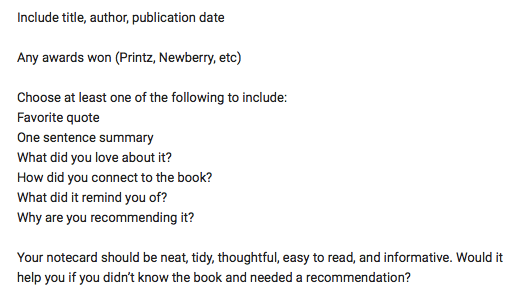
4. We reinvented the old-school card catalogue by filling an organizing bin with book recommendations. The categories in the bin match the ones on the library shelves, and students add their recommendations as they are motivated to do so, but only after reading the books, and if they liked the title. I gave them some basic guidelines for making the cards:Screen Shot 2018-03-20 at 5.29.43 PM

It takes students about five minutes to make a card, and they can even browse the “card catalog” at their desks.


5. The last method utilizes these frames from IKEA. They are double-sided, so on one side is a copy of the book cover, and on the other is the student recommendation.

I provided minimal guidelines for making the inserts to the frames:

Screen Shot 2018-03-20 at 5.29.23 PM

We are displaying them on our classroom conferring tables, on our book shelves, and in our school’s learning commons.

The common denominator with all of these ideas is that they are easily displayed, often student-created, and require minimal class time for students to create and use. They also get kids talking about books that they love, about their next reads lists, and about their reading lives. It’s win-win-win!

The gradual removal of scaffolding (like book talks) and the journey to independent reading lives are a couple of the major goals of workshop. Helping students build a community of readers means that they will depend on each other’s recommendations rather than those of their teachers’, and that helps us all reach the common goal of student independence. When students are encouraged to talk to each other about the books they read without the interference of the teacher, then true independence is closer than ever.

How do you encourage your students to build a reading community? I’d love to hear your ideas in the comments below.


Julie has been teaching secondary language arts for nineteen years, spending the first fifteen in rural Central Oregon, and the last four in Amman, Jordan. She’s thrilled to report that she and her family will be moving across the agua to Managua, Nicaragua next year, where a new adventure will begin.

Follow her on twitter @SwinehartJulie

Getting Around the Gradebook: How (and Why) to Go Gradeless

I spent a good portion of my spring break last week catching up on reading all of my students’ writing, and their thinking was a real treat. It is a blessing to work with preservice teachers, whose idealism and energy remind me of the optimistic fervor with which I tackled any challenge that came my way as a new educator.

As I read their work last week, I left comments, asked questions, and gave feedback. Often, I wrote thank-you notes to kids at the end of their papers–thank you for sharing your thoughts. Thank you for sharing them with me. Thank you for being you.

I did not leave grades.

I have believed for a long time that grades are part of the systematic destruction of our students’ love of learning. We’re killing their creativity, as Ken Robinson discusses in his TED talk that my students and I watched on the first day of class this semester:

We began our year with Ken Robinson’s powerful suggestion that we educate students out of their creativity–and yet, that we must teach students to survive in a future that we can neither predict nor imagine.

We next read Paulo Freire, who suggests in A Pedagogy of Freedom that the purpose of teaching is to create the possibilities for the production and construction of knowledge, that “what is essential is to maintain alive the flame of resistance that sharpens their curiosity and stimulates their capacity for risk.”

Just take a moment and let that sink in. THE FLAME OF RESISTANCE! THE CAPACITY FOR RISK! It’s beautiful, people!!!!!

So, where do grades have a place in this utopian vision for great teaching and learning?

My students’ thinking, which aligns with my own, suggests that they don’t. In fact, they create a dystopia: Jamie writes that students have shifted from being “programmed for learning” to just experiencing “programmed learning.” Kat lamented that “students are taught to anticipate rather than participate.”

It is essential that things change.

23398899.jpg

See? He’s totally Colin Firth

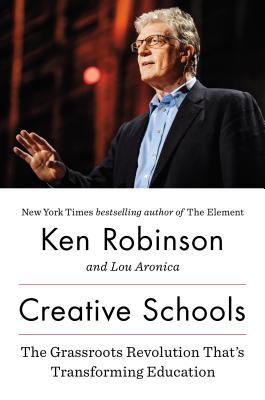
After becoming enamored with Ken Robinson’s Colin Firth-esque looks (to my mind, at least), I picked up his book Creative Schools: The Grassroots Revolution That’s Transforming Education. He narrates the audio version, and as he speaks to me in his adorable British accent, he advocates for a vision of change to the systems through which children learn.

Ken argues that schools and learning have long been erroneously thought of as mechanized processes, and that as such, efforts to reform them have been framed as simple tweaks, such as one would make to an industrial process in order to streamline it. But Ken presents a clear argument that learning is not an industrialized process, but rather an organic one: a complicated, complex system that cannot be standardized.

When I finish the book, I am sure I will be able to go and fix everything that is wrong with education today, but in the meantime, I’m content to a) recommend it to you, and b) stand firm in my commitment to make changes where I can.

I reflected, and found a place to make a change.

The change I made this semester was in removing grades from my classes. I had to cheat a little to do this, but I like the way it’s worked out. While I’ve always longed to do away with grades, I struggled with how to do so within the confines of a system that makes me put grades into a gradebook.

I found the answer in one of Tom Romano‘s syllabi from my Teaching Writing class with him:

screen-shot-2018-03-21-at-6-16-36-am.png

(Yes, I save syllabi for years. Electronically. I’m a teacher, okay?! That means I hoard.)

That was it, I decided. Eureka! Do the work. Do it well and do it on time. You’ll get an A. No ifs, ands, or buts.


Now, as I read student work via Google Docs, I focus on leaving organic comments, questions, reactions. I push and prod, pull and praise. I focus on what’s important, as Amy writes here.

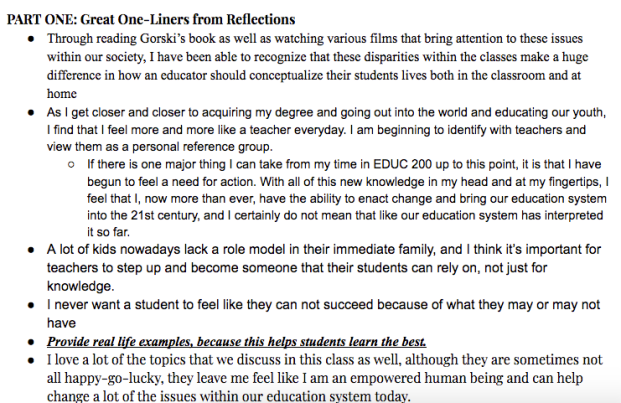
My students receive feedback from their critical friends and me, and engage in a conversation with all of us in the comments. We talk about their work in class, read it together, and pull out highlights and paste them into shared Google Docs, like these from our midterm self-assessments:

Screen Shot 2018-03-21 at 6.50.46 AM.png

(At the end of the semester, I’ll compile those highlights, some variation of which we do weekly, into a printed anthology I’ll give to each student.)

In my grading spreadsheet, I give full credit to match the point values of each assignment–10 points for one-pagers, 50 points for major papers, 25 points each for self-assessments and notebook turn-ins. No thinking about percentages or worrying about fractions. Just an A for work done well and on time, because it removes the pressure from students to worry about their grades.

Because I teach teachers, I get to be very meta about my processes, and I’ve practiced giving strong and thoughtful feedback alongside my students. We study our students’ (and our own) products, discuss what learning we see being made visible, and work to improve our feedback methods and messages each week:

IMG_7286

If I can’t remove grades, and the stress that comes with them, I’ll give all students a grade that makes them stop worrying about whether they’ll attain that A or not. That is what I have been longing to give them: learning unfettered by the pressure to boil down their thinking to a number or letter.

All thinking, reading, writing is worth so much more than a grade. It’s worth a reader, a respondent, a friendly ear, a coaching eye, a nurturing nudge.

This is my cheat code for how I’ve managed to get away from being a grade-doling disciplinarian, and come to enjoy being a truly engaged teacher of my students’ growth.

How do you get around the gradebook? Please share your strategies in the comments.

Shana Karnes teaches preservice teachers at West Virginia University, works with practicing ELA teachers through the National Writing Project @WVU, and reads approximately 562 books a day with her two daughters, ages 4 months and 23 months. Find Shana on Twitter at @litreader.


$%^@* Gradebook!

Sorry for the semiotic profanity, but the more research I read, the more conversations I have with students, the more reflecting I do about my practice, $%^@* is what comes to mind. The inherent contradictions between meaningful learning and the system in which it takes place become most apparent about a week before grades are due, which for many of us is right about now–the end of a quarter. And the accompanying frustration and anxiety seem especially pronounced in writing courses, where our emphasis is on process over product.

I teach Advanced Writing, one of several English courses for seniors. The whole of third quarter has been devoted to an author or genre study: students must read 3 full-length texts and a number of critical articles by and about their author/genre, and express their findings through a variety of genre, ie a multigenre paper. Students made their own schedules, although I assigned drafts throughout the process to be workshopped and revised prior to the due date, which is today.

Many students held firm to their own and my deadlines all along, becoming heavily invested in their work — and the work of their classmates. Claire, a self-professed “math & science person,” immersed herself in the work and the philosophy of Camus. RJ, a devoted journal-keeper, examined the work and the critical reception of confessional poetry. Grace, a reader of all things spooky, explored the connection between horror writers and themes of lost innocence and coming-of-age. (I could go on, but I want to save their work for another post). These students and many others made careful, purposeful decisions about how to express their discoveries in a variety of genre, even — gasp! — taking that bold writerly step of abandoning a draft that wasn’t working and trying something new. Workshop and multigenre at its finest, right?

Sort of. Last week, drafts started to trickle in from students who had arrived late to the process party. I gave feedback as effectively as I could and kept my teacherly admonishments about deadlines under control. By Saturday morning, I had returned at least one draft to every student who had submitted work, and so I carried on with my weekend. Sunday afternoon, my inbox was full again with drafts of genre pieces. I still don’t know why I was so surprised, given that the quarter-long project was due in less than 24 hours. As I skimmed the list of submitted drafts, I faltered between pride in the work that finally came in and frustration over how late it was.

grade cartoon Glasbergen_1824This course is about nothing if it’s not about writing as a process. For three quarters, our work has been based on no other principle more than this one. Students who handed in drafts so late clearly did not engage in the work at this fundamental level. Surely I couldn’t award them the same grade as those who had. Right?! Right. So I started drafting a not-so-nice email to those stragglers pointing out that they all have known the due date for quite some time and surely they must have had no intention to revise in the first place so why did they even bother handing in a draft and was it just to get a number in a gradebook but of course I will not award the same credit so you will receive that fat ZERO because you’re seniors and by gosh I’m going to use that fat zero to show you how the world works because it’s time you start …

OK, no, I didn’t go that far, but that’s where it felt I was headed, and it felt wrong. How could I disregard their work yet still claim to value the process? How could I do the talk (and walk) against grades as an artificial, arbitrary, inaccurate measure of ability and achievement and then use them as a punishment? The only lesson they are likely to learn is that yet another adult they wanted to trust is revealed as a hypocrite.

In the end, I made my best attempt at a compromise, the details of which I’m sure resemble what anyone reading this blog would have done. But in that initial moment of composing that email — and that it was my first instinct — reminded me how ingrained the system can be even in those of us who do all we can in our practice to skirt around its limitations. I’m sorry this post doesn’t provide any grand answers to this pervasive conflict between meaningful learning and hierarchical measurements of such, but gosh I feel so much better for having shared with an audience that can commiserate. I hope you do, too.

Revision Strategies that Make the Cut: Helping Students Be Incisive

I learned to be more incisive as a writer as an AP Language and Composition student (somewhere in between rocking flannel and rocking out to Pearl Jam). My perspicacity heightened with my argument research paper, which I had written by hand. Yes, by hand. We owned a computer, but I still expressed myself better pen to page (I’d make the case that writing by hand is still important for our students. Um–notebook time, anyone?). As I read what I had written, preparing to make revisions, I knew I wanted to rearrange the sections. So, I reached for scissors and tape. And–gasp–I cut up my essay, by paragraph, by sentence even. Sprawled on my bedroom floor, I spent the rest of that evening moving parts around until satisfied the parts built toward my whole.

My students’ body language says it all when I offer this story as the lead in to cutting up their own writing. They lean back, raising eyebrows, looking at me quizzically. I imagine their thoughts: “We have cut and paste for that, Mrs. J. You know, on our smartphones.” “Oh rats (emphasis added), I didn’t print my paper. Ha! Now I don’t have to do that.” “I like the way it is. Why would I want to cut it up?” This last query I think is most important. Writing is an act of making, of creation. As humans, we typically get attached to the things we make; we grow to love our words and the way we’ve orchestrated them on the page. Some students need to wrestle with this implicit bias more in order to discover the gaps in their writing. By making my students cut up their drafts, giving them a different kind of constraint, I’m helping them to engage in cognitive conflict, the kind of disequilibrium they need to continue their work revising and to move forward as writers.

These are 5.5 of the strategies so far (I’m always culling) that have made the cut in my classroom.

1. For Invention and Structure

Process: During the planning phase for their argument research papers, I offer old books and magazines to my students, directing them Disney Imagineer Style to cut words and images related to their issues and then arrange them on the page, keeping their audiences in mind.

Benefits: This kind of gathering, cutting, and moving allows for intuitive structuring of their papers AND sometimes engenders creative analogies within their justification (warrants).

2. For Structure

Process: To further gather ideas for structuring, I direct students to cut apart mentor texts to see how they are structured. Typically, I advise them to start with paragraphing but then encourage them to make further cuts and move text as needed in order to discover the ordering of the text and to label and note for themselves what moves the writers made.

Benefits: This exploration compels students–because they must analyze the implications of how the writer arranged the text–to more purposefully arrange and connect their own ideas.

3. For Development

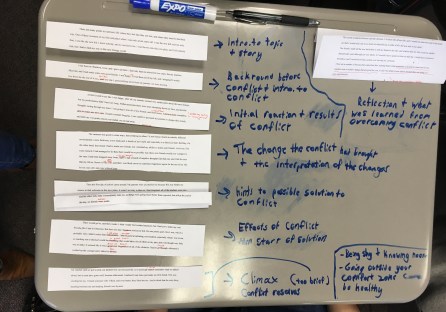
Process: Students begin by cutting up their papers by paragraphs. They then label the purpose of each section or determine what question each paragraph answers, keeping a post-it with the thesis/theme/point near to see if each paragraph aligns. They can then begin moving paragraphs or parts around to see how to manipulate time, to see if there can be greater logical interrelatedness, or to see if parts require more information.

img_1565-1.jpg

This student sample shows a narrative cut up and labeled.

Benefits: Cutting apart their own texts challenges students to determine the efficacy of development in their writing, especially because this compels them to examine one section–in isolation–at a time (something more difficult to do digitally). Here is one of my students talking through how he used the process and what he discovered.

4. For Purpose

Process: Here the cutting gets more minute: I ask students to cut out the center of gravity sentence (their thesis, claim, so what, point, etc.) to see if everything really does rest on it. After cutting it out (and sometimes just transferring it to a post it), students can move it next to different parts of their paper to see if the parts not only relate but if they build toward this.

Benefits: Sometimes the benefit here comes in the realization that they need a so what or that the parts don’t align or that the sentence itself lacks strength.

5. For Style

Process: Cutting out where they used a mentor text move and seeing if they applied that move to their own writing gets students looking at sentence construction.

Benefits: If we ask our students to “lift” a move from a mentor text, can’t we also ask them to lift their text and compare it back to the original, moving them side by side to determine how effective the application of the mentor text move is after all?

 5.5 For . . .?

Possible Processes: Cut away what tells instead of shows. Cut out all of the comparisons in the text to look for patterns, connectivity, etc. Cut out the best sentence from each paragraph to look for ways to build meaningful repetition.

Benefits: I don’t know yet. These are half-formed ideas right now. But I know they could help my students become more discerning as writers.

Amy Estersohn wrote in her recent post about the tools she relies on for workshop. I’d like to add one more tool: scissors. This tool inspires strategy, and thus, our writers. I frequently tell my students that writing is made of moveable parts. So, let’s get our students moving it!

Kristin Jeschke frequently finds scraps of paper and post it notes around her house–writing that may or may not have made the cut of her budding cartoonist nine-year-old and her emerging storyteller six-year-old. Of course, on days when her students are armed with scissors, her classroom looks similar. Follow her on Twitter @kajeschke. 

Politically Motivated: Positively Harnessing Student Passion in a Time of Uncertainty and Fear


Yesterday morning, I stood outside for 17 minutes. Per the instructions of my administration to maintain the opportunity for all students to learn without interruption should they choose, after a moment of silence in our school for the victims of the Parkland shooting, if students chose to participate in the national walkout, teachers were to follow only if every student in his/her class left the building. After a few seconds of looking around at one another, one by one my sophomores stood up and filed quietly out of the room.

Outside, a small group of students had prepared statements to lead the several hundred students gathered in the chilly March sunshine through 17 minutes of reflection, support, and silence. The group was large, diverse, respectful, and unified, if not in purpose (likely a few students were carried out more by curiosity than conviction), then in the experience itself. A hush I’m not used to experiencing in the company of several hundred high school students quickly fell on the chilly March morning and the group stood in near silence, listening to their peers eloquently unite the crowd in peaceful purpose.

Teaching in time when I feel that I must often couch statements with a reminder that logic and facts should not be considered political, I must again come to you today and suggest that the overwhelming pride I felt in the students gathered in front of our school yesterday, and at the student-led debrief/discussion held during our resource period afterwards, had nothing to do with the politics of their statements. It has everything to do with the way I saw students, our students, standing together in support of one another to promote safety, unity, and empathy, not only for our schools but for our communities.

Several weeks ago, after the tragedy unfolded at Marjory Stoneman Douglas High School, I was compelled to write about how we can help our students (Shana too wrote beautifully about positive activism in the classroom), those young people who were not even alive when the shooting took place at Columbine in 1999, process such violence and uncertainty as a constant shadow to their educations. Little did I know that our school too would need to process an alleged threat to safety, a school day where several hundred students stayed home out of fear, social media-fed rumors of possible violence, and countless discussions with students who said time after time that even though this particular brand of violence has been taking place for the entirety of their educations, they didn’t know what to do. They didn’t know how to feel. They didn’t know how to cope.

They just want it to stop.

I looked at their faces and saw fear, anger, and pain that frankly frightened me, and for the millionth time this year, I knew I needed to figure out what we could do.

Discussion, writing, reflecting, sharing, and hugging was working, but much like this past month, something felt different.

These kids needed to DO something.

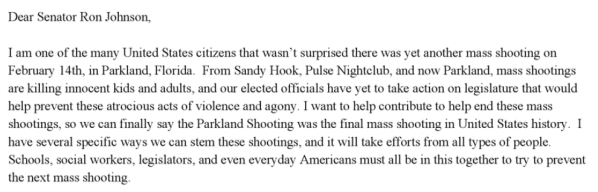
My colleague Sarah and I decided to have our AP Language students write letters to their representatives, expressing their researched opinions on how to end the violence of mass shootings. Their arguments would be their own, bolstered by research to better understand the issue, their own positions, and their audience.

social changeWe were clear with students from the very beginning that this was not an assignment in support of any particular political agenda. Instead, it was an exercise in better understanding our preconceived ideas and more deeply, and diplomatically, developing our rationale for how to bring about change  As long as their research came from credible sources, students could argue for changes to gun laws, support of the 2nd amendment, mental health considerations, school security, or any other defensible position to end mass gun violence. They could write to state or local representatives, as long as they researched that representatives current position on related issues, providing students with key insights to audience consideration we’ve previously only talked about or tried to emulate through blogging.

Supported with ideas from Kelly Gallagher’s incredible argument unit published over the course of 12 days on his personal blog, Sarah and I helped students through pointed research to build letters rich in ethos, persuasive argument, and pathos that could only be provided by the very students whose passions for activism have been flamed because they are so heavily and personally burdened with the threat of this particular brand of violence.

Over the course of the past two weeks, I have:

  • Seen students come in more for help/feedback with this assignment than any other throughout the year. When I asked a student after school yesterday, what had him so dedicated to crafting this particular summative he said, “Because my school work matters, but this assignment is going outside of the school. It matters outside of these walls.”
  • Watched young people who before could not identify who their state or federal representatives even are, research these people and their positions on key issues, and write directly in response to those issues in order to argue to an authentic audience.
  • Helped students channel their feelings of helplessness into purpose, simply by picking up a pen.

What these kids have produced is incredible. I am so proud of the way they have positively focused their overwhelming emotions into powerfully convincing letters to the men and women with means and opportunity to make changes to protect our students from further disaster.

Here are a few excerpts from letters that have started rolling in. In the coming days, we will get the letters printed, addressed, and mailed to Madison and Washington.


mass2


mass3


mass4


mass1


I am a firm believer that addressing issues in a constructive manner is a significant step toward positive change. We owe it to our students to provide them with, encourage them around, and support their efforts in making positive changes in their own communities. Though unequivocally necessary as a foundation to an informed electorate, we will not raise the citizens this nation so desperately needs on standards, skills, and summative assessments alone. A new reality is built on the combined knowledge and passions of the humans willing to take risks in support of that reality.

I will certainly never stop teaching my students that deconstructing a prompt is the best way to dig into a timed writing task or that commas don’t occur only where you would naturally take a breath, but I will also never stop supporting them in all they have to teach to us. Our students deserve our help in amplifying their voices to bring about a better world. In this, our jobs have never been so important.


Lisa Dennis teaches English and leads a department of incredible English educators at Franklin High School near Milwaukee. Follow Lisa on Twitter @LDennibaum. 


A Book for Women, Young and Old and In-between

I am always on the look out for books that will hook my readers and mentor texts that will inspire my writers.

But when I saw the title The Radical Element, 12 Stories of Daredevils, Debutantes & Other

My Radical Granddaughters

It’s never too early to give girls hope.

Dauntless Girls, I thought of my own three daughters, my daughter-in-law, and my two granddaughters. (Well, not so much the debutantes, but definitely the daredevils and the dauntless.)

We need books where our girls see themselves –where they feel empowered to take on the world. In a brochure I got from @Candlewick, it states:

To respect yourself, to love yourself, should not have to be a radical decision. And yet it remains as challenging for an American girl to make today today as it was in 1927 on the steps of the Supreme Court. It’s a decision that must be faced when you’re balancing on the tightrope of neurodivergence, finding your way as a second-generation immigrant, or facing down American racism even while loving America. And it’s the only decision when you’ve weighed society’s expectations and found them wanting.

So today, I write to celebrate the book birthday of The Radical Element edited by Jessica Spotswood.

Screen Shot 2018-03-13 at 12.54.36 PM

Jessica writes:

. . . Merriam-Webster’s definitions of radical include “very different from the usual or traditional” and “excellent, cool.” I like to think our heroines in these twelve short stories are both. Our radical girls are first- and second- generation immigrants. They are Mormon and Jewish, queer and questioning, wheelchair users and neurodivergent, Iranian- American and Latina and Black and biracial. They are funny and awkward and jealous and brave. They are spies and scholars and sitcom writers, printers’ apprentices and poker players, rockers and high-wire walkers. They are mundane and they are magical.

. . .

It has been my privilege to work with these eleven tremendously talented authors, some of whom are exploring pieces of their identities in fiction for the first time. I hope that in some small way The Radical Element can help forge greater empathy and a spirit of curiosity and inclusiveness. That, in reading about our radical girls, readers might begin to question why voices like these are so often missing from traditional history. They have always existed. Why have they been erased? How can we help boost these voices today?

I have only read a few of these stories so far, but they are a wonderful blend of adventure and courage.

Here’s what three of the 12 authors have to say about their stories:

From Dhonielle Clayton, “When the Moonlight Isn’t Enough”:

1943: Oak Bluffs, Massachusetts

What encouraged you to write about this moment in history?

 I wanted to write the untold stories of hidden black communities like the one in Martha’s Vineyard. I’m very fascinated with black communities that, against all odds and in the face of white terrorism, succeeded and built their own prosperous havens. Also, World War II America is glamorized in popular white American culture, however, we learn little about what non-white people were doing during this time period. 

 In researching this topic, did you uncover any unexpected facts or stories?

I didn’t find as much as I wanted because historians focused on white communities and the war effort, leaving communities of color nearly erased. I had to rely on living family members that experienced this time period and a few primary sources detailing what life was like for black nurses in the 1940s. 

 How do you feel like you would fare during the same time period?

The one thing I trust is that black communities have been and will always be resourceful. Accustomed to being under siege, we have developed a system of support. I think I would’ve fared just fine. 

From Sara Farizan, “Take Me with U”:

1984: Boston, Massachusetts

What encouraged you to write about this moment in history?

I’ve always been fascinated with the 1980’s. Even with all its faults, it is the period in time that stands out for me most in the 20th century. The music, the entertainment, the politics, the fear and suffering from the AIDS virus, the clothes, and the international events that people forget about like the Iran/Iraq war.

In researching this topic, did you uncover any unexpected facts or stories?

It was hard to look back on footage from news broadcasts about the Iran/Iraq war. I felt embarrassed that it seemed this abstract thing for me when really my grandparents came to live with my family in the States during the year of 1987 to be on the safe side. I was very young, and didn’t think about why they had a year-long visit, but looking back, I can’t imagine how difficult that must have been for them. Fun not so heavy fact: Gremlins, Ghostbusters, Purple Rain came out in the summer of ’84. And so did I!
How do you feel like you would fare during the same time period?

I think I would know all the pop culture references and my hair is already big and beautiful so that would work out great. My Pac-Man and Tetris game is strong, so I’d impress everyone at the arcade. However, I’m not down with shoulder pads and I don’t know if I would have been brave enough to come out of the closet back then.

From Mackenzi Lee, “You’re a Stranger Here”

1844: Nauvoo, Illinois

What encouraged you to write about this moment in history?

My story is set in the 1840s in Illinois and is about the Mormon exodus to Utah. I was raised Mormon, and these stories of the early days of the Church and the persecution they suffered were very common place. It took me a while to realize that, outside of my community, no one else knew these stories that were such a part of my cultural identity. I wanted to write about Mormons because its such a part of my history, and my identity, but also because, when I was a kid, there were no stories about Mormons. There are still no stories about Mormons–it’s a religious minority that has been largely left out in our current conversations about diversifying our narratives.

In researching this topic, did you uncover any unexpected facts or stories?

Ack I wish I had a good answer here! But honestly not really–I already knew so much of what I wrote about because I’d gone to a Mormon church throughout my youth.

How do you feel like you would fare during the same time period?

Badly! The Mormons went through so much for their faith, and as someone who has had a lot of grief as a result of the religion of her youth, I don’t know if I could have handled having a faith crisis AND being forced from my home multiple times because of that faith. Also cholera and heat stroke and all that handcart pulling nonsense is just. too. much. I didn’t survive the Oregon Trail computer game–no way I’d survive an actual trek.

Radical_Element_social_media_quotes_4


Amy Rasmussen teaches readers and writers at a large suburban high school in North TX. She loves to read and share all things books with her students. In regards to this post, Amy says, “It’s Spring Break for me, and I’ve been idle. Kinda. Three of my grandkids arrived at the spur of the moment, so I’ll use that as an excuse for posting late today.” Follow Amy @amyrass and @3TeachersTalk.


Three Ways of Looking at a YouTube Video

If your kids are anything like the ones in my life, both at home and at school, then they love YouTube. When I ask them what they watch, they list names of YouTubers.

At first, I scoffed at this medium that seems to absorb all their energy. Then I started noticing something.

IDEAS

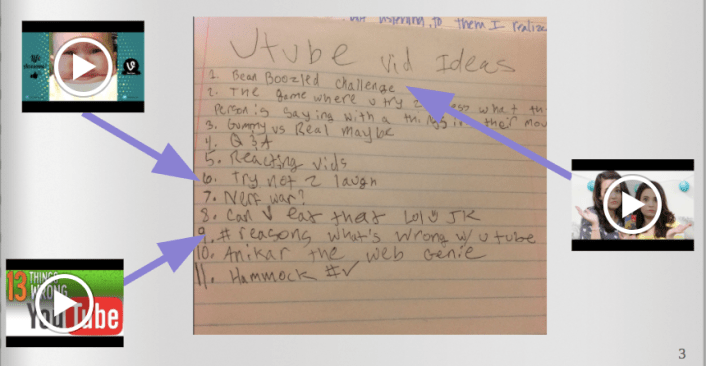
It started last summer after I kicked my three kids outside to play. They were writing in their notebooks furiously. Being my nosy self, I peered over their shoulders.

My kids, who are wonderfully, beautifully average, were planning their upcoming YouTube “projects”. They’d found an old digital camera and had been making videos (but not yet posting them anywhere). Upon further inspection, I noticed that many of these videos ideas were inspired by ones they watched endlessly on YouTube. They were using the texts they love as a way to generate ideas for their own composing. Further, they were using YouTube as a mentor text.

Screen Shot 2018-03-07 at 10.59.29 PM

They reminded me that often when I use mentor texts in my own instruction, I want students to use the mentors to generate their own ideas. Whether we read The Important Book by Margaret Wise Brown, or an essay about Hermione Granger in The New York Times, I want student writers to use those texts as launching pads for their own thinking around topics. I know that one of the most important things that writers do is choose topics that inspire them. I also know that doesn’t happen by accident or chance or magic. We have to teach students how to find their ideas and mentor texts can help us do that.

STRUCTURE

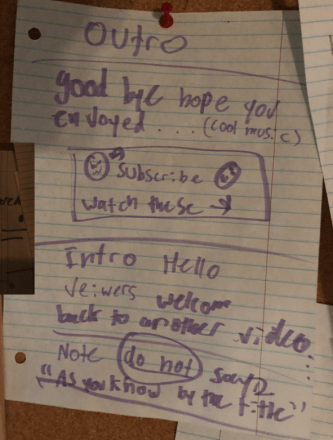
A few months later, my 10-year-old son started his own YouTube channel. One day I walked into his bedroom where I saw his bulletin board covered in notes. He had created a vision board about his channel where he posted a criteria list focused on what Screen Shot 2018-03-07 at 10.58.07 PMhe had been noticing in other videos. Upon further inspection, I noticed he had also created a template for a video. He was making note of the patterns in the videos, his mentor texts. He paying attention to the structure of a video, to the introduction (the intro) as well as the conclusion (the outro). He also made notes about what not to do.

Jacob’s work around structure reminds us that another way of looking at mentor texts is through the eyes of organizational patterns. When we ask students to notice how something is built, we invite them to create possibilities for their own writing. I want my students to read like writers and to make choices about the way they might structure a piece of writing. Mentor texts help us create a vision for doing that and they empower students to uncover those possibilities themselves.

CRAFT

As Jacob’s gotten better at making these videos, I’ve noticed that he’s also gotten better at the craft within the videos. He and his younger brother Justin decided to launch a series together (of which they’ve only made one episode). When I watch just the first minute of the video, I notice the way they use their voices and gestures. I notice the way they set the stage, displaying the title. I notice how they have clearly rehearsed what they’re going to say. These are all things they’ve picked up from watching their favorite videos, from studying the mentor texts. They identified nuances that add voice and flavor to the text, and then they tried it

Their attempts at incorporating these moves reminds me that another way to consider using mentor texts is to think about the ways we can teach students to read like writers. When we teach students to hone in on the craft moves a writer makes and to think about the purpose of the moves, they can start to think on a granular level about their own writing. The next step is to try those moves out in our own writing.

WHAT DOES THIS MEAN FOR OUR TEACHING?

As I notice the way my own kids have become immersed in these texts, I can’t help but think about how this relates to my own teaching using mentor texts. It’s not enough to show students a text and say, “Okay, now do this in your own writing.” We know that doesn’t work. Instead of becoming frustrated that kids don’t “get it,” I want to instead use  mentor texts with intention.

Using mentor texts is also a process. I can’t expect for students to be able to look at a text and consider ideas, structure and craft all at once. I have to carve out time for students to be able to work through the different ways mentor texts can support them as writers. I have to teach with intention so they can write with intention.

When I consider immersing students in the kinds of writing that will help them grow as writers, I want them to have the same kind of authentic experience as my kids did. As a teacher, I also want to lean in to exploring all the ways mentor texts can look in my classroom — anything from YouTube videos to essays to infographics can help nudge writers to think about how to generate ideas, how to make choices about structure and how to develop their craft.

If you’d like to learn more about finding mentor texts, you can check out this smart Mentor Texts Are Everywhere.