Category Archives: Amy Rasmussen

100 Days of Writing

Today my favorite quote on writing is this one attributed to James Michener.

355964-james-a-michener-quote-i-love-writing-i-love-the-swirl-and-swing

I’ve had a lot of emotions lately. Chaotic, confusing, crippling emotions. The kind that freeze action and force reflection.

But time thaws, and the writing of others warms me in ways my own writing often does not. I have found healing in the writings of my friend and colleague Amber lately. So raw and real and poignant.

I share her most recent post here. (An interesting mentor text idea:  Choose an age and write about it.)

I think about the work of writing and teaching writing a lot — more often than I actually write. I need to change that. Find my groove. Free my soul within the swing and the swirl of my pen. Stop thinking I can only write research-based pieces or tips on this blog. I need to walk my talk and just write — more. Period.

Our friends at Moving Writers have an incredible idea:  100 Days of Summer Writing. Imagine the possibilities — for ourselves and our student writers.

What do you think? Could we all use a little writing inspiration? Could we all write a little more, strengthen a few mental muscles?

I’m thinking if I do, perhaps everything that’s sent me into a spin lately will spin into something else entirely.

Writing can do that. That much I know.


Amy Rasmussen teaches English IV and AP Language & Composition in North Texas. She recently moved homes, trading one cluttered mess for another, which does nothing for her need for order and simplicity. You can find her searching websites for minimalist living and selling So. Much. Stuff. on Facebook Marketplace when she isn’t trying to prep her students for graduation or the looming AP English exam. For tweets, follow @amyrass 


An Intervention Change Up and a Plug for Summer Learning

brady-cook-314868-unsplash

Photo by Brady Cook on Unsplash

I bet I am more ready for summer than you. No, really. I am SO ready.

It’s not that I don’t like my job. It’s not that I am not having tons of great learning experiences with my students — they are doing beautiful things. It’s not that all things testing come crushing in this time of year (TELPAS, STAAR, AP) and make me daydream of working at a spa folding towels. It’s really none of that. It’s not even that I need a vacation — although I do. Did we already have Spring Break? (Oh, yeah, we did.)

It’s this:  Last summer I had one of the most amazing, awe-inspiring experiences of my teaching life. And I get a do over this summer.

Last summer I got to work with a powerhouse group of ELAR teachers in Clear Creek ISD with my friend and collaborator, Billy Eastman. I met Coach Moore who now writes on this blog and many other true blue educators dedicated to doing the work of workshop instruction and determined to do right by their readers and writers.

I could go on and on and on. But I won’t because Billy and I already did.

We wrote about our planning and implementation of that summer learning in this article “An Intervention Change Up: Investing in Teacher Expertise to Transform Student Learning,” recently published in English Journal.

I hope you’ll read it. Think about the intervention routines on your campus. Are they good for all students? Will they increase confidence in the hearts and minds of your readers and writers? Will they help students gain skills — or reinforce their lack of them?

And what about teachers? What’s in that work for you?

I’d love to know your thoughts. And if we can help, please let us know that, too.

Amy Rasmussen teaches English IV and AP English Language and Composition at a large senior high school in North TX. She is grateful to the North Star of TX Writing Project and Penny Kittle for showing her the benefits of choice and challenge; otherwise, she would probably still be dragging students through Dickens’ novels and pulling her hair our over plagiarized essays. Thank God she learned a better way. Follow Amy @amyrass and @3TeachersTalk. And please join the Three Teachers Talk Facebook page if you haven’t already. Join the conversation and share the good news of your workshop classroom.
A Book for Women, Young and Old and In-between

I am always on the look out for books that will hook my readers and mentor texts that will inspire my writers.

But when I saw the title The Radical Element, 12 Stories of Daredevils, Debutantes & Other

My Radical Granddaughters

It’s never too early to give girls hope.

Dauntless Girls, I thought of my own three daughters, my daughter-in-law, and my two granddaughters. (Well, not so much the debutantes, but definitely the daredevils and the dauntless.)

We need books where our girls see themselves –where they feel empowered to take on the world. In a brochure I got from @Candlewick, it states:

To respect yourself, to love yourself, should not have to be a radical decision. And yet it remains as challenging for an American girl to make today today as it was in 1927 on the steps of the Supreme Court. It’s a decision that must be faced when you’re balancing on the tightrope of neurodivergence, finding your way as a second-generation immigrant, or facing down American racism even while loving America. And it’s the only decision when you’ve weighed society’s expectations and found them wanting.

So today, I write to celebrate the book birthday of The Radical Element edited by Jessica Spotswood.

Screen Shot 2018-03-13 at 12.54.36 PM

Jessica writes:

. . . Merriam-Webster’s definitions of radical include “very different from the usual or traditional” and “excellent, cool.” I like to think our heroines in these twelve short stories are both. Our radical girls are first- and second- generation immigrants. They are Mormon and Jewish, queer and questioning, wheelchair users and neurodivergent, Iranian- American and Latina and Black and biracial. They are funny and awkward and jealous and brave. They are spies and scholars and sitcom writers, printers’ apprentices and poker players, rockers and high-wire walkers. They are mundane and they are magical.

. . .

It has been my privilege to work with these eleven tremendously talented authors, some of whom are exploring pieces of their identities in fiction for the first time. I hope that in some small way The Radical Element can help forge greater empathy and a spirit of curiosity and inclusiveness. That, in reading about our radical girls, readers might begin to question why voices like these are so often missing from traditional history. They have always existed. Why have they been erased? How can we help boost these voices today?

I have only read a few of these stories so far, but they are a wonderful blend of adventure and courage.

Here’s what three of the 12 authors have to say about their stories:

From Dhonielle Clayton, “When the Moonlight Isn’t Enough”:

1943: Oak Bluffs, Massachusetts

What encouraged you to write about this moment in history?

 I wanted to write the untold stories of hidden black communities like the one in Martha’s Vineyard. I’m very fascinated with black communities that, against all odds and in the face of white terrorism, succeeded and built their own prosperous havens. Also, World War II America is glamorized in popular white American culture, however, we learn little about what non-white people were doing during this time period. 

 In researching this topic, did you uncover any unexpected facts or stories?

I didn’t find as much as I wanted because historians focused on white communities and the war effort, leaving communities of color nearly erased. I had to rely on living family members that experienced this time period and a few primary sources detailing what life was like for black nurses in the 1940s. 

 How do you feel like you would fare during the same time period?

The one thing I trust is that black communities have been and will always be resourceful. Accustomed to being under siege, we have developed a system of support. I think I would’ve fared just fine. 

From Sara Farizan, “Take Me with U”:

1984: Boston, Massachusetts

What encouraged you to write about this moment in history?

I’ve always been fascinated with the 1980’s. Even with all its faults, it is the period in time that stands out for me most in the 20th century. The music, the entertainment, the politics, the fear and suffering from the AIDS virus, the clothes, and the international events that people forget about like the Iran/Iraq war.

In researching this topic, did you uncover any unexpected facts or stories?

It was hard to look back on footage from news broadcasts about the Iran/Iraq war. I felt embarrassed that it seemed this abstract thing for me when really my grandparents came to live with my family in the States during the year of 1987 to be on the safe side. I was very young, and didn’t think about why they had a year-long visit, but looking back, I can’t imagine how difficult that must have been for them. Fun not so heavy fact: Gremlins, Ghostbusters, Purple Rain came out in the summer of ’84. And so did I!

How do you feel like you would fare during the same time period?

I think I would know all the pop culture references and my hair is already big and beautiful so that would work out great. My Pac-Man and Tetris game is strong, so I’d impress everyone at the arcade. However, I’m not down with shoulder pads and I don’t know if I would have been brave enough to come out of the closet back then.

From Mackenzi Lee, “You’re a Stranger Here”

1844: Nauvoo, Illinois

What encouraged you to write about this moment in history?

My story is set in the 1840s in Illinois and is about the Mormon exodus to Utah. I was raised Mormon, and these stories of the early days of the Church and the persecution they suffered were very common place. It took me a while to realize that, outside of my community, no one else knew these stories that were such a part of my cultural identity. I wanted to write about Mormons because its such a part of my history, and my identity, but also because, when I was a kid, there were no stories about Mormons. There are still no stories about Mormons–it’s a religious minority that has been largely left out in our current conversations about diversifying our narratives.

In researching this topic, did you uncover any unexpected facts or stories?

Ack I wish I had a good answer here! But honestly not really–I already knew so much of what I wrote about because I’d gone to a Mormon church throughout my youth.

How do you feel like you would fare during the same time period?

Badly! The Mormons went through so much for their faith, and as someone who has had a lot of grief as a result of the religion of her youth, I don’t know if I could have handled having a faith crisis AND being forced from my home multiple times because of that faith. Also cholera and heat stroke and all that handcart pulling nonsense is just. too. much. I didn’t survive the Oregon Trail computer game–no way I’d survive an actual trek.

Radical_Element_social_media_quotes_4


Amy Rasmussen teaches readers and writers at a large suburban high school in North TX. She loves to read and share all things books with her students. In regards to this post, Amy says, “It’s Spring Break for me, and I’ve been idle. Kinda. Three of my grandkids arrived at the spur of the moment, so I’ll use that as an excuse for posting late today.” Follow Amy @amyrass and @3TeachersTalk.


What Does it Mean to Read like a Writer?

It’s a startling reality, but many of my seniors do not know how to read like writers. I spend a good part of the beginning of a semester helping students look at how an author crafts a text.

This still surprises me.

The seniors I have in class this spring have all passed their state mandated English exams. A big chunk of these Texas state exams, both English I and English II, ask questions in the reading portion about author’s craft. (I haven’t explicitly studied the question stems in a few years, but I am guessing at least half.) In trying to get students to talk about the writer’s moves, most of my students get stuck talking about meaning.

Of course, meaning is important — but not when we are using a text to help us move as writers. In workshop lingo, we call this using mentor texts.

How do we learn to write anything well if we don’t study the work of writers who write well?

When I was first asked to write recommendation letters, I studied well-written recommendation letters. When I begin to write a grant proposal, I study how to write an effective grant proposal. When I need to write a speech, I study well-written inspiring speeches. There are solid examples for every kind of writing.

I want my students to know this. If they learn anything from me this spring, I hope it is this:

We learn how to write well by studying effective writing. To quote Kelly Gallagher: “Before you can film a dogfight, you have to know what one looks like. Before our students can write well in a given discourse, they need to see good writing in that discourse”. (Read Gallagher’s “Making the Most of Mentor Texts” for an excellent detailing of how.)


Yesterday Charles wrote about scaffolding a reading lesson. The same type of lesson, but with an eye toward reading like a writer, worked recently with my seniors.

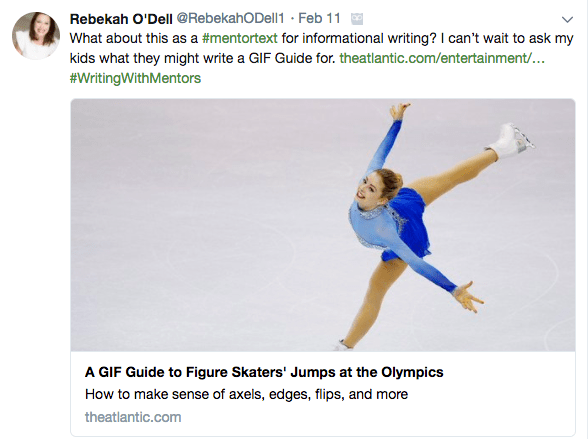
It all started when I saw this tweet: TweetofGIFGuide

I thought: “Okay, this may be a relatively painless way to get my writers into writing. We will use this text as a mentor and write our own GIF guides.” (Quick change in lesson plans on the drive to work.)

First, we started with a conversation about GIFs. This NY Times Learning Lesson has some good questions. We wrote our thinking in our notebooks and shared in table groups. Then, not quite as planned, the conversation shifted to how to pronounce GIF. “Um, it’s JIFF, Mrs. Rass, the creator of them said so.”

In case you are wondering:  I think the creator is wrong. But, does it really matter? I just wanted my students to use GIFs as an entry point into writing using mentors.

To help students understand how to study a text for a writer’s moves, I copied the text into a document, and removed the images, so students would focus on the language. Then I crafted a list of questions. Taking a cue from Talk Read Talk Write by Nancy Motley, I cut the questions up and gave a set to each small group. They spent the better part of a class period studying the text and using the questions as a guide.

Later, we brainstormed topics we thought would work, eliminating some that were too broad, and discussing ones that would lend well to a how-to or informational type of writing. Students then completed this document, so they could see my expectations for the writing task, and I could approve their topics.

Students talked. They wrote. I taught mini-lessons on introductions and sentence structure. Students revised. Some taught themselves how to make GIFS.

Most surprised me with their finished GIF guides. Here’s a sampling of a few. (Disregard the citing of sources — that’s still on the Need-to-Learn list.)


Students, no matter their age, will write when we give them the tools and the time they need to be successful writers.

Sure, not all of my students produced solid writing — yet. But I am hopeful. We are only a about a month into the course, and most students now have a writing success story.

That confidence matters.

For a great read on helping students write, read “Children Can Write Authentically if We Help Them” by Donald Graves.

I’d love to know the fun or interesting mentor texts you use to get your students to take a chance on writing. Please share in the comments.

Amy Rasmussen teaches English IV and AP Language at a large senior high school in North Texas. Go, Farmers! When she’s not skimming the news or her Twitter feed for mentor texts, she’s reading books to match with her readers or thinking about the rest she might get during spring break. Eight days, but who’s counting? Follow Amy @amyrass and @3TeachersTalk, and she invites you to follow this blog if you aren’t already.


So You Don’t Think Workshop Works? 5 Reasons You are Wrong

It doesn’t take much to fire me up.

Last month, I sat listening to Pernille Ripp speak at the TCTELA Conference in Galveston, TX. I’d just spent an hour walking along the beach and thinking about the presentation I would give in an hour. I’d subtitled it “Reimagining Literacy Through Secondary Readers-Writers Workshop.”

Pernille spoke as if our minds were fused. Her passion was my passion. Her beliefs were my beliefs. I haven’t read her books, but I quickly put them in my online cart.

She said some things I needed to remember to say, so I opened up my laptop and fell into an argument. A colleague had sent an email with a link to a neighboring high school’s online news article about my district’s new ELA curriculum, a curriculum that invites choice and challenge and allows teachers the freedom to plan instruction based on the individual needs of her students. It aligns with our state standards, which align with College and Career Readiness Standards. It does not require any specific texts be taught, but it does offer suggestions. Therein lies the rub.

While the student writers wrote a fine piece for high school journalists, they highlighted some erroneous conclusions about choice reading and the instructional rigor that it offers. They also seemed to side with those uninformed to the research and practical application of the workshop method of instruction. Those who just don’t get it.

I had a bit more moxie when I presented that day.

If you’ve heard me speak, or read this blog for any length of time, you know I’ve been on this journey a long while. Workshop instruction is not easy. And giving up control is only a slice of the hard part. But with talking, training, continual reading of research-based practices, and reflexive moves as a teacher, it works. It works to help students identify as readers and writers, and it works to prepare them for the work of college and the careers that will come after it.

In my presentation, I shared the why of workshop and needed more time to share the how. Later, it struck me:  The how can only happen when we fully understand the why, and the why only becomes clear when we are open to understanding it.

And there are probably a lot of teachers who are working hard to make choice work who need a lot more support and training to make it as successful as they know it can be.

A few days later, my colleague forwarded me her rebuttal to the students’ news article and asked for my feedback. I did not have anything to add to her remarks. They spoke to the need of fidelity to a choice model, specifically to the advantages of independent reading, and the importance of teachers being active celebrators of books and talking to students about their reading. But I did have a few thoughts related to a lot of other things regarding the subtext of the initial attack on our new curriculum. (Of course, I did.)

On SSR and Independent Reading. There is a difference, although the two are often misused synonymously. Both prove beneficial to students readers. SSR is usually choice without parameters and little accountability, except for celebrating books and teachers conferring with students about their reading lives in an attempt to get and keep them reading. Independent reading is a much more structured approach to choice. 

With independent reading, we teach using our books to study the strategies for becoming better readers and writers. We might suggest parameters like reading certain genres or books with specific themes. We might have students go into their books and find examples of characterization, how the writers move the plot forward, descriptions of setting, etc. — basically, we teach in mini-lesson format all the skills we might otherwise teach with whole class novels. Few teachers I know new to the idea of choice know this difference between SSR and the more complex approach to choice with Independent Reading. In my AP Language class, I do a combination of both.

On Research. The research is immense on the importance of experiential reading. I am sure you are familiar with Louise Rosenblatt’s work on Transactional Theory. Many other edu-researchers today build upon it, most recently Jeffrey Wilhelm, Kylene Beers, Bob Probst, and Penny Kittle. Today few high school English teachers I meet outside this blog circle understand this research. They teach the way they were taught, and many came to be English teachers because they love literature, not because they believe their job is to teach students to become readers and writers.

If we were to ask:  What is the theory that guides your practice? They would not be able to answer. I always refer to the research of Richard Allington and often quote an article he wrote with Rachel Gabrielle, Every Child Every Day. All students need the six things they mention, yet high school teachers often discount this research claiming:  That’s only for elementary. Of course, this is not true.

On Reading. Most teachers know the majority of their students do not read the required texts, and to hold students “accountable,” they give quizzes with questions “that cannot be found in Sparknotes or other online sources.” I have heard so many teachers say this! Instead of working to include students in the decisions important to their reading lives, they use punitive methods, disguised as grades, to turn students away from reading and into cheaters. Sure, there are some students who will read assigned texts, but if teachers would be vulnerable enough to actually ask their kids, so many would tell the truth:  they do not read. So not only do teachers enable dishonest behavior, they do not move their students as readers.

The only way to become a reader is to read. The same holds true for writing. If teachers give students choice in topic, form, etc, students are less likely to plagiarize, especially if the writing is done in the classroom with the teacher present to confer and coach students through the writing process. Plus, most teachers who rely on the whole class novel do not have time for authentic writing instruction. It just takes too long to work through whole class novels. Students write analytical essays over books again and again — the form of writing they are least likely to write in their careers and even in college, unless they become English majors (and if you didn’t know, the numbers of English majors continues to fall.)

On Engagement. Research shows that when students are engaged, they are more apt to learn. Many teachers confuse engagement and compliance. Many young people, especially those in schools and in classes where grades are the focus, are compliant. And we’ve trained students to reach for the grade instead of diving deep into the learning. In my experience with these students, they want to know how to make the A. They take few risks, and they get frustrated when I intentionally keep things ambiguous so they have to struggle with the learning. I get quite a lot of push back, which of course, ties in to growth mindset, another area rich in research. The systems we’ve created with grades and sit-and-get education have stagnated curiosity and the drive to learn for the sake of learning.

On Rigor. As Penny Kittle said, “It’s not rigor if they are not reading it.” Somehow, and I am guilty of this in the past, we think that complex texts equate to rigorous instruction. This simply is not true. The rigor is in what we have students DO with the text. How they think. How they interact. How they work through the process of learning.

I recently read Jeff Wilhelm’s article on interpretive complexity. He states:  “Interpretive complexity, or what the reader is doing with the text, should be the focus of our teaching. We don’t teach texts! We teach specific human beings—our students—to engage with texts.” For any teacher who wants the control of only “teaching” required texts, I have to ask:  So how are you teaching the “specific human beings” sitting in your class? Doesn’t specific imply some level of individuality?

Most teachers I know claim to hate the system of standardized tests, yet when we make all the choices in our classrooms, we are standardizing our instruction. This reeks of hypocrisy. On the contrary, instructional methods that involve choice invite students to own their learning. We talk so much of student-centered learning, yet when we hold hard to the harness, few students ever get the chance to take the reigns. If we are confident in our content, and we identify as readers and writers ourselves, we are more able to step out of the way and facilitate deeper learning that meets the needs of each individual.

I could probably go on, but those are the main reasons my ire is up at the moment. In all honesty, I know most teachers work hard, but some just do not want to change. They want to keep doing the same thing they’ve always done because it is safer. If they stick with the classics, parents probably won’t push back, and students will go with the flow —especially if they have never experienced anything other than the way English has always been taught.

If we want to reach and teach each child sitting in our classrooms each day, isn’t it about time we take a hard look at what methods we use and ask some serious questions? Are we limiting our students’ growth or fostering more of it? Do we hang on to control or hand it to our students? Does the research support or counter our methods?

Our students deserve the best education we can give them. Why put limitations on their learning?

Amy Rasmussen teaches English IV and AP English Language and Composition at a large senior high school in North TX. She is grateful to the North Star of TX Writing Project and Penny Kittle for showing her the benefits of choice and challenge; otherwise, she would probably still be dragging students through Dickens’ novels and pulling her hair our over plagiarized essays. Thank God she learned a better way. Follow Amy @amyrass and @3TeachersTalk. And please join the Three Teachers Talk Facebook page if you haven’t already. Join the conversation and share the good news of your workshop classroom.

What do colors have to do with teachers writing? Today, a lot.

When I read You Don’t Have to Say You Love Me by Sherman Alexie, I knew I’d found mentor gold. Infused with stirring poetry, this memoir tells the story of Alexie’s less than ideal relationship with his mother and how he grieves the loss of her, what was, and what could have been.

I reached for this book Monday as I began a session of PD. On a whim, I flipped the pages and landed on the poem, “Ode to Gray,” thinking it may spark some kind of response in my audience. It’s simple enough. And lovely.

Ode to Gray

This isn’t the complete poem. I just wanted you to get the idea. There’s one more stanza. Really, get this book.

After I read the the poem aloud, I asked listening teachers to write in response.

“Think of a color, and write about that. Write your own poem, or a paragraph. Doesn’t matter. Just write about your color.”

After writing five minutes, which is rarely long enough, I asked these writers to read over their words and do a bit of revision, challenging them to add an appositive phrase somewhere in their writing. This is a directive I often use with students:  We write. We read our work. We revise, often with a singular purpose that ties to a specific skill or craft move.

I walked the room, peeking over shoulders, listening to conversations — and noticed about a third of the group didn’t write a thing. Funny how some teachers are so much like some students, huh?

Maybe they didn’t get the simple task. I guess that makes sense if they’ve never been asked to write like this. I do not think that’s the case though. I heard one too many sigh and saw one too many eye roll to know I wasn’t the first presenter to ask this group to think and write.

It didn’t matter. We cannot make people eat. We can keep inviting them to the table.

Writing teachers should be willing to write.

Accountability in RWWorkshop

Some teachers in that session wrote a lot — and they wrote beautifully. Adam showed me his piece about the color black. I should have asked for a copy. All I remember is the line “Little black lies.” It’s a great line.

Of all I wrote, one line holds a bit of promise:  “Orange, the color of sunsets, why are you so lonely?”

And then there’s Mary. She took that little quickwrite and turned it into something tender, touching, real. She published it on Facebook and said I could share it here:

An Ode to Red
Workshopping With Amy Rasmussen
1.15.18
Red is the fire of your cheeks as you demand to be heard in the morning before school, on a day I was supposed to get to sleep in late. Red is the fire of mine as I scream back, frustrated, unsure of how to solve this trembling toddler enigma. You want red grapes, I gave you purple. In your mind, they are not the same.
“What’s your favorite color, Mommy?” you ask. You expect an answer.
“Purple,” I say, knowing the question that comes next. We do this daily dance, aware of each other’s rhythm.
“And what else?” you ask.
“And orange.”
“That’s good, Mommy. Mine’s red. Red and blue. I love red and blue.”
Red is the sucker, no, the second sucker you negotiate for after getting your hair cut. Just one of the many tricks/bribes that I’ve learned along this short parenting trip we’re on together. Sticky, stained red lips, sticky, stained red teeth and sticky, stained red fingers.
“Go wash your hands before you hug me!” I yell as we walk in the house. “5, 4, 3, 2, 1…”
Red is the color of the bath water after you dump the entire bottle of finger paint into the tub.
“Bubble bath!” you shriek excitedly, giggling, red steaks strung along the sides of the just-washed tub.
Red is my heart each time I leave, and each time I return. Red is the love. All of the love, engulfing me in flames.


I see red a bit differently today.

Thank you, Mary. My kids are grown, and now I get to watch them practice parenting. It’s hard and noble work, and you will feel every color of emotion — sometimes all on the same day and sometimes more than once. But it’s that “love. All the love” that turn these emotions into rainbows. And sometimes just writing about them helps us see every moment just a bit more clearly. Thank you.

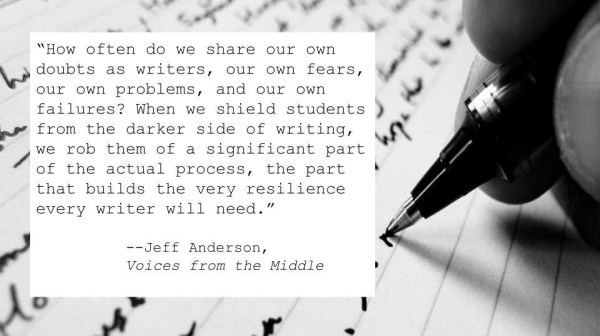
In an article by Tim Gillespie, published on the National Writing Project website, he sums up what I believe and have experienced myself as a teacher writer.

Accountability in RWWorkshop (1)

Here’s the thing, you teachers who refused to even try:  It doesn’t matter if you think you can write. Just write.

What does matter is that our students see us working at it. Just like we must be readers in order to help our students find the “just right” book, we must be writers if we want to know the struggle our students face when writing.

We learn when we are vulnerable. We learn when we practice.

So I am challenging myself as much as I am challenging you:  Write beside your students more. Let them see your thoughts, your mistakes, your struggles. Ask them for feedback.

If I truly want a community, where we all work to grow as readers and writers, I need to do more to get us there.

Amy Rasmussen began writing in journals at age 8. In addition to this blog, she now writes in notebooks and on sticky notes. A lot of sticky notes. She also tries to write the assignments she gives her students. She wishes she would have had teachers who wrote with her, but she does not remember one K-12 teacher ever doing so. Follow Amy on Twitter @amyrass and @3TeachersTalk

May I have your intention please?

I am borrowing my word for 2018 from my friend Whitney who in her wisdom spoke right to my heart:  “My word for 2018 is “intentional,” and I see that manifesting as spending quality time with quality people engaging in quality pursuits…being conscious about what I choose to do. I’m tired of being spread too thin and being so stressed out and/or exhausted that I can’t enjoy the moment I’m in.”

Ever had that moment when someone says your words for you? Thanks, Whit!

My father instilled in me the habit of setting goals. He taught me how to write them down and then see them to fruition. I am pretty good at it (most of the time.) But lately, (like the past three years) I, too, have spread myself too thin, and it’s taken a long while for my inner voice to shout loud enough for me to hear it. Poor hoarse thing.

This idea of intention resonates like an echo from the canyon of my soul. This voice is serious and a little scary. See, I’ve operated intensely in the extremes for decades. How can I do this and this and this? How can I be more, do more?

But I have not always practiced intention. More is not always better. Duh.

I am reminded of a conversation I had with my friends and colleagues Amber and Mary. I had the privilege of mentoring them as pre-service teachers several years ago. They told me the best word to describe me then was intense. Of all the words in the world. . .

I get it. And these friends will agree: I have come a long way. But I’ve got miles to go.

So I am going to be a little more honest with myself. A lot more patient. A lot more sincere. I am going to set myself free. Free to explore and relax and play.

Intentionhonestly

To be able to do this more effectively, I am also going to take some advice I got from Adam and not just take a break from social media but detach from it — a lot. Maybe I will read a lot more of the books Adam recommends and make a bigger dent in my books-to-read-next pile.

I found this article 6 Simple Questions to Set 2017 Intentions, and I’ve played around with my own questions and answers in my notebook. I am a year late to the party, but I’ve got the pointy hat on now.

I also found a list of beautiful poems at the Center for Mindfulness, a place I should probably rent a room. I’ve printed them out and will paste these poems in my notebook and write around them. (I remember Penny Kittle saying one time that she does this:  pastes poems in her notebook that she can write beside while whiling away in faculty meetings.)

Poem I Said to the Wanting Creature Inside of Me

Will this intention transfer into my teaching? into my relationships with students? No question. Here’s how I rewrote those questions above to fit with my quest to be more intentional at school:

  • What are 1-3 experiences I want to have with students this spring?
  • Who are 3-6 students I want to deepen my relationships with this semester?
  • What are 1-3 things I want to try in my classroom that I’ve put off trying?
  • What are 3 way I will take care of myself more effectively during the school day?
  • Who on my campus can I get to know more meaningfully?
  • What one word do I want students to describe me?

We all know the benefit of boundaries. I don’t know why it is so hard for some of us to set boundaries for our own well being. As teachers, we take on a lot, don’t we?

My hope for myself — and for all of you — is that we can stop a spell, consider the moment, think about what matters in the long run, then, and only then, take a step toward whatever it is we want to accomplish.

There we will have a solid place for our feet. I like that.

What are your intentions for the new year? I’d love to know.

Amy Rasmussen is the mother of six grown children and two naughty Sheltie puppies. She’s married to her best friend of 32 years and teaches at an awesome senior high school in North Texas. She hopes this is the year she can stop everything else long enough to write that book. Follow Amy on Twitter @amyrass and @3TeachersTalk 

What do fingernails have to do with data?

We all feel it, don’t we? That time of the year when teaching gets tough:  skies get darker, holidays come looming, and students look out windows more than they look to learn. I have 2.5 days until the break, and, like you, I am ready.

This is the time of year I start to question myself. Have I taught the way my students need me to teach? Have I made them feel special, valued, a part of our learning community? Have they learned anything?

These were my musings last week when I got a special gift in my inbox:  three photos of a former student’s fingernails.

With this message:

This is totally random, but I thought you might like to know that aside from all of the English, reading and writing skills that you taught me. . .our end of the year project (the How-To), has actually helped me in real life! If you remember, I did my project over biting nails because I desperately wanted to stop. After that project, it was so easy to, and I haven’t bitten them since the end of the year in your class 6 months ago! I’ve attached some pictures… Like I said, this is super random & weird, but if you’ve ever wanted proof of that project actually working, here is my successful end product.

Does this count as hard data?

Yesterday I answered questions about student data in a phone interview. One question went something like this:  If a cynic questions your methods, what do you do to win her over?

The exchange left me unsettled. I said I would show the cynic student work and let her read students’ self-reflections on their learning. I spoke about how the data I care about is the qualitative type that comes from my observations, conferences, and interactions with students. I value process over product.

I think my response fell flat with my interviewer. Maybe she wanted numbers. What would she think of Micaela’s nails as proof of my instructional methods?

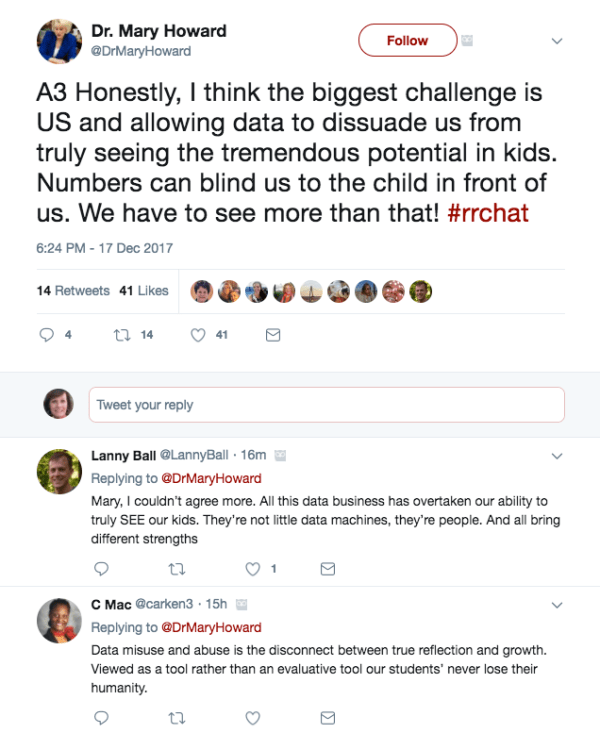
Later in the day I twittered upon these tweets:

Screen Shot 2017-12-18 at 8.06.56 PM

The whole thread rings true.  And I’ll add this:  Numbers mean nothing if we do not add value to a child’s life and help her learn to thrive, achieve, and find herself within it.

I’ll be honest:  I thought Micaela chose an easy topic last spring as her final writing piece:  a multi-genre project that was more than a how-to but a comprehensive argument for or against an issue; I didn’t think she could write enough about breaking her habit. But I got out of her way, and she composed a multi-layered piece about the shame and the struggle and her desperate desire to leave her nails alone.

I’ll go on break this Thursday. But when I get back to work in 2018, I’ll remember Micaela. What do my students need beyond my ELA curriculum? What motivates their thinking? What will my students choose to do this spring if I remember to get out of their way?

Amy Rasmussen shares a classroom with juniors and seniors at Lewisville High School in North TX where she learns as much from them as they ever do from her. She was once a nail-biter herself. Writing a paper about her habit at 16 might have helped her kick it a lot sooner. She was 21. Amy wishes you a joyful holiday and a Happy New Year, and sincerely thanks you for following and sharing Three Teachers Talk.

A Little Learning with Big Outcomes

Last week was tough. If you teach in TX, you probably know what I mean.

December means STAAR/EOC testing, and while I teach readers and writers in 11th and 12th grade English classes at a large senior high school, many of my students carry the label of “re-tester.” (It’s an ugly label; isn’t it?)

All week students who have yet to successfully pass all five exams required to graduate filed into testing rooms to try again. This meant many disruptions for students not testing.

All week the English hall, along with other rooms, became the testing center. Classes displaced. Students out of comfort zones. Just a bit of chaos.

We know how well this works for learning.

In an effort to get my students settled in, back in our classroom and back in our routine

Julian shares his haiku

Julian sharing his haiku

of workshop, we played with words.

Testing disrupted our writing project, a series of letters in a variety of forms with a variety of tones, all related to a self-selected thematic link. We needed a revision workshop, but my seniors were not having it. With just 10.5 days until winter break, plus 8.5 until the end of term, many are already playing XBox and watching Netflix in their heads. (Me, too, but at least I’m fighting it.)

Since we read our choice books at the beginning of every class period, and I work daily to hold students who have not read a book on their own throughout high school accountable, I am constantly trying something new.  Today the new turned pretty cool.

We wrote book reviews in the form of haiku.

The tremendous thinking about word choice — well, it was kind of magical. (If only students would always think about word choice with such care.) Here’s a sampling of our book review poetry:

A book can contain

many life lessons that we

can use in our lives.

~Cesar Perez

The Playbook by Kwame Alexander

Are her thoughts her own

or does the tightening coil

control her whole being?

~Maria Cruz

Turtles all the Way Down by John Green

my life was stolen

but after 18 years I

got to hug my mom

~Grace Foust

A Stolen Life by Jaycee Dugard

being arrested

for helping his ex-girlfriend

Being black is hard.

~Di’Myrius Owens

Dear Martin by Nic Stone

her eyes captured me

I lost myself in her heart

Owned me from the start

~Axel Ibarra

The Oxygen Thief by Anonymous

Looking for a path

Twisted and in need of help

How do I escape?

~Jesse Borjas

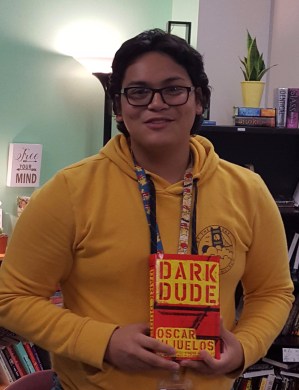
Dark Dude  by Oscar Hijuelos

Running for freedom

Garret escapes boot camp

Fear, risk run with him

~Cris Velasquez

Boot Camp by Todd Strasser

Black lives do matter.

Police brutality sucks.

assume all black steal

~Alondra Rosales

All American Boys by Jason Reynolds & Brendan Kiely

The first hand account

No excuses for mistakes

Kill Osama Bin

~McKenzie Bowie

No Easy Day by Mark Owen

This simple activity led to a complex discussion about the power of words and why we need to revise our writing in order to craft with purpose. We discussed adding figurative language, creating imagery, using complex sentences. I taught how to write appositive phrases, a grammar move my students did not know.

And as students moved into their writing groups, they talked about their plans for revision. Teaching writers does not get much better than that.

When our students take on the identify of writers, they talk like writers, and they write with purpose — choosing words and phrases and making moves like real writers do.

Side note:  Some of my students produces haikus that revealed needs in their reading lives. For example, one student wrote that Fahrenheit 451 was set in WWII, and another showed confusion in the change of point of view in All American Boys. Their book review haikus gave me an action plan for reading conferences. Bonus!

Amy Rasmussen teaches senior English and AP English Lang & Comp in North TX. She loves to get her students talking about the things that matter to them. She also loves to get them talking about the things that matter to us all:  books and words and poetry and writing and serving people everywhere. Follow her @amyrass and @3TeachersTalk.

“Did you know Gucci has a book?” I do now.

“Hey, Miss, did you know Gucci has a book? I want to read it.”

“Really? You are telling me you actually want to read book?”

“Yeah, but only that one.”

I go to my computer, click on Amazon, and look for a new book by Gucci. I find:

Screen Shot 2017-12-04 at 4.28.59 PM

These cannot be the books Daniel is talking about. I know this kid. He was in my junior English class last year — part of the class with the tissue issue, and now I had him as a senior.

“How do you know Gucci has a book?” I asked.

“I saw it on his Instagram,” Daniel said, showing me his phone.

Dear Reader, you are ahead of me on this, aren’t you?

I admit to being on the edge of old. I had no idea before this conversation with this student that his Gucci was not handbags and luxury leather goods. Because Daniel tends to mumble, it took me a while to figure out he was referring to Gucci Mane.

Daniel’s favorite rapper had a new book.

So I bought it.

When I first met Daniel, we had trouble. He sat in the back of the room, fake reading, sleeping, tossing pencils, goofing off so others laughed. I moved him to the front, and he slid low in his chair and sulked. Every day. And every day when I conferred with readers, I leaned over Daniel’s shoulder and asked what I could do to help him want to be a part of my class.

Eventually, he responded. He told me he’d read Gary Soto’s books in 10th grade. I wasn’t sure I could believe him, fake-reading tough guy and all, but I passed him the two Soto books I have in my library. He read them both.

Then, he started reading Matt de la Pena’s books. Ball Don’t Lie took Daniel a long time to get through, but he finished it and started Mexican Whiteboy. I’m pretty sure he read four books that semester — more than he’d ever read in his 16 years.

In conferences I asked Daniel about his life outside of school. He told me he wanted to work on cars like his brother and that he took the bus to the career center after my class every day, so he could take courses in auto mechanics. Based on our conversations, I do not think another general ed teacher had ever talked to this young man about what mattered to him:  cars.

hattie-teacher-student-relationships

Source: Hattie, J. (2009). Visible Learning: A Synthesis of Over 800 Meta-Analyses On Achievement. Routledge.

In education, we hear about the importance of building relationships a lot, and my experience with Daniel is a testament to the power of taking the time to get to know a student. Because he knew I cared, Daniel started to care about his English class. He began asking for help and coming to tutorials. He started showing up in spirit and not just as a warm body slumped in a chair. He felt like he belonged.

Did Daniel excel? Not exactly. But he passed, which was something a bit surprising to both of us after his I’m-too-cool-for-school-to-do-anything rocky start.

Flash forward to this year. I moved to senior English, and Daniel got his original schedule changed so he could be in my class. He walked in my room the first day with the same too-cool attitude. (Appearances are everything, and I know this game.) Again, I gently started conversations.

When Daniel scored an A on his first essay, he pretty much called me a liar. On his

Reading Boot Camp by Todd Strasser

Reading Boot Camp by Todd Strasser

next essay, he told me he stayed up all night so his brother could help him, so he wouldn’t show up to class empty handed. When we did a project on careers, and he presented to the class, Daniel spoke with confidence and detail about the field of auto mechanics. He’s read at least two books this fall and a lot of articles in The Wall Street Journal. This past Friday he came to tutorials for an hour, so I could review what he needed to do to pass his last state exam so he can graduate this spring. I don’t know if he will, but I sure hope so.


There are thousands of young men like Daniel in our schools. I wonder if teachers have the time, resources, and energy to give them the attention they need. There are 28 students in Daniel’s class this year. There were 32 in his class last fall.

There is one of me.

I cannot help but think of the famous starfish story. You know the one that ends with “I made a difference to that one.” I know I’ve made a difference to Daniel. I still call him a punk. He still mumbles when he talks to me. But he knows I like him. I really like him. And he even let me interview him, so you can like him, too. (The smile at the end is the best part.)

Choice matters! If you are reading this post, you probably already believe that as much as I do. I hope you do. Daniel’s story is not unique. We make a difference to many young people just like him when we open spaces for talk, engage in real conversations about what matters to them, and allow for self-selected reading in our instruction.

I would love to hear the stories of your Daniels. Please share in the comments.

Amy Rasmussen teaches English IV and AP English Language at a large senior high school in North Texas. She spends a ton of money on books with the hope of helping every child develop as a reader. And while she does not listen to rap, she does learn a lot from those who do. Follow her @amyrass