Category Archives: Amy Rasmussen

How Conferring and a Book Solved the Tissue Issue, and Hopefully, Much More #FridayReads

You know the boys who cannot sit still? I’ve got a gaggle of them in my second period. Now, I’m not talking about elementary school kids, nor middle school. I’m talking about the juniors I teach in high school.

No sooner do I blink, and at least one of them is up walking to the tissue box. He’ll slowly take a tissue. Saunter on back to his seat (for about three minutes — I’ve timed it) and then waltz on over to the trash can to throw the tissue away and then mosey on back to his seat.

With eight of these guys, it’s constant motion. And I need Dramamine.

One class period. Five days. Two boxes of tissues. Gone.

At the end of that first very long week, I realized the reality. All kinds of memories flooded back from Tom Newkirk’s class “Boys, Literacy, and Popular Culture”at UNH Lit Institute the summer of 2015.  (If you haven’t read Tom’s book Misreading Masculinity:  Boys, Literacy, and Popular Culture, it’s insightful.)

My tissue-loving boys were posturing all over the place, and somehow I needed to stop the Tissue Issue.

It’s been easier than I thought. Really, it’s all about getting them into books they want to read.

On the first day of school, I’d prepped my room with stacks of colorful engaging books on every table. We did a book pass and wrote down titles we thought we’d like to read. I showed my passion for books and reading, and my students rolled their eyes at my request they read for three hours a week.

“No way,” I heard one young man mutter, “I ain’t reading.”

This attitude doesn’t deter me.

Even if they were faking it, after just a few days and lots of one-on-one mini-conferences, every kid in a class of 30 at least looked like they were reading. Except two.

I invited these two separately into the hall for private chats about their social PATT (party all the time) moves in the classroom.

“You know, they all follow your lead, right? I need you working with me to make this class work.”

Both agreed, and I asked them to shake my hand on it.

But old habits die hard.

Then, today — 13 days into the school year — gold.

Book gold.

“Hey, Mrs. Ras, can I talk to you in the hall?

“Do you think you could help me find a different book to read — one with music. You already know I like music.” I remembered his free verse rap at the end of class last Friday.

“So give me some ideas –”

“Well, something like that book JaBo’s reading…the long way one.”

A Long Way Gone?” (I’m trying to remember if there’s any music in this memoir about a child soldier.)

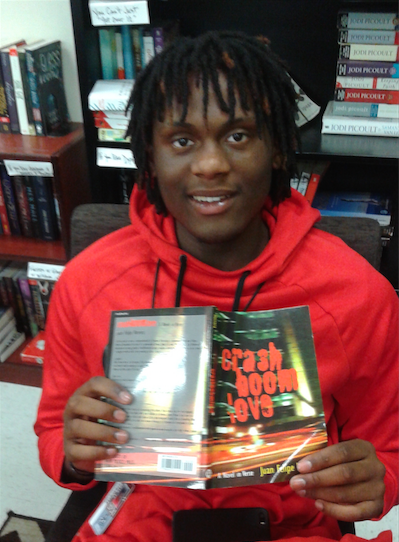
Both of my copies were checked out. I had to think fast. Crash Boom Love, a novel in verse by Juan Felipe Herrera, National Poet Laureate, flashed in the corner of my eye. (Thank you, poetry shelf just inside the door.)

We flipped through the pages, and I explained that it’s a book written in verse — all poems that make a complete story.

“You mean like one long poem?”

“Yep. Do you want to trade me this book for that one?” I said nodding at My Friend Dahmer, the graphic novel in his hand he’d been fake reading for 12 days. (I know he chose it for the pictures. “It’s weird” is all he could tell me in our first conference.)

Not six seconds after we’d entered the room, I saw Kameron flipping through the pages and showing his new book to JaBo.

That’s when you know you’ve got them — or at least got a chance at getting them to read — when they do a book talk to their friend before they’ve even read a page.

screen-shot-2016-09-08-at-11-05-01-pm

Meet Kameron. He may be a famous rapper one day.

I love this work with adolescent readers. I know we can change lives as we help young people grow in literacy skills, as we help them recognize themselves in books, and help them see others so different from themselves in the books they read.

It might be the only hope we have as a nation. Empathy, compassion, tolerance, justice, mercy, and love all wait for discovery like healing treasure and hope in the pages of the books we share with our students.

And when that book gold finally glistens — well, that’s when I have to cross the room for a tissue.


ftc-guideline-%22affiliate-links%22

I Prefer a Community of Confident Writers — Our Jump into Understanding a Writer’s Craft


Before spring term was over, I’d written two pages of notes in the back cover of my writer’s notebook. I titled it “Remember to Do Things to do Differently.” I’m a bit ambitious — and I realize, often, too hard on myself. Although I knew my students learned last yearemember-to-do-things-differentlyr, I wasn’t confident that they couldn’t have learned more.
I imagine you’ve been there, too. Always second guessing.

One of the things I knew I needed to improve was my relationships with students — I needed them to be good and strong, faster.  I also needed to help students jump in quicker to the complexities of craft analysis without scaring the poor little dears.

So last week, the second week of school, I did what Lisa just wrote about yesterday. I “Encourage[d] Students to Start Sharing Who They Are,” and I did it by sharing a favorite poem by Wislawa Szymborska: “Possibilities.”

I asked students to study the poet’s language in each line and then write their own “Possibilities” poem, imitating the poet’s sentence structure and word play. I gave them a copy of my annotations and wrote my own poem as a model.

This proved to be an excellent lead into the rhetorical analysis students must be able to do in AP Language. I was able to see which students quickly understood how to look closely at an author’s craft — and which ones did not.

The best part though was what I learned about my students. All their preferences!!

Last Friday, when their poems were due, we did our first Author’s Chair share in class.

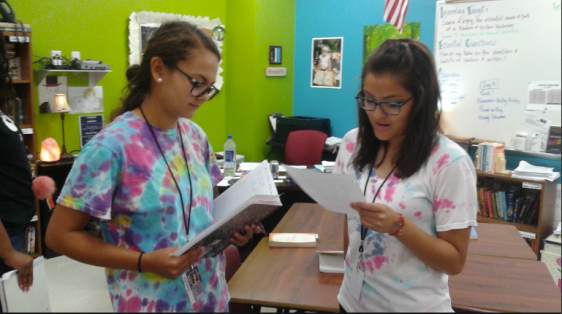
First, to help students build confidence, they read their poems to a partner.

faithsharing-possibilitiespoem

sharingpossibilitiespoems

Then, volunteers sat in our Author’s Chair and read their poems to the class.

While the student read his poem, everyone else sat with sticky note and pen in hand ready to offer “blessings,” things they liked about the author’s use of language, or connections they could make to his ideas.

sharingintheauthorschair

After each writer shared, the class flooded him with “blessings.” Smiles grew wide, trust blossomed, and the community that I felt was missing for too long a time last year took root.readingblessings

Bonus:  When students read their little notes, carefully crafted by peers who listened to
their writing, their confidence as writers grew. Too bad we ran out of class time. I might have run out of sticky notes if all students would have felt the desire to share.

readingblessings2

I wouldn’t have minded.

I would not have minded at all.

ciarawithblessings

I would love to hear your ideas on building community and/or introducing students to rhetorical analysis. Please join the conversation and share in the comments.

Keeping it Simple: Setting Up a Writer’s Notebook

Teresa wrote:  “I have a few questions about how your students setup their writing notebooks. What are the sections in the notebook, and how many pages do you have them section off for each? Also, does one composition book usually last all year, or do they have to get another one at semester?”

I met Teresa at a workshop training I conducted this summer. She’s getting ready for her school year to start, and I am glad she sparked my thinking about how I will have my students set up their notebooks this year. This is it:

First of all, and you probably already know this:  it’s hugely important to have students personalize their notebooks.  So during that first week of school, my kids will be using scrapbook paper, wrapping paper, and whatever to make their notebooks into something that represents their life or their personality in some way.

I’m thinking of having students email me three photos from their phones, and I’ll get those printed (since I doubt many would do that on their own), and they can use those photos to decorate inside and outside the covers of their notebooks. It’s also a way for me to build a contact list of all my students. Doubling up on purpose there.

Last year I skipped this important step of personalization, and it was a mistake. Students must take some time to make the writer’s notebook their own — it can make all the difference as to the care they take regarding ideas and writing they put into that notebook.

Now, to get to your question –the notebook set up:  For years I’ve made it complicated — so this year I am simplifying. Thanks to some discussion I’ve had with Shana about our writer’s notebooks, I finally have a plan for this year.

Since the focus of my instruction is to advance all readers and writers, I need to make sure my students know that their writers’ notebooks will be the tool we use to measure their movement. So on the very first page, I ask students to write big and bold at the top:  My Reading Goal for my Junior Year. Then I ask them to draw a square in the center about the size of a standard sticky note.

“Write your goal in the center,” I tell them, “How many books will you read this year?”

Most students write a goal of 4, 5, or 6. They don’t think in big book numbers yet — they are used to reading (sometimes) the assigned texts in their English classes. They don’t know about reading volume or choice or the engaging titles in my classroom library — yet.

I model and write my reading goal in the center of my square on the first page of my notebook:  37. My students gasp.

Then, I show them the list I’ve kept of the books I read this summer — and the stack of books I pull from under the table. “I read all of these just this summer,” I say and watch their eyes grow real wide.

“My goal for you is that you will read many more books than you think is possible this year. Let’s set those goals a little higher.”

Sometimes during the same class period, sometimes a day or two later, we read our choice books for ten minutes and then calculate our reading rate. (# of pages read in 10 minutes times six equals how many pages you can read in an hour for that book. Multiply that number by three (the amount of reading I expect my students to do each week) and that equals your individual reading goal for the week) We draw little charts of the Reading Rate formula at the bottom of our goal page right there in the front of our writer’s notebooks.

After we calculate reading rates, we often have to return to goal setting. Students realize that if they plan to meet the expectations I have for them, they will read many more than the four-book-goal they originally set for themselves. This discussion often leads into important discussions about reading volume and how it leads to fluency, vocabulary development, more background knowledge on a variety of topics, and improved writing skills. This is where I start the mantra that I repeat over and over throughout the year:

The only way to become a better reader is to read. 

Next, in our writer’s notebooks we move into our plan as to how we will reach our reading goal. First, we have to have a plan. Readers have a plan. They listen in on conversations about books. They become familiar with book titles. They come to know topics and genres they like to explore. A big part of helping students come to love reading is helping them identify themselves as readers. So many of my students do not know how to do that.

An easy way to start identifying as a reader is to walk the walk of one. We make a plan, and our plan looks like a “What am I going to read next? List.

We make this list on the back of our goals sheet. This is where we write down the titles and the authors of books we learn about through book talks, talking with peers, exploring the bookshelves, etc — all books we think we might like to read throughout the year.

This list serves as an accountability piece. If students’ lists grow, I have one way to measure their involvement in our reading community.

Screen Shot 2016-08-17 at 11.18.56 PM

I like the idea of having students include genre and start/finish or abandoned dates. I can learn more about a reader at a glance.

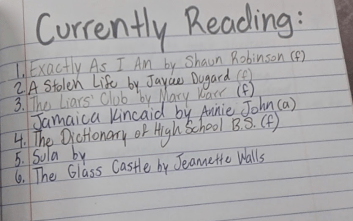
We also need a “What am I Currently Reading List.” We keep this list on the next page — right across from our TRN (to read next) list. This way students see how to transfer a “hope to read” into a “now I’m reading.”

Students record the title of the book, the author, the genre, the date they started the book, and the date they finished it or abandoned it. If they abandoned the book, which is absolutely fine — there are too many awesome books to suffer through too many we do not enjoy — I want short notes about why the book is being abandoned. I model statements that may work here. “It was boring” is not one of them.

“The narrator annoyed me because he seemed like a whiner,” or “I thought this book would be an engaging story, but it’s really a non-fiction book about information I don’t really care about” are both appropriate “I-am-abandoning-this-book notes.”

This list serves as an accountability piece. As students lists grow, I can see at a glance the titles and genres they are reading. I can see the start and finish dates to gage if their reading rate goals match with the dates recorded on this list. I can see where I might need to confer with a specific student about abandoning book after book after book — just from a scan of their CRL (currently reading list)

We need a space in our notebook for Response. We skip a page after our CRL and label this section of the notebook for what it is. This is where we will write our thinking. We will respond to a variety of texts: videos, news reports, poems, articles, stories, etc.

This is where we will deposit our initial reaction to and thinking about provocative things. This is a place for our quickwrites, our thinking on the page. We need a lot of space here, so in a composition notebook of 100 pages, we will reserve at least 20 for this section. (And we may need another notebook all together in the second semester.)

This serves as an accountability piece:  are students engaged in the writer’s community? Are they giving a ‘best effort’ at capturing their thinking on the page? Are they showing revision moves in their quickwrites? Are they playing with language like I’ve suggested as they develop their thinking and writing abilities?

Now, to really keep the set-up of the writer’s notebook simple, we just need three more sections:  reading, vocabulary, and writing.

Reading. In this section, we will record notes from reading mini-lessons, academic words

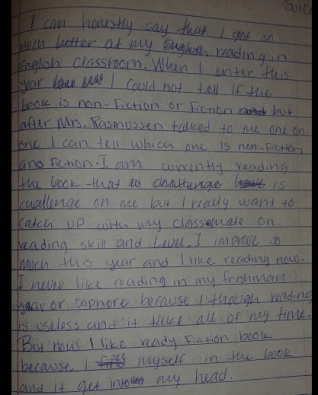
Screen Shot 2016-08-17 at 11.10.17 PM

Low-stakes student writing about her reading life. We can learn a lot about a student’s reading and writing this way.

that live in those lessons (and highlight them), tips on reading strategies, and our writing about our reading that we will complete on occasion.

This serves as an accountability piece:  Are students engaged in the reading community? Are they doing their part to advance their reading abilities? Are they competently writing about their reading?

Personal Dictionary. I used to give lists of vocab words for kids to student and then take a quiz over. Little authentic learning took place around those word lists. A much more authentic and useful way for students to learn vocabulary is for them to generate their own lists. Ask them what they do when they encounter words they do not know as they read. They’ll tell you: They skip them. No more.

We capture words we do not know in our choice reading books, and we record them in our own personal dictionaries. I ask students to record five words a week. They list the date of the week, then the title of their book (even if it’s the same book a few weeks in a row). Then they make a list of the five words they found in their reading that week, define them in context of how the author uses the word, and write down the sentence in which the word is used. We do this week after week, collecting words throughout the school year.

This serves an accountability piece:  If students are not reading, they will not have any words to record. If students are not reading a complex enough book for them, they will not have any words to record. I can help students determine if they are reading a book suitable for their comprehension abilities if I take frequent looks at their personal dictionaries.

Screen Shot 2016-08-17 at 11.17.32 PM

What started as a brainstorming activity to think about topics, lead to opportunities for discussion with this student I would not have had otherwise. Students reveal their lives to us in low-stakes writer’s notebook writing.

Writing. This is consistently the greatest chunk of our writer’s notebook. In the writing section, we craft a variety of writing territories. We take notes on writerly moves that we learn in mini-lessons and from mentor texts. We practice imitating the craft of our favorite writers. We take notes on grammar and mechanics. We practice sentence structures and the moves of writers we study as a class and in small groups. We build a tool set here of craft moves we can experiment with in our own writing. And we brainstorm and draft in this section of our notebooks.

This serves as an accountability piece:  Are students engaged in the writing process? Are they giving their ‘best effort’ attempts to create a toolbox of tools to use in their writing? Are they understanding the writing mini-lessons and practicing the application of those skills? In their drafts, is their thinking evident? Do they have strong ideas that will carry a piece before they every work on revision and craft?

And that’s it. Our writer’s notebooks are set up — with sections labeled and homemade sticky-note tabs to separate each section. These notebooks become gold. They are precious to the learning that takes place in my workshop classroom. Not only do students have one central place to keep notes and ideas. They have a personal place to practice their craft and write.

The writer’s notebook– and all these accountability pieces– mean relatively easy, though sometimes time-consuming, formative assessment for me:  I can choose to check the whole of student notebooks say every three weeks, or I can choose to check a section (I usually choose this option.) Either works to see if students are engaged in the workshop classroom and advancing readers and writers, which is my ultimate goal for all students all year long.

See more on writer’s notebooks by searching the TTT categories.

Please share your ideas for the set up for writer’s notebooks. I’d love to know if you think I’m missing something important that will further advance my students’ learning. And I wrote this post without having access of photos of each step. I hope the description will be enough.

Think Big and Grow Friends

My colleagues here at TTT and I met in a Google Hangout for a long long time last week. I love being surrounded by wise and witty people who make me feel more wise and witty.

When I was a teen my dad had me read How to Win Friends and Influence People by Dale Carnegie and Think and Grow Rich by Napoleon Hill. I don’t remember Dad ever reading for pleasure*, but I know he got pleasure from reading self-help books, and he read to learn. Then he shared what he learned with anyone who would listen.


I was a willing listener, always seeking to please my father.

I learned from Carnegie powerful truths that improved my interactions with strangers, friends, peers, and colleagues. And when I began teaching, I put into action these truths as I interacted with students. I believe trusting relationships and conferring moments rest heavily on Carnegie’s principles.

I learned from Hill seemingly simple steps that gave me vision, taught me to set goals —Screen Shot 2016-06-28 at 1.54.04 PMand to surround myself with those who would help me see them through. I’ve followed his advice for several decades now — each time developing skills, gaining trust and gaining knowledge, more readily and passionately. And while I am not rich in terms of monetary wealth, I am rich in all the ways that matter.

My TTT colleagues and the readers of this blog add to that wealth.

Thank you for subscribing, reading, sharing, commenting. Thank you for giving me a focus, a place to sharpen my skills as a teacher and a writer, a place to think big and make friends.

For the next several weeks, Shana, Lisa, Jackie, and I will take a break from writing posts. Like you, we are tired. We’ll use July to refine some plans and rev up for fall and a brand new school year. Maybe one of us will get the urge to write and post, but in the meantime, we’ll schedule some repeats of our favorite topics so you will keep getting content about how to make readers and writers workshop even more effective in your classroom.

We’ve got some plans for TTT that we know you’ll like. Please like the Three Teachers Talk page on Facebook if you haven’t already, and follow us on Twitter @3TeachersTalk.

And if you want to get in on some practical tips we’ll be sending to our readers’ inboxes starting when school comes back around, be sure you follow this blog by clicking on the “follow” link and providing us with your email address.

If you have questions that just cannot wait, feel free to email me at amyprasmussen@yahoo.com.

Join us as we continue the conversation in August. Until then, happy summer!

Try It Tuesday: Cite the Research that Drives Your Practice

In a session at the NTCTELA Conference a couple of weeks ago, Cris Tovani began her session asking us to reflect on this statement:  I can site the research that supports the beliefs that drive my practice. This got me thinking — not just about Cris’ inspiring session but about how we make decisions regarding the best practices we bring into our classrooms.

Do we have research that supports the moves we make as we teach our students to become better readers and writers?

It’s an important question. And for those of us who instruct via  readers and writers workshop, the research can be a powerful motivator to keep doing what we know works for our kids.

My favorite go-to research? The article by Richard Allington and Rachael Gabriel: Every Child, Every Day. They outline six easy-to-implement essentials to effective reading instruction — and learning to teach reading is not something I got much of in my education classes to become a high school English teacher. But many high school students still need help learning how to read, especially my ELL population. Every English teacher can implement these six essentials.

If you’ve never read Every Child, Every Day, I challenge you to read it. If you haven’t read it in awhile, I challenge you to read it again. Then, give yourself a quiz:  Does this research support the moves you make as you teach your students to become better readers and writers? If not, what will you do about it?

The resources at the end of the article can lead us down a rabbit hole but not take us on a goose chase. These researchers provide us with important information:  We can read about effective practices and then bring those practices into our classrooms. We can share these articles with colleagues and administrators with the hope of garnering more support for instructional practices that our best for our students — and proven to work.

If you’ve ever wondered why student reading engagement and success begin to wane as kids begin to enter middle school, read You Can’t Learn Much from Books You Can’t Read, another text by Allington.

If you teach in a low SES school like I do, you may find “The Early Catastrophe: the 30 Million Word Gap by Age 3” by Betty Hart and Todd R. Risley interesting. It’s a popular read. It might spark some thinking as to why so many of our students read far below grade level — and give you a poke in the gut to do more about child poverty.

Then, because the validity of that article sparked lots of commentary by other educators who wrote other research articles, spend some time reading “Debunking the Word Gap.” (Aha and Aha. And lots of validation for my practice. Choice and voice matter!)

If you don’t follow the blog of Paul Thomas, The Becoming Radical, you may want to. Thomas gets me thinking with everything he writes. I especially appreciate his post of yesterday: “To High School English Teachers (And All Teachers).” (Where I found the Debunking article and so much more and had to update this original post.)

Remember that rabbit hole?  I read every link Thomas shares and added to my research storehouse, tweeting links to colleagues, and I found a text by Ralph Ellison I’ll use with my AP Lang class in the fall. Bonus.

Of course, if you really want to explore and extrapolate, look up the articles Penny Kittle cites in Book Love or Donalyn Miller cites in The Book Whisperer or any other of your favorite teacher-leaders cite in their books.

It’s summer. Time to enjoy a little (not so light) reading. I promise, the research is worth it!

Please leave your suggestions for other insightful research articles in the comments.

#FridayReads — Picture Books in AP English

Sometimes speakers make you want to write. Last week when I listened to Lester Laminack was one of those times.

The North TX Council of Teachers of English Language Arts one-day conference was one week ago today. As president I had the honor of calling the meeting to order, and looking out at the audience of almost 600 ELA teachers, grades K-12, I could not help but think how fortunate the children in Texas are to have such dedicated teachers, teachers who want to help kids write, teachers who practice writing themselves.

Listening to Lester’s keynote as he talked about his writing process made my memories swirl, and my fingers get itchy.

I was not the only one.

Screen Shot 2016-06-17 at 3.29.59 PM

I left wondering:  What if more teachers stirred that kind of memory moment in the students we want to move as writers?

Picture books have that power. Elementary teachers know this. They read books aloud to little writers. They talk about meaning around moments their students can relate to.

Sometimes I think we secondary teachers forget the power in stories. We forget that seemingly simple things can spark big thinking. I want to remember.

Here’s a list of 15 of the books I will read with my not-so-little writers in the coming year: Screen Shot 2016-06-17 at 4.45.37 PM

Saturdays and Teacakes by Lester Laminack

All the Places to Love by Patricia MacLachlan

The Other Side by Jacqueline Woodson

The Hundred Penny Box by Sharon Bell Mathis

Is There Really a Human Race? by Jamie Lee Curtis

Harold and the Purple Crayon by Crockett Johnson

The Dot by Peter H. Reynolds

Chrysanthemum by Kevin Henkes

Henry’s Freedom Box by Ellen Levine

The Wretched Stone by Chris Van Allsburg

I Want my Hat Back by Jon Klassen

It’s a Book by Lane Smith

The Dark by Lemony Snicket

The Secret Olivia Told Me by N. Joy

Beautiful Oops by Barney Saltzburg

And I’ll probably use several of these:  wordless picture books

Please share your suggested titles for picture books you use in your secondary classroom.


Try it Tuesday: 44 Songs for Quickwrites

My students and I start writing on the first day of school. Our first quickwrite might be in response to a video or a poem or a short passage. For the past few years, I’ve shown To This Day by Shane Koyczan. I pass out notecards and ask students to listen to the message and then either write their thoughts to the whole of the video, or perhaps to a line in it.

I learn a lot about my students on the first day of school.

Then, three or four times a week, we write in response to other videos, poems, or passages throughout the year. Sometimes we return to these quick writing pieces, choose topics, and take the writing into full processed works. (Shana shares how she leads students into this mining his mini-lesson.) Sometimes we stop at just sharing our thinking with our table mates. Sometimes we use our thinking a springboards into texts we read together or in book clubs.

Writing responses is one of the best thinking strategies I know for engaging students in writer’s workshop. (Actually, I think asking students to write responses in any content area is good for thinking — I wish math and science teachers gave students more opportunities to write. I’m sure they wish I did more with math and science, but somehow I don’t think that’s really apples for apples. Is it?)


As this year winds down, I think of a million things to ask my students that might help me

Screen Shot 2016-05-30 at 4.48.59 PM

Lovelyn’s suggestions for songs to inspire writing.

reach more readers and writers the following year. This week I asked them to give me ideas on the songs they listen to — songs that might work well to get students thinking and responding in their notebooks.

They sent me lots. Some sent me lists.

(Disclaimer:  I have not listening to all of these songs yet, but I did start watching the music videos. Some have lyrics that might work well, but videos that might not. Some are a little too much… others are just weird. Some would work if we think of thought-provoking questions to include with the lyrics/videos. Should’ve had kids come up with those, too.)

Here’s a list of songs my students suggest would make for good quickwrites:

“Alive” by Kehlani

“Clarity” by Zedd

“Bright” by Kehlani

“Halo” by Beyonce

“Someone Like You” by Adele

“Be Alright” by Kehlani

“Lean On” by Major Lazer & DJ Snake

“Shark” by Oh Wonder

“Lights” by Vexents

“Thinking Out Loud” by Ed Sheeren

“Imagine” by John Lennon

“Run Away” by Kanye West

“Brother” by Need to Breathe

“Love Yourself” by Justin Beiber

“7 Years” by Lukas Graham  (I found this one before my students mentioned it. I actually saved the title to this song in my notebook after I heard it on the radio. It’s a great song for thinking about Our Stories.)

“Stronger” by Kelly Clarkson

“Humble and Kind” by Tim McGraw (Another song I already love and am tickled that a student suggested it. This is a message I know we all hope our students internalize. Studying the humanities makes the world –and the classroom — a better place.)

“50 Ways to Say Goodbye” by Train

“Apple Tree” by Erykah Badu

“Ain’t No Rest for the Wicked” by Cage the Elephant

“The Light That Never Fades” by Andra Day

“Rise Up” by Andra Day

“Hall of Fame” by the Script

“Cornerstone” by Hillsong

“Don’t Stop Believing” by Journey (Ohhh, Journey. I remember you well. Another student suggestion that made me smile.)

“The Middle” by Jimmy Eat World

“Heroes” by David Bowie

“What Would You Do” by Bastille

“Youth” by Troye Sivan

“Locked Inside” by Janelle Monae

“I Don’t Want to Be” by Gavin DeGraw

“Became” by Atmosphere

“Battle Scars” by Lupe Fiasco

“Not the Only One” by Sam Smith

“The Moon – The Swell Season, It Will Rain” by Bruno Mars

“Talking to the Moon” by Bruno Mars

“See You Again” by Charlie Puth

“Only One” by Kanye West

“Beautiful” by Eminem

“Heaven” by Troye Sivan

“Lose It” by Oh Wonder

“Don’t Let Me Down” by The Chainsmokers

“Never Forget You” by Zara Larson

First” by Laura Daigle

What about you — do you have some great songs you use to inspire your writers? Please share in the comments.


#FridayReads & Becoming (Twitter) Literary Critics

I am beat. My students are beat. I know you know exactly how that feels.

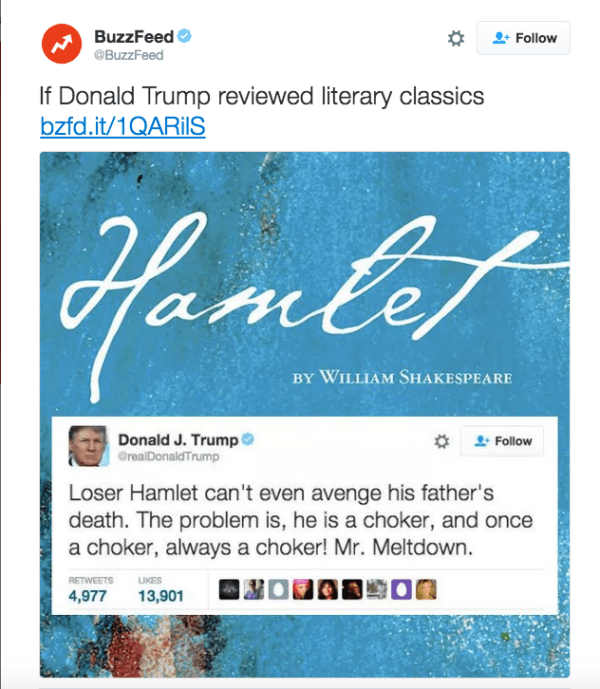
In an effort to lighten the mood but keep the idea of books and reading alive, my students and I had a little fun with Donald Trump. Now, it doesn’t matter what you think of the man or his politics, his tweets make pretty good mentor texts.

Screen Shot 2016-05-26 at 7.38.47 PM

I’m not the only one to think so — actually, I got the idea from someone Buzzfeed. Some clever writer put together a list of tweets, written as if Mr. Trump critiqued literature. Brilliant.

Screen Shot 2016-05-26 at 7.40.19 PM

So to have a little end-of-year fun, I asked my students to consider Trump’s sentence structure, and then write their own reviews based on the most recent books they’d read. Really, my only requirements:  a clear tone, but they didn’t have to be mean, and correct spelling and punctuation.

Here’s a few for your reading pleasure. Of course, the review makes the most sense if you are familiar with the books students refer to — I get that not everyone is as versed in YA like they might be the canon.

(Side Note:  To those who say students will never move beyond YA or ‘easy’ reading when it’s all about choice. Um, wrong again.)

What kind of end-of-year fun with books and reading — or anything else– have you had with your students? Please share in the comments.

#3TTWorkshop — Part Two Student and Teacher Buy In

This post is the continuation of a conversation from the previous post in response to an email we received from our friend an UNH colleague Betsy Dye.

How do we help students understand what we mean by choice, especially when they’ve been given ‘choice’ before in the form of ‘choose from this list of books or topics.’?

Shana:  Again, I think modeling is key here.  I show students my roller-coaster of reading, including the trashy romance novels I indulge in despite my Masters degree in literature.  I show them my pile of abandoned books, for “life’s too short to finish bad books.”  I show them classics that I sort of wish I’d read, but never have.  And then I show them my notebook pages of books I’m currently reading or want to read.

It also helps that I have students complete visual and written reading ladders each year, and I show new students the previous year’s ladders to illustrate individualized choice.  And again, here’s where the class reputation comes in handy as well.

Lisa:  ^This. Our stories as readers and writers are gold, especially to some kids who have no such models in their lives. My students laugh at my copy of Don Quixote on my desk. I started it in September. I am 200 pages in. I’ve read over a dozen books since I unintentionally stopped reading that tome, and I had to promise some of my juniors that I would finish it before they graduate next year, but I’ve covered a lot of ground by not allowing myself to get weighted down. Yes, we must press students to finish texts and not become kids that drop book after book without really pushing themselves, but we must also remember that when they do find the one, it can lead to the next one (especially with our gentle guidance) and hopefully many more to come.

In terms of writing, it’s more modeling and the application of the skill each and every day. Sometimes, it seems, it really comes down to endurance. Many kids only write when they have to, which causes them to sit in front of a screen, pound out the required pages, and move on. However, when they get into the habit of writing, when it becomes exploration instead of a narrowly focused task, it becomes less like completing your taxes and more like picking out what to wear. One you do not only do once a year with heavy sighs and confusion because you are basically out of practice and unwilling to do more than the required work. The other provides you with an opportunity to choose, express yourself, and build confidence.

Finally, the classroom library comes to mind. Variety here is key. Students need to see that they aren’t limited by the short list they might receive at the beginning of the year in other classes. If your library has options and you talk about those options often, they will believe. If you build it…they will come.

Amy:  I’ll repeat Shana:  Confer. Confer, Confer. The more we engage in conversations with our students about what we mean by choice and books and writer’s notebooks and everything else in the sphere of workshop, the more they will understand and take ownership of their choices. We must be willing to admit that choice is hard when they’ve never had it, or they’ve only had tiny tastes of it. So many students are afraid of being wrong, afraid of “the grade.” It’s through our conversations that we have the best chance of eliminating these fears and helping students trust themselves along the way.

How do we open the library shelves to our seniors and help them move beyond the four to six novels they’ve read each year for the three previous years?

Amy:  I’ll start with stating the somewhat controversial:  I doubt most of our seniors read

Screen Shot 2016-05-17 at 10.29.37 PM

Not my students’ actual conversation but still. 🙂

all the required novels teachers selected in those earlier years. Every year I ask my juniors how many books they read the year before. Some say they read only the required books. Some admit to starting but not finishing them. Some tell me they didn’t read those books at all. If we are going to make all the decisions about the books we choose for our students, we have to be okay knowing that not all of our students will read them.

Shana:  Ha–I know that kids don’t always read what’s assigned, because little goody-two-shoes me didn’t read what was assigned.  And I loved reading.  In fact, I read John Grisham under my desk while my teacher talked about Catcher in the Rye.  I tell students that story, and show them the many weather-beaten Grisham novels on my mystery shelf, and ask them about their guilty pleasure reads, or their life-changing reads, or their escape-from-reality reads.  [Amy:  or their Wattpad reads] All of those discussions start a conversation about the possibilities choice reading might offer, and we go from there.

Lisa:  I asked. They don’t read. They tell me sweetly, but still, they don’t read. Students I had as sophomores will gladly share with me as seniors all the ways they worked to convince me they read The Scarlet Letter, Uncle Tom’s Cabin, and The Adventures of Huckleberry Finn. 

Amy:  Lisa, I had students publicly confess to not reading a thing in my class in a Facebook group I had several years ago. Stabbed me right in the eye because at the time I had no idea they could be so sneaky — and smart — and still make high grades in my class without reading the same American literature books you mention. It’s like they subconsciously deny the canon!

Lisa:  So…how do we open our shelves and help seniors move beyond the books they never read? By offering up a wealth of books they can read, telling them to look through the books at home they’ve always meant to read, sending them to book recommendation lists, talking with them about what they might want to do after high school and suggesting books in that vein, having them talk with peers who have kept up with reading and have recommendations to share.

I had a student who graduated in 2013 come back to observe some of my classes this week. He book talked Ishmael to my AP students today, and I just received an email from a student saying that he went to Half Price Books and picked up a copy tonight. 

The power of suggestion is strong. If I am surrounded by people working out, I might consider getting off my couch. If I am surrounded by people complaining all the time, I start to complain too. If I am surrounded by readers, I am going to see what all the fuss is about. Many of our students want to read, but they need time. We can provide it. Many of our students want to read but need suggestions. We can provide those. Many of our students want to read, but only what they want to read.

Bingo. Let’s start there and build on it.

How do we help our colleagues get started with workshop?

Lisa:  By inviting Three Teachers Talk to provide professional development! No, seriously. It’s how my team in Franklin saw all the possibility that workshop holds and how to actually make it work day to day. So that comes down to support. Comparatively speaking, curriculum in a textbook is easy. Curriculum you’ve taught for fifteen, twenty, twenty-five years, provides comfort. Running off packets of study-guide questions isn’t too terribly difficult either. Building meaningful lessons from scratch is really hard work. I’ve lived it, and I’ve seen it happen at Franklin as we work to move our 9th and 10th grade classes to workshop. If we didn’t work at it together, it would be infinitely more difficult.

Shana:  Support is essential.  Whether it’s the kind of support one finds in a workplace colleague, or connecting with a like-minded friend via Twitter or a blog, workshop teachers are part of a community just as nurturing as the ones we strive to create in our classrooms.  It warms my heart and fuels my spirit to think of Lisa and Amy working on this craft in their Wisconsin and Texas classrooms, and it invigorates me on days I think I’d rather just run copies of a worksheet.  We’re all trying our best to craft strong, student-centered classrooms, and whatever guidance and support we can provide one another is a non-negotiable.  Pedagogical reading recommendations, webinars, and Twitter chats can all help our colleagues dive into workshop, and be buoys when we need them, too.

Amy:  Yes, to all that, and I can think of two other little things we can do to share this work with our colleagues:

1) invite colleagues to visit our classrooms. I am such a visual learner. When I see a strategy taught, over reading about a strategy in a book, I am much more able to use it successfully with my students. The same holds true for how workshop works. I read Nancie Atwell’s book In the Middle. It is a great book! But I could not imagine how I could make what she described work in my 9th grade classroom with 33 students. It wasn’t until I experienced writing workshop myself via the North Star of TX Writing Project Summer Institute that I got a vision of what workshop looked like.

Too often we teach like castaways on tiny islands, cut off from everyone else. Invite other teachers to walk through, sit a spell, engage in the same routines the students are doing. I think that is the single most powerful way to share the workshop philosophy with other teachers.

2) share student work, excitement, and testimonies. More than our own testifying to the power of workshop, it’s our students’ voices that move teachers. Do you remember the first time you watched one of Penny Kittle’s videos where she interviewed her students? Shana, I think this is the video we watched the summer we met at UNH. I love these boys.

Student voices = the sometimes needed push to fall over the cliff into this exciting workshop way to teach and learn.

Do you have topic ideas you would like us to discuss? Please leave your requests here or in the comments. Thank you for joining the conversation.

#3TTWorkshop — Teaching Students How to Thrive in Workshop

#3TTWorkshop Meme

We received the following request from our UNH-loving friend and inspiring educator Betsy Dye who teaches in Illinois. She got us thinking.

Betsy’s email:

What advice do you have for a teacher about introducing workshop to classes who are unfamiliar with it?  What are some of the effective ways to explain to students what they’ll be doing if they’ve never experienced a workshop classroom before?

While of course I’ve had students who have taken to and embraced the idea of workshop immediately,  I’ve had others who often fall into one or more of the following categories:

–students who have become so apathetic to what they’re doing because of no choice that they now prefer to be told exactly what to do which doesn’t require a lot of effort on their part
or
ninth graders who used to be enthusiastic readers and writers until middle school when whole class novels replaced independent reading and when whole class prompts were assigned for all writing and who’ve consequently lost their passion for reading  and writing
or
students who have been told they will have choices … but then have been pigeonholed when an actual assignment was given (‘you can write about anything you want as long as it happened in the 1700s in England’; you can read anything  you want as long as it’s a fictional historical novel’); these students don’t really trust me when I say I’m all about choice
or
seniors who have spent three years stuck in the whole class read/whole class discuss/whole class write essays cycle, and who have read only about 4 to 6 novels a year

I’ve also had a few colleagues ask how to get started and while I’ve been able to provide a few suggestions, I’d sure love some other input.

Amy:  First of all, I think asking ourselves how we get students, no matter their predisposition, to engage in a workshop-inspired classroom is something we should revisit often. Every year and every new group of students deserves our focus and best efforts so they have the best year of learning possible.

I have to remind myself that just because one group of kids understood and engaged well one year does not mean the incoming group of kids will the next. This year is a perfect example. I’ve wracked my brain, but I must have missed a core piece of the buy-in pie at the beginning of the year because many of the things that have worked in prior years have produced constant push back in this one. I’ve already got two pages of notes with what I want to do differently, or better, next year.

What advice do you have for a teacher about introducing workshop to classes who are unfamiliar with it?

Shana:  My strongest piece of advice is to make sure students know what they’re doing and why they’re doing it during each lesson segment in a workshop structure.  At the beginning of last school year, I had a student named Robert who was constantly angry with me for what he saw as workshop “catching him off guard.”  He didn’t know how to predict what we might do next after ten years of whole-class novel sameness.  He felt afraid that choice amounted to a trick, and that he wouldn’t be able to be as successful as he’d been in previous English classes.  

Robert reminded me that for many of our students, the workshop is wildly unfamiliar, and that for many teens, change is scary.  I had to be deliberate in my language, in our routines, and in my classroom organization in order to constantly reinforce for students what we were doing and why we were doing it.  I made sure to always have an agenda on the board, including a “what’s next” segment that showed how the day’s lesson related to the next class, and also made sure to review and preview during each day’s mini-lesson.  I found that once I reiterated to students that a day’s lesson was going to be used in a specific way, they began to make the connections between lessons that I only saw in my lesson design.

Lisa: Our district has been utilizing workshop for several years in the K-8 realm, but high school workshop is relatively new to our department, and completely new as the prefered delivery method. That said, I think the most important element to stress with teachers is that the enthusiasm they project has a huge impact on student willingness to buy in. This is true with or without choice, but when I am suggesting to my students that they be readers and writers, I need to model, live it, breath it, and love it.

Amy:  One of my first exposures to workshop instruction came from Marsha Cawthon who teaches in Plano, TX. She invited me to visit her classroom. Wow. The walls were painted deep inviting colors, and she’d moved out the ‘school-looking’ furniture and brought in home furnishings. The room welcomed something different. At that time, Marsha told me that when the room is different than what they are accustomed to — desks in rows and stereotypical school posters, etc — students know that the class and the instruction will be different. I started painting my walls, grouping my desks into tables, throwing a rug on the floor, and bringing in cast off furniture and book shelves.

Lisa:  Amy speaks about the impact the physical classroom has on this process. I think that makes a huge difference, too. Our enthusiasm shows in our classroom design. We as teachers know that we are selling a product. That means if we convey our enthusiasm through the way our rooms look, the level of excitement we project about a text through a book talk, and/or our sincere line of inquiry during conferences, students know if we really practice what we preach and use what we are selling. Let your enthusiasm for literature and writing, and in this case they are broad terms because they afford so many options, set the foundation for the year. Ask students a lot of questions, invest in their answers, and moving forward with confidence in what you have to offer them can, and in many cases will, empower them and change them for the better.  

What are some effective ways to explain to students what they’ll be doing if they’ve never experienced a workshop classroom before?

Amy:  Of course, I tell students on day one that the teaching I do and by extension the learning they will do will be different in my classroom. I know they don’t believe me. I teach 11th grade. Talk about kids that are set in their ways. Some checked out of school a long while ago, and they are just going through the motions. Most hope to go to college though — that’s a plus for the AVID program in which all of my students are a part of. I have taught 9th, and 10th grade before though — often the students at these younger grades are even harder to convince that workshop instruction differs from a traditional approach where the teacher makes all the choices in reading and writing. Sometimes kids do not want to make choices. It’s sad, but they are way too jaded already. I know everyone who’s taught for even a little while already knows this. So what can we do?

Rituals and routines. I think that’s at least part of the answer. We set up rituals and routines that we stick through like super glue, and we do not waver or change plans if at all possible. We practice, practice, practice until the routines become the norm. We help students recognize the moments that work and work well. For example, my students read at the beginning of every class period. The routine is set:  walk in the door, get out your books, begin reading. When I am on my game at the beginning of the year, and I welcome students at the door and remind them to sit down and begin reading, I have a much easier time than the daily reminder I end up resorting to. We save valuable reading and instructional time when we get right into our books. Then, when students read, I confer. This routine is the spokes in the wheel that keep my workshop instruction thriving. The more I consistently confer, the more students read and write in abundance and at high levels.

Lisa: I will echo what Amy says with wild abandon. Routine. Use the precious minutes for, as Penny Kittle says, what matters. Again, with our students entering high school with a workshop background, I think the biggest challenge for our official move to workshop next year will be for teachers to learn/grow through experimentation and for students to see what the accelerated expectations are at the high school level. Though, I think for all students, whether they have workshop experience or not, the routine provides a normalcy that quickly unifies the classroom. When students know what to expect every day (time to read, book talk, mini lesson, etc.), expectations have already been set. Then those routines can be built on to encourage consistent reading, deep analysis, focused revision of work, collaboration, and ultimately, the community of readers and writers forms.

Shana:  Again, we are in accord.  Routines and rituals are essential to the workshop.  Once those student-centered practices are made normative, and students know that their risk-taking within a workshop community will not result in punitive actions like bad grades, it is then that we can encourage the freedom and autonomy essential to advancement in a workshop classroom.  In addition to all this, I’ll say that after a few years teaching at my high school, my class established a reputation, and students entered the room trusting my practice rather than questioning it.  Students talk to one another about workshop classes, and those who’ve heard about the concept come in willing to try it out because they know the gist of what it’s all about.

How do you help inspire learning and engage those students who seem to prefer to be told exactly what to do?

Amy:  Everyone on the planet loves to have choices. This includes students who seem to be so apathetic they wait until we make the choice for them. Of course, Don Murray said something like this “Choice without parameters is no choice at all.” Sometimes too much choice looms too large for students. Lighten the load. Lower the stakes. Instead of saying “Read anything you want,” say things like “Why don’t you try a book from these interesting titles?” (and set down a stack of five or six) or “Let’s talk some more one-on- one. I bet I can make a reader of you yet.” This puts the challenge on you instead of on the student. Interesting how many non-responders will respond. Sometimes it takes awhile, but we can almost always win the challenge of engagement.

Shana:  I agree–all choice is no choice.  That’s why I like to consistently model what choice in literacy looks like.  When students see my example–I know the kinds of books I like, and I choose from within those genres, or I know the kinds of writing topics I’m interested in and write within those topic frames–they begin to understand what choice might look like for them.  Lisa’s colleague Catherine wrote about intentional modeling here, and I think that’s an essential part of the workshop.  When students see my passion for creating my own path of literacy advancement, they begin to see what theirs might look like, too.  Oh–and never relenting when kids ask for the easy path helps, too.  🙂

Lisa: What comes to mind immediately is how ironic that teenagers would ever want to be told what to do! In so many areas of their lives, like all human beings, we desire to forge our own path if we are truly given the resources and support to do so. Students often want to be told what to do when they are too afraid to take a risk or too trained to let other people think for them. Shana’s point about being a model is my strategy here too. Never be afraid to be geeky about your love of reading and writing.

Where I think I may have gone a bit wrong in the past is that I would try to translate my love of reading and writing through the texts that only I chose. This will hook some students, but without the ability to take a passion for reading and apply it to what they want to read, I was only ever hitting a few kids with each text. It’s like mushrooms. My husband, sweet as he is, has been trying to get me to like mushrooms for over a decade. Now, I do enjoy food, and I will gladly eat all day long, but I am never going to like mushrooms. In fact, when they appear, I am basically done eating (and yes, mushrooms just appearing is a real, hard hitting issue). Mushroom rants aside, we can’t take what we like and expect kids to invest.

We need to show them that we read and write, that reading and writing connects us to what it means to be humans (all humans), and we can all grow from it. Sometimes it takes a long, long, long time, but with the wide expanse of choice, we have a much better chance of reaching each and every student. And…bribe them. 😉

How do we reinvigorate a student’s passion for reading and writing?

Amy: I hesitate to lay all the blame on middle school, but I do think something happens during these years that can often dampen a love of reading and writing in our students. I remember reading a text by Alfie Kohn wherein he said something like “Just when students are old enough to start making wise choices, we take the choices away from them.” I know some would argue that sixth graders are not very wise, but I’d argue right back. Sure, they are. They are wise to the things they like to read and the topics they like to explore in their writing.

My twin sons had a workshop teacher in middle school — the only two of my seven children who did — I think it was seventh grade. Both Zach and Chase learned to like reading, something that did not happen in middle school. They also learned to write. They chose topics like football and winning the state championship like their older brother. They wrote hero stories about saving their friends as they imagined themselves as soldiers surrounded by gunfire. My boys are now close to 22. Chase has spent his first full week at Basic Training with the Army, and Zach plans on joining the Navy when he returns in a year from his mission in Taiwan. They are both masterful writers and eclectic readers. I owe a lot of thanks to that middle school teacher.

Lisa: Show them you care about what they care about, and you care enough to push them to care about a wider and wider world.  That means meaningful conversations (conferring), opportunities to explore student interests (choice writing/reading), passionately sharing your own ideas and insights (book talks, selection of mentor texts), and subscribing to the motto that variety is the spice of life.

I’ve read a lot in the past few months that I would have thought was out of my comfort zone. For example, I read my first graphic novel, Persepolis. Ahhh-mazing. I’ll be honest. I was judgey about graphic novels before, but now, I am hooked! Once hooked, I book talked the text and shared with students the story of how wrong I was about graphic novels. We talked then about books, genres, and experiences with reading that surprise us. I think it’s good for students to be nudged (shoved) out of their own comfort zones sometimes. At the same time, they aren’t going to jump back in the game without those experiences that come from a place of pure passion and joy. So…we must really get to know our kids, make suggestions that speak to them as best we are able, and then give them time. Time is precious to all of us, but to teenagers, it would seem, they have little to no time to read. We must make time for them in class (give them a taste) and then work with them to make the time (even ten minutes at a time) to keep coming back for more.

Shana:  Confer, confer, confer.  When we talk to kids and find out what they are passionate about, we can help them see the connections between their passions and literacy.  Further, we can introduce them to important links between success in their interests and how reading and writing can put that success within reach–my vocation-driven West Virginia students aren’t interested in the literacy skills that college might require, but they do care about being able to read or write a technical manual.

We can also help students discover new passions through reading–after reading Jon Krakauer’s Into Thin Air in tenth grade, I fell in love with Mt. Everest, and I still read anything I can get my hands on about it.

We’ll continue with part two of this discussion tomorrow. In the meantime, please add your comments. How would you answer Betsy’s questions? What did we leave out?