I belong to a lot of book clubs. Probably too many, if I’m being perfectly honest. This book club habit, though, allows me view a range of activities that can be considered “book club” and has opened up the way I teach book clubs in my classroom.
Book clubs are valuable experiences in and of themselves and there is no one right way to “book club.” Book clubs enrich the lives of readers and allow students to see a thought about a book go somewhere new with a friend.
We’ve all had those moments where we think, “Sure, I could run this unit as a book club, but how do I know the students are really reading?” As much as it pains me to write … we know the students aren’t reading regularly and consistently anyway. Penny Kittle’s Book Love gives a detailed account of the various deceptions and misdirections that high school students regularly go through when they “fake read” assigned classics for English class. The concern is most certainly worth raising, but we also shouldn’t assume we already have a perfect solution.
And book clubs are not a perfect solution, either. They are messy, they take time, and sometimes the teaching we do in a book club unit is more the teaching of life and human relationships than of actual content and reading strategies. But to hear students arguing the role of fate in one’s life? To see a gaggle of girls attempt to stymie me with a version of The Trolley Problem that they developed based on a book club conversation? To see students become obsessed with the Berlin Wall because of a book club? To listen in on how students work out interpersonal conflicts when they think an adult isn’t listening?
I’m telling you, it’s all worth it.
While there are no right ways to book club, here are some things that have worked for me:
- Give generous choice in partner selection. I maintain final say over groups, but I encourage students to indicate the classmates they want to work with on a survey. A colleague encouraged me to add a space for students to include a student that they haven’t worked with yet but would like to work with in order to encourage students to branch away from just indicating friends. If students look forward to talking to their conversation partners, I find they are more likely to read and more likely to have better conversations about the book.
- Steer students towards books they might not otherwise pick up. One of the hidden beauties of book clubs is that I can steer groups towards books they might not otherwise pick up. Groups of students are more likely to branch out of genre or try an author they hadn’t heard of before if they have a group to do it with. I use this opportunity to introduce racially diverse authors and authors whose works are set in other countries. It delights me to overhear students discuss the role of Choctaw culture in the magical realist tale How I Became a Ghost or mull over the levels of privilege in Piecing Me Together.
- Provide activities to get conversation going and flowing. One of my favorite activities from this past unit was having each student write down five significant events from the story, one event on each index card. Then, in book club groups, students sorted their cards into piles and labeled their piles. If you look at this picture, you’ll see that some of the piles from this student group are about setting (“orphanage”), others are about themes (“bravery,” “hope,” and “family”) and another is an observation about craft. This activity allows students to notice their noticings and realize they are not alone in their thoughts.
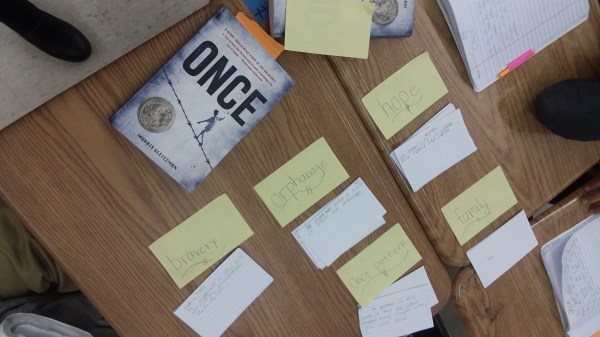
Once by Morris Gleitzman is the first of an incredible series. Bonus to a book club choice!
If your school has a traditional canon-based curriculum in place, there are areas where I would see book clubs falling flat. I would not assign Hamlet or Macbeth in book clubs. (I might, however, think about assigning excerpts to small groups after some whole class teaching.) I might instead start book clubs in a lower-stakes medium. Maybe your book club reads poetry. Maybe your club members are obsessed with the Dallas Cowboys and each member finds an article on the Cowboys to bring to the meeting. Or maybe your book club loves superhero comics, and you read the new Superman comics together.
Wherever you are and whatever grade you teach, I encourage you to give book clubs a go.
What about you? What are some of your favorite book club rules and routines? Or what are your book club roadblocks?
Amy Estersohn is a seventh grade English teacher in New York and is a halfway decent trivia team member. She collects her book and graphic novel reviews at teachingtransition.wordpress.com


 I annotated after each line of dialogue for how the character spoke. “What emotions are being expressed here?” I also told them that we needed to pay attention to italicized words and what they are there for.




 The Upside of Unrequited by Becky Albertalli – I so loved this book. I enjoyed everything about it asI read it in chunks at 2 am while feeding the baby. I loved the narrator’s voice, the hilarity of the supporting characters (whose ethnic, sexual, and gender “diversity” weren’t the main points of the story, but just a normal part of the fabric of the narrative, which I really appreciated), and the writing itself. If you or your students enjoyed the twins in Jandy Nelson’s I’ll Give You the Sun, the frank discussion of body image in Julie Murphy’s Dumplin’, or the awkwardness of Colin in John Green’s An Abundance of Katherines, definitely give this one a try.
 Made You Up by Francesca Zappia – I chose this one strictly based on cover appeal–because it’s really a gorgeous cover–and ended up reading it throughout labor, finishing the last 20 pages a few hours after Jane was born. I was sucked in immediately by the plight of Alex, who’s seventeen and schizophrenic and never quite sure what’s real or made up in her everyday life. Every character, object, or experience had my skepticism as I read, and my wariness was heightened as I grew more and more attached to each development, worrying that it’d turn out to be fake. There are twists and turns worthy of Gone Girl in this book, but ultimately, it’s a fantastic YA read that’s more coming-of-age than suspense or mystery genre.
 Turtles All the Way Down by John Green – Have you read this book yet? If you haven’t, is it at least pretty high on your TBR list? If it isn’t, have you been living under a rock!? John Green’s newest book–and his first release since The Fault in Our Stars–did not disappoint me. I purposely avoided reading anything about the book before I got my hands on it, and I was glad that I hadn’t been spoiled by spoilers. Its plot is driven by a typically slightly unbelievable Green-esque set of characters, circumstances, and adventures, but I’m always willing to suspend my disbelief for the likes of John Green, so I was undeterred. I quickly empathized with narrator Aza, who struggles with OCD, and appreciated Green’s sensitive exploration of mental health in the teen landscape.
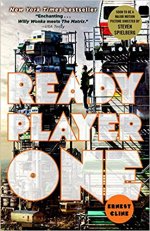 Ready Player One by Ernest Cline – Jackie told me about this book years ago, and I’ve been meaning to read it ever since–and it was worth the wait. A true YA classic, it blends a dystopian reality with the sinister machinations of a true supervillain (in this case, an entire corporation) and unlikely heroes and plot twists throughout. If you like The Matrix, the 80s, video games, or any of the above, you’ll like this book. It’s a great piece of fiction, and I appreciated Cline’s restraint in not turning it into a trilogy or series. I loved it as a stand-alone book full of everything I like in a page-turner.
 The Jane Austen Project by Kathleen A. Flynn – This isn’t YA, but it’ll definitely be of interest to any of my fellow Jane Austen lovers out there (and if you are one, then you’ll notice my aptly-named newborn daughter, above). In the not-too-distant future, time travel is a reality and true Austen fangirl Dr. Rachel Katzman has been selected to visit 1815 and Jane herself. Her mission is to retrieve a lost Austen manuscript, diagnose the mysterious illness that ended Jane’s life far too early, and try not to alter history too drastically along the way. I loved this book for its historical accuracy, its constant allusions to Jane’s works, and the depth of emotion I felt from every character.


 myself around 5:30 and head to the bus barn to pick up a bus for the varsity football game. The much needed rest was not coming today. Please forgive my anxiety with storms these days. It doesn’t seem to abate. Nor do my thoughts of teaching and coaching and facilitating our Student Council.



 Three Teachers Talk