Category Archives: Readers Writers Workshop

Try it Tuesday: Book Talks on the Big Screen

A few months back, my family was featured on a commercial for a local furniture store. We got paid handsomely to sit on a couch and look happy (easy) and cute (easy for my toddler). No dialogue. No acting. Just…sitting. It was well within my wheelhouse.

When the commercial ran, my daughter Ellie would race up to the screen in our living room, point excitedly, and exclaim, “LOOK! It’s ME!” Anytime she heard the telltale voice of the announcer, she would drop whatever she was doing and run to see if she was “in the television” again.

Her reaction was adorable (I’m biased), and pretty typical for a little kid who loves smiling for pictures and seeing herself in videos, but it would seem that as we grow, our perception of ourselves on screen tarnishes a bit. I mostly noticed how painfully true it is that the camera adds ten pounds. How cruel.  Thankfully, others often aren’t paying attention to such trivialities (I hope).

What’s important is the content.

In our classrooms, content takes many forms, but no matter the medium, we’re looking for the message to come through loud and clear. For example,  I teach my students when we work with speaking and listening standards that if we keep the message on pointe (Hurry in for the one day sale…) and organized (Hurry in today; it’s a one day sale), our audience will hopefully focus on the content (Wow, I could save serious bank on a sofa…todayand not our appearance (Hey, she looks like she packed on a few pounds. Ten. It looks like she packed on ten pounds). 

So, let’s consider what this means for readers workshop in our classrooms.

Book talks are central to a readers workshop. As such, many of us do them each and everyday. Amy and Shana recently discussed how and why they book talk in class, and one of the most useful quotes I took away from that post was when Amy reiterated the essence of a book talk, saying, “The best book talks are short, energetic, and introduce the book in some insightful or clever way.”

It’s simple: We want to hook our audience. The content is clear (This book is fantastic and you’ll love it too! ) and so is our mission (Read this book!).

With all this in mind, I’m going to ask you to come with me to a place that might make some of your a bit uncomfortable. However, in terms of risk-reward for the promotion of choice reading, this will be well worth the effort.

Let’s take our book talks to the big screen! 

Just as Ellie loved seeing herself on screen, students of the digital age delight in the visual medium. So, to add to our book talk repertoire, and even broaden the audience for books that delight our reading communities, here are three simple ways to switch up book talks in your classroom and keep things fresh and clever (personal screentime optional!). 


  1. Guest book talks caught on tape! Several months ago, I read and delighted in Jackie’s post on ways to stir up book talks. One of the suggestions I got rolling with was the guest book talk. Jackie insightfully wrote that “students need positive reading role models in all of their educators.” How true!

    I grabbed my phone and went down to Señora Ovalle-Krolick’s room. She had been speaking passionately just a few days before about Richard Wright’s Black Boy. I have yet to read this classic and I knew that her enthusiasm for the text would captivate my students. Before she could say no, I handed her the book and told her that I needed her passion. I asked her to tell me a bit about the book, her reading of it, and why she was recommending it. Her video, captured in one take, spoke beautifully about the text and her connection to it.

    Due to scheduling, it wasn’t possible to ask Alejandra to come to each of my classes, but with the video below, I was able to share it with all of my students. I’ve been working on my Social Studies neighbor next. He’s set to book talk via video next week. And all we need is my phone to get recording!

    https://www.facebook.com/lisa.n.dennis.7/videos/10154184296661549/?l=2213863947109559232

  2. Go big or go home – book talks on our school’s student newscast. Each week, the fantastic video production students at Franklin High School produce The Saber Roar. In recent months, I’ve helped an amazing student, Tasha Kappes, start a segment entitled Saber Reads. Students, teachers, and administrators (even a few from the district office!) have signed up to book talk some of their favorite selections!

    Here is Jessica Lucht, one of my amazing AP students book talking  The Young Elites by Marie Lu right around minute 2:45.

    In this episode, zip to minute 3:40 to see a book talk I did with my colleague, bestie, and partner in crime, Erin Doucette on Kristin Hannah’s The Nightingale. 

  3. Borrow brilliance from the internet. I learned about Reel Reading from Amy. Book trailers combine all of the elements of a great book talk, with the added bonus of moving pictures, music, and sometimes analysis or quotes.  In a post from several years ago, Amy’s students came through with some wonderful book trailers.Jackie talked about using book trailers in this post from last year, and I used a few of her links when I was feeling stuck in supplementing my own book talks recently.

    Just last week I wanted to book talk the Pulitzer Prize winning book The Road by Cormac McCarthy. I found the book trailer below the hooked several students with its haunting music and connection to the movie that was made from the book.

What ideas do you have for taking book talks to the big screen? What questions do you have? Please feel free to leave your comments and questions below! 

Reading Challenges for Growth, Connection, and Reflection

My students complete a reading ladder at the end of each quarter, during which they reflect on their reading from that nine weeks, write about the texts they read, and set goals for the following quarter.  When I read first quarter’s reading ladders, almost every student said one of their goals was to challenge themselves either with a book in a new genre or a more difficult length/writing style/topic.

So, I challenged them formally during second quarter to read a book outside their comfort zone, then write an essay that showed me that process.  I love Jak’s essay about his chosen challenge book–Cut by Patricia McCormick.  While this text is short and not full of especially difficult vocabulary, it challenged him because of its topic–self-harm and depression.  His essay is full of voice, text evidence, and text-to-self connections.  It’s a strong piece of writing that helped Jak reflect on his reading of this book, and is just one of many authentic alternatives to a traditional method of reading assessment.


img_1999

“A Challenging Cut” by Jak McMillen

Ready, Tropics? 1, 2, 3! LET’S GET TROPI—actually, let’s get dark for a moment. Let’s talk about Patricia McCormick’s Cut, a challenging and rough look into the mind of a depressed teen named Callie. Cue synopsis mode! To get into this mindset, Callie cuts herself. Never too deep, never enough to die, but just enough to feel the pain. Because she cuts, she’s been placed in Sea Pines, a treatment facility where everyone has a problem in one way or another. The only problem with Callie here is that she doesn’t speak, and for the most part refuses to throughout the book. Okay, synopsis mode over.

Now, Karnes, I’m assuming you have grown tired of the banter and have asked, “Well, how does this challenge you?” I’ll answer that shortly. In my essay earlier typed this year Of Mice and Misery, I cited one particular moment of my life that still affects me to this day, that of which being my father’s unfortunate passing. Now, my shell opens up more through this essay to share some of the past that I hold back.

Throughout my schooling years, I’ve found myself growing more and more tired of everyday tasks, even so far as just waking up and dressing myself. I could even use yesterday as an example: I had already felt like nothing more than dust the night before, which carried over to the next day. After coming back from MTEC the feeling was still there and unexplained, just as Callie’s feelings through the first parts of Cut. For me this is a culmination of years upon years of dark and harrowing thoughts of self-harm, and unfortunately at some points, even thoughts of suicide. Over the years of therapy some of these thoughts are still here. Now… I know that you probably didn’t want, nor did you need, to read that information, but I had to be relatable somehow, right?

41jIgmsYB+LAfter breaking her silence to her therapist, in their time between pages 122-125, Callie exposes her scars and tells what she uses. At one point in this segment, she says “Guess I’ll never wear a strapless ball gown,” from which I related in my own thoughts as feeling like I would never be good enough. Callie’s thoughts—as well as my own, but not in the book of course—were at most unexplained until later in the text. Cut took a vast amount of effort to read, and for this I praise McCormick for putting the amount of effort she did into writing this title.
When I read this title, it hit very close to home, and still does. I guess that’s why it’s such a challenge for me to read. Also, for the love of all that is holy, please do not take this as a cry for help or a sob story. I’ve moved on mostly and do not need any more sympathy than I’ve already received. Do know that it is much appreciated though! In closing I would like to say something Callie said once: “I may not want to get rid of my scars. They tell a story.”


How do you encourage your students to make personal connections to their reading?

#3TTWorkshop — Assessing Student Work in a Workshop Classroom

What does assessment look like in a workshop classroom?  #3TTWorkshop Meme

Amy:  Interestingly, I just saw a tweet by @triciabarvia yesterday that said “Growth, when ss do something better than they did before (as a result of assignment/lesson, that’s success.” In away that’s really what assessment should be, right? We should be noting growth and improvement, and celebrating successes. I think we forget this sometimes, especially in regard to what we view as assessments and students call grades. Too often we overlook the learning and focus on the 78 or the C+. (That is all most of my students focus on.)

Assessment in my classroom drives my students crazy. I think they feel like I am that elusive balloon they cannot pin down and pop. Poor darlings. I refuse to give in to the grades routine. I want to see improvement. I want to see them take the skill I know I’ve taught and then apply it — better yet, go beyond and do something clever with it. So to answer the question, “What does assessment look like?” is kind of tricky. I think too often teachers spend time assessing student work in ways that is not meaningful. We can waste a lot of time.

But if we’d plan a little differently and make assessment a natural and moving part of our learning journey, we would save time scoring work and enjoy talking to our students more. At least that is always my goal.

In my classroom, assessment takes the shape of written work:  play in notebooks or on notecards, exit slip quickwrites, and sticky note conferences, plus, of course, major writing tasks with formal and informal conferences and oral and written feedback. Assessment also shapes itself into lots of student self-evaluation: “Look at the instructions, the model, the expectations, did you meet them, why or why not?”

If I didn’t have to take grades I wouldn’t, but I assess everything all the time.

Shana:  I go back and forth when it comes to how I value process vs. product vs. what Tom Romano always called “good faith effort.”  There are students who have mastered skills important for reading and writing, but who haven’t fully committed in terms of being vulnerable and trying to advance their skills.  Then there are those students who explore powerful themes and show amazing growth in their abilities, but still can’t spell or use commas to save their lives.

Because I wrestle so frequently with this dilemma, I end up grading not on where each student is at in relationship to our academic content standards, nor on where each student is at in relation to their peers, but rather how far they’ve come since the start of the unit/school year/week.  And I do this by doing what Kelly Gallagher does– “a lot of fake grades.”  🙂

Amy: Me, too!

How do you design assessments?

Shana:  I used a lot of scantrons my first year of teaching.  Those kinds of assessments were pretty easy to make, if time consuming–long, multiple-choice tasks that were topped off by a few essays.  After a year or two of fighting with the scantron machine and my conscience when I noticed that oftentimes a kid’s essay was much stronger than his multiple choice section (or vice versa), I threw tests out the window.  I haven’t given a test in five years.

Now, I focus on designing assessments that are as unique as the units we work through.  A unit of study revolving around the exploration of complex themes cannot be assessed, well enough, in my opinion, using a multiple choice test.  So instead of trying to gauge a student’s interaction with Macbeth that way, I use Socratic Seminars.  Or projects.  Or reflections.  Or presentations.

Amy:  Yeah, I tossed out the multiple choice tests at the same time I introduced choice-independent reading. Even the shorter texts we read together as a class are worthy of much more than a scan tran. Harkness discussions and writing about our thinking allow students room to stretch a bit and show us what they really know.

I design assessments by thinking through my end game. Of course, teaching AP Lang means I must prepare my students for that exam each spring. I know my students have to write convincing arguments, synthesize sources into their arguments, deconstruction other writer’s arguments, and read critically — sometimes some pretty old texts. To design assessments means to start there and then work backwards into the instruction.

For example, I know my students must be able to synthesize sources into their arguments. So I may decide on a couple assessments — say a Socratic Seminar where students discuss three related texts. They must come to the discussion armed with questions, annotated texts, and join the conversation. Then, I may challenge students to find three more texts related somehow to the first three. Now, we move into writing an argument in which they must synthesize at least three of the texts. That essay becomes another important assessment because all along the way I’ve taught mini-lessons:  academic research via databases, proper citation, embedding quotes, transitions between paragraphs, interesting leads, combining sentences, etc.

Everything I teach as a mini-lessons gets a matching mini-assessment somewhere along the line to learning. By the time I read those synthesis essays I have a pretty good idea of which of my students understands and can apply each of those skills. I’ve conferred with them and retaught as necessary, and when I read that final paper I rarely have any surprises.

I think maybe one of the reasons I love a workshop pedagogy so much is because of the grading. It is just not the same as it was when I taught in a traditional model — it is better!


Do you have topic ideas you would like us to discuss? Please leave your requests here.


Try it Tuesday: Quick and Easy Formative Feedback

Remember last week, when I was waiting for spring?

Yup. Still waiting.

Meanwhile, it’s snowing outside my classroom window, and let me tell you, my students are (brace yourself for sarcasm) delighted. Not only is it a Monday, but it’s the first day back from break and it’s November-esque gloomy outside. Add snow to the mix and I’m staring down an epidemic of crippling apathy.

Needless to say, we have our work cut out for us today.

And yet…I have hope.

Simrah walked into last period with a smile and said, “Ah…Home.” She sat down, opened a book, and started reading. I almost cried.

It reminded me first and foremost how lucky I am to work with such wonderful students every day. In addition, it reminded me that an overwhelming number of  students value the choice a readers workshop model affords. It reminded me too that most students value the time we devote to that reading every class period and many have even said they look forward to it.

And really, it comes down to value. Valuing our students, their insight, their commitment, their time, and their drive. As the article “The Top Five Reasons We Love Giving Students Choice in Reading”from English Leadership Quarterly suggests, students feel valued when given the choice to read what interests them, and in turn, as we talk with our students about texts they have enthusiastically read, the relationship between teacher and student deepens as does their connections to what they read.  I referenced the above article in a previous post and Amy and Shana just spoke beautifully about choice in their workshop through EdCollabGathering this weekend. In short, choice empowers students. Who couldn’t use a little empowerment as third quarter crawls into fourth? My snow weary kids certainly could.

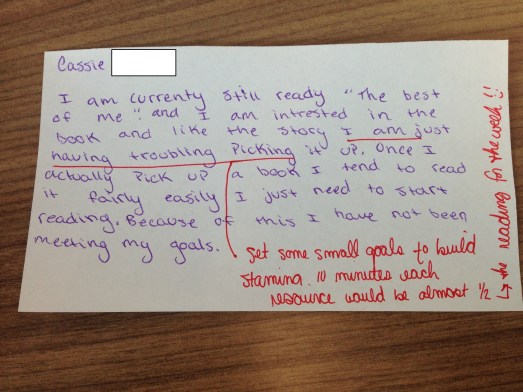
So, I felt it necessary to offer some encouragement and praise to my students to welcome them back from break and push us forward with our independent reading. It came in the form of a super quick formative that I was able to turn around within the same class period, providing feedback to each and every student and a quick snapshot for me to move our conferences forward purposefully in the coming weeks.

I found students that I suspected needed a push, and I was able to request that they come see me during our resource period. I found students that crushed their reading goals over break, their reflections brimming with pride, and I was able to congratulate them and encourage them to keep up the great work. I found students struggling to settle on a book, and I was able to list a few recommendations.

The prompt was simple: Give me a snapshot of your current independent reading life. What are you reading? How is it going? What do you need from me to help you be successful?

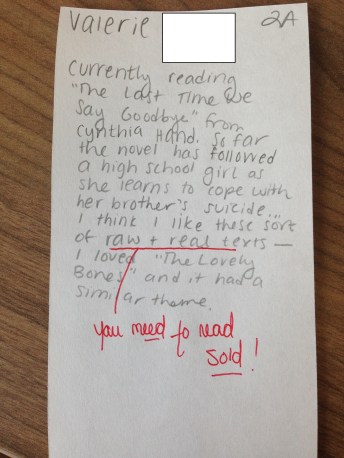
Below, you’ll see a few samples from students of varying abilities, interests, and commitments to independent reading. I am encouraged to see a number of students pushing themselves to meet the reading goals we are setting in class and so happy to be able to quickly intervene with those that need encouragement.

Bottom line: I was able to connect with each and every one of my students in only about ten minutes time. That is a huge win for the first day back from break. Bring on fourth quarter!

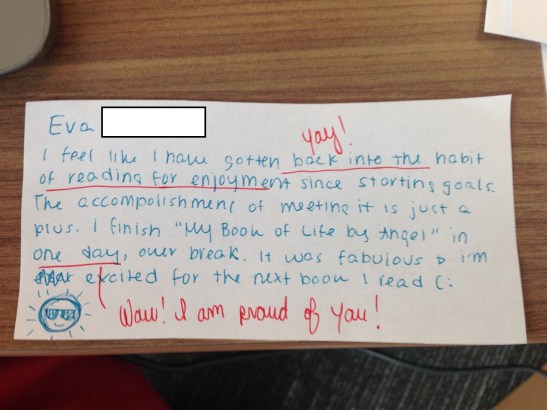
Formative 1

Eva often struggles to submit work on time. To see her excitement for My Book of Life by Angel made me smile. 

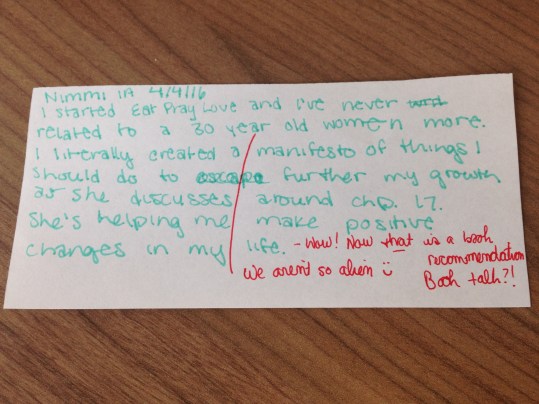
Fomrative 3

Nimmi cracked me up with this response. Apparently, it’s otherworldly to relate to someone as old as 30, but she’s making plans for her life based on her reading. Outstanding! 

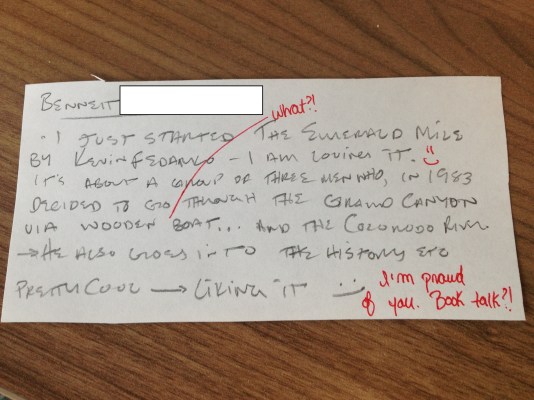
Formative 6

Bennett is a brilliant (accelerated) student who admits that reading isn’t often his priority. I can’t wait to hear his thoughts on The Emerald Mile. 

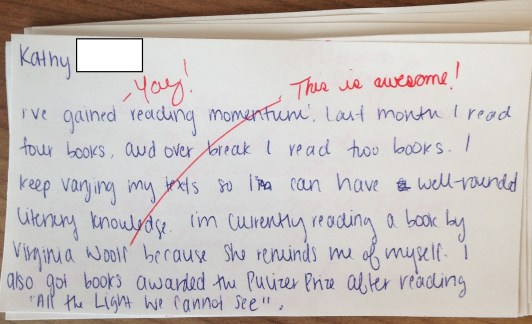
Formative 5

Kathy is an extremely hard worker who tackles reading specifically to better herself and prepare herself for AP Literature. We read an essay from Virginia Woolf and it sparked Kathy’s interest. 

Formative 2

Cassie is a sophomore who struggles with analysis. I’ve requested her for resource tomorrow so we can talk through what might be holding her back with this book in order to help her move on and meet her goals. 

Formative 4

Several students responded with insights into texts they are loving, which afforded me the opportunity to recommend further reading. 

What are the quick formatives you use to provide feedback to and motivate students? Please leave your comments below! 


Choice as the Keystone in Secondary English Classes

Shana and I were privileged to present a session during #TheEdCollabGathering on Saturday. If you joined us live, thank you! If you’d like to see our session, here it is. If you have questions we did not answer, leave them in the comments. We’ll do our best to answer.

Choice as the Keystone in Secondary English Classes

A big thank you to @iChrisLehman and the EdCollab Community.

Poetic Rhetoric — Spoken Word Poems in AP Lang

For a long while now, I’ve wanted to write spoken word poems with my students.

I use Sarah Kay’s “Hands” at the beginning of the year to start students thinking about their lives and the important moments that shape them. We draw hands in our notebooks and fill them with words that represent our memories. Like many of you, I first did this myself with Penny Kittle, and now I draw a hand in every notebook as one of the first pieces I write in it.

I use Shane Koyczan’s “To This Day” and ask students to write a response to it. Sometimes they tell me things that break my heart. Like the fall on the first day of school when two different girls in two different classes wrote about the abuse they experienced from their fathers at home.

These and other poems students find interesting and inspiring, and while they’ve always worked as never-fail quick writes, I wanted to challenge students to use all the skills we’ve focused on this year to write their own poetry. My student teacher, Zach, and I finally figured out how.

And students wrote some powerful poems with some perfectly poetic language.

We called the assignment:  Poetic Rhetoric. what-matters-most-in-life-are-quotes-and-stuff-that-tell-you-what-life-is-really-about_motto

The initial task read like this:  Craft a spoken word poem that addresses a personal conflict and/or a social issue, include rhetorical techniques and literary and rhetorical devices to convince your audience of the need for positive change. Perform your poem for the class live, or create an automated slide show with visuals, or a video recording as a way to digital.

Every day for a week we shared a different spoken word poem. Sometimes we wrote responses as a way to mine for our own ideas for topics. Sometimes we studied the lyrics, closely reading and analyzing structure, tone, and literary devices. We encouraged students to use the work of these poets as their mentors:  “Remember, we learn to write when we study good writing.”

We listened to “Paper People” by Harry Baker, and we talked about theme and sentences that hold the most weight, ones that might be his position statement.

We listened to “Education” by Aadil Malik, and we talked about evidence and examples that support the main idea.

We listened to “Touchscreen” by Marshall Davis Jones, and we talked about repetition, puns, and other literary devices that make language clever and meaningful.

We analyzed the structure of “To This Day,” and we talked about how Koyczan moves from self, to another, to another, to everyone as a way to finally get to his moving plea “to get a better mirror.”

Zach taught mini-lessons, reminding students how to use personification, puns, allusions, and fresh figurative language. We gave students time to write in class, and time to talk with one another, and time to talk with us about their process and their product.

We provided resources on how to write performance poetry like this and this and this.

And students wrote beautiful and meaningful arguments.

Most students performed their poems live in class. (I did allow for a teleprompter since I am the worst at memorizing myself.) We have a slam poetry night coming up on our campus in April. I hope many of my student will perform their poetry again there.

Here are the lyrics to some of the ones I personally enjoyed. I wish I had video of the performances. You’ll have to trust me — they were awesome.

Nefertiti Franklin:  WelcomeToStereotypesAA

Jennifer Melendez:  Find Your Charge, which includes an evaluation of her writing process

Kennedy Jenkins: Use Your Mind

Fabian Gutierrez: ADPoem

And here is an example of one of the poems published digitally. I love her language.

Jessica Ortiz:  People Love to Talk

Reminders to self for when I do this writing unit another year:

A. Take more time with topic selection. As with any writing, if students choose topics that are too broad, or they do not know enough about, the writing is harder to revise.

B. Meet with students more often. Conferring is essential to helping students find what they want to say. Too many students procrastinate and then think they can produce quality writing at the last minute. I must remember to confer at the beginning, the middle, and the end of the writing process. Schedule time for this.

C. Allow time for students to provide one another more targeted feedback. Although they met in small groups and talked about their writing, they did not use their time as effectively as they could have. If I will be more purposeful in modeling what a helpful feedback group looks like, students will be able to help one another more.

I love teaching students to write. I’m not sure there’s a better gift than reading their published work and seeing that they understand the power of their voices. Sometimes they blow my socks off with the force of their wisdom. I love it when they get it.

Have you used spoken word poetry in your writing class? How? What are your favorite poems?

What Janitors Can Teach Us About Getting Kids Into the Reading Zone by Amy Estersohn

guest post iconI love pop-psych self-help books.  I love books written by professors.  This book, by University of California professor Sonia Lyubormisky, happens to be both.  I love this book so much I bought a second copy because my first copy had too many post-it notes on it.

Lyubomirsky claims that happy people often achieve a state of “flow” and understand how to make flow happen.   We are in flow when we are absorbed in an activity that is not too challenging and not too easy for us.  In flow, we lose our sense of time completely: we are not bored, we are not anxious, we are not thinking about whether Trader Joe’s will have our preferred frozen meal in stock by the time we get there.  

IMG_0492If you’re like me, you read this description of flow and thought, “Oh, that’s just another word for the reading zone, only made more general for activities that aren’t reading.”
It’s easy to assume that flow experiences are reserved for avid tennis players, chess enthusiasts, artists, musicians, doctors, athletes, and others who have been able to live a lifestyle that caters to their interests.  However, research shows that even janitors can experience flow at work.  

“Other [janitors], in contrast, transformed the job into something grander and more significant.  This second group of hospital cleaners described their work as bettering the daily lives of patients, visitors, and nurses.  They engaged in a great deal of social interaction (eg. showing a visitor around, brightening a patient’s day), reported liking cleaning, and judged the work as highly skilled.  It’s not surprising that these hospital cleaners found flow in their work.  They set forth challenges for themselves– for example, how to get the job accomplished in a maximally efficient way or how to help patients heal faster by making them more comfortable” (Lyubomirsky 188-189).  Original research here.

Lyubomirsky believes that habits of mind like these are teachable and trainable.  Here’s what developing them can  look like during a reading conference:

The conference move: Critical Shopper

How I do it:  I’ll ask a student if she would recommend the book she is reading for a classroom library or book club set purchase.

How it supports “flow” or “reading zone”: It gives readers a reminder that reading can have a larger social purpose, and the more engaged they are in their reading lives, the better they can improve the reading lives of their classmates.

What I learn about the reader:  I learn about how a reader can engage critically with a text and can provide text-based evidence for a claim about whether a book would or would not make a suitable classroom library investment.


The conference move: Younger Sibling/Cousin

How I do it:  I ask a student what their younger sibling or cousin would say the book is about were he or she to read the book that the student’s currently reading.  Then I ask the student what he or she thinks the book is really about.

How it supports “flow” or “reading zone”:  It reminds readers that there are more ways than one to read a story, and that good stories beg to be shared with family, friends, and loved ones.

What I learn about the reader:  I learn about a reader’s ability to grasp themes and ideas in a text.  When I start off with, “What would your younger sibling say?” I expect the reader to give me plot summary and basic character traits.  Then, when I ask them for what they think the book is really about, it subtly lets the reader know that there are additional ways to answer this question.


The conference move: Goal-setting

How I do it: I ask students to set a goal, and I ask how I can help the student achieve that goal.

How it supports “flow” or “reading zone”: Just as the janitors who experience flow play an active role in setting their own goals, allowing a reader to set his goal gives him an additional purpose and meaning to his reading.

What I learn about the reader: I learn about a reader’s assessment of her own reading strengths and weaknesses.  Often the goal a student sets for herself is the same goal I would have chosen for her were I asked to make one.


The conference move: Remember when?

How I do it: I ask students to recollect a time when they were in “the reading zone.”  Sometimes I will use their reading log or my memory of their reading to jump-start this conversation.

How it supports “flow” or “reading zone”: By noticing and naming the characteristics that are associated with the reading zone — everything from body positioning while reading, the feeling of “Just one more chapter!”, the sensation of the pages flying by — we can celebrate the reading zone and try to make it happen more often.

What I learn about the reader: I learn about a reader’ self-awareness, and I learn what books got them in the zone, so I can recommend more books just like them!


Amy Estersohn teaches in New York.  Her classroom overlooks the parking lot where she learned how to drive.  She tweets about books at @HMX_MsE.

Try it Tuesday: Taking Your Classroom Library Digital

Spring break in Wisconsin is sort of a misnomer. Thank the heavens, it is a break. Time enough to make to-do lists that are far too long to actually do, but blessedly, reading time abounds and my tented texts are multiplying.

IMG_0216

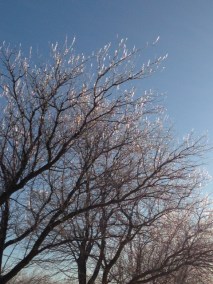
Ice covered trees just last week

But Spring? Not so much. Not usually. The cherry blossoms may be bursting into bloom in Washington and roadtrippers to Florida are finding warm sunshine and sand, but in Wisconsin, we’re a bit…behind.

Mother nature likes to tease Wisconsinites. Sixty degrees one day and snow that evening. Literally. My toes are cold just thinking about it.

However, as is the eternal promise of rebirth in spring, there are signs. Robins have returned, tiny buds are appearing on the trees, and the first flowers have pushed their tiny heads above the snow and suggested that warmer weather really might be on its way.

FullSizeRender

Crocus braving the elements

And so, with the hope that warmer days might actually be on the horizon, I get the undeniable and somewhat inexplicable urge to clean, organize, and pull my brain out of the numbing chill of winter. Throw open the windows (brr!), place hands on hips, and get to work. You’ll recall my to-do lists mentioned earlier? Several closets are in my sights and I geekishly delight in the thought of heading to the Container Store to finally wrangle the toys my daughter received for Christmas.

In the same way, before break, I surveyed my classroom (hands on hips and a waning desire to grade papers) and decided to tackle my number one organizational nightmare.

Mainly? My classroom library check in and check out.

With a recent influx in books for this library, there is excitement, variety, and chaos.

It’s new. It’s wondrous. It’s a big, ugly, mess.

As students clamour for new books (Yay!), their attention to our sign-out sheet has gotten messy at best, and completely ineffective at worst.

I was getting emails from kids weekly – Hi Mrs. Dennis, I accidently walked out of class with the book I grabbed. Could you sign it out for me?  or  Mrs. Dennis, I stole one of your books. Well, I didn’t steal it, I’ll give it back, but I have it and didn’t sign it out. Is that ok? 

Please, steal a thousand books if they are going to get read. However, it’s tricky. I can’t find books I thought I had. Students look for a texts and I don’t know if they are there or not. I go to book talk a text and it’s nowhere to be found.  #biblioissues.

But short of a full library scanning system and detectors that wail if you try to take out a book that’s not checked out, I was sort of at a loss.

So I turned to my friend Google, in search of different ways to handle the blessing of enthusiastic readers. And what I came up with has worked really well for my students that don’t always remember to sign books in or out during class, as they can now take care of it both in class and out.

I wanted it to be simple and provide me with some insights into both my students and the texts they choose. I needed to be accessible and easy for kids to use too. And, I wanted to try and create something that would run itself.

Enter – Google Forms.

Below, you’ll see the steps I took to digitize my classroom library, quickly and easily. 

  1. Create a Google Form that students can access easily. Forms provide you with a URL that can be sent to students’ email, pasted to a digital class syllabus, and/or shared on a class website. Once students fill out the form, all of the data is collected on a spreadsheet that you can alphabetize by student name, book title, or any category you like.

    Library 1

    The opening page leads students to differing questions depending on their need

  2. Differentiate questions on the form to gather the data you want. Below, you’ll see the questions I asked depending on whether a student was checking a book out (tell me what you are taking) or checking a book in (tell me how the reading went).
    • Checking out a book, I’m just looking for the basics:

      Check Out

      The basics so that I know where the book went.

    • Checking in a book, I’m looking to see if a student successfully completed the reading or didn’t, and why.

      Sign In 1

      The first page of the check in.

    • If students abandoned a book, I’m looking to find out why and if they successfully completed the book, I’m interested to find out what they thought.
      Abandon

      Reasons a student might have abandoned a text.

      Finished Book

      Insights once a student finishes a book.

  3. If you want it used, place the link to this form everywhere! I have the form linked to the top of my digital syllabus, I sent the link to students to save via Remind, I emailed it to their school account, and I made QR code for my classroom wall that students can scan, taking them directly to the form. Library Mangement
  4. Much like a mini reader’s conference, read what students are saying about they are reading. In the few weeks I have been asking students to use this form, I have taken away several key insights.
    • Book talks ARE making a difference. 

      Screen Shot 2016-03-28 at 9.56.27 PM

      Forms gives you data to help guide future text selections, book talks, and recommendations.

    • Students do read more simply because we give them time! Several students commented that they picked up a book for in class reading and then checked it out to keep reading.
    • Kids care about what their peers are reading. In the section where students suggest why they choose a book, many suggest that hearing their peers talk about a book, or simply seeing someone else read it, piqued their interest.
      Screen Shot 2016-03-28 at 9.57.24 PM

      You can take a look at student responses by submission, or…

      Screen Shot 2016-03-28 at 9.55.53 PM

      Go to a spreadsheet that you can organize to best supply data in any category you choose.


All in all, my organizational itch has been…digitized.  And as I sit and wait for spring during this week off of school, my closets may stay messy and I’ll never get through all the books I want to read (I did manage to start Animal Farm during my daughter’s nap today. A student recommendation and a sneaking suspicion I may be asked not to return to work if someone found out I haven’t ever read it have fueled my most recent read), but over 70 students have used my new classroom library form and that warms my heart, if not my toes.

UPDATE: Here is a link to a copy of my Google Form. Please feel free to make a copy of it for your own use! Enjoy! 


How have you made your classroom library run more smoothly? Other ideas on collecting usable data from readers workshop? Please leave your comments below! 


Books That Gave Me The Feels

I’m a big fan of all kinds of reading–sweep-me-away books, books that are dense and time-consuming, mysteries that puzzle me when I’m trying to fall asleep, books that break my heart, and more.

I think the teenage version of that whole entire category is “the feels.”

Books that are powerful, that grip us and force us to grapple with them, are what “the feels” are all about.  This is what I hope my students read for the rest of their days–far beyond the measly month or so they have left of high school.  I’m heartened by Emma’s recommendation list below–her blend of mystery, YA, and nonfiction that just rips at her heartstrings–because I know she’s already discovering books that give her the feels, and I hope she’ll continue doing so beyond our classroom.

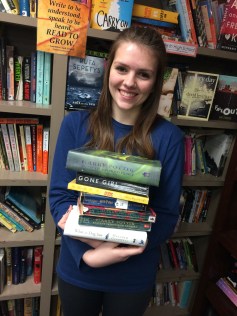
img_1549-1Emma’s Top 10 List: Books That Gave Me The Feels
  1. Stolen by Lucy Christopher – 

This book is crazy good. It has the most twisted and unexpected plot line in the history of books. With kidnappers then romance it is just freaky good. It would keep basically any reader captivated. A mixture of romance and just plain old creepiness.

  1. Gone Girl by Gillian Flynn –

I love weird creepy things and this book is exactly that. It is an amazing mystery with a heart dropping twist that left me feeling sick to my stomach. If you are a disturbed human being like myself, this is a must read.

  1. 13 Reasons Why by Jay Asher –

The overall idea of this book is sort of hard to wrap your head around. Suicide is a sensitive subject and this book makes it very real, almost as if you are living through the events. It is an interesting way of telling the story.

  1.  The Hunger Games by Suzanne Collins –

Though cliché, this series is very good, and perfect for my list because it pulls out a lot of emotions. All the action and loss and real world situations that are incorporated make it a very good read.

  1. If I Stay by Gayle Forman –

very emotional book that weighs life and death. It is an interesting way of telling a romance story while keeping the reader on their toes the whole time for fear that it might end forever.51clOkezoKL._SX329_BO1,204,203,200_

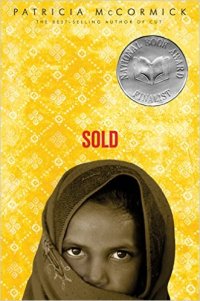
  1. Sold by Patricia McCormick –

More than anything this book is written beautifully, but the story is also very touching. The real life of a poor girl who gets put in situations out of her control is truly touching. It is a very easy read but very worth is because it is so touching.

  1. The Lovely Bones by Alice Sebold –

This book is good because it is told from the point of view of Susie, a girl who was murdered. It’s a cool way of an outsider point of view to the family who is struggling with their daughter’s death.

  1. The Fault in Our Stars by John Green –

On the more romantic side of my feels, this book ripped my heart out, along with every female heart in America. Illnesses are no joke and this book displayed the worst of circumstances, losing the one you love. It was a difficult book to read without crying.300x300

  1. Mere Christianity by C.S. Lewis –

On the complete opposite spectrum of any book genre. This book gives my Spiritual feels a tug. This isn’t a story with mystery or romance, it is just real life, telling you straight up how it is and I don’t know about you, but I’m a mess and when that is brought to my attention, the emotions start flowing. Plus, C.S. Lewis is a beast.

  1. 50 Shades of Grey by E.L. James 

I’ll start by apologizing for adding this book to my list but I don’t read many books so I don’t really have a choice. But hey, if awkwardness doesn’t give you the feels, what does? I can say with certainty that this novel will make you feel some type of way. Whether it’s good or bad, that’s up to you to decide.

“Plus, C.S. Lewis is a beast.” Don’t you just love that?!

What books give you and your students the feels?  Share in the comments!

#3TTWorkshop — Why Teachers Must Talk about Their Reading Lives

#3TTWorkshop Meme

Why is it important to talk about our reading lives with our students?

Amy:  If I want my students to be readers, I have to be a reader myself. The same holds true for writing. I am always surprised to meet English teachers who do not read and who do not write. This is our content! Seems like if we want to have any kind of credibility, we must practice the craft we want our students to learn. At least that’s what makes sense to me.

Of course, I’ve grown into this philosophy and this practice. When I first began teaching, I taught literature instead of teaching students. I think when I learned enough about my role as a secondary English teacher, and when I began challenging the status quo, I learned the importance of walking my talk. If I want students to read, I must model for them my life as a reader.

Shana:  Many of my students don’t have a role model who’s a reader.  I know that a large part of my identity as a reader growing up was shaped by my mother who was a reader.

I remember weekly trips to the library, a mom who held up her hand to finish a page before I could ask her a question, and having a bookshelf for a headboard in my childhood bed.  I lived a reading life from day one, because my mother did.  That is not the case for many of my students.  There is no one to model for them self-selected reading, the act of reading for pleasure, or the skill of choosing texts that will absorb a reader.  That’s why I have to be that person for my students–or at least, another person to model those skills for them.

How has your reading life changed since you began sharing it with your students?

Shana:  I know that when I’m tempted to be a lazy reader, remaining on the downhill portion of my reading roller coaster, I think of how often I encourage my students to push themselves with an unconventional genre, an award winner, or a lengthy tome. Then I feel like a hypocrite if I just pick up another trashy romance novel, so I challenge myself with something weightier instead.  Now, during pregnancy, I find myself much more deeply affected by difficult themes in books, so when I’m tempted to avoid them, I remind myself to be a better role model (as I’m doing now with Leaving Time, whose themes of a missing mother and elephant grief make my cry at the drop of a hat).

Amy:  I didn’t know you read trashy romance novels, Shana. Ha. I love a good romance, but I rarely find time for that kind of pleasure of late.  I’ve been a reader since the time I fell in love with Anne of Green Gables way back when. Now, I am a purposeful reader. Maybe that’s why I have a hard time relaxing — I always have some master plan. I cannot even remember the last time I just read for the pleasure of it. Shana, you and I both wrote about that in the past. Here and here. Look at this recurring theme.

While writing this I’m realizing that I have not been a good reading model lately. I haven’t snuggled under the covers with a book and let the language carry me away. I   read because it’s a responsibility. Kinda the way many of my students feel about reading for my class.

Aha! I need to do some things differently. Starting now.

During which portion of class do you tend to share your reading life with your students?

Amy:  Sure, I share my reading life during class, but my favorite time is the impromptu talks that happen with students in the hall or just before class starts. I love talking about books, and students come to know that about me.

Just today, a former student stopped in my room and asked if I could tell him about a book. I said sure, and he proceeded to tell me in a waterfall of words about the midterm this week in his new English class.

“They read The Crucible, and I need you to tell me what it’s about.”

I know, not exactly the same as sharing books for the love of them, but hey, this kid knows I know a lot about a whole lot of books. (I did not tell him about The Crucible. I might have mentioned Sparknotes.)

Shana:  I share mostly during conferences or booktalks.  When I booktalk, I tend to tell the story of my reading of the book (like on the treadmill at the gym, when I cried publicly while finishing We Were Liars), including when and where and how I read it.  During conferences (both formal at a student’s desk, or informal at the bookshelf), I use anecdotes to help illustrate a skill’s development with students.  And, occasionally, I use a snippet of my reading life to introduce a quickwrite–like creating an ideal bookshelf.   

Amy:  I am glad we discussed our reading lives. As always, you’ve pushed my thinking here. I can do more to model and talk about my reading life with my students, especially reading for pleasure. That means I need to walk the talk I give my kids a lot more often. Maybe I’ll take a stroll through the shelves at Barnes & Noble, asking myself:  If you had nothing on your schedule — no expectations from anyone or for anything — what book would you want to curl up and read?

Readers, I’d love your suggestions. Any amazing books you’ve read lately?

Do you have topic ideas you would like us to discuss? Please leave your requests here.