Category Archives: Readers Writers Workshop

Try it Tuesday: 2 Simple Ideas to Promote Reading

You know what I could use? A bookmark.

Actually, I could use five bookmarks right now.

I’m not proud and it’s not pretty, but I’m suffering from tented book syndrome these days. On my desk at school. My nightstand at home. The corner of the couch. The kitchen counter.

A vast field of tented texts. Books in progress. I know Amy can relate.
We share this affliction.

It always starts innocently enough. I’m between books. In the market for another. Speed dating texts to book talk, but not really committing myself yet. Then, I get sucked in.

It’s just one book to start. One book I want to come back to, so I’ll just leave it…here.

This time I blame Alyssa, one of my AP Language students. She enthusiastically book talked Anita Diamant’s The Red Tent. I immediately ordered it and it’s now flipped open on the coffee table as I type.  Shortly after,  Errin, an inquisitive sophomore, asked me to read Kafka’s Metamorphosis and that (to keep the creature in) is flipped upside down under a stack of papers.  Don Quixote has been languishing on my desk at school since the start of the year. I will finish it this time; I’ve just been distracted by about twenty-seven other amazing books since I started (I did read six whole pages today. That leaves 788 pages to go. So, I’m really cruising).

Penny Kittle’s Write Beside Them is eternally tented on the shelf behind my desk. And I’ve been flying through another ‘I can’t believe I haven’t read this text,’ The House on Mango Street by Sandra Cisneros. Esperanza was actually flipped open on the front seat of my car last week. I started it during an oil change.

So…I have a problem. For a bibliophile, this is a good problem to have. It is both damaging to my books and a testament to my deteriorating organizational skills, but it does keep those books at my fingertips. It’s super nerdy, but I love to see them, open and waiting for my return.

However, while having a good book close at hand might excite those of us already full of passion for reading, it takes a little something more to get our students geared up to keep turning the pages day after day. Just ask the local library. If merely having the books available led to literacy, I might be out of a job. I bet librarians would  be willing to open and tent books if they thought it would get kids reading, but shockingly enough, few students are as willing to be as visually nerdy as the average English teacher.

What we need is to not only get the texts in front of kids, but keep them there in a meaningful way.

Bright. Catchy. Student-centered.

So, here are two very easy ways to appeal to our students’ goal oriented nature, if not their occasional tendency to let their eyes wander around the room during class. If we can’t hook them with tented texts, these approaches just might catch their eye.

1. Reading Goal Bookmarks

This is a hybrid of a number of measures I’ve seen and read about for helping hold students accountable for their reading. While I certainly want to keep track of what they are reading and how they are progressing, I wanted to try and incorporate a visual reminder of their reading goals into the experience.

In the rare occasions I get into an exercise regiment (regiment may be a strong word…spurt, perhaps?), I stay accountable, in part, because I make the routine visible and harder to ignore. I set alerts on my phone, schedule time on the calendar, and put my workout clothes out where I can see them. In short, I make it so I can’t avoid seeing what I know I should be doing.

IMG_0172

The sample card I made for my classes. Fiction start to finish, but it showed how things should be organized. Without the example a few weeks ago, it was a big mess.

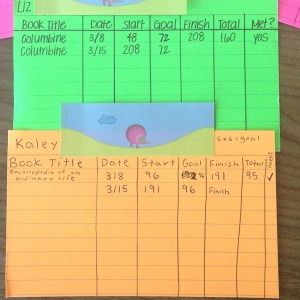
In that same way, I decided to purchase neon colored index cards for students to record their goals and progress. I’ve marked my own calendar for the days when we should be setting a weekly reading goal, and ask students to record their current book, the date, the page they are starting on, a weekly goal based on reading for two hours per week, and reflection the following week as to whether or not they met their goals.
IMG_0171

We just started this new system, but I like what I see so far!

Students keep track of their reading, I use the cards to help guide conferences, and even more wonderfully, I have them put their cards in the book not where they are currently in their reading, but where they want to be by week’s end. The bright neon cards stand all week as visual reminders of where students are aiming for the week.

2. Recommendation Walls

Sometimes, it just takes the support of one’s peers to keep texts fresh. In the same way that a book talk from students allows kids a glimpse into the texts their peers are enjoying, visually displaying recommendations and books completed, by both teacher and students, keeps suggestions fresh for everyone. Get those suggestions up on the wall and let kids take a peek.

IMG_0165

Erin Doucette’s wall is adorned with her hand painted sign and book suggestions from texts she and her students have enjoyed this year.
IMG_0167

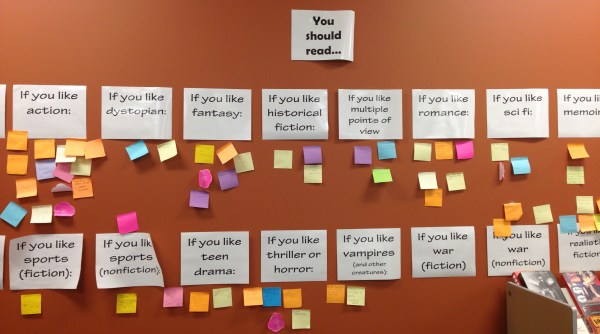
Catherine Hepworth has her students populate the recommendation wall based on genre.

IMG_0166

Brandon Wasemiller has students recommend books by creating their own analytical book covers.

How do you keep recommended texts at the forefront of your readers workshop? Please leave your ideas in the comments below! 


#FridayReads: Required Reading “Our Students Want to Write”

Confession:  I buy a ton of pedagogy books. I rarely read them all the way through. I blame it on my blossoming OCD. I can only take in so many ideas before I run out of space in my head to hold them all long enough to use them.

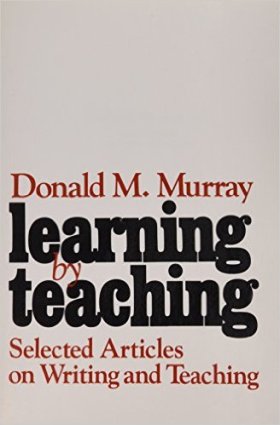
412bcpby4iol-_sx326_bo1204203200_That is not the case with this classic, suggested to me by my friend and mentor Penny Kittle, Learning by Teaching by Donald Murray.

I remember when Penny recommended it. She was in the DFW metroplex teaching a workshop, and I’d asked if we could meet up and talk about my writing. She graciously agreed, and we met at a Starbucks inside a Target. As always, Penny radiated positive energy. She told me about the work she was doing with Kelly Gallagher. I told her about my struggle trying to write a book, a book I am still trying to write.

I still cannot believe I had a writing conference — yet again — with Penny Kittle! (My first was during her class at The University of New Hampshire Literacy Institute the summer of 2013.)

At one point in our conversation, Penny paused and asked if I had read Don Murray’s book Learning by Teaching. I said no. At the time I hadn’t read any of his books, but I’d heard Penny talk about Murray with such affection, quoting him often. I knew this was a book I need to not just purchase, but one I needed to read. I’ve read and re-read and marked page after page.

Don Murray validates the moves I make in my workshop classroom, the moves I make

pageinMurraybook

My thinking while reading the essay “The Process of Writing” by Donald M. Murray


when planning instruction for my AP Language and Composition course. I have learned from those who learned from Murray, and his work reminds me again and again why teaching with student choice in mind works. Every time I feel like I fail, every time I get frustrated with the way an assignment flopped, or I didn’t reach a certain student what I’d hope to teach him, I turn back to this book of essays by Murray. (I did this recently after most of my students bombed an assignment, which was mostly my fault.)

Here’s an excerpt from Murray’s essay titled “Our Students Will Write –If We Let Them” published in North Carolin English Teacher, Fall, 1977. I probably break a copyright law by sharing, but I’ll risk it if it means freeing more writers. (See more about freeing writers in Penny Kittle’s piece “What We Learn When We Free Writers.”)

Our students want to write — but not what we want them to write.

Our students want to write of death and love and hate and fear and loyalty and disloyalty; they want to write the themes of literature in those forms — poetry, narrative, drama — which have survived the centuries. They want to write literature, and we assign them papers of literary analysis, comparison and contrast, argumentation based on subjects on which they are not informed and for which they have no concern.

We should see that their desire to write proves the vitality and importance of literature and literature-making in each generation, that language is central to the human experience, not just as a communications skill but as the best way to recall and understand experience. We tell our students the unexamined life is not worth living, yet we seldom allow those students to examine their lives firsthand through what is termed creative writing.

It is time that we, as a profession, not only support the reading of literature but the making of literature; that we encourage our students to write what they want to write and realize that what they want to write is more intellectually demanding, more linguistically challenging, more rhetorically difficult than the writing we usually require in the English class.

The biggest problem in the teaching of writing is ourselves. We do not encourage, allow, or respond to our students’ desire to write. We do not believe that our students can write anything worth reading, and they prove our prediction. Conditions will not improve until we realize that what we face is a teacher problem, not a student problem.

There are many important reasons to consider taking what is usually tolerated, at best, in the elective creative writing course and placing it at the center of the writing curriculum. Some of them are:

  • Writing about individual human experience motivates both the gifted and those we often consider disadvantaged. In fact, we may find that the disadvantaged aren’t in terms of experiences which can be explored through writing. Students who are not motivated by our lectures on the need for writing skills–they know the need does not exist in the lives they expect to live–still share the human hunger to record and examine experience. Students who are bored with papers of literary analysis or even incapable of writing such a paper at this state in their development may be able to write extraordinary papers based on first-person experience.
  • Students discover…that they have a voice, they have a way of looking at their own life through their own language. They discover and learn to respect their own individuality.
  • Through writing, the student increases his or her awareness of the world, and then works to order that awareness.
  • As students follow language towards meaning they extend and stretch their linguistic skills.
  • The experience-centered, doing nature of the writing curriculum will reach many students who are not comfortable with the analytical passive-receptive nature of the typical academic curriculum.
  • Creative writing gives students a new insight to literature. The study of literature is no longer entirely a spectator sport, but an activity which they can experience and appreciate.
  • The creative writing class may be the place where some students learn to read. Test results in many community colleges and other colleges of the second chance show that many students who test as not being able to read are also the best writers. They are able to read their own words and to perform the complex, evaluative techniques essential to revision. They learn to read by writing.
  • Students and teachers of creative writing rediscover the fun of writing. Art is, at the center, play, and perhaps that is the reason it is so little tolerated in the school. If it is fun can it be learning? Yes.
  • Finally, we should teach creative writing because it is more intellectually demanding than the study of literature or language as they are usually taught in the English class. This runs directly counter to the stereotype believe by most English teachers. IT is easier to complete a workbook on grammar, easier to tell the teacher what the teacher wants to know about a story than it is to use language to make meaning out of experience. The writing course is a thinking course, and it should be central to the curriculum in any school.

There is more. I believe Murray’s writing, like Penny’s books Write Beside Them and Book Love, should be required reading for every English teacher. I wish they would have been required reading in my education classes. For the first few years of my career, I struggled like many teachers I know with student engagement and learning while I taught literature instead of readers and writers. (Someday I’ll write about the Dickens I subjected my 9th graders to. It’s a sad sad tale of student, and teacher, woe.)

And someday I’ll finish this book I’m trying to write. I think Don Murray would want me to.

What books do you think should be required reading for all English teachers? I’d love to read your suggestion in the comments.


Mini-Lessons are in the Students Before You by Colleen Kiley

“You have all the tools you need to plan minilessons in the students before you. The secret is to be willing to flail around together through the murky mystery of how to get to the heart of story.”     -Penny Kittle, Write Beside Them, 2008

guest post iconA few weeks ago, in preparation for a unit on personal narrative, I was rereading (for at least the 4th time) a chapter from Penny Kittle’s Write Beside Them. Upon rereading these words, I immediately thought of my student Dani. Just yesterday she’d stayed after class to revise a piece of writing. The assignment, to write a snapshot moment, was the first formal writing piece of the semester (an idea I also gleaned from Kittle), and she was determined to get it just right.

Dani was writing about a semi-traumatic, semi-humorous event from a few months prior when, rushing to leave school, she rear ended a school bus. Dani was struggling with her beginning.

“What comes to mind first when you think of that day?” I’d ask a few days earlier.

“All I could see was yellow.”

“That’s perfect!” I was excited for her to begin this piece and just wanted her to get words on the page. “Start there, and then go back in time to show us the events leading up to hitting the bus.”

But today, after rewriting and reworking and just re-everything, we both realized the beginning wasn’t working.

“Okay,” I told her, “so scratch that first sentence and let’s find a new way to begin this.” I thought she’d be hesitant to delete something she spent a lot of time thinking about; many of my students are and I understand. Sometimes it takes days of my gentle prodding for them to get words on a page. And after so much work, they certainly cannot imagine deleting those precious words. But Dani loved it, and felt relief from deleting something that clearly wasn’t working. We spent another hour on the piece. I continued to make suggestions about totally deleting sections or being more specific with the details of the actual event, reminding her she was writing a snapshot, not an entire narrative.

“I’m worried there will be nothing left.”

I assured her that by keeping only the most important details, the ones that evoked the senses and allowed the reader to feel the intensity of the moment, she’d have a stronger piece than if she included every minute detail leading up to the actual event. And then she went back to work, eagerly adjusting and rewriting.

The type of revision Dani was engaged in felt authentic; she could see the piece improving in front of her and I could see she was pleased with the results. I wanted to infuse this into my other twenty-two students, so I asked if she’d walk the class through her revision process.


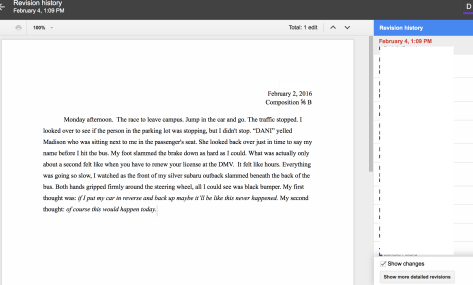
The next day Dani used the “See Revision History” tool in Google Docs to show the class how she revised her snapshot moment.

It wasn’t easy for her to talk through the process, though, and I was surprised at how often I had to remind her what decisions she’d made while revising. I asked her to tell the class why she’d deleted a section or rewrote another, and this proved to be a challenge. Dani is a very outspoken student, so I thought it would be easy for her. Then I recalled Kittle’s words: flail, murky, mystery. Right. It wasn’t easy for Dani to describe the process because she was just learning it and it’s not a simple process with easy to follow steps.

And isn’t that the lesson of revision? It’s murky and mysterious and you’re going to spend A LOT of time flailing around, as Dani had done. I’m hoping that’s what my students realized as Dani showed the evolution (again, the Google Docs Revision History tool was so helpful in this lesson) of her piece.

From these drafts we see so much about the revision process.

pic1 

We see that sentences must be deleted or rewritten.

pic2

We see that sometimes you have to rewrite the beginning many, many times.

pic3

We see that you have to rearrange paragraphs. Or delete paragraphs. Or save paragraphs at the bottom, in case you want them later.

We see that you have to do a lot of thinking.

pic4

And then we see a final snapshot that gives us all the details and emotions of the event, and leaves us wanting to know the rest of the story. Dani may continue this story and develop it into a longer narrative in our next unit, or she may start with a new topic and leave this be. Either way, Dani, and hopefully the class, learned what it truly means to revise, and I learned the power of using my students as mentors in the writing workshop.

Colleen Kiley teaches high school English in Bristol, Vermont, a rural town nestled in the foothills of the Green Mountains. She is passionate about connecting each student to the right book and was a 2015 Book Love Foundation grant winner. Inspired by the wonderful teachers at Three Teachers Talk and Moving Writers, she is continually trying to improve her approach to the writer’s workshop. You can reach her on Twitter at @ckiley4.

How to Book Talk 100+ Books in One Day

“Do you have a minute? We have an idea we’d like to run past you.”

My colleagues Amy Menzel and Leah Tindall were all smiles. Big smiles. The kind that suggest sincere enthusiasm, huge plans, a ton of work, and the possibility of incredible results.

And boy, did they deliver.

This past Friday, Franklin High School hosted our first ever Readers’ Showcase.

Over 100 students shared their enthusiasm for literacy through the course of the entire school day, creating a sea of informative posters, book talks, literary swag, and sweet treats for enticing passersby to stop and learn about books ranging from The Draft  by Pete Williams, to #GirlBoss by Sophia Amoruso,  The Devil in the White City by Erik Larson, and the biography of Alexander Hamilton by Ron Chernow.

Fresh off the heels of the incredible enthusiasm I detailed in this post about a choice reading frenzy at our school amidst the English department’s shift to readers and writers workshop, the showcase was a phenomenal way to keep students talking about books on a school wide scale.

As our Director of 9-12 Teaching and Learning Nick Kohn observed, “The love of reading was palpable throughout the entire building. I was particularly impressed not just with the depth and passion with which students talked about their books, but also with their excitement around the next book(s) they are planning to read.”

It was incredible to hear kids so excited to share their insights and recommendations with their peers and teachers and the organizers spoke passionately about loving to see their students engaged in “genuine conversations with authentic audience.”

I spoke with Brianna, a former student who read Devil in the White City. 

IMG_9976

Brianna handed out laminated bookmarks that looked like World’s Fair Tickets from 1893! 

“I wasn’t so sure about this book to start with, Mrs. Dennis,” Brianna smiled, “The detail. I thought it might get overwhelming, but it was incredible.”

“Right?!” I gushed, “Erik Larson is such a master with historical detail. Can you imagine his research process? Have you read Issac’s StormIn the Garden of Beasts? Thunderstruck?”

Whoa. How many books does he have? ”

And there, folks, is the power of reading.

One book, leads to one more book, leads to a student rediscovering reading.

And a showcase is one way to share over 100 books, in hopes that even just one more student finds that one book.

Even more exciting is the sheer number of students sharing their interests with those who might be new to a particular topic. My husband referred to it as “cross pollination.” For all of us dreaming of spring, I thought this was quite a fitting metaphor. Students interacted with the sincere enthusiasm of their peers in relation to a great variety of topics and took away with them ideas about texts that might never have reached their attention otherwise. Each new booth was a new opportunity discuss a book that their peers were already validating. Worker bees making something sweet to share!

Amy and Leah did amazing work to make this first annual Reader’s Showcase a success.

Here’s how they did it!

Start with a desire to promote reading with your students. We know that students are far more apt to read what interests them. They are human, after all. So, promoting choice texts is the way to go.

Last week, I came across an article in English Leadership Quarterly that spoke to this very principle. “Top Five Reasons We Love Giving Students Choice in Reading,” details what supporters of readers workshop already live and breathe. To allow students to choose texts, not only empowers them as readers, but shows that we as educators value their opinions. Once that confidence is built, it allows for the type of real and meaningful conversations around texts that we educators can’t get enough of, because it involves passion on the part of our students.

Build that excitement by having kids get out and talk with others about what they read. Interest is built around texts that are visible and accessible to kids. And while we do our darnedest to fuel the fire with passionate book talks in our classrooms (my students have noted me tearing up and actually jumping around while talking about books), posters advocating literacy, student discussion on choice books, “what to read” lists, and more, sometimes you need to go big.

The showcase put on by our College Preparatory Language and Composition classes (comprised of juniors and seniors) took place in our high school library and featured over 100 students. That’s big.

Organization for the event included: 

img_9989-1

The Reader’s Theatre

  1. An invite to the entire school to bring classes down for 20 minute showcase visits with their classes.
  2. Promotion via posters around school, a segment on our school news program, “Ask Me About My Book” buttons for all participants, and a fully decorated library to set the scene.
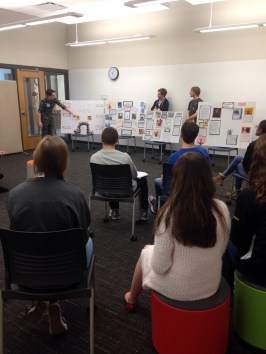
  3. A Reader’s Theatre book talk room to orient each visiting class where students entered, heard book talks from a rotating group of students, and were briefed on what they could find in the showcase.
  4. Book Booths manned throughout the day by students who supplied their insights and some sort of takeaway for guests (laminated bookmarks and themed treats were popular choices).


Students were expected to:

  1. Complete their text by the assigned day.
  2. Prepare a visually appealing tri-fold poster with the quotes they found to be most impactful, interesting facts about the text and/or the author, a recommendation section as to who might enjoy the book, and visual connections to the big ideas within the text. Students could also include reference to author blogs/websites that visitors might want to check out.
  3. Prepare several note cards with favorite quotes. Interested teachers could ask their visiting students to take a note card, find the corresponding booth, and ask the book talker to share why he/she chose that quote.
  4. Enthusiastically run their book booths throughout the day for the steady stream of classes that came through.
IMG_20160311_134746298

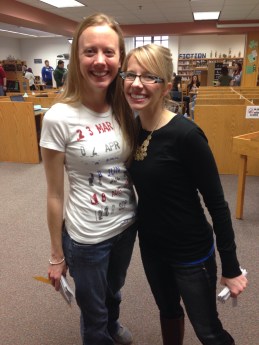
Cameron, on the left said, “It’s so cool to see real interest in the eyes of people that come to your book talk. They asked questions and seemed to be really listening!” 

And while the event itself and student preparation, obviously took a lot of work, the day itself was focused on fun.

Students nibbled on cake and perused book selections.

Teachers watched their students dash from booth to booth playing Showcase Bingo.

There were even book and gift card giveaways throughout the showcase, generously donated by our school principal. Rachelle, one of my students was lucky enough to win the new book Binge by Tyler Oakley (I felt super old when half my class of sophomores could not believe that I didn’t know who Tyler Oakley was. We looked him up. My list of books to read grows again). When we got back upstairs, Rachelle said, “It’s like they knew exactly what I would want to read.” Yup. It seems great books are falling from the sky these past few weeks. It’s awesome.

Finally, set aside some time for reflection. Amy and Leah’s big smiles paid off in a big way. The event was incredibly well received by not only the students that participated, but the students, staff, and administration that visited.

We are all already chatting about ideas for next year’s event. For example, the ladies plan to incorporate even more opportunities for fellow teachers to provide feedback on conversations with students and analysis of their visuals, thus sharing the load of assessment.

It’s all about sharing.

Share your love of reading with your students.

Ask them to turn around and share their love of reading with their peers.

One book, leads to one more book, leads to 100+ books in one day. 

img_9969-1

Amy and Leah – masterminds of the 1st Annual Franklin High School Reader’s Showcase

Do you have questions on organizing a Reader’s Showcase or ideas from a similar event at your own school? Please share your questions and ideas in the comments below! 


Mini-Lesson Monday: Identifying & Imitating Voice

Comedy is all about voice, and we’re gearing up to notice and imitate as much voice-filled comedy as possible in the next few weeks.  When thinking about how to help students identify and craft their own written voices, I thought of a lesson Amy and I shared in Franklin a few weeks ago.

721003Objectives: Using the language of the Depth of Knowledge Levels:  students will make observations about a writer’s craft, identifying patterns in sentence structure, punctuation, and word choice to help define voice.  Or, in the Common Core, students will interpret words and phrases phrases as they are used in a text and analyze how [they] shape meaning or tone.
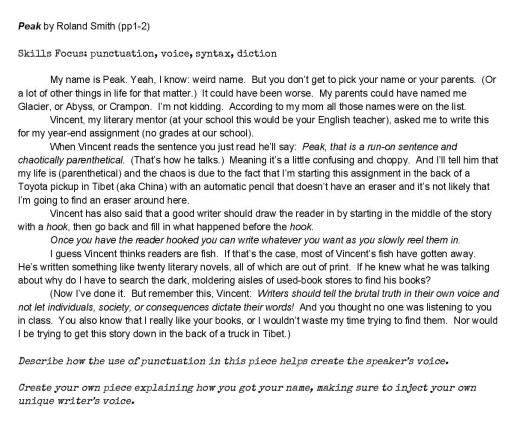
Lesson:  I’ll distribute copies of this excerpt from Peak by Roland Smith, which will serve today as both a booktalk and a mentor text.  I’ll introduce the piece as a book I loved, then segue into how it serves as an examplar of voice.

“Peak–that’s the main character’s name–is writing the whole book in the form of journals to his English teacher, so his voice is very conversational.  I found him pretty hilarious and sarcastic.

“Today we’re going to look at this excerpt from page one and try to see how Peak creates his writing voice.  Let’s all read this and annotate for craft–just notice HOW he’s saying what he’s saying.”

PeakVoiceLesson-page-001

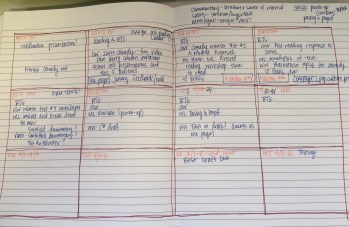
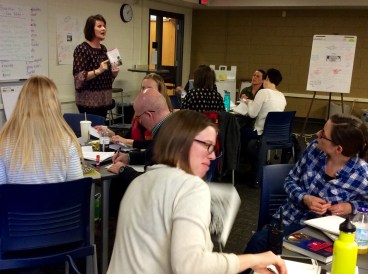
After a few minutes of student annotation, which I am doing alongside them on the document camera, I’ll ask students to share their noticings in their table groups.  “Share with your tables what you notice about Peak’s sentence structure, punctuation, and word choice,” I’ll say, writing those bold terms on the board.

Once students have shared in small groups, I’ll ask each table to share out what they noticed.  As a group, we’ll arrive at some conjectures about Peak’s use of:

  • parenthetical asides to the reader
  • occasional fragments amidst his varied sentence structure
  • relaxed jargon
  • rhetorical questions.

Once we have those key terms in our notebooks, along with great examples from the text, I’ll ask students to practice using these skills.

“In this case, using these writing moves create a writer’s voice unique to Peak.  We’re going to imitate this piece now by writing a quickwrite about how we each got our own names.  Write your piece imitating Peak’s style, and use those four writing moves as you do.”

Follow-Up:  We’ll all take about eight minutes to craft our name stories, imitating Peak’s voice, in our writer’s notebooks.  We’ll share them in our small groups, then use that quickwrite as a seed prompt for a possible comedy best draft as we move through the unit.

How do you help your students craft their writers’ voices?

YA Fiction That’s Funny and Full of Voice

After millions of snow days, my student teacher, Mike, and I are finally wrapping up our Siddhartha self-reflection unit and jumping into a new writing unit I’m really excited about–comedy!  We’ll study satire, sketch comedy, stand-up, commentary, and monologues for mentor texts, then work with our students to craft strong comedy writings that exemplify the skills of pacing, payoff, “punch-up,” and one other skill that I think is the most important:

Voice.

Writing voice, for me, is where humor, sarcasm, and personality come alive in a piece of writing.  “Voice,” Tom Romano writes, “is the writer’s presence on the page.”  Voice is the most elusive quality of writing to teach, I think, because it’s not really quantifiable and cannot be duplicated or imitated.  Each writer must craft his own authentic voice.

img_1738

Brainstorming the bare bones of a comedy unit

While discussing the very bare bones of our comedy unit, we brainstormed mentor texts, seed prompts, and writing skills.  After we hammered those out, Mike wondered about which books to booktalk for the unit.  “Nonfiction comedy is easy,” he said.  “Bossypants, Yes Please, Confederacy of Dunces.  But I’m not sure what to booktalk for fiction.”

“But YA fiction is so hilarious!” I exclaimed.  I started rattling off narrators who cracked me up.  Their writing voices were the perfect mentor texts for our students, who’d be focusing on crafting a humorous writing voice over the course of the unit.

“Looks like I know what I’ll be brushing up on for my weekend reading,” Mike remarked.  So here, in part, is a list of what I recommended to him–YA fiction that’s funny and full of voice.

The Absolutely True Diary of a Part-Time Indian by Sherman Alexie — This novel, paired with illustrations by the narrator, is loosely based on Alexie’s own upbringing somewhere between two identities–his poor Indian self who lives on the rez, and his striving-to-succeed “white” self who attends a better school up the road.  It’s infused with Alexie’s signature wry humor even against a pretty dark plot backdrop.

49750An Abundance of Katherines by John Green — This is, to me, the funniest of Green’s novels, although all of his narrators are pretty hilarious.  Colin Singleton has dated 19 girls named Katherine, and has been dumped by all of them.  If that’s not funny enough as it is, Colin is trying to write a mathematical formula for relationships and likes to find anagrams in random places.
The Disreputable History of Frankie Landau-Banks by e. lockhart — For me, Frankie is the female version of James Dean in Rebel Without a Cause.  Determined to subvert the male-dominated traditions at her private school, Frankie gets into all kinds of mischief, and I loved her headstrong voice.

American Born Chinese by Gene Luen Yang — This excellent graphic novel pairs multiple storylines, all of which are made hilarious primarily through dialogue and stylistic choices in Yang’s illustrations.  From antagonists so dumb they’re funny to Yang’s monkey alter ego, this is a humorous look at growing up different in America.

Anna and the French Kiss by Stephanie Perkins — I identified so much with the quirky narrator of this novel.  Forced to change schools right before her senior year, Anna is self-deprecating, sarcastic, and delightfully bewildered when she moves to the International School of Paris.  There’s also a great cast of hilarious supporting characters here.

Dumplin’ by Julie Murphy — I just loved Willowdean, the narrator of this terrific, important novel.  Most of her snide comments are made through internal monologues, but her interactions with her mom through dialogue are also quite funny, too.  Like Part-Time Indian, there are some heavier themes, but all in all I smiled throughout most of this book.

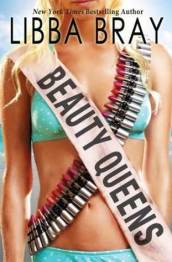
9464733Beauty Queens by Libba Bray — An all-girls’ Lord of the Flies, this book was fantastic for a variety of reasons.  The colorful cast of alternating narrators means there’s someone every reader can identify with, the interactions between those characters are often ridiculous and hysterical, and interwoven with it all is a series of broadcasts from a corrupt third party who are so evil it’s funny.
Noggin by John Corey Whaley — I finally read this book after it was stolen from my library countless times, and it’s hilarious from page one.  The story of a boy whose head is transplanted onto another teen’s body after he dies of cancer, Travis’ tale is at turns heartbreaking and hilarious as he tries to navigate the world five years after he last left it.  A fantastic series of supporting characters elevated the humor in this book for me, too.

Me and Earl and the Dying Girl by Jesse Andrews — For me, this was a more realistic version of The Fault in Our Stars.  I found Greg’s writing voice engaging and entertaining right away, and it made me read this book in one sitting.  His frequent addresses to the reader combined with his hilarious interactions with his friend Earl made Greg a favorite narrator of mine, and makes me eager for Jesse Andrews to write some more books!

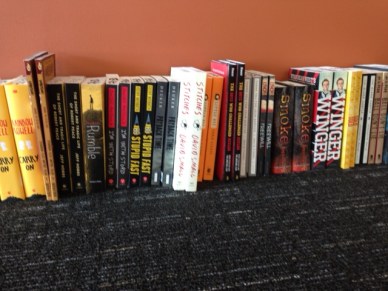
Winger by Andrew Smith — All of Andrew Smith’s writings are hilarious at times, but for me Winger was the funniest.  Ryan Dean West is a scrappy fifteen-year-old making his way through freshman year at a private school, and his escapades with his rugby teammates, his crush, and his teachers made for a lot of laughs–up until I completely broke down in sobs for the last 30 pages or so of the book.  Still, Ryan Dean’s voice was so great that I couldn’t wait to devour this book’s sequel, Stand-Off.

What are some of the best-voiced YA books you’ve read that have cracked you up?  Please share in the comments!

Book Talks & How To Do Them–#3TTWorkshop


img_0331-1

Amy booktalks during our visit to Franklin High School

Conversation Starter:  What’s a book talk and why do you do them?

Shana:  Booktalks are a structured way to fangirl about my favorite things in the world: books.  I do two booktalks per class, right after independent reading wraps up.  They’re a great way to transition from the relaxed reading mood of the classroom and move into the fast-paced work of critical reading and writing, but they’re also the number one change I’ve made to my teaching that has influenced how much I can get my kids reading.  Three years ago, I only did booktalks whenever the mood struck or whenever I got new books into my library, but now I do two a day, every day, no matter what–and it’s made an incredible difference.

Amy: You are an inspiration in consistency, Shana. I’ve done better at doing book talks this year than I have in the past. I try to do two a day as well — one non-fiction book and one fiction. I always seem to fall off the wagon at some point though. The demon, impending testing, pulls me to the dark side every year. I’m putting up a good fight this time around, and I have a plan to reinvigorate, not just my book talks, but the reading that’s happening in my room. Curiosity and intrigue: my goal for better book talks.

Is there a set protocol for a book talk — like length, reading a passage, etc?

Shana:  Just talking books is the biggest nonnegotiable for me.  While most days I do follow a protocol–one fiction, one nonfiction; 2-3 minutes per book; always share a passage, a brief plot teaser, and my own reading experience; try to mention a student who’s read the book–some days I just have to gush over a book that’s been recently returned, or a book I am reminded of during conference time, or some new items I’ve purchased.  Either way, I talk books every day, no matter what, which helps students become accustomed to exposure to new titles, adding books to their what-to-read lists, and hearing about trends in authors, genres, or topics.

Amy:  Remember at Penny Kittle’s Book Love class at UNH two years ago how she had everyone model a book talk? She set no guidelines other than modeling a few for us. After just a few turns, it became clear:  The best book talks are short, energetic, and introduce the book in some insightful or clever way. I try to do that.

When I read the books in my library, I look for passages for craft studies or beautiful sentences we can use as mentors. Sometimes I share those in book talks without doing the study — we just enjoy the language or listen to the voice of the narrator. I’ve started asking questions and trying to get my students to think about the topics the writers might address in the books. Just another way to get my readers to make a connection with writing.

The hardest books to book talk are the ones I haven’t read yet, but even those are doable when we show genuine excitement about the book. Why would I have a book in my library if I am not excited about students reading it? That’s a pretty easy sell in and of itself. It’s fun to get students to ask questions about the cover and to read the comments.

41drZBnWSzL._SY344_BO1,204,203,200_How do you decide which books to talk about within each unit?
Shana:  This is pretty easy for me since most of my units of instruction are themed.  For reading units themed around a topic, I find lots of books about that topic, or that contribute an alternate perspective to whatever central text we might be reading.  (Example:  While reading Siddhartha and thinking about coming of age and going on journeys, Outliers, Marcelo in the Real World, The Other Wes Moore, Paper Towns, and Their Eyes Were Watching God fit right into our unit.)  While in the  midst of a writing unit, I think about books that might serve as mentor texts in terms of topic or structure, or that are written by authors who serve as good mentors in general.  Other times, I have no rhyme or reason to my booktalks, because I simply MUST talk about a new book (like Dumplin’, which I just read and LOVED and had to booktalk randomly.)

Amy:  I structure my units more around genre than theme, so my book talks are more random than yours. Hey, maybe that’s the problem with my consistency!

My students and I talk a lot about aesthetic and efferent reading. I want them to understand the importance of making connections with the books they choose to read, and lately, I’ve seen that there is a real disconnect. Just because students choose books does not mean they are making personal connections to them. This is in part why so many of my students this year are having a hard time sticking with the books they choose. Because I know many are abandoning books so quickly, I’ve been working on getting students to talk a lot more about topics and how writers approach these topics. My hope is that my non-readers will find interest in learning about things, even if they are not interested in reading for the pleasure of it.

I’ve done several book talks this year around a topic; for example, depression, which is one of my 11th graders’ favorite topics to write about this year. Forgive Me, Leonard Peacock, Every Last Word, My Heart and Other Black Holes all flew out of my hands, and I had to get more copies.

Do you ever have students conduct book talks?

Shana:  Very occasionally, I do, when it’s really authentic.  When a student finishes a book and just raves about it during a conference, I ask them to share that enthusiasm with the class.  Last quarter, I asked all students to read a challenge book and then complete their choice of follow-up activities with the book–one choice was a booktalk, and the students who shared about the titles they loved did spark some interest in their peers.  However, those booktalks didn’t go over as well as the ones that arose from sheer exhilaration, so I think my future goal will be to limit student booktalks to spontaneous ones only.

Amy:  Like you, I rarely have students conduct book talks — at least the way I do. I’ve tried, but you are right, without the spontaneous excitement about the book, the other students just do not respond the same as they do when I conduct the book talks.

However, I do have students talk about books with one another. Most of the time it’s pretty informal:  Talk to your table mates about what you are reading. Sometimes it’s a little more formal:  Speed dating with a book, which is one of our favorite ways to share books.

What are some other ways you talk about books with your students?

Shana:  Basically, I bombard them with talk about books all the time.  When I see current or former students in the halls, I ask them what they’re reading.  When they come to visit me, I urge them to leave the room with a new book.  I make lots of segues in conversations from all topics to all books (mostly because this is just what I do in real life…ask anyone who knows me).  I also share with students all the time what I’m reading, and why they might like a given book.

Amy:  We are so much alike! I love to have former students borrow books, and I talk about books with every person who will listen — and some who don’t. I also try to get students to engage with me on Twitter, using the hashtag #FridayReads to share what they are reading each week. A few students set up accounts and we follow each other on Goodreads. I love those kids! I’ve also started a favorite quotes wall, and I’ve asked students to pull significant lines that lead to theme and/or beautiful sentences that show author’s craft. Getting students to pay attention as they read, noticing how writers use language to create meaning, leads to significant improvements in their own writing. Without fail, it’s my best readers who are also my best writers. If only more students would get that.

Do you have topic ideas you would like us to discuss? Please leave your requests here.

The Winds of Change Smell Like Books

Everywhere I look, I see books. bookshelf

Open in the hands of students.

Shared at the hands of teachers.

I’m dreaming about books. Like the pursuit of the one that got away, I am chasing after unopened books in my sleep. Waking in a state of minor panic – When WILL I have time to read all of these books?  I need a prep period just to read. I need an extra hour in the day. I need a sabbatical.

In the days since TTT came to share their wisdom and enthusiasm with the English Department at Franklin High School, literary excitement is wafting through our hallways and it’s all about books, books, and more books.

Students are buzzing about books.

As I walked through the commons a few days ago, I saw one of my AP Language students, Maddie, reading during her free block. I smiled and walked on. Then, I stopped, turned around, and went back to talk with her.

It was the best move of my day.

Sitting on the table next to Maddie was a copy of A Monster Calls (Since I sobbed over this book and poured myself into sharing it  with students in a book talk a few weeks back,  I’ve acquired six copies for my classroom and not seen one of those copies in days. Kids are handing them off in the hallway. Meeting for coffee to discuss. Making their parents read it. It’s beautiful) and in her hands The Girl on the Train. I asked her how it was going. “Ugh! Mrs. Dennis! I can’t read fast enough. I need to meet my reading goal and finish this book so I can start A Monster Calls.”

I almost hugged her.
Okay…
I hugged her.
Maybe a second longer than was necessary, but I think we had a moment.

Only a few weeks earlier, before I had recommitted to book talks every day and conferring with kids about their independent reading, we had talked in class about how independent reading was going. Maddie had shared that while she likes to read, she wasn’t making time for it. She had been enthused earlier in the year, when getting time to read in class was something new and different, but hadn’t kept up with the expectation to read 2 hours per week.

I was reminded that Penny Kittle says teachers sharing their passion for books is contagious. In this area, I needed to do better.

While I was giving time to read, sharing lists of books to choose from, and piling books on the shelves, I had let my own passion for texts slip away into the haze of curriculum redesign, semester exams, and lesson planning. In essence, I was asking students to make reading matter without me. Not cool.

So, I grabbed a copy of Stiff, by Mary Roach and got reading.

Of course, I couldn’t put it down. Of course, I wanted to tell my kids all about it. So,  I shared my passion in a book talk, we ended up chatting about the use of humor in nonfiction, and my students were reminded that we are a community that makes time for what matters. READbooks

Reading matters.

And our commitment to that as teachers needs to be visible and constant if we are to have any hope in keeping kids enthusiastically discussing what they are reading and reaching for more.

My colleagues are buzzing about books.

I’ve been wonderfully lucky to work with brilliant and passionate English teachers for each of the thirteen years I’ve been in the classroom. In the past two years, I’ve even been lucky enough to be their department leader and do my best in recent weeks to facilitate our move toward workshop.

While we all share the very traditional love of To Kill a MockingbirdPride and Prejudice, and The Great Gatsby, our passion for reading runs so much deeper. In workshop, it’s our responsibility (and pleasure!) to get kids reading all manner of texts. Not just glancing in the direction of a book, but digesting it.

In short, we know that to get a majority of our students excited about reading, their teachers need to be readers.

Tickled to share a passage, can’t wait to see what you think too, ask a million questions, highlight in multiple colors, adorkable readers. The classics have a role in this, but so do countless other styles, genres, and soon-to-be classics.

Our district has blessed us with a huge surge in classroom library materials in preparation for our shift to workshop instruction. This puts dozens of books in the hands of teachers who are now chatting about Patrick Ness in the hallway between classes, feverishly searching for texts that are suddenly in high demand (Anyone have a copy of Columbine? They are ALL checked out! How about The Nightingale? I’ve got a wait list. With six names on it. For a book)and frequenting Thriftbooks.com to compare how much money they have saved to add even more titles to their libraries.

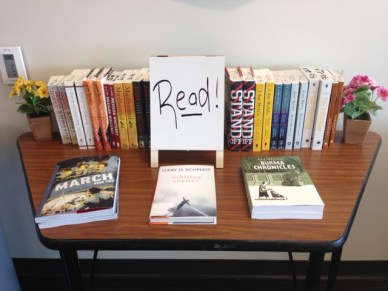
When in doubt, promote. We enlisted the help of some art students and had a poster made to show how super cool it is to read. A nicer group of people, you will never meet, but this poster says read, or else.

Reading Poster (1)

The students think it’s a riot…and have asked on more than one occasion which books we are reading in the picture.

Mission accomplished.

So, as the wind ushers in both spring and a journey with workshop, let the books come raining down as well. The more I see, the more I want to read. And the more I want to read, the more excited I get to prove to kids that we can all be readers.

How do you keep the beautiful buzz that surrounds books going in your classroom? Please share your ideas in the comments. 


5 Things I Need to Remember When Teaching my Writers

I know we’ve been posting mini-lessons on Mondays on this blog for awhile now, but today marks the first day of my spring break, and since my students and I just finished a fairly complex writing task, this is a good time for reflection.

don-graves-quoteMy AP Language students wrote arguments as spoken-word poems, and then performed them in class. (Or if they produced their poems digitally, which was an option for publishing, they projected them.)

Our process included reading and studying several poems. We watched YouTube videos of spoken word poems by Shane Koyczan, Harry Baker, Marshal Davis Jones and more. We analyzed structure, craft, and theme. We pulled out lines we felt held the weight of the poem and wrote responses to them, hoping to find inspiration for our own writing. We reviewed the elements of argument. We discussed the claims the poets make and how they use evidence (or do not) to support these claims. We spent workshop time thinking, writing, and revising our poems. And my student teacher Zach and I spent hours talking to writers about their writing.

I’ll share some of the amazing poems my students produced in another post. For now, here are some things my students reminded me I need to do better so they can do better in our next round of writing:

  • Topics matter. If I want my students to produce well-written texts, they must select well-chosen topics. Too often my writers choose topics they might have a passion for, but they know little about. This leads to vague superficial writing.

I need to take more time on the front end of the writing process to make sure all of my writers choose a topic that they not only care about, but that is specific enough to the task at hand. One resource that will help as we choose topics for other writing tasks is this tutorial from University of Arizona Libraries. I need to remember to slow down on the front end and help students select narrow topics.

  • Clear feedback matters. For this writing project, I only left feedback once on student drafts. It was not enough. Or it might have been — if students had read it. (Please tell me I am not the only teacher with this issue:  Students ignoring feedback.)

The best feedback is not when I leave comments on Google docs like I did for this project, but when I talk to them face-to-face and answer their questions. Students need to see my response to the work they have done. They need to see if I like it. They often misread, or don’t read, my tone in written feedback. I must remember to give them a balance of both — and a lot of it all along the way.

  • Sometimes more explicit instruction matters. In more than one conference, when I asked students why I didn’t see application of the mini-lesson in their writing, they said: “Oh, I thought that was just a suggestion.” Well, yes. But what’s the point of a mini-lesson — designed to help students write better — if they refuse to at least try it?

I know that we must teach the writer and not the writing, but sometimes without a little push to make specific changes, my writers just do not improve. I need to remember that with some students I must be more explicit in my instruction.

  • Accountability throughout the process matters. I was out of the classroom several days when students had writing workshop time to work on their poems. (Someday I’ll tell you about the standards revision work I’ve done with the TEKS Review Committee in Austin this year.) Although my student teacher was there, and my substitute — a former teacher and a sub my students know well — too many of my students clearly wasted the time given them in class to write. They are teenagers after all:  give them an inch and they take a mile. And they are major procrastinators. I think they are finally understanding that good writing takes time, but many are still not taking the time to produce good writing.

I need to do a better job at holding them accountable for working during workshop time. More exit slips. More sharing a favorite line or passage they’ve written that day. More purposeful formative assessment and personal evaluation of their writing processes.

  • Conferring (more) matters. The two days students shared their poems were exciting. So many were fantastic. So many clearly showed their understanding of how to write an effective argument — and how to be clever and creative with poetic elements as they did so. But quite a few did not.

As Zach and I discussed each performance and each poem, matching the writing to our rubric and assigning a grade, we became clearly aware of which students we conferred with the most and which students we did not. One of us would say: “She did exactly what we discussed in our conference,” or “That was something he and I talked about in his conference.”

The students we conferred with the most not only fulfilled the requirements for the assignment the best, they produced the most creative and convincing argumentative and poetic writing. And they knew it. Their confidence as they performed their poems was evident, and they rocked the house with their beautiful and inspiring poetry.

Taking the time to confer with every student — whether they want to talk about their writing or not — must be a regular part of the writing workshop. Too often conferring becomes optional when I get too busy or spread myself too thin. I must remember to schedule conference time into the lesson plans and hold myself responsible for making them happen — not once but several times for each student.

How do you know when your writing workshop is working?  Please share your ideas in the comments.

#FridayReads of a Different Kind of Joy


Sometimes we just need a little joy.

I know it is almost spring break, and the attitude’s toward thinking and learning and producing quality work have been bleak lately. (Evidence = 12 out of 24 students turned in the last assignment, and only seven of the 12 finished all the parts of it.)

My head’s been banging on the desk a little too much lately. I know you’ve been here a time or two yourself.

Teaching is hard.

Then we get gifts like the one I got today:  a blog post written by a student who shows she not only understands the philosophies behind my pedagogy — she likes it. She believes she’s learning.

Please read Jessica’s post.

I’ve read it five times today, and I smile just thinking about lines like this: “I feel strongly that this free-range form of teaching can be beneficial to other students as well, in the way that it both implements a refreshing break of classroom custom, and prepares us for the life of decisions that waits beyond the embellished paper borders of our high school diplomas.”

Choice matters, my friends.

I would love to hear of your most recent successes with students. Please join the conversation by leaving a comment.