I live for a good mentor text, and I have started to experience somewhat of a “Baader-Meinhof Phenomenon” because I find them everywhere.
Most recently, while scrolling through Facebook.
An article titled, “Dying, with a Lifetime of Literature” sounded powerful, so I clicked the link.
I immediately knew this piece would appear in my classroom.
The piece, written by Lynette Williamson, a former English teacher of thirty years, documents her diagnosis with ALS while sprinkling in allusions to literary works that stuck with her and appeared at various times after her diagnosis: quotes from Toni Morrison, Sophocles, Shakespeare, and even a connection to Kafka’s cockroach from The Metamorphosis.
I wondered, about myself and my students, “If we dug deep enough, which literary scars would we find hiding in our own skin?”
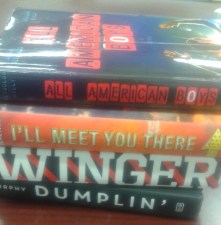
To start this excavation process, we created our own “ideal bookshelves” (based on the book My Ideal Bookshelf by Jane Mount and Thessaly La Force and referenced in Book Love by Penny Kittle). I get overly and outwardly excited when we talk books in our classroom, so, to spare my students another one of my emotionally-charged nerding-out moments, I stifled my excitement when I overheard their conversations about books! “Oh, remember this book?” “Oh yeah, that’s a good one – I need to add it to my shelf, too!” “You’ve never heard of this book? It’s so good! It’s about…”
And sure enough, at the end of the period, students were handing me their ideal bookshelves, my first peek into the connections they have forged with books.
The next day, we read “Dying, with a Lifetime of Literature,” together. I asked, “What is she doing as a writer?” And we agreed that she is referencing pieces of literature to tell her story. Then, to press the issue, I said, “We all superficially agree that books teach lessons (hello, thematic statements), but have we looked at that personally?” I told my students to visualize two timelines: one is everything they’ve read in life. The other runs parallel and is their life story. Where can we make connections or intersections between these two parallel timelines? What has happened in your own life that you could connect to a character’s?
To support this idea, I shared with my students the part of Mechanically Inclined where Jeff Anderson explains the “linguistic data pool theory,” where “all of a student’s visual and aural language experiences flow into that student’s personal pool of data” (17). I thought it fascinating to consider that what we read leaves marks on our schema and manifests itself at times and in ways that we may not even be aware.
At this point I’m sure my students are thinking I’m taking this idea way too far. So I snapped out of it, and we got to work.
And, true to my “Baader-Meinhof” tendencies, when I start thinking of an idea, possibilities appear everywhere. My instructional specialist, Stephanie, had recently shared with our grade level team an idea from Cult of Pedagogy (“16 Ways to Use Google for Student Projects”).
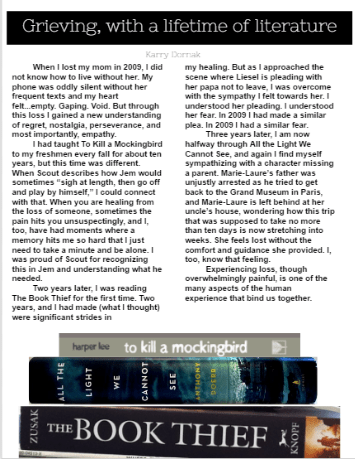
One idea is the e-book, which had just the right amount of simplicity and polish for our needs. I instructed my students on how to set up their e-books (using Google Slides, go to File, Page Setup, then change the dimensions to 8.5×11). Once the Slide is the right orientation and size, students can add images of books plus insert text boxes to type their own versions of Williamson’s writing.
For students who struggled to get started, I encouraged them to start the same way she did.
Hers: “When I was diagnosed with ALS….”
Mine: “When I lost my mom in 2009…”
A student’s: “When I heard the news that I would be going to study abroad in the States for 6th grade…”
I continued drafting my own “literary touchstone,” as I was now calling the assignment, in front of my students while they, too, drafted theirs. Writing together is powerful – students are able to see both my thoughts and my emotions while writing. The best writing is raw, real, and should be shared. After all, if these books had never been shared with us, look at all of the touchstone moments we would have missed out on.
To foster sharing, I created a Padlet. Students were able to share the link to their Google Slides presentation directly to that Padlet for other students to see. I make all of my Padlets require moderator approval, which means I have to approve the post first. This feature also allows me to not approve posts whose authors wish to keep their work private. I can still see the post, but others cannot.

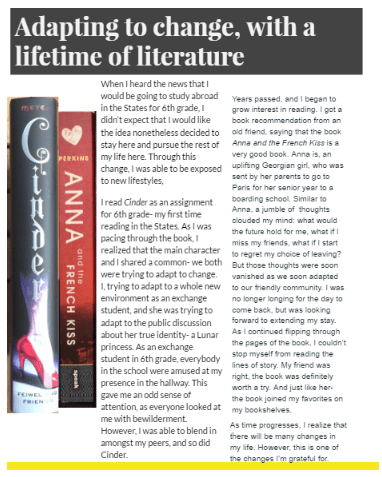
This experience (the words “activity” or “assignment” just don’t do it justice) touched on so many things I hold valuable in the classroom: conversation, nurturing book love, experimenting with writing, sharing, and publishing.
Experiences like these don’t happen in my classroom every day, but I hope that now that I am seeking them out, the Baader-Meinhof effect will continue to work in my favor.
Karry Dornak is living the dream teaching sophomore English at Klein Collins High School in Spring, TX. She is energized by research-based practices, innovative ways to teach and learn, and coffee.


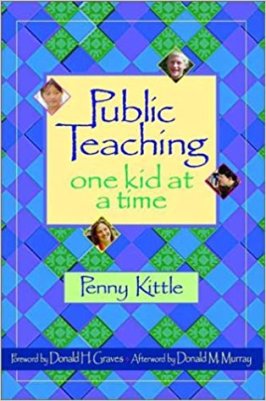 This week I tackled a title that’s long been on my to-read list:
  As we near the end of the school year, I hope you can find truth in one of Penny’s final statements: “In my experience, it isn’t the stress that’s left the greatest mark, it is the joy.”
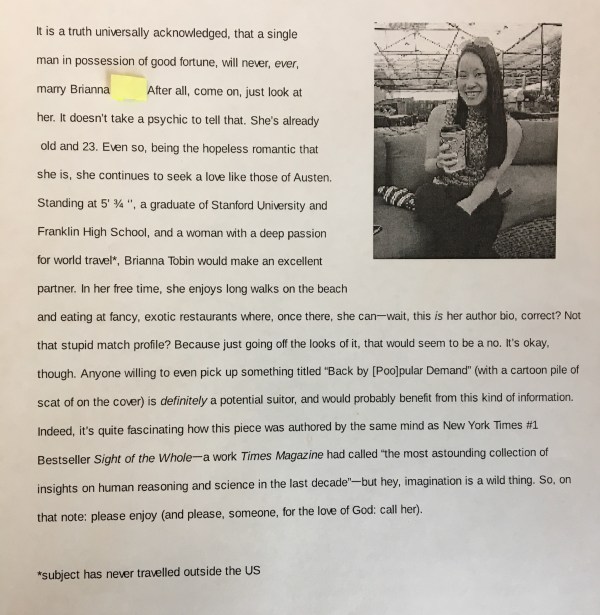
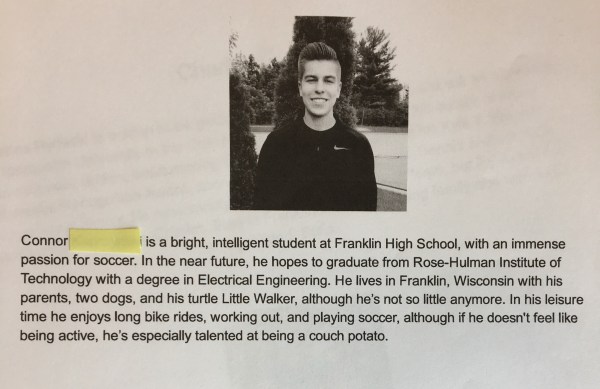
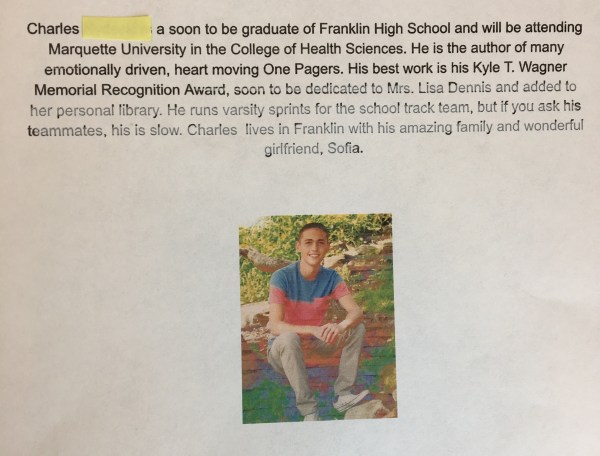
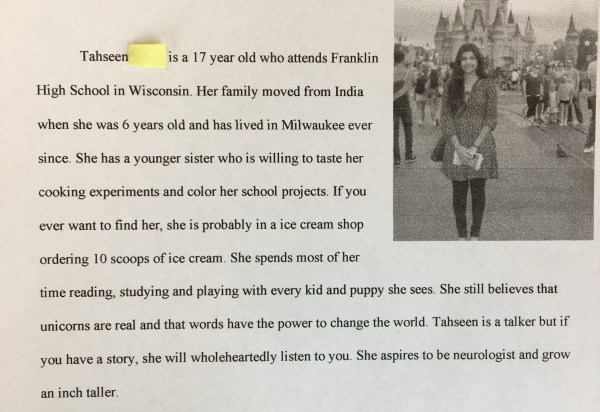

 year was a time to have students start summarizing work that we had done in order to demonstrate cumulative knowledge, as if a project could encompass all we’d learned together. In the past, I believe I was missing the point.


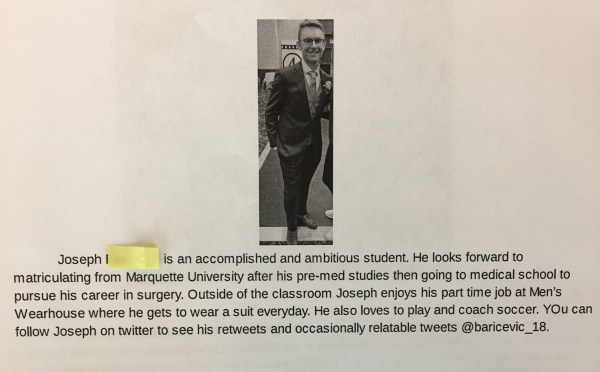
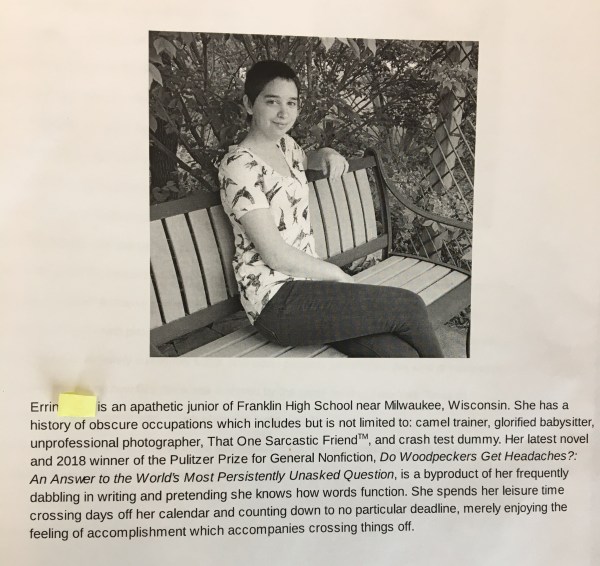
 I prepared first by reading the inside back covers of some of my hardback YA literature. I chose four bios with similar elements: Andrew Smith,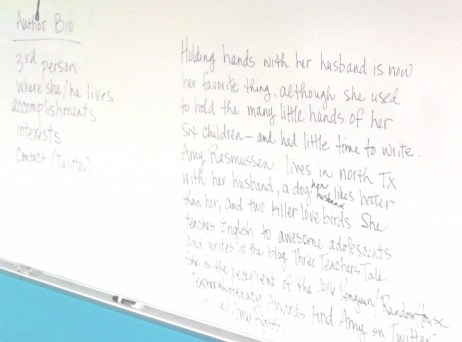
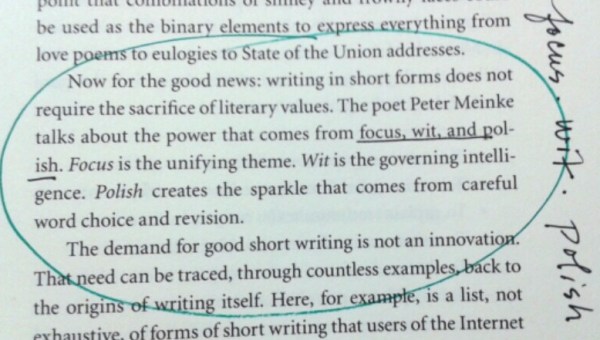
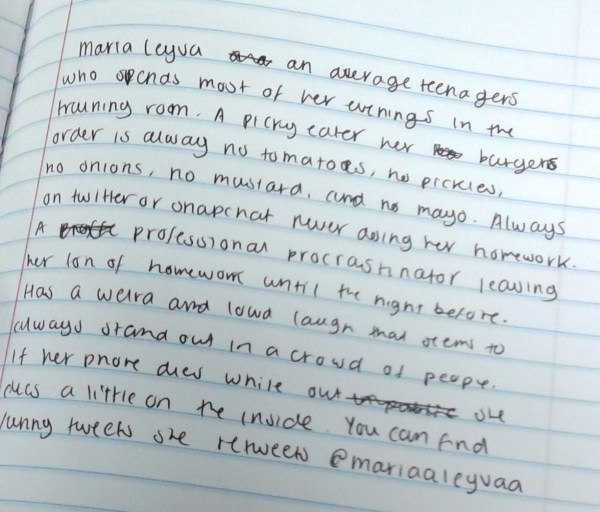


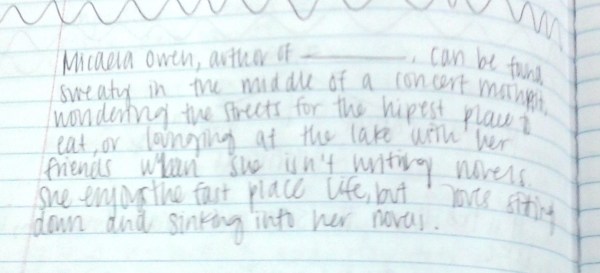
 I reminded students as they write over the next few days — finishing their multi-genre projects, their last major grade — to write with intention, to write in a way that shows the answer to the last question I’ll write on the board this year: How have you grown as a reader and a writer?


 y helped my students grow as readers, too. Anna’s favorite book of all time became the award-winning A Constellation of Vital Phenomena, while Connor was blown away by Ta-Nehisi Coates’ Between the World and Me. These books and more were chosen, read, and evaluated independently, without the confines of assignments or the too-broad sea of “your choice” to hold them back.
 I like to organize my thoughts this way. And, in no way am I suggesting that pulling ideas from a text is malpractice. At the end of the day, of course we need students to think deeply about their reading and demonstrate that thought through talk, written reflection, and/or analysis of some kind.


 Three Teachers Talk