Category Archives: Readers Writers Workshop

Sowing Seeds of Light: Reflections Following Time with Cornelius Minor

In October, I heard Kelly Gallagher explain that “our job is to create an ecosystem that serves to democratize opportunity.” In December, I observed Cornelius Minor facilitate this in my classroom. Yep, you read that right. THE Cornelius Minor spent an hour with my students, modeling the moves he makes to “disperse power throughout the room,” swiftly engaging students while simultaneously instructing a group of educators.

At all times, Minor modeled what democratization looks like. Prior to the hour in my classroom with students, he spent time with the staff who would be present during the lesson, in his own words, “planting seeds of ownership.” He asked us, “How are you?” and “What’s one thing to work on with you that would meet the needs of students?”. We delineated this, worked in conjunction with him to plan the lesson, and ultimately, “opted into learning” (Minor’s words again).

What followed in the classroom portion of the experience was remarkable. Because my colleagues asked for modeling of close reading, selecting evidence, and metacognition, Minor engaged the students in a digital text–a short video clip from a TV show–and chunked close reading into noticing stuff and providing structured opportunities for talk (structured in that each student had a role to fulfill). From there, he moved to a more complex text (a controversial poem) and continued to ask students to notice stuff; then he offered multiple perspectives on the text, asking students to grapple with these frames, seek evidence, and explore the inherent symbolism. My students simply, as they later reflected, had no timed to get bored or distracted. I observed true cognitive energy, energy sparked by intellectual curiosity, energy that connected my students one to another, each connection a charged particle contained into a beam of light on that December morning.

This light pushed me to confront the idea that my kindness and my work ethic will be enough. That when things aren’t quite right in the classroom, I can just work harder–at relationships, strategies, skills, feedback, whatever. I am not Orwell’s Boxer. In fact, if I continue defaulting to my strengths (of hard work and kindness) instead of working in small deliberate ways to grow, I oppress my students and myself. I’ve got work to do. I’ve got new terms to perseverate on, strategies to focus to, and questions to keep asking myself. And that beam of light will keep me focused on growth.

Terms to Absorb

Important: (for the student to know later–for that test, the next class, college): a teacher-centric term, a framing that doesn’t necessarily account for students’ perspectives or experiences at that moment.

Text Agnostic: without preference for specific texts. See “important” above. Connects to the value of choice in workshop. Means seeking out regularly what’s on students’ minds to cull texts.

Cognitive Overload: what a learner experiences when both the context and content are beyond readiness (both content and context are hard or unfamiliar). This stifles growth and ultimately creativity.

Justice: “what love looks like in public” (Minor).  

Aspirational Discomfort: What I’m experiencing as a professional right now. Have I mentioned I’ve got work to do? But I’ve already mentioned my Boxer-like tendencies, so…  

Strategies to Disperse Power

Feedback: One of the most important ways workshop presents opportunities to democratize learning is through feedback. Yes, by providing students with affirming and constructive feedback, I communicate to my students that their ideas and words matter in this classroom. But by seeking feedback from students (which is an additional strategy Minor modeled so well), I model the openness a writer needs for growth–even when not modeling this with writing. After all, I am a person in position of authority seeking opportunities to keep growing and getting better. Yes, we tout teacher vulnerability all the time as a tenet of workshop. But there are a million tiny little ways to do this beyond what we do already that will strengthen our ecosystems.

  • Position students in roles to provide feedback (and Minor emphasizes to let students know you’re doing just that); during his time in my class, Minor selected a student to help signal when something was confusing. Since his visit, I’ve been more deliberate and consistent about pulling aside a few students to check in on my pacing, and I plan to make this a routine in my classroom.
  • Seek feedback mid-stream: check in with students in various ways. Ask for permission to keep going. Ask how they’re feeling. Read Minor’s book and you’ll discover other informal ways, including the on-the-fly class meeting.

Roles: A fairly common practice of collaboration, especially within small groups, relies on taking roles.

  • As a teacher, I can share with students when I have conflicted feelings or interpretations of a text (this is a good thing–it models how our understanding is always evolving. Several students reflected on the power of this.).  Awareness of my confliction communicates that the authoritative interpretation of the text doesn’t begin and end with me. My role shifts, however infinitesimally. 
  • Use these conflicted interpretations, critics’ various interpretations, or ones students generate themselves to assign students roles to take. Minor used a complex and controversial text and, after offering two ways to frame it, assigned students (using partners A  and B) to find evidence to support their viewpoints. Roles extended to other tasks of this close reading of this text. Another student noted how “each person had something to look for” while another remarked that “he made us all feel included and excited.”

Questions to Encourage the Reflection Necessary for Doing the Work

  • How do I fuel my students to preserve that cognitive energy?
  • How do I scaffold experiences so as to avoid cognitive overload?
  • In what ways and at what times do my students “opt” into learning?
  • In what situations in the past have my students “opted” into learning?
  • In what ways can I plant seeds of ownership?
  • How do I send power throughout the room?

I’ll keep doing the work. I’ll continue the journey of democratizing my classroom in small ways, every day. I’ll work to improve how students see themselves in my classroom, helping them harness the power that’s always been theirs. I’ll keep sowing seeds of light. 

Kristin Jeschke teaches College Prep English and AP Language and Composition at Waukee High School in Waukee, Iowa. She marvels at her students who so readily engaged in the moment, even with a classroom full of educators studying their every move. She marvels, too, at the light emanating forth from the giants in our field, inspiring us all to keep reaching. Follow her on Twitter @kajeschke. 


A Day in the Life: Re-Starting with Narratives

The start of the second semester has been refreshing–maybe it was the two-week break that felt indulgent and a shuffling of students, or the fresh snow that sweeps over the Wasatch mountains weekly, perhaps the feeling that it is “August” in room 104 and we creating a rhythm with new workshop routines.

After attempting a balanced approach in a new school, giving students only glimpses and tastes of workshop, I have fully shifted gears for the second semester now that I know this school wants the creation of readers and writers, not compliance or approval seekers.  This semester, I plan to take laps around narrative, informational, and multigenre writing, and although each genre study will be faster than ideal, it is better than sticking to the old ways. 

Starting with narrative in a new year, several quick writes and write besides in our notebooks invited students to notice the rich source of their own lives.  As a “first lap,” as Penny Kittle and Kelly Gallagher term craft study in 180 Days, with narrative, I asked students to craft or select a picture that symbolizes their lives as second-semester juniors. I asked, “What is your life like now?  Who are you today, a junior in 2019?” Students are at a transitional time in their lives– they are looking ahead to the next step, making choices about what direction to go and who to be. I want them to show, tell, explain, and reflect.

My students needed a change.  My logic, like so many of you exploring and diving into workshop, was this:

Discussions as Readers x Discussions as Writers / Mentor Texts = Authentic Writing

  • We need to get back into our notebooks.  As we explore narratives, taking “laps” around mentor texts and reading like writers, students will write beside these texts. Rooting into what students know, themselves, will offer an access point to workshop writing.

Years of traditional English classroom expectations + My misguided start to the first-semester x The 3 by 5 Paragraph Essay = Is this what you wanted?

  • My students need to be challenged with choices and the decision-making process.  Majority of students see writing as an English-only endeavor and are hesitant to break from “Is this what you want?” to “I made this decision here because ___,” putting their choices and ideas at the center.

Required Curriculum + Low Classroom Investment = Disengaged Environment

  • Asking students to select a picture that reflects who they are in this moment, their fears, challenges, what makes them feel successful and unique, is another way to connect to students, as well as create space for student voice and individuality. The task mirrors notebook writing “beside” or “around” a picture, poem, or mentor text, which we spent time doing sporadically last semester and daily this semester and challenges students to be the creator and curator, making editorial decisions as an artist, then explaining as a writer.

As we have drafted, revised, and share I have learned more about my students and they are finding a cathartic release.

screen-shot-2019-01-16-at-8.38.27-am.png

Abraham reflected on the importance of animals to his culture:  I also love farm animals and horses. These are important not only to me but also to my parents because they grew up with farm animals and they helped nourished them and their families. All these animals have become a major part of our culture, specifically the horse used for work or transportations and rodeos. Then we have other farm animals that shape our traditional dishes.

screen-shot-2019-01-16-at-8.38.14-am.png

Ronata’s picture showed the importance of art in her life: I like to think that justice is an art. A piece so beautiful and unique, it is impossible to recreate. I’ve been taught about justice all my life, that it’s about people being treated equally. BSU has helped me realize how unjust the world’s ways are, and what ways I can help people understand that everyone needs to be treated with the same respect. Everyone has the same rights, yet society makes it seem as though people of color’s rights have no meaning at all.

screen-shot-2019-01-16-at-8.38.54-am.png

Katherine is seeking balance: The presence of my phone indicates a contrast between stereotypical adolescent behavior and my reality. As many teenagers utilize their iPhones and Macs to pursue recreational avenues such as social media or Netflix, I spend the majority of my time enveloped in the educational bubble. Rather than Snapchat or Instagram, my school email is open. Each unopened tab represents something I have to do.  This chaotic nature is indicative of my own thoughts, in which I endeavor to maintain a semblance of control.

(portions of pictures used with permission)


So my life now? A desk full of post-it notes with mentor texts, a dog-earred copy of 180 Days that is being read for the umpteenth time, a continuously revised calendar, a check list of students I have conferenced with, all next to a coffee cup.  We are off to a great “re-start” with workshop.

Maggie Lopez is enjoying ski weekends in Utah while pretending it is August in her classroom.  She just finished Killers of the Flower Moon and is currently reading Beautiful Boy to convince a student that it will not be “boring” compared to Tweak. You can follow her at @meg_lopez0.

Keeping It Real As a Teacher of Writers

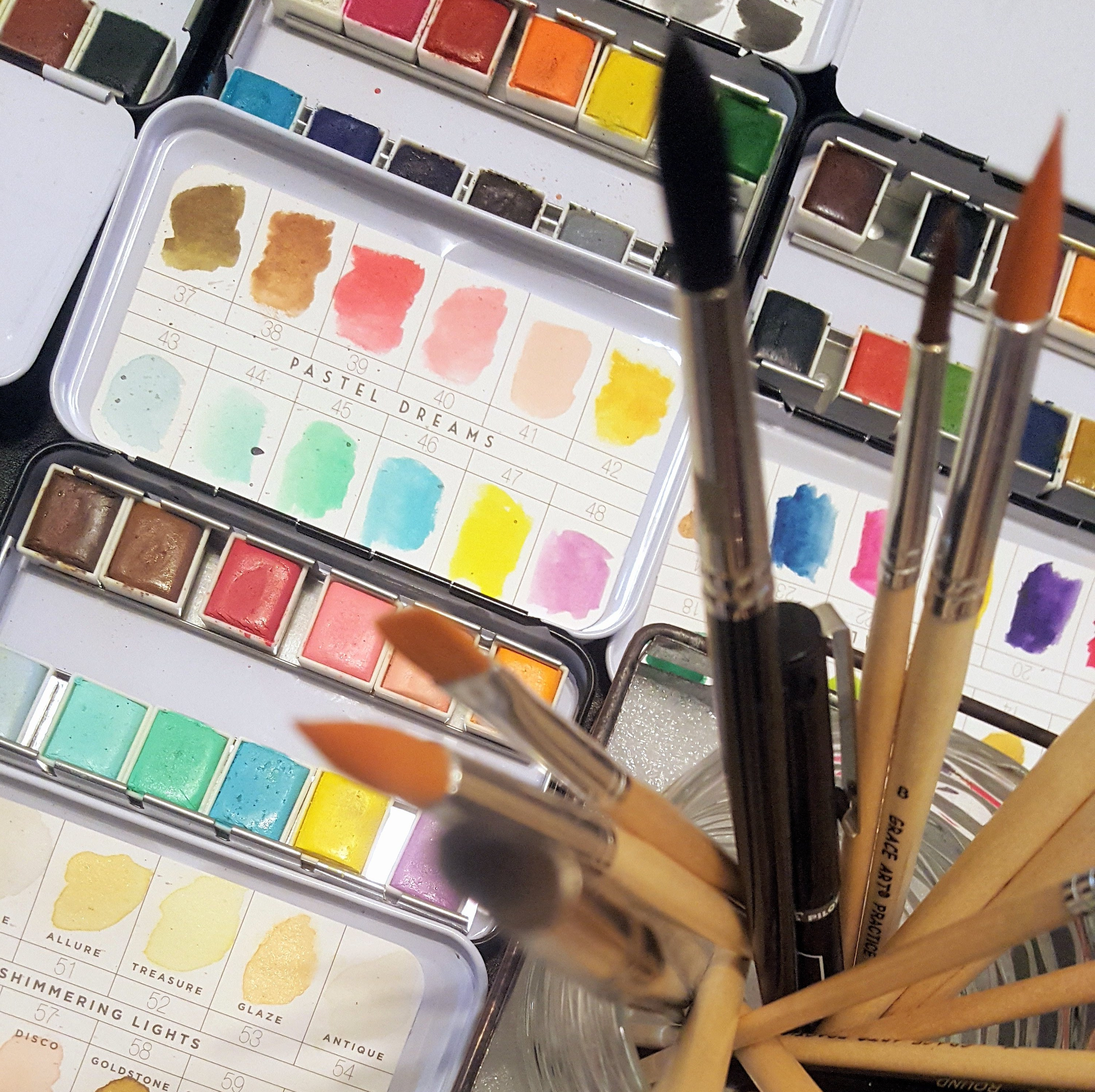
I have taken up watercolor. It’s been ages since I tried a new hobby, and I find the challenge pretty intense. Prone to put perfectionistic pressure on myself, my need to “get it right” limits my ability to play. This is problematic. And pretty stupid.

I will never get better if I do not take risks — with brushes or pigment or with the water.

For a long while now, I’ve followed my friend Laura’s work with watercolors. Her talent paints.jpgpiqued my desire to give painting a try, so I sent her a message asking advice on beginner supplies. She was gracious and encouraging in her response.
Then, I bought not three brushes but nine, not one medium-grade paint set but five, not one pad of paper but seven — in a variety of sizes. And I saved over 48 watercolor tutorials on Pinterest, plus, watercolor images of flowers, people, trees, waves, birds, landscapes, gardens. . .and pigs; and followed 18 watercolor artists on Instagram.

Because it seemed a lot easier to get ready to learn to paint than it did to try and fail.

Kind of like writing.

If you’ve read this blog awhile, you know I’ve been thinking about writing a book almost since starting 3TT. I’ve outlined three now. But I think and talk and read what others say about writing much more than I write. Like my hesitation about painting, this is problematic.

Of course it is.

And it reminds me of many of my student writers — the fear of getting it wrong or not making the grade, the vulnerability it takes to put ideas out there.

It’s real, and sometimes it’s stifling.

As I’ve worked to conquer my fear of learning to watercolor, practicing lessons on Skillshare (which has a plethora of lessons on multitudes of topics — check it out if you haven’t), trying new brushes and different washes and color combinations, and, finally, just relaxing into my art, I’ve discovered what I hope all young writers discover:

Writers must write for themselves. They write because they feel the tug of it, the need to express thoughts and ideas and meaning. Because they want to. Just as I paint for myself –the joy of it, the adventure in seeing if I can, the peace it brings me.

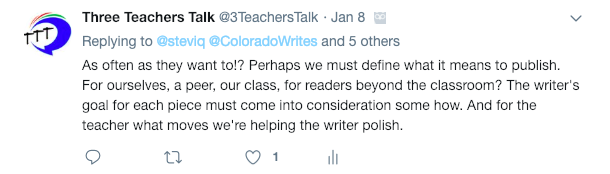
Recently, 3TT was asked this question on Twitter:  How often do you think MS and HS writers should publish? and I responded–

3tt tweet

I’ve thought about this exchange a lot since, and my thinking has led to more questions than answers:  How can we help our writers set personal goals for their writing? Which comes first:  the personal goal or the desire to write? If there’s no desire, can writers still write well? Does it matter if students write well?

Of course it does.

But just like every watercolorist finds her style, every writer must find his. All too often, school writing means prompts and formulaic structures, word counts and rubrics that restrict meaning-making more than they invite it.

So what can we do to open spaces that invite writers into the vulnerable places needed to grow? The best way I know is to keep it real.

Here’s a short list of what real means to me as I teach writers.

  1. Design Lessons based on what real writers do. For example, they don’t use standardized prompts — they come up with ideas they want to explore, creating their own prompts. Try quickwrites that inspire students to think about their lives and the world around them. Plan time for them to talk to their peers in ways that expands their thinking. Plan time for them to explore topics that interest them or challenge their thinking. Don’t just ask students to write about what they know. Ask them to write about what they notice.
  2. Make your writing life visible. Our writers need to see our thinking as we organize our thoughts into words on a page. They need to see us clarify, discover, and make meaning. They need to see that revision leads to improvement. Revision is not just a one-and-done step in the writing process. It’s not a strategy. Revision is a living breathing move writers make, and they make it often. Model all of the moves you do as a thinker, reader, and writer.
  3. Talk about everything related to writing and writers. “Writing floats on a sea of talk” (James Britton). Our writers need to share their ideas with one another — and with us as writing coaches in conferences. Often, we wait to invite writers to talk about their writing in peer feedback groups or in conferring sessions after they have penned their drafts. Real writers talk throughout their writing processes — from idea to draft into revision and on to redrafting. Talk leads to clarity and discovery, and in my experience, purposeful talk is the best resource teachers have for helping all students grow in confidence as writers.
  4. Immerse writers in beautiful language, clever word play, effective and powerful stories, essays, and poetry. Mentor texts that show students the impact of word choice, figurative language, and everything else from how an author creates believable characters to using dialogue to propel a plot forward are valuable teaching tools. Studying mentor texts helps students internalize what writers do. They come to recognize organizational patterns and structures they may choose to use in their own writing. Before I write pretty much anything of import, I study mentors. Don’t you?
  5. Make writing personal and purposeful. When we write about things we care about for readers we care about, we make deliberate choices as writers. Too often, and I am guilty of this myself, our writers only write for their teacher. Now, maybe your students differ from mine, but I’ve taught many a writer who didn’t care that I was her reader, and it showed. However, when I removed myself as my students’ primary audience and worked to build a community of writers where they wrote for one another, almost every student (sadly, there’s often a few hold outs) began to take greater care and ownership of their writing. They knew they had readers other than me. Of course, we can also help students determine outside-of-class purposes and audiences for their writing, and I encourage it; however, I’ve found that sharing our writing within our own classroom community is just as effective.

By no means do I claim to know it all when it comes to teaching writers. The puzzle working with adolescents is as real as my desire to help them grow as writers — and my newfound desire to learn to watercolor. I do know authenticity matters. When we make choices about literacy instruction, steeped in the authentic practices of what real readers and writers do as they read and write, more students engage in the tasks we ask of them. They take more risks. They more often than not rise to the occasion. And they shine as writers in their own right.

If you’ve made it to the end of this post with me, I appreciate you. And while I am not super confident in my watercolor abilities, and I have a ton to learn about the art of it all, I do have a stack of 20 bookmarks I’ve painted — mostly of birds because they make me smile. If you’d like one, share this post, follow me on Twitter @AmyRass (if you aren’t already), and send me a direct message with your name and address. (First 20 only. I’ve got a book to write.)


Amy Rasmussen has decided she loves teaching writers more than she loves to write, but she’s working on a balance of that as she attempts to discipline herself to “get ‘er done.” She has also decided that watercolor painting is harder than it looks. Amy’s currently on a “gap year” from the high school English class as she works on a book about authentic literacy instruction and facilitates professional development as an independent literacy consultant. She misses kids. A lot.

A Friendly Resource for Revising and Editing

The current version of my instructional practices, philosophies, and beliefs was born a couple of years ago. Word spread that our new curriculum coordinator was a “workshop” guy and, coincidentally, I was in a place where change was on my mind.

Traditional “drill and kill” methods heavily supplemented with canonical whole class novels and their hip-tied reading guides left me unfulfilled in my “teacher feels” and I knew there had to be a better way.

Serendipity through reader’s/writer’s workshop…

Much of the credit for the strengthening of my instructional practice can be attributed to the people I’ve met who provided me the opportunity to explore and improve my craft. Teaching next to brilliant people and participating in our Literacy Institute are invaluable experiences. Much of my improvement can be traced to those teachable moments.  Other sources of wisdom came in the form of “Hey, have you read anything by [insert important name here]?”

That spring, many quiet lunch periods were spent hunkered over a professional text, sweating from having just walked off the football field, highlighting brilliant thoughts, taking notes, absorbing as much knowledge as I possibly could.

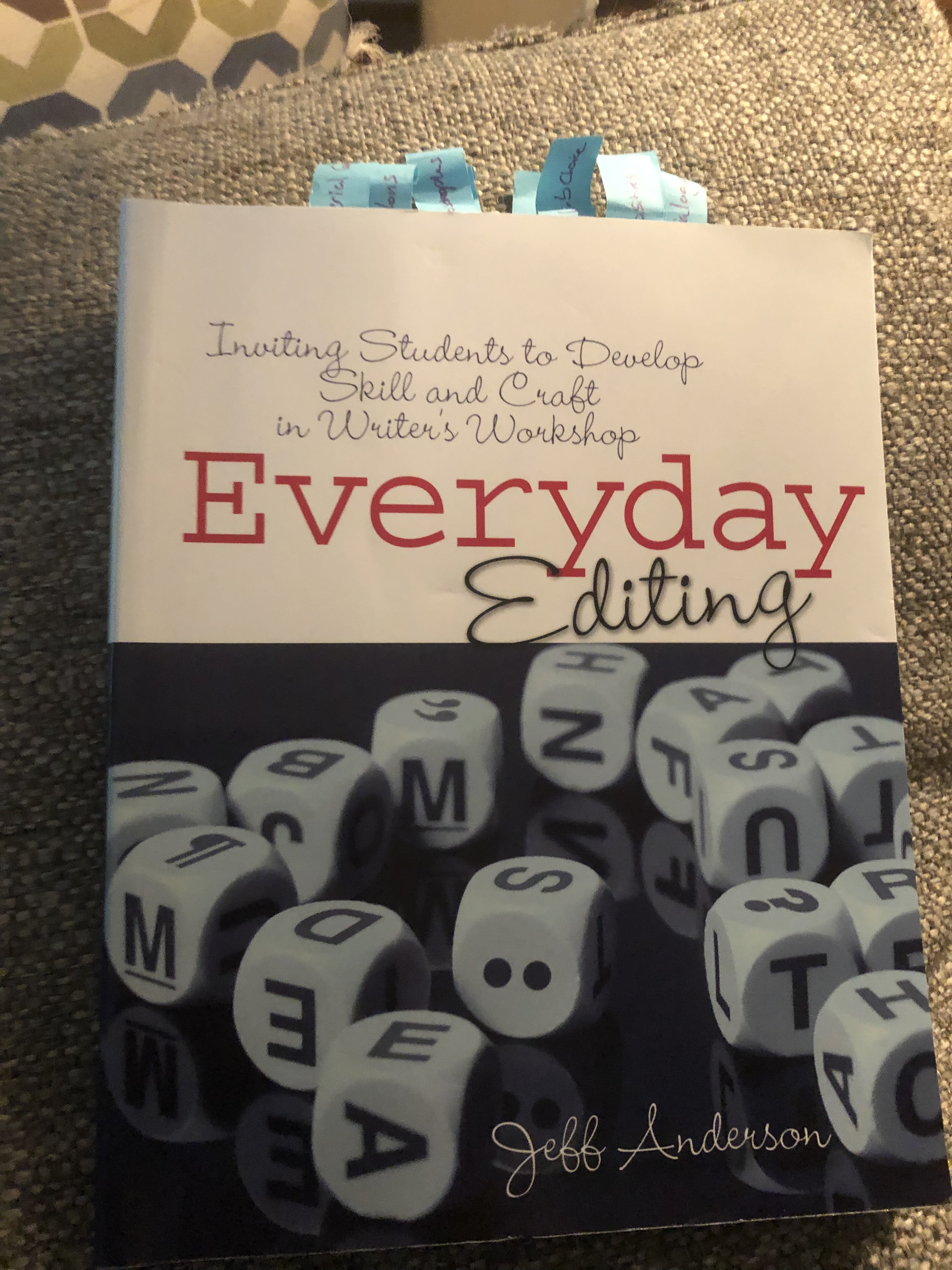
Lucky for me, one of the first places I visited was Everyday Editing by Jeff Anderson.img_5011

Our upcoming (and ongoing) revising and editing emphasis leads me back into one of my favorite books over and over.  I just can’t stay away from the wisdom contained in this book and the lessons it possesses beyond writing instruction.  This book outlines a path for exploring any skill that students need, and I found that the wisdom contained there-in reaches across the areas of emphasis in our workshop.

I love so much about this book.  Not just the content, but the craft, as well, is brilliant. Anderson breaks the teaching cycle down into nine parts, and, while at first wrapping my head around that many ideas felt daunting, eventually, this book helped polish my teaching methods to a point where I felt very comfortable.

The idea that I need to “invite” my students to join the process of editing is, I think, what this book is really about.  This shift in focus, from teacher to student, is one that proves difficult for many teachers, myself included.  Anderson explains, “I invite students to notice, to read like writers, to come into the world of editing – a friendly place rather than a punishing place, a creational facility rather than a correctional one.”

This right there!!! That sentiment that we can let the students tell us where they are with their understanding and where they need support is what left me gobsmacked.

Anderson repeats this idea over an over using several editing lessons. He takes the reader through the instruction of serial commas, appositives, paragraphs and dialogue.  We learn about using colons, apostrophes, and several other skills. But really, we learn that giving students the space and encouragement to explore their own learning is the best way we can build writers.

He breaks the process down into nine parts and they are so fully explained that even a football coach like me can employ them in a writing workshop. They are:

  1. Invitation to Notice
  2. Invitation to Imitate
  3. Invitation to Celebrate
  4. Invitation to Collect
  5. Invitation to Write
  6. Invitation to Combine
  7. Invitation to Edit
  8. Extending the Invitation
  9. Open Invitation

The first part, invitation to notice, provides us the opportunity for formative assessment right at the jump, and saves time in the lesson cycle. Too often, our assessment focuses on where they are in their learning at the end of the lesson and not on the growth in their understanding.  How can I optimize my instruction if I don’t measure how far they move in the time we work together?  I can’t, and if I don’t, then I’m just throwing out lessons and moving through lesson cycles robotically without any opportunity for the students’ powerful voices to be heard. Also, if I allow them to show me what they notice, I might learn something from them.  A scary thought.

The second part, invitation to imitate, teaches the writers to hang their own ideas on someone else’s frame.  I’m an old man and, more than ever before, I look at texts as mentors not just in content, but in craft.  Our students need that experience as well.  If we show them that mentors are everywhere, we open them up to worlds outside the four edges of a text and the four walls of our classroom.  So much of what we learn about life comes from the people we see and hear. That sentiment should inform our writing instruction as well.

The third part, invitation to celebrate, is one I didn’t understand well, even after reading this book. This one required a great deal of thinking for me to fully understand its importance.  Anderson makes it clear that correcting the writing of our students doesn’t make them better writers. He tells us, “In fact, correction may even stifle, crush and suffocate celebration” (32).  Instead of tearing our writers down, we should share in the joy of the successful writing experience.

Just those first three moves are incredibly important in our work. I’ll write about the next three parts in two weeks. Until then…


Charles Moore is blown away by how quickly the students in his classroom jumped back into their routines this semester and their joy in learning about reading and writing together.  He loves seeing their faces scrunched as they struggle through revising with purpose.  He loves this work and is massively thankful that he has the opportunity to share in the growth his students are experiencing. 

Making Time To “Slack Off” Is My New Priority

Throughout the year, I am guilty of getting caught up in the busyness of the daily grind. I never keep up with the latest Billboard Top 100s, the celebrity gossip, trending shows on Netflix or what is new in the theaters. Additionally, I seem to never find enough time to do the things I love like crafting, reading, etc. Naturally, the break seemed like the perfect time to do all of the things I don’t normally get to. With the break nearing the end, how many things on my list have I done do you ask? Not one.

Did I read the books I intended? No. In fact, they are on my desk in my classroom because I forgot to grab them as I flew out the door once the bell rang.

Did I binge watch any shows or catch up on my favorites I have missed? Absolutely not. In fact, the TV hasn’t been on very much. When it has, the remote control is never under my command.

Did I clean my house? No. My Christmas tree is still up as are all of the decorations. I even have some laundry that hasn’t been put away in over a week.

Did I break out my Cricut machine and craft my heart out with all of the projects I saved on Pinterest? No. Not in the slightest. I haven’t even turned it on in almost a month.

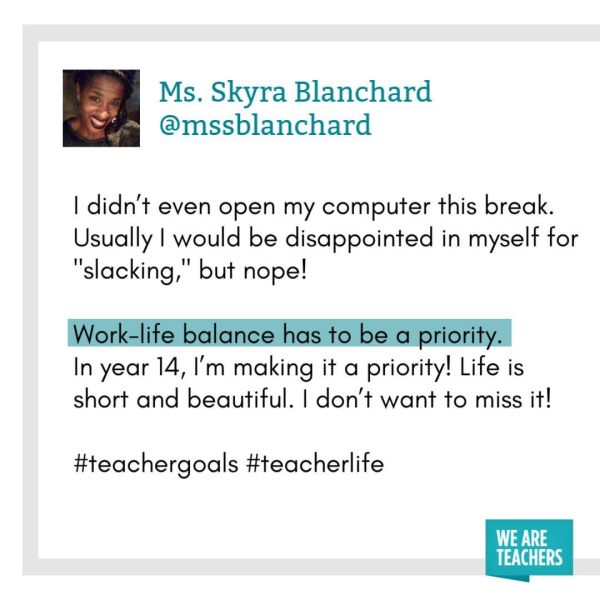
With all of the resolutions people are posting, I am exhausted thinking about all of the commitments, energy, and creativity that seems to be inspiring everyone EXCEPT me at the moment. I thought about downing some energy drinks and sucking it up to begin to tackle the emails, grading, and cleaning while I still have a little time left. Then I came across this while choosing to peruse Facebook instead.

unnamed

It was then that I immediately decided to ignore the inner voice that made me feel “less than” for choosing to “slack off” during my break.

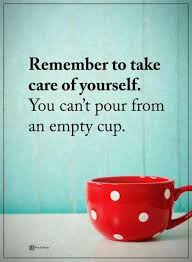
Unknown 1We have all heard the phrase… You cannot pour from an empty cup. I wholeheartedly believe that this sentiment works both ways. We cannot give to others if we do not feel whole ourselves. Our intentions can always be from the heart, but intentions don’t create change. Actions do, and sometimes, I simply do not have enough energy to act in ways I would like.

The same can be said for our students. As a adult, if I am in need of a physical, mental, and emotional break, then our KIDS are in need as well. We need to be able to model these moments for kids, too.

So here is what I DID do. I spent time with my family doing nothing except enjoying each other’s company. We played board games, painted rainbows, we colored endless amounts of pages in new coloring books with fresh markers, and we went to more movies in the past week than we did the entire semester. (Trust me, I probably ate my weight in movie theater popcorn. #noregrets) Our favorites were Aquaman, Bohemian Rhapsody, and Mary Poppins Returns.

Getting lost in movies, relaxing, allowing myself to NOT feel guilty about the stack of papers I didn’t grade or the stack of books I didn’t read has been one of the best decisions I have made in the last year. I vow to ensure that I make time for more “breaks” not only for myself, but for my students as well.

WOOPI came across this post on We are Teachers entitled Why “Think Positive” Isn’t Always Enough (For Teachers or for Kids) This shift in thinking might be what is needed in order to make sure that this “balance” continues in my classroom. Being realistic about what we need, when we need it, and why we need it might be the missing piece to accomplishing goals without feeling burnt out and overworked. This post highlights a WOOP strategy in setting realistic expectations and goals for both students and teachers. 

It is definitely worth a try.

What are some ways you balance the burnout?

200-2

Gena Mendoza teaches High School English in San Antonio, Texas. At the moment, she is savoring every second spent cuddling her family, including her 2 human and 2 fur children. She loves a good fluffy blanket and pair of fuzzy socks to get her through the rest of her break. She invites you to connect with her on Twitter at @Mrs_Mendoza3


I’ve Got Three Problems

Of course, making New Year’s resolutions is nothing new. Perhaps keeping them is. At least for me.

If you know me well, you know I am an idealist. I usually wake with Big Ideas that go onto lists and into Whatsapp convos with my blogging partners. But lately, actually, for a long while now, my first thought of every day has been:  What is it you want?

I do not have an answer (at least not one simple enough for just one blog post), but I do have a pretty clear idea of what I do not want. We can all probably make that list — easy.

I read Seth Godin’s blog pretty much daily. He’s a marketing guru, and I find useful info in his short quippy posts. On the last day of 2018, he published  Hilbert’s list.  It begins like this:

In 1900, David Hilbert published a list of 23 problems that he proposed would be the important ones for mathematicians to solve in the upcoming century. That list led to a focused effort that lasted a century, and the vast majority of the problems have been fully or partially solved. Ignoramus et ignorabimus is a foolish statement. We can know, and one day, we will.

Technology (the technology of connection, of devices and of knowledge) can create a surplus. The cost of light, of transport and of food has dropped by orders of magnitude in just a few lifetimes. Most of us waste electricity, water and other essentials in ways that would have been astonishing just a generation ago. Privileged populations go to the doctor for illnesses that wouldn’t even be a topic for discussion among those with less access to the surplus that we’ve created in access to healthcare.

Surely, we can build a better future with technology instead of focusing on autonomous drone delivery of a latte 9 blocks away in San Francisco.

As we enter a new year, one in which technology promises to move faster than ever, it’s worth considering what our 23 problems might be.

Then Godin suggests we make a list of the problems we want solved, personally and/or globally.  He states, “Technology doesn’t have to be high-tech. It can simply be the hard work of finding generous solutions to important problems, big or small.”

And this made me think about teaching, specifically teaching our readers and writers to be better readers and writers. I could probably come up with a list of 23 problems, but I think a concerted effort on just three would change literacy education as we know it. Thus, we change the lives of our students — and potentially, the world.

  1. Equitable systems that validate, celebrate, and allow educators to teach into the personal and unique strengths and needs of each learner.
  2. Authentic literacy experiences, including easy access to a wide array of vibrant engaging books by diverse authors our readers want to read; and using these texts to teach writing — the kind of writing our writers want to write, and readers in the world want to read.
  3. On-going professional learning at every level of literacy education, which builds content-specific skill so administrators and teachers know how to engage and instruct readers and writers through authentic literacy experiences.

As we step into 2019, I commit to adding my voice, to pushing back against the status quo, to advocating for students and teachers. As Godin says, “Our next steps might be far more effective than simple resolutions, which are easily ignored or pushed aside. We can work toward dignity, toward access, toward seeing the world as it is…” Or perhaps more importantly, toward seeing the world as it needs to be.


Amy Rasmussen is excited for the New Year and looks fondly back at 2018. She made some important career moves, changed homes, welcomed two new grandsons, and met her reading goal of completing 66 books. Follow her on Twitter @amyrass

2019 New Year’s Resolutions!!!

Image result for 2019 new years

Happy New Year!!!

I’m so excited to enjoy the next six days of our winter break. So much love and laughter to be enjoyed along with morning daughter cuddles, football galore watched with my son, knowing looks shared with my wife when the kids do or say something intentionally or unintentionally hilarious.

There is, however, still work to do.  The pool needs upkeep, trees need trimming, and there is that old corvette that needs an oil change and some drive time. I still need to prepare content for my presentation at TCTELA and dig my old lesson plan template out of the Google Docs mothballs.

Also, some forward looking introspection in order, as so many of us do, in the form of a few New Year’s Resolutions.

  • Lose Some Weight

The weight of my feelings about our educational system wears me down. It weighs on my like a heavy coat on a summer day.  More of my attention needs be directed towards variables I control not those controlled by others. Be gone ye negative thoughts.

  • Eat Better

Too much of what I consume lately comes from Youtube and Netflix. Instead, more of my content should come from Kittle, Gallagher, Beers and Probst, just to name a few.  My professional library is extensive and 2019 can be a year to dive back into the “classics” and remind myself of all the amazing knowledge and experience sitting on the shelves in my classroom.

  • Travel More

So often, I am content to bury myself in my classroom and the work that needs to be done there.  Literacy exploration is quickly becoming my life’s work, but I can’t stay cooped up in my self built museum, curating the practices I’ve mastered and going back to the well over and over.  Brilliant teachers litter my building, my twitter feed, and the conferences I am so lucky to attend.  2019 will be the year I

  • Meet Someone

Brilliant teachers litter my building, my twitter feed, and the conferences I am so lucky to attend.  2019 will be the year I reach out more than ever before to make connections with people that can make me a better teacher.

  • Get out of Debt

So much of my day is regimented and planned down to the second.  Alarms bleep and bells ring and then the day is over just as quickly as it began.  I always feel like I’m behind on grading, parent contacts, and lesson planning and constantly building debt.  I resolve that 2019 will see me get back to the intricate and intentional lesson planning that lets me bring intricate and intentional lessons to my kids.  I’ll make time to communicate with parents and stay ahead on my grading.


Charles Moore knows that he is terrible at following through on resolutions but he also knows you can’t reach goals that you don’t set.  He’s excited for his second semester of graduate school and his second semester at Clear Creek High School.  He’s so thankful for the caring co-workers who’ve supported him during the recent heath issues that have affected his family. He wishes each and every one of you a successful and prosperous 2019.

Adopting a Persona as We Move to Adopting Workshop

I am committed and inspired to move into true Reader’s Writer’s Workshop after NCTE and a near semester under my belt in a new school.  I left for the conference in Houston with a plan to read The Great Gatsby in December, and as much as I wanted to totally scrap it and start with a routine inspired by Penny Kittle and Kelly Gallagher in 180 Days,  I didn’t.  

I paused.  

Although every classroom minute is precious and developing readers is the most timely need, I wanted to give myself time to process this shift, to think through how my classroom would run, and brainstorm how to help my students, who from my inquiries have only experienced the full class novel, navigate texts with more autonomy and independence.

Going from trained text regurgitation to full choice would have been a huge, potentially disastrous, shift for my students.  Since August, they have looked to me to create meaning, to judge whether their writing is “right” or “good,” asking what I think about the text versus presenting their own original idea.  These students will grow immensely from workshop, which makes me so excited for January, but I felt they first need scaffolding up to meaning-making and trusting their interpretation and ideas.

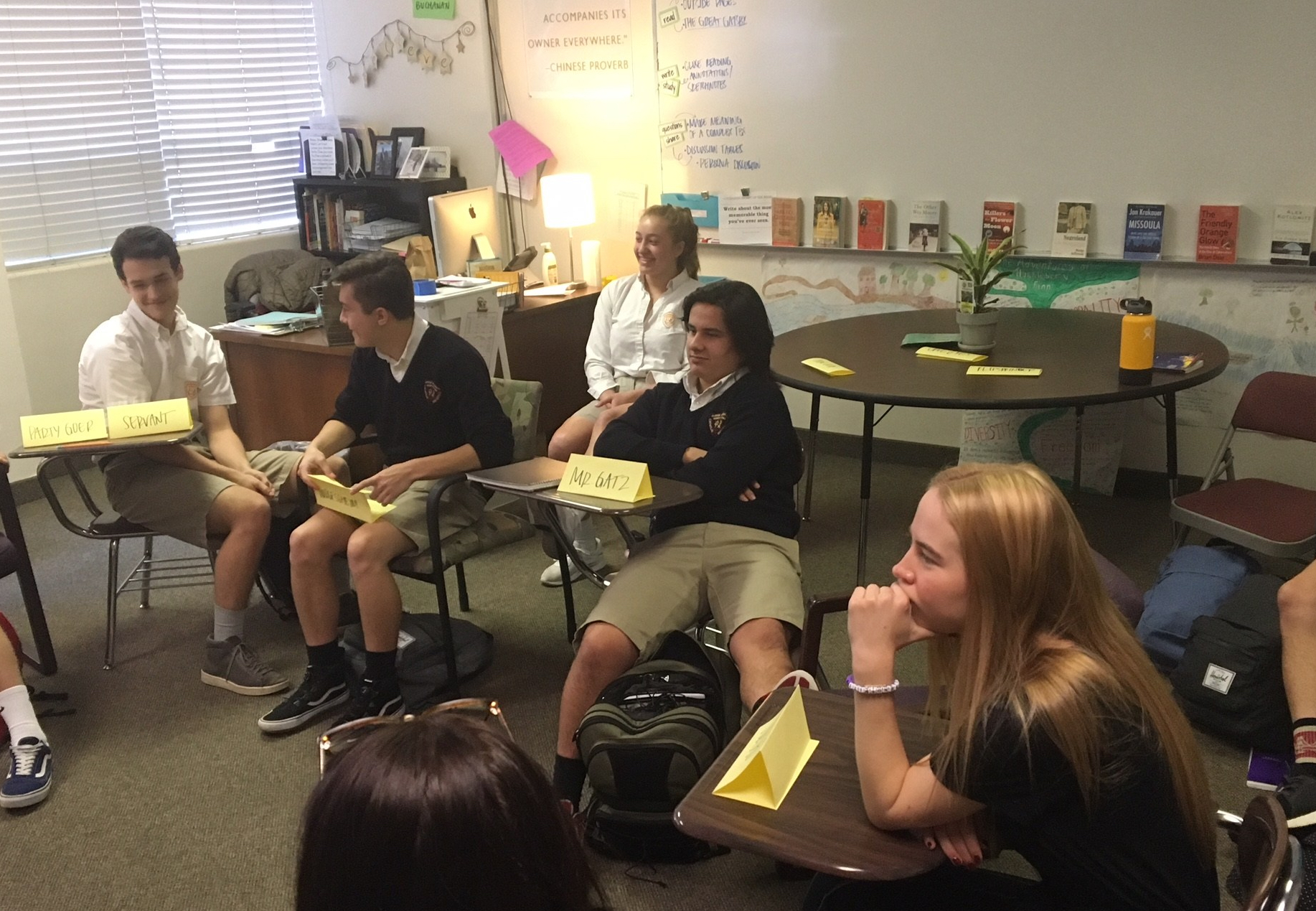
I created a Book Club atmosphere with students for our reading of The Great Gatsby, having students meet in “Discussion Tables” with their peers to process the text with each other.  As 180 Days suggests, I asked students to come with one question and one comment to their discussion tables.  Students were also responsible for close reading and annotating/sketchnoting key scenes of the text, commenting on development and language.  Their annotations served as a launch point for continuing and deepening the conversation. A Book Club-style approach allowed for a more structured release of responsibility to students while maintaining the shared experience of full class novels my students are accustomed to.  I stood back as an observer, listening in to their conversations, witnessing students make meaning together versus wait to be guided to a single answer or idea.

As the unit was primarily based on discussion and conversation, so was their culminating assessment, the “Persona Discussion.”  Students were given a choice of what character they wanted to embody, from the core characters like Jay Gatsby and Daisy Buchanan to more minor characters like Mr. Gatz or Meyer Wolfsheim, even “background” characters like the party goers were an option for students.  The core characters provided limited space for interpretation while added characters, like party goers, allowed for more creativity in the persona. Students signed up for a character and prepared by thinking through their characters in their journals.

IMG_0803.jpg

The discussion works like a Socratic Seminar, where students are the drivers of the discussion and can be adapted for both fiction and nonfiction.  I created this assignment for AP Language students who loved to debate and discuss in Chicago–they adopted the persona of Henrietta Lacks’ family, doctors, and author Rebecca Skloot after reading The Immortal Life of Henrietta Lacks.  For Henrietta’s Persona Discussion, the central question of the discussion was a quote about medical ethics. 

Students felt that the smaller characters were given a voice, an idea we discussed earlier in the passage when examining the wealth and marginalization of “the other” characters in efforts to disrupt the traditional text.  


Maggie, who played Myrtle, said she liked feeling immersed in the book:  “At first, I felt like Myrtle would only ask questions to Tom or George, but as we all started being our characters, I thought about how Myrtle and Gatsby were actually more alike and could have been friends, and I wanted to ask Daisy about her marriage more.”  Jordyn said the discussion was better for understanding the web of deception because “…it was like seeing the book as a play or real life and it made our group discussions more real or, like, meaningful.”  After discussing the text as a reader so much, Riley, a reluctant reader who has learned, as he admitted, to “fake it,” said, “It was more fun to prepare to play someone than to think about the big ideas for a regular seminar.  It made me want to do well and really know Tom.”  

As we build into full workshop mode in January, students have a foundation for how to enter a text, methods for creating meaning, and more confidence in their thinking.  Students were engaged with this type of discussion and reflected about their enjoyment, so I am going to incorporate it into next semester, perhaps jigsawing the characters from students’ choice reading or book clubs together from different realms or as a way to review major characters and texts before the AP Literature exam.   We’ll see what other “personas” develop!


Maggie Lopez is enjoying Utah ski season while re-reading 180 Days as she preps for second semester, American Girls: The Secret Life of American Teenagers before bed, and The Poet X in class.  She wishes you a very merry, restful holiday season!


A Sneak Peek at the List I Sent to Santa

I’ve never had the winter break creep up on me like this.  Between coaching responsibilities, Student Council activities, and English IV team lead duties, I always kept an eye on finals week, not because I wished for the semester to be over, but because that week meant we were out of time and every minute up to that point better have been accounted for.

The changes in my responsibilities, duties, and campus freed me up, I’ve come to realize, to just flat-out teach. Thus, I find myself staring at one more week of school remaining in the semester, confident I’m living my best teacher-life.

So I thought I’d share a few items I sent to Santa in the hopes he’s thought I was a good boy this year.  I only included a few of the items from my list because I’ll probably just end up with a lump of coal:

Item #1 – A Really Nice Pair of Shoes

My wingtips are hand-me-downs and the soles are so bad that by the end of the day my knees and ankles feel like I’m almost forty years old. Wait…um…

Item #3 – Notebooks and Pens

I love notebooks and pens and after reading Amy’s list of teacher supplies, I’m hoping to see a Moleskin notebook or a pack of Flair pens in my stocking.

Item #7 – More Amazing Reading Experiences

2a616ec2-a8b5-450d-b77b-56db55ce21d5-7652-00000076fb946ee6_file

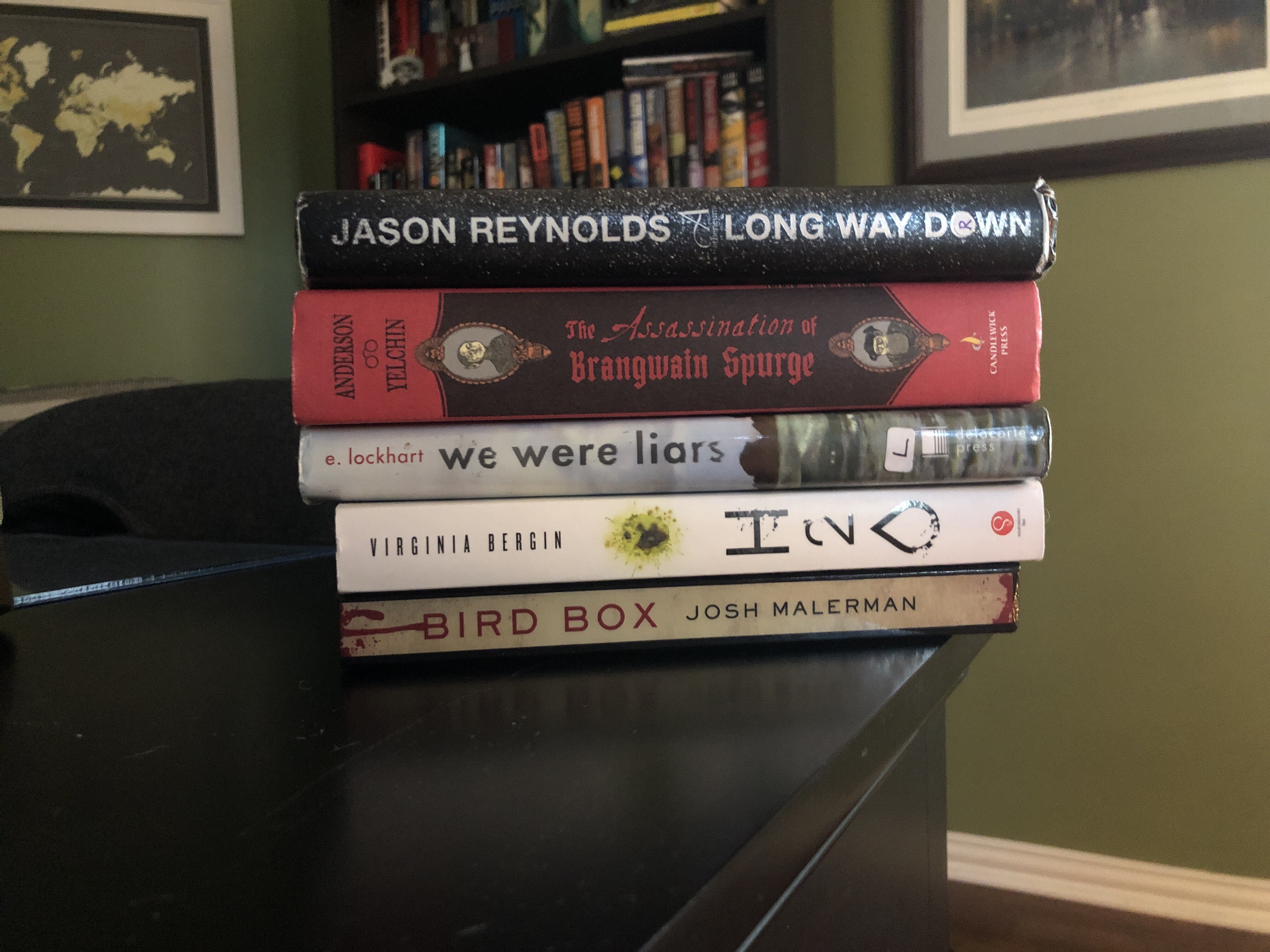
This is my book stack for the break.

I read a ton of books this semester, but most were assigned as required reading for my young adult literature class.  Since that class wrapped up, I’ve treated myself to Dry by Neil Shusterman and son, and I savored the immaculate The Poet X by Elizabeth Acevedo.  I also snuck in the guilty pleasure known as a Lee Child novel. Past Tense, like all Jack Reacher books, ended before I was ready for it to be finished. Currently, I’m bouncing back and forth between Nic Stone’s new book, Odd One Out, and A Very Large Expanse of Sea by Tahereh Mafi.  I love both of these books and will be talking about them in my classes in January.

Item #8 – More Amazing Reading, Writing, Thinking, Talking Experiences in My Classroom

Thursday, I whet their literacy palates with the first three pages from Dry before we looked at the pairing of this piece by Leonard Pitts and “The World is Too Much with Us” by William Wordsworth.  I should have an Elf on the Shelf in my classroom so that maybe Santa will catch wind of the amazing thinking, talking, reading and writing that the kids are doing in room D120.

Item #12 – Organic and Authentic Professional Learning

Maybe Santa can bring me more learning opportunities like this most recent adventure with the whole class novel.  A Novel Approach by Kate Roberts is a great resource and I’ve read Gena’s post at least three times, but I can’t say enough about how my colleagues facilitated my exploration of the shared reading experience in a workshop setting. They handed me a blueprint and I took it and ran…away from boring, disengaging, traditional teaching practices.

Item #15 – More Experiences like NCTE

Co-presenting with a team from Three Teachers Talk is going to be one of those “career highlights.”  I may never get the chance to speak on a stage like that again and I refuse to take it for granted. I can’t believe I’m so lucky. My batteries recharged from meeting Cornelius Minor, receiving a giant hug from Penny Kittle, sitting slack jawed absorbing the power of Christopher Emdin. I run on inspirational people and those were just a few of the men and women I look up to. I’m flying solo as a presenter at TCTELA, and my session is about research writing in the workshop setting.  Bring your popcorn because this sesh is gonna knock your socks off. It will be fun, and a growth experience. ILA, in the fall, is the next big conference for which I’m crossing my fingers and praying.

Item #19 –  A Dallas Cowboys Super Bowl Win

Is that too much to ask?


Charles Moore loves watching college and professional football with his son, but he hates losing to his mother-in-law in fantasy football.  Maybe the third time will be a charm as they face off again this week in the playoff semifinals.  Perhaps an upset is brewing.  He’s so proud of his daughter’s Snowy Christmas Tree and his son’s tenacious love of reading.  

Gifts of Writing

It’s that time of year where the kids are restless, teachers are exhausted, and gift-giving season looms. What if I told you we could use our writer’s workshop time to help us in all three areas?

Whether you have some days this upcoming week with students where you’re still not sure what you’re doing, or if you’re looking for ways to ease back into the routine once we get back from winter break, today I want to invite you to think about ways we can encourage students to use their writing as gifts for the people in their life.

The Important Book

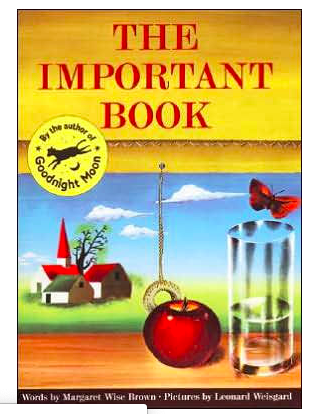
Screen Shot 2018-12-14 at 8.08.38 PM.pngI love Margaret Wise Brown’s The Important Book and how versatile it is as a mentor text. From the imitable structure to the crisp imagery to the simple illustrations, this book consistently inspires some of the best writing all year.

A few years ago we used this book as a thank you for my son’s first grade teacher. Each child wrote a “Important” poem about her, which a parent compiled into a keepsake book. I’ve written Important poems about my children at different ages, including this one about my daughter Emma. A colleague writes Important poems about each of her students at the end of the year, giving it to them as a farewell gift.

How might students craft their own Important poems?

How to Live

I was first introduced to Charles Harper Webb’s poem a dozen years ago in a class taught by Tom Romano (note: that’s where about 90% of any good ideas I ever have originated — in a class with Tom Romano).

I think students have so much advice for the people in their life, and they are so often not asked for advice. How great it is to invite them into the conversation about how they think we can live our best lives? And how else might we complete the rest of “How to…”? Imagine the possibilities as students practice procedural writing in a non-traditional way.

Odes

Did you see this tweet from @jessica_salfia last week? It instantly instigated so much thinking and I have been itching to try it with students.Screen Shot 2018-12-14 at 7.49.09 PM.png

I love the idea of writing odes about unconventional items. After seeing this tweet, I was getting ready to work with a group of elementary teachers. As I was trying to think of how to adapt the content of this tweet for younger students, I remembered my most favorite book of last year, Crown: Ode to a Fresh Cut by Derrick Barnes, illustrated by Gordon C. James. Screen Shot 2018-12-14 at 8.14.12 PMThis book is such a beautiful way to take an ordinary moment in life and to expand on what these small moments mean to our lives.

What would happen if we invited our students to write unconventional odes? I might write an ode to a tradition in my family, or to a special memory. What would you write about?

Poetry Anthology

When I first taught honors 10th graders 13 years ago, I borrowed an idea from my colleague Leah Naumann and asked students to create a poetry anthology for a person in their life. Students were required to find a variety of poems and in a letter to the recipient, they wrote about the ways that each poem reminded them of their intended audience.

It was some of the best writing and most thoughtful analysis I read all year. Students read dozens of poems, thinking critically about how these poems might fit a person. They naturally thought about themes and symbolism. They read poems for deeper meaning in ways I had never managed to teach. It was inspiring. Then they compiled the poems and letters into a book form, gifting it to their person.

I knew this was a gift of writing in so many ways when a few years later a former student reached out to me. His mom had recently passed away after a long battle with cancer that had begun the year he was in my class. He told me that through creating that anthology, he found a way to express things to his mother that he hadn’t been able to articulate in words. He found peace in that after she was gone. What more could we ever ask for our writing but to help us to all find peace in this world.

How will you find ways to encourage your students to see the their writing as the gift it is?

Angela Faulhaber lives in Cincinnati, OH. When she’s not freaking out over Christmas lists and to-do checklists, she’s trying to focus on enjoying the small moments with her family. And to avoid all the germs that are floating around. She first heard about the idea of Gifts of Writing from Nancie Atwell and has loved the idea of creating space for students to envision a life for their writing beyond the classroom.