Category Archives: Classroom Library

5 Lessons from Public Teaching

51A2WRYQAZL._SX312_BO1,204,203,200_.jpgThis week I tackled a title that’s long been on my to-read list:  Public Teaching: One Kid at a Time by Penny Kittle.  Published in 2003, it’s Penny’s first book, and has a foreword by Don Graves and an afterword by Don Murray.

(Yeesh…no pressure for when the rest of us thinking about writing our first books, right?!)

I loved this book, a collection of short essays plus an interview with Penny at the end.  It was readable, honest, and spectacularly well-written, as everything by Penny is.  I smiled as I read every page–except for the pages where I was crying.  Even in those essays I found myself impressed by the cleverness of Penny’s craft, both in her teaching and writing.

I bookmarked lots of pages and quotes to share with my preservice teachers this fall, but here are five lessons I took away from the reading that I believe are relevant to teachers of all content areas.


No one is perfect.

Penny begins her book with several amusing essays on mishaps from murderous crickets to accidentally-transparent skirts.  She eases us into the notion that even she, the great Penny Kittle, has had some missteps in her career, then launches into a few gut-wrenching essays on what she reflects on as her more weighty teaching failures:  a student we never say the right thing to, one we lose patience with, one we never teach to love learning or reading or writing.

We all have memories of those students, and Penny honors this with her writing.  I loved these vulnerable, humble essays that remind me we all ride a rollercoaster of success when it comes to our teaching.

Classroom management is a myth.

Penny tells the story of a novice teacher, struggling to manage her classroom, making wrong turn after wrong turn as a battle with her students escalates.  She has this to offer:

“Classroom management is really about the management of the heart and soul of your students.  The only ‘technique’ that works is a full-hearted human response to their lives, and to the conditions of school.  In some schools students sit in rows and listen, then rush to their next class, to sit and listen even more.  Try to understand the conditions in your particular school and view the entire day through their eyes. … You aren’t bad.  Your students are children, preoccupied with myriad distractions.  It is a natural state.  School is often the unnatural one.”

This advice was so much better, for me, than the age-old wisdom I got from mentors when I first began teaching and a lesson would crash and burn:  “don’t take it personally.”  I did take it personally, and still do, when I lose a class’s attention or a lesson falls flat.  When I learned the lesson Penny teaches here–“You must teach the students, not the content.  I want every student in my class to know that he or she is more important than what I am teaching”–I had far fewer of those flat moments and many more roundly satisfying ones.

Novice teachers need mentors, not critics.

We’ve all heard the statistics that half our teachers will leave the profession within three years.  As Penny says, “teaching, like marriage, is best when you make it past the courtship.”  The first few years are hard, and what makes them easier is exactly what improves my marriage:  talk.  As a young teacher simultaneously full of ambition and anxiety, I became more even-keeled when I found mentors.  I talked with them, they empathized, they advised.  I felt more prepared for my work, but I also felt less alone when I found a group of peers to encourage and support me.  “We have to mentor new teachers, listen to them, and I guess, hold hands once in a while,” Penny remarks.

Less is more.

“Somehow we decided that four short stories is better than one rewritten four times, and it’s a huge mistake.”

Penny’s assertion about the way many teachers conceive of writing is so true to my own learning experience, and as a result, my own early teaching experience.  I’ve been interested in the idea of simplifying my instruction for a while, and of course, Penny helped me see more clearly how to do it–with revision.

“I needed to have them linger longer over less,” she says, then backs it up with stories about an entire day’s work spent on fragments, the slow process of discovery learning, the work and power of weeks of revision on one genre of writing.  We have to jettison some things if we really want students learning, to keep it simple, to remember that less is more.

Teachers need to write.

By joining a writer’s group of teachers at her school, writing an essay for the local paper with her students, and carving out the time from motherhood to write, Penny learned to be a much better teacher by writing.  Her peer and student readers, as well as her editors, taught her to “be positive.  Encouragement works; criticism hurts.  Be careful with words.”

It’s hard to learn this lesson if you’re not a writer yourself, and Penny shows us her journey to becoming one throughout her essays.  She describes the early days of her writing group this way:

“Their criticism stung.  I didn’t like it.  You have to be careful when you’re correcting someone’s work.  I don’t think I was careful enough with my students all those years before.  It was so easy to just tell them what wasn’t working and think that was helping.  In writers’ group I learned quickly that compliments showed me what I could do and gave me confidence, criticism confirmed my fears and left me frustrated.  When I confidently approached a piece to revise it, I was playful.  When I went back to one in frustration, I usually made it worse.”

We become better teachers when we do what we’re asking our students to do–it’s only then that we can really know what we’re asking of them.  I highly recommend reading Public Teaching, doing some writing (how about with us?), and reflecting on your teaching by doing both.

43ccacd3aa51c2341980e1e34e34cba6.jpgAs we near the end of the school year, I hope you can find truth in one of Penny’s final statements:  “In my experience, it isn’t the stress that’s left the greatest mark, it is the joy.”

Shana Karnes teaches sophomore, junior, and senior preservice teachers at West Virginia University.  She finds joy in all things learning, love, and literature as she teaches, mothers, and sings her way through life.  Follow Shana on Twitter at @litreader.

An Idea: Author Bios and Some Focus, Wit, & Polish

I stole this idea from Lisa. She said it was okay that I write about it first. Bless her.

I finally feel like I’m getting a little of my writing mojo back. If you’ve been following my posts lately, you know I’ve had a hard time. I loved my student teacher, but I missed my students and how they inspire me to want to write and share.

It hasn’t been easy taking back my classroom. I am much more intense than Mr. G, and this translates to mean for some of my students. It’s true I grade hard, expect a lot, teach bell to bell. It’s not that he didn’t — maybe it’s just that I’m 50+, and he’s close to half my age. Whatever the reason, reinvigorating relationships hasn’t been easy.

Kind of casually one day, Lisa suggested she wanted to write author bios with her students next year. She said she’d read a few she wanted to use as mentor texts, thinking this little writing task would be a way to help her students develop their identities as writers. What a fantastic idea!

So last week for our writer’s notebook time, we wrote author bios, short, little, quippy, quirky writing that states who we are and why we write. (We still need work on the why we write part.)

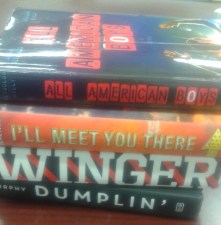
booksforauthorbiosI prepared first by reading the inside back covers of some of my hardback YA literature. I chose four bios with similar elements:  Andrew Smith, Winger; Julie Murphy, Dumplin‘; Heather Demetrios, I’ll Meet You There; and Jason Reynolds, All American Boys. {Bonus: four book talks, along with the author intros. Boom.]
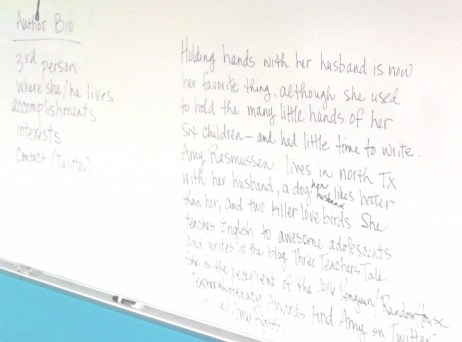
I explained the task:  We’re going to read four short author bios and then write our own. Listen to each one carefully, so we can pull out the similarities within each one.

We charted the elements of the bios on the board and then drafted our own.

authorbio

We spent five minutes on the writing, two minutes on revision, and six minutes sharing with our peers. We laughed. We wondered if the authors wrote their own book cover bios. We discussed our writing process.

“It would have been easier writing about someone else,” one student said.

“I need more time to think of how to say things,” said another.

“This would be fun to do at the beginning of the year,”

“I don’t do anything!”

“I’ve never won anything!”

“I cannot write that I am interesting when I am not interesting.”

“Can we write about what we want to do in the future instead?”

Oh, yeah, we stirred the pot, and ideas bubbled out. Throughout their questioning, my response remained:  Be creative.

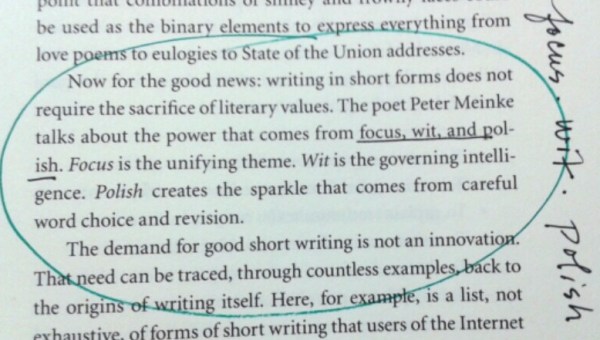
One of the best books I’ve read on writing is How to Write Short: Word Craft for Fast Times by Roy Peter Clark. I marked it up with lesson ideas:  “the whole chapter would make a great lead in rhetorical analysis” and “on annotating: read before starting 1st book club” and “use b/f narrative –teaches analysis with song lyrics” and “parallel structure & compound sentences!”

This paragraph from the introduction is a great reminder for all types of writing — and writing instruction:

How to Write Short

Focus, wit, and polish. My students and I talked about our identities as writers. We talked about the time it takes to develop our voice, our craft, our meaning.

As they read their author bios to one another, the cough of community clamored just a bit, and in a few minutes the whole classroom caught it.

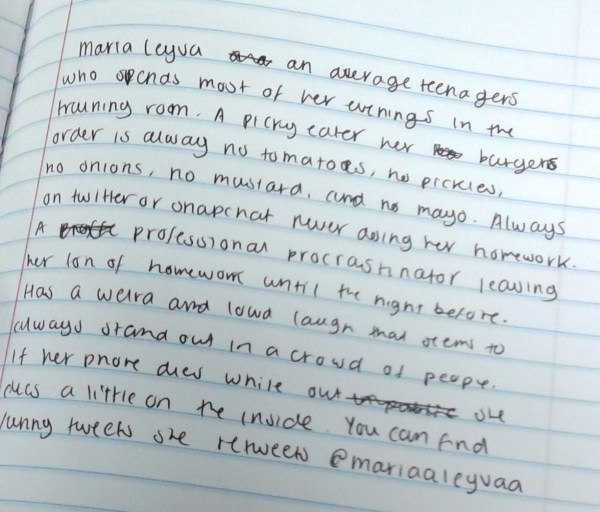
MariaLauthorbio

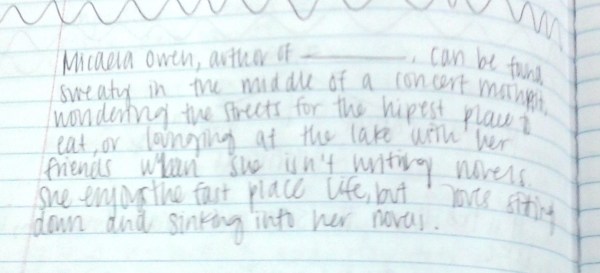
MariaCSkyauthorbioMicaelaauthorbioTreyauthorbioI reminded students as they write over the next few days — finishing their multi-genre projects, their last major grade — to write with intention, to write in a way that shows the answer to the last question I’ll write on the board this year:  How have you grown as a reader and a writer?
In the fall, I will do this exercise again. We will write our author bios at the beginning of the year, on day one, maybe. We will spent a good deal more time on them, and we’ll return to them again and again as we practice the moves all writers make to produce effective, convincing, creative writing. We will publish our writing with our bios. Hopefully, this will help us keep our sights on Focus, Wit, and Polish in all aspects of our writing.

How might you use this author bio writing activity? What tasks do your writers do that help them take on the identities of writers? Please leave your ideas in the comments.

Amy Rasmussen lives in north Texas and teaches AP English Language and English 3 at Lewisville High School. She loves talking books, daughters’ weddings (two this year), and grandbabies. Facilitating PD for other teachers making the move into a workshop pedagogy delights her. Amy adheres to the words of Emerson: “We aim above the mark to hit the mark,” and Jesus: “Love one another.” Imagine a world if we all aim higher. Follow Amy on Twitter @amyrass.

Refresh the Recommended Reading List

Hey book people: sometimes I feel we could learn a thing or two from the fashion world. (Or, at the very least, the fashion world as I see it from television.)


In the fashion world, trends are always changing, and once we’ve heard about something we know it isn’t hot anymore.  We’re quick to pass judgement on each other’s work and open in expressing opinions like that’s so old and I’ve seen that so many times before.

So if we as teachers are still recommending the same old, same old to our students (and yes, I count The Hunger Games and Twilight as same old) IT IS TIME TO UPDATE OUR RECOMMENDED LISTS.


I update and provide students with a (mostly) fresh list of recommendations about 3-4 times a year.  At minimum, I provide a beginning of school year recommended reading list for parents at Back to School Night and a summer recommended reading list to help students plan ahead for the long break.  Part of that planning is purely practical: I teach seventh graders, and the students’ reading tastes are going to change dramatically over the course of the school year, so I want  to be prepared.

And sure, part of it is my own boredom with reading, recommending, and thinking about the same books over and over again.  Hence I create new lists for students.


If you don’t currently create lists for your students, the easiest ways to make one are:


  1. Ask students for recommendations – what books they enjoyed reading and what books they plan to read in the future.
  2. Read books
  3. Steal other readers’ recommended reading lists.  My three favorite lists to steal from are the ALSC recommended titles YALSA’s book recommendations and the suggestions from the students in Nancie Atwell’s school.


Below is the recommended reading list I recently generated for my students.  Note that I broke the list into several themed sections (Classmates Recommend, Read With a Friend, and Challenge Books.)


You are more than welcome to steal this list in whole or in parts.  The descriptions of books are my own.


Classmates Recommend…


Everything, Everything by Nicola Yoon


This unusually formatted book will have you turning pages as you’ll get to know Maddie and her next door neighbor Olly through drawings, gchats, and short chapters.  Read it before the movie comes out! This book makes readers think more about disobeying authority (adults), falling in love, illness, and family


Michael Vey: The Prisoner of Cell 25 by Richard Paul Evans (part of a series)


High school student Michael Vey has a special hidden power.  He and some friends realize that there’s a conspiracy of adults trying to keep these powers under control. This book makes readers think more about  power, keeping secrets, and difficult decisions.


Masterminds (series) by Gordon Korman


Eli and friends live in Serenity, a perfect town without any crime or unemployment.  There’s only one issue: Eli and his friends can’t leave the town, and they begin to discover that there’s a reason why.This book makes readers think more about right/wrong, fighting back against adults, and friendship.


Once by Morris Gleitzman


It’s right before WWII, and Felix’s parents hid him in a Catholic orphanage so that he wouldn’t be suspected of being a Jewish boy.  Felix, concerned about his parents, escapes the safety of the orphanage and takes off on a dangerous journey to try to find his parents.This book makes readers think more about  risk-taking, growing up, good and evil, and friendship.


Gutless by Carl Deuker


Brock’s a soccer player, not a football player, but the football’s quarterback wants Brock to try out for the team.  Brock isn’t sure this is the best idea.  This book makes readers think more about bullying, friendship, and the risks of playing sports.


Scar Island by Dan Gemeinhart


When all the adults on a prison island die in a strange accident, the teens have to decide what to do next.  This books makes readers think more about risk-taking, heroism, good/evil,  and leadership.

Read with a friend!  Books I have multiple copies of


Goodbye Stranger by Rebecca Stead


Three female friends and the two boys and one photo that could possibly destroy their friendship.  This book makes readers think more about…. Relationships (romantic and non-romantic), cell phone use, growing up, and apologies.


The Seventh Most Important Thing by Shelley Pearsall


Arthur Owens threw a brick at an old man’s head and was sentenced to juvie for it.  Now that he’s out, the old man forgives him and asks Arthur to help him complete a strange task.  This book makes readers think more about forgiveness, family, and connections.


Chasing Secrets by Gennifer Choldenko


Lizzie wants to know why her family’s servant has disappeared.  In order to find him, she has to untangle a web of secrets surrounding the city of San Francisco.  This book makes readers think more about medicine, sexism, racism, and fighting against adult power.


The Absolutely True Diary of a Part-Time Indian by Sherman Alexie


Junior wants to go to a school off of his reservation; his neighbors and friends give him a hard time for acting “white.”  This book makes readers think more about racism, school issues, family, and friendship (especially difficult friendships.)


Piecing Me Together by Renee Watson


Jade is a black girl in Portland, Oregon who wants to travel the world.  Jade’s guidance counselor signs her up for a mentoring program instead.  This book makes readers think more about racism, healthy and unhealthy relationships, school communities, and how art can help bring people together.


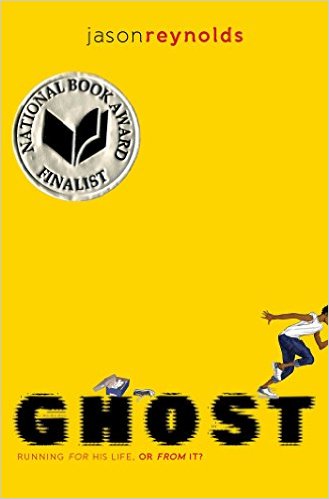
Ghost by Jason Reynolds


Ghost can run fast, but this tough kid doesn’t know how to be part of a team yet.  This book makes readers think more about healthy and unhealthy relationships, communities and teamwork, and forgiveness.


A Matter of Heart by Amy Fellner Dominy


Abby’s a competitive swimmer about to try out for the Olympics when she is told by a doctor that swimming too quickly could kill her.  This book makes readers think more about healthy and unhealthy relationships, good and bad risks, and figuring out who you are.


The Hypnotists by Gordon Korman


Jackson Opus has a strange power — he can hypnotize people to do whatever they want.  Now the brilliant Elias Mako wants to work with Jackson to develop his skill.  This book makes readers think more about power, good/evil, and fighting back.


Challenge Books

Longer, tougher, more complex ideas…


The Sun is also a Star by Nicola Yoon


Daniel and Natasha “bump” into each other and it’s love at first sight.  Was their meeting chance, or was it the universe pushing them together?  This book is by the same author as Everything, Everything, but readers are advised that this book is not a sequel or a companion to E,E.   This book makes readers think more about destiny/fate, love, and immigration.


The Hate U Give by Angie Thomas


Starr’s childhood friend Khalil is killed in an unfortunate accident when the police were looking for another suspect.  Khalil’s name is all over the news, and Starr’s private school friends don’t know that she was a witness to the murder.  This book makes readers think more about race, wealth/poverty, and the #BlackLivesMatter movement.


Scythe by Neal Shusterman


Two teens are training to become scythes, carrying out their society’s sacred role of determining who lives and who does not.  Scythe training is demanding, rigorous, and there are rebels within the order of Scythes who are looking to change the way death works … forever.  This book makes readers think more about power, death, and right/wrong.


Monster by Walter Dean Myers


In jail for a crime he didn’t commit, Steve creates a script for a movie that tells the story of his life and his run-in with the criminal justice system.  This book makes readers think more about power, race, art as healing, and the prison system.


All-American Boys by Jason Reynolds and Brendan Kiely


Quinn and Rashad go to the same school but aren’t friends, until a case of violence makes Quinn realize that there’s no such thing as being a neutral bystander.  This book makes readers think more about violence, race, and friendship.


Speak by Laurie Halse Anderson


A teen classic — Melinda is considered an outcast at her high school because she called the cops on a party.  This book makes readers think more about rebellion, fighting for what’s right, and the costs of popularity.


The Family Romanov by Candace Fleming


About 100 years ago, Russia had a royal family that was kicked out and eventually killed.  Learn about the factors that led to the uprising against the Romanov family.  This book makes readers think more about wealth/poverty and war.


Amy Estersohn is a middle school English teacher in New York and a 2016 recipient of the NCTE Gallo Grant.  Follow her on twitter at @HMX_MsE

Audiobooks are Books, Too

Totally honest: only recently did I discover the magic of audiobooks.


Audiobooks are magical because they allow me to READ while I am doing other things, like BEING STUCK IN RUSH HOUR TRAFFIC ON THE GEORGE WASHINGTON BRIDGE.    .

I’ve been using YALSA’S Amazing Audiobooks lists as a starting point for my auditory adventures.  By listening to stories, I’m able to arrive at understandings that I might not get from ink and paper.  For example, when I first read Katherine Applegate’s One and Only Ivan, I felt pity for the Ivan, a gorilla trapped in a shopping mall.  However, when I listened to the book on audio, I heard Ivan proudly talk about “domain.”  I realized then that Ivan is not able to understand his situation well enough to reflect on it the way I (a human adult) do.

Another example is Jason Reynolds’s GHOST, a book about a boy who joins a track team that was love at first page for me when I read it in print.  Guy Lockard’s voice work brings Ghost’s vulnerability to the surface, and his voice for Coach sounds like a teenager trying to impersonate an old man instead of an old man.  As a result, we hear the version of Coach that Ghost tells us about, not Coach as we might hear him if we met him.

41oUcSnuwoL._SX327_BO1,204,203,200_

Not just an award winner for the text, but an award winner for the audiobook, too!

My own studies are making me think more about how I can use audiobooks in the classroom.  I have some ideas about how I might bring these treats into the classroom:


  • Share and compare.  Give students a passage to read silently.  Then play them the audiobook selection for that passage.  Did students hear what they expected to hear?  Did they hear something different?  (The One and Only Ivan and GHOST are terrific mentor texts for this work with middle schoolers; for high school I might recommend a chapter from Wink Poppy Midnight by April Tucholke because the chapters are brief and the book did won an Amazing Audiobooks award.)
  • Inquiry and discussion of  award criteria.  Play a section from an Amazing Audiobook with or without accompanying text.  What makes this reading award-worthy?  Or is it award-worthy? 
  • Create your own mini-audiobook.  Especially if we want students to slow down their reading to notice voice and word choice, giving students an opportunity to read, direct, and/or produce their own mini-audiobooks would invite students to invest in their books and make that sharing public through a podcast or a rehearsed live performance.   Kelly Gallagher already does something similar with the reading minute.


Do you do any work with audiobooks?  Continue the conversation in the comments!


Amy Estersohn is a middle school English teacher in New York and a recipient of the NCTE Gallo Grant.  Follow her on twitter at @HMX_MsE

6 Gut-Punchers to Read After You Binge-Watch 13 Reasons Why

I got a Netflix subscription just so I could watch the 13 Reasons Why miniseries.13-reasons-why_0

The series is graphic and unsettling and leaves a lot to be talked about.  I haven’t even finished the series yet, but I bet my Scholastic Bonus Points that I have a few students who watched it over spring break and now are itching to read this book and others like it.

Here are a few books to steer readers to now…

friends for life

Friends for Life by Andrew Norriss

This book covers similar topics to 13 Reasons Why, but the plotting, pacing, and development of the topics is catered towards a younger teen audience.  Francis and Jessica become close friends quickly, but there’s a problem: Jessica’s a ghost, and Francis can somehow see her.  As readers learn how Francis can see Jessica, readers are also invited to consider the importance of friendship and reaching out to loved ones in times of need.

backlash

Backlash by Sarah Darer Littman


I find myself returning to recommend this book over and over again because it hits so many teen sweet spots.  Once upon a time, Lara and Bree were best friends.  Then Bree started to cyberbully Lara, pushing her to attempt suicide in a highly publicized manner.  Readers watch characters recover from trauma and hear the voices of others who were affected by the ongoing cyberbullying.


optimists die first


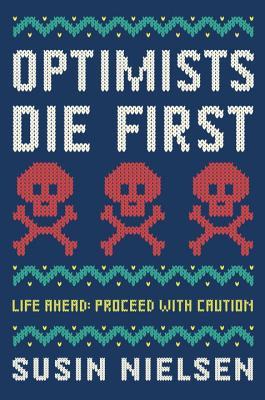
Optimists Die First by Susin Nielsen


Relevant information for adult readers: Susin Nielsen wrote for Degrassi.  If that’s not enough to pique your interest in her books, I don’t know what is!  (Unless, that is, you’ve never seen an episode of Degrassi.  Fix that!)  Nielsen’s book follows Petula, who feels burdened by guilt over a sibling’s death.  Her healing process involves Jacob, a boy who just moved to town who is keeping some secrets of his own.


truth alice

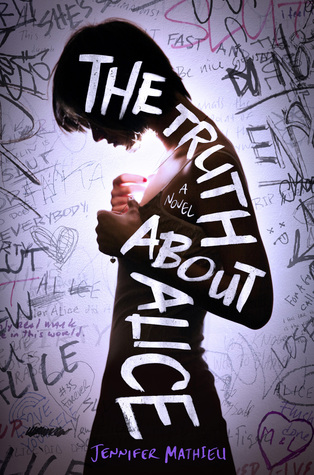
The Truth About Alice by Jennifer Mathieu


Have you heard about Alice and what she did at that party?  With not one guy, but two?  This fast-paced, multilayered story makes readers think more about empowered female sexuality and the pernicious power of the school rumor mill.


gerald faust

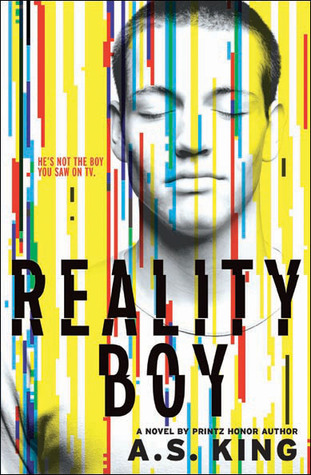
Reality Boy by A.S. King


From the files of deliciously messed up A.S. King comes a book about Gerald Faust, a boy better known to his high school classmates for his early-childhood antics on a reality TV show.   Gerald can’t escape his well-publicized past, and his parents might as well live in a fictional universe.   A.S. King’s talent as an author is developing some of the cruelest family dynamics known to contemporary literature, and this book ranks right up there for unkind parents.

bang lyga

Bang by Barry Lyga


Sebastian, at age four, shot his baby sister Lola by accident.  Now, Sebastian is immersed in homicidal/suicidal ideation.  When a new girl, Aneesa, joins the neighborhood and is unaware of Sebastian’s burning guilt, Sebastian has a chance to remake himself.


What books would you recommend to students who enjoyed watching 13 Reasons Why?


Amy Estersohn is a middle school English teacher in New York.  She is a 2016 recipient of the NCTE/ALAN Gallo Grant.  She laments the loss of the cassette tape.


10 Things Worth Sharing Right Now

I love the little ripple of a thrill that runs through to my fingertips when I find something that I want to share with my students. That borderline codependent excitement that comes with wanting to share a book, an article, a statistic…immediately.

“They NEED to see this,” I think, fumbling around on my phone to figure out how and where to save it.

“They NEED to read this,” I say to my husband, as I make him pause his own life to listen to yet another passage of my latest read.

“They NEED to know about this,” I mutter, linking wildly to our syllabus (just another in a long line of moments where I’m grateful that life happens and we share it in class).

So today, I’m taking a page from one of my newest obsessions, the newsletter put together weekly by the brilliant, inspiring, and wildly creative, Austin Kleon. Each week, delivered to your inbox, arrives a list of “10 things [he thinks are] worth sharing.” Simple. Intriguing. Very, very useful in the classroom.

I’m honestly not sure how I stumbled on this one, but in the month since subscribing, I’ve used three of his images to inspire quick writes, and book talked (loosely) the newsletter itself, suggesting to students that they should subscribe in order to broaden their horizons to current happenings, inspiring visuals, and commentary on books, shows, and cultural phenomenon. In other words, link up to something that delivers items to keep you reading texts other than social media updates (“Made a sandwich guys…bet you’re all jelly. Get it? Jealous, but jelly instead.? God, I am such a genius”).

  1. Austin Kleon’s Weekly Newsletter
    Kleon reflects on a central image each week, along with linking to intriguing articles, a poem of the week, ear candy audio, eye candy visuals, and other noteworthy insights from across the vast expanse of the internet. If someone comes up to you and says, “Hey, did you see…?” chances are Kleon will have it linked on his list for the week.
  2. The Power of Exemplars
    A few weeks back, I was bemoaning to my fellow Three Teachers Ladies, how disappointed I was in a recent project my sophomores had completed. My vision for a poster that brilliantly illustrated their insights on their latest reading, was met with large sheets of paper with haphazard cutouts of text, crudely taped across the page, accompanied by printed book covers in black and white, and the occasional hurried pencil addition to the project (last minute insight for forgotten components). Needless to say, I was frustrated AND without any way to hold students accountable for the quality of the visual they submitted (not the central point, for sure, but a consideration certainly). Take pride in your product, and all that, had fallen short. In my irritation, I searched in vain for something in the Common Core that might suggest students consider carefully how they convey their ideas.

    Then, I took a deep breath. I realized I had what I needed, I just hadn’t used it. See below the power of exemplars. My AP students were completing their community visuals (which I wrote about last year in a reflection on the use of essential questions), and I had no rubric for this work either. However, the power of suggestion, in showing them some of the brilliant work from the year before, was more than enough. They knew the expectation, saw what I thought was praiseworthy when it comes to presenting their insights, and we enjoyed some brilliant symbolism in the presentation of these visuals. Amen.
    img_1163

  3. Musical Genius
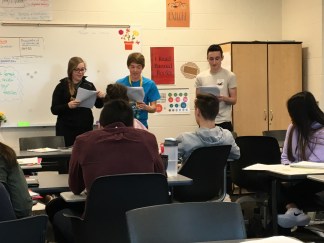
    One of my groups took a creative leap for their community unit visual and put together a musical. Franklin’s production of Joseph and the Amazing Technicolor Dreamcoat opened this past weekend. Several members of the cast in my first period class asked if they could complete the project in a slightly different way. Their project would still include analysis, present their ideas to the class, and involve audience feedback after the presentation, but…there would be singing.

    img_1092

    Francesca, Joe, and Parker

    Since I always joke with my kids about presenting their ideas through interpretative dance, this musical idea intrigued me. Their mini musical included several skits that detailed life within the community of a musical cast/crew. Watching students sing their way through a summative, I was reminded that my vision for a project is rarely as broad and brilliant as what students can come up with on their own. My exemplar pool had just expanded in verse.
    img_1095

  4. Bag o’ Books
    Remember to beg for books. Want to build that classroom library? Get down on your knees and remind your students of how good it feels to give back…to you.Maija recommend the book Dangerous Minds a few weeks back. When a fellow student was at the bookshelf looking for it the other day, I asked Maija if she’d be willing to bring it so, AJ could borrow it. I even turned on a sweet smile and said, “If you don’t need it anymore, I’d be happy to take it off your hands.”

    The book was outside my door the next day, in a bag with a sweet note and several other books. Score.

  5. Amy Poehler on Writing
    I’m training for a half marathon. Without audiobooks, I might not make it. Seriously. I need to get lost in a story to pound out the miles. So, when I started 10 miles on Sunday and realized my Overdrive audiobook had expired, I had to quick download something new. Ugh.Enter, Amy Poehler’s Yes, PleaseI smiled for nine miles (it takes awhile to download when you’re actively running down the street). Poehler’s voice is sincere, relatable, and funny as all get out. Easy to book talk.

    Here’s the golden ticket: The Preface. I heard it and knew I needed to play it for my students. Poehler writes with undeniable voice about writing. She says of her text and the writing process that she “had no business agreeing to write this book” and wrote it “ugly and in pieces,” because “everyone lies about writing…they lie about how easy it is or how hard it was.” She says, and students really related to the idea, that “writing is hard and boring and occasionally great, but usually not.” In reflection afterward, students also noted her use of stream of consciousness, aside, and self deprecating banter to tell her story, not just inform her audience about what the book would be about. Classes agreed that they could really get behind her idea that, “Great people do things before they are ready.” Amen, Ms. Poehler. Let’s all put pen to paper.

  6. langchat#17
    I recently started following the brilliant Elizabeth Matheny on Twitter. Her AP insights and resources have helped fuel my work recently and her AP Language slow chat last week was a great opportunity to have my kids practicing analysis with students across the country. I’m thinking of several things to extend this activity:
    – Have students organize a slow chat for peers
    – Get students to live tweet peer feedback during speeches or discussion
    – See #7 below
  7. Tweeting Authors
    I tweeted Angie Thomas to tell her that her book The Hate You Give is stunning and I’d be getting into the hands of as many students as possible.She liked my tweet.Fangirl moment.img_1024
    Have your students reach out to authors. They often reach back.
  8. Creativity Visual
    I love what this suggests to students about the power they possess.
    img_1157
  9. Get it to the Big (or small) Screen
    My students often buy into the idea that great books are made into (sometimes great) movies. The Underground Railroad is being made into a series with the director from Moonlight. Having just finished this intriguing read myself, I book talked the text this week and shared the movie plans.
  10. Quick Write – Psychopath
    This came across my Facebook feed the other day, and I tossed it on my PowerPoint. As is the way in educator, my students surprised in noticing it, and we ended up doing a quick, quick write about changing social norms. AP Language test prep comes in many , many forms.
    img_1122
    What would make your list of 10 things we need to see and share this week? Add your ideas in the comments below! 

Lisa Dennis teaches English and leads a department of English educating gods and goddesses at Franklin High School near Milwaukee. She loves lists, especially lists with links to beautiful thoughts and ideas. Follow Lisa on Twitter @LDennibaum 

disclosure


Goodbye Days: a Craft Study and a Gorgeous Grand Slam

I love language. I love sharing my love of language with students.

When I read a book, I often dog-ear the pages, thinking of how I might use a passage to help my writers. Sometimes a book just does me in — so many beautiful words I cannot keep up. It’s a bonus if the story does me in.

Like Goodbye Days by Jeff Zentner. 30649795

If you haven’t read this book, oh, you’ll want to. Zenter’s first book, The Serpent King, kissed my soul. Goodbye Days took a hammer to it.

In a good way.

I started marking passages at page 36. I think because I forgot to think about it. Just read the first line of this YA novel:  “Depending on who — sorry, whom — you ask, I may have killed my three best friends.”

Mini-lesson opportunity one (whom), two (parenthetical with the dash), three (participial phrase), and four (voice)– all in one sentence.

The first time I really thought about using language from YA novels to teach my writers was in a class at UNH Literacy Institute taught by Penny Kittle. She showed us mentors of sentences and passages, pulled from the books she introduced to her students. She talked about how these craft studies also could serve as quickwrite prompts and book talks. A triple play.

Since then, Shana (who sat with me in Penny’s class) and I upped the ante:  some of our favorite mentors are hard-hitting home runs. But the following passage from Goodbye Days –It’s a gorgeous Grand Slam.


Excerpt from Goodbye Days by Jeff Zentner (p36)

     I feel like I’m watching something heavy and fragile slide slowly off a high shelf. My mind swirls with mysteries. The eternities. Life. Death. I can’t stop it. It’s like staring in the mirror for too long or saying your name too many times and becoming disconnected from any sense of yourself. I begin to wonder if I’m even still alive; if I exist. Maybe I was in the car too.

     The room dims.

     I’m tingling.

     I’ve fallen through ice into frigid black water.

     I can’t breathe.

     My heart screams.

     This is not right. I’m not fine.

     My vision narrows, as if I’m standing deep in a cave, looking out. Spots form in front of my eyes. The walls are crushing me.

     I’m gasping. I need air. My heart.

     Gray, desolate dread descends on me — a cloud of ash blocking the sun. A complete absence of light or warmth. A tangible, mold-scented obscurity. A revelation:  I will never again experience happiness.

     Air. I need air. I need air. I need air. I need.

     I try to stand. The room pitches and tosses, heaving. I’m walking on a sheet of Jell-O. I try again to stand. I lose my balance and fall backward, over my chair, thudding on the hardwood floor.

     It’s one of those nightmares where you can’t run or scream. And it’s happening to me this moment in the dying light of this day of dying. AND I AM DYING TOO.


What writing mini-lessons could you teach with this passage?

Reframing Independent Reading: We Can Start By Not Grading It

imgres-1.jpgAll week, I’ve been thinking about Pernille Ripp’s exasperated plea, “Can we please stop grading independent reading?”  (I imagine that she initially had an exclamation point at the end of that post, like, COME ON, people, but then deleted it to be nice.)
Still, I am one of those people she is exasperated with.  Or I was while in the high school classroom, dedicatedly printing log sheets and grading reading every week for three years, using a complicated system of reading rates and conferences to give a number grade that reflected reading growth and sustained progress.

One year, I abandoned this system in the third quarter, just to see what would happen–would kids stop reading if I removed the accountability of a weekly reading grade?

Yes, yes they would–and they did.  So I re-instituted weekly grades, which, combined with a quarterly assessment, combined to 20% of my students’ total grade.  I was happy that this much of my course grade was dedicated to independent reading, but I didn’t realize that the grades I was mandating weren’t really creating independent readers at all.  (In hindsight, I should have begun the year without reading grades and created an authentic community of readers who weren’t motivated by reading logs.)

imgres.jpgAfter I read Pernille’s post, while thinking about this idea (read: beating myself up for slaughtering kids’ love of reading), I pulled out one of the most memorable texts I read while in college–Janice Pilgreen’s The SSR Handbook.  In the foreword, Stephen Krashen writes:
Free voluntary reading means reading what you want to read, with no book reports, no questions at the end of the chapter, and not having to finish the book if you don’t want to.  Sustained silent reading provides children with an opportunity to do free voluntary reading in school.  Is this a good idea?  Yes.

Pilgreen lists eight components of a successful SSR practice:

  1. Access – to many reading materials (books, newspaper, magazines, comics)
  2. Appeal – the materials are interesting and appropriate for the students
  3. Conducive Environment – the space in which students may read is comfortable and welcoming
  4. Encouragement – teachers and peers encourage students to read through discussions, modeling, and more
  5. Staff Training – teachers should have practical approaches in place for helping kids become readers
  6. Non-Accountability – no records, no monitoring, no “task-oriented” attitudes toward reading
  7. Follow-Up Activities – thoughtful, creative, interactive ways in which students discuss their reading lives authentically
  8. Distributed Time to Read – a volume of time that consistently occurs during which students read freely in school

When I think now about these eight simple factors, I see them clearly through the lens of workshop teaching.  To me, the components translated to my real-world readers workshop classroom look like this:

  • a classroom library brimming with high-interest books;
  • a reader-friendly community built not only into a welcoming physical space, but one in which daily reading, talk, conferring, and encouragement happen;
  • a teacher-leader who is the best reader in the room, who can model fluent reading and recommend a wide volume of books to students;
  • a lack of graded formative assessment and an emphasis on summative assessments for learning, not of learning.

This means no reading levels, no required number of books per year, no structured programs in place, no minimum number of minutes of reading done per week.  This means relinquishing control.  This means a lot of modeling, conferring, and progress monitoring to encourage student growth and lifelong learning.

This means thinking about independent reading as truly independent–independent of grades and of accountability.  This means reframing independent reading in school as an authentic, student-centered activity in which the readers take the lead and teachers merely help provide coaching and guidance.

If these ideologies are in place, teachers will know if kids aren’t reading (by simple observation and conferring).  We can adjust our instructional practices from there, without the damaging effects of punitive grades.  We can still give a grade for summative student self-assessments of independent reading growth (student-led is the key, here) to satisfy those mandatory gradebook updates, but if students are to become real readers we, as teachers, cannot be the ones holding them accountable for their progress.

There are many other kinds of reading that happen in language arts classrooms in addition to independent reading:  whole-class study of texts; small-group book clubs; close reading studies of poetry, articles, essays; explorations of mentor texts; analyses and syntheses of plays and novels and writing of all sorts.  This is where the work of learning to become a better reader can come in (which can be very enjoyable!), which lends itself to skills-based reading assessments.

In contrast, independent reading and all its many joys and struggles and spaces for success and failure are not, as Pernille says, “gradeable skills but instead a child practicing habits to figure out how to get better at reading.”  If we want to nurture this practice, we cannot keep grading it–and that’s the first step to reframing our thinking about independent reading.

Shana Karnes lives in West Virginia and teaches sophomore, junior, and senior preservice teachers at West Virginia University.  She finds joy in all things learning, love, and literature as she teaches, mothers, and sings her way through life.  Follow Shana on Twitter at @litreader or join her for the Slice of Life Writing Challenge here.


Letting Go in the Name of Book Love

letting go

I am a super fan of Pro/Con lists, although the true reflection of these lists never seem to govern my life as much as the making of them does.  Let me explain.

I can always think of a million reasons not to do something, but if I’ve already decided I want to do it, the Pros generally outweigh the Cons because of just that–weight.  Sometimes the reasons TO do something are fewer, but are so weighty that they can’t be ignored.

Workshop was that for me.

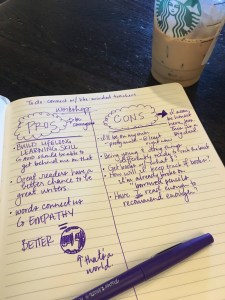
pro con

This is a real picture of my real notebook.  Please don’t judge the fact that I give myself pep talks within my P/C Lists.


Here are a few Cons of workshop from my list at the beginning of this year:

  • I’ll be on my own, pretty much.
  • I’m young, and everyone will think I’m just trying to rock the boat.
  • WHERE WILL I GET THE BOOKS?!!
  • Once I get those books, likely via my own dwindling bank account, how will I keep track of the books?  I already go broke on borrowed pencils–and those cost…well… can anyone break a penny?
  • What if I haven’t read enough to recommend enough?

Sure, all of these were true then, and are still true now.  However, I think the weight of the Pros on this list were hard to ignore:

  • I could truly build something that would become a lifelong skill that carries students through the rest of their lives as learners.
  • Great readers have the potential to be great writers.  You can’t do what you’ve never seen (at least not well).
  • Reading in builds empathy.  Reading far and wide builds empathy far and wide.

To be honest, the biggest fear on that list of Cons was the idea of losing books.  We teachers, just as Lisa pointed out yesterday, are notorious for going broke for the cause.

I started workshop anyway.  As soon as I met 3rd Period this year, Terri-Rose quickly became the actualization of my worst nightmare.  On the first day when we checked out books, she insisted on taking three home to peruse because she couldn’t make a decision.  My first endeavor into workshop, I wasn’t quite sure if that was a thing.  I gritted my teeth and slowly expelled a perfectionistic breath, attempting to inhale a free spirit (something which usually doesn’t hover near me much less inhabit my own body).  She held three of my shiny new bestsellers bought with my own money after the small grant I obtained already ran out.  I told her she could do that as long as she signed them out and brought two of them back to me the next time.  I glanced over my shoulder to my then-meager amount of books after the first checkout.  Who knew 300 books could go so quickly?  I might never see them again.  

But, you know what, I did.  Most of them.  Terri-Rose still hasn’t learned to make a decision.  Whenever she finishes one book, she takes two more.  She’ll get halfway through one, and then give it back to me.

I’ll ask, “You didn’t like this one?”

She’ll say, “I do, but I want someone else to be able to read it while I finish this other one.” We developed a system with her book marks.  She likes to use candy wrappers (always pristine) to mark her place, so she’ll hand me the candy wrapper, and I’ll put a sticky note on it with the book title and page number to hand back to her when she’s ready for that book again.  It’s a nice system.

The other day, she came into class raving about a book.  It’s a normal occurrence.  She’s never quiet about something she loves–a quality I’m hoping to channel more in the future.  She wanted to barrel her way through Everything, Everything because the movie is slated to release in May.

Then came the request.

“Mrs. Paxson, I have this pen pal in Weatherford and we’ve started talking about books.  I told her about Everything, Everything, and the movie coming out and now she really wants to read it.  Would it be okay if I mailed it to her to read and then she mails it back before school is over?  I can even ask her to write a review for it before she sends it back!”

The exhale and inhale was quicker this time, mostly because I was leaping for joy inside at the desire to share the Book Love.  I agreed to the terms of her proposal, and I can’t wait to get the book back with a long distance review.

All of those Cons, like I said before, still stand true.  I’ve lost some books this year–probably five or six.  But the weight of the Pros have grown heavier with success and small triumphs–more than I ever thought they might.

As I think of Terri-Rose, unable to make a decision, reading books halfway through and two at a time, always sharing with friends before she’s even close to done, I’m reminded of my own reading life.  It’s a real one, not one for a grade or to check a box.

Then I think: Holy crap–it works.

What moments have surprised you with sharing #BookLove and watching it grow?

Jessica Paxson is an English IV and Creative Writing teacher in Arlington, TX.  She frequently feels as though someone made a mistake in allowing her to hold the futures of over 100 teenagers in her jittery, over-caffeinated hands for the past two years.  If you enjoy watching her make a fool of herself by being unbearably vulnerable, you can catch more of that over at www.jessicajordana.com. Follow her on Twitter or Instagram @jessjordana.


Going Broke Buying Books

Disclaimer: There are countless ways to save money when securing books for your classroom library. I, however, often lack the patience for such measured and responsible procurement of texts. This is my story (and possibly my defense should my husband discover just how much I spend on books).


My husband Nick is a dear man. He has to be, to put up with the amount of time, energy, and hard earned cash I devote to this passion called teaching.

In the 14 years I’ve been at this, or rather the 2 years I’ve been building a genuine classroom library, I have probably spent $4, 398,291 (hyperbolic numbers are my favorite, because I’ve never been good at math).

It often happens before I know what I’m doing. Like those poor souls who sleepwalk and end up in the middle of a busy road in their pajamas, I find myself “just putting a book in my Amazon cart so I remember the title,” or “checking Thriftbooks for a minute (or 27), to see what’s new.”

Hi. My name is Lisa, and I buy a lot of books for other people’s children. 

doryThis “problem” sort of took me by surprise. With my head hanging low, I must admit there was a time, not too long ago, when there were very few books in my classroom. There were very few books in my life period, besides the ones I “taught” year after

year. My classroom was rich in many valuable thoughts, inquiries, and experiences before workshop, but it was not full of books.

How, as a teacher of literacy, had I allowed my classroom to become devoid of the very tools of reading I kept suggesting to my students would be their salvation in the face of collegiate ambitions, thematic exploration, and aspirations of world domination?

Apparently, it wasn’t important to me.

Ugh. That reflection looks ugly in print.

I didn’t purposefully create a text desert in my classroom, of course. If someone had said, “Hey, Dennis. You teach English. Where are all the books?” I would have smiled and pointed to the textbooks and countless copies of Uncle Tom’s Cabin. Students bought any books they needed for independent reading, and I happily progressed with assigning reading, providing study guides, giving content quizzes, lather, rinse, repeat. This is what I knew. This is what I had experienced myself. This is how I was taught to teach.

But then, one day, a big rock fell on my head. I dreamt of rows upon rows of bookshelvesryan gosling lining the walls of my classroom and students clutching copies of countless titles to their bosoms. Ryan Gosling walked into the room and said, “Hey girl. I really love the work you’re doing for public education. Let’s get those kids reading more. Cool?” When I came to, I was blushing, but more importantly, I knew that my students needed more choice. More challenge. More access to books.

Ok. Not really. But the conclusions I came to after some workshop research, training by the lovely workshop team of Three Teachers Talk, and logical reflection about how I wanted my students to view reading, that part is true.

There is still a very important place for whole class novel work in my classroom. There is still a place for short lists of books with a central theme to get kids working in book clubs. There is still a place for the classic and contemporary. But there is also now a place for a lot more choice right in my classroom, always located just a few steps away.

And though we might not want to believe that we have to hold our kids’ hands and walk them to our bookshelves, instead of trusting them to take their own time to go to the library or while away the hours at the local bookshop, at least in the beginning, we do. We need to make the books so wildly available, that kids can’t help but wade through them in the course of our time together.

Think of elementary classrooms. Books upon books, upon teachers reading aloud books. If books aren’t at home, they are certainly at school, and when kids are learning to read, they are showered with books. Why not shower them with texts when we are trying to reignite that love of reading?

Given time to read, talk about books, formative and summative work around independent novel study, goal setting, book challenges, quick writes on choice reading, daily book talks, a teacher who pours passion about books all over their every class period AND shelves of books three feet away, progress in building and rebuilding readers is very possible, and even, probable.

We can teach children to read, but for reading to become a habit, they need ready access to books. We also know, they need choice, choice, and more choice (thank you a million times for your brilliance, Donalyn Miller).

When it comes down to it, we might not want to believe our students evade the reading we ask them to do, but they often do. Many fake read very, very well. Others simply smile, or avert their gaze, or defiantly say, “I didn’t do it” or “I’m just super busy.”

I’ll put it this way, my dentist hands me floss, but I don’t use it as often as I should. There. I said it. I am a college educated, do-gooder, who knows she should floss…every day. I do not floss every day. I know my teeth will suffer for it. I know when I go to the dentist I feel bad for having to say that I could probably floss more. I know it’s with the best intentions for my own self-interest that the professional tells me to do it, but…I don’t do it. I’m just super busy.

Perhaps a bad analogy, but our students don’t always make the right choices when it comes to reading. They prioritize other things. If my dentist were handing me floss every day, chances are good, I’d get in the habit. Should he have to? No. Should I just do it on my own because I know it’s good for me, of course. But, I’m flawed. We all are.

So, at least for awhile, I’m going to care enough about my students’ teeth, er, reading habits to make it highly visible, readily accessible, and as entertaining as I can.

The payoff just this week is real:

  • Josh is a super smart kid who hadn’t been devoting time to reading. He, like so many others, used to love to read, but had fallen out of the habit. With our 10-15 minutes of reading a day, and my suggestion that he add just 10 minutes before falling asleep each night, Josh is back into books. Major texts, in fact, and just book talked The Name of the Wind by Patrick Rothfuss to our a class. A little bit here and a little bit there made the reading a habit again. I bought the book and handed it to one of his peers who flew through it too.
  • I saw Brianna standing at the bookshelf yesterday morning. Sort of swaying back and forth. I skipped over (ok, I was skipping in my head, but I was excited to help her find something magical).
    “What are you in the market for, my dear?”
    “Uh…I’m not sure. I just read Think Like a Freak: The Authors of Freakonomics Offer to Retrain Your Brain. It was really good, but I might be over nonfiction for a while.”
    “Makes sense. How about a really good story? Try this. Oooo! And this…and I had someone read this one last month. And…this (The Help). Have you read this one yet? Take a look at the reviews in the front from past readers. This is a great book.”
    Brianna was 20 pages into The Help and picked up the book between activities in class that day.
  • The somewhat shocked and surprised smile on JJ’s face when, after book talking Jodi Picoult’s Small Great Things: A Novel last week, I put in his hands a copy of her incredible new release. He had asked for my copy a few days later when he finished his latest read, but it had already been checked out. He looked crestfallen. When I saw it yesterday on the new release cart in the library, I checked it out, and hunted JJ down during our resource period. “Wow. Thank you!
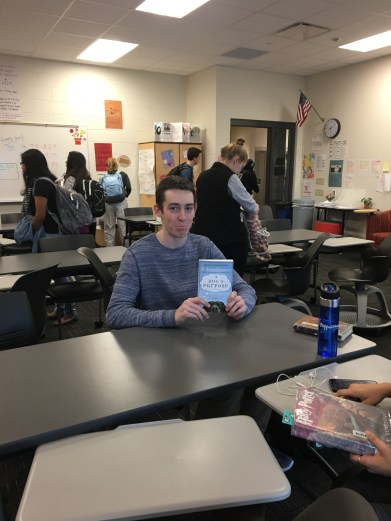
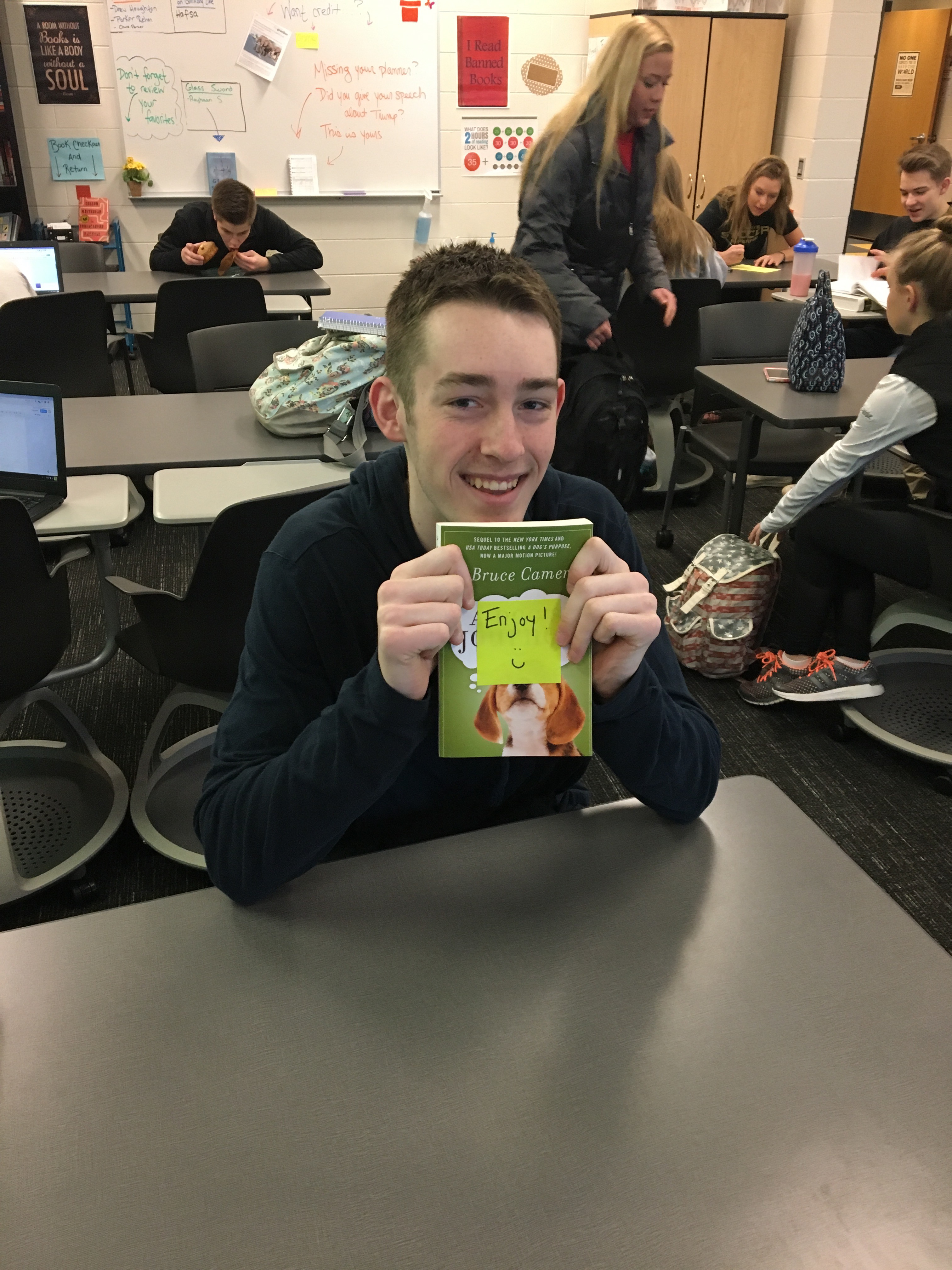
  • And this…You might remember Nathan from a few weeks back after he finished A Dog’s Purpose:
    img_0266
    I was at Barnes and Noble and used one of my gift cards to buy the sequel A Dog’s JourneyI think this smile is worth the expense:

Truth be told, I’m very lucky to work in a district that has put a huge amount of money into funding the classroom libraries of our English department as we’ve moved to workshop. And there are countless ways to put on your thrifty teacher cap and get the texts rolling into your room if your district isn’t yet on board with choice reading:

  • Write letters to your local bookstores and appeal to their sense of community pride, favorable Yelp reviews, and goodwill to all.
  • Loiter in bookstores and flash your teacher credentials. Sometimes a pleading jessicasmile and/or a small purchase will secure some free or discounted books.
  •  Apply for grants (Nothing says #booklove like free books…next year).
  • Rummage, thrift, estate sale your way through the summer.
  • Gather some research on classroom libraries and get it in the hands of your administrators. You might be surprised.
  • Ask Shana for books. She loves to give away books to fellow workshop teachers.
  • Befriend authors via social media! Jessica is trying her hand at scoring some Matthew Quick books through Shana’s connection. No shame, Jessica! Twirt (twitter flirt, I believe) away!

You don’t necessarily have to spend your own money on books, but I do. Something inside of me saying that I need more. I need more variety. I need more to recommend. I need more books.

I keep telling my husband that I’m helping to inform, inspire, and impassion the electorate. I’m also in charge of the money, so my little addiction should be able to continue a little while longer.

I consider you all my support group in this matter. Thank you for your support.

How do you surround your students with books? What titles have you added recently that keep flying off your shelves? We’d love to hear from you in the comments below. 

FTC guideline affiliate links

Lisa Dennis teaches English and leads a department of friends at Franklin High School near Milwaukee. Her latest classroom library purchases were The Hate U Giveby Angie Thomas, American Street by Ibi Zoboi,  and Violent Endsthe story of a school shooting told from various perspectives and written by 17 YA Lit. authors.  Follow Lisa on Twitter @LDennibaum.