Category Archives: Classroom Culture

What’s the right way to book club?

I belong to a lot of book clubs.  Probably too many, if I’m being perfectly honest.  This book club habit, though, allows me view a range of activities that can be considered “book club” and has opened up the way I teach book clubs in my classroom.

Book clubs are valuable experiences in and of themselves and there is no one right way to “book club.”   Book clubs enrich the lives of readers and allow students to see a thought about a book go somewhere new with a friend.

We’ve all had those moments where we think, “Sure, I could run this unit as a book club, but how do I know the students are really reading?”  As much as it pains me to write … we know the students aren’t reading regularly and consistently anyway.  Penny Kittle’s Book Love gives a detailed account of the various deceptions and misdirections that high school students regularly go through when they “fake read” assigned classics for English class.  The concern is most certainly worth raising, but we also shouldn’t assume we already have a perfect solution.

And book clubs are not a perfect solution, either.  They are messy, they take time, and sometimes the teaching we do in a book club unit is more the teaching of life and human relationships than of actual content and reading strategies.  But to hear students arguing the role of fate in one’s life?  To see a gaggle of girls attempt to stymie me with a version of The Trolley Problem that they developed based on a book club conversation?  To see students become obsessed with the Berlin Wall because of a book club?  To listen in on how students work out interpersonal conflicts when they think an adult isn’t listening?

I’m telling you, it’s all worth it.

While there are no right ways to book club, here are some things that have worked for me:

  • Give generous choice in partner selection.  I maintain final say over groups, but I encourage students to indicate the classmates they want to work with on a survey.  A colleague encouraged me to add a space for students to include a student that they haven’t worked with yet but would like to work with in order to encourage students to branch away from just indicating friends.  If students look forward to talking to their conversation partners, I find they are more likely to read and more likely to have better conversations about the book.
  • Steer students towards books they might not otherwise pick up.  One of the hidden beauties of book clubs is that I can steer groups towards books they might not otherwise pick up.  Groups of students are more likely to branch out of genre or try an author they hadn’t heard of before if they have a group to do it with.  I use this opportunity to introduce racially diverse authors and authors whose works are set in other countries.  It delights me to overhear students discuss the role of Choctaw culture in the magical realist tale How I Became a Ghost or mull over the levels of privilege in Piecing Me Together.
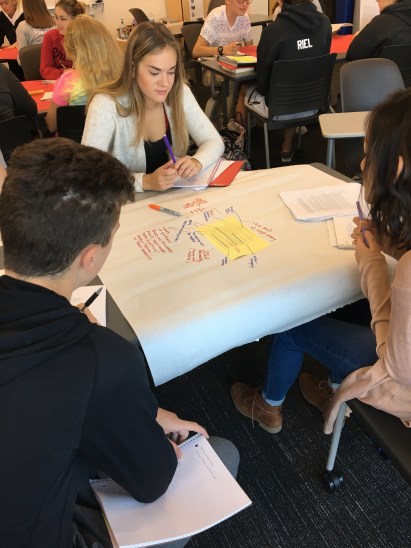
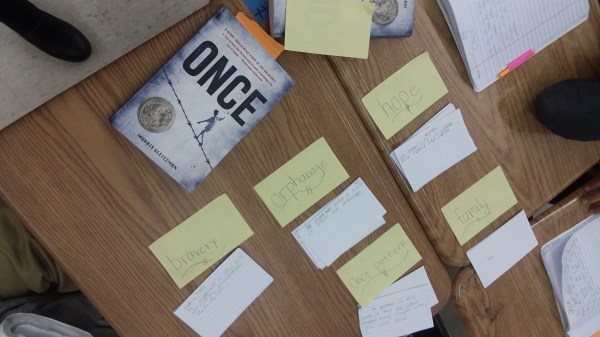
  • Provide activities to get conversation going and flowing.  One of my favorite activities from this past unit was having each student write down five significant events from the story, one event on each index card.  Then, in book club groups, students sorted their cards into piles and labeled their piles.  If you look at this picture, you’ll see that some of the piles from this student group are about setting (“orphanage”), others are about themes (“bravery,” “hope,” and “family”) and another is an observation about craft. This activity allows students to notice their noticings and realize they are not alone in their thoughts.
AmEOnceimage

Once by Morris Gleitzman is the first of an incredible series. Bonus to a book club choice!

If your school has a traditional canon-based curriculum in place, there are areas where I would see book clubs falling flat.  I would not assign Hamlet or Macbeth in book clubs.  (I might, however, think about assigning excerpts to small groups after some whole class teaching.)  I might instead start book clubs in a lower-stakes medium.  Maybe your book club reads poetry.  Maybe your club members are obsessed with the Dallas Cowboys and each member finds an article on the Cowboys to bring to the meeting.  Or maybe your book club loves superhero comics, and you read the new Superman comics together.

Wherever you are and whatever grade you teach, I encourage you to give book clubs a go.

What about you?  What are some of your favorite book club rules and routines? Or what are your book club roadblocks?


Amy Estersohn is a seventh grade English teacher in New York and is a halfway decent trivia team member.  She collects her book and graphic novel reviews at teachingtransition.wordpress.com


Sit Down Next to a Child

The closing of a semester is a stressful time.

Exams are looming for both students and teachers, papers are stacking up behind, on, and under my desk, and I’m certain that my desire to crawl headfirst into a hole (with a book?) isn’t a positive indicator of mental stability.

It’s also usually the time of year (one time at least) that I look back and wonder:

Did I guide them toward appropriate challenge?
Did we study enough mentors to shine a light on the path of reading like a writer?
Did I book talk a variety of books wide enough to hook readers at all interest levels?
Are these students better scholars and citizens for walking into my room every other day for the past four and a half months?
Will they remember any of what we did, thought, explored together?

Did I do enough?
Was our classroom experience together ENOUGH for these kids? 

Often, I fear the answer is no.

With half the year gone, I sense a blur behind me and a haze in front of me, and here I sit wondering how I can do more without killing myself in the effort, because despite all the hopeful posts of great tips and tricks and successful tidbits to help kids become better readers, writers, thinkers, citizens…I don’t feel the warm satisfaction of someone who knows it’s been enough.

  • Several students are in danger of failing.
  • My struggle with manageable methods to hold students accountable for their work/thinking hangs over my planning, and reflection, and lack of free time.
  • There is a persist voice in the back of my brain that tells me there just aren’t enough days in the school year, hours in the day, or minutes in the history of the universe to meet the diverse needs of my students, the administrative demands of documenting student progress, or the expectations I have of myself to provide the timely feedback to students that will most benefit their authentic learning.

And then…

I sat down next to Leila.

enough

A quiet, but determined student, Leila and I have sometimes struggled during the year to let her insights shine. From anxiety to a difficult home situation, there have been tears after a graded discussion when Leila couldn’t bring herself to speak, writer’s conferences where the draft was so muddled with tangents that the heart of her message was lost, and plenty of weeks when reading goals were nowhere near met, because life and the chaos it could bring her got in the way.

But we’ve grown together. Slowly.

Leila is the type of student that packs up methodically after last period. Sometimes she has a question. Sometimes I can tell she just wants to softly say goodbye without the bustle of 27 other students in the room. Sometimes she’ll shyly ask if I’ve read her draft yet or how she did in discussion that day.

She wants to connect.

And often, we do – chatting for a few minutes before she needs to catch the bus.

But shame on me, there are times I feel rushed – hurrying to a meeting, wanting to sit down and get to a stack of papers, resisting the urge to pack up and run screaming from the building after a day of craziness (not often, but sometimes).

Yesterday, however, I got the end of semester reminder that I needed. Leila asked if she could talk to me about a personal problem. Family struggles were weighing heavily on her slight shoulders, and could I listen for a few minutes because she needed to “talk to an adult I really trust”?

I put down the stack of books I was distractedly organizing and looked Leila straight in the eye. She smiled weakly and I came out from behind my desk to sit right down next to her.

Her struggles are the struggles of countless students: split family, terrible treatment by a parent, a struggling single mother, a student who wants to succeed from a deep need to exist as something positive in a world that has shown her far too much negativity in her 16 short years.

And as I listened to Leila struggle through and very carefully chose my words to let her know I really heard and appreciated her, a buried spark was re-lit. The soft glow inside when you feel truly connected to another human in this vast expanse of brisk passings, hurried exchanges, and impersonal interactions.

It had been exactly six school days since I had had a meaningful sit down with a student. In the name of providing time to “do work,” I had not conferred with kids, talked up a book, or written a word with them. They were working. I was working. We were coexisting and it felt…cold.

A few weeks back, I had a big, fat, slam a door fight with my husband.

It had been a few days (weeks?) during which we had let the hectic schedule of daily life hollow out a growing gulf between us. From the depleted shells we can all become after a day at work, to the endurance needed to weather the willful meltdowns of our spirited daughter, to the dog who needs to be walked despite windchills below zero, to the painful universal truth illustrated by conversations centered around, “I don’t know, what do you want for dinner?”, we were operating in triage mode almost each and every minute.

As a result, we were successfully coexisting, forging ahead, making steady progress, and maintaining stasis. We were not, however, connecting or particularly enjoying the experience.It wasn’t until we sat down next to each other and took the time to engage in meaningful conversation, that we fully realized how empty the very “full” days had been.

Such is the way of it with our students. Not the dinner conversations and toddler meltdowns, obviously, but the need to reconnect…or work to sustain the connections we’ve forged before too much stress, distraction, work time, or any sort of “other” gets in the way and makes it awkward.

So as this first semester comes to an end, I am trying to avoid the nagging questions of whether or not I have been, done, or provided enough in class so far this year.

When you become the trusted adult to any child who needs you, you have not only done enough, you are enough. 

img_9050-1

Sending anyone and everyone that needs it, a virtual hug today. Whether you find yourself at the end of the semester, or jumping headfirst into the new term, your work is important and valued.

Each and every time you sit down next to a child, it’s an opportunity. How blessed we are to have it.

So take a seat. You deserve it and your kids need it.


Lisa Dennis teaches English and leads a department of incredible English educators at Franklin High School near Milwaukee. Her new semester will start with State of the Union conferences for each student to reflect on the semester passed, set goals for the upcoming term, and connect. Follow Lisa on Twitter @LDennibaum. 

May I have your intention please?

I am borrowing my word for 2018 from my friend Whitney who in her wisdom spoke right to my heart:  “My word for 2018 is “intentional,” and I see that manifesting as spending quality time with quality people engaging in quality pursuits…being conscious about what I choose to do. I’m tired of being spread too thin and being so stressed out and/or exhausted that I can’t enjoy the moment I’m in.”

Ever had that moment when someone says your words for you? Thanks, Whit!

My father instilled in me the habit of setting goals. He taught me how to write them down and then see them to fruition. I am pretty good at it (most of the time.) But lately, (like the past three years) I, too, have spread myself too thin, and it’s taken a long while for my inner voice to shout loud enough for me to hear it. Poor hoarse thing.

This idea of intention resonates like an echo from the canyon of my soul. This voice is serious and a little scary. See, I’ve operated intensely in the extremes for decades. How can I do this and this and this? How can I be more, do more?

But I have not always practiced intention. More is not always better. Duh.

I am reminded of a conversation I had with my friends and colleagues Amber and Mary. I had the privilege of mentoring them as pre-service teachers several years ago. They told me the best word to describe me then was intense. Of all the words in the world. . .

I get it. And these friends will agree: I have come a long way. But I’ve got miles to go.

So I am going to be a little more honest with myself. A lot more patient. A lot more sincere. I am going to set myself free. Free to explore and relax and play.

Intentionhonestly

To be able to do this more effectively, I am also going to take some advice I got from Adam and not just take a break from social media but detach from it — a lot. Maybe I will read a lot more of the books Adam recommends and make a bigger dent in my books-to-read-next pile.

I found this article 6 Simple Questions to Set 2017 Intentions, and I’ve played around with my own questions and answers in my notebook. I am a year late to the party, but I’ve got the pointy hat on now.

I also found a list of beautiful poems at the Center for Mindfulness, a place I should probably rent a room. I’ve printed them out and will paste these poems in my notebook and write around them. (I remember Penny Kittle saying one time that she does this:  pastes poems in her notebook that she can write beside while whiling away in faculty meetings.)

Poem I Said to the Wanting Creature Inside of Me

Will this intention transfer into my teaching? into my relationships with students? No question. Here’s how I rewrote those questions above to fit with my quest to be more intentional at school:

  • What are 1-3 experiences I want to have with students this spring?
  • Who are 3-6 students I want to deepen my relationships with this semester?
  • What are 1-3 things I want to try in my classroom that I’ve put off trying?
  • What are 3 way I will take care of myself more effectively during the school day?
  • Who on my campus can I get to know more meaningfully?
  • What one word do I want students to describe me?

We all know the benefit of boundaries. I don’t know why it is so hard for some of us to set boundaries for our own well being. As teachers, we take on a lot, don’t we?

My hope for myself — and for all of you — is that we can stop a spell, consider the moment, think about what matters in the long run, then, and only then, take a step toward whatever it is we want to accomplish.

There we will have a solid place for our feet. I like that.

What are your intentions for the new year? I’d love to know.

Amy Rasmussen is the mother of six grown children and two naughty Sheltie puppies. She’s married to her best friend of 32 years and teaches at an awesome senior high school in North Texas. She hopes this is the year she can stop everything else long enough to write that book. Follow Amy on Twitter @amyrass and @3TeachersTalk 

Remembering How Good Readers Read – Guest Post by Brandon Wasemiller

Happy New Year, Three Teachers Talk! We hope your new year is off to a magnificent start. Hot off the presses from Franklin High School, my colleague Brandon Wasemiller writes about challenging our toughest students to value their voices and embrace the opportunities that reading can hold in their lives and their academic experiences with participation in The Global Read Aloud. 


We often talk about sparking the love of reading in our students. It is our daily, yearly, and career-defining struggle. Over the past few weeks, I tried something new because I was really struggling with a Tier II Intervention class (A class I have taught in the past but was reassigned to this year). I was giving book talks, getting to know the students, helping them with their books, teaching them how to be readers; but nothing was sticking. Most of them didn’t even try.   

It wasn’t until the second week of class that I came to a realization through a reading engagement survey, a pre-assessment, and a set of conferences. It was an idea that slapped me across the face and helped me guide the class. They’ve been nonreaders for so long that they have forgotten what it is to BE a reader.I have to re-teach these kids how to read.

And with that, I was off.

A fellow teacher, collaborator, and 3TT All-Star told me about a great project–The Global Read Aloud. A way for teachers and students in different classrooms (and most of the time different states) to collaborate and talk about the same book at the same time. So what was the chosen book? A Monster Calls by Patrick Ness.

(Listen, quick aside here,  but if you haven’t read A Monster Calls yet, what are you even doing?)

And so we began reading A Monster Calls. I tried to think of as many ways as possible to teach this book and make it fun and interesting. I started teaching them about active reading and about thinking while reading. I modeled for them how I read, and I had them track questions and comments throughout, but honestly, I felt like I was spinning my tires.

Then, one day, I pulled out the good ole Audible app and I played the audiobook. The chapters (The Wildness of Stories”, “The First Tale”, and “The Rest of the First Tale”) all feature two distinct characters. Conor, a young boy who is suffering through his mother’s battle with cancer, and a gigantic Yew Tree that turns into a monster at 12:07 to tell Conor stories. At the end of listening to all three chapters, we had a discussion as a class. To my sheer amazement, every single student discussed what happened and had amazingly in-depth responses to my questions.

So what was different? Why did the audiobook reach them better than some of my other activities?

And it hit me.

They are listening and experiencing a real and authentic reading experience.

They are actively engaged and plotting along with a READER who is emphasizing words, speaking in different voices for multiple characters, and emphasizing italicized and stylized words, all helping us as readers paint a picture of the novel in our heads. These are the qualities that good readers do independently. These are the qualities my students needed to re-learn.


I have a memory that I don’t think I will ever forget. I was probably six or seven, and I was at my grandma’s house. Every day, after nap time, my grandma would have story time and she would read from this book of Disney short stories. She would read us a few and she always did the voices. My grandma was Br’re Rabbit and talked in a thick southern accent, she was Mickey and squeaked her voice. My brother, sister and I were her captive audience. Our favorite story, however, was the Tale of the Headless Horseman.

One dark, rainy afternoon (I’m being serious, it really was dark and stormy) my grandma stepped out of the bathroom and her head was tucked inside a jacket and the jacket was zipped all the way up. The effect was that she seemed to have no head. She sat down to read the tale of The Headless Horseman as the Headless Horseman. She performed the tale of Ichabod Crane and his race to get across the bridge before losing his head.

That was not story time, that was an experience. I was there on the bridge racing to save my life, I was looking at the evil horseman careening towards me as I begged the horse to ride faster, I was there as the Horseman drew his sword and prepared to strike….

The idea for this unit came to me as I remembered that sometimes enjoyment in reading is lost because we lose what it is that makes us readers.

When you’re a kid, your parents read to you in different voices. When you read out loud to your parents or to teachers at a young age, they encourage you to read like they do. They help you sound out words, understand what a comma does in a sentence, what it sounds like to read a sentence as a question or exclamation; and then at some point–after the training wheels are off–we no longer read out loud.

So we have students who hate reading because it has been force fed to them for so many years. We get them into Workshop and spark the passion of reading, but they have forgotten how to read. My hope for this unit is that it will help those students.

And so, with this new realization, I decided to have my students tell a tale of their own using A Monster Calls as my mentor text.


Prep: Find chapters that will challenge the students to be readers.

I decided to use chapters featuring two distinct characters. Conor and the monster. Students had to create two distinctly different voices (yes, having a monster voice was a requirement) and they had to deal with sarcasm, anger, frustration, and other emotions throughout the chapter. brandon1

There were three chapters all about seven to eight pages long, so I made three groups of seven to eight students per group. Each group was responsible for a chapter, BUT each individual student had to read–out loud–one page. (Huge selling point here, I just kept telling them “It’s only one page!”)

Mini Lesson – Active Reader Annotating

I told my students that the goal for our first class was to focus on how characters speak throughout the chapter. However, for me, this was an opportunity to teach them how to be an active reader and note taker. I did the first page myself under the document cam.

brandon2I annotated after each line of dialogue for how the character spoke. “What emotions are being expressed here?”  I also told them that we needed to pay attention to italicized words and what they are there for.

We looked at the line “‘He’s been very good, Ma,’ Conor’s mum said winking at him from behind his grandma, her favorite blue scarf tied around his head” (41).

“So why is the word VERY italicized?” I asked. The class then talked about sarcasm and how his mom says it that way as an “inside joke” between her and Conor. “It’s so that Conor’s mom shows him that she gets that this is hard for Conor to handle. She wants him to know she is on his side” one student amazingly pointed out. These are the kinds of things I want them to notice. Not so much content, but style and sentence fluency.

Then they set off on their own! It was time for them to work in their small groups and annotate their chapter–together. I knew that I wanted them to collaborate together so I printed out each chapter on extra large (11×17 to be exact) paper, and set them up in areas that they could circle up and all work together. I gave them the space to work it out and let them discuss the dialogue. If they couldn’t get it, I encouraged them to read it aloud to each other and discuss.

I was amazed at how well they did in their chapter prep work. Often there are students who will push back because they are scared to read out loud, but I found that having only one page, and six other students doing the same thing helped them through their stage fright.

The last step of that day: I let them chose the page they will be reading aloud for the audiobook chapter.


Practice (Group and Individual)

I opened the next class by reading a chapter to them. I did my deep intimidating monster voice, I did my frustrated Conor voice, and I did my mean grandmother voice. I put myself out there and it made the kids smile (and yes laugh) but that is the point. Model for them what you are looking for, voices and all.
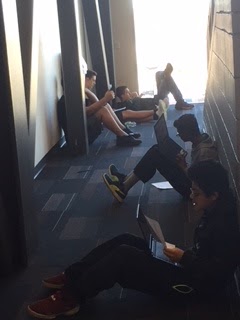
brandon6

I told them that they need to practice and become comfortable with their reading of the page and now is the time to do that. Armed with Screencastify (an easily downloadable Chromebook extension for most computers) and a copy of their individual page with annotations, I send them out to record themselves. After they turn the recording into me, I listen and give feedback. I did my best to coach them away from monotone reading, whispering, reading too fast, or too slow, or most importantly, NOT doing a monster voice.

Clearance and Final Recording

The students were set to go.  As one final step, I called each group into the hallway and had them rehearse the whole chapter, as a full group, for me. I gave them my last bits of feedback and sent them back into the room to do a final recording.


I am already looking forward to revising this unit–make it even better. I feel that it can work in any and all classrooms. So much can be learned by understanding how a book is meant to be read and it is our jobs to help the students learn that.

What do you think of reading aloud and making group chapters come to life? Do you see your students struggling to be authentic readers? How have you encouraged students to have authentic reading experiences in your classroom?


Brandon Wasemiller has been teaching a Franklin High School for the past four years. He graduated from the University of Milwaukee-Wisconsin where he majored in Secondary English Education. When he is not teaching, Brandon coaches multiple sports (Girls XC and Baseball) and enjoys listening to audiobooks while at the gym.
 

“Did you know Gucci has a book?” I do now.

“Hey, Miss, did you know Gucci has a book? I want to read it.”

“Really? You are telling me you actually want to read book?”

“Yeah, but only that one.”

I go to my computer, click on Amazon, and look for a new book by Gucci. I find:

Screen Shot 2017-12-04 at 4.28.59 PM

These cannot be the books Daniel is talking about. I know this kid. He was in my junior English class last year — part of the class with the tissue issue, and now I had him as a senior.

“How do you know Gucci has a book?” I asked.

“I saw it on his Instagram,” Daniel said, showing me his phone.

Dear Reader, you are ahead of me on this, aren’t you?

I admit to being on the edge of old. I had no idea before this conversation with this student that his Gucci was not handbags and luxury leather goods. Because Daniel tends to mumble, it took me a while to figure out he was referring to Gucci Mane.

Daniel’s favorite rapper had a new book.

So I bought it.

When I first met Daniel, we had trouble. He sat in the back of the room, fake reading, sleeping, tossing pencils, goofing off so others laughed. I moved him to the front, and he slid low in his chair and sulked. Every day. And every day when I conferred with readers, I leaned over Daniel’s shoulder and asked what I could do to help him want to be a part of my class.

Eventually, he responded. He told me he’d read Gary Soto’s books in 10th grade. I wasn’t sure I could believe him, fake-reading tough guy and all, but I passed him the two Soto books I have in my library. He read them both.

Then, he started reading Matt de la Pena’s books. Ball Don’t Lie took Daniel a long time to get through, but he finished it and started Mexican Whiteboy. I’m pretty sure he read four books that semester — more than he’d ever read in his 16 years.

In conferences I asked Daniel about his life outside of school. He told me he wanted to work on cars like his brother and that he took the bus to the career center after my class every day, so he could take courses in auto mechanics. Based on our conversations, I do not think another general ed teacher had ever talked to this young man about what mattered to him:  cars.

hattie-teacher-student-relationships

Source: Hattie, J. (2009). Visible Learning: A Synthesis of Over 800 Meta-Analyses On Achievement. Routledge.

In education, we hear about the importance of building relationships a lot, and my experience with Daniel is a testament to the power of taking the time to get to know a student. Because he knew I cared, Daniel started to care about his English class. He began asking for help and coming to tutorials. He started showing up in spirit and not just as a warm body slumped in a chair. He felt like he belonged.

Did Daniel excel? Not exactly. But he passed, which was something a bit surprising to both of us after his I’m-too-cool-for-school-to-do-anything rocky start.

Flash forward to this year. I moved to senior English, and Daniel got his original schedule changed so he could be in my class. He walked in my room the first day with the same too-cool attitude. (Appearances are everything, and I know this game.) Again, I gently started conversations.

When Daniel scored an A on his first essay, he pretty much called me a liar. On his

Reading Boot Camp by Todd Strasser

Reading Boot Camp by Todd Strasser

next essay, he told me he stayed up all night so his brother could help him, so he wouldn’t show up to class empty handed. When we did a project on careers, and he presented to the class, Daniel spoke with confidence and detail about the field of auto mechanics. He’s read at least two books this fall and a lot of articles in The Wall Street Journal. This past Friday he came to tutorials for an hour, so I could review what he needed to do to pass his last state exam so he can graduate this spring. I don’t know if he will, but I sure hope so.


There are thousands of young men like Daniel in our schools. I wonder if teachers have the time, resources, and energy to give them the attention they need. There are 28 students in Daniel’s class this year. There were 32 in his class last fall.

There is one of me.

I cannot help but think of the famous starfish story. You know the one that ends with “I made a difference to that one.” I know I’ve made a difference to Daniel. I still call him a punk. He still mumbles when he talks to me. But he knows I like him. I really like him. And he even let me interview him, so you can like him, too. (The smile at the end is the best part.)

Choice matters! If you are reading this post, you probably already believe that as much as I do. I hope you do. Daniel’s story is not unique. We make a difference to many young people just like him when we open spaces for talk, engage in real conversations about what matters to them, and allow for self-selected reading in our instruction.

I would love to hear the stories of your Daniels. Please share in the comments.

Amy Rasmussen teaches English IV and AP English Language at a large senior high school in North Texas. She spends a ton of money on books with the hope of helping every child develop as a reader. And while she does not listen to rap, she does learn a lot from those who do. Follow her @amyrass 

What Will You Teach Into?

I am a week away from bringing my second daughter into the world, and after yesterday’s horrific shooting in Texas, I find myself revisiting the same fears I’ve often had when I consider my progeny. Primarily, I wonder: what kind of world am I bringing my children into?

As I fretted about this to my husband last night, he reassured me with statistics about how unlikely it was that either of our daughters would ever be involved in a shooting, an act of terror, a horrific trauma.

That’s not what I’m worried about, I told him–not that they’ll die or be injured by one of these awful events. I’m much more worried about the world they are going to have to live in, day in and day out.

A world where a 26-year-old makes a conscious decision to attack a church full of people. A world where this incomprehensible event has become common enough that it is, less than 24 hours later, already being reduced to a sound bite: “This isn’t a guns situation. This is a mental health problem.” A world where a conversation about terror and murder has become more binary than complex. It is; it is not.

I don’t want my girls growing up in a world that doesn’t know how to talk about, seek to understand, or attempt to solve these unexplainable problems–problems that certainly cannot, to me, be boiled down to a single cause or effect.

do want them growing up in a world where we try to talk about these things. A world where these conversations are never taken for granted, where they continue to happen, no matter how difficult and painful, as Kylene Beers writes in “Once Again:”

“Honestly, though, I don’t want tomorrow to be easier. My fear is that this day you face tomorrow has become too easy. My fear is that your students won’t expect that this horrific killing will be discussed. My fear is that tomorrow is just another Monday.”

As a teacher, a mother, and a citizen, I cannot agree more with Kylene. I feel more powerless in the latter two of those roles than I do in my work as a teacher, though, for I feel that teaching is where I can make a difference. I feel it is where we can all make a difference.

This week and every week, I hope teachers are having difficult conversations with our students. I hope we are not shying away from the ease of ignoring our nation’s pain in favor of teaching about comma splices or symbolism or character development. I hope our time with students is deliberately geared toward talk about these incredibly complex, nuanced topics. Kylene says it well:

“No one ever told you that you’d need to know how to sit with children or teens to talk with them about people in churches getting killed by a gunman or little kids in a school getting killed by a gunman or families at a concert getting killed by a gunman. No one. And you didn’t sign up for that. You didn’t. But they will watch you and they will listen for what you say and what you don’t say.”

I hope you are grappling with this and asking yourself:

For what purpose am I teaching?

And I’m talking about a larger purpose than the day’s essential question or the target content standard. I’m talking about how the day’s lesson fits in with the culture of the classroom, the messages we want kids internalizing day in and day out, the life lessons we want them to learn as painlessly as possible.

One of the texts my students and I study that helps us learn to frame instruction this way is Peter Johnston’s excellent Opening MindsIn class on Friday, we discussed Johnston’s closing claims (p. 123-124) about research-based instructional design:


  1. Our singular focus on academic achievement will not serve children or their academic development well.
  2. The individual mind is important, no doubt, but as the center of the academic universe, it is overrated.
  3. We have to take seriously the fact that the adult is not the only teacher in the room.
  4. Children’s social imaginations should be taken more seriously. They are the foundation of civic society.
  5. Our interactions with children in the classroom influence who they think they are and what they think they’re doing.
  6. Making meaning is good. Doing meaningful things is better.

We spent time unpacking each claim, wondering how to apply it to our varied content areas and age groups, but dwelled on the last claim:

Making meaning is good. Doing meaningful things is better.

We were reminded that none of us became teachers so we could fix comma splices. We became teachers because we wanted to change the world–our world, and our students’ worlds–for the better.

This Monday morning, I want us to keep that goal in mind as we teach and plan and reflect on how we’ll spend our time with young people. How will we make sure that our work together is meaningful?

quotes-about-doing-meaningful-things-3

If you don’t already see your work as a teacher as powerful, if you don’t see your role as one of an agent of change, try looking at this familiar work in a new way. Your interactions with children in your classroom influence them in powerful ways. You have the unique power of being able to help them develop their social imagination, their empathy skills, so they’ll never reduce a tragedy to a single cause with an unimaginable effect.

You have the power to choose: what will you teach into this week? Making meaning? Or making life meaningful?

Shana Karnes is a worrywart in the best of times, but an idealist in the worst of them. She is grateful every day to work with amazing preservice teachers at West Virginia University, to be mom and wife in a beautiful family, and to be able to write and think and learn with her friends here at Three Teachers Talk. Connect with Shana on Twitter at @litreader

Shouldn’t Students Know How to Assess Their Independent Reading?

I have a love/hate relationship with the word authentic.

A few years ago when I participated in the North Star of TX National Writing Project, I wrote my action research goal to align with North Star’s definition of authenticity: “authenticity is connecting student learning with significant audiences, tasks, and purposes.” Of course, I still believe in this definition; I just struggle with redefining it for the individual students in my classroom.

Let’s take self-selected, independent reading for example. How do we ‘authentically’ assess this reading? Shana’s written about this topic lately in posts about too much measurement and alternatives to reading logs. She even started this google doc, a resource for assessing independent reading sans reading logs. There are some great ideas there.

I’m still not satisfied.

A few weeks ago I wrote about shifting control to invite more learning in which I write about shifting the finding to my students, giving them the opportunity to find mentor texts and create text sets we will study in class. I know this empowers students — they want to feel some element of control.

I decided to take the same idea of shifting and apply it to how I might assess student choice reading. Quite simply, I asked students to help me figure it out.

First, I reminded my readers why I am so adamant about independent reading and determined to hold them accountable. Then, I invited students to talk about how I might actually do it and asked that they write down their ideas. They seemed eager to help me figure it out. I listened in — grabbing my camera just in time — to capture some pretty rich conversation.

These are the ideas my class generated.

  • have reading partners that check each other
  • write a summary of what we’e read once a week (Me: “You really want to write more? Them: “No.”)
  • talk about our books for a minute or two*
  • record ourselves reading aloud (I asked:  “The whole book?” They said smiling: “Why not?”)
  • read together
  • summarize in a Google Classroom Q & A
  • pick a line from the page and write about how you feel about the line*
  • write about first impressions when we start a book
  • set reading goals then determine if we meet them by our reading rates*
  • write small summaries (Me: “You really want to write more? Them: “No.”)
  • talk about our books*
  • check for annotations
  • find our reading style
  • do book talks*
  • read novels in groups (Me: “We already do Book Clubs six times a year.” Them: “Oh, yeah.”)
  • write a blog post every week — what page we’re on and something we learned, not a summary because we can find those online
  • require us to finish at least one book every two weeks
  • book talks with our table — explain it to them*
  • write book summaries (Me: “What’s with the summaries?”)
  • check annotations
  • expand on quotes*
  • keep a reading log
  • write a one page summary every week (Me: “For real? a summary?”)
  • keep a reading log
  • create a sticky note system where we mark each hour, a start and end for that day
  • provide an incentive — candy? (Me:  “This will never happen.”)
  • give us due dates, but some will find this stressful
  • give grades to persuade and motivate (Me: “Exactly what I don’t want to do.” and under my breath: Can we give grades a rest already?)
  • write summaries? (Me, sighing: “At least you questioned it.”)
  • show progression through a book rather than setting a due date

And then these two responses:

  • The only way to actually PROVE someone is reading is if they read aloud.
  • You can’t really force [reading] upon someone; people need motivation.

Honestly, I was hoping for more. Something more — shall I say — authentic.

See? Students don’t really know how to assess pleasure reading either. Maybe that’s the whole point.

On that list above, the ideas with the asterisks? — those are things we already do. Plus, more. We study craft in our choice books:  sentences and passages. We pull ideas for expository and argumentative writing from our books. We review literary terms and analyze ways writers use them to enhance and craft meaning. We even occasionally swoon over a particular passage (well, I usually model swooning. It’s hard to get 17 year olds to swoon.)

I still do not know how to “grade” choice reading, and I’ve decided that it’s okay. Maybe I’ll take participation grades when I see students moving through their books at a fairly decent pace or after I confer with them and check for understanding. Maybe I’ll just keep listening in as my readers talk about their reading and lean over shoulders reading as they update their book lists in their notebooks.

I do know this:  The more I make everyday a reading day, a day we celebrate our lives as readers, the more students want to identify as readers.

And somedays they surprise us with their enthusiasm:

Michael came to class on Monday raving about his book. I pretty much shouted “Stop talking until I get my phone and can record you!”

How’s this for authentic reading assessment?

Please share your thoughts on assessing readers in the comments. Have you shifted yet?

Amy Rasmussen loves to read, and she loves her readers. The first book she remembers falling in love with was Anne of Green Gables, but her first memories of recall vaguely  The Boxcar Children. Amy models her reading life with her senior English and AP Language students by reading about books, talking about books, writing about books, and spending money on books for her readers to explore and enjoy. She firmly believes:  “It takes just one right book to make a reader. It’s just that every reader probably needs a different just right book.” Follow Amy on Twitter @amyrass and @3TeachersTalk


If These Walls Could Talk

We spend eight hours a day (Ha! Nine? Ten? Should I just sleep here?) in our classrooms.

Four walls, seating for 30 (Ha! 3img_66735? 78? Does flexible seating come in bunk style these days?), and an endless array of inquisitive minds, needs, and beliefs.
At Three Teachers, we speak with full hearts and buzzing minds about the opportunities that Readers and Writers workshop afford. From choice to challenge, talk to Twitter, and many, many elements in between, we explore, question, wrestle with, and embrace the opportunities that come with relinquishing control over a classroom to instead move together with our students as readers and writers.

As I look around my classroom this year, full of some familiar components (budget-busting classroom library, inspirational posters touting the beauty of words and books, and my space age rolling furniture), I also see evidence of my growth as a workshop teacher.

So, in much the same way that one might suggest that it’s what’s on the inside that counts, the following suggests some of the ideas I’ve collected from great workshop teachers, Twitter searches, fellow colleagues, and my professional reading over the summer to reflect the beliefs of our community and what we value as readers and writers:

img_6116

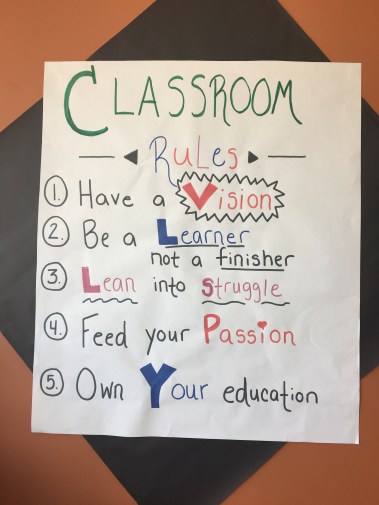
I’ve completely abandoned any traditional rules in the classroom. On the first day of school, I joke with kids about their vast knowledge of how to “play the game of school.” As long as we can, as high school students, keep from putting gum in each other’s hair, we can focus on the more important “rules” that will guide our philosophy of learning and engagement. These rules from Amy Fast, are referenced each and every day. Mostly rule #2. We need a LOT of work there. 

img_6117

I am NOT an artist, by any means. In the past, I’ve let this limit what I try to do when it comes to anchor charts in my room. NO MORE! With a projector and pencil, I am tracing my way to borderline copyright infringement (Don’t worry, I promise not to try and sell them). This beauty comes from the Disrupting Thinking by Kylene Beers and Robert Probst, which rocked my world over the summer. I wanted my students to have a solid reminder of what their books, brains, and hearts mean to their reading. We refer to this chart that I found through Google Images almost daily. 

img_6468

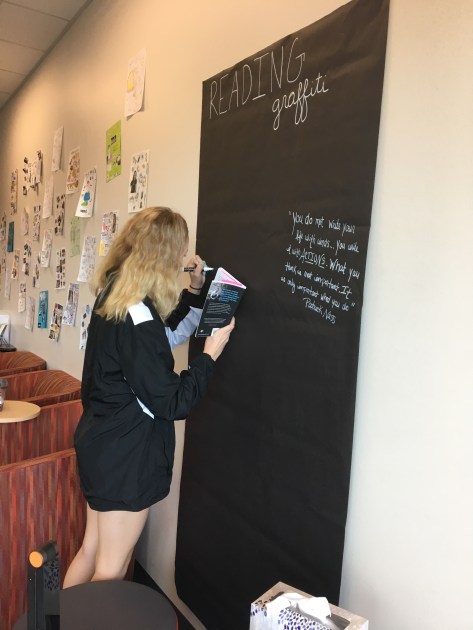
Giving students a place to share what moves them in their reading means we have a constant reminder of the power of words, and motivation to write as we reflect on the great beauty we find through the published word. This reading graffiti poster illustrates the baby steps my students are taking to feel comfortable in sharing what speaks to their hearts and minds while reading. Once I finally broke the seal and put a quote up myself (Thank you, as ever, Patrick Ness), students have added insights such as “When you tell a lie, you steal a man’s right to the truth” and “You can’t take it with you, right?!”I love the brave souls who are sharing their reading lives with us without even being asked. 

The back wall is a revolving homage to mentor text study. Early in the year, my sophomores started their study of narrative by emulating Kelly Norman Ellis’s poem Raised by Women.” These days, creations from my AP Language students grace the walls. They utilized authentic informative writing in the creation of biographies modeled after the work of James Gulliver Hancock in Artists, Writers, Thinkers, Dreamers.

img_6685

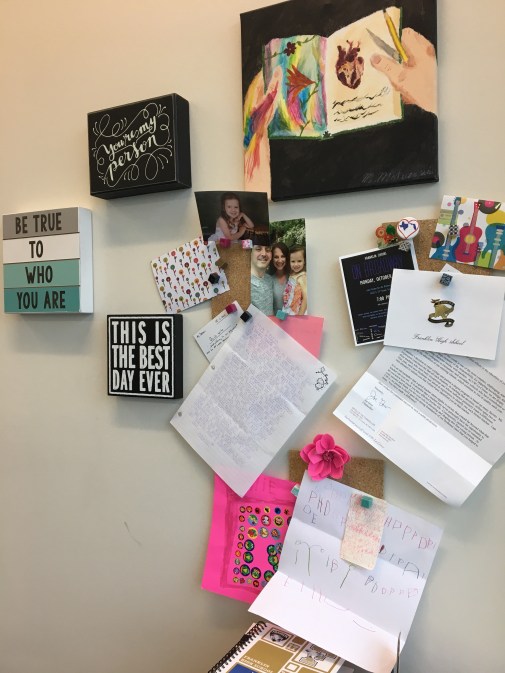
In the space behind my desk, I have inspirational words that help frame my work each day, provided by people that I love and respect. I have pictures of my family, notes of gratitude from students, and art from my daughter Ellie. I am a firm believer that as a reader and a writer in the room, my story matters too. I love to share with students how the belief that we can always improve, grow in reflection, and benefit from a positive attitude, can shape their experience in English class each day. 


Our classrooms, both full of students, and basically empty, suggest who we are as teachers. I love what mine says about the work we do everyday in the workshop.

What does your classroom say about your workshop journey? Please share in the comments below!


Lisa Dennis teaches English and leads a department of incredible English educators at Franklin High School near Milwaukee. One of her classroom walls is painted in a burnt orange color. It’s fall all year. Follow Lisa on Twitter @LDennibaum 

5 Lists of Books and More Space for Talk

I am a collector. I collect bookmarks I don’t use and tweets with headlines I think I’ll read later. I collect cute little pots I think I’ll eventually make home to plants, and notebooks I’m afraid to mess up with a pen (from my pen collection, of course.)

I also collect lists. Doesn’t everyone?

I collect lists of books thinking this will keep me from buying more books. Sometimes it works. Not often.

We’ve shared several lists of books on this blog:  Coach Moore’s list of books he read this summer, Shana’s Summer Reads to Stay Up Late With, Amy E’s Refresh the Recommended Reading List, and Lisa’s Going Broke List just to name a few.

I like reading lists about books. This helps me stay current on what my students might find interesting or useful. Often, I find titles that help me find the just right book for that one students who confuses “reading is boring” with “I don’t read well,” or “I don’t know what I like to read.”

With one heartbreaking event after another in our country lately, I keep thinking about the importance of reading to help our young people grow into compassionate citizens who more easily understand their world. Did you see the results of yet another study? Reading makes you feel more empathy for others, researchers discover.

Of course, we don’t need another study to tell us this. Many of us see it in our students.

I see it in my students. My students who enjoy reading also enjoy talking about their

Bookclubdiscussion

My students chose from nine different books for their book clubs. Once they chose, we had five different book clubs happening in one class. At the end of our second discussion day, I had students combine groups and talk with one another about the major themes, make connections, and share a bit about their author’s style.

reading. They relate to one another more naturally as they talk about their books, the characters, the connections. They welcome conversations that allow them to express their opinions, likes and dislikes. They learn much more than reading skills through these conversations.

My AP Language students recently finished their first book club books. I left them largely without a structured approach to talking about their reading. My only challenge on their first discussion day was to stay on topic:  keep the conversation about the book for 30 minutes. They did. I wandered the room, listening in as I checked the reading progress of each student.

On the final discussion day (three total), I reviewed question types and used ideas from Margaret Lopez’ guest post Saying Something, Not Just Anything, and asked students to write two of each question types:  factual, inductive, analytical prior to their book club discussions. This led to even richer conversations around their reading.

I remember reading a long while ago about how conversations about poetry could invite opportunities for solving big problems. I don’t know if this is the article I read, but the poet interviewed in this article asserts it, too:

I think we know the world needs changing. Things are going awry left and right. I firmly believe that in our very practical, technological, and scientific age, the values of all the arts, but of poetry in particular, are necessary for moving the world forward. I’m talking about things like compassion, empathy, permeability, interconnection, and the recognition of how important it is to allow uncertainty in our lives.

. . .Poetry is about the clarities that you find when you don’t simplify. They’re about complexity, nuance, subtlety. Poems also create larger fields of possibilities. The imagination is limitless, so even when a person is confronted with an unchangeable outer circumstance, one thing poems give you is there is always a changeability, a malleability, of inner circumstance. That’s the beginning of freedom.

When we invite our students to read, and then open spaces for them to talk about their

bookclubdiscussion2

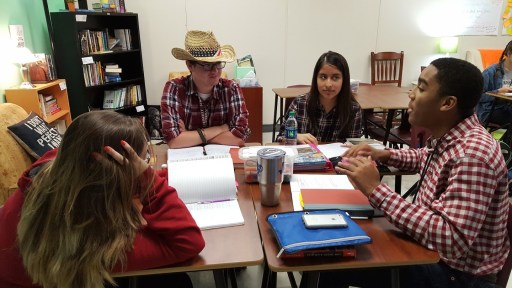
This group had hearty discussions around Hillbilly Elegy by J.D. Vance. It’s Western Days. They don’t always wear hats and plaid and boots, even in Texas.

reading, we provide the same opportunities that discussions around poetry do. Maybe not on the micro scale of ambiguity and nuance, but most certainly on the macro scale of possibilities. Our students are social creatures, and we must give them spaces to talk.

So I collect lists of books I think my students may like to read, with the hope of engaging them in conversations — with me and with one another — around books. (A couple of years ago, Shana and I had students create book lists as part of their midterm.)

Here’s five of the book lists I’ve read lately. Maybe you will find them useful as you curate your classroom libraries and work to find the right books for the right students, so they can have the conversations that help them grow in the empathy and understanding we need in our future leaders, right or left.

6 YA Books that are Great for Adults

50 Books from the Past 50 Years Everyone Should Read at Least Once

The Bluford Series — Audiobooks

20 Books for Older Teen Reluctant Readers

43 Books to Read Before They are Movies

Oh, and if you haven’t read Lisa’s 10 Things Worth Sharing Right Now post in a while, now, that’s an awesome list!!

Amy Rasmussen loves to read, watch movies with her husband, and tickle her five grandchildren. She’s in the market for a lake house and likes to shop thrift stores for books and bargain furniture. Someday she’ll be disciplined enough to write a book about teaching. For now, she teaches senior English and AP Lang and Comp at her favorite high school in North TX. Follow Amy on Twitter @amyrass, and, please, go ahead and follow this blog.

Shifting Control to Invite More Learning

569059I admit to liking control. I won’t go far as to say I’m a control freak, but I am freakishly close. As I age I realize I like more and more things in neat little rows, even my To-Do lists must be lined up perfectly, so I can make tiny check marks with my Precision pen.
I am ridiculous.

The hardest part of teaching for me is letting go. It’s also been the best thing for my teaching.

To be an effective workshop teacher, we step aside so our students can step in. They want to know their opinions, ideas, and choices matter. They’re hungry for it. We’ve written a lot about choice reading on this blog, and I know many of us advocate for self-selected independent reading, protecting sacred reading time like an O line protecting our quarterbacks.

I wonder what other choices we offer our students. How else do we invite them to own their learning?

Recently, I read this post “The Inspiration in Front of Your Eyes” by George Couros. He begins:

Often when working with educators, I try to give relevant examples of ideas that can be implemented into learning but get very specific to either a class or grade level.  My focus is not adding something to the plate of an educator but replacing something they currently do with something new and better than what they may have been doing before.  For example, instead of a teacher spending hours searching a video to explain a concept in math, or even creating it themselves, why not have the students find the concept and say why it is powerful, or having the students create some form of multimedia to explain the concept themselves? The flip is putting the learning into the student’s hands, which can lessen the work for the educator.

Deeper learning for the student, less work for the teacher.  Sounds good to me!

Couros goes on to explain the importance of being observant and connecting ideas we find in the world, and reshaping them to facilitate deeper learning for our students. Of course, this resonated. This is how we find mentor texts like author bios and user manuals. But Mr. Couros got me thinking about shifting the finding to my students.

Then before school a week ago Monday, I saw Kristen Ziemke‘s Padlet, Take a Knee. And I got another spark to shift my instruction.

I’d never used Padlet before, so while my students shuffled in to first period, I quickly made an account and created a board. I put one thing on it:  Kwame Alexander’s poem, Take a Knee, which I knew was the perfect quickwrite for the day after so many NFL players knelt in protest.

After we wrote and shared and talked in small groups and as a class about the issue. One student said, “I just don’t know enough about it to know what I believe.”

The perfect intro!

I suggested we make a text set that could help us understand the why’s and who’s and what’s of this hotbed of a topic, and I issued the challenge:  As a class of individuals with a wide variety of beliefs and backgrounds, we’d search for articles that would address all sides. We’d use Padlet as our storage space. Then we’d use the text set we build together for our learning in class.

With their phones and iPads, students went to work, and in the 10 minutes I gave them in class, they talked. Students talked about where to find information that “wasn’t biased,” “would tell them the truth,” “will help me want to know more.”

I leaned in to these conversations, teaching terms, suggesting sites, encouraging objectivity — and why it is important for our understanding of human needs and desires.

Our Padlet What’s the Argument is not complete. We haven’t had a chance to return to it yet, but we will. Maybe we’ll use it as we learn to ask better questions in preparation for whole class discussions. Maybe we’ll use it as we learn to synthesize information from a variety of sources. Maybe we’ll use it to spark ideas for the arguments we’ll post on our blogs. It doesn’t matter.

When we return to our Padlet, or even create another one that coincides with whatever peace-cannot-be-kept-by-force-it-can-only-be-achieved-by-understandinghotbed topic fires up the nation (sadly, there are so many), my students will know I value their input. They’ll know that helping them make sense of our world is as important to me as helping them love books and become good writers.

And maybe they’ll remember to look at all sides of the issues, to see into the hearts and minds of those we may disagree with so we can find a space for conversations.

If my giving up control makes space for that, I’ll take it every chance I get.

What ideas to do have to flip the learning into students’ hands, let go of control, and invite deeper learning? Please share in the comments.

Amy Rasmussen is a neat freak in her classroom but not her bedroom closet. She loves sharing books with student readers and reading students’ writing. She is the mother of six, grandmother to five, and wife to one very patient man. She teaches senior English and AP English Language at a huge and lovely senior high school in North Texas. Follow her on Twitter @amyrass