Category Archives: Classroom Culture

A Rebuilding Year – Growth Mindset for the Weary Educator

It’s been a solid decade since I taught freshmen, but those babyfaced, wide-eyed foundlings and I are on a long overdue reunion tour this year.  Such youth. Such innocence. Such…incredible chaos. I’m straight up exhausted. It’s a late February tired in early October on this homefront and wow, do I feel a heck of a lot older than my (insert inaudible mumbling here) years.

But, I’ve got a contingency plan, my fellow workshop enthusiasts, and it goes a little something like this:

Keep at it.

Keep at it for the ones whose names you learned first, out of necessity to rein in their testing behaviors. Keep at it for the ones who just can’t seem to get their curiosity, listening ears, and class materials in the same place at the same time. Keep at it for the ones who have fought you on every book selection you’ve slid ninja-style before them without yet hearing the sweet click of a kid who is hooked on a great book. Keep at it for the ones glued to your book talk, but still “too cool” to ask the teacher about something to read. Keep at it for the long haul…we’ve only just begun.

Sometime a few months back, in the blissful noncombative expanse of summer, I must have had a premonition of the deep need I would have to hear these words and repeat, mantra-style, this cadence of pushing forward to what can and will be better because of my efforts.

I was putting a cover together for my writer’s notebook so I’d have something personal to show my students, my 9th graders especially when it came to creating a notebook that invites exploration. I had been cleaning out a closet in our office/playroom, sorting through mementos I was saving to document my daughter’s latest art projects, and I came across two seemingly disparate items that sparked a theme for my writer’s notebook, and my year.

The first was a collage that hung in my locker when I was in high school. A random conglomeration of magazine clippings that spoke to some of my extremely adolescent aspirations.

growth.jpgThe other, a stack of unrelated photos from when my grandparents built their house in the early 1950’s. The tiny black and white photos cataloged the creation of a home that I would come to know as a place with countless memories, but in these photos, it was an unfinished, stark-looking shell.

The kitchen I would learn to bake in did not yet exist. The trees I would climb and swing from had not yet been planted. The four-lane highway that runs before it now, was then, just a dirt road.

But in those pictures, beyond the unfinished walls and barren yard was something even greater than it’s current state of general chaos – potential.

From those photos, I selected one and went on a mission to gather other illustrations of potential and growth. I added to my cover a picture from my wedding day, another of Ellie on one of her first days of daycare, a daily behavior chart from those same early days of “school,” and a sample of her earliest “stories.”

Together, these pieces helped me share with my students a purposeful personalization of my notebook, and shed light on part of my goal-setting process for the school year:

Overcome the fear (The freshmen are coming! The freshmen are coming!) and keep at it. Push forward through what’s hardest. Look for signposts of small successes along the way. Always travel in packs – collaborate, seek feedback, lean on others for support (Huge shout-out here to my fellow English 9 support team who have kept me afloat these first few weeks). And these pieces of advice are as true for the educators, as they are for our students who are just gaining their footing as readers and writers.

So, as my freshmen file in today, I will look past my tired and the somewhat frustrated, and instead, remind myself of the big goal I set for myself and their potential for growth. I will look to the young scholar I have had to speak to in the hallway on more than one occasion already about his disruptive behaviors sidelining the entire class. I will look to the young woman who rarely even makes it to class, and I’ll capture each time I see her as an opportunity to try and get her to come back. I will look to the socially awkward young man whose first speech of the year suggested he likes online video games to make friends so he can avoid people judging what he looks like in person. And for each of them, and all the rest, I will focus on what my conversations with them one on one can accomplish. Conferring is where the magic really happens, and if you’re too tired or overwhelmed to talk with kids, as I have sometimes already felt this year, then it’s time to reprioritize. Quickly.

It’s for those students who have admitted they haven’t completed any books since about the 5th grade. It’s for those students who say they love to write, but never want to share that writing with the group. It’s for the students who loved reading at one point and somehow that love was stomped out of their lives. It’s for the compliant ones, almost most of all, who need a spark instead of a dying fire to light their way back to the beauty of being readers and writers.

It’s because they can grow, they need to grow, and so do I, that I do this work every day. And though that road sometimes seems very long, often thankless, and sometimes overwhelming to the point of mental breakdown, it’s where this work will take us that’s important. So…I’ll keep at it.

Lisa Dennis teaches English and leads a department of incredible English educators at Franklin High School near Milwaukee. Follow Lisa on Twitter @LDennibaum 

Utilizing Every Square Meter

We’ve got them in every class… those students who love to sit in the back of the room or in the corner that’s difficult to get into once chairs are out, backpacks are on the floor, and drawers have been opened, etc. The corners and spaces that present challenges to navigate, and without being aware of it, make it so we let things slide. Maybe we don’t check in as often during notebook work, maybe we don’t see what’s on the computer screen as much during our writing work time, maybe we don’t always see what page they are on during independent reading time.

Maybe you all have figured out how to prevent these “dead spaces” from being a thing in your classrooms, but I was still working on it at the beginning of my twentieth year of teaching.

Screen Shot 2018-10-03 at 4.58.58 PM

It was a concept I had first started thinking about when reading Doug Lemov’s Teach Like a Champion a number of years ago (the updated version can be found here).

teachlikeachampioncover

I remember having a conversation with colleagues about “owning the room” based on what we had read in the book. I knew then that I had dead spaces, and I’ve worked on eliminating those spaces ever since.

This year I wanted to think about my classroom differently. I didn’t want to “eliminate dead spaces” as much as I decided I wanted to utilize the space to its fullest potential. I wanted each student to have a front row seat for at least part of the class time every day. I feel that this is inclusive; the students who often stay under the radar in the quieter spaces of my classroom can still find the spotlight, and the students whose personalities require constant attention sometimes find that they aren’t in the limelight for a little while. I want to spread my attention evenly and fairly, and I think that utilizing our space deliberately is one of the answers to this issue.

While nothing is every perfect, I think I’ve stumbled upon some good solutions.

I started by figuring out where the traditional problem areas are. I’m sure many teachers can relate: it’s primarily the corners and the walls. So I first focused on the perimeter of my classroom.

I looked at the corners and made sure that each of the four corners has a specific purpose.

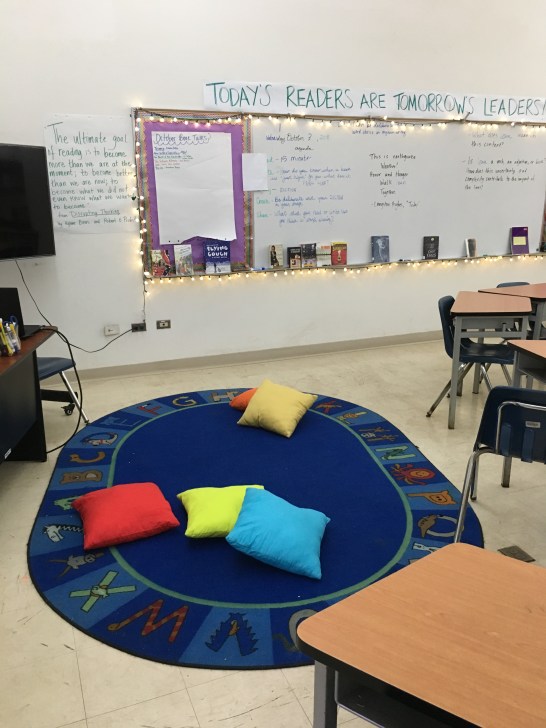
  • One corner has the TV screen and rug so that students can come up to participate in mini-lessons.
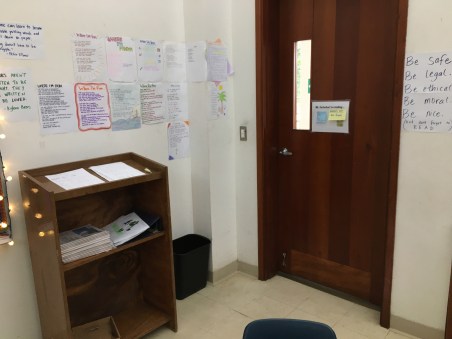
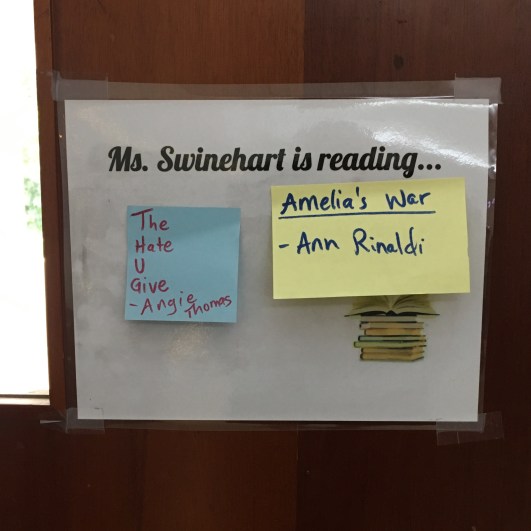
  • One corner is where students enter and exit, so I used the wall space for student work and my currently reading notice. I also re-purposed my podium — I turned the front of it to the wall and am using it as a place for students to sign in when they leave class or come in tardy. There are also handouts for students on the lower shelf.
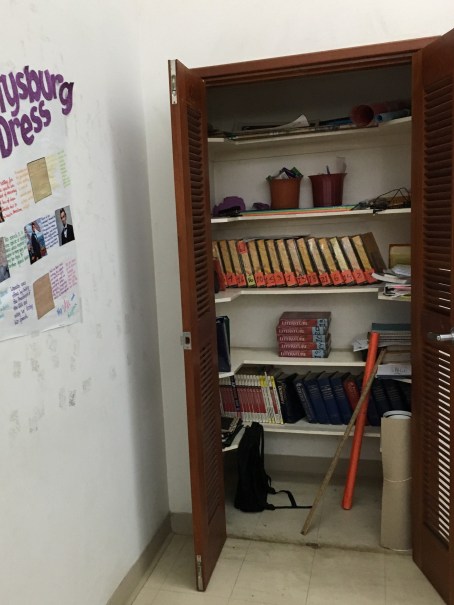
  • Another corner has a cupboard in it, which is always accessible. It’s for students — they can find extra supplies as well as their textbooks (we use them more as anthologies, to be honest).
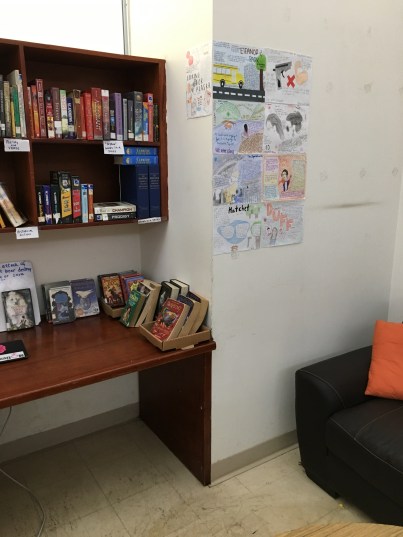
  • The last corner is the most popular. It’s the reading corner. It’s next to the classroom library, has the comfy couch, and also showcases student work as well as our reading agreements.
img_1142.jpg

This corner has the TV/computer set up for mini-lessons.

IMG_1147

The corner with my door showcases student work, has a spot for handouts and the bathroom/tardy sheets, and has my “currently reading” notice on the door.

img_1151.jpg

The corner with the closet isn’t off-limits to students. Extra supplies and textbooks (we’re calling them anthologies this year) are accessible to students at any time.

IMG_1150

Student work is displayed in the reading corner. Currently on the walls are some grade eleven one-pagers. These also provide ideas for what other students might want to read next.

IMG_1160

The reading corner is a popular spot; it’s right next to the classroom library and has the comfortable furniture.

IMG_1164

Mrs. Swinehart is currently reading…

IMG_1149

Students come to the rug for mini-lessons in this corner of the room.

After looking at the corners, I examined the purpose of each of the four walls.

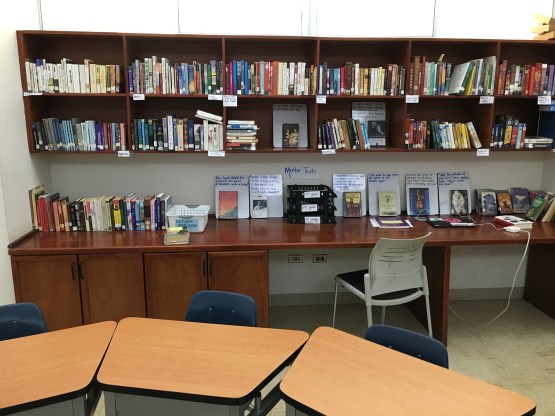
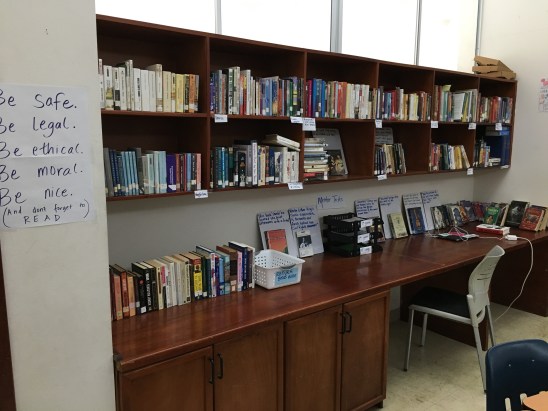
  • One wall is our classroom library, which is always a popular place to be. We use it and love it every day, in every class. It’s organized, at eye level, has a rotating display, and most importantly, includes titles that will appeal to my students.
  • Another wall is what would traditionally be the back of the room. It already had bulletin boards on it, so I hung anchor charts that are relevant on a daily basis. I refer to them, I walk to and through the space, and kids actively turn their bodies to look at them.
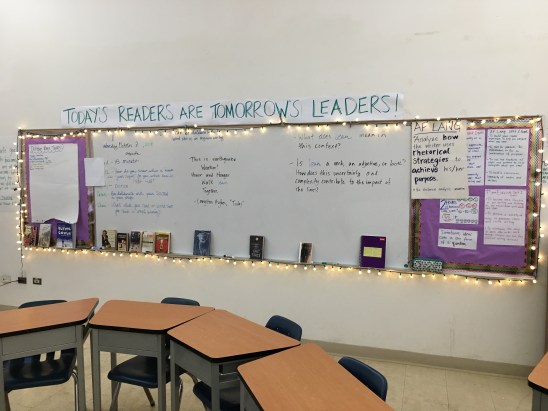
  • The next wall is what would traditionally be the front of the room. It’s where the white boards are, so it’s naturally where I put our daily agenda, and where I write the things that don’t need to be digital or saved on a chart. Books are displayed on the marker tray, monthly book talk lists are on one of the bulletin boards to the side of the white board, and it’s where we can go for “spur of the moment” lessons that aren’t created digitally in advance and don’t use the document camera.
  • The last wall is a wall of windows, and where a teacher might put a desk. My “desk” is there, but it’s pushed up against the wall and serves as a supply table. Next to it is our conferring space, which is used when I’m not circulating the room, and is even as a space for completing our Running Records. When I’m circulating the room, it’s another space for students to complete the learning in our classroom.


IMG_1143

Our classroom library is constantly in use.

IMG_1145


IMG_1148

The white board wall is also used for book displays, a daily agenda, and unit goals.

IMG_1165

The “teacher desk” is also a supply table. I’ve reserved a student desk behind it for the “teacher stuff” – including the obligatory year-round-use Christmas coffee mug, stack of loose papers, and Norton Reader. (I’m assuming every teacher has something like this?)

IMG_1152

The conferring space/extra space for student learning


Lastly, I had to look to the inside of the room. The perimeter is important, but the students tend to “live” towards the center of the room. I’ve tried to make it so the desks aren’t pointed in one particular direction so that each space feels important. I’ve moved desks so students have partners, I’ve had arcs facing different directions in different parts of the room, and sometimes the desk arrangement feels random or messy. I think that’s okay. The point isn’t to have orderly desks. It’s to have students who are engaged in their learning.

IMG_1155

While I’m sure I’ll still have days when I don’t visit every square foot in each and every class period, I think it’s an improvement on what my classroom set up once was. I don’t think there are any spots for students to “hide” and I feel comfortable walking around in each corner and cranny of the classroom. Because I circulate throughout more of the room, and because my students get up and move more often to the spots where they need to be, I interact with my students on an individual level more often than before. It helps to build relationships, which leads to trust, which leads to learning. This makes for a more inclusive, learning-focused classroom, and that’s our ultimate goal.

IMG_1159

A panoramic view from one of the conferring chairs. On the right side of the photo, behind the fan controls, is the closet. The rest, I think, is self-explanatory.

What do you do that ensures that every corner in your classroom is used for the power of learning?


Julie has been teaching secondary language arts for twenty years, spending the first fifteen in rural Central Oregon, and the last four in Amman, Jordan. She’s thrilled to report that she and her family have moved across the world to Managua, Nicaragua this year, where a new adventure has begun.

Follow her on twitter @SwinehartJulie

Atmosphere: 4 Big Ways to Nurture Readers And Writers

How do we get our students to become readers and writers; literate, engaged, empathetic contributors to our world?

flexible seating 3It’s simple. Ask yourself, “How do I prefer to read, write, create and learn?” I can guarantee that each and every one of us would have a different idea of what that looks like and would choose something different. We don’t all learn the same, so why do we expect our students to. The relationships we build and the space that we provide to our students each year is crucial to allowing them to become readers, writers and creators, and we have to cater to the different needs that allow them to become what we hope they can be. How do we create open spaces where students can, and want, to learn and grow?
The answer = Relationships!!!

Team building

This happens for at least the first FOUR days of school in my classroom. Yes, four. I don’t even say the word syllabus until day three. I want to start the year getting to know my students and how they function; who they are, what they love and what they hate. I spend these days doing team building activities and switching the teams up each day intentionally. It teaches them to work well with different personalities and it allows me to see who they can work best with. It’s also a nice perk to know who should avoid whom in those more difficult classes. This all plays into how I approach them to start those one on one conversations. These team building moments can carry on throughout the year, not just be left for the first week. I often break up high pressure times of year with a team building activity to help keep the momentum going and refresh their minds and our classroom atmosphere.

A big part of our relationship and team building happens when have a conversation about our classroom social contract. Every year, it never fails, each class initiates the signing of that contract with no prompting from me. It’s a beautiful thing to know that they WANT to act and sign the contract that THEY helped create. The more involvement and choice students have in what they do in our classrooms, the more investment they have in what they are working to create. Giving them the opportunity to have a say in what our classroom expectations are allows them to have that investment.

Team building is so important to me and my classroom environment because if we don’t feel like a team, if the students don’t feel welcome and safe, they will never hear one word of anything I need to teach them the rest of the year. A positive relationship is the best foundation for the rest of the year to be built upon.

Conferring

Flexible seating 2Yes, we confer to learn what books they like and guide them in their writing, but we also need to use it to build our relationship. Conferring during the first week (sometimes two) of school is simply “get to know you” conferring. I ask about reading and writing but I also want to know about the person behind the face and name that I will spend all year with. I write with them and they learn about me, then I confer with them about what they’ve written about their own lives.

Allowing our students to get to know us is just as important as us getting to know them. We need to let them see us in the struggle of writing; that’s why modeling what we ask them to do is so important. We need to let them know if we might be having a bad day and let them know it’s their turn to show the teacher some grace, like we show them each day. It’s a swaying tightrope that requires an immense amount of balance through a necessary obstacle if we want our students to become great readers and writers.

When students see their teacher taking the time to notice specifics about their personal life, not just the way they read or write, it creates a trust and willingness to be vulnerable and authentic in their writing. A simple, “I am so happy you shared!” or, “I am sorry to see that you felt this way and hope you never do again” can really allow them to feel like a wanted soul in your classroom, especially when you have 32+ students in one class period and they feel like just a number.

Affirmation and Validation

flexible seating 1These kids need to hear the words from us, spoken aloud, that tell them, “I care about you.” We can assume they know but hearing it out loud is necessary to their belief in that feeling. Sometimes a simple, “Hey! I care about you guys! Have a great rest of the day!” is something that will make a kids day turn around. Some of these precious souls that come through my door each day don’t see an adult figure, or one that is a positive role model, outside of this school. I need to be that for them. If I’m not, then who?

Validation is what they need to feel like they matter, that they are worthy, in order to move into a creative space and explore themselves as readers and writers. Yes, there are probably a million things we could critique about their writing, BUT we need to remember to build them up or they will never have the motivation to create at all. Validating and affirming that they are on the right track through conferring, notes, and blessings is a good way to do this. Starting with the positive and ending with encouragement. Giving them a positive end note can help them become motivated to dive back into a piece and create that authentic masterpiece. If we don’t work to make our students feel welcome, they will never hear what we want to teach them.

SPACE

Alternative seating  –  Five years ago I began my adventure of flexible seating. I have not had one moment of regret ever since. I am so glad I chose to push back against the fear of change, the “norm” in classrooms, and power through to what I have created now.

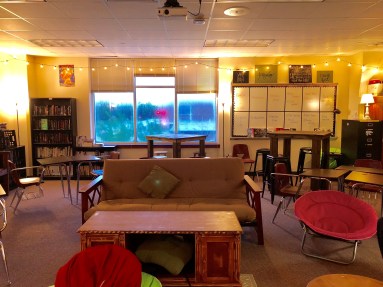
As you enter my room, you will see a space that ditches that harsh fluorescent lighting and replaces it with soft, warm lighting from lamps and stranded garden lights. You will notice that there are very few desks and many bean bags to sink into. There are two couches that will call to you and beg to be used. There are two bistro tables at standing height for those of us who need to stand in moments of writing to get our energy out. There are saucer chairs to hug you through those difficult pieces of reading and writing. My coffee tables are the perfect height for the “floor sitters,” like me, and accompanying floor pillows. There is also a beautiful, whimsical bench that my husband crafted (he also made the bistro tables with his talents – I might keep him around for a while). The atmosphere is welcoming and inviting, nurturing creativity.

When I first decided to bring in these seating alternatives, it was because I asked myself how I prefer to learn and WHY that space looks the way it does for me. The why is so, so important and gave me direction for which to take my classroom. Why do we need to create a comfortable space for students to create and learn in? The answer was simple. As an adult, I prefer to learn or read or write or create in a space filled with pillows or bean bags. One day I might want to sit on the couch, or, for days when I am really concentrating and creating (like while writing this blog) I prefer to sit on the floor with a coffee table as a desk, where I can spread out. So, as an adult, if I prefer this, I knew for sure my students would appreciate the option of getting to sit in the way they prefer, too. Feeling comfortable in a space provides us with the opportunity to open up all of our senses and focus on the creating of a piece or escaping into a novel. Giving them the opportunity to choose their space in my room is crucial to their development as readers and writers.

Flexible seating does not mean traditional desks are trashed and burned. Students use all the flexible seating, including the traditional desks. Some even move up to a traditional desk in moments of deep thinking or creating. Most of this seating you see in our classroom was free, donated or built. I only purchased the three saucer chairs and large futon from an online garage sale app. This is 5 years of accumulating different seating, so if you are inspired to start using flexible seating, know that it will take some time and always look for those deals! Even spending what you can spare on a simple cushion for the floor will be worth it.

I often get asked many questions when I talk about flexible seating. I think the biggest one is, “How do you get them to behave so well?!” Our flexible seating expectations are a topic we discuss while creating our classroom contract. It is important to voice your expectations at the beginning, just like any other classroom expectation. One of my expectations is that if students are debating on who gets to sit in a certain spot, they will decide calmly and compromise on who gets to sit in the seat that day, then switch the next day. Another important expectation that I make very clear is that it is their responsibility to maintain their focus while in the flexible seating. If they talk to their friends, sleep or just don’t complete the task at hand, they need to practice responsibility and make the decision to place themselves in a successful space. Some kids may need a reminder of this responsibility, but I rarely have to intervene when it comes to this. I think you will be pleasantly surprised at how much responsibility our students will take on when we give them the opportunity to have more responsibility through choice.

My students are free to choose how and where they sit, to learn and create in the way that fits them best. That choice gives them so much ownership of their own learning! And, isn’t that what we need to provide; more responsibility and ownership when it comes to their learning? Giving them a choice is how we provide them with that opportunity; in what they read, what they write and HOW they learn. When we establish the relationships with our students that allow them to feel comfortable in the vulnerability that is attached to what they share and write, when we give them the opportunity to take their learning into their own hands by giving them choice, they become literate, engaged, empathetic contributors to our world. They become readers and writers. Our students have stories to tell, and we need to guide them and give them the skills to tell them through the relationships and space we create for them.

Sarah Roy is currently singing songs from The Greatest Showman nonstop and wondering what took her so long to finally take her nose out of a book and watch those 105 minutes of greatness. She is enjoying spending time in her students work and seeing the potential that they have to create greatness in her class this year. Sarah is also seeking out her next read but enjoying reading all the informational books about salamanders with her eldest son, Crosby.

How We Built our First 3 Weeks of Workshop

Picture1

Look at Sarah’s room!

A classroom built around flexible seating is amazing for kids building their literacy.  Comfy chairs, tall stools, and bean bags take a student out of a “classroom” mindset and into a creative work space that encourages ideas to flow across boundaries that might have been impermeable with rows and rows of sterile desks.

It works just as well for teachers building a workshop from thin air. You can imagine how comfortable that tan couch felt on the last Friday morning before the start of school.

Sitting in that room for this much anticipated planning session felt as comfortable as if I’d been there for a decade.  Five teachers with a singular focus gathered their resources and experience to put together a plan that was student focused and built on the foundation of workshop.   I got to know this group well at the Literacy Institute but I’m still trying to learn the full extent of their individual and collective power.

It is important, on our team, to be intentional and explicit with our lesson design.  The kids should know exactly what we are doing and why we are doing it.  They should recognize the moves their teachers make and take comfort that those moves were selected specifically for them. There is no reason to keep the “why” and the “how” a secret.

On this team, we typically build lessons with an eye towards a learning focus that starts with something like: I want you to know that readers/writers ….. do something. (Thanks Amy, Billy, and the Lit Institute.)

For the first three weeks, though, we talked about using: I want you to know that members of a Reader/Writer Workshop….do…one of the six pillars.  You get it.

Our curriculum documents, designed by teachers, contain a section devoted to the six routines of workshop instruction and the following are the routines around which we built lessons:

The Reader’s/Writer’s Notebook

Lesson Focus: I want you to know that members of this Reader’s/Writer’s workshop use a notebook to explore thier literacy.

Our “notebooks” look very different teacher-to-teacher.  Some of our classes will use traditional composition notebooks and some will use Microsoft OneNote in our explorations.  Either way, the point of having a safe and personal place to plan, draft, revise, reflect, etc. remains consistent across our classes.  Its not enough for us to ask the kids to have a notebook, they need to know the importance of having it.  Some of the kids struggled with following my set-up instructions because they were intentionally vague.

Student: “Mr. Moore, what categories do you want us to use to track our reading this year?”

Me: “That’s up to you.  Its your notebook.”

Self-Selected Independent Reading:

Lesson Focus: I want you to know that members of this Reader’s/Writer’s workshop take ownership of their reading and writing experiences.

I remember back to last year, and how much the kids struggled genuinely connecting to a book. Maybe it was the hurricane sitting out in the Gulf or that they really only had one year of workshop leading up to their senior year.  What ever it was, we worked hard to take ownership of our reading, so much so that I wrote about it here and here. (Looking back at those words is like seeing the words of a different writer, but I digress…)

Mentor Texts:

Lesson Focus: I want you to know that members of this Reader’s/Writer’s workshop use mentor texts to guide their learning.

We use mentor texts to teach kids how to read and write like a writer. The students need to know that we looking at the writing of others with specific intentions in mind. Its important to delineate the separate lenses of craft and content and constantly reinforce the importance and interconnection of both.

We planned for ways to write beside them.  When I write in front of my students it invites them to connect to a writer from their community.  This connection is between a student and a person that shakes their hand every day and smiles when they make eye contact. That’s an incredibly deep connection and one that I’ll leverage every chance I get.

Mini-Lessons:

Lesson Focus: I want you to know that members of this Reader’s/Writer’s workshop look at specific skills that we want to learn and then apply those skills to their reading and writing.

The skills we choose to highlight are intentional and our students need to understand that they aren’t chosen at random.  Not only that, but we aren’t going to spend more than a few minutes in our mini-lessons before we move back into reading and writing, with an emphasis on those specific skills.

Collaboration:

Lesson Focus: I want you to know that members of this Reader’s/Writer’s workshop listen to others share and provide feedback that supports their growth.

I can’t teach all 30 of them all the time and maintain any level of effectiveness.  We have to build a supportive community that  allows me to widen the feedback cycle from one, typically confident student, to 30 who are confident to share with their confidants. They need to know that the days of me asking a question and calling on one person for the answer are far behind us.  We practice the routine over and over. Ask a question, discuss in group.  Ask a question, practice their thinking through written response. Rinse/Repeat.

Oh, and they have to be trained not to shoot up their hands or shout out an answer when they are asked to notice something.  Instead, they will learn to sit in the silence and let their thinking wash over them in waves. Or maybe the metaphor is to peel back the layers of their thinking like an onion. Whichever you prefer.

Conferring:

Lesson Focus: I want you to know that members of this Reader’s/Writer’s workshop take advantage of opportunities to talk one-on-one with the expert in the room.

The importance of regular one-on-one conferences can not be understated. I’m not just “checking-in” on them while they read and write.  I’m digging into their thinking for places I can provide support.  We will explain to our students how important it is for them to be honest and open when we confer.  They can’t hold back due to nervousness or fear. Like Jerry Maquire said, “Help me, help you!!!” with that typically creepy look on his face.


Based on our planning sessions, impromptu secret meetings, and the genuine happiness in which we approach each other, I know this year will be my best ever and it is because of the work this team will do together to move our freshman class forward in their literacy.

Now, in all seriousness, lets cross our fingers and hope nature and fate don’t hit us with the same intensity as last year.  We all need time to heal a little more.  Let’s do it together.

Charles Moore had a quiet Friday night and went to all four of his son’s soccer games this weekend.  He passed El Deafo by Cece Miller back and forth with his daughter this weekend.  He put more than two thousand words to the page this weekend between his grad classes and this blog post; a new record.  He can’t wait to get back into the classroom Monday morning and learn alongside the students.  And he wishes you the same happiness he’s enjoying right now. Visit him on twitter or instagram.


We Can All Be Writers

Penny Kittle absolutely ruined reading for me five years ago.

You heard me. Destroyed it.

In the summer of 2013, at the University of New Hampshire Literacy Institutes, Penny taught me how to read like a writer. Our class studied short poems and discussed the deliberation of the author’s diction with a sense of wonder rather than through the lens of “what does this symbol mean?”. We read whole books in book clubs and gave a presentation about our texts on simply its craft. We wrote process papers at the end of the class that told the story of how we’d written our final essays.

Something about this made me absolutely unable to mindlessly read anythinganymore. Online articles, advertisements, tweets, and even beach-appropriate fiction just screamed CRAFT ANALYSIS!!!! at me. I couldn’t really relax and let go while reading anymore–instead, I was hypersensitive to the words I read, thinking constantly about what the author had lived, and done, to write such a work.

The total immersion in craft study of those two weeks has stayed with me, five years later. In every book I read, I have a new appreciation for the work of the writer–the work of writing.

writer.jpg

The craft of language, the power of literacy, is everywhere.

And seeing writing everywhere helped transform me from a lifelong reader into something more: a writer.

I start my day with the awesome Twitter crew at #5amwritersclub. Many participants are teachers, writing before they begin the day with their students, and many others are parents, writing before they begin the day with their children. I identify with both groups and love the sense of identity that comes from writing beside my tribe.

I feel the same way about writing in online communities like this blog. Every time a Three Teachers Talk post appears in my inbox, I think about not just what the post says, but also what my fellow teachers were thinking and doing as they wrote. I have watched Amy’s and Lisa’s thinking grow over time, since I’ve had the privilege of reading their writing. When Amy wrote about beating the dread, and when Lisa wrote about settling into summer, I read beyond the “I agree” part of my teacher brain. I thought about those women, both moms, cramming in some writing after their (grand)kids’ bedtimes, or in the early morning hours before school, or on their too-packed planning periods.

This is, in part, what helped me shape my identity as a writer. I saw my peers, my friends, my teaching neighbors writing. I saw their process, their thinking, their methods translate into writing. It showed me what was possible: that I, too, was a writer.

Our students need to see this.

As we kick off this school year, we need to make not only our own writing processes visible–from initial thinking, to drafting, to tinkering, to publishing–but our students’ processes visible, too. Students who see one another write understand that it’s not a one-track process; writing can look different from one kid to the next, and from one school year to the next. The possibilities are endless.

We can all be writers. We should all be writers. Viewing the world so differently has no doubt made my brain more tired, but it has made my life so much more rich.

Believing that I could become a writer took time, a shift in my mindset, and lots of work…but it transformed my identity and introduced me to a whole community of writers I wouldn’t have met otherwise, and for that, I am forever grateful. I can only hope that my students someday can feel this sense of gratitude to the writers–both the teachers and students whose words they read, and the published poets and authors whose craft we study to get better–that I feel for every writer, every human, that I know.

Please leave a comment and let us know how you plan to make the writing process more visible for your students this year, so you might all become writers!

Shana Karnes is a mom of two, an avid reader and writer, and someone whose life has been immeasurably bettered by literacy and all it entails. She is grateful to be part of the Three Teachers Talk community, and loves equally her NWP@WVU and WVCTE (where a version of this post appeared earlier) peers and pals. Connect with Shana on Twitter at @litreader. 

Five Ideas that Beat the Dread

A few years ago I stopped reviewing class rules and smacking down my syllabus on the first day of school. I had been doing some research on chronic stress (mostly my own) and read extensively about the fight, flight, freeze response. One description glared at me and gave me pause:  “You have a sense of dread.”

I remembered what I had been taught as a first year teacher:  Set yourself up as the authority figure. Be kind but firm. Establish norms quickly so students know what you will and will not tolerate in your classroom.

Then, almost in the same breathe, I was told:  Develop relationships. Learn students’ names. Let them help develop class rules.

And I muddled through doing a combination of both the best I knew how. Those first few days of my first few years were rocky to say the least. And in hindsight, it’s clear:  there was dread. Lots of dread.

So when I read up on the fight, flight, and freeze response, I realized a big part of my problem:  With my seemingly simple attempt at outlining classroom expectations and detailing how ‘my class would run, chemicals danced a jig in students’ brains: fight, flight, or freeze. Now, I know my syllabus is not on the scale of major life trauma most often associated with this fff response theory, but many of my juniors and seniors didn’t want to be in school anyway. Why was I compounding it?

I learned a better way.

Wait.

Let every other teacher lay down the law. Lay out their plans. Run through the rules.

On the first day of school — maybe even the first five days of school — just write. And talk. Let students drive the discussion. Let them ask questions. Give them a chance to be seen and heard and welcomed.

“Community before curriculum” Angela wrote in her last post, and I love her thinking there. I also think we can merge the two on the first day of school and lay a firm foundation for thinking and talking every day thereafter. We can jump start community and begin our curriculum as we put pen to the page and write.

Here’s my top five sources that beg a response and invite students to write on the first day of school (or at least the first week or so):

  1. To This Day by Shane Koyczan.

Give every student a notecard and ask them to watch and listen and then respond to the poem as a whole or to a line they particularly like or relate to. (I’ve learned some pretty heavy stuff from students over the years. So many of them can relate to the themes in this poem.)

  1. How poetry can help kids turn a fear of literature into love by Jason Reynolds on PBS.

Give every student a sticky note and ask them to think about their reading lives. Then after they listen to Mr. Reynolds talk about reading, ask students to rate themselves. Are they readers eager for the pit bulls or for the puppies? Why? (I quickly find who my readers are and with whom I need to take on the challenge of helping them want to read.) Then for a little more of a challenge, on the flip side of the sticky, ask them to describe in poetic form their feelings about poetry. (You’ll learn even more.)

  1. Possibilities by Wislawa Szymborska. Or the version here where Amanda Palmer reads the poem.

Give every student a copy of the poem. Then read the poem aloud and ask students to write their own list of possibilities. Their list can be straightforward, funny, or interesting things they want the class to know. (I wrote about how I used this poem to practice imitation a couple of years ago. It’s a great lesson and a great poem to revisit.)

  1. Three poems:

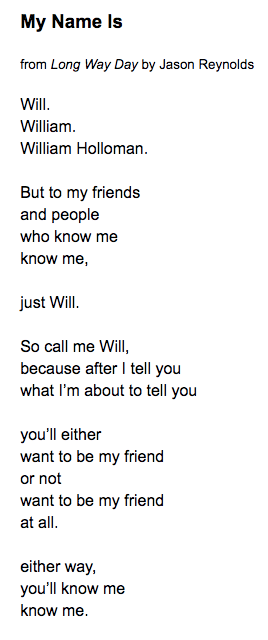
“My Name Is,” an excerpt from Jason Reynolds’ book Long Way Down. (If you haven’t read this book, oh, my goodness. It’s amazing!)

My Name Is by Jason Reynolds

“Instructions” by Rudy Francisco.

Instructions by Rudy Francisco

“Like You” by Roque Dalton, translated by Jack Hirschman

Give students copies of all three poems and a notecard or piece of paper. Read them aloud. Ask students to read them again and then to write a response. They can respond to just one of the poems, a line from a poem, or anything the poems make them think or feel. There is no right or wrong. Just write your thinking. (This is always an interesting response, and it tells me a lot about how to help my students. Many of them will begin to write an analysis of one of the poems — or all three. Others understand that I am asking for a different kind of thinking, one that leads them into ideas for their own poems, stories, or essays.)

  1. Author Bios!

Give students access to books that have clever, witty, or interesting author bios. YA authors like Julie Murphy, Jeff Zentner, Chris Crutcher, Libba Bray, and Gina Damico are great ones, but there are many with a bit of quirk that will draw students in and spark their interest in reading these author’s books. Ask students to explore the author bios and then make a list of the books they think they’d like to explore this semester. Have them write the author’s names on sticky notes for you to put in your conferring notes.

If you want to take this author bio idea further — (this is my favorite):

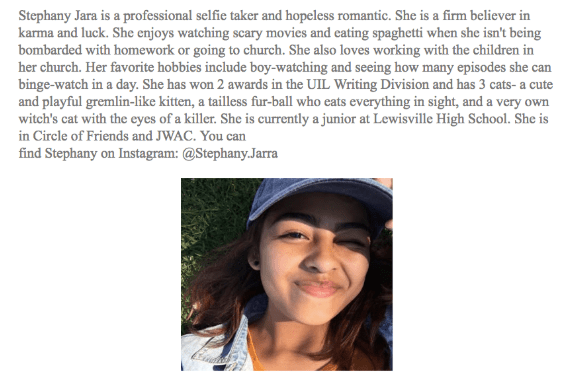
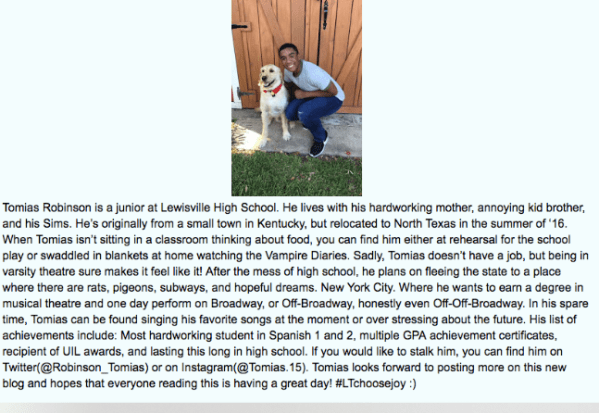
Read several professional author bios aloud. Ask students what information is shared and make a T-chart that lists the what on the left, e.g., name, personal hobbies, awards won, where the author lives, who the author lives with, etc. Then, ask students to describe how this information is shared and add these craft moves to the right. This is the how. For example, short and sometimes incomplete sentences, lists, 3rd person, the author’s name is first, witty word choice, etc. Finally, ask students to write their own author bio while you write yours as a model. Encourage them to try to craft their bio to include ideas from both the what and the how side of the T-chart. Below are two of my students’ bios from this past year.

Stephany author bio

Tomias author bio

(The author bio idea is Lisa’s baby, and she wrote about it here after I wrote about it here. It’s still the best idea I have ever heard to begin students on their journey into developing their identities as readers and as writers. I’ve used this idea in a model lesson for every workshop I’ve facilitated this summer, so if you were there, feel free to share the author bio you wrote this summer in the comments. My newest one is below.)

I wish you happy reading and writing with your students this year. Please share your go to ideas for inviting students to write and build your community.


Amy Rasmussen loves books, pretending to garden, adolescents, and coconut cream pie — not necessarily in that order. She lives in North Texas with her dashing husband of 33 years, their twin-terror Shelties Mac and Des, and a not so loving love bird named Colonel Brandon. Amy spent the summer leading professional development in several districts across Texas and has grown especially fond of the Houston area. If only she could move… Follow her on Twitter @amyrass — and if you are not already, please follow this blog.

3 Ways This Year Will be the Best Ever!!!

Can you feel it coming?  Do you smell new books and old desks?  Are you imagining the sounds of students shouldering their way through the halls and into your classroom like bees through long un-mown grass? (I’m a huge Oscar Wilde fanboy!)

Are you ready to hear a deep breath or quiet giggle interrupt a totally silent self-selected reading segment? Are you ready to mop up tears in buckets and heal emotional wounds with book bandages?

If not, you better get ready.  You may be starting school today, or maybe next week.  It doesn’t matter; time to get your mind right.

I’m ready to launch from the best summer of my life into the best teaching year of my life.  Happiness breeds happiness.

So here are three thoughts I have that will help me be the best teacher I’ve ever been.

  1. Book Talk like my teaching life depends on it…because it does.

If the number one tool in my belt is my classroom library, my number two is my ability to “sell” books.  We all know that we need to be able to sell books both informally and formally.

Informally, we confer with readers and talk about books with individual kids (and adults!) who are in the market for their next reading relationship.  This is the easy back and forth that comes with being a reader and contributing to a literacy rich classroom culture.

The formal moments, in my mind, are those points in time you carve out to stand in front of your class, or some group, and give them the hard sell on a book you’ve decided was worthy of their attention.

To me, these two different bookish scenarios require different thought processes and the latter is example is the one to which I plead my case.

Obviously we have to consider “how” we present the key information that we think will engender interest in deserving books.

But also, we have a massive burden to present books that offer a cultural variety of information that will allow our readers the “windows, mirrors, and doors” that Rudine Sims Bishop wrote about all the way back in 1990.

I took a step forward on the Sunday of the ILA conference and chose to attend a session featuring LGBTQ writers and their books.

Over and over, the panelists describe the point in their lives when they first encountered a character in whom they saw themselves.  Ashley Herring Blake, a primary grade teacher and middle grade writer from Tennessee talked about how she was 32 when it happened to her.  We have to be more pro-active when it comes to offering students windows, mirrors and doors.  Book talks are an opportunity in which we can’t afford to play it safe.

2. Love the kids like their learning lives depend on it…because it does.

I said it before: I will be 100% this year in telling my classes I love them before sending them out the door each period.  I’ve already been practicing with the Student Council kids that I hung out with at Fish Camp.  It was our first time to work together and as the day ended, I told them too. You never get a second chance to make a first impression.

But I’m not just going to say it to their backs as they sprint out of the room.  I’m going to say it to their faces as they enter and I’m going to write it on their papers.  Reading and writing culture revolves around love: of texts, but more importantly the readers and writers.

3. Empower the students to read and write in a massive volume like our world depends on it…because it does.

We know how important volume is in a student’s growth.  We have to let them read and write more than we can ever think about grading.

Also, we have to give them room to read and write in ways that let them explore their place in the world. Anything less than this, and I’ve failed. I will not fail.

Charles Moore will, for the first time in many years, teach Freshman English this year. His bleeding heart required him to volunteer to sponsor Student Council at this new school. You can follow his antics on twitter at @ctcoach


ILA 2018 Conference Run-down!!! (and an epiphany!)

Am I the only person who feels super awkward meeting new people?

So I’m standing in the “New to ILA!!!” section of the Austin Convention Center early Saturday morning.  Several well spoken women and men address the throng of newbies and supply us with important information about the conference.  Remarks concluded and we are encouraged to visit with those around us, meet new people, and hang out.

I’m there by myself waiting for Gretchen Meyer, my fellow literacy advocate, to arrive. She shared this conference experience with me and I couldn’t ask for a better guide.

IMG_4479

Can you imagine a more awkwardly handsome face?

So I’m scanning the crowd looking for familiar faces, assuming there won’t be one.  I’m an award winning people-watcher and for those of you who aren’t, teachers can be incredibly fun to observe.  Anyways, Marcie, an incredibly nice women with a bright smile introduced herself to me and we talked about the conference and how excited we were to listen to the speakers at the General Meeting that was to begin shortly.

Both of us, my new ILA friend and I, massively underestimated the level of brilliance that was about to wash over me.  I listened to Adan Gonzalez talk about his success in the face of poverty and bigotry and how he works to fight those demons today.  Nadia Lopez blew the crowd away with the statement, “I opened a school to close a prison.”  So…um…wow.  If that wasn’t enough, we got to experience the passion of Cornelius Minor and his charge to consider, “How can we not stand for our children…when the traumas of the world weigh them down in our classrooms?”

I had to pinch myself.  Was the rest of the conference going to be this amazing? (It was.) Was this euphoria and uplifting feeling of being re-energized going to fade as I left this hall and moved on to the other presentations? (It didn’t.) Was I ever going to see my new friend, Marcie, again? (I did, on the big screen, at the end of the general meeting.)

Marcie

Meet Marcie Post, the Executive Director of the ILA.

Even now, back in League City, I can’t stop reflecting on the lessons I soaked in at ILA.  Maybe the biggest realization I came to, and there were many, wasn’t about books or kids or literacy.  This realization encompassed all those ideas, but was really about me.

I realized that above all else, I’m a “culture” guy.

I’ve identified myself by so many labels over the years: Football guy, Coach that can teach, Book Lover, Literacy Advocate, Student First Teacher… all those things. But, when its all said and done, after 16 years in the classroom, culture means everything to me. The culture in my classroom is, obviously, important. Just as important, perhaps, and, for the most part out of my control, is the culture of the people around me.  I want to be around teachers that are happy people.  I want to feel like we are all in this together and that the kids will be the big winners in this world.

I think this seed might have been planted by this blog post by Lauren Ambeau, an intermediate school principal in my school district that posts on her own blog. Or it might reach all the way back to my first two principals, Marlene Skiba and Deanna Daws; two women that made me feel confident and valued in my teaching role.

I think, also, the people I learned from at my most recent, and longest, stay had a lot to do with it.  I have the honor of presenting with the brilliant Jenna Zucha next week and this woman took time out of her summer, twice actually, to visit with me about our upcoming opportunity to present about writing to the leaders and stake-holders of our district.  She guest posted on this blog back in May.  What’s funny about our second meeting, is that one of my best friends happened to be at the very same Starbucks. He’s a genius, and famous.  You might have heard of him… Ashton Kutcher thinks he’s cool.

bro

This summer’s Literacy Institute, our own sort of ILA, comes to mind as well.  Billy Eastman and Amy Rasmussen build a culture of respect, trust, and love that I try to recreate in my classroom.  The huge win came from spending three weeks with the beautiful souls whose teaching team I’m so looking forward to joining.   We laughed enough to get stares from the other groups and cried buckets on the last day as we bared our souls through our writing.  Sarah Roy guest posted about that process just two weeks ago and then Austin Darrow guest posted for Amy the next day!!!  Amanda Penny is one of the most fun loving people I’ve ever met. Looks like the culture I’m joining at my new place is strong, and, having gotten the opportunity to interact with the instructional leaders there, I know this is by design.

Kylene Beers, Sunday afternoon, said, “Our democracy requires that we hold onto our own literacy and not turn it over to a few pundits on this network or that one.”  This statement reminded me that I posted about this very same idea back in February.  Thus I’m reminded further that this blog, this digital workshop, is a culturally supportive space for teachers like me.

There is so much more to write about.  I plan to sprinkle those tidbits through my posts this year.

Understand this: I’ll fight for culture.  I’ll seek out good people and happy teachers for the rest of my teaching career.  The kids deserve it.

Charles Moore has his pool looking as clear as crystal.  He’s done a horrible job being a reader this summer. His kids spend most nights sleeping in a blanket fort in the boy’s room (thick as thieves, those two.)  He’s looking forward to sharing the experience of discovering a new school with the incoming 9th graders at Clear Creek High School.

Guest Post: Why I Want My Classroom To Run Like Zappos

I like shoes. Like many 20 something teachers, I want some variety in what I wear to 9d67eecb760e5f2da5199c53ffd5e85awork (heels, flats, boots, hand-painted Tom’s with Shakespeare’s quotes…) which means I’ve spent a lot of time perusing, purchasing, and inevitably returning some of those online shoe purchases. Hands down, their company is one of the easiest to return or exchange those shoes that don’t quite match that new blazer, I also bought online. All that aside, that isn’t why I want my classroom to run like their company.

For the last few years, Zappos has consistently shown up on the best places to work list. But why? This company has recently touted movement toward a “holacracy.”  This term, initially dubbed by the political writer, Arthur Koestler, focuses on the importance of individual autonomy and self-governance. Zappos prides itself on letting their employees be their own boss. Who hasn’t at one point or another dreamed of being their own boss?

Zappos’ move toward a holacracy is one that we’ve been slogging toward in the academic world for years. Author of multiple New York Times best-sellers and Ted-Talk Famous, Daniel Pink’s research on behavioral science, especially that on motivation, has verified what we as teachers have known for years; when we let the students be the boss, the quality of work often shows a shocking improvement in both output and originality.

Jumping on the Genius Hour bandwagon, with guidance from peers, I integrated this concept into my 12th grade English course. Once a week for twelve weeks, students researched and created a project that was their choice. In our district, people more powerful than me pushed for this concept to be a “real” part of our 12th-grade curriculum: the capstone of their high school experience. Through new curriculum development and alignment, this new course came to fruition. Relying heavily on Pink’s tenets for motivation, I’ve found that the level of work submitted to my “College Prep” English 12 classes often surpasses that of their Advanced Placement counterparts. Students have dazzled me by turning their ideas of starting a nonprofit organization into reality. Students who’ve written business plans for an online venture they want to begin in college.  Students who’ve created and launched their own drop-shipping companies and websites. Students who mastered specific aspects of Leonardo Da Vinci’s drawing style. Students who analyzed the psychology of repetition changing the neuroplasticity of brains. Students who completed a statistical analysis of data where they collected and disaggregated data on whether standardized test scores are representative of student GPA. Students who have designed and coded games of their own creation.

Students who don’t consider themselves “lovers of English” find success in this class. Students with special needs find success in this class. Why? Because, for once, they are their own boss.

Screen Shot 2018-07-01 at 10.53.17 AMWe start the trimester by exploring Pink’s research using excerpts from Drive and Dan Ariely’s book Payoff while also viewing Pink’s RSA Animate video. While my favorite part might be the Back the Future references, what we actually discuss are the ideas of companies like Skype, Wikipedia, and Atlassian. As a class, we dissect how each of these companies fulfills the concepts of purpose, autonomy, and mastery.

The conversation inevitably leads to the question: How are we going to do that in a class? From those big ideas (no, I don’t expect you to start a fully functional company), we scale back. What can students realistically complete in twelve weeks?

After brainstorming and project tuning, I become more of an instructor on educational pedagogy than the traditional English teacher. Each student is responsible for creating their individual learning plan and personal curriculum. Some days I slip on my curriculum boots and help kids write their own essential and guiding questions, explore (and explain) the Common Core State Standards, climb up Bloom’s Taxonomy and wade through Webb’s Depths of Knowledge. Students know these educational researchers and can articulate how their research and projects are fulfilling these expectations for curriculum. On other days, I tie on my English teacher tennis shoes and help students improve their research skills, encourage networking for action research, and determine the structure for research writing, revising, and editing.

Encouraged by the holacracy of their working environment, Zappos team members might set the record for longest and friendliest customer service calls. They might send you flowers when they make a mistake on your order. These employees go the extra mile not because they must, but because they want to.

In my classroom, I want students to go that extra mile: give an hour-long expert presentation on their learning, start a nonprofit, paint a mural in an impoverished community, teach their peers self-defense, create, design and 3-D print a new product. What does that mean for me as a teacher?

I compare it to watching my niece learning to tie her shoes. Even though it would be so much faster for me to tie her shoes for her, it is essential to explore the process and allow her to move at her own pace. Sometimes you’ve got to let her figure out if bunny ears or loop-swoop-and pull works best.

I want the same experience for my high school seniors. No matter the age, people learn best when they can be their own boss. Though it is easier said than done, we need to think about our identity as educators in an ever-shifting perspective. We need to continue to revise what it means to be a teacher. There are moments when you are needed to be the expert in English, literature, language and writing, but in a class that thrives on Genius Hour organization, you also have to accept that you are not the expert in every single avenue of research your students will take. As the teacher, you do your best to learn alongside your students and model what it means to be inquisitive and passionate about learning.  It takes time and a willingness on our part as educators to take a step back from being the “sage on the stage” and allow students to explore and engage in new content in a way that is meaningful to them.

Hayley McKinney is an English teacher in Birmingham Public Schools where she primarily teaches 10th and 12th grade English as well as public speaking classes.  She coaches forensic and debate in her spare time. She recently completed a Masters of Arts in Educational Leadership.


My Number 1 Tip for Moving Readers and Writers

My go-to question for readers and writers who don’t know where to go next is: What have you been thinking about lately?

thinker

Whatcha thinkin’ about?

That’s it.  That one question works just as well on adults as it does on kids.  It makes people think about who they are and where they are in their thinking.  Whether it’s a theme, issue, or struggle, I can go to my library and present a handful of books to meet almost every reader’s needs. Struggling writers need to examine themselves in that same way.

This very blog, for instance, has so many posts about the importance of making connections with kids.  Look here, here, and here, for just a few examples.  There shouldn’t be any argument about prioritizing the hearts and minds of our students.

Take me, for example: I’m addicted to YouTube.  My subscription list is a mile long and the list of topics is a mile wide.

When I really look at it though, it turns out most of my channels connect thematically..  My feed is full of builders and makers and I look forward to their progress videos like I do the next Game of Thrones episode. It’s not exactly “appointment TV,” but it’s pretty close.

Some of my favorites:

I love this channel produced by April Wilkerson (a Texan!) where she designs and builds everything from Adirondack chairs to her own gigantic workshop!!!  This woman is an inspirational creator that shows me that I could learn how to do anything I put my mind to. Maybe this speaks to my need to build literate people.

TheCorvetteBen channel documents the restoration of cars, mostly C3 corvettes. As an owner of a 1970 Corvette, a family heirloom, I love watching a regular guy work on cars and save them from the trash heap.  It’s cool to me that he works cars like the one I work on.  Maybe this speaks to my need to save as many kids as I can.

Pure Living for Life shows the lives of a couple who sold everything, moved to Idaho, and started the process of building a timber frame house from scratch.  A lot of this channel is about “grit” and “problem solving.”  It reminds me of a major theme from our district’s Literacy Institute: the privilege to struggle.

Those are just three of the several dozen channels I watch, but the themes repeat themselves over and over.

Questions:

What do you watch? What types of media attracts you and appeals to your interests?

Do we need to be aware of the media our students consume? Could deepening our awareness help us make stronger connections to the issues in which our students are interested?

I think so.

Charles Moore is struggling to get his grandfather’s corvette to drive.  He is struggling to get in a summer reading rhythm because he can’t put down his iPad and he can’t convince himself to focus on reading One of Us is Lying.  He wants to go sit in that river in Wimberley, TX already!!!