Category Archives: Classroom Culture

How Conferring and a Book Solved the Tissue Issue, and Hopefully, Much More #FridayReads

You know the boys who cannot sit still? I’ve got a gaggle of them in my second period. Now, I’m not talking about elementary school kids, nor middle school. I’m talking about the juniors I teach in high school.

No sooner do I blink, and at least one of them is up walking to the tissue box. He’ll slowly take a tissue. Saunter on back to his seat (for about three minutes — I’ve timed it) and then waltz on over to the trash can to throw the tissue away and then mosey on back to his seat.

With eight of these guys, it’s constant motion. And I need Dramamine.

One class period. Five days. Two boxes of tissues. Gone.

At the end of that first very long week, I realized the reality. All kinds of memories flooded back from Tom Newkirk’s class “Boys, Literacy, and Popular Culture”at UNH Lit Institute the summer of 2015.  (If you haven’t read Tom’s book Misreading Masculinity:  Boys, Literacy, and Popular Culture, it’s insightful.)

My tissue-loving boys were posturing all over the place, and somehow I needed to stop the Tissue Issue.

It’s been easier than I thought. Really, it’s all about getting them into books they want to read.

On the first day of school, I’d prepped my room with stacks of colorful engaging books on every table. We did a book pass and wrote down titles we thought we’d like to read. I showed my passion for books and reading, and my students rolled their eyes at my request they read for three hours a week.

“No way,” I heard one young man mutter, “I ain’t reading.”

This attitude doesn’t deter me.

Even if they were faking it, after just a few days and lots of one-on-one mini-conferences, every kid in a class of 30 at least looked like they were reading. Except two.

I invited these two separately into the hall for private chats about their social PATT (party all the time) moves in the classroom.

“You know, they all follow your lead, right? I need you working with me to make this class work.”

Both agreed, and I asked them to shake my hand on it.

But old habits die hard.

Then, today — 13 days into the school year — gold.

Book gold.

“Hey, Mrs. Ras, can I talk to you in the hall?

“Do you think you could help me find a different book to read — one with music. You already know I like music.” I remembered his free verse rap at the end of class last Friday.

“So give me some ideas –”

“Well, something like that book JaBo’s reading…the long way one.”

A Long Way Gone?” (I’m trying to remember if there’s any music in this memoir about a child soldier.)

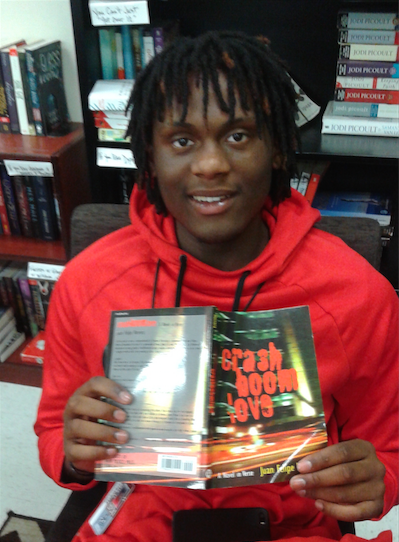
Both of my copies were checked out. I had to think fast. Crash Boom Love, a novel in verse by Juan Felipe Herrera, National Poet Laureate, flashed in the corner of my eye. (Thank you, poetry shelf just inside the door.)

We flipped through the pages, and I explained that it’s a book written in verse — all poems that make a complete story.

“You mean like one long poem?”

“Yep. Do you want to trade me this book for that one?” I said nodding at My Friend Dahmer, the graphic novel in his hand he’d been fake reading for 12 days. (I know he chose it for the pictures. “It’s weird” is all he could tell me in our first conference.)

Not six seconds after we’d entered the room, I saw Kameron flipping through the pages and showing his new book to JaBo.

That’s when you know you’ve got them — or at least got a chance at getting them to read — when they do a book talk to their friend before they’ve even read a page.

screen-shot-2016-09-08-at-11-05-01-pm

Meet Kameron. He may be a famous rapper one day.

I love this work with adolescent readers. I know we can change lives as we help young people grow in literacy skills, as we help them recognize themselves in books, and help them see others so different from themselves in the books they read.

It might be the only hope we have as a nation. Empathy, compassion, tolerance, justice, mercy, and love all wait for discovery like healing treasure and hope in the pages of the books we share with our students.

And when that book gold finally glistens — well, that’s when I have to cross the room for a tissue.


ftc-guideline-%22affiliate-links%22

I Prefer a Community of Confident Writers — Our Jump into Understanding a Writer’s Craft


Before spring term was over, I’d written two pages of notes in the back cover of my writer’s notebook. I titled it “Remember to Do Things to do Differently.” I’m a bit ambitious — and I realize, often, too hard on myself. Although I knew my students learned last yearemember-to-do-things-differentlyr, I wasn’t confident that they couldn’t have learned more.

I imagine you’ve been there, too. Always second guessing.

One of the things I knew I needed to improve was my relationships with students — I needed them to be good and strong, faster.  I also needed to help students jump in quicker to the complexities of craft analysis without scaring the poor little dears.

So last week, the second week of school, I did what Lisa just wrote about yesterday. I “Encourage[d] Students to Start Sharing Who They Are,” and I did it by sharing a favorite poem by Wislawa Szymborska: “Possibilities.”

I asked students to study the poet’s language in each line and then write their own “Possibilities” poem, imitating the poet’s sentence structure and word play. I gave them a copy of my annotations and wrote my own poem as a model.

This proved to be an excellent lead into the rhetorical analysis students must be able to do in AP Language. I was able to see which students quickly understood how to look closely at an author’s craft — and which ones did not.

The best part though was what I learned about my students. All their preferences!!

Last Friday, when their poems were due, we did our first Author’s Chair share in class.

First, to help students build confidence, they read their poems to a partner.

faithsharing-possibilitiespoem

sharingpossibilitiespoems

Then, volunteers sat in our Author’s Chair and read their poems to the class.

While the student read his poem, everyone else sat with sticky note and pen in hand ready to offer “blessings,” things they liked about the author’s use of language, or connections they could make to his ideas.

sharingintheauthorschair

After each writer shared, the class flooded him with “blessings.” Smiles grew wide, trust blossomed, and the community that I felt was missing for too long a time last year took root.readingblessings

Bonus:  When students read their little notes, carefully crafted by peers who listened to
their writing, their confidence as writers grew. Too bad we ran out of class time. I might have run out of sticky notes if all students would have felt the desire to share.

readingblessings2

I wouldn’t have minded.

I would not have minded at all.

ciarawithblessings

I would love to hear your ideas on building community and/or introducing students to rhetorical analysis. Please join the conversation and share in the comments.

Try it Tuesday: Silent Sticky Conferences

A burning question I seem to repeat year after year is “How do I talk to more of my students one-on-one beginning on the first day of school?”

I know the value of making eye contact with the adolescents who enter my room. I know the importance of making them feel like they belong here — like they are in a place where they can be themselves, a place where they want to learn.

I confer regularly with my students — about their reading lives and their writing lives — but every year it seems to take me a while to get in the groove. You know, get all the procedures introduced and underway, get students interested in books (and sometimes reading itself), learn names, set up our writer’s notebooks and our blogs and all the different bits of technology we use regularly like Google Classroom and Twitter.

I know all of these things are important, but sometimes I feel like I miss valuable moments of just I-want-to-get-to-know-you in my rush to get everything set up so we can finally begin to learn.

I know myself well.

So this year — I’ve slowed the pace a bit. And my students and I are passing notes.

Screen Shot 2016-08-29 at 7.49.08 PM

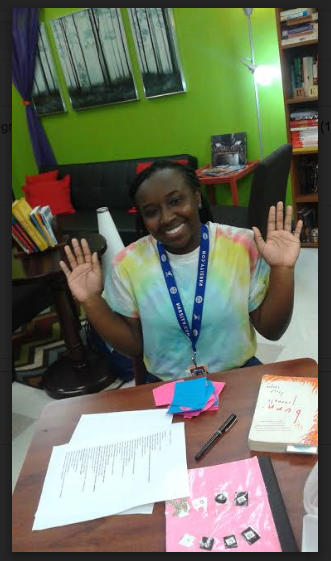
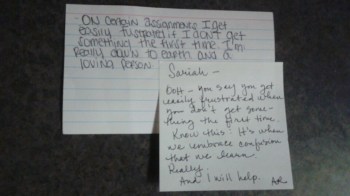
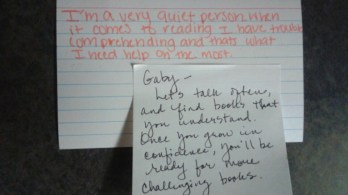
On the first day of school, I asked students to write their names big and bold on one side of a notecard. (I use these throughout the year to select non-volunteers to speak up and share their notebook responses and to answer questions. You know, like the popsicle sticks with everyone’s name on them idea.) Then, on the other side of the card, I asked students to tell me what they think I need to know about them as a learner in relation to the reading and writing we will do in this English class.

Silent confer1Some of my students’ notes were telling:  Many of them lack confidence. Few of them like to read. A couple feel ready for the complex texts they will have to tackle. Some explained in very few words a need to feel validated and cared for and something personal and important to them as learners in my care.

silentconfer3

I responded to each student’s note with a personal note of my own, written on a sticky note that I returned the next day in class. One young man questioned as I walked the room passing them out:  “Miss, you wrote to all of us?”silentconfer2

“Yes,” I told him, ” and I need you to carefully read what I wrote. Let’s see if we can start a conversation about you and what you need from me as a reader and a writer.” His grin grew as golden.

Silent sticky-note conferences have been the norm in my class for quite some time. They bridge the gaps between face-to-face conferences, build relationships, show we care enough to pick up a pen and pen a few words of encouragement or instruction.

With class sizes of 30 (sometimes 30+) we have to find ways to talk to our students one-on-one often. This passing little notes method fulfills my need to touch base with students, and it fuels their need to be recognized, validated, and hopefully inspired.

If you haven’t invested in sticky notes this year, hurry to the store while they are still on the back-to-school sales. I’ve got a whole crate of them.

Next step:  We’ll eventually move into larger pieces of paper, so I want to teach my img_1845students to fold notes like I did way back in seventh grade before the advent of all this technology. Texting friends just cannot be as fun as all those little folded notes.

What are your ideas for more face-to-face and one-on-one conversations with students this year? Please share in the comments.


Finding Solace in our Students

IMG_2666

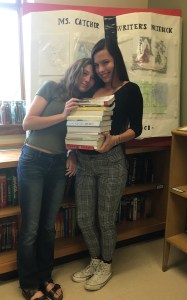
End of the year pics with friends and books.

The shooting in Orlando this weekend has weighed heavily on my mind for the past few days; it has settled into the back of my brain, penetrating my thoughts whenever I get a moment to rest between the hectic last days of school.  While I only know victims through six degrees of separation, I can’t help but see the images of friends, family, and students in the 49 faces of those murdered.

I’m not sure if it is the lockdown drills at school that make these tragedies feel all the more chilling and real, or if it’s the targeting of LGBTQ+ populations when I, oftentimes for the first time, watch young people finding their true identities in my classroom, but this time I feel nauseous and weak and powerless.

To think that this is the world my students are graduating into and growing up in, is frightening.

But as I scrolled through the profiles of the deceased, I found a statement from the father of victim Mercedez Flores.  He wrote, “We must all come together, we must all be at peace, we must all love each other, because this hatred cannot continue for the rest of our lives.”  That is what the workshop classroom allows me to share with my students—a corner of this peace and love.  It opens a door for me to connect with them on a personal level, allowing them to find not only acceptance but also stories, understanding, and success in their books.  Allowing them to open up to new literature and explore themselves as a reader sends the message that I not only value them as learners, but I value them as diverse people with a wide variety of needs, curiosities, and interests.  This avenue may only be minor, but in the wake of all the hatred and fear, I hope my classroom is a respite from the world.  A place where students can learn to at least respect one another’s differences without judgment or condescension, a place where we can explore the difficult themes and navigate challenging conversations in safety.

IMG_2693Everyday gives me a little more hope that this next generation has begun thinking about the innumerable struggles they will have to face.  As one of my students wrote about the universality of To Kill A Mockingbird, “For an innocent man to be found guilty is a miscarriage of justice, but for an innocent man to be found guilty for being black is a result of bigotry and prejudice, and shouldn’t happen…Sadly, as seen with Trayvon Martin, Mike Brown, and others, racism still does exist in this country. To Kill A Mockingbird is a constant reminder of how far we have come and how far left we still have to go when it comes to overcoming racism.”  Charlie’s words remind us that stories show us both the fallibility and overwhelming strength of the human condition.

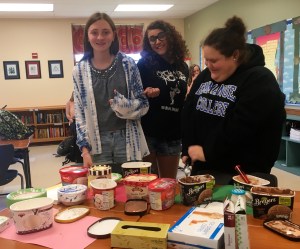
Yesterday morning, as I prepared for my last day of classes (we still have three more days of exams), I reminded myself that teaching allows me to model a life of acceptance and love, of caring and compassion, of concern and advocacy.  It may not be much in the general scheme of things, but it is the most productive way I can handle the tragedies our country continues to face.  Between cramming in grading and pulling together final assessments, I spent invaluable time writing notes to my classes, collecting ice cream toppings for our last day parties and signing the backs of photos of my students with the books they read this year.

The best part is that the love is returned as graduating seniors from years prior show

IMG_2701

Ice cream parties to finish up our yearlong adventure together.

up at my door to hug me good bye and have me sign their yearbooks.  College students visit to update me on their lives, current students voluntarily help me pack up my room, and former students spend their first summer afternoon organizing my bookshelves for future students.  For all the hate that exists in this world, there is far more kindness, far more compassion, and far more love.  I know because my students remind me of this every day.


Try It Tuesday: 11 Weeks to Regroup

In Wisconsin, we talk a lot about the weather. This may be due, in part, to the fact that it’s downright frigid, cold, and/or disturbingly chilly for (conservatively) seven months of the year. Block off October through April for likely snow (and as a special bonus, when I was nine years old, it snowed eight inches on May 10th), September and early May for possible winter jacket wear, and viola! Summer arrives and all residents are forbidden from complaining about heat. Ever.

must-see-imagery-wisconsin-summer-one-day

Thankfully, I find myself at the start of that all too brief period when summer is brand spanking new. In the last three days I’ve picnicked with my family, gone kite flying in the park, attended a Sam Beam concert, returned to running after a few weeks break, randomly decided to try yoga last night, cleaned out two closets, and finally had time to finish reading The Handmaid’s Tale (I am in love by the way. Mandatory reading for all progressively minded ladies and the men that love them, I think.  I’d never stand for being Ofnick, though I love my husband so, and that’s really the point of the dystopian adventure, yes? A quick bucket of ice water to the face in avoidance of complacency.)

Then, two nights ago, I picked up Hillary Jordan’s Mudbound and I cannot put it down. And you know what? I don’t have to. It’s summer.

But I digress. Over the past few weeks, the Three Teachers have been reflecting on the school year that was. Its trials, tribulations, successes, explorations, and even goodbyes (That’s four links to awesome posts, by the way. Enjoy!) And as we approached the end of the school year, and worked to reflect on so many experiences and experiments of thought, I noticed an underlying current of…weariness. Or rather, some well veiled (crippling) stress and (abject) exhaustion.

Now, don’t get me wrong. We love our work. We love our students, we love to read, we love to write, and we love to challenge ourselves and our craft. We love to blog. However, the reality is, it’s hard work and the four of us are tired (I love that Three Teachers Talk is really four teachers. Surprise! More bang for your workshop buck.) Between the four of us we have a wedding to plan, a new baby to attend to, a toddler to wrangle, grandbabies to dote after, and full time employment as teachers, readers, and writers. Any teacher on the planet will tell you – we love what we do, but sweet mother of mercy, can an educator get a nap up in here?

So here is my summer edition of Try it Tuesday:

I want you to rest.

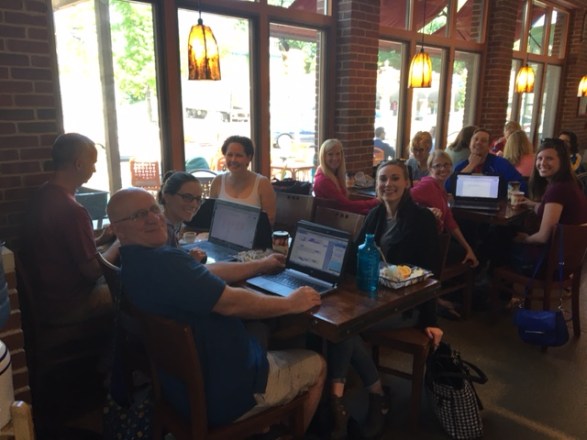
I know it’s contrary to our nature. I know that just four paragraphs ago I detailed all that I’ve crammed into the last three days (It’s like my soul sensed a vacuum created by the absence of school and sucked up anything and everything to fill the sudden void. Panic! Panic!) I know many of us have conventions to prepare for, curriculum to refine, classrooms to organize, final exams to score, and some have relatively beleaguered personal lives that need attention (My daughter asked me this morning if we were going to sit down to eat our toast today or take it in the car. Sigh. This lesson in slowing down brought to you by a three year old.)  I also know we are dedicated to a fault. Please see the following…my beautiful English colleagues working on the day after school let out.

IMG_1516

Exhibit A: This was day one of summer. Our entire team got together to finish up some district level curriculum work. They are all so sweet to look so pleased to be there.

The summer will be rich with opportunities, no doubt. Some of us will be blessed with opportunities to travel, attend workshops, dig into pedagogical texts, reflect on our craft, and excitedly (because teachers are downright adorkable) plan for next year.

But it can wait. A week? Two? I’m not sure. I’m betting it differs for everyone. But there is a reason we all get vacation at one time or another. Be it a stretch of summer or smaller breaks throughout the year, we all need to rest. In order to be our best selves when we return to the classroom, we all need time to recharge. I have eleven weeks, five of which already have one or more meetings in them. So right now…I’m going to take a few deep breaths and stare. At everything. Or nothing. Could be both. 

Don’t let anyone make you feel like you don’t deserve this break. Without it, I fear, many of us wouldn’t make it. Not for lack of trying, of course, but teacher burn out is horribly high with time away. And we all know the percentage of the coming weeks that we will (happily) dedicate to continued work as educators will be high anyway. Then, before you know it, we’ll be back at it.

IMG_1499

All quiet. For now.

So, take a bit of time for you. Catch up on Scandal or check out that Downton Abbey you’ve heard so much about (It’s over, you know, but I won’t tell anyone you’ve never seen it.) Pay someone to cut your lawn. Get in the car and drive with no real destination in mind. Sit next to the pool (Do you have one? Can I come over?) Sit down at a table to eat your breakfast, take more than 27 minutes for lunch, and demand that someone else make you dinner. Stare. 

IMG_1593

Heck, read a…wait. That suggestion’s a bit loaded.

Oh, alright. Read a book.

Read several.

I know I can’t stop you and why would I want to try?

I’m right there with you (Did I mention Mudbound is incredible?) 

Enjoy! You deserve it.

What are you doing to take a much needed break? Post your plans in the comments below!


Try It Tuesday – The ‘Secret’ to Workshop Success

At this point in the school year, teachers do a lot of counting. Counting days, counting essays left to grade, counting books missing from a classroom library (Seriously people, it’s not cool to steal from teachers. Your growing passion for reading is the bee’s knees, but my own kid may have to pay her way through college at the rate I spend on books for you. Might you return them? Please? Thank you). At graduation this past weekend, I found myself counting seniors I had taught and I began imagining all the opportunities in front of them. Interestingly enough, this year, I looked at those seniors and saw…books.

Zak raved about Ready Player One early this year. It was one of my first workshop successes.
Zoey emailed me over the weekend a few months back about The Girl on the Train.
Jenna plowed through Brain on Fire recently, after Zoey’s recommendation.
Larissa swears that Walden will change your life.
Ellen blushed when she told me she absolutely loved The Sociopath Next Door.
I counted at least eleven kids that read and sobbed over A Monster Calls.

Birds singing and happy little clouds everywhere.

And now…for a moment of full disclosure in the opposite direction. As my department makes the transition to workshop, sometimes the numbers are overwhelming and scary. We are one of only a handful of high schools moving to this model in the entire country. The path before us is paved by K-8 workshop instruction, but the number of secondary schools already doing workshop is relatively limited. This makes the sheer volume of curriculum we’re creating staggering and models hard to find.

On top of those numbers we have extremely limited common prep time, surface level understanding of the best way to break up our 86 minute class periods most effectively, and hundreds of new classroom texts we are working to keep track of (not to mention read). All with three preps for most of my colleagues and a grand total of one hour of collaborative PLC time per week.

In short, this transition isn’t easy and it’s already had some pretty sobering/ugly/weep-worthy moments.

We’re wrestling with very real questions about how to hold students accountable for their skill progression, how to keep track of meeting student need most effectively, how to appropriately conference with all of our students in large classes throughout the school year, and how to balance a need for college/career readiness with our desire to afford students the choice that will fuel their passions for both reading and writing.

At the end of the day, and the end of school year in which we have all been working to

IMG_1112

AP Language Super Readers – Simrah discovered nonfiction, Louise (our school salutatorian) delved into the study of language, and Ellen and Kaley blew through Brain on Fire.

incorporate more and more workshop practice into our daily instruction (knowing we will be expected to operate in the workshop model to fidelity next year), we are tired. Tired, overwhelmed, and nervous.

However, the visual of an Escher-like hellscape I’ve just created for you, thankfully, isn’t the whole story. As I reflect back on this move to workshop, the overwhelming nature of the preparation involved ultimately pales in comparison to the positive feedback I’ve received from students.

I was sitting on the patio a few nights ago with my husband discussing the class-feedback forms my students had just emailed to me (What did you learn from this class? What did you enjoy? What should I work on for next year?) with the completion of our regular class work and impending exam week. I expressed to him how proud I was of the number of students who commented on reading more, enjoying writing more, and basically being more invested in English class than any other year I can remember.

It sort of dumbfounded me as I recalled the emails over the course of the year. The casual

IMG_1090

My 2A AP Language Crew – Dema read Black Boy after a book talk, Bennett read Ishmael and says it changed his life, and Larissa fell in love with American Classics.

conversations with kids that showed their deep thinking about topics they cared about. Countless peer to peer discussions with overheard snippets such as “Oh, I loved that book. You need to read it” and “Yeah, I just couldn’t put it down” and “This topic sentence is really good, but if you combine it with this idea, the paragraph will make more sense.”  The longer I talked with my husband, and the more I recounted the year in student snapshots, the more surprised I was to realize that my stories of the year had little to do with content I “taught” and everything to do with the students themselves – what they were doing with the content. The difference of 2015-2016 was choice and encouragement to be readers and writers. In short…workshop.

So with my recent numerical obsession (did you know it’s only two more sleeps until the last day of school?!), I compiled the following rundown of my first year of exploring the workshop model:


Workshop by the Numbers

1 – Teacher playing around with workshop. Discovering its benefits, its challenges, and its similarity to and differences from her current instruction. Exhausting in the way teachers love. Some call it masochistic. I call it professional development.

IMG_1100

We learned how to make paper cups on the last day with our seniors…a nod to the practicality of English class…then we read. 

3 – Teachers (Talk) who journeyed to the wild North during February to instruct the Franklin High School English department on the day to day of workshop instruction. Exhilarating.

11 – Colleagues opening their lesson plan books and starting almost from scratch to first play with and then make a full transition next year to the workshop model. Collaborative.

117 – Students who read for 10 minutes of every class period we shared, wrote and reflected during every period of second semester, and changed as readers and writers in ways I’ve not seen before in my 13 years of teaching. Thrilling.

180 – Days in the school year to remind students that they will grow as readers and writers with practice, passion, and a commitment to question, explore, and expand their views of the world. Daunting.

2088 – Hours of summer to read the 16,983 books on my “To Read” list (No time for love, Doctor Jones…or sleep for that matter). Delicious.


So many opportunities.

But now, I am going to be brutally honest once again. As previously stated, the move to workshop can be scary. It’s new. New to us, our students, and in a formal sense, it’s relatively new to secondary education altogether.

However, here’s the part that sort of sounds like cheating:

Though teachers, myself included, are very rarely afforded the opportunity to take it easy, there are few things easier than throwing open the doors on choice and seeing what happens. Of course, there are many systems that need developing in my classroom and so much of workshop requires routine and consistency, but the heart and soul of workshop is really

IMG_1116

1B AP Language and Composition – The seniors have left us, but this crew still has final projects to present

choice – choice, talk, and lots of writing – all of which mainly require simply being honest with, invested in, and responsive to student need. No, it’s not totally easy. It can’t be a free for all. It can’t be totally haphazard. But it can be trial and error. It can be learn as you go. It can be beautifully impactful.

To provide proof, here is a sampling of student reaction from my class-feedback form this year. I tried a lot of different things. I messed up a lot. We backtracked often. I sometimes forgot to book talk. I sometimes didn’t provide enough modeling or take the time to write every time they did, but we worked with choice, we wrote more, and we talked more than ever before.

Here are just a few reactions from my AP Language and Composition class:


Hello,
This year I really learned to be literate. AP Lang actually taught me that I can read books that I want to read and no matter what they are I can discuss them in a scholarly way because even if the book is something like poetry or a comic it is still a book. I’ve learned that all books have something to teach and that’s why they were written in the first place. I’ve read some amazing books this year and I’ve learned how to discuss my opinions on things using a higher vocabulary and assertions that are beyond the obvious. I’ve learned that you can look at anything in life a little deeper and you might just learn something. My tendencies to look deeper into things was fostered and practiced through books and reading so thank you Mrs. Dennis for helping me become a scholar. The first time you called us scholars I didn’t really think you were serious, but now I feel it. I feel like I want to spend my entire summer reading and I plan on trying to finish a large chunk of my I want to read page because reading truly and utterly makes one a better person. Reading makes you a better thinker, citizen and friend. Language is truly a beautiful thing. Also, you should know that coming into this class I was intimidated and almost dropped. English is not my strongest suit as I want to go into premed, but now I can be a poetic Doctor am I right??
Thank you also for always being a nice person and a smiling face to see in the morning.
Love,
Nimmi
Mrs Dennis,
I loved this class, a lot. I’ve never really felt like I’ve learned much from English classes, but in AP Lang this year, I’ve grown so much as a writer and a reader and a thinker. Part of that is the class itself, part of that is the practice work we’ve done throughout the year that forced us to think for ourselves (I actually like doing one pagers now), and a big part of that is you as a teacher. You made us want to be smart. I wouldn’t change a thing, and I think that I’ll probably look back on this class as one of the most valuable I’ve taken in high school. I’ll miss having you as a teacher next year!
Thanks for everything,
Maddie
Mrs Dennis,
I always thought becoming a man would require some sort of coming of age. Some sort of ‘killing the beast and dragging it home’ type situation…
I began this year as a boy and ended it as a man. Throughout the year I became increasingly disillusioned with being a dependent, in ideology and in living situation. I read books about Manliness, articles about what it “means” to be a man and looked far and wide for what the distinction was.
There is no amount of *physical contact*, “macho” rites of passage, or waking up one day transformed that made me into a man. Oddly enough, it was sharing my feelings that made me a man. The turning point was the day you told us “Feel free to share more feelings in your one pagers”.
“Sharing my feelings” translated to me having to figure out WHAT I felt and believed and WHY.
Instead of having some book tell me that I should be principled and have virtue (which is simple enough for me, and not only a manly thing) AP Lang and you made me feel like I had a SAY in my own life and thoughts. AP Lang made me no longer dependent on others for what I believe and why, giving me the ability to evaluate, challenge, qualify AND support things.
AP Language and Composition MADE A MAN OUT OF ME.
I am eternally grateful,
Bennett
Encourage everyone to read Walden, strongly encourage. It’s life-changing.
Continue teaching everyone to question ideas or anything at all; I think that was really fundamental in my growth as a student as well.
Larissa

And here, ladies and gentlemen, is the secret formula…

It’s no secret at all.

These are the simple changes I made to my daily practice. And though I have a lot of work to do in regards to running a true workshop classroom each and every day, the results this year have felt amazing. Give it a try!

  • Provide 10-15 minutes per class period for students to read books of their choosing. It’s time well spent. Best spent, actually. 
  • Conference with students during that reading time to better understand what, how, and why they read. This will assist you in recommending further reading and in determining mini lessons your students need to make them better readers and writers.
  • Have students write each and every day. Encourage them to write without stopping (building fluency), revise something every time they write (building capacity to internalize the writing process), share that writing (to build community), and take pride in that writing by choosing and developing ideas.
  • Use additional class time for more conferences with students around what they are reading and writing. Students can work individually, in pairs, or in small groups during this time, depending on the mini lesson for the day.

Of course, readers and writers workshop involves so much more, but this is where I started this year. This is what resulted in the student response above.

If my calculations are correct, I have roughly 25 years left in the classroom (holy, holy, holy). That’s 3000 students (conservatively) over 4500 days. Talk about an opportunity. Or rather, 4500 opportunities.

What books will they love?

What great stories will they tell?

Whose life will change by becoming a reader and a writer?

I can’t wait to find out. Because the secret to workshop success is no secret…it’s the students.

IMG_1352

3A Sophomores – Trevor said he read more than he ever has, Errin and I read Metamorphosis  together, Josh read (and loved) Moby Dick, and Lauren’s “To Read” list is two pages long. 

What moves have you made to workshop that have made a difference in your practice? Please feel free to leave your comments and questions below!


Imagining Our Ideal Bookshelves

My students are selfie experts; somehow, through practice, they have discovered the perfect angle, the right light, the exact method to fit ten people into one frame—while still managing to make their head look normal-sized.  In those fleeting snapshots, they capture the essence of who they are (or at times who they want to be), if only for a second.

I believe that the books we read can serve as small photographs of our hopes, dreams, desires, and curiosities.  They provide a  snapshot of who we were, who we are, or who we want to become.

FullSizeRender-2

Julia’s highly organized ideal shelf

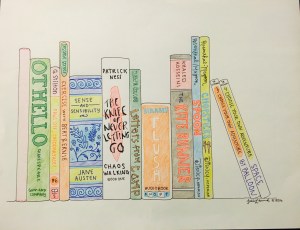
As a final project, my AP Literature and Composition students completed an “ideal bookshelf,” inspired by the book My Ideal Bookshelf and a quick write I completed in Penny Kittle’s summer class two years ago.  The assignment was relatively simple—create your own ideal bookshelf of the books that “represent you—the books that have changed your life, that have made you who you are today, your favorite favorites” (La Force xi).  Since this is an AP Literature class, I added a twist—I wanted students to stock their shelves with books that not only transformed them as a person, but also developed them as a reader.

As each student presented on their shelf, they transformed from self-assured seniors to wide-eyed children who relayed the story of the first book they had ever fallen in love with.  Many of them spoke of how they either found or developed their passion for art,

FullSizeRender-3

Max’s science-based book shelf

coaching, theatre, computers, and physics through books they had found over 18 years.  The books they listed did more than just challenge them as readers; these books had the power to inspire, entertain, and heal.  As Claudia wrote about The Sisterhood of the Traveling Pants, “I have no real idea what is so special about it, but I’m not going to question its magical powers when it does so much good for me.”


What I loved most is how these shelves found life through details; Julia’s shelf held her drawing notebook, Cam’s his favorite cookbook, and Payton’s was adorned with her grandmother’s locket, which she uses as a bookmark.  Some shelves were neat and orderly, perfectly stacked, while others, like Sammie’s were a bit more scattered.  As Sammie put it, “I don’t know what I want to do as a profession; I am still figuring it out.  That partially explains the disarray that is my bookshelf.  I couldn’t decide which would be more practical, stacking or leaning.  The result is a bookshelf with a little bit of both.”

FullSizeRender-1

Sammie’s slightly scattered ideal shelf

As my seniors complete the next three weeks and begin the process of preparing for college, I want them to walk away with the writing and analytical skills we’ve honed all year, but more than anything, I want them to remember why they fell in love with reading in the first place.  I want them to question why books are powerful and understand that the universality of a novel’s message can change readers.  I want them to read for knowledge and depth and challenges, but I also want them to accept that not everything needs to be analyzed, dissected or picked apart.  In fact, sometimes we read for escapism, for love, for adventure.  For many, this might be the last English class they take.  Hopefully, it is only the start of a lifetime of reflective reading and ideal bookshelves.


#FridayReads & Becoming (Twitter) Literary Critics

I am beat. My students are beat. I know you know exactly how that feels.

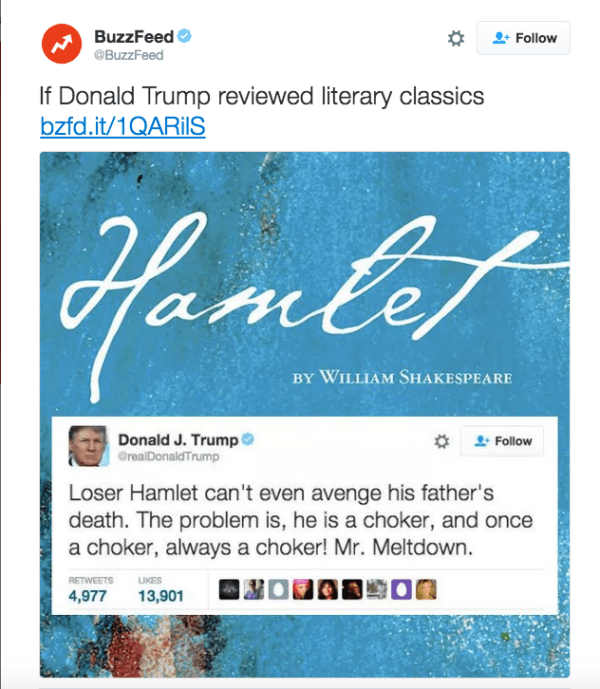
In an effort to lighten the mood but keep the idea of books and reading alive, my students and I had a little fun with Donald Trump. Now, it doesn’t matter what you think of the man or his politics, his tweets make pretty good mentor texts.

Screen Shot 2016-05-26 at 7.38.47 PM

I’m not the only one to think so — actually, I got the idea from someone Buzzfeed. Some clever writer put together a list of tweets, written as if Mr. Trump critiqued literature. Brilliant.

Screen Shot 2016-05-26 at 7.40.19 PM

So to have a little end-of-year fun, I asked my students to consider Trump’s sentence structure, and then write their own reviews based on the most recent books they’d read. Really, my only requirements:  a clear tone, but they didn’t have to be mean, and correct spelling and punctuation.

Here’s a few for your reading pleasure. Of course, the review makes the most sense if you are familiar with the books students refer to — I get that not everyone is as versed in YA like they might be the canon.

(Side Note:  To those who say students will never move beyond YA or ‘easy’ reading when it’s all about choice. Um, wrong again.)

What kind of end-of-year fun with books and reading — or anything else– have you had with your students? Please share in the comments.

A Reflection to Reinforce Workshop Non-Negotiables

Establishing an authentic readers-writers workshop community isn’t easy for teachers or for students.  Our discussions this week–on student and teacher buy-in and how to get students to thrive–have focused on helping both teachers and students to grasp the many moving parts of workshop.  While they’re straightforward, these non-negotiables are unfortunately often ones that neither students nor teachers have experienced firsthand in a learning setting:

  • A reading community filled with a diverse classroom library, frequent talk about books, and time to read
  • A writing community centered on a writer’s notebook for play and practice, frequent revision, and constant talk about writing
  • Choice in all matters–in what to read, how to read it, and at what pace, as well as about what to write, how to write it, and at what pace
  • Choice for the teacher, too, in what units to design based on what all parties are interested and invested in
  • Talk, talk talk:  structured talk in the form of student-teacher and peer conferences; discussion about the day’s topics and mentor texts; and an atmosphere of frank honesty

It’s sometimes tough to fit all of those things in every day (or to conceive of how to plan for them) but when we can manage it, it pays off.  Below is a reflection from Carleen–whose thought processes I wrote about here, too–that illustrates her journey from English disenchantment to workshop engagement.  This reflection is from Carleen’s winter midterm, and helps reinforce the value of the non-negotiables of a strong readers-writers workshop.


IMG_1537In the past, I’ve always dreaded going to English class. It was always the same every year with grammar, vocabulary, reading classics that were really boring, and writing about subjects I could care less about. I especially disliked English last year because it was AP. That class always put me in a bad mood. Writing rhetorical analyses almost every day as well as working on the dreaded ORP, which consisted of reading a nonfiction book and writing 20 journal entries and an essay, almost killed me. That class kind of depressed me because I couldn’t understand any of it. … I just stopped caring about my assignments because I didn’t see a good end result. On the bright side, I got a 3 on the AP exam; however, my high school English experience was basically ruined because of that class.

This was a lot of pressure for you, Mrs. Karnes, because you had to deal with my bad experiences. Yet, you have made this class my favorite (out of all my high school classes) and made me actually enjoy English. This semester I actually feel like I’m learning and improving my writing skills, which I’ve always been self-conscious about. I have definitely been reading more and trying to challenge myself with reading books outside my comfort zone. You made me care about my work and in return I worked really hard on my projects and assignments.

I’ve grown more as a writer this year more than any other year. I looked back at my first one-pager, which was dreadful because my sentences were super choppy, and compared it to my recent writing. I found that over the course of the semester, I have become more confident in my writing and I started to really enjoy writing my fanfics. You gave us the freedom to choose what we write about, which helped my writing immensely because I CARED about the topic and I enjoyed doing it. I realize that I’m eventually going to write about things I don’t care about and I probably won’t enjoy doing it, however I have been looking at writing differently now. I don’t really see it as a chore. It’s just something that I do on a weekly basis and it’s become a habit. I no longer see writing in a negative way, which helped me grow as a student.

In the beginning of the year, when you told us that we had to read two hours every week, I got super excited. I was always looking for an excuse to read, which my parents restricted me from. You know I’ve been an avid reader since the beginning of the year and I probably have been reading the same amount since the beginning of the semester (which is to say A LOT); however, with your recommendations, I have read books that I thought I would never read. This class helped me expand my reading repertoire, and I’m really grateful for it. I’m always excited when I leave your “Karnes and Noble” with a new book.


Share your students’ stories of workshop success in the comments!

Try it Tuesday: Teacher Readers Share the Love

Love what you read and read what you love.

Is this not the life force behind workshop? Behind teaching English? Behind becoming a reader?

Personally, I’m pretty sure my love for reading started in utero. My parents (both educators themselves) read to me and read to me often. The first real memory of a book I have is Disney’s The Penguin that Hated the Cold. Pablo the penguin wanted out of the Arctic. I connected with his desire to swing in a hammock and travel the high seas in a bathtub.

 Next came The Boxcar Children. I used to run out into the backyard of my comfortable suburban home and pretend to be an orphan living in a boxcar. Logical, right?

Soon after, I was devouring the Little House on the Prairie books, the early  Baby-sitters Club books (only those before #100…sorry Ann M. Martin, a girl has her limits), and The Nancy Drew Mystery Stories.  I read under the covers with a flashlight, swinging from the tire swing in my backyard, and sometimes under the dinner table. I only drew the line at reading in the car. Still can’t do it. It makes me vomitous.

The common thread to this early reading, was my love of stories. I chose what I wanted to read and I read voraciously because I was in charge of where I could travel, the conflicts I could watch unfold, and the people I could meet through books. I know my dad wanted me to read more Robert Louis Stevenson, but that was a journey of his childhood. The journeys of my childhood were with Roald Dahl, Beverly Cleary, R.L Stine, and C.S. Lewis.

So where is the balance that we, as English teachers, can bring to our classrooms when it comes to teaching the books we love (or the books we think students “should” read), and our understanding that choice fosters a connection to what we read? A connection that can far outweigh the legitimate literary merit of works we would choose for our students? Where do cultural literacy and passion for literature meet?

Well…I don’t really know. Yet.

What I do know, is that I need to provide opportunities for my students to choose texts that appeal to them. But my job can’t end there. I then need to help them move to more complex and challenging works. Classics included.

How to do that…I don’t really know. Yet. But I am learning.

Here is what I do know – If I am going to build a community of readers, I need to be a reader. If I am going to build a community of writers, I need to be a writer. Lead by example and beautiful things are sure to follow.

Easy, right? Of course we, as teachers, are often readers. The beauty of language, the study of what it means to be human, and the opportunity to live countless lives through reading is what led me to the high school English classroom. But somewhere along the way, I started reading more student papers than novels. More formative assessments than poetry. More parenting books than bestsellers (though I will contend that Oh, Crap! Potty Training is a necessary text for parents with kids of a certain age – Shana, this is the book –  trust me ). But with the advent of workshop, I have read more in the past few months, since Amy and Shana came to Franklin High School for professional development work, than I had in longer than I’d care to admit. And as such, I am able to broaden my repertoire of texts and my students now see me reading. A lot.

In fact, the students at Franklin High School are seeing their teachers read more and more. Not that we weren’t reading before, but as fellow colleague and reader Catherine Hepworth wrote in her guest post, we are now, as teachers working within the workshop model, making our reading far more visible. As a result, I wanted to share some recent reads from my colleagues. Teachers who are fired up about reading, because we love it and want to share the love.


The English Teachers at Franklin High School highly recommend these recent reads:

DemianDemian by Hermann Hesse – recommended by Karin Adelmann

Demian is a coming of age novel. Sinclair, the protagonist, is trying to find his way to what is true and real as he encounters different mentors and situations. The book frequently challenges more conventional ways of thinking.


The Handmaid’s Tale 
by Margaret Atwood– recommended by Lisa Dennis handmaid

As a pretty progressive woman, I can’t believe I haven’t read this book until now. I work; I share a household with my husband; I cook but also know how to shingle a roof, I vote; I raise my daughter to trust herself and know her own mind. And yet, I’ve never read this cautionary tale full of sardonic humor and striking dystopian visions that suggests all that Artwood feared about 1980’s “Morning in America.” The Handmaid’s Tale carefully unfolds the story of Offred, a woman living in the fictional future world of The Republic of Gilead. In a world of declining birth rates, fertile women are assigned to existing families, solely to bare children. Through Offred’s memories of her life before, an American life most of us would recognize, the reader discovers the sharp contrast between the freedom we currently enjoy and the very real limits placed on life when that freedom is lost. Like so many great dystopian novels before and after it, The Handmaid’s Tale is a testament to upholding the values of personal freedom in the face of what life might be like if we forget how precious those freedoms really are. I can’t put it down.

me before youMe Before You by Jojo Moyes– recommended by Erin Doucette

I was hooked on this book from the first page. The book is set in England, so I really enjoyed the voice of the narrator as well as some of the words she chose to incorporate. Me Before You chronicles the sometimes confusing, frequently tumultuous, and always touching relationship between a funny, eccentric, secret-hiding Louisa and formerly adventurous, formerly ruthless, and currently angry, quadriplegic Will. Quirky, unqualified Louisa becomes his care-giver for the 6 months he has left before his pre-planned assisted suicide.

I loved this book. It make me laugh. It made me cry. It made me angry, but best of all, it really made me think about the impossibility of some of the choices we face and the importance of standing by the people we love.

Eleanor by Jason Gurley – recommended by Richard Gould

This is a story of a young girl, Eleanor, whose twin sister dies in a horrible accident. After that, the entire family crumbles. At the age of 14, Eleanor has an experience that she cannot explain, but it seems that someone is trying to contact her in an unimaginable way. As these experiences happen more and more often, Eleanor begins to see a way to repair all the damage to her and her family’s lives. I recommend this book for several reasons. Fist, it features two strong female protagonists. The writing is authentic and the Eleanorcharacters are complex and not without fault. The story delves into “other dimensions” and would appeal to any fan of existential writing. The book is organized through a series of flash backs, flash forwards and time travel, which can be a bit confusing if a reader is trying to quickly read the story; however, this is a book to be enjoyed slowly with frequent pauses to think, not only about the story itself, but about the reader’s own perception of reality. There is a bit of romance, but not too much as the story stays focused on the protagonists’ objectives. The conclusion is satisfying but is not obvious or formulaic. When all is said and done, this book stays with the reader for a long time after it is put down.

Not My Father’s Son by Alan Cumming – recommended by Catherine Hepworth

not my father's sonAlan Cumming, Scottish actor extraordinaire, presents us with two parallel stories about the men in his life and their influence on him. While he is preparing for and filming a genealogy show, he is learning about his maternal grandfather’s escapades in WWII, while at the same time dealing with his own abusive father. It is a very honest and open memoir about one particular moment in his life that is at the same time about his entire life. He is my favorite celebrity and a wonderfully talented writer. I especially enjoyed his memoir because it’s rare that a celebrity gives you this type of glimpse into their heart breaking childhood. When I finished reading, I wanted to rush to NYC and give him a hug.

One More Thing: Stories and Other Stories by B.J. Novak – recommended by Amy Menzel one-more-thing

I like reading short story and essay collections because it mixes things up. It’s like what Mark Twain said about the weather in New England — to paraphrase, “If you don’t like it now, just wait a few minutes.” I can do that. And I’m pretty good at having the memory of Dory when reading story or essay collections. If I read something I don’t like, I forgive, I forget and I swim–I mean, read on. What I really like about Novak’s collection is his thinking. You might know of Novak from The Office fame. He wrote, directed, and starred in the hit sitcom. In this book, he uses his creativity to ponder some what if questions. “What if John Grisham’s publisher mistakenly published one his books with the place holder title of ‘The Something’?” “What if there was one man behind the creation of the calendar?” “What if there was a ‘Best Thing in the World’ Award?” I like how Novak thinks, and I really like that I get to follow his creative thinking in this collection.

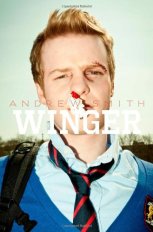
WingerWinger by Andrew Smith – recommended by Leah Tindall

I absolutely loved this book because Smith uses real language, humor and other great writing techniques that will truly appeal to all teens, boys especially. I thought I would take about a month to read in between grading and planning. However, once I started on a Tuesday, I finished it the following Friday evening. I could not stop reading it! I laughed almost every page, and then I cried in the end! I began reading it aloud in a few classes and this inspired several of my students- 3 girls and 4 boys, to be exact- to read it! One of the boys I don’t even have as a student- I was talking to him about it in resource. He didn’t read any books last year and finished this book and loved it! P.S. I love Andrew Smith.

Ready Player One by Ernest Cline – recommended by Sarah Sterbin and Brandon readyWasemiller

Sarah says: I love reading books that are being made into a movie so I can compare them. Ready Player One is hitting the BIG SCREEN in 2017 (I’m really on top of my game). It was an awesome read about living in a world where you can “plug in” to the virtual world. I have recommended this to a lot of my students who are into video games (and those who, like me, like to be harsh critics on the movies based on books), but it is a great story for ALL to read!

Brandon says: This is a book that I could not put down, and when I did I was trying to figure out the next time I could dive back in. Ready Player One was all that I could talk about for the week that I was reading it, and I suggested it to colleagues, family members, and students. This book has everything. A mystery, an dystopian future, life inside of a video game, undying friendship, 80’s references, solid characters, and a real look at how much video games affect our life–and more importantly how they could RUN our lives in the years to come. There is no a single person that I would not suggest this book to. It is unlike anything you have read before, and I highly suggest it to everyone.

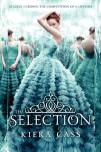
selectionThe Selection by Kiera Cass – also recommended by Sarah Sterbin

This books is a mash up of The Bachelor and Hunger Games. Dystopian feel while seeing the inner workings of a Bachelor type show (with some “ROYALTY”!) I have recommended this to a lot of my students who talk Bachelor/ette with me (guilty pleasure alert), and those who love reading Dystopian stories.

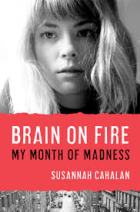
Brain on Fire by Susannah Cahalan – recommended by Brandon Wasemiller brain on fire

I grabbed up this book because I can be a window shopper when it comes to books, and I really liked the cover art on this novel. However, after I read the first page I was hooked, and spent much of my weekend reading through the entire thing. This is a book that takes you into pure madness and back again, and it is great for that reason. Going on a journey with someone as they go insane is a hard journey to take, but Susannah, a writer for the New York Post, brings her story to life. You will find yourself reading just ONE more chapter just to see if things get better.

challenger deepChallenger Deep by Neal Shusterman – also recommended by Brandon Wasemiller

I bought this book on Amazon because I saw that it had a five star rating, and really awesome art on the book jacket–I am so happy I did. The amazing quality that this book has is that it really makes you care about Caden, the main character, and the problems he is going through. Caden is in the real world, but also finds himself on a boat on its way to the deepest part of the ocean, Challenger Deep. You, the reader, are unable to help Caden who is starting to confuse dreams with reality. This book brought me back to the days when my grandma would read James and the Giant Peach to me and do all the different voices as she read, and like James and the Giant Peach, Challenger Deep is a journey of a young man who lives in one world, but escapes to another to work things out, but as a reader you worry that Caden will never come back. What if he is never “himself” ever again?

Columbine by Dave Cullen– Brandon’s passion for books cannot be contained. columbine
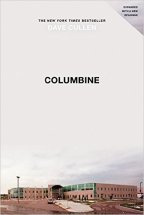
This was a book that I could not put down. Each chapter builds on the last, and you feel connected to the school, its students, and the tragedy that took place more than a decade ago. I never realized how much I did not know about Columbine. This book expertly tells the story of two very misguided young men, but more importantly, the teachers, administrators, students, and families that were all affected on that day and beyond. I would suggest this book to anyone looking for a great non fiction book, and a really solid look into what great investigative journalism looks like.


Thank you to the enthusiastic teacher readers at Franklin High School for sharing their recommendations. Each new text our students see us reading expands their field of choices and also lets them know that we truly, and gladly, practice what we preach. Because we love it.

What are you reading? What recommendations can you share? Can’t wait to grow our “to read” lists together with your suggestions in the comments below!