Category Archives: Classroom Culture

On In Defense of Read Alouds. Please, do.

At the end of a post I wrote last August called “My Classes are Only 45 Minutes — How Do I Do Workshop?” a reader named Andy left this comment:  I am at kind of a roadblock mentally and could use a push…I teach 8th grade reading in a building that still has both “reading” and “language” classes. While I am slowly transitioning to more of a workshop approach, I am still getting stuck on a few things. For our second semester, we have always read a whole class novel, but I would love to get away from that. Have any of you done read-alouds in your classes? I am beginning to think that maybe a better option would be to have students vote on a novel with a certain theme and do a read aloud and work on certain aspects of reading. My one concern that I can hear being brought up by administration is making sure I have enough assessments and grades…

First of all, I love that Andy asks this question and recognizes his need for “a push” as he wants to do more to engage his students than just another whole class novel. Not that whole class novels are necessarily bad, but those of us who have seen what choice can do in our students’ reading lives know:   if we only choose whole class novels, we lose valuable time developing readers. Giving students a choice as to a book to read aloud might just be a good idea.

I heard Steven Layne, author of In Defense of Read Alouds speak at the Illinois Reading Council Conference this past fall. He quoted the research and the position statements from scholars of various grade levels on the benefits of read alouds:

  • Positive attitudes are fostered towards books.
  • Imagination is exercised.
  • Background knowledge is built.
  • Reading skills are improved and reinforced.
  • A model of prosody and fluency is provided.
  • Reading independence is promoted.
  • Interests in genres are broadened.
  • Cultural sensitivity is increased.
  • Listening skills are improved.
  • Exposure to a variety of text types is provided.
  • Reading maturity develops.
  • Reading happens.

Based on these statements, Andy, what do you have to lose?

stephenlaynequote

I offer a few suggestions though:  HOW you read aloud to children is as important as WHAT you read aloud. Layne suggests five key elements the teacher-reader must employ as he conveys an awareness of phrasing and word color:  diction, volume, pace, tone, and pitch.

To read aloud effectively, as to engage all listeners, the reader must be a performer.

Of course, what you read aloud matters, too. Offering students several choices and letting them vote is one way to foster trust in your classroom community. Students want to know we value their opinions. I’ve found with my AP English students, when I provide several choices for their Book Clubs, many students will choose to read the books not selected for their independent reading.

I would also suggest that you offer a choice of books that are not too long. I learned a few years ago when I read aloud with my 10th graders that even when they choose the book, attention spans are short. A full-length novel read aloud can cause the same negatives that a whole class novel study can. For this reason, I think it’s important to consider your main objective first and then plan backwards.

If I were doing a read aloud with those same 10th graders this spring, I would plan differently than I did before.

  1. I’d select several books with the same theme I want to build a unit around, and I’d plan to introduce the books by reading aloud from each of them.
  2. I’d think about the goals I can accomplish as we focus on the theme, and I’d think of several summative-type assessments in which students can choose to show they’ve accomplished these goals. Or I’d think about how I might invite students to create their own major assessments.
  3. I’d think about the skills my students need to master, and I’d pair mini-lessons with the ones I know will emerge through the reading. (These can serve as formative assessments.)
  4. I’d think about how I will get my students to apply these skills to their independent reading books, which could all be centered on the same theme (if I planned that well enough). (These can also serve as formative assessments.)

One of my goals with my AP students this spring is to do more read alouds. I’ve learned this fall that many of my students do not understand the different forms and structures stories can take. We are going to use children’s books to help with our understanding. The book Writers ARE Readers by Lester Laminack and Reba M. Wadsworth offers several suggestions on titles that will work with students of all grade levels.

So while I will not be reading aloud a whole novel, I will be performing read alouds and thinking through 1-4 above as I plan this unit.

Best wishes to you, Andy, as you read aloud with your students. I believe this poem by Steven Layne is an important reminder to all of us who work with children:

Read to them
Before the time is gone and stillness fills the room again.
Read to them.

What if it were meant to be that you were the one, the only one,
who could unlock the doors and share the magic with them?
What if others had been daunted by scheduling demands,
district objectives, or one hundred other obstacles?

Read to them
Be confident Charlotte has been able to teach them about friendship,
and Horton about self-worth:
Be sure the Skin Horse has been able to deliver his message.

Read to them
Let them meet Tigger, Homer Price, Aslan, and Corduroy;
Take them to Oz, Prydain, and Camazotz;
Show them a Truffula Tree.

Read to them
Laugh with them at Soup and Rob,
and cry with them when the Queen of Terabithia is forever lost;

Allow the Meeker Family to turn loyalty, injustice, and war
into something much more than a vocabulary lesson.

What if you were the one, the only one, with the chance to do it?
What if this is the critical year for even one child?

Read to them
Before the time, before the chance, is gone.

– Steven L. Layne, from The Reading Teacher Vol 48, No. 2 October 1994

Do any of you have other suggestions for Andy about how he might structure and/or craft assessments for his read aloud? Please leave your ideas in the comments.

Amy Rasmussen lives in north Texas and teaches AP English Language and English 3 to the Fighting Farmers at Lewisville High School. She adheres to the words of Emerson: “We aim above the mark to hit the mark,” and Jesus Christ: “Love one another.” Imagine a world if we all love more than we think we can. Follow Amy on Twitter @amyrass.
 

disclosure

What’s the most important thing you think you’ll ever write?

I am good at setting reading goals. Good at helping students set them, too.

But I never really thought about the importance of setting writing goals until I decided I wanted to write a book and struggled to get words on the page each day. (I still struggle.)

Even with this blog, my writing goals seem fuzzy. Sure, we have a 3TT posting schedule, and more often than not, I make my mostly self-imposed deadlines. But I haven’t really considered these deadlines writing goals.

Today I am wondering why not.

And I’m thinking that this is probably similar to how my students view the writing tasks I ask them to complete. They look at the calendar I provide. They consider the writing workshop dates, the revision workshop dates, the writing group dates. Maybe they pay attention to the learning goals I write on the board and review each day — all valuable parts of our writing class routines, but I doubt they actually set any goals. (Okay, maybe they set the goal to actually complete the assignment. Maybe.)

But I want them to set writing goals. I want to set writing goals for myself this year.

billygoal

a gem of a goal by my friend Billy

So today as we go back to school and get back into our routines, we will talk about writing goals, not just writing assignments. We will talk about the reasons we write and how practicing our craft can help us accomplish those reasons.

I think we’ll start with this poem:  The Writer by Richard Wilbur. And then read “The Daily Routines of 12 Famous Writers” and maybe “9 Weird Habits That Famous Writers Formed to Write Better.”

Then, maybe I’ll ask this question:

What’s the most important thing you think you’ll ever write? Why?

I don’t know where the conversation will go, but I am okay with that. I’ll let my students know how I feel about setting some personal writing goals. I’ll let them know how I think this may change, or challenge, my ability as a writer.

I’ll write my goals as they write theirs, and we’ll share.

If you need personal writing inspiration — or just want to find some excellent short mentors to use as you write with you students — read this: “Ten Texts That Will Get Teachers Writing.” And, of course, we share lots of writing inspiration on this blog.

I’d love to know your writing goals for the year. Please share them in the comments. (P.S. I hope one of them is to write a guest post here in 2017.)

Amy Rasmussen lives in north Texas and teaches AP English Language and English 3 to the Fighting Farmers at Lewisville High School. She adheres to the words of Emerson: “We aim above the mark to hit the mark,” and Jesus Christ: “Love one another.” Imagine a world if we all love more than we think we can. Follow Amy on Twitter @amyrass.

Survival Strategy: Return to Structure

The Google calendar that the Three Teachers share has us on a rotating schedule. Fixed days with suggested ideas around types of posts and the three of us cycle through clock_stockeach week. Today, my friends, the suggestion is “strategy,” and boy do I need one.

After this lovely break from school, my daughter’s sleep schedule is a mess, I think I’ve put on five-ish pounds of cookie related belly weight, and the house is an unmitigated disaster zone of new toys without homes, student papers I’m placing around the house in an effort to combat “out of sight, out of mind,” and the organized chaos that comes with putting away all the holiday decorations while my daughter yells, “But we CAN’T put the tree outside! It will be lonely!”

So, what I guess I’m suggesting with all of that is that, although it has been legitimately lovely, I need to return to some structure or I’m going to lose it. I can’t watch The Grinch one more time, or I might pop Cindy Lou Woo in her tiny little nose. Bah! Humbug!

Was it really only a little over a week ago that I sprinkled unbridled joy across the blog in my Holiday Poem? My…how the Merry has fallen.

handsPlease don’t get me wrong. I’ve had an amazing break from work. Many aren’t able to share in the blessing of having such a richly restorative holiday from their employment, and I am grateful. I spent time watching my three-year-old revel in the magic of the holidays. We shared time with family and friends, laughing, toasting, and just generally enjoying one another’s company. I stayed up late reading. I rediscovered the thrill of flying down a sledding hill, shrieking like a teenager and giggling with my daughter. I even had one day where everyone was out of the house. I napped. On my own couch. Without having to block out Dory telling me to “just keep swimming” for the six millionth time.

However, while summer affords one the opportunity to release from the stresses of work and still find plenty of time to get on a schedule of chosen activities, winter break is a whirlwind, from which, many feel they need a vacation.

So, here is my strategy. A strategy to shake off the crazies and get back to some workshop non negotiables to send us back to school with a renewed enthusiasm around structure:

Step 1. Get back to school. Easier said than done, I’m sure. That alarm is going to go off tomorrow at 5:15 a.m. and I am not going to be happy, but this past week has reminded me that without consistency, I start to lose it. I need more purpose than Netflix programming selection. Much like workshop, I need consistent components of purpose in my everyday. They give me a roadmap to achieve goals. Goal one, get out of bed for work tomorrow.

Step 2. Read with my kids and then talk with them about what they read over break. I’m guilty of getting away from reading/conferring with my kids in the past few weeks. In the flurry of planning, preparing for exams when we return, fifty meetings after school, PD time to plan for, and countless other distractions, I started to let the few precious minutes at the start of class slip back to menial task time. Check email, organize papers, finalize workshop activity, etc. Our first day back, I’m going to read with my students at the start of each class (Warning! Shameless plug for #3TTBookClub to follow: Perhaps I’ll choose East of Eden by John Steinbeck, Between the World and Me by Tah-Nehisi Coates, or  Assessing Writing, Teaching Writers: Putting the Analytic Writing Continuum to Work in Your Classroom by Mary Ann Smith and Sherry Seale Swain. All fantastic choices for the month of January). The next class period, and those that follow, I need to talk with my kids at the beginning of the hour. Their only homework was to read over break. I want to hear about it.

Step 3. Set reading rate goals with my kids (another practice I slipped away from over the weeks between Thanksgiving and Winter Break…talk about a need for resolutions. If the past paragraph didn’t indicate my own failings at upholding a major tenant of workshop, this one sure will. I never slip on giving my kids time to read. We have 82,793 things to work through in a class period, but I don’t take their reading time. It’s just that important. However, holding them accountable for their reading outside of class? That’s a never ending battle. I’m going to get back to students setting goals in their notebooks, then I’m going to employ my newly favorite technique: Have students snap a picture of the page and email it to me. Stacks and stacks of notebooks are occasionally necessary, but they also give me hives. An inbox full of messages is somehow a challenge, as opposed to a stack of notebooks which is somewhat of a burden, meaning I end up collecting them far less than I would really like to.

Step 4. Get back to writing. We religiously write in class each day. Over the weekend, I wrote thank-you cards and last Wednesday, I wrote down my Jimmy John’s order for a friend. On the drive home from my in-laws tonight, I looked out at the last of the Christmas lights on passing houses and smiled at the memory of the big, old fashioned lights on the bushes outside the house where I grew up. The memory was quickly followed by an ache to write about it. I miss writing when I let myself feel “too busy” to do it, so I need to take William Wordsworth’s advice: “Fill your paper with the breathings of your heart.” Tomorrow, we will write about what makes us ache.

Step 5. Reconnect with kids. In one of the many moments I allowed myself to be distracted from work today, I saw a Tweet from literacy specialist Shawna Coppola, who said, “Relationships with students are more important than any curriculum.” Please see step 2 above and repeat that daily during workshop, drafting, small group work, experimentation, last 30 seconds of class, time.

——————–

The New Year is a time to move forward with renewed vigor. My final exams this semester will ask students to reflect on their growth as thinkers over the course of the first half of the school year and discuss specific takeaways from our work. They will then be asked to make suggestions as to how they will apply that learning during second semester.

In much the same way, I’m reflecting on how a lack of structure makes me more tired than teaching, parenting, and living combined. I was certainly ready for a break, but I’m also ready to get back at it.

The strategy is simple: Get back into workshop WITH your kids, and refresh that commitment to do what works each and every day.

Happy New Year, All. Welcome back!

Lisa Dennis spends her school days teaching AP Language and Honors/Pre-AP Sophomores, while also leading the fearless English department at Franklin High School, just outside Milwaukee, Wisconsin. Though loathe to discuss herself in the third person, she does delight in hearing her daughter ask for ‘just one more chapter,’ dreaming about European vacations ala Rick Steves, and sitting in the snugs of authentic Irish pubs. She is a firm believer that a youthful spirit, a kind heart, a big smile, and a good book can ease most of life’s more troublesome quarrels.
Follow Lisa on Twitter @LDennibaum.

disclosure

What is Your Teaching Everest?

I’m standing on my desk.

It’s dangerous, but exhilarating, and I probably look like a loon, but I don’t care. (Please see my post where I embrace my dorkdom in an effort to really get to know my students and move on happily with passionate living and teaching.)

oh-captain

High heels kicked off, channeling the spirit of Mr. John Keating and brazen pigeons everywhere, I’m perched on the edge of my desk during prep, looking around the room to try and gain gain a different perspective.

Oh, Captain, my Captain…Somebody call security. She’s lost it.

No, no. I’m all right. (Well, you know – Relatively speaking. Dear colleagues, if you hear a thud, please investigate.)

So, what caused this poetic exploration of my abandoned classroom? I was thinking about a quote I heard at NCTE 2016:

What is your Everest this year as a teacher?

No, my desk isn’t my Everest. I’m not that far gone. But, per Shana’s inspiration to start with a question, I was thinking about what needs my attention the most right now. With 86 minutes to plan, grade, create, and locate necessary motivation to do all of the roomaforementioned tasks, what should I start with?
There’s certainly a lot to chose from: stacks of papers, countless books to read, share, and sort, a department in need of collaborative time to plan, students flying under the radar.

Everything in front of me is important. I need to grade the narratives my sophomores wrote, to put some ending punctuation on that adventure. When She Woke by Hillary Jordan is calling to me too. That book is Hester Prynne meets Offred meets futuristic criminal justice system that injects offenders with a skin altering virus based on their crimes – I need several extra hours in the day to read. Truth be told, I should have started this post sooner too. Procrastination and exhaustion mix into a delightful little cocktail called Crippled Motivation. Bartender, I’ll take another when you have a minute.  

In all seriousness though, I return to my question (Yes, I’m off my desk, Mom), because answering it means I can get something done. I’m weird that way. Could I pick up a stack of papers and just start? Of course. But I have to mentally work up to it, know my plan, have a reward of some sort (read five papers, read When She Woke for five minutes). This time, the question, the task, the implication is much bigger.

What’s most important right now? When I could do a thousand things, what needs to be done right now because it will mean the most?  I know the answer. And not only because I was just standing on my desk :

My Everest this year is feedback.

Consistent, responsive, quick feedback that first encourages, and then focuses in on promoting growth. Remember the old saying about catching more flies with honey than vinegar? That’s the stuff right there.

I want to move my students forward. We all do. But now, more than ever,  I believe the way to do it is through sincere investment in the original thoughts and explorations of my students. Personal connections that, yes, take some time, but build relationships that have helped me to better recommend texts, suggest style moves students may need to make in their more formal writing, and encourage additional critical thinking beyond the classroom.

I used to stress about “finding something good” to include in my comments to my students. And I hate to say this, but it’s downright hard in some instances, isn’t it?

I really like what you did with the title there. 
Interesting transitional choice. 
Wow. So many words in that sentence.
Nice…font selection.

But now,  I’m thinking about feedback in new ways and delivering it in new ways too. To reach my Everest, I’m going to have to get creative and intentional. So, here’s what I did this afternoon:

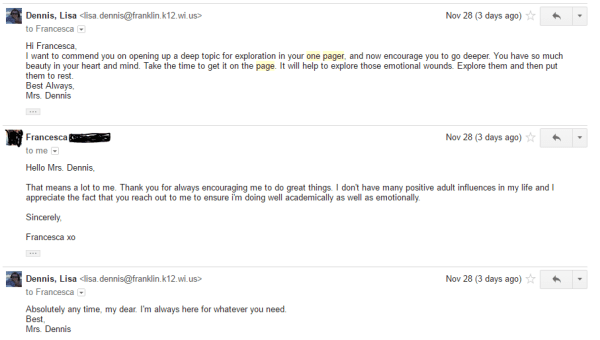
  • Read through a section of one pager submissions from my AP students. Check them in with the quick rubric for a formative score, and email five students per class with reactions. Not corrections, but reactions. Students are encouraged to explore in these writings and the best means of moving them forward in this case is to share additional insights, question, and encourage. I highlighted the students’ names in my gradebook to know I’ve contacted them and I’ll do the same with several more students next week. Writing feedback…check.

fran

  • I made a plan for conferring during reading later this week. Without a plan, it’s feeling random and I’m not doing it enough (the thousand things on my desk keep capturing my attention). So, I have a list. I know who I want to talk with based on quick writes students did today. They reflected on their progress toward their weekly reading goals and some students are struggling. Just by having them take a quick photo with their phones and email me the page, I got a literal snapshot of how each and every one of my students is doing with their independent reading, and I didn’t have to collect notebooks. Now, I’ve emailed a few students congratulations and made this plan. In the picture below, Alexis refers to her current read as “a beautiful romance of adventure.” Love! Reading feedback…check. 

    img_1012

  • Students will self-assess their latest practice AP argument essays. Feedback does not need to come from me to be beneficial. Using the AP rubric to help justify scores, students will take a sheet of paper, put a score and justification on the top, fold it over and hand it to the person next to them. Scoring will proceed in the same way around the table until everyone has his/her paper back. The table will then need to calibrate/norm and agree on a score. Self assessment and peer assessment…check
  • I am going to question and listen more. Long ago, I gave up on the idea that my imparting knowledge on others was the best way for them to learn. Everyone learns best when the are motivated to do so through personal connection to the work, interest in the material, and an understanding of how to improve. Workshop sets this up in a classroom, it’s now my job to remember to listen more and jump in less. During conferences, during book clubs, during discussion. Listen first, respond, encourage, and redirect/suggest later. This certainly doesn’t mean my presence in the room diminishes. It means I remember that my presence in the room is to guide my students, not steamroll them.

Gaining a new perspective feels like hitting the reset button to me. It provides clarity of mind and purpose. Skill development is my professional responsibility. Human development is my personal responsibility. They work hand in and hand and they are the Everest I will climb all year, every year, as I talk with, respond to, and gain insights alongside my students.

What is your teaching Everest this year? We’d love to hear from you! Please add your insights to the comments below! 

Mini-lesson Monday: A Matter of Perspective

I am thinking about the importance of perspective. Mine and others.

To truly understand how the world works, why decisions are made, what issues matter to individuals, when things do not go our way, we have to be willing to peer into the thinking of those who think differently than we do.

Sometimes — no, most of the time, this is hard.

It is especially hard for the sixteen year olds I teach. They wear their bias like badges, and they often silence those who disagree with them with blatant disregard. I fight against this every day, but last Friday we took a few steps forward. I want us to keep moving.

Objective: Students will formulate ideas while writing from a perspective other than their own: Who? What? Where? When? Why?; draw conclusions based on observations and interactions with peers.

Lesson: First, we’ll write. Students will take out their phones and take a photo of the person sitting across from them. They will then write for ten minutes, trying to convey that person’s point of view about their future. What do they want to do after high school? Where do they see themselves in five years?

We will then share our writing and discuss how difficult it is to know another’s thinking without ever having a conversation. We will tie this thinking into the conversations we had last week about stereotypes and making judgements.

Next, we will do the Crossing the Line activity as outlined here by Vanderbilt University. Of course, I will have to change some of the questions:  Coke vs Pepsi? Pshaw. This is Texas! I will have to say Coke vs Dr. Pepper.

This activity will inspire discussions about our similarities and our differences, and the poem will allow for even more discussion, analysis, and critical thinking around a text.

Follow up:  As we move into choosing topics for our Poetic Rhetoric unit, I will remind students of the importance of investigating all sides of a topic and the importance of considering alternate points of view as they compose their poems. I did not do this last year, and this will add a critical element to their arguments. Too many of the spoken word poems I’ve listened to seem like rants against some issue instead of including a shift or two that lead toward solutions.

In times like these, we definitely need solutions.

NOTE:  Shana, Lisa, Jackie and I are presenting at #NCTE16 this week. If you will be with us in Atlanta, we’d love it if you attend our session on Sunday, Nov. 20 at 1:30 pm. Room B211 of the GA World Congress Center. I will start our presentation with more on the value of perspective and how it relates to Advancing All Students in Readers-Writers Workshop.

screen-shot-2016-11-13-at-8-48-43-pm

Try it Tuesday: Revising a Goal…Card

Part of being relatively new to the workshop model is acceptance of personal limits on time, resources, and physical strength (I carry a lot of books around these days, but my twig arms persist). What workshop instructors can’t be short on is creativity, sales skills, or copies of  All the Light We Cannot See

So, as I start my second year exploring workshop, I find that some things need major overhaul (my capacity to read all of the books I want to read and share with kids) and some need tweaking (I’m going to try not to tear up while book talking The Kite Runner next year,..but no promises).

Last spring, I wrote about trying to motivate my readers with a visual reminder of the goals they were setting for their weekly reading. We created goal cards and placed them in our choice reading text at the point we wanted to read to (and beyond!) in the coming week. The card looked like this:

IMG_0172

Great. Except…not so great.

The goal card, meant to be inspirational, looked like a standings report at a track meet. Numbers, checkmarks, and most hideous of all, math. 

So, in the spirit of innovation, I went back through our former posts to find one I remembered from Shana about self-monitoring reading homework by calculating reading rates and then making bookmarks out of paint samples to inspire her readers. Beautiful shade progressions to symbolize change, quotes to inspire reading greatness, and reading rates, all tucked neatly in a text: IMG_9336

Great. Except…not so great.

Wisconsin hardware and paint stores now seem to only carry single color swatches or detailed color wheels in elaborate weekend warrior pamphlets, neither of which hold a place in a book in influential fashion.

Enter, my revised goal cards. A marriage of inspiration, functionality, and good old fashioned visual cues:

Students spent a few minutes finding quotes about books and reading that spoke to them. With my sample under the document camera as a guide, students created goal cards that reminded them of the importance and power of reading, and of not only setting goals, but keeping those goals visible in their daily reading.

Instead of using these cards as bookmarks, however, we calculated our reading rates (How many pages did you read during our ten minute reading? Multiply it by six and then double it for a two hour goal in your current text.), wrote them on the first page of our writer’s notebook under our text goals for the year, and then put the goal card in the book at the approximate place we’d reach in the text when we’d read for two hours.

Goal setting is important. As I tell the kids, it’s so important that we need to get our goals in print and on our minds to see them daily and make reading a habit.

Visual cues can help. In fact, sometimes they make the difference between passive participation (Sure, Mrs. Dennis. I’ll read for ten minutes in class…) and the active engagement we all seek.

What tweaks have you made to your workshop practice this year? Any major overhauls? Please share your ideas in the comments below. 

Try it Tuesday:Workshop Thievery

Disclaimer: Theft is wrong. The end.

Steal is a strong word (pun very much intended). Borrow? Swipe? Thieve? Pinch?

That last one makes me feel like a 1930’s gangster, so we’ll go with that.

I’m here to confess that I’ve been pinching materials from this very blog, and I’m pathologically not remorseful.

Pilfering and plundering are practices most teachers subsist on, so it’s only natural that as the fearless English Department at Franklin High School begins its first official year of workshop instruction, we are lifting everything we can get our hands on.

And while the prospect of taking our fresh and shiny Understanding By Design curriculum templates and matching our standards based curriculum with the workshop delivery model is daunting (to say the least), it’s also afforded me an opportunity to look at countless new practices and bring added excitement to this new routine through new ways of helping students read and write everyday.

Amy.
Shana.
Faithful readers of the Three Teachers Talk blog.
I stand before you (or sit during my prep), a grateful swindler.

Today’s Try it Tuesday matches (snatches) Amy’s Blessings Cards (or an even more detailed and awesome Blessing Card Mini -Lesson here) with Shana’s Write-Around, and the reflections my students produced were fantastic.


  1. To support my belief that students preparing for in depth analysis, college/career readiness, the AP Language test, and life should know what’s going on in the world img_5673around them, part of my AP summer work is for students to sign-up for a news story as it breaks or develops over the summer.Students are to read several editorials about the topic and draw their own conclusions as to the impact this story has on a given community (either local, national, or international).As one of their first assignments of the year, they take their research on the topic and present a one minute speech to the class. The scores are formative, but they tell me a lot about students’ abilities in using text evidence to support a claim and the basic professional communication skills they do (or do not) possess.
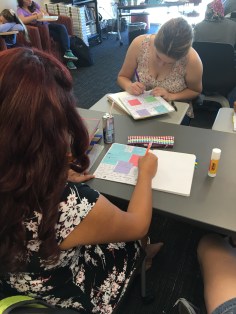
  2. As a positive form of peer assessment during our very first public speaking opportunity, I used Amy’s idea of blessings cards. Each table grabbed a card for each presenter (I split speeches up over several days) and put his or her name on the card.When the speaker was finished and I was hurriedly writing formative feedback on the rubric, students talked at their tables and bullet pointed blessings on the speaker’s img_5672card. We had reviewed the rubric before speeches began, so students could provide positive feedback directly related to their assessment criteria. When all the speakers were finished for the day, we showered our presenters with blessings.Lots of smiles.
  3.  Once all of our speeches were complete, I shared several pictures from Shana’s post about write-arounds. We took a look at how writing/reflection can be guided by objects that give permanence to our experiences.
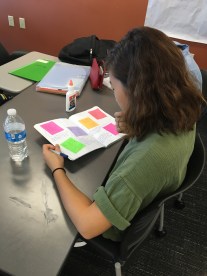
    I had students glue their blessings cards to a page in their response section of their writer’s notebook and then reflect on the experience. They could write about what they felt went well, goals for their future public speaking adventures, and/or anything that came to mind in relation to the experience.As I peeked over shoulders, I knew my stolen ideas were paying off for this reflection with such statements as:

    “Mrs. Dennis says that some people fear public speaking more than death. I know what she means. But this class seemed to think I had my act together though, so that’s cool.”


    “I’m never going to like this. I know it. I am never going to like public speaking. But I can get better at it.


    “I almost passed out up there. For real. But I had a notecard and it kept me basically organized. Next time, I’ll try breathing while I’m speaking. Maybe that will help too.” 


Classroom community and comfort within that community are not givens. Both must be built with intentionality. Workshop demands that we take time and honor the process around building readers, writers, and in this case, speakers to, because many of our students are not initially comfortable with the roles we are asking them to take on.

By examining the process with a growth mindset,  we put value upon the feedback that comes from not only the teacher, but peers and self reflection as well.  This feedback serves to support and motivate students as they move forward and start to become the community that will serve to encourage, challenge, and motivate better reading and writing throughout the year.

Steal these ideas. Please.

How do you encourage community building for your readers and writers? We would be blessed to have you share some ideas in the comments below.


Try it Tuesday: About that Digital Citizenship

I only had to ask three students to put their phones away on Monday. This is progress.

I know some teachers “outlaw” phones in class. I do not. We use them too often. Besides I have never been in a meeting or in a conference session or anything of the like and been asked to give up my phone. Of course, I know a thing or two about etiquette. Many of our students do not.

Instead of being the phone police, I would rather take the time to teach my students to use their devices appropriately in class — and, of course, with any luck, if the learning sticks, I’d like them to take that “appropriateness” beyond my classroom as well.

If we are not taking the time to teach our students phone etiquette and digital citizenship, we are missing out on important opportunities that may make a startling difference in their lives.

For example, did you see this headline:  “Girl gets kicked out of college for Snapchat photo”? The link lead to a hard sell for why every teacher should take the time to teach students the importance of digital citizenship.

I’ll be sharing it with my students today.

screenshot-2015-09-27-20-18-26-26o2pj7

keystrokes.wonecks.net

What are some ways you teach phone etiquette and digital citizenship in your classroom? Please share in the comments.


Ugly Cry Round Two – #FridayReads

Hi. My name is Lisa, and I’m a book hugger. “Hi, Lisa…” 

I feel like I can tell you this. Like you’ll understand and still let me sit near, if not at, the cool kids’ table. See, last week I was a dork. This week I’m a book hugger. Is that super dork? Literate dork? Biliophilic dork?

Either way, I’ll own it. That’s totally fine. In fact, if I know myself at all, as I hugged my copy of Kristin Hannah’s The Nightingale this morning,  my eyes were probably a bit wild too, breath bated, satisfied smile projecting my hope that pens would fly across the pages of our “I want Read” lists. Basically, when I book talk, I feel like the author is standing next to me. “Get them interested, Lisa.  Get them thinking. Sell it. Put my book in their hands, and hearts, and minds.”

So obviously…no pressure.

One of my AP Language students, Zach, smiled as I stood hugging my book today.img_5539 “Mrs.Dennis,” he said with a coy smile, “you’re super emotional.”

Who? Me?

Well…ok. Maybe. I do love a good cry. The “cathartic, wring you out, snot on the back of your hand, tell everyone to read the book” cries are my favorite (Please see my unraveling at the hands of A Monster Calls by Patrick Ness). But I know that you know; you’ve been there. Whether the tears actually fall or not (and they should, trust me, it feels great), a book that captures you can feel like a conversation with a good friend, an exploration of pure emotion, and a learning experience that leaves you a better person. Talk about a worthwhile human endeavor.

So, I quickly reflected and responded to Zach’s observation. “True, true. Hallmark commercials make me cry, but with books, that shows a pretty deep connection, doesn’t it? When the characters in a book are so real that you feel their struggle. When their stories remind you of your own, even if their life experiences are completely different from yours. That’s what I want for you. That’s why I’m up here hugging this book. Human connection.”

With further reflection, it’s how I have chosen each of the books I’ve book talked so far this year. No, they haven’t all made me cry, or I know for a fact that I’d be missing a significant portion of my audience; however, they have all been books that have touched me in different ways, to different degrees, and in different parts of my life.


So far this year, I’ve book talked:

Mudbound by Hilary Jordan – This text started my summer reading and while it’s justly won acclaim for it’s themes surrounding racial tension in the south, betrayal, and the secrets that can bury a family, I spoke to my classes about the rich voice Jordan is able to give a wide variety of characters. With a new narrator each chapter, you see this story from all angles and each is more personable and heartbreaking than the next.

The Handmaid’s Tale by Margaret Atwood – I finished this book right before summer break and I book talked it then too. It has quickly become one of my favorites as a cautionary tale and an all too real examination of how gradually, but how drastically people can become complacent to the loss of personal freedom. I took students down a “let’s imagine” path by asking them which events in their daily lives they inadvertently take for granted, but would certainly miss if they were denied the privilege. What if it was the right to have your own money that was denied? Or the right to travel? Or learn?

The Nightingale by Kristin Hannah – The characters became family to me. I realized that the terrible trials of World War II were occurring when my grandmothers were the same age as the main characters. Just because the pictures of the time period are in black and white, doesn’t mean the stories to come out of that time period are any less real. Or relatable. Or powerful (I hug what I love. I loved this book. It may be my current favorite piece of fiction). My three copies of this book disappeared today. I was tickled.

The Absolutely True Diary of a Part-Time Indian by Sherman Alexie – This is the first book I read this school year. I took it down in three days and could not stop laughing. I told my students that my connection to this book surprised me, and I think that’s part of the endearing quality of protagonist Junior’s voice. He hooked me with fart jokes. Certainly not my usual forte, but Junior’s search for hope is so real. And as I said to students, we all search for hope in different capacities. Junior searches off the reservation. I search the room during reading time. Just as Shana suggested, reading outside your comfort zone can offer some big rewards.
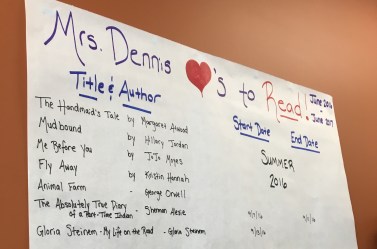
A Monster Calls by Patrick Ness – We’ve been well over this one. Ugly. Cry.
Though an additional sell, at the moment, is the forthcoming movie based on the book. My students want to take a field trip, but I’ve only committed to investigating the release date, if they get on reading the book. All six of my copies are currently gone from the library shelves. Win.


So, as I wrote last week when I was working to get to know my students, I feel it’s important to share who you are as a person, as much as you share who you are as a teacher, and illustrating you are a reader and writer is a part of that
img_5537-1opportunity/responsibility. With that in mind, showing you are a passionate reader is even more impactful. I feel like my students are getting to know the real me (dork and all). It’s the very best way to start building honest relationships. The kind that build trust, and thereby, community.

I’ve carefully chosen some of my favorite texts to book talk, followed my colleague Catherine’s lead in making my reading life visible, and jumped into this year with the goal of spreading my enthusiasm about books to another set of students through an honest look at what moves me, in a sincere effort to move them.  So far, so good. I just need some extra Kleenex boxes in room.

Try It Tuesday: Notebook Write-Arounds

Tom Romano calls writer’s notebooks “playgrounds, workshops, repositories” in Write What Matters.  As such, the writer’s notebook employed in a workshop classroom is much more than a place to store drafts, brainstorm ideas, or take notes.  It becomes a sacred space that is personal, meaningful, and enjoyable.  To fill it with writing and wordplay that spurs a love of language, I like to write around various artifacts in my notebooks, and urge my students to do so too.

img_4597

I cheated and wrote around a poem and a picture here

Write around a poem – In this lesson, inspired by advice from Penny Kittle (she told me her writing got more beautiful when she read poems more intentionally), I ask students to cut out a poem and glue it into their notebooks.  This activity can change with its purpose–sometimes students can respond to the language in a poem, sometimes they can write from a line, and sometimes they can work to analyze the text for literary devices and figurative elements.  The act, though, of gluing a poem into our notebooks keeps beautiful language at the center of our work, made visible when we flip backwards through our pages.

Write around a picture – Like Amy, I like to see my students’ notebooks full of pictures.  I ask students to bring in or print photos of any sort, then write descriptions, craft imagined dialogue, or narrate a memory the photo evokes.  In addition to being personal and meaningful, these quickwrite activities often serve as jumping off points for longer pieces of writing.

img_4595

Lisa sent me flowers, and I wrote around her note

Write around a note – My friends and I are big note-writers, and I’ve always had the compulsion to write “thank you for your thank you note” notes (maybe that’s just me, but Lisa is a dork so she might do it too!).  Because that’s socially awkward, I like to glue notes into my notebook and respond to them that way.  I also have students glue in their Bless, Press, Address responses from other students, or my own written feedback (like Amy’s Silent Sticky Notes), and respond to it in their notebooks.

Write around an object – Whenever I unearth something meaningful from the depths of my glove box, I like to glue it into my notebook and write around it.  I have Starbucks

img_4598

I’ve memorized my library card number, so I no longer need to carry it in my wallet…

sleeves, library cards, ticket stubs, and even an old necklace glued into my notebook, surrounded by writing.  In this era of electronic communication, I think it’s important for students to put physical objects into their notebooks–I still have shoeboxes full of notes from my friends in high school, and I like their tangible power more than just a series of saved text messages.

Write around an idea – A written version of the Four Corners activity, students write down a statement in the center of a page and then exercise some critical thinking around the statement.  The top left corner represents the “strongly agree” perspective, the top right is “agree,” bottom left is “disagree,” and bottom right is “strongly disagree.”  I’ve also experimented with just having students respond to the statement in general, but I like the Four Corners because it forces them to consider multiple perspectives.  Mostly recently, I asked my preservice teachers to respond to the idea that “Teachers are responsible for 100% of their students’ learning” using the Four Corners method–I can’t wait to see their responses when I collect notebooks next week.

What ideas or artifacts might you have your students write around? Please share in the comments!