Tag Archives: Writing Workshop

A Writing Workshop Lesson: Inspirational Speech

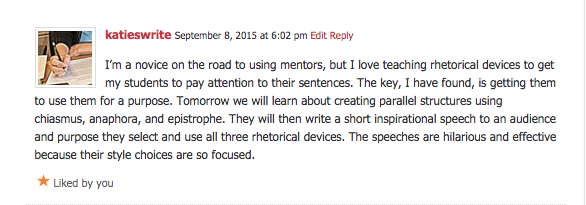
Last week I posted a mini-lesson about using student sentences as models for writing. Katie Bills-Tenney left this Screen Shot 2015-09-13 at 6.12.39 PMcomment. And I asked if she would write a post about her lesson.

She did even better:  she wrote on her own blog, complete with a lesson outline and student writing.

I love what she does here — and what her students do here, too.

Thank you for letting us see inside your classroom Katie.

Follow Katie at @Katieswrite

Mini-lesson Monday: Student Writing as Our Mentors for Sentences

I read Learning by Teaching by Donald Murray this summer, and I finally understand the importance of using student writing as the main text in my writing class. While I’ve believed students can learn from

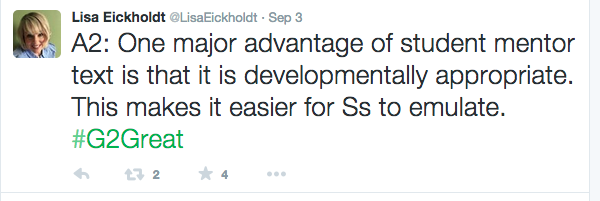
I lurked on this chat. Many positive examples of learning from student writing.

I lurked on this chat. Many positive examples of learning from student writing.

reading one another’s work, and I’ve often asked them to read and give feedback — on drafts and published pieces — I’ve never thought to actually use the text to teach a concept. I don’t know why. I supposed I’ve always relied on mentor texts by The Pros for that.

I am changing my tune. Here’s a bit of a lesson that worked better than I could have imagined.

Objectives:  Using the language of the Depth of Knowledge levels, students will write about their lives, and share their writing. They will recognize a wide variety of sentence structures. They will identify patterns, devices, and/or figurative language and discuss its effectiveness in creating meaning. They will revise their writing, formulate their own sentences, and apply their understanding to future writing assignments.

Lesson: Project the image, and ask students to write in their writer’s notebooks one sentence that answers the question. Remind them about what they know about various sentence structures and how punctuation works within a sentence.

“We can pack a sentence with a lot of information if we punctuate it correctly. Pay attention and see how you do. You can write any sentence, but try to not write a simple one.”

Give students about five minutes to write.

Next, ask for a couple of volunteers who are willing to write their sentences on the board. Be sure they understand that there is no judgment.

“We just want to talk about sentences.”

While two or three students write their sentences on the board, ask the other students in the class to read their sentences to each other.

one sentence

One at a time, read the student sentences on the board. Ask:  “What do you notice?”

Ethan sentenceTalk through the various comments students make, noting parallels, punctuation, clauses, word choice, etc.

Watch for teaching points. Ethan’s sentence on the left gave us a lot to talk about:  parallelism, use of semi-colons, colons, …

Next, ask students to return to their notebooks. “How can you make your sentence better?”

Allow time for revision (and time permitting, more sharing.)

Why this lesson works, especially for a writing lesson at the beginning of the year:  It’s just a sentence!

And sometimes we get a bonus gift like this one my class got from Edward:Edward C sentence

“I am the guy who picks people up when I, myself, am down; I am the guy who cares so much over things so little; I am the missing piece to a puzzle that has been forgotten; I am now by a sad and quiet shell of my former self; I am Edward Campos.”

The class hushed. All eyes turned to Edward.

“Wow,” I said, “Thank you for sharing this writing today. You’ve made yourself vulnerable, and we value that.

“First of all, we need to know that you are okay. Will you explain a little more what you mean here?”

Edward explained that he used to be fun and outgoing. He felt strong and powerful. Then at the end of last year and over the summer he learned his friends weren’t really his friends so much. Now, he feels alone and like he’s not the person he used to be.

“Hey, everyone, how many of you have ever felt like Edward?

“Look around, my friend, do you see all those hands? Everyone here has been where you are. We understand. You have new friends here.”

Two girls at Edward’s table leaned forward and touched his arm. “We’ll be your friends,” they said smiling.

And he smiled back.

Of course, because I am me — and I never leave a teaching moment untapped — we talked about the structure of Edward’s sentence. And we talked about the word choice:  “Why ‘forgotten’ instead of ‘lost’?”

When we watch for teaching moments in student writing, we will find them. Every single time.

Follow up:  In class the next day we did some free-writing in our notebooks in response to the spoken word poem “Hands” by Sarah Kay. Before we wrote I reminded students to pay attention to their sentences. Then instead of sharing the whole of what we wrote with the class, we only shared our favorite sentence. I consider this valuable formative assessment.

Now, I will hold students accountable for crafting their sentences with care in their upcoming writing assignment.

“The words of the world want to make sentences,” said Gaston Bachelard. I say, “We have to help them.”

Please share your best tips on getting students to pay attention to their sentences.


©Amy Rasmussen, 2011 – 2015


How to Respond to All Writers–Students and Professionals Alike

In a workshop classroom, all authors are mentors.  They are teachers of the craft of writing, and the foundation of the workshop model is built on acknowledging and celebrating them as such.  All writers are apprentices of other writers–Stephen King notes this in On Writing, Katie Wood Ray points this out in Wondrous Words, and Penny Kittle champions this in Write Beside Them.

This week, we’ve practiced treating two types of writers as mentors in our classroom–published authors and student writers.

Once we set up our writer’s notebooks, we began filling them with all things personal to us.  Heart maps, important photos, our hands, lifelines, reading histories, and more.  Then, we turned to adding the words of other writers.

IMG_9251

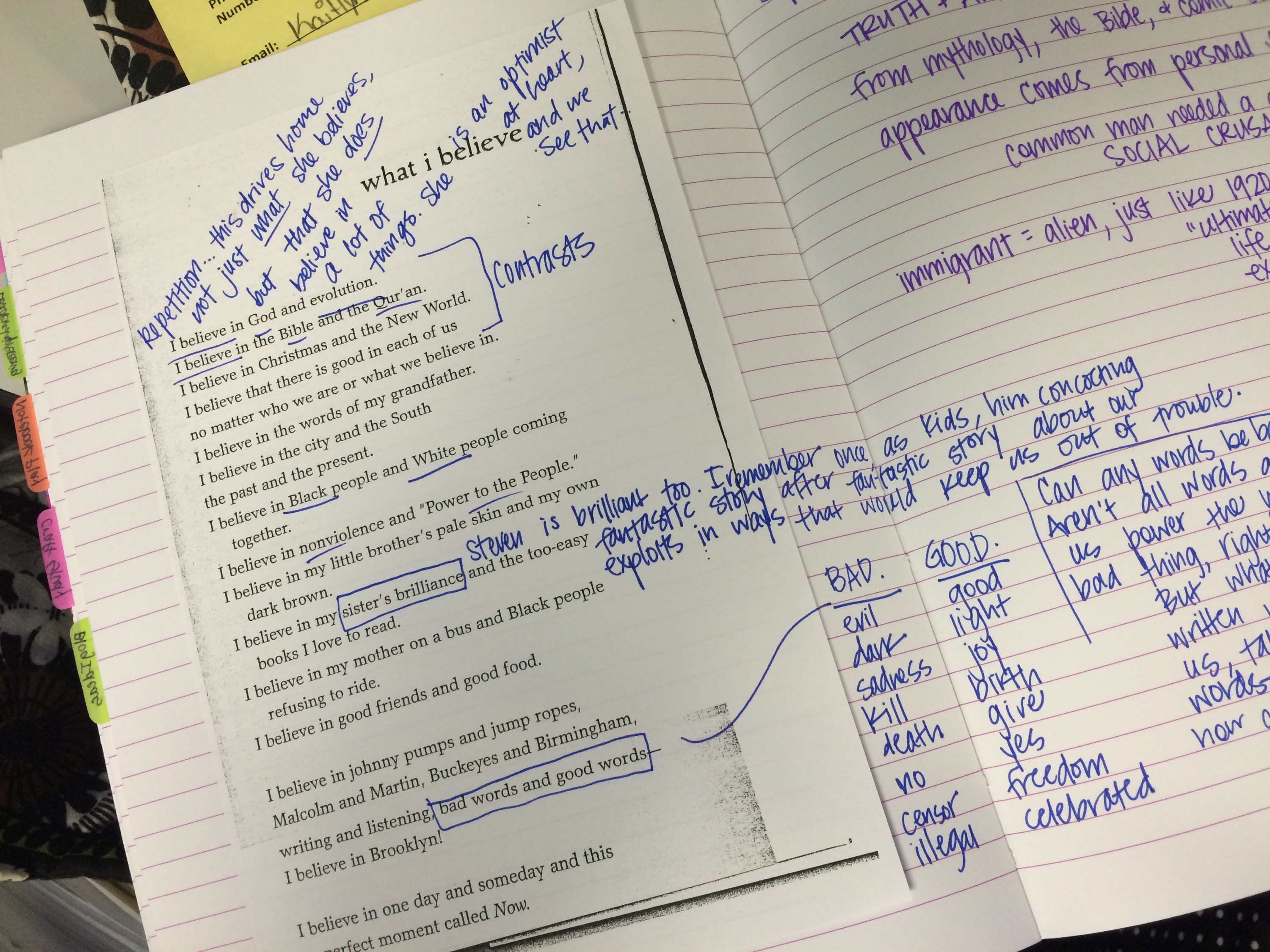
My writing atop Jacqueline Woodson’s

I wanted to show students the power of other writers’ words.  I wanted to teach them to read poetry not to “torture a confession out of it…to find out what it really means,” as Billy Collins writes, but to celebrate the act of simply reading that poem.  So, we glued in an excerpt from Jacqueline Woodson’s Brown Girl Dreaming.  I modeled for students how to respond to Jacqueline as a real writer, to notice and note her craft moves, to be inspired by her ideas and write more about our own feelings on those topics.  We wrote atop her poem, prioritizing our responses, reactions, and ideas rather than some analysis or “dulling down” of her meaning.  Responding personally and authentically to published authors will become an important part of our daily routine in our writer’s workshop.

I invited students to enter into a written dialogue with the authors we read.  So, as I settled down this weekend to begin reading a tall pile of student writing that had been turned in, I knew I had to walk the talk, as Amy always reminds me I must.  I ask students to treat authors as real people worthy of critical response, so why would I treat my student writers any differently?  I’ve always struggled with how to grade/evaluate/respond to student writing, but I’m thinking about it in a new way this year.  I just want to have conversations with my students about their writing, whether it’s in the form of a writing conference or in a weekend session with a stack of papers.  I know that when these conversations occur, student growth will follow.  In the excellent Portfolio Portraits, edited by Don Graves and Bonnie Sunstein, Linda Rief writes in an essay IMG_9248titled “Finding the value in Evaluation:”

I have discovered that students know themselves as learners better than anyone else.  They set goals for themselves and judge how well they reach those goals.  They thoughtfully and honestly evaluate their own learning with far more detail and introspection than I thought possible.  Ultimately, they show me who they are as readers, writers, thinkers, and human beings.

My thinking aligns with Linda’s.  When I remove myself from the role of “grader” or “evaluator,” I become an authentic reader of my students’ writing.  I invite students to assess their own writing, which in the words of Linda Rief “shows the value in evaluation.”

So this weekend, I read my students’ writing like I read books.  I noted beautiful lines they wrote, jotted down spiffy words they harnessed, and responded to thought-provoking ideas I saw them getting at.  I asked them questions, wondered about their meanings, and looked very much forward to reading more of their words in the future.  I will confer with students as I return their papers, and we’ll talk about how they might move forward with some of the topics, ideas, and stories they’d begun in these early writings.

In our classroom, we consider our responses to published writing as important as the writing itself.  The value of reading and writing lies in the interaction between the reader and the words, as Louise Rosenblatt describes.  When I transfer that value from the way I want my students reading writing to the way I want to read my students’ writing, new and important opportunities for student learning occur.

I’m Teaching Writing to the Whole 5th Grade — Now What?!

I received this note in a Facebook message:  I had big changes in my classroom assignment this year… moved from 2nd grade to 5th… turns out… after getting there I got the assignment of teaching writing to the entire 5th grade…. not what I really signed up for…. I have not only NEVER formally taught writing (as a process) beyond complete sentences… and moving toward paragraphs…. but I never even had a class in in it in college….. any suggestions on where to start and where to go with it? I will have 4 units of 12 days each during the year with each of the 5th grade classes….. suggestions?

Say you had to analyze the tone, what adjective would you use? concerned? riled? desperate? beseeching?

Let’s look at the clues:  “big changes,” “turns out,” “entire,” “not what I really signed up for,” “NEVER,” and all those “…..”

I could write an entire post on why the kind of changes this teacher has had thrust upon her is so disrespectful to her as an educator, as a professional. But I won’t. I just needed to say that.

Of course, I answered, and I will offer support and help any way I can. You would, too.

Maybe others have similar experiences and are new at teaching writing. Here’s how I answered my friend:

Yes, I have suggestions! Haha. Tons of them. You know I teach AP Language and Composition, right? Just writeThat’s juniors in high school, but good writing is good writing. Your instruction with your 5th graders can look very similar to mine. (And I hope it will.)

Here’s the non-negotiables in my writing class:

Writer’s notebooks. I use the black composition notebooks. Students cover them, personalize them, and make them mean something other than just a notebook for school. We write in them every day as a way to explore our thinking. I might give a prompt, or read a poem, or watch a news clip…whatever, and then I ask students to think and respond. These quickwrites become places to mine for ideas for topics we might develop into more formal pieces. Writer’s notebooks are required and loved in writing classes where students have choice and autonomy, two important components of effective writing instruction.

Mentor Texts. Mentors are texts that look like the writing I want students to practice. For example, if we are writing narrative, I want students to read good narrative writing. If we are writing book reviews, we need to study the structure of book reviews, etc. The authors of these mentors become our “writing coaches.” We study the moves the writers make, and then we try to make those moves in our own writing. Students learn from good models. They do not learn from poor, fix-the-grammar-and-punctuation worksheets or anything of that ilk. Research on that is plentiful.

Choice. When students have choice in the topics they write about, they are more apt to take ownership and care about their writing. Just like you and me — we do not want told what books we have to read, TV shows we have to watch, or essays we must write that show we learned something from pd. Topics matter so much to the effort students will put into their writing. We have to let students choose what they want to spend their time focusing on. Sometimes we need to nudge them. Sometimes we need to help them narrow the topic. But they need to always have a choice if we want to really teach them anything about writing. Save the formal test-like prompts for practice after students learn how to mine for ideas and develop those ideas in writing they want to do. Test writing can serve as a genre in itself later.

Time. Schedule time within the school day for kids to write. Let them know you are there to help. When they write with us, 1) we know they are writing and not a friend or parent, 2) we see their process and know where the struggles are.

Conferences. Meet with writers throughout the writing process, beginning, middle, and end. Ask questions that provoke their thinking. Let them talk about their ideas. Avoid giving advice, rather validate the students’ ideas and speak to them as writers. (Focus on the writer and his needs over the writing and what it needs — avoid the red pen at all costs.)

Modeling. Write in front of your students. This is probably the most effective instructional tool you have. Students need to see the messiness of the writing process. They need to know it is hard — even for a teacher. I try to write every assignment I ask my students to write. I start writing in front of them and let them see my thinking, my errors, my revision, my re-organization, all of it. Too many student writers think they should be able to write well in a one shot in the dark deal. That’s why they refuse to revise. We have to show them that writing is difficult and confusing and time consuming. We have to give them opportunities to see the struggle, so we can convince them that the work is worth it when we’ve finally been able to say what we want and need to say in our writing.

Talking. “Writing floats on a sea of talk,” I heard Penny Kittle say. Talk with students about their ideas, their process, their everything concerning writing. Encourage them to talk with one another. Talk and Write. Read and Talk and Write. Talking works to stimulate thinking and provoke the pen to action.

Celebrating. Feedback matters, even at the sentence level. Invite students to share their writing. This can be a sentence or a complete piece. Celebrating good writing along the way is a more effective feedback tool than a grade at the end of publication. Whips Around the Room that invite all students to share a favorite sentence or passage, Author’s Chairs that invite students to read a best draft, Posting on Blogs and inviting students to read one another’s work and leave comments, are all ways to celebrate writing — and help students understand the importance of audience.
Some of my favorite RESOURCES:

National Writing Project — Resources page

Read Write Reflect — Katherine  Sokolowski’s blog — the reflective practices inside a 5th grade classroom

The Nerdy Book Club — a community of readers (and teachers of readers) — read about books, reading, writing, and more!

Two Writing Teachers blog — more tips on teaching young writers that you can digest in one sitting

Moving Writers blog — Rachel and Allison show they are the best mentor text finders on the planet

And of course, my own blog: Three Teachers Talk where we write about Readers and Writers Workshop

Lucy Calkins quoteBOOKS you will consider life savers:

In the Middle by Nancie Atwell

Read Write Teach by Linda Reif
Write Beside Them by Penny Kittle

And I haven’t read this one yet, but who doesn’t want to be unstoppable? The Unstoppable Writing Teacher by Colleen Cruz
I imagine you are overwhelmed. No, I cannot really imagine. I do know that you are smart though, and you love children and teaching. You will do a wonderful job inspiring students to write — that is half the battle.

The learning comes from doing. Get your students writing. The more they write the better they will write. I see it every year.

Best blessings,

Amy

Did I leave anything out? What advice do you have for this emerging writing teacher?

©Amy Rasmussen, 2011 – 2015

3 Ways to Jump-Start Reluctant Writers

IMG_1703My younger sister Brittany is a phenomenal writer; in school, she excelled in all subjects, including English, but I never saw her struggle quite as much as when she was required to keep a writer’s notebook. For me, writer’s notebooks had always been liberating. I kept one in my spare time after having read Ralph Fletcher’s A Writer’s Notebook the summer before sixth grade. This was not the case for my sister though who, at the urging of her teacher, would write, “I do not know what to write” for ten minutes straight. Her teacher would tell her, “You’ll figure out what to write after a while,” but she clearly didn’t know my sister who is not only brilliant but also strong willed and persistent. In turn, when I told my sister I’d be integrating writer’s notebooks into my classes, she groaned, saying, “I hated those things.”

Brittany’s PTSD was reasonable. When used without encouragement or prompting, writer’s notebooks can become tedious and painful. Students can easily learn to loathe this tool that should otherwise be fun and stimulating. In turn, when my students explore their writing, I make an effort to help fuel their ideas and interests through a variety of writing activities and exercises that oftentimes help even the most particular writers.

  1. Prompt Board: At the beginning of the year, I ask students to write 3-4 pages in their writer’s notebooks. This helps students establish a writing routine and it helps me to learn about my students quickly. That being said, many students stall when it comes to putting pencil to paper. After running into this problem early on, I began posting five writing prompts per week on the side of my main white board. These topics included personal questions about students’ interests or extracurricular activities as well as sentence starters and fictional scenarios intended to lead into creative writing. I compiled the majority of these prompts off of social networks like Twitter and Pinterest, but I also use sentences from my book talks during the week as prompts as well. I post these prompts on my website in a separate section so students can always go back and revisit the prompts from past weeks.
  1. Ideas Shelf: Teens love thumbing through the pages of oddly shaped writing books. One of my most well-loved books is a cube shaped book called The Writer’s Block, which has “786 ideas to jump-start your imagination.” That being said, there are plenty of fantastic average size books that I store on an ideas shelf, which also includes 642 Things to Write About, Now Write: Nonfiction, Now Write: Fiction Writing Exercises From Today’s Best Writers and Teachers, and 100 Quickwrites by Linda Rief. When stuck, students gravitate towards this shelf. In addition, with the help of my Writer’s Club, I am hoping to add a jar of words, images, and prompts this year for students to pull from whenever they are struggling.
  1. Self-Guided Activities: As the adviser of Writer’s Club, I always have trinkets on hand Rory's Story Cubes for StADato help students put their pencils to paper. Some of my students’ favorite toys include Rory’s Story Cubes, which are dice with small pictures on them. Students can toss a handful of dice and incorporate the images into a story. I also have a collection of old skeleton keys I bought at a craft store. Tied to each key is a tag with a sentence starter that discusses where the key might have been found or what the key opens. Another easy activity involves collecting paint strips from your local hardware store and having students write stories involving the absurd color names on each strip.  Finally, I love utilizing found photography like the pictures from Miss Peregrine’s Home for Peculiar Children or old calendar images to get students thinking. I have a collection of small Dana Heacock calendar images, which are brightly colored drawings of New England scenery or objects.  These images oftentimes stir up students’ memories of childhood and lead to fantastic personal stories.

How do you help inspire your reluctant writers?  What methods do you use to jump-start their independent writing process?

To Confer is to Validate the Child

Question:  Do you have any tips or tricks for conferring for upper grade students

Answer:  Keep reading.

I love questions, especially questions about my practice and my passions. If you’ve been reading this blog for a while, you know that I’ve written quite a bit on conferring this past year. (Click the categories tab and go to conferring.)

Conferring with students is my on-going action research. He was the missing person in my workshop classroom for a long while. Then, he was the show-up-once-in-awhile, have a chat, and leave kind of guy. Later, he became a regular guest. Then, after my change and my constant focus, he finally moved in for good, and guess what? He transformed the learning in my classroom. i wish I would have invited him to stay much sooner. I missed a mountain of important talk time with my learners. Time I will never get back.

So, to answer the question I received in an email today, let me start with this:

Most of the strategies for younger grades work well for our older learners, too. Talk to elementary teachers. Use these experienced writing workshop teachers as a resource for your secondary writers workshop. They know how to talk to students, and we should follow their lead in many ways as we approach our writers.

Much of my study on workshop and conferring reveals similar approaches. I’ve found the work of Donald Graves, Nancie Atwell, Linda Reif, Penny Kittle and other workshop teachers rest on the same core principles of writing instruction:

1) students choosing what to write aboutt,

2) helping students discover ideas through writing,

3) talking to students regularly as writers,

4) modeling the struggle of writing,

5) using mentor texts to study the craft of writers.

Conferring fits into any and all of those principles, but it sits squarely at #3:  talking to students regularly as writers. This is different than talking to students about their writing.

So, I think the most important thing we have to do when we confer is validate the child as a writer (even if he is not a very good one — yet).

In his book Choice Words, Peter Johnston writes about the importance of helping students grow into the identity of readers and writers. In my experience teaching high school English, 9, 10, 11, on-level to AP Lang, most students do not put reader and writer as part of their identify. Few students will be successful readers and writers unless they do so.

This becomes my primary focus in conferences with my readers and writers: How can I help them have experiences where they can see themselves in these roles?

I find that getting students to talk to us about their thoughts, feelings, ideas, struggles, etc with their writing process is the same at every grade level. Perhaps the biggest difference is that teens do not always trust us like younger children tend to do — at least not at first. That is why validating positives with our writers has to come first — before any kind of one-on-one instruction. We have to remove fear and hesitancy. Let them write. Focus on what they do well.

This makes many red-penned teachers with a love of grammar crazy, but marking up a student’s paper is the worst kind of writing instruction — ever. We must respect the writer.

Today my friend and colleague Shana and I were discussing this very thing:

Conferring transforms differentiated instruction into individualized instruction.

So, as you think about conferring with adolescents, ask yourself:

How can I tap into the identity of the individual?

How can I help him see himself as a writer?

What writing experiences does he need to have to feel like he can be successful?

Start conferring there.

Dear reader, what are your thoughts on conferring? How do you answer my questions about conferring with adolescents?

 ©Amy Rasmussen, 2011 – 2015

Guest Post: Technology Transforms a Writing Workshop

In response to this post I wrote about walking the talk in our content areas, another teacher has responded to my invitation to write. She says of herself:  “Karen Clancy-Cribby loves learning, especially from adolescents. She’s a teacher, writer, and Writer’s Workshop is her life. Literally.” Find Karen on Twitter @kcribby.

My husband and I live in the country on land that is expansive, scrub oak, tall grasses.  Every time I go to the kitchen sink, my first look is up at the hill, across the valley, and I scan the hillside before my gaze settles to the immediate foreground.  I do this probably twenty times a day.

It hit me today, as I thought about this blog, that how I look out and around, before settling into the immediate, is how I think about everything.

I’m a big picture person, and when I was given the great honor of being offered the opportunity to guest blog about technology and Writer’s Workshop with this amazing group of teachers, I jumped at the chance.

Then I realized I’d signed up to write about a lesson.  Well, therein lies the rub.  To describe a traditional lesson is just not what resonates with the organic nature of the classroom we’ve been so fortunate to run with Writer’s Workshop.  The “we” in that sentence refers to my language arts colleague (and former student, and former student teacher) who I team with daily.

I’ve embraced Writer’s and Reader’s Workshop since I first read Nancie Atwell’s “In the Middle” back in 1990.  I’ve read Fletcher and Calkins and others since, but I’ve mostly just been diving in.

So, back to the whole lesson idea.  Lessons in WW can, and should, of course, be planned, but to speak of them outside the daily dynamic of the classroom doesn’t make sense to me.  Sure, plan for different activities, plan with the end in mind, know and plan for what students should know (even that is a stretch, but that’s another blog), but the ebb and flow of class has to be more dynamic and a response to what happens with students.  So, WW has been an ideal.  Set aside time for mini-lessons, reading and writing time, feedback and closure.

Now, with technology in the mix, well, wow.  So, instead of blogging a WW lesson with technology, I’m going to give you a day in the life of WW with technology.  I need to thank my language arts cohort and daily teaching partner, Emily, who suffered through all of these pages of drafts for this idea for a focus.

Here is our day:

Student working on writing in the winter pulled up a fire for cozy atmosphere.

We have our daily agenda and objectives on a Google Document shared with our students, who walk into class oftentimes having already pulled this document up on their Ipads or phones.  Every day, we ask students to answer a question as they come into class.  Thanks to another colleague, Kris, we call these “Fire-Ups,” given that warm-up seemed too tepid to describe the first lesson of the day which should be big.  So, students pull up the agenda on their iPads and log into their Google Doc on the Chromebooks.  Sometimes they need to look up a few things to answer the question, sometimes they need to just think, and sometimes they need to read and re-read to answer the question, which, ideally takes no more than ten minutes for everyone to feel okay to discuss the question.

Within ten minutes of class, we will ask them how much time they need.  It’s usually no more than a few minutes, but oftentimes, our questions are bigger than we planned.

So, our agenda is a work in progress, and we adapt, as all teachers do,  as the class goes along. Sometimes, all students need a nudge in a certain direction, and we extend the lesson.  This often looks like one of us “saging on the stage,” while the other uploads examples or research hints and tools.

Other times, and I’d hazard to say most times, they all just need to fly.  Then, we have the luxury of sitting down at our desks, reading over their virtual shoulders and giving them individual feedback in person or on their Google Docs.

Writer’s Workshop has been my educator dream ideal since I was in college, and now the ideal is…well, I hate to sound absolute, but it’s possible, truly possible.

Technology allows all of that to happen immediately and in real time.  I am fortunate (understatement) to teach with someone who not only embraces the workshop pedagogy as passionately as I do, but she is a whiz with technology.  Four years ago, when she was my student teacher, we had netbooks, and we started using Google Docs, and I’ll never forget those opening days of my brain exploding.  We had our agenda on the overhead screen, shining from her computer.  The agenda was made in Google Docs.  I had a few students who preferred to access their writing from their phones.  If I didn’t read literally over their cyber-shoulder, I would not have believed how fast they could write using their phones.  As more and more students used their phones alongside the netbooks (we are so lucky to now have Chromebooks!), I started thinking about so many possibilities of all the access they had to information.  Then, there were whispers of our district going 1:1 with iPads.  I’ll never forget standing in the front of the room with Emily, my student teacher, and I looked at her and said, “we can have the agenda online for them to have access to,” and she looked at me and said, “they can write their responses on a Google Doc too.”  That was four long (or short?) years ago.

Now, we’re all online, and I feel as though the newbie teacher dreams of a perfect Reader’s and Writer’s Workshop are now a reality.  Well, perfect is an oversell, but all of those years where I would say, “read and write whatever you want” have been transformed.

Students walk into the classroom, open up their Chromebooks and their iPads. Most students pull up the agenda on their iPad and then start answering their fire-up question on their running Fire-Up Google Doc.   The question is related to where we have been and where we are going.  We try to stretch the question, make it something they need to think about.  Sometimes there is a background/research portion, and then the question.  Sometimes it’s a piece of literature they need to explore for techniques; sometimes it’s a revision piece they need to evaluate.  These Fire-Up questions are very often taken from my own personal writing.  Writer’s Workshop isn’t WW without the teacher as writer.  The beauty of the Fire-Up being taken from my writing is that I am starting most classes with modeling myself as writer.  I can then keep going back to my writing, allowing everyone to critique it.  I have noticed that students are at their best when they are critiquing my writing.  With peers, they sometimes become too gentle, or the reverse, too harsh.  With my writing, they are quick to get to the heart of what needs improvement or what things work and why.

I get to do the think-alouds about my own writing; things I like, things I want to make even better, my purpose, etc.  This leads to them then taking that mini-lesson and my modeling metacognition, and then they look at their own writing, and other’s writing.

My teaching cohort Emily and I were talking the other day about how she needs to do some writing. We have an easy balance together, but she’s right.  She needs to write.  The best way we show ourselves is at our in-progress stage of writing, discussing what we want to do for purpose, topic, and audience.  We should not show ourselves ever thinking we’re “done.”

Back to how technology transforms this all.   Sharing is more immediate; there are multiple modalities for discussion (Edmodo for responding, Padlet for throwing out fire up responses, sharing of Google Docs for commenting).  The transformation, for me, having taught using this model for so long, is that if I ask a student to explore an interest, they can do it, right then, right there.

They can find and access a kazillion mentor texts.  ‘Nough said.

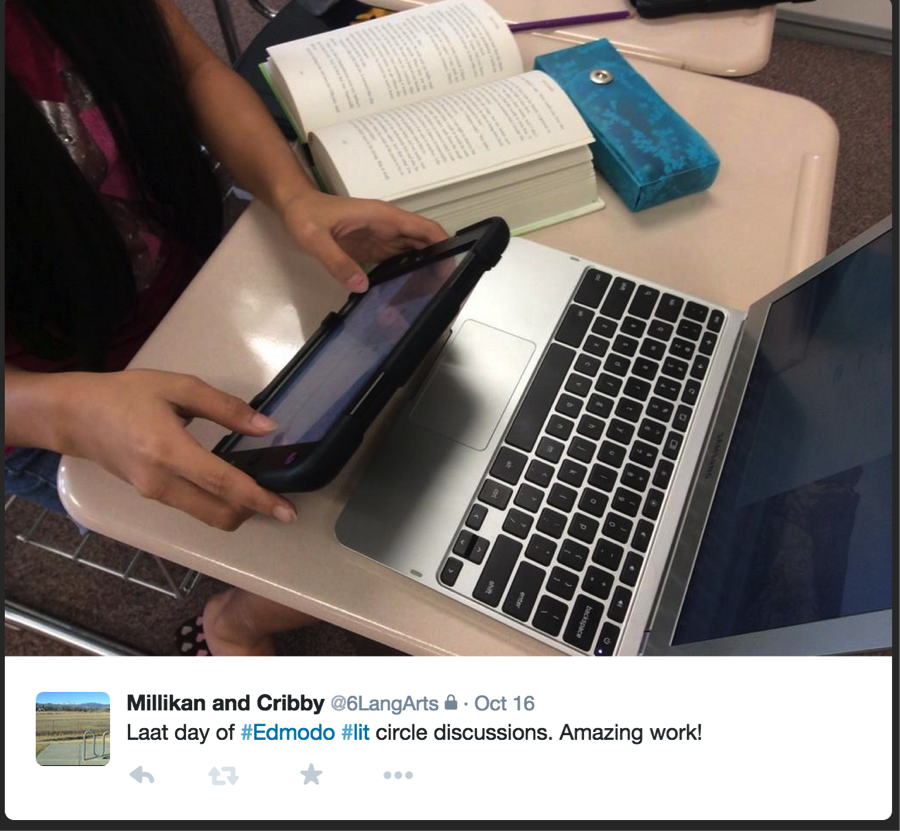
Student finishing up an online literature circle discussion using Edmodo.

Student finishing up an online literature circle discussion using Edmodo.

Here is another snapshot of this transformation.  As we were moving into the second quarter of language arts, Emily asked me how we should frame our lessons as we continued.  It hit me that though we were using the workshop model, it had transformed to such overwhelming possibilities.  It felt like grooming a rock star who had hit the charts.  I have no idea why that analogy came to me, but it’s so hard to describe the little monsters we’d created with so much room for them to stretch, reach, and grow with Writer’s Workshop.  I answered her with a gleeful, big, let’s see-where-this-will go shrug and said, “well, nothing has changed, let’s keep the workshop going, but maybe we need to call it something more expansive, like, “Learning on your own.”

The next day, when LOYO was on our agenda, and many students knew what the acronym was, well, wow.  The teacher learner in me talked about how their learning was officially limitless, and I was excited to sit down and visit with them and see where they were going.
I’m excited to see where I’m going.  I get to do this.  Every day.
Good Writing Moves Us — THIS Writing Moves US

I want to include you in a celebration of the work of a student that represents several of my kids this year. If you teach, or have taught, ELL students, I know you will understand.

The last assignment was an intensive writing piece that we workshopped for about seven weeks. Writing in class almost daily, conferring regularly, and mini-lessons with mentor texts and modeling served as the routine. Students turned in their writing in three separate chunks, gave one another feedback at least three times, presented their final pieces (published on their personal blogs) as their semester exams. Formative assessments were student writing conferences and the checkpoints along the way. Summative assessments were a self-evaluation and a self-evaluation paired with my feedback from a rubric we crafted as a class.

Biak with the book she loved the most this year. She read 12.

Please read the writing of Biak Par. The poems are original, and the story is her own. Just before school was out, I had to call Biak to my desk and let her know that she failed the state English II EOC. Again. That was nothing short of heartbreaking — for both of us.

Take several minutes and read Biak’s story. You will read the words of an improving and authentic writer. These words are elegant, poignant, and powerful. Good writing moves us — this writing moves us. 

Now, take a look at Biak’s writing from the beginning of the year— her first blog post is here, and her second is here.

Now, think about her end-of-year piece of writing. I know it is narrative, but you will note what I do — improvement. So much improvement. Voice, coherence, organization.

I wish I had another year with Biak, and several of her friends. We’ve come so far, and this is the work she should be allowed to celebrate — not a test score.

I know — preaching to the choir.

©Amy Rasmussen, 2011 – 2015

My Top 3 Tips on How to Find #MentorTexts

Yesterday I met with a teacher-leader, and she said that one of her main concerns in implementing writer’s workshop into her classroom is finding the right mentor texts. I’ve heard other teachers say the same. Knowing what mentor text to use to teach which skill can be daunting for teachers just starting out using the workshop model.

Here’s my top three tips on how to find mentor texts to teach writing (and some reading):

1. Read. Read everything from novels to plays to news articles and food reviews. The more we read a variety of texts the more we will have little “aha!” moments when we realize how the whole text, or even a part of it, will work to teach our writers.

2. Tweet. Twitter is the place for educators. Join in, or just tune in, to an #engchat or an #elachat or a number of other chats on Twitter. See Cybrary Man’s Educational Chats Schedule. You are sure to find a chat suited to your needs. Educators use Twitter to share ideas:  mentor texts, strategies, links to blog posts that share mentor texts and strategies. If you need it, you can find it on Twitter. And if you cannot find it, tweet a question and someone is apt to find the answer for you.

3. Follow or favorite or sign up for RSS feeds. I find mentor texts in a variety of places. I watch for updates from Izzit.org, and Essay5W.com. I also visit MovingWriters.org Mentor Text Dropbox Project. On Twitter I follow @brainpickings and @voxdotcom and and @NewYorker and many other news sources.

(Bonus:  A source for texts, specifically to use for reading and practicing the Notice and Note signposts, is the Notice and Note Facebook Group when I found these links to video clips and short stories and poems that can be used to teach the signposts. Thanks @msetha23 for these docs.)

What about you, do you have any ideas or resources you are willing to share? Leave a comment.

©Amy Rasmussen, 2011 – 2015

A Feedback Protocol for Revision Workshop

I didn’t mean to make them cry, but that’s what soul writing can do to a person. (Soul writing is what my students and I coined as the type of writing that rips at our guts, makes pools fall from our eyes, and leaves us lurching toward the door to “take a little break.”) We are only into the third week of school, and I tried a new protocol for feedback; something I learned at The Frost Place Conference on Poetry and Teaching, directed by Dawn Potter.

Giving honest and critical feedback to one another is difficult for many of my students. So afraid of offering offense, they either do not say anything, or they do the proverbial pat-on-the-back and mutter “good job.” I tell  them that when they refuse to be honest in their feedback, it’s cheating. They cheat their friends out of ideas that can help them grow. And that is what we want in a community of writers — we want everyone to experience opportunities to grow.

The tears today watered some tender little seeds. All afternoon I gushed about it to anyone who who listen.

We sat in a circle around the large table in the center of my classroom. Many students came to class without their drafts*, so I sentenced them to the outer edges and advised them to get their brains and their pens working. I told them to write silently, but they might want to keep an ear tuned to the conversations happening in the middle. If they did, they learned more than they could have from any one-on-one conference with me.

First, I explained that giving feedback can be a bit tricky. We want to be honest, but if we do not deliver that honesty well, we can cripple our writer. (I use the word cripple because that was my own experience. I’d spent months drafting a chapter for my book. I’d finally finished what I thought proved to be a powerful piece of writing. Then I asked a friend, someone I trust, for feedback. She gave it to me: honesty cloaked in sweet little daggers. When I read her comments, all my ideas crumpled, and my focus limped right out the door. I didn’t write another word for six months.)

The “I wonder ____” protocol is really very simple:

Those who offer feedback:

  • Listen carefully as a classmate reads her piece.
  • Think about ideas that might help her improve it.
  • Offer feedback that allows for the writer to “play with the possibilities” (Dawn Potter) by putting the ideas you have that might help the writer revise the piece into statements that begin with “I wonder ___”.

Those who receive feedback:

  • Read the piece loudly and with clarity. (Repeat if necessary.)
  • Listen to the “I wonder” statements made by peers and write yourself notes.
  • Try to just listen (This is hard because we tend to want to justify why we wrote certain things).
  • Play with these various possibilities while revising.


I asked for a volunteer to read her writing. Eyes darted all around the table until Jessica read her draft.

Jessica went first:

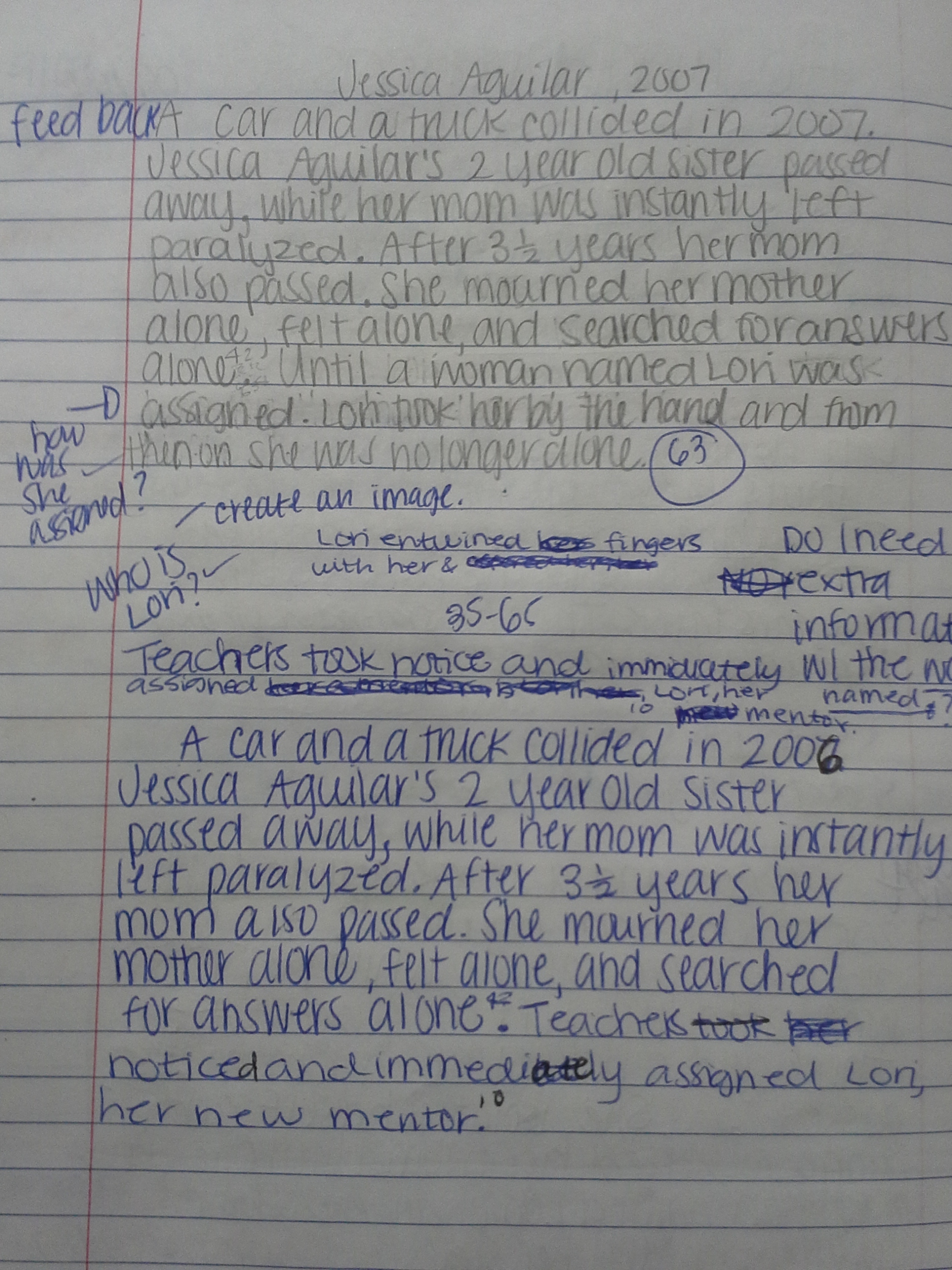
Jessica GoWorld story

Wow, right? She punched us right in the stomach, and we sat in silence. Finally, I said, “Okay, we’ve got some amazingly powerful stuff right here. How can we improve it?” and they looked at me like I had hornets on my head. I knew I better go first, or this feedback thing wasn’t going to work.

“I wonder if you need to tell us that Lori’s a woman,” I said.

Long pause.

“I wonder who ‘assigned’ her to you,” Mikaila spoke up.

“I wonder what she did that was so helpful,” Mariam said.

“I wonder how you survived,” said Daissy.

Jessica listened, answering a few questions, and taking a few notes on the comments her friends gave her.


And we were off . .


Daissy read next:

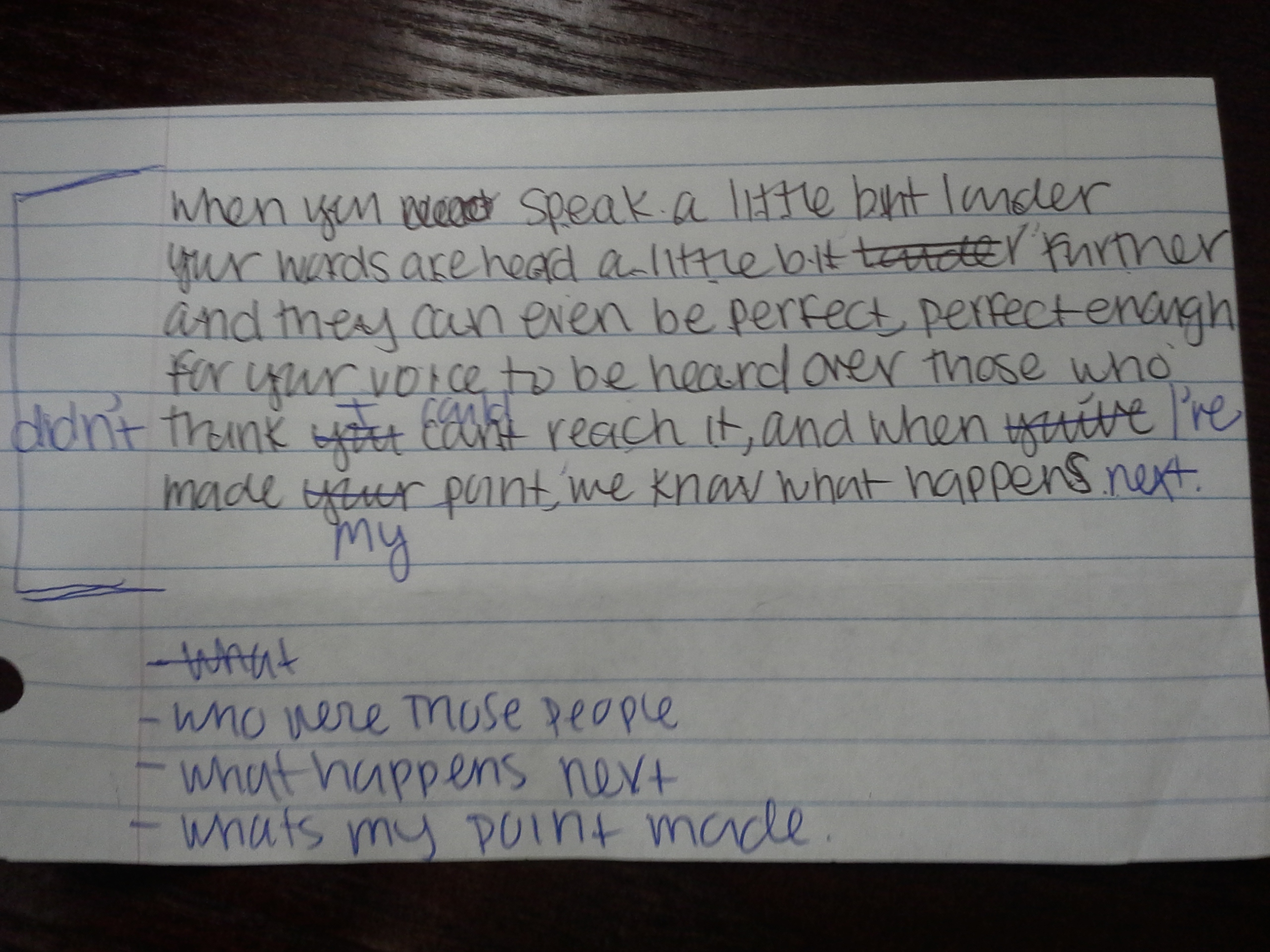
Daissy GoWorld story


“I wonder who ‘those’ are.”

“I wonder what the problem was.”

“I wonder what happens next.”

“I wonder what happened that made you change.”

And then Daissy could not remain silent any longer. She had to explain her stuttering, and how she’s worked so hard to overcome it, and how now wants to major in broadcast journalism and speak on live TV.

We forgot to preface our comments with “I wonder” when we all told her THAT is the story she needs to write.

revision corrections 2-7-12Feedback Magic happened with this “I wonder” protocol. And it happened in every class period, and so did the tears.

Students shared the honest writing from their hearts, and students gave honest feedback with tender and caring insight. Writing improved.

Even better? Imagine being in this kind of classroom with this kind of community of writers.

Heaven.


*Our mentor texts were VISA Go World commercials. I got this idea from an assignment I did at a class taught by Penny Kittle at the University of New Hampshire Literacy Institute. We watched several of the videos in class and discussed and analyzed the various structures of these very short, yet poignant, stories. Students were to watch and analyze a few more examples, transcribing the words to use as models for their own writing. Then they were to write their own, playing with word choice and syntax.