Tag Archives: student writing

Readers & Writers Workshop–Beyond English and Into Journalism

dotCJR-blog480Are any of us really just English teachers?

It has been rare in my teaching tenure to only teach English–and in my current position, my schedule is no different.  I teach Yearbook and Newspaper, in addition to four English classes.

Learning the content of those new-to-me courses has been one of the biggest (and most fruitful) challenges of my teaching career.  While writing instruction is naturally paramount in journalism courses, teaching photography, design, AP style, and the interview process were foreign concepts to me prior to starting this job.

So, when I discovered that I’d be teaching journalism, I did what any good teacher does–I began to research.  This article describing the four properties of powerful teaching–presence, personality, passion, and preparation–reminded me that I had the first three qualities when it came to teaching journalism.  I just had to do the work of preparation.

After a long summer of workshops and self-teaching, I felt well-versed in lens aperture and the inverted pyramid, but I wasn’t sure how I wanted to structure my journalism courses.  When I boiled down the values I wanted my young journalists to prize, though, they came down to doing good writing, good research, and good thinking–all values that are foundational parts of the readers and writers workshop.

So, each day in Newspaper and Yearbook, we begin with ten minutes of reading.  I confer with students and we discuss how to read like writers.  We analyze how a writer sets a scene, much like how a photographer composes a picture.  We note the author’s style, filing away their craft moves for use in our own copy writing.  We speculate about the writer’s inspiration for the story, trying to find our own topics to write about.

After two booktalks (often nonfiction), we then move into a quickwrite, thinking in writing for ten minutes about a variety of subjects–sometimes responding to simple questions, sometimes practicing journalistic writing skills, and sometimes brainstorming ideas for articles, photo stories, or coverage.

A ten- to fifteen-minute mini-lesson follows, taught either by me or the editor-in-chief of the day’s publication.  These mini-lessons are based on trends the editors and I notice as students submit their work.  Yesterday we worked on strengthening our headlines; today we’ll focus on brushing up on the conventions of AP style in our copy.

We leave ourselves with a sixty-minute writers’ workshop every day, which is packed full of collaboration, conferring, and chaos.  That last hour is productive until the bell rings, with every student journalist working toward a unique deadline or assignment, receiving guidance from any and every other person in the room.

Watching and participating in the organized, creative chaos of a journalistic writers’ workshop is probably my favorite time of day.

I asked two students how they felt that the workshop enhanced their journalistic learning.  Ryan feels the quickwrites are most valuable:  “Your notebook allows you to open up and be yourself when you write,” he says.  “You learn to still have a voice in journalism, which is usually just really formulaic.”

“I really like that you learn while you write,” he emphasizes, repeating that twice in our brief conference.

Gabi agrees.  “You’re learning as you do the writing–learning from your mistakes–rather than having concepts spoonfed to you,” she says.  “I think everyone likes to learn hands-on, by actually writing, instead of just reading other people’s articles.”

In what electives or non-English classes do you employ the workshop model?

Mini-Lesson Monday: The Power of “I”

Recently, Jackie humorously infused pickup lines and leads into her lesson to engage students in narrative writing.  It got me thinking.  While I am not nearly as funny as she is, I still needed to find a way to minimize the angst with starting a written piece.  Students deserve an opportunity to look at opening lines so they are innately thinking like writers.  Providing them the opportunity to authentically explore various ways to open their stories is key.  So, we gave it a whirl.

Objectives:  Students will recall moments in their lives that have shaped who they are today.  Drawing from their own life experiences students will distinguish what moments they are willing to chronicle in their personal narratives.  Students will construct meaning about their personal experiences by creating a written piece that utilizes author’s craft that has been studied and analyzed.

Lesson:  Let me say that I typically do not focus on opening lines, hooks, what have you until after students have written their pieces.  I find that students are able to more easily and comfortably play with their opening once they know where they’re going…or have gone… with their narratives.  Yet, I was curious to see how this would pan out.

 As we started to jog our memories for those defining moments that have occurred in our lives, we started thinking about questions that would help us dig deep into our own thinking.  A few included:

What do I believe?  (About life, the world, society, family, education, etc.)

What moment has occurred in my life that I am (still) confused by?

What is the most life changing experience I’ve encountered?  What decisions have I made during this situation that have shaped who I am today?

Who is important to me?  Who has made a tremendous impact on me (positive, negative)?  Do I find conflict in this?

What simple pleasures do I relish in when times get tough/stressful?

These questions, among many others, started getting our process underway.  Students had choice and freedom in picking what they wanted to write about – as we know personal narratives are sometimes brutal to compose: sometimes we want to forget what we’ve been through.  Yet, in order to foster the writers in room 369, these questions were written in the first person.  When we write questions for our writers in the second person (What simple pleasure do you relish in when times get tough and stressful?) we are providing them an opportunity to take a step back; to be a bit removed.  When we shift our curiosities to “I” “Me” “My”, it becomes personal.

IMG_20150928_083251

Then, we played with various different ways we could open our stories.  Each student played with concepts, moments, memories, and experiences after seeing how the authors of our independent reading books played with theirs.  Having heard about fifteen authors’ opening lines, students were willing to really dive in and try different ways to start: sounds, quotes, internal thinking, advice they’d been given, visuals, third person…

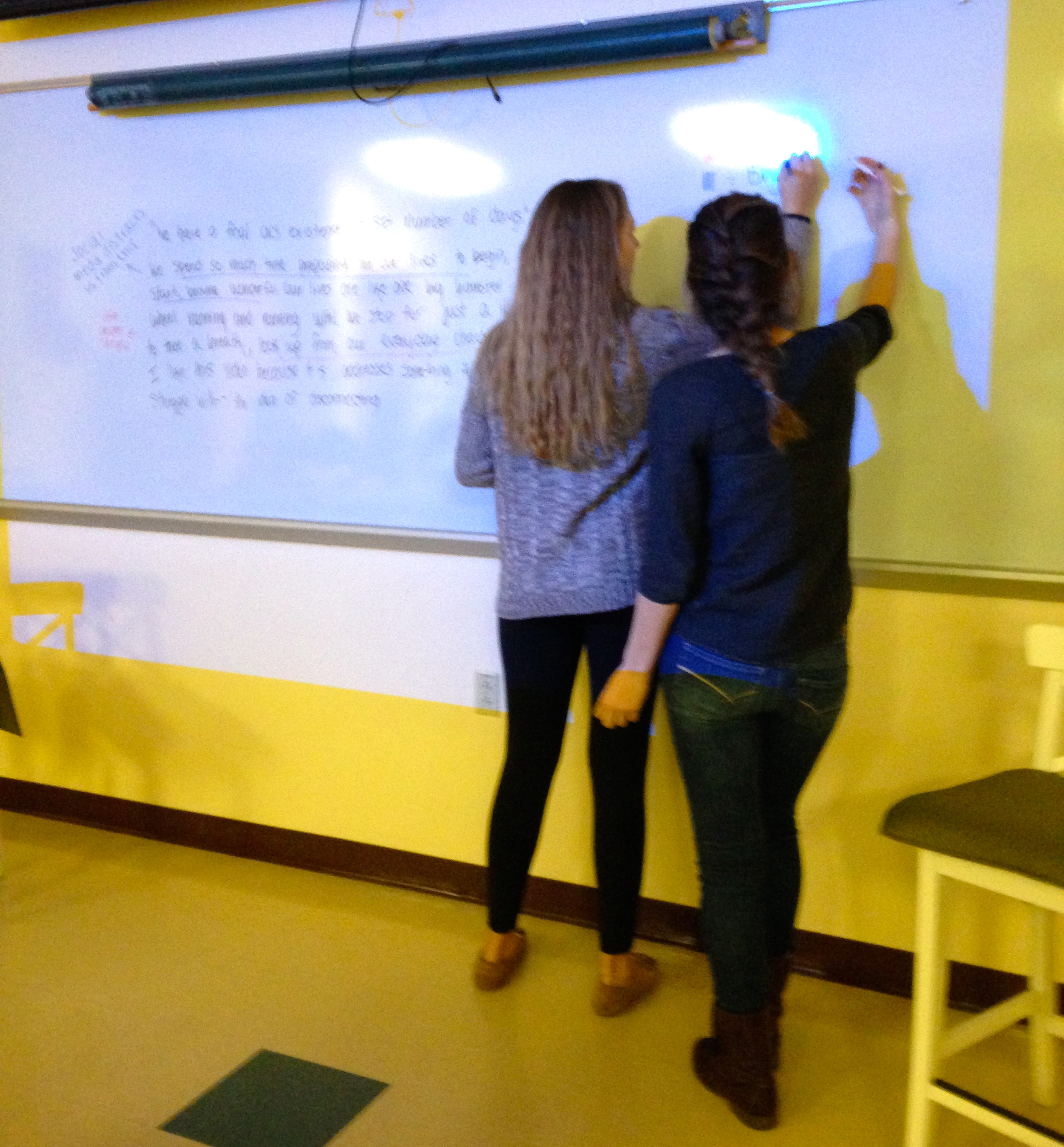
This visual represents our thinking at the very beginning of this school year.  Students are playing with this deep level of thinking and crafting for the very first time.  There is still some apprehension and hesitation, but for the most part students are willing to try…and play…and craft…and find their inner brave.


Follow Up:  Once students have created numerous ways to start their piece, they will narrow it down to two.  From there, students will start their narratives.  Yet, they are being asked to start their narratives using two different openings…

As writers we know that it takes much patience and practice to feel satisfied with our writing; specifically our opening lines.  Asking students to try writing their pieces from two different starting points allows us to see where our writing goes.  Maybe one start is stronger, prompts more thinking while the other falls flat.  Maybe they both prompt great confidence in continuing to see how they develop.  Maybe the best draft ends up being an infusion of both.

Regardless of where our personal narratives go, starting the process with options both in craft and experience, the pressure of writing is minimized and students feel more at home reliving some of the moments that would have never made it to the paper prior.

How do you foster the willingness to write when fear or apprehension stand in the way of our writers?  What techniques do you use as a writer that you channel to your student writers?

Mini-lesson Monday: Exploring a Page’s White Space in the Writer’s Workshop

PrintCircling the room, I hand out books in preparation for book speed dating. I place Ellen Hopkins’ Crank on a student’s desk.

“There’s no way I’m reading this,” she mutters to her friend. “This thing is huge.”

“Open it up.” I turn towards her, waiting for her to crack the book. She flips to a page and realizes the entire book is in verse. She flips again and again, every page has a minimalist feel, the text spread out, placing emphasis on each word within the sea of white. The sheer length of the book disappears and she is sucked into Hopkins’ narrative.

The more time I spend with teenagers, the more I value the use of that essential “white space.” I love book talking Patricia McCormick’s Sold or Jonathan Safran Foer’s Extremely Loud and Incredibly Close; despite their complex and emotional content, the books are instantly more accessible simply because of their unique structure.

This is why when we discuss paragraph breaks in writing and aesthetics and structure in reading, we also discuss the glory of giving the reader’s eye a break.

Objectives: Using the language of the Depth of Knowledge levels, students will recognize the use of white space within a piece of writing. They will make observations about the author’s use of this tactic, assessing the writer’s effectiveness in employing the use of white space. Finally, use choice reading and whole class examples as mentor texts, they will practice using white space within their own writing by formulating paragraphs at various lengths, revising these paragraphs through peer conferencing, and applying this craft in future writing assignments.

Lesson: Divide students into groups of three or four and have them open up their independent reading books to any page. Ask them to brainstorm what they see based on the page—tell them not to look at content, but instead the structure of the page—the text, paragraph breaks, and length. Have them compare their pages to each other, noting the similarities and differences. Once they have completed this, bring them back together into a whole class discussion. While they discuss their observations, compile a list on the board of what they noticed.

I love to breathe life into authors and remind students that a writer consciously makes decisions on the craft of their pieces. In turn, I have them to return to the structure of their page, focusing mostly on the line breaks, white space, and the spacing and formatting of the text in general. They reflect on this in their writer’s notebook, asking themselves: why do you think the author made this decision? What did they want the reader to think and/or experience?

IMG_2906Following their reflection, we return to discuss their individual pages as a class. Students volunteer to share why their author might have made the stylistic or structural decisions they did, which in turn, inspires other students to reflect further on their own page choices.

We discuss “one sentence paragraphs” and how they stand out surrounded by the white space of heavier paragraphs. They explore how white space can frame longer paragraphs and why exactly writers might use longer paragraphs to convey their point or tell a denser story. We notice how the white space of line breaks can show the passing of time and why it is important for readers to visually have a moment to internalize this time lapse. And finally, as readers, we share how we respond to cramped passages versus double spaced books.

The process of using choice books paired with class discussion helps students recognize the value of their role as a reader as well as how they can utilize these methods within their own writing.

Following our discussion, I take a few minutes to reinforce the points we’ve made either on the white board or through a prepared PowerPoint. These slides provide visual examples from books I am currently reading as well as some tips for applying this knowledge to our own writing.

Follow-Up: At the beginning of the year, students complete a snapshot narrative followed by a longer personal narrative. Using the mentor examples as well as the examples from our choice reading, we look at how we can integrate white space into our own pieces either through line breaks, diverse paragraph lengths, or one-sentence paragraphs. Based on this mini-lesson, they can also trade narratives and provide peer feedback to one another.

What are some mini-lessons you use to help students analyzing the structure of books? How do you help them integrate these observations into their own writing?

A Writing Workshop Lesson: Inspirational Speech

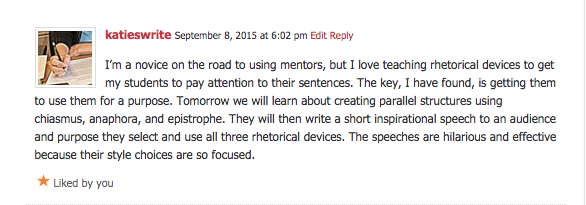
Last week I posted a mini-lesson about using student sentences as models for writing. Katie Bills-Tenney left this Screen Shot 2015-09-13 at 6.12.39 PMcomment. And I asked if she would write a post about her lesson.

She did even better:  she wrote on her own blog, complete with a lesson outline and student writing.

I love what she does here — and what her students do here, too.

Thank you for letting us see inside your classroom Katie.

Follow Katie at @Katieswrite

Kids Want to Write! (and why my writers need yours)

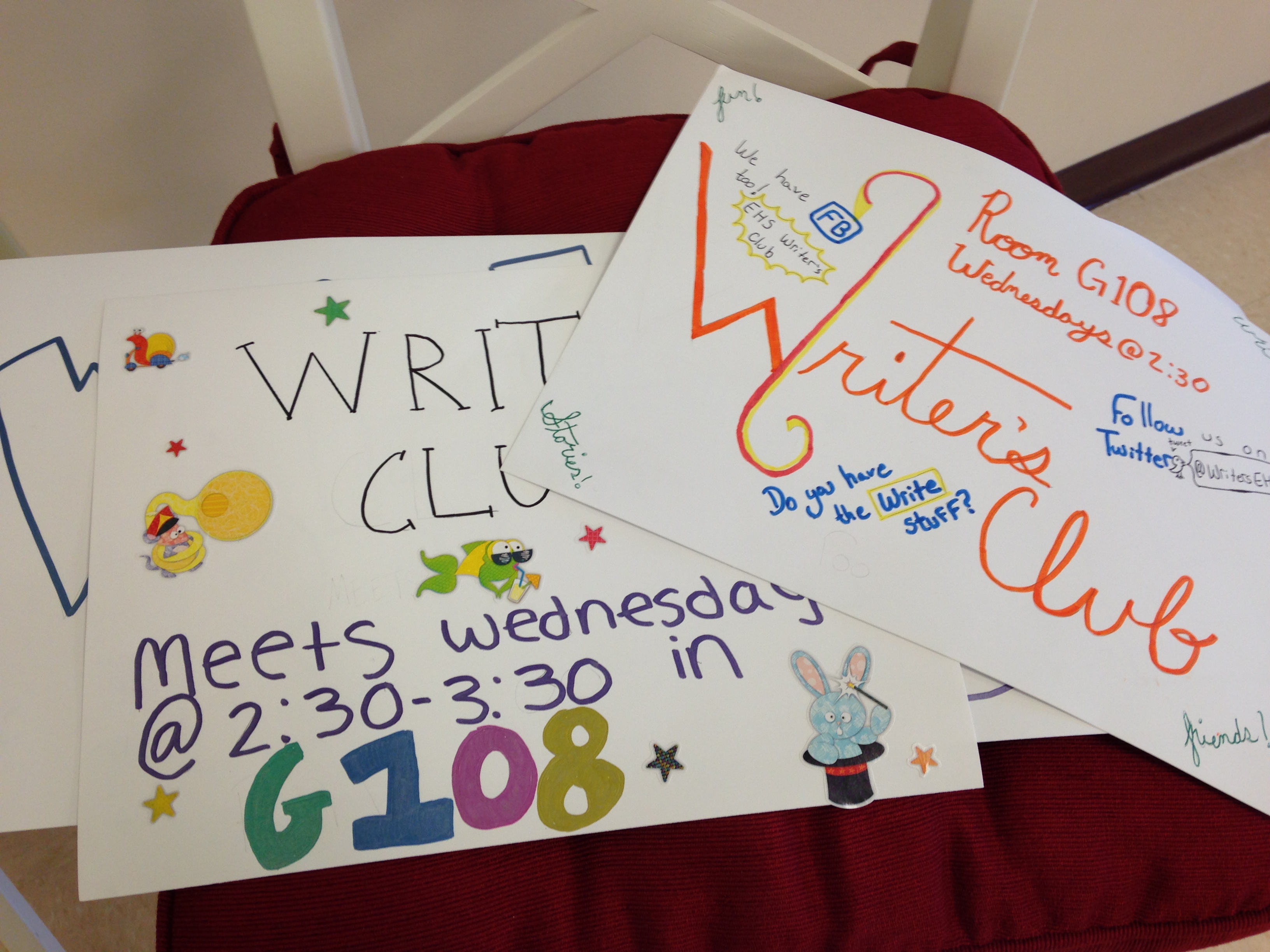
photo(1)Two weeks before the end of summer break Kayla shared a three-page Google doc of writing exercises with me. Yesterday morning Kate showed up at my door at 7:15am, brimming with writing prompts and workshop plans. And yesterday afternoon my writing meeting with two students turned into an impromptu gathering of ten. The odd part is that these aren’t my students. In fact, I haven’t even met the vast majority of these students who show up at my door. But they keep arriving, and the reason is that kids want to write.

I know this because for the last two years, I have co-advised my school’s Writer’s Club, a community of students who set aside time each week to explore words, laugh over prompts, and share their writing.

When I inherited Writer’s Club last year, I didn’t think the concept was unique to many schools. A teacher established the club before I was even hired, but as I grew to know my members, I realized Writer’s Club served a larger purpose. Students ranging from freshmen to seniors and academics to honors showed up at my door with notebooks. Students who had been writing their entire lives arrived with laptops packed with stories. While many of these students had tried out newspaper club, yearbook, and literary magazines, they told me they had found their niche here among like-minded peers. Unlike other clubs that focus on publication, Writer’s Club focuses on the process.

This club provides a safe space free from the pressures of classmates, peer groups, and lesson plans. Even my best classes (and believe me I love my classes) don’t capture the pure acceptance and kindness these students have for one another. Just like with adult writer’s groups, these students rely on each other to explore their thoughts and work. Some students carve out time to work on a book they’ve been writing, others plug away at fan fiction, and the majority dabble in a wide variety of styles and genres. This club gives them their fix of creativity that can’t always be reached within the classroom.

This year we have a variety of activities lined up. We’re already planning to decorate writer’s notebooks and create a colorful display for the club fair. We’re creating lists of workshop dates so members can sign up and discuss one of their pieces with the group. We’ll have lunch with visiting writers and invite local authors to discuss their craft. As the foliage turns, we’re planning a field trip to downtown Exeter where we’ll take a walking tour then settle into the park with donuts, cider, and notebooks in tow. But above all, we will write and share to our heart’s content.

Yesterday afternoon one of my freshmen stumbled into my room to look at the homework board. She froze in the doorway, scanning the room of students who were brainstorming on the white board and sitting at tables painting and coloring club posters. Music was blasting and kids were engrossed in their individual projects, laughing with each other, and telling stories of their summer.

“What is this?” she asked me.

“It’s Writer’s Club! Want to join?” I said.

“Well I’m part of yearbook club. We meet at the same time,” she said.

From across the room a student yelled to her, “Cool sweatshirt! I like that” while another struck up a conversation about writing fan fiction on the student’s favorite TV show Supernatural.

“Do you want to stay?” I asked.

She smiled, looked around, and took off her backpack. “Yeah, I think I fit in here.”

What do you do to inspire writers outside the classroom? Do you have a Writer’s Club or a writing group for us to team up with? We’d love to Skype, e-mail, share, and chat with writers from across the country!

How to Respond to All Writers–Students and Professionals Alike

In a workshop classroom, all authors are mentors.  They are teachers of the craft of writing, and the foundation of the workshop model is built on acknowledging and celebrating them as such.  All writers are apprentices of other writers–Stephen King notes this in On Writing, Katie Wood Ray points this out in Wondrous Words, and Penny Kittle champions this in Write Beside Them.

This week, we’ve practiced treating two types of writers as mentors in our classroom–published authors and student writers.

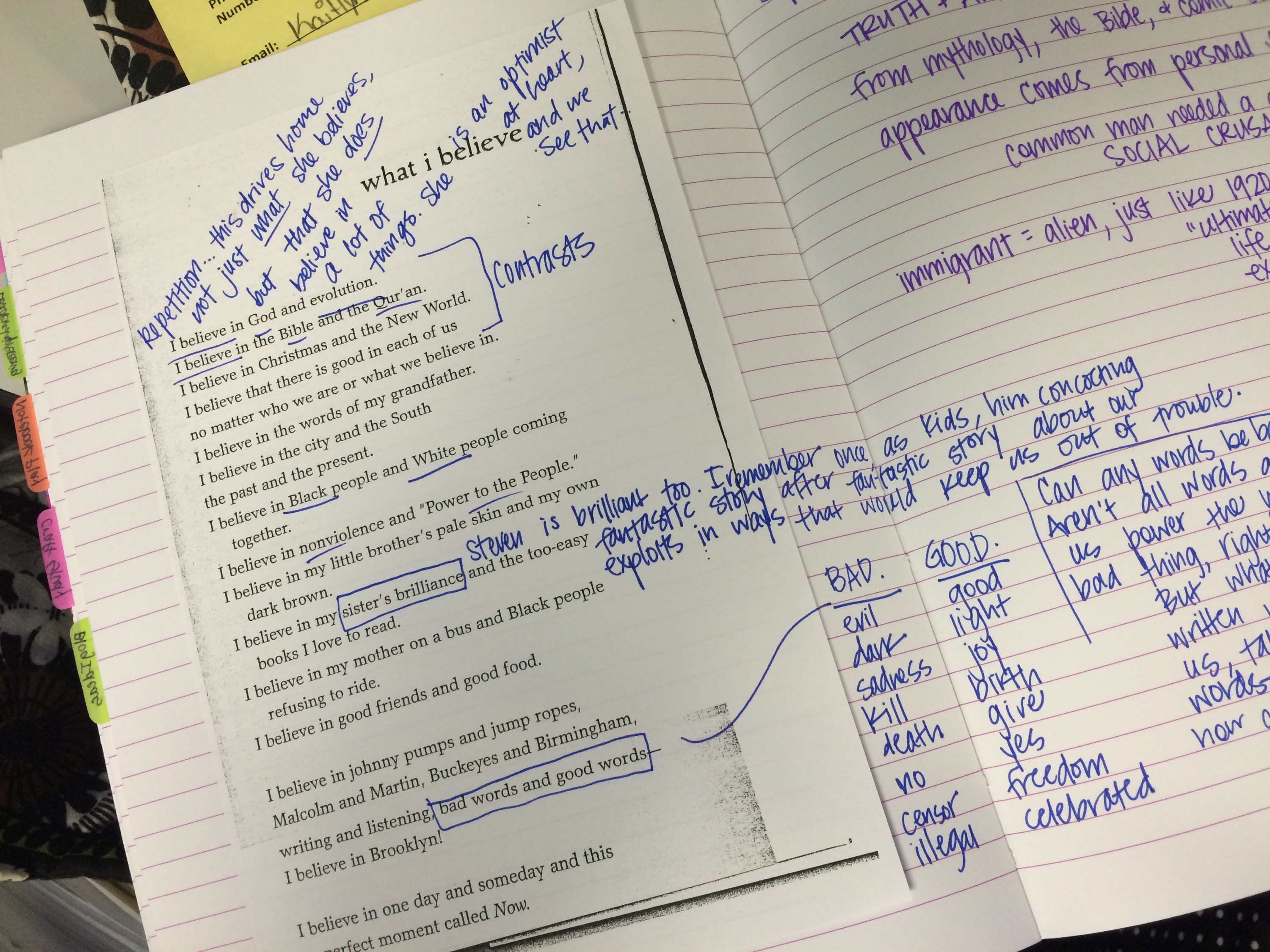
Once we set up our writer’s notebooks, we began filling them with all things personal to us.  Heart maps, important photos, our hands, lifelines, reading histories, and more.  Then, we turned to adding the words of other writers.

IMG_9251

My writing atop Jacqueline Woodson’s

I wanted to show students the power of other writers’ words.  I wanted to teach them to read poetry not to “torture a confession out of it…to find out what it really means,” as Billy Collins writes, but to celebrate the act of simply reading that poem.  So, we glued in an excerpt from Jacqueline Woodson’s Brown Girl Dreaming.  I modeled for students how to respond to Jacqueline as a real writer, to notice and note her craft moves, to be inspired by her ideas and write more about our own feelings on those topics.  We wrote atop her poem, prioritizing our responses, reactions, and ideas rather than some analysis or “dulling down” of her meaning.  Responding personally and authentically to published authors will become an important part of our daily routine in our writer’s workshop.

I invited students to enter into a written dialogue with the authors we read.  So, as I settled down this weekend to begin reading a tall pile of student writing that had been turned in, I knew I had to walk the talk, as Amy always reminds me I must.  I ask students to treat authors as real people worthy of critical response, so why would I treat my student writers any differently?  I’ve always struggled with how to grade/evaluate/respond to student writing, but I’m thinking about it in a new way this year.  I just want to have conversations with my students about their writing, whether it’s in the form of a writing conference or in a weekend session with a stack of papers.  I know that when these conversations occur, student growth will follow.  In the excellent Portfolio Portraits, edited by Don Graves and Bonnie Sunstein, Linda Rief writes in an essay IMG_9248titled “Finding the value in Evaluation:”
I have discovered that students know themselves as learners better than anyone else.  They set goals for themselves and judge how well they reach those goals.  They thoughtfully and honestly evaluate their own learning with far more detail and introspection than I thought possible.  Ultimately, they show me who they are as readers, writers, thinkers, and human beings.

My thinking aligns with Linda’s.  When I remove myself from the role of “grader” or “evaluator,” I become an authentic reader of my students’ writing.  I invite students to assess their own writing, which in the words of Linda Rief “shows the value in evaluation.”

So this weekend, I read my students’ writing like I read books.  I noted beautiful lines they wrote, jotted down spiffy words they harnessed, and responded to thought-provoking ideas I saw them getting at.  I asked them questions, wondered about their meanings, and looked very much forward to reading more of their words in the future.  I will confer with students as I return their papers, and we’ll talk about how they might move forward with some of the topics, ideas, and stories they’d begun in these early writings.

In our classroom, we consider our responses to published writing as important as the writing itself.  The value of reading and writing lies in the interaction between the reader and the words, as Louise Rosenblatt describes.  When I transfer that value from the way I want my students reading writing to the way I want to read my students’ writing, new and important opportunities for student learning occur.

Fart Jokes in 12th Grade

photo 2-2Three minutes into silent reading, someone farted. I have the band-aid colored desk-chair combos, which meant that one vibrating toot was magnified against the metal frame of the guilty student’s seat. The room stayed silent for half-a-minute and then erupted in laughter. The girls quietly chuckled, but there was no way the boys could settle back into their books, so we moved on to our minilesson and called it quits.

My boys can’t get enough of lowbrow humor. Their writer’s notebooks and fictional stories are full of crass humor—farts, sexual innuendo, embarrassing stories, and offensive humor. For years, I chalked up their obsession with these topics to immaturity. I love a good fart joke or sarcastic paper, but I never truly understand the point.

Newkirk argues that humor is a mode of exploration for students, particularly boys. Instead of chastising them for vulgar or lowbrow humor, teachers should capitalize on boys’ love for the weird, gross, and funny. He pointed out that classic literature is full of crass humor, citing Beowulf and Shakespeare as examples. Boys, he noted are inclined to read humorous literature and use these as mentors for their own writing.

Too often though, teachers either don’t understand boys’ humor or they fear that the silliness somehow undermines the assignment. This shouldn’t be the case. Just as we give girls the room to explore emotionally charged pieces about self-confidence or dating, we must also give boys the opportunity to investigate their own questions, which may very well include both humor and violence, as Shana discusses. In an excerpt Newkirk gave us from Boy Writers, author Ralph Fletcher notes that “some of the crass humor in their writing (burping, farting, dirty diapers) tries our patience, but many boys are simply making ‘text-to-text’ connections between their writing and the kind of humor they read in books.” These connections are invaluable when it comes to capturing the attention of our male students.

IMG_2367In turn, we must allow our boys a space to explore humor. Sometimes jokes are just funny, but other times, they soften heavy themes in literature. They open up deeper discussions that are otherwise inaccessible or uncomfortable. As Newkirk writes in Misreading Masculinity, “[Humor] provides a forum for negotiating and sustaining male friendships, and of making overtures to girls. It allows us all to laugh at the peculiarities of our bodies, as we escape, if only briefly, from our embarrassment at the sounds they involuntarily make and the smells they produce” (Newkirk 167). Will students toe the line between inappropriate and appropriate humor? Most likely. Will they take their jokes too far? Potentially. But learning is about testing our surroundings and studying voices to find our own. At the end of the day, I’d much rather my students explore their world through laughter than not, fart jokes and all.

Good Writing Moves Us — THIS Writing Moves US

I want to include you in a celebration of the work of a student that represents several of my kids this year. If you teach, or have taught, ELL students, I know you will understand.

The last assignment was an intensive writing piece that we workshopped for about seven weeks. Writing in class almost daily, conferring regularly, and mini-lessons with mentor texts and modeling served as the routine. Students turned in their writing in three separate chunks, gave one another feedback at least three times, presented their final pieces (published on their personal blogs) as their semester exams. Formative assessments were student writing conferences and the checkpoints along the way. Summative assessments were a self-evaluation and a self-evaluation paired with my feedback from a rubric we crafted as a class.

Biak with the book she loved the most this year. She read 12.

Please read the writing of Biak Par. The poems are original, and the story is her own. Just before school was out, I had to call Biak to my desk and let her know that she failed the state English II EOC. Again. That was nothing short of heartbreaking — for both of us.

Take several minutes and read Biak’s story. You will read the words of an improving and authentic writer. These words are elegant, poignant, and powerful. Good writing moves us — this writing moves us. 

Now, take a look at Biak’s writing from the beginning of the year— her first blog post is here, and her second is here.

Now, think about her end-of-year piece of writing. I know it is narrative, but you will note what I do — improvement. So much improvement. Voice, coherence, organization.

I wish I had another year with Biak, and several of her friends. We’ve come so far, and this is the work she should be allowed to celebrate — not a test score.

I know — preaching to the choir.

©Amy Rasmussen, 2011 – 2015

Why Assignment Sheets Might Be Killing Your Students’ Writing

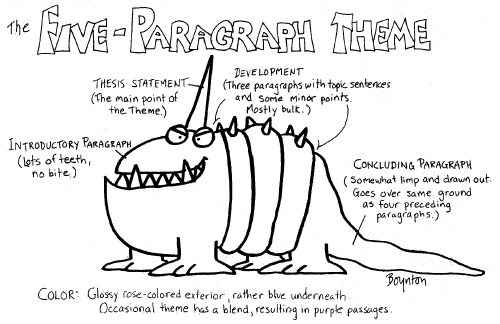
58090ec056811830ee936030edb1c9dbMy first year of teaching, I didn’t realize that the “five-paragraph essay” was a dirty phrase. My  internship year I painstakingly dragged my freshmen through the essay outlining process, watching them regurgitate homogeneous essays about symbolism in Lord of the Flies. At the end of our six-week study of the book, I slogged through 25 nearly identical essays, all of which had eloquent yet oddly familiar intro, body, and conclusion paragraphs. I’ll readily admit that despite the dull content, I felt victorious. My students had completed literary analysis essays and I had taught the foundation of essay structures.

It was that summer that my perception on structured essays changed. Two days into taking Penny Kittle’s writing course at the University of New Hampshire’s Literacy Institute, I realized that I had committed a cardinal sin of workshop teachers. Admitting to teaching the five-paragraph essay (let alone the sandwich method of paragraph-writing) was like confessing to enjoying McDonald’s burgers at an elegant chophouse: the cut (or concoction) of meat might serve the same purpose, to fill me up, but the quality was quite different. In turn, I was feeding my students homogeneous writing, a detailed equation to a subject that couldn’t be distilled down to simple mathematics. If I expected greatness, I needed to break beyond the boundaries of such a restrictive form of writing. After all, an introduction + body paragraphs + conclusion didn’t guarantee a solid essay; if anything, it guaranteed an entirely unspectacular essay.

This process of digesting the material and then providing a summary of the structure was far too easy for students. Not only did it place the onus on me to provide a set guide of instructions, but it also required me to complete the majority of analysis. Instead of my students engaging with the text and delving into the intricacies of structure and craft through individual exploration and group discussions, I was basically pre-digesting the material before offering it to them.

IMG_1845

Students analyzing an author’s craft in front of the class.

This year I have made a point to wean my students, particularly my juniors and seniors, off the assignment outlines they so desperately desire. Instead, my students now receive a half-page sheet simply telling them the type of essay they are writing (cause and effect, definition, personal narrative, etc.), the mentor texts they may refer back to, the page length requirement, and the due date.

Initially, they were frustrated with this format. As one student said during our career building unit in which we practiced writing cover letters and resumes for celebrities, “Ms. Catcher, do you have an assignment sheet for this or something?” When I pointed out the paper I had given to him previously, he replied, “No, I mean something that tells me how to write this paper.” We discussed the numerous mentor texts we had read and dissected and how these as well as our class discussions ultimately provided the basis we to develop our pieces. As a class, we asked questions of the text and author, starting broad by looking at the overall tone, voice, structure, intended audience, and progression of the piece. Then, independently or within small groups, we delved into more of the intricacies—what examples were provided, word choice, sentence structure, punctuation, and transitions. Students have gradually learned that there is no set solution for getting an A, which also means that they are forced to read and reread mentor texts to gain a firm understanding of a piece’s intricacies.

My problem from the beginning was that I was too busy telling my students how to write an essay to allow them to discover the messy albeit enlightening connection between reading, writing, and modeling. As we complete the last six weeks of school, I have noticed a significant difference in the structure and craft of my students’ work. They are relying more readily on mentors to help guide them in their process, and I can see both their group and independent analysis directly translate into their writing. For the past three years, I have harped on my students about showing rather than telling, but as the year comes to a close, I can finally say that I have internalized my own advice when it comes to my teaching.

How do you inspire students to rely on mentor texts instead of assignment sheets?  What steps have you taken throughout the year to make them more independent and confident writers?

Students Need Real-Life Writing

suit-and-tieWe live in a technical world. People rarely see one another face-to-face anymore, which is why writing has become our hypothetical suit-and-tie. To get a job, one uploads and sends a cover letter and resume. To apply to college, one submits a college essay. To correspond with a colleague, one sends an e-mail. To be engage in online discussions or to communicate on social media, one must post or blog or tweet or comment. More than ever before, we are our words. We live in an age where we can look and act like slobs behind the screen while our words tell a different story. It’s empowering and liberating but also terrifying. Terrifying because too often our students don’t understand the value of formality in writing.

This has become even more apparent as I, a 26-year-old, am both exposed to and part of a generation of socially illiterate people. We, as well as our students, understand text language, chatting, posting, and tweeting, but our colloquial language seeps into our every day interactions, handicapping us in other ways.

While students can effectively communicate with their peers, they have not received the training to engage in formal written conversations—the types of conversations that drive the academic and business world. In turn, students arrive in college lazily piecing together informal e-mails to their professors that poorly represent their abilities and knowledge. We assume that because they have grown up as Internet babies and that because they are constantly on their phones, they understand the unwritten rules of Internet writing, but they don’t. This year I have made it a point to inject the discussion of voice, formality, and audience into my reading and writing units in an attempt to widen my students’ understanding of and comfort with writing.

In all of my classes I have sought to push my students outside of their comfort zones by exposing them to diverse mentor texts and assignments that force them to play with words. For many students, voice is a challenging concept. They struggle with finding a voice in their own writing, which makes it even more imperative students be exposed to comedic, sardonic, opinionated, and academic pieces. The only way to develop voice is to study it. Not all of the pieces I show my students are high brow; I pull from a variety of sources ranging from blog posts to articles from The Atlantic. But the pieces I choose are intended to show that a wide range of writers and voices exists. The more students understand that there is no one-size-fits-all structure, the sooner they will be willing to dabble in their sarcastic or silly side.

In learning about voice, students must also understand the value in formality and audience in their writing. Too often the e-mails I receive from students look like a long rambling text message. We’ve all received them—the ones riddled with grammatical errors, making us cringe and wonder if they’ve learned anything this year! Teens quickly become comfortable with the fact that teachers are the only people reading their writing. Students become overly comfortable with teachers reading their writing at times. We’re seemingly safe and familiar; we know their quality of work. Exposing their writing to new eyes and ears increases the stakes and makes their work more relevant.

This year, I was determined to push my lower level freshmen beyond the classroom and get them engaging with mentors. I could tell my students to work hard, which I did many times over, but in the general scheme of things, I was their teacher (akin to their mom). So I recruited a Navy Seal, an elementary school teacher, a forensic anthropologist, a photojournalist and others to do the job for me. Students were required to research a career. While they completed their research, I sat down with each student and helped him or her to draft an e-mail that they would send to a professional with which I paired them. Oftentimes I would return to find my students’ e-mails plagued with the same grammatical errors I’d seen so many times before,Depositphotos_7626816_m only this time, I was with them on the sending end.

My mini-conferences turned into minilessons on the importance of editing and the impression it had on the e-mail recipient. Students struggled with how to start their e-mails, how to address the recipient, and how to sign their name at the end. We practiced online manners, thanking the professionals for their time and answers while also noting something the student found to be interesting or appealing from the professional’s answers. In the end, their attention to detail paid off. A forensic science professor who teaches college students included the following in his e-mail:

“I was taken aback when I saw that he is only in ninth grade; I have students much older who do not bother to write properly and it disappoints me.  I am not your friend on FB nor are you texting me so no need for brevity at the expense of complete and correctly written sentences.  Salutations?  Maybe next year.

I have a 12 year old son so I think I will have him peer over my shoulder as I write to Carter so he can see how polished someone so young can be.  Thanks!”

Our students are going to college arguably without knowing or understanding the importance of voice, formality, and audience. To prepare them for life beyond high school, we must strive to incorporate real-life writing assignments into our classrooms. While some of my students may never write a research paper after they graduate from high school, I know that nearly all of them will use e-mail, apply for jobs, and engage on social media.

My role as an educator is to help mold and train productive and intelligent citizens and while giving them lifelong skills that translate beyond the classroom. Part of this is continuing to develop and adapt my classroom to better fit the needs of 21st century students. So regardless of what my students do in their free time whether they enjoy lounging in sweatpants with a tub of Doritos or taking selfies in a bathroom mirror, I want them to sound like poised, intelligent, and confident individuals. I want the world to be open to them—both online and in real-life.