Tag Archives: relationships

An Idea: Author Bios and Some Focus, Wit, & Polish

I stole this idea from Lisa. She said it was okay that I write about it first. Bless her.

I finally feel like I’m getting a little of my writing mojo back. If you’ve been following my posts lately, you know I’ve had a hard time. I loved my student teacher, but I missed my students and how they inspire me to want to write and share.

It hasn’t been easy taking back my classroom. I am much more intense than Mr. G, and this translates to mean for some of my students. It’s true I grade hard, expect a lot, teach bell to bell. It’s not that he didn’t — maybe it’s just that I’m 50+, and he’s close to half my age. Whatever the reason, reinvigorating relationships hasn’t been easy.

Kind of casually one day, Lisa suggested she wanted to write author bios with her students next year. She said she’d read a few she wanted to use as mentor texts, thinking this little writing task would be a way to help her students develop their identities as writers. What a fantastic idea!

So last week for our writer’s notebook time, we wrote author bios, short, little, quippy, quirky writing that states who we are and why we write. (We still need work on the why we write part.)

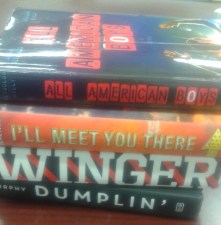
booksforauthorbiosI prepared first by reading the inside back covers of some of my hardback YA literature. I chose four bios with similar elements:  Andrew Smith, Winger; Julie Murphy, Dumplin‘; Heather Demetrios, I’ll Meet You There; and Jason Reynolds, All American Boys. {Bonus: four book talks, along with the author intros. Boom.]

I explained the task:  We’re going to read four short author bios and then write our own. Listen to each one carefully, so we can pull out the similarities within each one.

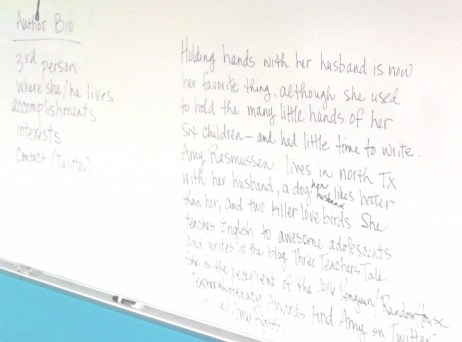
We charted the elements of the bios on the board and then drafted our own.

authorbio

We spent five minutes on the writing, two minutes on revision, and six minutes sharing with our peers. We laughed. We wondered if the authors wrote their own book cover bios. We discussed our writing process.

“It would have been easier writing about someone else,” one student said.

“I need more time to think of how to say things,” said another.

“This would be fun to do at the beginning of the year,”

“I don’t do anything!”

“I’ve never won anything!”

“I cannot write that I am interesting when I am not interesting.”

“Can we write about what we want to do in the future instead?”

Oh, yeah, we stirred the pot, and ideas bubbled out. Throughout their questioning, my response remained:  Be creative.

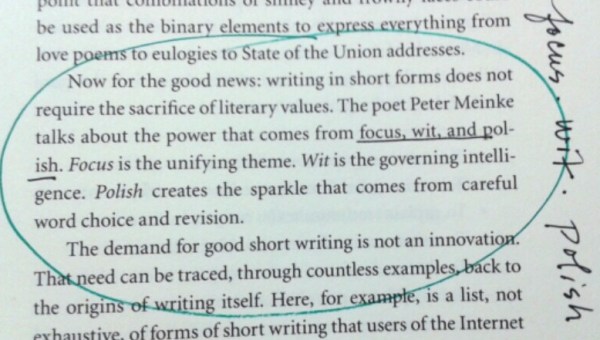
One of the best books I’ve read on writing is How to Write Short: Word Craft for Fast Times by Roy Peter Clark. I marked it up with lesson ideas:  “the whole chapter would make a great lead in rhetorical analysis” and “on annotating: read before starting 1st book club” and “use b/f narrative –teaches analysis with song lyrics” and “parallel structure & compound sentences!”

This paragraph from the introduction is a great reminder for all types of writing — and writing instruction:

How to Write Short

Focus, wit, and polish. My students and I talked about our identities as writers. We talked about the time it takes to develop our voice, our craft, our meaning.

As they read their author bios to one another, the cough of community clamored just a bit, and in a few minutes the whole classroom caught it.

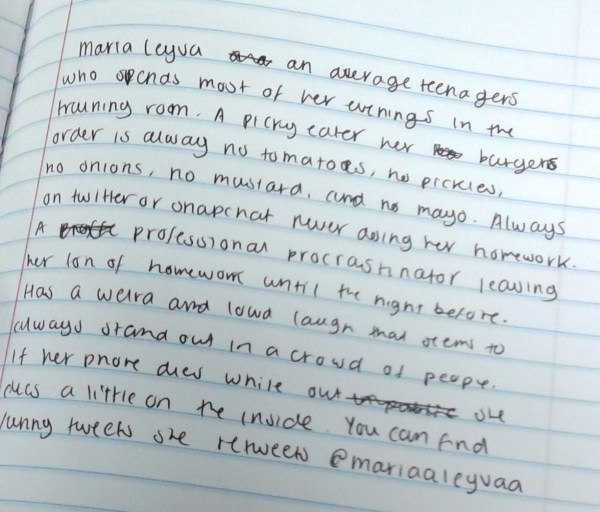
MariaLauthorbio

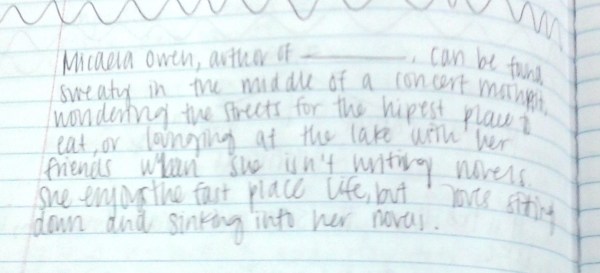
MariaCSkyauthorbioMicaelaauthorbioTreyauthorbioI reminded students as they write over the next few days — finishing their multi-genre projects, their last major grade — to write with intention, to write in a way that shows the answer to the last question I’ll write on the board this year:  How have you grown as a reader and a writer?

In the fall, I will do this exercise again. We will write our author bios at the beginning of the year, on day one, maybe. We will spent a good deal more time on them, and we’ll return to them again and again as we practice the moves all writers make to produce effective, convincing, creative writing. We will publish our writing with our bios. Hopefully, this will help us keep our sights on Focus, Wit, and Polish in all aspects of our writing.

How might you use this author bio writing activity? What tasks do your writers do that help them take on the identities of writers? Please leave your ideas in the comments.

Amy Rasmussen lives in north Texas and teaches AP English Language and English 3 at Lewisville High School. She loves talking books, daughters’ weddings (two this year), and grandbabies. Facilitating PD for other teachers making the move into a workshop pedagogy delights her. Amy adheres to the words of Emerson: “We aim above the mark to hit the mark,” and Jesus: “Love one another.” Imagine a world if we all aim higher. Follow Amy on Twitter @amyrass.

8 Ways Listening Leads to Learning

not-listeningWe teachers often talk too much. Research on listening suggests that adults spend an average of 70% of their time engaged in some sort of communication; of this average, 45% is spent listening compared to 30% speaking, 16% reading and 9% writing. I would argue that this data does not represent teachers in the classroom. We tend to talk more than we listen.

I wonder how many of us have thought of teaching as communication.

Think about this definition of communication: “Two-way process of reaching mutual understanding, in which participants not only exchange information, news, and ideas and feelings but also create and share meaning. In general, communication is a means of connecting people or places.”

Now, think about how much richer our classroom environments could be if we planned, prepared, and presented our lessons through this lens of communication — with the goal of reaching mutual understanding, exchanging information, ideas and feelings, and creating and sharing meaning. To do so, we must listen more than we speak.

What about the time, we may ask, what about the content knowledge we must impart?

When we exchange our need to talk with our students’ vital need to have us listen, we

  1. transform our teaching by looking for ways to invite students into conversations
  2. better utilize the time we have with our students, meeting their needs in one-on-one and small group discussions
  3. deliver information in new ways, other than students listening to lectures or taking notes from slide presentations, or completing worksheets
  4. break down walls many adolescents have built against school and against authority — they know we see them as the unique individuals they are, and they respond
  5. provide opportunities for students to learn from one another so we may listen as they share with one another
  6. help students discover and take ownership of their needs, both personally and academically — talk often works as a lead into deeper thinking
  7. facilitate communication that leads students to take on the characteristics and behaviors of readers and writers — or in a biology class as scientists, or in a history class as historians.

Fostering room for more listening is the first move into creating a culture of conferring.

Does it make us vulnerable? Yes! and facing our vulnerability is where our growth as teachers takes root, taps into strategies that nurture our learners, and eventually blossoms into the instruction and learning experiences we want for all students.

How do you make room for listening in your classroom? Please share in the comments.

Amy Rasmussen lives in north Texas and teaches AP English Language and English 3 to the Fighting Farmers at Lewisville High School. She adheres to the words of Emerson: “We aim above the mark to hit the mark,” and Jesus Christ: “Love one another.” Imagine a world if we all love more than we think we can. Follow Amy on Twitter @amyrass.

Why Conferring Matters

Conferring is the interaction missing from many of our students lives.

Consider this:  the current generation thrives on one-on-one attention. They do not remember a time before social media, and many live much of their lives online via their smartphones. They turn to instantaneous interactions that have a direct impact on how they feel about themselves:  Snapchat, Vine, and Instagram over Facebook, which they are abandoning in droves because “it’s for old people.”

Our students crave immediate feedback. They seek personal communication — and they need it.

Think of the implications of this virtual-reality world on long-term relationships and problem-solving. We have already seen how it impacts our students in the classroom: short attention spans, skimming versus sustained reading to name a couple, not to mention the addiction to notifications.

Our students need to experience and understand the importance of eye contact, facial expressions, and body language, and how these physical features create non-verbal communication. They need to interpret and explicate tone.

The students in our classrooms today are different from Millenials. Anyone born after 1995 earns the new title of Generation Z, also called iGen, Centennials, Founders, and my favorite title: Gen Edgers.

As a whole, these students use technology as their primary source of communication — to validate, and to feel validated.

They also value genuine relationships, loyalty, and honesty and are increasingly more careful than the previous generation with the friendships they form online. They want to know their voices matter and that they are okay just being themselves instead of being the perfectly-phrased word count they must craft online.

Our students need opportunities to share thoughts, feelings, ideas, and knowledge in non-threatening situations through real face-to-face conversations.

Conferring opens opportunities to meet the needs of our students at the core of their longing.

When we invite students to talk and affective filters lower. Students relax. They respond.

When teachers confer with genuine interest in the well-being of the child, we grant students permission to be their genuine selves. Research on the brain shows that “positive comments and positive conversations cause a chemical “high,”” and with less pretense and stress, students experience more learning.

Conferring gives students the chance to share their stories; and besides creating trusting relationships, conferring allows us to meet them where they are and help them advance in knowledge and skills from there.

On-going regular conferences ensure that every student receives the one-on-one interaction and instruction they deserve. Peter Johnston reminds us that every student has a personal history that affects our ability to help them advance in their literacy skills.

Through conferring we learn the cultural and personal backgrounds that shape our learners, along with the experiences that shaped them in the past as readers. Both are important factors. By asking questions that invite students to recall their learning histories, we initiate future learning.

Conferring also sparks critical thinking, creativity, and curiosity.

No matter the teaching style — be it an English class where the teacher makes the choices about books and writing topics, or a workshop inspired classroom where students choose what they read and write, or even a classroom of another content area — when conferring becomes a norm, students proactively engage in learning, which results in more growth, independence, and mastery of content and concepts.

Our students learn to ask questions, ponder responses, and seek for interesting ways to show they are learning. Differentiation happens naturally.

Imagine the opportunities students may create and the innovative energy they will have in the future if they experience this kind of learning in their secondary schools.

The children in our classrooms are part of the fastest growing force in the workplace and the marketplace. Their influence is changing companies, marketing styles, and consumer habits.

This generation wants to make a difference in the world. They are pragmatic, self-aware, goal-oriented, and self-taught via YouTube. They’ve grown up “dealing with too much vs. too little information their entire lives.”

They will soon become our peers standing in voting lines, our colleagues standing near the copy machines, maybe even our bosses, or perhaps the officials that govern our cities and our states.

As adults we must provide each child with the education that prepares them for the future they are moving into.

We cannot keep teaching the way we have always taught with one-size-fits-all lesson plans and instructional models. We cannot keep making all the choices about books and reading or essay topics.

We must talk to our students one-on-one about what matters to them personally. Our future, and theirs, depends on it.

And for the teacher who worries about time, conferring provides a means of easy and accurate formative assessment, which saves valuable time spent grading:  time teachers may spend planning effective lessons or conferring with more students.

When done with fidelity, conferring improves the effectiveness of our teaching. I don’t know one teacher who doesn’t want that.

Please share your thoughts on conferring in the comments. What are your conferring routines?

Amy Rasmussen lives in north Texas and teaches AP English Language and English 3 to the Fighting Farmers at Lewisville High School. She adheres to the words of Emerson: “We aim above the mark to hit the mark,” and Jesus Christ: “Love one another.” Imagine a world if we were to all aim higher to love our fellow man. Follow Amy on Twitter @amyrass.

Better Teaching: Please tell me your story

I already knew they were hard workers. This group of girls spent a lot of time in my classroom after school. They huddled together at the far table, speaking in a language I did not understand. They asked questions occasionally, afraid of being wrong.  

“Is this right?” one would say, timidly showing me her iPad where she’d written a few sentences in the Docs app. Returning to her table, she’d share my response with her friends.

They held on in AP English by decimal points as each grading period ticked by. Lucky for them, I scored on improvement, not on the AP writing rubric.

In class we watched the documentary “A Place to Stand,” based on the book by the same name by Jimmy Santiago Baca who became a poet while serving time in prison. Baca’s story captivated my students. They identified and analyzed the argument: “Education matters. Fight for it. Words matter. Learn them. Write them. They empower you..”

Some students understood that more than others. These girls, for sure.

We read several of Baca’s poems. Although mine is primarily a non-fiction course by nature of AP Language and my syllabus, I know that it’s through poetry that my students more easily grasp the beauty and intention in an author’s craft.

The task was to re-read Baca’s poem “As Life Was Five” and to write a reflective piece in response to it.

These girls were struggling, so I finally joined them at their table.

“Tell me what’s going on,” I said.

“We just aren’t sure,” Biak said. She spoke more often than the others, although her English was only a little better.

“Can I see what you’ve written?” I asked, and she timidly passed me her writing, carefully penned on notebook paper.

She quickly broke into explanation:  “I wanted to write my own poem. I don’t know how, and I don’t know…” Words tumbled out, and she lowered her head, waiting for me to read the page.

I looked, and before I could read anything, the words “Burmese!! STUPID and CRAZY!” shouted at me.

“Wait,” I said, “I thought you were from Burma.”

Five voices rose in chorus:  “Yes, yes, we are from Burma, but we are not Burmese. We are Chin.”

I needed them to teach me. I’d never heard of Chin, and my knowledge of Burma was limited to the first few chapters of Saving Fish From Drowning by Amy Tan I’d tried to read and abandoned years ago.

“Will you tell me your story?” I asked, looking closely into the small faces of these beautiful young women, similar yet so different in features and personality.

Biak began to talk.

“We are from the state of Chin in Burma. The Chin are the mountain people. The Christians. The Burmese hate the Christians.”

And then they all talk and tell me their story:

They fled Burma with their families, leaving grandparents and loved ones behind. Sometimes not getting to say goodbye for fear the secret of their journey would be told. They traveled in groups, mostly at night, walking, walking, walking, they said. Often barely eating food, and even then, mostly rice balls or an egg stirred into water.

Bawi told of a Buddhist monk who acted as their guide. “He wouldn’t let us pray,” she said. “Every time we tried to pray, he would knock away our food. ‘Pray to me,’ he’d say, ‘I’m the one who gave you food, not God.’ He was so scary!”

“I lost my shoes,” Biak said, “I walked for miles and miles with no shoes, and the.. What are those things?” she turned to her friends, motioning with her hands like claws, “…those things that stuck to my feets?”

“Thorns,” they said.

“Yes, thorns stuck in my feets, but I had to walk. Walk and walk.”

“Walk quickly and don’t let go,” Kimi said.

“There was a pregnant woman with us. She could not keep up. When we reached the border of Malaysia, she could not run. I do not know what happened to her.”

“I remember we heard the POW POW POW. We had to run as fast as we can to cross the border. I was so little. My legs short. I was so scared.”

Biak begins to cry. She bows her head and covers her face with her hands, “I don’t like to think about it. I remember my grandmother’s face. We barely got to tell goodbye. She cried so much.”

I look around the table. Their eyes shine with memories.

“You all left family behind, didn’t you?”

They nod, and I see Van’s chocolate eyes pool with tears.

“Did you travel together?”

“No! But we all have same stories. All Chin students do,” Duh says.

“Wow,” I say, “Just wow.” My heart throbs in my chest, heavy with the weight of these stories. Resilience takes on new meaning.

“So you must think it’s pretty lame when your classmates whine about having to work a three hour shift and that’s the reason they cannot do their homework.”

The tension breaks, and they laugh.

“What an amazing gift you’ve given me,” I say, “You need to write your stories.”

“I wanted to write a book,” Kimi says, “but I don’t know how.”

I smile. “We can work on that.”

My heart changed after that chat with my girls from Chin. I also felt chagrin. I waited three months into the school year to extend the important invitation:  “Tell me your story.”

I can come up with fourteen different reasons why. None of them matter.

Throughout the fall, I struggled with my classes because I focused on the skills needed to be successful in AP English instead of focusing on the individuals who needed to learn the skills to be successful in life. I forgot why I wanted to teach teenagers in the first place.

Perspective matters.

The most important conversation is the one that invites our students to tell us their stories.

Those young women from the state of Chin grew to trust me because I asked, and I listened. They told me later that I was the first teacher who asked them to tell me their stories — they had all attended U.S. public schools for at least four years.

I am sure other teachers assumed they knew. I thought I knew until I saw the emotion in five pairs of eyes. “We all have same stories,” Duh had said, but that is not true. They all have similar experiences. Their stories are uniquely personal, and they serve as cardinal prerequisites to the identities of each individual.

Identity matters.

How our students see themselves — as teenagers, thinkers, readers, writers, friends, students — matters, and to instruct the individual we must know what she believes about her abilities and her capabilities, both of which have been shaped in one way or another before she ever steps through our door.

Peter Johnston helped me understand the importance of identity in his book Choice Words. He reminds us, “[Children] narrate their lives, identifying themselves and the circumstances, acting and explaining events in ways they see as consistent with the person they take themselves to be” (23).


screen-shot-2016-12-03-at-8-45-20-pm

Trust and esteem are imperative to effective conferring. They are imperative to effective teaching. They are two cornerstones of conferences that allow for the relationships students need with their teachers, the relationships students need to learn.

If our goal is to help our students incorporate reader and writer into their identities, we must build foundations that allow them to take on the behaviors of those who read and write. Equity and autonomy create balance in this foundation and become the other cornerstones.

All students must feel that we meet with them fairly and without judgment. They must know our goal is to inspire independence as they become more effective readers and writers — and of course, literate citizens.

Really, it all begins with the invitation:  “Please, tell me your story.”

my-chin-girls

Graduates Lewisville High School Class of 2016


THAT DAY  THAT DAY
by Biak Par
Far from my Home, my Family
When looking at the sky they seem so happy
But me,
Thinking about that day
Every word they speaks, every looks, every smiles, every laugh
They tear me apart, the soul sing Be Strong
That day
Every word they talk, it burn my ears like Hell
Its torture me every night, in intimidate me every day
When I see those similar faces
That day
Those word, those eyes         
Tear my heart into two pieces.
Those words are as sharp as a razor
They call me foolish, Yea, I don’t know them
Burmese!
That day
My body fills with wound and remorse.
It like drawing into the water, I could not breathe nor talk,
Walking to class
All eyes on me,
Looking down with hope that there is a place I can conceal
But the room seems so small
As I take a step to the room, the room seems colder
Like I was at Antarctica,
Very Cold
Looking at the room I was isolated for this people,
This entire people are strangers.
That day
Standing still
People examine me, like I am from the others planet
That day…
My tremble body, drum in my blood
Eyes fill with water,
That day
The word of Burmese, such as STUPID, CRAZY echoed through my ears
Stupid, crazy,
My mouth wants to shout, but my mouth feels numb
And makes my throat feels tight like I am being choked,
Almost tearful
Wanting to run away can’t bear the exposes of feeling being hunted.
That day
Eyeing for a place to seat
But none of them invites me or speak,
It like I am walking into a room full of a babies Dolls,
They do not talks
But their EYES,
Their evil eyes talk, its say get out of this room
That day
Head down, looking at the floors as I walk toward to the edge of the room,
Seat alone,
The room feels so dark, so lonely and scary
Even, I was surrounding by those people
That day
My silent cry, wishing I can revisit to where I’ll be safe
Because every second, every minute, every hours this place seems so hazardous
That day…
Hopes and dreams are fading away like the wave of the cloud fade, little by little.
From that day the world is never the same
That day, change my life
Made me feels like a woman, made me realize
That because I am different from them (Burmese) and I only speak
CHIN,
They destroy and killed my hopes, my thought, my believe,
The thought of what might come next. I am Scared.
But,
My soul sing to me, be strong. BE Strong Biak Par. Be STRONG.
 

Reel Reading for Real Readers: Pride and Prejudice

20130207-190708.jpgSome of my colleagues might think I am anti-classics, but this is assuredly not so. I just hate how we commit what Kelly Gallagher calls Readicide by reading them to death in English classes. Pride and Prejudice by Jane Austen is my all time favorite:  book and movie. The characters speak to me, and I’d know them on the street; I’ve read of them so many times. I even fantasize about living in turn of the century rural England. Well, maybe not fantasize, but I would like to travel to the English countryside someday.

Official Movie Trailer:  Pride and Prejudice

I want students to read this book. I do not want them to hate it. Therefore, I will talk it up. Quote some characters, show them this movie trailer, and offer a bribe or two if I have to: “I’ll bake you tiny cakes and bring you tea.” Whatever.

“My good opinion once lost is lost forever.” — Darcy, Pride and Prejudice

Do you remember that scene in You Got Mail? Meg Ryan’s character has praised Elizabeth Bennett and in subtle ways thrown down the challenge to Tom Hank’s character to read the book. He tries. For her. It’s the sweetest thing ever.

My daughters and I love all things Jane Austen. When the movie Becoming Jane came out, we were on a girls’ trip in Florida where the drivers love their horns, and we shook hands with a young man named Mr. Stubbs who was missing half a finger. The four of us walked into the movie theater, and we waltzed out humming the score and discussing literature. This mother’s perfect evening, surrounded by loving daughters who talk about books.

I’m all about building relationships with my students. By sharing my love of Pride and Prejudice with them– and why I love it, they will see a glimpse into me. The me outside the English class. The me who loves being a mom. Who goes to the movies. Who takes her girls to Florida on vacation. Who finds irony in people’s names.

If my students know me, I have a better chance of knowing them. Books and literature are so much more than reading material.

So, let’s play a bit here. What’s your favorite CLASSIC text, and why?