Tag Archives: Readers Writers Workshop

Cliché College Essays and Why I Hate the “Three Ds”

IMG_0040On the Monday their essay was due, I handed out a rubric. “I cannot and will not grade you on this essay,” I said to my AP Literature class.

In all honesty, I don’t care what they get for a grade on this piece. After days, weeks, and months of toil, a number cannot and will not determine the actual value of this paper: the college essay.

I have a love-hate relationship with the college essay. I love that students have the opportunity to express themselves through writing and that they are encouraged to provide personal stories. I especially love the emphasis on creativity that draws them away from the rigidity and structure of standardized tests and check-box-surveys. What I hate is the overwhelming weight that accompanies telling “your story,” the crowning piece of one’s 17 years of life.

My first year of teaching, I fretted over college essay advice. I told students to steer clear of the three Ds—death, disease, and divorce—and to instead explore a wider variety of ideas that included mundane moments. I wanted them to beware the standard cliché essays of human suffering.

What I found was in restricting these three topics, I also restricted the very stories that shaped these students’ identities. After all, our students are still teenagers; they have many more stories to live and we mustn’t undermine those stories of death, disease, and divorce that have framed their present reality.

Sarah’s essay on her father’s death and her inability to hold his hand during his last moments tears at my heart every time I read it, and I have been working with Sarah on this piece for a year. She writes:

It is nearly two years after my father has passed, and my inability to hold my father’s hand on his deathbed still haunts my dreams and consumes my thoughts. I am sixteen years old, I have done regretful things in my life, but the singular moment I regret most in my life is not holding my dad’s hand during the one time he needed it to be held by me.

Sammie’s poetic piece on coping with her best friend’s severe eating disorder and eventual hospitalization and rehabilitation has a place in Sammie’s college folder. Maddie’s experience meeting her mother’s boyfriend for the first time after the shock of her parents’ divorce belongs filed alongside her SAT scores.

Instead of limiting their stories or categorizing them as cliche, we, as teachers, must help our students explore these experiences through expert narration and craft. After all, doesn’t the beauty in literature rest in its familiarity? Its common story? Its trumpeting of empathy, underdogs, and resilience?

How do you approach college essays, and how do you help students who are struggling with essay topics?

Mini-Lesson Monday: Sentence Boundaries and Adding Some Variety

Sorry, I forgot to record the book’s title.

Even the students in my AP English class struggle with correct punctuation and varying their sentences. In one-on-one conferences, I’ve started to remind them more often to pay attention to how the author of their self-selected books craft meaning. I used to get glossy-eyed blank stares, but students are beginning to understand that writers make intentional moves to draw us in, and keep us within, the pages of their books.

“As a writer, you must do that, too,” I remind them.

This lesson grew out of a conferring conversation with a student who told me:  “I just do not understand all the comma and semicolon stuff, but I have a pretty good idea of what I want to say in my writing.”

Objective:  Using the language of the Depth of Knowledge levels, students will recognize the sentence boundaries and the variety of sentence structures in their self-selected books. They will make observations about the author’s use of punctuation in these sentences, assessing the writer’s effectiveness in crafting meaning. Students will then use their author as a mentor as they apply their knowledge of sentence boundaries and sentence variety and create, revise, and rewrite sentences in their own pieces of writing. Finally, through peer-to-peer conferring, students will evaluate the accuracy and effectiveness of one another’s sentences.

Lesson:  Every student needs their independent reading book. If a student is reading a book of poems, or a graphic novel without many sentences, you will want to supply a stand in book for this lesson or ask the student to find a book she’s previously read.

Tell students that you’ve noticed in their writing that they are ready to make their sentences more sophisticated. Correctness is one way to do this. Varying the length of sentences is another way. Instruct students to turn to a random page in their books, say page 51. Ask them to read the page in search of one long sentence and one short sentence. Give students sentence stips or blank paper and have them write out the sentences they find in their books. They should spell and punctuate the sentences exactly like the author does.

sentence boundaries lessonNext, in small groups, ask students to discuss with one another the structure of the sentences. They might put all the short sentences together and compare them. Then they might put the long sentences together and look at how the authors use commas to separate ideas. Some students will know more about grammatical terms than others, and that is okay. The idea is to get students noticing how writers compose within the boundaries of standard English and to get them to understand how punctuation works to craft meaning. Ask questions that help them discover why boundaries and variety work to produce effective writing.

You may choose to have students imitate the sentences they chose from their books. Imitation is a useful tool for many writers.

Using self-selected books, not just to practice wide reading, but to teach students to read like writers, adds an important element to the workshop classroom. Our writing improves when we take the time to notice and apply the skills of professional writers.

Follow up:  Have students review a piece of their own writing. The writing can be in any stage of the writing process. They should study their writing to evaluate their use of sentence boundaries and variety. Encourage students to revise their writing as necessary, remembering to use the author of their books as their mentors.

Extension:  This lesson works to have students study leads, similar to what Jackie wrote about in the mini-lesson Pick up Lines and Leads. It also works to have students search their books for sentences that include imagery.


©Amy Rasmussen, 2011 – 2015

#FridayReads — Oh, Mercy! Have I got a plan for this mentor text

Usually I read about four books at a time. This makes for a mess on the bedside table, the coffee table, the kitchen table. I rarely use bookmarks, which is a shame because I have quite a lovely collection.

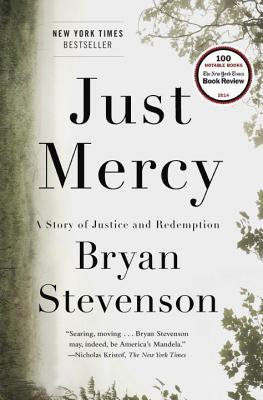
I end up leaving books split open and sound asleep right where I left them –sometimes just so I can remember the parts I know I want to use in class. I refuse to read on until I capture the sentence or passage that gives me pause. Such is the case with my new now bent-spine-copy of Just Mercy, a Story of Justice and Redemption by Bryan Stevenson. I’ve been stuck on page 18.

Here’s a portion of the passage I will use with my AP Lang students. You will, of course, find the rest of it when you buy the book, or here.

     When I first went to death row in December 1983, America was in the early stages of a radical transformation that would turn us into an unprecedentedly harsh and punitive nation and result in mass imprisonment that has no historical parallel. Today we have the highest rate of incarceration in the world. The prison population has increased from 300,000 people in the early 1970s to 2.3 million people today. There are nearly six million people on probation or on parole. One in every fifteen people born in the United States in 2001 is expected to go to jail or prison: one in every three black males babies born in this century is expected to be incarcerated.

     We have shot, hanged, gassed, electrocuted, and lethally injected hundreds of people to carry out legally sanctioned executions. Thousands more await their execution on death row. Some states have no minimum age for prosecuting children as adults; we’ve sent a quarter million kids to adult jails and prisons to serve long prison terms, some under the age of twelve. For years, we’ve been the only country in the world that condemns children to life imprisonment without parole; nearly three thousand juveniles have been sentenced to die in prison.

     We also make terrible mistakes. Scores of innocent people have been exonerated after being sentenced to death and nearly executed . Hundreds more have been released after being proved innocent of noncapital crimes through DNA testing. Presumptions of guild, poverty, racial bias, and a host of other social, structural, and political dynamics have created a system that is defined by error, a system in which thousands of innocent people now suffer in prison.

…..

     We are all implicated when we allow other people to be mistreated. An absence of compassion can corrupt the decency of a community, a state, a nation. Fear and anger can make us vindictive and abusive, unjust and unfair, until we all suffer from the absence of mercy and we condemn ourselves as much as we victimize others. The closer we get to mass incarceration and extreme levels of punishment, the more I believe it’s necessary to recognize that we all need mercy, we all need justice, and — perhaps — we all need some measure of unmerited grace. 


Before we ever read the text, and I did pull much more of it than I’ve posted here, we’ll spark our thinking with an image like this, posted at The Sentencing Project, and then write our initial responses in our writer’s notebooks:

Next, we will TALK. I know my students will want to share what they think about this graphic. Many will identify personally with it because they know a family member or a friend who’s served prison time.

When I introduce them to Stevenson’s text, I’ll give them a purpose for reading — besides just comprehending the message (identifying the purpose is a breeze since he tells us the reason he writes the book) — I want my students to notice the structure, the progression between ideas, the repetition and patterns they will see in the language. All the clues that build the tone.

I will ask them to mark the text, noting their thinking about these things. Without a purpose for reading, too many of my students struggle with the stamina they need to make it through even a page when I ask them to read critically.

Next, we will TALK. Talking will help some students understand what they read. It will help other students clarify their understanding. Some students will have noted what I asked them to notice as they read. I will rely on them to help the others — skill level is just one way my students are diverse.

I will also hand them a stack of questions that prepare them to write. They will read something like this:

What do you know about the writer based on what he writes?

What is the Stevenson’s purpose? Why does he come out and tell us so plainly?

What are the facts in this piece? What are opinions? How do you know?

What do you notice about the structure, any patterns, repetition? What do they do for the message?

How does Stevenson move between ideas?

And then we will write. Maybe I’ll give a prompt like this: Based on the text, and our discussion, is Stevenson’s opening argument effective, why or why not?  Maybe I’ll ask students to come up with their own analytical-style question to respond to. (I like this idea a lot.)  [see Talk Read Talk Write]

That’s probably enough for one class period, but my mind is still stirring:

  • What if I ask students to problematize the issue? Who are the stakeholders? Think all the way around the issue. Why do they care? Why do we care? What kinds of questions do we have about the claims Stevenson makes? What kinds of evidence do we need to convince us they are valid? How and when could anything regarding this issue change?
  • What if I ask students to identify just one of Stevenson’s claims and then research it? I assume the author provides support throughout the book. I’ll know when I keep reading. But what if students did a bit of research and then collaborated on substantiating Stevenson’s claims. Collaborative writing can be a powerful learning experience.
  • What if I ask students to brainstorm other issues Stevenson’s text suggests? We could probably create a pretty elaborate bubble map of ideas. These could lead to student choice in research topics.

What do you think? Any other ideas?

©Amy Rasmussen, 2011 – 2015
Weekly One-Pagers to Develop Writing Fluency

IMG_9425

Janelle, now in college, appreciates the one-pagers belatedly

This summer, Amy and I talked a lot about what we wanted for our students.  While there were lots of complex ideas tossed around, we knew that our goals boiled down to two simple ones:  for our students to become real writers and real readers.

We had lots of structures in place to help our students become authentic, fluent readers–weekly reading homework, daily booktalks, reading conferences, reading workshops, and more.  But writing was a bit different.  Daily quickwrites and longer compositions were already in place, but I wanted to add something more to get students writing more regularly outside of class on topics of their choice.  I wanted them to gain the same fluency with writing that they did through their weekly reading homework.

So, I was reminded of something I used to require my AP and Honors English students to do–a weekly one-pager.  Every Monday, a one page, single-spaced, typed paper was due.  I offered topic suggestions, but ultimately, students could choose what to write about.  I decided to revive this routine, inspired by Kelly Gallagher’s powerful claim that students should be writing four times as much as teachers could ever assess.  Why shouldn’t all students–not just the AP and Honors level students–write this much?

This year, I only have one Honors class, but all four of my English classes write weekly one-pagers.  We have a section in our notebooks called “Weekly Writing,” which is rapidly filling up with writing on a variety of topics.  During bi-weekly notebook collections, I check to see that these weekly one-pagers are being completed, but I don’t “grade” them–that’s not the point.  The point is to build writing fluency.

These one-pagers are low stakes–ten points apiece, so on a particularly busy week, if students just don’t have time to write, it’s no big deal.  But the frequent follow-up and sharing activities we do in class with these writings, combined with the autonomy students have in their topics, make the missed one-pager a rare occurrence.

I was initially inspired to create this routine by some of my greatest college professors, for whose classes a written response was due each day.  Alan Frager’s “study guides,” Tom Romano’s “one-pagers,” and Don Daiker’s “reading responses” were handed in at the start of each class period.  By writing a short paper every single day for most of my college years, I developed incredible writing fluency.  I knew I wanted my students to develop this written fluency as well, partially in preparation for their own college experiences, but also to bridge the gap between a writer’s thoughts and his words on the page.

As evidenced by Janelle’s testimony above, building this writing fluency pays off.  Already this year, students are remarking that it’s becoming much easier to write a full page, after only writing eight of them thus far.  I’m enthused by the growth I see in all my students’ writing fluency, and looking forward to seeing how much they can develop as writers by the end of this school year thanks to the weekly one-pager.

What routines are in place in your classes to help build students’ writing fluency?

Studying Vocabulary Through Choice Reading

IMG_2886“Reading increases one’s vocabulary,” I tell incoming freshmen every fall. But up until now, I have had little evidence to support this claim. It is true that reading exposes students to new words, but I never went out of my way to help students sort through these new words.

Instead, as a junior English teacher, I regularly taught SAT vocabulary as part of my Advanced Composition curriculum. Students completed chapters from the Sadlier-Oxford Vocabulary Workshop books and took quizzes every other week. While some students relished the challenge, many saw little relevance to their own lives, retaining few words by the end of the year.

In turn, this year I have turned from my well-worn Sadlier Oxford books and have instead had students reference their independent reading books for new words. Students develop their own lists of eight words every other week. My goal in doing this is not only to have students slow down their reading, but to also expose them to diction and complexity within their independent books. Once again, like many of the mini-lessons within the workshop classroom, this practice also turns into a lesson on craft and intention within a writer’s work.

Too often students skim over large words, failing to activate context clues and prior knowledge to help them draw out meaning. By creating vocabulary lists, students must practice these skills while also recording definitions, synonyms, passages, and parts of speech.

The benefit is twofold: students have a say in their vocabulary and immediately see both the relevance and payoff of understanding a new word. At the same time, having independent vocabulary lists eliminates cheating and encourages independence. Instead of worrying about students’ wandering eyes during quizzes, I spend time helping students understand the words they have picked. In addition, independent vocabulary lists provide insight into students’ reading levels and comprehension. I have learned more about my students’ reading lives simply by becoming aware of the words they find challenging.

Every other week, students complete a summative assessment that helps gauge their understanding of their eight vocabulary words. Two weeks ago I had students complete “Rock and Roll Vocabulary,” an activity that requires students to roll dice and answer questions about their vocabulary corresponding to specific numbers. This week students will complete a grid about various words.

While I am still new to this vocabulary approach, I feel confident in my students’ choices. Oftentimes I have seen the typical “SAT words” pop up in multiple lists, reinforcing that students will indeed choose challenging vocabulary. The process is far from perfect, and my students and I are still ironing out some of the flaws. Some students intentionally pick easy words, but the next assessment will require them to rank the difficulty of their words. In addition, I allow retakes of vocabulary summative assessments considering students made a “good faith effort” according to our school’s retake policy. Finally, not all independent books offer complex language, which can be a struggle for students who love the content yet can’t seem to find their eight or so words. In those instances, students may pull from in-class readings, articles, and textbooks. If they still struggle, I have books of SAT vocabulary they may choose from instead.

While this method of teaching is somewhat nontraditional, it provides students with continued say in their education. Not only are they empowered by their newfound words, but also by the end, I hope my students will see that reading truly does increase one’s vocabulary.

A Writing Workshop Lesson: Inspirational Speech

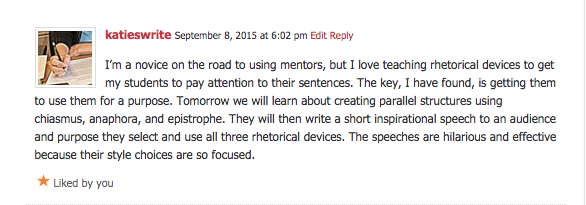
Last week I posted a mini-lesson about using student sentences as models for writing. Katie Bills-Tenney left this Screen Shot 2015-09-13 at 6.12.39 PMcomment. And I asked if she would write a post about her lesson.

She did even better:  she wrote on her own blog, complete with a lesson outline and student writing.

I love what she does here — and what her students do here, too.

Thank you for letting us see inside your classroom Katie.

Follow Katie at @Katieswrite

Mini-Lesson Monday: Self-Monitoring Reading Homework

It’s the fourth week of school, and some students are starting to panic as their weekly reading homework grades are showing up in our online gradebook.  When they come to me, concerned, I ask, “Have you been doing your reading homework?”

Sheepish grins, embarrassed blushes, and nervous giggles follow.  I know I need to give my students some tangible reminder of why they need to be reading two hours per week.

Objectives — Using the language of the Depth of Knowledge Levels:  Calculate how much you can read in two hours; Estimate how your reading rate will change over a two-hour time period; Assess your own reading fluency and growth.  Or, from the Common Core: Read and comprehend complex literary and informational texts independently and proficiently.

IMG_9336

Shailyn, Justin, and Mrs. Karnes’ paint strip bookmarks

Lesson — We begin class, as always, with independent reading.  I ask students to pay attention to what page they’re starting on and start a timer for 15 minutes on the board.

At the end of the 15-minute reading period, I ask students to count the number of pages read and multiply that number by eight to calculate their reading rate.  They complete their calculations and jot down their reading rates as I pass out paint strips and Sharpies.

“Today I want to remind one another about the importance of frequent reading.  We can’t become better readers without lots of practice reading, which is why your weekly homework is to read for two hours.  So, we’re going to make some bookmarks reminding us why we read, and also reminding us how much we should be reading.”

I ask students to take out their phones and look up a quote about reading.  Once we all choose quotes, I model on the document camera, writing my chosen quote on my own paint strip.  Students grab some Sharpies and a paint strip in their favorite color and doodle their quotes on their paint strip bookmarks.

IMG_9335

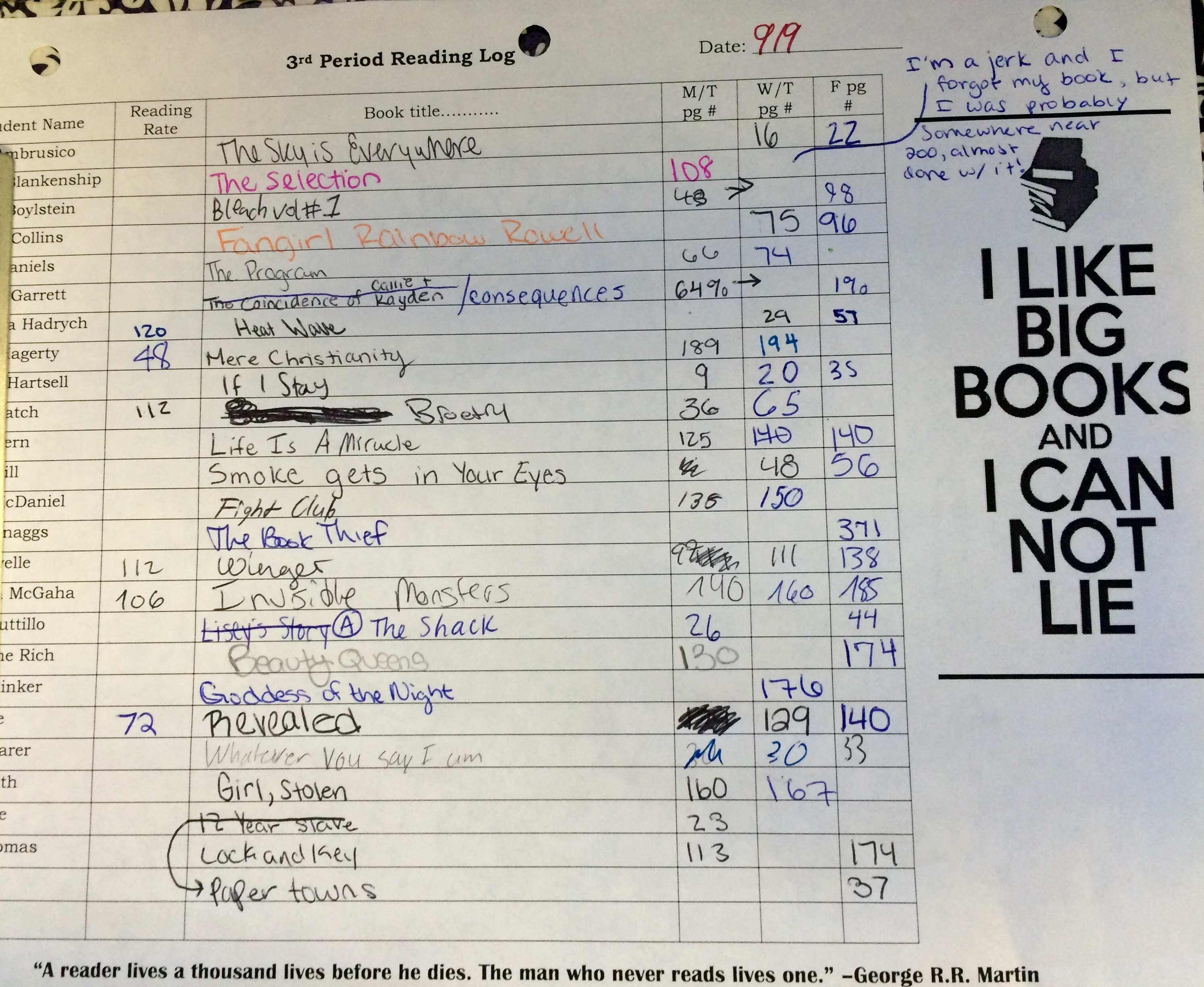
Students modify their reading rates in the Reading Rate column

“Once you’ve gotten your quote down, add your reading rate to your paint strip, nice and small.  You’ll want to change your reading rate whenever you switch books, and you’ll also want to note your new reading rates on the log sheet as it goes around each day.”

Then, I ask students to think about what might happen to their reading rates over time.  Jared predicts, “I think if I sit down for a solid two hours and read, I might read more than my reading rate.  When I really get going I can read pretty fast.”  Shailyn predicts, “My reading rate will increase…majorly!”

“What about if you read a harder book?” I ask.

“Um, I think I’d probably start out slow at the beginning, but as I get into the book, I’ll read it faster,” Shailyn adds.

“Awesome,” I say.  “We’ll have to see what happens.  So, as you use your bookmarks in the coming weeks, keep an eye on how your reading rate changes week to week, and how quickly or slowly you read your required number of pages.  I’ll check in with you in reading conferences soon.”

Follow-Up — Now that students have a tangible reminder of their reading homework to use as a bookmark, they can hold themselves more accountable.  The quotes give them a rationale for reading, and the written reading rates give them a reminder of their reading goals.  By self-monitoring both, students can assess their own reading progress far better than I can, and we’ll confer about that self-assessment during class for weeks to come.

#FridayReads: Matching Reluctant Readers to the Classics

IMG_9287On Tuesday, during a lull in class, Tyler was staring at the ceiling.

This isn’t unusual, or even discouraged, as our ceiling is covered with tiles that represent books.

“What’s that book up there?” he asked, pointing. “The one with the fire?”

“That’s Fahrenheit 451, by Ray Bradbury,” I replied.  I know that Tyler is a volunteer for our fire department.  I also know that he hasn’t had a lot of positive experiences with reading, so I tailored my impromptu booktalk to my knowledge of him specifically.

Fahrenheit 451 is a book about a fireman.  But he’s not an ordinary fireman–instead of putting out fires, he starts them.”

Tyler looked incredulous, and a bit offended.  “So he’s an arsonist?”

“He is, but that’s the job of the whole fire department in this book. Their job is to start fires to burn books and maintain censorship. Anyone whose house has books in it is the target of the department–they burn the house, and the books inside.”

“That’s messed up!” Tyler said, eyebrows raised.

“Right?!?” I agree, equally outraged for his benefit.  I tell Tyler some more of the plot–the corrupt fire chief, the terrifying mechanical hound, the strange professor that Guy happens upon.  “But eventually the main character–his name is Guy–gets curious.  He’s never read a book.  He starts to wonder, do they really need to be burned?  So, one day, at one house, he takes one.”

“The hound goes after him, don’t he?” Tyler predicts.

IMG_9289“He does.  And a lot of other crazy stuff happens.  I love that book so much…the way that Guy changes is so cool.  I really grew to love him by the end.”

Then, he asks the best question:  “Do you have that book?”  We cross to the bookshelf and I thank the gods–it’s there.

I give it to him, and he starts reading right away.

Tyler has abandoned a lot of books, but I think he’ll finish this one.  This was a case of matching the right book with the right reader at the right time, as Teri Lesesne says.

Tyler wants to read this book, despite its difficulty–he has reading strategies to cope with the challenges in vocabulary, sentence structure, and chronology that he’ll encounter.  I have faith that he will employ those strategies and grow as a reader and a thinker, as I have seen many a student do before, with greats like The Poisonwood BibleTheir Eyes Were Watching GodPride and Prejudice, and Brave New World.

We don’t need every single student to read all of those books.  They are gorgeous works of art that I hope everyone will discover, but thinking the only way to expose students to those books is to make everyone read them isn’t the way to do that.  Our student readers will find the classics on their own, if we give them the tools and the hunger to do so.  Tyler has the tools, and the hunger, so he found Fahrenheit–all because of a simple desire to know more, to find out why firemen would act so radically, sparked by the depiction of a flame on our classroom’s ceiling.

How do you match your readers with classic texts?

Window Shopping and Writer’s Notebooks

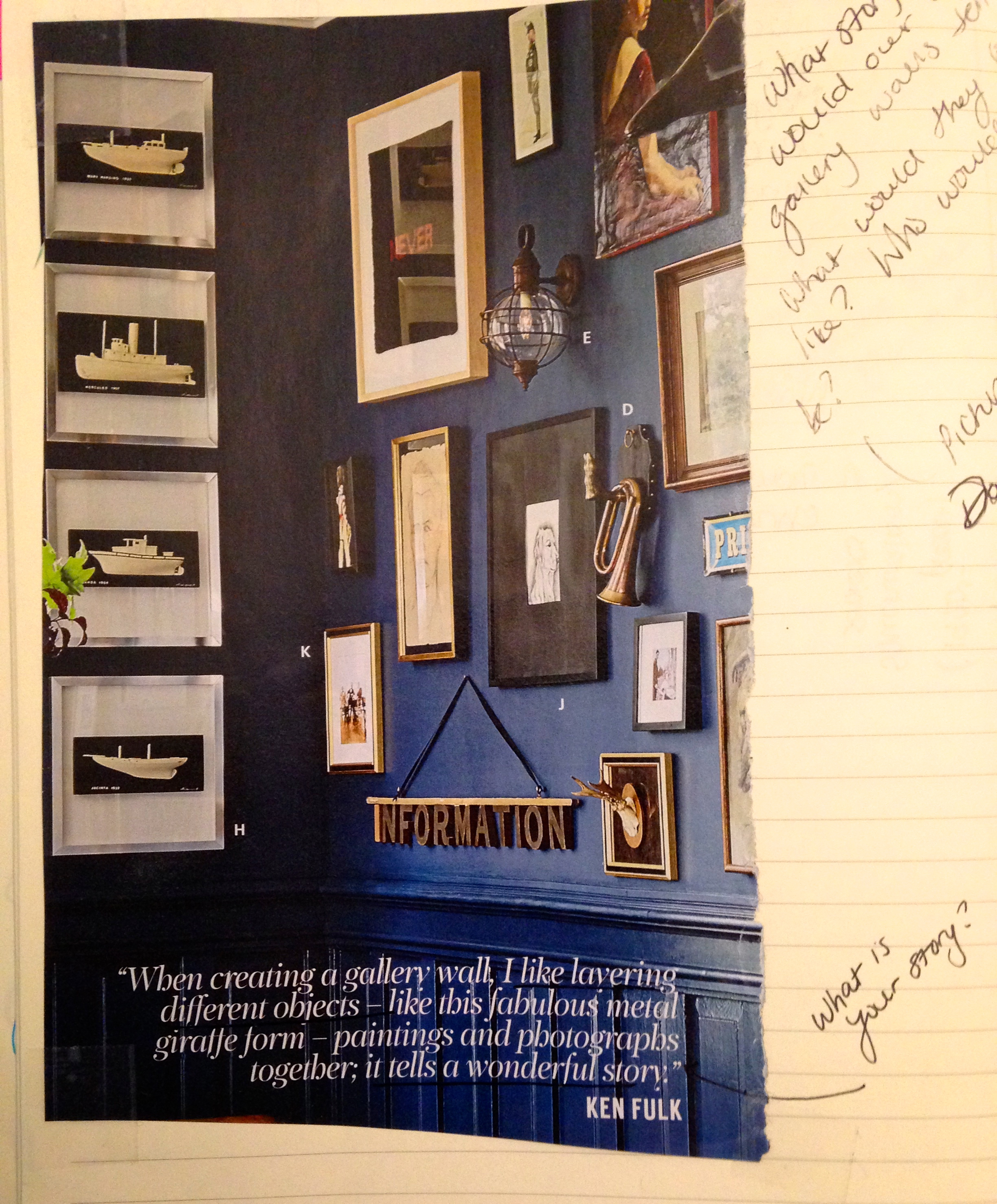
IMG_2848While thumbing through a Pottery Barn catalog, I paused to appreciate a navy gallery wall. Inky prints, gold frames, and brass hardware framed an assortment of images, below them designer Ken Fulk wrote, “When creating a gallery wall, I like layering different objects…paintings and photographs together; it tells a wonderful story.” I looked at the images, trying to decipher the story these antlers, ivory boats, dogs, and pencil sketches communicated. To be honest, I have no idea what he was going for, but I ripped out the page anyway, taped it into my writer’s notebook and started writing around it: “What story would our own gallery walls tell?” “What is your story?”

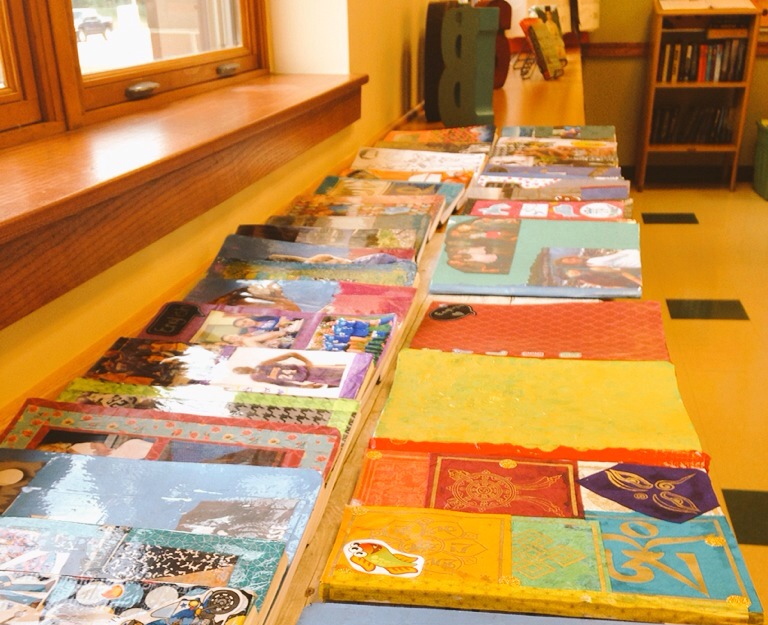
These are the questions I want my students to answer, and bit-by-bit their stories unravel. But all too often the process of answering these questions through writing intimidates them. In turn, one of the first activities we did this year to establish classroom culture involved designing and decorating our writer’s notebook covers. In the past I had students create inspiration page collages on the inside of their notebooks, but these were hidden and personal. They didn’t distinguish one’s self or serve as a conversational piece between peers. These images, which could serve as gallery walls for my students, were tucked away.

Student notebooks ready for writing.

Student notebooks ready for writing.

In turn, this year I stocked my classroom with scrapbook paper, patterned tape, and stickers. I lined tables with butcher paper and allowed for the messy process of gluing and cutting and painting. Together, my class sat listening to music and chatting about TV shows, cars, sports, summer vacations, and the scary transition between middle and high school. While this artistry and expression is typically celebrated at the elementary level, I encounter few secondary teachers who value setting aside class time for these collages. Some of my colleagues use it as a homework assignment, but I love how blocking out one class period and allowing for exploration becomes an icebreaker in and of itself. After all, these interactions mirror the same writing process students will engage in as they begin filling their notebooks and sharing the stories of their images.

Today we’ll circle around the classroom, sharing our notebooks with each other and highlighting one meaningful aspect of our covers. This activity is low stakes and comfortable; they have a choice in how much or how little information they provide. Hopefully they’ll find that these collages are snapshots in time of who

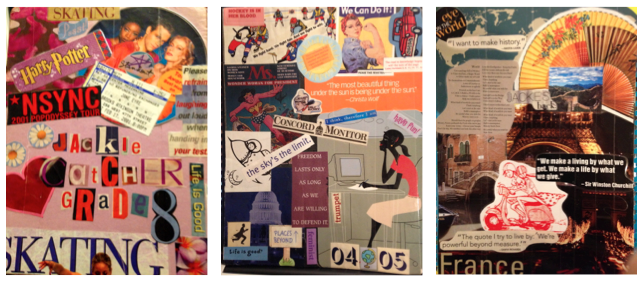
we are, reminders of what we value, and visual hopes for who we’ll become. I know this because as we sit in a circle, I will share, for the first time, the cover I created in 8th grade when I was caught between childhood and adulthood, the cover from 11th grade when I thought I wanted to be a journalist, and the cover from my junior year of college when I left on a great adventure to study abroad in Ireland. In the end, we’ll take a great leap forward in beginning our process of sharing who we are through words and images.

My notebook covers through the ages: 8th grade (far left), 11th grade (middle), junior year of college (far right).

My notebook covers through the ages. 8th grade (far left), 11th grade (middle), junior year of college (far right).

An Authentic Connection: Literacy and Citizenship

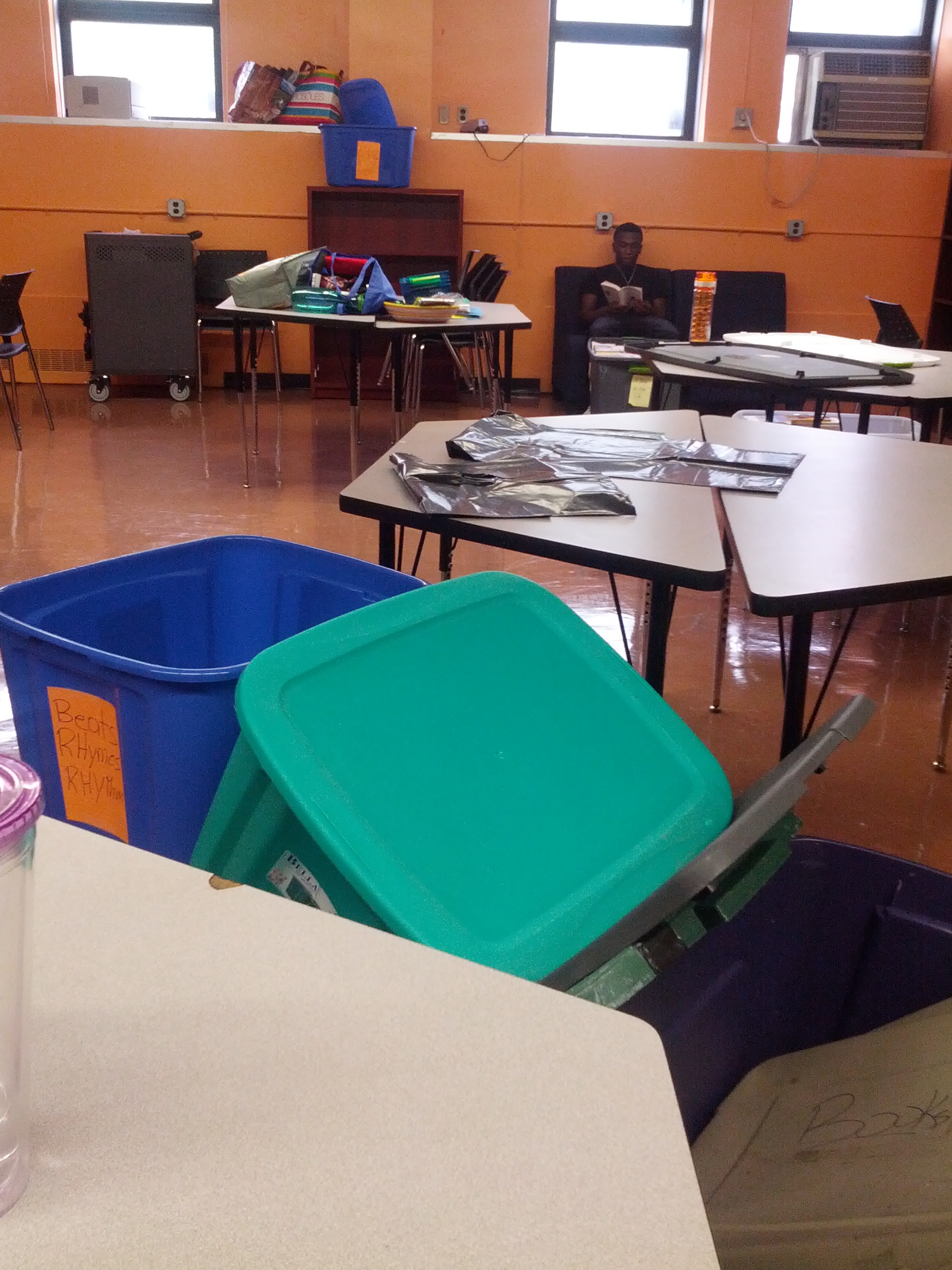
IMG_20150904_220827

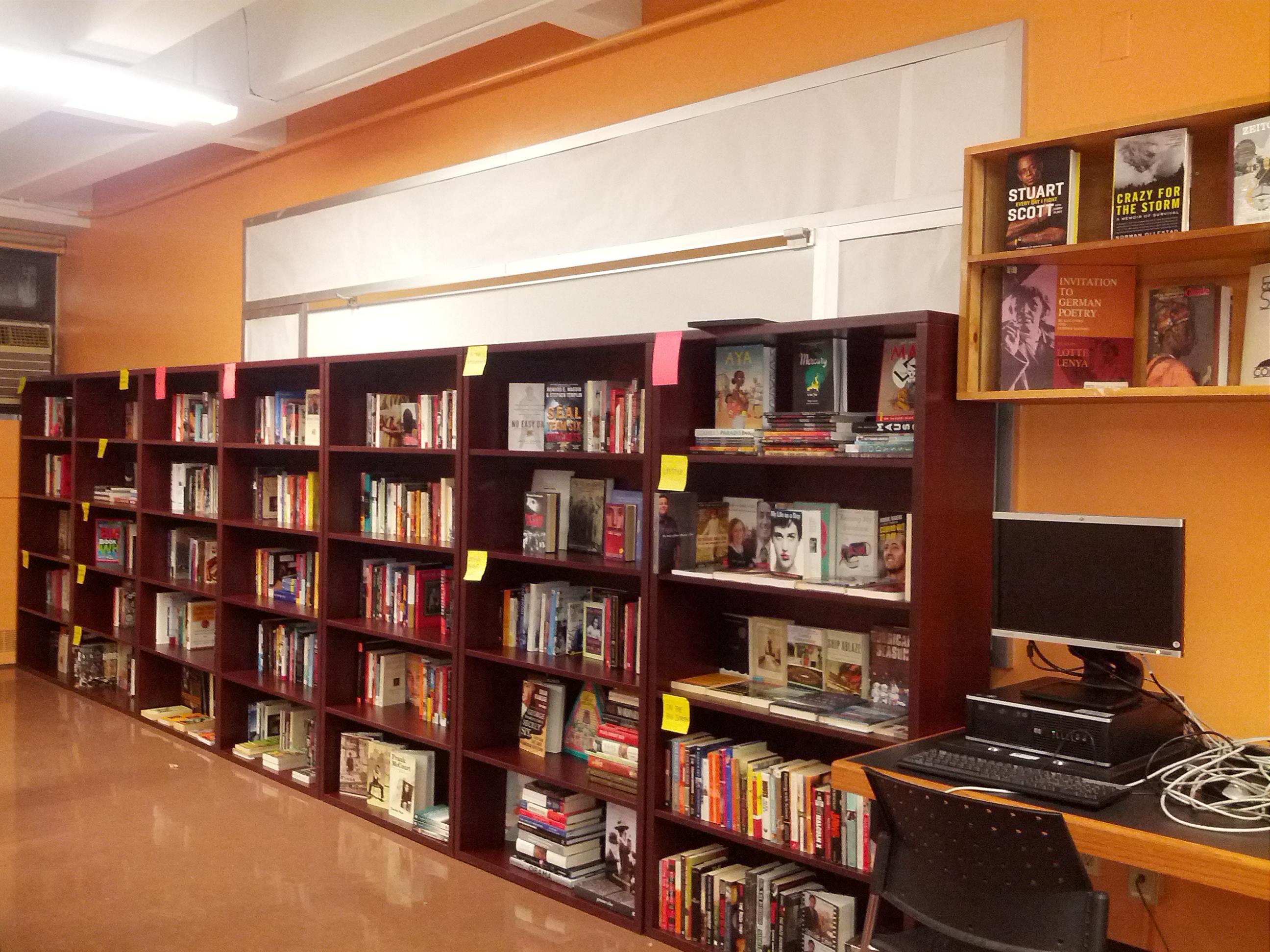
Room 369: The New Home of the Francis Gittens Lending Library

It is finally time for educators across the state of New York to head back to school. Here in the city, we have one day to organize, get our rooms situated, be professionally developed, catch up on the summer on-goings of our colleagues, and be ready to open our doors and welcome our new students full with promise – tomorrow.

So, as I let this ruminate; I find myself referring back to an article I was sent this summer to keep my mind whirling and my thinking on the edge.  Why are students falling off track?  According to this piece from Education Week the gap that separates students from achieving academic success is staggering.  This is not news.

IMG_20150904_133918

A moment of calm amongst the disorganization…

However, as I have had to arduously undergo this move of 3,000 books and their accompanied bookshelves (the entire Francis Gittens Lending Library) from room 382 to room 369; much has come to light.  I’m no stranger to believing that literacy is the key to access, opportunity, and self-worth; or that the Readers Writers Workshop is the venue in which to do so. Yet, this experience — this move, has taught me even more.

Literacy needs to be passed on.  It cannot remain only within our classrooms or the classrooms down the hall.  It must be infiltrated into the homes in which our students live; brought with them on public transportation where book covers are viewed by others; shared with siblings.  It must continually be invited and welcomed into places it does not often find an invitation.  That’s our job as educators.

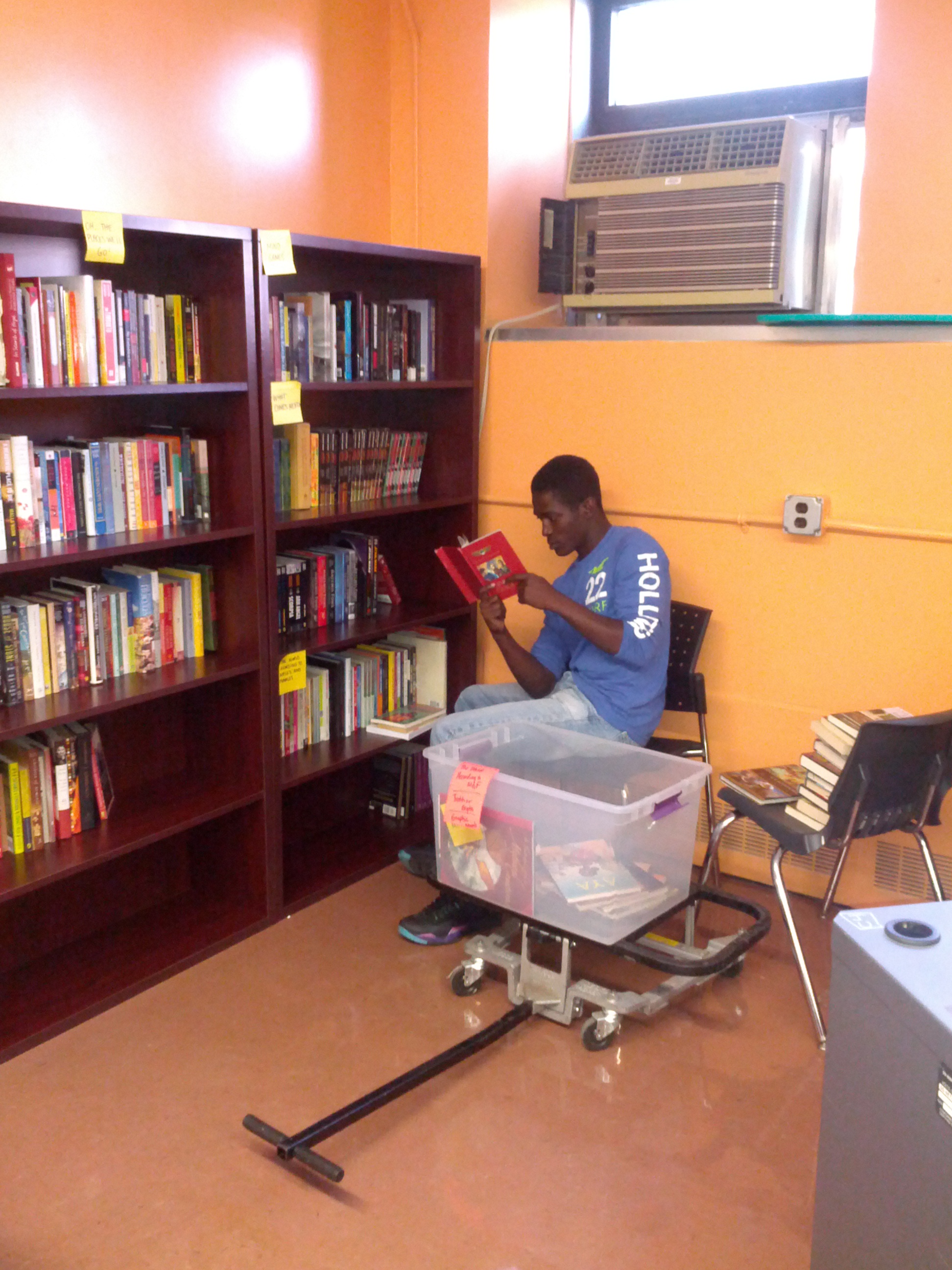
I’ve been reflecting on this past year, and years prior, to recollect what I believe to be some of the most vital components of the educating that occurs within the Readers Writers Workshop – and I always come back to the same two elements: creating a love and thirst for knowledge through literature and fostering the creation of students’ voices through writing.  This was solidified when Daphtho (pictured above) matter-of-factly stated, “Ms. Bogdany, you don’t have to thank me for helping with the move.  It’s my way of thanking you for helping me receive my diploma.”

So when Daphtho and George (two recent graduates) offered to spend their time among the heat, lifting and moving and organizing and undoing and reorganizing and waiting (for me to make aesthetic decisions); they quietly schooled me.

IMG_20150904_173359

A moment’s pause amidst the move…

Through their actions they showed me that when we are relentless in supporting their thinking and ideas, when we foster them as individuals (not just students) they innately become the young men and women they are destined to become. They are willing to give back to their community (even if they are no longer going to be physically present). They understand what it means to feel safe to take risks, comfortable to allow vulnerability to surface, and the power of giving back.  And, are eager to pass it forward.

During the many hours of this move, there were quiet (if not silent) moments of understanding.  Albeit the towering stacks of boxes that needed unpacking, these young men stopped in their tracks as they found literature that spoke to them – and found themselves comfortable spaces in which to explore. Daphtho will be bringing literature home for his brother entering sixth grade as he works side-by-side with him on his literacy skills (knowing the importance of a strong foundation) and George decided on two pieces that were donated by a friend of mine from high school – ponderings and questions about taking the next steps in our lives.

So no, my urgency for, “Time is ticking” did not kick in.  But what did kick in was, “This is exactly what this time needs to be.  Us. Books.  Connection.  They are ready for their next steps.  How grateful I am to have borne witness to their growth and how wildly fortunate I am to know them as the citizens they have become.”    

What elements of the Readers Writers Workshop do you believe propels your students in becoming robust citizens?