Tag Archives: Readers Writers Workshop

Choice Doesn’t Necessarily Mean Personal Connection: A reflection for a do-over


I have started this post four times, and I cannot think of a pithy way to begin. You know, some clever opening, some hook to get the reader’s attention — some startling statement.

My creativity got swallowed by analysis. Well, kind of.

I figure I must be doing something wrong because my students cannot analyze to save their lives. They can talk around a text and say absolutely nothing quiet well though.

So all afternoon and into the evening I’ve thought about thinking. I’ve thought about my students’ thinking.

And I’ve determined the problem: Many of my students are not doing it.

They sit and wait, looking around the room, waiting for someone else to speak up and do the thinking for them. It’s like a Mexican standoff, and something’s gotta give.

105997-clint-eastwood-mark-wahlberg-s-jkzn

Last week I listened to Dr. Margaret Hill talk about the importance of connections and how standards must include opportunities for students to make both efferent connections and aesthetic ones. The only way to truly learn is to make personal connections, Peg reminded me, citing Louis Rosenblatt’s Transactional Theory.

How can I provide more opportunities for students to connect to the learning?

Yesterday I read an article about mindfulness and how when it’s practiced in schools it is helping children’s well-being. Some experts say the practice of mindfulness is even an essential —  a way to reduce depression, extend focus, truly learn.

How can I help students get and stay in the present?

This morning I watched the TED Talk by Shonda Rhimes “The Year I Said Yes to Everything,” and how playing again has helped her find “the hum,” the thrill and joy in her life and in her life’s work.

How can I introduce more play into my classroom?

Today in class most of my students crashed into a brick wall of higher-thinking they could not go through, over, or around. Many didn’t even try. I came home from school worn out and weary.

Then I read this post by Tricia Ebarvia, and I stalked her blog until I read the post “Steps toward an Inquiry-based Classroom,” and a missing piece walked right into my puzzle.

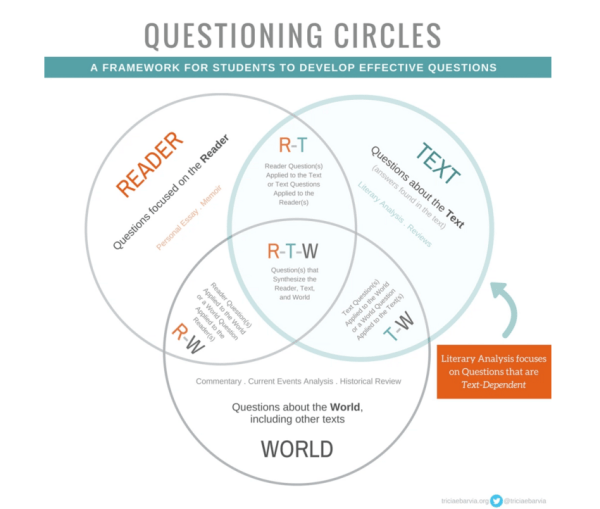
Tricia made me think about the on-going need for curiosity and student-generated questions. The ongoing need for purposeful and personal inquiry. She shared the chart below, citing the work of Christenbury and Kelly, NCTE, and Jeff Wilhem. And I got it.

Screen Shot 2016-02-18 at 7.18.15 PM

My students do not care enough about the books they’ve chosen to read. They do not care enough about the topics they’ve chosen to write about. I haven’t been paying enough attention, or I would have realized this sooner:  Choice does not necessarily mean personal connection.

I am glad I have time this year for do-overs.

It’s time to back up a few steps, so we can step into better opportunities for engagement, growth, and learning.

Maybe we’ll mediate.

Maybe we’ll play.

But we will certainly play with developing effective questions.

#3TTWorkshop: Asking Good Questions When Making the Move into Workshop

IMG_1279

Book talks about NF like Columbine by Dave Cullen and talking about the writer’s research process capture many readers

Shana and I recently conducted a two-day professional development workshop in Franklin, WI — such inspiring teachers in Franklin!

Franklin administrators asked that we help their teachers move into a workshop pedagogy, which is, of course, a favorite topic at Three Teachers Talk. We shared the background of workshop, which stems from the work of Don Murray and Don Graves, and from the work of our mentor Penny Kittle, whose ears had to be ringing and ringing since we said her name a million times throughout those two days.

Franklin teachers caught the vision and the value of letting loose the reins and opening their hearts to choice reading and writing. They just needed to experience it themselves from the seats of their students.

The discussion covers five of the pressing questions teachers asked during our pd.

They:  Where are some great places where I can get resources for books and materials for my classroom library?

Us:  The good news for Franklin teachers is the buy-in from their insightful administrators who have reserved funds to begin building classroom libraries. Not all teachers who catch the vision for choice independent reading, and the need for engaging, well-curated classroom libraries, are so fortunate. We weren’t. But finding resources and is certainly possible. Shana wrote this great post awhile back about grants she’s been awarded and the many businesses that give funds to buy books. Amy’s had great success with Donor’s Choose, one of the options Shana mentions. Three grant projects funded there so far! Lewisville Education Foundation has also been a great resource for Amy’s students and the books they love. Be sure you check out the grants offered through your own EF.

Other resources besides books are important, too. We spent time watching and responding to spoken word poetry with our new friends, modeling quickwrites, and studying the craft moves of these poets. Some of our favorite spoken word poets are Shane Koyczan, Sarah Kay, Phil Kaye, Marshall Jones, and Amy’s new favorite Harry Baker. Search online, and you’ll find YouTube videos and posts with the texts.

Engaging non-fiction articles are an essential in workshop instruction. Mentor texts, craft studies, and pairings with literature all make for authentic engagement with thought-provoking non-fiction. Find interesting articles at NewsELA, Izzit.org, Essay5W, and The Learning Network at the NY TImes. And, of course, the excellent mentors curated by our friends at Moving Writers.

They:  How can I design units that foster inquiry-based outcomes for my students?

Us:  We lead teachers in a gallery walk activity where they explored ideas of what authenticity, modeling, dialogue, inquiry, and other workshop essentials look like from both a teacher and the students’ points of view. It was interesting for us to see the many iterations of inquiry these teachers listed and how closely they overlapped with authenticity. Yes, they should.

However, getting students curious about learning does not always happen instinctively — especially when they come to us hardened by years of sit ‘n git classroom instruction. We must provoke inquiry, pique imaginations, inspire curiosity.  Of course, the move to choice opens doors to many of these needs. Providing, introducing, and talking about highly engaging literature helps. But so does allowing students to decide how they want to read it and what they want to do with it to show they are learning from reading it.

Teachers have to let go of control. We have to trust that students want to learn. We have to stop doing all the hard thinking for them. What if we let them find the mentor texts that best suit their needs as writers? What if we give them chances to determine themes they want to study, and then let them take those themes into other genres and ideas?

Let’s invite students into authentic and on-going research, so we move far far away from the one-unit-one-major-research-paper. Shana’s multi-genre project and my students’ engaging in our multi-modal feature article unit are good examples of how we apply this thinking in our own classrooms.

They:  I write every day for my job, but I have never written a “persuasive essay” for my job. How do I design authentic instruction that mirrors what my students might have to write in the future?

Us:  Read like a writer. Look for mentors everywhere. And know your kids. 

We know, if the answer was really that easy, everyone would do it. Although we do believe every teacher could. One way we’ve found to incorporate authentic instruction is to conduct regular craft studies of a variety of texts. We read a lot, and we look for texts in which we can discuss with our students topics like structure, literary and rhetorical devices, tone, etc. We call this reading like writers.

Shana and I agree, we first learned the value of reading like writers from Katie Wood Ray in her book Wondrous Words. Here’s a great Pinterest board to get you started. Shana and I will post the craft studies we find and use with our students more often. You’ll find several we previously posted when you search the “craft study” category.

They:  How do we hold students truly accountable?

Us:  In a word, conferring. We must talk to our students often and with purpose. 

sticky conferences

Modeling Silent Reading Conferences

Amy remembers when she first started moving students into self-selected texts how her conferences revolved around the books students read. Eventually, she realized that if she wanted to truly move readers, she needed to talk more to the student — as a reader — than about the book she was reading. This is an important shift in mindset and practice.

If we only encourage students to talk about the plot, summarizing this or that, maybe describing the characters, we miss out on valuable opportunities to help the reader stretch and grow in the skills she needs to mature as an independent reader. Identity matters.

Teachers foster a love of reading not by focusing on the books but by focusing on the reader of those books and helping those students identify themselves as readers. If you need ideas on conferring, Amy and Jackie discussed conferring in this #3TTWorkshop post, Amy wrote about conferring in a crowded classroom here, and Shana wrote about a what to read conference here.

Another important thing to remember about accountability:  We can ask students to write about their independent reading. Shana and I both ask students to evaluate their reading lives — several times a year. We consider these summative assessments, and students provide thoughtful commentary on how they struggle, grow, and succeed as readers. Amy quotes many of her students’ evaluations here. They are honest and insightful.

img_0331

Speed dating with books increases student talk about books, which increases students reading good books

When we ask students to write about their reading, it must be a task they see as worthwhile — and one we see as a support to our ultimate goal:  developing life-long readers. Too often, we read about teachers who punitively assign tasks to “catch their students not reading.” If this is you, please stop.

They:  How do I create engagement not compliance due to grades?

Us:  Choice. Choice leads to engagement. Engagement leads to autonomy. Autonomy leads to independence. Independence is engagement.

Trust the process, and see for yourself.


Integrating Reading & Writing Instruction: Craft Studies & Mentor Texts

This is a continuation of our post from yesterday.

#3TTWorkshopWhat are you reading now, and/or what are your latest finds that could be strong mentor texts?  

Jackie:  For fun, I am currently reading Ready Player One by Ernest Cline, and for AP Literature, I am currently reading Othello.  I read Ready Player One as a departure from my typical YA reads.  I was never a gamer or 80s enthusiast, so I wanted to “challenge” myself by choosing a new genre.  Ernest Cline brilliantly writes action pieces.  Somehow he manages to translate the video game structure into a novel AND make it interesting for non-gamers like me; I am planning to use an excerpt to discuss movement of time either when we work on our multi-genre project this year or our fictional writing next year.  

Most recently, my CP freshmen read the picture book The Promise by Nicola Davies as a mentor for our narrative fiction unit.  In my academic freshman classes, we recently completed process papers based on The Compound by S.A. Bodeen.  Mentors for these included “What you will need in class today” by Matthew Foley and “Instructions for a bad day” by Shane Koyczan.  Students used each as a mentor text by which to craft their own poems and then eventually built them into unique survival guides ranging from “How to survive a zombie apocalypse” to “How to survive a friend’s breakup.”  As Shana said yesterday, I like pairing professional work with my own to show them the messy process of writing, so prior to class I get a head start on my own piece and then I continue developing it while projecting my writer’s notebook on the board at the beginning of workshop time.    

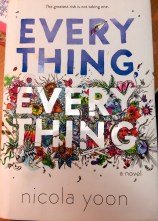
img_1056-1Shana:  I just finished the beautiful Everything, Everything by Nicola Yoon.  I love it as a mentor text because it’s a bit multigenre, and it’s an engaging YA love story, AND it’s gorgeously written.  With tons of parallel structure and a short-chapter format, it’s a quick read but one that lends itself to lots of frequent re-reading.  I’ll use this text for craft studies at the sentence and paragraph level to teach things like repetition, parallel structure, and varied sentence structure.

Another book I just read was Caitlin Doughty’s memoir Smoke Gets In Your Eyes, and Other Lessons from the Crematory, which I usually booktalk with Mary Roach’s Stiff.  This tale of Caitlin’s experiences working in a crematory will be useful for my students to analyze at the chapter level, during which she employs narrative to blend her adult experiences in the crematory with the formative experiences of her youth in order to make a claim about the nature of human life and death.  It’s a powerful example of the use of narrative within nonfiction.

I also recently read Memoirs of a Teenage Amnesiac by Gabrielle Zevin, which tells the story of a high school senior who falls and loses all memory of everything after sixth grade.  As a result, most of her life story is revealed through dialogue with other characters, so this will be a fantastic mentor text at the whole-text level–how can we craft a short story that uses dialogue to reveal movement through time, a character’s background, or a character’s personality traits–all without that dialogue being spoken by that character?


How will you integrate your current reads into your practice?

Shana:  I like to share this article about noticing beautiful writing with my students.  We use it as the basis for two sections in our notebook–“Quotes & Craft Study” and “Wondrous Words.”  I like to break down with my students why a particular line or paragraph or chapter in a piece of writing is so powerful–at the word level, the structural level, the punctuation level.  When we read like writers, we can notice all of those details and begin to imitate them in our own writing.  

img_1057My students asked for more craft study and grammar instruction in their midterm exams.  With our new notebook setups, I’m hoping to create a routine for the wordplay we’ll need to constantly return to in order to strengthen our use of punctuation, specific diction, sentence structures, and other craft moves.  I want to employ more “triple-plays,” as Penny Kittle calls them–books that act as a booktalk, a quickwrite, and a craft study mini-lesson.  For example, I’ll take the chunk of Everything, Everything pictured at right and make copies of it for my students to glue into their notebooks.  Beneath it, we’ll imitate the parallel structure of the sentences, and the exercise will serve to teach parallelism, talk up the book itself, and be a quickwrite we’ll call “it could be.”

Jackie:  Inspired by a course we took this summer with Tom Newkirk, my colleague and I are putting together a superhero unit for our academic Freshman English classes.  The unit will involve both a persuasive essay and a comic strip students make about a hero in their life.  In turn, I’ve been skimming comics and graphic novels to find inspiration for students.  

In this unit, students will practice storyboarding their own comics while studying the use of craft like onomatopoeia, movement of time, and internal and external dialogue.  My hope is that these building blocks will provide a foundation for us to further discuss the use of colors to portray goodness and evil within a comic (or novel) as well as the use of framing or perspective in the pieces as well.

Please join the conversation–how do you approach the study of craft with your student writers?

Finding Mentor Texts & Craft Studies

#3TTWorkshop MemeWhat prompted you to begin the process of noticing examples of mentor texts or craft study?

Jackie:  When I first started teaching, finding mentor texts proved to be difficult.  While I knew what made writing strong or well-crafted, I didn’t always know what I was looking for.  Instead, I would eat up a plot line, soaking in word choice (I have always loved words), but rarely did I stop to think about how an author sculpted a line or page or chapter.  Finally, after struggling with structuring a piece of fiction writing, I referred back to To Kill A Mockingbird by Harper Lee.  Intrigued by her ability to create a scenes that showed the progression of time, I read and re-read the novel, observing her intentional moves as a writer.  Gradually, I began understanding the value of mentor texts to my own writing.  

The skill is not easy, and I have learned more about myself as a reader in the time I have taught than I ever did during my schooling.  While reading like a writer does slow down the reading process, it also makes me appreciate the artistry of writing.  It makes me aware of my own moves as a writer and how writing, like any other form of art, is about discipline, awareness, and interpretation.

Shana:  I didn’t know about the concept of mentor texts, or craft studies, or imitating great writers, or even reading like a writer…until I took Penny Kittle’s UNHLit class in 2013.  Everything that summer blew my mind, and I was hungry to begin looking for strong examples of real writing for my students to study, imitate, and craft.  I learned about lots of authors, nonfiction writers, poets, journalists, and more while I was at UNH, and in the year following I learned to think back to my own favorites and ask my students for their recommendations when I needed more mentor texts.

Once I began thinking about writing instruction in terms of products I wanted my students to create, I learned to start searching for examples of those strong products.  Sometimes I seek out a specific genre of mentor text if I want to teach a unit about narrative fiction.  Other times, I find an amazing mentor text and design a unit around getting kids to create that specific genre.


Describe your process as you search for examples of mentor texts and craft studies.

Shana:  I read much more slowly now.  Almost all of my reading is of texts that could be used for craft study in my classroom, or books that might go well on the shelves of my classroom library.  I think about writing and reading in such new ways now that I almost unconsciously note a good page for a booktalk, a beautiful line for craft study, or an interesting segment of writing for a mentor text.  

To build an arsenal of texts for use in my classroom, I began to scour the award lists for the National Book Award, the Pulitzer Prize, the Man Booker Prize, and lists of recommendations by groups like ALA, Kirkus, and more.  I also value the recommendations of literacy greats in our field like Donalyn Miller, Carol Jago, and Penny Kittle.  I want strong, complex writing to hand my students, so that they can absorb the craft of good writing through constant, diverse exposure.

img_1057

The page I’ll booktalk from Everything, Everything by Nicola Yoon

Now, most of the mentor texts I discover are incidental–I stumble upon a lovely sentence in a book I’m reading, or I see someone tweet a link to a good article, or I’m struck by a student’s craft as I’m reading their writing.  I try to give a published example, a student example, and my own example as an “in-progress” mentor text, in keeping with the recommendations of Katie Wood Ray in Wondrous Words.

Jackie:  Now that I have begun practicing reading as a writer, I am more aware of the mentor texts that surround me every day.  It took about a year of intentionally slowing down my reading, contemplating the craft, and thinking about where to file the piece within my units for me to develop this practice.  

From Pinterest finds to articles to book excerpts to poems, I am constantly searching for pieces that will inspire and engage my students.  Most of my finds feed into mini-lessons that tackle current skills with which my students struggle.  For example, Many of my students grapple with the use of second person point of view and use it as a default instead of intentionally employing it to reach out to and connect with their audience.  After the November Paris attacks, I found a piece that brilliantly uses second person point of view to help students develop empathy with Syrian refugees.  This piece serves to not only guide them but also make them think about the intentional moves needed to connect with one’s readers.

I also look for mentor texts in classic literature and young adult reads.  These short excerpts teach my students phenomenal craft while dually serving as a mini-book talk.  The writing sells itself.  I always have students request The Glass Castle by Jeanette Walls after I use the first chapter as a mentor text for multi-scene narratives as well as a craft study for opening lines.  The same goes for when I use The Goldfinch by Donna Tartt when I use a short explosion scene to discuss snapshot narratives.

Tomorrow we’ll discuss how we employ found mentor texts in our classrooms.  Join the conversation in the comments–how and why do you seek out mentor texts?


4 Monthly Challenges to Beat the Winter Reading Slump

New England winters lend themselves to steamy mugs of cocoa, plush blankets, and chilly evenings curled around a book.  Despite the ideal environment, halfway through the year, some of my students hit a reading slump.  The initial momentum of the reading initiative subsides, leaving students a bit more lackluster come second semester.

In turn, here are four challenges I plan to integrate over the next three months to beat the winter slump and reinvigorate students’ passion for reading.

1. January: Reading Bingo and Challenge Lists

The New Year, or for us, the second semester lends itself to fresh reading goals.  Goal-setting and self-reflection aside, I love reading challenges that push students to step out of their reading comfort zone and delve into new genres.  This year I comYA-Reading-Bingo-Challenge-2014piled a variety of reading challenge lists that I’ll be printing out on bookmarks to provide to my students.

I personally love the #26BookswithBringingUpBurns challenge, which has readers fulfilling challenges like reading “A book set somewhere you’ve always wanted to visit” and “A book with a color in the title.”  I’m also enjoying Rebeccah Giltrow’s BookaShelf 2016 Reading Challenge, which has participants base their book choices on the alphabet.  For example, “A” stands for “a book with an apocalyptical theme.”  Finally, Random House’s “YA Reading Bingo” is the perfect way to get students reading through rows of books while competing with one another to fill in a bingo card.

2. February: Book Trysts and Library Dates 

February lends itself to romance with Valentine’s Day, so to celebrate our book love, students will set up blind dates for some of their favorite books.  They will cover their choices in brown packing paper and write “dating profiles” including intriguing qualities readers will hopefully fall for.

In addition, students will participate in a library “date” with a friend from class.  Inspired by this “date night at the library” post by The Dating Divas, I created a list of entertaining and useful tasks and challenges for students to complete.  From “finding a book authored by someone with the same name” to “finding a book that has been made into a movie,” this friendly competition will put books in students’ hands while also promoting conversations revolving their reading.

3. March: March Madness and the Literary Hashtag Challenge

As March Madness approaches, my basketball students will be building teams and taking bets.  I know little about basketball…but I do know about books, which is why I’m hoping to create a March Madness that looks similar to Shana’s last year.  For those looking to create student-based teams, Principal Justin Cameron’s “Fantasy Reading League” at Frederick W. Hartnett Middle School gets the entire school involved in the competition together.

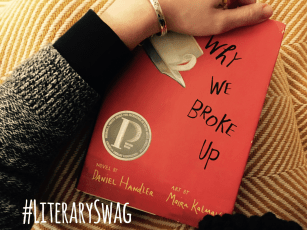
Finally, in March I will launch a new literary hashtag challenge that asks students to IMG_1801.PNGexhibit their reading lives outside of school.  Students will e-mail a Twitter or Instagram class account with literary images that include the following hashtags: #LiterarySwag (a hashtag for fashionistas who know books can serve as a stylish statement piece for any outfit), #Shelfie (a hashtag for beautiful bookshelves), #IReadEverywhere (a hashtag to highlight reading in unique places), and my favorite #BookFace (a hashtag that pushes people to be a bit more creative with their book covers).

By putting new books in students’ hands, I’m hoping to inspire a little competition, a lot of conversation, and a passion that will turn them into lifelong readers.


How do you reinvigorate students’ passion for reading?  What tips do you have to make it through the winter reading slump?


#3TTWorkshop — Making Workshop Work in AP English Part 2

This is a continuation of yesterday’s post — a conversation between Amy, AP Language teacher, and Jackie, new AP Literature teacher

Do you think it’s important that students read classic literature in an AP class?

Amy:  In an AP Literature class, yes. In classes leading up to AP Literature, yes, in sound bites and shorter texts. However, balance is key. Do we give students some say in what they read for our classes — not just what they may choose to read on their own? Are our students reading and growing as readers? Do we approach the text with the goal to help them do so, or do we approach the text and teach the book instead of the reader?

In a conversation the other day, one teacher said she likes to use classic literature because the conversations around the complexity help even her struggling students learn. Of course, that is probably true, but learn what? Those conversations will not help those students become better readers. The only way to become a better read is to read. If students are not reading the books we choose, we have to be okay with that. We have to admit that perhaps our goals for that specific unit, and that novel, are different than choosing the book because we know all students will read it. We have to decide we are okay will students not reading. I wrote a pretty long post about this whole debate here.

Jackie:  In AP Literature, yes, my students must read classic literature.  Because the AP Literature test Jackieclassroomboysis centered on the canon of “higher literary merit” books, I do teach set texts like Invisible Man by Ralph Ellison and Othello, but I stress from the beginning that in this course we are continuing to develop our reading lives as both academics and hobbyists.  Fortunately, many of my students arrive at my door with a passion for reading, but as I saw at the beginning of the year, far too many of them haven’t read a book for enjoyment since their freshman year.  Their lives become too busy and the first thing that seems to go is reading.

In turn, while I teach multiple whole class texts to fulfill the needs of the test, I also make space for independent reading.  The vast majority of my AP Literature students are seniors, and I know that this is their last English class before they move onto college.  In turn, my greatest goal beyond providing them with the necessary skills for deep critical thinking, is to reinvigorate their passion for literature and love of books.  

Where does teaching writing fit into your AP curriculum?

Amy:  I tell my students:  Ours is primarily a writing class. Before we even get settled in, students know they will write a lot — in all kinds of different modes and to a vast audience they build themselves. When I first changed my approach to teaching, I began with writer’s workshop. I’d heard Penny Kittle present, giving ideas from Write Beside Them, and that book became my curriculum guide. Today, I urge teachers who are thinking of shaking up their teaching, to take the first wobbly step into writer’s workshop. Depending on your book shelves and your library, it might be easier. Of course, it depends on your own confidence, too. If a teacher isn’t comfortable teaching writing, it’s probably because she hasn’t practiced being a writer herself. That has to be step number one. Write. Write beside your students so they see you struggle. Read articles and books on writing by writers. I’ve been reading the works of Donald Murray, a suggestion given to me personally by Penny Kittle. Murray’s books have enriched so many aspects of my writing life — and my teaching life. Try Learning by Teaching, and you will know exactly what I mean.

Jackie: It’s funny that you say your class is primarily a writing class; for me, AP Literature is primarily a reading class.  At the beginning of the year, I challenged my students to read 25 books…and I don’t just mean books of higher literary merit.  I wanted students to fall in love with reading again, which can be quite tricky when it comes to a class centered on analyzing books.  Even today during a mid-year progress presentation, a student talked about how he initially felt guilty picking up a YA book, but how this book helped him fall in love with reading again.  As you said, I too practice my craft alongside my students, only this year, it’s all about reading beside my students, which I do every year, but it’s fun to analyze many of the pieces for the first time with my students.  I don’t hold back when it comes to admitting my own questions about a text.  Learning beside my students makes the social process of the workshop model that much more authentic.  

Amy: Besides teaching my students to write arguments, since that is what the AP exam is all about, I also teach my students to write everything. We start with narrative, move into information, determine the difference between persuasive and argument, and practice research and synthesis as we go. My students write on their blog, usually about topics they read about in the news, although I’m going to try to mix this up in the spring and open their topics up to ones they find in their independent reading.

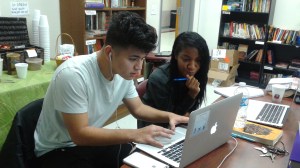
Diego and Tia deep into discussion around revisions.

Diego and Tia deep into discussion around revisions.

Blog writing is practice writing. I read as many posts as I can get to, and I try to leave feedback that helps the writer grown. The whole process starts out rough. Students think they they can pour out their thoughts on the page and then publish without doing much revision. We talk about this. We talk about audience, purpose, form. We even explore what Bloggers do to appeal to their audiences, and we try to build a readership (although I need to do a better job and take more time on this.) The whole point is to expand the classroom — to give my readers a reason to write that is other than Mrs. Rasmussen said so. Does every student buy in? No, but I get many more students to buy in to becoming writers, and many of them ask me if they can write on their blogs more than I require.

Of course, we also move through process papers, using mentor texts, studying the moves of writer’s, mirroring and modeling his or her craft, practicing revision and revision and revision before finally publishing. This year we’re writing about four of these essays a 9 weeks, which isn’t as much as I would like, but it’s a good amount for my writer’s this year.

Jackie: I am building from the bottom up this year.  With the help of a phenomenal mentor, Sheridan Steelman, I am learning how to marry the workshop classroom with the traditional AP Literature curriculum.  AP Lit is all about recognizing the beauty of language and the craft moves an author makes as they frame an idea or concept.  I’m that weird teacher that is so moved and excited by my students recognition of beauty in a piece that I jump out of my chair and cheer.  It’s okay though, I’m surrounded by word nerds!

During the first half of the year has involved analyzing writers’ craft to gain a better sense of the author’s goals and purpose.  We do write plenty of analysis essays, some being short timed pieces while others are lengthy explorations of deeper themes.  We also co-write papers in small groups, which forces students to rely on one another as they tackle the writing process.  Next semester I look forward to exploring more creative writing outlets as students mirror some of the craft within their independent novels.

Above all, my favorite writing my students do is the writing in their critical reading notebooks.  I love thumbing through the raw reactions to students’ YA literature and personal reading novels as well as the the pages of scribbled notes on characters and connections from their novels of higher literary merit.  
Join the conversation. What ideas do you have for a balance of choice and required in an AP English class? How do you manage the writing?

10 Pedagogical Must-Reads for Workshop Teachers

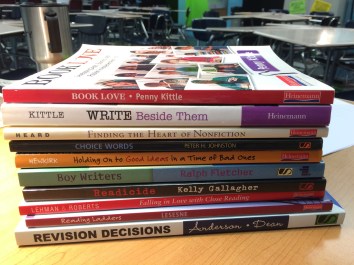
IMG_0650I met with my new student teacher a few weeks ago, and he asked me to borrow any books that might help him get going on the readers-writers workshop–the “theory” version of Jackie’s starter kit.  He’s been in my classroom before, so he knows the general routine and character of our work, but he wanted to know the ins and outs of how I thought and planned and conceptualized the whole thing.

I sat at my desk and looked at all of the titles I had on hand, remembering how influential reading them for the first time had been.  As a result, it was hard not to just dump my entire professional bookshelf onto a cart for him, but I managed to pick out a few titles that have guided me most adeptly in one aspect or another of my current classroom practice.

  1. Book Love by Penny Kittle – This was the book that helped to solidify my vision of an ideal classroom.  Before I read it, I had already been doing many of the best practices Penny mentions–writer’s notebooks, choice reading, personalized writing.  But I didn’t know how to bring it all together until Book Love.  As such, this is my #1 recommendation for any teacher looking to jump-start their individualized workshop curriculum.
  2. Write Beside Them by Penny Kittle – This book introduced me to the concepts of mentor texts, reading like a writer, and best draft/publication of writing.  I learned about quickwrites, constant revision, writing conferences, and a great deal more of what are now standard routines in my classroom.  This is the book for anyone curious about the big picture of writing instruction.
  3. Finding the Heart of Nonfiction by Georgia Heard – I was raised in the tradition of literature as containing mostly fiction and poetry, but Penny’s books helped me see the great value of nonfiction.  I wanted to know how to integrate it well into my thematic units, and this book helped me do that.  Georgia’s book is full of wisdom about finding the soul of good nonfiction writing and matching it to your students’ needs.
  4. Choice Words by Peter Johnston – This book taught me how to talk to students.  It is my #1 recommendation for anyone looking to address those pesky Speaking and Listening standards in the Common Core–this book teaches you about the delicate, volatile power of a few choice words between you and your students.  I re-read it every year, and it might be the most important book in this stack.
  5. Holding On to Good Ideas in a Time of Bad Ones by Tom Newkirk – This book is subtitled “Six Literacy Principles Worth Fighting For,” and Tom Newkirk certainly made me want to engage some of my former teachers in fisticuffs when I finished it.  This text is full of common-sense brilliance that will transform the way you think about why we teach reading and what kinds of texts we teach.
  6. Boy Writers by Ralph Fletcher – Why do my students keep writing about violent gun battles?  Why do they always ask if they can swear in their writing?  What’s up with the complete unwillingness of my boys to be vulnerable?  If you’ve asked yourself these questions…this book is for you.  Ralph writes about everything you ever wondered about boy writers and how to move them forward in their writing.
  7. Readicide by Kelly Gallagher – Schools have been killing reading for many years, Kelly argues, and then presents ways you can stop the slaughter.  He fires away at pop quizzes, assigned chapters, multiple-choice tests, and all the practices that steer our students toward SparkNotes.  Then he reveals ways to get students authentically engaging in literature in a way that doesn’t kill their love of reading.
  8. Falling in Love with Close Reading by Chris Lehman and Kate Roberts – After finishing Readicide and wanting to abandon the eight or so whole-class novels I once felt chained to, I wasn’t sure how to teach close reading skills.  This book answered that question for me, and more.  Chris and Kate reveal how to use poems, articles, short stories, and selections from novels to get kids interacting with the beauty and power of language in all kinds of texts.
  9. Reading Ladders by Teri Lesesne – When all of your students have finally found a book they will actually read–then what?  Teri Lesesne taught me how to help students climb a reading ladder of text complexity with this book.  It’s a tough battle to get all kids reading, but it’s even tougher to get them to all challenge themselves once they are.  Reading ladders are the solution to the increasing complexity question–now they’re a consistent part of my instruction.
  10. Revision Decisions by Jeff Anderson and Deborah Dean – After reading the first nine books on this list, I still wasn’t sure where grammar instruction fit in.  I knew to have students read like writers and learn from language and sentence structures that way, but I wasn’t sure how to structure my mini-lessons, until I read this book.  Jeff and Deborah helped me find strong craft study lessons and bring them into the classroom in a way that appealed to students and also benefited them immediately in their writing.

This is by no means an exhaustive list–That Workshop Book by Stephanie Harvey, Read Write Teach by Linda Rief, The Book Whisperer by Donalyn Miller, and many other integral titles were simply not on my shelf when I gave this stack to Mike.  But these top ten are ones I wouldn’t be the same teacher without.

What other titles are essential to your practice?  Please share in the comments!

Update:  Here are must-read folks that readers have suggested via Twitter and Facebook, as well as in the comments:

  1. Lucy Calkins
  2. Nancie Atwell
  3. Linda Rief
  4. Katie Wood Ray
  5. Donalyn Miller
  6. Don Graves
  7. Donald Murray
  8. Peter Elbow
  9. Ariel Sacks
  10. James Moffett
  11. Louise Rosenblatt

Starting with Why

“People don’t buy WHAT you do, they buy WHY you do it” ~Simon Sinek, Start With Why

I first heard of Simon Sinek from my son Zachary. He came home from work one day excited to share a TED Talk he’d listened to during his break. I had not seen my youngest son so animated in months. Zach had big dreams, but he made some poor choices that led to him having to wait a while after high school to start making those dreams a reality. This young man needed some inspiration. Simon Sinek gave it to him.

At Zach’s request, I watched Sinek’s TED Talk “How Great Leaders Inspire Action,” and talked with my son about Sinek’s message:

“There are leaders and there are those who lead. Leaders hold a position of power or influence. Those who lead inspire us. Whether individuals or organizations, we follow those who lead not because we have to, but because we want to. We follow those who lead not for them, but for ourselves.”

Zachin Taiwan

Elder Zachary Rasmussen

Zach watched that TED Talk multiple times, and my husband pulled Sinek’s book from a shelf in our hallway. “You ought to read it,” he said.

“I want to be that kind of leader, the one who inspires,” Zach told me, and he began to make choices based on his drive to help people instead of what he thought he would get out of helping people. As I write this, Zach is in Taiwan. He gave up his cell phone and his friends and jumped into learning Mandarin Chinese. His 6’4” frame dons white shirts and ties everyday as he rides a bike through Taipei, serving a full-time two year Mormon mission.

My son found the WHY that Sinek inspires, and it changed the direction of his life.


Sinek’s book is about identifying why some leaders are able, not just to sell a product, but to create a movement. He explains his purpose: “to inspire others to do the things that inspire them so that together we may build the companies, the economy, and a world in which trust and loyalty are the norm and not the exception” (7).

That reads like a nice idea for educators, too, doesn’t it? I do not know a teacher who does not want “to inspire [students] to do the things that inspire them.” However, according to Sinek many in business go about it backwards. By extension, I argue that many in education do, too. We focus on the WHAT and the HOW– like making learning relevant, engaging our students, teaching them grit, focusing on achievement, calculating grades, teaching a specific book, giving them a quiz — instead of WHY we teach our students in the first place.

Sinek says, “All the inspiring leaders and companies, regardless of size or industry, think, act and communicate exactly alike. And it’s the complete opposite of everyone else.” They start with WHY. Instead of a focus on the WHAT they produce or sell, or HOW they produce or sell it, they focus on WHY they produce and sell it in the first place. Apple, for example, obviously sells computers. That is their WHAT, but their WHY is to challenge the status quo. It always has been. Stay with me here with Sinek’s explanation:

“A marketing message from Apple, if they were like everyone else, might sound like this:

We make great computers.

They’re beautifully designed, simple to use and user-friendly.

Wanna buy one?

When we rewrite the Apple example again, and rewrite the example in the order Apple actually communicates, this time the example starts with WHY:

Everything we do, we believe in challenging the status quo. We believe in thinking differently.

The way we challenge the status quo is by making our products beautifully designed, simple to use and user-friendly.

And we happen to make great computers. Wanna buy one?

Apple doesn’t simply reverse the order of information, their message starts with WHY, a purpose, cause, or belief that has nothing to do with WHAT they do” (40-41).

Now, let’s think about this as educators:  Most of the time, we think and talk about WHAT we do. “I teach English,” or “I teach high school,” or even “I teach kids.” Sometimes we talk about HOW we do it. “I teach readers and writers in workshop,” or “I advocate for choice independent reading,” or even “I teach To Kill a Mockingbird, ” or “I teach Hamlet.” These are different from WHY we teach and have nothing to do with what motivates us to greet our students each morning, armed with carefully crafted lesson plans, and a smile.

According to Sinek, when we focus on WHAT we do instead of WHY we do it, we are like most of the businesses and companies in the world that drive their work with manipulations and punitive rewards, which might work in the short-term, but do not breed loyalty and long term change. We see this in education all the time:  threats of in-school suspension and failing grades, mandatory tutorials, new test-prep programs, increased numbers of safety nets designed to keep students from failing, changes in grading policies, and more. “There are only two ways to influence human behavior: you can manipulate it or you can inspire it,” writes Sinek. Most decisions we make to motivate students are based on manipulation, and we fail to inspire long-term change. No wonder we see the same students in the same trouble year after year. When we define ourselves, or our schools, by WHAT we do, that’s all we will ever be able to do (45), and that is not enough “to inspire [students] to do the things that inspire them,” or to build a world where trust and loyalty are the norm. We need what Sinek calls “inside out thinking.” To inspire lasting change, we must start with WHY.

Let’s take that example of Apple from before and apply it to our schools. If we are like everyone else, we might talk about our school like this:

We teach high school.

Our school culture is spirited and sound. Our curriculum is rich. Our test scores are high.

Wanna come here?

When we rewrite the example again, and rewrite the example in the order an inspiring school leader actually communicates, this time the example starts with WHY:

Everything we do, we believe in challenging our students’ thinking. We believe in genuine and individual inquiry.

The way we challenge our students is by making our school safe and innovative, with passionate and knowledgeable teachers who are caring and compassionate, who cater to the needs of all students.

And we happen to graduate honorable and educated citizens. Wanna come here?

Does that example make you feel a little different?

As I read Sinek’s book, I kept imagining what his argument looked like when applied to education, but more specifically, I kept imagining what it would look like applied to me as a literacy leader in my classroom. The way I talked about teaching was like everyone else I knew; I focused on what I did as an educator instead of WHY I did it.

I taught AP English Language and Composition. I taught skills to pass a test. I taught students to love books and to like reading. I taught students to write.  Although I had changed my instruction from when I first began teaching, from whole class novel studies with little writing instruction, to readers and writers workshop with choice, modeling, and mentoring, I still struggled. I struggled until I turned my thinking inside out. I took that example Sinek uses to explain what makes Apple such an innovative force in the market and applied it to my belief about myself as an educator and how I make that belief happen in my classroom.

See how I start with WHY:

WHY:  Everything I do as a teacher, I believe in helping my students identify as citizens, scholars, and individuals whose voices matter. I believe our world is better when individuals understand their value, believe in their capacity to cause change, and take action to better the world around them.

HOW:  The way I challenge my students is by making my classroom safe and inquisitive for my individual learners, with instruction that centers on trust, esteem, equity, and autonomy. Through the rituals and routines in my workshop classroom, students gain a sense of belonging, identify themselves as readers and writers, develop their voices, advance in literacy skills, and take risks that have the potential to change their worlds and the world around them.

WHAT:  And I happen to teach English by modeling my reading life and writing life.

It works.

My readers and writers advance because they know we are in the business of learning about ourselves and our world — together.

Simon Sinek is right:  “[Students] don’t buy what we [teach], they buy why we [teach] it.”

My challenge for you:

Follow Sinek’s model like I have above, and write your WHY. Please share it in the comments.

Five things you can do to guarantee your students will read

“Pull up a chair. Take a taste. Come join us. [Books are] so endlessly delicious.”
― Ruth Reichl

I’ve spent a lot of time with the love birds my children gave me for my birthday. They are beautiful. Marianne and Colonel Brandon And scared. I made the mistake of not reading enough about them before I tried my hand at training. Now, I am having to back track just to get them to like me. I knew better. Should have done my research.

It all starts with trust. Every day I put my hand inside the cage, hold it there, and just talk. I talk about the weather — it’s been quite tragic in north TX lately. I talk about the book their names come from — Sense and Sensibility. (My daughter dubbed them Marianne and Colonel Brandon.) I talk about how we will be the best of friends if they will just trust me.

Colonel Brandon bit my finger and held on so hard I stamped my feet for five full seconds hoping he would let go.

I’ve even tried speaking my limited Spanish. (The birds came from a Mexican vendor at an outdoor market.)

“Hola, buenos dias.”

Sitting on the floor near the cage is my school bag. In it is my conferring notebook. It holds a roster with check marks for books read and pages for each student where I record our conversations about books and reading.

This morning I was finally able to get Marianne to step up on to a perch and gently pull her from the cage. She sat on the top, eating happily on a millet twig. Progress.

I flipped through the notebook, remembering conversations I’ve had with students this fall.

“I used to love to read,” Henry told me, but then I didn’t like textbooks so I didn’t read anything again until 8th grade.

“What do you mean textbooks, you mean like an anthology of stories and poems and such?”

“Yes, those,” he said, “I hated those, so I just didn’t read anything in middle school. Then my teacher in 8th grade let us choose the books we wanted, and I read a ton. Hunger Games, Divergent, all those dystopian books. Then in 9th and 10th it was back to textbooks. I stopped reading.”

Henry was a hard sell at first. I’d already set up the routines in my reader’s workshop classroom. He missed the read arounds, the notebook set up, the initial book talks with the titles I know students love every year. And just like with my birds, I started wrong with Henry.

I expected him to step up without question into our reading world. He didn’t.

I had to back track and build some trust. I’d do a book talk and then set the book not far from him. I’d talk to other students about their reading near enough so Henry could hear. I’d ask Henry questions and I’d listen to his answers, so he would know I cared about him as a person more than as a reader.

And Henry started reading.

Henry has read four books since September when he joined my class:  Article 5, Friday Night Lights, Peace Like a River, and Labron James’ Dream Team.  Not bad for a young man who went two years without reading anything in 9th and 10th grade.

For any teacher who says independent reading just doesn’t work for you or your students, I issue this challenge:  Backtrack and try again.

Five things you can do to guarantee your students will read:

  1. Read. The more you read books you think your students will enjoy, the more you will be able to talk about books your students will enjoy. Don’t have a clue about YA? Read anything by Matthew Quick, A.S. King, Jandy Nelson, or John Green (my personal favorites). You’ll have a good start.
  2. Share book talks daily. Talk about books you know students love. If you don’t know titles, ask your librarian for help, read book lists like this one, read lists we’ve shared in previous posts.
  3. Show book trailers. I used to post book trailers on this blog. You’ll find many post with trailers, interviews, and other ideas here.
  4. Get students talking. The more students talk to one another about their reading the better your chances of getting all students to read. One favorite activity in my classroom is speed dating with a book.
  5. Give students time. I heard it first from Penny Kittle:  “If they aren’t reading with you, they are not reading without you.” We must give students time to read during class. Too many teachers and administrators think silent reading is not a good use of instruction time. FALSE. The only way to become a reader — or to become a better reader — is to read. If we want students to develop the habits of life-long readers, we must help them develop the habits in class where we can help them 1) stay focused, 2) learn what readers do when they get stuck, 3) practice choosing books for learning and for pleasure, 4) make plans for future reading.


What tips can you share for anyone who’s struggling with independent reading? Please leave your suggestions in the comments. Thanks!


The Best Gift You Can Give Your Students

A few weeks ago, when I sat down to confer with Asia, she told me that she bought me a Christmas gift. She was really excited about it. “I’ve never bought a teacher a gift before!”

She’s a senior in high school.

img_0731

My scarf from Asia

I asked her why she’d never bought a teacher a gift before. She thought for a moment. “No teacher ever gave me respect automatically, like I deserved it.”

It breaks my heart that in twelve years of public education, this girl never felt that a teacher respected and cared about her.

“How did you know I respected you?” I asked her. A few other kids sitting with us answered this question too.

“You talk to us every day, like we’re adults, about our learning, and you really care what we say.”

We confer.

“You do all our assignments with us so we know they’re not busywork.” This from Shailyn.

I write beside them.

“You always expect us to know more than we do, and you don’t take BS excuses about why our work isn’t done,” Jocelyn said.

I have high expectations.

“You know exactly what your students are capable of,” Jocelyn further explained.

I know them, well, through frequent talk about their choice reading and writing.

“You just seem to really like me, and see me,” Asia finished.

A few days later, she eagerly presented her gift to me, and waited eagerly for me to open it.  It’s a lovely seasonal scarf much like the ones I always wear–a very thoughtful gift that, when I thought about her reason behind giving it and combined that with my pregnancy hormones, made me completely bawl.  I love it, because Asia gave me much more than just this scarf–she gave me proof that my teaching is important, if only just to her.


Readers and writers workshop is about more than just nurturing literacy skills–it’s about nurturing people, their thinking and creativity and confidence.  Conferring isn’t always about teaching into a standard–it’s often about just talking with another person about what’s in your mind, helping to flesh it out through talk before writing.  Writing beside your students isn’t just valuable because it’s modeling–it’s essential to creating a true community of learners committed to growing as readers and writers and thinkers.

This holiday season, give your students the best gift possible–respect, love, value, and the equal footing that comes with shared learning and the collaborative creation of knowledge.