Tag Archives: AP English

Try it Tuesday: Taking a line

My AP Lang and Comp students have been writing. A lot.

We’ve analyzed arguments and written short analysis essays. We’ve read powerful OpEd pieces like this and this and this, and we’ve written responses and modeled these writers’ craft moves. We’ve written arguments on our blogs and had a bit of fun modeling Neil Pasricha’s Awesome writing as we practiced using figurative language and specific examples in our essays.  We’ve read about the importance of serious reading, and written one-pagers to defend, challenge, or qualify. Lately, we’ve studied the work of Bryan Stevenson in Just Mercy and watched his TED talk.

I sensed my students needed something a little different, but I needed to keep them writing. So with just one class last week, instead of using a full mentor text to inspire great writing, we used a sentence.

I pulled this quote from Stevenson’s talk:

screen-shot-2016-10-30-at-2-47-56-pm

And then I asked students to write anything they wanted: poems, essays, stories, whatever. The only requirement? Use that line somewhere in your own writing.

Then, on Friday, students moved to our “writer’s chair” and shared their writing. Our community responded with sticky note blessings.

Several students were reluctant to share. “Mine isn’t good,” more than one student said.

“We are a community of writers,” I encouraged. “This is a safe place, and we all want to know what you have to say. Truly, no pressure.”

After a few volunteers, Martina finally rose to share her response to Stevenson’s quote. Her voice was soft yet powerful:

It’s the sigh of relief and relaxed muscles from knowing you did the right thing. It’s liberating and lightweight–the world suddenly doesn’t seem to be positioned heavily on your shoulders. It can be the doubt and little knock of guilt on the back of your head knowing you did the wrong thing. It’s the tempting feeling of doing correct actions, but not being able to when you’re being held against a wall by your own conscious.

It’s difficult to see greener grass on the other side of the horizon when it’s fertilized with the negative aspects of your actions. Learning to realize and move on from what cages you in is the only form of developing into a healthier person–sometimes this ends up being all it takes for it to be “The right thing to do.”

“Always do the right thing even if the right thing is the hard thing”

As kids we grow up with love from family, the goodnight kisses from your parents after a bedtime story, the reassurances of  “It’s Okay” after a tumble on the playground, and the form of love that lingers in the atmosphere when you’re around the individuals that raised you. As we grow our love transforms into something deeper, something more emotional, something dangerous. It might have started with a crush on the new individual at work, the butterflies twisting and turning in your belly are a pure indicator that you’ve deeply fallen in a midst of hearts and dazy clouds of love.

Often times, things go wrong. Abusive relationships exist and they are common amongst the men and women in our society. Nearly half (43%) of dating college women report experiencing violent and abusive dating behaviors, Nearly 1.5 million high school students nationwide experience physical abuse from a dating partner in a single year, and one in seven men age 18+ in the U.S. has been the victim of severe physical violence by an intimate partner in his lifetime.

The right thing in this case is following your heart. Men and women trap themselves in abusive relationships because loving the one person that hurts you seems to be the right thing. Other times, allowing yourself to step away from the relationship/situation is not an option and it becomes a tough obstacle to get out of the arms that hold a restricting grasp on you. There’s always help, there’s always somebody there. Reach out for the right motives even if it’s the hard thing to do.

Never let a person of interest degrade your actions or make themselves superior to you. The most damaging thing to do–and often hardest–is staying in an abusive relationship. Love is a beautiful thing, don’t let anybody damage that for you. Instead, do the right thing for your health, mind, and body without the harm of anyone or anything. 

Two students shared poems, others shared why they think that quote is important, and others wrote arguments of a sort like Martina’s. All were important reminders to me to let students choose how they show they are learning.

Of course, the shared experience of reading their work was pretty fabulous, too.

One of the best things I can do as a teacher of writers is to offer opportunities for students to share their writing. I know the more we share with one another, the better our writing will become. If I remain the only audience (or even mostly their only audience — my students do write on their blogs and leave feedback for each other), some students may never make the connection between writing and truly conveying meaning. Too many just care about the grade.

By just taking a line last week and then asking students to write whatever they wanted, and then sharing… we built trust in our community and we celebrated that we really are on our way to becoming better writers.

What have you tried lately that improved some aspect of your classroom community? Join in the conversation and share in the comments.


ftc-guideline-%22affiliate-links%22

Mini-lesson Monday: Deeper Reading


I posted this on the TTT Facebook page on Saturday, but I think it also makes for a good mini-lesson, so here goes:

I went to a session by Kelly Gallagher at #IRC2016. He shared ideas from his book Deeper Reading, combining ideas he’s using with his students now. I was reminded of his thinking around thinking from a text: What does the text say? and What does the text not say?

Gallagher shared a few images from the news, a fact statement, an ad for a truck, and he modeled how he asks his students these two questions as ways to get them thinking about their reading.

I’d heard these same ideas before, but they resonated with me again. Critical thinking matters. We cannot get thoughtful writing, if we are not helping our students to think thoughtfully through texts.

Objective: Read a visual text, make observations and inferences that push critical thinking about a text. Draw conclusions and write your thinking.

Lesson:  Tell students that critical readers don’t just pay attention to what a text says, we also must pay attention to what a text does not say. This ties into the idea that everything is an argument — sometimes overt, sometimes covert. Bias also comes into play. So to get into some critical thinking today, we’re going to watch a short video about the refugee crisis.

Draw a T-chart. Label one column with “What does it say? and the other column “What does it not say?” As you watch the video make lists that answer these two questions.

Watch the video “Your phone is now a refugee’s phone.”

After students have time to do their own thinking and writing their lists (and maybe watch the video again), have them talk in pairs or small groups about the things they noted.

Hold a short whole class discussion about what it does for our thinking when we consider what the author, or in this case, the video creator, intentionally leaves out of a text.

Follow up:  Ask students to find their own text and apply this same thinking. Tell them they can find an advertisement, a chart or graph, an info graphic, another video — any text that they can answer the following questions:

What does the text say?
What does it not say?
Why does it matter?

Continue to ask students to consider these questions with a variety of texts throughout the year. This may also serve as a good exercise to help students find writing topics. Bonus!


Do you have any videos, ads, or short text suggestions that you use in similar ways to get students thinking critically? Please share them in the comments.


ftc-guideline-%22affiliate-links%22

Mini-lesson Monday: Remembering 9/11 and a study of language

Our students are too young to remember the events of 9/11. And while we are not history teachers, I do think we have a responsibility and an opportunity to help them try to make sense of the horrors of that September morning and how it impacts their lives today.

hyrum

Pvt. Hyrum Chase Rasmussen

In church yesterday, the congregation stood and sang three verses of “The Star Spangled Banner.” This song has new meaning for me since my son Hyrum joined the Army this summer. It may have new meaning for you if you’ve been following the Colin Kaepernick-taking-a-knee-event-fall-out-and-discussion. I want my students to be able to make sense of their world and one way I can help them do that is to provide them with thought-provoking pieces that help them make connections. Maybe one of these texts will help them find their own “new meaning.”

In honor of September 11, the every day people and every day heroes who lost their lives, the families who still mourn loved ones, the soldiers who valiantly died facing foes in foreign lands, and the men and women willing to serve today in a time of unrest and war, this is the lesson that I will share with my students today.

Objective:  Using the language of the Depth of Knowledge levels, students will react to a first-hand account of 9/11 in their writer’s notebooks. They will formulate ideas on how this one story relates to our growing theme of what it means to be courageously human. Students will then analyze a text and compare the writer’s use of language to a text read previously.

Lesson:  We’ve already discussed the question, “What does it mean to be courageously human?” a phrase I borrowed from a text we read last week. (I read Chequan Lewis’ piece as a read aloud, wanting students to just listen and enjoy his use of language. Then, later we read it again and analyzed the literary and rhetorical devices he uses to create the meaning. I modeled how to annotate and asked students to write their own notes in the margins — something I will expect them to do throughout the year.)

Today I will remind students to read texts with pens in hand, noting the writer’s interesting use of language, any points of confusion, any words they don’t know, the structure of the text, and any and all devices the writer uses to craft meaning. Today’s text is the masterful piece Leonard Pitts, Jr. wrote September 12, 2001.

After students have time to read, annotate, and discuss in small groups, we will come together as a class and craft an anchor chart that details the moves Pitts makes in comparison to those craft moves made by Mr. Lewis. I will charge students to model these moves in their own writing throughout the year.

Follow up:  The anchor chart will hang in the room as a reminder that writers are intentional in the moves they make as they craft meaning. Students will be expected to be intentional in their own writing as they work on various forms of writing in class and on their blogs this year.

#FridayReads — Picture Books in AP English

Sometimes speakers make you want to write. Last week when I listened to Lester Laminack was one of those times.

The North TX Council of Teachers of English Language Arts one-day conference was one week ago today. As president I had the honor of calling the meeting to order, and looking out at the audience of almost 600 ELA teachers, grades K-12, I could not help but think how fortunate the children in Texas are to have such dedicated teachers, teachers who want to help kids write, teachers who practice writing themselves.

Listening to Lester’s keynote as he talked about his writing process made my memories swirl, and my fingers get itchy.

I was not the only one.

Screen Shot 2016-06-17 at 3.29.59 PM

I left wondering:  What if more teachers stirred that kind of memory moment in the students we want to move as writers?

Picture books have that power. Elementary teachers know this. They read books aloud to little writers. They talk about meaning around moments their students can relate to.

Sometimes I think we secondary teachers forget the power in stories. We forget that seemingly simple things can spark big thinking. I want to remember.

Here’s a list of 15 of the books I will read with my not-so-little writers in the coming year: Screen Shot 2016-06-17 at 4.45.37 PM

Saturdays and Teacakes by Lester Laminack

All the Places to Love by Patricia MacLachlan

The Other Side by Jacqueline Woodson

The Hundred Penny Box by Sharon Bell Mathis

Is There Really a Human Race? by Jamie Lee Curtis

Harold and the Purple Crayon by Crockett Johnson

The Dot by Peter H. Reynolds

Chrysanthemum by Kevin Henkes

Henry’s Freedom Box by Ellen Levine

The Wretched Stone by Chris Van Allsburg

I Want my Hat Back by Jon Klassen

It’s a Book by Lane Smith

The Dark by Lemony Snicket

The Secret Olivia Told Me by N. Joy

Beautiful Oops by Barney Saltzburg

And I’ll probably use several of these:  wordless picture books

Please share your suggested titles for picture books you use in your secondary classroom.


Imagining Our Ideal Bookshelves

My students are selfie experts; somehow, through practice, they have discovered the perfect angle, the right light, the exact method to fit ten people into one frame—while still managing to make their head look normal-sized.  In those fleeting snapshots, they capture the essence of who they are (or at times who they want to be), if only for a second.

I believe that the books we read can serve as small photographs of our hopes, dreams, desires, and curiosities.  They provide a  snapshot of who we were, who we are, or who we want to become.

FullSizeRender-2

Julia’s highly organized ideal shelf

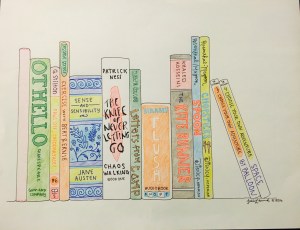
As a final project, my AP Literature and Composition students completed an “ideal bookshelf,” inspired by the book My Ideal Bookshelf and a quick write I completed in Penny Kittle’s summer class two years ago.  The assignment was relatively simple—create your own ideal bookshelf of the books that “represent you—the books that have changed your life, that have made you who you are today, your favorite favorites” (La Force xi).  Since this is an AP Literature class, I added a twist—I wanted students to stock their shelves with books that not only transformed them as a person, but also developed them as a reader.

As each student presented on their shelf, they transformed from self-assured seniors to wide-eyed children who relayed the story of the first book they had ever fallen in love with.  Many of them spoke of how they either found or developed their passion for art,

FullSizeRender-3

Max’s science-based book shelf

coaching, theatre, computers, and physics through books they had found over 18 years.  The books they listed did more than just challenge them as readers; these books had the power to inspire, entertain, and heal.  As Claudia wrote about The Sisterhood of the Traveling Pants, “I have no real idea what is so special about it, but I’m not going to question its magical powers when it does so much good for me.”


What I loved most is how these shelves found life through details; Julia’s shelf held her drawing notebook, Cam’s his favorite cookbook, and Payton’s was adorned with her grandmother’s locket, which she uses as a bookmark.  Some shelves were neat and orderly, perfectly stacked, while others, like Sammie’s were a bit more scattered.  As Sammie put it, “I don’t know what I want to do as a profession; I am still figuring it out.  That partially explains the disarray that is my bookshelf.  I couldn’t decide which would be more practical, stacking or leaning.  The result is a bookshelf with a little bit of both.”

FullSizeRender-1

Sammie’s slightly scattered ideal shelf

As my seniors complete the next three weeks and begin the process of preparing for college, I want them to walk away with the writing and analytical skills we’ve honed all year, but more than anything, I want them to remember why they fell in love with reading in the first place.  I want them to question why books are powerful and understand that the universality of a novel’s message can change readers.  I want them to read for knowledge and depth and challenges, but I also want them to accept that not everything needs to be analyzed, dissected or picked apart.  In fact, sometimes we read for escapism, for love, for adventure.  For many, this might be the last English class they take.  Hopefully, it is only the start of a lifetime of reflective reading and ideal bookshelves.


#FridayReads & Becoming (Twitter) Literary Critics

I am beat. My students are beat. I know you know exactly how that feels.

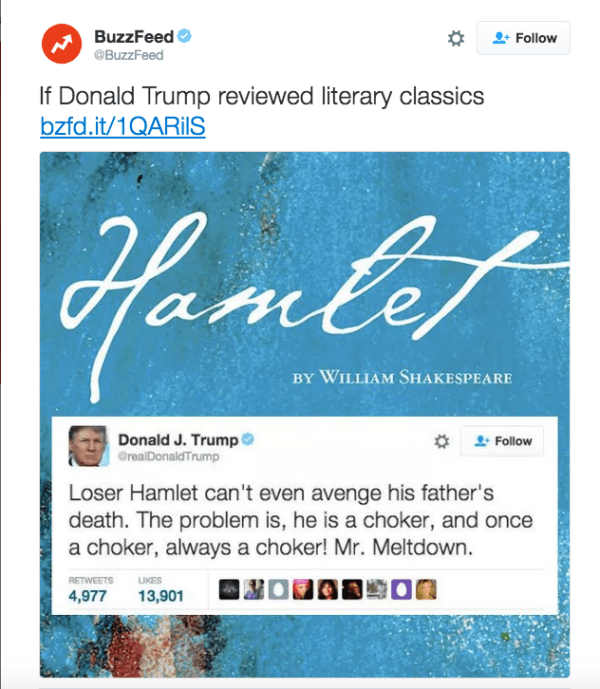
In an effort to lighten the mood but keep the idea of books and reading alive, my students and I had a little fun with Donald Trump. Now, it doesn’t matter what you think of the man or his politics, his tweets make pretty good mentor texts.

Screen Shot 2016-05-26 at 7.38.47 PM

I’m not the only one to think so — actually, I got the idea from someone Buzzfeed. Some clever writer put together a list of tweets, written as if Mr. Trump critiqued literature. Brilliant.

Screen Shot 2016-05-26 at 7.40.19 PM

So to have a little end-of-year fun, I asked my students to consider Trump’s sentence structure, and then write their own reviews based on the most recent books they’d read. Really, my only requirements:  a clear tone, but they didn’t have to be mean, and correct spelling and punctuation.

Here’s a few for your reading pleasure. Of course, the review makes the most sense if you are familiar with the books students refer to — I get that not everyone is as versed in YA like they might be the canon.

(Side Note:  To those who say students will never move beyond YA or ‘easy’ reading when it’s all about choice. Um, wrong again.)

What kind of end-of-year fun with books and reading — or anything else– have you had with your students? Please share in the comments.

Writing Myself Out of a Wreck

Note: This post was supposed to run this morning. Must not have clicked the right button last night. So, here’s my thinking of late. Better late than not at all. (I think that’s the mantra of many of my students.)

I have a confession:  I am pretty much a wreck.

I could blame it on my son who joined the Army and left for basic training the afternoon of Mother’s Day, or I could blame it on another son who called to say he’s marrying a girl he’s known a month and I’ve never met, or I could blame it on this Empty Nester thing that’s barely three days new and haunting me with shutting doors and creaking floors.

I could blame it on the AP Language exam my students take today.

It’s the same every year — well, not that son part, thank God — but definitely the wreck part.

Every year I wonder if I taught enough, had them write enough, gave enough feedback. I wonder if I helped them grow as critical thinkers and accomplished writers. I wonder if they will read the prompts correctly. I wonder if they’ll answer the questions. (I’d be happy with a thesis statement.) I wonder if they’ll remember we learned to read footnotes. I wonder if they’ll cite their sources. I wonder if they’ll write enough to show they are bright and honest and eager and loving young adults.

Oh, wait.

That’s right.

No matter how my students do on this high-stakes test, the important things — the things that matter to me, and should matter to the world — are the things that cannot be measured in 55 multiple choice questions and three essays.

I just needed to write myself into that reminder.

_________________________________________________________________

Today I read  Enjoy the Best Year Ever with a Mantra by Ruth Ayres and loved her Why I Write mantra. I took up the pen to write my own. It’s still a work in process, but I’m kinda likeing it, and I’m no longer a wreck.

Why I Write

I write to make myself feel better.

I write to discover what I want to say.

I write to hear my voice within the chaos.

I write to play with colorful words (and pens).

I write to show my students I am a writer — and because it’s hard.

I write to share my thinking, my hoping, my planning, my longings.

I write to be remembered and to be worth remembering.

I write to know I belong.

I write to advocate for literacy and learning and the lives of my kids.

I write to become a better reader (and I read to become a better writer).

I write to tell stories.

I write to walk the walk and talk the talk of my English teacher self.

I write because it is better than the spa.


Have a go at it. What is your mantra?


Poetic Rhetoric — Spoken Word Poems in AP Lang

For a long while now, I’ve wanted to write spoken word poems with my students.

I use Sarah Kay’s “Hands” at the beginning of the year to start students thinking about their lives and the important moments that shape them. We draw hands in our notebooks and fill them with words that represent our memories. Like many of you, I first did this myself with Penny Kittle, and now I draw a hand in every notebook as one of the first pieces I write in it.

I use Shane Koyczan’s “To This Day” and ask students to write a response to it. Sometimes they tell me things that break my heart. Like the fall on the first day of school when two different girls in two different classes wrote about the abuse they experienced from their fathers at home.

These and other poems students find interesting and inspiring, and while they’ve always worked as never-fail quick writes, I wanted to challenge students to use all the skills we’ve focused on this year to write their own poetry. My student teacher, Zach, and I finally figured out how.

And students wrote some powerful poems with some perfectly poetic language.

We called the assignment:  Poetic Rhetoric. what-matters-most-in-life-are-quotes-and-stuff-that-tell-you-what-life-is-really-about_motto

The initial task read like this:  Craft a spoken word poem that addresses a personal conflict and/or a social issue, include rhetorical techniques and literary and rhetorical devices to convince your audience of the need for positive change. Perform your poem for the class live, or create an automated slide show with visuals, or a video recording as a way to digital.

Every day for a week we shared a different spoken word poem. Sometimes we wrote responses as a way to mine for our own ideas for topics. Sometimes we studied the lyrics, closely reading and analyzing structure, tone, and literary devices. We encouraged students to use the work of these poets as their mentors:  “Remember, we learn to write when we study good writing.”

We listened to “Paper People” by Harry Baker, and we talked about theme and sentences that hold the most weight, ones that might be his position statement.

We listened to “Education” by Aadil Malik, and we talked about evidence and examples that support the main idea.

We listened to “Touchscreen” by Marshall Davis Jones, and we talked about repetition, puns, and other literary devices that make language clever and meaningful.

We analyzed the structure of “To This Day,” and we talked about how Koyczan moves from self, to another, to another, to everyone as a way to finally get to his moving plea “to get a better mirror.”

Zach taught mini-lessons, reminding students how to use personification, puns, allusions, and fresh figurative language. We gave students time to write in class, and time to talk with one another, and time to talk with us about their process and their product.

We provided resources on how to write performance poetry like this and this and this.

And students wrote beautiful and meaningful arguments.

Most students performed their poems live in class. (I did allow for a teleprompter since I am the worst at memorizing myself.) We have a slam poetry night coming up on our campus in April. I hope many of my student will perform their poetry again there.

Here are the lyrics to some of the ones I personally enjoyed. I wish I had video of the performances. You’ll have to trust me — they were awesome.

Nefertiti Franklin:  WelcomeToStereotypesAA

Jennifer Melendez:  Find Your Charge, which includes an evaluation of her writing process

Kennedy Jenkins: Use Your Mind

Fabian Gutierrez: ADPoem

And here is an example of one of the poems published digitally. I love her language.

Jessica Ortiz:  People Love to Talk

Reminders to self for when I do this writing unit another year:

A. Take more time with topic selection. As with any writing, if students choose topics that are too broad, or they do not know enough about, the writing is harder to revise.

B. Meet with students more often. Conferring is essential to helping students find what they want to say. Too many students procrastinate and then think they can produce quality writing at the last minute. I must remember to confer at the beginning, the middle, and the end of the writing process. Schedule time for this.

C. Allow time for students to provide one another more targeted feedback. Although they met in small groups and talked about their writing, they did not use their time as effectively as they could have. If I will be more purposeful in modeling what a helpful feedback group looks like, students will be able to help one another more.

I love teaching students to write. I’m not sure there’s a better gift than reading their published work and seeing that they understand the power of their voices. Sometimes they blow my socks off with the force of their wisdom. I love it when they get it.

Have you used spoken word poetry in your writing class? How? What are your favorite poems?

The Winds of Change Smell Like Books

Everywhere I look, I see books. bookshelf

Open in the hands of students.

Shared at the hands of teachers.

I’m dreaming about books. Like the pursuit of the one that got away, I am chasing after unopened books in my sleep. Waking in a state of minor panic – When WILL I have time to read all of these books?  I need a prep period just to read. I need an extra hour in the day. I need a sabbatical.

In the days since TTT came to share their wisdom and enthusiasm with the English Department at Franklin High School, literary excitement is wafting through our hallways and it’s all about books, books, and more books.

Students are buzzing about books.

As I walked through the commons a few days ago, I saw one of my AP Language students, Maddie, reading during her free block. I smiled and walked on. Then, I stopped, turned around, and went back to talk with her.

It was the best move of my day.

Sitting on the table next to Maddie was a copy of A Monster Calls (Since I sobbed over this book and poured myself into sharing it  with students in a book talk a few weeks back,  I’ve acquired six copies for my classroom and not seen one of those copies in days. Kids are handing them off in the hallway. Meeting for coffee to discuss. Making their parents read it. It’s beautiful) and in her hands The Girl on the Train. I asked her how it was going. “Ugh! Mrs. Dennis! I can’t read fast enough. I need to meet my reading goal and finish this book so I can start A Monster Calls.”

I almost hugged her.
Okay…
I hugged her.
Maybe a second longer than was necessary, but I think we had a moment.

Only a few weeks earlier, before I had recommitted to book talks every day and conferring with kids about their independent reading, we had talked in class about how independent reading was going. Maddie had shared that while she likes to read, she wasn’t making time for it. She had been enthused earlier in the year, when getting time to read in class was something new and different, but hadn’t kept up with the expectation to read 2 hours per week.

I was reminded that Penny Kittle says teachers sharing their passion for books is contagious. In this area, I needed to do better.

While I was giving time to read, sharing lists of books to choose from, and piling books on the shelves, I had let my own passion for texts slip away into the haze of curriculum redesign, semester exams, and lesson planning. In essence, I was asking students to make reading matter without me. Not cool.

So, I grabbed a copy of Stiff, by Mary Roach and got reading.

Of course, I couldn’t put it down. Of course, I wanted to tell my kids all about it. So,  I shared my passion in a book talk, we ended up chatting about the use of humor in nonfiction, and my students were reminded that we are a community that makes time for what matters. READbooks

Reading matters.

And our commitment to that as teachers needs to be visible and constant if we are to have any hope in keeping kids enthusiastically discussing what they are reading and reaching for more.

My colleagues are buzzing about books.

I’ve been wonderfully lucky to work with brilliant and passionate English teachers for each of the thirteen years I’ve been in the classroom. In the past two years, I’ve even been lucky enough to be their department leader and do my best in recent weeks to facilitate our move toward workshop.

While we all share the very traditional love of To Kill a MockingbirdPride and Prejudice, and The Great Gatsby, our passion for reading runs so much deeper. In workshop, it’s our responsibility (and pleasure!) to get kids reading all manner of texts. Not just glancing in the direction of a book, but digesting it.

In short, we know that to get a majority of our students excited about reading, their teachers need to be readers.

Tickled to share a passage, can’t wait to see what you think too, ask a million questions, highlight in multiple colors, adorkable readers. The classics have a role in this, but so do countless other styles, genres, and soon-to-be classics.

Our district has blessed us with a huge surge in classroom library materials in preparation for our shift to workshop instruction. This puts dozens of books in the hands of teachers who are now chatting about Patrick Ness in the hallway between classes, feverishly searching for texts that are suddenly in high demand (Anyone have a copy of Columbine? They are ALL checked out! How about The Nightingale? I’ve got a wait list. With six names on it. For a book)and frequenting Thriftbooks.com to compare how much money they have saved to add even more titles to their libraries.

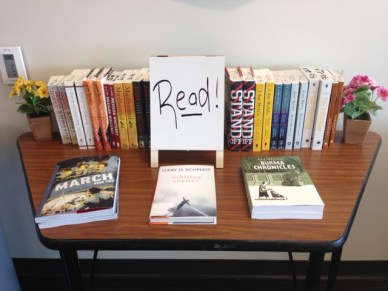
When in doubt, promote. We enlisted the help of some art students and had a poster made to show how super cool it is to read. A nicer group of people, you will never meet, but this poster says read, or else.

Reading Poster (1)

The students think it’s a riot…and have asked on more than one occasion which books we are reading in the picture.

Mission accomplished.

So, as the wind ushers in both spring and a journey with workshop, let the books come raining down as well. The more I see, the more I want to read. And the more I want to read, the more excited I get to prove to kids that we can all be readers.

How do you keep the beautiful buzz that surrounds books going in your classroom? Please share your ideas in the comments. 


5 Things I Need to Remember When Teaching my Writers

I know we’ve been posting mini-lessons on Mondays on this blog for awhile now, but today marks the first day of my spring break, and since my students and I just finished a fairly complex writing task, this is a good time for reflection.

don-graves-quoteMy AP Language students wrote arguments as spoken-word poems, and then performed them in class. (Or if they produced their poems digitally, which was an option for publishing, they projected them.)

Our process included reading and studying several poems. We watched YouTube videos of spoken word poems by Shane Koyczan, Harry Baker, Marshal Davis Jones and more. We analyzed structure, craft, and theme. We pulled out lines we felt held the weight of the poem and wrote responses to them, hoping to find inspiration for our own writing. We reviewed the elements of argument. We discussed the claims the poets make and how they use evidence (or do not) to support these claims. We spent workshop time thinking, writing, and revising our poems. And my student teacher Zach and I spent hours talking to writers about their writing.

I’ll share some of the amazing poems my students produced in another post. For now, here are some things my students reminded me I need to do better so they can do better in our next round of writing:

  • Topics matter. If I want my students to produce well-written texts, they must select well-chosen topics. Too often my writers choose topics they might have a passion for, but they know little about. This leads to vague superficial writing.

I need to take more time on the front end of the writing process to make sure all of my writers choose a topic that they not only care about, but that is specific enough to the task at hand. One resource that will help as we choose topics for other writing tasks is this tutorial from University of Arizona Libraries. I need to remember to slow down on the front end and help students select narrow topics.

  • Clear feedback matters. For this writing project, I only left feedback once on student drafts. It was not enough. Or it might have been — if students had read it. (Please tell me I am not the only teacher with this issue:  Students ignoring feedback.)

The best feedback is not when I leave comments on Google docs like I did for this project, but when I talk to them face-to-face and answer their questions. Students need to see my response to the work they have done. They need to see if I like it. They often misread, or don’t read, my tone in written feedback. I must remember to give them a balance of both — and a lot of it all along the way.

  • Sometimes more explicit instruction matters. In more than one conference, when I asked students why I didn’t see application of the mini-lesson in their writing, they said: “Oh, I thought that was just a suggestion.” Well, yes. But what’s the point of a mini-lesson — designed to help students write better — if they refuse to at least try it?

I know that we must teach the writer and not the writing, but sometimes without a little push to make specific changes, my writers just do not improve. I need to remember that with some students I must be more explicit in my instruction.

  • Accountability throughout the process matters. I was out of the classroom several days when students had writing workshop time to work on their poems. (Someday I’ll tell you about the standards revision work I’ve done with the TEKS Review Committee in Austin this year.) Although my student teacher was there, and my substitute — a former teacher and a sub my students know well — too many of my students clearly wasted the time given them in class to write. They are teenagers after all:  give them an inch and they take a mile. And they are major procrastinators. I think they are finally understanding that good writing takes time, but many are still not taking the time to produce good writing.

I need to do a better job at holding them accountable for working during workshop time. More exit slips. More sharing a favorite line or passage they’ve written that day. More purposeful formative assessment and personal evaluation of their writing processes.

  • Conferring (more) matters. The two days students shared their poems were exciting. So many were fantastic. So many clearly showed their understanding of how to write an effective argument — and how to be clever and creative with poetic elements as they did so. But quite a few did not.

As Zach and I discussed each performance and each poem, matching the writing to our rubric and assigning a grade, we became clearly aware of which students we conferred with the most and which students we did not. One of us would say: “She did exactly what we discussed in our conference,” or “That was something he and I talked about in his conference.”

The students we conferred with the most not only fulfilled the requirements for the assignment the best, they produced the most creative and convincing argumentative and poetic writing. And they knew it. Their confidence as they performed their poems was evident, and they rocked the house with their beautiful and inspiring poetry.

Taking the time to confer with every student — whether they want to talk about their writing or not — must be a regular part of the writing workshop. Too often conferring becomes optional when I get too busy or spread myself too thin. I must remember to schedule conference time into the lesson plans and hold myself responsible for making them happen — not once but several times for each student.

How do you know when your writing workshop is working?  Please share your ideas in the comments.