Good Writing Moves Us — THIS Writing Moves US

I want to include you in a celebration of the work of a student that represents several of my kids this year. If you teach, or have taught, ELL students, I know you will understand.

The last assignment was an intensive writing piece that we workshopped for about seven weeks. Writing in class almost daily, conferring regularly, and mini-lessons with mentor texts and modeling served as the routine. Students turned in their writing in three separate chunks, gave one another feedback at least three times, presented their final pieces (published on their personal blogs) as their semester exams. Formative assessments were student writing conferences and the checkpoints along the way. Summative assessments were a self-evaluation and a self-evaluation paired with my feedback from a rubric we crafted as a class.

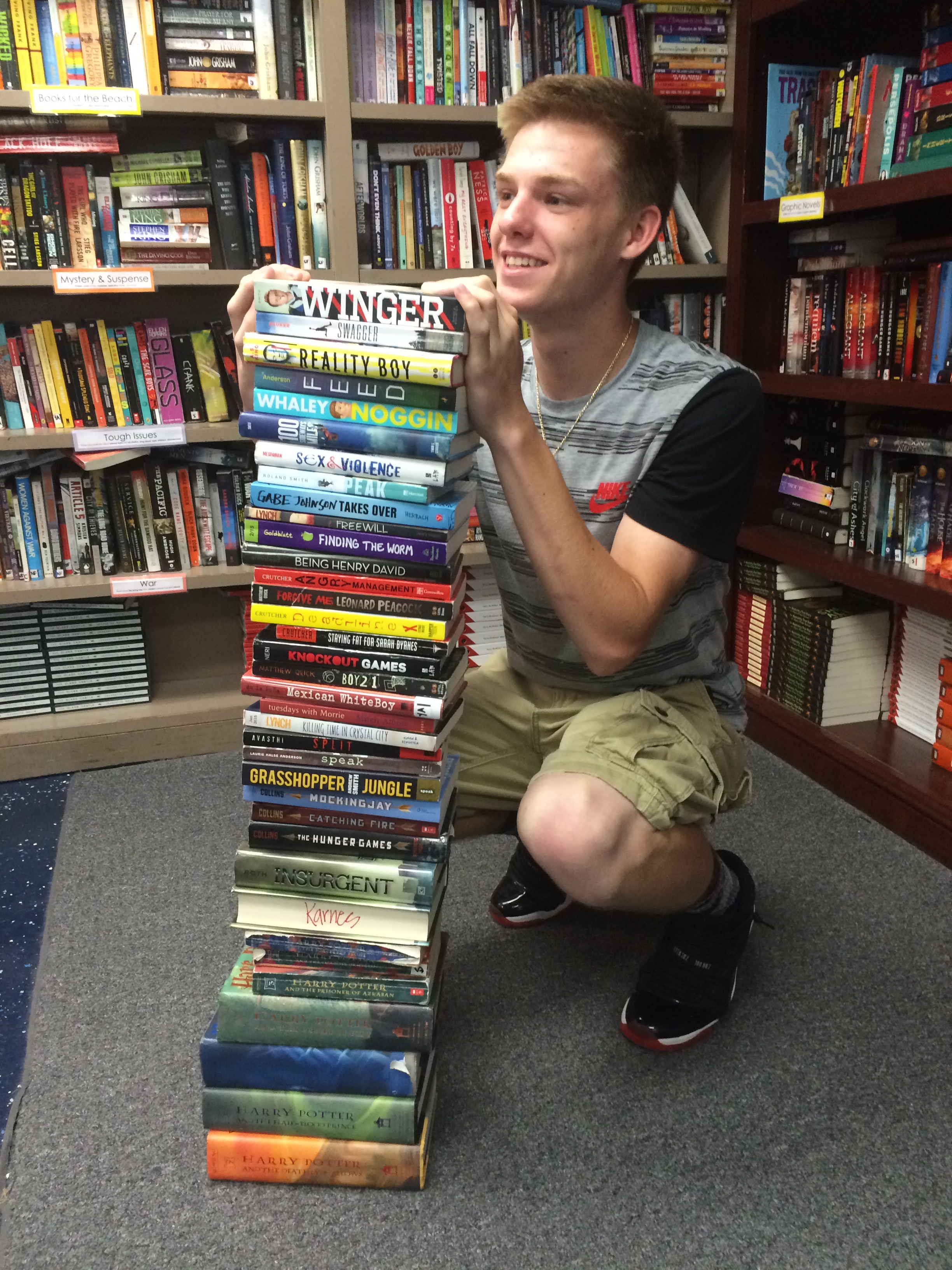
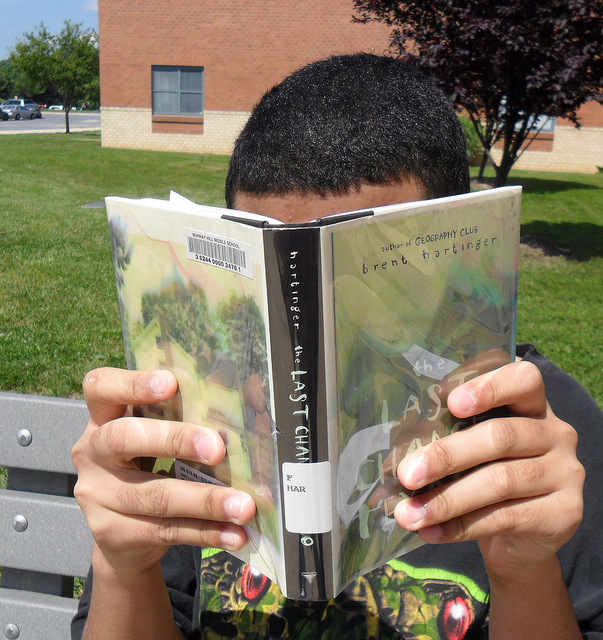
Biak with the book she loved the most this year. She read 12.

Please read the writing of Biak Par. The poems are original, and the story is her own. Just before school was out, I had to call Biak to my desk and let her know that she failed the state English II EOC. Again. That was nothing short of heartbreaking — for both of us.

Take several minutes and read Biak’s story. You will read the words of an improving and authentic writer. These words are elegant, poignant, and powerful. Good writing moves us — this writing moves us. 

Now, take a look at Biak’s writing from the beginning of the year— her first blog post is here, and her second is here.

Now, think about her end-of-year piece of writing. I know it is narrative, but you will note what I do — improvement. So much improvement. Voice, coherence, organization.

I wish I had another year with Biak, and several of her friends. We’ve come so far, and this is the work she should be allowed to celebrate — not a test score.

I know — preaching to the choir.

©Amy Rasmussen, 2011 – 2015

#ShelfieShare – Growing Your Library

FullSizeRender[1]Yesterday was our last real day of school, and it was a busy one.  My students spent our last class periods together sharing their final multigenre writings with one another, clearing out their writing portfolios, and packing up their notebooks.

They also flooded me with classroom library books and sheepish smiles.

“Sorry,” Riley said, as she entered my classroom with a shopping bag full of books.  “I didn’t realize I had like 12 of your books at home.”

“I opened a cabinet and found like 20 of your books!” Emily said.

“If I bring back all your books, can I borrow like five for the summer?” Jordan asked.

“I found The Book Thief and almost just kept it, for the irony,” Hailey explained.

Now that all the books that are usually on kitchen tables, under beds, and piling on nightstands have begun to find their way back onto my bookshelves, things are looking a little crowded:

FullSizeRender

The five bookshelves in my classroom are mostly full of independent reading books–a class set of literature and grammar books, dictionaries, and book club collections provided by my department find their homes on the bottom shelves, but everything else has been a labor of love to build on my own.

FullSizeRender[4]I began building my library six years ago, and started with anything I could find at Half-Price Books.  I spent $20 a month in the clearance section, netting $1-2 finds that built my sci-fi and YA sections, and used my staff ID to get an extra 10% off.  During the holidays, HPB ran promotions for free $5 or $10 gift cards with the purchase of a $25 gift card, and I took advantage of those aggressively.

Next, I discovered Barnes & Noble‘s very generous 25% teacher discount, and shopped mainly in their clearance section, which was always well stocked with “former bestsellers.”  This was perfect, as a book had been out just long enough to generate buzz among my students.  I became a bit of a regular there, and began to ask the manager if he had any damaged, extra, or reject books he didn’t want.  He obliged, providing me with class sets of The Perks of Being a WallflowerWaiting to Exhale, and Tuesdays with Morrie–totally gratis.  I also got lots of hardcover books that were being replaced by paperback editions, again, for free.

Next, I discovered the generosity of my school’s PTA, which granted teachers up to $100 per year in classroom supplies.  Every year, my $100 was spent at Wal-Mart, Half-Price Books, or any other purveyor of cheap books.

FullSizeRender[3]By the time the summer of 2013 rolled around, my library was in decent shape–I had about 800 books, mostly paperback, mostly YA and general fiction.  I traveled to New Hampshire to take Penny Kittle’s course about informational writing, and fell in love with nonfiction.  I also met my amazing friends Amy, Jackie, Erika, and Emily, who told me about DonorsChoose.  I created, and funded, several projects–especially ones that helped me get lots of nonfiction–right away, which increased the number of books in my library up to about 2,000–all without a dime of my own money.

I also created DonorsChoose projects that were funded every October by U.S. Cellular, a partner of DonorsChoose.  Depending on your state, big businesses or even celebrities may fund your existing projects of up to $1000.  I used this partnership to fund two $1000 grants, growing my library up to about 3,000 books.

FullSizeRender[2]For my next brainstorm, I began to write letters to local big-box businesses, asking for donations of gift cards to purchase books.  Target, Sam’s Club, Kroger, and Wal-Mart all granted me gift cards, nearly monthly, of up to $50 per month.  Target in particular was wonderful, as their website offers a wide variety of books, especially great nonfiction finds, and free shipping on purchases of $50 or more.

When I finally got an iPhone in October of 2014, I joined Instagram and followed lots of bookish accounts.  Through these book fanatics, I learned about Book Depository, which offers discounted books with free shipping to anywhere in the world; Books-a-Million, which has a wonderful bargain section and an awesome used books market; and the glorious world of GoodReads giveaways, where free ARCs can be won by one and all.

This summer, I’ll take a week of rest, then begin to write book donation request letters, a DonorsChoose grant, and a variety of Morgantown-specific grants.  I’ll focus on replacing lost or stolen books, getting newly-paperback titles, and building shelves I think are a little weak.  I hope you’ll use this slew of resources to build your library, and your readers’ choices, too!

What are your favorite strategies for building your library?

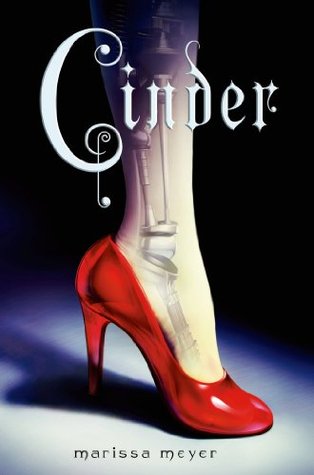
Cinder by Marissa Meyer

cinder

“Even in the future, the story begins with Once Upon a Time.”

Are you looking for a good old fashioned dystopian YA series to start your summer?

How about a modernization of a classic fairy tale?

Or, have you been craving a story about a cyborg mechanic, trying to avoid a plague, who’s got secret mental powers, a really crappy stepmother, and is actually a lost princess?

Well, if any or all of those books sound good to you, then look no further–this one will grant all your wishes.  Cinder by Marissa Meyer is book one of the Lunar Chronicles, a series incorporating futuristic versions of Cinderella, Little Red Riding Hood, Rapunzel, and more.  But it’s not just a book that retells a classic fairy tale–my boy readers love it too, because Cinder is a mechanic who works on androids in a post-WWIII future.  Complete with hovercrafts, bizarre medical technology, and sinister political plots, this story really has it all.

“But if there was one thing she knew from years as a mechanic, it was that some stains never came out.”

As a narrator, Cinder is complex, likable, sarcastic, and the embodiment of different.  In her society, cyborgs are considered less than human, and she battles this stereotype throughout the story.  Still, she responds to her critics with dry humor that made me guffaw as I read, and an unapologetic bent that made me know she’d be a great role model for my students.  Cinder defies convention in every way–a female mechanic, a plain princess, a cyborg in a human society–and yet her bioelectric backbone keeps her standing tall through it all.  I truly fell in love with her character by the heartbreaking, humiliating end of this first book, and immediately ordered the next two on Amazon.

“It is easier to trick others into perceiving you as beautiful if you can convince yourself you are beautiful. But mirrors have an uncanny way of telling the truth.”

Marissa Meyer crafts an incredible, fascinating future in the Lunar Chronicles, and writes with a style and flair that lend personality to the dystopian drama that unfolds in this series.  I highly recommend Cinder and its sequels for the science fiction shelf of your classroom library–scoop it up to enjoy before the magic wears off at midnight!

A Yearlong Community

The sense of camaraderie and fellowship in our workshop classroom has ebbed and flowed this year.  Some days, I watch with pride as the readers and writers in the room help guide each other to a higher level of understanding, appreciation, or excitement.  Other days, I see disengaged students annoyed with one another’s antics.

Getting this community established at the beginning of the year takes time, but once the foundation is laid, it’s easy to keep it in place.

…Until you have 15 snow days in a row.

Or a student teacher.

Or a six-day block of testing.

Or 75-degree weather with sunshine, just out the window.

All of those common interruptions can derail a classroom community.  This year, though, I feel as close to my students as ever, and they are as tight-knit a group as can be.  Here are four reasons why.

Passion.  I’ve written before about how fangirling helps create a community of readers.  But it’s not just being excited about books that helps a classroom community develop–it’s passion about the work we do here as a whole.

Jordan, a student who joined our class in September, told me yesterday, “I still remember the first time I came to this school.  Yours was the first class I came into.  You were yelling and all excited and stuff.  I thought, ‘Wow, is this how this school is?’  Then I went to the rest of my classes and I was like, awww, where’s the excitement at?”

The passion I brought to teaching stuck with Jordan for nine months, especially when he contrasted it to his other teachers’. Communicating our genuine excitement to our students models for them the lasting value of our content.  Without that enthusiasm, a classroom community may not seem worth building.  With it, students come to class ready to learn, which creates the first condition for a strong community.

Vulnerability.  Around my birthday in early September of each year, I share with my students a song my friend Joey wrote and recorded for me.  About a month after he gave it to me, he passed away.  I play the song for the students and we write, then, the soundtrack of our lives–which song it would be and why.  I write about Joey, my guilt and sadness over his suicide, how I slept with the lights on for months after his death.

Chelsea recently told me that at first, she wasn’t quite sure about me.  “Then you wrote that piece with us about your friend Joey, and that’s when I started to think differently about you.”  Modeling my vulnerability with my students encouraged them to do the same–they began to write about topics they once considered very private, and to share their writing in small groups, which I rotate monthly.

Sharing this story with my students, crafting and refining it alongside them, modeled for them not just vulnerability, but the writing process when it relates to a difficult subject.  I became, in their eyes, not just a model writer–but a model thinker, with emotions and difficult memories just like them.  Shifting from not just an English geek to a real human is the second condition for a strong community.

Guts.  This spring, I had a student teacher for eight weeks.  When she left, state testing began almost immediately.  After those two lengthy periods of disruption to our established routine, my students were sluggish and disinterested–frequently unprepared for class, slacking off on their reading, unenthused about their final multigenre projects.

Then, I shared with them my own multigenre piece for this year, about the miscarriage I suffered on Mother’s Day.  As I showed them my writing, the classroom became eerily quiet.  The stillness and silence was deafening.  After lots of hugging and passing around of tissues, the students worked with energy and reverence on their own writing once again.  Their enthusiasm was back.

“I thought it was cool that you would put that out there for the students to know,” Madison told me the next morning. “I was shocked that you wrote about it.”  The fact that I not only shared such a tough subject with them, but had the guts to write about it, was powerful.  This gave many students the boost of confidence they needed to confront a difficult issue and create beautiful writing about it–the third condition for keeping that sense of community strong right up to June.

DSC_7929

Two of my funniest students, Troy and Logan, smirk at me over lunch.

Humor.  We’re not morose all the time–we have lots of fun.  Whether it’s a humorous booktalk, a funny poem, or just a celebration of a student’s silliness, there is lots of laughter in our classroom.

A small whiteboard on one wall of our classroom is full of quotes that have made us laugh.  A word like “clementime” can crack us all up, remembering when Troy bemoaned the book Columbine‘s length but accidentally said, “Oh boy, Clementine, here we go.”  Or “overalls,” which calls to mind Kristen’s claim that “I woke up, put on my overalls, and everything just got really weird.”  These simple one-word phrases memorialized on the whiteboard can bring a smile to our faces when we need a lift, and remind me that my students aren’t just learners–they’re people, and pretty darn cool ones, too.

Talk.  Talk is such a foundation of workshop, but it’s important to talk outside of conferences, small groups, or minilessons.  Isaac, a student who has struggled with academic success in the past, has been sitting in my room during his lunch period all this month, working on his multigenre paper.  He chats at me as he writes, asking whatever questions come to mind, writing-related or not.  As a result, he is soaring.

“This is probably the first project in school I’ve ever worked this hard on,” Isaac keeps telling me. “This project is so awesome.”  I told our principal how hard he’d been working lately, and he complimented Isaac when he saw him in the hall.

“Oh my god, I can’t believe teachers talk about students outside of class!” Isaac exclaimed later.  I could tell by his little smile that he was secretly pleased that we had said nice things about him.  Talk has an impact far beyond its transient initial utterance.

Passion, vulnerability, guts, humor, and talk–all year long–make for a beautiful classroom community I’ll enjoy ending this year with.  What do you do to keep your learners unified?

What I Didn’t Teach This Year

The end of the year is upon us (finally!), and I’ve been reflecting as I always do.  This year, though, I’m thinking about something I’ve rarely considered before–not just what I taught, what worked, or what I want to do next year.  I’m thinking about all the things I didn’t teach this year.

There are 180 precious days in a school year, and the way my school is structured means I spend 90 days with each set of students.  That seems so fast.  There was no time to waste, so here’s what I didn’t fill that time with:

FullSizeRender

As Sabra stepped up for her reading ladder picture, she said, “This is pretty good for someone who didn’t finish a book until your class!”

Whole class novels.  This was a controversial choice for me, given that I love so many authors of American literature–Mark Twain, Walt Whitman, Nathaniel Hawthorne, etc.  But, no matter what novels I’ve chosen in the past, there’s always a student that book isn’t right for.  Fahrenheit 451, The Absolutely True Diary of a Part Time Indian, The Glass Castle, Maus–none of them is a perfect match for every child.  I’ve used a wide variety of strategies to get students to be able to read those books, and every ounce of passion I can muster to get them to want to read those books, but still–students have been conditioned to not read, to just get on SparkNotes, or ask an older sibling, or use Wikipedia.  When the stacks of matching novels come out, groans abound and engagement tangibly disappears.  I’ve seen this.  I’ve battled it.  No more.

So, I scratched whole class novels altogether.  Students worked in book club groups twice, and engaged in independent reading challenges two other times.  We read tons of short stories, articles, essays, and middle-length writings together.  But we didn’t read a single whole-class novel, and my readers still thrived.

IMG_8294

“I found myself as a reader this year,” Jordan writes.

Did my students grow as readers this year?  Yes.  I watched students who hated reading come to love it.  I watched students who couldn’t read well at all increase their stamina, passion, and skills related to reading.  I watched students who were good readers but bored with books fall in love with nonfiction, poetry, graphic novels, or award winners as they discovered new genres.  I watched students who loved to read flourish and challenge themselves with complex texts and childhood favorites alike.  Most of all, I watched a community of real readers spring up in my classroom–students recommending books to one another, self-selecting books and keeping long to-read lists, telling me all about their finds at Barnes & Noble.  These readers have become truly independent.  “Now,” Taylor writes, “I think I can read anything that’s put in front of me…and enjoy it.”

FullSizeRender

Isaac performs a poem for Nathan on poem-in-your-pocket day.

A movie.  As I’ve walked the halls this last week or so, I hear the unmistakeable sounds of cinema from behind closed classroom doors and darkened rooms.  I have no doubt that students are watching relevant films–movie adaptations of Romeo and Juliet in English, Forrest Gump in History, etc.  But this year, I felt I had absolutely no extra time…there was SO MUCH I wanted to do!  I used to love showing O Brother Where Art Thou with The Odyssey, and my students really delved into the symbolism of both texts.  But this year, my SmartBoard was full of YouTube videos, slam poets, or the still, quiet images of a document camera showing some writing.

I didn’t have time to show a movie, but I also wasn’t pressured by the crush of hours of grading that usually prompted me to show films in the past.  I’ve taken Kelly Gallagher’s rule about student work to heart–students should be doing four times as much reading and writing as we could ever grade.  So, I’ve read and responded to about a quarter of my students’ work, and let self-evaluations, peer conferences, and notebook passes do the rest.

Most of what I taught last year.  Last year was great, don’t get me wrong–but this year, my students were a new batch.  They’re different kids than last year’s group, so the same things won’t work for them.  After seven years in teaching, I know that.  I didn’t waste time trying to figure that out…I just started fresh.  I know I’ll do the same thing next year…out with the old, and in with the new.

IMG_0054

Shailyn read almost all of my YA fiction, and wrote reviews about nearly every book for our school newspaper.

Tests or formal essays.  Tom Romano likes to call the typical English essay a “five-paragraph you-know-what,” and it truly is a dirty little assignment.  At an NWP workshop I attended, each teacher was asked to bring some samples of student writing.  All around me emerged typed, double-spaced, Times New Roman, size 12, thesis-at-the-end-of-the-first-paragraph essays.  From my own bag came photocopies of messy scrawls in notebooks, multimedia This I Believes, strongly-voiced commentaries, poetic musings developed from quickwrites, and lengthy, involved, multigenre research papers.  No two pieces looked alike, and they certainly looked nothing like most other teachers’ samples.

I’d be lying if I said I didn’t feel a faint nostalgia for my own high school days, when I took pride in being able to punch out a perfectly formatted five paragraph essay in just under an hour, and which made absolutely no sense but looked great, and which constantly netted me As.  But I listened to my neighbors rant about poorly integrated in-text citations and incoherent thesis statements, I dismissed that nostalgia and read my own students’ work for what truly matters–good writing, heart and soul on a page, and authenticity at work.  As my husband said when he saw me dwarfed behind a pile of multigenre papers to grade, “I could read some of those for you.” “You wouldn’t know what to look for,” I said.

“Good writing is just good writing,” he replied, and he is right.  As the year ends, my students are good writers and good readers–not all of them are great, and there are kids I feel I could’ve pushed harder, but all are certainly better than they were when the year began.  I’ll look forward to our last day of class, when I’ll gift them each a new composition notebook and a pile of classroom library books to read over summer…and to months beyond, when I get to hear their stories of summer literacy in the fall.

#PoetryChat Tonight, 8ET

poetry-prompts-rantLet’s talk poetry.

A few months ago, a pre-service teacher I know asked me to give her some feedback on a poetry unit she’d written.  Her mini-unit, a 25-page document filled mostly by her professor’s formatting requirements, troubled me for a few reasons.

First, as Amy established, poetry is more than a unit–it’s a powerful way of teaching linguistic precision, the art of writing, and the freedom of expression.  It shouldn’t be a two-week item to scratch off a curricular checklist.

Further, pre-planning a unit in such a detailed way takes the power out of learning. “You’re doing too much of the thinking in this unit, and your students aren’t doing enough,” I wrote to her. She had selected every poem, every genre, and every skill for her students to learn–in doing so, she took away a valuable opportunity for her students to seek out, evaluate, and share found and original poetry.

Second, this teacher’s unit was full of contradictions.  I loved seeing her ideas about including slam poetry, spine poems, blackout poetry, and other engaging, unique poetry possibilities.  However, I was confused by what seemed to be an obligation she felt to teach every literary and poetry term ever.  “Focus on getting your students to learn how to WRITE poetry by studying other AUTHORS of poetry,” I advised. “When Dickinson was writing poems, it wasn’t because she was like ‘oooh I love metaphors’–it was because she had a broken heart.”

In teaching poetry, it seems like too many of us are yoked to an antiquated view of poetry–metaphors, dactyls, metric feet.  We are focused too much on the HOW of poetry, and not enough on the WHY.  As we teach our students, let’s focus on them as poets, not simple readers of poems.

Join us tonight at 8ET for a #poetrychat about ways to transform our students into poets by getting poetry off our shelves and into their hands, introducing them to mentor authors, and encouraging play with nontraditional poetry forms.

#PoetryChat Questions:

Warm-Up: Your favorite line or phrase from a loved poem

1. Why do you think many students find poetry intimidating or inaccessible?

2. When you teach poetry, how do you balance the students’ READING of poetry and WRITING of poetry?

3. What are your favorite genres of nontraditional poetry (prose poetry, spine poems, etc.)?

4. Who are your favorite mentor poets? How do you use them to teach your students?

5. What can our students gain from novels in verse? What are your favorite in-verse titles?

6. Let’s finish by sharing our most successful poetry teaching stories. What’s yours?

Resources to Make Your Move to Readers and Writers Workshop

When you believe in the power of the workshop classroom, research that supports it starts jumping at you like my dog when he sees me put on my running shoes. “Okay, Jag, give me a second. You can go with me.”

So when educators ask me for resources that support my Readers and Writers Workshop instruction, I am happy to share. Come, go with me — and bring all of your students!

Of course, a pretty good resource is Three Teachers Talk, right? The four of us who write here all practice this pedagogy in our unique classrooms in WV, NH, NY, and TX respectively. Erika wrote a great post of our Year in Review that reads like a highlight reel.

Of course, we have different teaching styles, but we all value specific things that never change in our practice:  choice, time, talking, reading, writing, conferring, modeling, sharing, publishing. I wrote about these 7 Moves in My Workshop Schedule recently.

Our presentation at NCTE last fall was all about starting and maintaining workshop in high school English classes. Jackie shared A Reader’s Workshop Starter Kit to Jumpstart the Process. Erika shared Landscape of Workshop: We Have Arrived. Shana shared Non-negotiables Across the Landscape of Workshop. And I shared The Landscape of Workshop in AP English.  (Our proposal for 2016 was not accepted, but we are mostly over the bitter and will keep advocating for RWW every chance we get.)

If you need research to back the why of readers and writers workshop in addition to what we might share in our posts, you might start with Donalyn Miller’s blog post: “I’ve Got Research. Yes, I Do. I’ve Got Research. How About You?” — Donalyn shares a list of articles and books that support why readers workshop is the best pedagogy for all students.

My colleagues and I believe the best book for secondary readers workshop is Book Love by Penny Kittle. Her argument for independent, choice reading resonated with me the moment I read it.

Donalyn Miller’s the Book Whisperer is another great resource for readers workshop. Although Donalyn taught middle school, many of the ideas she shares work with my AP English Language and Composition students.

For writers workshop, Write Beside Them, also by Penny, is my favorite. That is the book that changed me as an educator.

Another excellent resource for writers workshop is Learning Through Teaching by Don Murray. This is the most recent book Penny recommended to me to help with my own writing. Oh, boy, is it helping!

So, yes, please ask for resources. And if you are already a workshop believer, please share them. Every student I know will thank you.

Do you have resources you share that we might find valuable here at TTT? Please leave your thoughts in the comments.

Shelfie Saturday: My Ideal Bookshelf

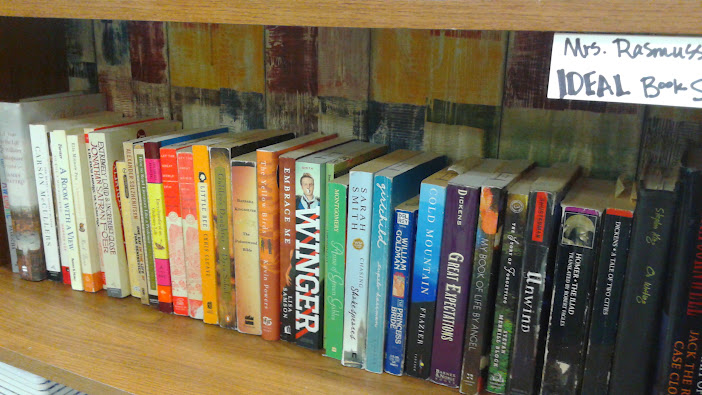
shelfieAT UNH Literacy Institute 2014, Penny Kittle gave us a handout so we could create a depiction of our Ideal Bookshelf. The idea comes from a lovely book that features articles where “100 cultural figures” describe the books they read and love.

Here’s a sampling from Brainpickings: My Ideal Bookshelf: Famous Artists and Writers Select Their All Time Favorite Books.

I keep an Ideal Bookshelf in my room. This is a place for my favorite, books. They touched me, molded my thinking, changed me in some way.

I talk about these books often, and many of my students read them. We share what we like and what we don’t. I encourage them to craft their own shelf of favorites.

From Awesome to Shakespeare to Girlchild and Great Expectations to On Writing and Portrait of a Killer by Patricia Cornwall — this is my personal canon, my Ideal Bookshelf.

What do you keep on your Ideal Bookshelf?

Please leave your favorite titles in the comments. They might just fill the next shelf in my classroom library.

©Amy Rasmussen, 2011 – 2015

Guest Post: The Case for Teaching Reading in High School

cherry-blossoms-from-our-bedroom-window-april-2014As spring arrives, the cherry blossoms start to bloom, the daffodils open their petals towards the sun, and high schools across the country begin their own feverish rite of spring, end of course test intervention and remediation. Schools will hold after school opportunities to help students prepare for a reading test that they must pass. In my state, Virginia, if students don’t pass the test, they don’t graduate, the school’s graduation rate is affected, and accreditation is considered. All this is not to say that schools don’t want to do what is absolutely best for students, because we do. We know that a high school diploma can make the difference between a mediocre job and a career. But we don’t grant a high school diploma unless a student passes the reading test. The irony is that, undoubtedly, when we sit down with these students to help them prepare, we will be doing little reading at all.

What are the costs of not reading well? The Alliance for Excellent Education, estimates the cost in terms of lost wages over a lifetime due to low literacy skills is around $335 billion per year. According to Reading at Risk, a survey conducted by the National Endowment of Arts, there is a sharp divide in reading skills of incarcerated adults versus non-prisoners. On the flip side, those who read more for pleasure exercise and volunteer more. They even vote more. And students are not going to read more, are not going to become avid readers, if they are not reading. Students should be engaged in what they are reading in order to become more competent readers. Not surprisingly, reading more makes us better readers. The Department of Education reports that frequency of reading for pleasure correlates strongly with better test scores in reading and writing. Students who read outside of school see more vocabulary, reading comprehension, verbal fluency, and background knowledge growth, all of which are skills students need in order to pass the reading test. Right now, there is a decline in voluntary reading rates among teenagers while at the same time reading skills in schools remain stagnant or worsen. A required reading test is not the problem. Students graduating from high school should have the skills and strategies to pass the test. The problem, instead, is that in this era of high stakes testing and accountability, schools, divisions, and states have lost track of the original goal of the test, to ensure that all students who graduate from high school in the United States are competent readers. Instead, we are focused on teaching for and to a test.

According to the most recent National Assessment of Educational Progress (NAEP), our country’s 4th grade reading scores are slowly moving up and are the highest they have been in the past 33 years. This is great news as it shows the achievement gap is shrinking with our elementary school population. Unfortunately, the numbers are much different for our adolescent learners. The 2013 average reading score for adolescents has gone down from the first assessment and remains unchanged since 2009. In Virginia, only 36% of eighth grade students scored at or above proficiency level on the NAEP reading test. Students with disabilities and English language learners are often struggling readers, and schools have a difficult time meeting accreditation as these subgroups continue to score poorly on state reading tests. In fact, the achievement gap among high school seniors with and without disabilities is growing.

In our current era of accountability, it is required for states to have a reading test in order to be accountable to the federal government. States need to show that students are making adequate progress in reading. These scores are not only used for accountability at a state level but also on a more local level. Community members look at these scores in an effort to understand the needs of a school or division. Unfortunately, when we look at the demographics of the students we are currently cajoling to stay after school for extra test preparation, we don’t see good results. Last year, although 90% of students in Virginia passed the end of course reading test, only 62% of students with disabilities and 70% of limited English proficient students passed. This, in turn, is affecting Virginia’s accountability score for the federal government, as students with disabilities and limited English proficient gap groups did not make adequate progress.

Instead of prepping students to pass a specific test, schools should focus on teaching students how to girl-reading1read better. Schools can do this by teaching students at the appropriate reading level and using explicit instruction while at the same time increasing teachers’ professional development on literacy. Students need to be reading high interest books that aren’t too difficult or they will give up and not read at all. English language learners may start school with little literacy preparation which, according to the NAEP study, results in only 3% of English language learners in the 8th grade scoring at or above proficient in reading. These students will not pass a test by having test prep. Instead, they should be reading, analyzing, and talking about books and passages that they can read so that they can do the rigorous work asked of them.

In Reading Next, a Carnegie Corporation report, researchers map out fifteen elements of effective adolescent literacy programs, none of which include test preparation. Instead, this report focuses on the importance of explicit instruction in comprehension, vocabulary, fluency, writing, and motivation for struggling readers. Schools should be providing these literacy interventions in the school day every day, not just after school as the test looms near. Time must be spent in class with texts in order to read and write effectively. Research suggests that these texts should ideally consist of good literature on and slightly above students’ reading level to grow as readers. Professional development should be provided for teachers so that students who struggle can work on strategic reading skills in all their content classes.

boy readingWe cannot better prepare students for the test by having them practice process of elimination in answering the multiple choice questions. Instead, we must require a shift in instruction to do the hard work of teaching students to be more strategic, aware, and yes, avid readers. We can do this by helping students where they are, providing support where they need, and allowing them time to read. Schools should shift our focus towards real reading in order to better prepare for the reading test. We need to prepare stronger readers to help them be successful both in their professional lives as well as in their community. So as spring is upon us, we cannot get caught up in the flurry of test prep remediation but instead should teach reading by having students read. What a better season for it? For surely, it is not a coincidence that a perfect way to enjoy this spring weather is to sit outside and read a good book.

References Pfautz article

Jeannie Pfautz is a reading specialist in Charlottesville, Virginia.  She loves the opportunities she gets to work on reading and writing every day with her students.

Book Clubs in AP English: Just let them talk

Some of it was great. Some of it not so much. I’m talking about the book clubs in my classroom this Screen Shot 2015-05-02 at 5.42.03 PMyear. The great was actually my students reading and talking to one another about that reading. The not so much — the way I did assessment.

This is what I learned and what I will change for next year:

Book Clubs serve as a way to challenge my readers into the more complex books that many of my students would never choose for themselves. Book Clubs also allow my readers to talk about books in an authentic way without the strictures of guided reading questions or anything else that might lead to Readicide. (‘Read-i-cide: noun, the systematic killing of the love of reading, often exacerbated by the inane, mind-numbing practices found in schools” –Kelly Gallagher) I wrote about the importance of balance literacy and how book clubs fit into that in this post.

I provide a short list of titles that I know contain fantastic stories of resilience, survival, hope, courage, and any other trait that prods readers to relate to the human experience. I introduce the books, usually with book trailers or video interviews of the author’s, and I include either on paper or a projected slide the synopsis and ratings from Goodreads or Amazon.

Students select their books, often talking with one another and making selections together. I ask students to purchase their own books, so they can annotate anything “interesting, intriguing, puzzling, contradictory, or you just plain do not understand.” Since most of my students come from less affluent families, we talk about the importance of libraries and surrounding ourselves with texts that can inform and influence our thinking. Often, students will purchase more than one of the books I introduce for book clubs. I also have a few copies of the texts in my room that students may check out if they cannot purchase their own. I always think my copies will be used more than they are, but I’ve learned that my readers like to buy books. Most feel the sense of ownership that I want them to feel.

Our first book club this year, I gave students a choice of the following titles, all centered around themes of family and parents and how they influence our upbringing and our choices:

Extremely Loud and Incredibly Close by Jonathan Safron Foer

Swamplandia by Karen Russell

The Curious Incident of the Dog in the Night Time by Mark Haddon

Girlchild by Tupelo Hassman

The Glass Castle by Jeanette Walls (literary non-fiction)

More students read The Glass Castle than any of the others, but every book was represented in at least one book club of three to six students. Students loved The Glass Castle, and they told me that they could relate to much of Walls’ upbringing.

Screen Shot 2015-05-02 at 5.42.19 PMAssessment:  For this first book club, I asked students to read with an eye looking for theme. They would work with their book clubs to craft a mind map that included numerous quotes from the book that contributed to the theme, and they would analyze these quotes as part of the mind map. They could create the mind map as a paper poster or online. As they read the book, they were to mark the text like I had taught with the short passages of text we’d read together in class, and they were to also look for sentences and phrases and passage that pointed to theme.

My students did not have a clue how to do that. Most did not mark their books, so when the project time rolled around, they ended up scouring through the book or searching for quotes on Goodreads or elsewhere to find enough quotes that they could plop into their mind maps. I needed to provide more guidance in annotating, and in reading for beautiful sentences, and in making thematic connections, and so much more.

Also, I allowed students to work in groups to create their mind maps. This did not work because no one in the group would rise up and be the leader. They were new in the class and new in their friendships with one another. Group work is a topic for another post, really. This time it failed, and I’ll need to do a lot more prep work before I spend as much class time on this kind of project ever again (if I ever do).

Our second book club, students choice a title from this short list, all centered around themes of culture and how these cultures influence us:

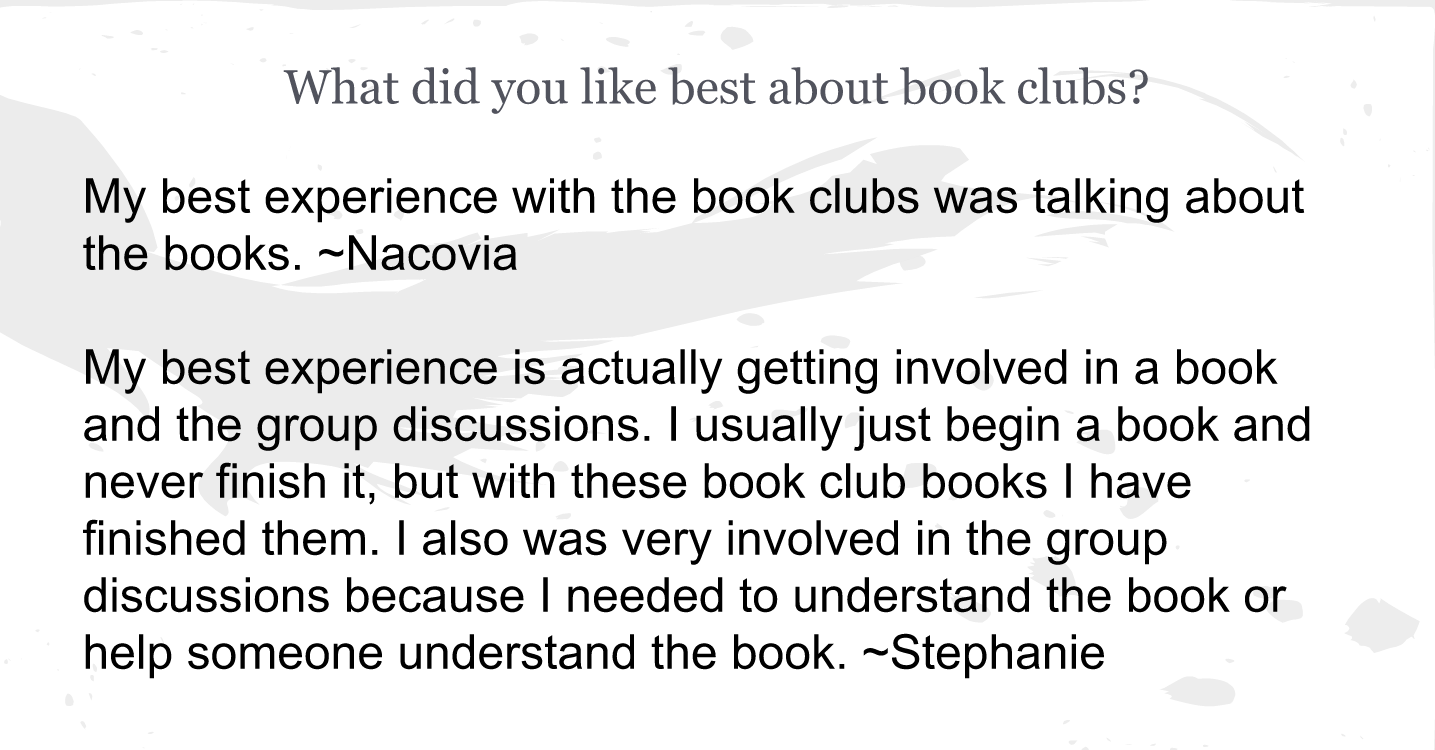
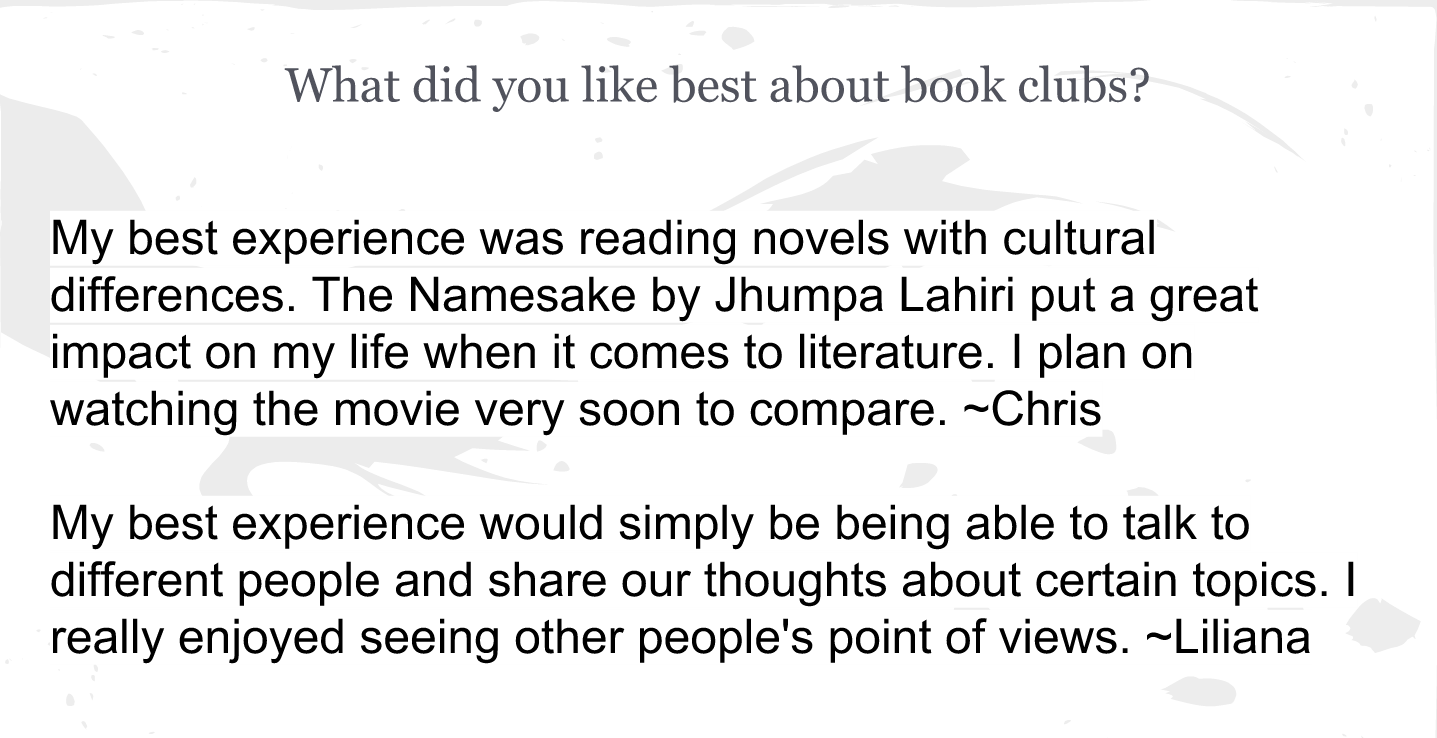
The Namesake by Jhumpa Lahiri

Little Bee by Chris Cleeve

Sarah’s Key by Tatiana de Rosnay

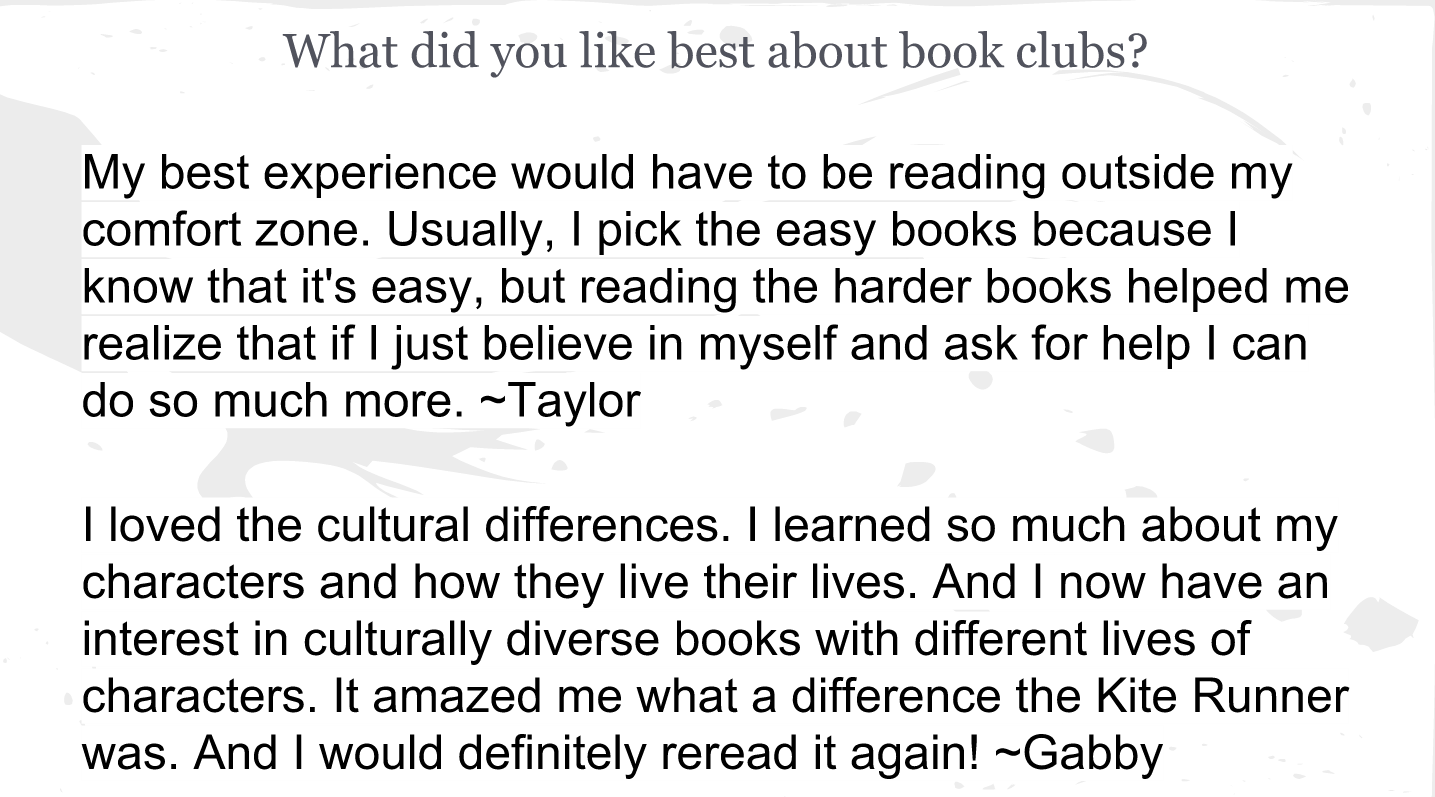
The Kite Runner by Khaled Hosseini

A Thousand Splendid Suns by Klaled Hosseini

More readers chose Sarah’s Key than any of the others. Students find stories of the Holocaust fascinating, and that shelf is a popular one in my classroom library. (Erika’s, too.)  Many students read The Namesake, and at least one book club read each of the others.

Assessment:  This one was even more lame than the first. Sometimes I feel the pull to get back to a Screen Shot 2015-05-02 at 5.42.33 PMmore traditional pedagogy. I am the only one on my campus who fully implements readers and writers workshop, so I listen in often to what other teachers have their students do. If you teach AP English, at some point, you have probably had students write a hexagonal writing over a piece of literature. (Hexagonal because student write thinking about their knowledge, comprehension, application, analysis, synthesis, and evaluation as it relates to the book. It sounds like a great assignment.)
It was the worst writing my students completed this year — if they completed it at all.

I know why. There was no authenticity in it. Follow the structure I gave you. Each paragraph should be about this… No wonder they didn’t care about writing well. I was their only audience, and I was making them write something worse than a book report.

We wasted a lot of time. (The grading policy in my district requires that I reassess major grades. Hey, let’s write this paper again since you cared so much about it the first time. Right.)
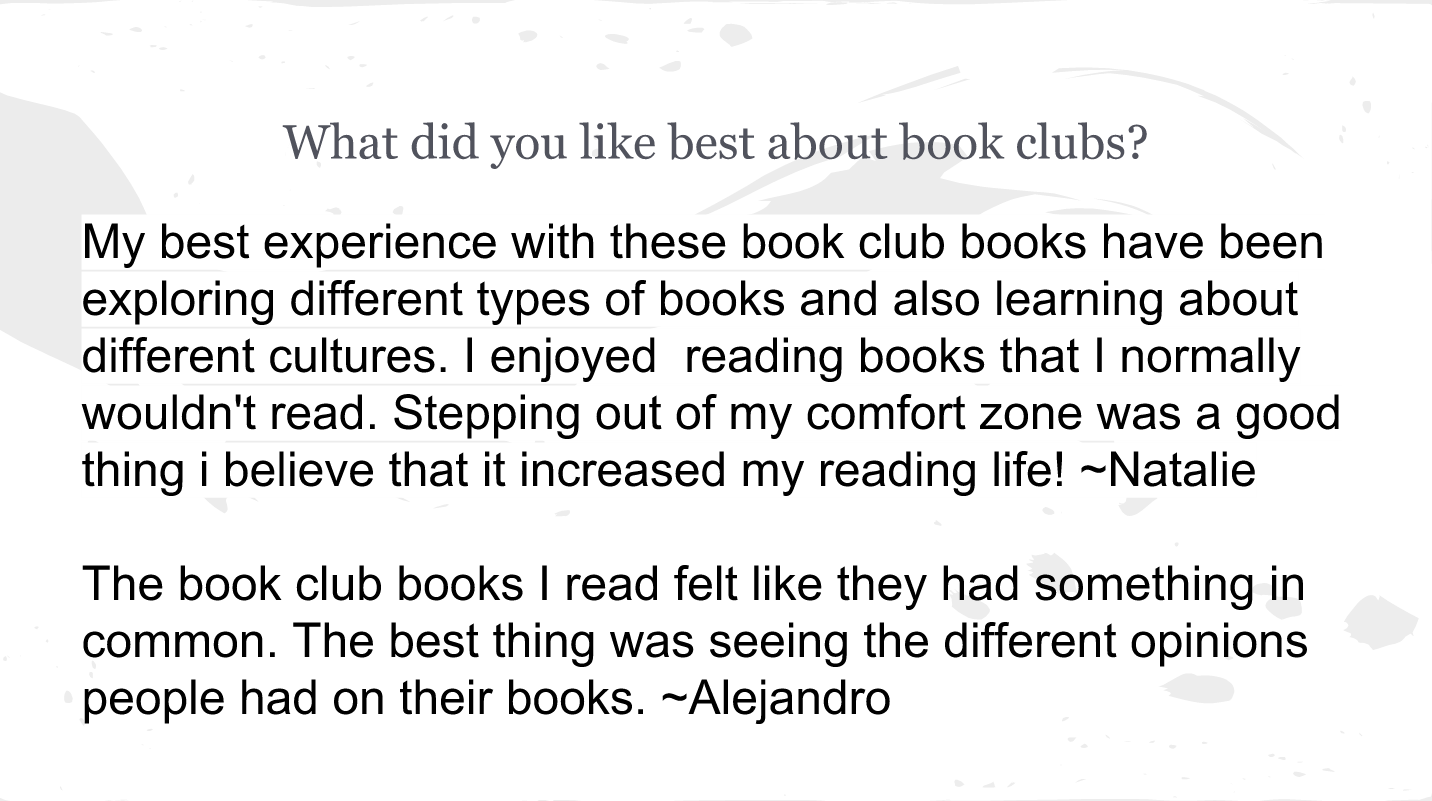
Screen Shot 2015-05-02 at 5.42.45 PMMy readers would have benefitted more from a gift of time to talk about the books more. Shana posted about the value of book clubs for talk earlier this year, and after two subpar experiences I began to agree:  “asking students to keep the conversation [about their books] going for 20 straight minutes provides valuable time for students to build relationships [around conversations about their reading.]”

I would just let them talk.

Our third book club students selected titles from this short list, all centered on war (or internal war) and its influences on individuals and humanity:

The Yellow Birds by Kevin Powers

Room by Emma Donoghue

Where Men Win Glory by Jon Krakauer (literary non-fiction)

The Bell Jar by Sylvia Plath

The Things They Carried by Tim O’Brien

The majority of my readers chose to read ROOM or The Bell Jar. They loved Room, and didn’t think The Bell Jar lived up to its hype.

I scheduled more opportunities for students to talk about their books. I wandered the room, sitting at Screen Shot 2015-05-02 at 5.42.57 PMgroups and listening in as conversations circled in and out and back again. Often, I placed a stack of TableTopic cards for book clubs in the center of their table, and students used these to guide their discussions. (Looks like the book clubs version of TableTopics is no longer available. Sad.)

Next year, I will do this again. I might ask students to look for significant passages so they can practice analysis on a page they select for themselves. Here’s a post that I’ll probably show them with a sample passage for craft study.

I might have them create a found poem or a black out poem.

Or I might just let them read and talk and read and talk some more.

That’s what I do in my own book club.


If you have your own suggestions for improvement, please share them in the comments.


©Amy Rasmussen, 2011 – 2015