The Consciousness of the Child: Another Thought on Conferring

Much has been written about conferring with younger students, but in the current professional literature, I find little that addresses the needs I have in my secondary classroom. I know when I talk to my students in one on one conferences, they grow more as individuals who engage in reading and writing more critically. I believe that if teachers will talk to their students more, teaching them as individuals instead of the collective, students will respond in ways that delight and surprise us (and often surprise themselves as well).

Teenager with parent

Teenager with parent

The topic of conferring consumes my reading life of late, and I find myself reading Misreading Masculinity with this guiding question:  How does this relate to my study and work on talking to students about their thinking?

The following lines from Newkirk’s book relate directly to what I believe must be our first step in helping our teenage readers and writers develop the sense of self needed to engage meaningfully with the material and skills we need them to in high school English:

“…the ability to think beyond the “logic” of normal school performance in order to inhabit the “logic” of the student (Newkirk, 12).”

. . . The linguist Basil Bernstein elegantly points out the centrality of this ethnographic stance for teaching:

If the culture of the teacher is to be part of the consciousness of the child, then the culture of the child must first be in the consciousness of the teacher…We should start knowing that the social experience the child already possesses is valid, and that this social experience should be reflected back to him as being valid and significant. (1966, 120)

As a credo for education in a multicultural society, I don’t think we can do better than that (Newkirk, 13).

Educators must relate to students as individuals with a variety of interests, passions, backgrounds, and literary histories. We must try to think like they do if we are ever going to develop relationships that engage the teenager in reading and writing experiences that invite them to take on the qualities of readers and writers. Our goal should reach far beyond the idea of school. It must reach into a student’s future life.

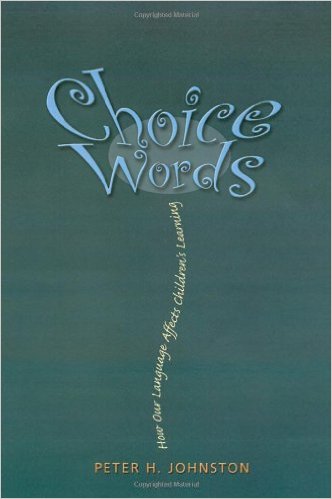
In the book Choice Words,  Peter Johnston discusses the importance of tapping into students’ literary Choice Wordshistories in order to give them a literary future. What experiences has the child had with reading and writing that have formed her belief about herself as a reader and a writer? We must learn of these experiences and then validate them if we ever expect to move our students from the starting places at which they come to us.

Regularly conferring with students is a vital part of getting into the “consciousness of the child.” However, many high school English teachers instruct their students as if they all experience the same culture and the same consciousness. No wonder groupthink is so prevalent in our communities and in our politics. It is a reflection of how students receive instruction. This whole class, one-size-fits-all, standardized teaching (not to mention the tests) is detrimental, not just to boys, but to all students who deserve to be instructed at an individual and personal level.

What are your thoughts?

©Amy Rasmussen, 2011 – 2015

Just Let Them Write: Boys and Autonomy

“Just let them be boys.”

This aphorism about dealing with boys is a long-standing one, but I learned last week in Tom Newkirk’s class on boys and literacy that it’s much easier said than done.

First, after reading a pretty fascinating article in The Atlantic, I realized that modern society doesn’t often let our boys be boys.  The economy, family structures, and workplaces of America have changed drastically in the past twenty years, and the traits and skills that used to make men successful and fulfilled have gone away.

Second, I listened to my fellow teachers discuss their classrooms this week at UNH, and I was struck by the language of control prevalent in teaching narratives:  “I make them;” “I let them;” “I shoot down their ideas;” “They have to;”…these were the words teachers used to describe their students’ activities.

These are phrases of division, of separation, of a differentiation of teacher and student, expert and learner, master and subject.  Having just read Daniel Pink’s Drive, the phrase “The opposite of autonomy is control” has been stuck in my mind.  It seems that even in the academically enlightened setting of the New Hampshire Literacy Institutes, many teachers still practice a teaching philosophy of control and compliance, rather than one of equity and autonomy.  Further, many of these speakers were women–so this was an issue not just of control, but of furthering the claims of the Atlantic article mentioned above regarding emasculation.

Our class talked about violence a lot, and whether it was acceptable in writing.  Ralph Fletcher’s Boy Writers taught me that violence in boys’ writing was as natural as the sunrise.  Newkirk addresses this issue as well, defining violence in general as “the intentional infliction of pain…on another,” and specifying that “writing would be a violent act if it caused pain to others…for example, if it caused readers to feel threatened or humiliated.”  Too many teachers in our class had a strict no-kill, no violence, etc. rule about writing topics–the opposite of autonomy.

Most reading and writing boys do doesn’t involve intention to inflict physical pain or harm.  Their topics may be provocative, but most of the time, it’s just boys working out things that are on their minds–huge issues like death, love, violence, and sexuality.  Adults do this all the time too–these are issues many of us haven’t quite worked out, so why should we deny children an opportunity to explore them through writing or other means?

Thanks to reading texts like Boy Writers, Misreading Masculinity, and Peter Johnston’s excellent Choice Words, I feel like I understand and enjoy many themes in my boy students’ writing. In fact, the first time I met my husband was in my freshman English class, where I wrote a story about a serial killer who stole college students’ identities and test scores by ripping off their faces and stitches them over his own. My professor asked me to share it in front of the class and I still recall the nervous giggling that followed my sharing, including Jon’s wide eyes. As a writer, I was just proud of creating a fictional voice so creepy and plausible, but the embarrassment of that experience shamed me to a degree that I’ve shied away from all fictional writing since.

As a teacher, I don’t want to quash a student’s creativity, violent or not. I love my boy writers and respect the sanctity of their writer’s notebooks, in which their fantasy lives can be explored and reflected upon in private. For them to grant me access to those fantasy lives through writing is a sign of respect and trust, and I wouldn’t want to violate that by censoring their thoughts, showing them to administrators, or asking them to share with the class.

But most of all, I want to distinguish between feeling “uncomfortable” and feeling threatened or unsafe.  Hearing me read my serial killer story probably made some of my freshman English students feel uncomfortable, but no one felt scared–I did not threaten anyone in the room, nor did my fictional narrator.  In fact, the end of the story revealed that the killer’s actions were mostly motivated by justice, revenge for his victims’ pervasive academic dishonesty.

Feeling uncomfortable, though, is something I believe is essential to learning.  Disequilibrium is the space in which our worldviews are challenged, where we achieve the Vygotskyan zone of proximal development.  We are confronted with new knowledge and are close enough to it to assimilate it into our existing schema.  An open, unfettered workshop classroom is one place where this kind of development can (and should) occur.  Rules like no violence, no swear words, no sex, no freedom, prohibit the opportunity for disequilibrium–and real social learning–to occur.  We cannot fear our students’ inner minds.  We must acknowledge the distinction between fantasy and reality in books, in writing, and in our kids.

Further, we must value that chasm, and respect our students’ varied and important processing strategies.  Writing these issues out is a way to come to understand them, so we must forsake this antiquated notion of creating control and compliance in classrooms.  Given choice, given autonomy, our students will read and write their ways toward understanding beyond our classes and into their adulthood, as we do.  We are the same as our students, grappling with concepts in writing (like I am here, now) and are no better than or superior to them.  Eliminate authority, cultivate autonomy, and just let them write.

#PoetryChat – Boys & Poetry – Monday, August 3 8ET

IMG_8888This week, the writers of Three Teachers Talk are together in Durham, New Hampshire at the UNH Literacy Institutes.  For five days now, we’ve learned with Penny Kittle and Tom Newkirk about strengthening our practice and our thinking.

Newkirk’s class, centered around his Misreading Masculinity (2001), is focused on boys and literacy.  We’ve read and discussed issues of violence, humor, personality, sexuality, power, and more–all surrounding boy readers and writers.

Join us to continue this conversation on the topic of poetry.  The four of us will be together in Portsmouth, ready to chat on Monday at 8ET.

1. How do you notice your boys responding to poetry in your classroom?

2. Should boys write poetry in an English class?

3. How is poetry uniquely valuable for boys?

4. How do you hook boys into poetry?

5. What are your best poems, poets, or poetry resources to engage your boys?

Poetry Chat August 3

To Confer is to Validate the Child

Question:  Do you have any tips or tricks for conferring for upper grade students

Answer:  Keep reading.

I love questions, especially questions about my practice and my passions. If you’ve been reading this blog for a while, you know that I’ve written quite a bit on conferring this past year. (Click the categories tab and go to conferring.)

Conferring with students is my on-going action research. He was the missing person in my workshop classroom for a long while. Then, he was the show-up-once-in-awhile, have a chat, and leave kind of guy. Later, he became a regular guest. Then, after my change and my constant focus, he finally moved in for good, and guess what? He transformed the learning in my classroom. i wish I would have invited him to stay much sooner. I missed a mountain of important talk time with my learners. Time I will never get back.

So, to answer the question I received in an email today, let me start with this:

Most of the strategies for younger grades work well for our older learners, too. Talk to elementary teachers. Use these experienced writing workshop teachers as a resource for your secondary writers workshop. They know how to talk to students, and we should follow their lead in many ways as we approach our writers.

Much of my study on workshop and conferring reveals similar approaches. I’ve found the work of Donald Graves, Nancie Atwell, Linda Reif, Penny Kittle and other workshop teachers rest on the same core principles of writing instruction:

1) students choosing what to write aboutt,

2) helping students discover ideas through writing,

3) talking to students regularly as writers,

4) modeling the struggle of writing,

5) using mentor texts to study the craft of writers.

Conferring fits into any and all of those principles, but it sits squarely at #3:  talking to students regularly as writers. This is different than talking to students about their writing.

So, I think the most important thing we have to do when we confer is validate the child as a writer (even if he is not a very good one — yet).

In his book Choice Words, Peter Johnston writes about the importance of helping students grow into the identity of readers and writers. In my experience teaching high school English, 9, 10, 11, on-level to AP Lang, most students do not put reader and writer as part of their identify. Few students will be successful readers and writers unless they do so.

This becomes my primary focus in conferences with my readers and writers: How can I help them have experiences where they can see themselves in these roles?

I find that getting students to talk to us about their thoughts, feelings, ideas, struggles, etc with their writing process is the same at every grade level. Perhaps the biggest difference is that teens do not always trust us like younger children tend to do — at least not at first. That is why validating positives with our writers has to come first — before any kind of one-on-one instruction. We have to remove fear and hesitancy. Let them write. Focus on what they do well.

This makes many red-penned teachers with a love of grammar crazy, but marking up a student’s paper is the worst kind of writing instruction — ever. We must respect the writer.

Today my friend and colleague Shana and I were discussing this very thing:

Conferring transforms differentiated instruction into individualized instruction.

So, as you think about conferring with adolescents, ask yourself:

How can I tap into the identity of the individual?

How can I help him see himself as a writer?

What writing experiences does he need to have to feel like he can be successful?

Start conferring there.

Dear reader, what are your thoughts on conferring? How do you answer my questions about conferring with adolescents?

 ©Amy Rasmussen, 2011 – 2015

Guest Post: Technology Transforms a Writing Workshop

In response to this post I wrote about walking the talk in our content areas, another teacher has responded to my invitation to write. She says of herself:  “Karen Clancy-Cribby loves learning, especially from adolescents. She’s a teacher, writer, and Writer’s Workshop is her life. Literally.” Find Karen on Twitter @kcribby.

My husband and I live in the country on land that is expansive, scrub oak, tall grasses.  Every time I go to the kitchen sink, my first look is up at the hill, across the valley, and I scan the hillside before my gaze settles to the immediate foreground.  I do this probably twenty times a day.

It hit me today, as I thought about this blog, that how I look out and around, before settling into the immediate, is how I think about everything.

I’m a big picture person, and when I was given the great honor of being offered the opportunity to guest blog about technology and Writer’s Workshop with this amazing group of teachers, I jumped at the chance.

Then I realized I’d signed up to write about a lesson.  Well, therein lies the rub.  To describe a traditional lesson is just not what resonates with the organic nature of the classroom we’ve been so fortunate to run with Writer’s Workshop.  The “we” in that sentence refers to my language arts colleague (and former student, and former student teacher) who I team with daily.

I’ve embraced Writer’s and Reader’s Workshop since I first read Nancie Atwell’s “In the Middle” back in 1990.  I’ve read Fletcher and Calkins and others since, but I’ve mostly just been diving in.

So, back to the whole lesson idea.  Lessons in WW can, and should, of course, be planned, but to speak of them outside the daily dynamic of the classroom doesn’t make sense to me.  Sure, plan for different activities, plan with the end in mind, know and plan for what students should know (even that is a stretch, but that’s another blog), but the ebb and flow of class has to be more dynamic and a response to what happens with students.  So, WW has been an ideal.  Set aside time for mini-lessons, reading and writing time, feedback and closure.

Now, with technology in the mix, well, wow.  So, instead of blogging a WW lesson with technology, I’m going to give you a day in the life of WW with technology.  I need to thank my language arts cohort and daily teaching partner, Emily, who suffered through all of these pages of drafts for this idea for a focus.

Here is our day:

Student working on writing in the winter pulled up a fire for cozy atmosphere.

We have our daily agenda and objectives on a Google Document shared with our students, who walk into class oftentimes having already pulled this document up on their Ipads or phones.  Every day, we ask students to answer a question as they come into class.  Thanks to another colleague, Kris, we call these “Fire-Ups,” given that warm-up seemed too tepid to describe the first lesson of the day which should be big.  So, students pull up the agenda on their iPads and log into their Google Doc on the Chromebooks.  Sometimes they need to look up a few things to answer the question, sometimes they need to just think, and sometimes they need to read and re-read to answer the question, which, ideally takes no more than ten minutes for everyone to feel okay to discuss the question.

Within ten minutes of class, we will ask them how much time they need.  It’s usually no more than a few minutes, but oftentimes, our questions are bigger than we planned.

So, our agenda is a work in progress, and we adapt, as all teachers do,  as the class goes along. Sometimes, all students need a nudge in a certain direction, and we extend the lesson.  This often looks like one of us “saging on the stage,” while the other uploads examples or research hints and tools.

Other times, and I’d hazard to say most times, they all just need to fly.  Then, we have the luxury of sitting down at our desks, reading over their virtual shoulders and giving them individual feedback in person or on their Google Docs.

Writer’s Workshop has been my educator dream ideal since I was in college, and now the ideal is…well, I hate to sound absolute, but it’s possible, truly possible.

Technology allows all of that to happen immediately and in real time.  I am fortunate (understatement) to teach with someone who not only embraces the workshop pedagogy as passionately as I do, but she is a whiz with technology.  Four years ago, when she was my student teacher, we had netbooks, and we started using Google Docs, and I’ll never forget those opening days of my brain exploding.  We had our agenda on the overhead screen, shining from her computer.  The agenda was made in Google Docs.  I had a few students who preferred to access their writing from their phones.  If I didn’t read literally over their cyber-shoulder, I would not have believed how fast they could write using their phones.  As more and more students used their phones alongside the netbooks (we are so lucky to now have Chromebooks!), I started thinking about so many possibilities of all the access they had to information.  Then, there were whispers of our district going 1:1 with iPads.  I’ll never forget standing in the front of the room with Emily, my student teacher, and I looked at her and said, “we can have the agenda online for them to have access to,” and she looked at me and said, “they can write their responses on a Google Doc too.”  That was four long (or short?) years ago.

Now, we’re all online, and I feel as though the newbie teacher dreams of a perfect Reader’s and Writer’s Workshop are now a reality.  Well, perfect is an oversell, but all of those years where I would say, “read and write whatever you want” have been transformed.

Students walk into the classroom, open up their Chromebooks and their iPads. Most students pull up the agenda on their iPad and then start answering their fire-up question on their running Fire-Up Google Doc.   The question is related to where we have been and where we are going.  We try to stretch the question, make it something they need to think about.  Sometimes there is a background/research portion, and then the question.  Sometimes it’s a piece of literature they need to explore for techniques; sometimes it’s a revision piece they need to evaluate.  These Fire-Up questions are very often taken from my own personal writing.  Writer’s Workshop isn’t WW without the teacher as writer.  The beauty of the Fire-Up being taken from my writing is that I am starting most classes with modeling myself as writer.  I can then keep going back to my writing, allowing everyone to critique it.  I have noticed that students are at their best when they are critiquing my writing.  With peers, they sometimes become too gentle, or the reverse, too harsh.  With my writing, they are quick to get to the heart of what needs improvement or what things work and why.

I get to do the think-alouds about my own writing; things I like, things I want to make even better, my purpose, etc.  This leads to them then taking that mini-lesson and my modeling metacognition, and then they look at their own writing, and other’s writing.

My teaching cohort Emily and I were talking the other day about how she needs to do some writing. We have an easy balance together, but she’s right.  She needs to write.  The best way we show ourselves is at our in-progress stage of writing, discussing what we want to do for purpose, topic, and audience.  We should not show ourselves ever thinking we’re “done.”

Back to how technology transforms this all.   Sharing is more immediate; there are multiple modalities for discussion (Edmodo for responding, Padlet for throwing out fire up responses, sharing of Google Docs for commenting).  The transformation, for me, having taught using this model for so long, is that if I ask a student to explore an interest, they can do it, right then, right there.

They can find and access a kazillion mentor texts.  ‘Nough said.

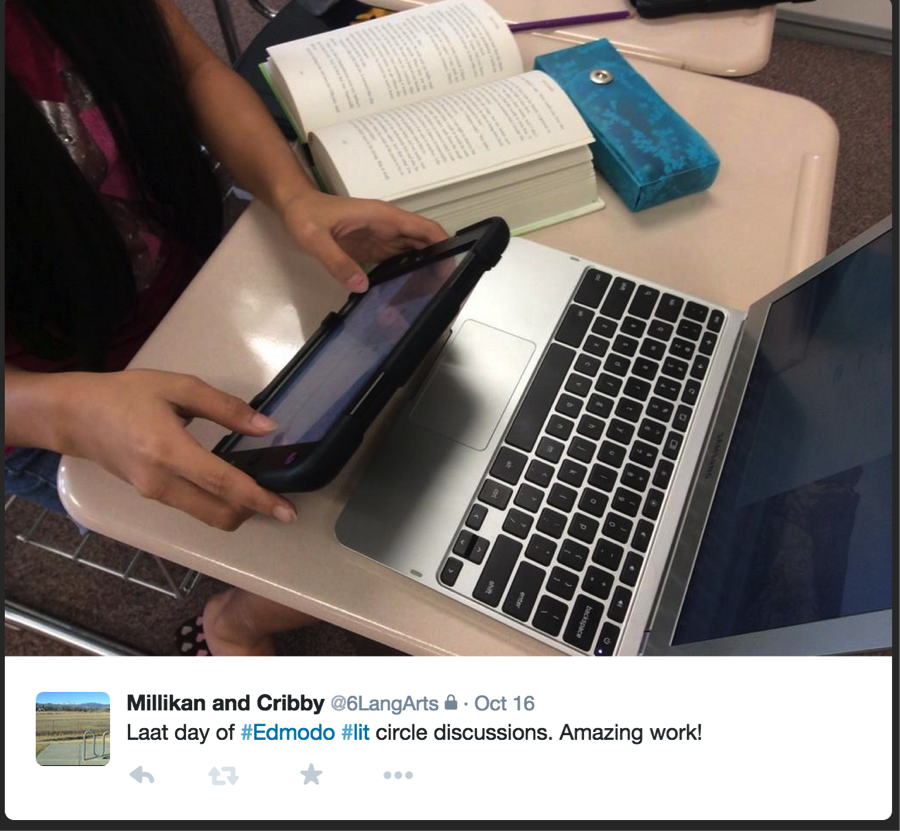
Student finishing up an online literature circle discussion using Edmodo.

Student finishing up an online literature circle discussion using Edmodo.

Here is another snapshot of this transformation.  As we were moving into the second quarter of language arts, Emily asked me how we should frame our lessons as we continued.  It hit me that though we were using the workshop model, it had transformed to such overwhelming possibilities.  It felt like grooming a rock star who had hit the charts.  I have no idea why that analogy came to me, but it’s so hard to describe the little monsters we’d created with so much room for them to stretch, reach, and grow with Writer’s Workshop.  I answered her with a gleeful, big, let’s see-where-this-will go shrug and said, “well, nothing has changed, let’s keep the workshop going, but maybe we need to call it something more expansive, like, “Learning on your own.”

The next day, when LOYO was on our agenda, and many students knew what the acronym was, well, wow.  The teacher learner in me talked about how their learning was officially limitless, and I was excited to sit down and visit with them and see where they were going.
I’m excited to see where I’m going.  I get to do this.  Every day.

Poems to Write Beside

Last evening was #poetrychat. We talked about poems that inspire writing. Here’s a list of all the poems mentioned. I wrote them in my notebook, and then I pinned them to my poetry board. Then I read and wrote a bit.

Eyes Fastened with Pins by Charles Simic

The Fall of Icarus by WC Williams

Musee des Beaux Arts by W. H Auden

This is Just to Say (a book) by Joyce Sidman

Making a Fist by Naomi Shihab Nye

Where Dreams Come From by Marge Piercy

Where I’m From by George Ella Lyon

Hailstones & Halibut Bones by Mary O’Neil (elementary)

(anything by Douglas Florian) (elementary)

Change by Charlotte Zolotow

Legacies by Nikki Giovanni

How to Live by Charles Harper Webb

A Passionate Shepherd to His Love by Christopher Marlowe

Still I Rise by Maya Angelou

(poems by Tony Medina and @SirJohnBennett and Claudia McKay)

The First Day by Joseph Green

Days by Billy Collins

Wild Geese by Mary Oliver

(other poems by Billy Collins, Christina Rosetti, and Sandra Cisneros)

For the Young Who Want To by Marge Piercy

Possibilities by Wislawa Szymborska

Those Winter Sundays by Robert Hayden

Do you have other favorites to write beside or to ask students to write beside? Please leave your suggestions in the comments.

And Happy Writing!

I plan to read and write to one poem every day this month. I find it fulfilling. Strange word, maybe, but there it is. Once I get the pen moving, I can write for hours. That’s what I need is hours of writing time.

How and what are you writing this summer?

Poems to Write Beside is the Topic for #PoetryChat Monday, July 6, 2015 8ET

My friend posted a link on Facebook that took me to “Life While You Wait” by Wislawa Szymborska. I’d never read it before and loved it so much I stopped what I was doing so I could write it in my notebook. Then I wrote a page about why the poet reached into my heart this morning. That thinking led me to think about my mother who’s been gone over a year now. Bittersweet.

Then I explored a bit, and clicked the link that took me to “Possibilities,” and I pulled the cap off my pen again. I copied the poem in my journal as I listened to Amanda Palmer read it. then I wrote notes on how I might use this poem with my students. I could use it as a mentor text and ask students to write their own “Possibilities,” or I can use it the first week of school (maybe even the first day), and we’ll write a class poem. I like this idea best.

After we write a few lines together, I’ll give each student a line, maybe two, and ask him to think about what the poet does with language there: compare and contrast, advice, internal rhyme, repetition, personification, etc. Then, they will write their own lines, modeled after the poet’s.

We’ll piece our lines together and see what we come up with. Collaborative-type writing on the first day of school…with a poem. Might set the tone for the school year quite nicely.

My simple act of writing beside poetry gifted me with emotion and ideas this morning.

There are a million other ways that poems can bless us with inspiration to write, think, learn, change, mature, grow. . . and teach. Join us for #poetrychat and give and receive.

Questions for our chat:

1. What are you writing this summer?

2. How does poetry inspire you to write?

3. Who is your favorite poet to turn to for inspiration? or what is your favorite poem?

4. What poems inspire your students to write? Any no fail poems out there?

5. Please share links to your own poems and/or other writing.

Screen Shot 2015-07-02 at 3.18.41 PM

Winding Down to Gear Up

Last week I scored essays at the AP Reading in Kansas City. This was my first time. It will probably be solitudemy last. It was more exhausting than my first week out of school should ever have to be. I may be in recovery all summer.

A couple of weeks ago I asked my writing partners we might want to take a break from writing on the blog this summer. I need to write so I get a book done. That’s been my goal for way to long with nothing of substance to show for it — yet. I figured my TTT friends needed to be free to explore their own lives a bit. I knew we all had a lot going on, but I didn’t quite put it into perspective until I asked.

Shana wrote:  “I honestly feel like all four of us got the figurative sh** kicked out of us this year in a variety of ways — we can come back and attack a million new ideas in the fall.”

Jackie wrote:  “I am limping to the finish line” and in another email “I am waiting for the dust to settle.  I feel like my life is in boxes all over the places–both in my classroom and in my home.”

Erika wrote:  “After hacking my guts out for over a week, rounding the end of instructional time along with regents prep, and just being worn out…I round the corner today, open the recently painted door blazing with fumes from recently being painted (wonders for my asthma that’s already exacerbated), I walk down 1/2 of the staircase to find it blitzed with shredded paper.  If I wasn’t so darn exhausted I would have taken footage because that’s EXACTLY how I feel!  I need a rest; figurative, literal, physical.  All of it.  But, I love the idea of us winding down to gear up for another year of an even more incredible TTT!”

So, our dear teacher-friends who read what we write here, we are taking a little motivation vacation. We plan on reposting some of the content we’ve written in the past, but other than that — unless the need to write bites, and it often does, we will start posting again with fresh ideas and student-tested content and Secondary Readers and Writers Workshop in August.

Happy Summer!

Warmly,

Amy

Wrapping up with book trailers

After a slew of snow days and an extended year that pushed the end of school into the second-to-last week of June, my students’ motivation lagged as we approached our final month together. They needed an engaging project that still proved to be challenging and fun. Inspired by Amy’s work, my students and I celebrated the end of the reader’s workshop with a final book trailer project.

The process was organic; students latched onto the idea of watching mentor texts and dissecting the craft to gain a firmer understanding of the writing genre. Over the course of a few days, we analyzed and discussed the differences between the book and movie trailers for John Green’s upcoming film Paper Towns, a class favorite. We combed through countless examples of professional book trailers, dissecting the craft of the films and looking at the cinematography, hook, pacing, script, music, and scene choices. Finally, after brainstorming and storyboarding, students used Stupeflix, WeVideo, Puppet Edu, or iMovie to generate stunning book trailers. The results blew me away.  Here is a small sample of some of the trailers I’ll be using to supplement my book talks next year.

**Make sure to unmute the video. In some cases, the sound doesn’t automatically play.

The Boys in the Boat by Daniel James Brown–Created by Matt

http://https://www.wevideo.com/hub#media/ci/410328553

Perfect by Ellen Hopkins–Created by Emily

Missing Pieces by Meredith Tate–Created by Alyssa

Looking for Alaska by John Green–Created by Tristan

There are years of innovation and then there are years of transformation

1506480_10102034229280020_1983828873_n

Emma was sunshine personified. She was salty hair and smiles and surfing. She was the student who sat in the front row, the one who showed up early to class just to chat. Emma died this past September in a car accident, one day after I revised her college essay, one day after she told me “one more concussion and I’ll be dead,” one day after she laughed off my nervous, “Be careful!”

When I first hear the news, I had been given the wrong students’ name, and I am ashamed to admit that for a moment I selfishly breathed a sigh of relief. But then her picture loaded, the pixelated image appeared line by line on my smartphone, her sandy blonde hair and smile, flashing section by section and I fell apart alone in my living room at 6:30am.

That was only the beginning.

Quickly students began unraveling. I am a second year teacher, a relative novice in the education world, yet I feel like I have lived a thousand lives. Had you asked me to reflect on my world after my first year, I would have peppered you with stories of passionate readers and personal successes, comedic performances of Macbeth, and classes that became family.

This year was different.

The questions weren’t the same, and while my first year had its own challenges, my second year was consumed with worst case scenarios. How was I supposed to deal with my seventeen-year-old students’ funeral? Where should I go when my student has an anxiety-induced nervous breakdown in the middle of class? How do I respond when my entire class just watched their classmate carried out in handcuffs? Or punched in the face in the middle of class? Or attacked by another student with psychiatric disorders and no impulse control? What do I do when my student disappears after being threatened with gang violence? Or because they attempted suicide? And these were only a handful of questions that I dealt with.

I have learned that there are years of innovation and then there are years of transformation. This was my year of transformation. No workshop or course could have prepared me to deal with the needs of my students this year. From them, I have learned unconditional commitment as a teacher. I have defended the rights of my students to remain in my classroom despite their disabilities. I have learned the value of opening my classroom as a safe space for those who have no place to go, whether that is at 7:00am or 4:30pm, to chat or just to read silently away from the prying eyes of peers. I have learned the value of openly modeling enthusiasm and empathy, of thanking them for filling my days with humor and love. I have learned the value of showing them that their words matter—that I will get their friend help immediately, that I will notice their change in disposition and book them an appointment with the school case worker, that I will sit with them in silence if that’s what they need.

I have a week-and-a-half left with my students, and while this year has saturated every ounce of my being, I will enter summer both as a stronger teacher and individual. As always, the end of our journey together is bittersweet, maybe even more so this year after the amount of time and personal energy I have invested into my students’ well being and success. This summer, I will delve into new novels and make lists of new lesson plans. I’ll attend multiple courses and collaborate on curriculum development, but I won’t forget that at the heart of my job is compassion. I can only hope that my students learn as much from me as I learn from them.