Tom Romano calls writer’s notebooks “playgrounds, workshops, repositories” in Write What Matters. As such, the writer’s notebook employed in a workshop classroom is much more than a place to store drafts, brainstorm ideas, or take notes. It becomes a sacred space that is personal, meaningful, and enjoyable. To fill it with writing and wordplay that spurs a love of language, I like to write around various artifacts in my notebooks, and urge my students to do so too.

I cheated and wrote around a poem and a picture here
Write around a poem – In this lesson, inspired by advice from Penny Kittle (she told me her writing got more beautiful when she read poems more intentionally), I ask students to cut out a poem and glue it into their notebooks. This activity can change with its purpose–sometimes students can respond to the language in a poem, sometimes they can write from a line, and sometimes they can work to analyze the text for literary devices and figurative elements. The act, though, of gluing a poem into our notebooks keeps beautiful language at the center of our work, made visible when we flip backwards through our pages.
Write around a picture – Like Amy, I like to see my students’ notebooks full of pictures. I ask students to bring in or print photos of any sort, then write descriptions, craft imagined dialogue, or narrate a memory the photo evokes. In addition to being personal and meaningful, these quickwrite activities often serve as jumping off points for longer pieces of writing.

Lisa sent me flowers, and I wrote around her note
Write around a note – My friends and I are big note-writers, and I’ve always had the compulsion to write “thank you for your thank you note” notes (maybe that’s just me, but Lisa is a dork so she might do it too!). Because that’s socially awkward, I like to glue notes into my notebook and respond to them that way. I also have students glue in their Bless, Press, Address responses from other students, or my own written feedback (like Amy’s Silent Sticky Notes), and respond to it in their notebooks.
Write around an object – Whenever I unearth something meaningful from the depths of my glove box, I like to glue it into my notebook and write around it. I have Starbucks

I’ve memorized my library card number, so I no longer need to carry it in my wallet…
sleeves, library cards, ticket stubs, and even an old necklace glued into my notebook, surrounded by writing. In this era of electronic communication, I think it’s important for students to put physical objects into their notebooks–I still have shoeboxes full of notes from my friends in high school, and I like their tangible power more than just a series of saved text messages.
Write around an idea – A written version of the Four Corners activity, students write down a statement in the center of a page and then exercise some critical thinking around the statement. The top left corner represents the “strongly agree” perspective, the top right is “agree,” bottom left is “disagree,” and bottom right is “strongly disagree.” I’ve also experimented with just having students respond to the statement in general, but I like the Four Corners because it forces them to consider multiple perspectives. Mostly recently, I asked my preservice teachers to respond to the idea that “Teachers are responsible for 100% of their students’ learning” using the Four Corners method–I can’t wait to see their responses when I collect notebooks next week.
What ideas or artifacts might you have your students write around? Please share in the comments!




 r, I wasn’t confident that they couldn’t have learned more.





 Flexible Seating and a Classroom Redesign – The Beginnings


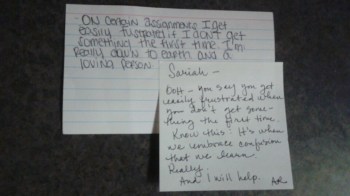 Some of my students’ notes were telling: Many of them lack confidence. Few of them like to read. A couple feel ready for the complex texts they will have to tackle. Some explained in very few words a need to feel validated and cared for and something personal and important to them as learners in my care.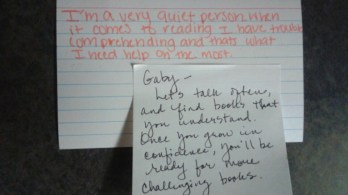

 students to fold notes like I did way back in seventh grade before the advent of all this technology. Texting friends just cannot be as fun as all those little folded notes.
 Again, I’m betting I’m not alone on this. We teachers often get caught up in innovation. And innovation is a good–no, a great thing. But innovative educators have been innovative for years and careers. We don’t always have to start from scratch. I suggest we all
  Step 3: Revise.
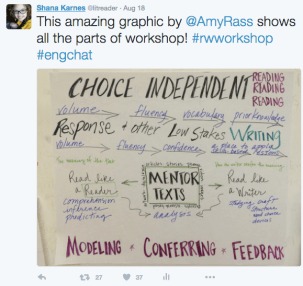
 time has been well spent. Every workshop classroom will–and should!–look a bit different. That’s one of the most valuable things about workshop: not only does it provide for student choice, it gives teachers autonomy, too.
 Three Teachers Talk