Returning to the Classroom – A Masked Year in Uncertain Times

When I found out late last summer that I’d be returning to the classroom in person, full time for the 2020/2021 school year, I was equal parts elated and terrified. Having basically not left my house in months, I couldn’t fathom how we’d manage to move back into the classroom with any sense of normalcy or how I’d keep myself, my family, my colleagues, and my students safe simultaneously. Pandemic teaching sounded to me like a mashup of dystopian proportions.

At the same time, teaching from home all last spring brought with it challenges I didn’t relish either (My husband and seven year old daughter were home working alongside me and there were times we were each/all ready to pack a bag and go…who knows where. Mostly elsewhere). I once again considered returning to my roots as a barista or possibly trying to sleep through the coming school year. Healthy, yes?

As news trickled in about navigating our return, it was clear we were building an airplane thirty-two thousand feet off the ground. A noble effort to be sure, but harrowing, dangerous, frightening, and quite possibly deadly. As educators have been time and again, we were being shoved to the front lines. Not as well-equipped or even trained first responders, but instead, as the humble servants who apparently swore oaths to serve and protect no matter the circumstances or cost. I was to be handed a mask and optional face shield, told to keep distance from the thirty students in my room, and do the job I had signed up to do. It did not sit well.

I raged – How could they ________ ?
(Fill in the above blank with four million questions about how it would all possibly work)

I feared for my safety – If I get sick what will happen to ________?
(Fill in the above blank with anyone I love and had been working so hard to protect in the previous months by staying home, masking, not hugging my own mother, etc.)

I cried – But what if _______?
(Fill in the above blank with an equal number of less rational and more emotionally charged wonders)
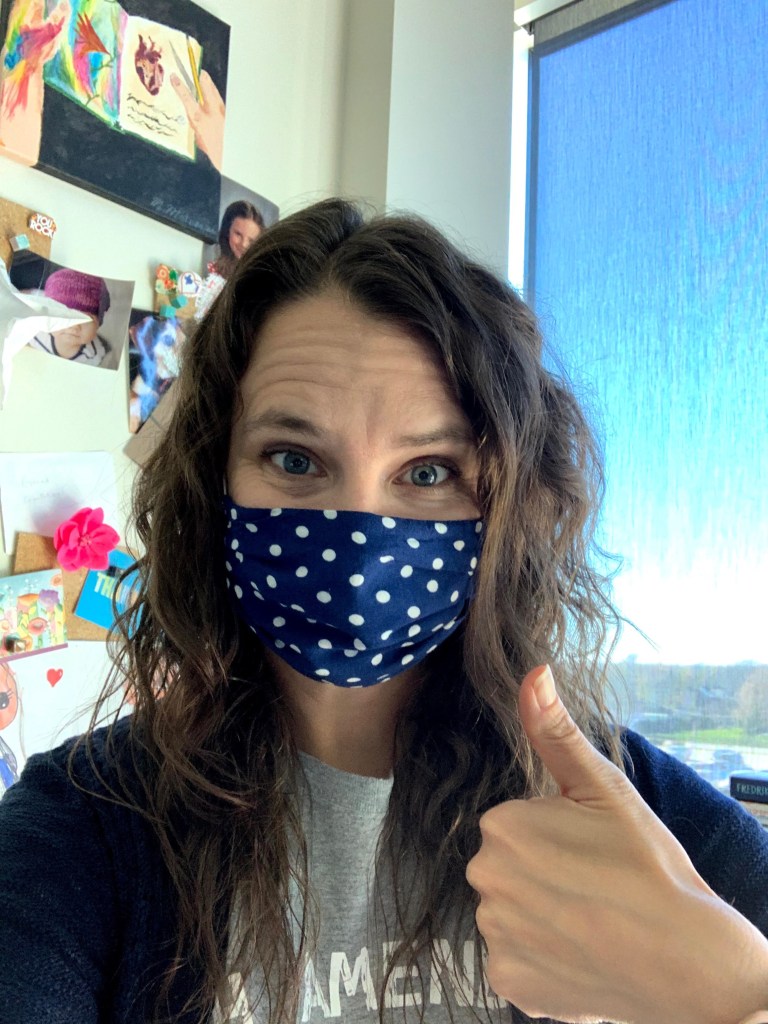
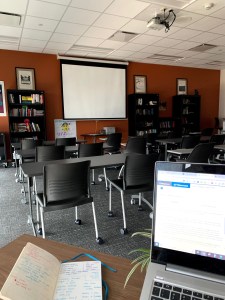
And while I’m not here to tell you it’s all gone perfectly, or that all of my initial concerns were or even could be addressed before we jumped in, or that the same will be true for you if you’ve yet to return – we have in fact done it. For eight months, I’ve taught in person and virtually at the same time (during the same class hour, in fact). 30 kids in my classroom. Masks all the day through. Suspicious eyes cast on every cough, sneeze, and inadvertently exposed nose.

We’ve shut down just once for two weeks last fall, but otherwise through a revolving door of exclusions for both students and teachers, staff turnover, extended class periods to allow time for cleaning each hour, and nervous moments spent supervising hundreds of unmasked students during lunch…we’ve supported one another through the uncertainty.

In some ways, things are no different than they ever were. My students read at the start of each period, write about what matters to them, and challenge themselves to discuss the weighty issues of our times both intelligently and diplomatically. The room looks much as it always has, but beneath the masks we wear each day, are fears and questions and uncertainties and trauma I could not have imagined last spring when I walked to my room in a haze on March 13th after a brief staff meeting suggesting our spring break would be extended by a week, gathered a few items to teach from home, and looked around at my empty classroom with a growing sense of dread.

Over a year later and as a mirror to live outside of my classroom, it all seems surreal. The longest school year of my life and the quickest. The most stressful, to be sure, but also the most challenging in ways that have caused me to grow in resilience, patience, and compassion.

A few days ago, Melissa asked if we were okay. My answer is yes, and no, and sort of, and I don’t even know. The layers of exhaustion wrought by worry, extra duties, student exclusions, positive Covid cases in my room, and teaching as I never have before (basically tethered to my desk so students at home can hear me while students in the room likely wonder whether my ankles are twisted or I’ve just grown lazy) are just too much. And yet, having kids in my classroom (and even teaching Virtual Film as Literature to 34 black Google Meet boxes), is the light in this dark time. Their curiosities and triumphs push me forward.

So, if you are staring down a return in fall, I cannot be the one to hug you (for obvious reasons) and say everything will be alright. But I can assure you through my example, that you are not alone in your fears, but likewise not alone in the overwhelming sense of joy you’ll feel by seeing your students in person and stretching in a thousand ways to inch back toward a new normal.
What I have learned in this past year (not related to making your own cleaning products, conserving toilet paper, or managing familial relations in close quarters for weeks on end) will forever change my teaching, but also solidify that nothing can shake the core principles that existed well before this pandemic …

  • Students and teachers are resilient, but still human:
    • If there was ever a circumstance to put patience and understanding at the forefront of our work, this pandemic is certainly a contender. It adds an ever present layer of uncertainty that is equal parts traumatic and debilitating. We’ve all experienced loss and change and fear and stress in ways we’ve collectively never experienced before. As ever, students need structure and support as they school in new and sometimes scary ways. Listen more/talk less. Write more/grade less. Read more/test less. Be there for your students, but also for yourself.
  • Reading and writing offer timeless benefits we know well, but choice is more important that ever:
    • I recall last spring, the push to have students write about their experiences in quarantine. And then the push back with the consideration that many students couldn’t/didn’t want to try and process this fresh trauma. It’s been my guide this year in offering students far more opportunities to process through SEL grounded prompts, but there’s always choice. Some students have written all year about the pandemic and what it’s meant to them, done to/for them, taken from them. Some students want to write about anything but. In the weeks and months ahead, our students will be on different timelines with their experiences and per the usual, it will be our job to be equal parts support system and challenger to process the world in which we live. Fall back always on choice – it provides for our students what our limiting circumstances often cannot.
  • Toxic positivity is not the answer, but active engagement in seeking positivity can be:
    • We cannot know how deep the cuts from our recent experiences truly are. We don’t know for ourselves or our students. Personally, the opportunity for deep and meaningful change that seems to have passed us by in hitting the pause button on traditional schooling is a deep cut. The standardized test slog is still in place (don’t get me started on the calls to measure “learning loss” with tests, tests, and more tests…though there are some reasonable voices out there), our hours/schedules/calendars are largely unchanged despite unprecedented additions of responsibilities and stress, and most importantly, to my mind, the opportunity to restructure in a meaningful way to address unconscionable achievement gaps often resulting from inequitable systems and misinformed priorities across education. This year has reminded me that I must continue to use my voice to advocate change in our work, but the moment to moment with kids demands that I give them as much positivity as I can muster. And when my store of smiles is low, I give myself the grace to take a step back, take a deep breath, and take time for myself, because in this circumstance we need to take a little to have anything left to give.

Above all, do what you need to do to balance the unending demands so that you and your family come first every single time. We are only as good for our students as we can be to ourselves, and we can be better each day when we prioritize our health, our loved ones, and our own sanity.

Lisa Dennis spends her school days teaching AP Language, English 9, and Virtual Film as Literature while also leading the fearless English Department at Franklin High School, just outside Milwaukee, Wisconsin where she lives with her husband Nick, daughter Ellie, and beagle Scout.  She now tries to live life based on the last pieces of advice her dad gave her –
Be kind. Read good books. Feed the birds. Follow Lisa on Twitter @LDennibaum

Addressing Perfectionism in Student Writing

A few weeks ago I was scrolling through social media and I read an excerpt from Fear and Art by David Bayles and Ted Orland that resonated with me and made me reflect on my teaching practices. In the section titled “Perfection”, Bayles writes:

The ceramics teacher announced on opening day that he was dividing the class into two groups. All those on the left side of the studio, he said, would be graded solely on the quantity of work they produced, all those on the right solely on its quality. His procedure was simple: on the final day of class he would bring in his bathroom scales and weigh the work of the “quantity” group: fifty pounds of pots rated an “A”, forty pounds a “B”, and so on. Those being graded on “quality”, however, needed to produce only one pot — albeit a perfect one — to get an “A”. Well, came grading time and a curious fact emerged: the works of highest quality were all produced by the group being graded for quantity. It seems that while the “quantity” group was busily churning out piles of work-and learning from their mistakes — the “quality” group had sat theorizing about perfection, and in the end had little more to show for their efforts than grandiose theories and a pile of dead clay.”

― David Bayles, Art & Fear: Observations on the Perils (and Rewards) of Artmaking

So often we are taught that we should focus on quality over quantity making it easy to overlook the simple fact that, sometimes, we need quantity to get to quality. It makes complete sense to shift away from the idea of perfection and just start making things- or in the case of our ELA classrooms, writing things. The skill will grow with practice. Unfortunately, it isn’t always so easy to convince our students. 

The fear of a blank page can be crippling for any writer. It stares back at the best of us with a terrifying mix of expectation and possibility. I see it in my students all the time- that quest for a flawless piece of work. They want reassurance that their writing is “good” or “perfect” before submitting it for a grade. Others become so stressed about failing, they never even start. 

How do we help our students work through their perfectionism and just start writing? Enter the Writer’s Notebook.

I’ve always been on a bit of a mission to find ways for my students to create a sort of writing portfolio, but I also wanted them to have a place to keep quick writes, notes, and other short pieces of writing. A few years ago, I started utilizing Writer’s Notebooks in my class and noticed how easy it was for students to flip around to different pieces they’ve written. 

My students have the space to make multiple attempts at writing in a low stakes manner. They explore their voices as writers, play with language, journal, finish pieces, scrap pieces, start over, revisit previous pieces to examine and evaluate their progress. I absolutely love this tool in my classroom. 

My goal for Writer’s Notebooks with my students, in addition to helping them keep up with notes, handouts, and their writing, was to help my students gain confidence in their ability.

I was in the middle of transitioning my students into more choice reading and the idea struck me- if my students are self-selecting texts to read, why can’t they also choose the writing that I grade? So, I flipped the script a bit and opted to let my students select which of their writings I would grade. 

Oh. My. Stars. 

When I say that this was a total game-changer in my teaching practice, I am not exaggerating. It eliminates so much of the emotional roller coaster that is grading. It gives students agency to choose the best example of their work which provides the opportunity for focused feedback on areas of improvement instead of feeling like I need to help them correct basic errors. 

I observed this simple change help many of my struggling writers ask specific questions as they were working or in our writing conferences. Once they knew they’d be able to select the piece I’d be grading, their fear of writing badly lessened enough that they’d actually begin. I definitely count that as a win.

What does this look like in the classroom?

Limit the choices to showcase a skill and not a specific prompt without making it overwhelming. This will vary depending on the lessons and skills, but I always make sure to build in multiple opportunities for a student to practice so their choice comes down to piece A, B, or C. 

How will you help address perfectionism in your students and get them writing?

Samantha is a wife, mom to three tiny humans, high school English teacher, perpetual student, Texas transplant, and lover of beautiful stories. She spends her days seeking levity in the chaos, sharing her passion for writing and storytelling with students, and searching for her constantly misplaced cup of reheated coffee. You can follow Samantha on Twitter @SimplySivils and on her blog http://simplySivils.wordpress.com/.

Are You Doing Okay?

This has been a year.

The last time I wrote a post for Three Teachers Talk was last May when I was in the midst of trying to get my students to finish a research paper on the the “Positives of the Pandemic.” At the time I would never have thought that we would be teaching all school year in a pandemic and I would be trying again to teach a new research paper to students remotely (and to those in person) at the same time.

Last year I thought that teaching was hard. This year, teaching remotely and then concurrently to students in person and at home at the same time nearly broke me. I ask if you are doing okay, because it is okay if you aren’t okay. I wasn’t okay for much of this year. What we have been asked to do during this ongoing pandemic takes teaching to a new level. I thought I was a techie before (HAHA!), but boy was I wrong. I have learned so much (Canvas, Zoom, Remind, Google Hangouts, Padlet, Nearpod, Google Jamboard, Google Sites, EdPuzzle, etc.) and yet still feel like a failure everytime I am teaching my class.

This week I led a training for our 1st and 2nd year teachers focusing on the topic of our mental health and work/life balance. We read the article, A New Way to Think About Work-Life Balance, which resonated with me because until this fall I did not know what work/life balance really meant to me. I spent the first six months of the pandemic working all hours of the day and night, answering text messages and phone calls, spending hours on Zoom with administration, and by August I was burnt out and exhausted. I was not mentally in a place where I was excited to start the school year with students. In all 23 years of my teaching career, I have never felt this way before. I thought I needed work/life balance. I was not okay.

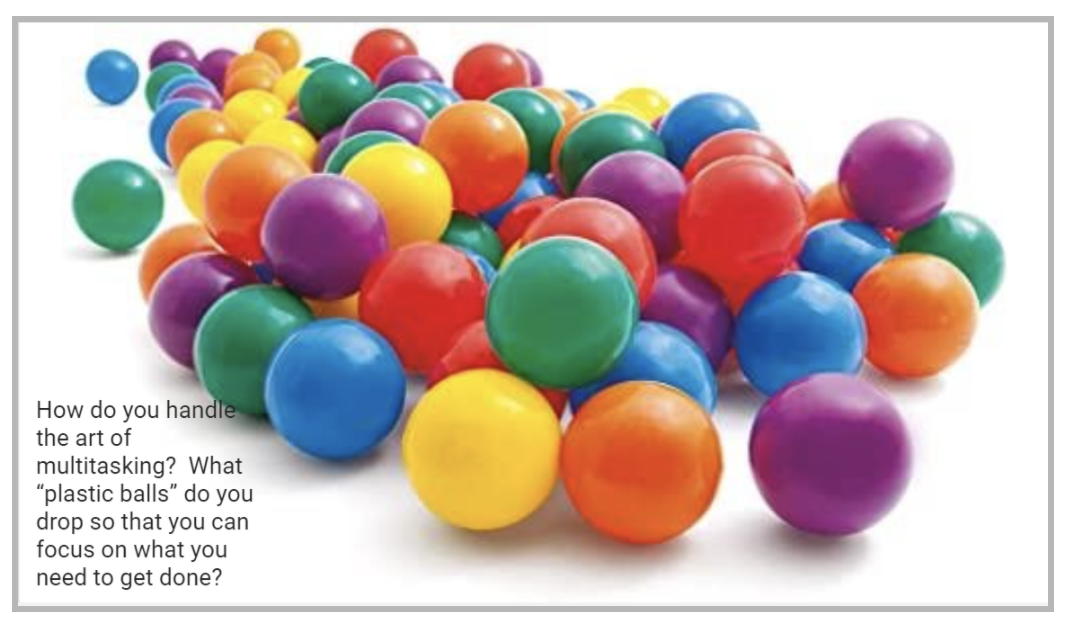
In A New Way to Think About Work-Life Balance, elementary school principal, Joe Mullikin, offers a new perspective. In reality there is no such thing as work/life balance. The key word being balance. It is impossible to “balance” lesson planning, grading, observations, family, me time, coaching, etc. all at one time, so instead we need to learn how to juggle, and know that it is OKAY to drop some “plastic balls” (responsibilities) from time to time as long as we don’t drop the “glass cups” (the things that make us who we are or are most important to us). Problems arise when we confuse “ghosts” (self-imposed, deep-seated, but nonessential expectations) with “glass cups”. Ghosts are not real and we need to be reminded to let them go.

As I started to prioritize the “glass cups”, my family and my health, and realized it was okay to juggle school responsibilities and drop some plastic balls each day, I started to feel better. Saying “no” to gave me more time for what I needed to prioritize in my life and keeping my family and my health at the center of every decision I make has made my life happier and less stressful. I also have more energy to handle the things like lesson planning and student feedback that I dreaded when I was so burnt out this fall.

As you begin take time to reflect on the 2020-2021 school year, I ask you to think about the “glass cups” in your life. Were you able to prioritize those this year? If not, what were the plastic balls and ghosts that kept you from investing in yourself? What will you do this summer to recharge and take care of yourself? What will you change for next year?

In the beginning of my post, I asked if you are okay? Please know that your mental and physical health are just as important as the care your have for the students you teach everyday. #YouMatter

Melissa Sethna lives and teaches with her husband in Mundelein, ILIn a normal school year, she is so busy coaching teachers and planning professional development (along with co-teaching her English class)This year she fell in love with Brene Brown podcasts, Studio Sweat on Demand spin workouts, coaching high school diving, and watching her own sons swim and play high school waterpolo. You can follow her on Goodreads and Twitter @msethna23.

The Real-world Relevance of Rigorous Informational Reading (& Writing)

GUEST CONTRIBUTOR: Tosh McGaughy

Building background knowledge. Increasing academic vocabulary. Growing text analysis skills. All of these common goals of literacy teachers are readily and complexly taught with informational texts. As fundamental as we all know that rigorous informational reading is for our learning readers and writers, no other genre is quite so easy to push aside for the more glamorous and engaging texts of just about every other genre. With an academic focus on college and career readiness, state education agencies and universities across the country are also advocating for more informational reading. For example, my state is in the process of revising our state language arts tests to include reading passages that are aligned to science and social studies standards. And, the sophisticated reading passages on the current Reading SAT include two History/Social Studies passages, two Science passages, and only 1 literature passage while the text types in the Writing section of the SAT are argument, informational text, and nonfiction narrative.

Thinking about backwards design from what and how students are assessed on their reading comprehension skills, intentional and spiraled engagement with a variety of informational texts in our Readers Writers workshop classrooms (and in every other content area) must become a standard practice. Connecting the reading skill to the writing skill is how workshop teachers can anchor the informational reading skills to real-world relevance. Providing plentiful mentor texts and examples is crucial, but to keep the texts current and relevant, teachers have to be constantly searching out different informational texts to put in front of students.

Hindsight is 20/20. I was fortunate enough to teach ELAR to my own daughter in 7th grade. (If you know 7th grade girls, you probably can imagine some of the challenges that year posed for me, personally and professionally.) Charlotte and her classmates wrote prolifically in their journals and experimented with different writing styles. There was a lot of poetry writing and narratives and imaginative stories. As I reflect, I wish now that I had pushed her to read more complex informational texts because her ability to write a lovely sonnet did not help her at all when she tried to decipher her first apartment lease nor was it the type of writing she is required to do often in her degree or in her job search as a college senior. By focusing on the beauty of language and expression, I neglected the power and practicality of strong informational reading and writing skills.

I, like many other language arts teachers, overvalued and overemphasized the genres of fiction in the lessons I taught, and now I’m on a mission (crusade?) to help teachers connect students with interesting and complex informational texts that can broaden their knowledge of the world around them as well as model the writing they will have to do in that world. After a recent textbook adoption, I have been disappointed by the quality and number of these texts that the big publishers include in their traditional anthologies. I find myself searching for options to include in text sets for my teachers. Some of my “go-tos” resources are below, but I also encourage teachers to teach students to seek out their own informational texts for independent reading and as a support for their content area studies. Tapping into inquiry and research skills to find their own relevant, rich, and rigorous texts is as real-world as it gets.

A Few Resources

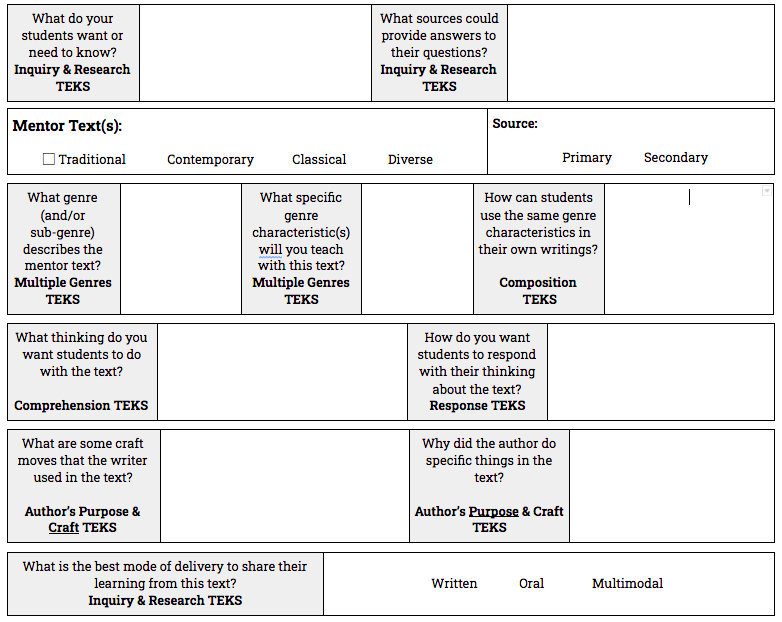
My state adopted new Language Arts standards recently, and I created some planning guides to help visualize how to interconnect the strands. This one starts with our inquiry & research strand as the purpose for the informational reading & writing. LINK.

lesson guide template

And, inspired by Kelly Gallagher’s work around writing purposes, I have this reference for teachers to remember the many different real-world purposes for effective informational writing that are as far-removed from the state-tested expository essays as they can be. LINK.

Informational Text Go-tos:

Text Sets from the Masters by Gretchen Bernabei, 2016

Finding the Heart of Nonfiction by Georgia Heard, 2013

The Quickwrite Handbook by Linda Reif, 2018

Texts & Lessons for Content Area Writing by Harvey Daniels and Nancy Steineke

TweenTribune by Smithsonian

Kelly Gallagher’s Article of the Week

NewsELA

The Culture Code and Writing Conferences: Part 1

I’m a sponge

“I love taking in so much new information that it just oozes out of me at the slightest provocation.” A friend recently described herself this way and, gross imagery aside, I get it. The feeling of having just read or heard or watched something new and being so INTO the idea that you can’t help but bring everything in every conversation back to that idea. We call this sponging. We’re very original.

She sponges…a lot. I sponge…less.

So when I do sponge, I stop and take notice. Last week I finished Daniel Coyle’s The Culture Code*,  which outlines ways to build effective, productive cultures by examining everything from the San Antonio Spurs to Zappos to a call center in India while sprinkling in a healthy amount of research to support his claims. I soaked it all up, finishing the book in a day – and then began oozing ideas about culture and long-term flourishing all over everyone and everything.

See, the book rests upon the idea that humans are constantly (consciously and unconsciously) asking themselves questions as they interact with others:  

  1. Are we connected? 
  2. Do we share a future? 
  3. Am I safe? 

If we can find ways to answer these questions for members in our groups, we can create robust cultures. Confronted with the powerful notion that our brains are trying to answer these three questions all the time even when we’re unaware, I couldn’t help but think of the implicit ways our writing conferences answer these questions and then began to think of ways to make the implicit explicit. So, over my next few blog posts, I’d like to discuss those three questions and how they relate to writing conferences, looking at strategies and routines we could implement to get more from this common practice.

Unpacking the Questions

Question 1: Are we connected? 

Coyle quotes MIT Professor Alex Pentland: “Modern society is an incredibly recent phenomenon. For hundreds of thousands of years, we needed ways to develop cohesion because we depended so much on each other. We used signals long before we used language, and our brains are incredibly attuned to certain types of behaviors.” In short, our brains are constantly and UNCONSCIOUSLY looking for clues that we are connecting to other individuals. It’s why we pay so much attention to facial expressions, why we maintain eye contact, why we turn our bodies to face the people we’re interested in. We’re looking to see that the energy we’re bringing to any given conversation is being matched, that we’re being treated as unique individuals. These often non-verbal cues speak loudly and help answer the second question humans are constantly (and again unconsciously) asking of each other. Part 2 of this series will look at the physical set up of writing conferences and routines I’ve built to answer the “are we connected” strategy. One such routine is my system of weekly feedbacks. You can read about them here

Question 2: Do we share a future?

The non-verbal cues from question one signal that the relationship will continue into the foreseeable future, letting us know that we are connected to others and, thus, are safe. In our social engagements, we have some choice about the kinds of relationships we engage in and the level to which we feel safe. For example, this question makes me think of a volleyball team I play on. With the end of the season nearing and none of us quite sure we want to continue to play together next season, that “do we share a future” question looms large. This uncertainty leads to awkwardness and doubt amongst the teammates, which, unsurprisingly, translates to the way we play on the court. We need a better culture. However, in the classroom, we can’t choose which kids sit in front of us day in and day out. So we might amend that question to “do we share a mutually respectful and productive future?” This safety question becomes even more important because those interactions are created non-voluntarily. Essentially, in our classrooms, our students might consistently be asking themselves (consciously or unconsciously), about the state of their relationship to us, checking in to see where we stand with each other. Answering that question often can put the brain at rest, prepping it to learn and grow more efficiently. Part 3 of this series will look at how we can answer this question through feedback routines and quick check ins with students AFTER the writing conference is over. 

Question 3: Am I safe? 

Maslow had it right – humans just want to know that they’re safe in any given situation. Granted, we’ve developed past the “is that a tiger in the bush” phase in our evolutionary cycle, so we’re less worried about getting actually eaten and more worried about getting metaphorically eaten. The combination of the physical cues (Q1)  that tell a student they belong and that we share a future together (Q2)  work to assure a student that she is safe in our room- safe to learn, to take risks, to grow.  Coyle writes, “They [the cues] seek to notify our ever-vigilant brains that they can stop worrying about dangers and shift into connection mode, a condition called psychological safety.” Part 4 of this series will look at how the one on one attention provided  by conferences allows students to calm the worrying part of their brain and focus more comfortably on the task at hand. I’ll also talk here about how I use writing conferences to navigate the move to a gradeless classroom inspired by Sarah Zerwin. You can read about fellow contributor Sarah Krajewski’s work in the gradeless classroom here

Where do we go from here?

As we begin to answer these questions for students we can work towards communicating our actual message: I care about you as a person and a student. I want you to learn and grow. From here, we can begin to say to students as Coyle writes: “You are part of this group. This group is special; we have high standards here. I believe you can reach those standards.”

*Affiliate link: If you purchase through this link, 3TT gets a little something.

Sarah Morris teaches AP English Language & Composition, AP Seminar  in Murfreesboro, Tn. She is currently rewatching The Good Place. She can’t help it. There’s something about this line from Chidi in Season 2 that gets her every time: “I argue that we choose to be good because of our bonds with other people and our innate desire to treat them with dignity. Simply put, we are not in this alone.” She tweets at @marahsorris_cms. 

A Huge Bright Moment in a Pretty Bleak Year

GUEST POST by Rebecca Riggs

Last year around this same time in “the before,” my students were participating in a book tasting to choose their book club books for the fourth quarter of school.

As I walked around the library (no seating chart needed) and looked at my students smile, scowl, and everything in between, students passed around books on their tables. I built up my library of books so I had multiple copies of popular, widely representative books mostly from the ProjectLIT list, and I was very excited to see what students would pick.

I spent the first days of my break leafing through my students’ ranked choices, and I was pleasantly surprised that they almost all fell perfectly into groups where I was able to give them their first choice.

It was my team’s first time trying out book clubs; I was thrilled to try something new and to see what it would teach me! Unfortunately, we all know how that ended–my students never got to do those book clubs, and I did not get to see them again.

Here we are a year later with my current students (including some of those students from last year since I moved up a grade) engaging in overwhelmingly successful book clubs in a hybrid teaching model in a pandemic!

If you told me at the beginning of this dumpster fire of a school year that I would have been able to try out any new instructional model, let alone book clubs, I would have told you to cut out the toxic positivity and leave me to my despair.

I will not lie, the logistics and setting things up was a lot of work and overwhelming at times, but I am so glad we took the time to do this. My students are having meaningful conversations about their books, some are reading a whole book for the first time in years, and almost all engaging more than they have this year because of these clubs.

I am so grateful for this huge bright moment in a pretty bleak year.

As far as logistics go–

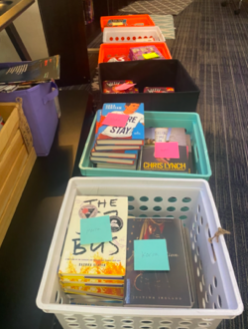
I first gathered class numbers from each of my colleagues who do not have their own sets of book club books, and I made sure we could make it work with what I and my one other colleague, Deanna Hinnant, had.

Since last year, we have taken advantage of First Book Marketplace’s low prices, promo codes and book bank prices to gather books for clubs.  Once that was settled, and I gave those teachers their books, we had to figure out how to facilitate a book tasting that was both safe and accessible to students online.

My amazing librarian, Tasha James, made us book tastings for students to choose books for their independent reading at the beginning of the year, and I just modified one she had already created. My colleagues who did not feel as tech-savvy reached out to Mrs. James, asking her if she could create their book tastings for them.

Here is the one I created. I gave the students about half of a class to look at the book tasting and to complete this form to rank their choices.

From there, it was pretty easy to get kids into groups and to assign kids who chose not to respond. I intentionally had the groups be a mix of online and on-campus students, but some of my colleagues chose homogeneous groups. I also chose to go through each book and break it into 5 sections that aligned with chapters (if there were any), and I gave them this document in hopes that the groups would mostly stay on the same page. (I know there are date discrepancies between some of the documents. We can thank the Texas Winter Storm for that one!) My colleagues chose to let their students break it into 5 sections themselves and decide as a group where they would reach in their book for each discussion, which seemed to work just as well.

After we had our list of groups, we stayed after school two different days in two different weeks in order to hand out books to online students. We began advertising this well before students even chose their books through parent emails, telling the students at the beginning of every class, and sending Remind101 messages. As expected, there were lots of students who did not pick up their books. We tried our best to meet with these students one-on-one to set up alternate times, to leave the books in the front office for them to get or to explain to them how they can get the book online from our school/county library. At the end, 90% of the students got a hold of their book in one way or another, and the ones who did not were not participating in class at all regardless.

For our assessment, we created a TQE document that you can view here.

We practiced using this method during our reading of The Crucible one time before it was used for book clubs to make sure students understood the method, but also to make tweaks because it was our first time as teachers using the method, too. The “Topic of the Week” aligned with our mini-lessons each week and were merely a suggestion of what to think about as they read. You can find more about the TQE method from the Cult of Pedagogy Podcast episode 103 or from their blog post. This is where we got the idea and modified the method for our purposes.

Overall, I found this method to be an amazing, fairly-easy way to get kids to make their thinking visible and to prepare them for their book club discussions. However, I did have to “fail forward” when I realized during the second book club discussion that I had not made it clear that the “Thoughts” and “Questions” (and maybe epiphanies) portions were to be filled out before their discussion while they read in preparation for the discussion.

The standards we were focusing on for the reading, TQE’s and discussions can be found here.

When I tell you that these book club discussions I listened into made my heart leap in my chest, I am not being hyperbolic in the slightest. These kids, man. They just amaze me.

Students were demonstrating mastery of so many standards, but also just saying such thoughtful things while connecting with each other. It’s everything I have wanted for this year.

It was not a perfect start, and some kids came to their first discussion with only five pages read, but I saw so many kids start to read when they heard how excited their peers were about their reading.

I had a couple groups of students who I actually had to redirect because they would try to talk about their books when we were working on other tasks in class, or I was giving a lesson. Honestly, I do not even mind that they were being disruptive!

I had one student who is designated as SPED who was reading Monday’s Not Coming* by Tiffany D. Jackson who was having a hard time getting into the book and getting motivated. After her groupmate encouraged her and raved about the book, this student read 100 pages in one day. She shared that this will be the first book she’s read in its entirety in years. Many students have been positively affected, but that one student becoming a reader would have been enough to make it all worth it. Fortunately, this is one of many stories of students finding books they love and finally seeing themselves as readers.

I will not lie and tell you that the organization and logistics were not hard and time consuming and frustrating at times. We had students we couldn’t get in contact with. We had different people, including me, out at different points during that unit for weeks at a time and others on our team had to pick up the slack.

We also had an unprecedented winter storm in Texas that took a week of instruction and rocked many of our staff and colleagues’ lives.

Some students never got their books and some students are still just on page 50 after five weeks of reading. In addition, we had students dropping other classes three weeks before the end of the quarter grading period and being added to our classes in the middle of book clubs.

It was not perfect, but it is one of the most impactful things I have done in my classroom since I started doing independent reading with my students, and I cannot believe we were able to pull it off during hybrid teaching with everything else we have added to our plates this year.

As my dad would say, “You can do hard things,” and this hard thing was well worth the effort.

*Affiliate link: If you purchase through this link, 3TT gets a little something.

Rebecca Riggs is currently in her 4th year teaching (feels like 10th) at Klein Cain High School in Houston, TX. She loves recommending books! You can find her on Twitter @rebeccalriggs and on Instagram @riggsreaders 

Shake the Dust: Writing an Epilogue Poem

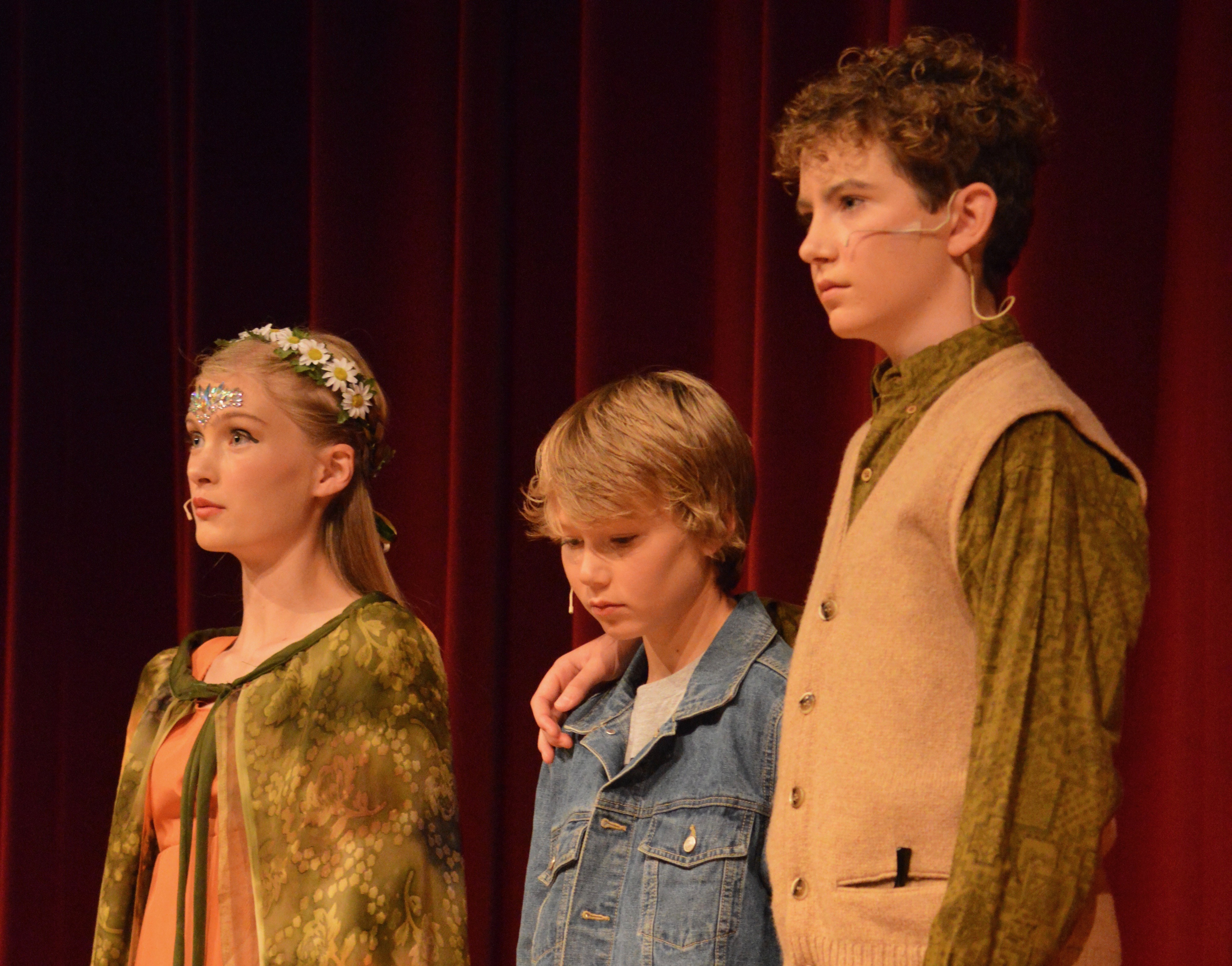
Faith, Rhett and Deacon on stage in November for a production of Copperfield, now a favorite memory…

This is for the bus drivers driving a million broken hymns. This is for the men who have to hold down three jobs simply to hold their children. This is for the night schoolers, and the midnight bike riders who are trying to fly. 

Shake the dust….Anis Mojgani

Shake the dust. My students and I have been reflecting on what it means to be “dust shakers” during a year when we’ve all experienced “broken hymn” moments. This spring, as our time in writing workshop draws to a close, I’ve asked my students to cultivate their writing gardens by composing what I call an “Epilogue Poem,” a reflective piece about an element of their journeys as eighth graders. 

Our mentor poems for Epilogue Poetry are:

“The Golden Shovel” by Terrance Hayes:  (If you’re not familiar with Golden Shovel poetry, check out this New York Times article for suggestions on how to write a Golden Shovel Poem using a newspaper headline as a mentor text!)

“Remember” by Joy Harjo (Thanks to Oona Marie Abrams and Go Poems for suggesting this poem!)

“The Breath of Life” by Scott Myers: This poem is about the inestimable value of every breath.

“A Long and Happy Life” by Delta Rae (Thanks to Brett Vogelsinger for introducing me to this song!) In addition to playing the song, I like to share this behind the scenes video with my students because band members talk about using book titles as mentor texts, childhood artifacts,  and  discuss what having a “long and happy life” means to them. This inspires my students in their thinking about abundant life as they write their poetry.

“Shake the Dust” by Anis Mojgani: This beautifully written spoken word gem speaks to anyone who has ever felt marginalized.

After listening to the mentor poems, discussing craft moves, and making annotations throughout the week, we take the next step into writing a poetic reflection on any of the following:

  • A “watershed moment” in our lives. I define “watershed” as a moment that alters the trajectory of life such as a birth, death, divorce or separation, etc. While I would never obligate a student to write about a watershed, many choose to do so after a whole year of writing together.
  • Something we’ve learned during the pandemic
  •  A  favorite elementary or middle school memory
  •  A tribute to someone who has mentored us
  • What it means to have an abundant life
  • A reflection on our families

 We use Wakelet to curate golden lines from our favorite mentor poems and then try writing our own lines modeled after the mentor or simply publish an idea that we have for a poem.

My student Daiva posted:

 I chose this golden line from “Shake the Dust” :”So when the world knocks at your door, turn the knob and open it up, and run into its widespread, greeting arms.” I chose this line because the writer makes the world sound like a person. This line reminds me that the world will always welcome us, though we may hesitate at first. I liked all of our mentor poems, but this one spoke to me the most…

Natilia wrote a few of her own lines using “Remember” as a mentor text:

Remember the night sky.

Remember the look of it at 10’o’clock on a summer evening

With the breeze blowing in your face…

I wrote beside my students by posting on Wakelet, and then sharing a draft that I was composing using the Scott Myers piece as a mentor.  A portion of my poem, “Alive and Breathing,” is linked here.  Students will use the Wakelet posts as a springboard for their rough drafts.

April is the perfect time to shelter in poetry with our students, and to reflect on the joys and challenges of this “broken hymn” season in our learning lives.  Epilogue poetry compels eighth graders to capture their favorite memories, before they’re lost.

What are your favorite ways to shelter in poetry?


Elizabeth Oosterheert teaches 8th grade language and theatre arts in Iowa. She  loves writing beside students and sharing the stage with them.  Her favorite stories are Our Town, The Outsiders, and Peter Pan.  

Rethinking Grades (Part 2)

Last June, I wrote a blog post while in the middle of rethinking how I grade in my classroom. At the time, I was in learning mode. I knew what I wanted to change, and I thought my workshop classroom would fit my ideas quite well.

Last August, as I attempted (and often failed) to plan for a year of unknowns, I decided that I would look at the 2020-2021 school year as an opportunity.

An opportunity to try teaching strategies I was always too intimidated by.

An opportunity to focus on joy and autonomy.

An opportunity to lessen my students’ stress level (and mine) in an already stressful time.

Yes, this year was the perfect time to go gradeless.

Sure, my students were a bit confused at first. No number on an assignment but they still had to do it? As one student put it, “how will I know what’s important in this class?” One student even asked why he should do any work at all. These were important questions, I thought, so we spent the beginning of year discussing them. We couldn’t go gradeless if my students didn’t understand their role in the learning process.

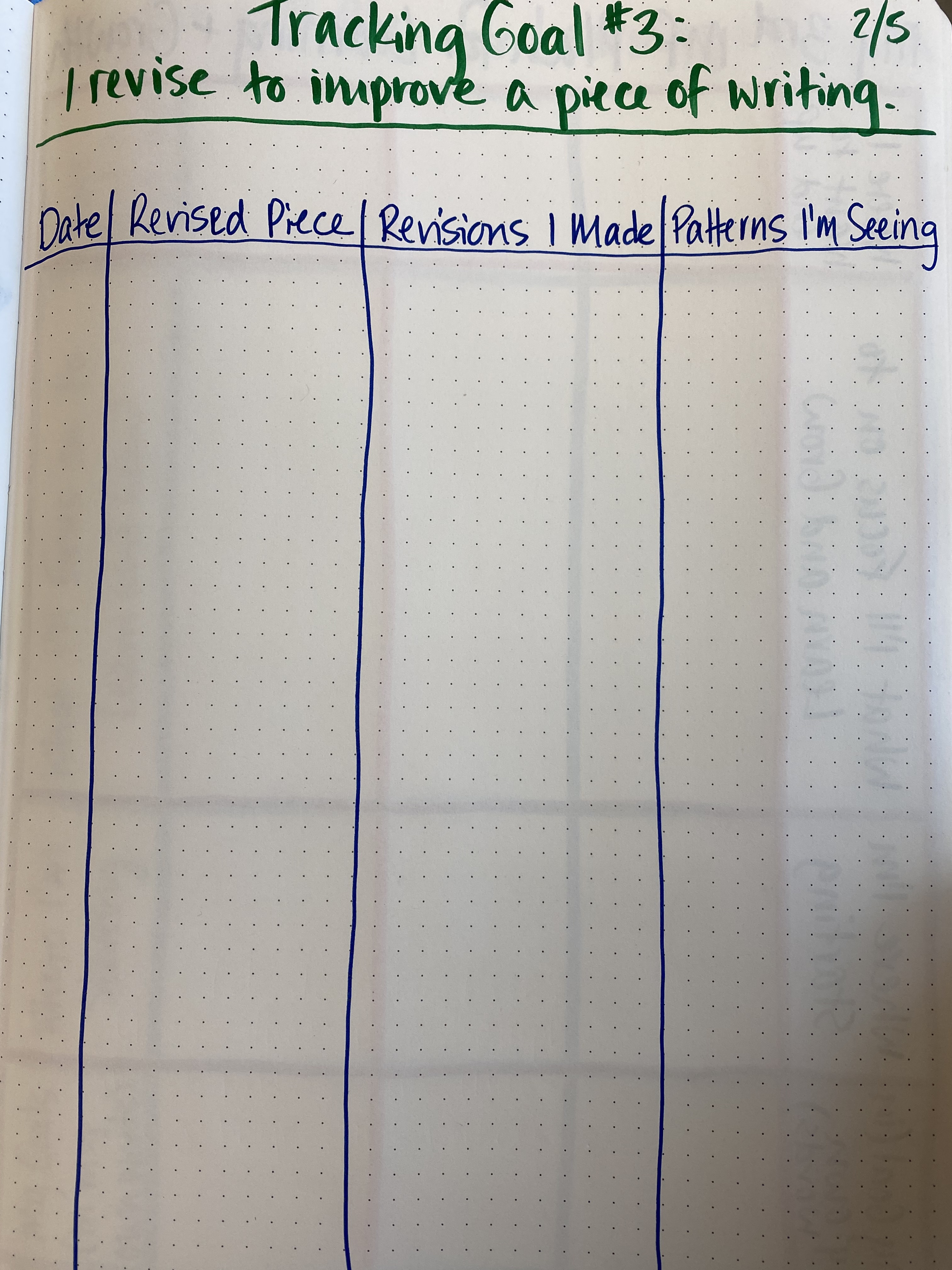
To help my students organize their thinking, we got into our notebooks. Using a list of ten learning goals (I modeled mine after the ones Sarah M. Zerwin included in her book Point-Less), students created plans to meet two goals each marking period. We created tracking charts in their notebooks (see mine below), and each week they took time to record their progress. Along the way, I shared my own progress, as well as my setbacks. My struggles helped them realize that some weeks would be easier than others. By the end of the first marking period, they wrote letters sharing their stories of strengths and successes, where improvement was still needed, and then based on both, what grade they believe they deserved.

One of my planning charts, and two tracking charts. I keep track of my learning, just like my students.

Yes, going gradeless was terrifying at first. It was such a big change for us all. One aspect that many students struggled with was their “grade” in our online grading application. They still saw a number there, so wasn’t that their English grade? Not quite. I was still required to put numbers in a grade book, but what they saw were their “completion grades.” This was one of the many ways students received feedback, but in the form of a 0, 5, or 10. A 0 meant the assignment was missing, a 5 meant it was incomplete or completed incorrectly, and a 10 meant it was fully completed. At first, my students only looked at those numbers, so I had to change their thinking by giving them additional feedback on their assignments and in conferences. Students soon learned that receiving a 10 didn’t mean that an assignment was finished. I would share strengths I noticed, but also push for more revision. This way, no matter the ability of the student, I could always challenge them. Soon, I began to see more revision than I had ever seen before.

Now, as I write this post, my students are in the process of reflecting on their 3rd marking period of learning. As I read over their letters, I can see their obvious growth and honest reflection. This senior shared some honest thoughts about a tough marking period: “At times it was hard to find motivation and complete assignments on time. But for this class I believe I gave good effort and expressed myself in my writing. As far as reading goes, I’ve read more consistently this marking period and have put aside more time to read.” One of my other seniors found something he enjoys: “My strength in English is writing stories. It’s something that I could do all day if I could.” A ninth grader shared that she gained confidence in her reading from participating in a book club: “The book club helped me to improve my reading skills by sharing my ideas and my thoughts with my classmates in my group.”

Next week, we begin conferences where I will meet with each student to discuss the content of their letters and the grades they are asking for. I must say, so far their self-assessments have been pretty accurate! Some students are even too tough on themselves.

I still have more to learn about going gradeless, but I do know that this is the path I am meant to be on. My students are cognizant of their own learning now, so this gradeless journey is a welcomed one.

Sarah Krajewski teaches high school English and Journalism near Buffalo, New York.  She is currently in her 19th year of teaching, and is always looking for new, creative ways to encourage her students to read and write. At school, she is known for helping students become lifelong readers, and for being a devoted reader herself who “knows her books.” You can follow Sarah on Twitter @shkrajewski and her blog can be viewed at http://skrajewski.wordpress.com/.

Reading through Liberty

My two-year-old grandson is a master manipulator–or maybe he’s just brilliant.

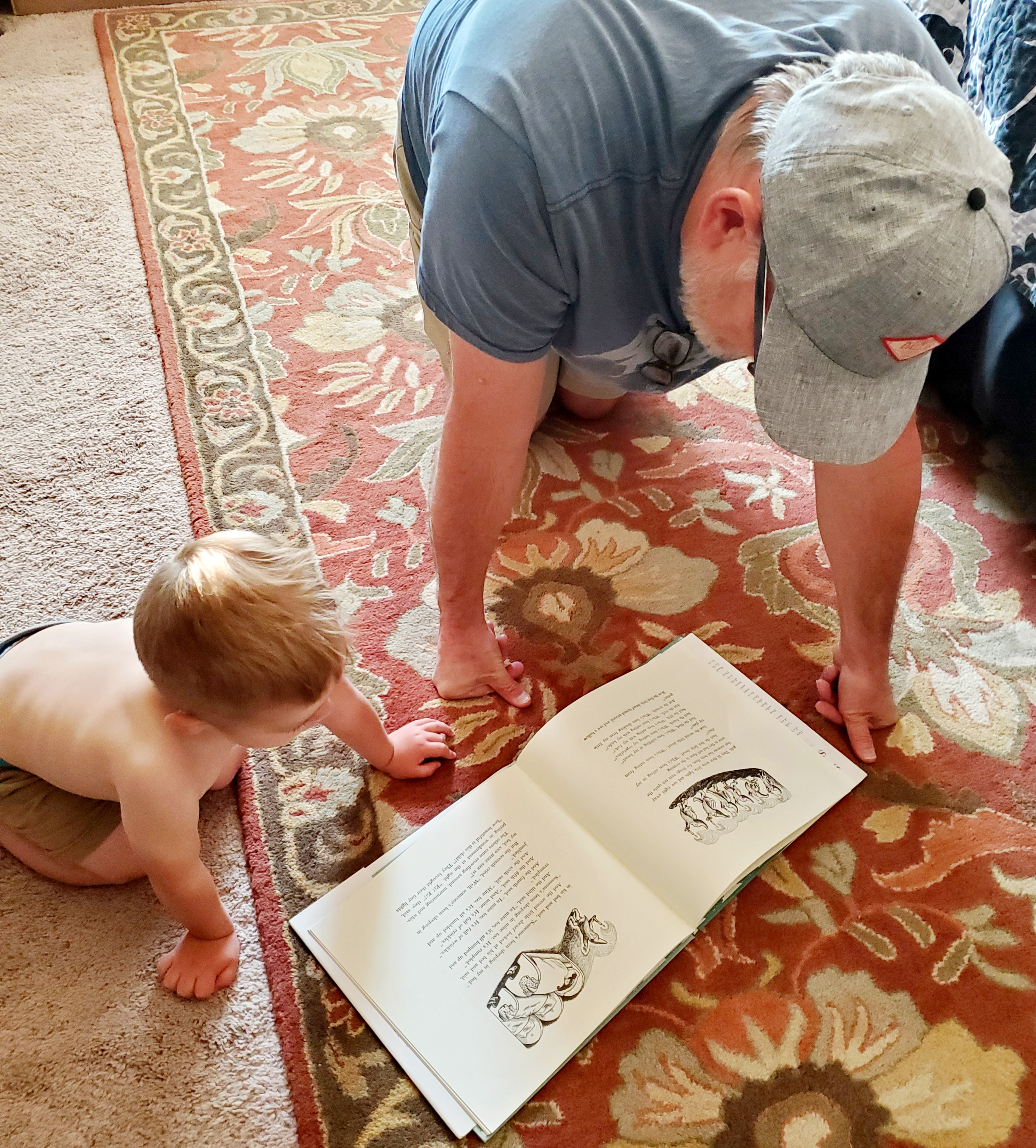
Over the weekend, his mom and dad took a little anniversary trip, so Papa and I tended Indy and his baby brother. More than once, when we needed/wanted/pleaded with Indy to do a certain thing, he ran to the bookcase in our room, pulled out a book–or four or seven–and sat down to read. “Shh. Quiet,” he’d say, patting the space on the floor next to him in a commanding invitation to sit beside him.

What else is a grandparent to do but stop and read with the little man?

We all know the benefits of reading to young children. (Google gives “about 921,000,000 results” for the question.) We also know that somewhere along the way, many children, maybe especially adolescents, come to not like reading.

Most of us face two challenges:

How do I get students to read when they just don’t want to?

How do I get students to read when they just don’t seem good at it?

I used to think it was all about the books. You know, I’d pack the shelves in my classroom library with the most colorful, interesting, inclusive, newly published, award-winning books; I’d talk about these books A LOT, doing my best to match books with student interests. I’d do All The Things.

And, yeah, many students came to like our dedicated daily reading time. Some of them even came to like the books they read. Many of them claimed to have read more than they ever had before. I’m just not super sure how many students came to really like reading.

Maybe that’s okay.

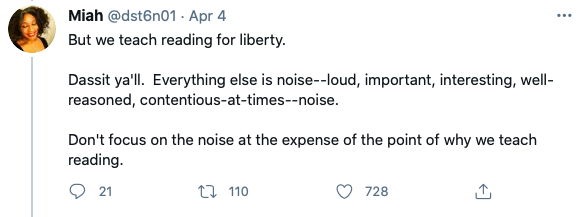
The other day I saw this tweet by Sarah, a friend and contributor to this blog, and I quickly read the whole of the thread posted by Miah on April 4. It’s a beautifully constructed and compelling argument and well worth your time to read in full. Like Sarah, “I’ll be thinking about it for a long time.”

Today, I’m thinking about it here in relation to my tiny grandson and the reader he may be when he’s 10, 14, 17, or 37.

Miah lists reasons we teach reading: “We teach reading for. . .security. . .self-advocacy. . .freedom. . .economic security. . .social justice. . .evolution. . .social advancement. . .liberty in the highest sense of the word.”

and includes this sage advice–

I think we know what “the noise” is, even beyond how Miah describes it. There’s noise in so many aspects of our teaching lives. And sometimes, nay often, it is hard to ignore. Yet you and I both know we must.

And I think one way to do it is to position liberty: We teach reading for liberty, but we also teach reading through liberty.

If you’re nerdy like me, maybe you look up “liberty” in the dictionary. Merriam-Webster offers a whole list of definitions: “The quality or state of being free” and all the context descriptors–all but speak to the importance of student choice when it comes to reading in a high school English class. Thus, a robust classroom library and all the things.

Then, there’s this definition: “a right or immunity enjoyed by prescription or by grant PRIVILEGE

And there it is–the word privilege making me think again.

In context of my teaching practice, who has the liberty to talk, ask questions, move about the room, take risks, choose texts, shape plans, assess learning? What’s privileged, where, and when?

And, yes, I know–if you’ve read this blog for awhile now, I am most likely preaching to the choir.

But even if we “get it,” even if we try it, even if we’re tired of trying or tired of this pandemic, even if we cannot handle one more decibel of noise–if we believe in empowering students with the skills they need to capitalize on the liberty life affords them–or liberate themselves so they have more–we keep thinking and reflecting, and we keep doing the things that help young people have experiences with reading that make them want to read.

Try This “Conversation Starter” (I read it recently in the Morning Brew, an online newsletter I read pretty much every day.)

If your bookshelf could only have five books, what would they be?

You can learn a lot about an individual–positive, negative, and otherwise–depending on the books they choose, or if they don’t make any choices at all.

Amy Rasmussen is a lover of words, color, and living things–like plants, art frogs, and grandkids. She lives in North Texas and escapes for long periods of time on the country roads near her home. She writes (mostly in her notebook) to see and feel and think in new ways, and when it comes to publishing anything publicly, her phobia of heights doesn’t seem half bad. Amy has a book about authentic literacy practices she’s co-written with Billy Eastman due for publication this fall. She’s both excited and terrified. Follow her @amyrass –maybe she’ll get a little more active on social media.

Today’s a Good Day to Write a Poem–or anything really

Perhaps you’ve noticed. Posts here have been scant for quite a long time. Maybe the reasons are too complicated to explain, or maybe they only make sense in my head. I could probably figure out how to explain the gap year, but if you’re like most of my students you’d think there’s too much print on the page and skim or skip this post before it really says anything.

I’d rather just say “Hi! I hope you are well, sane, surviving–maybe even enjoying this crazy life we are living. I’m glad you are here, and I’m working on stiffening my spine and sharpening my skills for the 3TT Come Back Tour.”

Since today launches National Poetry Month, it only makes sense to think and write about poetry. A quick search reminded me I wrote something similar close to two years ago today– Can Poetry be Wrong? And Other Inspiration for #National Poetry Month. I still believe in what I wrote there. Maybe I believe it even more. I’m still stunned by the first comment: “Yes. In fact, most poems are wrong, the 99.99% of poems that do not survive the test of time.” What the what?!

Since I wrote that post in March of 2019, my life has changed in dramatic ways–some positive, some not-quite-so, and some tragic (these still leave me reeling.) And when I read poetry, even snippets of it on my IG feed, my moods and emotions get a boost, a validation of sorts. I am grateful for the wonder of it all: Someone somewhere said in a poem something I wanted/needed/hoped to say.

Today, I’m wondering how you will celebrate National Poetry Month — by yourself and with your students. There’s some great ideas at the previous link. Here’s a three more if you are still looking–

Join #verselove21. It’s a celebration–and a challenge–to read and write poetry, hosted by Dr. Donovan at the Ethical ELA blog. I’ve joined in several of her Open Writes and always find new ways to expand my craft–and ideas to use with student writers. Writing a poem a day for 30 days is hard for me, but I like to try. It’s also hard to share, but I do it anyway.

Check out some poets on Instagram. Raquel Franco and Amy Kay are two new favorites, and both have posted a list of prompts for the month.

Order the keepsake book of Amanda Gorman‘s poem “The Hill We Climb, an Inaugural Poem for the Country.” (I’m reading it slowly and playing with tiny illustrations on the pages.) Note: If you order through the link, 3TT will get a tiny something.

Use the photos on your phone for inspiration. For example, look at the last five photos and choose one for inspiration. Or, scroll through and notice colors; then choose an image with a color that speaks to you today. Or find an image of an object and write a poem that personifies it. There’s so much inspiration in our phones!

And if you just don’t have it in you to write poetry this month, (I get it. I really do.) I hope you will at least find some time to enjoy it. Whether you take a shallow dip or a deep dive, I hope you’ll find joy. And maybe you’ll find these words by another of the IG poets I follow worth noting–

how to understand the poem:

do not be afraid to feel it. (alison.malee)

Please share in the comments your best tips for leveraging National Poetry Month or leveraging poetry in any month.

Amy Rasmussen is a lover of words, color, and living things, like plants and grandkids. She lives in North Texas and escapes for long periods of time on the country roads near her home. She writes (mostly in her notebook) to see and feel and think in new ways, and when it comes to publishing anything publicly, her phobia of heights doesn’t seem half bad. Amy has a book about authentic literacy practices she’s co-written with Billy Eastman due for publication this fall. She’s both excited and terrified. Follow her @amyrass –maybe she’ll get a little more active on social media.