Why I Returned to Hard-Copy Grading

tumblr_maccshmi241rvog5q.gifGrading, grading, grading.

Sigh.

As the kids say, I literally cannot even.

Where do I begin?

Grading, to me, is one of the necessary evils of education–along with mandatory monthly fire drills, whole-building staff meetings, and standardized tests.  I have disliked it for the duration of my teaching career, as I have disliked all of those things, but I still have not found a way to avoid it.

When I left the high school classroom last May, one of the things I was happiest to let go was grading.  (That and those damned fire drills.)

But I didn’t expect to come to loathe grading even more when I began teaching college students.

There were a few reasons I disliked grading in my new job:  first, I found that, by dint of the course designs I inherited, that the only “grades” given were at the very end of the semester.  This meant that what little formative feedback was built into the course wasn’t seen as valuable–by the students nor the other instructors I was working with.  I sat in meetings where a colleague complained about “having to do all that reading and write all those comments for nothing” (“nothing” being no grade).  I thought to myself, wow, you’re missing the whole point of formative feedback.

Another thing I loathed was that most everything was electronic.  Any assignment due was expected to be turned in via email/eCampus/Google Drive two days prior to the class meeting, and the instructor was to give feedback and a grade before class began on Friday.  This meant that the only feedback about a student’s work was always only given by the instructor, and that students never saw one another’s work.

So, as the semester moved along, I began to make some changes to the course design:  more formative feedback, more frequent turn-in checkpoints for large assignments, lots of ungraded, low-stakes drafting of ideas in class.  We all hobbled to the end, adjusting assignments and expectations as we went.

But over the winter break, as I reflected and gathered the many post-its of ideas I’d stuck here and there, seeking to refine our syllabus and clarify our goals, I thought of one major change I could make that would solve a lot of my problems with the course.

Return to paper.

img_7291Good, old-fashioned, print-it-out-and-bring-it-to-class-and-turn-it-in assignment submission.

This practice has had a few key benefits for me so far this semester.  First, I am seeing much more clarity of thought in my students’ talk in class–I suspect because they’re treating their weekly one-pagers as first drafts of their thinking, and then re-reading them, as evidenced by their frequent typo corrections or asides to me in the margins.

Second, the issue of opacity between students’ assignment submissions is gone.  Each class meeting, I try to build in a time to share our writing, whether by trading papers, using our papers as an artifact to support some talk, or asking students to comment on one another’s work.  I ask students to read not just for content, to glean multiple perspectives, but also to read for structure, to see how other writers think through the issues we’re grappling with.  As a result, I’ve seen a great deal of growth in how students structure their writing, as well as a transformation in the confidence of their writing voices as they engage with (and often question) the ideas in the texts we read.

Third, we’ve been reading Visible Learners this semester, which encourages the practice of documentation for the purpose of reflection.  By having concrete documentation of our thinking in the form of hard-copy papers, as well as hard-copy documentation of responsive thinking in the form of my comments or their peers’ in the margins, it is much easier to trace patterns and progress in our thinking.

Fourth, I’ve found that removing laptops or tablets from the equation when students share work actually improves the quality of their conversation.  I’ve been reading widely about how detrimental our devices can be to our talk, so I’ve made a conscious effort to reduce our screen time in class.  Fewer devices lead to more robust dialogue, which leads to better thinking and writing and time together overall.

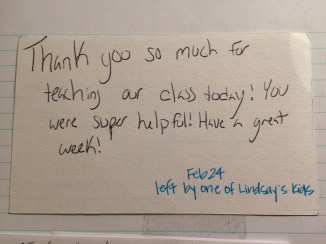
Finally, my students are now accustomed to receiving frequent formative feedback and have come to expect and welcome it.  Initially, the students were a little wary when they saw my scribbles, assuming they were all corrections, but then were delighted when they actually read the feedback a peer or I had left.  Now, they hunger for the moments when a friend hands them back their paper with a handwritten note, or I return assignments the next class.

C4ErTFNVcAA9ku9 2

Switching to hard-copy grading has improved a great deal of my work with my students, and although I still haven’t come to love grading, I am enjoying it a lot more this semester.

Now to tackle that huge stack of one-pagers that’s been staring at me all morning…!

Shana Karnes lives in West Virginia and teaches sophomore, junior, and senior preservice teachers at West Virginia University.  She finds joy in all things learning, love, and literature as she teaches, mothers, and sings her way through life.  Follow Shana on Twitter at @litreader or join her for the Slice of Life Writing Challenge here.

FTC guideline affiliate links

Monitor and Adjust: Begging for Engagement

Control

I’m not sure where the plans went.  I don’t even have a window.  They must have squeezed out through the rat-chewed hole in the ceiling.

Wherever they went, they no longer resided within my white-knuckled fists generally inclined toward control–control of listening, control of thinking, control of growth and progress.

It was a project I thought would stretch students to think about their futures and what it would take them to get there.  And it did!  It was practical, imaginative, rigorous, artistic.  It was what every high school senior wanted–or maybe it was just what I wanted.  The work was getting done–for the most part.  We were simply missing one thing: Electrifying energy, passion, a desire to find out more.  Many teachers call this “engagement.”

This project was just another task for my students.  So as I began to search for the cracks in my classroom responsible for swallowing up my PERFECT PROJECT, I turned to my lovely colleagues/friends for advice.

Lisa offered a lovely story about fraudy feelings in her own teaching career, and a story about a faltering relationship with a student that left her feeling less than a great teacher.

Shana shared the possibility that I might just ask my students, “WHAT WILL ENGAGE YOU?!  TELL ME!”  Begging and pleading might seem below an “authority figure” such as a teacher, but I disagree.

Amy seconded the fact that I might get the students involved in determining what they would like to do, but her second piece of advice was even more reassuring.  She explained, “If you go deeper into conferring–more frequently, with more probing questions–you might discover it is actually only a couple of  students in each class who are affecting the entire culture.”  She went on to discuss the “Savior Complex,” and how 100% engagement, 100% of the time is a very lofty goal.

All this advice, however, reminded me that engagement is a worthy (albeit, bloody and tearful) fight.

I wish I would have asked for help sooner, but I’m going to take a little bit of each piece of advice.

  1. We are going to finish this project and these presentations after we have a Spring Break palate cleanser.  I am finishing this out knowing, after conferring and returning to my notes, that it is only a few students affecting the culture.
  2. After presentations, we will take some time for feedback (or feedforward?).  I will beg and plead.  I will write in all caps, WHAT WILL ENGAGE YOU?! TELL ME!  However, I think we will also need to discuss, What even is engagement?  How is engagement different than compliance?
  3. Develop a plan by including the students, but holding them fast to high expectations.  Learning should stretch, it should challenge, it should change.  Sometimes that is painful.  I don’t want to get rid of the pain and the stretching, I just want them to be able to get behind the place into which they are stretching and growing.

My goal in this post was not to complain or lament, but instead to share that ALL teachers struggle with engagement.  ALL teachers deal with real humans, with real struggles, and real curious and wondering minds.  We want them to open the windows and the doors, but we have to teach them how, first.  Workshop is not a magic pill, but it is a magical formula that allows a lot of wiggle room to engage students if they’ll let you.

I want to get back to why I became a teacher, and remember to let go as much as humanly possible so that the students can grab onto the learning themselves.

What do you think?  When do you make changes and when do you stick to your plan?

Jessica Paxson is an English IV and Creative Writing teacher in Arlington, TX. She also attempts to grapple with life and all of its complexities and hilarities over at www.jessicajordana.com. Follow her on Twitter or Instagram @jessjordana.

Need a Friend? Yup, Me Too.

Our juniors spent last Tuesday morning taking the ACT test, along with every other junior in the state of Wisconsin. I spent the morning watching them take the test. Talk about mind numbing.

“You will now be taking the fourth part of the test in Science. You will have 35 minutes to complete this test. Please open your test booklets and try not to fall out of your chairs after three hours of testing, during which I have listened to you sniffle, shuffle, and sigh to the point of my own mental health crisis. I mean…you may begin.”

On days when I hand out Kleenex and monitor bubble fill in, I long for interactive class periods of inquiry, exchange, and exploration. However, that sometimes is a pipe dream as well.

Lately, it’s been a bit like pulling teeth to get kids to participate. Pushing them to meet their reading goals feels less like inspiring work, and more like drudgery (How much more inspirational do you need me to be with this whole reading gig? Just DO IT already.). Their quarter three blank stares and exhausted sighs have me resisting the urge to fix my vacant eyes right back at them and mouth breathe until they see their reflections in the mirror of my face.

worksheet

 At times like these, I am reminded by fellow trench mates that we teachers need love too. I don’t want to feel tired, occasionally demoralized, and ill tempered, but I’m there, and part of the reason is that I know my kids are there too.

Workshop can be legitimately magical. Students reading more than they ever have, writing for authentic audiences, and hearing each other speak deeply and passionately about real life issues through literacy. But, Shana didn’t post 9 Books to Hook Your Holdouts for nothing. Amy had the Tissue Issue and needed to Write When It Was Hard.  Jessica is finding her way in a brand new workshop classroom. And countless sources across the web detail teacher burnout and student engagement struggles.

So when our newest contributor Jessica to 3TT reached out over the weekend with: “You ladies are rockstar teachers. Do you ever have discipline or complacency struggles in your classroom?” I had to smile. And then laugh. And then cry a little. And then…

I was taken back to a conversation with a colleague a few years back, where an offhanded comment poked me right in the teacher feels. We had actually been talking about this very idea – the slump we can all feel when teaching gets somewhat less Stand and Deliver and more, students loitering around the complacency trough.

“Well,” he had said somewhat smugly, “As long as you have engaging lessons, students don’t check out.”

Oh. Really? That’s awesome for you…

Listen, I get his point, and to some extent I agree, of course engagement has to be at the heart of what we do, but from personal experience as a learner, it’s not always possible to engage all of the kids all of the time (collective gasp, coupled with Lisa polishing her resume). And that can be exhausting and frustrating to educators, and disruptive to the class.

But today, I am not here to provide advice for how to move forward with this issue in the classroom (I happen to know for a fact that my 3TT ladies have several posts up their sleeves all about engagement. Stay tuned!).

strong

I’m actually here to quickly remind everyone, because I needed the reminder too, that when you are feeling like you could arrange for Big Bird to walk in the door and hand out cookies to everyone in the class, but no one would crack a smile, you need…friends.

Teacher friends.

In your building, down the hall, gathered at PLC, across the country, on the phone, send a quick note, smile at your neighbors, friends.

trouble

I, for one, am a lucky duck in this department. I work with friends. Dear friends.

Stand up in her wedding, give a quick tearful hug, giggle over buffalo chicken dip, join a bowling league, talk about Ryan Adams, compare Lularoe leggings, grab a drink, bake some cookies, geek out over Out of Print literary shirts, talk about being daddy’s girls, Irish Oatmeal, send each other lip sync videos, eye roll at the same time, laugh first and ask questions later, friends ( I think I hit everyone in the department. Seriously. I love you people). 

So, whenever possible, and especially when you feel like you might voluntarily throw yourself down the stairs rather than walk into 3rd period, find people to spill your guts to. Find people to share your successes and colossal failures with. Friends who share mini lesson ideas and friends who share unbelievable content knowledge. Fresh out of college and boundlessly energetic friends, and experienced, measured, and wise friends. Those who have seen decades in the classroom and those who weren’t born yet when you started teaching.

Take the time to engage with the people you work with, both as educators and as humans. Engagement at work increases when we have friends. Harvard said so.

And if the people you work with don’t do this for you, branch out.

The ladies at 3TT have been WhatsApp-ing (verb I just created) lately. We use voice messages, pictures, texts, and links to talk about classroom questions, vent about burnout, explore possible post ideas, and discuss who’s drinking which variety of wine tonight.

There are always ways to connect with like-minded, similarly leaning, comparably focused educators. And there are ways to connect with challenging, make you reflect on your practice, I can’t believe I used to do that too educators who can help reassure you that you are making the right moves, even when those moves are difficult.

Hand someone a cup of coffee and take a seat.

Open up Twitter and join a #chat.

Send one of the Three Teachers (really five of us now, how cool is that?) an email and we’d be glad to listen. 

Don’t close your door and let handing out Kleenex to kids feel like a highlight of positive, professional interaction.

Friends can help you feel sane, productive, positive, and human again. A few kind words, commiseration, a hug, and a maybe a quick snack.

Little else is needed to take the deep breath necessary and get back to 3rd period.

Except maybe, Spring Break.

We’d love to hear your shout-outs to fellow educators who help you right your ship, stay afloat, and just keep swimming! Please share in the comments below. 

shout out.png


Lisa Dennis teaches English and leads a department of friends at Franklin High School near Milwaukee. She almost left the profession in year one, and would have, if not for fellow English teacher Erin Doucette who took Lisa under her wing and taught her the importance of being yourself in the classroom, challenging you students, and celebrating St. Patrick’s Day every year without fail. I love the teacher you are and the teacher you have helped me to become. Follow Lisa on Twitter @LDennibaum. 


Window, Mirrors, and Gigantic Doors: Inviting Sound into Uneasy Silences

For weeks I’ve worked on a list of books to use for book clubs in our junior English classes. I believe that students must have options that challenge, yet engage, and allow them to see themselves and/or others within the pages. It’s that whole windows and mirrors and doors analogy. Jillian Heise describes it well in this post. I’ll just quote a part that struck me:

Dr. Rudine Sims Bishop originated the idea that many now reference. She talks about windows as “offering views of worlds that may be real or imagined, familiar or strange.” And about mirrors, “…we can see our own lives and experiences as part of the larger human experience.” But she also talks about sliding glass doors which “readers have only to walk through in imagination to become part of whatever world has been created or recreated by the author.” The thing is, it’s the third part of it, the sliding glass door that seems to often be left out, but is perhaps the most important part – it’s the part that, in my interpretation, allows us to step into those other worlds and become part of them for the time we are in that book – and isn’t that the power of reading? Being able to develop empathy, understanding, new perspectives by living in someone else’s shoes for a short time. Especially for books as powerful as the ones being written about these real issues that are affecting kids in their lives today, this mirror, window, sliding door access becomes even more important for them to see they have a place in our society, no matter what perspective they may bring.”

I’d like to offer an addition, not just sliding glass doors that  “allow us to step into those 8124672460_6b6f1ef826_zother worlds and become part of them for the time we are in that book,” although that interpretation is certainly vital to developing readers who love books and to gaining empathy.

What about other doors — like the kinds we have to push or pull to get through — the doors that make us work: cathedral doors, fortress doors, iron doors, or doors with scary knockers? These doors require effort. These doors may make us uncomfortable. And sometimes they require courage.

Some books can change us if we view them this way. They can change our students. And I’m not just talking about lexile levels, or complexity of ideas. I am talking about content. The content that exposes our flaws and weaknesses, the content that pushes our thinking, moves us out of our comfort zones, and makes us face, as Dr. Kim Parker puts it, “the lived experience of so many folks of color in this country.”

I am a white woman who teaches students of color. I grew up in a middle class family with conservative ideals. I go to church regularly, and I practice my religion. I had parents who were married for 55 years and taught me the value of hard work, education, and persistence. I am different from most of the students in my classroom. I enjoy a privilege in this country most of them have never experienced.

So what does this have to do with doors?

I choose the big ones.

Awhile ago I conducted a PD session with a group of teachers, mostly white women who like me teach mostly students of color. I showed some of the spoken word videos I use with my students:  “Spelling Father” by Marshall Davis-Jones and “Knock Knock” by Daniel Beatty. I shared articles about undocumented immigrants and Syrian refugees. I read an except from Homegoing by Yaa Gyasi where a character’s wife is kidnapped and he desperately tries to find her, showing her picture around the streets, and finally being accosted by a policeman after he accidentally brushes into a white woman. The policeman rips up the man’s only picture of his 8-months-pregnant wife. The year:  pre-Civil War.

We viewed and read texts. We wrote quickwrites and analytical responses. We discussed author’s craft and studied the moves the writers make to create meaning. Everyone read. Everyone wrote. Everyone engaged in the learning.

Later, the conversation turned to engagement, and I asked the questions:  “What are you doing to make the learning matter to your students? How are you discussing the issues that echo in their lives?”

I gave them time to talk, and I wandered the room, listening in to table discussions. I heard some valuable exchanges, but I also heard: “Oh, I don’t even go there. I’d lose control.”

Hmm.

How will we ever change as a society if we don’t ever go there? How will our students, no matter their color, ever learn to talk about tender and sizzling issues, ever learn to deal or challenge or change them, if their teachers never go there?

We cannot make excuses. We have to invite the hard topics into our classrooms. We have to provide books that are windows, mirrors, sliding doors, and gigantic wooden ones. Not only for the sake of the students we teach but for our profession.

How will we ever have more teachers of color if our students of color do not have better experiences in their English classes?

At NCTE last November, I met Dr. Kim Parker in person for the first time. She read her credo and she sealed a place in my heart with her sincere desire to do right by the students in her care. I share her credo here because it so closely echoes my own. I don’t think she’ll mind:

Ze’Voun tells me that he never knew that reading books could matter so much, could be so enjoyable. He is a young man who is Black, brilliant, and bored. He is a writer and a reader for whom schools seem to be increasingly less designed. When he disappears from my class without any explanation, I learn, a few weeks later, that he has been assigned to an out of school placement program, joining other boys who are–likely–as Black, brilliant, and bored as he.

I believe in rage, and I believe in action. I believe in a world where staying woke matters.  

My most essential work is making classrooms spaces where kids like Ze’Voun can read and write in ways that matter to them–from diss tracks; to letters to the local police department reminding them that Black Lives Matter, too, and that wearing their hoodies is not a crime; to Tweets to favorite authors thanking them for books that are just for him; to books that affirm, reflect, and extend his existence as a brilliant Black boy. Opening up spaces inside classrooms where they can speak a variety of Englishes as they explore the origins of Ebonics, where they can engage and delight with canonical and multicultural texts and write about their understandings, and where they are creators of texts that validate and stretch their identities is some of “the work my soul must have.”

Though Ze’Voun never returned, I continue to hold space in my classroom for other young people who have similar needs and desires, who are hungry for the diverse texts that reach them. I continue to hold on to a belief, and a dream, that the work I do must be as diverse as the students I teach. As escapist, as validating, as powerful as the texts they read. As whole, as free, as happy as we all wish, hope, and need to be.

This what I’ve dubbed Right Now Literacy. We have to give every student the commitment, resources, and opportunities they need to learn the reading and writing skills they need right now, to live and thrive in the world we are in right now.

Dear reader, I ask you the same questions I asked those teachers at that PD:  What are you doing to make the learning matter to your students? How are you discussing the issues that echo in their lives? 

Please answer in the comments. Let’s share our best practices and best resources for pushing ourselves and our students through the doors that can change us at the core. (And next week I’ll try to remember to share my new book club lists.)

FTC guideline

Amy Rasmussen lives in north Texas and teaches AP English Language and English 3 to the Fighting Farmers at Lewisville High School. She adheres to the words of Emerson: “We aim above the mark to hit the mark,” and Jesus Christ: “Love one another.” Imagine a world if we all love more than we think we can. Follow Amy on Twitter @amyrass.

5 Middle School-Friendly Fiction Books About 9/11

I was still a teenager in 2001, and an immature teenager at that.  On 9/11 I wrote a poem in my diary about watching people jump to their deaths on television.  By September 13, 2001, I was back to writing in my diary about getting the silent treatment and missing allowance money.  I didn’t have a way to process 9/11 back then. 

So it’s no wonder to me that I seek out middle school-friendly books about 9/11, because a middle school book about 9/11 is exactly what I needed when I was… you know… in middle school.

And, interestingly, all of these books emphasize the importance of connections to others in the face of tragedy — not just our family and close friends, but also those neighbors we never talk to, the strangers in our lives, and the people we don’t even know we know.  


Some notable 9/11 fiction books for teen readers include:


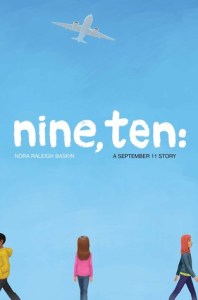
  1. Nine, Ten by Nora Raleigh Baskinnineten

Baskin’s lyrical, concise book follows four different young teens in the hours leading up to the terrorist attacks on the United States.  The emphasis here is on the importance of community rather than the tragic events, and our characters are removed from Ground Zero.  Given the brisk pacing, the age of the characters, and the gentle treatment of the terrorist attacks, this book is probably a best fit for readers in grades 5-6. However, the topic gives this book significant crossover appeal to a middle school or even a high school classroom.


  1. towers-falling  Towers Falling by Jewell Parker Rhodes

This book begins in present-day Brooklyn and works backward, as our main character Deja attempts to understand her father’s emotional fragility.  While younger readers will probably be surprised to discover Deja’s connection to the 9/11 attacks, older readers will be able to make reasonable predictions about where the story is heading from the generous hints Jewell Parker Rhodes gives us along the way.  I appreciate this book not only as a 9/11 book, but also as a book that brings in diverse characters, homelessness, PTSD, Islamophobia, and other social issues.  Recommended for grades 5-7.


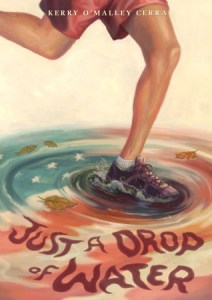
  1.  Just a Drop of Water by Kelly O’Malley Cerrajust-a-drop-of-water

Before 9/11, Floridian Jake Green’s only cares in the world seem to be  becoming captain of
the eighth grade track team and his grandfather’s war medals.  But 9/11 affects everybody, even in this sleepy town, and all of a sudden Jake’s best friend’s father is taken into FBI custody.   Cerra presents a traditional middle school friendship novel introduces tough topics like the unfair detainment of innocent Muslims and the role of war in international relations.  Recommended for grades 6-8.


  1. memory-of-things  The Memory of Things by Gae Polisner

On the morning of September 11 Kyle Donohue evacuated Stuyvesant High School, blocks away from the World Trade Center, and walked home to Brooklyn
with a large group of refugees.  On the way he sees a girl with angel wings who seems lost and confused and brings her to his apartment.  This dual perspective story (Kyle’s narrative is straight prose, the girl’s narrative is fractured poetry) is wholly immersive in 2001 period details and is more about people than politics.  Recommended for grades 7+


  1. All We Have Left by Wendy Millsall-we-have-left

Hand this book to the reader who wants to be INSIDE the towers as they come falling down.  Readers go back and forth between the story of Jesse, who is 2016 was only 2 years old when her older brother Travis died in the World Trade Center, and Alia, who in 2001 was one of the last people to see Travis alive.  This book is heavy, but its messages of healing and redemption make it palatable to a wide range of readers.  You’ve been warned: bring tissues.  Recommended for grades 7+.


Amy Estersohn is a middle school English teacher in New York.  Her taste in music is very 2001.  Visit her on Twitter @HMX_MSE

4 Ways Teachers Can Be Kinder–To Our Students, Ourselves, & One Another

Last week, my students finally hit the breaking point.

Maybe it was knowing that my stressed-out little preservice teachers had just one more week until spring break.  Maybe it was the fact that Betsy DeVos had just said or done something stunningly idiotic.  Maybe it was the fact that we were reading and thinking and writing and talking about yet another heavy topic.

Whatever it was, as we discussed the futility of policy changes in education, one of them burst out, “it’s hopeless!  We’re just teachers!  There’s nothing we can do!”

Channeling my inner Pam Allyn, and directly quoting her, I exclaimed, “Yes there is!  Teaching IS social change!!!”

And by exclaimed I really mean shouted.

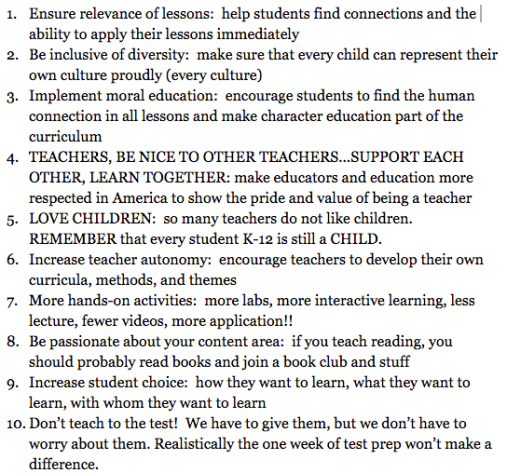
My students sat up a little straighter, possibly slightly afraid of me at this point.  But I was not deterred–I opened a google doc they could all access, put them in groups of three, and asked each group to come up with one actionable change that teachers could do in class tomorrow that would address some of the issues in our readings.

Screen Shot 2017-03-03 at 5.29.31 AM.png

Ten minutes later, they’d created a pretty nice list.

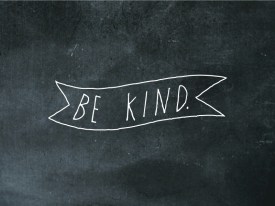
636143262607992163-535158864_be-kind-ribbon.jpegAs I re-read it this morning, I’m thinking about the patterns I see in these actionable changes.  The overarching one:  kindness.

Kindness requires thoughtfulness, which in the fast-paced world we live in can actually be quite difficult to enact.  I think that, if we can slow down for just a moment, we can enact social change in our classrooms by modeling, teaching, and living simple kindness.  Here are four ways to think about that.

Teach who matters, not what matters.

My fellow 3TTers and I had a pretty robust conversation the other day on Twitter about the merits of the “AP list” and limiting kids’ choice to it in AP classes.  After much wordsmithing and hashtaggery, our basic conclusion was that it doesn’t matter so much WHAT we teach as it matters WHO we teach, and how. (Because we’ll never agree on what matters, anyway!)

We teach readers, not books.  We teach writers, not five-paragraph essays.  We teach wordsmiths, not grammar.  When we frame our teaching like this, we remember why we got into teaching in the first place:  because we love kids and want the best for them…and what’s kinder than that?

img_7428Be kind to other teachers.  

I recently spoke with our NCTE student affiliate about why it’s beneficial to be connected to a larger teaching community on Twitter.  During our conversation, I loved watching the students’ faces as they saw the likes of Tom Newkirk, Penny Kittle, and Chris Lehman come alive on the screen.  These weren’t just mysterious high-tower authors who wrote the books they read–these were real people.

Their eyes were bright with wonder as they realized that they, too, could join that community of teacher-writers whose thoughts and opinions were valued, no matter how new or old one was to the profession.  And that’s compelling evidence that we need to build a kind teacher community–because it ushers practitioners into the world of research-based best practices and creates a safe space for trying new things.  Teachers can be mean.  We need to stop.  Cover a colleague’s classes.  Nurture them when they need to grow as practitioners.  Join them in their classroom.  Smile at them during staff meetings.  Try not to get frustrated, and apply the previous strategy–work with the person, not the teacher of Beowulf.

Allow yourself some freedom and autonomy as the teacher.

Standards are standards.  But as Louise Rosenblatt says, they’re just ink on a page until you bring meaning to them.  If we apply the transactional theory of reading to the Common Core, or any other set of standards, then they’re really not so bad.  When I read a standard like this…

Screen Shot 2017-03-03 at 6.28.33 AM.png

…I get excited.  But many teachers don’t.  As a high schooler, my teachers generally addressed this standard by assigning literary analysis papers.  It doesn’t have to be that way! imgres

For example, my fellow WV teachers Karla Hilliard and Jessica Salfia recently addressed this standard by having a #CrossChat on twitter after their students read Kwame Alexander’s The Crossover.

A twitter chat.  As an assessment.

WHAAAAT???  HOW AMAZING IS THAT?!

But hey–if you can teach a rockin’ literary analysis, then by all means, do it.  The point is that we have more freedom and autonomy than we often allow ourselves–whether because we’re pressured to conform to a school culture, or offered a prescribed curriculum, or confined by a set of district-wide initiatives.  So be kind to yourself.  Stretch those boundaries however you’re comfortable and be yourself, teach to your strengths, and make your job fun.

imgres.pngForgive.

None of us is perfect, not any day, not any week, not any school year.  We hear constantly about being reflective and reflexive practitioners, and we can be hard on ourselves when we reflect on our teaching or respond to our students’ confusion.  It’s when we do not forgive ourselves for those imperfections that we become resistant to change.

We can never grow if we aren’t comfortable discarding our old skin, and there’s no reason to be ashamed of doing that.  Forgive yourself if you, too, started your career by alienating kids with pop quizzes.  Forgive the kid who called you a rude name yesterday, because hopefully he was having a bad day and isn’t just a jerk.  Forgive the 9th grade teacher who slaughtered your students’ love of reading by giving 83 tests on TKAM.  Teach your students to forgive the crappy first drafts of their narratives.

If we forgive, then we open the door for growth.  And that’s the kindest thing of all.

Shana Karnes lives in West Virginia and teaches sophomore, junior, and senior preservice teachers at West Virginia University.  She finds joy in all things learning, love, and literature as she teaches, mothers, and sings her way through life.  Follow Shana on Twitter at @litreader or join her for the Slice of Life Writing Challenge here.

Easing into Mentor Texts

its-complicated-cover

I am the queen of wanting a do-over.  I will probably say this a million more times before we get to June.  The truth is, I teach Seniors.  Senioritis may be a made up excuse for laziness and longing for Summer, but I think it’s starting to rub off on me!

When I’m feeling like February is never going to end, like my students are better off with a Sub for the rest of the year since I’m teaching them NOTHING, or like I need an IV of caffeine just to function as a normal–forget about extraordinary–human, I turn to my wonderful colleagues on this blog.

Last week, Lisa taught me that great teachers don’t wait for a new school year to make changes.  This struck me especially with my current, slightly flawed approach to PD books.

Writing with Mentors wrecked my Christmas Break, in the best way.  I ordered it out of curiosity, hoping I could implement some practices here and there with my new batch of Creative Writers.  Instead, I found it whispering answers and solutions to all of the buzz-worthy issues that haunt teachers in their dreams of evaluations and students moving on and forgetting about their class and everything they taught forever.

Mentor Texts offer ways to differentiate, they offer real-world/relevant writing situations, they require readers who not only appreciate a text, but closely analyze and pick it apart, they offer engagement.

However, just because something is offered, doesn’t mean it comes naturally.

I could have let the overwhelm of such great and fundamental teaching ideas squash my ambition to the point that I would table it until my “do-over” arrived.  Lisa reminded me that small changes are best, and are mandatory.

This idea was 100% from Writing with Mentors, but I was so astounded at the products my students came up with, I had to share the success!

Mentor Text: It’s Complicated: The American Teenager

Objective: Students will be able to articulate the difference between reading like readers and reading like writers, and will imitate craft moves to create their own product.

Products:

These blew me away.

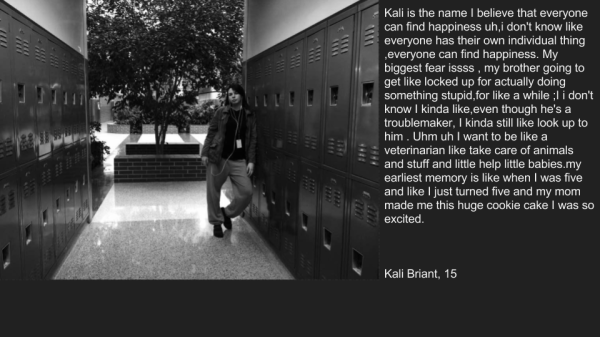
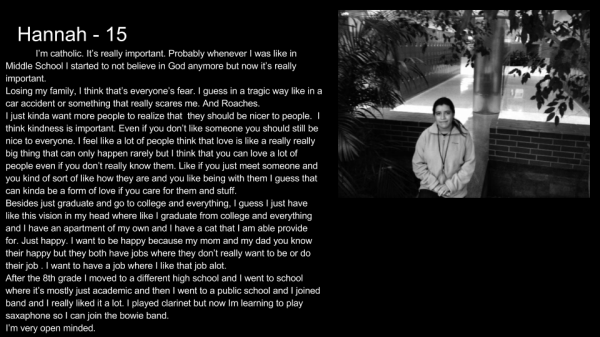
1%2f19%2f17sally-interviewkali-brianthannah-15

Reflection:

The first thing we did was read like readers.  We perused the website, evaluated, reacted.  Then we read like writers.  I asked them, “How did this author go about developing these pieces?”  They noticed some specific moves, such as conversational language.  After we talked a bit, they really started to dig in.

“It seems almost like she recorded them speaking and then typed from that.  How else could it sound like real talk?”

“She must have asked them what they fear the most, and what they believe in.”

From simply studying the mentor text, we found our form, tone, and interview questions.  After they interviewed a partner, I let them go “out into the wild” to take pictures.

I literally just told my students to “go.”  I gave them some guidance, but mostly when they asked me about a specific requirement, or how I wanted something, I would usually say, “What does the mentor text do?”

This gave me a great diagnostic as their very first assignment, and allowed students to get to know each other as they got to know how our class is going to work.

I was so happy with this process and product, and I was especially happy that I could steal it from someone smarter than me!  Sometimes the best ideas are the ones we steal from our colleagues.

How do you introduce your students to mentor texts?  What works?  What doesn’t work?

Jessica Paxson is an English IV and Creative Writing teacher in Arlington, TX. She also attempts to grapple with life and all of its complexities and hilarities over at www.jessicajordana.com. Follow her on Twitter or Instagram @jessjordana.

Quick Writes That Work

QUICK WRITE

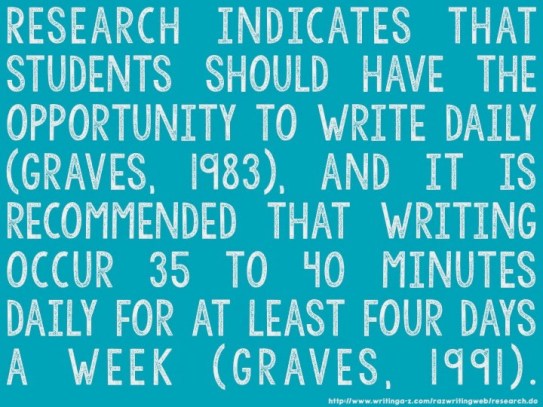
It appears daily on my agenda and often sparks great writing, discussion, and even revision. My bestie Erin said it beautifully: “Quick writes produce pure honesty and they’re a good place for me to “talk” with my students.” The writing is low stakes, the creativity can be high, and we can “talk” with our kids and provide feedback on issues and ideas, over syntax and conventions. Plus, it helps with the endless struggle for volume, volume, volume.

But sometimes, quick writes can end up feeling a bit routine, which is not cool as I am trying to keep writers excited about their writing and producing more and more of it.

writers-block

So, because I’m sometimes known to Google my life (Last weekend my foot hurt after a run and the Mayo Clinic suggested I might have cancer, so there’s that.) I often head to the internet for curricular inspiration.

There are countless sources online that will lead you to quick write topics, if that’s what you are in the market for, and I am often in the market for someone’s fresh thinking to get my students writing when I haven’t left enough time to plan or the same old quick write feels bland.

graves

Quick writes are just the start! 

For example, I was inspired to write this post after I saw our friend Gary Anderson tweeting a journal topic of the day on Twitter. I’ve used several, and loved writing along with my students on his thought provoking prompts.

Here are a few reflections I have on quick writes. The process, their power, and providing writing opportunities to our kids every day.

  1. Link your quick write to what you’re work on in class that day, an essential question you’re studying, or relevant topic to your study. Or don’t! Quick writes can lead naturally into a mini lesson. They can also put that mini lesson on hold as students take off into small group and then passionate/uproarious/contentious whole class discussion. I’ll often have my students go back into their notebooks after discussion to add to their thinking, so even if they didn’t share, they are working with the ideas that class is chewing on and writing more.
  2. Let students write about what inspires them. At the beginning of the year, many students balk at the “opportunity” to write about whatever they like, but by the time you’ve established a rapport and let your students know that they belong to a community of writers, many are excited to be given time to get their thoughts on paper. And when you have them take some time to revise at the end of the writing and share their ideas or powerfully written lines with others, they take more seriously the production of that work.
  3. Give limited choice to guide writing toward a necessary discussion for that day’s mini lesson or topic of discussion. When I do want the quick write to lead into the mini lesson, I try not to lead too much. I want kids to write and discover. I don’t want to slip back into old habits of guiding students to a fixed answer. They feel duped, I feel cheap, the whole thing is a mess. So, when I am heading in a specific direction, I really try to give choice in these instances. Our mini lesson in American Literature the other day was on bias for our argument writing unit. I could have had them write about where they see bias and how it impacts an argument’s credibility. Totally fine. Instead, I asked them to choose:
    • Write on any topic from the perspective of someone who is heavily biased toward a particular outcome. Then, write the same appeal from the opposing viewpoint.
    • Consider the bias of an author you’ve read or a story you know well. How did the bias serve the author? How did the bias impact the story?
    • Defend, challenge, or qualify the idea that media bias is detrimental to a functioning democracy.
  4. Early on, I stole something I heard Amy say during the professional development she and Shana ran at Franklin last year. I always remind my students to “write as much as you can, as fast as you can, as well as you can.”Amy taught me that kids need to outwrite their inner critics, and I’ve coupled that with the discovery that, often times, a student’s inner critic sounds an awful lot like…a teacher. We need to help retrain kids to see the first quick draft of anything as just that, a quick draft. I scrap half of what I write when I consider it for revision. This is something new to most kids, who train themselves to pour writing out on a page and see that as the first, last, and only draft. We work to write quickly, revise in the moment, and later, choose some pieces for further expansion, refinement, and polishing. But in the six or seven minutes I am giving them to write, their job is to write in that moment and to keep moving.
  5. Remind students to write and respond as they see fit. Students can write, jot, draw, change colors, compose a poem…Students often limit themselves unconsciously by the “rules” they have been taught over the years. Quick writes are a place to explore, not fit in the lines or a box. Unless you want to write in boxes.

  6. Have students respond to quotes, images, poems, videos, their own writing (we are doing this today!), the writing of other students, current events, lists, song lyrics, letters to the editor, overhead conversations…You get the idea. Students can creatively explore just about anything and should. Their opportunities for creative expression are often too few and far between. We can be the place where questions, emotions, fears, innovations, and discoveries find a safe place to take root.

Some of my recent favorite topics are below. These are quick writes that generated some fantastic discussion in small groups and whole class debriefs.


From Gary Anderson a few weeks back, I had students choose one and write:

Today…
I am concerned about…
I am upset about…
I do not understand…
I wish I could change…
I am grateful for…


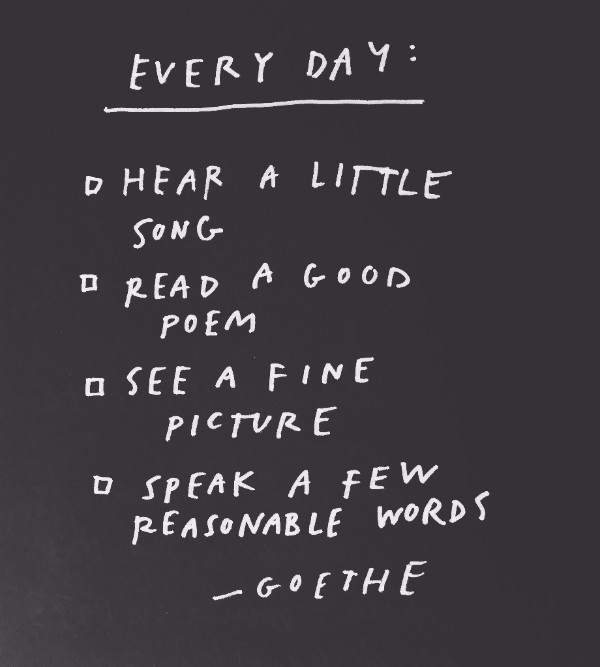
From Austin Kleon’s blog that I started following last week, students took this image in a thousand directions and one class even had a collegiate level discussion on the implications these suggestions (directives? nudgings?) could have for society:

goethe


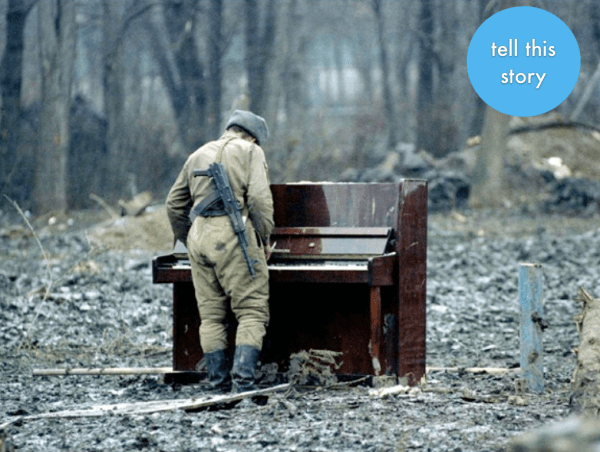
I will sometimes choose several images and have my students respond to one, or try to tie them together, or imagine they are the photographer, or…whatever best suits our purpose for that day. The exploration of the human condition is reason enough to put pen to paper. “Tell this story” is a great search term to yield a wide variety of results.

tell-this-story-2


Quick writes can even be 2-3 minute reflections on the simplest of reading adventures. At the start of the new calendar year, I had my kids search for what their lives would hold in 2017, according to their independent novels.

quick-write

Have a favorite quick write topic that gets the pens moving in your classroom? Please share your ideas and insights in the comments below! 

Lisa Dennis teaches English and leads a department of English educating gods and goddesses at Franklin High School near Milwaukee. She has no fewer than six quick write journals going at once, mostly due to her inability to settle on spiral vs. bound. She added to Goethe’s list that we should smile at the thought of someone each and every day. Follow Lisa on Twitter @LDennibaum 

8 Ways Listening Leads to Learning

not-listeningWe teachers often talk too much. Research on listening suggests that adults spend an average of 70% of their time engaged in some sort of communication; of this average, 45% is spent listening compared to 30% speaking, 16% reading and 9% writing. I would argue that this data does not represent teachers in the classroom. We tend to talk more than we listen.

I wonder how many of us have thought of teaching as communication.

Think about this definition of communication: “Two-way process of reaching mutual understanding, in which participants not only exchange information, news, and ideas and feelings but also create and share meaning. In general, communication is a means of connecting people or places.”

Now, think about how much richer our classroom environments could be if we planned, prepared, and presented our lessons through this lens of communication — with the goal of reaching mutual understanding, exchanging information, ideas and feelings, and creating and sharing meaning. To do so, we must listen more than we speak.

What about the time, we may ask, what about the content knowledge we must impart?

When we exchange our need to talk with our students’ vital need to have us listen, we

  1. transform our teaching by looking for ways to invite students into conversations
  2. better utilize the time we have with our students, meeting their needs in one-on-one and small group discussions
  3. deliver information in new ways, other than students listening to lectures or taking notes from slide presentations, or completing worksheets
  4. break down walls many adolescents have built against school and against authority — they know we see them as the unique individuals they are, and they respond
  5. provide opportunities for students to learn from one another so we may listen as they share with one another
  6. help students discover and take ownership of their needs, both personally and academically — talk often works as a lead into deeper thinking
  7. facilitate communication that leads students to take on the characteristics and behaviors of readers and writers — or in a biology class as scientists, or in a history class as historians.

Fostering room for more listening is the first move into creating a culture of conferring.

Does it make us vulnerable? Yes! and facing our vulnerability is where our growth as teachers takes root, taps into strategies that nurture our learners, and eventually blossoms into the instruction and learning experiences we want for all students.

How do you make room for listening in your classroom? Please share in the comments.

Amy Rasmussen lives in north Texas and teaches AP English Language and English 3 to the Fighting Farmers at Lewisville High School. She adheres to the words of Emerson: “We aim above the mark to hit the mark,” and Jesus Christ: “Love one another.” Imagine a world if we all love more than we think we can. Follow Amy on Twitter @amyrass.

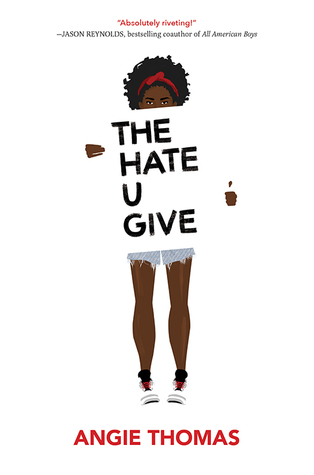
Booktalk this now: THE HATE U GIVE by Angie Thomas

The story behind the story.  I received an early review copy of this book when I attended the ALA Mid-Winter meetings in January and asked extra-nicely at the HarperCollins booth if there were extras.  


(Pro tip: Check to see if there are any ALA meetings happening near you and block those days off on your calendar now.  Free books.  Lots of them.)


I started reading it about 6:10 AM over breakfast before leaving for school.  By about 6:50 AM I was reluctant to leave the house and get to school.

thehateugive

The book talk. I told students that this was the rare book that made literally want to drop everything and read.  Starr is at a spring break party when gunshots go off and she and childhood friend Khalil leave the party by car in search of safety.  Police pull Starr and Khalil over and end up killing Khalil in what might be a case of mistaken identity.


Why do you think the cops had reason to be suspicious of Khalil?  I asked.


Students responded:

Well, he’s a teenager and the people who were at the party were teenagers too.

He was near the scene of the crime when it happened.

Was he speeding away when cops pulled him over ?  (The book makes it clear: he wasn’t speeding.)

Was he black?


That’s when I covered up all but the first letters of the acrostic so students could read the title down the page: The Hate U Give or THUG.  


“Ohhhhhhh,” students said.  “Khalil was probably stereotyped because he looked like a thug.”


Building empathy and understanding for the Black Lives Matter movement.  While this book covers a lot of tough teen topics, be ready for readers to proke, prod, and question its support of Black Lives Matter.


Be ready for readers to say, “What about all the cops that keep everybody safe?  You can’t be anti-cop.”  And “I don’t understand why Black Lives Matter people have to make it about black people.  What about white people who just want everybody to get along?”  Thomas pre-emptively responds to these readers by giving this book a strong moral core, where there are supportive police officers, kind family members, a grassroots nonviolent community organization, and a terrific white boyfriend along with some villain characters of both races.  


Starr is a teenager of the moment.  She’s a tumblr addict, she wants you to know that she considers Beyonce a cousin, she nae-naes and hits the quan.  She embodies contemporary teens in general and contemporary black teens in particular.  In 25 years she’ll appear fuddy-duddy, just as her Jodeci and Juvenile-loving parents are right now.


Patience and stamina.  The action happens in the first few dozen pages, and what follows is reaction and rebuilding.  This book felt more slowly paced to me than readalike All-American Boys by Jason Reynolds and Brendan Kiely.  Some readers, particularly middle school readers, might find the pace discouraging, so if you include this in a classroom, I’d recommend that readers find a book partner to talk about the book as they read.  


Where to buy it.  You can buy signed copies from Lemuria Books in Jackson, Mississippi.  The book goes on sale tomorrow!


Amy Estersohn is an English teacher in New York.  There are as many seasons of Survivor as there are books in her To Be Read pile.   Follow her on Twitter @HMX_MSE