Refresh the Recommended Reading List

Hey book people: sometimes I feel we could learn a thing or two from the fashion world. (Or, at the very least, the fashion world as I see it from television.)


In the fashion world, trends are always changing, and once we’ve heard about something we know it isn’t hot anymore.  We’re quick to pass judgement on each other’s work and open in expressing opinions like that’s so old and I’ve seen that so many times before.

So if we as teachers are still recommending the same old, same old to our students (and yes, I count The Hunger Games and Twilight as same old) IT IS TIME TO UPDATE OUR RECOMMENDED LISTS.


I update and provide students with a (mostly) fresh list of recommendations about 3-4 times a year.  At minimum, I provide a beginning of school year recommended reading list for parents at Back to School Night and a summer recommended reading list to help students plan ahead for the long break.  Part of that planning is purely practical: I teach seventh graders, and the students’ reading tastes are going to change dramatically over the course of the school year, so I want  to be prepared.

And sure, part of it is my own boredom with reading, recommending, and thinking about the same books over and over again.  Hence I create new lists for students.


If you don’t currently create lists for your students, the easiest ways to make one are:


  1. Ask students for recommendations – what books they enjoyed reading and what books they plan to read in the future.
  2. Read books
  3. Steal other readers’ recommended reading lists.  My three favorite lists to steal from are the ALSC recommended titles YALSA’s book recommendations and the suggestions from the students in Nancie Atwell’s school.


Below is the recommended reading list I recently generated for my students.  Note that I broke the list into several themed sections (Classmates Recommend, Read With a Friend, and Challenge Books.)


You are more than welcome to steal this list in whole or in parts.  The descriptions of books are my own.


Classmates Recommend…


Everything, Everything by Nicola Yoon


This unusually formatted book will have you turning pages as you’ll get to know Maddie and her next door neighbor Olly through drawings, gchats, and short chapters.  Read it before the movie comes out! This book makes readers think more about disobeying authority (adults), falling in love, illness, and family


Michael Vey: The Prisoner of Cell 25 by Richard Paul Evans (part of a series)


High school student Michael Vey has a special hidden power.  He and some friends realize that there’s a conspiracy of adults trying to keep these powers under control. This book makes readers think more about  power, keeping secrets, and difficult decisions.


Masterminds (series) by Gordon Korman


Eli and friends live in Serenity, a perfect town without any crime or unemployment.  There’s only one issue: Eli and his friends can’t leave the town, and they begin to discover that there’s a reason why.This book makes readers think more about right/wrong, fighting back against adults, and friendship.


Once by Morris Gleitzman


It’s right before WWII, and Felix’s parents hid him in a Catholic orphanage so that he wouldn’t be suspected of being a Jewish boy.  Felix, concerned about his parents, escapes the safety of the orphanage and takes off on a dangerous journey to try to find his parents.This book makes readers think more about  risk-taking, growing up, good and evil, and friendship.


Gutless by Carl Deuker


Brock’s a soccer player, not a football player, but the football’s quarterback wants Brock to try out for the team.  Brock isn’t sure this is the best idea.  This book makes readers think more about bullying, friendship, and the risks of playing sports.


Scar Island by Dan Gemeinhart


When all the adults on a prison island die in a strange accident, the teens have to decide what to do next.  This books makes readers think more about risk-taking, heroism, good/evil,  and leadership.

Read with a friend!  Books I have multiple copies of


Goodbye Stranger by Rebecca Stead


Three female friends and the two boys and one photo that could possibly destroy their friendship.  This book makes readers think more about…. Relationships (romantic and non-romantic), cell phone use, growing up, and apologies.


The Seventh Most Important Thing by Shelley Pearsall


Arthur Owens threw a brick at an old man’s head and was sentenced to juvie for it.  Now that he’s out, the old man forgives him and asks Arthur to help him complete a strange task.  This book makes readers think more about forgiveness, family, and connections.


Chasing Secrets by Gennifer Choldenko


Lizzie wants to know why her family’s servant has disappeared.  In order to find him, she has to untangle a web of secrets surrounding the city of San Francisco.  This book makes readers think more about medicine, sexism, racism, and fighting against adult power.


The Absolutely True Diary of a Part-Time Indian by Sherman Alexie


Junior wants to go to a school off of his reservation; his neighbors and friends give him a hard time for acting “white.”  This book makes readers think more about racism, school issues, family, and friendship (especially difficult friendships.)


Piecing Me Together by Renee Watson


Jade is a black girl in Portland, Oregon who wants to travel the world.  Jade’s guidance counselor signs her up for a mentoring program instead.  This book makes readers think more about racism, healthy and unhealthy relationships, school communities, and how art can help bring people together.


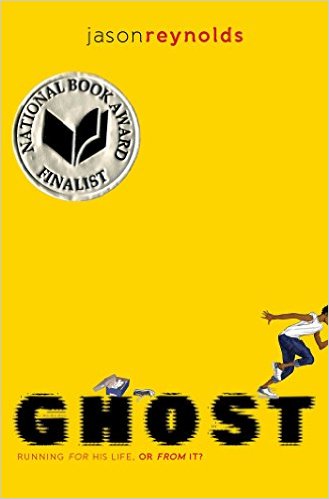
Ghost by Jason Reynolds


Ghost can run fast, but this tough kid doesn’t know how to be part of a team yet.  This book makes readers think more about healthy and unhealthy relationships, communities and teamwork, and forgiveness.


A Matter of Heart by Amy Fellner Dominy


Abby’s a competitive swimmer about to try out for the Olympics when she is told by a doctor that swimming too quickly could kill her.  This book makes readers think more about healthy and unhealthy relationships, good and bad risks, and figuring out who you are.


The Hypnotists by Gordon Korman


Jackson Opus has a strange power — he can hypnotize people to do whatever they want.  Now the brilliant Elias Mako wants to work with Jackson to develop his skill.  This book makes readers think more about power, good/evil, and fighting back.


Challenge Books

Longer, tougher, more complex ideas…


The Sun is also a Star by Nicola Yoon


Daniel and Natasha “bump” into each other and it’s love at first sight.  Was their meeting chance, or was it the universe pushing them together?  This book is by the same author as Everything, Everything, but readers are advised that this book is not a sequel or a companion to E,E.   This book makes readers think more about destiny/fate, love, and immigration.


The Hate U Give by Angie Thomas


Starr’s childhood friend Khalil is killed in an unfortunate accident when the police were looking for another suspect.  Khalil’s name is all over the news, and Starr’s private school friends don’t know that she was a witness to the murder.  This book makes readers think more about race, wealth/poverty, and the #BlackLivesMatter movement.


Scythe by Neal Shusterman


Two teens are training to become scythes, carrying out their society’s sacred role of determining who lives and who does not.  Scythe training is demanding, rigorous, and there are rebels within the order of Scythes who are looking to change the way death works … forever.  This book makes readers think more about power, death, and right/wrong.


Monster by Walter Dean Myers


In jail for a crime he didn’t commit, Steve creates a script for a movie that tells the story of his life and his run-in with the criminal justice system.  This book makes readers think more about power, race, art as healing, and the prison system.


All-American Boys by Jason Reynolds and Brendan Kiely


Quinn and Rashad go to the same school but aren’t friends, until a case of violence makes Quinn realize that there’s no such thing as being a neutral bystander.  This book makes readers think more about violence, race, and friendship.


Speak by Laurie Halse Anderson


A teen classic — Melinda is considered an outcast at her high school because she called the cops on a party.  This book makes readers think more about rebellion, fighting for what’s right, and the costs of popularity.


The Family Romanov by Candace Fleming


About 100 years ago, Russia had a royal family that was kicked out and eventually killed.  Learn about the factors that led to the uprising against the Romanov family.  This book makes readers think more about wealth/poverty and war.


Amy Estersohn is a middle school English teacher in New York and a 2016 recipient of the NCTE Gallo Grant.  Follow her on twitter at @HMX_MsE

3 Ways Paper Built a Classroom Community

This year, I’ve gotten away from a focus on online reading, writing, and grading, and returned to paper.

I’ve always kept certain things hard-copy–the writer’s notebook, one-pagers, and book talks–but when I started working with college students, Google Drive became my best friend.  I used Slides to keep myself organized in class, Sheets to keep track of my grades, and Docs to collaborate with my students as we worked on their writing.

However, after a semester of forgotten deadlines, regrettably disconnected class sessions, and lackluster writing voices, I wanted to switch things up.

So, beginning in January, my students printed a one-pager about the week’s writing and brought it to class.  When they gave presentations or shared their thinking, I asked them to bring a tangible artifact to represent their work.  Any time we shared or offered up our thinking, we wrote notes to one another and signed them with our names.

These three practices, along with an emphasis on slowing down our thinking and being more deliberate in our work, language, reading, and interactions, made this semester one of my favorites in a ten-year career of teaching.

Sharing Hard-Copy Writing — I tried to build in class time weekly for us to pass one-pagers around and leave feedback.  While this didn’t happen every week, it allowed for students to hear each other’s writing voices, discover new modes for representing their thinking, and come to a more dialogic understanding of the week’s readings rather than a “right or wrong” frame of mind.  In her self-assessment for the course, Erin writes about the benefits of reading one another’s work:

Screen Shot 2017-05-05 at 9.08.29 AM.png

Paper as an Artifact of Thinking — “I began writing this by going back and re- reading my writing from the beginning of this course. I still believe in some of the statements I made in my first one pager related to the beauty in the simplicity of a child’s world,” img_8673Hanna began her self-assessment.  Her ability to look back at her earliest writings as an artifact of who she was as a thinker 16 weeks ago allowed to her to launch into a detailed reflection on her growth over the course.

In keeping with that theme, I asked my students to bring in an old-fashioned poster or trifold to share the thinking of their final projects.  While they’d be turning in a more formal paper or Prezi during finals week, I wanted everyone to get to share their process tangibly.  We engaged in a gallery walk during our last class period together, and the students enjoyed showing off their own thinking and comparing it to their fellow teachers’.

As they read, they jotted ideas in their own notebooks for how they might modify their own thinking before submitting it in final form.  This type of physical engagement with one another’s work yielded far more interaction in terms of thinking and feedback than last semester’s format, in which I requested students send me three Google Slides about their work that we’d all share.

img_8672

Keepsake Feedback — Keeping with the hard-copy theme, I devised a few new feedback protocols for students to give one another comments they could hang on to.  While sharing the fruits of our semester-long inquiries, I asked students to engage in a “push and pull” with the writer.  On one side of a piece of paper, they “pushed” the writer on some things they might take a little further or explain in more detail.  On the other side, they told the writer what they had “pulled” from their work to enhance their own thinking.

In this way, students received feedback on these informal “drafts” of their thinking from their peers and from me, three weeks before they needed to finalize their assignment.  When they turned in their notebooks at the end of the semester, I saw that many students had taped in their peers’ feedback to hang onto as both advice and encouragement.

img_8676

By making our thinking visible this semester in the form of hard-copy papers that represent our thinking, posters or 3D representations of our ideas, and written feedback we can hang onto, I noticed a marked growth in my students’ progress.  Their writing evolved throughout the semester to not only take on different forms, but also in its sophistication of content.  My students all got to know one another well, even those in my class of 30.  They learned about a diversity of perspectives and ideas beyond mine or their own that helped banish the idea of a “right or wrong” binary.

I really enjoyed my teaching, grading, and students this semester…and it was all thanks to paper.

How have you balanced integrating technology and keeping it old-school to help your students see one another’s thinking? Please share in the comments! I’d love some more ideas for next year.

Shana Karnes lives in West Virginia and teaches sophomore, junior, and senior preservice teachers at West Virginia University.  She finds joy in all things learning, love, and literature as she teaches, mothers, and sings her way through life.  Follow Shana on Twitter at @litreader.

When Context is a Novelty

Senioritis is real, people–I think I have it.  Teacheritis?  I don’t know.  Either way, the type of this condition my students have seems to be an airborne contagion, because I’ve caught it.

However, along with the feeling of I-just-want-to-sit-on-a-beach-and-read-Matthew-Quick-novels, I’m having all the other feelings, too.

We are nearing the end of the school year, which will bring to close my SECOND–count ’em, one, two–year of teacher the lovely half-child, half-almost-adults, half confused and terrified individuals we call seniors.

The other feelings I’m beginning to feel are difficult to wrestle.

I’m excited for a clean slate.

I’m lamenting over all the Should Have Done’s and Wish I Did’s.

I’m paralyzed with fear that someone will steal books from my classroom over the summer, jeopardizing the integrity of the inventory I have yet to take.

I’m overwhelmed at coming up with a better system of organization than my piles of sticky notes.

I’m also mourning the fact that these amazing human beings whose lives I’ve been a part of for 180 days will now go off into the world and I may never see them or hear from them again.

One of these incredible humans is Zoe.

file

Aside from the fact that we look like sisters, Zoe has been a student who’s been on my mind a lot this year.  The first day when we set reading goals, I was taken aback that her goal was heftier than mine.  She wanted to read 50 books this school year.  Even more, she labored over a plan to actual complete that goal, as she wanted it to be realistic!

At the Principal’s Breakfast, I described Zoe as having her head in the clouds with one foot on the ground.  She has this uncanny ability to dream big, but to make sure she understands the logistics of everything.

Zoe is a student who always asks why.  She doesn’t ask it in a way to throw off the teacher, she just truly wants to know how everything connects and why it matters.  This has made me better.

When we had our class discussion on engagement, Zoe explained that this was the first English class in which she felt everything had context.  Surprised at her remark, I asked her to explain further.

She said, “We don’t do random worksheets for grammar or learn random words that don’t have any sort of genesis or connection with what we are actually reading or talking about.”

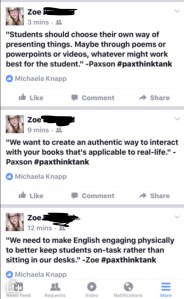
She tweeted a few things that made my heart sing:

PTT6

Aside from the fact that I’m glad this connection is happening in my classroom, I’m confused as to why context in the classroom is such a novelty.

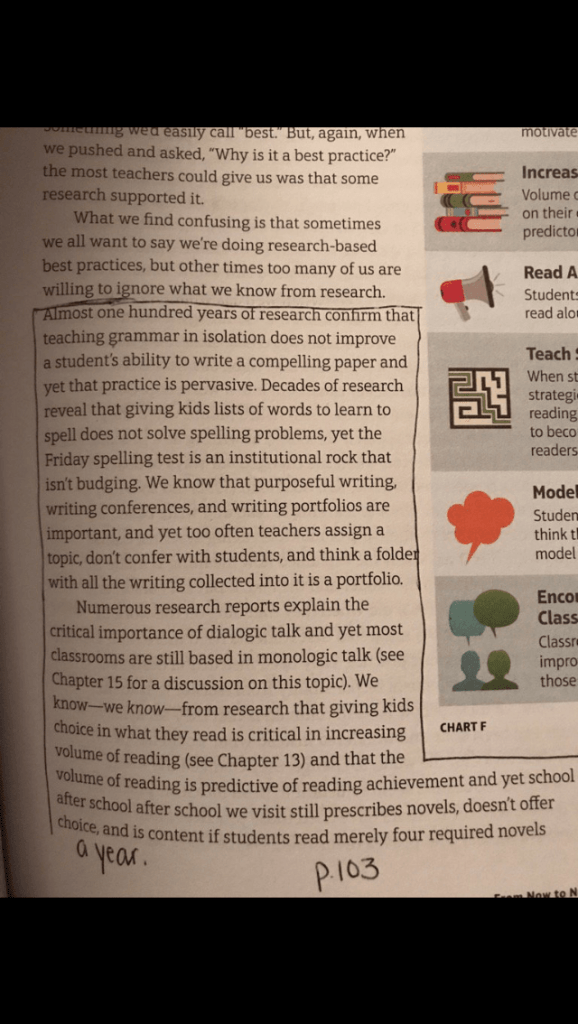
I’ve been seeing many Twitter friends commenting on the new book from Kylene Beers and Bob Probst, Disrupting Thinking.

file

Excerpt from Disrupting Thinking via @msethna23 on Twitter


Like it says, we know the research.  We know things should not be taught in isolation.  We know kids need hooks and pegs on which to hang their knowledge.  So why are our classrooms still reflecting a plot-and-prescribed-theme teaching, vocabulary word memorizing, grammar terms on Fridays environment rather than an environment of connected and contextual literacy?

With a couple of sentences in a classroom discussion, Zoe sparked my mind to not only consider my own teaching practice, but to artfully consider why things are the way they are in education in general.

My new research question: If one knows something, how do they benefit from feigning ignorance?  What would it take to change a whole system in which so many are comfortable with comfort?

As for those that are reading this post, I’m sure I’m preaching to the choir.  Even still, how can we band together to show how much better it is this way?

Zoe is the type of student who sticks with you, but I’m running into increasingly more of those these days.  I’ve attempted this year to change my teaching from This is What You Need to Know to What is your story and how can I help it along, make it wider and deeper, and revel in the light of a lifelong learner taking a step into the real world. 

How do you create context and connectivity in your classroom?


Jessica Paxson is an English IV and Creative Writing teacher in Arlington, TX.  She usually takes on major life events all at once rather than bit by bit, such as starting graduate school, buying a house, going to Europe, and preparing for two new classes next year.  If you enjoy watching her make a fool of herself by being unbearably vulnerable, you can catch more of that over at www.jessicajordana.com. Follow her on Twitter or Instagram @jessjordana.

Learning from One Another – Professional Development is Everywhere

As high school cliques go, I was never a part of the “cool kids” group. I loitered around the exterior, occasionally granted access to view what went on behind the curtain, but knowing people who know people didn’t really make much of a difference in terms of obtaining a season pass to all things elite.

I was a somewhat lovable dork, voted most compassionate of my high school class (please read this amazing post about being nice vs. being kind, because I was far too nice in high school), content to spend time laughing with my band geek friends and the ever flexible crowd made up of people who really tried not to care what went on at the “totally awesome” parties thrown by people too important to acknowledge the existence of 92% of their graduating class.

Now, in retrospect, I was saved from many things:  painful experiences that would have blown my sheltered innocence far before I could handle it, drama related to pecking order and perceived slights over social class, Gatsby-esque flaps fueled by alcohol and beautiful shirts.

These days, in the professional world, having a collaborative group that functions supportively, creatively, cohesively, also has many benefits reminiscent of those true friends from years past who helped get me through, helped raise me up, helped make me better. The teachers in my department are simply amazing, and I am lucky to have a season pass to be a part of their cool.

Across the profession, some of us meet weekly (or more often) in PLC meetings. Some of us meet in spare moments after school, chance encounters in the hallway, and Google hangout planning sessions. Some of us befriend the teacher next door and talk shop at all hours. It’s about growing as professionals, even when it’s sometimes just about what we’re all “doing tomorrow.”

pd1

However, growing as a professional, these days, can also mean connections that are far from the traditional and learning that comes from very surprising places. In these trying professional times, to be a teacher requires hits of rejuvenation whenever and wherever we can get them.

Take, for example, Shana’s post from last week on her professional development enthusiasm and the message she shared with 3TT. I listened to her message and hurriedly wrote down two ideas I wanted to try right away.

That is the magic of connecting with other professionals: learning (or reviewing) what can bring back (or sustain) the spark that every classroom teacher needs in order to weather the slings and arrows of our craft.

Those sessions where you fill up page after page of quotes, insights, lesson ideas, tips, and tricks. Where you are the cool kid, not because you’ve adjusted who you are in any way, but because you have built up who you are and what you do.

Over the course of this year, I have come to see professional development as something that is happening every surprising moment, from all possible angles. pd2

Below, some reminders (that I myself needed this year) of how empowering learning is. If we forget about, resist, or otherwise close ourselves off to new ideas, review of what works, or even the very basics of our craft (Let me hear you : teachers must be readers and writers or we are in the business of false advertising) what unfortunate hypocrisy we make of what we purport to do each and every day.

Embracing PD Opportunities Based on Your Needs

Whether it’s to pursue an advanced degree, get continuing education credits, fulfill a district initiative, or to explore a topic of interest, professional development can be hugely invigorating to daily practice (It can also be a flop and/or downright insulting, but that’s for another post).

For example, I am typing this blog post today, because I was in need. I needed support to help make the move to workshop and to lead my department through that move. I Google searched “readers and writers workshop,” started reading the 3TT blog, emailed Amy to ask her a million questions, and then insisted to my district that 3TT needed to come for professional development in Franklin. It was some of the most authentic PD I’ve received in fourteen years of teaching.

photo2

Sometimes, it can feel like professional development gets overwhelming. We have professional development opportunities at staff meetings, during mandatory extra hours outside of the school day, and in order to fulfill countless professional expectations of record keeping, curriculum development, and reflection.

However, through professional development organized by and for teachers, we learn from those who know best and know now because they are in the trenches. Seek out professional development for yourself that speaks to the needs you feel need to be met in your classroom.

Creating a PLC with Students 

Sheridan lingered after class yesterday. She’s actually the inspiration for this entire post.

Shyly, she asked if it would be alright to share an article with me. “I ran across this article yesterday while I was looking for something else and it intrigued me so much that I read it.”

With a smile on my face I said, “What were you looking for?”

She laughed, “I don’t even know. I never found it! But I think you’ll like this, so I’ll send it to you.”

What arrived was a link to a Washington Post article from a few years back. Alexis Wiggins, the daughter of Grant Wiggins (of Understanding By Design fame), is also an educator and had shadowed a student for several days. Her takeaways in this article about what students experience every day hit home with me in a big way.
Not because her insights were new or because they would change everything I do on a daily basis, but for two reasons.

The ideas were a reminder of a perspective that often falls away in the face of daily routine and that reminder was shared with me by a student of my own.

Sheridan in no way was looking to make me feel bad, but she did exactly what I tell my kids that reading, sharing, and reflecting should do : remind us of what we need to make a priority each day.

Wiggins research on students needing to feel valued, engaged, and physically and mentally present isn’t new to me, but the article was the best kind of professional development: Kid centered, kid inspired, immediately applicable to my classroom.

Look for, solicit, or otherwise beg students to share with you what is making them think. Direct them to places like Austin Kleon’s newsletter or Arts and Letters Daily, so they can study new and unique ideas, talk about those insights in class, connect them to current learning, and expand your repertoire of resources, insights, and enthusiasm.


Hanging with the Cool Kids

Expanding our definitions of professional develop can also be hugely beneficial.

You’re doing it already, you know. Reading this blog. Reading other blogs, following educational news, getting active in political topics that weigh on our schools, our kids, and our jobs.

Go even further:

  • Follow the English rockstars on social media– Kittle, Gallagher, Newkirk, Morrell, Miller, Anderson, just to name a few.
  • Like the Facebook pages of authors your students love – I’ve had Angie Thomas and Matthew Quick like posts my students and I wrote just in the past few weeks.
  • Tag big names in your posts – Opening your insights or questions up to a wider pd3audience.
  • Jump on Twitter chats –  You don’t ever even need to comment, if you don’t want to. You can just read, click on links to other great articles/insights/lessons, and remain anonymous. You can watch a chat as it’s happening, or follow a hashtag back to a conversation that’s already happened and read through what was said. Here is a link to scheduled Twitter chats that educators might find value in.

Keep learning intentionally.

Not only will you open yourself to an even wider world of resources, insights, opinions, and discussion, but sometimes, you’ll hear personally from these teaching megastars, and let this fangirl tell you, that discipleship can take you all the way back to that thrilling peek behind the curtain of the cool kids.

What professional development opportunities have you found most beneficial to your career? Whether it be attendance at a national conference or stalking a Twitter chat, we’d love to have you join the conversation in the comments below! 


Lisa Dennis teaches English and leads a department of incredible English educators at Franklin High School near Milwaukee. Her favorite pens for note taking during professional development are Paper Mate Flair pens in a variety of colors. Follow Lisa on Twitter @LDennibaum 

Where I’m From, With a Twist – Guest Post by Margaret Egler

During the process of writing this poem, I had to make many decisions. Since this poem is not about myself, it was difficult to include details and experiences. I interviewed Tommy and he told me where he came from and his passions in life. When Tommy began to tell me about his memories, I pictured them in my head and pulled out words/pictures I thought related to that particular story. I struggled at times trying to put my all into this poem; writing about someone is a lot more difficult than it looks. — Darcy

Writing in general is a lot more difficult than it looks.  And for juniors and seniors in high school, the stakes for writing well are high: college admission essays, standardized writing tests, artist statements, scientific reports —  not to mention, massive group texts!Screen Shot 2017-05-01 at 8.44.22 PM.png

As writing teacher, I’m constantly on the lookout for authentic writing experiences that give students new perspectives — on themselves and others. I’m also drawn to the economy and intentionality of poetry as a way to help students both appreciate the beauty of words and make them aware that each word needs to earn its place in a piece of writing.  For my first semester students, I’ve used Kelly Norman Ellis’ “Raised By Women” poem to launch writing college essays, finding that the short bursts of images and details provide insightful golden nuggets that can be then mined for longer personal narratives.

For my second semester students, I wanted to create a similar experience with poetry, but I didn’t have the imperative of a college essay to focus our attention.  I teach at a project-based high school where I share a team of students with a teacher in another discipline. This year, my biology partner and I wanted students to interview stakeholders for our inter-disciplinary project on protected environmental spaces.  

A new idea for poetry was born! Taking Willie Perdomo’s moving and gritty “Where I’m From” poem as a mentor text, I twisted the usual process of using this poem to write about one’s own home. Instead, I randomly partnered students up and asked them to write a first-person “Where I’m From” poem about the other person’s life.

This poem had its ups and downs. Something that worked well was that it was cool seeing a perspective of another person. Sometimes we get too stuck in our own world and just don’t put into perspective how someone’s life is. — Gabriel

Once they found their partner, I gave the pairs a series of questions based on Perdomo’s poem to prompt them into conversation and let them loose around the school to interview each other:

— Describe the landmarks around your home

— What tunes do you listen to?

— What are the “sayings” of your family?

— What languages are spoken in your home?

— What streets do you live on?

— Who are the people in your life?

When students returned from their interviews, they began drafting their poems, but with certain structures that guided the structure of their poems.  For example, they were required to write six stanzas and to use an anaphoric line at the beginning of each stanza (e.g., “Where I’m from…” or “If you knew…”). We also discussed the importance of  concrete and sensory details as tools to make writing interesting.  As they got underway, students soon realized they didn’t have enough information to fill out the stanzas or they lacked specific details. So back they went to their partners to delve more deeply into their lives.

Screen Shot 2017-05-01 at 8.10.36 PMFinally, I would like to thank Isaiah, Victoria, Andrew, and Margaret for helping me make this poem the best version possible. I would also like to give a big shout out to Holly for answering all of my annoying, pestering questions and letting me represent her through this poem. — Hannah

In the process, students underwent an intensive cycle of writing with prodding questions
from their peers and me about the content of their poems, (“Which specific beach do they go to?” What specific dish does their grandma make? What does it smell like?”). What emerged was a deep desire to respect and honor their partner’s emotional life through details and word choices.

I wrote to capture the way Betty would have written it. It was very difficult to write in the shoes of someone else and talk about their life. — Andrew

As a visual touch to their poems, students traced their own self-portraits and scanned them into photoshop to play around with color and line.  When they were done, their writing partner assembled the final poem using InDesign to create a visually compelling and creative piece of art.


Margaret Egler teaches 11th and 12th grade humanities at High Tech High in San Diego, CA. This project had many inspirational sources: Kelly Williams, Paul Lopez, Kalle Palmer, Jeremy Farson, Stephanie Lytle, Kaleb Rashad, and, post hoc, Chris Emdin (“Help students dig into themselves to mine their own brilliance”). Thanks especially to the Margarita Whales and Kalle Flowers for sharing their brilliance.


Screen Shot 2017-05-01 at 8.44.22 PMCare to join the conversation? We’d love to add your voice! Please email guest post ideas to Lisadennibaum@gmail.com.

Audiobooks are Books, Too

Totally honest: only recently did I discover the magic of audiobooks.


Audiobooks are magical because they allow me to READ while I am doing other things, like BEING STUCK IN RUSH HOUR TRAFFIC ON THE GEORGE WASHINGTON BRIDGE.    .

I’ve been using YALSA’S Amazing Audiobooks lists as a starting point for my auditory adventures.  By listening to stories, I’m able to arrive at understandings that I might not get from ink and paper.  For example, when I first read Katherine Applegate’s One and Only Ivan, I felt pity for the Ivan, a gorilla trapped in a shopping mall.  However, when I listened to the book on audio, I heard Ivan proudly talk about “domain.”  I realized then that Ivan is not able to understand his situation well enough to reflect on it the way I (a human adult) do.

Another example is Jason Reynolds’s GHOST, a book about a boy who joins a track team that was love at first page for me when I read it in print.  Guy Lockard’s voice work brings Ghost’s vulnerability to the surface, and his voice for Coach sounds like a teenager trying to impersonate an old man instead of an old man.  As a result, we hear the version of Coach that Ghost tells us about, not Coach as we might hear him if we met him.

41oUcSnuwoL._SX327_BO1,204,203,200_

Not just an award winner for the text, but an award winner for the audiobook, too!

My own studies are making me think more about how I can use audiobooks in the classroom.  I have some ideas about how I might bring these treats into the classroom:


  • Share and compare.  Give students a passage to read silently.  Then play them the audiobook selection for that passage.  Did students hear what they expected to hear?  Did they hear something different?  (The One and Only Ivan and GHOST are terrific mentor texts for this work with middle schoolers; for high school I might recommend a chapter from Wink Poppy Midnight by April Tucholke because the chapters are brief and the book did won an Amazing Audiobooks award.)
  • Inquiry and discussion of  award criteria.  Play a section from an Amazing Audiobook with or without accompanying text.  What makes this reading award-worthy?  Or is it award-worthy? 
  • Create your own mini-audiobook.  Especially if we want students to slow down their reading to notice voice and word choice, giving students an opportunity to read, direct, and/or produce their own mini-audiobooks would invite students to invest in their books and make that sharing public through a podcast or a rehearsed live performance.   Kelly Gallagher already does something similar with the reading minute.


Do you do any work with audiobooks?  Continue the conversation in the comments!


Amy Estersohn is a middle school English teacher in New York and a recipient of the NCTE Gallo Grant.  Follow her on twitter at @HMX_MsE

Learning from Other Teachers

5054c4145eaf8a4c41c3bbd1d1954cdd.jpgI have so much hope for our profession, our students, and our society.
In a pretty pessimistic world, want to know why I’m so optimistic?

Because I believe in our future teachers.  After an entire school year of working with preservice educators, I have seen so much energy, excitement, and engagement from every single one of my students.  Every challenge that comes their way–whether in the form of an assignment, a tough reading, or grappling with a seemingly unsolvable education issue–only reaffirms their desire to help their students.  They just careso much.

A fantastic conference I attended last week was a wonderful reminder of all of that hope I have for teachers and teaching and learners and learning.  We’re here because of love–love for who and what and how we teach.  Yesterday, I shared my learning from the morning sessions of that conference, and today I’d like to share the ideas, quotes, and joy I heard in my afternoon sessions.

Session Three:  On Teaching Writing & Knowing Our Students

This amazing session was led by three preservice teachers who interned in high school ELA classrooms in our community.  Each of them spoke about their struggles and successes with so much passion that I was left feeling proud to be a teacher by the end of their talks.

Idea:  Audio Recording Peer Feedback–I absolutely loved Katie N.’s idea of having students record their feedback to peers.  After a semester of struggling to get her students to view themselves and one another of being capable and worthy of giving authentic, valuable feedback, she hit upon the idea of having students read one another’s papers ahead of time, prepare some comments, and then record a few minutes of thoughts, responses, suggestions, and connections.  I can’t wait to have my students try this idea!

Quote:  “When I conferenced with my students, so many of them really surprised me!!”  Danielle focused on looking for patterns in her students’ extracurricular involvement and how it might connect to their engagement, motivation, and success in schools.  She had lots of preconceived notions about how her athletes, club members, or student body leaders might act in the classroom, and many of them were wrong.  She loved the experience of being surprised by her students when she took the time to confer with each of them multiple times.

Just Joy:  Katie P. was interested in taking a whole class novel study far beyond the book.  While reading A Separate Peace with her students, she encouraged her students to read the novel through a critical literacy lens, identify social issues they could connect to their own school community, and then take action to improve the state of those issues.  As a result of her teaching, the students in her class created a club focused on improving mental health by participating in mindfulness activities like meditation, yoga, and deep breathing.

As she spoke about this new awareness of mental health issues in a school that had been plagued by student suicides, Katie teared up–as did many of us in the room listening to her speak.  I was so impressed and inspired by the power this young teacher realized she had to change a school community.

Session Four: On Evaluating Ourselves

In this session, led by a mix of teachers and school leaders, speakers presented on ways in which they looked at their own teaching, their whole classroom, or their entire school community; identified a problem; and then attempted to fix their issue.  Many of their inquiries resulted in some amazingly ambitious goals–one principal wanted to find a way to improve her students’ poor attendance, which was often caused by factors stemming from a community plagued by poverty; a group of teachers formed a committee to implement more responsive, sensitive discipline into their elementary school; and an academic coach shared ways she’d aggressively procured free technology into her school for teachers and students to use to improve learning.

I loved all these school leaders’ ideas, but I found one presenter’s approach to strengthening pedagogy incredibly effective and easy to implement.  Josh Karr, a high school math teacher, simply emailed his colleagues and invited them to form an informal PLC to evaluate themselves.

Idea:  Record Your Teaching–Josh invited his whole faculty, via email, to video record one of their lessons, watch it alone, and then bring a small clip to share with a partner in their mini-PLC after school.  Thirteen teachers agreed to participate, and showed up, quite nervously, with their recordings.  They paired up, regardless of content area or grade level, and worked together to analyze their videos, give and get feedback, and talk through some questions they had.  I loved this super easy, low-stakes idea to self- and peer-evaluate our teaching in such a welcoming way.

Quote:  “We laughed at how many teachers didn’t even have students in their videos.”  Josh told a funny story about how several of the teachers’ video cameras had only been pointed at the teachers themselves, and how they didn’t realize this narrow-minded view until they started talking with colleagues.  It was a real revelation for many of these teachers to realize that, wow, their worldview wasn’t very student-centered.  I was so uplifted by hearing Josh speak about how this simple activity prompted these teachers to stop looking at themselves for evidence of good teaching, and to begin looking at their students instead.

Just Joy:  Josh talked about what an inspiring thing it was to be part of this tiny community of teachers within his school, which included teachers from all content areas, and even the band director.  He gave me such hope when he shared how the teachers’ video recordings had evolved over the weeks to include more students, more difficult class periods, and more and more vulnerable learning.

I loved hearing how teachers of all levels of experience and expertise were willing to open themselves up to their colleagues for the sake of improving their students’ learning opportunities.  It’s a hard thing, in this profession, to invite criticism of our teaching when our  work can sometimes be thankless.  I can’t wait to try this idea with my students and colleagues alike.


Check out Part I of this post from yesterday, and then please leave us a comment:  what strategies, ideas, or frames of mind might you try out in your classroom?  Will you share some fantastic lessons you’ve gleaned from good conferences in the comments?

Shana Karnes lives in West Virginia and teaches sophomore, junior, and senior preservice teachers at West Virginia University.  She finds joy in all things learning, love, and literature as she teaches, mothers, and sings her way through life.  Follow Shana on Twitter at @litreader.

Getting Invigorated by Good PD

11863319_864585353577385_5354103936493098384_n.jpg

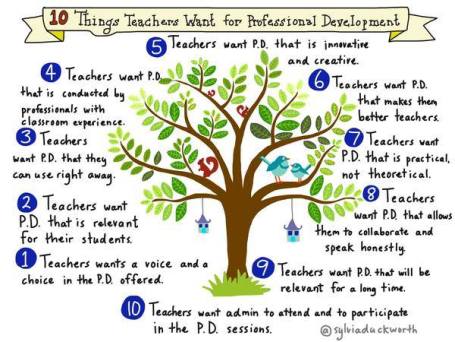
I love this accurate graphic about PD by Sylvia Duckworth.

Last Friday, I was fortunate enough to attend some of the best professional development I’ve been to in a while–and it was free!

At the end of the day, I left my 3TT friends a seven-minute WhatsApp message of out-of-breath enthusiasm, describing my day’s learning.  That’s how you know it’s been a good day.

The conference I attended is held annually to celebrate our Masters’ students’ impending graduation and entry into the field of teaching.  The all-day event features presentations by both preservice and practicing teachers, academic coaches, and principals.

Before the conference, speakers are invited to conduct an inquiry into one aspect of their practice, then present on their methods, findings, and insights.  I attended four absolutely wonderful sessions, and filled up six pages in my notebook with ideas and quotes and just joy–and I’d love to share them with you all.  Today I’ll share ideas gleaned from my morning session, and tomorrow I’ll share what I learned from the afternoon portion of events.

Session One:  On Independent Reading

In my head, I called this session “What you do after you’ve read Book Love,” because it was full of amazing ideas that I’m certain would be Penny Kittle-approved.  One presenter, Andy Patrick (@MrPatrickELA), absolutely blew my mind with the ways he’s clearly innovated independent reading.

Idea:  Reverse Reading Rates–Andy explained that when students chose a challenge book, they took a new reading rate and then used their findings to determine how long it would take them to finish the book.  The students could set a completion goal, Andy could touch on this goal in his conferences with them, and when the book was finished, students reflected on their reading process.  Since I’ve struggled with reading rates and accountability, I just loved this idea.

Quote:  “I never let them off the hook” when they tell me they don’t like reading.  Andy followed this fantastic one-liner up with his philosophy that they just weren’t reading the right books, and it was his job to help his students find them.

Just Joy:  I left this session absolutely impassioned thanks to Andy’s flurry of ideas.  He tossed out strategies like using quotes about the joy of reading as quickwrite prompts, his determination to get colleagues on board with teaching reading across the curriculum, and how great teachers of reading cannot excel unless they are real readers themselves.  YAAAAAAAASSSSSSS was the prevailing word in my notebook after that session!

Session Two:  Strategies for Reading, Writing, and Grammar

After leaving the first session, I had no idea how any other speakers could top that.  Luckily, I was just as inspired by three preservice teachers who’d done their internships in middle school ELA classrooms, and who shared their optimism for our profession in the form of their research.

Idea:  Say Something Journals–Sierra shared that many of her seventh graders weren’t engaged in reading independently or as a whole class, and she wanted a way to spark their interest in their texts.  She created journals, simply folded out of notebook paper, in which students could practice recording their internal reactions to something while reading during class.  When they were reading shared texts, she had students trade journals and giggle about the similarities and differences in their reactions.  The journals culminated in getting the reader to “say something” about the “something” they believed the writer was trying to “say.”  I loved Sierra’s emphasis on the transactional nature of reading, rather than a linear interpretation of a book’s message.

Quote:  “Why don’t they just capitalize their i’s?!” said Tori, who struggled with getting her 8th graders to use grammatical conventions in their writing, even after conferences and practice sessions in which students proved they knew what they were supposed to be doing.  Tori’s presentation was characterized by her sheer love of grammar and her bewilderment about why the heck kids could study mentor texts, send flawless text messages, and yet still refuse to obey the conventions of standard English.

One student’s response?  “Well, I just think capital I’s aren’t very cute.”

Just Joy:  Charity brought sophistication and high expectations to her 8th graders by teaching them about what critical literacy is and then working with them to practice it when reading nonfiction texts.  She focused on helping students develop discussion skills to practice thinking, reading, writing, and speaking within a critical literacy framework, all while reading place-based texts they helped her select.

I think my jaw was on the ground throughout the whole of this brilliant young teacher’s presentation–I want my daughter in her classroom someday, I kept thinking to myself.  What a treat to end my morning by feeling so hopeful about the new talent entering our profession!

Stay tuned for Part II of this post tomorrow, and please share with us in the comments–what have you learned from strong PD sessions you’ve attended?

Shana Karnes lives in West Virginia and teaches sophomore, junior, and senior preservice teachers at West Virginia University.  She finds joy in all things learning, love, and literature as she teaches, mothers, and sings her way through life.  Follow Shana on Twitter at @litreader.


None of the Above: A Bubble-Free Final Exam

Remember Scantrons tests? The filling in of bubbles at semester’s end in order to prove your worth as a scholar? Many of my anxiety-cloaked memories of high school involve those hideous little forms, a No. 2 pencil, and hours spent hurriedly filling in bubbles to demonstrate my multiple choice understanding of the world.

exam 9

Once upon a time, I took this type of test. Early in my career, I gave them. Currently, I hate them. Or rather, as this is a company name I certainly wouldn’t dream of defaming, I hate the concept of a test format that negates creativity, deep thinking, or conveyance of personal connection to learning. While admittedly easy to grade, I don’t recall the last multiple choice test that left me satisfied with the assessment in any way.

Now, before I get myself in hot water, both with Scantron and my fellow teachers, there are realities associated with multiple choice testing that are inescapable, and if we want students to be prepared for the high stakes testing they will certainly encounter as a means to pass AP tests, seek admission to college, and succeed on many college campuses, then we must do our part in preparing students for this type of assessment and thinking. Applied Practice tests, for example, challenge students to dig into a passage and deeply analyze the author’s craft and style. That skill development and demonstration is a wonderful tool.

However, this post is about the opportunities presented to us as educators as we look to the end of a grading term and search for ways to have students think critically about their cumulative learning, their growth as readers and writers, and the

exam11

Bailey’s reading insight.

connections they’ve made throughout our time together that will move them forward as educated citizens.

Many of these thoughts started well before my work with workshop when several years ago, our administrative team organized a committee to discuss our practices around final exams. Scheduling, format, exemptions, and weighting were all on the table. My biggest takeaway from those reflections?

I wanted my final exams to be reflective of student thought, synthesis, growth, and accomplishment to this point. In other words, I didn’t want any part of our “final” exam to be final in any way except that it would happen to be our last assessment together.

In other words, a final exam should showcase rather than stifle.

It should be an opportunity.

In years past, a multiple choice test showed a student’s regurgitated knowledge of the texts we had read and the literary movements we had studied. A written portion challeneged skills in supporting claims, sometimes providing text evidence, and timed writing.

exam 7

Amelia’s reading takeaway.

Again, these are valid and necessary skills to prepare students for future academic endeavors. Personally, however, I have grown to believe that if a paper isn’t going to receive some feedback, it’s power and purpose are lessened, or even negated.


We want students to grow as readers and writers throughout the year. This should include their final assessment opportunities as well.

exam 1With that in mind, my colleagues and I have worked hard over the years to provide more authentic assessment opportunities for students to demonstrate their growth during final exams.

Portfolios have replaced timed papers. Graded discussions have replaced short answer questions. Reflective speeches, projects, and writing have replaced bubble tests. And, with the advent of workshop, choice reading reflection has become my go-to.

In January, the teachers in my Honors English 10 collaborative group, organized an opportunity for our students to share the insights gleaned from an entire semester of choice reading. I was so excited by the project that I added some additional symbolic and reflective elements to it and used it with my AP Language students as well.

Students reflect on the texts

exam 8

A reflection from Josh.

they have read throughout the course of the term, select meaningful passages from that reading (many had been marking key quotes in their notebooks throughout the year), and give a talk about how the reading changed, moved, and/or developed their thinking with the support of visual cues and quotes to provide context for their ideas.

Illustrations of such deep thought include:

  • Abby learned that “we all struggle, but it’s how we handle those struggles that truly defines our character.” 
  • Errin suggested that “our world is only as vast as our perspectives allow it to be.” 
  • Tahseen claimed that “books help me solve the problems in my life.” 
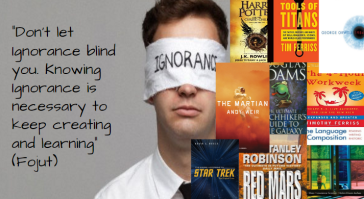
  • Bailey, in his infinite wisdom buoyed by the most sincere character, pled with the class to not “let ignorance blind you. Knowing ignorance is necessary to keep creating and learning.”
  •  Rachel said we must “know yourself and use that knowledge to go out and know the world.” 

exam 4

exam 6

Some student samples from Amelia and Josh

As the time for final exam planning in at hand once again, here is a link to the project. Use it as a springboard for your own great reflective projects and encourage kids to once again see the value of the choice reading they have completed this year.

How have your finals evolved? What will your students be doing to wrap up the year? Please share in the comments. 


Lisa Dennis teaches English and leads a department of incredible English educators at Franklin High School near Milwaukee. She fondly remembers dabbing chapstick on her Scantron to try and fool the machine. This was during her rebellious streak, which lasted about four days. Follow Lisa on Twitter @LDennibaum 

Two Take-Aways from Mentoring my Student Teacher

Next week I get my students back. For 12 weeks I’ve had Joseph as a student teacher, and I’ve come to really miss my kids. It’s an exciting time.

I am hoping I get my writing mojo back, too. I’ve struggled with topics to write about since I haven’t been working with my students day to day. One of my favorite parts about being a reflective practitioner is my itching need to think about, write, and share my experiences in the classroom. Thanks for reading this writing.

This is the fourth student teacher I’ve mentored. It is the first time I’ve given up control. Maybe it’s because I’ve learned how. Maybe it’s because Joseph is just that awesome at stepping into the role of teacher. It’s probably Joseph. I have learned a lot from Joseph over the past several weeks, and I’ve learned a lot about my teaching practice as I have become the observer.

In every aspect of my practice, I have become more purposeful. When I return to my classroom next week, I will be sharper, more intentional in my planning and instruction, and how I interact with my students day to day.

Here’s two top take aways — and why I think every teacher, especially teachers who practice a workshop pedagogy — should offer to mentor a preservice teacher eager to enter our discipline and our profession:

Perception changes everything. My first conversation with Joseph was in the fall. He spent several weeks during the semester observing my classes two days a week. After his first visit he said something like this:  “That was unlike any English class I’ve ever been in. I was always bored in English. I didn’t know a class could look like this.”

Don’t most new teachers step into their roles and teach the way they were taught?

I did. I assigned writing with prompts and due dates instead of teaching writing with mentors and modeling. I pulled out the textbook, assigned a lead weight book to every student, used the suggested lesson ideas and the questions for guided discussion and the activities in each chapter. I chose every novel for the whole class, torturing children with booklets of questions to “aid their understanding” or dialectical journals to “write their thinking” for the complex texts I chose. The students I taught year one certainly still dream about Dickens, and quizzes about characters and setting and plot. I was a nightmare.

Joseph conferring

Conferring with readers during independent reading time.

New teachers have to believe there is a better way. I know some university education programs prepare students for choice and workshop. (Shana was blessed at the University of Miami with the likes of Tom Romano for a professor.) But many programs do not come close to preparing students for the realities of teaching, much less the research-based practices of readers-writers workshop.

Experienced workshop teachers can change that one student teacher at a time.

Research-based Practices in Reading and Writing Instruction. Even more than usual, I’ve turned to research to back up and refine my thinking. I’ve studied Lou LaBrant thanks to Dr. Paul Thomas and his blog. I’ve read more blogs by thoughtful educators like Tricia Ebaria and books by teacher leaders who inspire great ideas — favorite faithfuls like Penny Kittle’s Book Love and Write Beside Them, and I have re-read conference notes and remembered the why and the how of this pedagogy called readers-writers workshop.

I’ve been able to support my thinking with research, and I’ve learned through my reading the importance of validating that research. Research is important to the choices I make in my classroom.

My confidence grows as I read the work of people who are smarter than me and usually more experienced. I nod along, making notes in the margins, get giddy when I think “I do that.” And as my confidence grows, I am more apt to take risks. When I take risks, my students are more likely to take risks. Risks are exciting in a writing class where we celebrate the process over the product. We go on the journey of discovery together.

Sharing this research with Joseph is like a backpack of confidence. Depending on where he lands as a teacher, and the input and control of administration, he may need it to back up his workshop approach to teaching readers and writers. Knowing Joseph will begin his career with evidence-based practices may take away some of the other frightening struggles of first year teaching. I hope so.

I look forward to seeing Joseph step into a classroom of his own. His students will be lucky ones.

What advice can you give Joseph as he steps into his career in English education? Please share in the comments.

Amy Rasmussen lives in north Texas and teaches AP English Language and English 3 to the Fighting Farmers at Lewisville High School. She also facilitates professional development for other teachers making the move into a workshop pedagogy. She adheres to the words of Emerson: “We aim above the mark to hit the mark,” and Jesus Christ: “Love one another.” Imagine a world if we all love more than we think we can. Follow Amy on Twitter @amyrass.