An Idea: Author Bios and Some Focus, Wit, & Polish

I stole this idea from Lisa. She said it was okay that I write about it first. Bless her.

I finally feel like I’m getting a little of my writing mojo back. If you’ve been following my posts lately, you know I’ve had a hard time. I loved my student teacher, but I missed my students and how they inspire me to want to write and share.

It hasn’t been easy taking back my classroom. I am much more intense than Mr. G, and this translates to mean for some of my students. It’s true I grade hard, expect a lot, teach bell to bell. It’s not that he didn’t — maybe it’s just that I’m 50+, and he’s close to half my age. Whatever the reason, reinvigorating relationships hasn’t been easy.

Kind of casually one day, Lisa suggested she wanted to write author bios with her students next year. She said she’d read a few she wanted to use as mentor texts, thinking this little writing task would be a way to help her students develop their identities as writers. What a fantastic idea!

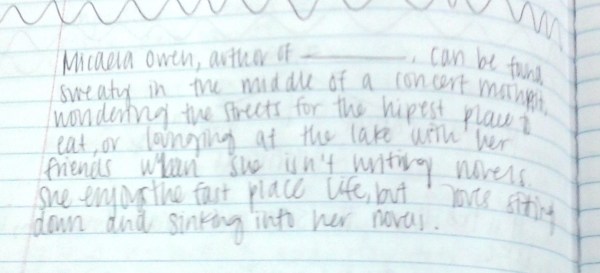
So last week for our writer’s notebook time, we wrote author bios, short, little, quippy, quirky writing that states who we are and why we write. (We still need work on the why we write part.)
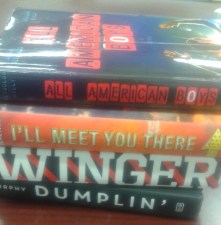
booksforauthorbiosI prepared first by reading the inside back covers of some of my hardback YA literature. I chose four bios with similar elements:  Andrew Smith, Winger; Julie Murphy, Dumplin‘; Heather Demetrios, I’ll Meet You There; and Jason Reynolds, All American Boys. {Bonus: four book talks, along with the author intros. Boom.]

I explained the task:  We’re going to read four short author bios and then write our own. Listen to each one carefully, so we can pull out the similarities within each one.

We charted the elements of the bios on the board and then drafted our own.
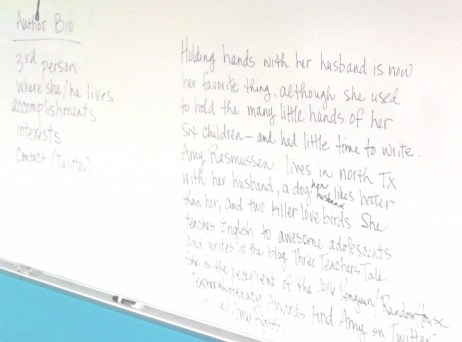
authorbio

We spent five minutes on the writing, two minutes on revision, and six minutes sharing with our peers. We laughed. We wondered if the authors wrote their own book cover bios. We discussed our writing process.

“It would have been easier writing about someone else,” one student said.

“I need more time to think of how to say things,” said another.

“This would be fun to do at the beginning of the year,”

“I don’t do anything!”

“I’ve never won anything!”

“I cannot write that I am interesting when I am not interesting.”

“Can we write about what we want to do in the future instead?”

Oh, yeah, we stirred the pot, and ideas bubbled out. Throughout their questioning, my response remained:  Be creative.

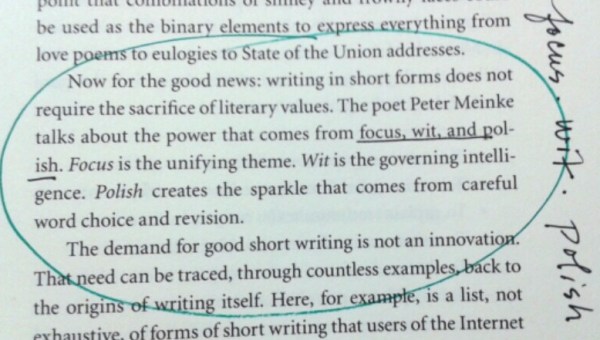
One of the best books I’ve read on writing is How to Write Short: Word Craft for Fast Times by Roy Peter Clark. I marked it up with lesson ideas:  “the whole chapter would make a great lead in rhetorical analysis” and “on annotating: read before starting 1st book club” and “use b/f narrative –teaches analysis with song lyrics” and “parallel structure & compound sentences!”

This paragraph from the introduction is a great reminder for all types of writing — and writing instruction:
How to Write Short

Focus, wit, and polish. My students and I talked about our identities as writers. We talked about the time it takes to develop our voice, our craft, our meaning.

As they read their author bios to one another, the cough of community clamored just a bit, and in a few minutes the whole classroom caught it.
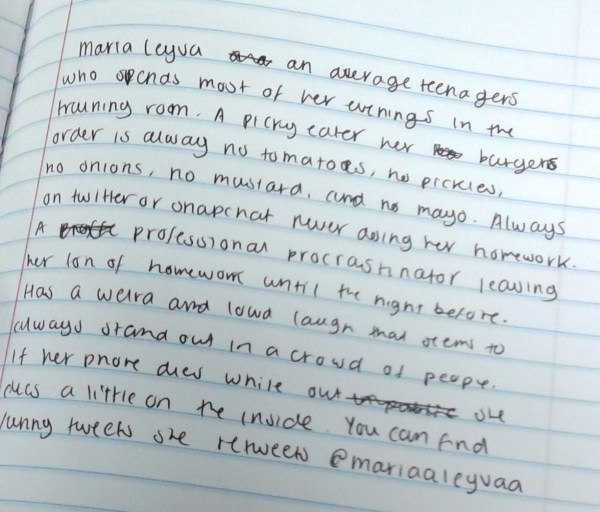
MariaLauthorbio

MariaCSkyauthorbioMicaelaauthorbioTreyauthorbioI reminded students as they write over the next few days — finishing their multi-genre projects, their last major grade — to write with intention, to write in a way that shows the answer to the last question I’ll write on the board this year:  How have you grown as a reader and a writer?

In the fall, I will do this exercise again. We will write our author bios at the beginning of the year, on day one, maybe. We will spent a good deal more time on them, and we’ll return to them again and again as we practice the moves all writers make to produce effective, convincing, creative writing. We will publish our writing with our bios. Hopefully, this will help us keep our sights on Focus, Wit, and Polish in all aspects of our writing.

How might you use this author bio writing activity? What tasks do your writers do that help them take on the identities of writers? Please leave your ideas in the comments.

Amy Rasmussen lives in north Texas and teaches AP English Language and English 3 at Lewisville High School. She loves talking books, daughters’ weddings (two this year), and grandbabies. Facilitating PD for other teachers making the move into a workshop pedagogy delights her. Amy adheres to the words of Emerson: “We aim above the mark to hit the mark,” and Jesus: “Love one another.” Imagine a world if we all aim higher. Follow Amy on Twitter @amyrass.

Varying Paragraph and Sentence Length for Effect

The formula is simple.


Pair a simple, declarative sentence in its own paragraph with a longer, more detailed paragraph to follow.  The two paragraphs set against each other will balance the other’s flavors out nicely.


Practice it mercilessly in workshop and use sparingly in finished work.


As you can see from this blog post, an entire essay or article that’s filled with long-short paragraph variations is going to tire, frustrate, and bore readers easily.   It will also become predictable, just like predicting that LeBron James is going to score 20 points in a game.  The good news, however, is that once you introduce the trick, you can invite readers to look for it across their reading.


Mentor texts used: An article about Alec Baldwin’s Donald Trump impersonation from The New York Times and a chapter from The Nix by Nathan Hill (hardcover pgs. 482-492) Note:  read over these mentor texts before using to see if they are appropriate for your students.  

Teaching this technique – version A:


  1. Invite students to freewrite off of each of these starting sentences from these mentors: “It takes seven minutes” or “Today was the day he would quit Elfscape.”
  2. Have students share their work.
  3. Reveal first two paragraphs of the Times article and page 482 from The Nix.  (Note: the vocabulary on this page of The Nix is tough, so I would suggest using it as an example of the technique only.)  
  4. Identify ideal locations for this technique (leads, beginnings of chapters and sections.)
  5. Practice this technique in a freewrite or on a piece in progress.


Teaching this technique – version B:


  1. Have students read the New York Times article and flash-skim the chapter from The Nix.  Unless you want students to read a sentence that extends for ten pages…
  2. Ask students about how and why these two authors decided to begin paragraph 1 simply and laden paragraph 2 with all the details.  Why might an author decide to describe a character’s decision to stop playing an online role playing game with zero periods?  Why might the Times author give us excruciating detail about Alec Baldwin’s Trump makeup?  To what extent are these “characters” portrayed similar?  Or are the purposes here different?
  3. Invite students to “hack” their own writing or another expository piece (e.g. a history or science textbook) to mimic the long-short style.  Is this an improvement?  Is the writing worse?  Why or why not?


Amy Estersohn teaches middle school English in New York.  She has never played an online role playing game and only pretends to know how to play paper and dice role playing games, so reading The Nix wasn’t easy.  Follow her on Twitter at @HMX_MsE.

3 Ways to Offer Choice and Challenge in Reading

Yesterday I got the opportunity to write for our state NCTE affiliate, the West Virginia Council of Teachers of English!  Their best practices blog is full of great stuff–definitely check it out, and follow @WVCTE on Twitter for more ideas and resources.

Here’s my offering for their blog–and I’d love to know how you offer your students choice and challenge in their independent reading.  Please share in the comments!


I can be a bit of a lazy reader.

I get impatient while reading, waiting for the plot to pick up, and abandon books with gusto.  I leap from mystery to mystery, romance novel to short fiction, and toss in the stray nonfiction book when I’m feeling curious.

When I first began making choice reading a priority in my classroom, many of my students were lazy readers, too.  They gobbled up YA fiction in droves, but balked when I booktalked a classic, or an award-winning piece of fiction, or any nonfiction.  Some of them refused to move beyond their genre of choice for a whole year.

I knew, when I committed to choice reading, that it went far beyond just YA.  I knew that all kids were capable of reading sophisticated texts, making complex choices about when and how and what to read, and that all readers have a hunger for a challenging, engaging read.  But I wasn’t seeing my students living out those expectations, so I built in some structures to help them get there.

Reading Challenges — I began scaffolding students up to more difficult reading choices with reading challenges.  I read about these in Book Love by Penny Kittle, but wanted to put my own spin on them as far as making very specific challenges went.  So, the first reading challenge involved picking a book outside your comfort zone (which required a fun day of work identifying our own reading zones); the second challenge involved reading a nonfiction book, the third involved reading an award winner, and so on.

By working as a whole class to try new books out simultaneously–me reading along with my students–everyone felt comfortable getting uncomfortable.  We were all struggling along together, trying to decipher the vocabulary in a new book, or the structure of a new genre, or the style of a new kind of writer.  I built in mini-lessons on these things, but I think it was most helpful that we talked about these issues in the light of being real readers–not “struggling” readers.

Authentic Writing about Reading — When I first joined GoodReads many years ago, I realized how much my reading life was improved by just quickly taking the time to rate what I’d thought of a book.  Before that, I’d start and finish books and never really think about them again.  Soon, I began writing short book reviews, and then long ones, first just for myself, and then for the benefit of other readers.  I began reading more book reviews to get a sense of what I might talk about other than writing and characters.

I wanted my students doing something similar, so we began studying book reviews–popular, funny ones on Goodreads and Tumblr; professional ones in the New York Times and the New Yorker; even famed reviewers like Roger Ebert, whose writing moves about film we applied to books.  Students began tweeting at authors, writing reviews informally in their notebooks and formally for our school paper and giving their own booktalks to one another.

Nurturing a Real Reading Life —  No longer were kids feeling confined to books I handed them.  They began to choose books more independently, armed with information about their tastes, their peers’, and what was popular in general.  I began to see more students reading books that didn’t come from my classroom library, more students talking to one another about books, and a bigger variety of books being read in general.

In my own reading life, I modeled these challenges.  I read The Great Gatsby, Walden, and a few other classics for the first time in years, and truly appreciated them more during these second reads.  I wrote book reviews on Goodreads, the Nerdy Book Club, and Three Teachers Talk.  I tracked my reading in my notebook, on GoodReads, and on Twitter, setting goals and trying to take a moment to jot down, in quick review form, WHY I liked or didn’t like a book.

These practices not only helped me become a better reader; thePicturey helped my students grow as readers, too.  Anna’s favorite book of all time became the award-winning A Constellation of Vital Phenomena, while Connor was blown away by Ta-Nehisi Coates’ Between the World and Me.  These books and more were chosen, read, and evaluated independently, without the confines of assignments or the too-broad sea of “your choice” to hold them back.

Shana Karnes teaches sophomore, junior, and senior preservice teachers at West Virginia University.  She finds joy in all things learning, love, and literature as she teaches, mothers, and sings her way through life.  Follow Shana on Twitter at @litreader.

Where Dioramas Go to Die

I picked up my first pedagogy book of the year this week and I can’t put it down. Disrupting Thinking by Kylene Beers and Robert Probst is living up to its name. It’s 1950’s Louise Rosenblatt Reader Response Theory meets a desperate modern need to educate kids to be responsible consumers of information in order to compassionately embrace the viewpoints of others.

The first few chapters have felt like the perfect “Now what?” for someone that has recently made the move to workshop.

My kids are choosing what they read. Now what? 

I’m devoting class time for students to build this habit. Now what? 

My students are reading more and more. Now what? 

The “now what” is to really think about the how and why we read. The text details insights on building responsive, responsible, and compassionate readers who will interact with a text, rather than just extract from it, question the text, and open themselves up to the text in order to see other points of view.

Cue the angelic choir and parting clouds. I’m ready.

But, I am also guilty of not always facilitating this type of reader response. Not on purpose, of course, but just out of difficulty in dealing with the daily grind.

We read. We talk. We mini lesson. We write. We rearrange the order. We repeat.

However, somewhere in there, we also lose a lot of readers. The once enthusiastic elementary kids, with their literal cartwheels about books, often come to us as vacant vessels of readicide. How does this happen? Beers and Probst suggest that “we have made reading a painful exercise for kids. High-stakes tests, Lexile levels, searches for evidence, dialogic notes, and sticky notes galore – we have demanded of readers many things we would never do ourselves while reading. We have sticky-noted reading to death” (46).

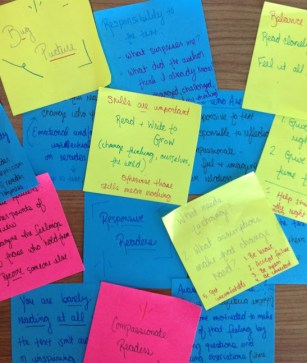
Now, ironically, I’ve written quite a few sticky notes around the insights in this book…postitI like to organize my thoughts this way. And, in no way am I suggesting that pulling ideas from a text is malpractice. At the end of the day, of course we need students to think deeply about their reading and demonstrate that thought through talk, written reflection, and/or analysis of some kind.

But what is appropriate? What is too much? What kills a desire to read as opposed to igniting it?

In search of some renewed inspiration, Disrupting Thinking had me laughing out loud as it got me thinking about why and how I interact with texts:

Seriously, as you finished the book you most recently enjoyed, did you pause, hold the book gently in your hands and say to yourself, ‘This time, this time, I think I’ll make a diorama’?…Do you write summaries of what you read, make new book jackets, rewrite the ending, take tests over every text? Any text? Do you want your reading level put on a bulletin board for all to see. Do you even know your damn reading level? (Beers & Probst 46)

So, how do we balance professional responsibility, a love of content, a desire to build up students as readers and writers, and the knowledge that a lot of what we’ve done (or still do) in our classrooms actually exhausts, irritates, and/or alienates our students from reading?

Unfortunately, I don’t have all the answers. This is a reflective process in action.

What I do know, is that Disrupting Thinking has me…thinking about it. A lot. It also has me vowing to put a few things into practice and promote a few others in my classroom:

  1. Promote Responsive Readers through more and more opportunities to talk about choice books. I’m guilty of still trying to “make sure kids are reading,” when in fact, most often, they are cutting corners in that reading if we are trying to “catch” them. Book clubs, conferring, and talk through reflective notebook writing promote low stakes opportunities to share insights on texts.  With mentor texts to support skill instruction, the thinking can be applied to choice reading, but doesn’t necessarily mean that I should be looking to choice reading as a summative data point.
  2. Promote Responsible Readers by working to find a balance between supporting/celebrating reading and “holding students accountable.” This is an imperfect science to be sure. I find that the more I talk with students one on one, the more they have to say, and the more I can directly intervene to move them forward to more challenging books, deepen their understanding of why I want them to keep reading in the first place, and celebrate their successes as independent readers. Save the evaluation for skills based cold reads when the curriculum demands the assessment we as teachers need, while keeping in mind that many students don’t see those assessments as their responsibility to reading, and I would argue, nor should they.
  3. Promote Compassionate Readers, again, through talk. When I read something that is changing my perspective on the world, myself, or life in general, I want to share that with someone. I want to share that with many someones. I also know, that to grow in my reading life, I need to read a wide variety of books…books that challenge my long held beliefs and understandings (or misunderstandings) of the world. Again, this is where helping students to diversify their reading lives is so very important.
  4. Talk, Talk, Talk! I’ve been asking my students two questions this week to drive their book club discussions: How is this changing me? How is this changing my view of the world? These two questions invite personal connection and reflection. I can’t wait to hear my AP students’ book club discussions!

Lisa Dennis teaches English and leads a department of incredible English educators at Franklin High School near Milwaukee. Her thinking has been disrupted and she’s loving it. Follow Lisa on Twitter @LDennibaum 

ruBRICKS Part II – A Follow-Up Guest Post by Julie Swinehart

Blogging, writing, talking, being part of the conversation about what it means to be an educator in 2017, it’s all easier to do than to actually live it and breathe it and teach it. We can talk about theory, we can read our guiding texts, we can attend professional development conferences around the world, participate in twitter chats, and we can all talk the talk.

Walking the talk is the hardest part.

Theory doesn’t always meet practice. But we try. I try.

I recently wrote about the idea of rubrics – that they should serve more as a foundation than a weight or a wall pinning students in. That they should allow for creativity rather than limiting imagination.

One way that I have tried to allow for student voice and creativity is with the most important thing I can help my students learn.

The topic is the habits of a healthy reading life.

If my students learn to read literary nonfiction, classic novels, and short stories, it will be fantastic. But it’s fantastic only if they actually choose to read these texts on their own. Most importantly, they need to have a habit of reading, to discover the reader within themselves.

This winter I realized that I wasn’t sure that my students knew what the endgame was. So we talked about it. We talked about what it looks like to have a healthy reading life, and we brainstormed the attributes of a healthy reading life.

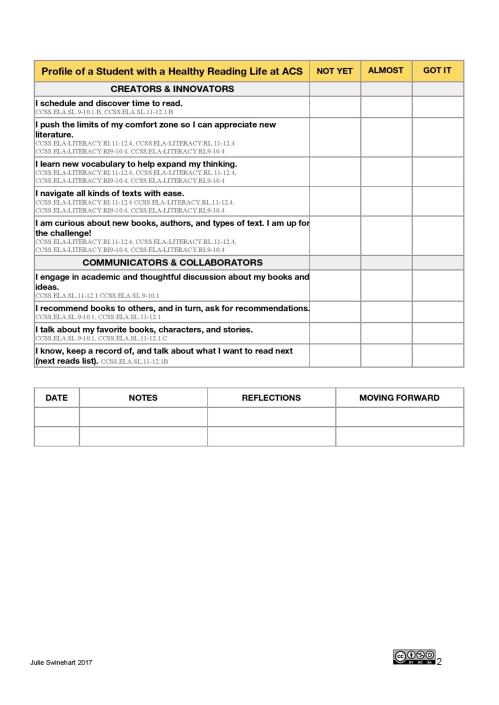
I did my best to organize their ideas into categories and indicators that made sense. I used our school’s student profile to help with the organization. The six categories are Respect and Integrity, Global Awareness, Reflective Thinking, Critical Thinking, Creators and Innovators, and Communicators and Collaborators.

From that, I created a rubric.

I think the process for this rubric can be re-created with other standards and goals, and can be simplified to a simple yes/no checklist, or a one point rubric for student self-reflection.

healthyreadinglifeprofile-page-001

healthyreadinglifeprofile-page-002

I know, I know… There are still problems with the document. But I think the point is that the ideas in it originally were theirs. The ideas belonged to the grade nine students.

While it’s an intimidating double-sided checklist in its entirety, it is easy to split into the six sections, which means we can examine just one section of a student’s reading life at a time. At that point it becomes smaller and quite manageable, and it’s not a brick wall of text.

I can print just one section at a time, and use it as an exit ticket or as a prompt for a reflective quick write. It doesn’t weigh students down when they simply examine only two or three indicators about their habits of reading.

The document still needs to be refined, and maybe all of the Common Core standards I’ve attached to the indicators aren’t exactly right; it’s still a draft, a work in progress. But this rubric, one that could be revised to a simple yes/no checklist, has been the catalyst for some seriously authentic and relevant conferences with my students.

Because I used their criteria and ideas, it’s not a brick wall, and it doesn’t confine my students between narrow rails. Instead, it’s a conversation starter, a tool for goal-setting while conferring, and it’s something that shows my students what to strive for.

It shows them what this readers workshop is all about: healthy reading lives.

I think the takeaway here is that teaching is always a work in progress, as is learning. Setting goals is important for students and for teachers. Creating authentic scoring guides continues to be one of my goals. This year I created one about the topic that I think is the most important of all – the healthy habits of reading. Next year we will tackle the habits of being a writer.

I will keep talking the talk – that means I am learning and reflecting on my practice. I will also keep trying to walk the talk, which I think has to include student input, because student voice is so essential to readers workshop, and is of course essential to building the habits of healthy reading lives of students.

We can’t weigh them down with our “help” – our rubrics and scoring guides should serve as foundations for growth, which is what I think this one does.
Nothing’s perfect, and we teachers have to be okay with that. We will continue to read, learn, discuss, and to walk the talk. Walking it and living it is a work in progress, and our students are better because we keep trying.


Julie has been teaching secondary language arts for eighteen years, spending the first fifteen in rural Central Oregon, and the last three in Amman, Jordan. A recent convert to the workshop model, she likes to blog about and share her learning and experience with others.

Follow her on twitter @SwinehartJulie

Follow her blog https://adventuresinhighschoolworkshop.wordpress.com/


iconCare to join the conversation? We’d love to add your voice! Please email guest post ideas to Lisadennibaum@gmail.com.

Helping Students Revise With Ghost Grades

Sometimes our biggest challenges aren’t teaching concepts or content, but teaching kids to rethink what’s common sense to them.


For example: when students hit “submit” and send their written work off into cyberspace to be graded by me, it gets crossed off their things-to-do list.  They stop caring about the assignment, move on to worrying about their weekend plans and sports games, and wait (not-so) patiently for a grade with some feedback on what to do next time.

How-do-we-help-students

Lisa and Amy have commented before  on the importance of feedback over grades.  Give the students feedback that they can act upon rather than a grade that’s fixed and gone.  My own struggle here has always been incentivizing students to act upon feedback and remind them that … yes … if you are able to improve your piece, you’ll receive a higher grade.


Enter…. my ghost grade policy.


Once every major writing project, students are able to submit work by an early deadline to receive additional feedback and what I call a “ghost” grade.  A ghost grade is a rough draft grade the way a rough draft of writing is a rough draft of writing.  It’s a guaranteed minimum final grade, and the only direction it can go is up.


My students enjoy seeing their ghost grades for three reasons, and they wrote to me about how much they enjoyed getting ghost grades.  First, it’s validation of the work they have already completed.  Second, it gives them a preview of that anxiety-inducing moment when they see their final grades.  Third, it puts the ball back in their courts.  Want to see a higher final grade?  It’s time to get back to work in writing and revising.


On my end, I struggle with grading and feedback to all students twice on a single project.  If I commit to ghost grades, I am also committing to reading and reviewing work quickly — as in, submit your work by Friday, feedback by Monday.  I have experimented with modifying ghost grades — for example, if you want a ghost grade, you must also come and see me during the extra help schedule block.  


Ghost grades, like student work, are a work in progress and subject to revision.


How do you help students see the value of the revision process?  Do you have suggestions for how I can revise my ghost grades to work well for me and for my students?


Amy Estersohn is a middle school English teacher in New York and a 2016 recipient of the NCTE Gallo Grant.  Follow her on twitter at @HMX_MsE.

6 Takeaways from Student Self-Assessments

51W731EdIWL._SY344_BO1,204,203,200_After completing self-assessments in Tom Romano‘s classes in college, and finding them invaluable, I’ve always made them a large part of my teaching arsenal.  At the end of every year, we spend a few days on SAs, or they’re part of the final exam, or they’re what we share as a last-day-of-class celebration.

This semester, my students wrote three self-assessments, with the last one counting as the final exam.  In this particular SA, I asked students to do five things:

  • Evaluate our course materials and routines
  • Discuss your growth as a teacher, thinker, writer, reader
  • Write your teaching credo
  • Give me some advice about what to keep/change next year
  • Make a list of strategies, frames of mind, and ideas you’ll use in teaching

As finals week drew to a close and I was crushed by grading, I looked forward to reading these self-assessments.  Students didn’t hold back on the advice or evaluation portions, used their signature writing voices with abandon as they discussed their growth and beliefs, and made me fill my notebook with pages of ideas and strategies as I read their lists.

In addition to just being fun to read, I also learned a great deal from their honest words.  While I took a whole book full of ideas away from these amazing and inspiring future teachers, I’ll spare you and just share six lessons I learned from reading their self-assessments for this semester.

What we read matters.

Without exception, every student extolled the virtues of our central text, Paul Gorski’s Reaching and Teaching Students in Poverty: Strategies for Erasing the Opportunity Gap.  I highly recommend this excellent text as reading for any teacher, especially Gorski’s vehement statement that all students, no matter their background, need appropriate challenges when learning.

Screen Shot 2017-05-12 at 7.30.12 AM

Lily cements my belief that a strong central text really helped anchor our course.

By studying a text I was so passionate about, my students could feel my enthusiasm, and I believe it was contagious.  A strong central text anchored our lively class discussions and students’ weekly one-pagers.

Trust your pedagogical instincts.

Our students are champions when it comes to complaining–their stamina is literally unending.  “But I don’t want to write this.”  “ANOTHER paper?!”  “MORE writing?”  “Why are we doing this again?”

All of these gripes can really wear a teacher down.  But, teachers usually know what is best for our students–we know that a high volume of writing will help our students become better writers.  We know that writing about our reading will help our students become better readers.  We know that constant practice with critical thinking will help our students become more literate and conscientious citizens (and teachers, in my case).

Screen Shot 2017-05-12 at 7.07.47 AM

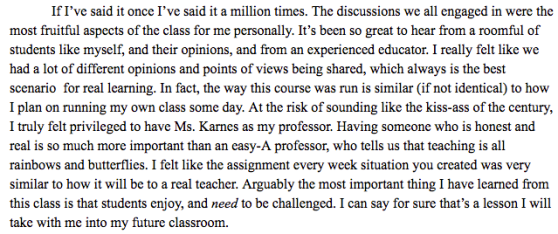
Aaron grudgingly admits that despite the onslaught of papers and projects, he grew in his thinking and learning.

So, despite the eye-rolls or sighs, I kept at it with what my gut was telling me.  I knew that, no matter how much of all of our time it took, students needed to do a lot of reading, writing, and talking about their thinking, with a lot of feedback from their peers and from me, all while remaining appropriately challenged and engaged in learning.  I kept at it and resisted the frequent temptation to revise my syllabus, and students appreciated it–and grew.

Frequent, low-stakes writing often provides the most space for growth.

While the big assignments of the semester may be what most teachers consider the bread and butter of teaching writing, I believe the opposite.  Those long essays or projects, in my experience, are more likely to stress out all parties involved.  For me, the short stuff is where the growth happens, and exponential growth is what leads to student success in writing long and complex pieces.

Screen Shot 2017-05-12 at 7.09.01 AM

Anetta extols the value of informal weekly writings.

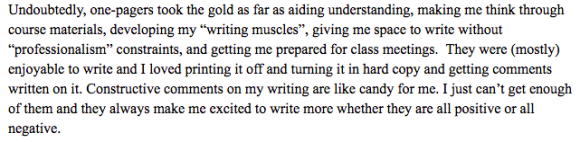
My students wrote six major papers this semester–none of which were shorter than six pages, and some that were up to twenty–but where they really displayed the biggest leaps in learning were in their one-pagers, submitted weekly.  Every single student except for one told me that I should keep one-pagers and that, despite how much they sucked/were annoying/ruined their Sunday nights, they were the most valuable part of the class for their growth.

All students crave challenge.

As Gorski reinforced for my students this semester, all learners crave a challenge.  Nobody wants to be bored, and by engaging students in complex tasks of reading and writing, nobody in my classes will be.  With small- and large-scale assignments scattered throughout the course, frequent opportunities for revision, and detailed feedback, all students felt that they could succeed, and had ample opportunities to practice and prove that they could.

Screen Shot 2017-05-12 at 7.05.54 AM

Ryan vows to replicate the challenge of high expectations in his own classroom.

Feedback is invaluable.

It is a lot of work.  A LOT.  I know.  But every student valued, appreciated, and grew because of thorough feedback protocols on any formal paper.

Screen Shot 2017-05-12 at 7.11.12 AM

Erin was appreciative of the attention her writing received.

Students did a lot of writing I never graded–in notebooks, in drafts, in groups.  But what they turned in, I spent a great deal of time commenting on, and while it was definitely arduous, I know I’ll keep it a condition of my classes in the future…fueled by lots of coffee.

Creating conditions for safe student growth is paramount.

Kevin became something of a celebrity in our class with his frequent questions, hilarious asides, and opinionated comments.  He never held back, and because he was welcomed into dialogue with open arms by myself and other students, he really flourished as a learner for one of the first times in his academic career.

Screen Shot 2017-05-12 at 7.05.03 AM

Kevin, with his signature writing voice, reminds me that a safe learning environment is the most important thing we can give students.

By creating a community of trust and engagement and low-stakes learning, Kevin felt safe to take risks and grow.  It’s what I want all students to be able to achieve, and is one of the most powerful reminders about teaching and learning I can think of.

What have your students taught you about your teaching?  Will you utilize self-assessments this year?  Please share in the comments!

Shana Karnes lives in West Virginia and teaches sophomore, junior, and senior preservice teachers at West Virginia University.  She finds joy in all things learning, love, and literature as she teaches, mothers, and sings her way through life.  Follow Shana on Twitter at @litreader.

5 New Ideas from a Stack of Books

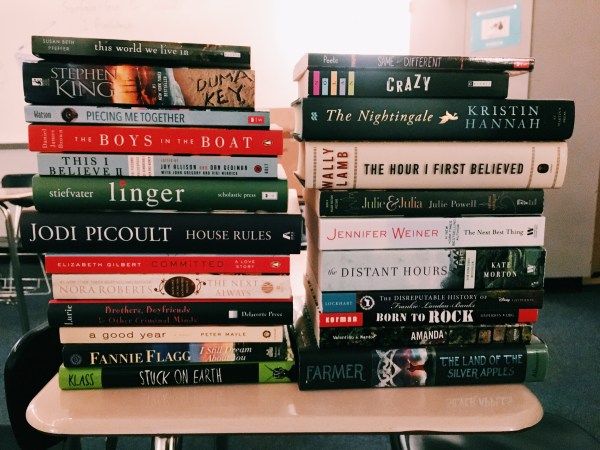
Books 1I keep telling myself I won’t buy any more books.  Every time I resolve that enough is enough, and I can wait for grant money, it seems like another sale pops up.

Enter Scholastic Warehouse Sale.

I fell victim to the Arlington Warehouse Sale yesterday after school.  By victim, I mean I wheeling through the aisles at breakneck speed with a giant smile on my face.  I left with a stack of about 27 books for $61, and a slew of fresh lesson ideas.

5 New Ideas from a Stack of Books

  1. This I Believe Essays:  I have seen so many teachers use This I Believe from NPR as a jumping-off point for writing and larger projects.  I snagged a book full of these essays for mentor texts.  How great for seniors to think about how their beliefs have changed throughout high school?  I would love to do more of this next year.
  2. For the Love of…: This basketball picture book is going to make for a great mentor text for expanding upon a list.  This would also make a great starter mentor text for writing about favorites for ESL students. Books 2
  3. Same/Different/Crazy: I got this from the top two titles on my stack.  Quickwrite prompt–What has been the same this year in high school?  What has been different?  What has been CRAZY?
  4. Pieces of Me: From the title, Piecing Me Together, we might do a visual representation of the pieces of each student.  Part self-portrait, part personal reflection.
  5. Linger: What do you hope will disappear when you leave this building, and what do you hope will linger?  What is the legacy that you have left on this place?

These are only the ideas I’ve gleaned from the titles of these books.  I can’t wait until I actually crack the covers!

Does a new stack of books reignite your creativity?  What does your stack look like?  We would love to see some pictures in the comments or shared on FB!


Jessica Paxson is an English IV and Creative Writing teacher in Arlington, TX.  She usually takes on major life events all at once rather than bit by bit, such as starting graduate school, buying a house, going to Europe, and preparing for two new classes next year.  If you enjoy watching her make a fool of herself by being unbearably vulnerable, you can catch more of that over at www.jessicajordana.com. Follow her on Twitter or Instagram @jessjordana.

Have you asked students what they need? It is not too late

I am great at taking notes. I am lousy at looking back at them (a lot like my students).

But my student teacher is done with his semester, and am back reading and writing with my students each day. We’ve done a little AP exam crunch — our exam is today — and we are all ready for that test to be over. I’ve got 14.5 days before the summer bell rings, and my students leave me. Fifteen days to solidify my students’ identities as readers and writers, not just students reading and writing for an English class.

It’s been a hard row with this group. This group, especially my brightest students who let grades motivate their every move. There’s a disconnect the size of the Mississippi when it comes to showing evidence of learning and whining about grades.

Maybe I notice it more because I haven’t been with them every class period for the past six weeks. But something’s got to give.

So I opened up my notebooks and read notes from the class Penny Kittle taught at the University of New Hampshire Literacy Institute in 2014. Don Murray leaped from the page:

“If you understand your own process, you stop fighting against it.”

“We have to respect the student, not for his product, but for the search for truth in which he is engaged.”

“If you don’t leave a conference wanting to write more, there’s a problem with the feedback.”

“We work with language in action. We share with our students the continual excitement of choosing one word instead of another, in choosing a true word.”

“Mule-like stubbornness is essential for every writer.”

“One teacher in one year can change a child’s view on reading.”

All reminders of what I love about teaching writers and what I hope for all my students. And I’ve got 14.5 days before the summer bell rings, and my students leave me.

Recently, I read a great post by Tricia Ebaria titled “One Important Thing I Can Learn from Students.” This part resonates:

Rather than join the chorus of end-of-the-year countdowns, instead of giving in to fatigue (or cynicism), what if we reframed our thinking and asked ourselves: What’s the one important thing I can still do with my students? After all, it’s never too late to do work that is meaningful and important to our students and to the world.

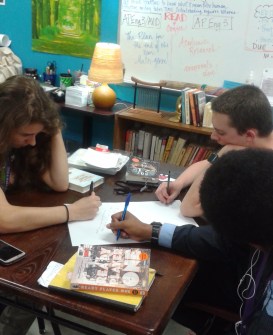
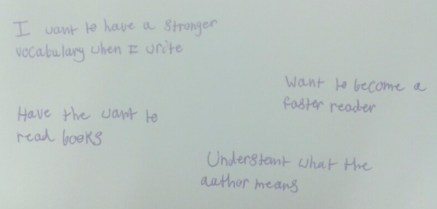
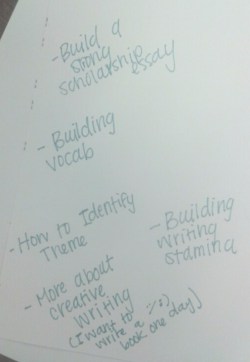
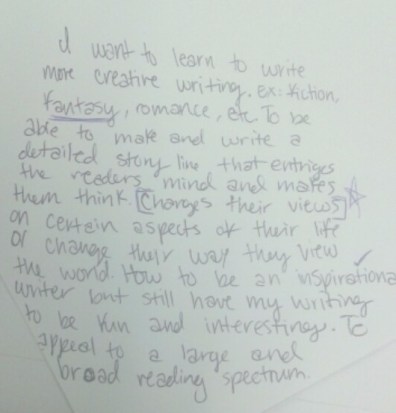
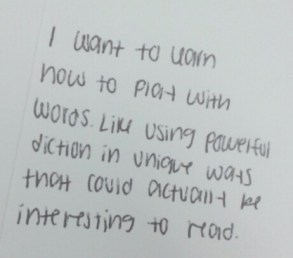
Or how about this question: What’s the one important thing I can still learn about my students? studentswriting

So today I asked two questions to help me focus on students’ needs, and to help students focus on our need to keep learning:

1. Have your grown as a reader and a writer this year? And we talked about if the answer is no then we’ve both failed.

2. What’s one thing you still want, or need, to learn regarding reading and writing before your senior year and beyond? And students wrote their responses at their tables.

Some responses gave me pause. Others made me crazy. Many gave me hope that we still have time so every student can answer question one with a resounding YES.

student want 5

“Because we’ve really done nothing in class this year” is my first thought, right? But I have to wonder: Why does this students still feel this way?

student want 6

student want 8

student want 3

I’m celebrating the word PLAY.

student want 1

student-want-2.jpg

student want 4

Hmmm. 

We have to be willing to be vulnerable. We have to be willing to ask our students what they need from us as their teachers. If we don’t, we may miss the point of teaching them all together.

I learned valuable things about my students and how they feel about their growth. This lesson is enlightening and humbling. And frightening.

I am almost out of time.

So we started in our writer’s notebooks. Updating our currently reading lists and talking about the books we’ve read, we’ve started, abandoned, and we’ve finished. We updated our challenge cards and checked our progress.

I book talked Goodbye Days by Jeff Zentner, my new favorite (I wrote about it here), and American Street by Ibi Zoboi, and let students know I had a fourth copy of The Hate U Give by Angie Thomas. All books I’d read when Joseph was teaching and was dying to share with kids. Students eagerly reached for them, even tussling over Zentner’s book. (TBH I shudder just a bit when I think about not getting these new books back with it being so close to the end of the year.)

Next, I showed them an idea for their end-of-year writing — a pretty monumental task for teens already dreaming of days out of the classroom. But I think I sold them on how it can answer my question #2.

Multi-genre. Thank you, Tom Romano, and Shana for showing me how a marvelous multi-genre project can light a fire within my writers and let them showcase their interest, their talents, and the learning they’ve acquired this year.

We looked at samples. We talked about topics and research and genres. We talked about how the topics we choose can potentially help us learn the things we still need and want to learn.

We got excited about writing. I think some even got excited about learning.

So with 14.5 days left in the school year, we committed to a pretty intensive end-of-year plan.

I have a mule-like stubbornness when it comes to teaching readers and writers. Certainly some of that will wear off on my students, and maybe someday they’ll look back on their notes and their writing from their junior year in high school and recognize they’ve learned and grown in their “search for truth” as a writer.

How are you utilizing your end-of-year time? Please share in the comments.

Amy Rasmussen lives in north Texas and teaches AP English Language and English 3 at Lewisville High School. She loves talking books, daughters’ weddings (two this year), and grandbabies. Facilitating PD for other teachers making the move into a workshop pedagogy delights her. Amy adheres to the words of Emerson: “We aim above the mark to hit the mark,” and Jesus: “Love one another.” Imagine a world if we all aim higher. Follow Amy on Twitter @amyrass.


When rubrics are unintentional ruBRICKS – Guest Post by Julie Swinehart

My fourteen-year-old son surprises me with some of the things that come out of his mouth. I won’t repeat them all here (you’re welcome), because sometimes I’m astounded in a way that makes me laugh, but doesn’t necessarily make me think.

But the other day, he did make me think.

We were at the kitchen table. I was reading my students’ online readers notebooks while he was working on homework. Responsibly, he checked the rubric that accompanied the assignment he was working on, but by doing so, he seemed to get more frustrated instead of finding clarity.

I looked over at him, eyebrows raised in silent question. His response was, “This rubric is more of a brick than a help!” and he went on to explain that it felt like he was weighed down by the rubric rather than feeling like it provided guidance.

I immediately understood his comparison. Rubrics as bricks, hobbling students,

brick

“This rubric is more of a brick than a help!”

confining them to strict definitions and requirements, weighing them down instead of allowing them to soar.

Rubrics as brick walls on paper, wordy, unclear, sometimes too demanding, confining creativity instead of providing a place from which to let creativity flow.

I then turned my thoughts to my own teaching and to my own students. Have I unintentionally weighed down my students with a brick of a rubric?

Have the rubrics I’ve attached to my class assignments served as brick walls, stifling creativity, rather than as foundations that my students could use as guides for demonstrating what they know and what they can do?

Have the rubrics I’ve provided my students allowed them to show that they can exceed and see things in a way that I, as the teacher, never imagined?

During this school year my thinking and teaching style has evolved dramatically. I’ve moved away from a more traditional method, in which my students read the same texts, responded to the same writing prompts, learned the same skills, and turned in the same assignments, all at the same time. I used rubrics for most of their assessments, and while my students demonstrated their learning, I inadvertently didn’t really allow for a ton of creativity.

This year, my students are reading different texts, sometimes have individualize due dates that they have chosen, and are turning in very different assignments from each other.

This year, I’ve also still used some rubrics, and I think there are some good ones out there. But in response to the advice of one my colleagues, I started the slow move to a more holistic approach to scoring guides.

I still include the standards and learning targets for students on the task sheet, and I describe what an exemplary, middle, and poor quality product will look like, include, or omit. But I find that the more holistic scoring guide approach allows for the student choice and creativity that is essential in the workshop model.

It’s not as prescriptive as a rubric can be, and instead of being a document made of bricks that build walls around and confine creativity, it serves more as foundation of sorts, something students can build from, and also demonstrate their learning through their own creative ideas.

A holistic scoring guide does not provide all of the answers that a rubric holds. There aren’t as many words on the paper, which means that students have to think about what they are going to do, rather than simply tick some boxes of requirements in order to get the grade.

I’m enjoying the holistic scoring guide approach, and my students are still doing well with the change. They demonstrate creativity, they show their learning, and they allow their personalities to shine through in their work.

Workshop is about student choice, and I think some rubrics unintentionally stifle the choice that we are so eager and willing to provide.

I’m going to be careful from now one, doing my best to ensure that the assignments I give allow for student agency, and doing my best to ensure that my students aren’t weighed down or walled in by unnecessary bricks.


Julie has been teaching secondary language arts for eighteen years, spending the first fifteen in rural Central Oregon, and the last three in Amman, Jordan. A recent convert to the workshop model, she likes to blog about and share her learning and experience with others.

Follow her on twitter @SwinehartJulie

Follow her blog https://adventuresinhighschoolworkshop.wordpress.com/


iconCare to join the conversation? We’d love to add your voice! Please email guest post ideas to Lisadennibaum@gmail.com.