Guest Post by @cJezasaurusRex — An Open Letter from a Book Thief

Dear Ms. Gerdes,

You were the first teacher who taught me how/ when to properly use “Ms.” You taught me the power of a Phenomenal Woman. You taught me to value my mother. Big Time. And you taught me that reading is magic.

Ironically, you were my math teacher.

I wish I could say that you “gave” me books. The fact of the matter is that — I actually stole them. Actually. Literally. (Non?)Legitimately. STOLE A BOOK FROM YOU. Maybe even more than one. Probably, Likely so.

And all I can do right now is to apologize. Also–what is your address? Do you prefer USPS, FedEx, UPS, Armed Guard?

Just, please forgive me.

If you remember me at all, then you know (at 36) I would eventually be safely breaking every conventional rule in regards to punctuation and grammar. I hope you knew me well enough to know there is purpose behind my rebellion.

This all started more than 25 years ago. You were a Pioneer for Choice Reading time. And I know that I talked through most of those minutes, but I swear to you that I WAS SOAKING IT IN. Conduct marks set aside, I watched as you made time to focus on your own book during MATH!? I was, assuredly, a total A-Hole about it. Again, Sooooooo Soorrryyyy About that. But— I need to tell you that you are the ONE who (unknowingly) gave me a gift that I hope I am worthy enough to pass on to hundreds of other fellow humans.

I teach English to High School Students, and I flipping swear that 15-year-olds are and will remain the ultimate worst EVER. I love them. Every day. Not every second of every day… but mostly just every day. I look at them and am reminded of when I got sent to ISS or locked in a book closet by my English Teacher, and so it’s just effing fine by me that I threw my Pre-Law Degree out the window (wish the student loan attached would disappear too).

Since I’m always broke, and I’m the baby sibling, my Big siSTAR gave me her OLD Kindle about 12 years ago. Before I reset the account, I had to read ALL THE BOOKS she left on the account. One was Readicide by Kelly Gallagher.

For roughly 12 years, I’ve (kinda) done what I’ve been told by The System while I operated another system behind that closed door. I’ve tossed the curriculum back to my students like a contagious, hot potato. What. Do. YOU. Love. To. Read. As teachers, we often forget that it was NEVER about us, and it NEVER will be about us. And it has been my mission since my first year of teaching to throw my neck out on the guillotine to fight for that freedom.

Ms. Gerdes, I hope you are proud of the part you played in creating this monster.

But I stole your book. Now that I have built a classroom library of close to one thousand books, I know how pissed I get when my curation starts to disappear. Year after year, the carefully selected and bargained-for dwindles as quickly as cotton candy in a humid, Houston Heater. Some moments, I look at my shelves and wonder why my students can’t just return that damn book!

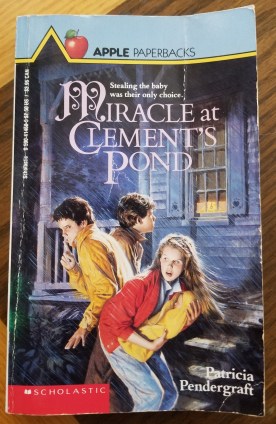
Today, while my Punky Brewster of a daughter was helping me pull all the donations we have for our town’s Little Free Library, she brought me Miracle at Clement’s Pond by Patricia Pendergraft. Your name written in permanent marker across the back.
miracle 1miracle-2.jpg

I’m. Melting. I am so sorry. I won’t even say that, “I can’t believe it.” I won’t even say that, “I’m so ashamed.” I can believe it. And I’m a little glad that I’m not ashamed.

You must have told me about the miracles found in books. Maybe, even this one in particular. Maybe I wasn’t ready, at 11 years old, to read what my teacher suggested–but I was ready to STEAL it so HARD! (I am sorry about that.) Mostly, at 36, I know what it feels like to bury my nose in words that make magic. The spell that is crafted by each stroke of the pen. To finish a novel and then hold it close to your heart with your eyes closed. Brimming with tears of empathy and connection. The feeling that next day of “Great Book Hangover” causing all other brain functions to fail.

This is the most life-altering lesson any teacher can leave behind.

I’m real sorry that I stole your book. (Plus, also I am sorry I was kind of a pain). The most sincere apology I can offer is that I am about to read this book, and I will NEVER forget Miracle at Clement’s Pond by Patricia Pendergraft–even if it sucks so hard. Plus, each time one of my books turns up missing, I promise to think of this apology. I promise to think of how pseudo- crappy kids can turn out to be alright humans. Or that ultra-rad kids can sometimes make terribly impulsive decisions. I promise. I promise. I promise. I stole something from you that is much bigger than a 242 page paperback from Scholastic.

I stole promise.

I hope you will forgive me. I hope you know that you truly changed my life. I hope to do the same for others.

Incredibly Sincerely Best of all Regards,

Crystal Jez

Crystal Jez has been teaching high school English in Texas for twelve years.  As curator of a chaotically color-coded classroom library, she is typically knee-deep in stacks of books.  When she isn’t reading or teaching, you can find her chasing chickens or saltwater kayak fishing.  Crystal is the wife of a super-hot guy and mom of three ultra-rad kids.

Formative Assessment Works!!!

For those of you who haven’t taught Seniors, trust me on this:  Formative assessment during the second semester is challenging.

If you’ve taught seniors, then you might understand where I’m coming from:  Sometimes it’s hard to tell if they aren’t grasping a concept, or they are just too tired of school to have the energy to engage.

I hurts my heart to even consider that my precious learners are worried about bigger issues than Comparative Literary Analysis essays or finding examples of bias in their self-selected texts.  Prom looms five days away and graduation seven weeks after that.  They work, they compete in extra curriculars, they deal with the adults and peers in their lives.  I forget, sometimes, that their plates are filled with important thoughts.  I remind myself I’m not doing their stress levels any favors by point out that we still have important work to do before June 2nd.

Last Monday we reviewed an excerpt from Niel Schusterman’s Thunderhead as a mentor text for practicing literary analysis through all the lenses that should be crystal clear to these literate learners.  I needed to assess their understanding and thinking so that I could make decisions about the instruction leading up to the summative assessment.  That’s the point of formative assessment; to “form” a plan for instruction.

I read the short selection with them, and asked them if they would, please, mark their thinking on this first lap through the text.  They should, as they’ve done many times before, underline or highlight what they noticed about the words the author chose through the lenses of diction, bias, author’s purpose…literally anything they noticed within the realm of literary analysis. It’s the last nine weeks of their public education career. They should be able to look at a text through a variety of lenses.

Some of them made some marks on the page while others wrote notes next to highlighted lines or words.  Others, though, marked nothing.  [Alarms wiggle and stir in my head. Something’s not right.]

I asked them to share within their groups what they noticed.  Muted whispers of ethos, tone, and metaphor struggled out of some groups, but again, most said very little.  Very few connections were being made. For them and for me, the picture was as clear as mud. This, by itself, is important formative assessment. This wasn’t working. [Def Con 55- Full tilt klaxons at maximum volume!]

Yet, I refuse to blame them.  I fully believe that it is solely on me, the teacher, to facilitate engagement with the text.  Somehow I need to do a better job inviting them to take all those useful tools out of their tool belts and dissect this very meaningful text.

New England Patriots at Washington Redskins 08/28/09

I bear a striking resemblance to Tom Brady.  Photo by Keith Allison

In football parlance, I needed to call an audible in the middle of the game. What I had hoped they would do; they won’t or can’t.  It’s time for me to jump in and scaffold this concept to a place where they can see the connections they can make and I can assess their thinking.  I’m not going to put them in a position to fail on the summative assessment if I know they aren’t ready for it.

In a whole class mode, I read over the text, mark what I notice and verbalize my analysis.

Now I ask them to talk about what they notice.  There it is…an increase in discussion, an inflation in dialogue. The alarm volume turns down a notch, but it doesn’t turn off.

I wrap the class period up with an invitation to write about what moves the author is making and as they do I confer with a few students who seem completely flabbergasted.  The bell tolls, signaling an end to their literary torture session.


Thus was the source of my salvation:

book

I only saunter.

Jumping into this book reminded me of a few important tenets of writing instruction that I let myself forget:

  1. Give them choice- I was allowing no choice in the subject of their analysis.  I know better than to restrict their reading and writing experiences and I let my, and their, end of the year exhaustion affect my decision making.
  2. Show them, not tell them, what you want to assess.  I wasn’t showing them examples of literary analysis and again, I know better.  I was expecting, wrongly, that Senior English students would confidently engage in literary analysis and move forward with their thinking in a way that shows me they can write a response in essay form.

After school, I tore up my lessons plans for the next four days and re-wrote them to reflect what I SHOULD do to support my students in this exploration.

On page 5 of their amazing new book Marchetti and O’Dell introduce a mentor text written by Joe Fassler from The Atlantic.  His recurring series “By Heart” is a collection of responses from a diverse group of thinkers and writers and is an amazing resource.  A simple Google search returned a link to this series of essays. I scanned the list of the titles and discovered an article from September titled, “What Writers Can Learn From Goodnight Moon.”   In it, Celeste Ng describes her feelings of the children’s book and how it “informs” her writing.

Perfecto!!!

This checked so many of the boxes of what I was looking for in a mentor text.  And…I get to read a children’s book to “big” kids.  I know enough about my students to know they will love this.

Also, I used Marchetti and O’Dell’s five part descriptions of literary analysis on pages 11 and 12 to create a glue-in anchor chart for their readers’/writers’ notebooks that helped to clarify what exactly we should look for when reading and writing literary analysis.

Confidence restored! Disaster averted… kind of.

We Ng’s reflection and discussed how this was a perfect example of literary analysis.  They asked questions, we laughed about Goodnight Moon.  I saw their confidence grow and I knew we were back on track and ready to move toward our essay.

Thursday, we started the drafts and I hope to see many of them tomorrow.

Being responsive and intentional is a crucial part of the workshop pedagogy.  I can’t stress enough how this one piece can make our break my teaching.  My lesson planning skills have finally reached the point where I plan for and anticipate opportunities to change up what we are doing to match what the students need. This was an opportunity for which I hadn’t planned, but we made the adjustment and made it work.

Sometimes, that’s how it goes.

Let me know in the comments below when you’ve had to make big changes on the fly to support your students’ learning. I know I can’t be the only one.

Charles Moore is neck deep in Children of Blood and Bone.  He’s spending the day taking his daughter to school and then having lunch with her.  It might be the best day of his life.  His summer TBR list is growing uncontrollably; feel free to add to it in the comments.

Carpe Disputationem

Before introducing metaphysical poetry to my AP Literature students, I often take a page out of the fictional Professor Keating’s book. My students and I take a little “field trip” to the front of the school, where photographs of students dating back to the first graduating class of 1901 line the foyer. I ask my students to write down their observations. When we return to class, I ask them to share. They often cite racial homogeny right off the bat. Our student population is incredibly diverse, and they cannot imagine an exclusively white school. A discussion about desegregation of schools inevitably follows, as does a conversation about the surprising number of females in the early graduating classes. We also talk about the devastation the World Wars had on the young men in those faded photographs. How many of them survived? They wonder: how did our graduating class grow from 6 to approximately 1100?

After what never fails to be a rich conversation, and the students’ realization that they have walked past those photos everyday without ever looking at them (a life lesson in itself), we watch the film clip from Dead Poets Society in which Keating, played by Robin Williams, engages his students in a similar activity. He explores the concept of “carpe diem” and mortality. Following this clip, I invite my students to write their response to carpe diem. They might write about what it means to them, whether they embrace this philosophy, or any other thoughts or feelings that the saying evokes.

CarpeDiemAfter a few minutes of writing, I ask for volunteers to share their thoughts. In a recent discussion, some students found the idea of carpe diem “frivolous” and thought that people should always stay focused on future goals. To them, “living for today” was short-sighted and irresponsible. This makes sense for teens who are driven to go to the right college and earn the right degree to live a “good” life. Other students said that since none of us are guaranteed a future and we’re “all going to die,” we should do something today: something of value, something productive. Such responses received a great deal of agreement, though students realized that “value” and “productive” are relative, subjective terms. One student wisely noted that we should remember that while we’re trying to live our best lives, others are as well. They discussed the complexities of when the lives of people with different goals intersect. Ultimately, my students saw how their seemingly disparate ideas actually overlapped a great deal, and they separated carpe diem from the trite YOLO idea that many of them initially equated as the same concept.

After a 20-30 minute discussion of carpe diem, my students not only understood the concept, but they also understood their relationship to the aphorism as well as its universal appeal. Onward to metaphysical poetry analysis!

I shared this teaching anecdote to underscore the importance of setting up and maintaining a safe workshop environment in which students expect to read, write, think, share, and work together to construct meaning. My students fearlessly followed me, willing to discuss observations even when issues such as race were broached. I could have presented them with the definition of “carpe diem” or asked them to draw on prior knowledge as a quick basis for launching into the unit of study, but by giving them the space and opportunity to explore the concept, they built a stronger foundation of understanding that will ultimately translate into better reading, writing, and thinking. We make choices everyday about when to lecture and when to facilitate; when possible, we must “seize” the opportunity to trust our students to delve deep beneath surface-level understandings and reach true depths of meaning.

A scaffold is a scaffold…

As a curriculum coordinator this time of the year gets blurry. I have begun to mold what our summer curriculum work will look like, so naturally I forget that it’s still the current school year and start thinking and feeling like we’ve already moved into next year. A question that I’m going to pose to our grade level curriculum writers is this: what are we going to do differently next year than we did this year? How are we going to continue moving down our path of becoming a workshop district? It’s hard. What do teachers need? Support? Resources? A scaffold? A scaffold!

When we teach our students complex or multi-step skills we break them down, right? Make it more digestible. Isn’t it the same when it comes to teachers implementing workshop in a classroom? Scaffolding workshop implementation expectations make implementation manageable and sustainable.

Maybe this is the time you flag this post and come back to it in May or June when your school year actually ends. Or, ask yourself what went well this year, and what you can do next year to make it even better for your students.

Best advice I received and try to share is this: be okay with organic or grass-roots growth. Just let it happen. Not everything needs to happen at once, or even in one semester, or in one year. I know that’s difficult to hear, especially for English teachers, but take a deep breath and repeat after me…it’s okay to go slow.

So, how do you add one more layer of workshop into your English classroom?

1.What “workshoppy” things do you already do? 

As a district team, we began with a list of “workshop” things. Teachers circled what they were already doing in their classroom and then chose ONE thing to commit to trying in the upcoming semester.

Our list included: Independent Reading, Independent Writing, Conferring, Mini-Lesson, Grammar Instruction, Vocabulary, Structure, Classroom Library, Balanced Literacy Model, Small Group Instruction, Notebooks, Share Time, Collaboration, Mentor Texts, Classroom Culture/Community, Goal Setting, Assessment

What I saw and heard is that our English teachers are already doing a lot. So when it comes to being a workshop teacher give yourself slack, give yourself grace, and give yourself credit. YOU are already doing great things for your students.

2. Where do you start?

I think you have to start by asking yourself what you believe and why you believe that. Shana wrote about some must reads for teachers considering workshop and for me personally this was a great place to start. I bought and read the books she shared. Amy shared a post: Citing the Research That Drives Your Practice. I read it and nodded, a lot. Then I dove in to what I thought my district could do.

⇒ Two key things: the first is independent reading

Our district was able to bring Amy Rasmussen and Lisa Dennis in for two days last summer (repeating this summer) where they shared and defined workshop with about 50 teachers. It was magical to say the least. My big takeaway was how important independent reading is within a workshop classroom. Because of that, we began asking teachers to incorporate 50 minutes of in class reading per week (break it up however you want/however it fits your classroom routine/structure).

I recently went to a PD led by Penny Kittle and Kelly Gallagher where they shared their new book 180 Days which reinforced the work we’ve been doing. No surprise, I immediately bought the book and cannot WAIT to finish it and talk to all the people about it. In the book they share a chart regarding independent reading which shows that if students add basically no outside reading to their routine, but add 10 minutes per day in class (or 50 minutes per school week) they are able to increase their word exposure by 556%! Is there an easier way to increase word exposure than this? <– that’s rhetorical, of course. 😉

⇒ The second key is conferring. 

Same training with Penny and Kelly; I’m immersed in taking notes when Kelly begins to talk about why they sit down beside kids to talk with them about their reading and writing. At this point, I was so engaged that I stopped taking notes mid-sentence and just soaked it all in. So, please no judgement on this sure to be mis-quote. Kelly said something to the effect of conferencing doing more and telling you more than anything else can: it’s 1:1 teaching, it’s a response to intervention, it building relationships, and above all it tells you what kids know and what they don’t know. Wow! No program or worksheet or multiple choice test can give you all of those things.

3.Where do you go next?

If you’re not a part of a campus or district where workshop is an expectation or recommendation, start with your campus and/or district vision. What does your campus/district want the student learning experience to look like, and how does workshop instruction fit into that description? Keep digging into the Three Teachers Talk blog posts. There are so many different perspectives from all over the United States (and outside, too!).

And now, I leave this last nugget from the 180 Days PD with Penny and Kelly…

responsive teaching

If we are responsive to student’s needs they will be engaged in the work that we’re asking them to do. Maybe that means you start by incorporating choice in independent reading, or bring in relevant articles when studying nonfiction versus pulling out the same ‘ole file folder with the same ‘ole speech you do every year, or maybe it meanssitting beside students to talk about what they think.

With the end of the year rapidly approaching now is the time to really reflect on how this year went and what can be done better or different next year. What “workshoppy” thing do you want to try?


What Teachers Really Need To Hear

I have been working on a post about how to teach students to write purposeful conclusions. I’ll still write that. But as I’ve spent the last few weeks working with teachers, creating plans for the weeks before testing, I realized there’s something else I need to say. 

Dear Teachers,

I see you.

I see you on the picket lines, demanding more for students, for yourselves, for our world. I see you in your classroom in the late afternoon light, fine-tuning tomorrow’s lesson. I see you on the last day of spring break, bringing your own son to school, working for hours in your classroom to get ready for the week. At your daughter’s soccer practice, grading papers between goals. At the beach, reading books your kids might like. At the library, scouring shelves for the just-right books about mullets for that one kid.

You. Are. Amazing.

I see you now, as testing season blooms, these weeks that have been looming finally here. I see you cheerleading and boosting and nudging. I see you creating review games, engaging kids and building their confidence. Behind that, though, I see the stress, the wonderings, the worry.

Will they try?

Are they ready?

Did I do enough?

The answers: Probably. Yes! Absolutely!

The truth is, we’ve done everything we can. We are at the doors of the big game, and what’s left is to cheer. And to remember that despite what it feels like, the test is a slice of a year full of wonder and growth and success. 

The tests feels huge — they are huge. But these tests are not the sum of you as a teacher. Just as you remind your students that they are more than a score, you are more than a growth measure or a value added or a designation on an evaluation. You are their teacher. 

I’m reminded too that after testing season passes, we still have several weeks of instruction left this school year. What a gift! We still have time to introduce students to new characters, to immerse them in new genres of writing, to push them to stretch.

Dear Teachers, I see you. You are beautiful and strong. Thank you.

This letter is inspired by the piece What Students Really Need to Hear by Chase Mielke (a great mentor text for students!). 

Angela Faulhaber works as a literacy coach in Cincinnati, OH, and teaches pre-service teachers at Miami University. She is in awe every day of the passion she sees in teachers and loves planning with and supporting them so they can do their best work.


Some Multi-Genre Magic

So, remember my lamentations 2 weeks ago about students turning in “drafts” less than 24 hours before the “final version” of their multi-genre writing was due? Well, I still think years of indoctrination of The Gradebook Mentality is doing immeasurable damage to students own perception of their learning and success. But dang, did they come through in the end.

To review, seniors in Advanced Writing produced a multi-genre paper focused on an author or a genre. And the genres they could choose to write in were seemingly endless. To generate these, we played a version of Scattergories in which groups competed to name the as many unique genres as possible.  (Apparently, competition is a real motivator. Who’da thought?) Some of the noteworthy were manifestos, glossaries, Scrabble game boards, breakup letters, suicide notes, and on. What might have been the favorite was Choose Your Own Adventure: Claire took readers through an existential journey through Camus, and Maya let readers find love (or not) in her study of David Levithan.

qualitiescoverOne mentor text we studied brought about some magical results: The Book of Qualities by Ruth Gendler (BIG props to my teaching partner Mariana Romano for this idea). In this book, Gendler takes a whole slew of abstract “qualities” and embodies them in a collection of beautiful prose poetry.
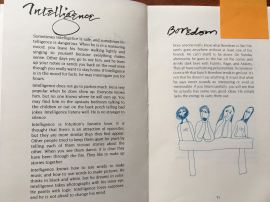
Many students followed Gendler’s lead by taking prominent “qualities” of the work they studied and embodying them in prose poetry.  To express a theme that emerged from his study of Salinger, Jed personified “Innocence:” qualitiesexample

Innocence is that old friend. You know the one. That friend you run into on the street … It’s been so long, right?! Maybe not quite long enough… But at this stage of your life, it just isn’t a good match … and somehow you manage to lose them more than youMorrisonAppendix already had. 

Myria, who studied parallel universes in fiction, personified the fear that permeates the work. fear_myria

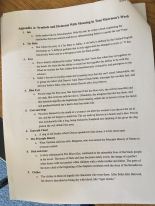
Elizabeth, one of the worst “late draft” offenders, included an appendix in her study of Morrison to aid her own readers in interpreting the complex symbolism in Morrison’s fiction.

Gray composed a recipe poem to explain the operation of the worlds built in Brandon Sandrecipe_grayerson’s fiction.

And Maya even went 3-D — her project on David Levithan’s love stories lives in a breakup bag! breakupbag.jpg

So, hope is restored. Which is SO useful as I follow my seniors into the final quarter of their high school experience — useful for me, anyway.


Baby Steps into Writing Workshop

For several years now, I’ve been hovering around Readers/Writers Workshop, certain that this is the path that is exactly what my students need. I started with Readers Workshop two years ago, and I’ve watched my students grow in their love of reading and stretch themselves. I’ve seen kids go from being professed (and almost proud) non-readers to stalking my bookshelves for new books or asking me to get my hands on specific books that they’ve heard about. (If you’re new to the idea of Readers Workshop, check out this post to learn more about why it’s so awesome!) We still have work to do in Readers Workshop in my classroom, but I feel comfortable about the direction in which we’re heading, and I’m confident that my kids are on the right track. I even use Readers Workshop strategies with my AP kids, thanks to encouragement from posts like this one from Amy. She’s the one who started me down this path.

pexels-photo-264635.jpeg

Writers Workshop is a different animal (for me) entirely. Perhaps it’s the fact that I feel like I should be reading everything that they write; maybe it’s that I’m still struggling with giving up some control–I’ve been at this teaching game for a while (since 1997) and sometimes it’s hard to teach old dogs new tricks. Writing has always been important to me, and it’s something that I’ve put emphasis on in my classroom. My kids have always known that they’ll be doing plenty of writing in my classroom; until this year, though, most of that writing has been in traditional academic essays: ACT-style essay prompts, persuasive essays, literary analysis, etc.

For several years now, I’ve abandoned traditional objective tests, opting instead to give my students essay exams. It means that my grading load is heavier, but I feel more confident that I’m getting a more clear idea of what my kids know and can do as opposed to the answers that they have memorized from the students from earlier class periods. I tell them that I’m not necessarily concerned that they remember the specific character names of the characters in Farewell to Arms or that Huck Finn met Buck in the middle of a Hatfield/McCoy style shoot-out. What I’m more interested in are the ideas and connections that they can make from what we’re reading in class to other pieces of literature and to what’s going on in their lives and in the world around them. I want them to see that the themes in Langston Hughes’ “Mother to Son” still resonates today, even though it was written 96 years ago, and that Carl Sandburg’s “I Am the People, I Am the Mob” could have been written by Emma Gonzalez last month after the Parkland shooting instead of in 1916, 102 years ago. That’s the beauty of literature–the themes are timeless and the human experience tends to be the same from generation to generation. So we’re doing real work, and I’m working to help them make connections so that they can see models for navigating these times that we find ourselves in. (Read more about connections like these here.) I’ve seen improvements throughout the years, and I’ve seen kids grow, but I haven’t seen the same kind of buy-in that I’ve seen in the growth in the reading culture in my classroom.

All of the literature is clear–just as readers thrive in a culture of choice, writers need choice as well. Kelly Gallagher says that, in order to improve, writers should write at least four times what teachers could possibly read–FOUR TIMES! Knowing that but also knowing that I’m barely keeping my head above water with my grading load is probably also part of the hesitation that I’ve had with Writers Workshop.

This year I’ve been determined to move past that hesitation that I have in order to better help my students. I’m so enamored by posts like Shana’s that show just how powerful Writers Workshop can be, so I am pushing past my awkwardness. I’ve modified how I grade essays, trying to cut down on some of the workload there. Rather than marking up student essays, I try to do more holistic grading and then encourage my students to come to me for writing conferences where I can give them more focused feedback. This pushes my students to look at their writing themselves rather than simply search for my comments and make changes based on those. I’ve also tried to build in some choice in writing topics, giving them 4 different options for argumentative prompts, for example, rather than one topic that they’ll all write in lock-step.

The biggest change with writing in my classroom lately, though, has been with the introduction of writing journals and writing prompts. I was lucky to go to a professional development session with Penny Kittle and Kelly Gallagher in February, and they talked about different ideas and strategies to get students writing. One of the things that they modeled was writing beside students and encouraging students to take a small period of time to “make it better.” Now we have a writing prompt at the beginning of class just about every day. I usually give them about 4 minutes to write, and then they’ll have 1 minute to make it better. Sometimes I specify how they should do that–sometimes I ask them to strengthen their verbs, other times I ask them to add details, while still other times I ask them to work with sentence structure, adding complexity and interest. After their “make it better” minute, we spend some time talking about what they’ve done and sometimes I ask for students to share their work.

pexels-photo-545053.jpeg

These are little moments in the scope of my classroom–we have 53 minute periods, so we spend 10 minutes reading (choice reading, of course), 4 minutes writing, and then 1 minute making it better, before we move on to the other 38 minutes of whatever we’re doing that day–but these have become some of the most powerful moments in my classroom. I’ve had students who are so excited to share or who have been proud of a particular turn of phrase or image. These moments of Writers Workshop in my classroom have begun to create a community of collaborators with students working together to encourage each other or to come up with the right tweak of a sentence. They’re excited about these short segments of class and they buzz with ideas for their writing. There have been requests (pleas, really) for more time to keep writing because students are pulling on a thread and they want to stay with it while the ideas are fresh.

One of the best parts of this, from a time management perspective, is that I’ve been able to do these things and achieve this growth without adding anything to my grading load. The feedback comes from our discussions and from their peers’ response to what they have written. I will have them go to their notebooks soon and pull something from what they’ve written to expand it into a longer, more developed piece, but this little foray into Writers Workshop has taken away some of the stigma of writing in the classroom. When they’re done in 4 minute segments with 1 minute to “make it better,” it seems more accessible for students and less intimidating. I’m not asking them to plan out a whole paper or to reflect what they should have read–these prompts have (so far) been either reaction/response prompts to current events or creative outlets. The creative prompts are the ones that they have enjoyed the most. I teach Juniors in high school, so there are very few moments in the day when they actually get to do things “just for fun”–these Writers Workshop moments and the independent reading for our Readers Workshop are the “fun moments” in my kids’ days. Maybe that’s the biggest takeaway for me–through Readers and Writers Workshop, my kids are beginning to reawaken that part of themselves that enjoyed learning just for learning’s sake. That alone makes any struggle or growing pains immensely worthwhile. We may be making baby steps in our progress towards Writers Workshop, but it feels as if we’re starting along the right path.

Do you use Readers and Writers Workshop strategies in your classroom? What were the hardest parts for you when you were getting started? What have you seen as the biggest rewards? Share your story with us in the comments section below!

March Madness – A Book Bracket that Breaks a Few Rules

As I write this post, I can’t help imagining what it will feel like at this time Thursday night when I am up to my eyeballs (finally) in all things Spring Break. I’m envisioning an episode of This is Us, an adult beverage, and perhaps some Easter candy the bunny just won’t get a chance to deliver. Maybe I’ll throw caution to the wind and rent a movie, stay awake for the entire thing, and put extra butter on my popcorn. Don’t try and hold me back, friends – I’m going to let ‘er rip. This girl is going to calorically navigate every day of this vacation.

Because let’s face it, sometimes we need to break the rules and revel in what feels good. Sometimes we need to abandon the stress, irritation, and seemingly endless march of…March.

Sometimes we need to break the rules.

Now I know, if I were you, I would be reading on in great anticipation of a reflective post that smacks at the very heart of pushing aside what’s prescribed and going instead with the deeply personal, life-altering, philosophy-bending, workshop work that fuels lives rich in reading, writing, and empathetic connections across our school communities.

Well…did I mention I am only four class periods away from vacation? 344 total class minutes. 18 total hours on the clock. 27 miles there and back to my nice warm bed. Dozens of warm smiles and well wishes for a well-deserved break to all my lovely students and colleagues.

Some will voyage to lands far and wide. Some will go on great adventures.

I will gladly go to my couch. My brain is fried.


As such, I wanted to share with you my experience with a March Madness Book Bracket, in the hopes that if you haven’t tried this yet, you’ll consider it for next year, or even better, you will ditch the March Madness component and just create your own Book Battle for April or May of this year to stir up passions around the current favorite titles in your classroom.

Personally, this idea came from two places:

  1. A random picture I saw on Twitter at some point that highlighted the excitement around a classroom book battle.
  2. March Madness Hoopla (punny is as punny does) here at Franklin High School.

Our school is blessed with a great number of hugely passionate, committed, and just all around awesome teachers and administrators across the building. This past month, Franklin saw the advent of our annual March Madness school-wide event. The incomparable Pat Gain, AP Environmental Science teacher to the stars, organizes an extravaganza the brings the whole school together in excitement, friendly competition, and support of Franklin’s Relay for Life and Best Buddies. Students earn raffle tickets for possible school spirit, teams organize to battle it out on the court, and the entire school gathers for a pep rally to watch the championship games and other fun at week’s end. This year, it inspired me to jump on the bandwagon and create a book bracket in my room.

IMG_9931.jpg

After the fact, I found this awesome March Madness Book Bracket that includes book trailers, printable brackets, a bracket reveal video, and the wherewithal to organize it all way ahead of time and share it so classes across the world can vote. You can vote in their championship matchup between The Hate You Give and Scythe right now! These people have t-shirts. It’s legit.

Meanwhile, I’ll be over here with my humble pie and share with you what I did and what I want to try to do for next year.

First, a disclaimer. I said I broke rules. I did. But it still worked.

  • There was no actual bracket to fill out.
  • I don’t know a lot (enough, much, anything) about basketball.
  • My bracket had no actual lines.

But it all worked out. Check it out below.

Mrs. Dennis March Madness Book Bracket 2018…

  1. Each of my classes did a quick write on their favorite read so far this year. We chatted after writing, reminisced about great books, added to our “I Want to Read” lists, and then put some titles up on the board. Over the course of a few days, the suggestions for awesome books grew, and I picked 16 that represented the most consistently raved about and most passionately advocated for in each class.
  2. I matched up the books somewhat appropriately in logical pairings. Two classics up against one another. Two historical fiction texts. Two books in verse. Etc.
  3. I printed images of the book covers for each title and set up a rudimentary book bracket on the back wall.
  4. A Google Form shared on Google Classroom gave my students the opportunity to vote in any/all of the matchups they felt compelled to vote for. I also shared this Google Form with other members of the English Department and encouraged them to share the link with their students and to vote for their own favorites.
  5. After the initial matchups, I was left with eight books in illogical pairings, so I had students vote for their top four choices one week, their top two the next, and now we’ve arrived at Championship Week.
  6. Before voting each round, students lobbied for the books they felt should move on to the next round. Which were the most worthy of advancing? Which changed student thinking? Which were the page-turners? It was awesome to hear kids going to the mat for their choices, and even when their favorites lost, they continued to try and sway people to still give the book a try. It did make it to the Big Dance after all.

Franklin March Madness Book Bracket Every Year From Now On…

  1. Start the whole process earlier. Give students a chance to pick up a book or two from the bracket and add fuel to the fire of how many kids have a book in the race.
  2. Complete actual brackets for some random and cheap prizes from my Kelly Gallagher-inspired Bag of Fun Crap.
  3. Random pairings. I love the idea from the link above to let the chips fall where they may and let books battle au natural. This eliminates my perceived issue of illogical matchups. Brackets are made to be busted!
  4. Measure twice, cut once. My book covers were almost too big. I had to move furniture! The hallway may be a more appropriate space and would promote the matchups to a wider audience as well.
  5. My pithy neighbor Brandon suggested that tape between the matchups would make it look a lot more like an actual bracket. Touché.
  6. Expand the empire and work to involve more students, more grade levels, more opinions, more passionate pleas for books to advance. More. Madness.

IMG_0107.jpg

My March needed a bit of madness and I look forward to doing it again next year. Though we didn’t have any actual brackets to fill out ahead of time, or league sanctioned seeding, or even actual matchups past the first round, the results involved a whole lot of passionate talk and writing around books.

When students hustle in the room to see which books are winners, as opposed to hurridly taking one last glance at their phones before the bell rings, I consider it a slam dunk.

(He he…told you I needed a vacation).

Our bracket is down to The Nightingale by Kristin Hannah and When Breath Becomes Air by Paul Kalanithi. Which one would be your winner? Which books could go the distance with your classes this year? Please leave your comments below!


Lisa Dennis teaches English and leads a department of incredible English educators at Franklin High School near Milwaukee. Her knowledge of basketball is limited, but her support of underdogs is fierce. Let’s Go, Loyola! Follow Lisa on Twitter @LDennibaum. 

Creating Magic in the Classroom

Disney

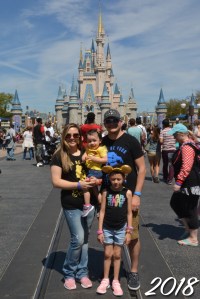
My family and I on our last day at Disney World a few weeks ago.

I recently took my family on vacation to the most magical place on earth-Disney World! The days leading up to our travels took a toll on my anxiety, patience, and stress levels. I planned this trip several months in advance and felt prepared to ensure that my family and I were going to have the most amazing time ever, and we did. All of our reservations went off without a hitch, my children behaved beautifully (surprisingly, no meltdowns!), my husband and I worked together as a team, and we had an itinerary that helped us stay on track without feeling pressured to see and do everything. At the risk of sounding cliché, it was truly a magical experience.

After pouring through hundreds of photos and reminiscing on everything we did, I came to a realization. We had a exceptional time not because I made incredible plans (although, it definitely helped!), but because of our environment, trust in each other, ability to let go of things we couldn’t control, and simply enjoying each moment and the time spent together.

That had me thinking. Isn’t that the ultimate goal of a successful workshop classroom? Isn’t that the beauty and magic of why it works?

Trust me, teaching high school English is no walk in a Disney park (pun TOTALLY intended), but it IS an extraordinary experience. Who would have thought that what makes a successful family vacation ALSO translates into the workshop classroom? (You can find amazing resources about why it works here and here, and by exploring the Three Teachers Talk archives.)

Creating and maintaining the spark may seem overwhelming. However, based on the insight I have gained through this recent epiphany after returning from Disney, I want to share with you my top 5 ways to help you create (and continue to foster) magic in your classroom.

5 Ways to Make Your Workshop Classroom Magical:


1. Be prepared. It is true, in life we cannot prepare for everything. However, the confidence that is instilled when one feels as prepared as they can should not be overstated. In my classroom, I ease my personal anxiety and that of my students when we have a plan. We have clear expectations and a set plan/goal that helps us stay focused. It seems like a simple solution, but it is quite the task. Ultimately, in order to feel in control (and to provide that for my students, too) I am consistent about the following; 

Class Collage

(L to R) My objectives are written daily. I share a daily agenda on the projector and write the homework for the week on the board. (The colored calendars are the proposed plans for the grading period and are posted to my website as well) 

  • Have an agenda
  • Communicate the goal of each day
  • Inform students of major deadlines in advance
  • Plan for multiple scenarios and/or have a back up plan.

 I also provide calendars, teacher and student samples of work when possible, and an array of mediums in which students can access helpful information. Over the years, I have found this cuts down on having to explain the same items repeatedly and helps students learn accountability.


2. Be mindful of the impact of your environment. Ambiance is a huge part of my personal philosophy when creating the climate of my classroom. As a germ-a-phobe, I have bottles of hand sanitizer, tissue, and Lysol wipes readily available. Rarely, if ever, are the fluorescent lights on.  1.) The lights give me headaches and remind me of a doctor’s office, so I chose to use a few floor lamps in my room. 2.) I adore natural lighting, especially with 3 large windows in my room. 3.) The dim lighting helps students feel comfortable, less intimidated, and reduces the noise levels (Trust me, it does!). In addition, I am particular about the quotes and student work on display. I even have carpets and pillows to increase comfort and provide flexible seating. You don’t have to pull out all the stops, especially with teenagers, but it helps to pay attention to the vibe of your tribe.

This slideshow requires JavaScript.

3. Trust in your support systems… and your kids. Lean on your admin or campus leadership, colleagues and PLC’s when you can. You never know when YOUR leadership can also serve as the support system for others as well. In my experience, I have learned something from every team and grade level I have been a part of, regardless of personalities or personal opinions. As educators, we are in the business of learning and seizing all teachable moments. This should also apply to our interactions with our colleagues.

One of the prime examples of why the workshop model works is because the focus is on the kids. As with any vacation or event for kids, we MUST keep them first at all times. Kids are kids. Yes, they will have times where it is a struggle to get through each moment, but it is worth it when the light bulbs finally turn on. All of the effort is completely worth it to see the growth and progress they make each day. My students never cease to amaze me with their stories, experiences, and development every year.

4. Prioritize. Part of planning and preparing is also understanding that you might not get to everything. Don’t stress about it, just figure out what your non-negotiables are and start there. Some reflection questions I have to help me in this process are;

  • What do I want my students to learn in this unit?
  • How will I know if they understand it?
  • What do I do if they don’t?
  • What do I do for my students who require extended learning or have special circumstances?

By keeping these in mind, I can quickly determine where we need to go, how we get there, and plan for various ways for my students to master their learning.

5. Enjoy the time together. At the end of the day, we became teachers for a reason. It is imperative that we also strive to keep that passion and excitement alive. Our love for our content and profession is contagious. When you surround yourself with opportunities to appreciate the time you spend cultivating young minds, trusting in the process, and uncovering the joy and value of each moment, that is the true magic of teaching.

I would love to hear about what has worked for you in your classrooms! What are some ways you and your students have been successful throughout your journey?

Gena Mendoza is still reeling from her recent visit to Disney World with her family over Spring Break. She is currently trying to convince her husband to agree to go back as soon as possible. In addition, she teaches High School English in Texas and is grateful for her students who kindly (and patiently) tolerate her latest obsession with all things Disney. She invites you to connect with her on Twitter and Instagram at @mrs_mendoza3.


An Intervention Change Up and a Plug for Summer Learning

brady-cook-314868-unsplash

Photo by Brady Cook on Unsplash

I bet I am more ready for summer than you. No, really. I am SO ready.

It’s not that I don’t like my job. It’s not that I am not having tons of great learning experiences with my students — they are doing beautiful things. It’s not that all things testing come crushing in this time of year (TELPAS, STAAR, AP) and make me daydream of working at a spa folding towels. It’s really none of that. It’s not even that I need a vacation — although I do. Did we already have Spring Break? (Oh, yeah, we did.)

It’s this:  Last summer I had one of the most amazing, awe-inspiring experiences of my teaching life. And I get a do over this summer.

Last summer I got to work with a powerhouse group of ELAR teachers in Clear Creek ISD with my friend and collaborator, Billy Eastman. I met Coach Moore who now writes on this blog and many other true blue educators dedicated to doing the work of workshop instruction and determined to do right by their readers and writers.

I could go on and on and on. But I won’t because Billy and I already did.

We wrote about our planning and implementation of that summer learning in this article “An Intervention Change Up: Investing in Teacher Expertise to Transform Student Learning,” recently published in English Journal.

I hope you’ll read it. Think about the intervention routines on your campus. Are they good for all students? Will they increase confidence in the hearts and minds of your readers and writers? Will they help students gain skills — or reinforce their lack of them?

And what about teachers? What’s in that work for you?

I’d love to know your thoughts. And if we can help, please let us know that, too.

Amy Rasmussen teaches English IV and AP English Language and Composition at a large senior high school in North TX. She is grateful to the North Star of TX Writing Project and Penny Kittle for showing her the benefits of choice and challenge; otherwise, she would probably still be dragging students through Dickens’ novels and pulling her hair our over plagiarized essays. Thank God she learned a better way. Follow Amy @amyrass and @3TeachersTalk. And please join the Three Teachers Talk Facebook page if you haven’t already. Join the conversation and share the good news of your workshop classroom.