My Antiracist Reading List

Many years ago in my teaching career, I acknowledged a gaping hole in my pedagogical knowledge that’s rooted in an unchangeable part of my teacher identity: being a white woman.

The implications of this were both large and small. I realized that the students in my classroom who were most successful were the white females. I realized that the students I had the most trouble suggesting books for were the students who were not white females. I realized that my family phone call log was full of communication with male students and students of color.

I knew I needed to make a change. And I realized that the one and only variable of my classroom that I could ever control or change was myself.

It was then that I began to look critically at the systems and norms and institutions I had in place or held in place. I examined my curriculum critically and saw a slew of white authors. I found a canon of classics that were long and uninteresting and irrelevant to my students. I found a syllabus, a classroom contract, and a school handbook of rules that privileged a definition of behavior and compliance defined by white people.

So, I did what I considered an extension of my education program: I read theory, reflected, put it into practice, reflected some more; read more theory, reflected, practiced, repeat.

And I got better. My curriculum became more diverse (adios, dead white guys; hello, @diversebooks), my methods became more student-centered (goodbye, long tests; hello, conferring), my critical reflection became more astute (sayonara, mindless grading; hello, assessment for learning). And my students experienced more successes in reading and writing because I was addressing some of the inequities and inadequacies in my teaching.

Here we are, ten years after that realization, and I’m optimistically hoping antiracist teaching has become an educational aspiration that is normative. And, three states and four schools later, I’m still working to grow and improve.

So this summer, thanks to #cleartheair, #educolor, #disrupttexts, and #thebookchat friends on Twitter, my TBR list has been filled with books about antiracist, equity, and inclusive teaching. It’s been hard to find those books alone, and it’s been especially difficult to find voices of color in books specifically tailored to secondary English pedagogies and methods:

After that conversation, I was left with two things: an impressively wide to-read list filled with BIPOC authors discussing equity, and a distressingly narrow slice of books by BIPOC authors who were writing about literacy methods in high school classrooms. Here’s a short list of titles:

  • Not Light, But Fire by Matthew R. Kay
  • Fearless Voices by Alfred Tatum
  • Writing Instruction in the Culturally Relevant Classroom by Maisha T. Winn and Latrise Johnson
  • Total Literacy Techniques by Persida Himmele
  • The Write Thing by Kwame Alexander
  • Linking Literacy and Popular Culture by Ernest Morrell

I wondered why there weren’t more books like this out there, so I did some broader reading, too: Paolo Freire, bell hooks, Gloria Ladson-Billings, James Baldwin. At Cornelius Minor’s suggestion, I read Baldwin’s “A Talk to Teachers.” At my entire Twitter timeline’s suggestion, I read Robin DiAngelo’s White Fragility, and ordered Ibram X. Kendi’s How to Be An Antiracist.

These readings stirred my thinking in hundreds of ways, but it really boiled down to one change I wanted to make: elevating voices that have historically been silenced.

I specifically want to find and read texts by authors whose perspectives have been marginalized, to amplify those voices and others’ whose have been oppressed, and to help students tell stories they’ve not been able to tell before (but that’s another blog post). This cycle, to me, involves considerable struggle, but it is worth it to help change the narrative of who and what matters in classrooms. This is our tireless work, and my goal this year is to keep at it unflaggingly, with boundless energy, because it matters.

I hope you, too, have dug deep this summer into the changes you hope to make in your students, your teaching, and yourself. I wish you strength this school year as you internalize Baldwin’s words in his talk to teachers: “The obligation of anyone who thinks of himself as responsible is to examine society and try to change it and to fight it.”


Please share your thinking in the comments: who might you add to this reading list? What changes are you hoping to make this school year? Please also consider joining our writing team!

Shana Karnes lives, learns, and teaches in Madison, Wisconsin, with her husband and babies. This year she’s working with the Greater Madison Writing Project at the University of Wisconsin. Connect with Shana on Twitter at @litreader.

Hope Thrives in Courage

Today is the third Friday with my senior English students. Yep, I did it. I’m back in the classroom, learning alongside some amazing young people.

I have a billion goals for myself — enough to weigh me down, certainly — but one that keeps floating to the top is this:  Thrive in hope. (Yeah, I don’t really know if that’s a goal, but stay with me here.)

When I left the classroom two years ago, I’d lost a lot of it. Personal struggles. Professional struggles. The state of the world struggles. All of it. But lots of self-reflection, rest, writing, paint, dirt, good friends, family, and growing things –probably most of all growing things — changed me. My hope is back. It’s thriving, just like the plants that add energy and life to my home and my new classroom.

And while I teach literacy skills to seniors in high school, what I really want to teach is hope. Hope in humanity and our ability to thrive — together and as individuals.

So, like you, I’ve started with relationships. Every text we’ve read together, every task WritingBesideDwyaneWadeI’ve asked students to complete, every book I’ve matched to a reader’s interest has given me insight into who these young people are as individuals with backgrounds, cultures, fears, failures, dreams and desires. Just like me, they cling and pounce and clamor after hope.

A few years ago, after a sniper killed five police officers in downtown Dallas, I read this commentary by Chequan Lewis. The last line still resonates: “My sights are simply set on what is possible when we are courageously human.”

Courageously human. That’s what I want for myself and for my students — to practice courage as a means of becoming better than we were when we walked in the door. So moving forward into senior English plans, I’ll invite students to step into the vulnerable spaces that require courage: reading texts that challenge the status quo, writing honestly about ourselves, our learning, controversies, and convictions; and communicating in ways that validate, clarify, empathize, and challenge.

I’ll step there, too, because the more I think about it:  Hope thrives in courage.

Here’s a few of the texts we’ve used thus far to write beside and spark our thinking on this journey. Perhaps you’ll find them useful as you begin your own.

My Honest Poem by Rudy Francisco

Famous by Naomi Shihab Nye; the poem here

“This Bud’s for 3” — Dwyane Wade

If you have ideas for more resources that fit our theme, please share in the comments.


Amy Rasmussen teaches seniors at a large high school in North Texas. She’s a #houseplantcollector, writer, reader, gardener, watercolor-artist wannabe, bicyclist, and grandmother to eight courageous little people, the newest little man born today! Follow her @amyrass and @3TeachersTalk

Becoming a Writer — Guest Post by Austin Darrow

On a late summer night, as the new school year looms on the horizon, my wife and I re-watch Heath Ledger’s comedic masterpiece A Knight’s Tale for the umpteenth time. As Ledger’s character William makes the decision to bravely follow his true calling and stand as a knight, knowing he will be arrested, Roland proclaims the old adage, “Well boys, all good things must come to an end.”

As all teachers oft do, I took this as a metaphor. It’s time for summer to come to an end, to don my armor, pursue my calling, boldly face the new year. In response, my wife said to stop being so melodramatic and watch the movie.

With her reminder, I did put an end to these flairs. Sure, summer–with its days of sleeping in, its weeks to simply and blissfully read for hours, catch up with old friends, its endless possibilities–would have to make way for something more structured. But I also felt a change this time around. The nervousness, the butterflies, the back-to-school nightmares (mostly) gave way to a new feeling: excitement. This would be a great year.

You see, last year, my second year in this profession, was a furnace for me.

industry-647413_1280

The Image by zephylwer0 from Pixabay

Conditions were just right: the heat was cranked up by my peer Charles Moore, who constantly challenged me to grow through conversations, mentor text wars, an anchor chart “hall of fame”, and an endless pursuit of authenticity in our shared love of teaching literacy; a mold was given to me by my mentor, Helen Becker, who showed me concrete strategies to make these things work while always reminding me to read, write, and cut out all the extra “stuff” that could allow impurities to ruin my work; Megan Thompson was the hand that guided the hammer, refining the techniques I tried, inviting me into her classroom and her thoughts, and modeling an unconditional love for students that requires a strong will; lastly, the students were the anvil, always giving me a sturdy base on which I could hone my edges and continue growing and shaping.

Without “further gilding the lily” as Chaucer would say in A Knight’s Tale, I learned and grew so much in this forge through the strong students, mentors, peers, colleagues, and I daresay friends that were willing to walk the walk with me.

Our North star–our central focus–at the heart of this growth was always learning how to make the literacy experiences for our students more authentic.

As I continue to reflect on these experiences, I realize that our greatest growth was in writing instruction. As our students walked in the door for the first time last year, we quickly realized many had gaps in their writing instruction. But perhaps a more alarming assessment was that most students, even those “proficient” by any state standards, had no love or purpose for writing.

And so our work began.

We tried many things–increasing the amount of formative data we would look at in team meetings to help guide our planning; shifting what and how we assessed and graded with rubrics and scales that would be more authentic; changing the pacing and length of our mini-lessons to get out of the way of these young writers; and so much more. Each of our adjustments were tried, refined, and often ditched and replaced, and I believe that each warrants further reflection. But one adjustment stood above the rest: when we as teachers became writers too.

In Kelly Gallagher’s Write Like This, he proclaims: “Of all the strategies I have learned over the years, there is one that stands far above the rest when it comes to improving my students’ writing: the teacher should model by writing–and think out loud while writing–in front of the class” (15).

Nearly all teachers of writing have heard something along these lines at some point in their career. Many have been brave and vulnerable enough to try it.

But this past year, I learned that there is a difference between writing in front of your students and becoming a writer.

A writer is a person who keeps journals and notebooks and endless Word documents, filled with ideas and drafts and revisions in a smorgasbord of conditions. A writer is an artist who pursues and experiments with their craft to get it just right. A writer is a dreamer filled with goals and purpose that can only be met through careful, meticulous, arduous effort.

With this working definition, I quickly realized that I was not a writer. Are you? I also questioned myself:  How could I authentically ask my students to become the writers that I have qualified here if I hadn’t become a writer yet myself? How could I expect them to give what I was not willing to give myself?

So I set out to become a writer. At first, I wrote the same essays and assignments that I tasked my students with. Then I said yes to sponsoring our school’s Poetry Corner and shared my own work at our weekly meetings. I wrote letters to family and friends, and love notes to my (at the time) fiancé. I wrote reviews of products I had purchased and services I had received, application letters to conferences I wished to attend, thank-you cards to wedding guests, and much more.

As I climbed each of these mountains of literacy, I shared my writing experiences with students. I wrote many of these pieces with them, inviting their feedback and giving mine in return. I became a writer and watched as my students became writers, too.

In a recent conversation with the aforementioned colleagues and friends, we created an anchor chart of reasons why everybody–students and teachers alike–benefit when the teacher becomes a writer:

  • Foresight to specific struggles students might have
  • Better understanding of what skills to teach in mini-lessons
  • Concrete conferring questions to ask student writers
  • Empathy for students struggling with the writing process
  • Equity in creating assessment scales and rubrics
  • Modeling vulnerability, struggle, and craft for the students
  • Modeling authenticity and purpose as a writer

I’m certain there is more to unpack here, but with these benefits alone, I am convinced: the most essential “tool” of writing instruction is when the teacher becomes a writer, too.

So as I glimpse into the year ahead, the usual back-to-school nerves have been replaced with sheer excitement. I am excited to step into the classroom, share my writing territories with students, and coach them as they create their own. I am excited to write alongside them, receive their feedback, and watch as they grow. I am excited for our next Poetry Corner meeting, where old students and new are so electrified by their literacy that they have to come and share. I have so much to learn still about writing instruction, and I am excited to step back into the furnace.

Austin Darrow has now begun his third year as a teacher and self-proclaimed literacy advocate. He teaches English I, AP Lit, and coaches the Academic Decathlon at Clear Creek High School. He is trying to grow and refine his voice of advocacy, so follow him on Twitter @darrowatcreek.

Scaffolding an Authentic Reading Community with Multiple Copies in our Classroom Libraries

As the school year gets off to a great start, I am thinking about how I am going to build an authentic community of readers. My goal is that my students will be as independent and engaged as possible, which means I have to step out of the way and make room for them to do their thing. I’ll scaffold along the way, but I am hoping that they take ownership and come up with their own ideas.

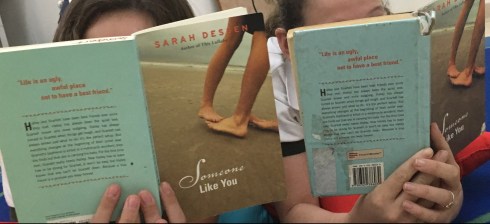
Building an authentic reading community is our goal. I had a few students last year who decided to read books in a partnership, and they ended up having a great time. They read, talked, laughed, and ended up enjoying their books, I think more than if they had been reading alone. It’s always more fun with a friend.

img_2688-e1566863806219.jpg

This memory of last year got me thinking about how to encourage this type of partnership without requiring it.

I realized that I purchased lots of multiple copies of the same titles for my classroom library, and I can simply make the suggestion. Students have asked for multiple copies of the same book before, so if I place them in my classroom library strategically, maybe they will take the bait…

So I rearranged a few books and remain hopeful…


I reorganized a few of the books in our contemporary fiction section and went from there…


Many of the doubles (and triples, etc) that are in the classroom library have already been checked out, but the ones that are left I shelved together with the suggestion that students might pick them up with a friend.


Last week our department invited all students to tour each others’ libraries, and as a result of that activity, three of my students decided to read Butter together. These books were all in different classrooms, but these students decided to read the same book anyway. It gives me hope that when I intentionally place books next to the suggestion of reading with a friend, they will start to read together.

Screen Shot 2019-08-27 at 8.37.45 PM

I’m looking forward to seeing how my students decide to move forward with this suggestion, and I’m hopeful because I’ve seen it happen before.

How do you encourage your readers to read together?

Julie has been teaching secondary language arts for twenty years, spending the first fifteen in rural Central Oregon,  four in Amman, Jordan, and the most recent school year in Managua, Nicaragua. 

Follow her on twitter @SwinehartJulie


Guest Post: Dear New Teacher by Amy Menzel

My back-to-school rituals include: setting up my writer’s notebook, organizing a snazzy course calendar I’ll inevitably abandon, watching School of Rock, and feeling guilty that I haven’t checked in more with new teachers once the year is underway. Back in the day, I started my career mid-year and was briefly mentored by a well-intentioned educator who solemnly said, “Teaching is a very lonely profession.” Welcome!

Luckily, she was wrong. I worked with some wonderful and wonderfully supportive colleagues those first six years at Cudahy High School (shout out to my Packer peeps!) and throughout my career I have come to realize that teachers are some of my absolute favorite people. Still, teaching can feel lonely at times. And I don’t always think I do enough to ensure my colleagues feel supported in the same ways I have. I want to remedy that and I’m starting now with a brief (I know your time is valuable) letter to new teachers.

Eh hem…

Dear New Teacher,

Welcome! Isn’t this exciting? And slightly terrifying? Yeah, it’s the best.

Now, I know you’re busy, so I’m going to keep this brief. I just want to reach out and provide some insight and initial support. I’ve narrowed down my advice to four main points. Hopefully this helps. Feel free to reference back as necessary throughout the year–and, just maybe, throughout your career.

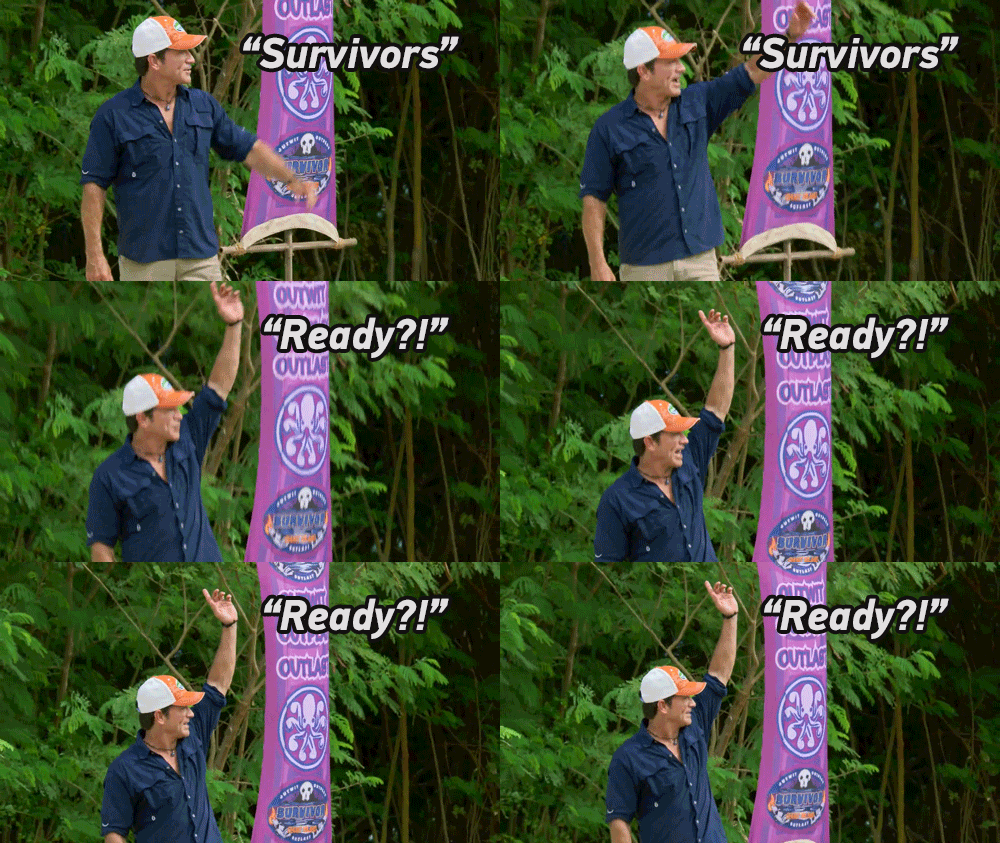
  • Brace yourself. Kidding! (Not kidding.) Teaching in hard. It will get easier, but it will always be hard. There are just too many variables beyond your control to ever make it even seem easy. But, whether you realize it or not, you already know this. In fact, it’s one of the reasons you chose this profession. You like–no, you love a challenge. So, in the words of Jeff Probst…

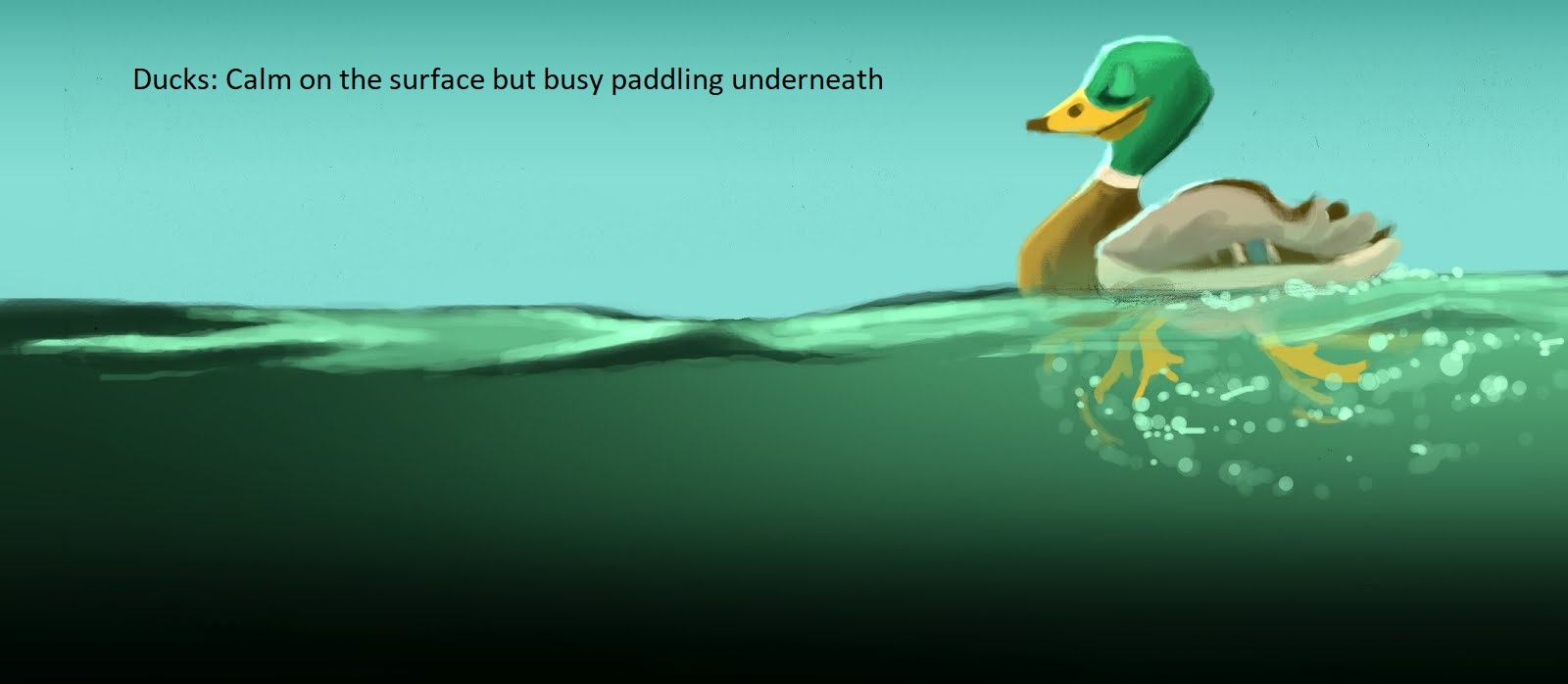
Again, I kid. (Sorta.) Know this: teaching is hard for all teachers. Don’t let the cool demeanor of veteran educators fool you. Some of them have spent years perfecting their duck faces.

No, not this duck face:

This duck face:

  • Find your people. NOTE: Your people should genuinely enjoy teaching. None of this, “Don’t smile until Christmas stuff.” (Or maybe that’s just me…)

These should be colleagues you feel you can turn to for feedback, advice, and/or to help you fix the copier when it’s broken (again). Do keep in mind that even the best of colleagues may seem frazzled at times, but we’re all in the business of helping people. So, if you have a question or few, ask away! If they’re “your people,” you generally won’t feel like you’re bothering them. 

  • Figure out what’s really important. Remember how I said teaching is hard? Well, the hardest part is that there will always be a bajillion things to do and they will all be important. Or, rather, deemed important. Of the utmost importance, really, because, in the field of education, there is no prioritizing. Everything is important and it all deserves your immediate and undivided attention. Good luck!

Just kidding. In all seriousness, determining what’s really important and prioritizing accordingly is the single most important teacher skill you can and should develop. It’s a survival skill, really. Trusted colleagues (i.e. “your people;” see #2) may be able to help you in this regard. Otherwise, and/or in addition, allow #4 to be your guide.

  • Remember that the individuals seated in front of you every period of every day are the most important. If what you’re doing doesn’t directly and positively affect their lives and their learning, it’s not all that important. Full stop.

Maybe I should have led with that last one. As another year starts, I’m definitely going to lead with it.

Have a great year, Teach! You’re going to do great things.

Sincerely,

An admiring and supportive colleague


Amy Menzel is excited to join her students and colleagues at Waukesha West (WI) for her 3,007 day of high school in just a couple of days. Until then, it’s more reading and writing on the back patio. Ahhh, summer…

A Poem to Start Your Notebook

Each morning, I receive two poems in my email inbox: one from The Poetry Foundation, and one from The Writer’s Almanac. One morning in July, I received “More of Everything” by Joyce Sutphen, read it, and thought, wow. That would be so powerful to write beside with students.

As it turns out, some pretty brilliant thinkers receive these same poems in their inboxes, and they took the same poem and ran with it in a beautiful direction:

I often have my students write beside poetry inside our notebooks, but Linda Rief and Penny Kittle have inspired me to bring poetry to the personalization process. I love the idea of having students glue this poem into their personal photos and collage pages we create: it prioritizes an individual, emotional response to literature that is valued in the workshop classroom…and the results of the thinking around this text are beautiful, too.


As you and your students begin the school year and personalize your writer’s notebooks, perhaps you’ll consider adding a text to the start of your journals. Will you share any poems or short texts you frame your year with in the comments?

Shana Karnes lives in Wisconsin with her husband, daughters, and cats. She is teaching and learning alongside amazing teachers through the Greater Madison Writing Project this year. Connect with Shana on Twitter at @litreader.

Will You Write With Us?

Six years ago, Amy Rasmussen looked at me and said, “I’d love for you to write for our blog.” 

It wasn’t a casual offer–it was said with levity, marking me as a Writer, a Teacher With Things to Say. At first, I wanted to shake my head and demur, as so many teachers are taught to do: fade into the background and let our students shine.

But something in me made me say yes. I felt honored, nervous, and purposeful as I worked in my classroom that year, beginning to think about my instruction through a new lens: how I might write about what I was doing, what pedagogy was informing my instructional design, what artifacts of learning my students were producing. I had to start thinking more critically about why I made the instructional decisions I was making, and exactly how they impacted students. Then, I wrote about my thinking, which led to new critical reflection, new thinking, more writing…and the cycle continues.

In six years, I’ve written over 200 posts at Three Teachers Talk. That’s 200 think-critique-write cycles. And I know that every one of them has made me a better, more reflective, more thoughtful educator. 

If being a better, more reflective, more thoughtful educator sounds like someone you’d like to be, then we extend that same invitation to you, with the same sense of levity: write with us. Find your voice. Hone it. Amplify it.

We invite you to join us as a regular contributor if you —

  • Are a high school teacher, instructional or literacy coach, or administrator who advocates for choice via readers-writers workshop practices, including self-selected reading and authentic writing instruction
  • Your thinking is guided by our mentors, namely, Penny Kittle, Thomas Newkirk, Donalyn Miller, Kelly Gallagher, Cornelius Minor, Tom Romano, and the tenets of National Writing Project 
  • Can commit to sharing writing that highlights details from your instructional practices, your personal and/or professional reading, and everyday teaching experiences

If you are interested in growing your own thinking around readers-writers workshop, strengthening your writing through authenticity, reflection, and publication, and amplifying the voices in our conversation about workshop, please fill out this Google Form. I hope you’ll join us in contributing writing around student-centered literacy practices. As someone who has enjoyed the benefits of this practice for more than half of my teaching career, I can say with confidence that becoming a teacher-writer is one of the best professional decisions you can ever make. I know that you, your students, and our readers will benefit from your leap of faith.

Please consider joining our writing team and spreading the word to your trusted colleagues and professional learning communities. We hope to have a diverse representation of voices sharing and growing thinking about readers-writers workshop best practices in schools and communities everywhere.

Give Me an Inch, and I’ll Take a Mile…

back to schoolWrapping up the “back to work” week left me feeling energized and excited for the new school year to start. I’m teaching two new preps, sophomores and AP Lang, and, whereas in the past looking a blank calendar spiked my anxiety, last week my mind danced with literacy possibilities.
One point of origin for my ebullient confidence comes from small but important changes I’ve noticed over the past handful of years in the organization of the professional learning routines I experience in the week before the kids come back.

Gone are the interminable days of marathon “sit-and-get” informational sessions, and with them the mad scramble on Friday afternoon to make sure Monday will be about welcoming students more than merely surviving the cacophony of controlled chaos.

img_5675Our back-to-school schedule included many of the typical, district-mandated informational reviews. It was obvious that our administrators did their best to keep that time from dragging or being wasted, and for that, I am grateful.
What differed most from previous years was the amount of time I was able to spend exploring my needs. I found myself presenting at our district ELA professional learning day, meeting with my instructional coach to hash out plans, debriefing with my intern teacher, checking in with with my first-year teacher mentee, and writing the first mentor text that I’ll share with our sophomores as we attack persuasive writing. Overall, I was given a great deal of flexibility in the decisions I made about how to best take advantage of my time, something I truly appreciate.

However, I can’t help but feel that we could take this experience one little step further.  There is some part of me that wonders what would happen if I could design my own professional learning? What if I could work with my supervising administrator, and a few colleagues, to explore research and practices that could make me a better literacy teacher?

I’m trying to imagine a world where I could, along with some like-minded co-workers, explore my own professional learning path.

Who might enter into that learning with me?

There are some, I know who would walk blindly into the maelstrom, bringing with them knowledge and skills that would supercharge our efforts.  Others would bring with them their positive energy and drive to grow. It takes people with different ideas, willing to share, confident in themselves.

I can think of more than one literacy leader from each of our high school campuses who would welcome, and have welcomed, the opportunity to collaborate across departments, or even content areas. This cross current of efficacy intrigues me and feeds my desire to interact with teacher leaders.

What might that look like?

The most authentic learning experiences that happen in my classroom unfold as the kids take ownership.  In those magical moments I cease to exist and the kids fully shoulder their literacy growth.  The engagement explodes in a quiet bang and for a few brief moments I sit down, take a breath and enjoy anonymity.  This vortex forms spontaneously and when it does, I get out of the way. So often I wished to hit record and save those moments for times when I’m feeling discouraged.

This happens with adult learners too.  I’ve seen it, been in the eye of the storm as it swirls around me. Whether in the hallway in a chance encounter, in team planning meeting, or at a district curriculum review day, there is strength in numbers, and I long soak up what others bring to the table.

Maybe it starts with a research text that ignites and unites the interest of our learning group.  Perhaps a chapter from a professional text like – oh, I don’t know – something from Penny Kittle jump starts the vortex and teachers with similar goals, but different experiences find new territory to explore.

There might be readers and writers scattered haphazardly around the room. Some would whisper in pairs or stare pensively at their notebooks or a self-selected bit of research. Others might engage in lively and loud debate centered on the merits of a particular mentor text or skill. One or two tears might work their way out over the emotional connections writers build with their words or the connections readers build with the words of others.

I can see books being passed around, hear laughter erupting, and feel “eureka” moments; the language of learning.

What would be the result?

Teacher efficacy stands among the leading factors in student achievement and we can always push harder towards this ideal.  When teachers find energy in each other, almost nothing threatens success.

The authenticity that stems from teachers who feel empowered by those around and above them produce positive results. They nurture young minds and walk beside them through their educational journey. They feel free to share their writing and save in the vulnerability demanded therein.

Ultimately, the goal for all professional learning is growth, whether pedagogical or practical; informational or emotional. Whatever the goal, I want to continue my journey in the company of others. This “work” that I’m exploring can’t be done in isolation, and, while I know some amazing people in our ELA department that push me to be better everyday, there is so much more to discover.


Charles Moore is excited to set forth on his 18th foray into education.  He’s feeling humbled by his recent piece in Literacy Today, the ILA magazine.  Working with the High School Section of TCTELA has been both a challenging and rewarding experience, forcing him to exercise muscles he didn’t know were there.  Here is the link for TCTELA presentation proposals.  The deadline is Sept. 4th. Charles is grateful that he gets to spend so much time with his family these days and looks forward to his son’s first year of organized football. 

Guest Post: I’ve been thinking about Ghosts or What I’ve learned about the power of mentors…and time by Elizabeth Oosterheert

“That version of the story–that version of my life without my husband in it–is a ghost I carry around with me. It’s always there, beneath the surface of my real life. I feel…so grateful that this big, messy, joyous life isn’t a ghost life, but mine…”
Kate Hope Day for The New York Times

Joe and Toby

Joe & Toby after a performance of the 2018 play, Merlin’s Fire

If you’re like me, when the end of the school year arrives, you entertain the ghosts of what might have been. These lingering ghosts are questions like:  What if I had spent more time conferencing with that student? What if I had found this mentor text a little sooner? What if I had done more mini-lessons about . . .

And the list goes on.

I learned a few lessons during this past year I hope will have a positive impact on EVERY facet of my readers’ and writers’ workshop for next year. My teacher’s soul already knew this, but I recognized more powerfully than ever before that the right mentor texts at the right time, combined with enough space to explore craft moves and to write about things that matter, makes all the difference.

My students love what I call food literature (thanks to @KarlaHilliard for this amazing idea!),  a writing study we do after Christmas composed entirely of reflections about food. This takes the form of food narratives, poetry, listicles, or critical reviews.

We study mentor texts, and then students choose a direction based on the ideas they’ve developed in both handwritten and digital notebooks.  After discussing many mentors, and highlighting craft observations, students list powerful descriptive words, make notes about the writer’s voice,  and practice composing complex sentences based on passages in the mentor pieces.

I encouraged my students to consider food in the context of specific flavors and seasons. 

Childhood and adolescence have unique tastes. December has a far different flavor than July. What we quickly noticed is that food literature is about so much more than what is on our plates. It’s about savoring cherished memories.

Another frame that worked well for food narrative that is also very effective for other kinds of autobiographical writing is an idea adapted from Penny Kittle that I call Then and Now:

Then I thought, but now I know. . .

When we write Then and Now snapshots, we admit that our understanding of everything from food, to sports, to relationships evolves as we age and learn how difficult it is to be a human being.

Three new mentor texts spoke powerfully to my students. One was “Carrying the Ghosts of Lives Unlived,” published in the Ties section of The New York Times, written by Kate Hope Day. While this piece is NOT about food, it is about how, in Day’s words, “There are hinge points in time when life could be one thing, or another.” My students applied  this mentor to our food study, writing about different life seasons, and how sometimes seemingly small decisions have a BIG impact.

Another New York Times piece that was very helpful to us  was “Christmas Fudge and Misremembered Snow Cream” by Rhiannon Giles.  I composed a piece for my students based on this mentor about the flavors of my childhood.  An excerpt is linked here.  Students then wrote about their own life flavors, recipes, or memorable meals.

Finally, we studied “Ode to Cheese Fries” by Jose Olivarez. What I love is that my discerning, sensitive, wondering students used that poem to create beautiful reflections on some of their fears about adolescence and daily pressures assailing them. In his poem, “Pack of Ranch Sunflower Seeds,” Toby, one of my eighth grade authors, wrote:


What if I’m the small seed

With a big shell

Waiting in the bag

Pleading not to be eaten up

By the mouth

Called life

And my inner seed gets revealed

And my outer shell is thrown out and trampled

By reality


Maybe I should chew more bubble gum


The rest of Toby’s poem is linked here. 

Our food study is a ghost that haunts me, because I hope that I can continue to make it more authentic. For now, though, I have to remember to be grateful for the time and the writing that was — and in the words of Mary Oliver, give thanks for my “one wild and precious life” and the students’ lives that intersect with mine every day.


Elizabeth Oosterheert is a middle school language arts teacher and theatre troupe director at Pella Christian Grade School in Pella, Iowa. She loves writing, and sharing the stage with seventh and eighth graders. Her favorite stories are Peter Pan, The Outsiders, & Our Town. You can find her on Twitter @oosterheerte

Five Ideas That Beat the Dread: A Return

Three Teachers TalkThank you for joining us for a summer series revisiting our top posts from this school year! Don’t forget to please “turn and talk” with us in the comments section one last time.
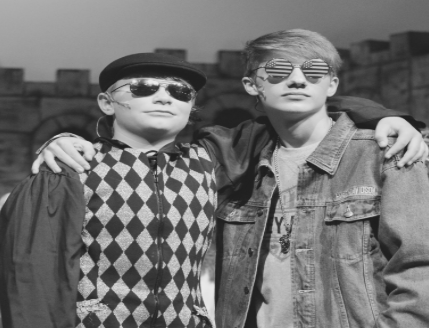
Amy Rasmussen’s back-to-school post from 2018 will help you frame your school year positively and “beat the dread.”


A few years ago I stopped reviewing class rules and smacking down my syllabus on the first day of school. I had been doing some research on chronic stress (mostly my own) and read extensively about the fight, flight, freeze response. One description glared at me and gave me pause:  “You have a sense of dread.”

I remembered what I had been taught as a first year teacher:  Set yourself up as the authority figure. Be kind but firm. Establish norms quickly so students know what you will and will not tolerate in your classroom.

Then, almost in the same breathe, I was told:  Develop relationships. Learn students’ names. Let them help develop class rules.

And I muddled through doing a combination of both the best I knew how. Those first few days of my first few years were rocky to say the least. And in hindsight, it’s clear:  there was dread. Lots of dread.

So when I read up on the fight, flight, and freeze response, I realized a big part of my problem:  With my seemingly simple attempt at outlining classroom expectations and detailing how ‘my class would run, chemicals danced a jig in students’ brains: fight, flight, or freeze. Now, I know my syllabus is not on the scale of major life trauma most often associated with this fff response theory, but many of my juniors and seniors didn’t want to be in school anyway. Why was I compounding it?

I learned a better way.

Wait.

Let every other teacher lay down the law. Lay out their plans. Run through the rules.

On the first day of school — maybe even the first five days of school — just write. And talk. Let students drive the discussion. Let them ask questions. Give them a chance to be seen and heard and welcomed.

“Community before curriculum” Angela wrote in her last post, and I love her thinking there. I also think we can merge the two on the first day of school and lay a firm foundation for thinking and talking every day thereafter. We can jump start community and begin our curriculum as we put pen to the page and write.

Here’s my top five sources that beg a response and invite students to write on the first day of school (or at least the first week or so):

  1. To This Day by Shane Koyczan.

Give every student a notecard and ask them to watch and listen and then respond to the poem as a whole or to a line they particularly like or relate to. (I’ve learned some pretty heavy stuff from students over the years. So many of them can relate to the themes in this poem.)

  1. How poetry can help kids turn a fear of literature into love by Jason Reynolds on PBS.

Give every student a sticky note and ask them to think about their reading lives. Then after they listen to Mr. Reynolds talk about reading, ask students to rate themselves. Are they readers eager for the pit bulls or for the puppies? Why? (I quickly find who my readers are and with whom I need to take on the challenge of helping them want to read.) Then for a little more of a challenge, on the flip side of the sticky, ask them to describe in poetic form their feelings about poetry. (You’ll learn even more.)

  1. Possibilities by Wislawa Szymborska. Or the version here where Amanda Palmer reads the poem.

Give every student a copy of the poem. Then read the poem aloud and ask students to write their own list of possibilities. Their list can be straightforward, funny, or interesting things they want the class to know. (I wrote about how I used this poem to practice imitation a couple of years ago. It’s a great lesson and a great poem to revisit.)

  1. Three poems:

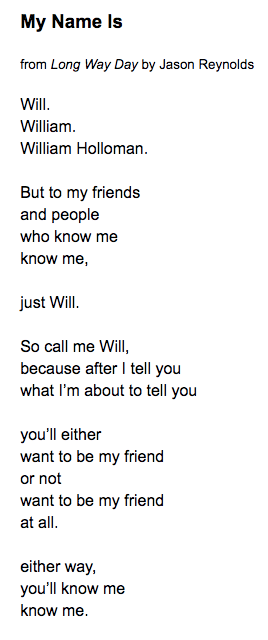
“My Name Is,” an excerpt from Jason Reynolds’ book Long Way Down. (If you haven’t read this book, oh, my goodness. It’s amazing!)

My Name Is by Jason Reynolds

“Instructions” by Rudy Francisco.

Instructions by Rudy Francisco

“Like You” by Roque Dalton, translated by Jack Hirschman

Give students copies of all three poems and a notecard or piece of paper. Read them aloud. Ask students to read them again and then to write a response. They can respond to just one of the poems, a line from a poem, or anything the poems make them think or feel. There is no right or wrong. Just write your thinking. (This is always an interesting response, and it tells me a lot about how to help my students. Many of them will begin to write an analysis of one of the poems — or all three. Others understand that I am asking for a different kind of thinking, one that leads them into ideas for their own poems, stories, or essays.)

  1. Author Bios!

Give students access to books that have clever, witty, or interesting author bios. YA authors like Julie Murphy, Jeff Zentner, Chris Crutcher, Libba Bray, and Gina Damico are great ones, but there are many with a bit of quirk that will draw students in and spark their interest in reading these author’s books. Ask students to explore the author bios and then make a list of the books they think they’d like to explore this semester. Have them write the author’s names on sticky notes for you to put in your conferring notes.

If you want to take this author bio idea further — (this is my favorite):

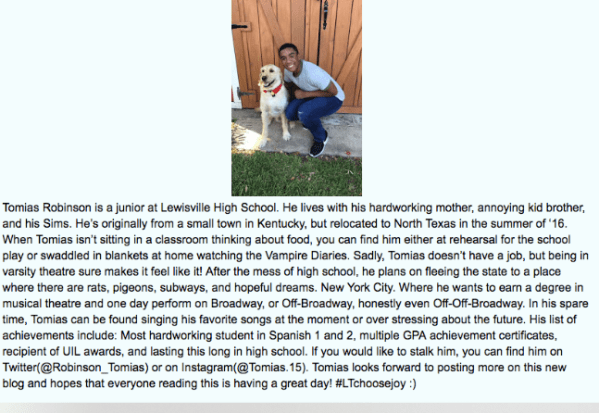
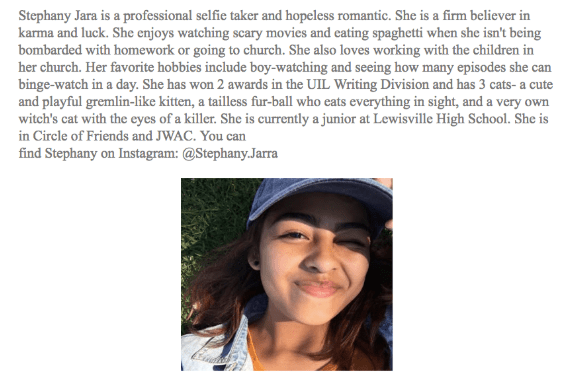
Read several professional author bios aloud. Ask students what information is shared and make a T-chart that lists the what on the left, e.g., name, personal hobbies, awards won, where the author lives, who the author lives with, etc. Then, ask students to describe how this information is shared and add these craft moves to the right. This is the how. For example, short and sometimes incomplete sentences, lists, 3rd person, the author’s name is first, witty word choice, etc. Finally, ask students to write their own author bio while you write yours as a model. Encourage them to try to craft their bio to include ideas from both the what and the how side of the T-chart. Below are two of my students’ bios from this past year.

Stephany author bio

Tomias author bio

(The author bio idea is Lisa’s baby, and she wrote about it here after I wrote about it here. It’s still the best idea I have ever heard to begin students on their journey into developing their identities as readers and as writers. I’ve used this idea in a model lesson for every workshop I’ve facilitated this summer, so if you were there, feel free to share the author bio you wrote this summer in the comments. My newest one is below.)

I wish you happy reading and writing with your students this year. Please share your go-to ideas for inviting students to write and build your community.

Amy Rasmussen loves books, pretending to garden, adolescents, and coconut cream pie — not necessarily in that order. She lives in North Texas with her dashing husband of 33 years, their twin-terror Shelties Mac and Des, and a not so loving love bird named Colonel Brandon. Amy spent the summer leading professional development in several districts across Texas and has grown especially fond of the Houston area. If only she could move… Follow her on Twitter @amyrass — and if you are not already, please follow this blog.