Category Archives: Writers

Multigenre Magic

Teacher goosebumps. We’ve all had them: students are focused, consulting their Writer’s Notebooks, talking to each other, incorporating what they learned into their writing. It’s what we live for. No moment in the academic year ever evokes this synchrony more than the multigenre project.

Defining Through Experience

Like my students, you might be wondering what multigenre is. I learned about multigenre during my first year of teaching when I attended a workshop with Tom Romano, the godfather of multigenre. Dr. Romano has since become a mentor and colleague and his work continues to inspire my students 15 years later. Shana 

When we begin our multigenre unit, students have, at best, a vague notion of the vocabulary, but no experience.

Before class begins, I conspire with one of the orneriest kids; today it’s Jamal. Together, we quickly whisper a plan. As students finish up their vocabulary quiz, I look to Jamal, eyebrows raised.

“Jamal! I just saw that. You cheated,” I accuse heatedly. Suppressing a smile, Jamal shifts to fake outrage. We verbally spar a bit, ensuring all students tune in. They’re used to firm classroom management. Today it’s different.

Channeling all my inner drama queen, I huff and puff and toss my ID badge and keys to the floor. “Guess, what? I’m done!” I proclaim as I storm out of the door.

I wait a beat. Then before students can get too excited, I burst back in the door and high-five Jamal. Students are confused, excited, hyped. “You’re trying to figure it out, right? Well, before we talk about it, let’s write about it.”

Students grab their Writer’s Notebooks (WNB) as I pass out notecards. On each notecard is a genre of writing with which my students are familiar: Facebook post, text message conversation, letters, among them.

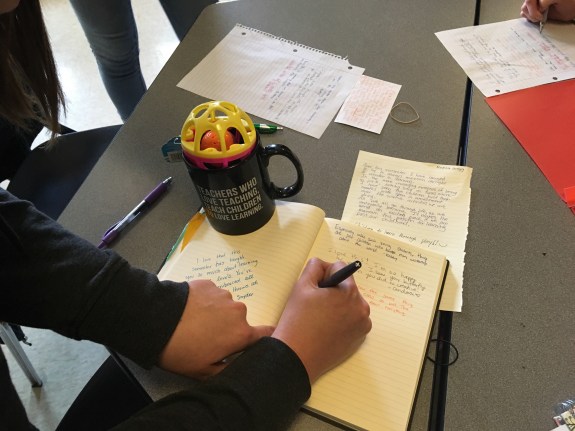
And students write. For three minutes their pens flow and they capture all the nuances — the questions, the perspectives, the layers. We share writing. We collaborate. We grow as a community.

“We’ve just created a multigenre,” I explain and share Romano’s definition of multigenre.Screen Shot 2018-05-03 at 2.31.22 PM

Multigenre Tasting

Once we define multigenre, the next step is to immerse ourselves in mentors. Using past projects, as well the ones I’ve curated at Multigenre Library, we participate in a multigenre tasting. We create lists of the qualities of multigenre, as well as a rubric and checklist for this kind of writing. After establishing guidelines, students go back to their notebooks and explore their writing territories, finding compelling topics.

Mini-lessons

The bulk of the time for this unit is spent workshopping, conferencing, writing. We spend time in three main ways:

  1. Genre minilessons
  2. Research minilessons
  3. Revision minilessons

In genre mini-lessons, I stand firmly on Katie Wood Ray’s shoulders, knowing that asking my students to notice things in a piece of text is the key to them reading like writers. So, when we are going to try a new genre, we start by looking at examples of that genre. We make a list of rules/guidelines for that kind of writing and then we write about our own topic. Together we explore double voice poems, recipes, and open letters. Katie wrote about one of my favorite genres to explore in this post last month.

Once students have tried out lots of different ways of writing, from lots of different perspectives, we talk about incorporating research into their writing in a purposeful way. Whether students are writing about personal topics, or more traditional research subjects, they need to know how to add a layer of research because it deepens the writing and builds their own knowledge.

I began to save the research step until later in the process after they’d generated plenty of writing about their topics. They write a bit, then conduct research, then weave that research into writing that already exists. This approach has cut down on plagiarism. More importantly, it’s made the writing and the research more authentic.

Publishing & Assessment

Next students publish. We discuss how important it is to remember that their writing is the engine of the multigenre project. A beautiful presentation falls flat if the writing doesn’t show evidence of craft. This is an English class, after all. Students conference with me and with each other about ways they might present their work. Some choose digital platforms, others create scrapbooks.  


I have tried many approaches to assessing student learning within this unit. I used to have a rubric that was so detailed you’d need a magnifying glass to read it (which means nobody actually read it). Now I use a simple rubric, one we create together. Students must have a certain number or pieces, and write in a set number of genres. There needs to be passion and voice. Mostly, though, I focus on feedback. I make notes on post-its and stick them on pages where their voice soars, where images pop. The assessment has already happened through conferencing and workshopping. In the end, we focus on celebrating the work and how far they’ve come.

Angela Faulhaber is a literacy coach in Cincinnati, working with teachers in all grade levels to move kids as readers and writers. She’s getting ready to introduce multigenre to 150 freshman next week while covering a 3-week sub position. She might be a little crazy (but also really excited).

Artifacts of Our Learning: A Classroom Museum

One of the things I love most about learning is how dynamic it is–how sometimes there is tangible evidence of growth in thinking, but how (many) other times it’s invisible to our eyes and others’ when we’ve learned a lesson well.

It’s an art, in my opinion, to try to represent our thinking to others–through talk, images, poems, music, or any genre. That’s why in the past, so many of my final projects with students have been multigenre–it’s much too hard to try to encompass learning in one simple genre.

This year, as I wondered how my students might share their learning with one another at the end of the year, I kept coming back to the concept of art. Any creative offering is an artifact of the artist’s mind in one particular time and place–what Picasso created in his early years is much different than his later works.

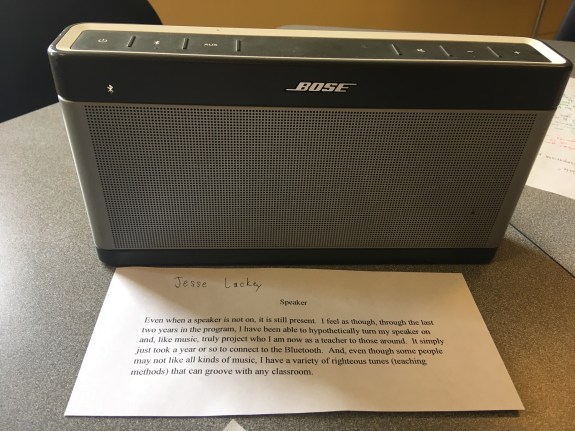
For a final assessment of our learning, I asked my students to think like artists whose works would be displayed in a museum, and to bring in something that represented their learning. To prepare, I asked them to look back at their early notebook writings and one-pagers to discover artifacts of their thinking about our readings, their writing, and their growth as teachers and thinkers over the semester, and to write a brief explanation of how their learning was represented.

img_0512

Our classroom was transformed into a museum that was a diverse, multigenre affair. We played music as we set up our artifacts and their explanation cards around the room.

img_0507

Once our artifacts were on display, students set out papers or their notebooks for peers to write on, and we each rotated around the displays and wrote notes to one another. There was lots of talk, writing, and laughter. It was a lovely, celebratory atmosphere.

img_0483

Students came into class with representations of their learning; they left with tangible artifacts of their peers’ feedback. Making learning visible has been a key theme of ours this semester, as a book by that same title was our central text study. In addition to a summative representation of learning, I hoped to get my students thinking about how to represent their thinking in a way that wasn’t literally getting it down on paper.

img_0504

I paired our end-of-year museum of learning with individual conferences with students about their final assignments and projects. These two activities–the visible representation of our learning, and our talk through it–were the things that helped me not only pop a grade into the gradebook for students, but end the semester on a high point, feeling connected to my students and optimistic about the future of our collective learning and growth…which, as is true for all artists, will never end.

What are you thinking of doing to wrap up your time with students? Please share your ideas for student reflections, self-assessments, or showcases in the comments!

Shana Karnes is wrapping up her semester with students at West Virginia University, finishing a yearlong C3WP workshop with the National Writing Project @WVU, and delightedly bidding adieu to the longest winter ever. She’s excited to start a summer of reading, reflecting, writing, and collaborating with her PLN…and spending time in the sun with her two lovely daughters! Connect with Shana on Twitter at @litreader.

100 Days of Writing

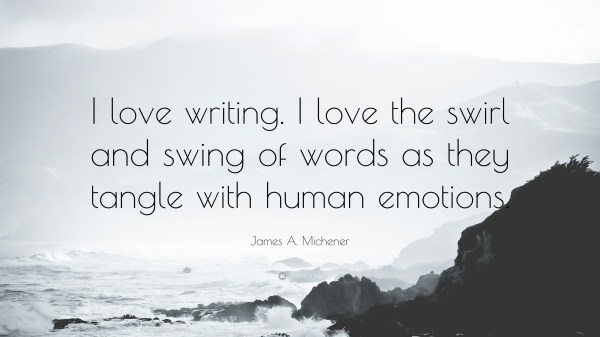
Today my favorite quote on writing is this one attributed to James Michener.

355964-james-a-michener-quote-i-love-writing-i-love-the-swirl-and-swing

I’ve had a lot of emotions lately. Chaotic, confusing, crippling emotions. The kind that freeze action and force reflection.

But time thaws, and the writing of others warms me in ways my own writing often does not. I have found healing in the writings of my friend and colleague Amber lately. So raw and real and poignant.

I share her most recent post here. (An interesting mentor text idea:  Choose an age and write about it.)

I think about the work of writing and teaching writing a lot — more often than I actually write. I need to change that. Find my groove. Free my soul within the swing and the swirl of my pen. Stop thinking I can only write research-based pieces or tips on this blog. I need to walk my talk and just write — more. Period.

Our friends at Moving Writers have an incredible idea:  100 Days of Summer Writing. Imagine the possibilities — for ourselves and our student writers.

What do you think? Could we all use a little writing inspiration? Could we all write a little more, strengthen a few mental muscles?

I’m thinking if I do, perhaps everything that’s sent me into a spin lately will spin into something else entirely.

Writing can do that. That much I know.


Amy Rasmussen teaches English IV and AP Language & Composition in North Texas. She recently moved homes, trading one cluttered mess for another, which does nothing for her need for order and simplicity. You can find her searching websites for minimalist living and selling So. Much. Stuff. on Facebook Marketplace when she isn’t trying to prep her students for graduation or the looming AP English exam. For tweets, follow @amyrass 


Eulogy writing as a way to employ rhetorical strategies

I find myself like I am sure many AP teachers do, searching for ways, strategies, assignments, etc. where students can apply the writing styles and tools in new ways that expand beyond the timed essay.  My students are developing the shift in mindset that is required for rhetorical analysis, shifting away from evaluating what was said to how it was said.  

During our culminating discussion of Into the Wild, students had divergent views on Chris McCandless–some students sympathized with his quest and others believed him reckless and arrogant (this later made for an amazing debate!).  The seminar shifted to discussing all of those that Chris’ choice to go into the wilderness, and death, impacted his parents, beloved sister, and those he met along his journey.  It was a student’s question, How do you think his parents felt going back to the bus?  Which  led us to consider those Chris left behind and what they would want to say to him.  

As Louise Rosenblatt discovered decades ago, the merit of a text for adolescents often lies in the connection a student has with the book (read more about a modern take on Rosenblatt’s transactional theory here and here).  Students want to connect with texts in meaningful ways, through their own experiences, beliefs, and preferences.  We want readers to have emotional reactions no matter what they’re reading, be it poetry, fiction, or nonfiction.  My students identified with Chris, his loving sister, or his longing parents.  Some students understood his adolescent need for adventure and freedom while others argued he had a duty to his family.

Tasking students with writing a eulogy for such a polarizing person seemed an ideal way for students to employ their rhetorical techniques as writers while defending their view of Chris.

Prior to letting them loose to write, we examined and discussed eulogies from famous people to use as mentor texts.  Our readings ranged from Bill Clinton’s eulogy of Richard Nixon to Amy Winehouse and Steve Jobs.  Through these mentor texts, students discussed how tone is established and reveals the relationship to the deceased individual, even the eulogist’s feelings towards the person, as well as the features of a eulogy.  From reading a range of eulogies, students came to their understanding that quality, emotional eulogies often employ a variety of appeals, noting that rhetorical techniques are for everyday use–yes!  There IS a use for these skills outside of the Language and Composition classroom, beyond the exam!

After students felt comfortable with the format, I assigned the eulogy and students selected the character they would become during their eulogy.  Then the writing and revision process took hold!

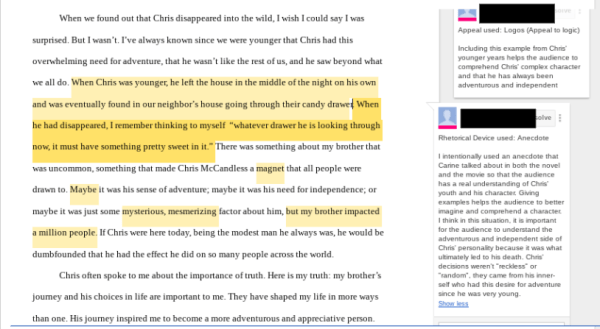
A powerful last step was for students to annotate their draft to identify and discuss the purpose of the devices they employed, like a reflective rhetorical analysis of their choices as a writer.  This was key to moving students towards understanding why writers make the moves they do.  Then, we delivered them to develop speaking skills in a low stakes setting and have the opportunity to hear rhetorical strategies used.


Two student samples through various perspectives with their annotations:

Screenshot 2018-03-12 at 2.18.56 PM

Screenshot 2018-03-12 at 2.18.40 PM

While this assignment was made for Into the Wild and specifically for Chris McCandless, the assignment could easily be modified for any text studied as a class or independently. Consider how the ending of The Great Gatsby would change if Nick delivered a eulogy. What would Daisy have said, with or without Tom in the audience?  What would Hannah’s classmates who received a cassette in 13 Reasons Why have said to memorialize her?   

This eulogy allowed me to assess students’ character understanding, a way for students to apply their rhetorical knowledge, as well as a low stakes way to practice speaking, all while synthesizing perspectives in the text.  Did I mention squeezing in a little rhetorical practice for the upcoming exam?  I also think students were able to sort out their views on Chris through the persona they took on, adding an invaluable transactive quality to their analysis. 

Maggie Lopez teaches juniors and seniors in Chicago, but is looking forward to a new adventure in Utah for the next school year.  Currently, she is working through her personal reading list of An American Marriage by Tayari Jones and Red Sparrow by Jason Matthews.

We Cannot Act Alone – Equity For Every Classroom by Cornelius Minor and Lisa Dennis

3TT Corn Chat

Rattling around the dimly lit corners of the teachers’ lounge and shuttered mall locations of Successories nationwide, one can find the oft-quoted sentiment that teaching may well be the greatest act of optimism.

However, I would argue that today’s teacher is far more likely to embody optimism by learning.  

When we stretch, scrutinize, professionally and personally grow, challenge, inquire, and courageously push ourselves to learn for the sake of better understanding and connecting to our students, then we are better educators and better leaders and better agents of change in our classrooms.

Because we need far more than optimism. We need realism.

At the upcoming NCTE conference this November in Houston, Texas, a convention focused around raising student voice, the passionate crew from Three Teachers Talk will be honored to share with a you a talk entitled, “Accomplice”-ing Great Things: An Action Plan for Equity, Inclusivity, and Allied Partnerships in ELA Classrooms.

Additionally, in the realm of hardcore fangirling, I am pinching myself to report that the incredible, incomparable, inimitable Cornelius Minor has agreed to be our Chair for the session. As Lead Staff Developer for Columbia University’s Reading and Writing Project, Mr. Minor is a tour de force in the fight for equity in the classroom whose passion and persistence is blessedly catching to all those who yearn to do better and be better for our students.

The crew at Three Teachers Talk has been in love with Cornelius Minor for years. I had the pleasure of first hearing Mr. Minor speak at the 2016 NCTE conference in Atlanta, Georgia. I recall being so struck by his words that I uncharacteristically approached him after the session. My thanks for his message turned into some sort of incoherent blubbering, I’m sure, but Mr. Minor smiled that blazing smile he’s known for and gave me a hug saying, “We’ll talk soon, ok?”

Maybe my teacher universe didn’t really pitch wildly at that moment, forever altering the trajectory of my work with students, but really, it did.

Among countless brilliant insights Cornelius shared that morning in Atlanta, I was particularly struck by his statement that it’s our job as educators to teach children how to “maintain partnerships” in order to “define our culture.” I recalled this statement recently as Amy, Shana, and I brainstormed on ways to best share our ideas at the NCTE’s 2018 Convention – Raising Student Voice.

Thus, our work as accomplices to our students came to the forefront of our planning, and a few things became clear.

Chief among them; We cannot become who students need us to be if we act alone.

This work toward equity is deeply personal, beautifully nuanced, and to many of us, it is brilliantly new. We are in a constant state of knowing that for far too many children, there is a savage gulf between what education promises and what education is.

We know the research. Girls are underrepresented in science and technology. Children of color continue to be suspended at exponential rates compared to their white peers. Poor children are more likely to attend schools with fewer resources. These outcomes are sexist. They are racist. They are classist. School, as an institution, continues to perpetuate them. We can change this, and we are certain that the way forward is together.

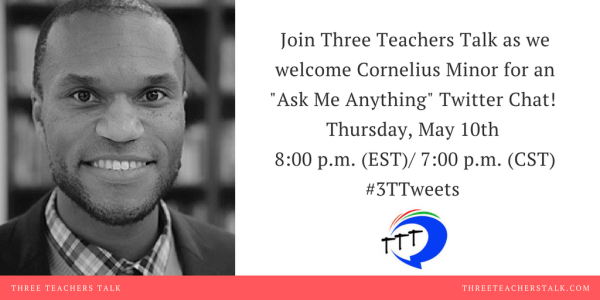
In the spirit of moving forward together, we’ve invited Cornelius to join us for a very special Twitter chat.

So that we can share as much as possible, we’ll be using an “Ask Me Anything” chat format. AMAs, as they are commonly called, are a little different from traditional Twitter chats.

Cornelius will be moderating, but he won’t be posing the questions. You will!

For one hour, you will be able to ask Cornelius anything about literacy, education, equity, activism or Fortnite.

We’re looking forward to seeing where this goes! We’ll put a little bit about Cornelius below so you can get to know him before the chat. Feel free to comment below too with any questions that you hope he’ll answer as we Tweet the night away. 

Can’t wait to see you in the Twittersphere!
Thursday, May 10th at 8:00 p.m. (EST) / 7:00 p.m. (CST)!
#3TTweets 


Here’s a sampling of some of Mr. Minor’s recent (brilliant) thinking:

“We Can Do Better” from the March/April publication of ILA’s  Literacy Today. 

“Five Steps to Launching a Schoolwide Social Justice Movement” from Education Week Teacher

A two-part interview conducted with Laura Hancock at Literacy Junkie


What questions do you have for Cornelius Minor? Leave them in the comment section below as we look forward to watching Cornelius’s fingers fly over the keys on May 10th! Please join us and spread the word for this important discussion with one of today’s foremost educational leaders on equity. 


My Students Teach Me 5 Strategies To Use Today…and So Much More

You know, growing up, I didn’t have very many female friends.

Teenage girls are a difficult species, and when I was one, I was sensitive, shy, and pretty happy to stay solitary. Frankly, I found my middle and high school peers a little scary, and a lot intimidating. I happily read books in lieu of having girlfriends–or boyfriends, come to think of it.

But, since teaching is a very female-dominated profession, I’ve been unable to avoid working with women on a daily basis.

And I am so thankful for that.

Becoming a teacher has taught me a great many things, but one of the most beautiful things it has brought me are so many amazing friendships with strong, intelligent, passionate, driven women. Women like my Three Teachers Talk sisters Amy and Lisa; women like my work friends Marissa and Elaine; women like my college-level colleagues Audra, Sarah, and Sharon; women like my college classmates Maggie and Caitlin.

img_0076And for the past two years, as I have worked with preservice teachers of all content areas and grade levels, my students have been almost exclusively female. These ladies embody girl power as they work through the stringent requirements of our program and navigate the emotional ups and downs of their first days of teaching.
This weekend, I was so lucky to get to chair a presentation by five of my secondary English teachers, in which they shared a successful strategy they’d used in their classrooms. As I watched them confidently lead a room full of English teachers through activities and questions, I felt both like a proud mama and their soul sister.

My kids have come of age, and have joined our teacher tribe.

img_0077At our WV ELA State Conference, Elizabeth, Brittany, Sarah, Victoria, and Rachel shared one each of their tried-and-true strategies with participants.

  • Elizabeth shared her brilliant “I Wish I Could Have Said” notecard idea, in which her students jot down ideas they never got to share in whole-group discussion, partner talk time, or in writing. Elizabeth collects their cards periodically and responds in a variety of ways. Her handouts are here.
  • Brittany shared a critical literacy activity she uses for either reading or writing in which her students read a given text through a specific lens. She scaffolds this activity to be as simple as reading for sensory details, or as complex as reading through the lens of postmodernism. You can view her handouts here.
  • Sarah shared an activity in which she staged a murder scene in her classroom, having her students evaluate the scene like detectives in order to craft claims and support them with specific details. She used this as a lead-up to her argument writing unit. Her handouts are here.
  • Victoria shared how she brings games into the classroom to help her middle school students practice democratic curricula and choice. After they work through a game, they craft a product that narrates their experience in multiple genres. You can see Victoria’s handouts here.
  • Rachel shared a post-it note strategy in which her students wrote in pairs in response to a specific question or prompt she gave. Then, she’d conference with students about the given topic, using their post-it as an artifact, providing multiple opportunities for students to think through and revise their responses. She shared how this could work as a brainstorming activity, pre- or post-assessment activity, or spin on a quickwrite.

As I reflect on all these young women have taught me over their past two years in my cohort, I am struck by how much more than just their educational wisdom they have unknowingly shared with me. They’re full of great ideas and effective strategies, but they’re also full of strength, humor, perseverance, compassion, and joy.

31081436_10208782786366314_5359183226134855680_n.jpg

Young educators can teach us so much. Let this be a lesson to listen not only to their fresh-from-college, research-based ideas, but also to be inspired by their energy, optimism, and idealism. The success of our profession depends on them, and our students will soon be in their capable hands.

And, if you’re open to learning…you never know what they might teach you.

Shana Karnes is thankful to teach at West Virginia University, where she works with preservice teachers in the College of Education. She is the mom of two-year-old and five-month-old daughters and wife of an orthopedic surgical resident. Find Shana on Twitter at @litreader.

One Concept That Makes Me a Better Teacher: Tempo

Earlier in the Spring I spent a Saturday morning at the new football stadium in Katy, Texas listening to football coaches speak about various aspects of the sport.  That’s right, in January, high school football coaches get together to talk football… for fun.

The speakers presented their philosophies of offense or defense and talked about schemes and personnel.  I loved how, universally, they were: bright, confident, and eager to share their knowledge.

Just like with teachers, collaboration helps grow the profession. Coaches know the importance of sharing insight.  Its something I love and appreciate about the profession.

One speaker, from a school down here by us, presented on the topic of “Tempo.”

Tempo is the offenses ability to change how fast or how slow they snap the football.  In layman’s terms, its a way for an offense to give themselves an advantage over the defense and can be brutally effective when used to full effect.  Often times, tempo can dictate who is going to win or lose a contest.

The same can be true in our classrooms.

Often times, I find myself racing along, pushing the students through this concept or that; when necessary circling back around to re-teach when needed or tie-in an idea that supports our current work. I like to think of workshop pedagogy as weaving a tapestry made of many different threads of many different types and colors.  Sometimes we pull in this string or that one.  Whichever combination of threads that most effectively addresses our students’ needs.

I’m continuously amazed at how well the students facilitate this complexity in their learning.

Penny Kittle and Kelly Gallagher talked about their process in ” target=”_blank” rel=”noopener”>this amazing podcast. They explain it far better than I ever could.

Momentum

I am a big believer in using momentum in my instruction.  When the students see success in their literacy, I want to capitalize on those feelings of success by moving on to the next idea quickly. Any lull or pause in our movement forward is an opportunity to stop and lose focus. I don’t like “catch up days.”  Every day, in my mind, we should move our literacy forward.

Tempo

What I don’t do often enough, is take a deep breath and slow down.  I’ve found, this year, that I don’t take time to do the “fun” workshop activities. I’m talking about activities that build morale and allow the kids to laugh and, dare I say it…. play.

When they get to approach an activity as “play,” they can find success they haven’t found before:

Or they might find a fun way to learn its okay to come up a little short:

Either way, they are engaged in facilitating their own growth!!!

The assessments I’ve asked them to complete show me so many gaps in their skill sets that I can’t ever find enough time to address them all. But being hard-headed and driving forward without ever taking a moment to relax, we miss out on some of the fun that workshop can facilitate.

I have quantitative data that shows my students are reading and writing more than my previous senior classes and I have the anecdotal information they share with me about reading and writing more than any previous year in their education.  This is important to consider and it is valuable data to analyze as I work towards the end of this year and start thinking about next year.

The data tells me something else.  My students are burned out.  They are done; not just with their writing and reading, but with their thinking. Maybe I moved them too fast through our work in the fall and early spring.  Maybe the world they exist in is so far removed from the one I experienced at that age, that I have no real understanding of their stress levels.

I have to ask myself, what am I trying to accomplish and can I get that done operating the way I operate right now.

“Tempo,” I tell myself, “slow down.”

I have to do a better job keeping our tempo in mind as we finish out their high school education.

I’ll mix in more Poet Moments.  I’ll take more time to let them explore their own voices through narrative work that isn’t for a grade and is for fun.  I’ll change the mode from individual drafting of language to more group feedback. Generally, I’ll ratchet down the intensity of our work and lighten up on the speed with which we attack it.

What are some of the “fun” workshop activities that I can mix into my lesson plans that still hold value and have rigor?

Charles Moore is currently reading Before We Were Yours and The Glass Sword. He spends his newly freed up afternoons waiting to get his kids off the bus and tending to his beloved pool.  He just completed the GRE and hopes to start graduate school in the fall at U of H. One more thing, he recently took his Student Council class to a ropes course leadership facility and it was one of the best days of his teaching career.  Two of the many videos he took are included in this post.

Using Technology to Extend Reader’s Advisory

While I do teach one class of Senior English and one class of AP Capstone Seminar, the majority of my job is actually as the Teacher Librarian in our Senior School (Grades 6-12). As a Teacher Librarian, I spend a lot of time focusing on Reader’s Advisory as students stop by the library looking for a book to read.

Reader’s Advisory can take some time and is often about asking the right questions. While some students come to the library with a clear picture of what they want to read, more often than not, students have a vague notion of what they are looking for or have no idea at all. Sometimes when students enter the library they have a clear goal in mind, but more often I come across students mindlessly wandering the shelves because they want a book (or have been told they have to get a book), but really have no clue what they are looking for. These students may be in a reading rut and nothing is inspiring them. When I encounter these students, I always start with questions such as: what is the last thing you read that you really enjoyed? What did you like about that book? What didn’t you like about the book? Sometimes the questioning period is short and I have just the right book for the student, but sometimes the process can take much longer with every suggestion I give being turned down. While my role in Reader’s Advisory can be an important one, often the best advisors when it comes to helping students find their next great read is not me, rather it is their peers. While it is important that we as teachers and librarians are reading the books our students are reading and while it is important that we are able to recommend books to students, it is also equally as important that we are creating a culture of reading in our libraries and in our classrooms where our students are sharing the books they love with their peers and where they are engaging in Reader’s Advisory by recommending books to each other.

To read some more great ideas about creating a culture of reading in your school and your classroom, check out Melissa Sethna’s post on the first steps you can take in transforming a culture.

While some of the best Reader’s Advisory between students happens in the casual conversations in the library or in the classroom or in the excited moments when a student just has to share this amazing book he or she has been reading, technology can also help us extend our reading culture beyond the walls of the classroom and the school itself. At our school, we have been using technology in an exciting way to help extend the conversations around books beyond the school walls.

Over the past few years, our English department has been using Biblionasium and Goodreads to broaden our reading community and to help our students engage in discussions about reading and to connect to Reader’s Advisory moments in larger communities.

biblinasiumgood

Some of our Grade 6 and 7 students using Biblionasium to write reviews and recommendations about their favourite books.


With our Grades 6 and 7 students, we have introduced Biblionasium. Biblionasium is a free social book sharing platform for younger students (there is a paid version, but the only real added feature to this version is that it allows you to link your Biblionasium class with your library catalogue). It allows teachers to create online reading communities. At our school, our Grade 6 and 7 students all belong to our online Biblionasium community that has been set up by their English teachers and by myself. On Biblionasium, students can log the books they have read by placing them on their own virtual bookshelves, can write reviews of these books, can place books on the group’s virtual book shelf to allow other students to see them, and they can also recommend books to other students. As well, the teachers in the group can send book recommendations to the whole class or to specific students. Because it is a program designed for elementary students, Biblionasium confines students to the class that was set up by the teachers and students can not interact with other users on the site. This allows students to engage with their classmates in their Biblionasium group, but does not open them up to a larger community of strangers.

goodreadsgood

Page 1 of many (we have had this group going since 2014!) of our Grades 8-12 Goodreads reading group Recommended Reads bookshelf.

With our Grades 8-12 students, we have moved from Biblionasium to Goodreads, another free platform. While many teachers use Goodreads for their own reading, they may not realize that is also allows you to create groups that you can use in your classes. It is this feature we use with our students. We have created a private group for our Grades 8-12 students and for teachers at our school. Much like the Biblionasium group, this group is a place for our students to place the books they have read on their shelves, to share books on the group shelves, to recommend books to each other and to write reviews. The group itself if private, which means only our students and teachers can access it and our shared bookshelves. Unlike Biblionasium, however, the reviews that the students write on Goodreads are visible to the larger Goodreads community. While this may not be ideal for younger students, for our older students it has extended their Reader’s Advisory community in many profound ways. When they write book reviews for the Goodreads community, they are contributing to a larger global discussion about books and when they are looking for book recommendations, they can tap into the reviews and suggestions of a huge community of passionate readers. This not only gives them the experience of writing for a real audience, and access to many amazing mentor texts for book reviews written by other people in the Goodreads community, it also gives them membership into a vast group of people who love to talk about books. This year one of my Grade 11 students discovered that Emma Watson, her favourite actress, is extremely active on Goodreads and, in fact, runs her own feminist book club through the site. My student quickly joined this club and was soon reading her way through Emma’s reading list and engaging in amazing online conversations with other members of Emma Watson’s book club. She was soon bringing these conversations into the classroom and quickly had a whole crew of students – male and female- avidly reading Emma Watson’s recommended books and debating them every chance they could get. I tell you, there is nothing as exciting as walking into a classroom full of students planning their Alias Grace Netflix binge watching session because they just finished reading the book with Emma Watson’s bookclub and they need to watch the Netflix series to see if it did it the book justice in order to join in on the conversation going on in the Goodreads group on this very topic.

Using technology to extend the classroom reading community can have some challenges and does require a certain amount of work with students in regards to interacting with others in the digital environment. The use of technology through reading community sites like Biblionasium and Goodreads can be a powerful way to have students extend their reading community, explore new books and recommended reads, and share their recommendations and critiques with a larger community.

Pam McMartin is a Senior English Teacher, English Department Head and Senior School Teacher Librarian in Tsawwassen BC, Canada. She is also addicted to Goodreads and spends decidedly too much time stalking people’s virtual bookshelves in search of her next great read. She is always looking to expand her Goodreads family, so feel free to add her as a friend. Besides on Goodreads, you can follow her thoughts on Twitter at @psmcmartin.


Champions Finish Strong

pexels-photo-332835.jpeg

About this time, every year, I begin to feel that itch, that urge to chuck everything I’m working on right now and start planning for next year. Maybe it’s the feeling of spring in the air, but I always find myself frustrated with how I spent my time this year and wanting to start fresh and clean for next year. So, as I move into test review mode, I begin my wish list for this year and vow to do better in August. It goes something like this:

     I wish that I had conferenced more…next year I’ll conference and here’s how…

     I wish that I had done a better job with writer’s notebooks…next year those notebooks are going to be cute and organized and here’s how…

     I wish that I had frontloaded this idea more in August….next year I’m going to frontload so hard and here’s how…

     I wish that I had taught this title instead or offered more choice here…next year I’m going to revamp every lesson plan and here’s how…

I think it’s pretty easy to recognize the “I wish” road as a treacherous one to travel down. But, honestly, for me, that urge to start planning for next year in the middle of this year is the real danger.

See, all of the end of the year countdown clocks act as siren songs, pulling me into the excitement of planning for a new school year: new pens (because they help me plan better), PD books (I’m starting with 180 Days), Google Folders (because I’m nerd, this will never not make me happy). I’m getting antsy just thinking about it.

And so I find myself eased into bright, happy, shiny thoughts about how perfect next year will be. I look forward to the excitement of a brand new group of students, of a summer spent immersing myself in practice, of all of the hope a new year of school brings.

And I know these are dangerous waters. I also coach volleyball, and, in that context, I would immediately recognize this behavior as problematic. Whenever my team thinks about Tuesday night’s game before Monday night’s game, we have a rough night. We can’t think about the district tournament in October until we’ve handled August. I would put a clamp on that kind of thinking right away on the court. And so, I’m realizing I also have to lock down my mid-April urges to plan for next year.

Why?

Because, in a nutshell, champions finish the way they start.

I think we have to approach the end of the year the same way we started it – fired up, focused on the tasks at hand, bringing that same excitement and hope and enthusiasm to each LONG day of testing and test prep. Don’t our students sitting in our classrooms right now deserve that? Don’t they deserve to know that we’re happy to see them each day they enter our classrooms, not counting down the days until they leave? Don’t they deserve more than filler? Don’t we deserve to be present in the moment, enjoying where we are right now in our journeys together?

But what is there to be excited for during testing season?

Great question. I teach in TN – testing has been… rough… this week.

However,  I’m particularly excited about three activities between here and our AP Lang and Comp test. These are pretty common activities among AP Language teachers, so I’m not presenting anything new here or even my own ideas (good teaching is good stealing according to Harry Wong), but sharing some ideas that have worked for me. They are tried and true ways to keep students involved, interested and invested on this downhill dash to the test:

1. Rhetorical analysis – Role playing. We’re currently role playing as Abigail Adams writing a letter to her son John Quincy. Students pair up (one is Abby, the other is a dear friend there to offer advice) and craft a letter to her son, encouraging him to take advantages of all of his opportunities. Then we read and analyze her actual letter to him. This is a pretty common AP lesson, but it’s new to this class. The simple act of role playing really deepened our discussion of rhetorical analysis and provided lots of AHA moments along the lines of “You’re right! She DIDN’T sit down and think ‘I need four rhetorical questions and one use of asyndeton. She thought about her large and small goals and worked from there!’” Students left with a better understanding of what to notice in a RA and how to organize their essay around ideas instead of devices. Surprisingly, these letters also showcased an almost aggressive level of voice. It was productive and fun – the perfect way to spend a test prep day.

Here are some examples culled from today’s writings.


  1. Synthesis – Pinwheel discussion. Again, more role playing. Students jigsaw a few short texts related to a topic and then come to a center table to discuss a single question in front of the whole class. They are encouraged to identify the attitude of the author and then converse with that attitude as that author. Unsurprisingly, they really get into it. The activity has them intentionally synthesizing  multiple perspectives on the fly and on their own in front of an authentic audience, reinforcing the idea of synthesis as conversation and elaboration.

3. Argument  – Speed dating. Five to six thought-provoking prompts are posted on the board one at a time. Students have four or five minutes to brainstorm claims, evidence, organizational structures and a theses. We whip around the room, sharing insights and approaches, curating a list of universal nouns or excellent pieces of evidence, creating ideas that students can tuck away in their back pockets before the test. I love this activity. There’s such great community in the sharing of ideas while also mimicking the time crunch of the written portion of the test.

Hopefully, none of the ideas feel like test prep. Hopefully, it’s just more learning. Hopefully, we find ourselves excited to be in English, fully present in the moment, enjoying our productive time together. The thoughts and ideas for next year can percolate until the end of May.

Sarah Morris teaches AP Language & Composition and Film as Literature in Murfreesboro, Tn. She plans on watching two episodes of Buffy the Vampire Slayer for Friday’s Film as Lit lesson. She realizes how very lucky she is that this falls under the category of  “Something She Gets To Do At Her Job For Money!!!!” She tweets at @marahsorris_cms.

It’s better with Verse! Short and sweet book clubs encourage readers to try new format.

Student voice and student choice have been the priority this school year as we try to foster healthy, robust reading lives in our students. They have been introduced to many titles through plenty of book talks and book recommendations, so they know there are a ton of choices out there for them, but this level of choice also means we haven’t had too many shared texts.

This spring I thought it might be fun to squeeze in some shared texts and build up our reading community with deliberate talk about books. I wanted us to be able to finish in just a couple of weeks, so we are engaging in book clubs with books written in verse.

In keeping with the priorities of student voice and student choice, I provided many titles for students to choose from as they entered into this short unit. These are all books that we have multiple copies of and can be found in our classroom libraries.

Before spring break my students were given a little time to get to know a book they hadn’t seen before, and then share that book with a partner. It took just a couple of minutes for each exchange, and then both partners switched books and started again. After a few rounds of sharing books, I allowed students to flip through the remaining titles that had seemed interesting but they hadn’t had the chance to hear about yet.


They had handouts for note-taking during this activity, and when we were done, they put the notes in their readers/writers notebooks so they would have easy access after the break.

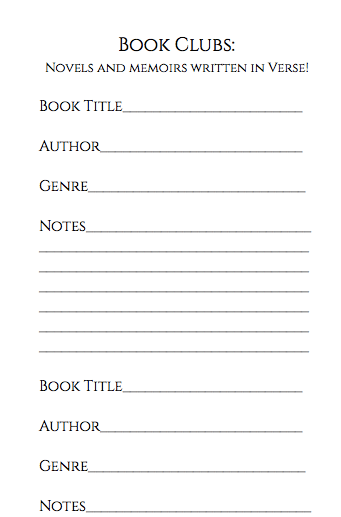
book club notes - verse

When we returned from spring break, students reviewed their notes and listed their top five choices. I assigned and handed out the books, putting between two and four students in each group.

IMG_6872

These are the titles students chose from.

The assignment was pretty straight-forward.Screen Shot 2018-04-17 at 3.37.17 PM

Students were directed to annotate for the fiction and/or nonfiction signposts found in Notice and Note and in Reading Nonfiction, (depending on their titles) the Book Head Heart framework and questions found in Disrupting Thinking, and some poetry vocabulary (listed below).


After they started reading, but before they were too many pages in, a few students had questions about how to annotate a book written in verse. They had annotated other texts before, but for some reason this type of text had some obstacles. IMG_7697 2

I decided to do a quick, fun example of annotating a narrative poem with a simple children’s poem by Shel Silverstein. Cloony the Clown has many of the fiction signposts, poetic devices, and we talked about the Book Head Heart framework. Finding the signposts and annotating together was fun. It took less than fifteen minutes to share the example in class, and my students seemed much more comfortable with annotating their book club books when we were done with the activity.

Students then used their annotations to spark discussion, and regularly use them during the week to practice their sustained conversation.

They will be assessed next week in the form of a video-discussion, where they will meet in their book groups. Using iPads, they will record their thoughtful discussions, referring to annotations, making connections with the text, and sustaining academic conversation for around twenty minutes.

What I’ve heard and seen so far has been encouraging. Students are sharing, referring to lines and stanzas, and feel accomplished that they have read a complete text in such a short amount of time. Some of them are on their second or third-draft reading, which I think is a great strategy and habit to reinforce. They are truly getting to know their books, and in the process learning about story, poetry, and close reading.


Some students were able to read their book club book in an hour or two, and then get right back to their other choice reading. Others are encouraged by the progress they are quickly making in a full-length book because it often takes them longer than a few days to read most of a book. That’s one of the many great things about books written in verse – it doesn’t take a long time to read them, but they are rich with language, story, character, and they hold student interest. With the variety of types and titles, there really is something for everyone.


I borrowed an idea from this amazing post from Buffy J Hamilton regarding connecting text to the world around us. Next week, as one of the finishing activities in this short unit, students will each bring in a current event article which somehow relates to their books, and use these articles to launch new conversations about their books, connecting the text to themselves and to the world around us.

I’m pleased with the way these books clubs are progressing. My students don’t seem to feel intimidated by the length or weight of the books, and they tend to agree that the books are relevant and thought-provoking. While some of them have enjoyed books written in verse before their book clubs, for others this is one of their first experiences with a book written in verse. So for some students, this unit validates and supports their reading experience, and for others, it opens a door to a new form.

I encourage others to try some “unconventional” types of text for book clubs. Graphic novels, short stories, and poetry collections are all ideas I’m kicking around for future book club units, and I’m wondering how other teachers have incorporated different types of texts in their classes, and encouraged new conversation. Please leave your ideas and experiences in the comments below!

Julie has been teaching secondary language arts for nineteen years, spending the first fifteen in rural Central Oregon, and the last four in Amman, Jordan. She’s thrilled to report that she and her family will be moving across the agua to Managua, Nicaragua next year, where a new adventure will begin.

Follow her on twitter @SwinehartJulie