Category Archives: Guest Post

Holden

Today I asked my colleague, Elaine Miskinis, if I could share her writing with the TTT community.  Elaine teaches Sophomore English, Junior English, and AP Language and Composition.  I am fortunate to pass my freshmen along to her while receiving her juniors in return. She perfectly sums up the struggles of first semester, the hope that comes with second, and the transformative power of literature. ~Jackie

Rye_catcherThe plan?  Spend the hour and a half between the end of the school day and kiddo pick up time entering my students’ midterm grades, doing some lesson planning for “Hamlet” and cleaning and organizing my room in preparation for third quarter.

The reality?  A student who is failing with a single digit average came to finish his midterm.  He mentioned, in passing, that reading Catcher in the Rye made him realize some things about himself.   Any conversation that opens with “The Catcher in the Rye made me realize…” is never going to be a short conversation.  It’s just the nature of that novel and the power it holds.

Long story short, he’s experienced some significant trauma and, like Holden, nobody has really been there to help him to process it.  He said, “You know how Holden is really smart, but he’s failing because he just can’t get out of his own head and move on from what he’s experienced?  I think that’s like me.”  Over an hour later we came up with a plan to get him someone to talk.  We also scrapped any plans of turning him into a model student this year and replaced them with the goal of helping him so that he, in his words, “Can stop pretending to be happy and actually start to feel it”.

So, now my classroom is a fire hazard of papers and books, my planning for Monday stands at “Wing It” and I have two bags of papers that have come home with me that still need to be logged into my grade book.  But, this was one of those days that will likely stand out when I think about why I teach. And, more specifically why I value teaching literature.  For every kid who whines and “Spark Notes” and skims, there might be one kid in the back of the room who looks like he’s disengaged and disconnected but who, in reality is so much in his own head at that moment, and possibly even so far in the head of a character that he’s lost in ways we can’t begin to see.

It’s easy to forget the power of novels, especially the ones we teach year after year and it’s easier still to forget the power we hold as teachers, especially when we’re consumed with midterms and grades and planning, and frankly, all of the things that really, in the end don’t amount to a whole lot.  Today was an important reminder to me of what it’s really about and why what we do really does matter.  I don’t know that we’ll be able to help this kid in any substantial way, although I certainly hope we will, but I do know that he felt comfortable broaching the topic with me this afternoon because he had Holden Caulfield there to lean on.  It makes me wonder how often these small, important moments get lost as we focus on assessments and core competencies and all of the minutia of our lives as teachers.  Sometimes it just has to be about more than that, and about more than reading check quizzes and essays.  Sometimes it has to be about letting our kids hang out with characters for a while to learn that they’re not alone.

A Writing Workshop Lesson: Inspirational Speech

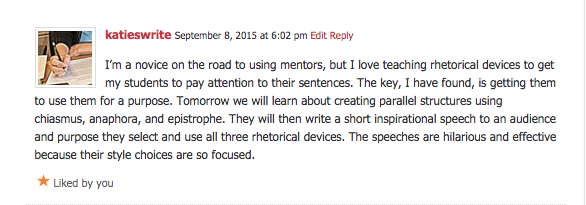
Last week I posted a mini-lesson about using student sentences as models for writing. Katie Bills-Tenney left this Screen Shot 2015-09-13 at 6.12.39 PMcomment. And I asked if she would write a post about her lesson.

She did even better:  she wrote on her own blog, complete with a lesson outline and student writing.

I love what she does here — and what her students do here, too.

Thank you for letting us see inside your classroom Katie.

Follow Katie at @Katieswrite

Guest Post: Technology Transforms a Writing Workshop

In response to this post I wrote about walking the talk in our content areas, another teacher has responded to my invitation to write. She says of herself:  “Karen Clancy-Cribby loves learning, especially from adolescents. She’s a teacher, writer, and Writer’s Workshop is her life. Literally.” Find Karen on Twitter @kcribby.

My husband and I live in the country on land that is expansive, scrub oak, tall grasses.  Every time I go to the kitchen sink, my first look is up at the hill, across the valley, and I scan the hillside before my gaze settles to the immediate foreground.  I do this probably twenty times a day.

It hit me today, as I thought about this blog, that how I look out and around, before settling into the immediate, is how I think about everything.

I’m a big picture person, and when I was given the great honor of being offered the opportunity to guest blog about technology and Writer’s Workshop with this amazing group of teachers, I jumped at the chance.

Then I realized I’d signed up to write about a lesson.  Well, therein lies the rub.  To describe a traditional lesson is just not what resonates with the organic nature of the classroom we’ve been so fortunate to run with Writer’s Workshop.  The “we” in that sentence refers to my language arts colleague (and former student, and former student teacher) who I team with daily.

I’ve embraced Writer’s and Reader’s Workshop since I first read Nancie Atwell’s “In the Middle” back in 1990.  I’ve read Fletcher and Calkins and others since, but I’ve mostly just been diving in.

So, back to the whole lesson idea.  Lessons in WW can, and should, of course, be planned, but to speak of them outside the daily dynamic of the classroom doesn’t make sense to me.  Sure, plan for different activities, plan with the end in mind, know and plan for what students should know (even that is a stretch, but that’s another blog), but the ebb and flow of class has to be more dynamic and a response to what happens with students.  So, WW has been an ideal.  Set aside time for mini-lessons, reading and writing time, feedback and closure.

Now, with technology in the mix, well, wow.  So, instead of blogging a WW lesson with technology, I’m going to give you a day in the life of WW with technology.  I need to thank my language arts cohort and daily teaching partner, Emily, who suffered through all of these pages of drafts for this idea for a focus.

Here is our day:

Student working on writing in the winter pulled up a fire for cozy atmosphere.

We have our daily agenda and objectives on a Google Document shared with our students, who walk into class oftentimes having already pulled this document up on their Ipads or phones.  Every day, we ask students to answer a question as they come into class.  Thanks to another colleague, Kris, we call these “Fire-Ups,” given that warm-up seemed too tepid to describe the first lesson of the day which should be big.  So, students pull up the agenda on their iPads and log into their Google Doc on the Chromebooks.  Sometimes they need to look up a few things to answer the question, sometimes they need to just think, and sometimes they need to read and re-read to answer the question, which, ideally takes no more than ten minutes for everyone to feel okay to discuss the question.

Within ten minutes of class, we will ask them how much time they need.  It’s usually no more than a few minutes, but oftentimes, our questions are bigger than we planned.

So, our agenda is a work in progress, and we adapt, as all teachers do,  as the class goes along. Sometimes, all students need a nudge in a certain direction, and we extend the lesson.  This often looks like one of us “saging on the stage,” while the other uploads examples or research hints and tools.

Other times, and I’d hazard to say most times, they all just need to fly.  Then, we have the luxury of sitting down at our desks, reading over their virtual shoulders and giving them individual feedback in person or on their Google Docs.

Writer’s Workshop has been my educator dream ideal since I was in college, and now the ideal is…well, I hate to sound absolute, but it’s possible, truly possible.

Technology allows all of that to happen immediately and in real time.  I am fortunate (understatement) to teach with someone who not only embraces the workshop pedagogy as passionately as I do, but she is a whiz with technology.  Four years ago, when she was my student teacher, we had netbooks, and we started using Google Docs, and I’ll never forget those opening days of my brain exploding.  We had our agenda on the overhead screen, shining from her computer.  The agenda was made in Google Docs.  I had a few students who preferred to access their writing from their phones.  If I didn’t read literally over their cyber-shoulder, I would not have believed how fast they could write using their phones.  As more and more students used their phones alongside the netbooks (we are so lucky to now have Chromebooks!), I started thinking about so many possibilities of all the access they had to information.  Then, there were whispers of our district going 1:1 with iPads.  I’ll never forget standing in the front of the room with Emily, my student teacher, and I looked at her and said, “we can have the agenda online for them to have access to,” and she looked at me and said, “they can write their responses on a Google Doc too.”  That was four long (or short?) years ago.

Now, we’re all online, and I feel as though the newbie teacher dreams of a perfect Reader’s and Writer’s Workshop are now a reality.  Well, perfect is an oversell, but all of those years where I would say, “read and write whatever you want” have been transformed.

Students walk into the classroom, open up their Chromebooks and their iPads. Most students pull up the agenda on their iPad and then start answering their fire-up question on their running Fire-Up Google Doc.   The question is related to where we have been and where we are going.  We try to stretch the question, make it something they need to think about.  Sometimes there is a background/research portion, and then the question.  Sometimes it’s a piece of literature they need to explore for techniques; sometimes it’s a revision piece they need to evaluate.  These Fire-Up questions are very often taken from my own personal writing.  Writer’s Workshop isn’t WW without the teacher as writer.  The beauty of the Fire-Up being taken from my writing is that I am starting most classes with modeling myself as writer.  I can then keep going back to my writing, allowing everyone to critique it.  I have noticed that students are at their best when they are critiquing my writing.  With peers, they sometimes become too gentle, or the reverse, too harsh.  With my writing, they are quick to get to the heart of what needs improvement or what things work and why.

I get to do the think-alouds about my own writing; things I like, things I want to make even better, my purpose, etc.  This leads to them then taking that mini-lesson and my modeling metacognition, and then they look at their own writing, and other’s writing.

My teaching cohort Emily and I were talking the other day about how she needs to do some writing. We have an easy balance together, but she’s right.  She needs to write.  The best way we show ourselves is at our in-progress stage of writing, discussing what we want to do for purpose, topic, and audience.  We should not show ourselves ever thinking we’re “done.”

Back to how technology transforms this all.   Sharing is more immediate; there are multiple modalities for discussion (Edmodo for responding, Padlet for throwing out fire up responses, sharing of Google Docs for commenting).  The transformation, for me, having taught using this model for so long, is that if I ask a student to explore an interest, they can do it, right then, right there.

They can find and access a kazillion mentor texts.  ‘Nough said.

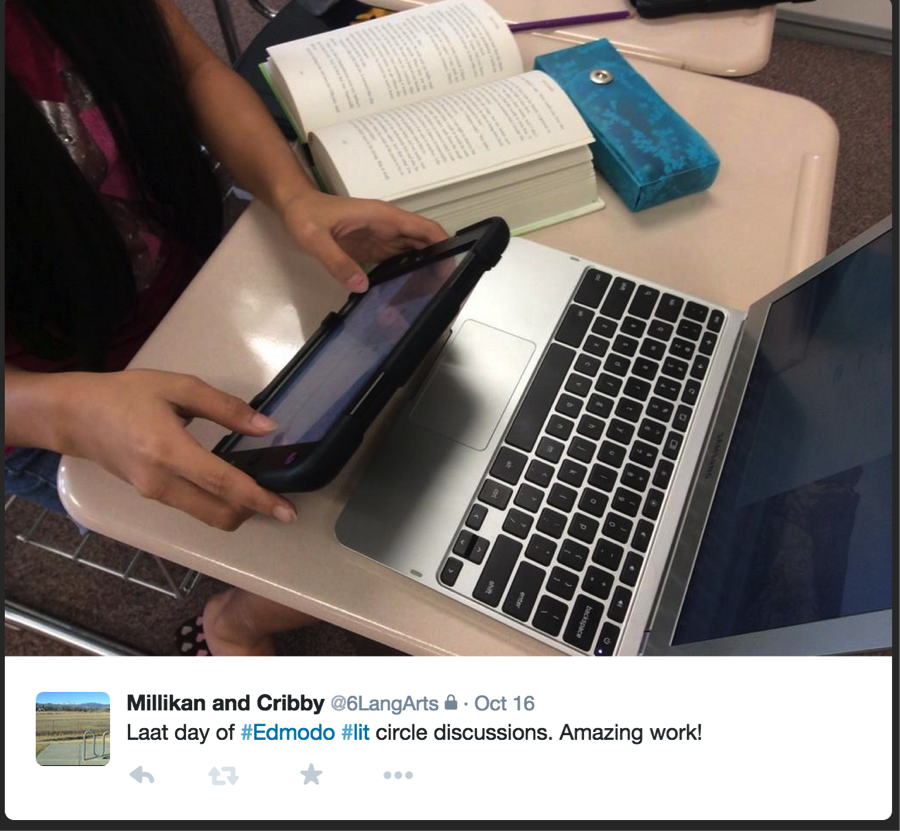
Student finishing up an online literature circle discussion using Edmodo.

Student finishing up an online literature circle discussion using Edmodo.

Here is another snapshot of this transformation.  As we were moving into the second quarter of language arts, Emily asked me how we should frame our lessons as we continued.  It hit me that though we were using the workshop model, it had transformed to such overwhelming possibilities.  It felt like grooming a rock star who had hit the charts.  I have no idea why that analogy came to me, but it’s so hard to describe the little monsters we’d created with so much room for them to stretch, reach, and grow with Writer’s Workshop.  I answered her with a gleeful, big, let’s see-where-this-will go shrug and said, “well, nothing has changed, let’s keep the workshop going, but maybe we need to call it something more expansive, like, “Learning on your own.”

The next day, when LOYO was on our agenda, and many students knew what the acronym was, well, wow.  The teacher learner in me talked about how their learning was officially limitless, and I was excited to sit down and visit with them and see where they were going.
I’m excited to see where I’m going.  I get to do this.  Every day.

Guest Post: The Case for Teaching Reading in High School

cherry-blossoms-from-our-bedroom-window-april-2014As spring arrives, the cherry blossoms start to bloom, the daffodils open their petals towards the sun, and high schools across the country begin their own feverish rite of spring, end of course test intervention and remediation. Schools will hold after school opportunities to help students prepare for a reading test that they must pass. In my state, Virginia, if students don’t pass the test, they don’t graduate, the school’s graduation rate is affected, and accreditation is considered. All this is not to say that schools don’t want to do what is absolutely best for students, because we do. We know that a high school diploma can make the difference between a mediocre job and a career. But we don’t grant a high school diploma unless a student passes the reading test. The irony is that, undoubtedly, when we sit down with these students to help them prepare, we will be doing little reading at all.

What are the costs of not reading well? The Alliance for Excellent Education, estimates the cost in terms of lost wages over a lifetime due to low literacy skills is around $335 billion per year. According to Reading at Risk, a survey conducted by the National Endowment of Arts, there is a sharp divide in reading skills of incarcerated adults versus non-prisoners. On the flip side, those who read more for pleasure exercise and volunteer more. They even vote more. And students are not going to read more, are not going to become avid readers, if they are not reading. Students should be engaged in what they are reading in order to become more competent readers. Not surprisingly, reading more makes us better readers. The Department of Education reports that frequency of reading for pleasure correlates strongly with better test scores in reading and writing. Students who read outside of school see more vocabulary, reading comprehension, verbal fluency, and background knowledge growth, all of which are skills students need in order to pass the reading test. Right now, there is a decline in voluntary reading rates among teenagers while at the same time reading skills in schools remain stagnant or worsen. A required reading test is not the problem. Students graduating from high school should have the skills and strategies to pass the test. The problem, instead, is that in this era of high stakes testing and accountability, schools, divisions, and states have lost track of the original goal of the test, to ensure that all students who graduate from high school in the United States are competent readers. Instead, we are focused on teaching for and to a test.

According to the most recent National Assessment of Educational Progress (NAEP), our country’s 4th grade reading scores are slowly moving up and are the highest they have been in the past 33 years. This is great news as it shows the achievement gap is shrinking with our elementary school population. Unfortunately, the numbers are much different for our adolescent learners. The 2013 average reading score for adolescents has gone down from the first assessment and remains unchanged since 2009. In Virginia, only 36% of eighth grade students scored at or above proficiency level on the NAEP reading test. Students with disabilities and English language learners are often struggling readers, and schools have a difficult time meeting accreditation as these subgroups continue to score poorly on state reading tests. In fact, the achievement gap among high school seniors with and without disabilities is growing.

In our current era of accountability, it is required for states to have a reading test in order to be accountable to the federal government. States need to show that students are making adequate progress in reading. These scores are not only used for accountability at a state level but also on a more local level. Community members look at these scores in an effort to understand the needs of a school or division. Unfortunately, when we look at the demographics of the students we are currently cajoling to stay after school for extra test preparation, we don’t see good results. Last year, although 90% of students in Virginia passed the end of course reading test, only 62% of students with disabilities and 70% of limited English proficient students passed. This, in turn, is affecting Virginia’s accountability score for the federal government, as students with disabilities and limited English proficient gap groups did not make adequate progress.

Instead of prepping students to pass a specific test, schools should focus on teaching students how to girl-reading1read better. Schools can do this by teaching students at the appropriate reading level and using explicit instruction while at the same time increasing teachers’ professional development on literacy. Students need to be reading high interest books that aren’t too difficult or they will give up and not read at all. English language learners may start school with little literacy preparation which, according to the NAEP study, results in only 3% of English language learners in the 8th grade scoring at or above proficient in reading. These students will not pass a test by having test prep. Instead, they should be reading, analyzing, and talking about books and passages that they can read so that they can do the rigorous work asked of them.

In Reading Next, a Carnegie Corporation report, researchers map out fifteen elements of effective adolescent literacy programs, none of which include test preparation. Instead, this report focuses on the importance of explicit instruction in comprehension, vocabulary, fluency, writing, and motivation for struggling readers. Schools should be providing these literacy interventions in the school day every day, not just after school as the test looms near. Time must be spent in class with texts in order to read and write effectively. Research suggests that these texts should ideally consist of good literature on and slightly above students’ reading level to grow as readers. Professional development should be provided for teachers so that students who struggle can work on strategic reading skills in all their content classes.

boy readingWe cannot better prepare students for the test by having them practice process of elimination in answering the multiple choice questions. Instead, we must require a shift in instruction to do the hard work of teaching students to be more strategic, aware, and yes, avid readers. We can do this by helping students where they are, providing support where they need, and allowing them time to read. Schools should shift our focus towards real reading in order to better prepare for the reading test. We need to prepare stronger readers to help them be successful both in their professional lives as well as in their community. So as spring is upon us, we cannot get caught up in the flurry of test prep remediation but instead should teach reading by having students read. What a better season for it? For surely, it is not a coincidence that a perfect way to enjoy this spring weather is to sit outside and read a good book.

References Pfautz article

Jeannie Pfautz is a reading specialist in Charlottesville, Virginia.  She loves the opportunities she gets to work on reading and writing every day with her students.

Guest Post: How a High School Improved Reading by Building Little Free Libraries

busLast summer, I became a Penny Kittle convert. I originally didn’t know what I was signing up for, but something kept driving me to be sure I was where she was. Turns out, it’s been the best hunch of my teaching career. The mind shift I was searching for. A complete game-changer. And this is year eighteen.

After 2 ½ days with Penny, I spent the rest of my summer trying to keep up with my churning brain. I wrote more than I have since I was a slightly over dramatic, totally drowning-in-love teen. I read. And I read. And I read. I rediscovered that lust for story I had almost forgotten. I freed myself from the idea that pleasure reading was fluff and gripped the concept of reading what speaks to me as a means of improvement – just like I would soon ask my students to do.

In the midst of my mid-career crisis (maybe crisis is too harsh?), I found a tweet about the site littlefreelibrary.org. The various clever wooden boxes built for books captivated me. I loved the idea of a take-one-leave-one system designed to build community. What fun! I wanted one! Maybe a home project with my own children? Then, I had a thought. What if we put these book boxes in the hallway at our high school? What if this could be the reading take-over Penny Kittle encouraged? So, on my wild whim, I retweeted the link with that very suggestion.

Soon (which means mere seconds in the Twitter world), my teacher peers of all disciplines — math, sharkscience, history, technology, world languages — responded with enthusiasm! They wanted to build wooden cubbies! They wanted to donate books! They were all on board! So, the fun began…

In an August inservice session, I presented the idea to the full faculty, highlighting the importance of choice-reading in ALL classrooms. I used so many of Kittle’s words in an effort to begin a movement. We have to get all of our kids reading – the rich, the poor, the gifted, the challenged, even the ones who don’t eat their vegetables. And, in a school as diverse and unique as ours, we couldn’t wait another second. Of course, there was one small glitch; I didn’t know or have the means yet to build the little libraries. But I knew we could.

Following my first session, our new theater tech teacher immediately approached me, and he offered to have his tech class build the first set! I cried. I usually do at most sentimental things, but I just didn’t expect this outpouring. Books began to appear in my classroom from teachers and then parents. Some opted to write an inscription inside their favorite books, explaining to the future reader the special significance of that particular tale.

#hebronreads was born.

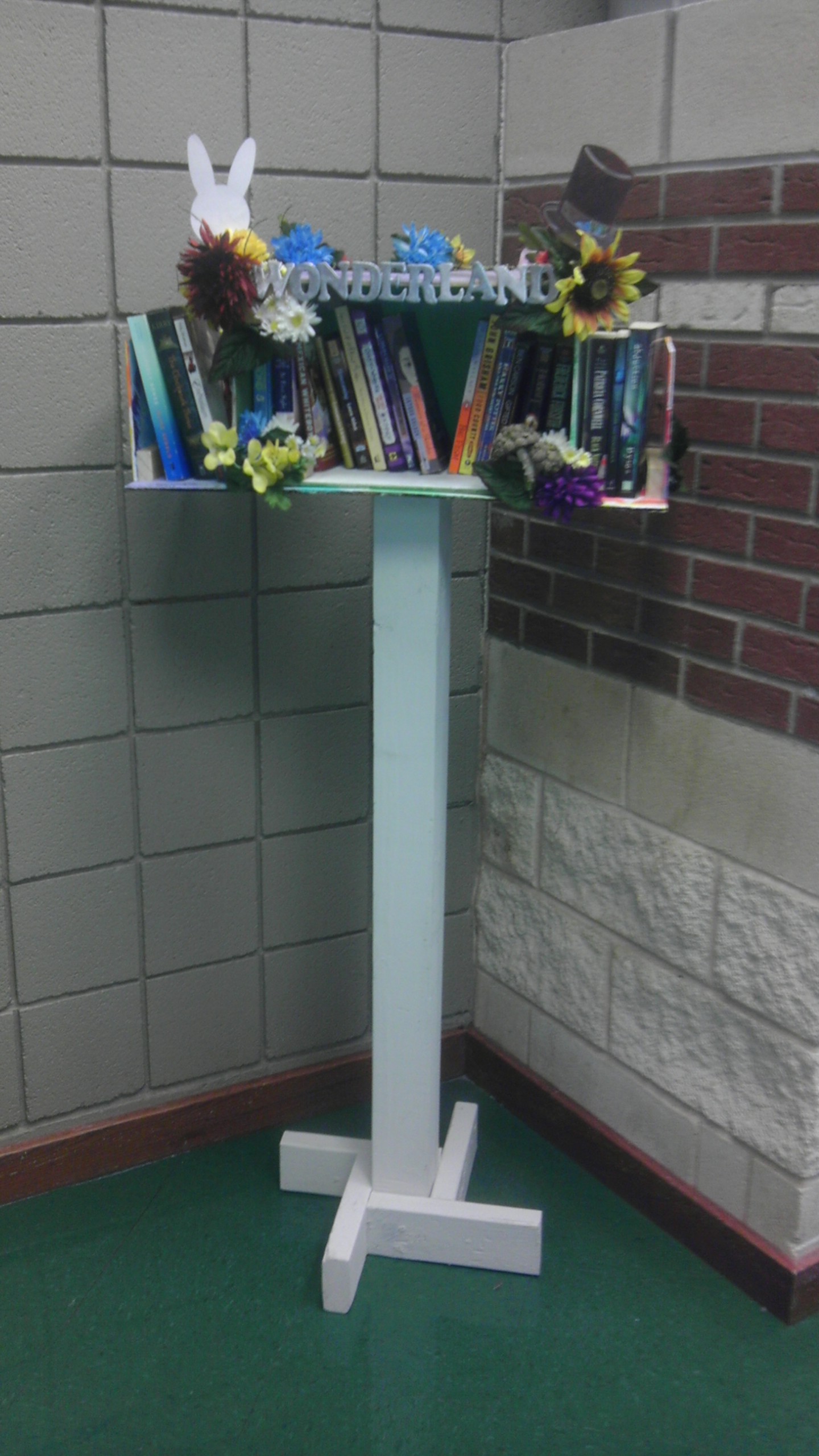
The theater tech class created the first five Book Nooks, as they are now called, from lumber and Slide2supplies donated by our community. In true theater style, the Nooks have flare – a shark, an Alice in Wonderland, a school bus, the Parthenon, and, of course, a book! All student created! All on pedestals in various niches in our halls. At our fall open house night, books poured in from parents who heard our call to promote literacy, and books continue to appear in my classroom like gifts from the Tooth Fairy.

Students in our advertising and marketing classes competed to create a campaign for the program. On World Read Aloud Day in March, we paused to read to our students, and we passed out bookmarks and talked books during lunches. Students have daily choice-reading time in math classes and business classes in addition to English classes. Another book drive is slated during our spring football game in May. A spring literacy night with former Hebron High School grad now YA author Lindsay Cummings is in talks.

alice


This is only the beginning.  

In my hopes and dreams, we will build more Book Nooks and litter the building with choices. We will continue the book drives until all classrooms have some sort of libraries. We will keep talking reading and promoting ideas via @hebronreads. And one day, when we are feeling pretty confident in our literacy push, we will make Nooks and take them filled with books to neighboring schools who need more stories in their lives too. Hebron High School is now a thriving community of readers, and it is truly glorious!

Parent quote:

“My son has always loved to read (‘loved’ is probably an understatement), so when he found these books in Hebron’s hallways, he was very excited.  He came home telling me what a neat thing this was — books for the taking, any book, all kinds. Once he understood the program, he commented on what a great idea . . . read a book, replace a book, or just bring it back. Great idea, Hebron!”    Carolyn Sherry

Donna Friend teaches at Hebron High School in Carrollton, Texas. She is making readers out of English III students and leads her department into the chaos of educational risk-taking. Currently, she is honored to be her campus as well as the Lewisville Independent School District’s Secondary Teacher of the Year, an accolade that, despite her 18 years of teaching, she doesn’t yet feel old enough to have earned! Her current favorite book is Jandy Nelson’s The Sky is Everywhere, and she is practicing being a regular reader and writer along with her students. She has a 9 year old son, a 6 year old daughter, a hubby, two cats, and a few fish. She once dreamed a young adult novel and still regrets not writing it down immediately after waking. Find Donna on Twitter @mrs_friend

Guest Post: Changing the Reading Culture in Our School One Book at a Time

Both Penny Kittle and Kelly Gallagher have transformed my thinking as a high school literacy coach.  As a former elementary school teacher, I had always used reading/writing workshop, literature circles, and choice in my classroom.  When I transitioned to being a reading specialist/literacy coach in a high school, I really struggled with the whole class novel approach.  It didn’t work for me with the little ones and I saw more and more of my students struggle with it at the high school level.  Attending workshops offered by Gallagher and Kittle, along with reading everything they have written has given me the reassurance and the research that this approach CAN work in a high school.  Here is what has happened at my high school in just six months:


More and more teachers are trying it…

It all starts with one teacher and the support of a department chair.  Last spring after sharing what I learned at Penny Kittle’s Book Love workshop, one teacher decided to drop everything he has been doing in English and take on the “Book Love” approach.  He had so much success getting students to actually read books and improve their writing that two other teachers decided to jump in second term and teach English through choice and mentor texts.  The results were astounding. Word spread at lunch and in our PLCs – students were engaged and excited to come to English class.  Then at the beginning of term three, we had four more teachers jump in.  I am not sure if it was the “positive peer pressure” or hearing about students’ engagement, but little by little teachers have been asking about how to structure their classes in a way to make this work.


Teachers are reading more and talking about books…

At times during lunch teachers used to vent about the struggles they had motivating students to complete the reading from the previous evening, or how students bombed the reading check, but now the conversations are about books. We are talking about what we are reading, what our students are reading, what mentor texts we are using, and what changes we see in our classrooms.

Thanks to one teacher’s organization and determination, staff members are swapping rooms once a week and book-talking to students that they don’t teach.  The other day the principal’s secretary came in to our freshman class and book talked The DaVinci Code.  After she left, I saw that several students had added that book to their to-read list.

None of this would even be possible if our teachers weren’t willing to read new books.  Teachers are setting their own reading goals, keeping to-read lists, creating book trailers, etc.  For the past two years we have had “I am Reading” posters outside of our classroom doors, but this is the first year teachers are updating their posters more often and students are noticing the books.


Our library is busier than ever before…

We have a beautiful library that has a lot of books that just didn’t get checked out.  This year that has changed.  Last year from August until the end of February, only 4821 books were checked out and 63 books were placed on hold.  This year in the same time period 7333 books have been checked out and 137 books were placed on hold.  That is over 2500 more books being checked out and 74 more books being asked to be held.  Why the change?  Student choice!

Students now come to the library with a purpose.  They have a to-read list (some that are pages long) and if all the books they want are checked out, they can give us a good idea of what they want to read next.  As one of our English teachers told me, “They are thoughtful about what they are looking for if they go to the library.”  He doesn’t worry anymore about students going up to the library trying to “leave class” or “waste time.” Another teacher shared how his students “know their favorite authors and/or recognize titles that have been book-talked.”  They are talking to each other about books and recommending new titles to each other.  They are even checking out 2-3 books at a time.

Our library staff is also trying hard to find ways to get books in our students hands.  Our librarian has shared ARCs with classes and spends time in the classrooms promoting tons of books – the new ones and some of the oldies but goodies that haven’t been checked out in a while. The staff has started creating competitions each month to encourage students to read (Abe Lincoln Award voting, March Madness book bracket challenge, etc) new books.  The library is no longer just a place for students to come and get homework done.


Students are reading….

They really are reading and not just the “YA” books that naysayers worry about.  Prior to taking this approach, students came into classes either as students who read all the time (1-2), students who only read assigned books, students who fake read assigned books, and students who didn’t even try fake reading the assigned books.  As one teacher pointed out to me, “As soon as choice became an option, reading, for the vast majority of the students, became fun again!”  They began forming a reading habit that had been lost so long ago.

The issue is no longer trying to get students to read anything. They are reading more consistently than ever before.   Instead of dealing with them reading zero pages in a week, teachers are finding ways to increase student stamina from 50 to 150 pages in a week. That in itself is a huge success.  Students come to class early and start reading their books.  They can even be found reading as they walk down the halls. One boy almost knocked over an upperclassman in his attempt to finish the chapter of his book.  Once a week I co-teach in a freshman English class.  Of those twenty-one students, I think only two students have finished three books.  The rest have read an average of six books in nine weeks (snow days and all). Instead of worrying how to encourage our students to read common texts and pass the reading checks, the challenge is having enough books that interest all of our readers.

Our students ARE challenging themselves – reading more, picking nonfiction, moving up the reading ladder, and trying new genres based on what others have recommended to them. I had one boy in my homeroom start with Hatchet by Gary Paulsen in January and stretched and read Escape From Camp 14 by Blaine Harden for book two.  It was definitely challenging for him, but he didn’t give up on it and was so proud when he finished it.  Other teachers are finding the same thing – students are willingly picking up books from Fitzgerald or Vonnegut, or Hemingway and are able to have real conversations about these books from their perspectives. Students are talking about books with each other AND coming up to teachers and discussing books with them. Because of the location of my office (the library), I tend to do book talks quite often when kids come upstairs and are looking for something new to read.  One of my favorite memories from this winter was a girl who had seen my Goodreads list and made her to-read list off of some of my favorites.  After she finished To All the Boys I’ve Loved Before by Jenny Han, she asked her teacher if she could come find me and talk with me about it.  She had loved it so much and wanted to thank me for introducing her to that book.These students aren’t afraid of looking smart or nerdy – they are proud.


The culture is changing…

Students are now immersed in books wherever they turn.  Between our March Madness Book Bracket challenge, I am Reading posters, Classroom Reading Trees, the Health class independent reading project, random teacher book-talks, etc. students are reading more than ever before.

Melissa Sethna @msethna23 is a high school literacy coach in Mundelein, IL. She has always had a passion for books, technology, and working with adults. In her free time, she loves to read.  She’s a strong believer in book choice and sharing her joy of literature with her family and students. She says, “I wouldn’t be the teacher I am today without my reading heroes: Penny Kittle, Kelly Gallagher, Kylene Beers, Bob Probst, and Donalyn Miller — who inspire me to take risks, and I try to encourage others to do the same.”

Reading Resolutions

For the past few years, all of my reading has been for the purpose of research.  I read pedagogical teaching texts or young adult lit almost exclusively, and when I branched out from that, it was to read complex books that I thought I might use to challenge my students to use for craft examples in class.  I read only as a teacher, and not as a reader.  In 2015, I’m determined not to do that.

pc

Poet’s Corner

Ten days ago, I was in London, England.  Pretty much every moment of every day since then has been spent either reliving a magical moment there, or frantically trying to catch up with everything I fell behind on here in real life.

Much of that trip of a lifetime was spent flitting around different literary sights in London.  My husband and I had a beer at The Plough, the famed pub of Dickens, Woolf, and Darwin.  We visited Poet’s Corner in Westminster Abbey and saw graves of and memorials to my heroes Jane Austen, William Shakespeare, C.S. Lewis, and more.  We enjoyed a visit to the home of the most famous fictional character in England, Sherlock Holmes.  The Globe Theatre, The British Library, Southbank Book Market…we saw it all.  Awash in the history of English literature, my trip made me desperately want to revisit much of it.  I can’t think of the last time I read a classic for pleasure.  So, I made my first reading resolution for 2015: read my roots.  My degree is in literature, but I’ve missed out on a lot of its classics–probably because they were assigned as boring whole-class novels and I knew about SparkNotes, but I digress.

NYT-list---11---Cropped-761259So, I knew I wanted to read some classics for fun.  But I also wanted to make sure I read lighter, easier things too, for a different kind of escapist fun.  I got curious about bestsellers I’d never bothered exploring…Janet Evanovich. James Patterson. Sue Grafton.  I’ve never read any of their books, but millions of others have. So, that’s another resolution–read my age.  I’m a 27-year-old female lover of mysteries, and I’ve never cracked the spine of an Agatha Christie! So much of my reading life is focused on the 11th graders in my classroom, but I need to read my age, too.  I want to read what everyone is reading and talking about–all of the New York Times bestsellers, not just the Young Adult list.

FullSizeRender

Heaven in Outer Banks

My last resolution is to relax and read.  I recently read an article about a woman deciding not to participate in the GoodReads Reading Challenge because she felt like it stressed her out and diminished her intrinsic love of reading.  The comments were overwhelmingly negative and unsympathetic, but I found myself in complete agreement with her!  I was always “behind schedule” on the challenge, always feeling like I couldn’t take the time to read anything massive like The Goldfinch or pondering like The Poisonwood Bible or immersive like Will in the World.  Those books would take me way too long to read, and how was I supposed to find new things to booktalk for my students then?!  Well, I’m done with that.  I want to return to the days of my vacation in North Carolina last summer, where it rained for seven days straight and all I did was read.   It was the perfect beach vacation.

FullSizeRender (1)

My selfish to-read list

2015 is my year to stop feeling guilt, obligation, or stress about books.  Yes, reading saves lives, changes the world, and creates empowered, literate citizens, but that’s not why people read.  And that’s not why I try to get kids to become readers.  Reading is an exercise in imagination, in escape, in adventure.  It’s joy and pleasure and heartbreak.  It’s empathy and knowledge and understanding.  I’ve been so busy trying to teach that that I’ve forgotten it myself.  This year, my resolution is to remember that.  What’s yours?

Share your #readingresolutions and see others’ on Twitter.

We Learn Facts from Fiction

NCTE is always so magical, isn’t it?  It’s a five-day frenzy of learning and teaching and connecting and wondering and writing, which should be exhausting.  But it’s not.  Somehow, I come back to school every year with so much energy, revitalized by the conference and its plethora of ideas and inspiration.

This year at NCTE, as the words and wisdom of my teacher heroes washed over me, I was drawn in by one theme that kept recurring–the role of narrative in informational text.  Given that the theme of the conference was “Story as the Landscape of Knowing,” this wasn’t surprising.  What did surprise me, though, was that almost everyone I heard speak discussed how narrative helped learners in the context of nonfiction.  I began to wonder–what about narrative in its most accepted place–fiction?  What information do readers learn from reading fiction?

ptiIn addition to hearing from many teacher-researchers, I also got to hear from many authors.  David Levithan, e. lockhart, Libba Bray, Lester Laminack, Paul Janeczko, Georgia Heard, and more spoke about their writing processes.  Every one of them mentioned research at length, and I jotted a note–“research processes are as multigenre as its products.”  All of those writers had a unique research process, but they were all strong.  These authors put work into making their fiction as fact-based as possible.  Others discussed putting their own lives into their fictional works–Sherman Alexie has too many parallels with the narrator of Part-Time Indian for it to be a coincidence.  What’s more authentic and research-based than a lived experience?

bsogMy brain was whirling.  How many fictional novels have helped me fill gaps in my understanding?  Between Shades of Gray enlightened me to the fact that there was a Baltic genocide.  The Absolutely True Diary of a Part-Time Indian taught me about culture on a reservation.  Extremely Loud and Incredibly Close brought 9/11 to life for me.  Peak showed me the world of Mt. Everest in a new light.

Fiction transports us to other worlds…it lets us know we’re not alone…and it saves our lives.  But it also teaches us a great many facts.  We don’t ask our students to read in order to just make them better readers.  We ask them to read because we know it will improve their lives…help them attack the “idea poverty” they suffer from, in Kelly Gallagher’s words.  Fiction, especially the YA fiction that is so popular in my classroom, is educational at an informational level.  Readers acquire knowledge of topics they had limited prior knowledge about by reading fiction.  They also gain understandings of universal themes and grand ideas, but they also learn facts.

Forgetting this is a grave oversight, and perhaps is at the root of why YA lit isn’t always considered “serious” literature.  Kelly Gallagher also said that “there is wisdom in Hamlet that is not found in Gone Girl,” and he’s right.  But there’s also factual information in Elizabeth Peters’ Amelia Peabody series about Egypt and archaeology that I did not get out of Antony and Cleopatra.  We do a disservice to authors when we discount their research processes just because they write in a genre called fiction.

All that we learn, and that our students learn, may best be processed in narrative form…but information doesn’t just have to come from nonfiction.  This is an important lesson–it’s why reading needs to be a schoolwide, nationwide, worldwide focus–not just the job of English teachers.  Reading EVERYTHING helps us acquire knowledge, expand our schema, make sense of the world, and become productive, intelligent, informed, democratic citizens.  And it also makes us pretty damn happy.

What fiction are you and your students reading that helps you acquire knowledge?

#NCTE14 J.44 Nonnegotiables Across the Landscape of Workshop

Jackie, Erika, Amy and I are excited to present at NCTE in Washington, D.C. on Saturday at 2:45 pm. Penny Kittle is our Chair. We are session J.44. Join us!

“I am the sum of my mentors,” writes Meenoo Rami in Thrive.  As a student at Miami University in 2005, I had no idea how fortunate I was to have Tom Romano as one of my mentors.  As a leader in educational writing, a teacher with his thumb on the pulse of research, and the giant who first introduced me to NCTE, Romano has always been my single biggest mentor.

As I thought for months about what I wanted to share with teachers regarding the readers-writers workshop at NCTE, I was reminded of an assignment I’d done in Romano’s class–to find the “red thread” of my teaching…my nonnegotiables regarding our profession.  I dug for it in the depths of my hard drive.

Re-reading it, I laughed as I always do at my older writing, but then I smiled.  Many of my nonnegotiables remain unchanged: sustained silent reading.  Craft informed by research.  Authenticity.  Engagement is central.  Model, model, model.

Tom Romano obviously did a damn good job as a mentor.

IMG_5031Those simple principles–plus my genuine passion for reading, and writing, and the joy I believe they can bring everyone–inform my practice day in and day out.  They are supported by the research of Penny Kittle, Katie Wood Ray, Tom Newkirk, Kelly Gallagher, Donalyn Miller, Linda Rief, and more.  I am the sum of those mentors, and in this season of giving thanks, I’m so grateful that I am.  My students have found incredible success because I stand on the shoulders of those giants, and I can’t wait to share their stories at our session in Washington, D.C.

Professional Development Doesn’t Have to Be Painful

We all know–and perhaps fear–the Disrespectfully Disengaged Learner.  You know the one I mean:  rolling his eyes, muttering under his breath.  Asking to recharge her phone so she can keep playing games instead of listening.  Sometimes, that learner is even you or me.

IMG_5737

Materials for our workshop are ready!

They say teachers are the worst students, so maybe that’s why I’m so nervous about the workshop I’m helping to lead today.  My colleague and I will present to 20 of our fellow teachers, and we have worked incredibly hard, for many hours, on our presentation and materials.  Even if 19 leave our classroom with smiles on their faces and a new spring in their steps, there will almost certainly be one person we can’t reach.  Sadly, that one person is the one I’ll obsess over for weeks to come.

The phrase “professional development” has somehow become synonymous with “eyeball gouging”, at least in all the schools I’ve taught.  But professional development doesn’t have to be painful.  Its purpose (like so many other well-intentioned ideas) is a positive one–to advance a person’s career or personal development through learning.

That doesn’t sound so bad, right?

IMG_5610

Kristin Ziemke presents during “Notebooks, Pens, and Pixels”

Don’t get me wrong:  horror stories abound.  I recently sat through eight straight hours of lecture at a “training”, zero hours of which were relevant to my classroom, and ended up lying in the hallway of a hotel conference center with a very pregnant colleague, who simply couldn’t sit in her chair any longer.

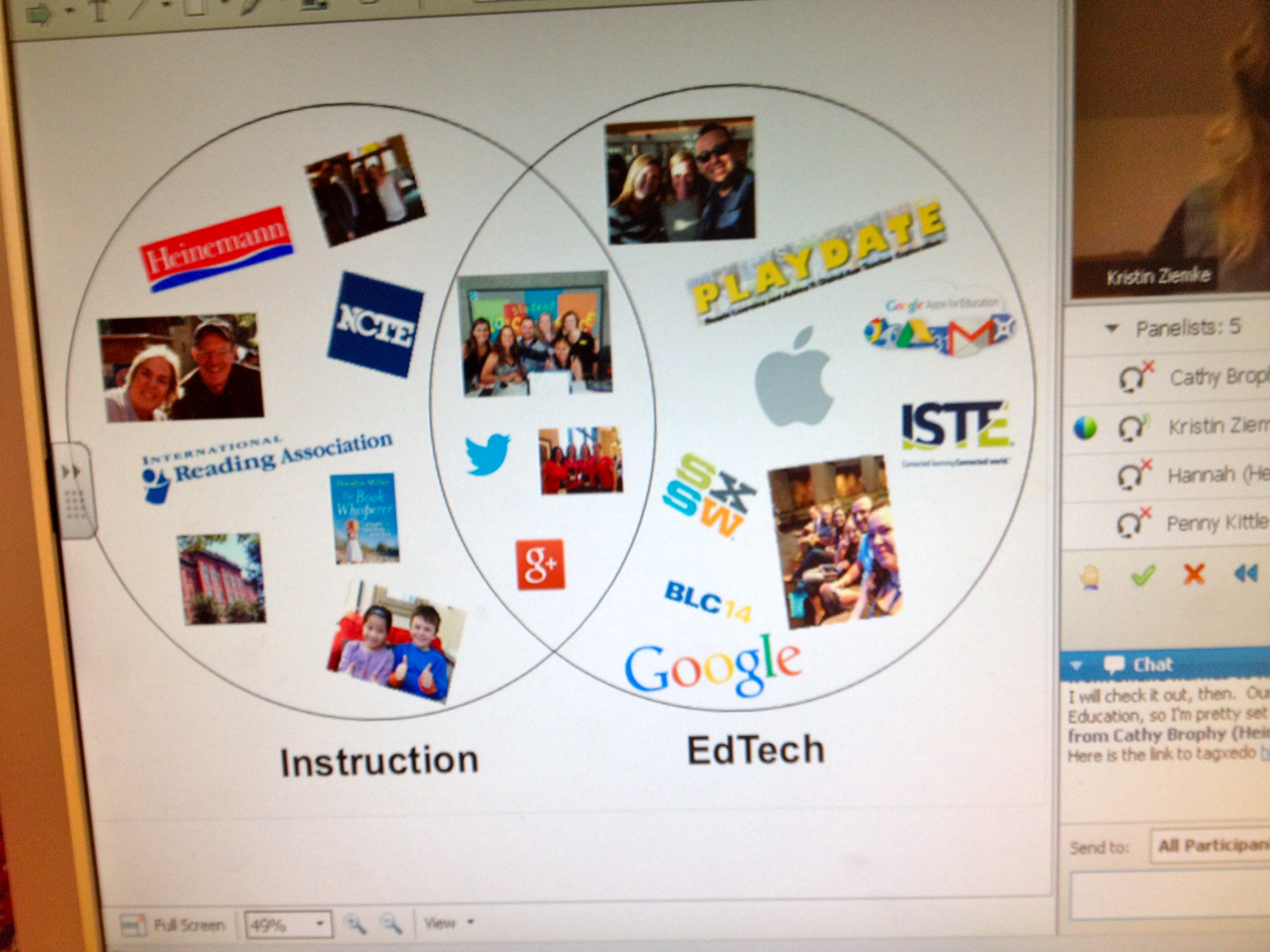
But, even more recently, I sat on the edge of my seat as I listened to Penny Kittle, Troy Hicks, and Kristin Ziemke present on using technology in language arts education.  This free Heinemann webinar lasted a little over an hour, but it felt like only a moment had passed as I listened to those teacher-leaders share their mind’s inner workings.  That amazing webinar, which also granted me insight into Kelly Gallagher and Tom Romano’s thinking-through-writing processes, falls under the same umbrella that torturous eight-hour lecture did.

My professional to-be-read shelf

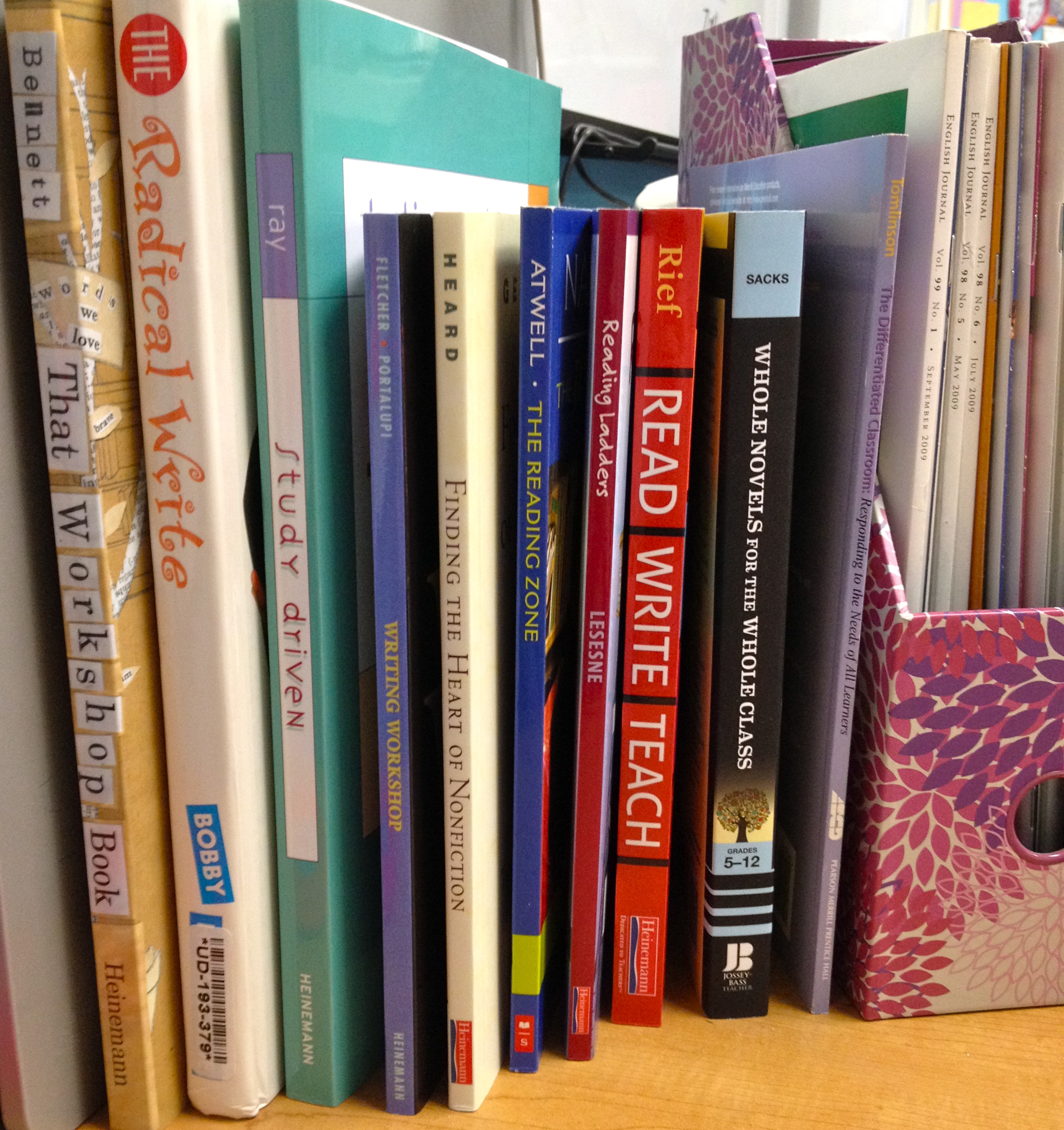
My professional to-be-read (and re-read) shelf

Presentations and lectures aren’t all there is to professional development.  Simply reading the latest research is PD–sharing ideas over lunch with a colleague is PD–sitting down to write and reflect in the mornings is PD, too.

I’d argue that professional development is a teacher’s duty.  Teachers really shouldn’t be the worst students–we should be the best.  As professors of knowledge, shouldn’t we crave knowledge?  Hunger for new ideas?  Salivate over scholarship?  If we seek to inspire a thirst for learning in our students, we must have it in ourselves.  There are too many ways to grow in our profession–Twitter, online journals, NCTE, the National Writing Project–for us to not take advantage of the many opportunities for growth that come our way.

Professional development is something to aspire to, not to dread.  Seek it out.  Savor it.  Lead it.  It will make you a better teacher, and a more richly knowledgeable professional–and there’s nothing painful about that.