Category Archives: Amy Rasmussen

Five Ideas That Beat the Dread: A Return

Three Teachers TalkThank you for joining us for a summer series revisiting our top posts from this school year! Don’t forget to please “turn and talk” with us in the comments section one last time.

Amy Rasmussen’s back-to-school post from 2018 will help you frame your school year positively and “beat the dread.”


A few years ago I stopped reviewing class rules and smacking down my syllabus on the first day of school. I had been doing some research on chronic stress (mostly my own) and read extensively about the fight, flight, freeze response. One description glared at me and gave me pause:  “You have a sense of dread.”

I remembered what I had been taught as a first year teacher:  Set yourself up as the authority figure. Be kind but firm. Establish norms quickly so students know what you will and will not tolerate in your classroom.

Then, almost in the same breathe, I was told:  Develop relationships. Learn students’ names. Let them help develop class rules.

And I muddled through doing a combination of both the best I knew how. Those first few days of my first few years were rocky to say the least. And in hindsight, it’s clear:  there was dread. Lots of dread.

So when I read up on the fight, flight, and freeze response, I realized a big part of my problem:  With my seemingly simple attempt at outlining classroom expectations and detailing how ‘my class would run, chemicals danced a jig in students’ brains: fight, flight, or freeze. Now, I know my syllabus is not on the scale of major life trauma most often associated with this fff response theory, but many of my juniors and seniors didn’t want to be in school anyway. Why was I compounding it?

I learned a better way.

Wait.

Let every other teacher lay down the law. Lay out their plans. Run through the rules.

On the first day of school — maybe even the first five days of school — just write. And talk. Let students drive the discussion. Let them ask questions. Give them a chance to be seen and heard and welcomed.

“Community before curriculum” Angela wrote in her last post, and I love her thinking there. I also think we can merge the two on the first day of school and lay a firm foundation for thinking and talking every day thereafter. We can jump start community and begin our curriculum as we put pen to the page and write.

Here’s my top five sources that beg a response and invite students to write on the first day of school (or at least the first week or so):

  1. To This Day by Shane Koyczan.

Give every student a notecard and ask them to watch and listen and then respond to the poem as a whole or to a line they particularly like or relate to. (I’ve learned some pretty heavy stuff from students over the years. So many of them can relate to the themes in this poem.)

  1. How poetry can help kids turn a fear of literature into love by Jason Reynolds on PBS.

Give every student a sticky note and ask them to think about their reading lives. Then after they listen to Mr. Reynolds talk about reading, ask students to rate themselves. Are they readers eager for the pit bulls or for the puppies? Why? (I quickly find who my readers are and with whom I need to take on the challenge of helping them want to read.) Then for a little more of a challenge, on the flip side of the sticky, ask them to describe in poetic form their feelings about poetry. (You’ll learn even more.)

  1. Possibilities by Wislawa Szymborska. Or the version here where Amanda Palmer reads the poem.

Give every student a copy of the poem. Then read the poem aloud and ask students to write their own list of possibilities. Their list can be straightforward, funny, or interesting things they want the class to know. (I wrote about how I used this poem to practice imitation a couple of years ago. It’s a great lesson and a great poem to revisit.)

  1. Three poems:

“My Name Is,” an excerpt from Jason Reynolds’ book Long Way Down. (If you haven’t read this book, oh, my goodness. It’s amazing!)
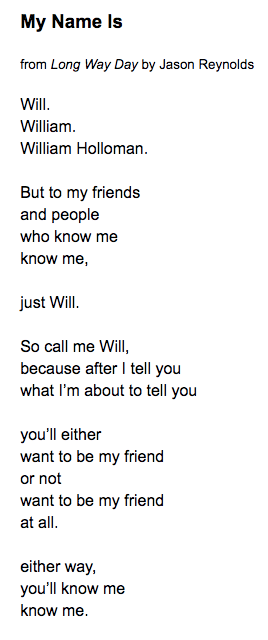
My Name Is by Jason Reynolds

“Instructions” by Rudy Francisco.

Instructions by Rudy Francisco

“Like You” by Roque Dalton, translated by Jack Hirschman

Give students copies of all three poems and a notecard or piece of paper. Read them aloud. Ask students to read them again and then to write a response. They can respond to just one of the poems, a line from a poem, or anything the poems make them think or feel. There is no right or wrong. Just write your thinking. (This is always an interesting response, and it tells me a lot about how to help my students. Many of them will begin to write an analysis of one of the poems — or all three. Others understand that I am asking for a different kind of thinking, one that leads them into ideas for their own poems, stories, or essays.)

  1. Author Bios!

Give students access to books that have clever, witty, or interesting author bios. YA authors like Julie Murphy, Jeff Zentner, Chris Crutcher, Libba Bray, and Gina Damico are great ones, but there are many with a bit of quirk that will draw students in and spark their interest in reading these author’s books. Ask students to explore the author bios and then make a list of the books they think they’d like to explore this semester. Have them write the author’s names on sticky notes for you to put in your conferring notes.

If you want to take this author bio idea further — (this is my favorite):

Read several professional author bios aloud. Ask students what information is shared and make a T-chart that lists the what on the left, e.g., name, personal hobbies, awards won, where the author lives, who the author lives with, etc. Then, ask students to describe how this information is shared and add these craft moves to the right. This is the how. For example, short and sometimes incomplete sentences, lists, 3rd person, the author’s name is first, witty word choice, etc. Finally, ask students to write their own author bio while you write yours as a model. Encourage them to try to craft their bio to include ideas from both the what and the how side of the T-chart. Below are two of my students’ bios from this past year.
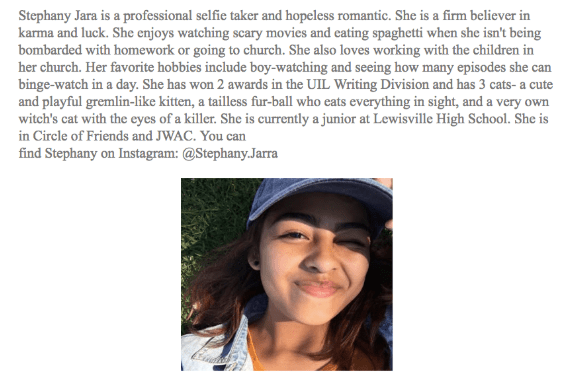
Stephany author bio

Tomias author bio

(The author bio idea is Lisa’s baby, and she wrote about it here after I wrote about it here. It’s still the best idea I have ever heard to begin students on their journey into developing their identities as readers and as writers. I’ve used this idea in a model lesson for every workshop I’ve facilitated this summer, so if you were there, feel free to share the author bio you wrote this summer in the comments. My newest one is below.)

I wish you happy reading and writing with your students this year. Please share your go-to ideas for inviting students to write and build your community.

Amy Rasmussen loves books, pretending to garden, adolescents, and coconut cream pie — not necessarily in that order. She lives in North Texas with her dashing husband of 33 years, their twin-terror Shelties Mac and Des, and a not so loving love bird named Colonel Brandon. Amy spent the summer leading professional development in several districts across Texas and has grown especially fond of the Houston area. If only she could move… Follow her on Twitter @amyrass — and if you are not already, please follow this blog.

Q & A: What are the essentials to making Readers-Writers Workshop work? #3TTWorkshop

Questions Answered

It can be overwhelming. We attend training sessions and conferences, read professional books and journal articles, search online and join Facebook groups, and try to figure out this thing called Readers-Writers Workshop. I did all of that for years. I still do. I suppose that’s one of the things I love best about this blog:  I get to share all my trial-and-error-years-of-learning-and-ongoing-ideas with all of you.

If I said I’ve got it all figured out, I’d be lying.

I think that’s the beauty of this model of instruction. While the routines might be the same: independent self-selected reading, quickwrites, craft study, time to talk and write, conferring… the texts we use to meet the needs of our students and the amount of time we spend on those routines vary, depending on the individuals learning with us in our classrooms.

So I’ve been giving a lot of thought to this question:  What are the essentials to making readers-writers workshop work? and while my answer might be different tomorrow or next week, here’s what I think the essentials are today:

  • We have to build and nurture a community of readers and writers who identify as such and who respect one another’s right to explore, express, and develop in their literacy skills.
  • We have to believe that it’s more important to teach readers and writers, speaking to them as such, than it is to teach books — even if they are books we love.
  • We have to push back at standardized tests that crush authenticity in reading and writing tasks — and give our students choice. Lots of choice!
  • We must be confident in our skills as literacy teachers. We need to walk our talk and continually work to grow our expertise. If we don’t know YA books and other literature our students will want to read, we need to read more. If we don’t know how to teach writers, instead of assigning writing, we need to learn what writers do to craft meaning — and model those things for our students.
  • And perhaps more than anything, we have to dedicate the precious time we have with students to the things that help them grow confident in their own literacy skills. Time to think, read, write, talk, listen, and celebrate. Everyday!

There is no one way to do all this. However, if we’ll keep these essentials in our focus, we will find the one way that works for us — and for our students.


Note:  This post is a part of a series. It’s based primarily on the most frequent questions about readers-writers workshop asked at our workshop trainings. For more see here.

Amy Rasmussen loves to learn. She reads a lot and writes a lot to figure things out. She loves her husband of 34 years and adores her kids and grandkids. Amy will be teaching senior English when school starts in just a few short days. Follow her @amyrass

Q & A: What are some good poems to write beside? #3TTWorkshop

Questions Answered (1)

I think I’ve mentioned before that I used to avoid poetry. Now, I’m really not pointing fingers at anyone — okay, yeah I am — but I blame it on my teachers. Not one of them shared poetry just for the love of poetry — of rhythm and words and images often cloaked in color and emotion. Not one. Not one used poetry as inspiration for other writing. It was always analyze this and write a paper on it. Bleh. My least favorite kind of writing.

Good poems have the potential to be great teaching tools. Sure, analysis but so much more. If we want students to love language or even play with it in their writing, we have to expose them to language worth loving — and encourage them to make paper swords and sequin-shiny shoes with it. Inviting students to write beside poems with us is one good starting place.

This month Shana and I attended the Poetry Foundation Conference for teachers in Chicago. We read, talked, listened to, and explored poems for a week. (And slept on the worst dorm beds possible.)

The thing about immersing yourself in poetry for a week is this:  You start seeing poetry

GiordanoPizza

Giordano’s Pizza — so good!

everywhere. Billboards, names on shops, menus in restaurants, bikers on the path along Lake Michigan, ceramic swans cuddling on the other side of a pane glass window, and pizza!!

Poetry is like an English teacher with a brand new set of 36 Flair pens. Color everywhere!

In my workshop classroom, we share a lot of poetry. Sometimes just for the love of it. Sometimes to talk about. Sometimes to inspire us to write.

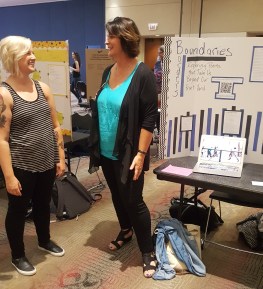
PoetryFoundationpresHere’s a few poems (and a lesson plan) my group and I collected for our project at the poetry conference. We titled our presentation Boundaries & Borders:  Exploring Poetry Beyond our Front Yard (That’s a shout out to Gwendolyn Brook’s “a song in the front yard.”) I’ll tell ya, we hashed around a topic for a long time and finally decided that reading poems that help us explore our personal and societal boundaries might make an interesting backdoor into exploring identity, which is a topic many of us develop out thematically using a variety of other texts in our courses. If nothing else, the images we collected (all found at Unsplash) might be interesting to use to prompt student thinking.

If you’re looking for other topics, take a look at the Poetry Foundation. There’s so much there! And if you like podcasts, you might like this one:  the Slowdown with Tracy K. Smith. It’s my first-ever podcast listen, and I’m hooked.

So, what are some good poems to write beside? You decide. And please share some of the poems you love in the comments!


Note:  This post is a part of a series. It’s based primarily on the most frequent questions about readers-writers workshop asked at our workshop trainings. For more see here.

Amy Rasmussen is a teacher, writer, artist, and house-plant enthusiast. She lives near Dallas, TX and is a believer in all things that make us better humans. Follow her @amyrass


Q & A: How do book clubs work in a Readers-Writers Workshop classroom?

Questions Answered

Book clubs, or literature circles as some like to call them, can be a real bonus when it comes to not only getting some students to read, but in helping students talk about books in meaningful ways and learn about literature through discussion.

I like to think of Book Clubs as discovery:  Students lead the learning. They choose the books they’ll read (often within parameters I give them) set their reading schedules, generate questions about their books, and engage in small group discussions. Each group discovers something, or a series of somethings, that strikes them as readers. Book Clubs by nature are collaborative, yet they can be powerfully personal.

“I really liked being able to just read the book and discuss it like a real book club would, not with any assignment. It gave me the freedom to enjoy the book and not have to focus on finding anything specific.”  Emily, 11 grade

When I first started doing Book Clubs with my students many years ago, I didn’t have a clear purpose or direction, and that often created a bit of chaos for me and my students. Although most students did the reading, I didn’t have a plan on how to teach into the reading or any notion of how to authentically assess learning.  I knew I didn’t want to teach books but to teach readers, and I knew what that meant when it came to self-selected independent reading — but not for book clubs.

I’ve learned that to have success with the negotiated choice of book clubs, I must do some heavy thinking before I ever choose the book titles. (My hope this coming year is that my students will choose the titles. I’ve never trusted myself enough to try trusting them to choose. I’m learning.)

Here’s a little list of questions I try to answer in order to clarify my purpose and to make a plan for accelerating learning within student book clubs:

  • What are my goals for my readers? What are my goals for my writers?
  • How can I help my readers and writers set their own goals?
  • What books can I offer as choices that will help students meet these goals? Do I include a variety of books that will meet the various reading levels of my students?
  • How will I help students set expectations for their reading and discussions?
  • How will I know if students are really reading? How can I help my students hold one another accountable?
  • What whole-class, skills-based mini-lessons might I teach when students are engaged in book clubs?
  • How might my students collaborate with other students who may be reading different books?
  • How might my students collaborate with other students, perhaps on a different campus, who may be reading the same books?
  • How will I assess student learning, based on the instructional goals I set for book clubs?

The answers to these questions guide my planning. Many of the answers look the same when applied to self-selected independent reading and student choice in writing. The routines of workshop remain the same:  We read, talk, write, and talk — every day. And I do a whole lot of listening.

There’s so much to say about book clubs, and I don’t think there’s a one-size-fits-all way to make them work. We have to know our students. We have know their needs and align those needs with instructional goals and practices that best meet them. I think book clubs are one good option for doing so, and I can’t wait to get them started in the fall with my seniors. I’m thinking we’ll do at least two rounds: memoirs and something social sciences, but fiction with multiple or unique perspectives could be interesting.

I’m still thinking.

Amy Rasmussen just spent a week in Chicago at a conference on poetry, hosted by The Poetry Foundation. Her notebook now sings with melodic musings and personal poems. In a few weeks, Amy will start a new position, teaching senior English at Hebron High School in Lewisville, TX. She’s excited about learning with young people again everyday. Follow her @amyrass

Q & A: How do you confer with readers without causing a distraction?

Questions Answered

Recently, I facilitated a readers-writers workshop training with a small team of brilliant teachers in Minneapolis. We shared an inspiring two days together, exploring and discussing how to shift instructional practices to allow for choice, challenge, and the authentic moves readers and writers make as they mature in their craft. In these trainings, I tend to talk a lot about conferring. I think it’s the linchpin that makes all the essential parts of a workshop pedagogy work. (It’s also the thing I still struggle with the most.) Towards the end of our time together, one young teacher said, “Have you tried everything? It sounds like you’ve tried everything.”

Pretty much.

At least it feels like it. I’ve pretty much tried anything and everything I think will help my students want to read and write — and want to improve as readers and writers. (I am still learning. Send me ideas!) And when it comes to conferring with my readers, I’ve tried a lot of things.

One thing I know for sure:  The expectations we set matter — a lot.

When I work with teachers, I get this question often:  How do you confer with readers without causing a distraction?

I don’t. I want to cause a distraction, especially for the one student I’m conferring with at that moment, perhaps for the couple of students sitting near enough to listen into our conversation, maybe for the student across the aisle who needs to know it’s not as scary as she may think to talk to a teacher about a book.

Besides — I may only distract a reader for a moment before I move on to the next reader. Right? And with a class of thirty students, it may take several days to loop back around to distract that reader again.

Sure, I could ask students to come to me — maybe at my desk or at the side of the room or just a step outside the door (I’ve tried all these locations), but scooting up in my rolling chair, or kneeling beside them, at their space seems much more authentic to me — less threatening, more inclusive. In my experience, our conversations are richer when my readers share their space with me.

I know it can be hard to concentrate and read when someone is talking, even in whispers, to someone else a couple of feet away. (I tried reading on a plane yesterday, but the couple next to me kept talking, talking, talking, and I finally took a nap.)

Expectations matter. If we build a culture of reading within our learning communities, where all students know we expect them to read during sacred reading time, and all students expect us to talk to them about their reading lives, every student will come to expect our conferences. It’s part of the overall workshop routine. It’s a huge part of what makes self-selected independent reading work on the daily.

The weight of the distraction just doesn’t come close to the impact of regular one-on-one conversations with our readers.


Note:  This post is a part of a series. It’s based primarily on the most frequent questions about readers-writers workshop asked at our workshop trainings. For more see here.

Amy Rasmussen lives, loves, and teaches in North Texas. She will be at a new-to-her high school in the fall — teaching seniors! This week she is in Chicago at a conference sponsored by The Poetry Foundation. So cool! If you have questions about Secondary Readers-Writers Workshop, shoot her an email amy@threeteacherstalk.com. While she doesn’t claim to be an expert, Amy’s been imperfectly practicing the routines of workshop for a long time. Maybe she can help.


Q & A: How do I know what mini-lessons to teach? #3TTWorkshop

Questions Answered

When I first started trying to implement readers-writers workshop, I was the master of the quickwrite and pretty much nothing else. It wasn’t until after a lot of volume writing that didn’t go far in helping students improve in style or structure that I knew my instruction was missing something. I had to teach into these quickwrites. Ohhh.

Over time, I’ve learned how to develop lesson plans that not only engage students in the non-negotiables of workshop instruction, but to actually feel confident that I am teaching the ELAR standards.

We all have standards, right? These might be Common Core —  or determined by whichever state we teach. Texas has their own standards (Of course, it does).

The beauty of workshop instruction is that we can practice independent reading and writing — and teach into students’ skills development independently. We just have to plan accordingly. . . and leave space, knowing we will do more on the fly.

Take a look at this —

Minlessons

So how do we know what mini-lessons to teach?

When planning, I start with my state standards. In Texas we have Student Expectations, SE’s. Each one of those can be a mini-lesson. I introduce the SE to students, model what it looks like in a text or task. We discuss, question, and practice it by applying it to our own independent reading or writing.

Then, I pay attention. Sometimes, based on formative assessment or conferring, I may need to teach the mini-lesson again to the whole class, or sometimes small student groups or specific individuals.

These are the mini-lessons I plan in advance. However– and this is a big however — just because I know I must “teach” the standards, does not mean readers and writers must “master” them. (Don’t even get me started on standardized testing.) When it comes to writing, especially, student writers may choose not to apply specific moves in their own writing. That’s the beauty of teaching writers instead of teaching to rubrics or a specific format (Ugh, five-paragraph essay). Real writers makes choices depending on their intent for meaning and their audience. I love how Linda Rief explains more about this here.

So what do responsive mini-lessons look like?

These are the pop ups — the ones I know I’ll need to teach on the fly — based on what I see in students’ learning and growth. Maybe students are struggling with strong thesis statements or putting punctuation in places that actually aid the meaning of their sentences. I respond to their needs, and I teach specific mini-lessons, using mentor texts, to help students see how language works to craft meaning.

There is no list of mini-lessons we may teach in any given year. Your students’ needs are different than mine, and probably different than the teacher next door. Lean in, listen, identify their needs as readers and writers, that’s the best way I know how to know what mini-lessons my students need me to teach them.


Amy Rasmussen has taught all levels of high school English, except AP Lit, which is still on her teaching bucket list. She lives in North Texas and will be at a new-to-her high school in the fall. Alas, all gap years must come to an end. Follow Amy on Twitter @amyrass — and if you have questions about Secondary Readers-Writers Workshop, shoot her an email amy@threeteacherstalk.com. While she doesn’t claim to be an expert, Amy’s been imperfectly practicing the routines of workshop for a long time. Maybe she can help.

Q & A: How do I do this on my own without other colleagues teaching this way? #3TTWorkshop

Questions Answered (1)

Believe me when I say I understand. Completely. I think many other teachers who took off the old shoes of making all the choices in their English classes and tiptoed, stomped, or danced into workshop instruction understand, too. Sometimes we are the only one hearing the music.

This was me most of the time.

Of course, working with colleagues in highly functioning PLC’s is advantageous. If we’re lucky, we’ve been in a few grade level teams, or even full departments with colleagues who embrace the choice and challenge readers-writers workshop offers and collaborate well. Other times we have to stick with our knowledge of what works best for growing readers and writers and make our own instructional choices, based on what we know is best for the students relying us in our own classrooms. It’s always our own students who matter most.

So how do I do workshop on my own without other colleagues teaching this way?

Here’s the advice I got when I asked a similar question to someone with a whole lot more experience than me in all things authentic reading and writing instruction:   Nod your head a lot, and then close your door.

That’s pretty much what I did for the first eight years when I was figuring out how to manage a classroom library, give students choice in the books they read, hold them accountable in some way for their reading, get them writing more (and better), using mentor texts, conferring semi-regularly, and trying not to lose my mind when I’d go to team meetings and hear “I’m teaching ________ (insert title from the canon) and making students do study questions, along with these specific annotations. Do you want a copy of my test over the book?” Thanks by no thanks.

We teach readers, not books. And maybe it’s just me, but when I hear teachers say “I make my students do ____”, I kind of cringe. Study questions, annotations for all (done with a teacher’s specific rules for notes instead of the reader’s own rules), and tests over books:  Sandpaper on teeth.

When I shifted my instruction to include choice, student engagement soared. I was converted, and I hungered for more ways to fully move into workshop instruction. But at the time, I was the only convert on my campus. I was lonely there.

However, I had company outside my school. Everyone who determines to make this shift does. You may just have to find it.

First off, there’s this blog. I started it with two brilliant teachers, Heather and Molly, I met at a summer institute of the North Star of TX National Writing Project, a site of National Writing Project. We wanted a place to write about how we applied our learning from our institute with our students, and we wanted a space that helped us stay connected. I was teaching at a Title I high school in a district just north of Dallas; Molly had just moved to a high school with a focus on project-based learning in Longview; Heather taught middle school in a district east of Ft. Worth. (If you know north TX, you know we spanned a distance geographically.) I tell you this history for a few reasons:

The National Writing Project advocates for authentic writing instruction, and it is one of the best networks of educators, willing to collaborate and share, I know. If you can link to a site near you, you will never do this work alone.

Three Teachers Talk has grown as my learning about workshop instruction has. Heather and Molly moved in exciting career directions different than mine, and at times this blog has really been one teacher talking as I tried to figure things out. (Note: Writing helps us figure things out.) Then, when I attended the University of New Hampshire Literacy Institute and took a two week class taught by Penny Kittle, and learned with Shana, Erica, and Emily, a similar blog-writing collaboration happened.

We started writing regular posts here called Our Compass Shifts because we were all working to shift our thinking about instruction and apply the learning from Penny’s class with our own readers and writers. Our teaching souls clicked. The Modern PLC. Emily and Erica wrote with us for awhile, but like Heather and Molly they moved on to other good things. We remain friends, but Shana — Shana remains as Diana exclaims of Anne in Anne of Green Gables, my “bossom friend. A bosom friend—an intimate friend, you know—a really kindred spirit to whom I can confide my innermost soul.”

To continue improving, growing, striving to do right by our students, I think we all need at least one bossom friend. I’ve got two in Shana and Lisa, two of the other admins on this blog. (Angela, you’re up-and-coming.)

I had to find them though. I couldn’t keep my classroom door shut and not step in to learning opportunities that helped me grow. Growing takes action.

So how do I do workshop on my own without other colleagues teaching this way?

Seek out connections with others who are making workshop work. All of the contributors on this blog have been where you are. Read their posts. Leave comments. Ask questions. Email me directly if you can’t find answers amy@threeteacherstalk.com. Like everyone else in the teaching world, I’m busy, but I will do my best to help. (And your questions may turn into blog posts. That’s how I met the amazing Lisa Dennis.)

Join a network of passionate educators on Twitter. There’s chats for you. #TeachWrite #DistruptTexts #buildyourstack #3TTworkshop #titletalk #NerdyBookClub #APLitchat #teachlivingpoets all come to mind. So many teachers moving the work of choice and challenge — and equity — forward. If you are new to Twitter and don’t know who to follow, follow us @3TeachersTalk; then, check out who we follow — educators like you.

Read books by those who’ve built a movement, and join in on discussions. Some of our favorite teacher-writers are active on Twitter, and they share brilliant ideas regularly. Thomas Newkirk, Tom Romano, Penny Kittle, Kelly Gallagher, Linda Rief, Cornelius Minor to name a few.

Also, Shana put together a fabulous resource page here. It’s not exhaustive, but it’s a good start.

I know joining chats, reading books, and connecting online does not replace collaboration on a campus, but it does work to help us grow in our practice.

Just like my daughter has online friends who are in the #houseplantclub, and my sister has online friends who play Pokemon Go, teachers — eager to make workshop work for their students — can find the support they need to make this ever-important pedagogy of engaging students as they grow in their identity as readers and writers work.

Press on, my friends, we are here for you.

Amy Rasmussen calls herself a literacy evangelist –among other things. Wife to a lovely man, and blessed to be the mother of six and grandmother of seven (five of which are boys), she loves to read and teach and share ideas that just might make the world a little brighter — for everyone! Follow her @amyrass — and join the conversation around workshop instruction on the Three Teachers Talk Facebook page. Go here see other Q & A posts about Secondary Readers-Writers Workshop.

Starting With Why: A Return

Three Teachers TalkJoin us for a summer series revisiting our top posts from this school year, and please “turn and talk” with us in the comments section each week!

This week’s post is from 2016. Amy Rasmussen’s viewing of a TED Talk left her with a reason for teaching, plus a bonus writing exercise. 


“People don’t buy WHAT you do;
they buy WHY you do it.”
~Simon Sinek, Start With Why

I first heard of Simon Sinek from my son Zachary. He came home from work one day excited to share a TED Talk he’d listened to during his break. I had not seen my youngest son so animated in months. Zach had big dreams, but he made some poor choices that led to him having to wait a while after high school to start making those dreams a reality. This young man needed some inspiration. Simon Sinek gave it to him.

At Zach’s request, I watched Sinek’s TED Talk “How Great Leaders Inspire Action,” and talked with my son about Sinek’s message:

“There are leaders and there are those who lead. Leaders hold a position of power or influence. Those who lead inspire us. Whether individuals or organizations, we follow those who lead not because we have to, but because we want to. We follow those who lead not for them, but for ourselves.”

Zachin Taiwan

Zach watched that TED Talk multiple times, and my husband pulled Sinek’s book from a shelf in our hallway. “You ought to read it,” he said.

“I want to be that kind of leader, the one who inspires,” Zach told me, and he began to make choices based on his drive to help people instead of what he thought he would get out of helping people. As I write this, Zach is in Taiwan. He gave up his cell phone and his friends and jumped into learning Mandarin Chinese. His 6’4” frame dons white shirts and ties everyday as he rides a bike through Taipei, serving a full-time two year Mormon mission.

My son found the WHY that Sinek inspires, and it changed the direction of his life.


Sinek’s book is about identifying why some leaders are able, not just to sell a product, but to create a movement. He explains his purpose: “to inspire others to do the things that inspire them so that together we may build the companies, the economy, and a world in which trust and loyalty are the norm and not the exception” (7).

That reads like a nice idea for educators, too, doesn’t it? I do not know a teacher who does not want “to inspire [students] to do the things that inspire them.” However, according to Sinek many in business go about it backwards. By extension, I argue that many in education do, too. We focus on the WHAT and the HOW– like making learning relevant, engaging our students, teaching them grit, focusing on achievement, calculating grades, teaching a specific book, giving them a quiz — instead of WHY we teach our students in the first place.

Sinek says, “All the inspiring leaders and companies, regardless of size or industry, think, act and communicate exactly alike. And it’s the complete opposite of everyone else.” They start with WHY.Instead of a focus on the WHAT they produce or sell, or HOW they produce or sell it, they focus on WHY they produce and sell it in the first place. Apple, for example, obviously sells computers. That is their WHAT, but their WHY is to challenge the status quo. It always has been. Stay with me here with Sinek’s explanation:

“A marketing message from Apple, if they were like everyone else, might sound like this:

We make great computers.

They’re beautifully designed, simple to use and user-friendly.

Wanna buy one?

When we rewrite the Apple example again, and rewrite the example in the order Apple actuallycommunicates, this time the example starts with WHY:

Everything we do, we believe in challenging the status quo. We believe in thinking differently.

The way we challenge the status quo is by making our products beautifully designed, simple to use and user-friendly.

And we happen to make great computers. Wanna buy one?

Apple doesn’t simply reverse the order of information, their message starts with WHY, a purpose, cause, or belief that has nothing to do with WHAT they do” (40-41).

Now, let’s think about this as educators:  Most of the time, we think and talk about WHAT we do. “I teach English,” or “I teach high school,” or even “I teach kids.” Sometimes we talk about HOW we do it. “I teach readers and writers in workshop,” or “I advocate for choice independent reading,” or even “I teach To Kill a Mockingbird, ” or “I teach Hamlet.” These are different from WHY we teach and have nothing to do with what motivates us to greet our students each morning, armed with carefully crafted lesson plans, and a smile.

According to Sinek, when we focus on WHAT we do instead of WHY we do it, we are like most of the businesses and companies in the world that drive their work with manipulations and punitive rewards, which might work in the short-term, but do not breed loyalty and long term change. We see this in education all the time:  threats of in-school suspension and failing grades, mandatory tutorials, new test-prep programs, increased numbers of safety nets designed to keep students from failing, changes in grading policies, and more. “There are only two ways to influence human behavior: you can manipulate it or you can inspire it,” writes Sinek. Most decisions we make to motivate students are based on manipulation, and we fail to inspire long-term change. No wonder we see the same students in the same trouble year after year. When we define ourselves, or our schools, by WHAT we do, that’s all we will ever be able to do (45), and that is not enough “to inspire [students] to do the things that inspire them,” or to build a world where trust and loyalty are the norm. We need what Sinek calls “inside out thinking.” To inspire lasting change, we must start with WHY.

Let’s take that example of Apple from before and apply it to our schools. If we are like everyone else, we might talk about our school like this:

We teach high school.

Our school culture is spirited and sound. Our curriculum is rich. Our test scores are high.

Wanna come here?

When we rewrite the example again, and rewrite the example in the order an inspiring school leader actually communicates, this time the example starts with WHY:

Everything we do, we believe in challenging our students’ thinking. We believe in genuine and individual inquiry.

The way we challenge our students is by making our school safe and innovative, with passionate and knowledgeable teachers who are caring and compassionate, who cater to the needs of all students.

And we happen to graduate honorable and educated citizens. Wanna come here?

Does that example make you feel a little different?

As I read Sinek’s book, I kept imagining what his argument looked like when applied to education, but more specifically, I kept imagining what it would look like applied to me as a literacy leader in my classroom. The way I talked about teaching was like everyone else I knew; I focused on what I did as an educator instead of WHY I did it.

I taught AP English Language and Composition. I taught skills to pass a test. I taught students to love books and to like reading. I taught students to write.  Although I had changed my instruction from when I first began teaching, from whole class novel studies with little writing instruction, to readers and writers workshop with choice, modeling, and mentoring, I still struggled. I struggled until I turned my thinking inside out. I took that example Sinek uses to explain what makes Apple such an innovative force in the market and applied it to my belief about myself as an educator and how I make that belief happen in my classroom.

See how I start with WHY:

WHY:  Everything I do as a teacher, I believe in helping my students identify as citizens, scholars, and individuals whose voices matter. I believe our world is better when individuals understand their value, believe in their capacity to cause change, and take action to better the world around them.

HOW:  The way I challenge my students is by making my classroom safe and inquisitive for my individual learners, with instruction that centers on trust, esteem, equity, and autonomy. Through the rituals and routines in my workshop classroom, students gain a sense of belonging, identify themselves as readers and writers, develop their voices, advance in literacy skills, and take risks that have the potential to change their worlds and the world around them.

WHAT:  And I happen to teach English by modeling my reading life and writing life.

It works.

My readers and writers advance because they know we are in the business of learning about ourselves and our world — together.

Simon Sinek is right:  “[Students] don’t buy what we [teach], they buy why we [teach] it.”

My challenge for you:

Follow Sinek’s model like I have above, and write your WHY. Please share it in the comments.

Amy Rasmussen lives in North Texas. Follow her on Twitter @amyrass — and if you are not already, please follow this blog.

How do you read enough to match students with books? #3TTWorkshop

Questions Answered (1)The verb is the key. How do we read enough in order to help students find books they want to read? We read. We have to read — a lot. And we have to know our students.

The reading part is fairly simple. Well, as simple as carving out the time for it, which I know can be a challenge. Maybe it’s a matter of belief. I have to believe my time reading books I may not normally choose for myself will be worth it. I have to believe that YA literature has substance. I have to believe that my students will read, and most likely read more, when I can recommend books because I have read them.

We find time for the things we value. Simple as that. If we value our readers, we must do the things that help them want to read, and reading books that appeal to adolescent readers is a major part of it.

Book Stack

My Current To Read Next Stack

Personally, I like books in print because I like to save favorite sentences and passages that I might be able to use for craft lessons as I read. But audiobooks are a time saver I trust. I usually have at least two books I’m reading at any one time, hardcopy and in Audible. (I started The 57 Bus by Dashka Slater yesterday; I’m halfway through listening to There There by Tommy Orange.)  And honestly, there are some books I just can’t finish, but that doesn’t mean I haven’t read enough to know if I might have a student who wants to give it a try. I can read enough to know if a book might engage one of my readers.

I have to know my readers. The best way I know to get to know them is by talking to students one on one.

Again, the time issue.

Short personal writing can be a real time saver, especially at the beginning of the year or a new semester. Lisa’s Author Bio idea is one of my favorites, ever. I also like to use Meg Kearney’s Creed poem and have students compose their own. Writing like this gives students permission to show themselves, and it gives me an invitation to see into their lives. This is what I need to help match students with books.

A follow up question to the How do you read enough . . .? is often:  How can I find books my students will want to read? or What are some great books for seniors? for 7th graders? for sports enthusiasts? for dog lovers? for a student born in Pakistan? for a group of kids into becoming Insta famous?

I don’t know.

Your school librarian will, most likely.

(Really, I may have some ideas for a few of those questions….but that’s not the point.)

Create a partnership with your school librarian. Hopefully, you still have one. This person loves books and advocates for books and readers. This book expert is a friend to self-selected independent reading, and this professional has access to book lists with descriptors and synopses. (And sometimes funds to add books to the school library.)

Of course, you can find all kinds of book lists online:  Pernille Ripp posts great lists on her blog. The Assembly on Literature for Adolescents of the NCTE (ALAN) shares picks. Young Adult Library Services Association (YALSA) has Best of the Best lists. Edith Campbell recently posted a list of 2019 middle grade and YA books, featuring and written or illustrated by Indigenous people and people of color. And, of course, this list I crafted before Christmas — all recommendations from the contributors on this blog.

To make self-selected independent reading work, which is a vital part of an authentic literacy focused pedagogy, we have to do the work. We have to read, and I wish I could remember where I heard it first:  Reading YA literature is a powerful form of professional development. Isn’t it?

Amy Rasmussen reads a ton of books on the porch, in the yard, by a pool, on her bed in North Texas. She will be spending a lot of her summer with teachers facilitating PD around readers-writers workshop in secondary English classes. Her favorite. She’s also going to be doing a lot of writing. And a little poetry study at the Poetry Foundation Summer Teachers Institute in Chicago. Follow her @amyrass


Defining Readers-Writers Workshop: A Return

Three Teachers TalkJoin us for a summer series revisiting our top posts from this school year, and please “turn and talk” with us in the comments section each week!

This week’s post comes from 2017, when Amy Rasmussen dove into defining the term workshop–the umbrella that envelops all we do. 


“I need a visual of a ‘workshop.’ That word confuses me still.”

This is not the first time I’ve been part way through facilitating professional development and a participant has made a similar request. There’s a lot for me to learn here.

Before we can begin really sharing the excitement and benefits of a readers-writers workshop model of instruction, we must get on the same page as to what we mean by Workshop. I’ll try to do that here.

Let’s start with the dictionary definition of workshop and zero in on #2.

workshop definition

Based on this definition, let’s consider this essential question:

How do we create open spaces where the children we teach can grow as readers and writers?

To me “open spaces” equates to “workshop.” Open spaces means teachers let go of control, remove themselves from center stage as the holders of the knowledge, and invite students into a space of curiosity and discovery. It’s a space where students thrive in a community of trust and sharing, where they talk about their identities and experiences as readers and writers, where they play with language and take risks as they explore what it means to develop their comprehension and analysis skills — and their craft as writers.

Opening spaces requires planning. It is not willy-nilly choice in books or topics, or stations without specific guidelines and instructions, or seats moved from rows into small groups without modeling the thinking that makes it possible to “engage in intensive discussion and activity” around our content. Teachers must model what this looks like. And we must trust that our students will engage and learn in this model.

They will — if we let them.

Readers-writers workshop is a method of instruction that often requires a paradigm shift, a shift from the teacher making all the choices and telling students what to learn within a text, to students making choices, and through practice and application of skills-based lessons, learning as they read and write.

I’ll return to some definitions found online to help clarify:

“The Reading Workshop is a teaching method in which the goal is to teach students strategies for reading and comprehension. The workshop model allows teachers to differentiate and meet the needs of all their students.”

For our readers, we open the space for students to choose the books they read. By doing so, we meet students where they are in terms of their interests and abilities. The teacher becomes a coach, teaching skills specific to the needs of each learner. This requires time. We must reserve time for students to read when they are with us in class, and we must confer with students about what they are reading — and how they are reading it. This is reading instruction in a workshop model. We teach the reader, not the book. Readers must predict, visualize, infer, comprehend, analyze, and evaluate. These are all skills we model and teach in readers’ workshop.

What about writer’s workshop?

“As in a professional writer’s workshop, each student in the class is a working author. The teacher is a writing professional and peer coach, guiding authors as they explore their craft. … Teachers write with their students and share their own work as well.”

To teach our writers, we must be writers ourselves. We must model the moves writers make as they use language to craft meaning. We must validate our writers and help them recognize what professional writers do to think of ideas, organize those ideas, and convey those ideas in a way comprehensible to readers. In a workshop classroom, we use mentor texts:  sentences, paragraphs, passages, essays, poems, stories to teach writing skills that students apply to their own writing. We teach the writer, not the writing.

workshopquestion

So, what do I mean when I say “workshop”? I mean students doing the work of readers and writers, “engaged in intensive discussion and activity on a particular subject” — specifically related to growing as readers and writers. This work happens because teachers open the spaces in their classrooms which allow for it.

Questions about your move to a workshop model of instruction? Please ask in the comments.

Amy Rasmussen lives in north Texas and teaches AP English Language and English 4 (new prep in ’17. She loves talking books, daughters’ weddings (two this year), and grandbabies (five). She also loves facilitating PD for other teachers making the move into a workshop pedagogy. Amy adheres to the words of Emerson: “We aim above the mark to hit the mark,” and Jesus: “Love one another.” Imagine a world if we all aim higher. Follow Amy on Twitter @amyrass. And she really hopes you will follow this blog!