Category Archives: Amy Rasmussen

Mini-lesson Monday: All Good Writing Begins with a Good Question

One of the hardest things I ask my students to do all year is choose their own topics. We start generating ideas on the first day of school. We watch video clips, read quotes and short passages, listen to poems, look at cartoons — and we write responses. We create various versions of writing territories in our writer’s notebooks. We have many ideas stored in our well-used notebooks by this time each year.

But with every writing task, students seems to always start the topic journey right back at square one, even when I remind them that they have a mine of ideas sitting in the pages of their composition books. I’ve decided that just like me they like the process of discovery.

My goal is to get them to move past topic discovery into writing discovery. Too often, students think they have to know what they want to say before they ever start writing. No wonder so many kids have a hard time approaching the blank page. (See NCTE’s 10 Myths of Learning to Write #4)

The last writing assignment my students complete each year is a multi-genre type piece wherein they show they’ve improved in the various writing modes we’ve practiced throughout the year. They have almost total choice in terms of what they write, and they have most of the choice in terms of the forms they write in.

I have just two mandatory suggestions (oxymoron intended):  one piece must be a Rogerian argument, and somewhere in their master piece, students must show they know how to use an academic database to find valid sources, and then they must use the sources in the correct context, and cite the sources correctly.

We look at a few mentor texts that use multiple genres within the same piece. Narrative, informative, persuasive — plus images and info-graphics, or other types of forms that present information, including videos and interviews. My favorite is the award-winning feature article, Snowfall: Avalanche at Tunnel Creek by John Branch.

Once students know their end-goal: the creation of their own multi-genre writing piece that shows off their writing journey for the year, they must choose a topic. Some will want to stick with a topic they’ve written about multiple times this year. Depending on the topic, and the student, I may be oaky with that.

This mini-lesson came about in an attempt to help students figure out a topic that they know enough about to ask questions but not so much about that they could answer all of them.

Objective:  Using the language of the Depth of Knowledge Levels, students will construct a list of things that make them wonder; they will formulate questions about a self-selected topic derived from their wonderings. They will then categorize the questions in sets that make sense. Finally, they will determine which questions may best be answered through a specific genre or form of writing.

Lesson:  I tell students that we are about to play in our notebooks. “Turn to a new page, and write a list of all the things you wonder about,” I say. They usually sit there writing nothing, so I get them started:  “I wonder if teens got paid to go to school if they would want to learn more.”

Most students start to write, but I keep wandering the room, stating things that make me wonder as students list their own wonderings in their notebooks.

“I wonder when the state of Texas will get wise to the lack of wisdom in state testing. I wonder why students choose to do their APUSH homework over AP English. I wonder if the Dallas Cowboys will ever win the Superbowl again.”

Once students have at least a half a page of wonderings, I ask them to talk with one another in their small groups. “Perhaps your peers will remind you of something else you wonder about. Add it to your list.”

“Okay, look at your list and zero in on one topic that you think you can find the answer to with a little bit of research. Now, let’s think all the way around this topic.”

I ask students which of my wonderings I should use as a model for their next step, and they tell me the one about the Cowboys. I write it on the board. “Okay, help me come up with questions that look at this from every perspective possible — like who has a stake in whether the Cowboys win the Superbowl again.”

When was the last time the Cowboys won the Superbowl?

Who led the Cowboys to the Superbowl in the past?

How many times have the Cowboys been in the Superbowl?

Is the Cowboys coach as good as the coaches in the past? Are the players as good as the players in the past?

What is different or the same about the NFL?

What do the Cowboys need to do to win more games?

Who would be a better quarterback than Tony Romo?

Does the current team consist of Superbowl quality players?

Which teams are in the way of the Cowboys going all the way again?

Some questions get silly — pretty sure the Dallas Cowboy Cheerleaders don’t matter all that much to the reality of getting to the Superbowl. Sorry, girls — but students get a hang of the idea. “Ask as many questions as you can think of. After you write a list of your own, ask your peers for help in writing others.”

Next, we need to put our questions in categories. I ask students to talk with one another and determine which of our questions about the Cowboys might go together. We decide we’ve got questions about 1. the history of winning the Superbowl, 2. similarities and differences in the game, the coach, the players, 3. current Cowboys, 4. the opponents.

We talk about what genres and forms might work to convey the best answers to our questions.

“Compare and contrast the differences. That’d be easy,” someone says.

“The history of the Cowboys’ past wins would be information, right?” another student says.

“What could be the topic of a persuasive piece?” I ask.

“The question about the ability of the current players. Easy.”

I tell students that they get the idea, and I charge them with reading through their questions and categorizing them into groups that seem to go together.

I remind them:  “All good writing begins with a good question.” And they’re off.

Follow up:  Students should use their questions and their categories to guide the choices they make as they write their end-of year multi-genre pieces. In conferences, I read through questions, helping students add to and clarify. I remind them that form helps determine meaning, so as they make choices, they need to think about the best way to share meaning with their intended audiences. Students will present their writing projects as their final exams.

14 Days to Take It Up a Notch

I keep thinking that if I could consider myself an expert at conferring I might actually feel confident in writing a book about it. Then every once in awhile I hear a voice that tells me that the only way to become an expert at conferring is to write about it. Then another voice says, “Can anyone ever be an expert?”

I think about conferring a lot. I know that when I confer regularly with my readers they read more, and they read better. The same holds true for my writers. The more we talk about the moves they make and the meaning they want to convey, the more they take ownership of their work and confidently work at it.

But the consistency in conferring trips me up a lot.

This week I read in a student’s notebook: “I didn’t take the AP exam because my teacher didn’t make me feel like I was good enough. I know that is a terrible excuse to go off an emotion like that. But it also connects with the reason why I don’t do my homework. I get no educational support from anyone. I feel like I’m a nobody that just exists in school. That’s why I turn to music cause it makes me feel special and important.”

That burned. He knew I’d asked to read it. He wrote that for me.

I flip through the notebook and read poem after poem that reflects this student’s sadness, despair, and thoughts of hurting himself. Of course, I take it to the counselor.

I turn to my conferring notes and see that I’ve conferred with this student as much as my others, but he has never let on he was quite so unhappy. We’ve talked of academics, of books, of English things like reading and his writing. I’ve known he’d been depressed in the past. I thought he was doing better.

Now, I wonder. What if more of my students feel this way? What could I have done differently this year that would have let them know I care more about them as people than as English students?

I could have approached conferring differently, more purposefully, more personally. The irony? I wrote about the need to confer with fidelity here, and my first point is about our students’ need for personal attention.

I have 14 days left with my students this year. Surely not enough time.

I’m still going to try.

______________________________________________________________

And now for the rest of the story.


That evening I went to the bookstore thinking I would buy this boy a book. I was on the hunt for the YA novel Someday This Pain will Be Useful to You by Peter Cameron, a book I haven’t read yet — but oh, that title.

No copies available.

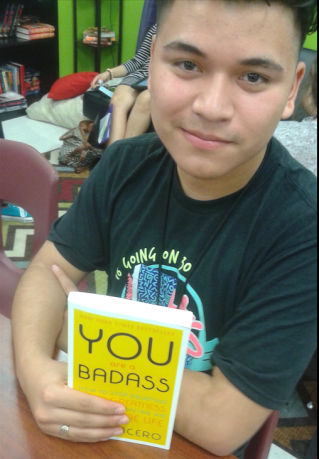
Then, I saw You are a Badass:  How to Stop Doubting Your Greatness and Start Living an Awesome Life.

Screen Shot 2016-05-13 at 1.19.08 PM

Diego:  “…when you feel like you have everything but you are never satisfied” that speaks to me.


Perfect.

The next morning, I scribbled a note inside the cover and called Diego into the hall to give it to him. I told him that I’d read his message and handed back his notebook. We talked a bit, and he assured me that he’d written those poems awhile ago, but he still felt lost at school. I assured him that he was not alone, he needed to believe that every adult in this school cares about him — that’s why we teach here, and the worst thing we could do is take it easy on him because life never will. I gave him the book and watched as he hurried back inside the room and quickly read my note.

I’ll take that smile.

Day 13.


Note:  When I snapped that photo of Diego, one of the girls nearby laughed and said: “Mrs. Rasmussen, taking it up a notch.”

“I’ll be writing about you next,” I said.

Student name and writing used with permission.


Writing Myself Out of a Wreck

Note: This post was supposed to run this morning. Must not have clicked the right button last night. So, here’s my thinking of late. Better late than not at all. (I think that’s the mantra of many of my students.)

I have a confession:  I am pretty much a wreck.

I could blame it on my son who joined the Army and left for basic training the afternoon of Mother’s Day, or I could blame it on another son who called to say he’s marrying a girl he’s known a month and I’ve never met, or I could blame it on this Empty Nester thing that’s barely three days new and haunting me with shutting doors and creaking floors.

I could blame it on the AP Language exam my students take today.

It’s the same every year — well, not that son part, thank God — but definitely the wreck part.

Every year I wonder if I taught enough, had them write enough, gave enough feedback. I wonder if I helped them grow as critical thinkers and accomplished writers. I wonder if they will read the prompts correctly. I wonder if they’ll answer the questions. (I’d be happy with a thesis statement.) I wonder if they’ll remember we learned to read footnotes. I wonder if they’ll cite their sources. I wonder if they’ll write enough to show they are bright and honest and eager and loving young adults.

Oh, wait.

That’s right.

No matter how my students do on this high-stakes test, the important things — the things that matter to me, and should matter to the world — are the things that cannot be measured in 55 multiple choice questions and three essays.

I just needed to write myself into that reminder.

_________________________________________________________________

Today I read  Enjoy the Best Year Ever with a Mantra by Ruth Ayres and loved her Why I Write mantra. I took up the pen to write my own. It’s still a work in process, but I’m kinda likeing it, and I’m no longer a wreck.

Why I Write

I write to make myself feel better.

I write to discover what I want to say.

I write to hear my voice within the chaos.

I write to play with colorful words (and pens).

I write to show my students I am a writer — and because it’s hard.

I write to share my thinking, my hoping, my planning, my longings.

I write to be remembered and to be worth remembering.

I write to know I belong.

I write to advocate for literacy and learning and the lives of my kids.

I write to become a better reader (and I read to become a better writer).

I write to tell stories.

I write to walk the walk and talk the talk of my English teacher self.

I write because it is better than the spa.


Have a go at it. What is your mantra?


#FridayReads — A Book about Death to Teach Writing?

Last Saturday my niece and I attended the North TX Teen Book Festival.

Hundreds of teens stormed the book sales and stood in lines to get signatures from their favorite authors. Authors shared stories about their craft and their books while grouped in panels with interesting names like “‘Just a Small Town Girl’ Small towns — Big Stories,” and “‘The Book Boyfriend’ Sometimes Boys in Books are Better,” and “‘We’re Young and We’re Reckless, We’ll Take This Way Too Far’ Exploring mature situations in YA.

Raistlyn took notes. She is 14, a prolific poet, and is writing a novel.

Screen Shot 2016-04-26 at 9.09.01 PM

New books added to by to read next list.

For our last event of the day, we crowded in an overflowing room to listen to Holly Black, James Dashner, Sarah Dessen, Gayle Forman, Ruta Sepetys, Margaret Stohl talk about what it is like when books become movies. We oohed and aahed and laughed as they told of their experiences. (Margaret Stohl is funny!)

School busses lined the streets, and I cheered that so many teachers thought to bring their students. I did not. We were out of school the day before, and thanks to my poor planning, I never got around to getting a field trip approved.

I kicked myself after.

But I got a lot of great book recommendations, and my TBR tower is now named Eiffel.

I only bought one book. (Don’t tell. My husband and I have a bet to see who can resist 18883231buying books the longest.) I bought Denton Little’s Death Date by Lance Rubin because I heard the author talk with such excited wonder about this story and his experience writing it.
It’s the story of a boy who knows the date of his death. He knows because that’s the way it goes in his world — everyone knows the day they will die. Morbid, you say? Maybe.

But this is a comedy.

Hooked me. I need more books with laughs in my classroom library, and so far, this one does not disappoint. Here’s the excerpt I will share when I book talk this book:

Excerpt from Denton Little’s Deathdate by Lance Rubin p 66-67

I know different people and cultures have varying approaches to death, so in case you don’t know about the tradition of the Sitting, here’s the deal:  whilst waiting for death, you sit. You generally end up in a room of your house, probably the family room (ideally not the living room because the irony of that is too hilarious and stupid), where you’re joined by your immediate family and whoever else has been invited:  cousins, aunts, uncles, grandparents, girlfriends, best friends, and so on. Everybody communes and celebrates and waits for something to happen.

And something always happens.

Heart attack, stray bullet, seizure, fallen bookshelf or tree, stabbing, tornado, tumble down the stairs, strangling, drug overdose, fire, aneurysm. Not to mention the basics:  old age, cancer, pneumonia, other fatal illnesses. People have gone to great lengths to try and survive, but you just can’t. This guy, Lee Worshanks, in Pennsylvania, spent years working on what he called a Safety Room, the perfect place in which to spend his deathdate:  ideal temperature, rubber walls, dull-edged furniture, the works. When the Big Day rolled around, the room’s complicated security system somehow malfunctioned, and Lee found himself locked out. After hours of failed attempts to get inside his perfect room, he went a little nuts. He ended up electrocuted by some kind of circuit panel in the basement. So pretty much every possible variation on death in a house has happened to at least someone in the past few decades.

But you don’t know what the variation is, and you don’t know when in the day it will happen. That’s why the Sitting has always seemed insane to me. Who would ever want to be sitting in a room with their family for twenty-four hours straight? How is that anybody’s idea of a happy way to die?

Besides liking the narrator’s voice, I love how Rubin structures some of these sentences. This is a great passage to discuss syntax.  Look at that stand alone single sentence paragraph. Look at the lists and the use of the colon. And I love all those sentences that start with conjunctions. My students think that’s a grammatical error, and that leads to interesting discussions about why a writer might start a sentence with and or but or so.

I also love that example:  “This guy, Lee Worshanks, in Pennsylvania, spent years working on what he called a Safety Room, the perfect place in which to spend his deathdate. . .”

My students struggle with developing their ideas by using appropriate and convincing evidence. Here, right in a passage from a YA novel, is an example of an example I will use to illustrate examples with my writers. (My nerd factor is pretty high right now, isn’t it?)

Here’s the thing:  I loved attending that book festival with my niece. I loved listening to authors talk about their writing. I loved getting new ideas for books to share with my readers. And I really love that I found this one little passage in a pretty clever book about how we face and talk about death I can use with my students.

Reading is fun. Isn’t it?

*Note:  Did you know there’s a site that will predict the date you will die?

#3TTWorkshop — Some Thinking on Feedback and How We Use It


Did you know there are 167 synonyms for feedback? reaction, response, answer, reply, assessment, comeback . . . criticism . . .

By definition, feedback in the business world means: Process in which the effect or output of an action is ‘returned’ (fed-back) to modify the next action.

In the mini-lesson I posted Monday, I mentioned that I’d asked my students to write for five minutes in response to this:  Think about your reading growth and improvement this year. Can you honestly say you are better now than you when you walked in the classroom in the fall?

TTT reader Leigh Anne commented:  “I love this idea. . . I do wonder though, what were some of their responses to how they grew as readers this year. I only teach 6th grade, but answering this question seems to be a struggle for them. I can’t image how junior AP students would answer it.”

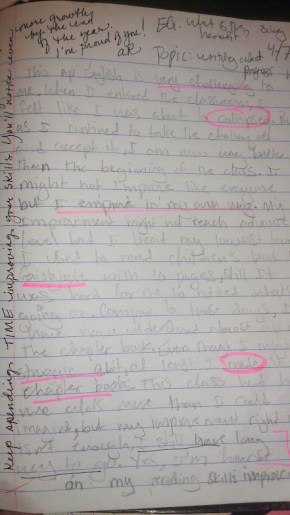
So I took snapshots of four students’ writer’s notebooks and transcribed what they wrote.

notebook response

For quickwrites, I ask students to write as much as they can as fast as they can as well as they can. Then, we always read over our writing and try to revise.

Before you read (in their own quickwrite language), I’d like to suggest that while this simple writing exercise served as self-evaluation for students and set up the personal reading challenge activity, more importantly, it served as valuable feedback for me. We spend an awful lot of time self-selecting books and reading them. One way I know if the investment in time is worth it is to ask my readers. As a result, I now know how my students feel about their progress, and I have ideas on how to “modify the next action.”

“This AP English is being challenging to me. When I entered the classroom, I felt like I was about to collapse. But as I continued to take the challenge and accept it, I am now way better than the beginning of the class. I might not improve like everyone but I improve in my own way. My improvement might not reach advance level but I beat my lowest level. I used to read children’s book, fairytale with 10 pages , still it was hard for me to notice what is going on. Compare to those days, I have now understand almost all the chapter books. This class had helped me more than I could imagine, but my improvement right now isn’t enough, I still have long way to go.” ~Sui

Next action:  Sui said she now understands “almost all the chapter books.” I’ll talk to Sui and find out what she thinks might help her understand all the chapter books. She may be able to tell me where she gets confused. If she does, I will be able to offer strategies and support so she will continue to improve.

“I haven’t done all the required reading in a timely manner, however, I have grown slightly as a reader. My pace has increased with some books, but also slowed down due to difficulty of certain books. That happens to everyone, hopefully, because it could just be me. I still have a focus issue with reading, but it has improved within the time frame of this year. I’m not where I should be as a junior in high school, but it could be worse.” ~ Cerin

Next action:  I’m curious to know if Cerin truly believes she might be the only one who has to slow down when reading more complex books — and I didn’t know she has “a focus issue.” I need to talk with Cerin and find out what she means by this and determine how I might help. I know she’s abandoned several books this year. Maybe she’s one of those expert fake readers, or maybe she still hasn’t found any books she likes enough to finish.

“Honestly, I can say that my reading has improved since the beginning of the school year. I can say this because before I lacked motivation when it came to picking up a novel. It might have had something to do with lack of interest with the topic. Also, I found myself skimming through the text and not critically annotating the pages, but now looking forward this semester my book is tattooed with my thoughts, and each word read one after another.” ~Unity

Next action:  First, I must tell this girl how much I love that “tattooed” bit! I know Unity spent a lot of time reading and annotating the non-fiction book she chose for our research mentors. She shows me here how proud she is of that, and I need to recognize and celebrate her efforts. Our next one-on-one conference may turn into a discussion on the notes she made in her book and why. I need to see her critical annotations.

“I can honestly say that I got so much better at my reading in English classroom. When I enter this year I could not tell if the book is non-fiction or fiction, but after Mrs. Rasmussen talked to me one on one I can tell which one is non-fiction and fiction. I am currently reading the book that is challenge on me but I really want to catch up with my classmate on reading skill and level. I improve so much this year and like reading now. I never like reading in my freshman year or sophomore because I thought reading is useless and it take all of my time. But now I like reading fiction book because I see myself in the book and it get into my head.” ~Siang

Next action:  Siang’s challenged herself for a while now. I need to be sure she is not stuck reading a book that bogs her down too much. She’s been frustrated with reading in the past, and she finally found success with some fairly easy reads. Fluency means comprehension, and that is where the story is. By saying she likes to read fiction, Siang is really saying she likes good stories. I need to make sure she finds another one.

_________________________________________________________________

Were all student responses quite so encouraging? No. These are juniors in high school after all. I’ll say this for them though: they are usually brutally honest when I ask them for this kind of response.

One student wrote that he has not improved as a reader this year, and he does not think he needs to. He feels like he’s as good as he ever needs to be. (I wish this was satire — we are in the middle of that right now.) Alas, it is not. This young man does the bare bones minimum to show he’s learning anything — just keeps his head above passing, goes through the motions. But his response is valuable feedback, too.

“Hey, kid, we have about seven more weeks of school. I’m not done with you yet.”

And that’s the thing, isn’t it? They enter our rooms, and we give them our all. In my case, my all gets charged by the hope I have. I hope my students will grow as competent, confident, intelligent, and compassionate citizens. They can energize the world.

I believe reading more and reading well is the fast track to all of that.

Please share your ideas on getting  — and giving feedback.

Mini-lesson Monday: Personal Reading Challenges

If you’ve ever taught juniors, you probably know my struggle. The third quarter of every year, students hit some kind of mountain of a speed bump. I think they are tired, overwhelmed, a little undone.

Junior year is hard for many of my readers. It’s the first time most have taken an AP class, and some are taking two or three. Competing with APUSH is something I’ve become accustomed to —students choose to do their history homework over English every year. Textbook reading for history looks like homework while the reading I need students to do, reading books that fill their heads with knowledge and stories and vocabulary and empathy does not.

When we hit the wall this spring, I asked a group of my students to help me design a plan to get our reading lives re-energized. They kept it simple:

  1. We should create personal reading challenges.
  2. You should talk to us more about what we are reading.
  3. We should talk to each other more about what we are reading.

This lesson shows how we created our challenges. The more talk part? That was a reminder to up my game with conference and to remember to schedule time for more talk around books.

Objective:  Using the language of the Depth of Knowledge Levels, students will assess their reading lives so far this year, predict how many books they can read this spring, and design a personal challenge that will help them continue to grow as readers.

Lesson:  I projected this question on the board at the beginning of class and asked students to write for five minutes in response:  Think about your reading growth and improvement this year. Can you honestly say you are better now than you when you walked in the classroom in the fall?


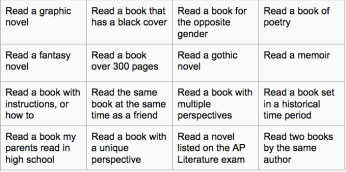
I then asked students to talk to one another about their responses. And then we talked as a group about how we can up our reading game. I explained that a few of their peers had suggested that everyone craft their own reading challenge, and I showed them mine.

Screen Shot 2016-04-17 at 11.25.13 PM

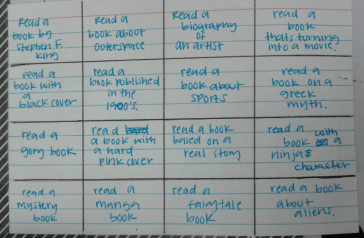
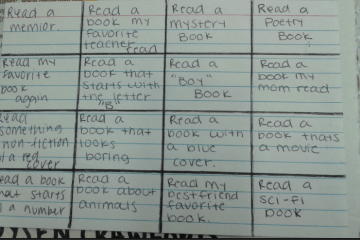
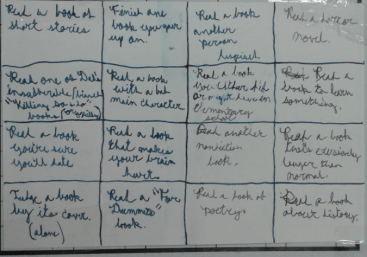
Then, I gave everyone a notecard, and they went to work. Here’s a sampling of some of my students’ personal reading challenges for the end of the year. I think they’ve decided we are playing bingo. (An interesting idea for the beginning of next year, too.)

Read a book that makes your brain hurt. That’s my favorite!

Screen Shot 2016-04-17 at 11.33.17 PM

Screen Shot 2016-04-17 at 11.34.29 PM

Follow up:  I’ve met with more students the past week than I had in the three weeks prior to creating these challenge cards. I appreciate my students reminding me — and wanting me to talk to them more about their reading. The cards serve as excellent talking points for our conferences.

We can never talk to our students one-on-one enough! I know that is true, and I know we get caught up in a million other things that consumes our conferring time. I am recommitted. I want my students to leave me with a sure knowledge that they’ve advances as critical and thoughtful readers who know how to choose books they enjoy and books that challenge their thinking and their abilities. Since students came up with the idea for this little challenge, they have shown much more interest in it than other challenges I’ve created in the past. A good reminder for me. Now, I see kids standing at the books shelves, and when I ask what they are looking for or if I can help them find a book, more often than not, they tell me they need to find a book on their challenge card.


#3TTWorkshop — Assessing Student Work in a Workshop Classroom

What does assessment look like in a workshop classroom?  #3TTWorkshop Meme

Amy:  Interestingly, I just saw a tweet by @triciabarvia yesterday that said “Growth, when ss do something better than they did before (as a result of assignment/lesson, that’s success.” In away that’s really what assessment should be, right? We should be noting growth and improvement, and celebrating successes. I think we forget this sometimes, especially in regard to what we view as assessments and students call grades. Too often we overlook the learning and focus on the 78 or the C+. (That is all most of my students focus on.)

Assessment in my classroom drives my students crazy. I think they feel like I am that elusive balloon they cannot pin down and pop. Poor darlings. I refuse to give in to the grades routine. I want to see improvement. I want to see them take the skill I know I’ve taught and then apply it — better yet, go beyond and do something clever with it. So to answer the question, “What does assessment look like?” is kind of tricky. I think too often teachers spend time assessing student work in ways that is not meaningful. We can waste a lot of time.

But if we’d plan a little differently and make assessment a natural and moving part of our learning journey, we would save time scoring work and enjoy talking to our students more. At least that is always my goal.

In my classroom, assessment takes the shape of written work:  play in notebooks or on notecards, exit slip quickwrites, and sticky note conferences, plus, of course, major writing tasks with formal and informal conferences and oral and written feedback. Assessment also shapes itself into lots of student self-evaluation: “Look at the instructions, the model, the expectations, did you meet them, why or why not?”

If I didn’t have to take grades I wouldn’t, but I assess everything all the time.

Shana:  I go back and forth when it comes to how I value process vs. product vs. what Tom Romano always called “good faith effort.”  There are students who have mastered skills important for reading and writing, but who haven’t fully committed in terms of being vulnerable and trying to advance their skills.  Then there are those students who explore powerful themes and show amazing growth in their abilities, but still can’t spell or use commas to save their lives.

Because I wrestle so frequently with this dilemma, I end up grading not on where each student is at in relationship to our academic content standards, nor on where each student is at in relation to their peers, but rather how far they’ve come since the start of the unit/school year/week.  And I do this by doing what Kelly Gallagher does– “a lot of fake grades.”  🙂

Amy: Me, too!

How do you design assessments?

Shana:  I used a lot of scantrons my first year of teaching.  Those kinds of assessments were pretty easy to make, if time consuming–long, multiple-choice tasks that were topped off by a few essays.  After a year or two of fighting with the scantron machine and my conscience when I noticed that oftentimes a kid’s essay was much stronger than his multiple choice section (or vice versa), I threw tests out the window.  I haven’t given a test in five years.

Now, I focus on designing assessments that are as unique as the units we work through.  A unit of study revolving around the exploration of complex themes cannot be assessed, well enough, in my opinion, using a multiple choice test.  So instead of trying to gauge a student’s interaction with Macbeth that way, I use Socratic Seminars.  Or projects.  Or reflections.  Or presentations.

Amy:  Yeah, I tossed out the multiple choice tests at the same time I introduced choice-independent reading. Even the shorter texts we read together as a class are worthy of much more than a scan tran. Harkness discussions and writing about our thinking allow students room to stretch a bit and show us what they really know.

I design assessments by thinking through my end game. Of course, teaching AP Lang means I must prepare my students for that exam each spring. I know my students have to write convincing arguments, synthesize sources into their arguments, deconstruction other writer’s arguments, and read critically — sometimes some pretty old texts. To design assessments means to start there and then work backwards into the instruction.

For example, I know my students must be able to synthesize sources into their arguments. So I may decide on a couple assessments — say a Socratic Seminar where students discuss three related texts. They must come to the discussion armed with questions, annotated texts, and join the conversation. Then, I may challenge students to find three more texts related somehow to the first three. Now, we move into writing an argument in which they must synthesize at least three of the texts. That essay becomes another important assessment because all along the way I’ve taught mini-lessons:  academic research via databases, proper citation, embedding quotes, transitions between paragraphs, interesting leads, combining sentences, etc.

Everything I teach as a mini-lessons gets a matching mini-assessment somewhere along the line to learning. By the time I read those synthesis essays I have a pretty good idea of which of my students understands and can apply each of those skills. I’ve conferred with them and retaught as necessary, and when I read that final paper I rarely have any surprises.

I think maybe one of the reasons I love a workshop pedagogy so much is because of the grading. It is just not the same as it was when I taught in a traditional model — it is better!


Do you have topic ideas you would like us to discuss? Please leave your requests here.


Poetic Rhetoric — Spoken Word Poems in AP Lang

For a long while now, I’ve wanted to write spoken word poems with my students.

I use Sarah Kay’s “Hands” at the beginning of the year to start students thinking about their lives and the important moments that shape them. We draw hands in our notebooks and fill them with words that represent our memories. Like many of you, I first did this myself with Penny Kittle, and now I draw a hand in every notebook as one of the first pieces I write in it.

I use Shane Koyczan’s “To This Day” and ask students to write a response to it. Sometimes they tell me things that break my heart. Like the fall on the first day of school when two different girls in two different classes wrote about the abuse they experienced from their fathers at home.

These and other poems students find interesting and inspiring, and while they’ve always worked as never-fail quick writes, I wanted to challenge students to use all the skills we’ve focused on this year to write their own poetry. My student teacher, Zach, and I finally figured out how.

And students wrote some powerful poems with some perfectly poetic language.

We called the assignment:  Poetic Rhetoric. what-matters-most-in-life-are-quotes-and-stuff-that-tell-you-what-life-is-really-about_motto

The initial task read like this:  Craft a spoken word poem that addresses a personal conflict and/or a social issue, include rhetorical techniques and literary and rhetorical devices to convince your audience of the need for positive change. Perform your poem for the class live, or create an automated slide show with visuals, or a video recording as a way to digital.

Every day for a week we shared a different spoken word poem. Sometimes we wrote responses as a way to mine for our own ideas for topics. Sometimes we studied the lyrics, closely reading and analyzing structure, tone, and literary devices. We encouraged students to use the work of these poets as their mentors:  “Remember, we learn to write when we study good writing.”

We listened to “Paper People” by Harry Baker, and we talked about theme and sentences that hold the most weight, ones that might be his position statement.

We listened to “Education” by Aadil Malik, and we talked about evidence and examples that support the main idea.

We listened to “Touchscreen” by Marshall Davis Jones, and we talked about repetition, puns, and other literary devices that make language clever and meaningful.

We analyzed the structure of “To This Day,” and we talked about how Koyczan moves from self, to another, to another, to everyone as a way to finally get to his moving plea “to get a better mirror.”

Zach taught mini-lessons, reminding students how to use personification, puns, allusions, and fresh figurative language. We gave students time to write in class, and time to talk with one another, and time to talk with us about their process and their product.

We provided resources on how to write performance poetry like this and this and this.

And students wrote beautiful and meaningful arguments.

Most students performed their poems live in class. (I did allow for a teleprompter since I am the worst at memorizing myself.) We have a slam poetry night coming up on our campus in April. I hope many of my student will perform their poetry again there.

Here are the lyrics to some of the ones I personally enjoyed. I wish I had video of the performances. You’ll have to trust me — they were awesome.

Nefertiti Franklin:  WelcomeToStereotypesAA

Jennifer Melendez:  Find Your Charge, which includes an evaluation of her writing process

Kennedy Jenkins: Use Your Mind

Fabian Gutierrez: ADPoem

And here is an example of one of the poems published digitally. I love her language.

Jessica Ortiz:  People Love to Talk

Reminders to self for when I do this writing unit another year:

A. Take more time with topic selection. As with any writing, if students choose topics that are too broad, or they do not know enough about, the writing is harder to revise.

B. Meet with students more often. Conferring is essential to helping students find what they want to say. Too many students procrastinate and then think they can produce quality writing at the last minute. I must remember to confer at the beginning, the middle, and the end of the writing process. Schedule time for this.

C. Allow time for students to provide one another more targeted feedback. Although they met in small groups and talked about their writing, they did not use their time as effectively as they could have. If I will be more purposeful in modeling what a helpful feedback group looks like, students will be able to help one another more.

I love teaching students to write. I’m not sure there’s a better gift than reading their published work and seeing that they understand the power of their voices. Sometimes they blow my socks off with the force of their wisdom. I love it when they get it.

Have you used spoken word poetry in your writing class? How? What are your favorite poems?

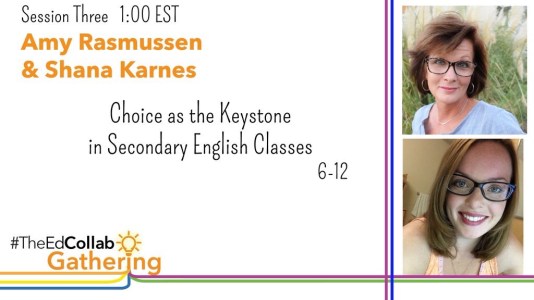
Choice as the Keystone in Secondary English Classes

In a readers and writers workshop, everything comes back to choice.

Have you seen the movie You’ve Got Mail?  If so, you’ll recall the scene where Tom Hanks is giving Meg Ryan business advice.  “The Godfather is the answer to any question. ‘What should I pack for summer vacation?’ ‘Leave the gun, take the cannoli.’ ‘What day is it?’ ‘Maunday, Tuesday, Thursday, Wednesday.'”

It’s the same with choice.  “How will I know they’re reading if I haven’t read the book?”  They’ll be engaged, authentically, because they’ve chosen their books.  “How will I get them to want to revise their writing?”  They’ll want to strengthen the writing about topics and in genres they’ve chosen.  “How can I assess them if they’re all reading different books?”  You offer choice in ways for students to show their mastery–reflections, conferences, blogs, and more.

Choice is the keystone.img_1957

We have written about choice here and here and here.  It crops up again and again in our writing, thinking, and talking.

And we’re excited to talk more about choice with you all this Saturday, April 2, during The Educator Collaborative’s annual Gathering.  This amazing, free, inspiring day is the perfect way to spend a spring Saturday, as it will leave you energized, rejuvenated, and brimming with ideas.  It’s the modern PLC at its best, and the perfect way to help you finish the school year strong.

Tune in at 1:00 EST as we discuss choice as the keystone in English instruction.  We’ll share:

  • Research to support choice in literacy education
  • Strategies for teaching independent vs. small group vs. whole-class novels
  • Why conferring is at the heart of workshop
  • Writer’s workshop non-negotiables and the use of skills learned from independent reading

Please let us know in the comments, via Twitter (@amyrass or @litreader), or on our Facebook page what questions you have about choice as the keystone in secondary English classes.  We’ll be happy to answer them Saturday, and we can’t wait to see you there!

Mini-lesson Monday: A How-to on One Way I Teach with Short Texts

“Hey, Mrs. Rasmussen, I noticed this passage when I was reading,” Geovany said after class as he flipped a few pages in The Kite Runner and read a few lines. “That just really make me think, and it’s really nicely written.”

“And this is what I want you to understand, that good, real good, was born out of your father's remorse. Sometimes, I thing everything he did, feeding the poor on 
the streets, building the orphanage, giving money to friends in need, it was all 
his way of redeeming himself. And that, I believe, is what true redemption is, 
Amir jan, when guilt leads to good.” ~Khaled Hosseini

That might have been the passage. I don’t remember exactly, but I do remember the moment. It’s one of my favorites of the year.

Geovany did little work in my class until these book clubs. I’m not sure he finished reading even one book all fall. Although bright and capable, he is busy. He works 20 hours a week changing tires at a local auto shop, plus school with at least one AP English class. Mine. I know Geo has big hopes for his future, and I know he wishes he had a dad. He’s written a few times this year about how he wishes he had a father to mentor him, care for him — be a dad to him. So when Geovany showed me that passage in The Kite Runner, and when he explained that he’d made a connection to it, I knew all my talk about reading and noticing how authors craft language was working.

I will keep doing what I know works.

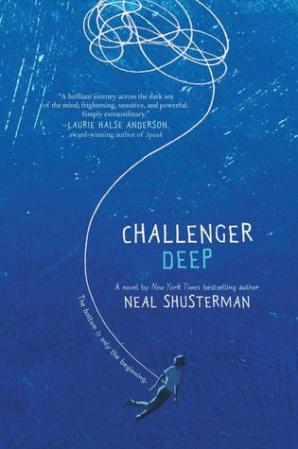
This lesson is an example of how I use what my colleagues and I call a triple play. We got the term from Penny Kittle. A triple play is when we find a passage that allows us to do three things with it:  1. have student write a personal response to the passage, 2. talk about an engaging book students might like to read, 3. study the author’s craft — not necessarily in that order. This lesson uses a passage from Challenger Deep by Neal Shusterman. (Actually, there’s two passages because I love them both!)

Objective:  Using the language of the Depth of Knowledge Levels, students will make observations about a text, write a response, discuss and analyze the author’s craft, and construct meaning of their own modeled after the writer’s.

Lesson: First, to give students a glimpse into the book, I introduce it by reading the cover, 18075234which has three interesting quotes:  1. “A brilliant journey across the dark sea of the mind; frieghtening, sensitive, and powerful. Simply extraordinary.” ~Laurie Halse Anderson, award-winning author of Speak; then two from the book:  2. “The bottom is only the beginning.” and 3. “My feet are on safe, solid ground, but that’s just an illusion.”

I ask: What do you think this book is about? After we read a passage from this book today, analyze a little bit, and write a little bit, I hope this is a book you will want to read.

Next, I give students a copy of the passage. I read it aloud first and ask students to pay attention to anything they find interesting that the writer does with language. They almost always find the literary or rhetorical devices I hope they will. Sometimes they do not know how to name it, so this is where I teach academic vocabulary. We discuss the effect of the devices on the meaning of the passage or why the writer might have made those choices when constructing meaning. We almost always talk about tone. Depending on where we are in the school year and how much we’ve done with analysis, I may ask students to write an analytical paragraph that answers the craft study question.

Finally, I ask students to read the passage again to themselves and then write a response. Some suggestions for response prompts are at the bottom of the passages. Students have about 10-15 minutes to write. I always ask students to read over what they wrote and then revise before they share. Sometimes students share at their tables. Other times we share out as a whole group.

Follow up:  Throughout the school year, I use a variety of texts I pull from books I read from my classroom library. You’ll find other passage I’ve used if you search the categories for craft studies (or just click there).

A few times a year, I ask students to find significant passages in the books they read. Sometimes they construct their own “craft study” questions. (I especially like to do this when we read in our book clubs.) Sometimes students answer the questions they construct in formal response one-page essays.

The goal is to help students learn how to identify and analyze the moves writers make to craft meaning — and to help them practice writing using these moves as models for their own craft.

And just maybe they will make connections to a text like Geovany did to The Kite Runner.