Category Archives: Social Networking

Shelfie Saturday

sticker,375x360.u1


I love Monday mornings.

Monday signifies a new week, new possibilities, and new literature!  At the start of every week, I take time to display different books on each themed shelf.  This provides readers an opportunity to explore new titles on an ongoing basis.  Some books are brand new to Room 382 while other books have occupied our shared space for years; yet feel fresh and enticing when they are uniquely displayed.

Students (and guests) are continually gazing at our Francis Gittens Lending Library and enjoy, not only the vast array of literature to choose from, but how easily accessible it is to find what they are looking for. Gone are the days of ‘genre shelving’ and in are the days of ‘theme shelving’.  Whether students are just emerging into the world of literature or they are deeply rooted in their love for reading; our scholars need to feel supported.  By clustering books via theme, students (regardless of their comfortability with literature) know exactly where to go to get more of what they want!

Many students find their heritage fascinating and want to explore it beyond their current ideologies, beliefs, and familiarities.  So, they peruse the shelves in which they see themselves; racially, culturally, geographically, athletically, and so on.  They find comfort in exploring the lives and stories of those they’ve met before in history class or via conversations taking place within their homes.  They also take pleasure in learning more about who they are within the context of society, and on an even larger scale, within the world; simultaneously honing in on their more localized and individual existence.

All adolescents are searching.  They search for identity.  They seek to understand.  They thrive on building connections.  They strive to be enlightened.  And many times, students stumble upon exactly what they didn’t know they were looking for!  I love that.

Be it non-fiction, fiction, poetry, fantasy, science-fiction, auto/biography, graphic novels, screen plays, what have you; genre holds much less weight when the stories, characters, and settings transcend our students into a world full of exploration.

Here, our ever growing and ever evolving “Roots” shelves allow us to embark on a genre free yet culturally rich journey!
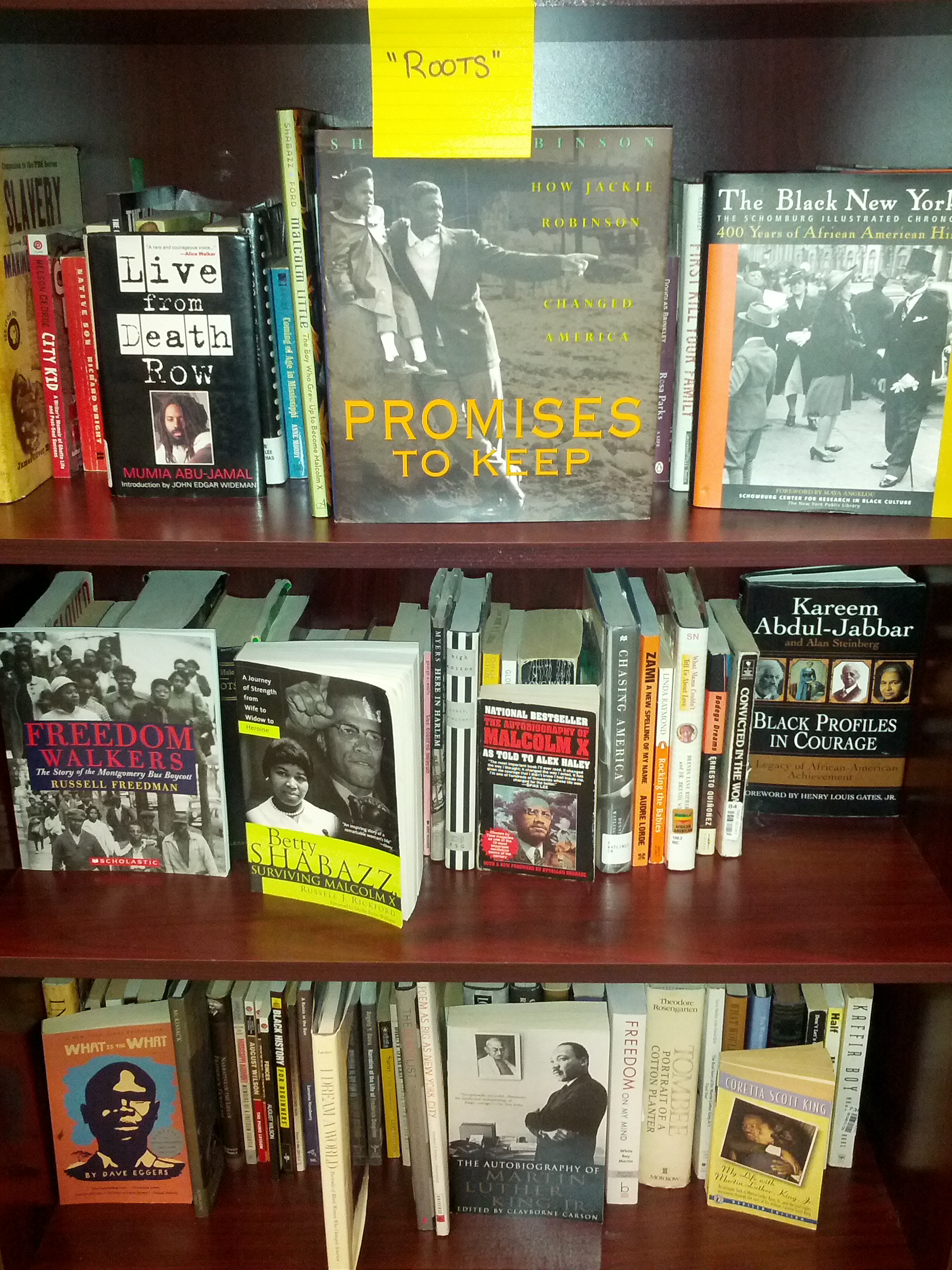
Some of our collective favorites include: Mumia-Abu Jamal, Jackie Robinson, Malcolm X, Betty Shabazz, Dr. MLK, Jr. and his lovely wife


Join the conversation by posting your own shelfies!  Share a shelfie with #shelfieshare and let us know if it’s a #classroomshelfie, #bookstoreshelfie, or other miscellaneous find.

Shelfie Saturday

One of the foundations of a strong reading and writing workshop is providing students access to a wide variety of excellent mentor texts.  You may provide access to those books through your classroom library, school media center, or public library–but how do you know which books to purchase?  How do you predict which titles will be most popular with teens?  How do you know which authors will teach your students the most about writing?

sticker,375x360.u1We hope to offer you a few answers to these questions on Shelfie Saturdays.  Here, we’ll share shots of our classroom library shelves, bookstore tables, yard sale treasures, and more.  We hope these will act as examples of which books to buy, how to shelve them, and which ones to get into the hands of your readers.

So, to get us started, here’s one of my most popular library shelves–the Award Winners shelf.  This shelf houses winners of the Printz Award for Young Adult Literature, the Pulitzer Prize, the Man Booker Prize, the National Book Award, and more.  I also include nominees for all of those awards, as well as honorable mentions.  The genres are varied–YA, nonfiction, general fiction, even multigenre.  The books are at a range of difficulty levels–some have complex narrative structures, others are very long, and others are tough only because of their dense topics.

FullSizeRender[1]

I asked a few students why they liked this shelf so much.  Mylana said, “I want to challenge myself sometimes.  Whenever I read for fun I usually choose fiction, so I like to pick a nonfiction book that’s long but not boring.  I know I can find that on this shelf.”

I asked Garrett how he chose books on this shelf.  He said, “I pick books on this shelf because I hear about them on GoodReads or because they’re made into movies.  So I go to this shelf and pick the ones with the coolest covers.  The length is challenging, but if I get far enough in I won’t give up as a point of pride.”

Students gravitate toward The Goldfinch, Jellicoe Road, Grasshopper Jungle, The Round House, and Why We Broke Up more than any other texts on this shelf.  Again and again, I hear the same refrains during conferences regarding award-winning books–this book was hard, but I finished it because I just couldn’t put it down.  Award winners are shelved so for a reason–they’re the best writing has to offer in a given year, and are incredibly valuable teachers for the young readers and writers in my classroom.

Join the conversation by posting your own shelfies!  Share a shelfie with #shelfieshare and let us know if it’s a #classroomshelfie, #bookstoreshelfie, or other miscellaneous find.

I’m hosting #engchat March 23 7:00ET: We’re Talking Poetry as More Than a Unit

poetry answer-quote

Before I attended The Conference on Poetry and Teaching at The Frost Place last summer, I was a reluctant, resistant teacher of poetry. Sad to say, I never had a memorable experience with poetry until I was in my 50th year.

At The Frost Place, I listened and joined in conversations with working poets about language and their craft. My heart changed. I finally understood because I lived that language for a glorious week surrounded by these people with poetic souls and a view of the White Mountains smiling down on me. Oh, Franconia, NH. (Read about my experience here.)

By no means am I an expert when it comes to poetry in the classroom; however, nobody has to be! Our job as teachers is to help our students grow in literacy skills. Poetry helps us do that.

We bring a beauty into our classrooms, a peace that our world is so often lacking, when we allow poetry to be spoken, heard, shared, and felt.

#engchat is Monday March 21, 2015 at 7:00 ET. That’s 6:00 CT for me, which is why I forget and rarely make it to this chat. The family dinner hour for me in Texas. I’m eating out and early on the 21st though.

TOPIC: Immersing Poetry into ELA Instruction

Questions for Our Chat:

Q1: What are some ways, other than a poetry unit, that you use poetry in your class? #engchat

Q2: “Play is what we want to do. Work is what we have to do,” said W. H. Auden. Poetry is both of those things. How do we use poetry for work and play? #engchat

Q3: We can teach most any skill with poetry that we can w/ prose. Agree/disagree? If agree, what skills do you teach with which poems? #engchat

Q4: Last question. What resources can you share that will help us all immerse our students in beautiful language, daily? #engchat


Do you have any other questions you’d like us to talk about during #engchat? Please leave a comment.

©Amy Rasmussen, 2011 – 2015

The Modern PLC

Sometimes things stay with you. In December I got this message:

I have been working with three teachers this fall who have transformed their classrooms (all ranging from freshman level to AP Lit and AP Lang) from the traditional class to a readers/writers workshop approach.  Your blog posts always show up in my email box at the exact right time when they are in need of inspiration to keep going and figure out what to do in their classes.  They realized very quickly how fast they were able to get through “old curriculum” when they dropped the class novel approach and were then scrambling to find new and exciting mentor texts, books to share, and additional writing ideas. Their students have read thousands of pages and enormous amounts of books which never happened in their classes before.  Students were writing them thank you letters for inspiring them to become true readers and writers.  Penny Kittle’s books got them started on this path, but your real life teacher posts have helped them validate what they are doing.  So… thank you and keep those posts coming.  They are making a difference in our classrooms.

I could write a book about the value in that feedback (Probably will). Feedback should make writers want to write more. That is exactly what Melissa Sethna’s kind words did for me and my friends here at TTT.

Her simple thanks also made us want to follow her work, support her even more, watch how she helps other teachers. We’ve become colleagues with a united purpose. We’ve become friends.

And that is the beauty of the modern PLC.

A literacy specialist in Mundelein, IL sends a thank you to a teacher/blogger in Lewisville, TX, which makes the teacher/blogger want to become a better teacher so she becomes a better writer so she writes more inspiring and instructional blog posts for other teachers and so on.

Teachers supporting one another as we do our best to do right by the children that we teach. As ELA teachers the best way we know how to do that is through balanced literacy practices in readers and writers workshop.

That’s the foundation for the Three Teachers Talk blog, which started as three friends committing to stay in touch by sharing our work through our writing. We are four teachers now — writing, sharing, and growing. And participating in a Professional Learning Community that’s been redefined, refocused, and restructured by connected educators around the globe who are just like us.

Thank you, readers, for being part of the best PLC on the planet.


Note: Melissa Sethna posts as a guest blogger here tomorrow. Her work inspires us.

©Amy Rasmussen, 2011 – 2015

6 Ways to Spend Your Snow Day

snow-day2So it’s your fifth snow day this winter…or your fifteenth.  Either way, you’ve done all of your spring cleaning, you can’t grade or lesson plan because you haven’t seen students for a week, and you’ve completely emptied your queues on Netflix and Hulu.  What’s a teacher to do?

1. Read a good book.  If you’re anything like the hundreds of English teachers I know, you love reading.  Use the time you’ve been cooped up to read something you’ve been wanting to but just haven’t had the time to start.  I haven’t stopped hearing about Jennifer Niven’s All the Bright Places, Atul Gawande’s Being Mortal, and Anthony Doerr’s All the Light We Cannot SeeI’ll think I’ll try to tackle the last two this week.

2. Write around a poem.  Penny Kittle shared once that she likes to tape poems into her notebook and write around them–it’s one way to move toward doing your own beautiful writing, she advised.  So, I signed up to receive the Poetry Foundation‘s daily poem via email, and when I read one I love, I print it and tape it into my writer’s notebook.  I’m amazed at the nuggets of written wisdom I arrive at after responding freely to a poem in writing.

3. Read a teaching book.  I’ve been wanting to finish Tom Romano’s Zigzag and Donalyn Miller’s Reading in the Wild for quite some time now, but with the day-to-day craze of the school year, it seems like the only time I find to read teaching books is over the summer.  This is the time of year, though, that I often need a little lift in my teaching spirit, so it’s always rewarding to explore some new thoughts from some of my old favorites.  Since I’m in the middle of a nonfiction book club and writing unit right now, I think I’ll settle down today with Georgia Heard’s Finding the Heart of Nonfiction.

4. Check out that dreaded State Test.  Dana Murphy at Two Writing Teachers reminded me that when our students are accustomed to writing in a choice-based, unit-driven workshop, they are not accustomed to writing to a prompt, and that while standardized tests do leave a bitter taste in our mouths, they are a reality our students must face.  If we want them to feel confident as writers in all environments, we must prepare them for all writing situations–especially the two or three standardized writing tests they may face each year.  Here in West Virginia, we’ve elected to go with SmarterBalanced as our Common Core-aligned assessment.  Today I’d like to spend some time looking at the writing portion of that test and brainstorming some lessons to help my students feel confident writing to those prompts.

5. Catch up with your tweeps. Twitter is a bottomless pit (seriously; you can get lost in it) of resources, ideas, and inspiration for teachers.  I could spend hours perusing the archives of #engchat, #titletalk, and #litlead, just to name a few.  I’d also love to look at the archives of some chats I missed recently–#mindsmadeforstories, for one.

6. Read incredible teacher blogs. I could browse the virtual thoughts of my colleagues forever!  We have so many brilliant and inspirational people in our profession, from the genius team at Nerdy Book Club to the marvelous ladies at Moving Writers; the steady wisdom of What’s Not Wrong to the joyful inspiration of the dirigible plum.  I’ve also been loving the thoughts of Hunting EnglishThe Reading Zone, and countless more…really.  I could never list all the great teacher blogs I’ve stumbled upon.  I feel so grateful to the many, many teacher-writers who have helped me fill my writer’s notebook with thoughts and ideas on dreary snow days like these.

What are your favorite ways to relieve the restlessness of several snow days?  Share in the comments!

Reading Resolutions

For the past few years, all of my reading has been for the purpose of research.  I read pedagogical teaching texts or young adult lit almost exclusively, and when I branched out from that, it was to read complex books that I thought I might use to challenge my students to use for craft examples in class.  I read only as a teacher, and not as a reader.  In 2015, I’m determined not to do that.

pc

Poet’s Corner

Ten days ago, I was in London, England.  Pretty much every moment of every day since then has been spent either reliving a magical moment there, or frantically trying to catch up with everything I fell behind on here in real life.

Much of that trip of a lifetime was spent flitting around different literary sights in London.  My husband and I had a beer at The Plough, the famed pub of Dickens, Woolf, and Darwin.  We visited Poet’s Corner in Westminster Abbey and saw graves of and memorials to my heroes Jane Austen, William Shakespeare, C.S. Lewis, and more.  We enjoyed a visit to the home of the most famous fictional character in England, Sherlock Holmes.  The Globe Theatre, The British Library, Southbank Book Market…we saw it all.  Awash in the history of English literature, my trip made me desperately want to revisit much of it.  I can’t think of the last time I read a classic for pleasure.  So, I made my first reading resolution for 2015: read my roots.  My degree is in literature, but I’ve missed out on a lot of its classics–probably because they were assigned as boring whole-class novels and I knew about SparkNotes, but I digress.

NYT-list---11---Cropped-761259So, I knew I wanted to read some classics for fun.  But I also wanted to make sure I read lighter, easier things too, for a different kind of escapist fun.  I got curious about bestsellers I’d never bothered exploring…Janet Evanovich. James Patterson. Sue Grafton.  I’ve never read any of their books, but millions of others have. So, that’s another resolution–read my age.  I’m a 27-year-old female lover of mysteries, and I’ve never cracked the spine of an Agatha Christie! So much of my reading life is focused on the 11th graders in my classroom, but I need to read my age, too.  I want to read what everyone is reading and talking about–all of the New York Times bestsellers, not just the Young Adult list.

FullSizeRender

Heaven in Outer Banks

My last resolution is to relax and read.  I recently read an article about a woman deciding not to participate in the GoodReads Reading Challenge because she felt like it stressed her out and diminished her intrinsic love of reading.  The comments were overwhelmingly negative and unsympathetic, but I found myself in complete agreement with her!  I was always “behind schedule” on the challenge, always feeling like I couldn’t take the time to read anything massive like The Goldfinch or pondering like The Poisonwood Bible or immersive like Will in the World.  Those books would take me way too long to read, and how was I supposed to find new things to booktalk for my students then?!  Well, I’m done with that.  I want to return to the days of my vacation in North Carolina last summer, where it rained for seven days straight and all I did was read.   It was the perfect beach vacation.

FullSizeRender (1)

My selfish to-read list

2015 is my year to stop feeling guilt, obligation, or stress about books.  Yes, reading saves lives, changes the world, and creates empowered, literate citizens, but that’s not why people read.  And that’s not why I try to get kids to become readers.  Reading is an exercise in imagination, in escape, in adventure.  It’s joy and pleasure and heartbreak.  It’s empathy and knowledge and understanding.  I’ve been so busy trying to teach that that I’ve forgotten it myself.  This year, my resolution is to remember that.  What’s yours?

Share your #readingresolutions and see others’ on Twitter.

Finding A Teaching Family Outside of School

“It’s funny how my closest friends live states away,” Amy said to me as we crossed the convention center’s atrium during NCTE. I agreed; our group of four, Amy, Shana, Erika, and I, might live in different parts of the US, but we share a unique bond, one that has carried me through both the highs and lows of teaching.

Teaching is an anomaly: for being such a social career, it is also quite isolating. I learned this my first Screen Shot 2014-11-26 at 9.37.08 AMyear when I went from sharing a classroom during my yearlong internship to suddenly being by myself at the end of the hall. I found that while my colleagues and I would sit down for lunch everyday, we struggled to find common times to chat about our work or pedagogy outside of professional development days or staff meetings. Despite being within the same building, we’d oftentimes take to the Internet to discuss our plans and work with one another. Over the summer I would receive messages from Jenn about a fantastic new book we could incorporate into our academic English curriculum or recently I received a Pinterest pin from Kristina pointing out a fun way to teach sentence diversification.

Social media has changed the face of my professional learning network. While many of my teacher-friends are at my school, my core group doesn’t just involve those within my state anymore. I have discussed pedagogy with teachers in Canada, talked shop with friends in Washington D.C., and connected with educators across the country. Teaching is no longer the isolated occupation it once was. Over the past two years, these discussions have had a profound effect on my development as a teacher. Many teachers have helped to shape the workshop model within my classroom by being honest about their successes and struggles. My PLN has given me a place to geek out over reading, writing, and discussing literature. And ultimately, this passion online translates into my enthusiasm within the classroom.

With Thanksgiving right around the corner, I cannot be more thankful to my online peers as well as to Screen Shot 2014-11-26 at 9.33.43 AMthose teachers who I have met at conventions and in classes. I am grateful for the relationships I have garnered via social media and e-mail. No teacher should feel alone in this occupation—there are countless resources to uplift and inspire even the most isolated. After all, teaching is an occupation composed of charismatic, committed, and loving individuals who not only see the best in their students but also search for the best in each other.

Make Your New Year Revolutionary

It’s the end of New Year’s Day, and I am pondering resolutions. I should have probably already made some, but the end of 2013 took over my heart, and I am a little behind.

My husband’s grandmother passed away two days before my sweet mother. We attended two funerals in one weekend. Since we had to travel and plan services, I took the last seven days of the semester off, which means I missed reviews and final exams and calculating semester grades. I have a lot to do. And I’m having a hard time feeling like doing it.

But I will. And as I’m thinking about my resolutions I know I need to help my students set some, too.

So many need to read more, write more, do more. And I only have one more semester to help them learn.

So I am going to slow down, be more purposeful in my conversations with students, take more time for allowing them to talk, express, emote.

I am going to extend writing time, allow more hours to create and polish and publish–instead of rushing to meet the end of a grading period like I always seem to do.

I am going to keep filling my award-winning-books-only bookshelf and challenge advanced students to take on more advanced texts.

And finally, I am going to use Twitter more in the classroom: share links to student blog posts, reviews on Goodreads, book suggestions, author tags, and more. Try to model the sharing I do with my own PNL. Twitter made a huge difference in my class two years ago, but I haven’t taken the time to get it set up and going well in class this year. I need to change that.( I’m thinking about Instagram, too, but I’m still mulling around how to use it to promote more reading.)

On Monday I got two messages about resolutions from two of my daughters. Jenna said, “church was all about resolutions. They kept just calling them goals, but I always think a resolution should have a stubbornness to stop something or do something. You know, when people say things, resolutely? There’ something with staying power there. So, yeah, I’ve made some resolute goals for the New Year.”

And Kelly said, “I hope you all are making some New Year’s REVOLUTIONS! Not resolutions because that is lame…And revolutions are big. Make it a year to remember with me!

Next Tuesday my students and I will be back in the classroom. We will talk about being more resolute in revolution readour learning, more intentional as we learn together this spring. We’ll set some new goals.

And if I can figure out how to get students to do all this grading (the one thing that bugs me the most about teaching), well, that will be truly revolutionary.

Happy New Year, friends.

What are your New Year’s Revolutions?

Christmas Miracles

ocs

December has traditionally been my least favorite month of the school year.  Something about it bogged me down, without fail, every winter–the dark, sunless days…the mountains of papers to grade…the looming specter of exams–to write, administer, and grade.  I hated my job in December.  From old journals, I know that I was consistently unhappy in the twelfth month of the year, and I wanted to quit teaching every time it rolled around.

This December, though, things couldn’t be more different.  I am LOVING my job!!  Last week, I found myself completely caught up on grading–something that literally hasn’t happened yet this school year.  Somehow, I had plenty of time to plan great lessons, confer with students with no back-of-the-brain worries, AND reorganize my classroom library.  I was a productivity machine–and it didn’t stop at school.  At home, I found the energy to assemble Christmas cards, decorate my apartment, and make some holiday crafts.  As I type this, my fingers are still sticky with powdered sugar from the big batch of cookies I baked this morning.  What’s with the freakish perfection, you ask?  One little, made-up, three-week-old, hashtag of a word:  #nerdlution.

nerdlution-button-tiny-01

Teachers across the country made nerdy resolutions that would be kept for 50 days.  They could be anything–write every day, exercise, a more robust reading life.  A Thanksgiving day Twitter chat gave rise to that wonderful idea, which I hope will become an annual tradition.  Still riding my NCTE13 high, I resolved (nerdsolved? nerdluted?) to spread professional ideas about English teaching any way that I could, every day.

IMG_1036I started by leading an epic two-hour workshop for my English department.  We book-passed (a la Penny Kittle) the entire contents of my professional library, shared best practices in a “gift exchange” of ideas, and made our own heart books (a la Linda Rief) of things we wanted to try.  Afterward, Kristine, a 20-year veteran with a reputation for pessimism, approached me.  “I used to have your energy,” she said.  “I don’t know what happened, but I haven’t had it…for years.”  She teared up, then borrowed Blending Genre, Altering Voice by Tom Romano, a balm for her troubled teaching soul.  Other books from my NCTE haul were checked out, too–Georgia Heard’s brand new Finding the Heart of Nonfiction was battled over by two first-year teachers, Penny Kittle’s incredibly dog-eared and highlighted Book Love and Write Beside Them were taken by veterans, and Tom Newkirk’s well-loved Holding On To Good Ideas in a Time of Bad Ones was checked out by our department head, who has held his position since 1972 (I’ll let you do the math on that one).

I was elated, and my colleagues’ willingness to try new ideas didn’t stop there.  The next day, a friend came and talked through some ideas about having her students do mini multigenre projects on Greek gods.  Enthused, I told her I couldn’t wait to see the results.  The following morning, Kristine, the tired veteran who’d borrowed Tom Romano’s book, stopped me in the hall.  “I came to school every day this week with a new attitude.  I feel the spark again,” she told me.  I nearly cried after we went our separate ways.

IMG_1313The following week, it all seemed to be coming together–our entire English department was on board for trying something new, especially the workshop model.  They wanted to see it in action.  In five days, I was observed eight times by fellow teachers, and they saw my students doing amazing things.  With heads down and pens on paper, their extended narratives were growing to eight…twelve…twenty-six pages long.  They were BEAUTIFULLY written, and on an incredible variety of topics–hunting, car crashes, detectives, breakups, death.  One male student wrote a narrative about rape from a woman’s point of view after hearing me booktalk Speak.

IMG_1314As my colleagues listened in, my students conferred with me about their writing like the confident, thoughtful, reflective authors they are:  “I want it to read like a Rick Riordan story,” Kenneth told me.  “Do you think the pace is too slow?” Nora asked.  “I just need to zoom in a little more on this,” Tevin realized.  “I’ve resorted to writing in my vocab section because the rest of my notebook is full,” Adam admitted with a giggle.  I ended every class with a smile and a feeling of pride threatening to burst out of my chest.  My colleagues were stupefied.  “How are you getting them to read so much?  To write so much?  To work on this stuff in study halls and for homework?”  They were flabbergasted, but all I had to do was point them toward that professional bookshelf, full to bursting (but with more and more empty spaces!!) with the brainchildren of so many of my teaching heroes.

So, my #nerdlution, as well as this little workshop experiment that Emily, Erika, Amy, and I have been trying out, is going beautifully.  The two are combining to bring me the most peace I’ve felt during the holiday hustle and bustle in a long time–and that, for me, is a Christmas miracle.

Reflecting on Connections

ocsI’ve been thinking about connections. With Connected Educator Month coming to a close, many of you might be thinking about it, too. I’ve read chats and tweets about what it means to be connected, and I’ve thought a lot about what being connected has meant to me in learning how to be a better teacher.

My husband had me take the Six Human Needs test designed by Cloe Madanes a few years ago. According to Cloe’s research, we all have two needs that drive us and influence our decisions, behaviors, and actions. Of Significance, Certainty, Uncertainty, Contribution, Connection, Growth, my driving needs are growth and contribution. Learning this was not surprising, and it explains in part why I became an educator, and why I love to help other teachers grow in their practices.

While connection didn’t rise as one of my primary needs. It’s impossible to contribute and grow as a teacher with out connections. I have many.

photo @2003 Anselm Hook Flicker

photo @2003 Anselm Hook Flicker

I connect with my peers in the English department as we talk about the needs of our students, design lesson plans, and try to help students succeed. I connect with my colleagues in other content areas as we meet in faculty meetings, school activities, and crowded hallways.

Then I have my North Star of Texas Writing Project connections, the amazing educators that make up our Teacher Consultants. It’s because of them I am a confident presenter, researcher, writer, and workshop teacher.

Much of my confidence comes from the connections I’ve made on Twitter. Joining chats with my teacher heroes, receiving responses to questions, discussing issues with other professionals with similar challenges, all these connections help me improve the instruction in my room and the relationships with my students.

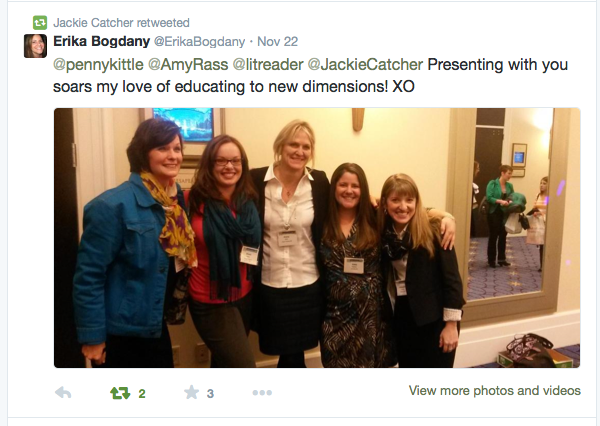
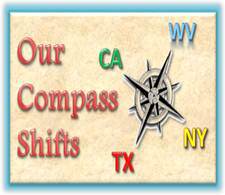
The relationships I made this past summer at the University of New Hampshire Literacy Institute changed my teacher soul forever. The connections made there gave me hope on more than one occasion. Emily, Erika, and Shana allow me to contribute and grow on a regular basis, and I am grateful for their insights and encouragement in my life. It can be difficult being the only teacher on my campus who believes in the power of a readers/writers workshop classroom. Support from these friends, even as far away as CA, WV, and Brooklyn, NY, comes at the most opportune and significant times. (Of course, the Words with Friends games help our camaraderie, too. What English teacher doesn’t want to beat another one at a word game? BK, join us!)

So today as I reflect on my week of blog posts, comments, and shared goals for students, I am thankful. Thankful for new connections, new friends, and even new challenges as I keep writing, keep sharing, keep trying to change the way I reach the students in my care.

Thanks to all of you, my connected educators.