Category Archives: Writers Workshop

‘Tis the Three Teachers Talk Holiday Poem

My dad was an 8th grade Social Studies and English teacher for well over 30 years, and his joy (and frustration) as it relates to education, inspired me to work in the classroom as well. I grew up on stories of my dad’s intelligence, humor, creativity, and passion in the classroom. This and other tales of how I’m pretty sure my dad was incorporating elements of workshop in his classroom in 1968, in a future post.

But it’s not only my choice in profession that was influenced by my dad, it’s the writing you are reading right this very moment. Dad has a gift with words. People are still talking about how clever and touching his speech was at my wedding…almost nine years ago. He has a way of turning phrases to make them as sharp as his wit and as beautifully deep as his heart. I’ve always wanted to write as powerfully as my dad.dad

So, early on, my writing filled with passive voice and right-clicked thesaurus words (the nuances of which I was not skilled enough to use correctly), I wrote. And I often wrote utter crap.

When I would ask my dad to read it,  an old school sea of red comments would flood the page. Arrows, strike-outs, question marks. It was harsh, but fair. And though I was often too stubborn at the time to admit it (a trait I certainly, thankfully, and ironically in this case, inherited from him directly), his insights pushed me to add clarity, depth, and insight to my craft.

Earlier this week, Amy wrote about writing when it’s hard. She spoke of filling the room with beautiful language, getting kids to keep talking with one another, and allowing time to think.

I humbly add to Amy’s list the idea of helping students to find what or who inspires them to write. With the mutual understanding that my “brilliant” quick write ideas aren’t always going to cut it and not everyone is lucky enough to have a writing mentor at home to inspire them, we need to help our students find inspiration. In essence, as their teacher, I need to be that writing mentor by sharing brilliant published writing, encouraging students to share their writing with one another, and in (sometimes with a knotted stomach) sharing my own.

I’m inspired today by both the last day of school and, again, by my dad. For years, Dad would take traditional poems and rewrite the lines to match the happenings at his school. Christmas, the end of the year, retirements…Dad would craft witty quips about teacher’s lounge antics, administrative frustrations, student silliness, and more. He has a gift for playing with the written word.

snow

So, dear readers, Dad, and Robert Frost, forgive me as I try my hand at a holiday poem to warm your workshop hearts. It’s all in the name of holiday cheer.

Stopping By a Workshop Classroom…

Three Teachers write here, I think you know. 
Ideas of workshop and reading to sow;
We read and write each day without stopping
To keep our students’ brains and pens hopping.

Some colleagues certainly must think it strange
To bring to our classrooms such a great change.
A room full of books and pages of scratch;
Such delight when a book with a student we match.

They may even, with concern, their heads firmly shake
To suggest that there must be some grave mistake.
But lives as readers and writers we give
For choice and challenge in our classrooms do live.

This workshop gig can inspire, uplift, and “readicide” it can mend,
But break is here my old dear friend.
So go on and with your family some happy time spend,
Because this week of school is finally (blessedly) at an end.

Merry Christmas, Happy Holidays, and a very Happy New Year to all, and to all, a great break. I’m hoping to settle in for a long winter’s nap.

Who or what inspires your writing? How will you be spending your well-deserved break?
Please share in the comments below!

Better Teaching: Please tell me your story

I already knew they were hard workers. This group of girls spent a lot of time in my classroom after school. They huddled together at the far table, speaking in a language I did not understand. They asked questions occasionally, afraid of being wrong.  

“Is this right?” one would say, timidly showing me her iPad where she’d written a few sentences in the Docs app. Returning to her table, she’d share my response with her friends.

They held on in AP English by decimal points as each grading period ticked by. Lucky for them, I scored on improvement, not on the AP writing rubric.

In class we watched the documentary “A Place to Stand,” based on the book by the same name by Jimmy Santiago Baca who became a poet while serving time in prison. Baca’s story captivated my students. They identified and analyzed the argument: “Education matters. Fight for it. Words matter. Learn them. Write them. They empower you..”

Some students understood that more than others. These girls, for sure.

We read several of Baca’s poems. Although mine is primarily a non-fiction course by nature of AP Language and my syllabus, I know that it’s through poetry that my students more easily grasp the beauty and intention in an author’s craft.

The task was to re-read Baca’s poem “As Life Was Five” and to write a reflective piece in response to it.

These girls were struggling, so I finally joined them at their table.

“Tell me what’s going on,” I said.

“We just aren’t sure,” Biak said. She spoke more often than the others, although her English was only a little better.

“Can I see what you’ve written?” I asked, and she timidly passed me her writing, carefully penned on notebook paper.

She quickly broke into explanation:  “I wanted to write my own poem. I don’t know how, and I don’t know…” Words tumbled out, and she lowered her head, waiting for me to read the page.

I looked, and before I could read anything, the words “Burmese!! STUPID and CRAZY!” shouted at me.

“Wait,” I said, “I thought you were from Burma.”

Five voices rose in chorus:  “Yes, yes, we are from Burma, but we are not Burmese. We are Chin.”

I needed them to teach me. I’d never heard of Chin, and my knowledge of Burma was limited to the first few chapters of Saving Fish From Drowning by Amy Tan I’d tried to read and abandoned years ago.

“Will you tell me your story?” I asked, looking closely into the small faces of these beautiful young women, similar yet so different in features and personality.

Biak began to talk.

“We are from the state of Chin in Burma. The Chin are the mountain people. The Christians. The Burmese hate the Christians.”

And then they all talk and tell me their story:

They fled Burma with their families, leaving grandparents and loved ones behind. Sometimes not getting to say goodbye for fear the secret of their journey would be told. They traveled in groups, mostly at night, walking, walking, walking, they said. Often barely eating food, and even then, mostly rice balls or an egg stirred into water.

Bawi told of a Buddhist monk who acted as their guide. “He wouldn’t let us pray,” she said. “Every time we tried to pray, he would knock away our food. ‘Pray to me,’ he’d say, ‘I’m the one who gave you food, not God.’ He was so scary!”

“I lost my shoes,” Biak said, “I walked for miles and miles with no shoes, and the.. What are those things?” she turned to her friends, motioning with her hands like claws, “…those things that stuck to my feets?”

“Thorns,” they said.

“Yes, thorns stuck in my feets, but I had to walk. Walk and walk.”

“Walk quickly and don’t let go,” Kimi said.

“There was a pregnant woman with us. She could not keep up. When we reached the border of Malaysia, she could not run. I do not know what happened to her.”

“I remember we heard the POW POW POW. We had to run as fast as we can to cross the border. I was so little. My legs short. I was so scared.”

Biak begins to cry. She bows her head and covers her face with her hands, “I don’t like to think about it. I remember my grandmother’s face. We barely got to tell goodbye. She cried so much.”

I look around the table. Their eyes shine with memories.

“You all left family behind, didn’t you?”

They nod, and I see Van’s chocolate eyes pool with tears.

“Did you travel together?”

“No! But we all have same stories. All Chin students do,” Duh says.

“Wow,” I say, “Just wow.” My heart throbs in my chest, heavy with the weight of these stories. Resilience takes on new meaning.

“So you must think it’s pretty lame when your classmates whine about having to work a three hour shift and that’s the reason they cannot do their homework.”

The tension breaks, and they laugh.

“What an amazing gift you’ve given me,” I say, “You need to write your stories.”

“I wanted to write a book,” Kimi says, “but I don’t know how.”

I smile. “We can work on that.”

My heart changed after that chat with my girls from Chin. I also felt chagrin. I waited three months into the school year to extend the important invitation:  “Tell me your story.”

I can come up with fourteen different reasons why. None of them matter.

Throughout the fall, I struggled with my classes because I focused on the skills needed to be successful in AP English instead of focusing on the individuals who needed to learn the skills to be successful in life. I forgot why I wanted to teach teenagers in the first place.

Perspective matters.

The most important conversation is the one that invites our students to tell us their stories.

Those young women from the state of Chin grew to trust me because I asked, and I listened. They told me later that I was the first teacher who asked them to tell me their stories — they had all attended U.S. public schools for at least four years.

I am sure other teachers assumed they knew. I thought I knew until I saw the emotion in five pairs of eyes. “We all have same stories,” Duh had said, but that is not true. They all have similar experiences. Their stories are uniquely personal, and they serve as cardinal prerequisites to the identities of each individual.

Identity matters.

How our students see themselves — as teenagers, thinkers, readers, writers, friends, students — matters, and to instruct the individual we must know what she believes about her abilities and her capabilities, both of which have been shaped in one way or another before she ever steps through our door.

Peter Johnston helped me understand the importance of identity in his book Choice Words. He reminds us, “[Children] narrate their lives, identifying themselves and the circumstances, acting and explaining events in ways they see as consistent with the person they take themselves to be” (23).


screen-shot-2016-12-03-at-8-45-20-pm

Trust and esteem are imperative to effective conferring. They are imperative to effective teaching. They are two cornerstones of conferences that allow for the relationships students need with their teachers, the relationships students need to learn.

If our goal is to help our students incorporate reader and writer into their identities, we must build foundations that allow them to take on the behaviors of those who read and write. Equity and autonomy create balance in this foundation and become the other cornerstones.

All students must feel that we meet with them fairly and without judgment. They must know our goal is to inspire independence as they become more effective readers and writers — and of course, literate citizens.

Really, it all begins with the invitation:  “Please, tell me your story.”

my-chin-girls

Graduates Lewisville High School Class of 2016


THAT DAY  THAT DAY
by Biak Par
Far from my Home, my Family
When looking at the sky they seem so happy
But me,
Thinking about that day
Every word they speaks, every looks, every smiles, every laugh
They tear me apart, the soul sing Be Strong
That day
Every word they talk, it burn my ears like Hell
Its torture me every night, in intimidate me every day
When I see those similar faces
That day
Those word, those eyes         
Tear my heart into two pieces.
Those words are as sharp as a razor
They call me foolish, Yea, I don’t know them
Burmese!
That day
My body fills with wound and remorse.
It like drawing into the water, I could not breathe nor talk,
Walking to class
All eyes on me,
Looking down with hope that there is a place I can conceal
But the room seems so small
As I take a step to the room, the room seems colder
Like I was at Antarctica,
Very Cold
Looking at the room I was isolated for this people,
This entire people are strangers.
That day
Standing still
People examine me, like I am from the others planet
That day…
My tremble body, drum in my blood
Eyes fill with water,
That day
The word of Burmese, such as STUPID, CRAZY echoed through my ears
Stupid, crazy,
My mouth wants to shout, but my mouth feels numb
And makes my throat feels tight like I am being choked,
Almost tearful
Wanting to run away can’t bear the exposes of feeling being hunted.
That day
Eyeing for a place to seat
But none of them invites me or speak,
It like I am walking into a room full of a babies Dolls,
They do not talks
But their EYES,
Their evil eyes talk, its say get out of this room
That day
Head down, looking at the floors as I walk toward to the edge of the room,
Seat alone,
The room feels so dark, so lonely and scary
Even, I was surrounding by those people
That day
My silent cry, wishing I can revisit to where I’ll be safe
Because every second, every minute, every hours this place seems so hazardous
That day…
Hopes and dreams are fading away like the wave of the cloud fade, little by little.
From that day the world is never the same
That day, change my life
Made me feels like a woman, made me realize
That because I am different from them (Burmese) and I only speak
CHIN,
They destroy and killed my hopes, my thought, my believe,
The thought of what might come next. I am Scared.
But,
My soul sing to me, be strong. BE Strong Biak Par. Be STRONG.

 

Try it Tuesday: Building Fluency (And Relationships) One Page at a Time

I got to know Bennett because he “grew up” in my classroom.

I got to know Kathy because she discovered how much reading could challenge her thinking.

I got to know Austin because his sense of curiosity,  coupled with his sense of humor, brought him back after graduation to share his insights on college level critical thinking with my students last year.

I got to know Trevor because he had lost his love of reading, and workshop helped him find it again.

I got to know Abbey because I unknowingly played a part in developing her confidence.

We get to know our students in countless ways and through countless circumstances. Through conferences, writers notebook entries, overheard conversations, questions, books in their hands, and sometimes simple nods and smiles, we better understand the humans we as teachers are blessed to work with everyday.

And it is my belief that understanding (connecting with, acknowledging, listening to) students is the component that makes true growth and learning possible. As in life, building relationships breeds understanding, compassion, insight, tolerance, empathy…the list goes on and on (and as I’m typing this, is strikingly similar to a list of reading/writing benefits as well. Coincidence? I think not).

Yet, there are plenty of students I feel like I never get to know as I should. In fourteen years of teaching, I’ve had the opportunity to know roughly 2000 students. That’s 2000 unique life experiences, desires, learning styles, and needs, and I’d be lying if I said I connected, to the degree I might have wanted to, with each and every one, or even most.

But workshop does bring me closer. I talk more with students than at students now, and it makes a world of difference. I’m also offering up more opportunities these days for students to have real and honest connections with the classes I’m teaching. They share who they are in what they choose to read, how they respond to it, and what they write in far more meaningful ways, because the personal connections they create with the material allows for more depth.

My task now is to match those personal connections to learning through assessment of their acquisition of skills.

Sounds simple.
Not simple. Not at all simple.

But you know this. I’m pushing at an open door.
And yet, I would wager, it’s rarely easy for any of us.

So. How to keep students honestly sharing, deeply thinking, connecting to their reading, and growing as writers?

The one pager.

Shana wrote about weekly one pagers about a year ago, and I first started them with my AP students last January. It’s a simple concept. Students write every week. They write what they think, feel, and want to explore.

My modification for my AP students is to have them write weekly about what they are reading independently or specifically for class. The emphasis is to contextualize a chosen quote that they find impactful in some way and then react to it. Part craft study, part reflection, part magic. Beyond that, I encourage students to let their writing flow. 500 words (ish). Single spaced. Analysis. Reflection. Once per week. No exceptions.

Since the point is to write more (and more, and more, and more), I try to keep in mind that I don’t need to read every word. With four sections of AP Language this year, totalling 81 students, I’d be in way over my head. So instead, I keep the scores formative, rotate through the classes to comment on one section of the four per week, and give completion scores for those I skim over. Students use turnitin.com to submit the writing each week, so it’s organized and in one place. Occasionally, we’ll discuss our quotes in small groups and/or use the writing for some craft study in class.

sample-3

sample-2

sample-1

Those are the logistics.

My favorite part of this practice, however,  is the way it provides a safe place for my writers to grow, and when they really embrace the exercise, fantastic things happen.

At the start of this school year, I received an email from Simrah, a former student who finds herself in college this year:


Mrs. Dennis,
     I hope you are doing well. I’m having a wonderful time in college and have been meaning to email you to say thank you for having us write one pagers. In English these first two weeks of school, we have been writing one pagers on different readings. Doing so last year was very helpful. We continue to write one page type essays in my class as a grade and being able to do it without question has been great! You can tell you AP Lang students I said this. Thanks again and I hope you have a wonderful school year. Hopefully I’ll stop by the school some time to say hello personally 😉 ❤

Sincerely,
        Simrah —– (a very thankful one pager writing college student)


Just this week, as I introduced my AP Language students to their upcoming “opportunity” to grow as writers, I received an email from Charlie, a young man whose heart is big, his desire to learn is bigger, and unfortunately, this week, he had an unexpected topic emerge for his one pager that turned his piece into an outpouring of emotion that he desperately needed and brought tears to my eyes.

Charlie lost his grandfather this past weekend. Up to this point, Charlie and I have laughed together, as he is a wonderfully personable young man, but I wouldn’t say we had particularly connected. Then he emailed me Sunday to (can you believe) apologize for going over the word limit on the one pager and share with me a picture of how striking the resemblance is between his grandfather at the same age Charlie is now.

Charlie’s writing touched me. He quoted Dr. Seuss in saying, “Don’t cry because it’s over. Smile because it happened,” and went on to detail the events of the past week and his deep thinking/feeling about them.

When I hugged him this morning, he smiled again, and then hung back for a few minutes after class to tell me more about his grandpa, how the family was doing, and how he was doing. It was a conversation he needed to have and I was honored to share it with him. He joked on his way out the door that it would be hard to top his first one pager this coming weekend, but he would try.

Earlier in the weekend, Charlie had ended our email exchange by saying, “I am so lucky to have a teacher like you who cares so much.”

Well, Charlie, you’re sweet to say, but really,  I’m the lucky one.

Because I’ve gotten to know Charlie, Bennett, Kathy, Austin, Trevor,  Abbey, and I’m learning more and more ways to know more and more students.

I’m getting to know them in ways that truly matter.

As readers.
As writers.
As learners.
As people.

As writers of one pagers. Simple assignments that can be simply amazing.

Have you tried “one pager” writing in your classroom? How do you work to build fluency in your students’ writing. Please share in the comments below. 


Mini-Lesson Monday: Great Sportswriting is Worth Two Reads

In fifth grade, I attended a writing workshop with sportswriter Paul Daugherty at the helm.  A columnist for the Cincinnati Enquirer, he encouraged we wee ten-year-olds to think about how we might revise more quickly and do our prewriting in our heads.  He spoke about his experiences writing half a story while watching a game unfold, sometimes being tempted to write the ending before the ending had even occurred.  At age ten, I found him eloquent, mysterious, and inspiring–I decided then that I wanted to be a journalist.

Although I dropped my journalism major after one year in college, I still enjoy Daughterty’s columns in the Enquirer and occasionally Sports Illustrated.  And as an adult, I see his process in his product.  The craft of Daugherty’s writing is one of the things that made me enjoy sportswriting, and now, strong pieces about America’s most-loved athletic pastimes are some of my favorite things to read.

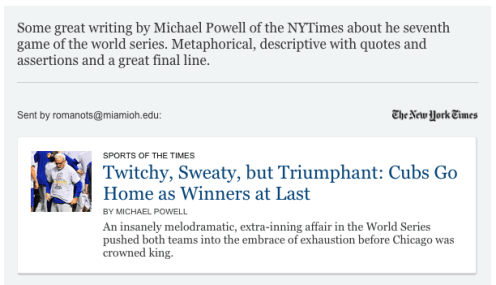
So, when Tom Romano sent me this piece from the New York Times, I thought immediately of how students would love the “metaphorical, descriptive” writing “with quotes and assertions and a great final line.”

Screen Shot 2016-11-07 at 5.56.48 AM.png

Tom Romano’s great description of this piece in the Times.

Objectives: Identify patterns in the author’s writing to characterize his voice; find where the author cites evidence that supports his claims; infer the writer’s process; apply concepts of writer’s voice and strong argument writing to your own nonfiction pieces.

Lesson:  I’ll distribute copies of “Twitchy, Sweaty, but Triumphant” by Michael Powell for students to read, but I’ll also have the piece projected on the Smart Board so kids can see the great accompanying photography.

Because ’tis the season of moving past narrative and into nonfiction writing (in which we often harness the power of narrative, by the way) students will have already been immersed in a study of making claims supported by evidence, crafting a clear and purposeful structure, and maintaining a voice and style that defy the conventions of a five-paragraph you-know-what.  This article will serve as a mentor text that features all three, plus some insight into that long-ago lesson I learned from Paul Daugherty: the speed of a sportswriter’s process.

“We’ve been studying a variety of nonfiction pieces that have great style as well as strong claims–commentaries, columns, and speeches.  And here’s another example of those traits in this sports article.

“As you read it, look for the writer’s voice and the way the writer makes claims and supports them with evidence, as we’ve been doing throughout this unit,” I request.

We take ten minutes to read through the article, annotating quickly and noting writerly moves that jump out at us.  I model on the document camera, noting what I see–the unnamed players throughout the first paragraphs of the piece, creating a universal scene; the sheer entertainment of his vocabulary (words like gluttonous, beatnik, facsimile that you wouldn’t expect in a sports article); his unique turns of phrase.

I then ask students to share in table groups what they noticed about craft and claims.  After they share and we debrief, I return to the article.

“One of the things I find fascinating about sportswriting is how quickly it has to happen.  The turnaround is so quick–we spend a few weeks polishing pieces of this length, but these writers only have a few hours.”

(In keeping choice central to my curriculum, students always get to choose either their process, genre, or topic.  Because in this unit students are constrained to one genre–nonfiction–I will make an effort to help them choose their own topics and processes.  That’s wisdom I gleaned from Writing With Mentors.)

“I want to consider the writer’s process, and I found some good evidence of it:  let’s look at Powell’s tweets from during the game.”

I pull up Powell’s Twitter account and we scroll down to see his game-time tweets, many of which contain some of the same phrases  in the article: the Dead End Kids, the Lackawanna freight train rolling through, the pitchers being gassed.  Students notice these unique phrases immediately.

“What could you infer about Powell, given that this game ended at around 1:00 am and his piece ran at 9:00 am?”

I elicit students to share:  “He was already writing a bit during the game.”  “He writes sports all the time so he can already pull up a lot of the jargon quickly.”  “He really loves his subject, since he’s up watching the game and tweeting and having fun with it.”  “He’s knowledgeable about the history of these teams–maybe he did a lot of research beforehand or maybe he just knows it from writing about it a lot.”

Now, students have painted a picture of the piece’s author.  We can go into the reading warm, not cold.

“So, let’s read again, and consider his process this time,” I ask.  “Look now to see how his tweets–evidence of his prewriting–are in the article and what that teaches you about his process.”

We read the article again, a fresh purpose for reading helping us see the writer’s process come to life.  Once we’ve finished, we talk in table groups and then debrief as a whole class about the evidence we see of Powell’s writing process based on his tweets and what we know about sportswriters as a group.

These two reads give us three things:  another example of writer’s craft, more examples of claims with supporting evidence, and an example of process.

BN-QP490_2PgCZ_M_20161103011549.jpg

I love this great photo of the Cubs’ moment of triumph from the Wall Street Journal. 

Follow-Up:  After students read this piece, there are many opportunities for follow-up.  One is to simply have them apply its writing lessons to their own nonfiction pieces.  Another is to have a lengthy conversation on writing processes, and how they can be short yet incredibly effective–students can see that prewriting doesn’t have to take the form of a web or an outline, but that it can be tweets, too.

Daugherty’s work, the now-defunct Grantland, and The New York Times sports section are some of my favorite places  to find great sportswriting.  What are some of your favorite resources for finding great nonfiction for your students? Please share in the comments!

Try it Tuesday: Taking a line

My AP Lang and Comp students have been writing. A lot.

We’ve analyzed arguments and written short analysis essays. We’ve read powerful OpEd pieces like this and this and this, and we’ve written responses and modeled these writers’ craft moves. We’ve written arguments on our blogs and had a bit of fun modeling Neil Pasricha’s Awesome writing as we practiced using figurative language and specific examples in our essays.  We’ve read about the importance of serious reading, and written one-pagers to defend, challenge, or qualify. Lately, we’ve studied the work of Bryan Stevenson in Just Mercy and watched his TED talk.

I sensed my students needed something a little different, but I needed to keep them writing. So with just one class last week, instead of using a full mentor text to inspire great writing, we used a sentence.

I pulled this quote from Stevenson’s talk:

screen-shot-2016-10-30-at-2-47-56-pm

And then I asked students to write anything they wanted: poems, essays, stories, whatever. The only requirement? Use that line somewhere in your own writing.

Then, on Friday, students moved to our “writer’s chair” and shared their writing. Our community responded with sticky note blessings.

Several students were reluctant to share. “Mine isn’t good,” more than one student said.

“We are a community of writers,” I encouraged. “This is a safe place, and we all want to know what you have to say. Truly, no pressure.”

After a few volunteers, Martina finally rose to share her response to Stevenson’s quote. Her voice was soft yet powerful:

It’s the sigh of relief and relaxed muscles from knowing you did the right thing. It’s liberating and lightweight–the world suddenly doesn’t seem to be positioned heavily on your shoulders. It can be the doubt and little knock of guilt on the back of your head knowing you did the wrong thing. It’s the tempting feeling of doing correct actions, but not being able to when you’re being held against a wall by your own conscious.

It’s difficult to see greener grass on the other side of the horizon when it’s fertilized with the negative aspects of your actions. Learning to realize and move on from what cages you in is the only form of developing into a healthier person–sometimes this ends up being all it takes for it to be “The right thing to do.”

“Always do the right thing even if the right thing is the hard thing”

As kids we grow up with love from family, the goodnight kisses from your parents after a bedtime story, the reassurances of  “It’s Okay” after a tumble on the playground, and the form of love that lingers in the atmosphere when you’re around the individuals that raised you. As we grow our love transforms into something deeper, something more emotional, something dangerous. It might have started with a crush on the new individual at work, the butterflies twisting and turning in your belly are a pure indicator that you’ve deeply fallen in a midst of hearts and dazy clouds of love.

Often times, things go wrong. Abusive relationships exist and they are common amongst the men and women in our society. Nearly half (43%) of dating college women report experiencing violent and abusive dating behaviors, Nearly 1.5 million high school students nationwide experience physical abuse from a dating partner in a single year, and one in seven men age 18+ in the U.S. has been the victim of severe physical violence by an intimate partner in his lifetime.

The right thing in this case is following your heart. Men and women trap themselves in abusive relationships because loving the one person that hurts you seems to be the right thing. Other times, allowing yourself to step away from the relationship/situation is not an option and it becomes a tough obstacle to get out of the arms that hold a restricting grasp on you. There’s always help, there’s always somebody there. Reach out for the right motives even if it’s the hard thing to do.

Never let a person of interest degrade your actions or make themselves superior to you. The most damaging thing to do–and often hardest–is staying in an abusive relationship. Love is a beautiful thing, don’t let anybody damage that for you. Instead, do the right thing for your health, mind, and body without the harm of anyone or anything. 

Two students shared poems, others shared why they think that quote is important, and others wrote arguments of a sort like Martina’s. All were important reminders to me to let students choose how they show they are learning.

Of course, the shared experience of reading their work was pretty fabulous, too.

One of the best things I can do as a teacher of writers is to offer opportunities for students to share their writing. I know the more we share with one another, the better our writing will become. If I remain the only audience (or even mostly their only audience — my students do write on their blogs and leave feedback for each other), some students may never make the connection between writing and truly conveying meaning. Too many just care about the grade.

By just taking a line last week and then asking students to write whatever they wanted, and then sharing… we built trust in our community and we celebrated that we really are on our way to becoming better writers.

What have you tried lately that improved some aspect of your classroom community? Join in the conversation and share in the comments.


ftc-guideline-%22affiliate-links%22

Mini-Lesson Monday: Friendly Competition

Having just watched my beloved Green Bay Packers hand the game to the Atlanta Falcons, my belly is full of delicious chili, but my heart is heavy. Now, I’m watching the Cubs possibly beat Cleveland and getting an odd thrill over a game I have absolutely no stake in. I’m not usually such a sports enthusiast, but all the excitement has me thinking.

img_6450The thrill of competition, win or lose, can make the ordinary far more fun. This typical Sunday night, for example, involved good friends, good food, and a good amount of jawing about a sport none of us have ever played, but still feel the need to critique. Any other Sunday night would find me waist deep in student papers. A different kind of fun, for sure.

Competition in the classroom puts a spin on the ordinary as well. It’s been my experience that a little friendly competition can turn the most aloof high students into passionate, enthusiastic, albeit candy-crazed participants. When the “prize” is stickers, watch out. The stakes are suddenly cutthroat.

For this relatively ordinary mini lesson on narrative techniques, I took advantage of the fact that I have a class of 28 students. While there are countless techniques that a writer can use in order to advance the chronology of his or her piece, my sophomores were going to be focusing on the basic idea that chronology can be linear or nonlinear, utilizing techniques like foreshadowing, flashback, building suspense, and reflection.

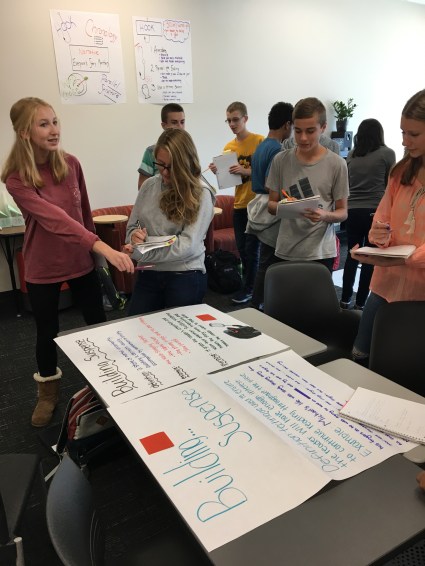
One of my collaborative team members came up with the idea to have the kids make the anchor charts for the lesson (thanks, Weston!), and I ran with that img_6454idea for the active engagement section of the class.
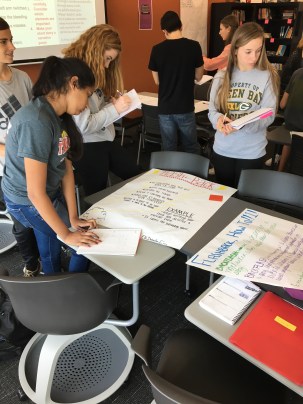
Objective: After researching in small groups, students create anchor charts for narrative techniques related to chronology and use them to determine which techniques could apply to their own stories during revision of their current draft.

Lesson: Having researched their randomly chosen terms in small groups, students pooled their findings and created an anchor chart that included the name of the technique, a definition, a purpose for using the narrative tool, and an example or two. 

With a larger class, I was able to have two groups work with each term, meaning we could have a little friendly competition.

img_6448Students completed their charts and we distributed them around the room. With their small groups, students traveled to each poster pairing and took notes on the techniques, discussing with their classmates places in their own stories they could utilize the technique. In addition, students were deciding which poster they felt more accurately covered the technique and would fit in well with the logical detail needed for our classroom anchor chart wall.

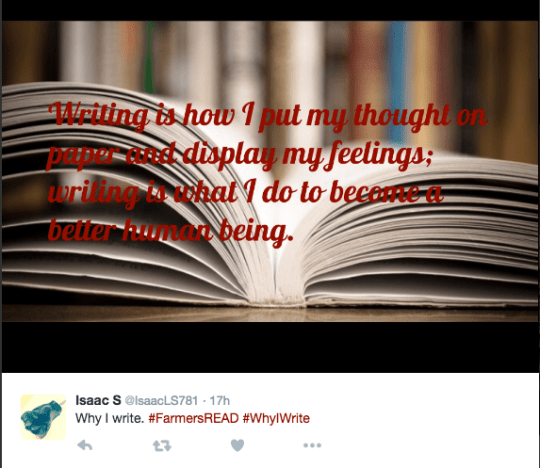
There was a lot of great talk that followed and students writing notes and ideas down in their notebooks too. I loved listening to their ideas of how the technique could be incorporated in their stories and where/how it might best fit.

The voting process even made me smile. The class suggested that they should have an official delegate from each group come forward to vote and then hang the winning poster on the wall. It was very…democratic.

Follow-Up: Students worked during workshop time to identify the chronological steps taken in their papers already and then strengthen the purposeful inclusion of chronological techniques in their pieces. Next class period, we’ll be doing some peer editing involving the specific inclusion of these elements. That exercise and their final submissions will both involve assessment of the writing (peer assessment and self assessment) using the same rubric I will use to grade this portion of their papers.


Proficient Level Narrative Chronology:
The text creates a logical progression of experiences or events using some techniques—such as chronology, flashback, foreshadowing, suspense, etc.—to sequence events so that they build on one another to create a coherent whole.

How do you utilize friendly competition to engage students? Please feel free to share in the comments below. 


Why I Love My Writers (and some book suggestions, too) #FridayReads


Maybe you see this, too:

I’ve got truly brilliant, fun-loving, willing-to-learn students this year, but when it comes to writing, they are as sloppy as a room full of toddlers with their first plates of spaghetti.  Missing periods and capital letters, too many commas (or not enough), and the makes-my-eyes-bleed lower case i. That one’s all over the room.

And I keep seeing this new thing:  the missing “it.”

Take this for example, all sentences from a self-evaluation students completed last week:  “My reading’s good, is something I do to release stress,” or this one: “Is the same thing as going somewhere,” or this: “My reading improved is better because I tried more.”

What?

Do I worry about mechanics over ideas? Never. Do I worry that my students know better and are just not paying attention? Always.

I teach juniors in AP English Language. This string-your-spaghetti-anywhere-you- want-punctuation should not be happening.

So we slowed down a bit. Took a step back. Searched in our in our independent reading books for sentences that struck us as interesting.

Students wrote their sentences on notecards. Here’s some they chose:

“It’s easier to jump out of a plan — hopefully with a parachute — than it is to change your mind about an opinion.” Think like a Freak by Levitt and Dubner

“We looked over toward the echoes of burdensome chimes, the slip and boom of the clutch and rasp of gears as the ice cream truck entered the dead-end streets and curves of Las Lomas.” Always Running by Luis J. Rodriguez

“They played basketball the way basketball is supposed to be played, and in the end they lost — but not before proving that Goliath is not quite the giant he thinks he is.”  David and Goliath by Malcolm Gladwell

“The barber gazed in amazement at this man with long-thick and black hair and beard, which gave his head the appearance of one of Titan’s portraits.” The Count of Monte Cristo by Alexander Dumas

“When he smiles, she notices that he has a dimple on only one side, and there’s something about this that makes him seem endearingly off-balance.” The Statistical Probability of Love at First Sight  by Jennifer E. Smith

“At the end of the hallway is a boy so powerful, so fearless, that he’s set up shop in the middle of a sacred site and renamed himself Goliath.”  Vivian Apple at the End of the World by Katie Coyle

“I felt a hot, tingly sensation spread spread over my skin as I slid down a few inches against the bench seat, wishing I could just melt directly into it’s crusty upholstery.” We Should Hangout Sometime by Josh Sundquist

“This is an ordinary Monday morning school day.A Stolen Life by Jaycee Duggard

“You see, Cinderella and I know what it’s like to look in the mirror and not recognize the reflection.”  Skinny by Donna Cooner

Then, in small groups we categorized sentences long and short, many punctuation marks or few. And we discussed the whys:  How does that mark help create meaning?

We could have spent days on this lesson. I should have allotted more time, and we will certainly return to it (maybe next week — it’s that pressing).

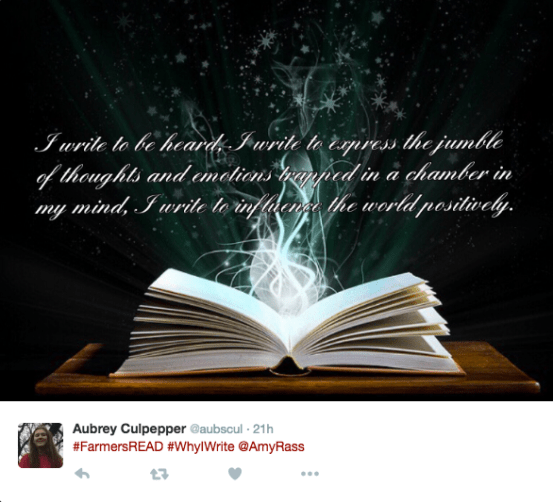
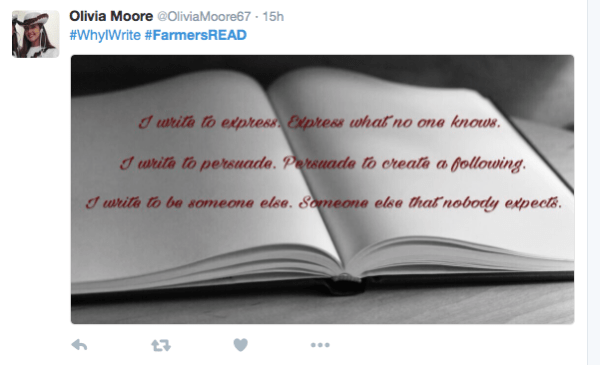
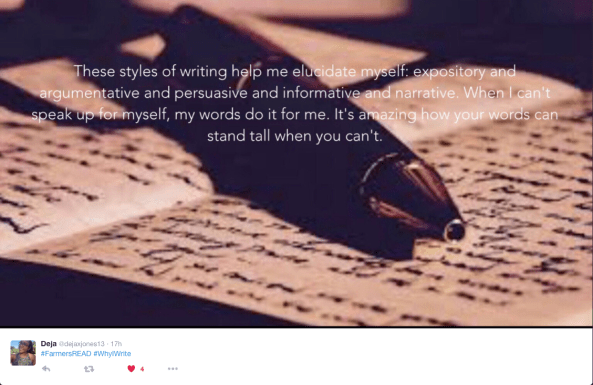
Then, yesterday as a way to join in on the National Day on Writing, I asked students to create a slide that explained why they write. Their slide needed to contain an image, a beautifully crafted sentence that included at least one of the literary or rhetorical devices we’d focused on recently, AND everything had to be correct: capitalization, spelling, punctuation. You might call me out on Olivia’s, but I think it works.

The ratio for correctness on this voluntary assignment was 22:6.

Here’s some of their tweets, evidence of why I love my writers. And also the reasons I hope we can take a little more care as we write. They have such amazing things to say.

screen-shot-2016-10-21-at-8-37-16-amscreen-shot-2016-10-21-at-8-35-42-am
screen-shot-2016-10-21-at-8-23-59-amscreen-shot-2016-10-21-at-9-23-40-amscreen-shot-2016-10-21-at-9-25-23-am


ftc-guideline-%22affiliate-links%22

Mini-Lesson Monday: Narrative Analysis with StoryCorps

We all have a story to tell.

In fact as writers, we have countless stories to tell. We tell of our experiences, fears, hopes, dreams, and even those trivial events that sometimes add up to more “life” than we could have imagined.

We tell the stories of others too. Real and imagined people that speak to us in words we’ve heard and sometimes, in the words we long to hear.

I wax poetic with my students like this often, but especially early in the school year. I want them to feel my passion for the power of stories and encourage them to develop their own passion for expression. As Morris (protagonist from one of my daughter’s favorite children’s books The Fantastic Flying Books of Mr. Morris Lessmore) beautifully states, “Everyone’s story matters.” 

With this in mind, my American Literature collaborative team (Shout out to Brandon, Catherine, and Erin!) worked this year to develop a unit of narrative writing that asks students to look at the stories they tell and how those stories can be interconnected. Everyone’s story matters, and in this case, they get to have even more meaning as students craft individual tales that relate to their chosen thematic focus.

Students, having already selected, listened to, and analyzed an episode of This American Life for elements of author craft in a narrative (hook, chronological/detail choices, and word choice), partnered up or formed a group of three, and selected a theme out of a hat (dangers of conformity, vanity as downfall, the power of choice, etc.) they would explore, both individually and in their groups.

The overarching assignment is to craft an individual narrative that fits the theme and ultimately orally record the stories in a podcast that highlights the interconnectedness of the individual work. Students are graded individually on their narratives, but the podcasts are a group effort and will be played for the class.

storycorps


Objectives — Students will listen to several examples of 2-3 minute stories from NPR’s StoryCorp in order to practice narrative technique identification and analysis one more time before drafting their own stories. Students will discuss and share their insights on narrative impact of what they heard in an effort to purposefully craft their own narratives.

Lesson  — According to their website the initiative of StoryCorp is to “preserve and share humanity’s stories in order to build connections between people and create a more just and compassionate world.” 

In class, we had spoken already about the power and purpose of stories and students had come up with some wonderful ways stories enrich and fulfill us. Stories:

  • explain, or attempt to explain, where we come from and/or why we are here.
  • allow us to express what we believe or hope.
  • reveal who we are or who we want to be.

I shared with students that we were going to listen to some short pieces that told unrelated stories on the surface, but each would link back to some of the reasons we tell stories at all. Students were asked to record what they heard in the hook, insights on which details were included and why, and word choice (all elements they will be scored on when writing their own narratives).

I started by playing a sample story and then walking them through my own analysis. “Traffic Stop” is a piece that details police brutality in 2009 against a black man who was raised by white parents. The piece pretty brutally (I did have to mute three or four seconds of the piece where a police allegedly uses a racial slur that is inappropriate for the classroom) relates the story of a young man who is pulled over by police, searched but cleared, and then is assaulted by police when he questions why the officers are searching his car.

After I played the piece, I projected some of my own analysis. The hook involved the young man’s mother saying that she never would have thought skin color would make a difference for her son, but she painfully learned she was wrong. Word choice vividly captured the pain, fear, and confusion of the young man who was beaten by police. The chronology includes context for the horror of the event, a play by play of the few moments of the traffic stop, and details about the young man’s mother seeing his injuries in the hospital. My analysis was that the elements chosen were specifically selected and organized to convey the disbelief that something like this could happen to an innocent person and the role that race played in the event.

We then listened to two more stories. Students wrote down their take-aways in their writer’s notebooks and discussed after each piece. We shared out ideas and pulled insights back to those class generated elements of why we tell stories.

Finally, I had students listen to one last piece, detail their analysis on a half sheet of paper and turn it in to me for some formative feedback.

Follow-Up — We are about to start mini-lessons on hook, chronology, word choice, and parallelism (thank you Common Core) in drafting these narratives. I plan to reach back to the insights shared during this class in order to help students make purposeful choices in crafting and revising their narratives.

Everyone’s story matters. 

What tools do you use to get students thinking intentionally about their writing craft? Please share your ideas in the comment section below! 

Mini-Lesson Monday: College Applications and the Six Word Memoir

College applications are a daunting endeavor for many of my students each year. Their mailboxes and email inboxes fill with opportunities to apply everywhere from the local community college, to pricey Ivy League schools across the country, to study abroad programs in countries they may never have heard of.

As if that wasn’t enough to sort through, lurking in these countless pages and pamphlets is another overwhelming prospect – The college application essay. Also known as the “tell us who you are as a human, what your soul’s greatest desires might be, and every intimate struggle you’ve had that define you as a young adult” essay. No wonder my announcement that our first paper in AP Language will be the college application essay is usually met with huge sighs of relief. However, that relief is also somewhat short lived as we start to take a look at prompts:

  • Reflect on a time when you challenged a belief or idea. What prompted you to act?
  • Please tell us why you think you would be a good fit for __________.
  • Consider something in your life you think goes unnoticed and write about why it’s important to you.

As I tell my AP classes, “Colleges want to know the real you. The honest, gritty, learned from your mistakes, can bring something unique to their campus you. Your transcripts say keep-calm-and-apply-to-college-27-resized-600a lot about your work ethic, experiences, values, and achievements, but once you put pen to paper, you are a writer, and your story might just help them see the real you and decide that you are far too good to pass up.”
Their horrified looks usually tell me I should follow up with an explanation along these lines:


Don’t worry. We are going to do this together. Sharing your story might not be easy, but take it from this girl, everyone has a story to tell. I was your stereotypical upper-middle-class white girl with loving parents and a blissfully happy childhood. I pretty much seized up when my senior composition teacher said that we needed to write something deeply emotional and challenging in our college application essays. He had me convinced my happy life was going to keep me from going to college. Without a car wreck, lost dog, or deeply wounded heart, what compelling story did I have to tell?

Well, it turns out that one can write from the heart no matter the circumstances, and that’s what I want you to use for your own applications. An experience, belief, value, or direction for your life, can all be deeply emotional and revealing of the type of person any college would want to accept. I spoke about my desire to be a teacher in my application. Teaching is in my blood, and I had known I wanted to be a teacher since I was little. My dad used to bring home an extra gradebook for me and I’d line up my babies and stuffed animals and teach class. See…? I have the beginnings of a narrative right there. I expanded on what it would mean to me to become a teacher and how I knew the patience and passion I already possessed would not only make me a good teacher someday, they would make me a great addition to any campus because true teachers know the value of lifelong learning.


So…how to help students concisely sum up who they are?

Examples, examples, examples.

Let’s try six words. Total.

Objective: Using the language of the Depth of Knowledge levels, students will create six word memoirs as written artifacts in their writer’s notebooks to either spark ideas for drafting their college application essays, or serve as possible opening sentences for those essays.

Lesson: The timing of this lesson is after several class periods of having students explore who they are and what they value through quick writes and other activities. On one occasion, I have students write a quick write on the story they would tell to demonstrate positive elements of their character. We share stories about helping those in need, commitment in the face of certain defeat, and encounters with temptation, and then bullet point some of the “college friendly” attributes these stories suggest.

During another class period, I had students read, analyze, and then emulate Amy’s recent suggestion of the poem “Possibilities.” This was the first year I used this poem during this unit, and I could not be more happy with the results. Students did some beautiful work in analyzing Szymborska’s structure in order to write a poem with their own preferences. I made sure to discuss with students the variety of topics that Szymborska uses in the poem from straightforward preferences of activities and food to those that reveal character and life experiences. I challenged students to do the same with some wonderful results.

Finally, for this specific lesson, I reminded students of my suggestion to keep their college application essays brief, as most applications would demand that they be so with limited word counts.

“So today, I want you to be really brief. Six words brief. We’re going to try to capture some of who you are and what you believe in exactly six words.”

I begin by sharing with them a few six word memoirs of my own and talking them through sixwordthe back stories. We then head to Smith Magazine’s Six Word Memoir page so students can look around. They are to write down a few favorites and also write what they think the larger message of those snapshot memoirs might be. We discuss at our tables and then share out a few to discuss what their favorites might reveal about the authors that crafted them.

Throughout the lesson, I remind students that just as we saw in “Possibilities,” brief snippets can reveal an awful lot about who we are. This is our goal in the college application essays as a whole, and this is our goal in the exercise.

Students spend some time drafting, sharing, and then praising the work of their peers. I suggest to students that these memoirs might be great hooks for their essays, they might spark an anecdote they could include along the way, or they might simply keep students focused on their own beliefs and values in order to use those to guide what they write about themselves.

Follow-Up:  Students are working hard on their college application essays and will be doing some peer editing early this week with submission to follow later in the week. To extend the work even further, I’ll be sharing a unique extension activity with my classes.

On September 22nd, 2016, the team at Six Word Memoirs will be participating in the 3rd annual Character Day, which is a global discussion about the importance of developing true character in the world’s citizens. I’ll be encouraging my students to participate with some of the six word memoirs they’ve already created and perhaps with contributions they craft especially to speak to developing, according to the Six Word Memoir site, “curiosity, empathy, and grit.”

How do you challenge your students to write about themselves in meaningful ways? Please share your ideas in the comment section below! 

Try It Tuesday: Notebook Write-Arounds

Tom Romano calls writer’s notebooks “playgrounds, workshops, repositories” in Write What Matters.  As such, the writer’s notebook employed in a workshop classroom is much more than a place to store drafts, brainstorm ideas, or take notes.  It becomes a sacred space that is personal, meaningful, and enjoyable.  To fill it with writing and wordplay that spurs a love of language, I like to write around various artifacts in my notebooks, and urge my students to do so too.

img_4597

I cheated and wrote around a poem and a picture here

Write around a poem – In this lesson, inspired by advice from Penny Kittle (she told me her writing got more beautiful when she read poems more intentionally), I ask students to cut out a poem and glue it into their notebooks.  This activity can change with its purpose–sometimes students can respond to the language in a poem, sometimes they can write from a line, and sometimes they can work to analyze the text for literary devices and figurative elements.  The act, though, of gluing a poem into our notebooks keeps beautiful language at the center of our work, made visible when we flip backwards through our pages.

Write around a picture – Like Amy, I like to see my students’ notebooks full of pictures.  I ask students to bring in or print photos of any sort, then write descriptions, craft imagined dialogue, or narrate a memory the photo evokes.  In addition to being personal and meaningful, these quickwrite activities often serve as jumping off points for longer pieces of writing.

img_4595

Lisa sent me flowers, and I wrote around her note

Write around a note – My friends and I are big note-writers, and I’ve always had the compulsion to write “thank you for your thank you note” notes (maybe that’s just me, but Lisa is a dork so she might do it too!).  Because that’s socially awkward, I like to glue notes into my notebook and respond to them that way.  I also have students glue in their Bless, Press, Address responses from other students, or my own written feedback (like Amy’s Silent Sticky Notes), and respond to it in their notebooks.

Write around an object – Whenever I unearth something meaningful from the depths of my glove box, I like to glue it into my notebook and write around it.  I have Starbucks

img_4598

I’ve memorized my library card number, so I no longer need to carry it in my wallet…

sleeves, library cards, ticket stubs, and even an old necklace glued into my notebook, surrounded by writing.  In this era of electronic communication, I think it’s important for students to put physical objects into their notebooks–I still have shoeboxes full of notes from my friends in high school, and I like their tangible power more than just a series of saved text messages.

Write around an idea – A written version of the Four Corners activity, students write down a statement in the center of a page and then exercise some critical thinking around the statement.  The top left corner represents the “strongly agree” perspective, the top right is “agree,” bottom left is “disagree,” and bottom right is “strongly disagree.”  I’ve also experimented with just having students respond to the statement in general, but I like the Four Corners because it forces them to consider multiple perspectives.  Mostly recently, I asked my preservice teachers to respond to the idea that “Teachers are responsible for 100% of their students’ learning” using the Four Corners method–I can’t wait to see their responses when I collect notebooks next week.

What ideas or artifacts might you have your students write around? Please share in the comments!