Category Archives: Writers Workshop

Multigenre Magic

Teacher goosebumps. We’ve all had them: students are focused, consulting their Writer’s Notebooks, talking to each other, incorporating what they learned into their writing. It’s what we live for. No moment in the academic year ever evokes this synchrony more than the multigenre project.

Defining Through Experience

Like my students, you might be wondering what multigenre is. I learned about multigenre during my first year of teaching when I attended a workshop with Tom Romano, the godfather of multigenre. Dr. Romano has since become a mentor and colleague and his work continues to inspire my students 15 years later. Shana 

When we begin our multigenre unit, students have, at best, a vague notion of the vocabulary, but no experience.

Before class begins, I conspire with one of the orneriest kids; today it’s Jamal. Together, we quickly whisper a plan. As students finish up their vocabulary quiz, I look to Jamal, eyebrows raised.

“Jamal! I just saw that. You cheated,” I accuse heatedly. Suppressing a smile, Jamal shifts to fake outrage. We verbally spar a bit, ensuring all students tune in. They’re used to firm classroom management. Today it’s different.

Channeling all my inner drama queen, I huff and puff and toss my ID badge and keys to the floor. “Guess, what? I’m done!” I proclaim as I storm out of the door.

I wait a beat. Then before students can get too excited, I burst back in the door and high-five Jamal. Students are confused, excited, hyped. “You’re trying to figure it out, right? Well, before we talk about it, let’s write about it.”

Students grab their Writer’s Notebooks (WNB) as I pass out notecards. On each notecard is a genre of writing with which my students are familiar: Facebook post, text message conversation, letters, among them.

And students write. For three minutes their pens flow and they capture all the nuances — the questions, the perspectives, the layers. We share writing. We collaborate. We grow as a community.

“We’ve just created a multigenre,” I explain and share Romano’s definition of multigenre.Screen Shot 2018-05-03 at 2.31.22 PM

Multigenre Tasting

Once we define multigenre, the next step is to immerse ourselves in mentors. Using past projects, as well the ones I’ve curated at Multigenre Library, we participate in a multigenre tasting. We create lists of the qualities of multigenre, as well as a rubric and checklist for this kind of writing. After establishing guidelines, students go back to their notebooks and explore their writing territories, finding compelling topics.

Mini-lessons

The bulk of the time for this unit is spent workshopping, conferencing, writing. We spend time in three main ways:

  1. Genre minilessons
  2. Research minilessons
  3. Revision minilessons

In genre mini-lessons, I stand firmly on Katie Wood Ray’s shoulders, knowing that asking my students to notice things in a piece of text is the key to them reading like writers. So, when we are going to try a new genre, we start by looking at examples of that genre. We make a list of rules/guidelines for that kind of writing and then we write about our own topic. Together we explore double voice poems, recipes, and open letters. Katie wrote about one of my favorite genres to explore in this post last month.

Once students have tried out lots of different ways of writing, from lots of different perspectives, we talk about incorporating research into their writing in a purposeful way. Whether students are writing about personal topics, or more traditional research subjects, they need to know how to add a layer of research because it deepens the writing and builds their own knowledge.

I began to save the research step until later in the process after they’d generated plenty of writing about their topics. They write a bit, then conduct research, then weave that research into writing that already exists. This approach has cut down on plagiarism. More importantly, it’s made the writing and the research more authentic.

Publishing & Assessment

Next students publish. We discuss how important it is to remember that their writing is the engine of the multigenre project. A beautiful presentation falls flat if the writing doesn’t show evidence of craft. This is an English class, after all. Students conference with me and with each other about ways they might present their work. Some choose digital platforms, others create scrapbooks.  


I have tried many approaches to assessing student learning within this unit. I used to have a rubric that was so detailed you’d need a magnifying glass to read it (which means nobody actually read it). Now I use a simple rubric, one we create together. Students must have a certain number or pieces, and write in a set number of genres. There needs to be passion and voice. Mostly, though, I focus on feedback. I make notes on post-its and stick them on pages where their voice soars, where images pop. The assessment has already happened through conferencing and workshopping. In the end, we focus on celebrating the work and how far they’ve come.

Angela Faulhaber is a literacy coach in Cincinnati, working with teachers in all grade levels to move kids as readers and writers. She’s getting ready to introduce multigenre to 150 freshman next week while covering a 3-week sub position. She might be a little crazy (but also really excited).

100 Days of Writing

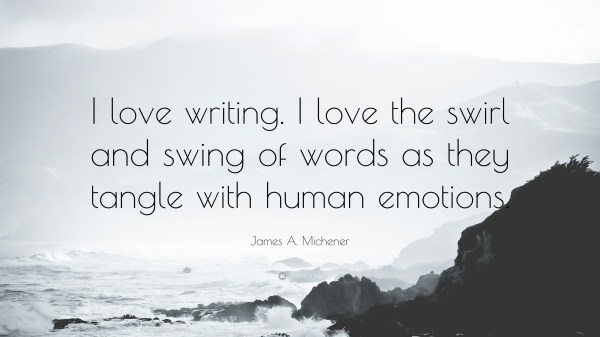
Today my favorite quote on writing is this one attributed to James Michener.

355964-james-a-michener-quote-i-love-writing-i-love-the-swirl-and-swing

I’ve had a lot of emotions lately. Chaotic, confusing, crippling emotions. The kind that freeze action and force reflection.

But time thaws, and the writing of others warms me in ways my own writing often does not. I have found healing in the writings of my friend and colleague Amber lately. So raw and real and poignant.

I share her most recent post here. (An interesting mentor text idea:  Choose an age and write about it.)

I think about the work of writing and teaching writing a lot — more often than I actually write. I need to change that. Find my groove. Free my soul within the swing and the swirl of my pen. Stop thinking I can only write research-based pieces or tips on this blog. I need to walk my talk and just write — more. Period.

Our friends at Moving Writers have an incredible idea:  100 Days of Summer Writing. Imagine the possibilities — for ourselves and our student writers.

What do you think? Could we all use a little writing inspiration? Could we all write a little more, strengthen a few mental muscles?

I’m thinking if I do, perhaps everything that’s sent me into a spin lately will spin into something else entirely.

Writing can do that. That much I know.


Amy Rasmussen teaches English IV and AP Language & Composition in North Texas. She recently moved homes, trading one cluttered mess for another, which does nothing for her need for order and simplicity. You can find her searching websites for minimalist living and selling So. Much. Stuff. on Facebook Marketplace when she isn’t trying to prep her students for graduation or the looming AP English exam. For tweets, follow @amyrass 


Growing Writers: Making Use of Student Mentors

My mentee Sarah, a new-to-the-district teacher in the midst of an intense co-teaching experience (where on an average day seven adults supported thirty students with an expanding continuum of needs), was filling me in on the narrative her students would be drafting. Support for students while drafting is critical. Sarah’s students would need questions answered, ideas suggested, and gentle encouragement: just-in-time support. Which is why I blurted out, “We should see if the AP Lit. kids will help!”.

Why AP Lit. kids? Why not?! By the time they reach AP Literature in our building, these students have completed two advanced English courses and a college level composition course (AP Language). Skilled, these students know what good writing looks like and how to produce it. But more than that, the AP Lit. kids could be–as Shana coined and Amy embellished on–living mentor texts.  

As living mentor texts, the AP Lit. kids’ stories differ from the current story of this particular classroom and the many stories of the students in it; the AP Lit. students are further along the learning journey. No one would be comparing the writing generated by Sarah’s students to these mentors, and there’s comfort–safety–in that. 

I did worry a little, though. While our AP Lit. students successfully provide feedback for writers in the advanced sophomore course, routinely mentoring them, I didn’t know how this would translate to a co-taught classroom. Would our living mentor texts help the sophomores optimize their skills and ultimately their stories as writers? 

Steps of the Experience

Before escorting the seniors to Sarah’s room, I briefed them on the parameters of the narrative writing assignment. After coaching the seniors to listen, paraphrase, question, ask to look at the writing, offer suggestions, and celebrate strengths, we headed to Sarah’s classroom. Following introductions, the seniors began moving about the room, neatly engaging the sophomores in conversation about their writing, inviting them to story-tell. Of course, my worry was needless. 


Reflections on the Outcome

Sarah certainly saw the power of their interactions:

“I saw my students open up so much more. Students who were nervous or uncertain about asking me questions or getting feedback were so much more willing to talk to peers. The students seemed to look up to these upperclassmen. Even if the seniors said the same thing I did as a teacher, the students took the senior’s perspective so seriously and really engaged with the process fully. Even if it was only a few minute conversations, the students really appreciated having someone who could check in with them right away. A lot of the base level questions could be answered more efficiently since there were more “experts” to share. Especially in a large class of 30 like mine was, it is hard for the teacher to get to spend quality time each student. This allowed for more contact time with each student.”

When Sarah later collected her students’ reflections on what type of feedback they found most helpful for their narrative essay, so many noted their living mentor texts.

“The AP people helped a lot. They just were there when I needed help or was stuck.”

“The peer mentors helped me see where I could transition or use better words.”

“Having an upperclassman helped me see how other people might do the essay which helped me think of new ways to write.”

“The AP students were new eyes and that helped me get over my writer’s block.”

“I liked that other students from another class saw my paper. It wasn’t pressure like a teacher grading but I still got feedback.”

Wanting to know what impact being a living mentor text had on the senior volunteers, I asked them to reflect on the experience.

Emily felt both “inspired to stop taking her English skills so lightly” and “inspired to use [her skills] to their full potential.”

Claire noted that “[the students] seemed really appreciative of [her] help, and seemed like they really wanted to talk about their writing. In helping and talking to them, [she] realized that [she does] have the ability to be a writer.”

Kyler reflected that “[t]he goal is getting students to revise and revise until they feel they’ve created something great. The smiles that came across some students’ faces when [he] told them [he] loved a part of a sentence or a comparison were fulfilling…The world of writing is something [he] really enjoy[s], and to share that joy by helping others consider the impact they can have is always a joyful experience.”

Screen Shot 2018-04-14 at 10.21.43 PMWhile Sarah and I loved the story of her classroom those two days, we experienced less success the next attempt. But we’ll try again. We’ll schedule the AP Lit. students more specifically, we’ll partner students according to need, we’ll invite the AP Lit. mentors to support the sophomores throughout the writing process. We’ll even explore digital mentoring through Google Docs. Sarah’s optimistic that increased access to our living mentor texts would increase confidence in her writers, helping them to grow. And, I am too.
Next Steps


IMG_1718

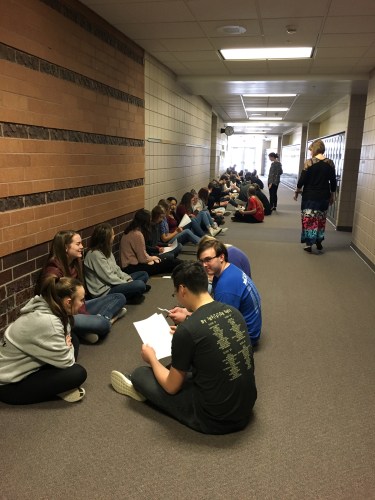
Ap Lit. students work with Honors II sophomores. Also pictured my teaching partner Amanda who teaches AP Lit. and one of my mentors Ann who first began the practice of AP Lang. and AP Lit. students mentoring honors students. 

My fellow AP and advanced teachers plan to expand the current mentoring as well. AP Lit. students and AP Lang. students will continue to guide our advanced sophomores; yet starting next fall we hope our advanced sophomores will mentor our advanced ninth graders (who are in different buildings). What a way to use writing to  foster connection!


I know there are exceptional peer writing tutor programs out there. But in these times of budget cuts and burgeoning class sizes, tapping into resources like Emily, Claire, Kyler, and the others who serve without expectation of reward is powerful. Many of the students–mentors and mentees–recognized the value in the stories of others and in their own. Their perspectives on writing, on others, and on themselves shifted, ever just so slightly.

It’s a small way to change the world. Or at least grow writers.

Kristin Jeschke teaches AP Language and Composition and College Prep seniors at Waukee High School in Waukee, Iowa. She loves when her former students eagerly volunteer their services for the underclassmen yet upstream, and she loves serving as mentor to her two favorite mentees, Abbie and Sarah. Follow her on Twitter @kajeschke. 

Moving from Assigner to Teaching Along Side My Students

Hi, my name is Kristin and I’m a recovering assigner.

I can easily blame the system that taught me. Numerous years of forced writing assignments, inauthentic essay prompts, and unfair expectations with little to no chance to confer.

What I am describing is not just my own experience of high school in the mid to late 90’s but even my own classroom (I’m a work in progress). It wasn’t until this group of wonderful educators and the amazing work of Penny Kittle and Kelly Gallagher did I even begin to understand there was more to writing than the pattern of assigning, “teaching”,  and correcting. It started slowly last year through personalized writer’s notebooks, engaging quick writes, and dabbling in mentor texts to help us grow readers and writers.  But I still didn’t feel “there”– I didn’t feel ready for the complete jump into writer’s workshop.

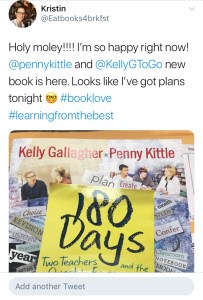
Fast forward to March– State testing is winding down and I have Kelly Gallagher and Penny Kittle’s new book, 180 Days: Two Teachers and the Quest to Engage and Empower Adolescents in my hands.

Image-1 (1)

Their recent book takes a look at the question “How do you fit it all in?” but does it with such thoughtfulness, insight, and in a way that makes their readers stop and think about their own practice. For me, it really made me think about how I needed to move from assigning narrative writing to immersing my students in the art of narrative writing.

After reading 180 Days the first time (I’m planning on rereading with my PLC as a book study), I was struck by how Penny and Kelly take different laps during their writing units, with each lap building off the last until students have shown a deeper level of development of their writing than our traditional 4×4 setup (read a book, take a test, write a paper, and repeat each term) allows us to do.

So, how has my life changed?

What my narrative unit was before:

  • I would diligently create a beautiful assignment, even including criteria for success so the students knew exactly what was needed in their narrative.
  • Students were given some choice in what they wrote (but it was choice in disguise–it still had to connect to the novel we recently read)
  • I gave students time in class to work and would start each day with a mini-lesson but it was based on what I thought needed to be taught, not in a responsive way through conferring or using a baseline assessment.
  • Usually five days later, the narrative was due. Some students used their 43 minutes each day to stare at a blank screen and eventually passed in an attempt at a story. Some loved this type of activity but passed in a narrative that was underdeveloped or without any organization. Some didn’t pass in anything at all–they would rather take the zero than take the risk.
  • While they were writing, I spent my time catching up with my grading and walking the room, begging my reluctant writers to get something on the page.

What my narrative unit is now/moving towards:

  • We started last week with multiple low-stake narrative activities in their writer’s notebooks using engaging mentor texts like “Hands” by Sarah Kay, 36-word stories using Visa commercials (Amy R. wrote about a very similar activity here), and writing alongside excerpts from some great young adult books from our classroom library.
  • This week, students will choose which pieces they want to work with and during our work time to expand them based on the day’s mini-lesson and practice revision skills (especially since my students think their first draft in their only draft–still trying to break this habit). We’ll also continue using mentor texts but use them for imitation work– “borrowing” great lines or ideas from actual writers!
  • After a well-deserved spring break, we will take a final lap with narratives the last week of April. I’m still deciding this piece– I want to see how the beginning of this week goes and see where we need to go next as we move towards the break.  I’m trying to be more responsive as a teacher, which is hard as a Type A planner. At the same time, I think this will benefit both myself and my students because I’m teaching the kids and skills in front of me versus just assigning the same narrative prompt year after year.

Although it’s only been a week in, these are some of the things I know so far:

  • My students have never been this engaged (in terms of their writing lives). How do I know this? Their notebooks are out and ready to go each class. They are passing their notebooks around the room, asking their peers to read what they worked on in class. We end our classes with “beautiful words” and they fight over who gets to share this time.
  • My closeted writers are finally finding their space in my classroom. They are sharing their work with others, giving advice to their peers, and even sharing their personal work with me (I had tears in my eyes when one of my painfully shy students handed me her poetry journal she brought from home–she thought I would like to read them this weekend. Be still, my teacher heart!).
  • Where my students are! Skimming through their notebooks has helped me see where they are starting and where we need to go. In the past, I wasn’t seeing their work until the end, which Kelly Gallagher calls gotcha grading. Now, I know where I want to and need to go to help my students with this type of writing.
  • And the best part- I’m writing. Whatever the students are writing, I’m writing alongside them and using my document camera to show my students my typos, my revisions, and myself. Narrative writing can be so personal. To see my struggle but also share parts of myself and my life has helped us connect in ways only stories can.

Although I still have a long way to go to shed the title of assigner, I feel so much hope that I am finally moving in the direction I’ve watched so many other teachers move towards. I’m reminded of what a wise educator has said about teaching– it’s making your practice 5% better each year. In this little way, I feel that my practice is becoming better because of the resources I have at my fingertips (like this group) and finally making the jump into the deep end of the workshop pool. 

What are some of your favorite things to engage and move your narrative writers? What advice do you have for those who are moving from assigners towards writer’s workshop?


Kristin Seed has been teaching for ten years at both the middle school and high school level in Massachusetts. Her passion is reading and leaving piles of books in every room of her house. You can find her chasing after her five-year-old son and now a 13 week old Golden Retriever, Abby. Follow her adventures on Twitter @Eatbooks4brkfst.

Formative Assessment Works!!!

For those of you who haven’t taught Seniors, trust me on this:  Formative assessment during the second semester is challenging.

If you’ve taught seniors, then you might understand where I’m coming from:  Sometimes it’s hard to tell if they aren’t grasping a concept, or they are just too tired of school to have the energy to engage.

I hurts my heart to even consider that my precious learners are worried about bigger issues than Comparative Literary Analysis essays or finding examples of bias in their self-selected texts.  Prom looms five days away and graduation seven weeks after that.  They work, they compete in extra curriculars, they deal with the adults and peers in their lives.  I forget, sometimes, that their plates are filled with important thoughts.  I remind myself I’m not doing their stress levels any favors by point out that we still have important work to do before June 2nd.

Last Monday we reviewed an excerpt from Niel Schusterman’s Thunderhead as a mentor text for practicing literary analysis through all the lenses that should be crystal clear to these literate learners.  I needed to assess their understanding and thinking so that I could make decisions about the instruction leading up to the summative assessment.  That’s the point of formative assessment; to “form” a plan for instruction.

I read the short selection with them, and asked them if they would, please, mark their thinking on this first lap through the text.  They should, as they’ve done many times before, underline or highlight what they noticed about the words the author chose through the lenses of diction, bias, author’s purpose…literally anything they noticed within the realm of literary analysis. It’s the last nine weeks of their public education career. They should be able to look at a text through a variety of lenses.

Some of them made some marks on the page while others wrote notes next to highlighted lines or words.  Others, though, marked nothing.  [Alarms wiggle and stir in my head. Something’s not right.]

I asked them to share within their groups what they noticed.  Muted whispers of ethos, tone, and metaphor struggled out of some groups, but again, most said very little.  Very few connections were being made. For them and for me, the picture was as clear as mud. This, by itself, is important formative assessment. This wasn’t working. [Def Con 55- Full tilt klaxons at maximum volume!]

Yet, I refuse to blame them.  I fully believe that it is solely on me, the teacher, to facilitate engagement with the text.  Somehow I need to do a better job inviting them to take all those useful tools out of their tool belts and dissect this very meaningful text.

New England Patriots at Washington Redskins 08/28/09

I bear a striking resemblance to Tom Brady.  Photo by Keith Allison

In football parlance, I needed to call an audible in the middle of the game. What I had hoped they would do; they won’t or can’t.  It’s time for me to jump in and scaffold this concept to a place where they can see the connections they can make and I can assess their thinking.  I’m not going to put them in a position to fail on the summative assessment if I know they aren’t ready for it.

In a whole class mode, I read over the text, mark what I notice and verbalize my analysis.

Now I ask them to talk about what they notice.  There it is…an increase in discussion, an inflation in dialogue. The alarm volume turns down a notch, but it doesn’t turn off.

I wrap the class period up with an invitation to write about what moves the author is making and as they do I confer with a few students who seem completely flabbergasted.  The bell tolls, signaling an end to their literary torture session.


Thus was the source of my salvation:

book

I only saunter.

Jumping into this book reminded me of a few important tenets of writing instruction that I let myself forget:

  1. Give them choice- I was allowing no choice in the subject of their analysis.  I know better than to restrict their reading and writing experiences and I let my, and their, end of the year exhaustion affect my decision making.
  2. Show them, not tell them, what you want to assess.  I wasn’t showing them examples of literary analysis and again, I know better.  I was expecting, wrongly, that Senior English students would confidently engage in literary analysis and move forward with their thinking in a way that shows me they can write a response in essay form.

After school, I tore up my lessons plans for the next four days and re-wrote them to reflect what I SHOULD do to support my students in this exploration.

On page 5 of their amazing new book Marchetti and O’Dell introduce a mentor text written by Joe Fassler from The Atlantic.  His recurring series “By Heart” is a collection of responses from a diverse group of thinkers and writers and is an amazing resource.  A simple Google search returned a link to this series of essays. I scanned the list of the titles and discovered an article from September titled, “What Writers Can Learn From Goodnight Moon.”   In it, Celeste Ng describes her feelings of the children’s book and how it “informs” her writing.

Perfecto!!!

This checked so many of the boxes of what I was looking for in a mentor text.  And…I get to read a children’s book to “big” kids.  I know enough about my students to know they will love this.

Also, I used Marchetti and O’Dell’s five part descriptions of literary analysis on pages 11 and 12 to create a glue-in anchor chart for their readers’/writers’ notebooks that helped to clarify what exactly we should look for when reading and writing literary analysis.

Confidence restored! Disaster averted… kind of.

We Ng’s reflection and discussed how this was a perfect example of literary analysis.  They asked questions, we laughed about Goodnight Moon.  I saw their confidence grow and I knew we were back on track and ready to move toward our essay.

Thursday, we started the drafts and I hope to see many of them tomorrow.

Being responsive and intentional is a crucial part of the workshop pedagogy.  I can’t stress enough how this one piece can make our break my teaching.  My lesson planning skills have finally reached the point where I plan for and anticipate opportunities to change up what we are doing to match what the students need. This was an opportunity for which I hadn’t planned, but we made the adjustment and made it work.

Sometimes, that’s how it goes.

Let me know in the comments below when you’ve had to make big changes on the fly to support your students’ learning. I know I can’t be the only one.

Charles Moore is neck deep in Children of Blood and Bone.  He’s spending the day taking his daughter to school and then having lunch with her.  It might be the best day of his life.  His summer TBR list is growing uncontrollably; feel free to add to it in the comments.

Some Multi-Genre Magic

So, remember my lamentations 2 weeks ago about students turning in “drafts” less than 24 hours before the “final version” of their multi-genre writing was due? Well, I still think years of indoctrination of The Gradebook Mentality is doing immeasurable damage to students own perception of their learning and success. But dang, did they come through in the end.

To review, seniors in Advanced Writing produced a multi-genre paper focused on an author or a genre. And the genres they could choose to write in were seemingly endless. To generate these, we played a version of Scattergories in which groups competed to name the as many unique genres as possible.  (Apparently, competition is a real motivator. Who’da thought?) Some of the noteworthy were manifestos, glossaries, Scrabble game boards, breakup letters, suicide notes, and on. What might have been the favorite was Choose Your Own Adventure: Claire took readers through an existential journey through Camus, and Maya let readers find love (or not) in her study of David Levithan.

qualitiescoverOne mentor text we studied brought about some magical results: The Book of Qualities by Ruth Gendler (BIG props to my teaching partner Mariana Romano for this idea). In this book, Gendler takes a whole slew of abstract “qualities” and embodies them in a collection of beautiful prose poetry.
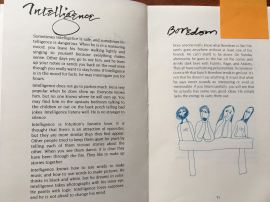
Many students followed Gendler’s lead by taking prominent “qualities” of the work they studied and embodying them in prose poetry.  To express a theme that emerged from his study of Salinger, Jed personified “Innocence:” qualitiesexample

Innocence is that old friend. You know the one. That friend you run into on the street … It’s been so long, right?! Maybe not quite long enough… But at this stage of your life, it just isn’t a good match … and somehow you manage to lose them more than youMorrisonAppendix already had. 

Myria, who studied parallel universes in fiction, personified the fear that permeates the work. fear_myria

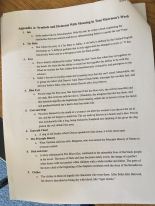
Elizabeth, one of the worst “late draft” offenders, included an appendix in her study of Morrison to aid her own readers in interpreting the complex symbolism in Morrison’s fiction.

Gray composed a recipe poem to explain the operation of the worlds built in Brandon Sandrecipe_grayerson’s fiction.

And Maya even went 3-D — her project on David Levithan’s love stories lives in a breakup bag! breakupbag.jpg

So, hope is restored. Which is SO useful as I follow my seniors into the final quarter of their high school experience — useful for me, anyway.


Creating Magic in the Classroom

Disney

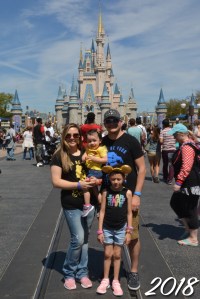
My family and I on our last day at Disney World a few weeks ago.

I recently took my family on vacation to the most magical place on earth-Disney World! The days leading up to our travels took a toll on my anxiety, patience, and stress levels. I planned this trip several months in advance and felt prepared to ensure that my family and I were going to have the most amazing time ever, and we did. All of our reservations went off without a hitch, my children behaved beautifully (surprisingly, no meltdowns!), my husband and I worked together as a team, and we had an itinerary that helped us stay on track without feeling pressured to see and do everything. At the risk of sounding cliché, it was truly a magical experience.

After pouring through hundreds of photos and reminiscing on everything we did, I came to a realization. We had a exceptional time not because I made incredible plans (although, it definitely helped!), but because of our environment, trust in each other, ability to let go of things we couldn’t control, and simply enjoying each moment and the time spent together.

That had me thinking. Isn’t that the ultimate goal of a successful workshop classroom? Isn’t that the beauty and magic of why it works?

Trust me, teaching high school English is no walk in a Disney park (pun TOTALLY intended), but it IS an extraordinary experience. Who would have thought that what makes a successful family vacation ALSO translates into the workshop classroom? (You can find amazing resources about why it works here and here, and by exploring the Three Teachers Talk archives.)

Creating and maintaining the spark may seem overwhelming. However, based on the insight I have gained through this recent epiphany after returning from Disney, I want to share with you my top 5 ways to help you create (and continue to foster) magic in your classroom.

5 Ways to Make Your Workshop Classroom Magical:


1. Be prepared. It is true, in life we cannot prepare for everything. However, the confidence that is instilled when one feels as prepared as they can should not be overstated. In my classroom, I ease my personal anxiety and that of my students when we have a plan. We have clear expectations and a set plan/goal that helps us stay focused. It seems like a simple solution, but it is quite the task. Ultimately, in order to feel in control (and to provide that for my students, too) I am consistent about the following; 

Class Collage

(L to R) My objectives are written daily. I share a daily agenda on the projector and write the homework for the week on the board. (The colored calendars are the proposed plans for the grading period and are posted to my website as well) 

  • Have an agenda
  • Communicate the goal of each day
  • Inform students of major deadlines in advance
  • Plan for multiple scenarios and/or have a back up plan.

 I also provide calendars, teacher and student samples of work when possible, and an array of mediums in which students can access helpful information. Over the years, I have found this cuts down on having to explain the same items repeatedly and helps students learn accountability.


2. Be mindful of the impact of your environment. Ambiance is a huge part of my personal philosophy when creating the climate of my classroom. As a germ-a-phobe, I have bottles of hand sanitizer, tissue, and Lysol wipes readily available. Rarely, if ever, are the fluorescent lights on.  1.) The lights give me headaches and remind me of a doctor’s office, so I chose to use a few floor lamps in my room. 2.) I adore natural lighting, especially with 3 large windows in my room. 3.) The dim lighting helps students feel comfortable, less intimidated, and reduces the noise levels (Trust me, it does!). In addition, I am particular about the quotes and student work on display. I even have carpets and pillows to increase comfort and provide flexible seating. You don’t have to pull out all the stops, especially with teenagers, but it helps to pay attention to the vibe of your tribe.

This slideshow requires JavaScript.

3. Trust in your support systems… and your kids. Lean on your admin or campus leadership, colleagues and PLC’s when you can. You never know when YOUR leadership can also serve as the support system for others as well. In my experience, I have learned something from every team and grade level I have been a part of, regardless of personalities or personal opinions. As educators, we are in the business of learning and seizing all teachable moments. This should also apply to our interactions with our colleagues.

One of the prime examples of why the workshop model works is because the focus is on the kids. As with any vacation or event for kids, we MUST keep them first at all times. Kids are kids. Yes, they will have times where it is a struggle to get through each moment, but it is worth it when the light bulbs finally turn on. All of the effort is completely worth it to see the growth and progress they make each day. My students never cease to amaze me with their stories, experiences, and development every year.

4. Prioritize. Part of planning and preparing is also understanding that you might not get to everything. Don’t stress about it, just figure out what your non-negotiables are and start there. Some reflection questions I have to help me in this process are;

  • What do I want my students to learn in this unit?
  • How will I know if they understand it?
  • What do I do if they don’t?
  • What do I do for my students who require extended learning or have special circumstances?

By keeping these in mind, I can quickly determine where we need to go, how we get there, and plan for various ways for my students to master their learning.

5. Enjoy the time together. At the end of the day, we became teachers for a reason. It is imperative that we also strive to keep that passion and excitement alive. Our love for our content and profession is contagious. When you surround yourself with opportunities to appreciate the time you spend cultivating young minds, trusting in the process, and uncovering the joy and value of each moment, that is the true magic of teaching.

I would love to hear about what has worked for you in your classrooms! What are some ways you and your students have been successful throughout your journey?

Gena Mendoza is still reeling from her recent visit to Disney World with her family over Spring Break. She is currently trying to convince her husband to agree to go back as soon as possible. In addition, she teaches High School English in Texas and is grateful for her students who kindly (and patiently) tolerate her latest obsession with all things Disney. She invites you to connect with her on Twitter and Instagram at @mrs_mendoza3.


Revision Strategies that Make the Cut: Helping Students Be Incisive

I learned to be more incisive as a writer as an AP Language and Composition student (somewhere in between rocking flannel and rocking out to Pearl Jam). My perspicacity heightened with my argument research paper, which I had written by hand. Yes, by hand. We owned a computer, but I still expressed myself better pen to page (I’d make the case that writing by hand is still important for our students. Um–notebook time, anyone?). As I read what I had written, preparing to make revisions, I knew I wanted to rearrange the sections. So, I reached for scissors and tape. And–gasp–I cut up my essay, by paragraph, by sentence even. Sprawled on my bedroom floor, I spent the rest of that evening moving parts around until satisfied the parts built toward my whole.

My students’ body language says it all when I offer this story as the lead in to cutting up their own writing. They lean back, raising eyebrows, looking at me quizzically. I imagine their thoughts: “We have cut and paste for that, Mrs. J. You know, on our smartphones.” “Oh rats (emphasis added), I didn’t print my paper. Ha! Now I don’t have to do that.” “I like the way it is. Why would I want to cut it up?” This last query I think is most important. Writing is an act of making, of creation. As humans, we typically get attached to the things we make; we grow to love our words and the way we’ve orchestrated them on the page. Some students need to wrestle with this implicit bias more in order to discover the gaps in their writing. By making my students cut up their drafts, giving them a different kind of constraint, I’m helping them to engage in cognitive conflict, the kind of disequilibrium they need to continue their work revising and to move forward as writers.

These are 5.5 of the strategies so far (I’m always culling) that have made the cut in my classroom.

1. For Invention and Structure

Process: During the planning phase for their argument research papers, I offer old books and magazines to my students, directing them Disney Imagineer Style to cut words and images related to their issues and then arrange them on the page, keeping their audiences in mind.

Benefits: This kind of gathering, cutting, and moving allows for intuitive structuring of their papers AND sometimes engenders creative analogies within their justification (warrants).

2. For Structure

Process: To further gather ideas for structuring, I direct students to cut apart mentor texts to see how they are structured. Typically, I advise them to start with paragraphing but then encourage them to make further cuts and move text as needed in order to discover the ordering of the text and to label and note for themselves what moves the writers made.

Benefits: This exploration compels students–because they must analyze the implications of how the writer arranged the text–to more purposefully arrange and connect their own ideas.

3. For Development

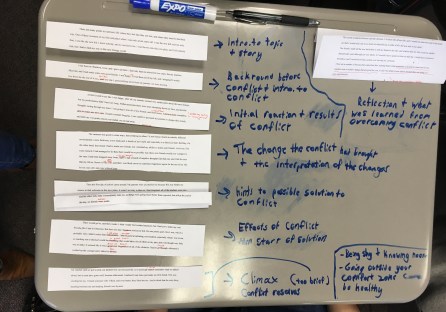
Process: Students begin by cutting up their papers by paragraphs. They then label the purpose of each section or determine what question each paragraph answers, keeping a post-it with the thesis/theme/point near to see if each paragraph aligns. They can then begin moving paragraphs or parts around to see how to manipulate time, to see if there can be greater logical interrelatedness, or to see if parts require more information.

img_1565-1.jpg

This student sample shows a narrative cut up and labeled.

Benefits: Cutting apart their own texts challenges students to determine the efficacy of development in their writing, especially because this compels them to examine one section–in isolation–at a time (something more difficult to do digitally). Here is one of my students talking through how he used the process and what he discovered.

4. For Purpose

Process: Here the cutting gets more minute: I ask students to cut out the center of gravity sentence (their thesis, claim, so what, point, etc.) to see if everything really does rest on it. After cutting it out (and sometimes just transferring it to a post it), students can move it next to different parts of their paper to see if the parts not only relate but if they build toward this.

Benefits: Sometimes the benefit here comes in the realization that they need a so what or that the parts don’t align or that the sentence itself lacks strength.

5. For Style

Process: Cutting out where they used a mentor text move and seeing if they applied that move to their own writing gets students looking at sentence construction.

Benefits: If we ask our students to “lift” a move from a mentor text, can’t we also ask them to lift their text and compare it back to the original, moving them side by side to determine how effective the application of the mentor text move is after all?

 5.5 For . . .?

Possible Processes: Cut away what tells instead of shows. Cut out all of the comparisons in the text to look for patterns, connectivity, etc. Cut out the best sentence from each paragraph to look for ways to build meaningful repetition.

Benefits: I don’t know yet. These are half-formed ideas right now. But I know they could help my students become more discerning as writers.

Amy Estersohn wrote in her recent post about the tools she relies on for workshop. I’d like to add one more tool: scissors. This tool inspires strategy, and thus, our writers. I frequently tell my students that writing is made of moveable parts. So, let’s get our students moving it!

Kristin Jeschke frequently finds scraps of paper and post it notes around her house–writing that may or may not have made the cut of her budding cartoonist nine-year-old and her emerging storyteller six-year-old. Of course, on days when her students are armed with scissors, her classroom looks similar. Follow her on Twitter @kajeschke. 

Politically Motivated: Positively Harnessing Student Passion in a Time of Uncertainty and Fear


Yesterday morning, I stood outside for 17 minutes. Per the instructions of my administration to maintain the opportunity for all students to learn without interruption should they choose, after a moment of silence in our school for the victims of the Parkland shooting, if students chose to participate in the national walkout, teachers were to follow only if every student in his/her class left the building. After a few seconds of looking around at one another, one by one my sophomores stood up and filed quietly out of the room.

Outside, a small group of students had prepared statements to lead the several hundred students gathered in the chilly March sunshine through 17 minutes of reflection, support, and silence. The group was large, diverse, respectful, and unified, if not in purpose (likely a few students were carried out more by curiosity than conviction), then in the experience itself. A hush I’m not used to experiencing in the company of several hundred high school students quickly fell on the chilly March morning and the group stood in near silence, listening to their peers eloquently unite the crowd in peaceful purpose.

Teaching in time when I feel that I must often couch statements with a reminder that logic and facts should not be considered political, I must again come to you today and suggest that the overwhelming pride I felt in the students gathered in front of our school yesterday, and at the student-led debrief/discussion held during our resource period afterwards, had nothing to do with the politics of their statements. It has everything to do with the way I saw students, our students, standing together in support of one another to promote safety, unity, and empathy, not only for our schools but for our communities.

Several weeks ago, after the tragedy unfolded at Marjory Stoneman Douglas High School, I was compelled to write about how we can help our students (Shana too wrote beautifully about positive activism in the classroom), those young people who were not even alive when the shooting took place at Columbine in 1999, process such violence and uncertainty as a constant shadow to their educations. Little did I know that our school too would need to process an alleged threat to safety, a school day where several hundred students stayed home out of fear, social media-fed rumors of possible violence, and countless discussions with students who said time after time that even though this particular brand of violence has been taking place for the entirety of their educations, they didn’t know what to do. They didn’t know how to feel. They didn’t know how to cope.

They just want it to stop.

I looked at their faces and saw fear, anger, and pain that frankly frightened me, and for the millionth time this year, I knew I needed to figure out what we could do.

Discussion, writing, reflecting, sharing, and hugging was working, but much like this past month, something felt different.

These kids needed to DO something.

My colleague Sarah and I decided to have our AP Language students write letters to their representatives, expressing their researched opinions on how to end the violence of mass shootings. Their arguments would be their own, bolstered by research to better understand the issue, their own positions, and their audience.

social changeWe were clear with students from the very beginning that this was not an assignment in support of any particular political agenda. Instead, it was an exercise in better understanding our preconceived ideas and more deeply, and diplomatically, developing our rationale for how to bring about change  As long as their research came from credible sources, students could argue for changes to gun laws, support of the 2nd amendment, mental health considerations, school security, or any other defensible position to end mass gun violence. They could write to state or local representatives, as long as they researched that representatives current position on related issues, providing students with key insights to audience consideration we’ve previously only talked about or tried to emulate through blogging.

Supported with ideas from Kelly Gallagher’s incredible argument unit published over the course of 12 days on his personal blog, Sarah and I helped students through pointed research to build letters rich in ethos, persuasive argument, and pathos that could only be provided by the very students whose passions for activism have been flamed because they are so heavily and personally burdened with the threat of this particular brand of violence.

Over the course of the past two weeks, I have:

  • Seen students come in more for help/feedback with this assignment than any other throughout the year. When I asked a student after school yesterday, what had him so dedicated to crafting this particular summative he said, “Because my school work matters, but this assignment is going outside of the school. It matters outside of these walls.”
  • Watched young people who before could not identify who their state or federal representatives even are, research these people and their positions on key issues, and write directly in response to those issues in order to argue to an authentic audience.
  • Helped students channel their feelings of helplessness into purpose, simply by picking up a pen.

What these kids have produced is incredible. I am so proud of the way they have positively focused their overwhelming emotions into powerfully convincing letters to the men and women with means and opportunity to make changes to protect our students from further disaster.

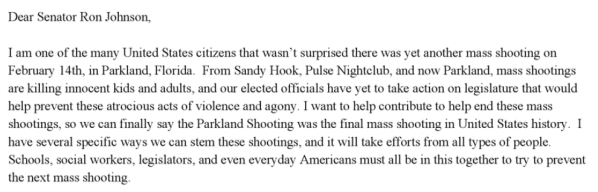
Here are a few excerpts from letters that have started rolling in. In the coming days, we will get the letters printed, addressed, and mailed to Madison and Washington.


mass2


mass3


mass4


mass1


I am a firm believer that addressing issues in a constructive manner is a significant step toward positive change. We owe it to our students to provide them with, encourage them around, and support their efforts in making positive changes in their own communities. Though unequivocally necessary as a foundation to an informed electorate, we will not raise the citizens this nation so desperately needs on standards, skills, and summative assessments alone. A new reality is built on the combined knowledge and passions of the humans willing to take risks in support of that reality.

I will certainly never stop teaching my students that deconstructing a prompt is the best way to dig into a timed writing task or that commas don’t occur only where you would naturally take a breath, but I will also never stop supporting them in all they have to teach to us. Our students deserve our help in amplifying their voices to bring about a better world. In this, our jobs have never been so important.


Lisa Dennis teaches English and leads a department of incredible English educators at Franklin High School near Milwaukee. Follow Lisa on Twitter @LDennibaum. 


A Book for Women, Young and Old and In-between

I am always on the look out for books that will hook my readers and mentor texts that will inspire my writers.

But when I saw the title The Radical Element, 12 Stories of Daredevils, Debutantes & Other

My Radical Granddaughters

It’s never too early to give girls hope.

Dauntless Girls, I thought of my own three daughters, my daughter-in-law, and my two granddaughters. (Well, not so much the debutantes, but definitely the daredevils and the dauntless.)

We need books where our girls see themselves –where they feel empowered to take on the world. In a brochure I got from @Candlewick, it states:

To respect yourself, to love yourself, should not have to be a radical decision. And yet it remains as challenging for an American girl to make today today as it was in 1927 on the steps of the Supreme Court. It’s a decision that must be faced when you’re balancing on the tightrope of neurodivergence, finding your way as a second-generation immigrant, or facing down American racism even while loving America. And it’s the only decision when you’ve weighed society’s expectations and found them wanting.

So today, I write to celebrate the book birthday of The Radical Element edited by Jessica Spotswood.

Screen Shot 2018-03-13 at 12.54.36 PM

Jessica writes:

. . . Merriam-Webster’s definitions of radical include “very different from the usual or traditional” and “excellent, cool.” I like to think our heroines in these twelve short stories are both. Our radical girls are first- and second- generation immigrants. They are Mormon and Jewish, queer and questioning, wheelchair users and neurodivergent, Iranian- American and Latina and Black and biracial. They are funny and awkward and jealous and brave. They are spies and scholars and sitcom writers, printers’ apprentices and poker players, rockers and high-wire walkers. They are mundane and they are magical.

. . .

It has been my privilege to work with these eleven tremendously talented authors, some of whom are exploring pieces of their identities in fiction for the first time. I hope that in some small way The Radical Element can help forge greater empathy and a spirit of curiosity and inclusiveness. That, in reading about our radical girls, readers might begin to question why voices like these are so often missing from traditional history. They have always existed. Why have they been erased? How can we help boost these voices today?

I have only read a few of these stories so far, but they are a wonderful blend of adventure and courage.

Here’s what three of the 12 authors have to say about their stories:

From Dhonielle Clayton, “When the Moonlight Isn’t Enough”:

1943: Oak Bluffs, Massachusetts

What encouraged you to write about this moment in history?

 I wanted to write the untold stories of hidden black communities like the one in Martha’s Vineyard. I’m very fascinated with black communities that, against all odds and in the face of white terrorism, succeeded and built their own prosperous havens. Also, World War II America is glamorized in popular white American culture, however, we learn little about what non-white people were doing during this time period. 

 In researching this topic, did you uncover any unexpected facts or stories?

I didn’t find as much as I wanted because historians focused on white communities and the war effort, leaving communities of color nearly erased. I had to rely on living family members that experienced this time period and a few primary sources detailing what life was like for black nurses in the 1940s. 

 How do you feel like you would fare during the same time period?

The one thing I trust is that black communities have been and will always be resourceful. Accustomed to being under siege, we have developed a system of support. I think I would’ve fared just fine. 

From Sara Farizan, “Take Me with U”:

1984: Boston, Massachusetts

What encouraged you to write about this moment in history?

I’ve always been fascinated with the 1980’s. Even with all its faults, it is the period in time that stands out for me most in the 20th century. The music, the entertainment, the politics, the fear and suffering from the AIDS virus, the clothes, and the international events that people forget about like the Iran/Iraq war.

In researching this topic, did you uncover any unexpected facts or stories?

It was hard to look back on footage from news broadcasts about the Iran/Iraq war. I felt embarrassed that it seemed this abstract thing for me when really my grandparents came to live with my family in the States during the year of 1987 to be on the safe side. I was very young, and didn’t think about why they had a year-long visit, but looking back, I can’t imagine how difficult that must have been for them. Fun not so heavy fact: Gremlins, Ghostbusters, Purple Rain came out in the summer of ’84. And so did I!

How do you feel like you would fare during the same time period?

I think I would know all the pop culture references and my hair is already big and beautiful so that would work out great. My Pac-Man and Tetris game is strong, so I’d impress everyone at the arcade. However, I’m not down with shoulder pads and I don’t know if I would have been brave enough to come out of the closet back then.

From Mackenzi Lee, “You’re a Stranger Here”

1844: Nauvoo, Illinois

What encouraged you to write about this moment in history?

My story is set in the 1840s in Illinois and is about the Mormon exodus to Utah. I was raised Mormon, and these stories of the early days of the Church and the persecution they suffered were very common place. It took me a while to realize that, outside of my community, no one else knew these stories that were such a part of my cultural identity. I wanted to write about Mormons because its such a part of my history, and my identity, but also because, when I was a kid, there were no stories about Mormons. There are still no stories about Mormons–it’s a religious minority that has been largely left out in our current conversations about diversifying our narratives.

In researching this topic, did you uncover any unexpected facts or stories?

Ack I wish I had a good answer here! But honestly not really–I already knew so much of what I wrote about because I’d gone to a Mormon church throughout my youth.

How do you feel like you would fare during the same time period?

Badly! The Mormons went through so much for their faith, and as someone who has had a lot of grief as a result of the religion of her youth, I don’t know if I could have handled having a faith crisis AND being forced from my home multiple times because of that faith. Also cholera and heat stroke and all that handcart pulling nonsense is just. too. much. I didn’t survive the Oregon Trail computer game–no way I’d survive an actual trek.

Radical_Element_social_media_quotes_4


Amy Rasmussen teaches readers and writers at a large suburban high school in North TX. She loves to read and share all things books with her students. In regards to this post, Amy says, “It’s Spring Break for me, and I’ve been idle. Kinda. Three of my grandkids arrived at the spur of the moment, so I’ll use that as an excuse for posting late today.” Follow Amy @amyrass and @3TeachersTalk.