Category Archives: Readers Workshop

Blackout Poetry with a Twist

Early in the school year, I’m always on the lookout for new ways to gather diagnostic data on my students, without uttering the words diagnostic, data, quiz, baseline, or any other term that reduces my students to plot points on a spreadsheet or numbers in the gradebook.

We know the power of conferring in learning about our students in countless ways, but what to do when, say as an AP teacher, we need to know students’ understanding of analysis terms or their ability to apply those terms in order to really dig into authentic analysis through study of mentor texts?

The idea of a vocabulary quiz makes me shutter. Conferring long enough with each student to get a good understanding of his/her knowledge of syntax, imagery, figurative language, etc. would take weeks. Submitting annotations on our first go-around seems cruel to both students and to me.

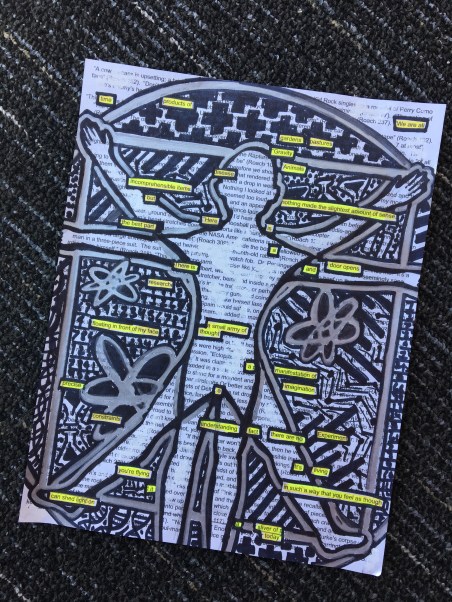
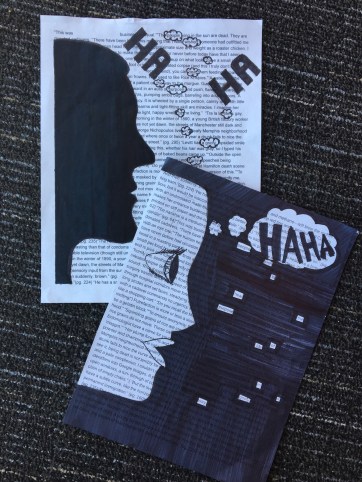
So this year, my colleague Sarah and I decided to try something different. We wanted an understanding of how students would go about identifying the purpose of a piece and img_6137provide appropriate text evidence of the basic terminology of analysis: syntax, imagery, diction, figurative language, and detail. We wanted students to use their left and their right brains. We wanted to students to work together to solve a problem.

Enter, the blackout poem.

Traditionally, black out poetry makes meaning out of the words provided by a single page of text. Whether it be from a book, article, essay, etc., a poem is created from the words that live on the page by blacking out all other words and leaving just the ones that create meaning for your given purpose. Additional images are sometimes included.

We decided to turn this upside down a bit. Students would create their page of text from the text evidence they pulled from their reading (In this case, their choice of Mary Roach books from our summer homework assignment) and a poem to illustrate their claim of purpose from that reading.

And this, is some of what we got:

Below, are the steps we took in guiding students through this unique assignment. It could work for jut about any reading, and I would love to try it when students have read a variety of perspectives on a given topic.

img_6132

  1. Students read their choice of Mary Roach books over the summer and kept track of instances where they felt she purposefully utilized DIDLS (Detail, Imagery, etc.).
  2. We then partnered up or formed groups of three to discuss what we found and what we thought it meant. We were working toward specific purpose claims for each text.
  3. Students shared examples of the various instances of craft from Roach’s texts and as they did so, they typed those quotes onto a shared Google document. Their final task with that original quote document was to decide on a claim of purpose for the text(s) they read.
  4. Once finished, students printed that document of quotes so I could take a look. I’ll use it as a jumping off point for review that’s needed with specific elements of analysis.
  5. The kids then eliminated all of the formatting for their quote document, so they were left with a page full of quotes from their texts. Essentially, they created the page of text for their blackout poem, instead of using an existing one from the book.
  6. We then talked about how to communicate their claims of purpose poetically. Simply finding the words from their purpose was not going to be poetic, it was going to sound like a thesis. We brainstormed ways to convey the purpose through related ideas and involve more imagery, figurative language, etc. in our own work.
  7. Finally, we put the poems under the document camera and each group explained their claim for Roach’s purpose in the text, how it influenced their poem, and read their work to us. We snapped at the end of each reading.

I love that this work got students talking about a text, using text evidence, attacking an assignment with both sides of their brains, and enthusiastically supporting one another’s work by sharing with the class. Their creations went well beyond finding and explaining examples, to creation. Poetry from nonfiction for the win.


Lisa Dennis teaches English and leads a department of incredible English educators at Franklin High School near Milwaukee. Her favorite insight from Mary Roach (courtesy of the book Gulp) is that our mouths fill up with saliva before we vomit in order to protect our teeth. We have so much acid in our stomachs that our teeth would be irreparably damaged when we puke, if our saliva didn’t protect them. Science. Incredible. Follow Lisa on Twitter @LDennibaum 


#TwitterTeacher

I’m late to the party. This I know. But my enthusiasm for this soirée is genuine, and it fueled some of my first day success.

In an effort to build community as quickly as possible this school year, and to get to know our students a bit over the summer, my colleague Sarah Sterbin and I decided to add some technological play to our AP Language summer homework. Using the hashtag #fhslanglife, students were asked to share their reading life twitter4throughout the summer.

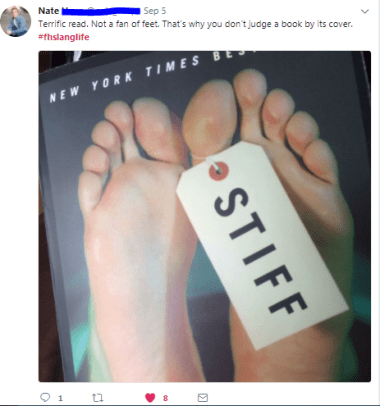
They could snap photos of their trips to the bookstore, their feet in the sand and a book in their hands, and their smiling faces reading the summer away.

They could quip about quotes from required and choice reading, make suggestions to peers on what to read next, comment on the insights of others, follow my reading adventures, and the list goes on.

As often happens with open ended assignments, we got a wide variety of participation. Tweets ebbed and flowed throughout the summer, but each time a student posted, I made it a priority to comment, retweet, like, and/or tag an author to promote connections across the world of reading. When Ishmael Beah, Allen Eskens, and Matthew Desmond interact with your students over the summer, I call that a solid win for starting to build readers and a community with enthusiasm around reading.

twitter5

On the very first day of school, and in the few days that followed, as we quickly collected summer work, set down to work with a quick writes, set up writers’ notebooks, organized editorial speeches for our first speaking opportunity, and took in the surroundings of our room, I asked students to use our hashtag to share their excitement about the work ahead. I love what they chose to share.

twitter3twitter1twitter 2twitter6

Tweeting is a quick and easy way to build community. I sometimes display current tweets our daily PowerPoint/Syllabus to keep the movement afoot, and I love to hear students’ reactions as they come in the room to see their humor, insights, and recommendations on the big screen.

Twitter

How do you use social media to promote reading and writing lives? Please leave your brilliant ideas in the comments below!


Lisa Dennis teaches English and leads a department of incredible English educators at Franklin High School near Milwaukee. Her latest tweet suggests that she thinks about reading 24/7. Follow Lisa on Twitter @LDennibaum 

We Remember Our Students; They Remember Us, Too

img_7247.jpg

Bryce photobombing me in 2014

Sometimes I go months without seeing any of my former students. Then, I’ll venture to the grocery store at 5 pm on a Tuesday and see six of them in 15 minutes.

Sometimes I worry about the ones I never bump into. How are they doing? Are they okay? I wonder.

Bryce is one of those students I worry and wonder about. I had him for two years, and he made incredible progress from a squirrelly junior who couldn’t sit still in his desk, to a serious senior who devoured first graphic novels, then dystopian classics. He wrote pages of essays I couldn’t get him to care about, then progressed to delivering measured country wisdom.

Bryce, along with his class, wasn’t a kid you could easily forget–he was part of my MTEC crew, the rowdy country boys who attended our high school for half a day and worked on their vocational certifications for the rest. Bryce and his pals Troy and Bull leapt at the chance to build my bookshelves rather than read books, give my husband advice on how to fix up the ’92 Bronco he bought rather than write poetry, or sneak their dip spit into Gatorade bottles rather than revise an essay.

So, when my husband, a spine surgeon, saw Bryce come into the ER one evening, he knew who he was. He knew his face from his visits to my classroom; he knew his personality from my stories over the dinner table; he knew my frustration as I lamented over trying to find him a book to read. He knew what that kid meant to me, and he also knew he wasn’t allowed to tell me about the horrific car crash it was evident Bryce had just been in.

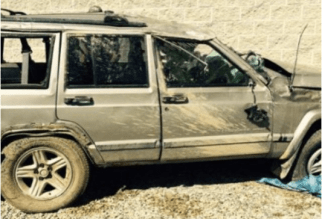
But the news was all over social media–Bryce had flipped his Jeep over an embankment, rolled down a hill, and broken his spine in several places. I knew that since my husband was on call, he’d be the one taking care of Bryce, fixing his shattered bones. I also knew that Bryce wouldn’t be returning to school this year, that he’d be assigned to homebound instruction, and that not just anyone would be able to shepherd him through his classes.

So I was worried right away–worried that for all of Bryce’s progress, this accident outside the classroom would erase the growth he’d achieved so painfully, in an equally painful way. Would he walk again? Would he be himself after rolling his prized Jeep down one of our state’s famous country roads? Would he finish his junior year classes successfully and stay on track to graduate?

Since I had an in with his doctor, I got to visit Bryce in the hospital the day after his surgery. He wasn’t paralyzed, but he’d have a long road to recovery–and to a successful finish to his school year.

A week later, Bryce was at home, in a back brace, scars all over his body, and his face still bruised and battered. I was there too, my arms filled with binders full of his assignments from all six of his classes. His mom, whom I’d met when I visited the hospital, brewed me coffee in the kitchen and sorted out the pills Bryce needed to take every afternoon. He blushed when she had to help him use the restroom, or nagged him to get out of his recliner and take a walk, or shuffled the thick stack of hospital bills I saw on their kitchen counter.

For three months, this was our routine–I’d arrive at Bryce’s house two afternoons per week with all of his homework and gently prod him through it. I’d bring him Gatorade and Cheetos from the gas station on the way to his house to help bribe him through the math and history assignments he hated. Science, he enjoyed, and his vocational class homework never failed to bring a smile to his face. But it took him twice as long to finish all of his required work–between his concussion and injuries, his fear about getting hurt again if he were to return to school, and the exhaustion brought on by physical therapy and trauma, it was no wonder he had trouble concentrating.

Screen Shot 2017-09-18 at 7.10.30 AM

Bryce included a photo of his totaled Jeep in his MGP

But I knew that English would be a tough subject to approach. I wanted Bryce reading and writing meaningfully–frequently and deeply enough for the acts to be therapeutic.  Outside the workshop community of our classroom, it was harder to guide him toward this kind of cathartic literacy, but we got there.

By the end of the semester, he’d read nine books with damaged protagonists, written poetry about how his accident had created new gratitude for his mother and sister, and crafted a multigenre paper about his accident called “Anything With Wheels Will Cost You.”


My Jeep is my peace keeper. It’s the thing to let me get rid of reality. Some people have books, walks, or something else, and I have riding. No one is able to get ahold of you and all it is, is you and the woods and the roads.

After reading that line from his MGP, I knew he’d get another fast car, and he did. By the next year, he had new wheels and a new attitude. I got to have him in class again. He was a different kid–subdued, quiet, focused. He worked just as hard in class as he did outside of school, holding down two jobs to be able to buy a new vehicle so he could feel like his old self again. He flew largely under the radar in my 28-person class, graduated in the spring, and finished his vocational certification.

img_2433.pngI hadn’t seen Bryce in over a year, but had wondered what became of him. Then, last week, I spied him pulling out of a gas station. He was easy to spot, driving a truly West Virginia tricked-out truck, complete with lift kit, muddin’ tires, and chrome roll bars. His hair was longer, and he was smoking a cigarette. I pulled out my phone, wondering if I still had his number, and I did.

His reply to my message makes me continue to worry and wonder about him, perhaps more than I did before I’d seen him.

Life after high school isn’t easy for any of our students. When they leave our classrooms and we continue to worry about them, it’s for good reason–the transition from a “much simpler” time to the responsibilities of adulthood is tough for anyone.

But they remember what we teach. Maybe they don’t remember things like apostrophe use, but they remember that we care, that our concern for them goes beyond whether they can read and write well, and into whether they can live well beyond our classrooms.

I know you have kids you’ll never forget, too. And I know they haven’t forgotten you, either. We remember them; they remember us. Let’s teach them what’s worth remembering.

Shana Karnes is mom to 1.5 spunky little girls and wife to a hardworking surgical resident.  She teaches practicing and preservice English teachers at West Virginia University and is fueled by coffee, Reese Puffs (this week), and a real obsession with all things reading and writing.  Follow Shana on Twitter at @litreader or read more of her writing on the WVCTE Best Practices blog.

3 Ideas for Better Book Talks

I should have written this post yesterday. Yesterday was 9/11, and I always try to incorporate some lesson about the events, emotions, and effects of that day into whatever our focus is in class. It’s important we always remember.

My students are juniors and seniors. 9/11 is history to them, and few of my students like to read historical fiction. They choose YA off of my “Teen Angst,” “There Might Be Kissing,” and “You Just Can’t Get Over It” shelves most often. (I suppose most of the books I book talked today fit in that last category though. I’ll be moving a few later.)

Without really meaning to, I shared three books with students on Monday in three different ways. Thus, the idea for this post on engaging students in reading by mixing up our book talks.

  1. Read a poignant, exciting, or particularly intriguing passage from a book.

Over the weekend, I read The Memory of Things by Gae Polisner. I found this a touching story about love and loss and resilience — all topics my students can relate to. What does it mean to be responsible? How do we fight our fears and struggle through the tragedies that terrify us?

In my book talk, I spoke about the characters in the book:  a young man trying to prove his worth to his dad, and a young woman who we learn is in conflict with hers — both struggling with the realities in NYC on the tragic Tuesday of 9/11.

I read the first few paragraphs aloud:

“I move with the crowd, away from downtown Manhattan.

We travel swiftly but don’t run, panicked but steady, a molten lava flow of bodies across the bridge.

A crash of thunder erupts–another explosion?–and the flow startles and quickens. Someone near me starts to cry, a choked, gasping sound, soon muted by a new wail of sirens rising at my back.

I stop and turn, stare frozen. People rush past me:  faces twisted with shock and fear, mouths held open in O’s, others only eyes where their noses and mouths have been covered with knotted sleeves against the toxic, burning reek.

I search fro Kristen or Kelly, or Mr. Bell, but I lost them all as soon as we got to the bridge.

I don’t see anyone I know from school.

I don’t see anyone I know.

I press my sleeve to my nose– Don’t think, Kyle, just move!–but feel stuck gaping at the place where the city has vanished beyond the thick brown wall of smoke.

Two planes have hit, one building is down, and my dad is in their somewhere.”

There’s a lesson in imagery in there I may return to sometime. We are writing narratives right now, so I bookmarked this for later. For now, it’s a good teaser and an effective book talk.

2. Show a movie trailer — but play up on how the book is always better.

My students love videos. They admit to spending their entire lives on YouTube, so any chance I get to show a video clip I take.

If you’ve read Extremely Loud and Incredibly Close, maybe you feel like I do about the movie:  I loved it, but the book just gives us so much more detail, description, characters, and craft to love. Oh, how I love the craft in this book by Jonathan Safron Foer.

For my book talk, I first flipped through the book, showing student how Foer plays with white space, page markings, and photo essays — all which play into how he develops the plot and constructs meaning. I talked about the parallel plot line and how the movie makers diminish, change even, the important second storyline. I explained how this book taught me more about author’s craft than anything I’ve ever read. Then, I showed the movie trailer.

(Book trailers work as effective book talks, too. You’ll find a bunch here and here and here. We even have a few ideas about book trailers in our archives on this blog.)

  1. Use a passage as a quick write prompt or as a craft study. 

Have you read The Red Bandanna: A Life, a Choice, A Legacy by Tom Rinaldi? Just a few pages in, and your heart will swell.

As I read the books I know I will share with my readers, I mark passages that make me think and feel. Important moves for any reader. I model these moves as I share books and writing ideas with my students. This passage from The Red Bandanna tears me to shreds every time.

The Red Bandana

In my senior English classes, I talked about the heroics of Welles Crowther, the main character in the book, and then students wrote in response to the questions:  What do you carry, what truth could it possibly contain? What meaning could it hold?

In my AP Language class, we talked in our groups about the word choice, the interesting syntax, the tone, and then students wrote their answers to those questions, trying to imitate the writer’s rhythm and descriptive language.

In all my classes, we talked about 9/11, our thoughts, our feelings, and why they matter to the lives we live now. We made connections to texts and to one another as we shared our thinking and our writing. That to me is an added bonus of an effective book talk.

I know my students will read more the more I talk about books. I am the salesperson, and they are the often skeptical customer. I’ve learned that mixing up how I talk about books matters.

And getting students interested in reading pretty much anything these days matters most of all.

Do you have ideas on mixing up our book talks? Please leave your ideas in the comments.

Amy Rasmussen loves to read, watch movies with her husband, and tickle her five grandchildren. She’s in the market for a lake house and likes to shop thrift stores for books and bargain furniture. Someday she’ll be disciplined enough to write a book about teaching. For now, she teaches senior English and AP Lang and Comp at her favorite high school in North TX. Follow Amy on Twitter @amyrass, and please, go ahead and follow this blog.

Alternatives to Reading Logs

c5e2590b7277d0516b78e67e6021b540Ahhh, Labor Day weekend–that first glorious three-day respite from back to school, or the last vestiges of freedom before it begins.  Whatever this weekend is for you, I hope you’re using it to relax and recharge before we see bright, smiling faces (or sleepy ones) tomorrow.

I bet you’re using a book or two to help you enjoy this weekend–what are you reading?  I’m reading little bits of Bill Bryson’s The Mother Tongue whenever I can squeeze it in (usually as I fall asleep).  In longer chunks, I’m reading Scaachi Koul’s memoir, One Day We’ll All Be Dead and None of This Will Matter, which is a perfectly-sized series of essays for my busy days.

In quiet moments on long weekends like these, I wonder what our students are doing.  Do their reading lives mirror mine?  If the answer is no…what can I do to help them become readers?

And, more pressingly–is there something I’m doing that’s preventing them from becoming readers?

Reading homework, requirements, levels; book reports, assignments, due dates.  None of these are what I’m tying to the books I’m reading this weekend.

But is that true for our students?

This article from School Library Journal talks about the work done by librarians to match a person to a book.  They call it readers’ advisory.  Then, they lament that so many classrooms discourage the important work of “talking with a child, observing body language for clues, and walking together through the stacks while offering suggestions” and rely on leveled bins, assigned texts, or assessment-bound reading units to get kids to read.

How much of what goes on in my classroom is readers’ advisory–and how much damages that work?

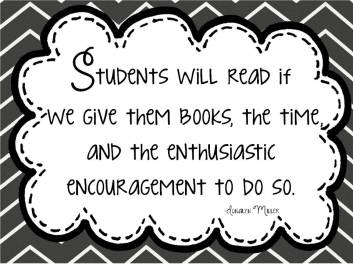
Slide2I’ve been thinking since last May about how we should stop grading independent reading.  The best and brightest in our teacher hive give us their advice and wisdom in books, blogs, and articles, with quotes like this one from Donalyn Miller.  Books, time, encouragement–these are themes we see repeated in what students need to blossom as independent readers.  Nowhere do we see that we need to measure, assess, or grade them.


To be sure, our kids need our instruction and guidance to grow as real readers.  Conferences, follow-up activities, book clubs, goal-setting, talk, and self-assessment are powerful tools to help move students forward.  How can we prioritize those things instead of more measurable (and infinitely less revealing, rewarding, or authentic) methods like reading logs, records, and quizzes?

Well, we really want to know.

Please share with us:  what are your alternatives to reading logs?  How do you approach a gradebook that must be filled, and fill it with meaningful activities tied to reading?


Screen Shot 2017-09-04 at 7.15.11 AM


In that Google Doc, we’ll work to compile a series of alternatives to reading logs, and share them here for everyone to benefit from.  You can also leave a comment on this post, write on our Facebook page, or tweet to us.  Together, we can create a repository of ideas and strategies for approaching independent reading in a way that’s authentic and helpful this school year.

Shana Karnes is mom to 1.5 spunky little girls and wife to a sleepy surgical resident.  She teaches practicing and preservice English teachers at West Virginia University and is fueled by coffee, chocolate (this week), and a real obsession with all things reading and writing.  Follow Shana on Twitter at @litreader or read more of her writing on the WVCTE Best Practices blog.

A Reader’s Manifesto

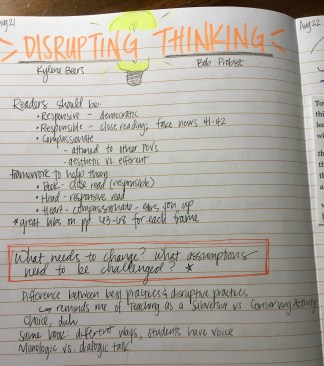
After a hectic summer of being well behind my fellow Book Love Book Club readers, I finally finished Kylene Beers and Bob Probst’s latest book, Disrupting Thinking.

giphy.gif

Yay for me!

Its ideas had been disrupting my thinking since page one.  I loved its premise, which centered around two questions the authors returned to again and again–what needs to change?  And in order to make those changes, what assumptions need to be challenged?

These questions are as good an acid test for our teaching as Louise Rosenblatt’s 1956 article of the same name.  Too much of education today rests on the status quo.  To disrupt that status quo, “good teaching sometimes feels like a rebellion,” as Penny Kittle wrote in our book club chat this summer.

img_1952

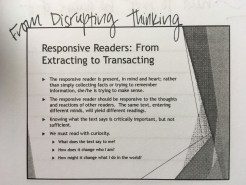
Sharon’s slide on transactional reading

Rebelling has always come naturally to me in teaching.  It’s no different now that I teach at the college level, but I’m lucky to have many like-minded peers to work alongside at WVU.

In our collaborative planning meeting last week, my friend Sharon shared her thinking about a different kind of reading and writing she really wanted our preservice teachers doing–the work of transacting.

448bf2b22af9be31dbc183a082a3f9fb.jpg

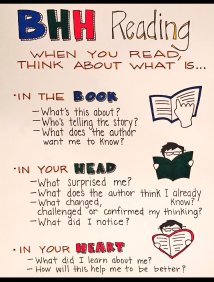
The BHH framework from Disrupting Thinking

“It’s from a book I read this summer,” she explained, and I exclaimed, “Yes!  I read it too!  I was just wondering how we could bring Book, Head, Heart into our weekly readings!”

Our students are proficient readers and writers, and it’s easy to assume that they don’t “need” a technique like BHH to help them interact with a text.  But to me, helping students of all skill levels become responsible, responsive, compassionate readers is the point of teaching reading.  Who cares about comprehension without understanding?  What’s the point of decoding if we don’t connect to the ink on the page?

Sometimes my college students forget that reading is more than a means to an end.  During my whole reading of Disrupting Thinking, I wondered how I could remind them about the aesthetic rather than the efferent purposes of reading from Rosenblatt’s transactional theory.

Because the truth is, the book, head, heart framework–or the aesthetic stance, or helping readers become responsible, responsive, and compassionate, or whatever you’d like to call it–is more than a guideline for students just learning to be strong readers.  It’s a manifesto for all readers.

img_1951

My notebook jots on the book

We’ve gotten away from teaching kids WHY we read and focus too often on simply HOW to read.

And that’s the problem–how to read is too simple a standard.  Yes, learning how to read is difficult.  Teaching kids how to read is hard, too.  But how to read, like so many standards we must adhere to, can be measured.  There’s a formula, an algorithm, a process:  first you decode, then you do the mental work of meaning-making, and sometimes in there you need some fix-up strategies to help you scaffold the story into your schema.  Just employ all those buzzwords and voila!  You’re a reader!

But when I shirk a pile of grading on a Sunday afternoon to finish a book, it’s not because I’m all about practicing my phonemic awareness.  And I didn’t spend an hour googling “Hurricane Harvey” at 4:00 this morning because I wanted to try out my word recognition skills, either.

Our highest standard is to help our students become real readers and writers.

It’s a standard that’s difficult to measure, but so are all of our most important, difficult goals–and it’s scary to teach all day, all week, all year, and feel like you can’t prove on paper that you’re making a difference.  The fear that we might be asked to offer evidence of our effectiveness might be what keeps teachers teaching novels and prevents them from teaching readers.  It might be why teachers persist in teaching essays instead of teaching writers.

Any good self-assessment will give you all the data in the world about how important and effective your instruction is, so if that’s what you need, again I say voila.  But if you’re searching for a way to make reading meaningful and engaging for your students, check out Disrupting Thinking, the book-head-heart framework, and their roots in Louise Rosenblatt’s work.  You’ll find a reader’s manifesto that truly shows you that why we read matters most–at every level, in every grade, across every content area.

How will you frame reading in your classroom this year?  Please share your strategies and ideas for helping students become engaged, authentic readers in the comments, on our Facebook page, or on Twitter!

Shana Karnes is mom to 1.5 spunky little girls and wife to a somehow-energetic surgical resident.  She teaches practicing and preservice English teachers at West Virginia University and is fueled by coffee, sugar, and a real obsession with all things reading and writing.  Follow Shana on Twitter at @litreader or read more of her writing on the WVCTE Best Practices blog.

More Than a Coach, a Reader

Clear Creek ISD June 2017 (1)The following is a guest post from an inspiring teacher and football coach I met this summer. He sent it to me the day after my daughter got married, and I’ve been playing catch up with life and getting-ready-for-back-to-school ever since. Sorry, I am late in posting it, Charles. You have to know, this post excites me:  I’m excited for the PD experiences we had this summer. I’m excited for the students who will walk through your door this fall. I’m excited to know you will spread your love of books and reading far and wide — and I’ll be excited, and not at all surprised, when you share a few titles with your linebackers. (Have you read Twelve Mighty Orphans?)


It’s August 6th and my summer is effectively over. We start football camps Monday and I’ll work until 5pm most days making sure helmets are ready, tackling dummies are out of storage, and duties are clear. This isn’t a necessarily dreadful thing because I love coaching football, and this part of the year is rife with expectation and uncertainty.

It’s also, for me, a time of reflection. Did I make the most of my time away from the classroom? Did I find enough time to shower my own kids with love and affection? Did I make sure I did the dishes and laundry and kept the house in order so that my wife had time to relax when she got home from work? I hope the answer to all these questions is “yes,” but I fear it’s a “maybe,” at best.

I was at school most days. The first two weeks after graduation were dedicated to our very first CCISD Literacy Institute, and mornings spent with athletes at Strength and Conditioning camp consumed most of the rest. The Literacy Institute was an incredible experience in almost every way. I learned so much from my teaching partner, Meggie Willner, and we both fell head over heels in love with our group of STAAR Camp students. Working with our curriculum director, Billy Eastman, and Amy Rasmussen made this the most valuable professional learning I’ve ever experienced. Those two weeks will make a difference in the lives of students in my class and the time trade off was more than worth it. Strength camp is bittersweet because I didn’t get to sleep past 6:15, but my football players and my own kids were there for most of it, and seeing them learn and work was worth it. For better or worse, this physical connection to campus means that I never really stop thinking about teaching or coaching. I’m always there.

My summer was, for the most part, wonderful. Whether afternoon napping, writing, playing board games with my kids, or swimming in our new swimming pool, my family and I always found ways to fill our time with laughter and joy. This summer was, however, different, and not just because of our much deeper sun tans. This summer I read like a “real” English teacher should. I’ve always listened while my colleagues extolled the virtues of their summer reading regimen. Don’t get me wrong: I’ve been known to crack open a book on a hot summer afternoon while sitting in the cool air-conditioning, but it hasn’t been my habit. Reading during the summer always felt like “work,” and I shouldn’t be working during my break. I should be chasing my kids around the house, helping them build blanket forts or taking them to the trampoline park. Reading threatened to get in the way of all that fun, but I wasn’t going to use that excuse this summer.

This summer, I consciously committed to being an avid reader, and while I’m sure many of you read much more than I did, that felt like a success for me.
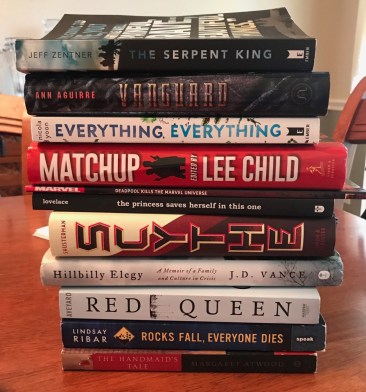
CharlesMoorebookstackI read so many amazing books and looking at my stack makes me realize what an eclectic collection it is. I read fiction, memoir, poetry, a thriller short story anthology, and even a graphic novel. I read the first book in a series, the fourth book in a series and a few standalone novels.

I’m proud of the volume that I consumed (remember I must spend SOME time thinking about inside linebackers). I’m proud of the variety and scope and I think it will make me a better teacher going forward.

These are the books in the order in which I read them:

The Handmaid’s Tale by Margaret Atwood

My teaching partner, Meggie, and our curriculum director, Billy, wanted to throttle me when I told them how I felt about this book. They both RAVED about it and I really didn’t care for it. I’m sure a second reading would do it justice because I was dealing with a lot personally and professionally at the end of the school year while reading it, but it just didn’t resonate with me. I hope this doesn’t make me an embarrassment to the profession.

Rocks Fall, Everyone Dies by Lindsay Rebar

They say reading is like a roller coaster and I went with an easy to read book for the Literacy Institute at the start of summer. A super straightforward, gently-paced book was exactly what I needed at the start of summer. I really enjoyed this book and for those seeking YA that appeals to both boys and girls, you can’t go wrong here.

Red Queen by Victoria Aveyard

I loved this book!!! It is a blend of Sci-Fi and fantasy with a strong female protagonist. I loved the author’s take on super powers and the surprisingly effective post-apocalyptic setting. I was tempted to read the second and third books in the series, but I want this world to be there for me when I want to revisit it.

Hillbilly Elegy: A Memoir of a Family and Culture in Crisis by J. D. Vance

This book spoke to my teaching soul. Vance examines a culture drowning in poverty and while it’s a reflection on his firsthand experiences, I felt like there was so much from his past that echoed in mine. I don’t think I realize how much our students’ home lives affect their school lives, but this book made me reflect on it again and again. This book coupled with a viewing of The Shack, directed by Stuart Hazeldine caused a sort of mid-summer epiphany that will change my teaching in the years to come. Another blog post, maybe?

Scythe by Neal Schusterman

I one-clicked this book the day Billy Eastman book talked it at the literacy institute and once I picked it up, I couldn’t stop. It’s original and well-written and even though parts of it were somewhat easy to predict, others still kept me guessing until the end.

the princess saves herself in this one by Amanda Lovelace

I read this poetry book under a shade tree in Wimberley, Texas, on our 16th annual summer camping trip. My mother-in-law noticed how fast I was turning the pages while reading this one and told me it wasn’t a real book. I handed it to her and she read it cover to cover. We didn’t talk about it, but I think we both knew how it affected us: deeply.

Deadpool Kills the Marvel Universe by Cullen Bunn and Dalibor Talajic

Determined to read a graphic novel, I picked up one about my favorite Marvel character. I’m not particularly experienced with graphic novels, having only finished George R. R. Martin’s graphic novels that are companions to his A Song of Ice and Fire. It was fun but not intellectually stimulating. Maybe this experience will help me with a reluctant reader or two or maybe give me some “street cred” with my Manga readers.

Matchup edited by Lee Child

Please don’t hate on my man crush on Lee Child. I’m obsessed with his Jack Reacher character and devour anything Child publishes. This book is produced by the International Thriller Writer’s Association and paired a dozen female authors with a dozen male authors to write a dozen short thrillers with varying success. There might be mentor texts here.

Everything, Everything by Nicola Yoon

This book was a quick read for me and it made me feel like an idiot because I didn’t see the plot twist until it was too late. I really enjoyed reading about how Yoon’s main character dealt with her problems the way a teenager would. I think this is an important book for our students to experience. To some, the main character’s relationship to her mother will be an eye-opener; to others, all too familiar.

Vanguard by Ann Aguirre

A vanity read if there ever was one. I love the Razorland trilogy and I couldn’t resist buzzing through this fourth book in the series. The love story made me uncomfortable at first, but I think books should do that sometimes. I enjoyed the happy ending in this book as my summer also draws to a happy ending. A modern Romeo and Juliet story? Maybe, maybe not.

The Serpent King by Jeff Zentner

This might be the top of the list of my summer reading. The story was incredible, the characters were deep and it is set in the same part of the country that J. D. Vance visits in his memoir from earlier in the summer. I love when books connect like that. This is one of the few books this summer that would keep me up late at night reading. I fell in love with this book and can’t wait to read Zenter’s Goodbye Days (if I can ever get it back from our freshman A.P. teacher).

Ah, the ones that got away…

Looking for Alaska by John Green

The Essex Serpent by Sarah Perry

Goodbye Days by Jeff Zentner

The Last Neandertal: A Novel by Claire Cameron

House of the Scorpion by Nancy Farmer

One of Us Is Lying by Karen M. McManus

and so many more…

So now I must start a list for the new school year. I don’t typically read a lot during football season. Working 80-hour weeks and trudging through months without a day off will take the motivation out of me. But maybe I can set a goal for the fall. Something to reach toward even when my knees and ankles are tired and my eyes won’t stay open.

Maybe I can get to school 20 minutes earlier and squeeze in some reading while the coffee percolates. I crush coffee.

Charles Moore is the senior English team lead at Clear Springs High School in League City, TX. He enjoys leisure swimming, reading, and coaching linebackers. Follow Charles on Twitter @ctcoach
Every Teacher a Reader. Every Teacher a Writer.

Do any of you follow the Middle and High School Secondary ELA group on Facebook?

Now, I am not trying to pick any fights, but I’m just going to say it:  Some of the comments drive me straight over a rocky cliff. Honestly, I tend to get a little snarky if I spend too much time there. (Sorry, not sorry.)

Today an ELA teacher posted “Writing sucks.” What?! I sure hope a student never hears her say that. Yesterday a teacher posted this question:

“Silent reading…have you built it into your routine? For how long? Do you find your struggling readers or non-readers (at home) love this time? I currently have built it in for the first 15 minutes since I know many of my 6th grade sts do not read at home. I think it works, but just brainstorming other ways to do things for next year. Just curious what you all do! I would be curious if HS teachers still give time to silent read, too.”

I had a hard time reading the thread with comments like “They won’t read, or forget their books… It turns into wasted time.”

Of course it does, if teachers do not establish the all out importance of reading, the benefits of reading, the time commitment to grow as readers; if teachers do not walk the talk of readers, share their reading lives, promote books and match books to kids and beat the drum of reading. Every. Single Day. We have to help students value reading.

The same holds true for writing. We have to help students value writing. We have to help students value the struggle of writing well.

Are we teacher-writers who model the difficult task of writing? Do we share the struggle of getting thoughtful ideas on the page and revising and revising and revising to convey the meaning we intend to the audience we intend? Writing well means we make intentional choices and we develop the habits of writers. Read Donald Murray’s “Habits of Writing,” and then internalize his last line: “Consider my habits of writing, but develop your own by studying what you did when the writing went well, and make what you discover your own writing habits.” (If you really want to build your writer-mojo, I suggest Murray’s books, The Essential Don Murray:  Lessons from America’s Greatest Writing Teacher, and Learning by Teaching.)

We can learn to write well. We can learn to teach writing well as we discover our own writing habits and guide students into developing their own. But this will never happen if we do not write.

readerswriters

I’ve written about walking our talk before — and I believe it more every day. I think we owe it to our students to be actively engaged in the learning process the same way we ask them to be actively engaged. I can never be a good enough reader. I can never be a good enough writer.

So, this summer I commit to keep working on my craft. I will read. I will write.

If you are reading this post, I know I am preaching to the choir. I know you already share at least some of my beliefs about reading and writing. Thank you for that!

I invite you to share your reading and your writing, to amplify our collective voices as teachers who read and write, and walk our talk — even during the summer. Shana posted our summer posting plans yesterday. I hope you’ll join us on our Facebook page, our Instagram feed, and on Twitter. And as Austin Kleon famously asserts:  Show your Work!

Let’s spread it far and wide!

Amy Rasmussen lives in north Texas and teaches AP English Language and English 4 (new prep in ’17. She loves talking books, daughters’ weddings (two this year), and grandbabies (five). She also loves facilitating PD for other teachers making the move into a workshop pedagogy. Amy adheres to the words of Emerson: “We aim above the mark to hit the mark,” and Jesus: “Love one another.” Imagine a world if we all aim higher. Follow Amy on Twitter @amyrass. And she really hopes you will follow this blog!

A Call for Real Opportunities to Learn — Not More Test Prep

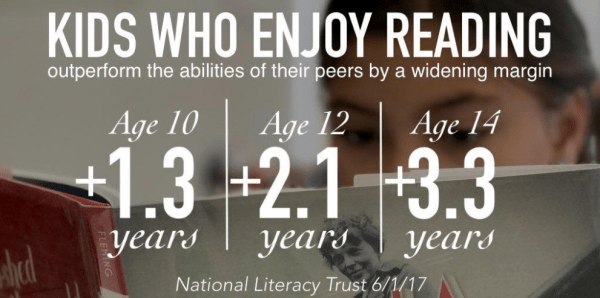
Natl Literacy Trust Survey 2016

Of course, this data caught my eye.

My friend Gary Anderson posted it on Facebook with this link to the National Literacy Trust Findings from their Annual Literacy Survey 2016: Celebrating Reading for Enjoyment.

I had just spent the day working with teachers in Clear Creek ISD as they launched their two week STAAR Academy, a series of summer school-like classes designed to immerse students in authentic reading and writing — not the typical mode of tutorials often offered in the hope of helping students pass their state mandated English exams.

Billy Eastman, Clear Creek ISD High School ELA and World Languages Coordinator, is a visionary who believes in his teachers and in the students they serve. He knows that when students choose books they want to read, experience learning in an environment that validates their personal lives and learning journeys, and are given space and instruction that allows them to write about the topics that matter to them, students grow. They grow in confidence, and they grow in ability.

Thirty-five teachers met with me in a two hour institute this morning. We read and talked and wrote and talked. We built a community of teacher-readers and writers. We engaged in learning — all with a central goal:  How can we create a space for all students to advance as readers and writers?

Then, teachers planned. In teams they designed lessons intent on engaging students as real readers and writers — not just students reading and writing for a test.

After lunch, teachers facilitated similar community building activities with the roughly 250 students attending the academy.

With generous funding by his district, Mr. Eastman was able to provide books, lots of new high-interest YA literature, in which students could choose a book they want to read. This is the first step in “celebrating reading for enjoyment” and all the benefits that come with it.

As I visited the 12 classrooms this afternoon, I witnessed students writing and talking about their reading lives.

“I like stories okay,” one boy said, “but I don’t like to read.”

“I’m not really into reading,” said another.

“Reading isn’t my thing,” another boy said.

I asked one young man if he liked to read, and he told me: “Yes, I read a lot.” He had just selected Scythe, the new book by Neil Shusterman, and I could tell he was eager to get started reading it. He’d already read Unwind and quickly told me how much he enjoyed that series. The other three students in this boy’s small group were less enthusiastic about reading anything, but they were willing to try. One chose Still Life with Tornado by A.S. King, another Boy 21 by Matthew Quick, and the other Out of Darkness by Ashley Hope Perez.

As I observed every classroom this afternoon, I noticed a few things:

  • The ratio of boys to girls in most every classroom was at least 4 to 1.
  • Boys want to read books that look “tough.” The cover has to captivate them.
  • Girls will choose books with male protagonists more often than boys will choose books with female protagonists.
  • Few students choose historical fiction — they seem drawn to realistic fiction and dystopian.
  • Many students chose books teachers might deem too difficult for them. (One of the most popular book choices offered today was All the Light We Cannot See, which won the Pulitzer Prize in 2015.)

For the next nine weekdays, students will read their chosen books and spend time engaged in their community of learners. They will practice the moves of real readers and writers as teachers practice the routines of readers-writers workshop and read and write beside their students. Besides the obvious benefit for students, teachers will engage in the kind of professional development that truly matters, the kind that gives hands-on experience with students as they practice the art and craft of teaching.

I am excited for the outcome. I am excited that teachers are excited. I am honored to be a part of Mr. Eastman’s vision for his district.

So what does this have to do with the National Literacy Trusts’ Annual Survey? A lot.

As I read through the report this evening, I found nothing startling or surprising. Of course, there are advantages to reading for enjoyment.

But then I shifted my thinking and began questioning the why and the what. Why does the data say what it does? Why are their gaps in enjoyment between boys and girls? Why are their gaps between age groups? What is happening in schools that might be causing these gaps? What is happening in students’ lives that might be causing these gaps? What can change if we approach reading and writing instruction differently? What should change?

I challenge you to read the report and ask yourself similar questions. Then, I challenge you to take the next step:  follow Billy Eastman’s lead. Whatever your sphere of influence, how can you allow a space for reading for enjoyment? And if you haven’t done so yet: How can you change the model of instruction in your classroom, in your school, or in your district so all students have the chance to become real readers and writers who enjoy what they read and write?

Don’t all students deserve similar opportunities to learn — not more test prep?

Amy Rasmussen lives in north Texas and teaches AP English Language and English 4 (new prep in the fall). She loves talking books, daughters’ weddings (two this year), and grandbabies. She also loves facilitating PD for other teachers making the move into a workshop pedagogy because it keeps her focused on her own improvement. Amy adheres to the words of Emerson: “We aim above the mark to hit the mark,” and Jesus: “Love one another.” Imagine a world if we all aim higher. Follow Amy on Twitter @amyrass. And she’d love it if you follow this blog!

Summer Reads to Stay Up Late With

Teachers, we are SO close.

giphy


The end of the school year is nigh.  Perhaps it’s this week, maybe it’s next, but either way, it’s nearly time to treat yo’self with what all teachers love to do in the summertime:

Take 84 naps, and then start binge reading.

This is what I did when my school year ended a few weeks ago, and after several days of excessive sleep, I started staying up late to finish books guilt-free.

Please forgive me for what I’m about to do to your Amazon carts while I gush over the titles that’ve kept me up until the wee hours, and their friends on my TBR list:

9780345807298

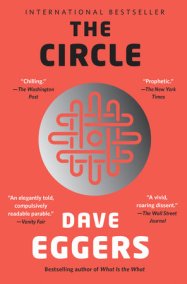
The Circle by Dave Eggers – This book was so plausible that it creeped me out.  It’s the tale of an ambitious college grad who lands a job at one of the tech industry’s premier companies, The Circle, who so slowly ingratiate their surveillance, social sharing, and health-tracking apps into her life (and others’) that it seems like no big deal at all–until it is a big deal.  This one kept me in suspense until 2 am, when I breathlessly finished it.  Similar titles on my TBR include The Handmaid’s Tale, Dark Matter, and The Dinner.  Creeptastic!

410ZVjytceL._SX329_BO1,204,203,200_

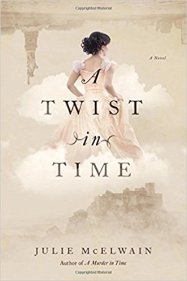
A Twist in Time by Julie McElwain – I’ve been anxiously awaiting this title since I read the first book in the series, A Murder in Time.  Now that it’s here, I’ve already devoured half of its 600-page bulk, most of that on my wedding anniversary, no less.  Kendra Donovan is a modern day FBI agent, a genetically-engineered genius who’s an outcast even amongst her fellow elite criminal profilers…or so she thinks, until she’s transported through time to the 1800s and really feels like an outcast.  Now, she’s stuck there solving murders without the help of forensic equipment and techniques readily available to her in the 21st century…or any hope of getting home.

I think McElwain’s writing is a great blend of period-accurate details and modern, funny asides, and the story only further serves to suck me in.  If you, too, find yourself craving a tale of time-traveling modern women, check out Outlander or the National Book Award finalist News of the World.

41kE9IRLqpL._SX329_BO1,204,203,200_

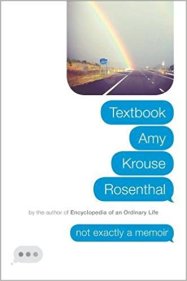
Textbook by Amy Krouse Rosenthal – I’ve been wanting to read this book since I read Encyclopedia of an Ordinary Life, but then got even more desperate to do so when I read Rosenthal’s heartbreaking essay in the New York Times, and then about her subsequent death.  It’s impossible not to read this book through those lenses, and while it’s amazing on its own, it’s even more powerful as a magnum opus.  I also want to check out similar memoirs like The Rules Do Not Apply, Hallelujah Anyway, and Strangers Tend to Tell Me Things


51zE2A3zS0L._SY344_BO1,204,203,200_

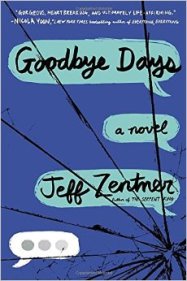
Goodbye Days by Jeff Zentzler – I read this one in two days over Memorial Day weekend, largely ignoring our company to finish it that Sunday.  I was sucked in on page one by the beautiful writing and the premise–a teen dealing with the fact that he sent a text message that led to the deaths of all three of his best friends–and I asked my friends if they’d read it.  “I did,” Amy volunteered.  “It ripped my guts.”  And boy, did it.  This was one of the first YA reads I’ve picked up lately that I really just couldn’t put down.  I’d love to see how The Inexplicable Logic of My Life, A List of Cages, and The First Time She Drowned can measure up to this book.

51VK2PHg7rL._SX258_BO1,204,203,200_

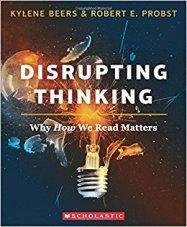
Disrupting Thinking by Kylene Beers & Bob Probst – Lisa has been so effusive about this book that I just had to go ahead and start reading it, even though I’ve been trying to wait until everyone else in the Book Love Summer Book Club dives in.  But it’s so darn readable, and such a great refresher of a lot of the research I’ve read and loved.  I always enjoy Beers and Probst for helping synthesize their wide reading into a crucible of new ideas.  Other fabulous pedagogical reads on my TBR list this summer are Joy Write, No More Telling as Teaching, and Write What Matters.

download

When Breath Becomes Air by Paul Kalanithi – This book hit home for me, and at quite a short length, I read it in one day–about half of it while on a treadmill!  It’s the memoir of a neurosurgical resident who, near the end of his grueling training, finds out he has advanced stage cancer.  My husband is entering his fourth year of orthopedic residency, so I read this book with a blend of horror at its possibilities and admiration for its author’s poise and eloquence.  My gushing over it led to lots of our resident friends reading it with similar amounts of waterfall-like tears.  After reading it in an afternoon, my hubby asked for some more books like it, so I ordered him Being Mortal, The House of God, and The Buddha and the Borderline.

410eExjPXCL._SX327_BO1,204,203,200_

The Hate U Give by Angie Thomas – I listened to this now-famous (in teacher circles, anyway) book on audio, and found myself driving or walking in circles so I could hear more faster.  What impressed me most about this book wasn’t its nuanced treatment of the topic of police shootings, or its awesome one-liners, or its many layers of issues faced by its narrator, Starr.  No, what impressed me most was how authentic to Angie’s life and personal history it seemed.  After reading Between the World and Me, I learned a great deal about the roots of African-American empowerment and efforts for equality.  Malcolm X, the Black Panthers, James Baldwin, and more had been strangers to me before that book, but I saw them come up again and again in The Hate U Give.  

This terrific book definitely broadened my worldview, and to help it grow more, I’d also like to read American Street, All-American Boys, and Allegedly.

What’s kept you up late reading lately?  What’s next on your TBR?  Please share in the comments…so we can all go broke buying books!!

Shana Karnes teaches sophomore, junior, and senior preservice teachers at West Virginia University.  She finds joy in all things learning, love, and literature as she teaches, mothers, and sings her way through life…and in the new knowledge that she has ANOTHER baby girl on the way!!  Follow Shana on Twitter at @litreader.