Category Archives: Pedagogy

Conferring and My Wish for a Time Machine

I am as guilty as the next guy. When I first started teaching, I didn’t have any idea how to get students to read more, write more, do more in my English class. I didn’t even know I would have to work so hard. Although I was in the middle of raising my own teenagers (and they all turned out great), I had no idea how to inspire other people’s teens to give books a long enough look to want to read them or to take the time needed to write something they would want others to want to read. I was all about my content, my lesson plans, my choices, my control. I did most of the talking. I did very little listening.

I remember the first day of my first year teaching. Students sat in assigned seats, alphabetically by last name. I asked each student, seat by seat, row by row, to tell everyone their name and one thing they hoped to learn in their freshman English class. I have no idea what they said — except for one.

“My name is Susie, and I hate white people.”

I am a white woman.

I might have felt stunned, hurt, appalled. I do remember thinking, “The audacity!” and shouldering an internal huff. I tried not to let these words sink me before I ever got afloat, and for the most part, I think I succeeded. Susie and I learned to work together that year, and she did fine in my class.

But my idea of success is much different than it was back then:  I no longer think fine is ever good enough.

I think about those young people from my first few years of teaching, and if time machines were a real thing, I’d set the dial to 2008. I would do things differently because I am different. I know better. I learned to be better.

1200-330446-relationship-quotes-and-sayings

Last week I facilitated a day-long training on implementing the routines of readers-writers workshop in secondary classrooms — a shift in pedagogy so students sit at the center and learn through authentic reading and writing practices. These teachers are eager, and their district leadership is providing support to make this happen. Yet they struggle.

In table-group conversations, two topics came up again and again:  Our students lack discipline. We need more tips on conferring.

What’s obvious to me now, that wasn’t back when I first started teaching, is a clear connection between the two. Students need to be heard. Now, I am not saying that implementing a workshop pedagogy will fix all disruptive behaviors, but I do believe these behaviors are often evidence of a lack of conferring. Students need to be seen and heard. (See more on why here.)

We talk a lot about creating a positive culture in schools and cultivating learning communities where relationships thrive. These take intention, effort, and time. In ELAR classes, these take intentionally designing instruction that utilizes every square meter as we practice authentic literacy skills with authentic texts and model the effort it takes to build our identities as readers and writers. To do all of this well, we must meet our students where they are in their learning, or in their apathy, or their attitudes, or whatever we want to call it. Conferring, those one-on-one little talks with kids, is where we do it.

As with anything that deals with humans, it has to start with listening. Listening jumpstarts relationships. Relationships build community. Community shapes culture.
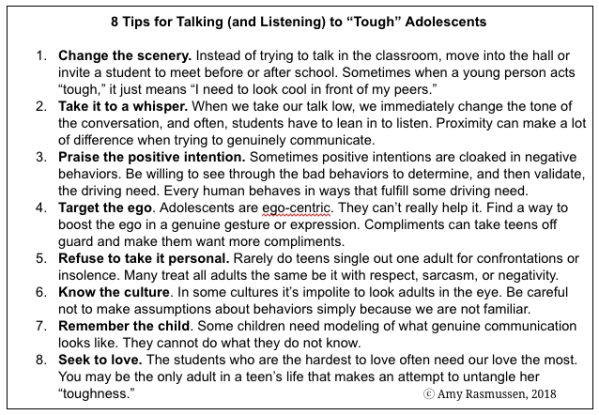
8 Tips for Talking to Adolescents

If I could relive day one of my first year teaching and my interaction with Susie, I’d make sure she knew I heard her. I’d pull up a chair at the beginning of our next class, and I’d listen. That would be the start of Susie doing more than just fine in her freshman English class. I am pretty sure of it.


Amy Rasmussen loves her life in North TX. She’s currently reading We Got This by Cornelius Minor, Embarrassment by Thomas Newkirk, and Braving the Wilderness by Brene Brown. She may be a completely different person come 2019. Find her on Twitter @amyrass


Question Storming with Students

analysis blackboard board bubble

Photo by Pixabay on Pexels.com

Eighty percent of my teaching load is in the role of senior school teacher librarian and much of this aspect of my job is spent working on research skills with our middle years and graduation years students. One of the hardest tasks students face when starting with research is knowing where to start. Often times students will start with a topic that is significantly too broad and they lack the skills to narrow down their search focus, which leads to a frustrated student proclaiming they can’t find anything at all on their topic.

One technique I have used with my students to help them narrow their focus in their research and to guide them through the search process is a technique called question storming. Question storming is a technique I discovered in the educator section of The Right Question Institute website and I have used it with success in research lessons with Grade 6s all the way up to my Grade 10-12 AP students. Question storming is similar to brain storming, but instead of generating ideas or statements that come to mind, students are asked to generate questions. The following are the steps I take to guide my class through the question storming process.

Step One: I model the process of question storming by walking through the process with them. I love to use images as prompts to generate questions as I find students really become engaged with the images the more they ask questions about it. After I briefly explain what a question storm is, I project a thought provoking image on the screen. With my most recent question storming practice with my AP Capstone class, I used the viral image of the Palestinian protester in Gaza.

Step Two: After projecting the image, I ask students to generate as many questions as possible about the image. In my initial modelling with my students, I have them call the questions out and I record them on the board. I also remind my students that at this stage we are not trying to answer the questions and we are not judging the questions, we  are simply trying to generate as many questions as possible. The first questions generated are often rather surface level, things like why is the man holding a flag or where is he, but after the first few questions, I am always surprised at the depth that starts to emerge in the questions.

Step Three: After a few minutes of generating questions, we stop and review the difference between a closed question (one that can be answered simply) and an open question (one that is complex and has multiple possible perspectives) and we go through the list of generated questions and label each as being either an open question or a closed question. At this stage we talk about how it is the open questions we want to explore in our research, but the closed questions often help us in our research, as well because they help us explore what basic information we need to understand about the topic before we can delve into exploring the open ended questions.

Step Four: Once we have labelled our questions as being closed or open, we then select the one open question we want to explore as our main topic. Some of the open ended questions my students generated about the Palestinian protester photo included: To what extent are the Palestinian protests in Gaza affecting the conflict? How has the media coverage of the conflict in Gaza affected the conflict? To what extent has the media coverage of the conflict in Gaza affected the level of aid provided by other countries?

At this stage, students have a significantly more focused starting point for their research and have narrowed their focus with their open-ended questions. As well, they can use their close ended questions to help provide search terms to help narrow their research down even more.

When students start research or an inquiry with a powerful question they find the research process to be easier and more meaningful and question storming is a technique that helps make the challenge of coming up with the right question easier.

For some more practical teaching strategies, check out Shana’s post on some strategies she learned from the pre-service teachers she works with.

Pam McMartin is a Senior School Teacher Librarian, Senior English teacher and English department head at an independent school in Tsawwassen, British Columbia Canada. When she is not wading through storms of questions with her students, she is braving the perpetual winter stormy weather outside that comes with living in the Pacific Northwest. You can follow Pam on twitter @psmcmartin. 


NCTE: Sparking Hope, Equity, and Voice

Like so many educators who attended the 2018 NCTE conference, I am still reeling from the wealth of information and inspiration provided by some of the brightest and most compassionate people in the world. I listened with awe and determination as strong speakers like Chimamanda Ngozi Adichie and Elizabeth Acevedo stressed the importance of what we do as ELA teachers, and I carry with me a renewed sense of urgency about literacy instruction that empowers all students. No – not “empowers” – even that word has been transformed, as I now understand that it’s not my place to give them power; rather, it is my job to help students recognize and harness the power they already possess.1

The universal message of the conference did not so much present new ideas as it did combine them and clarify that we cannot wait any longer to act. We must reach each of our students where they are, provide them with the representation they need and deserve, and encourage them to add their own voices to the world. We have embraced diversity, equity, and representation in a variety of ways, but the time for the best practices to coalesce into purposeful change across schools is at hand.

Screen Shot 2018-11-19 at 10.38.29 PM

My book haul from NCTE 2018 – I can’t wait for my students to read these!

As I walked through the exhibit hall, admittedly searching for free books to take back to my students, I heard two main ideas – to quote Kylene Beers and Bob Probst – “again and again.” By absorbing the voices around me over the four days of the conference, I was able to discern what teachers, who attended a wide variety of sessions, thought. One of the most common ideas expressed was that NCTE presenters were “preaching to the choir.” Of course, this is true to a great extent. Teachers who love learning, who support choice, who engage their students in meaningful instruction, who believe in the power of writing workshop: these are the teachers most likely to attend the conference, and, more specifically, the sessions that explore these ideas. Teachers who believe in the humanities love the young humans we teach, and we will always seek to improve for their benefit and the benefits to society. This is no way diminishes the power of these workshops or their presenters, for they offer the keenest insight and carefully collected research to support best practices in teaching, and though I admittedly enter sessions predisposed to agree with much of what I hear, I always leave with new ideas scrawled in the margins of my notes. Like many others, I always leave feeling renewed, reinvigorated, and inspired, and I wish every ELA teacher could feel this way.

This brings us to the second most common idea expressed throughout the exhibit hall lines: how do we take these ideas back to our schools and inspire those who weren’t at the conference? I heard several teachers – both in sessions and while milling about – who said things like “I wish [so-and-so] from our department could hear this.” The truth is: we all know teachers who need to hear the messages from the conference, and the difficulty lies in how to offer the essence of what we have gleaned in a palatable manner. Some ideas are not well-received by teachers entrenched in established practices, and we must balance the urgency with which shifts need to occur with the tact and professionalism that our well-meaning colleagues deserve. I had the opportunity to speak with Amy Rasmussen about The College Board’s stance on shifting away from a focus on the canon to include more contemporary and diverse texts, and she offered an analogy that I wish all could hear: we don’t expect doctors to ignore research in favor of the practices they personally prefer, and when one of their primary research-based organizations like the American Medical Association or the New England Journal of Medicine offers guidelines, those are adopted as best practices. Can you imagine if they didn’t? We’d still have doctors bleeding us for pneumonia.

So, as I continue to synthesize all I learned at the conference and develop my own lines of inquiry, I leave you with these questions: why don’t we expect all ELA teachers to follow the research and vision of NCTE? Why can’t we confidently return to our campuses as ambassadors of ELA and NCTE and share what we’ve learned with our peers? Will we let the established system and soft bigotry continue to deny true equity to our students, or will we carry the spark of progress back to our campuses? I, for one, plan to stoke the fire.

1 I would love to offer due credit to the speaker who discussed the problematic idea of “empowerment,” but I cannot find the connection in my notes. If you can offer proper attribution, please add it in the comments.

Amber Counts teaches AP English Literature & Composition and Academic Decathlon at Lewisville High School. She believes in the power of choice and promotes thinking at every opportunity. She is married to her high school sweetheart and knows love is what makes the world go around. Someday she will write her story. Follow Amber @mrscounts.

80/20

photograph of a lighted ferris wheel

I’d like to take this post and, in honor of Halloween, share something really spooky with you. Well, maybe not spooky, but terrifying. Maybe not terrifying, but scary…

It’s the fear that creeps in every time I try something new in the classroom: a little fear I like to call The Questioning. And that’s what it is – just a series of questions that like, any good Halloween monster, waits until I’m lulled into complacency to rear its ugly head. Questions like is this best practice? Does the research support it? Are you doing enough? Are you doing too much? Are there better ways to support your kiddos? What are the unforeseen consequences of this action.

You see, my PLC partners and I are trying a lot of new ideas this year in our AP classrooms. We are organizing our units around essential questions, including a lot of choice reading in classes where choice reading has never really been an option for us, and slowing our instruction down in an attempt to go a mile deep and an inch wide instead of an inch deep and a mile wide.

I feel almost like a new teacher again – high on the possibilities of all the new ideas but brought low by the realization that I’m creating new content again while also surrendering a lot of the direction in the classroom to my students. Now, granted, they are rising to the occasion, and their conversations and writings are truly interesting, interesting in the ways that I’m not sure they would have been without these new procedures. But, it’s been a little bit of a roller coaster of a year – a crazy, scary rollercoaster.

I find that I’m spending a lot of my time thinking through new activities and new approaches, trying to predict the possible benefits and consequences of these changes while also teaching and grading and making time for reflection. I don’t feel like I am ever wholy in one part of the teaching cycle, but instead just this Go Go Gadget-person vacillating between all of the points on that spectrum at any given moment. It’s stressful.

In times like these when I can’t get my brain to settle, I remember a little tidbit of wisdom dropped by Penn State’s Russ Rose at a volleyball clinic several years ago. He argued that limiting your drill set to a few key areas and the finding variations on those drills to keep them fresh was the key to his success.

He called it the 80/20 rule.

The idea goes back to an Italian economist in the 1800s who found that 80% of the wealth in Italy was held by 20% of the population. Oddly enough, he also found that 80% of the peas in his garden were produced by 20% of the plants. Essentially, Pareto‘s rule could be boiled down to this: 80% of the effects are the product of 20% of the causes.

Whenever my class seems frantic or I’m nervous about my practice, I think of Pareto. If 20% of my effort produces 80% of my results, where should I spend my time? How should my students spend their time? I’m becoming more and more conscious of the demands placed on our students. I grapple with what I should expect of them outside of school as many take two or more AP classes, play sports, work jobs, and still need to be, you know, people with a consistent work-life balance. I want to make sure that I make intentional choices that meet the demands and rigor of my subject while honoring my students’ time.

Pareto’s Principle reminds me to consider what has the most immediate and lasting effects on my students. It reminds me to channel my energies into productive avenues by limiting my focus to just a few key ideas. For me, those ideas always come back to Socratic Seminars – it’s important that we talk through our ideas in controlled and questioning places. It comes back to writing – it’s important that we write every day (a goal I’m refocusing on) And, it’s important that we marry those ideas in conferences – safe places where we talk about our writing. Consistently, these have been my 20%. What are yours?

Sarah Morris teaches AP Language & Composition and Film as Literature in Murfreesboro, Tn. She is rediscovering her love of bullet journaling and PaperMate InkJoy Gel Pens.  She tweets at @marahsorris_cms.

Getting “There:” The Narrative Behind the Grade

Suddenly, there is snow on the mountain range that encircles Salt Lake City and the first quarter has come and gone.  Even after spending 11 weeks together, I confess that we, my students and I, aren’t “there.”

You know, there, that elusive place in education where students are investing, taking ownership, engaging, and enjoying thinking.

We have engaged in the elements of workshop, but our classroom feels like we are on a 10 mile per hour train to “there” that is frequently derailed.  Reading as a community was a high point, but the momentum has since stalled.  My old bag of tricks–student-created due dates, “go to” YA books that may shock or surprise, favorite mentor texts–aren’t reaching a far too large chunk of my people. 

Students are being compliant, but they’re not engaged.  

I am not okay with this.  It feels…I feel…mediocre.  

Was it me?  Is it me? The stress of junior year? Too much choice?  Not enough choice? Other teenage things I don’t know about? In an effort to figure out what was going on, what the story behind the data was, I asked students to write the narrative of the student behind the grade. 

I simply wanted to know:  Who is the student behind these grades?  Who is the human behind the numbers?  

Throughout my 100+ students, the reflections were consistent and their honesty certainly made the case for continuing to cultivate a workshop classroom.  Thankfully, we are heading there.  Summatively, these are the three take aways from their data-driven reflective narratives.

  • Stress and anxiety:  Junior year seems to unkindly smack students in the face.  I have seen it for eight years now. The ramped up, seemingly casual yet threatening chats about the looming college process sits heavy on their shoulders.  Increased course demands eat up time that used to be spent with friends or participating in activities without sacrificing academics. Aside from school stress, there are two-sport athletes, thespians, part-time workers, and family child care providers struggling to balance.

All the more case for carving out time to read for pleasure.  These students’ lives are just as busy as adults. Giving time to read, even 10 minutes at the start of class, can be “therapeutic” as Emily said: “This student found reading at the start of class each day to be therapeutic.  She is sad on odd days when the class doesn’t read.” Our students need time to pause. More importantly, they need to connect with characters, settings, and challenges that mirror their existence. They need to read that sometimes things work out, sometimes they don’t, but you will get through these tough years.

  • True choice is new:  While students now admit they really like being able to choose books, choice in August was scary.  I believe it was scary because they didn’t know themselves as real readers, just readers who were assigned chapters due on certain days.  Aria, who is reading through everything that is on Netflix or will soon be a movie, reflected: “This student, who read three books last quarter, loves being able to choose books without judgment.”  

All the more case for exposure to new titles.  While my school is a college prep school and many teachers, from theology to science, assign books to read outside of a textbook, it isn’t a culture of readers.  Students struggling with choice lack a knowledge of what genre or story they prefer versus what they don’t like. My developing readers need exposure via student recommendations, book talks, library displays, topic journals, or ANY other medium, so they can continue to curate a “To Read” list with meaningful titles.  


  • Writing voices are still developing:  Elliot wrote:  “This student has never been asked to write anything besides school stuff.  This student has a writing voice, but it is quiet and shy, only the notebook knows it now, but the voice is gaining courage.”  Wow. Check out that voice! Many times, I feel my students don’t trust their ideas or analysis as being “right,” just as they don’t yet trust themselves as writers, frequently asking “Is this what you want?” or “Is this good?”

All the more case for writing, writing, and writing more.  Writers need practice just like athletes. Aside from developing confidence in their ideas, students need to develop confidence in trying out elements of voice to develop the craft of writing by writing beside mentor texts, infusing craft into formal writings, journaling, and closely reading for craft in their choice books.  

Boiling it down:  students need time, exposure, confidence so we can get there.  

I will keep at it, as Lisa encouraged, because the work is not easy, but we know it is worthy. As some keep resisting, fake reading, or simply not reading at all, I will keep conferencing and book talking.  I will give reading time As students doodle instead of write, stare at the ceiling instead of revise, ask “Is this good?” instead of trust their skill, I will keep modeling writing and encouraging.  The culture I create this year will create momentum for next year, then into the following, speeding up the train to take us to that special place of learning.

The train may not be speeding ahead, but it’s chugging along.  At least I know we are on the track, heading in the right direction.

Maggie Lopez teaches American Literature and AP literature in Salt Lake City.  She is anxiously awaiting the start of ski season in Utah and NCTE in Houston next month, while reading Girl, Interrupted and scouring for flexible seating furniture on a budget. You can follow her on Twitter at @meg_lopez0


#3TTalks Shop — It’s about Time

Quick Conversations on the Topics That Matter to You!

“To the true teacher, time’s hourglass should still run gold dust.” ~Douglas William Jerrold

“These are the times that try men’s [teachers’] souls.” ~Thomas Paine

Conversation Starter:  With all the demands on teachers beyond the classroom (extra duties, campus committees, new initiatives, etc) how do we capitalize on the time we have and keep our focus on our learners?

Amy:  I am lousy at self-care, yet I know that is an important part (maybe the most important part) of time management. It is hard to take care of ourselves, physically,

time

Photo by Aron on Unsplash

mentally, emotionally, and spiritually when all require at least a little of our time–usually alone time–and others put demands on us we have little control over. My trouble starts within the school day and bleeds over into home time: excessive meetings where little get accomplished or co-opted conference periods or new accountability systems or school initiatives that do little to promote academics, especially literacy, are the biggest time swamps to the workday. New things so often trump what actually needs to happen regularly in classrooms. Every good teacher I know takes work home, and this is the work that usually requires the most mental capacity and relates directly to student learning. I think administrators forget that all too often.

Lisa: I spent some time in a school improvement meeting today, during which I wrestled with this very notion. How do we continue to work eight, nine, twelve hours a day without burning out? How do we face the fact that “hour number twenty-five” is never going to come to the rescue of our ever-expanding task lists? How do we devote ourselves daily to the exhausting pursuit of teaching, and have anything left over for family, friends, or even the pet goldfish? (I marvel at Doc’s resilience as the often neglected Dennis Family goldfish)  

Most importantly, how do we make sure the precious few hours we have with our students in class, best reflect all the work we do outside of class on their behalf?

Amy: That’s where the routines of workshop keep me sane. No matter what anyone else demands of me, when I keep my focus on student engagement via reading, writing, listening, talking, and thinking together about issues they care about, utilizing our classroom library and writer’s notebooks, we accomplished something good that day. I

time 2

Photo by Kunj Parekh on Unsplash

remind myself to step back, slow down, and focus on what really matters in growing confident and accomplished readers and writers:  choice, access, volume, time, and my expertise as literacy instructor and discussion facilitator.

Lisa: Yes! I find that when I’m spinning out of control with all the “other,” my solace lies on the shelves of books that guide my work with kids. My refined definition of what it means to be a good English teacher includes taking time to lose myself in books, with the express purpose of bringing the mirror, window, or door back to my students through book recommendations, excerpts for mentor texts, and even just the calmer, happier teacher that reading makes me and that they deserve.

Now, as for overcoming all of the additional demands the job places on us these days, I am slowly coming to terms with (very slowly, as my mental health is still a bit tenuous in this regard) the fact that only I can create the personal boundaries around how much work comes home with me both literally and figuratively, and I absolutely must make it a priority to limit the extent to which this job becomes my entire life. This happens when I let go of what I think I should be doing, and focus instead on what’s most important. 

Amy:  Personal boundaries! Yes, yes, yes. I am pretty lousy at those, too. I am working on it though. One thing that’s helping me set myself up for success (and cope with everything else) is a combination of two time management techniques. It works like this: 

  1. List 3 big (urgent, important, make-everything-else-easier-when-this-gets-done) tasks
  2. List 2 other important, but not so pressing, things
  3. Then, do #1 on the big list in sprints of the longest time chunk I can manage. Within the school day, this might be 15 minutes. Unplug, shut the door, and keenly focus.

Imagine the possibilities if we had the time to keenly focus on our students all the time?

Lisa: It’s so true. There’s always a ton to bring home. However, having a kindergartner at home has really put into perspective for me how much time I should be putting in at home when it now feels like it’s not only at the expense of my mental health but the well-being of my child. I limit the amount of work I do at night these days because spending time with my family and then trying to get a reasonable amount of rest before my alarm goes off at 5:00 a.m. may be the only thing between me and burnout right now.

I’ve taken the practice of one of our district administrators to heart this year and I’ve worked to keep my “school hours” to a twelve-hour window. I do not check my email before 6:00 a.m and I do not check it after 6:00 p.m. I am more than connected to colleagues and school happenings in other ways, so should there be an emergency or change of plans big enough to impact the following day, I’d still know about it. Beyond that, the homework “emergencies” of my students can be addressed the following day. I can follow up with a parent or colleague when I get into work. In this way, I can be more present at home when I’m there, and at least attempt to draw that line between my work and my life so that my time is better spent in both places. Now weekends…that’s another story. I’ve got some reevaluation of time management to do there, for sure, not to mention guilt around working AND not working. 

Amy:  Smart, Lisa! Your twelve-hour window is generous, and you are so right:  That kindergartener of yours–and Doc the goldfish–need you! Everything else can wait.

Do you have topic ideas you would like us to discuss? Please leave your requests here.


Getting on the Boat: a New Teacher’s Swim into Secondary Readers-Writers Workshop

Screen Shot 2017-05-01 at 8.44.22 PM

If you are an educator, navigating workshop, please consider sharing your story. Email amyprasmussen@yahoo.com

The metaphor of the last school year at Klein Cain High School seemed to be, “We’re all in the same boat.” However, I did not feel that way. Though we were all experiencing opening a new school together, navigating through unplanned and unexpected events (think Harvey, sharing our high school with an elementary school that flooded, and snow days), we were not experiencing it in the same way. Last year, I had the alienated feeling that all the veteran teachers were indeed in same boat, but I was treading water next to the boat, sometimes practically drowning, choking on water, struggling to breathe. I think many first-year teachers, new school or not, would agree with me.

It was a trying year to say the least, but I had many life preservers thrown my way. The summer before my first year, I had the pleasure of attending a two day professional development session about reader’s-writer’s workshop that built on the philosophies I had seen and heard in my student teaching. I was very encouraged to see that my district valued such practices. This knowledge became the lifejacket I held on to many times.

Because of that PD session, I became a disciple of Penny Kittle’s. I bought her books, studied them and implemented her strategies (though I butchered many of them). From her books, I learned about the Book Love Grant; I put a reminder in my phone for January, applied and actually received one of the 60 $2,000 grants! The books I have had the honor of adding to my classroom have been my life-raft, holding me afloat and helping me make it to my colleagues’ boat.

alexander-sinn-977744-unsplash

Photo by Alexander Sinn on Unsplash

Even though I had these things to hold on to, I struggled to truly implement workshop until this year. Instead of last year’s survival mode, this year I feel like I am in the lifeboat that is just next to the one all my colleagues are on. I’m close, but just not quite there yet. I have had many experiences that have brought me closer.

This year, I have co-teach sections, so I have a greater amount of students with autism and other special needs. At first, I was worried about trying out workshop with these kids, but, luckily, my co-teacher Mallory encouraged me to teach like I would with any other class. I am so glad she led me to that decision because we have had some true gems arise. During one of our quick writes, we watched the poem “Lost Voices” and started our writing with the sentence stem “You tell me you know what it’s like to be…” One of our students finished that sentence with “autism” and wrote a beautiful quick write detailing the difficulties from his point of view.

I have also seen self-declared non-readers with their noses still stuck in a book as they slowly make their way back to their seats during a transition from reading time; they just don’t want to put their books down. We have conferred, figured out book preferences, written more than I thought possible at the beginning of the year and we are making our laps (as Kittle and Gallagher write about in my teaching bible- 180 Days) toward better writing.

Since I have decided to follow my instincts and implement workshop in my classes, I feel closer to being on that main boat with the rest of the teachers at my school. I’m not in survival mode anymore. I’m not just filling time instead of I’m making all my lessons very intentional. Like Lisa Dennis in this last post, I got to participate in Amy’s professional development this summer and it rejuvenated me and encouraged me to truly immerse my classroom in workshop. This blog has been the most constant life preserver in my reach this year and last. This community keeps me going strong, so thank you for encouraging me constantly to keep working toward being on the main boat.

Rebecca Riggs is a second year teacher at Klein Cain High School in Houston, TX. She prides herself in being a wife, dog mom and professional development fanatic. Rebecca is just now learning to call herself a writer. She is living her best life because she gets to live out her passion everyday- learning from students she loves. Follow Rebecca on Twitter @RebeccaLRiggs

Good books — and a teacher’s expertise in using them — can do it all

On Sunday, my friend and extraordinary literacy-leader, Billy Eastman, and I got to giveBookTweet away books. We presented at the Coalition of Reading and English Supervisors of Texas (CREST) fall conference, and Follett Learning gave us 30 books, six signed by the authors, to raffle off to our audience. It was kind of an Oprah moment: “You get a book, and you get a book.” Oh, the thrill of book giving.

But giving books is just part of the thrill. We know this. We ‘give’ books to readers and students we hope will become readers often. We model our reading lives. We read aloud. We line whiteboard rails with new titles. We do book tastings and speed dating with books. We celebrate our readers and exhaust our arsenal of book-loving ideas.

And some would-be readers still don’t read. What’s a teacher to do?

Here’s three ideas that have worked for me:

1. Never give up. When we set high expectations, when our students know we are serious about Book Love, when we practice keep-on-keeping-on with all the things I listed above– and we relentlessly share our joy, passion, and commitment to their reading lives– even if we never get a student, or a handful of them, to read a book, we have succeeded.

2. Believe in #1. Often we focus on the one student who just won’t budge. She chooses books, flips a few pages, fakes reading a chapter, bluffs her way through a conference, and we get discouraged. Keep trying — but do not let her be a black hole. So often we find ourselves gravitating to the one over and over again when we need the energy to keep encouraging, moving, and celebrating the many.

3. Make it okay to not read novels (yet). Anthologies are awesome. Sometimes

61doyibbmql-_sx395_bo1204203200_

“… this anthology empowers the nation’s youth to listen, learn, and build a better tomorrow.”

students who don’t like reading just need to enjoy a good piece of writing. Many will then want to read more by a particular author. One title many of my students dabbled in, and often read in its entirety, is Flying Lessons & Other Stories with authors Kwame Alexander, Jacqueline Woodson, Matt de la Pena, and more. I’ve recently purchased Fresh Ink, which is similar and looks equally engaging. It’s got authors Nicola Yoon, Jason Reynolds, and more! And I just read about this one this morning:  We Rise, We Resist, We Raise Our Voices. It’s now in my shopping cart.


In our session at CREST, Billy and I discussed implementing the new ELAR standards for Texas (We both served on the teacher committee that wrote them), and we shared the transformative role investing in teacher expertise and authentic resources has made in his district (We wrote about some of it in this English Journal article.). Access to engaging books like the ones we gave away in our session is just part of it. Knowing how to use them to teach thinking, reading, writing, speaking, and listening skills is the other.

Good books — and a teacher’s expertise in using them — can do it all.

Billy Eastman at CREST

We know the real thrill isn’t in getting a new book but in the knowledge, the empathy, or the know-how that books gives to us. This is the thrill we want for our readers. It’s the reason we do what we do.


Amy Rasmussen is a mother, grandmother, reader, writer, and wannabe sleeper. She spends a lot of nights thinking about growing readers, encouraging writers, and talking to her writer’s block. She’s back to working on that book she started five years ago, so if you’ve got any extra luck hanging around, please send it her way. Follow Amy on Twitter @amyrass 

Takeaways from Tyrolia: Four Days with Kylene Beers, Penny Kittle, Bob Probst, and Linda Rief by @KarryDornak

Tyrolia Ranch
I still haven’t mentally returned from my time at Tyrolia, Kylene Beers’ ranch, in Waco, TX. My mind still thinks I am sitting at her dining room table, painting a watercolor picture while overlooking a pond banked with Cypress trees. Or nestled on one of her incredibly-comfortable couches talking about a podcast with a newfound friend. Or riding a Mule (the all-terrain vehicle, not the animal) with Penny Kittle and five other people who were just as giddy as I was. Or sitting around her living room chatting and laughing with Bob Probst and Linda Rief while the aroma of the evening’s dinner tempted our senses.

Scenic Tyrolia RanchIt’s amazing that a place of scenic tranquility and beauty could rouse such feelings of rebellion and determination.

But you can’t talk about rebellion without first talking about power, so let’s start with the power of literacy.

For the first time in history, power is no longer based solely on wealth. Power is a Tweet. A YouTube video. A social media post. Kylene gave a fascinating talk about the “ugly roots of literacy in America.” In Colonial America, “literacy” primarily meant one’s ability to sign a document or contract. Who held the power there? Those who could sign the document, or those who could write the document? During the Revolutionary and Civil War times, penmanship was valued as literacy. But who had the leisure to practice their penmanship? Those with wealth, privilege, and power. From the Civil War to World War I, literacy meant one’s ability to recite poems, monologues, and stories. But who had the leisure to practice memorization? Those with wealth, privilege, and power. Then we get to the Industrial Revolution, where the assembly line was born. And then our schools began modeling the assembly line design (can’t you just picture kids on a conveyor belt being carried from class to class?). From the 1950s to 1980s (and even in the present), literacy meant analyzing the meaning of what we are reading. But still, someone else held the power (it was the teacher — or CliffsNotes —  who determined if a student’s analysis was correct or not).

The point is, the definition of literacy shifts to reflect what is happening in the country and world. Presently, businesses see the value in synthesizing information and identifying potential problems rather than just solving existing problems. So what does this mean for our classrooms?

It means we abdicate the power we as teachers have held on to for decades and give it to our students. If we are only teaching them analytical literacy, we are preparing them for 1980. For this century, students need the same literacy skills they’ve always needed: to summarize, to retell, to articulate, to evaluate. But more importantly, they also need a willingness to see another perspective, the chance to take a risk, the ability to sustain their focus, an acceptance of ambiguity, and the self-confidence that allows them to identify as readers and writers. Because that’s power, right?

But the chances are, if you’re reading this, you already believe this. Chances are, if you’re visiting Three Teachers Talk, you are already subscribed to the belief that education has not caught up to the 21st century. And chances are, you sometimes feel alone in this belief. Or isolated. Like you are fighting a losing battle. Like you have found a great discovery, only to feel that no one else believes you.

That’s where Penny Kittle’s words ring true  — that courage is more important than caution. I understand not wanting to “rock the boat” or damage friendships with your colleagues, but at what cost? The risk of sending our students into the world illiterate by 21st century standards and powerless?

Kylene told us that to start [educational, metaphorical] fires, we must start with our best kindling. So find your tribe. Find your people. Those who value courage over caution. They may not be in your hallway. Perhaps they’re across campuses, across districts, across states, across international borders. That’s who I found at Tyrolia. I found my tribe.

And persist. Penny said that it is often the changemakers who take the lumps. And I don’t know about you, but I have definitely felt it. But our kids are worth it. Linda echoed this sentiment when she said that even if you just change one teacher, that is one group of kids who are benefitting. To add to the conversation, Bob suggested we focus on the 5%: the 5% of teachers who are ready and willing to make a change, or the 5% of our teaching that we are dedicated to improving. So ask: “What’s one thing we can change this year?”

For me, I am vowing to write more. Penny encouraged us to start the habit of writing for fifteen minutes a day. You know what I said to her? I’ve tried to keep notebooks and journals, but I always lose interest because I feel like what I’m writing doesn’t matter.

Dwell on that sentiment: My words don’t matter.

You know many of our students feel the same way. How can I show my kids that their words and voices matter when I don’t even feel that my own do?

But she told me that my words did matter. And then four days later, she retweeted this, and I can’t help but think it was for me:

PK notebook tweet

The truth is, words matter.  Everyone’s: mine, yours, our students’. The words we read shape our thoughts. So immerse yourself in the words of Kylene Beers, Penny Kittle, Bob Probst, and Linda Rief. Their words are life-changing.

Immerse your students in words of both the past and the present, so that they understand how we got to now, and how we can change the future. And the words we write matter. They help us reflect, learn, process, and discover.

I’m slowly wakening from the dream that was Tyrolia, but I hope that we all remain:

Determined to write.

Unafraid to rebel.

Revolutionaries for 21st century literacy.

On a mission to find our tribes.

The 5%.

As of today’s publication, Karry Dornak has continued to write, rebel, revolutionize, and seek out her fellow 5%. She is balancing life in Spring, TX, as an instructional specialist, teacher, wife, mom, and Pumpkin Spice Latte enthusiast. Follow Karry on Twitter @karrydornak


How We Built our First 3 Weeks of Workshop

Picture1

Look at Sarah’s room!

A classroom built around flexible seating is amazing for kids building their literacy.  Comfy chairs, tall stools, and bean bags take a student out of a “classroom” mindset and into a creative work space that encourages ideas to flow across boundaries that might have been impermeable with rows and rows of sterile desks.

It works just as well for teachers building a workshop from thin air. You can imagine how comfortable that tan couch felt on the last Friday morning before the start of school.

Sitting in that room for this much anticipated planning session felt as comfortable as if I’d been there for a decade.  Five teachers with a singular focus gathered their resources and experience to put together a plan that was student focused and built on the foundation of workshop.   I got to know this group well at the Literacy Institute but I’m still trying to learn the full extent of their individual and collective power.

It is important, on our team, to be intentional and explicit with our lesson design.  The kids should know exactly what we are doing and why we are doing it.  They should recognize the moves their teachers make and take comfort that those moves were selected specifically for them. There is no reason to keep the “why” and the “how” a secret.

On this team, we typically build lessons with an eye towards a learning focus that starts with something like: I want you to know that readers/writers ….. do something. (Thanks Amy, Billy, and the Lit Institute.)

For the first three weeks, though, we talked about using: I want you to know that members of a Reader/Writer Workshop….do…one of the six pillars.  You get it.

Our curriculum documents, designed by teachers, contain a section devoted to the six routines of workshop instruction and the following are the routines around which we built lessons:

The Reader’s/Writer’s Notebook

Lesson Focus: I want you to know that members of this Reader’s/Writer’s workshop use a notebook to explore thier literacy.

Our “notebooks” look very different teacher-to-teacher.  Some of our classes will use traditional composition notebooks and some will use Microsoft OneNote in our explorations.  Either way, the point of having a safe and personal place to plan, draft, revise, reflect, etc. remains consistent across our classes.  Its not enough for us to ask the kids to have a notebook, they need to know the importance of having it.  Some of the kids struggled with following my set-up instructions because they were intentionally vague.

Student: “Mr. Moore, what categories do you want us to use to track our reading this year?”

Me: “That’s up to you.  Its your notebook.”

Self-Selected Independent Reading:

Lesson Focus: I want you to know that members of this Reader’s/Writer’s workshop take ownership of their reading and writing experiences.

I remember back to last year, and how much the kids struggled genuinely connecting to a book. Maybe it was the hurricane sitting out in the Gulf or that they really only had one year of workshop leading up to their senior year.  What ever it was, we worked hard to take ownership of our reading, so much so that I wrote about it here and here. (Looking back at those words is like seeing the words of a different writer, but I digress…)

Mentor Texts:

Lesson Focus: I want you to know that members of this Reader’s/Writer’s workshop use mentor texts to guide their learning.

We use mentor texts to teach kids how to read and write like a writer. The students need to know that we looking at the writing of others with specific intentions in mind. Its important to delineate the separate lenses of craft and content and constantly reinforce the importance and interconnection of both.

We planned for ways to write beside them.  When I write in front of my students it invites them to connect to a writer from their community.  This connection is between a student and a person that shakes their hand every day and smiles when they make eye contact. That’s an incredibly deep connection and one that I’ll leverage every chance I get.

Mini-Lessons:

Lesson Focus: I want you to know that members of this Reader’s/Writer’s workshop look at specific skills that we want to learn and then apply those skills to their reading and writing.

The skills we choose to highlight are intentional and our students need to understand that they aren’t chosen at random.  Not only that, but we aren’t going to spend more than a few minutes in our mini-lessons before we move back into reading and writing, with an emphasis on those specific skills.

Collaboration:

Lesson Focus: I want you to know that members of this Reader’s/Writer’s workshop listen to others share and provide feedback that supports their growth.

I can’t teach all 30 of them all the time and maintain any level of effectiveness.  We have to build a supportive community that  allows me to widen the feedback cycle from one, typically confident student, to 30 who are confident to share with their confidants. They need to know that the days of me asking a question and calling on one person for the answer are far behind us.  We practice the routine over and over. Ask a question, discuss in group.  Ask a question, practice their thinking through written response. Rinse/Repeat.

Oh, and they have to be trained not to shoot up their hands or shout out an answer when they are asked to notice something.  Instead, they will learn to sit in the silence and let their thinking wash over them in waves. Or maybe the metaphor is to peel back the layers of their thinking like an onion. Whichever you prefer.

Conferring:

Lesson Focus: I want you to know that members of this Reader’s/Writer’s workshop take advantage of opportunities to talk one-on-one with the expert in the room.

The importance of regular one-on-one conferences can not be understated. I’m not just “checking-in” on them while they read and write.  I’m digging into their thinking for places I can provide support.  We will explain to our students how important it is for them to be honest and open when we confer.  They can’t hold back due to nervousness or fear. Like Jerry Maquire said, “Help me, help you!!!” with that typically creepy look on his face.


Based on our planning sessions, impromptu secret meetings, and the genuine happiness in which we approach each other, I know this year will be my best ever and it is because of the work this team will do together to move our freshman class forward in their literacy.

Now, in all seriousness, lets cross our fingers and hope nature and fate don’t hit us with the same intensity as last year.  We all need time to heal a little more.  Let’s do it together.

Charles Moore had a quiet Friday night and went to all four of his son’s soccer games this weekend.  He passed El Deafo by Cece Miller back and forth with his daughter this weekend.  He put more than two thousand words to the page this weekend between his grad classes and this blog post; a new record.  He can’t wait to get back into the classroom Monday morning and learn alongside the students.  And he wishes you the same happiness he’s enjoying right now. Visit him on twitter or instagram.