Category Archives: Readers Writers Workshop

9 Books to Hook Your Holdouts

This fall is my first out of a high school classroom, and I miss this season of watching teens fall in love with books. I relished the task of matching every kid with the right book, armed with the energy that a crisp autumn morning and a pumpkin spice latte afforded me. By this time in September, I’d usually managed to hook most of my readers, but I had also identified my holdouts–those few skeptics who just didn’t think there was a book for them, who I couldn’t entice with a booktalk, or bribe with a “just try it,” or persuade through a conference.

So, I always turn at this time to the power of social capital, harnessing tools like speed dating with books, book passes, or writings in Red Thread Notebooks, to get my students recommending books to one another.  If I couldn’t hook my holdouts, well, their friends were my last hope.

So, to recommend some titles to hook your holdouts, I decided to ask my former students for their recommendations: what’s the last book you read that really hooked you?  Their responses, via Snapchat, are as follows:

img_4790-1

Anna recommended Men Explain Things To Me by Rebecca Solnit, a collection of essays that are both scathingly funny and weightily serious about communication between men and women. It’s a great pick for your holdout who doesn’t want something long–he or she can devour one of these essays in no time.

img_4794-1

Connor recommends the National Book Award winner Between the World and Me by Ta-Nehisi Coates.  This beautiful text, a commentary on race in modern America written in the form of a letter from father to son, “was intriguing because it touched on social justice issues in a way that I could relate to even though I had never had to deal with those issues,” according to Connor. It’s a fantastic, fast read whose subject matter will really draw you in.

img_4793-1

Gabi’s recommendation is Just Mercy by Bryan Stevenson, a story of twisted justice told by a young, new lawyer. Stevenson’s idealism wars with the machinations of politics and injustice and biases, and is written in a voice that has made many compare the narrator to Atticus Finch. If that doesn’t make your holdouts fall in love, I don’t know what will!

img_4792-1

Jocelyn recommends Leslye Walton’s award-winning The Strange and Beautiful Sorrows of Ava Lavender, a prose book of fiction that reads more like beautiful poetry. Ava is born with wings, and writes in a voice direct and melancholy–she reminded me of Madeleine from Everything, Everything. And, as Jocelyn notes, the cover is gorgeous, which is sure to help hook your holdouts.

img_4791-1

Claire recommends Donna Tartt’s layered novel of accidentally-murderous friends, The Secret History.  Tartt, the Pultizer-winning author of The Goldfinch, introduces us to a group of college students who, through their readings and conversations, begin to fancy themselves above the law–both legal and moral. As Claire says, it’s a brow-wrinkler that’d be great to recommend to a reader you just can’t challenge enough–and its writing is amazing.

img_4807-1

Olivia recommends John Green’s Paper Towns, of course!  Recently adapted into a film, it’s the story of a misfit boy who loves a supercool girl from afar, and then is inexorably sucked into her world of adventure in the tale that ensues. John Green is a YA favorite for a reason, and you’re sure to hook some holdouts with the knowledge that the book was big-screen worthy.

img_4806-1

Caleb recommends Ashlee Vance’s exceedingly well-written biography, Elon Musk: Inventing the Future. Musk, described as a “real-life Tony Stark,” founded PayPal, Tesla, SpaceX, and other billion-dollar companies throughout a life filled with both struggle and success. While telling Musk’s tale, Vance compares his work to inventors from Thomas Edison to Steve Jobs, and entices the reader to wonder whether anyone can compete with geniuses such as Musk in a technology industry as competitive as today’s.

img_4797-1

Garrett recommends Hank Haney’s The Big Miss, an inside look at Tiger Woods’ golf game through the eyes of his coach. While Tiger was always a gifted athlete, his mental game made him constantly fear a “big miss”–a wild shot that could ruin an entire round. Haney gives insight into Tiger as an athlete as well as a man, who ultimately committed a big miss in his personal life that derailed his golf game far more than he ever saw coming. This is a great pick for any athlete who’s holding out on reading.
img_4802-1

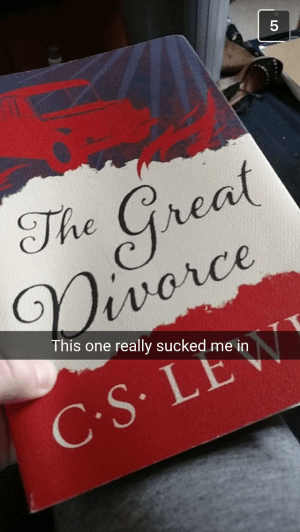
Allison recommends C.S. Lewis’ The Great Divorce, a book I equate to a modern version of Dante’s Inferno. The story begins with the narrator boarding a bus, which takes him on a long journey of discovery about himself, great truths, and the nature of good and evil via a trip through Heaven and Hell. Described by many as their “favorite book by C.S. Lewis” (a real feat, since The Lion, the Witch, and the Wardrobe is so colossal in our culture), this allegory will be sure to hook any holdout into some irresistibly deep thinking.


Now that I’ve had my proud-teacher moment of so many of my former students continuing to be lifelong readers (and look at all their actual BOOKS lying around!!!), and significantly expanded my own TBR list, I hope you’ll ask your students to recommend some engrossing titles to help hook your holdouts.

What books are your students recommending to one another? Please share in the comments!

Try it Tuesday: About that Digital Citizenship

I only had to ask three students to put their phones away on Monday. This is progress.

I know some teachers “outlaw” phones in class. I do not. We use them too often. Besides I have never been in a meeting or in a conference session or anything of the like and been asked to give up my phone. Of course, I know a thing or two about etiquette. Many of our students do not.

Instead of being the phone police, I would rather take the time to teach my students to use their devices appropriately in class — and, of course, with any luck, if the learning sticks, I’d like them to take that “appropriateness” beyond my classroom as well.

If we are not taking the time to teach our students phone etiquette and digital citizenship, we are missing out on important opportunities that may make a startling difference in their lives.

For example, did you see this headline:  “Girl gets kicked out of college for Snapchat photo”? The link lead to a hard sell for why every teacher should take the time to teach students the importance of digital citizenship.

I’ll be sharing it with my students today.

screenshot-2015-09-27-20-18-26-26o2pj7

keystrokes.wonecks.net

What are some ways you teach phone etiquette and digital citizenship in your classroom? Please share in the comments.


Mini-Lesson Monday: College Applications and the Six Word Memoir

College applications are a daunting endeavor for many of my students each year. Their mailboxes and email inboxes fill with opportunities to apply everywhere from the local community college, to pricey Ivy League schools across the country, to study abroad programs in countries they may never have heard of.

As if that wasn’t enough to sort through, lurking in these countless pages and pamphlets is another overwhelming prospect – The college application essay. Also known as the “tell us who you are as a human, what your soul’s greatest desires might be, and every intimate struggle you’ve had that define you as a young adult” essay. No wonder my announcement that our first paper in AP Language will be the college application essay is usually met with huge sighs of relief. However, that relief is also somewhat short lived as we start to take a look at prompts:

  • Reflect on a time when you challenged a belief or idea. What prompted you to act?
  • Please tell us why you think you would be a good fit for __________.
  • Consider something in your life you think goes unnoticed and write about why it’s important to you.

As I tell my AP classes, “Colleges want to know the real you. The honest, gritty, learned from your mistakes, can bring something unique to their campus you. Your transcripts say keep-calm-and-apply-to-college-27-resized-600a lot about your work ethic, experiences, values, and achievements, but once you put pen to paper, you are a writer, and your story might just help them see the real you and decide that you are far too good to pass up.”
Their horrified looks usually tell me I should follow up with an explanation along these lines:


Don’t worry. We are going to do this together. Sharing your story might not be easy, but take it from this girl, everyone has a story to tell. I was your stereotypical upper-middle-class white girl with loving parents and a blissfully happy childhood. I pretty much seized up when my senior composition teacher said that we needed to write something deeply emotional and challenging in our college application essays. He had me convinced my happy life was going to keep me from going to college. Without a car wreck, lost dog, or deeply wounded heart, what compelling story did I have to tell?

Well, it turns out that one can write from the heart no matter the circumstances, and that’s what I want you to use for your own applications. An experience, belief, value, or direction for your life, can all be deeply emotional and revealing of the type of person any college would want to accept. I spoke about my desire to be a teacher in my application. Teaching is in my blood, and I had known I wanted to be a teacher since I was little. My dad used to bring home an extra gradebook for me and I’d line up my babies and stuffed animals and teach class. See…? I have the beginnings of a narrative right there. I expanded on what it would mean to me to become a teacher and how I knew the patience and passion I already possessed would not only make me a good teacher someday, they would make me a great addition to any campus because true teachers know the value of lifelong learning.


So…how to help students concisely sum up who they are?

Examples, examples, examples.

Let’s try six words. Total.

Objective: Using the language of the Depth of Knowledge levels, students will create six word memoirs as written artifacts in their writer’s notebooks to either spark ideas for drafting their college application essays, or serve as possible opening sentences for those essays.

Lesson: The timing of this lesson is after several class periods of having students explore who they are and what they value through quick writes and other activities. On one occasion, I have students write a quick write on the story they would tell to demonstrate positive elements of their character. We share stories about helping those in need, commitment in the face of certain defeat, and encounters with temptation, and then bullet point some of the “college friendly” attributes these stories suggest.

During another class period, I had students read, analyze, and then emulate Amy’s recent suggestion of the poem “Possibilities.” This was the first year I used this poem during this unit, and I could not be more happy with the results. Students did some beautiful work in analyzing Szymborska’s structure in order to write a poem with their own preferences. I made sure to discuss with students the variety of topics that Szymborska uses in the poem from straightforward preferences of activities and food to those that reveal character and life experiences. I challenged students to do the same with some wonderful results.

Finally, for this specific lesson, I reminded students of my suggestion to keep their college application essays brief, as most applications would demand that they be so with limited word counts.

“So today, I want you to be really brief. Six words brief. We’re going to try to capture some of who you are and what you believe in exactly six words.”

I begin by sharing with them a few six word memoirs of my own and talking them through sixwordthe back stories. We then head to Smith Magazine’s Six Word Memoir page so students can look around. They are to write down a few favorites and also write what they think the larger message of those snapshot memoirs might be. We discuss at our tables and then share out a few to discuss what their favorites might reveal about the authors that crafted them.

Throughout the lesson, I remind students that just as we saw in “Possibilities,” brief snippets can reveal an awful lot about who we are. This is our goal in the college application essays as a whole, and this is our goal in the exercise.

Students spend some time drafting, sharing, and then praising the work of their peers. I suggest to students that these memoirs might be great hooks for their essays, they might spark an anecdote they could include along the way, or they might simply keep students focused on their own beliefs and values in order to use those to guide what they write about themselves.

Follow-Up:  Students are working hard on their college application essays and will be doing some peer editing early this week with submission to follow later in the week. To extend the work even further, I’ll be sharing a unique extension activity with my classes.

On September 22nd, 2016, the team at Six Word Memoirs will be participating in the 3rd annual Character Day, which is a global discussion about the importance of developing true character in the world’s citizens. I’ll be encouraging my students to participate with some of the six word memoirs they’ve already created and perhaps with contributions they craft especially to speak to developing, according to the Six Word Memoir site, “curiosity, empathy, and grit.”

How do you challenge your students to write about themselves in meaningful ways? Please share your ideas in the comment section below! 

Ugly Cry Round Two – #FridayReads

Hi. My name is Lisa, and I’m a book hugger. “Hi, Lisa…” 

I feel like I can tell you this. Like you’ll understand and still let me sit near, if not at, the cool kids’ table. See, last week I was a dork. This week I’m a book hugger. Is that super dork? Literate dork? Biliophilic dork?

Either way, I’ll own it. That’s totally fine. In fact, if I know myself at all, as I hugged my copy of Kristin Hannah’s The Nightingale this morning,  my eyes were probably a bit wild too, breath bated, satisfied smile projecting my hope that pens would fly across the pages of our “I want Read” lists. Basically, when I book talk, I feel like the author is standing next to me. “Get them interested, Lisa.  Get them thinking. Sell it. Put my book in their hands, and hearts, and minds.”

So obviously…no pressure.

One of my AP Language students, Zach, smiled as I stood hugging my book today.img_5539 “Mrs.Dennis,” he said with a coy smile, “you’re super emotional.”

Who? Me?

Well…ok. Maybe. I do love a good cry. The “cathartic, wring you out, snot on the back of your hand, tell everyone to read the book” cries are my favorite (Please see my unraveling at the hands of A Monster Calls by Patrick Ness). But I know that you know; you’ve been there. Whether the tears actually fall or not (and they should, trust me, it feels great), a book that captures you can feel like a conversation with a good friend, an exploration of pure emotion, and a learning experience that leaves you a better person. Talk about a worthwhile human endeavor.

So, I quickly reflected and responded to Zach’s observation. “True, true. Hallmark commercials make me cry, but with books, that shows a pretty deep connection, doesn’t it? When the characters in a book are so real that you feel their struggle. When their stories remind you of your own, even if their life experiences are completely different from yours. That’s what I want for you. That’s why I’m up here hugging this book. Human connection.”

With further reflection, it’s how I have chosen each of the books I’ve book talked so far this year. No, they haven’t all made me cry, or I know for a fact that I’d be missing a significant portion of my audience; however, they have all been books that have touched me in different ways, to different degrees, and in different parts of my life.


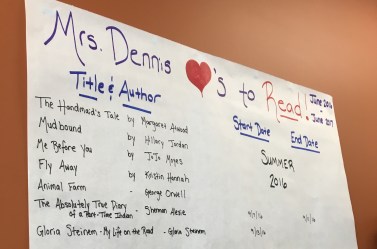
So far this year, I’ve book talked:

Mudbound by Hilary Jordan – This text started my summer reading and while it’s justly won acclaim for it’s themes surrounding racial tension in the south, betrayal, and the secrets that can bury a family, I spoke to my classes about the rich voice Jordan is able to give a wide variety of characters. With a new narrator each chapter, you see this story from all angles and each is more personable and heartbreaking than the next.

The Handmaid’s Tale by Margaret Atwood – I finished this book right before summer break and I book talked it then too. It has quickly become one of my favorites as a cautionary tale and an all too real examination of how gradually, but how drastically people can become complacent to the loss of personal freedom. I took students down a “let’s imagine” path by asking them which events in their daily lives they inadvertently take for granted, but would certainly miss if they were denied the privilege. What if it was the right to have your own money that was denied? Or the right to travel? Or learn?

The Nightingale by Kristin Hannah – The characters became family to me. I realized that the terrible trials of World War II were occurring when my grandmothers were the same age as the main characters. Just because the pictures of the time period are in black and white, doesn’t mean the stories to come out of that time period are any less real. Or relatable. Or powerful (I hug what I love. I loved this book. It may be my current favorite piece of fiction). My three copies of this book disappeared today. I was tickled.

The Absolutely True Diary of a Part-Time Indian by Sherman Alexie – This is the first book I read this school year. I took it down in three days and could not stop laughing. I told my students that my connection to this book surprised me, and I think that’s part of the endearing quality of protagonist Junior’s voice. He hooked me with fart jokes. Certainly not my usual forte, but Junior’s search for hope is so real. And as I said to students, we all search for hope in different capacities. Junior searches off the reservation. I search the room during reading time. Just as Shana suggested, reading outside your comfort zone can offer some big rewards.
A Monster Calls by Patrick Ness – We’ve been well over this one. Ugly. Cry.
Though an additional sell, at the moment, is the forthcoming movie based on the book. My students want to take a field trip, but I’ve only committed to investigating the release date, if they get on reading the book. All six of my copies are currently gone from the library shelves. Win.


So, as I wrote last week when I was working to get to know my students, I feel it’s important to share who you are as a person, as much as you share who you are as a teacher, and illustrating you are a reader and writer is a part of that
img_5537-1opportunity/responsibility. With that in mind, showing you are a passionate reader is even more impactful. I feel like my students are getting to know the real me (dork and all). It’s the very best way to start building honest relationships. The kind that build trust, and thereby, community.

I’ve carefully chosen some of my favorite texts to book talk, followed my colleague Catherine’s lead in making my reading life visible, and jumped into this year with the goal of spreading my enthusiasm about books to another set of students through an honest look at what moves me, in a sincere effort to move them.  So far, so good. I just need some extra Kleenex boxes in room.

Reading Your Students’ Reading Lists by Amy Estersohn

guest post iconThe words “reading assessment” sound about as charming as “dental prophylaxis,” especially if you’re committed to free-choice independent reading and feel under pressure to prove to yourself that the kids really are growing.

A list of finished books is one of the best reading assessments there are.  Here are four questions I always ask when I review a list:

  • Is the student reading books that were published recently?   If students are reading fresh and contemporary titles that are hot off the bookshelves, that’s a sign that this student is already in the “in crowd.”  He isn’t waiting for the librarian to do a book talk to go ahead and finish The Fifth Wave series.  He probably visits bookstores and libraries on his own, has a sense of the kinds of books he enjoys, and has a stable of authors he trusts to create compelling stories.  
  • Is this student reading across a variety of complexity levels, and does the time it takes to finish the book scale to the complexity of the title?   My seventh grade students’ reading lives often mirror the myriad feelings and experiences they have over the course of the year.  In my case, I have students who might pick up a elementary-level comic book/ text hybrid like Charlie Joe Jackson’s Guide to Not Reading and follow it with  the adult book Unbroken.  It might take her one week to finish Charlie Joe and six weeks to finish Unbroken.   If she were only reading books that took her six weeks to finish, I’d wonder about her ability to self-select appropriate titles.  However, given that she has found “popcorn” books like Charlie Joe, I’m more confident that she understands herself as a reader to know what reading is like when it is easy and what it is like when it’s slower going.
  • Is this student listing a lot of series books?  If the student is clustering series books on a list in groups of 5 or more, I start to wonder about the authenticity of the list as well as the self-confidence of the reader.  Is this reader in love with Lisa McMann’s action-adventure series, or did he just write down “Unwanteds 1, Unwanteds 2, Unwanteds 3, Unwanteds 4” because he saw others reading the books? (Not to mention that the books in the Unwanteds series all have different titles.)   Students claim to stick very closely to series books are students I want to get to know early on.
  • Is this student listing books that are also movies or books that have a large online presence?  If her list prominently features Hunger Games, Divergent, and Maze Runner series, I also wonder if she has enjoyed these books for their own sakes or if she put the books on the list because she is relying on the movies to assist with comprehension.  Even without the movies or Spark Notes for assistance, a quick google search will get you the summaries and main ideas of many contemporary bestselling titles, enough so that a student could have a passable reading conference if she relied on this information instead of on the text.  You want to be aware of what’s out there when you see what books your readers are holding.

2008readinglistOkay, so how do you collect all this information on what books readers are reading?

Some of the teachers I work with rely on the Penny Kittle clipboard method, where a clipboard circulates around the room during independent reading time and students self-enter the book and page number they are on.    Others take the Nancy Atwell approach and record the book title and page number as part of the conference routine.

I did both and neither: last year I had students self-manage this information in their reading notebooks by giving them class time to do a reading log every day.   I did occasional graded notebook checks to keep students on target.   I also surreptitiously chose about 3-4 students per class to watch carefully over a period of 2 weeks or so to see if my notes and their notes lined up.

One of my goals for this coming school year is give my students more opportunities to find their books completed data as helpful as I do.


Amy Estersohn is a middle school English teacher in Westchester County, NY.   She also reviews comic books for http://www.noflyingnotights.com.   Follow her on twitter at @HMX_MSE


Try It Tuesday: Notebook Write-Arounds

Tom Romano calls writer’s notebooks “playgrounds, workshops, repositories” in Write What Matters.  As such, the writer’s notebook employed in a workshop classroom is much more than a place to store drafts, brainstorm ideas, or take notes.  It becomes a sacred space that is personal, meaningful, and enjoyable.  To fill it with writing and wordplay that spurs a love of language, I like to write around various artifacts in my notebooks, and urge my students to do so too.

img_4597

I cheated and wrote around a poem and a picture here

Write around a poem – In this lesson, inspired by advice from Penny Kittle (she told me her writing got more beautiful when she read poems more intentionally), I ask students to cut out a poem and glue it into their notebooks.  This activity can change with its purpose–sometimes students can respond to the language in a poem, sometimes they can write from a line, and sometimes they can work to analyze the text for literary devices and figurative elements.  The act, though, of gluing a poem into our notebooks keeps beautiful language at the center of our work, made visible when we flip backwards through our pages.

Write around a picture – Like Amy, I like to see my students’ notebooks full of pictures.  I ask students to bring in or print photos of any sort, then write descriptions, craft imagined dialogue, or narrate a memory the photo evokes.  In addition to being personal and meaningful, these quickwrite activities often serve as jumping off points for longer pieces of writing.

img_4595

Lisa sent me flowers, and I wrote around her note

Write around a note – My friends and I are big note-writers, and I’ve always had the compulsion to write “thank you for your thank you note” notes (maybe that’s just me, but Lisa is a dork so she might do it too!).  Because that’s socially awkward, I like to glue notes into my notebook and respond to them that way.  I also have students glue in their Bless, Press, Address responses from other students, or my own written feedback (like Amy’s Silent Sticky Notes), and respond to it in their notebooks.

Write around an object – Whenever I unearth something meaningful from the depths of my glove box, I like to glue it into my notebook and write around it.  I have Starbucks

img_4598

I’ve memorized my library card number, so I no longer need to carry it in my wallet…

sleeves, library cards, ticket stubs, and even an old necklace glued into my notebook, surrounded by writing.  In this era of electronic communication, I think it’s important for students to put physical objects into their notebooks–I still have shoeboxes full of notes from my friends in high school, and I like their tangible power more than just a series of saved text messages.

Write around an idea – A written version of the Four Corners activity, students write down a statement in the center of a page and then exercise some critical thinking around the statement.  The top left corner represents the “strongly agree” perspective, the top right is “agree,” bottom left is “disagree,” and bottom right is “strongly disagree.”  I’ve also experimented with just having students respond to the statement in general, but I like the Four Corners because it forces them to consider multiple perspectives.  Mostly recently, I asked my preservice teachers to respond to the idea that “Teachers are responsible for 100% of their students’ learning” using the Four Corners method–I can’t wait to see their responses when I collect notebooks next week.

What ideas or artifacts might you have your students write around? Please share in the comments!

Mini-lesson Monday: Remembering 9/11 and a study of language

Our students are too young to remember the events of 9/11. And while we are not history teachers, I do think we have a responsibility and an opportunity to help them try to make sense of the horrors of that September morning and how it impacts their lives today.

hyrum

Pvt. Hyrum Chase Rasmussen

In church yesterday, the congregation stood and sang three verses of “The Star Spangled Banner.” This song has new meaning for me since my son Hyrum joined the Army this summer. It may have new meaning for you if you’ve been following the Colin Kaepernick-taking-a-knee-event-fall-out-and-discussion. I want my students to be able to make sense of their world and one way I can help them do that is to provide them with thought-provoking pieces that help them make connections. Maybe one of these texts will help them find their own “new meaning.”

In honor of September 11, the every day people and every day heroes who lost their lives, the families who still mourn loved ones, the soldiers who valiantly died facing foes in foreign lands, and the men and women willing to serve today in a time of unrest and war, this is the lesson that I will share with my students today.

Objective:  Using the language of the Depth of Knowledge levels, students will react to a first-hand account of 9/11 in their writer’s notebooks. They will formulate ideas on how this one story relates to our growing theme of what it means to be courageously human. Students will then analyze a text and compare the writer’s use of language to a text read previously.

Lesson:  We’ve already discussed the question, “What does it mean to be courageously human?” a phrase I borrowed from a text we read last week. (I read Chequan Lewis’ piece as a read aloud, wanting students to just listen and enjoy his use of language. Then, later we read it again and analyzed the literary and rhetorical devices he uses to create the meaning. I modeled how to annotate and asked students to write their own notes in the margins — something I will expect them to do throughout the year.)

Today I will remind students to read texts with pens in hand, noting the writer’s interesting use of language, any points of confusion, any words they don’t know, the structure of the text, and any and all devices the writer uses to craft meaning. Today’s text is the masterful piece Leonard Pitts, Jr. wrote September 12, 2001.

After students have time to read, annotate, and discuss in small groups, we will come together as a class and craft an anchor chart that details the moves Pitts makes in comparison to those craft moves made by Mr. Lewis. I will charge students to model these moves in their own writing throughout the year.

Follow up:  The anchor chart will hang in the room as a reminder that writers are intentional in the moves they make as they craft meaning. Students will be expected to be intentional in their own writing as they work on various forms of writing in class and on their blogs this year.

How Conferring and a Book Solved the Tissue Issue, and Hopefully, Much More #FridayReads

You know the boys who cannot sit still? I’ve got a gaggle of them in my second period. Now, I’m not talking about elementary school kids, nor middle school. I’m talking about the juniors I teach in high school.

No sooner do I blink, and at least one of them is up walking to the tissue box. He’ll slowly take a tissue. Saunter on back to his seat (for about three minutes — I’ve timed it) and then waltz on over to the trash can to throw the tissue away and then mosey on back to his seat.

With eight of these guys, it’s constant motion. And I need Dramamine.

One class period. Five days. Two boxes of tissues. Gone.

At the end of that first very long week, I realized the reality. All kinds of memories flooded back from Tom Newkirk’s class “Boys, Literacy, and Popular Culture”at UNH Lit Institute the summer of 2015.  (If you haven’t read Tom’s book Misreading Masculinity:  Boys, Literacy, and Popular Culture, it’s insightful.)

My tissue-loving boys were posturing all over the place, and somehow I needed to stop the Tissue Issue.

It’s been easier than I thought. Really, it’s all about getting them into books they want to read.

On the first day of school, I’d prepped my room with stacks of colorful engaging books on every table. We did a book pass and wrote down titles we thought we’d like to read. I showed my passion for books and reading, and my students rolled their eyes at my request they read for three hours a week.

“No way,” I heard one young man mutter, “I ain’t reading.”

This attitude doesn’t deter me.

Even if they were faking it, after just a few days and lots of one-on-one mini-conferences, every kid in a class of 30 at least looked like they were reading. Except two.

I invited these two separately into the hall for private chats about their social PATT (party all the time) moves in the classroom.

“You know, they all follow your lead, right? I need you working with me to make this class work.”

Both agreed, and I asked them to shake my hand on it.

But old habits die hard.

Then, today — 13 days into the school year — gold.

Book gold.

“Hey, Mrs. Ras, can I talk to you in the hall?

“Do you think you could help me find a different book to read — one with music. You already know I like music.” I remembered his free verse rap at the end of class last Friday.

“So give me some ideas –”

“Well, something like that book JaBo’s reading…the long way one.”

A Long Way Gone?” (I’m trying to remember if there’s any music in this memoir about a child soldier.)

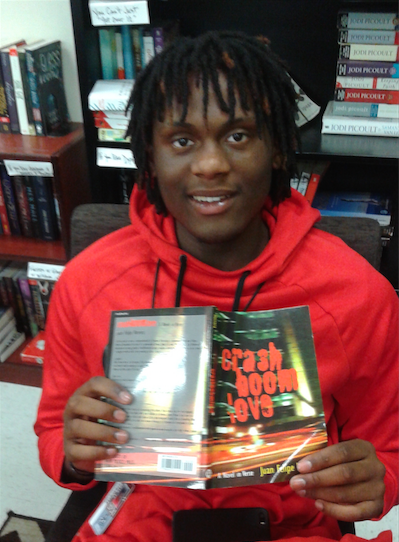
Both of my copies were checked out. I had to think fast. Crash Boom Love, a novel in verse by Juan Felipe Herrera, National Poet Laureate, flashed in the corner of my eye. (Thank you, poetry shelf just inside the door.)

We flipped through the pages, and I explained that it’s a book written in verse — all poems that make a complete story.

“You mean like one long poem?”

“Yep. Do you want to trade me this book for that one?” I said nodding at My Friend Dahmer, the graphic novel in his hand he’d been fake reading for 12 days. (I know he chose it for the pictures. “It’s weird” is all he could tell me in our first conference.)

Not six seconds after we’d entered the room, I saw Kameron flipping through the pages and showing his new book to JaBo.

That’s when you know you’ve got them — or at least got a chance at getting them to read — when they do a book talk to their friend before they’ve even read a page.

screen-shot-2016-09-08-at-11-05-01-pm

Meet Kameron. He may be a famous rapper one day.

I love this work with adolescent readers. I know we can change lives as we help young people grow in literacy skills, as we help them recognize themselves in books, and help them see others so different from themselves in the books they read.

It might be the only hope we have as a nation. Empathy, compassion, tolerance, justice, mercy, and love all wait for discovery like healing treasure and hope in the pages of the books we share with our students.

And when that book gold finally glistens — well, that’s when I have to cross the room for a tissue.


ftc-guideline-%22affiliate-links%22

I Prefer a Community of Confident Writers — Our Jump into Understanding a Writer’s Craft


Before spring term was over, I’d written two pages of notes in the back cover of my writer’s notebook. I titled it “Remember to Do Things to do Differently.” I’m a bit ambitious — and I realize, often, too hard on myself. Although I knew my students learned last yearemember-to-do-things-differentlyr, I wasn’t confident that they couldn’t have learned more.
I imagine you’ve been there, too. Always second guessing.

One of the things I knew I needed to improve was my relationships with students — I needed them to be good and strong, faster.  I also needed to help students jump in quicker to the complexities of craft analysis without scaring the poor little dears.

So last week, the second week of school, I did what Lisa just wrote about yesterday. I “Encourage[d] Students to Start Sharing Who They Are,” and I did it by sharing a favorite poem by Wislawa Szymborska: “Possibilities.”

I asked students to study the poet’s language in each line and then write their own “Possibilities” poem, imitating the poet’s sentence structure and word play. I gave them a copy of my annotations and wrote my own poem as a model.

This proved to be an excellent lead into the rhetorical analysis students must be able to do in AP Language. I was able to see which students quickly understood how to look closely at an author’s craft — and which ones did not.

The best part though was what I learned about my students. All their preferences!!

Last Friday, when their poems were due, we did our first Author’s Chair share in class.

First, to help students build confidence, they read their poems to a partner.

faithsharing-possibilitiespoem

sharingpossibilitiespoems

Then, volunteers sat in our Author’s Chair and read their poems to the class.

While the student read his poem, everyone else sat with sticky note and pen in hand ready to offer “blessings,” things they liked about the author’s use of language, or connections they could make to his ideas.

sharingintheauthorschair

After each writer shared, the class flooded him with “blessings.” Smiles grew wide, trust blossomed, and the community that I felt was missing for too long a time last year took root.readingblessings

Bonus:  When students read their little notes, carefully crafted by peers who listened to
their writing, their confidence as writers grew. Too bad we ran out of class time. I might have run out of sticky notes if all students would have felt the desire to share.

readingblessings2

I wouldn’t have minded.

I would not have minded at all.

ciarawithblessings

I would love to hear your ideas on building community and/or introducing students to rhetorical analysis. Please join the conversation and share in the comments.

Try it Tuesday: 3 Easy Ways to Get to Know One Another

“I’m pretty sure my students are going to know I’m a dork,” I said to my husband last weekend, “from day one.” 

I had been working on updating the pictures I include on my “Getting to Know Mrs. Dennis” PowerPoint (dork alert), and noticed how having a child has really brought out the dork I think I once tried to suppress. I’m sure my daughter, now only three, will delight in that fact someday.

I’d be lying to you if I said that I’ve lost my cool over the years. That becoming a mom turned me from Audrey Hepburn into Jill Taylor (90’s sitcom references only serve to solidify my dorkdom).  To be honest, I never really had the cool. I had the kind, the careful, the detail-oriented, the poofy hair, and the braces, but not the cool.

But cool isn’t me. Watching Stranger Things with a bowl of pretzels and a glass of milk is me. Reading The Nightingale at stoplights because I can’t put it down is me. Pretending to be a bear at the zoo to make my kid smile is me.

And this week, at school, I’ve been introducing my students to the real, dorky, punny, excitable, overly-optimistic me, and it’s going really, really well.

As I told one of my classes on our very first day together, “I’m going to push you all year to share yourself with this class, on paper, in discussions, through conferences. We need to build community in here so we all feel safe enough to share things that actually matter to us. And I’d be a hypocrite

photo6

Gentetically linked dorks. Poor kid.

if I preached that to you, but didn’t clue you in to the deeply dorkish, flawed, silly, person I am. I’ll be endlessly dedicated and passionate to our growth as readers and writers this year, and I’ll be looking for the same from you. To start, we need to get to know each other. I’m Mrs. Dennis and I promise to be real with you.”

Building community is why I teach. I want my students to feel that self expression can help make them more comfortable in their own lives and thereby help them connect to others, regardless of the differences they once perceived. In building community, it’s so terribly important to be honest (though considerate) and real (though appropriate), that I spend several class periods at the start of the year working to make that possible for my students.

Here are a few of the first day activities that have my students learning about this new community we’ve just created. I tell them on the first day that our class is about the study of what it means to be human, so we start with getting to know the humans around us, as understanding breeds trust and comfort (key components to any successful group, but especially in a workshop classroom).

  • Share Parts of Who You Are: Last week, I introduced myself to students with the PowerPoint linked here. It includes plenty of pictures, a few policies and expectations, and a lot of who I am. I try to incorporate the people I love, the fun I had over the summer, and some of the background that supports the joy I find in the classroom. I encourage students to ask questions, and this year we had a few laughs over the antics of my summer with a precocious three year old. Horribly embarrassing public tantrums are hilarious in the retelling, thankfully.
  • Encourage Students to Start Sharing Who They Are: I also took Amy’s advice and made time for decorating our writer’s notebooks. I shared some of the pictures and song lyrics I used to decorate mine. We discussed the power of making something their own and turning an ordinary notebook into something that they would hopefully look forward to writing in. I took song requests for work time, students laughed about my complete lack of artistic ability, and we had fun. Rigorous, no. Important, yes. But we followed up that activity with a quick write where students chose to respond to either a quote about conformity from Marcus Aurelius or a quote about the origins of cruelty from Lucius Seneca. They supported their viewpoints with an example from something they’ve read and current events. Boom. 
  • Keep Learning and Sharing Well Into the New Year: Over the years, I’ve done countless ‘get to know you’ activities. Three Truths and a Lie. Interview Questionnaires. Find a Friend. Scavenger Hunts (See below. It’s not pretty). This year, I combined a traditional questionnaire, a twist from a colleague, and a plan to use a little time each class period talking with kids about some silly things that make them tick. On day one, I wanted to get students writing. We have only 18 minute class periods that day, so time is precious. I had kids turn in summer work and get down to a quick write in their notebooks and chat with their classmates after drafting. To take attendance, I had students write their first names (as they would like me to call them) and last names on an index card. I collected the cards and then handed them back the next day to test my knowledge of students names. But I wanted more. I now plan to use the cards to learn about my kids and share some fun with them too. I had them flip the cards over and write:
    • Personal anthems (songs that capture your soul)
    • Spirit animal
    • Dream job when you were 5 and today
    • Book that speaks to your heart
    • Extracurricular passions

So far, I’m seeing smiles and enthusiasm, and hearing lots of discussion. Students are already talking about themselves as readers and writers. 

Not always so. In my first year of teaching, a colleague had me take my five classes of freshmen through a textbook scavenger hunt. They sat silently at their desks (model students) and searched their new textbooks for answers to the questions on the worksheet I’d run off for them on “fun” green paper. I’m bored just typing about it.

Thank the heavens and Fitzwilliam Darcy (Pride and Prejudice and Dorks – my forthcoming novel), I’ve grown to trust myself and the value I see in learning about my students and building relationships. The energy it brings to the start of the year has been incredible.