Category Archives: Readers Writers Workshop

Creating a Culture: the workshop journey begins

“Mrs. Turner, I’m mad at you…”

This was the voice that greeted me the other morning before the first bell to begin school had even rung. I was surprised. Garrett is one of our seniors–a kid who I had taught for two years and who often called me Mom (and sometimes Dad, just to be funny). We are close, and I didn’t know why he’d be mad.

“I finished that book and now I don’t have anything to read and I can’t stop thinking about what happened in Winger and I’m mad at you.”

Ah…now I get it. You see, this young man was an avowed non-reader three years ago. He was almost proud of it–he wore it like a badge. Garrett was not alone. My classroom seemed to be filled with young men and young women who had lots of “better” things to do than to pick up a book. Many (almost proudly) said that they hadn’t read a book since they stopped AR testing in elementary school. Frustrated with lower reading scores than I thought appropriate and encouraged by industry greats like Kelly Gallagher and Penny Kittle, I was determined to change my kids into readers, one kid at a time.

I set out to fill my classroom with books. I bought used books, I bought books from Goodwill, I took donations from friends and family members–there were books everywhere!

IMG_3924

Then I took a bigger leap and decided to give up 12 minutes of my instructional time every day. We’re in 53 min classes 4 days a week with 39 minute classes on Fridays–251 min of instructional time; 12 minutes a day 5 days a week is roughly 20% of my instructional time. I believed the literature, though, and, more than that, I believed in the power of books. I’ve been a lifelong avid reader, and as the kid who took a book everywhere (and always had a spare book in the car), I’ve always used books as an escape but also as a way to help me work through whatever issue I was facing.

So back to my grand experiment. Through trial and error, lots of book talks, and lots of reading conferences, we started to see a change. All of a sudden (though actually after quite a lot of intentional hard work), I had 90% of my students reading and excited about it. There were several days a week when even my toughest audience would request more time to read. Garrett, for example, tore through Gym Candy by Carl Deucker, then Runner, then Payback Time, then Swagger. Swagger had the biggest impact, I think. Now it wasn’t just about the sports narrative–he was getting to something with meat and weight. He was also getting a little obsessed with Carl Deucker. After some encouragement and more than a little coercion, he tried Kevin Waltman’s High School Hoops series–Next, Pull, Slump, and Quick. It was somewhere in the middle of Slump when he admitted that maybe he didn’t just like to read Carl Deucker books–maybe he actually liked to read. (For ideas about using great sports writing as a hook for your students, click over to Shana’s mini-lesson.)

Now Garrett’s a senior, and he’s in my room about once every two weeks looking for something new to read. He’s not alone, either. It seems that there’s a constant stream of kids in and out of my room looking for a new book. I get comments in the hall about something new that someone is reading, or a former student stops me at lunch to recommend the book that he just finished. Another student might stop by in tutorials to ask if I’ve read anything about a particular topic that she’s struggling with. I’m not alone, either. My other colleagues in the English department are experimenting with different ways to institute independent reading time in their classes. It doesn’t look the same in any of our classes, but the bottom line is that our kids are getting time to read, and in that time, they’re getting time to think. It’s moving into other departments as well–one of the History teachers is toying with the idea of incorporating some reading time into his class as well. The funny thing is that we’re starting to see results on test scores, too. The Reading component average for ACT scores at my school is slowly moving up–progress! We are creating a community of readers at my school, and, in the process, creating a community of thinkers.

If you are looking for some books that are sure to jump-start even the most reluctant reader, check out this post from Jackie! Charles Moore also has a great list of books and an inspiring story of his own journey here.


Do you have a story of a reading workshop success? I’d love to hear it! I’m also always looking for books that grab your most reluctant readers so that I can be ready with ammunition!

Sinead Turner has been trying to find a balance between reading ALL of the books and reading/grading essays–reading is just more fun! She teaches English 11 and AP English Language & Composition in Alabama at a small Catholic school and has three beautiful girls, a saint of a husband, and a menagerie of animals. She’s also sticking her toe into the proverbial Twitter water at @SineadWTurner.


Trigger Warning – Whole Class Novels

Ideas don’t sneak up on me. They hit me from just beyond my peripheral vision like a swift backhand to the kneecap. I can’t possibly go on as I had been only moments before. The ideas explode onto my consciousness, and then my to-do list, and then leap onto my calendar, and then to most of my waking moments until I actually do something about them, or surgically remove them somehow from my obsessive brain.

Translation: I had been happily proceeding about my merry workshop way with the start of the second semester, until this weekend when I met Kate Roberts from The Educator Collaborative via her recent blog post “The Healthy Skeptic.”

And now I can’t stop thinking about whole class novels. Or the brilliance of Kate Roberts. Or whole class novels. Or nostalgically gazing in the rearview mirror of my career at some whole class novels.

However, it would be disingenuous of me to paint my work with whole class novels, even The Scarlet Letter, with rose-colored glasses (Sorry. Hester has enough to deal with. I shouldn’t try to make this punny). Self-reflection and engaging students in honest dialogue, often reveals that my students, like most students, were experts in the art of fake reading. We were experiencing texts together, in many cases for far too many weeks at a stretch, but few were reading.

So while the merit of the texts in and of themselves might be harder to shake, it was easy to admit that the value to my students was relatively low in comparison to the amount of time we took, form writing we constructed, and smiling/nodding (on a good day) that was had.

I wasn’t teaching the readers, that’s for certain. And if students aren’t reading, I’m not really teaching reading either. We’re unnaturally drawing out the process for avid readers at best, turning young people off to or supporting preexisting negative feelings about reading at worst, and going through the motions far more often than our nation’s tenuous relationship with literacy can afford.

Yesterday, I found myself in a nearby district sitting around a huge conference table with two administrators, one reading specialist, and a dozen or so high school English teachers. I had been asked to come in and talk about Franklin’s experiences with high school workshop as this department weighs their options in moving forward with balanced literacy, daily practice, and all the options to start parting ways with traditional, and explore the unknown. This group of educators had incredible questions, a healthy amount of skepticism I think, and most importantly, a sincere desire to do right by their students.

We talked a lot about the nonnegotiables of workshop, considerations when structuring daily lessons, the difference between engagement and compliance, fake reading, assessment, classroom libraries, and the notion that teaching students to be English teachers leaves far too many students on the sidelines, nodding along or possibly disengaging from reading once and for all.

Mostly we talked about control. How hard it is to let go. How necessary it is to work to balance the power in your classroom. How creating a “reading love fest” as one cross-armed gentleman yesterday suggested, really is the best way I have found to get kids seriously, joyously, consistently reading. Is it a personal savior for every single kid? Sadly, no. Does it solve some problems and create countless more, absolutely. But here is the bottom line in my book: Letting go of some control to hand it over responsibly to the students whose education we are entrusted to support is one giant step toward getting our students to value that education that so many take for granted, can’t afford to really embrace, or think they don’t need for one societal reason or another.

Letting go of some control and embracing the very specific needs of the students can come in many forms. Right now, I’m thinking about how it might impact the selection of a whole class novel.

booklove

This needs to look different and it must be intentional in every class, and my estimation of what my students need is only going to take me so far. Selection of a whole class text must serve the purposes of addressing the specific needs of the students in front of me.

My ninth grade teachers know, from speaking directly with their students, that most read, but don’t necessarily challenge themselves. Additionally, many have had longer texts read to them (excellent!) but have rarely finished a longer piece independently (not good!). In this case, the team feels that starting the year with a pointedly chosen whole class text is needed to really help students see what they can be looking for, thinking toward, and discovering when they read on their own. Many simply don’t have that skill developed deeply enough yet, to really do the type of critical thinking we’re asking them to do. And if that’s the case, the changes that their skills will develop independently are markedly lessened.

At the upper levels, I now have students who have been working in the workshop for over a year. As evidenced by students with books across campus, there is more reading happening now than in years past. However, the push toward challenge is spotty and in some cases, the real depth of understanding when challenge is pursued seems even spottier. In this case, our AP Language classes are considering using Between the World and Me by Ta-Nehisi Coates to not only tackle some recent unrest in our own school community but to work carefully together to analyze author craft across the main ideas of this dynamic text.

The key is to choose with purpose. To invite student input into that choice. To spend a reasonable amount of time working with the text (3-4 weeks is a general recommendation based on my recent experience and the advice of those far more seasoned than I). To have student-centered goals in mind. To celebrate the text without covering every inch of it, and possibly killing the book AND a student’s hope of becoming a reader in the process.

Our students deserve what our careful analysis of their needs would suggest we best use our limited class time for. The unifying study of a text can be just such an activity. Your professionalism, the unique make-up of your classroom, and the social events/factors that should drive national discourse – these are some of the most important factors in selecting any curriculum; however, the goal should always be the same. We want our students to value the power that comes with better understanding the human experience. Powerful books can take us there. Let’s read them together.


Lisa Dennis teaches English and leads a department of incredible English educators at Franklin High School near Milwaukee. Her personal mission statement is a work in progress but needs to involve equal parts readers, writers, thinkers, believers, and dreamers. Follow Lisa on Twitter @LDennibaum. 

The Power of Self-Reflection

For the last 9 years, I have been living proof that dreams come true. Once I decided to become an educator, all I would do is picture my ideal classroom, inspiring kids and motivating them to learn. For any new teacher, the excitement to begin our futures is so powerful; I wanted to bottle that up and keep it forever. However, the first year was all about survival. I devoted every waking moment to my job because that’s what I always thought “good teachers do.” I was like the Energizer Bunny; I never stopped planning, grading, copying, (did I mention grading?), etc. It wasn’t until 3 years in that I realized that teaching was different than what I thought it would be. I still loved everything about being in the classroom (okay, maybe not the paperwork), but I still felt that something was missing.

unnamed - Edited

I poured through a plethora of professional books and signed up for every type of professional development out there. While I was (and still am) appreciative for the feedback from colleagues and leaders in my district, I couldn’t get that image out of my head – the one where my hypothetical students were smiling, learning, and coming back to tell me all of the lessons they learned in my classroom. I was convinced those “lessons” in my dream classroom had nothing to do with participial phrases or thesis statements. Desperate to fulfill my vision, I did something I had never done formally before. I began to reflect on my own performance as a teacher.

Some things that came to mind were;

What do I want students to gain from being in my class?

How can I connect with every student?

Was I doing enough to ensure my students felt safe to take academic risks in my classroom?

Would I want to be a student in my class?

Am I the kind of teacher I would want for my own children?

As the years went on, I continued to ask myself those questions constantly. I saw a difference once I was open to growing and changing to fit the needs of my students. The connections I had with my students strengthened, as did the confidence I had in my classroom and willingness to accept constructive feedback from my colleagues and administrators. However, my teaching assignment changed, and now, I was up against high school students a.k.a teenagers.face

Quickly, I learned that my motivational “talks” and individual conversations with kids were not enough to keep their attention and frankly, I was doing all of the work. That also meant I was doing all of the learning, and I was NOT okay with that. I remembered seeing something on Twitter about “Growth Mindset,” so I decided to give it a whirl. I put together a fun presentation, had my students reflect on their mindsets and even create motivational posters for my classroom. They became involved in their learning in a way that I had never experienced or expected.

IMG_7360

This picture is of a bulletin board in my classroom. We choose the best ones as a class at the beginning of school and refer to them throughout the year.

I knew this wasn’t something I would only do at the beginning of the year. Shifting a mindset is a continuous process; It can be difficult, frustrating, and make you question every single choice you make. For most adolescents, this is something they don’t do, or don’t know HOW to do.  This year, I have had a tough time lighting a fire in my students the first semester. No matter what I did, I felt as if my students were just going through the motions. I took our “Growth Mindset” further by having them check their own progress. I created a simple 5 question survey that would help me target the real issues my students were up against

Survey

As we talked through these reflection questions as a class, I reminded them that self progress is not limited to English class. They were free to reflect on whatever they felt they needed to improve on.

The questions weren’t rocket science, but they were the questions I wanted to ask each and every student. After all, they were questions I ask myself all the time! That is when it hit me. How many chances do I give my kids to be involved in their own learning? Shouldn’t they have a voice, a chance to explore and identify what causes them to be successful or not? Shouldn’t they have a place to figure these things out in a safe environment, free from judgement, rather than for them to be left to fend for themselves? Shouldn’t I be the one to model this openly for them?

One of the reasons I became a teacher was because I fully believe that what we do in the classroom transcends far beyond the mere 187 days we spend together. It is my purpose. Yes, I am passionate about learning, about reading and writing, etc., but my #1 priority will always be on valuing who my students are. Being able to show them that their progress (or lack of) is controlled by the choices they make, and that I truly care about the people they are becoming helps clear the way for them to take ownership of their learning. Once they see that their needs matter to me and they are encouraged to share them, they become open to change. They begin to see their obstacles as opportunities for growth.

Shana Karnes recently wrote about the power of conversation. She expressed that,

“Speaking and listening are much more than just standards for us to cover – they are the tools our students need to change themselves and the world for the better.”

I wholeheartedly agree. However, this doesn’t only apply to students. As educators, we should be the ones to model our own growth mindsets. Our students need to know that these conversations aren’t just one-sided; they have a voice, and how they choose to use it will help define who they are. We just have to give them a chance to do that. More importantly, we are the ones who need to be willing to listen.

What are some ways you encourage growth mindsets and reflection in your classroom?

Quote

Gena Mendoza is a proud wife, mom of two little princesses, and teacher of high school English. Her students are well educated in the fine art of disinfecting their hands when they enter her classroom and appreciate her aversion to fluorescent lighting. She is an excellent re-tweeter and is currently working on her goal of reading 50 books by the end of the school year! Find her on Twitter and Instagram at @mrs_mendoza3.


Empowerment and Time

I didn’t respond as well as I would have liked. You know that after-the-fact missed-it-moment we sometimes get when the wit and wisdom leaves us wordless? I had that.

I was presenting on the topic of rigor in the workshop classroom at an ELA PD day in a district I’ve worked with quite a lot. So many fantastic teachers there are taking risks, celebrating choice, modeling reading and writing lives, and working to revise their practices so they significantly impact the reading and writing lives of every learner. This is truly a district initiative with support and resources from many levels.

I started the session by referring to the work of Simon Sinek who teaches that great leaders  Start with WHY.  (I wrote previously about the impact of Sinek’s work on my own thinking here. ) When we know why we teach, and we let our why guide our planning, it becomes much easier to let go of control and design instruction that keeps the focus on developing readers and writers. We teach children, not books. We teach readers and writers, not reading and writing. We become open to, and then protect, the space that allows for more time to read, more time to write, and more time to read and write beside our students.

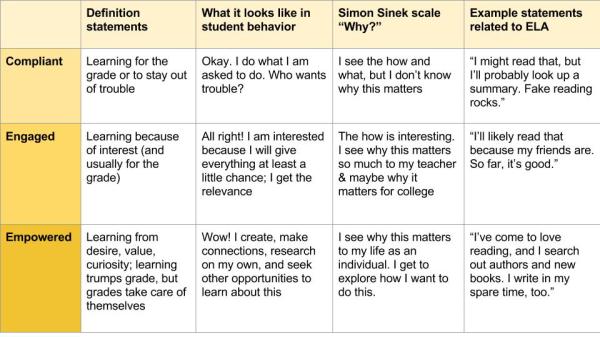
Take a look at this graphic. I first saw in in a tweet by George Couros and modified it a bit to fit ELA.

Rigor in RWWorkshop

original:  @gcouros #InnovatorsMindset

Don’t we all want our students to feel empowered? How many of us can say with fidelity they are? I cannot — at least not all the time. I struggle with time and texts and mandated tests and so much more, and just when I think I have it figured out, the year ends and a new group of students show up with different needs. (Or our preps change like mine did this year.)

But workshop is the model that helps the most. My focus stays on the individual:  What books will help him identify as a reader? What books will challenge her so she sees her growth? What do they need to feel the pull of the pen and want to write, revise, and publish?

Honestly, I am struggling with a lot of that this year, but I’ve taught the other way with whole class novels, one after another; and study guides, worksheets, and tests over books. I will never go back. However, I still feel the pull at times when a colleague shares some activity she’s created, and it sounds cool or she says students liked it. I nod and thank and think:  Does this reflect my why? Does it fit within my philosophy of workshop instruction?

See, I wasted so much valuable time. Time I could have used to help students gain a greater sense of themselves as readers, writers, and contributors in our world. When we spend all that time teaching the history behind a novel, so students are more apt to understand the novel, and then either read the book aloud in class, or then task students to read it at home on their own (so many don’t), and then assign worksheets and annotation minimums, and then give multiple choice tests — we forfeit valuable time.

And we often teach kids to hate reading.

That is what I wish I would have said in that PD session.

It doesn’t matter that I “love teaching literature” and “that is why I wanted to teach English.”

What matters is our students. What do they need?

Amy Rasmussen teaches readers and writers at Lewisville High School in N. Texas. She’s an advocate of kids, big or small, and works tirelessly to try to fit all the pieces in all the right puzzles. Follow her on Twitter @amyrass

TCTELA 2018: Professional Learning in Style on the Isle

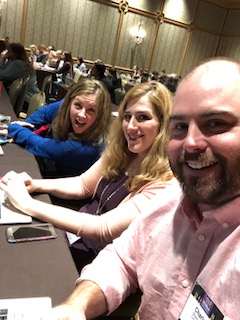
I like to think I know about teaching.  Then I go hang out with hundreds of brilliant educators and I realize how much I have to learn.

(I hope Helen and Megan see what I did there)

Teachers

I just got home from the TCTELA Conference.  The 30 minute ride north on I-45 allowed me a brief opportunity to reflect on this weekend and think about the experiences that I encountered and the people I had the pleasure of meeting.

Collaborative Conversations:

Spending time in different sessions with different people from our District rejuvenated me. I enjoyed sitting with Adam Glasgow and taking in a presentation on curriculum development from two teachers from our district: Helen Becker and Megan Thompson.  I loved hearing them speak the workshop language.  It’s nice to take in a lunch with teachers from other schools in our district and really get to know them. There were also impromptu twitter education sessions and conversations about snacks.

Mary Margaret

Super Star Speakers:

Alfred Tatum is brilliant.  His presentation was first thing in the morning on Friday and was a perfect start to the conference.  His ideas about texts belonging to all students perfectly echo the words of Atwell, Kittle, and Gallagher.  Here is a video of Dr. Tatum talking about self-selected reading.

Pernille Ripp is inspiring and passionate.  She is one of the most ardent speakers I’ve ever heard and when she said, “Our fidelity should be to the students, not the programs. See the children and hear their voices,” I knew I had a new teacher-crush (Sorry Kelly Gallagher).

Donalyn Miller made me continue to think about my role in the classroom and as an advocate for literacy.

Chris Lehman closed out the conference this morning and his ideas about close reading should be standard practice for all of our reading teachers.

Chris Lehman

Looks like I’ll be spending money on more teacher books soon.

Harvey Panel:

Diane Miller of U of H Downtown set up this panel of amazing educators.  Unfortunately, our time slot worked against us and more people sat on the stage than in the crowd.  In that aspect, it kind of reminded me of the JV soccer game the night before.  That wasn’t really the point though.  The point was that these educators shared their uplifting stories and shared some of their emotional baggage.  It’s important to give a voice to those who are thinking and acting outside the box to help kids.

Call to Action:

Get involved.  Connect with innovative people on social media!!!  NCTE is in Houston this year.  Meet up with us!!!! If you are a Texan, Join us at TCTELA next year in San Antonio!!!

Charles Moore’s students sometimes revolt when he tells them to quiet down and all they want to talk about is their writing.  He can’t wait for the weather to warm up so that he can enjoy craw fish and his pool and maybe even devour craw fish while in the pool.  You can find his frequent thought bursts and his passive aggressive treatment of trolls by checking out @ctcoach on twitter.  His poorly executed instapoem collection can be seen @mooreliteracy1 on Instagram.

3 Ways to Utilize Audio and Visual Recording with our Readers and Writers

There is much debate regarding the use of digital technology in the classroom. For teachers, cell phones and other technology are both frustrating helpful when it comes to student use. They have the potential to be distracting and disruptive, as we all know, but tech is useful when it comes to some classroom activities, such as keeping a next reads list, or looking up word gaps. I love the idea of using them for the powers of good, so recently, I tried asking my students to use their mobile phones just for the purpose of recording, and to try to ignore the notifications that might come across as they used them.

I’m always looking for new strategies to help the readers and writers in my classroom, and in the past few weeks I’ve tried a couple of different applications. Using cell phones and iPads is simple, and it meets one of the simple rules I am trying to follow when it comes to working with students: meet them where they are.

Recently, while my grade nine students were in the thick of drafting informational essays, I asked them to read their essays aloud, and listen to the flow, the choppiness, the parts that sound great, and the parts that “just don’t sound right.” While I’ve asked students to read their own work aloud before, this time I asked them to record themselves, and then after, to listen to their voices while reading, keeping a pencil in their hands, pausing the audio and editing and revising as they go.

My students were reluctant at first, but once they got over the initial awkwardness of listening to their own voices, they indicated that it was a simple and useful strategy for revision. It’s one that can be used in other classes, and doesn’t require any other tools or even other people for help.

Another strategy we employed using recording technology was focused on the use of video recording. Before my students had started writing informational essays, we studied informational texts, using the Nonfiction Notice and Note signposts, along with the Book Head Heart strategy found in the works of Kylene Beers and Robert Probst.

IMG_4387

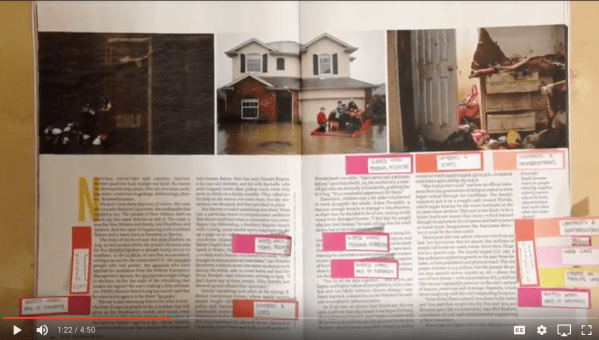
When students learn reading strategies and skills, it’s important to be able to see just where they are in the learning process, but it takes time to thoroughly check in with each and every one of them. So with this unit, our ninth grade English teacher team decided that it would be great if students could demonstrate their learning through a think-aloud. Doing this in class would take a lot of one-on-one time, so we asked students to demonstrate their thinking and reading skills on their own, and to use the video recording capabilities on their iPads and cell phones.

videothinkaloud

A screen shot from a video-think-aloud

Because we, as teachers, had modeled the think-aloud strategy in our classes many times, students knew exactly what we meant, and were able to demonstrate their understanding of the strategies and skills necessary when reading magazine articles. They annotated, exposed their initial confusion, shared their process of finding understanding, and demonstrated a multi-draft reading of the articles they had chosen. It was a successful method of assessment, and I plan to utilize it again. Students had a chance to showcase their thinking and understanding, and it wasn’t a one-off opportunity. They had the chance to try multiple takes with their recordings, so the pressure was off and they could easily share their thinking.

Our most current rationale for the utilization of video in class is with our new short novel unit, in which we formed book clubs. We are squeezing in a shared text at the beginning of second semester with Of Mice and Men. While all of my students are reading the same text, they are split up into groups of three and four so they can form their book clubs. One of the summative assessments with this unit is a small group discussion that they will record. They will need to demonstrate some academic, sustained, literary discussion in their videos, and are practicing in class, leading up to the recorded discussion. I’ll be able to have five small-group discussions going on at the same time in my class, which means precious class time isn’t frittered away with transition times between discussions, for example. Students will be thinking, reading, and discussing, and I’ll be able to watch the video later, when the pressure is off, and I can truly assess the conversation. I’ll try to remove the guess-work because I can slow down the speaking and listening assessment portion of it all.

annotation OMAM

One student has heavily annotated in preparation for the recorded small group discussion.

These are just a few ways to allow students to use the simple technology that is available to them. Kids know how to make movies and to splice audio, so there is little need to instruct regarding the technical details. They can use the audio and video to showcase their skills.

It’s also a timesaver as far as the classroom goes, and it takes some of the stress off of students who have test anxiety or who struggle when it comes to on-demand assessments.

While it’s not a student-recording, I will share one last recent use of video in class. I played the video in this NPR article about a murmuration of starlings as an inspiration for a quick write this week. I played it without sound, and hit replay several times. My students were fascinated and wrote some fun responses. One was even moved to write music: img_5972.jpg

I love how my students are constantly surprising and impressing me. They are unexpected and wonderful.

I’d love to hear more about how teachers and students are using laptops and cell phones for the power of good in the comments below!

Julie has been teaching secondary language arts for nineteen years, spending the first fifteen in rural Central Oregon, and the last four in Amman, Jordan. She’s thrilled to report that she and her family will be moving across the agua to Managua, Nicaragua next year, where a new adventure will begin.

Follow her on twitter @SwinehartJulie

Follow her blog https://adventuresinhighschoolworkshop.wordpress.com/

A Reading Conference with Tom Romano

I am fortunate to be on friendly-emailing terms with the great Tom Romano, from whom I’ve learned much about good writing instruction, multigenre, and student voice.

So when I received an email from him the other day, asking for book recommendations, I laughed aloud. My most excellent writing mentor, asking me what to read next?

img_6004

I admit, I balked a little at first. This was like having Tiger Woods ask you what golf club to try next. But then, I fell back on my tried-and-true reading conference strategies, which I’ve used countless times over the years with reluctant and prolific readers alike.

As with any student, I had much of what I needed in order to give a good recommendation between the request itself and my background knowledge of Romano. When students need help finding something to read, we’ll often meet at the bookshelf. As they stare blankly at the wall of books, one of the first questions I ask is:

“What are you in the mood to read?”

Often, students can give me a feeling–something fun, lighthearted, serious, or challenging–or a genre–romance, nonfiction, adventure. It’s even better when they can give me specific titles that relate to their preferences. I usually glean these titles by asking:

“What’s the last book you read that you loved?”

In his request, Romano gave me all the information I needed–he wanted something literary, something like The Nightingale (which I’d read after Lisa recommended it to me), Atonement, or All the Light We Cannot See. He’d also answered another question I usually ask readers:

“What’s your reading plan?”

Knowing where a student will be reading this book–at work in short spurts, at home in long stretches, or on a crowded bus on the way to an athletic event–impacts my recommendation as well. Here, Romano told me he’d be reading for long, uninterrupted stretches of time in airports, so I knew I could suggest something all-consuming.

So, I stuck with my usual formula:

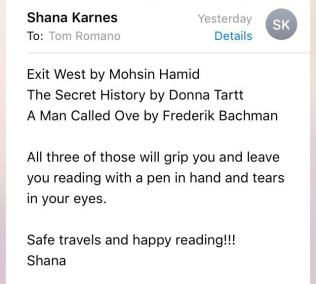
I recommended three titles.

img_6005.jpg

Exit West is a title I’ve heard a great deal about and would love to read, but haven’t gotten to yet; The Secret History is an amazing hidden gem by Pulitzer Prize-winning author Donna Tartt that I read about 15 years ago; and A Man Called Ove is a new viral title that made me sob hard over Girl Scout cookies and coffee as I finished reading it. My three recommendations usually consist of something old, something new, and something I haven’t read yet.

I wrapped up my pitch as I always do, with a clincher:

A promise of what the book will do for the reader.

A week went by, and last night at 11 pm, I received another email from Romano:

img_6006.jpg

“Loved Ove.”

A successful end to a successful reading conference, if you ask me…but of course, like any other conversation about books, I couldn’t let it end there. I just had to throw in one more recommendation, which I always do for my students when they return a book:

“If you liked that book, you should try ______________.”

This quick exchange of emails, like so many off-the-cuff conversations we have with students, was packed full of powerful data about a reader’s interests and abilities; a teacher’s knowledge of texts and titles, and most importantly, the transaction between the two parties–a shared endeavor to find a just-right book at just the right time.

All our words are imbued with purpose and power when we are discussing literacy. Reading conferences don’t need to be formal, sit-down conversations all the time. They have just as much weight when they’re held standing at the bookshelf, passing in the hallway, or from afar via email. This reading conference with Tom Romano reminds me: never take any of our talk about books for granted.


Do you have a what-to-read conference “formula?” What other titles might you recommend to Tom and me? Please share in the comments!

Shana Karnes is eagerly awaiting the end of flu season so she can go back to work without worrying about her two tiny daughters getting sick…again. When her family is actually healthy, she teaches preservice educators at West Virginia University, goes for long runs while listening to even longer audiobooks, and tweets about reading, writing, and school at @litreader.

Collaboration 4 Ways

The Classroom

It had been a great week in the classroom: we had shared our stories, written in our notebooks, and analyzed Queen’s awesome “Bohemian Rhapsody” (if that’s not a “fun on a bun” way to dive into rhetorical analysis, I’m not sure what is!). But despite my best intentions, I had not faithfully modeled engagement with writing mini lessons (ML’s) and folded in collaboration the way I intended. Okay, or much at all. You know how it goes . . . you nibble some off this end and things slide a little at the other end.

So, I found myself without time–as I so often do (Help Pacing Gods and Goddesses! Help me learn to be less thorough already!)–and wondered if/how I could efficiently address the 4 ways writers can collaborate. My colleague and I believe writers collaborate with mentor texts, people (teachers via ML’s and conferences and peers), materials, and themselves. How could I satisfy this need, this craving to model these fundamental skills in a totally wholesome way without cramming it down their throats?

Thus, Collaboration 4 Ways was born. Reminiscent of Steak ‘N Shakes’ Chili 5 Ways, I quickly figured out how to model what I wanted to do by synthesizing the 4 collaboration skills into a one-plated ML, focusing on the 6 Word Memoir, which is our lead into application essay writing for our seniors.

  1. I modeled collaborating with a mentor text, using an online sample off NPR’s site, taking note of what worked. I annotated interesting arrangement of words, varied syntax, clever pairings of language and visual, and more. Then I thought aloud regarding what I ought to “throw into the mix”–measuring out words that helped to build meaning.
  2. I modeled collaborating with the teacher; and, pulling the picture of my sweet and silly Ingrid as a unicorn, used the ML strategy of writing about what the picture encapsulated in 17 words or fewer. Ideas first; concision later.
  3. I modeled collaborating with materials (AND my students): gathering small thumb drive size sticky notes, I wrote each word and
    IMG_1142 (1)

    Here’s what I mixed up–with student collaboration–on the doc cam. The whole sticky notes reflect student suggestions and “drafts.” Note to self: they do sell thumb sized sticky notes . . .

  4. piece of punctuation on one and with student help, moved the words around and changed/added punctuation to truly model that sentences are made of moveable parts and that punctuation DOES matter (what taste it adds, darn it!).
  5. Finally, I modeled collaborating with myself, thinking aloud and reflecting to create my final piece. Does this arrangement of words build meaning? Does it build power? Should I revise the punctuation? Etc.

And, I did this all in 10-15 minutes (what I had originally allotted each day to teach each one of those separately).

Discovery:

Served early in the course, this lesson acted as a catalyst for many of my students. Some use the 6 word memoir approach to generate topics or meanings of topics; some manipulate syntax via sticky notes for their purposes; some spend more time talking through ideas; some realize then and there the value of a mentor text.

As for me, I discovered that maybe, just maybe, I needed to shift my thinking. Because it will shift my students’ approach. ML time has been about modeling what to do and getting help from my students, too, discussing and processing. To me, the ML steps have seemed a recipe for success–a thorough list of ingredients and instructions to follow as they work at isolating and problem-solving a certain challenge in their writing. With someone modeling it all for them. Collaboration 4 Ways allowed me to model possibilities . . . instead of the way, one way with an intended outcome.  Serving up Collaboration 4 Ways reminded me that students need to see what’s possible. And how even a seasoned cook needs to test and try.

Truth: Possibilities precede problem-solving.

Giants whose shoulders I stood on:

Many a giant supported me on this one  . . .

  • My Directors of Teaching and Learning who reminded us before school began that we have more freedom than we are using. And, what opportunity really means.
  • Angela Stockman’s Make Writing 5 Teaching Strategies That Turn Writer’s Workshop Into a Maker Space for inspiring me to experiment more with making writing.
  • My colleagues for holding me to the fire with how I ML because sometimes there’s not much mini about it.
  • Three Teachers Talk Mini Lesson Mondays!

Kristin Jeschke, in addition to enjoying Chili 5 Ways during late night study sessions back in college (too many years ago to mention here), appreciates constraints, good talk, and post it notes (lots of them, in all sizes) when writing. Follow Kristin on Twitter @kajeschke. 

What do colors have to do with teachers writing? Today, a lot.

When I read You Don’t Have to Say You Love Me by Sherman Alexie, I knew I’d found mentor gold. Infused with stirring poetry, this memoir tells the story of Alexie’s less than ideal relationship with his mother and how he grieves the loss of her, what was, and what could have been.

I reached for this book Monday as I began a session of PD. On a whim, I flipped the pages and landed on the poem, “Ode to Gray,” thinking it may spark some kind of response in my audience. It’s simple enough. And lovely.

Ode to Gray

This isn’t the complete poem. I just wanted you to get the idea. There’s one more stanza. Really, get this book.

After I read the the poem aloud, I asked listening teachers to write in response.

“Think of a color, and write about that. Write your own poem, or a paragraph. Doesn’t matter. Just write about your color.”

After writing five minutes, which is rarely long enough, I asked these writers to read over their words and do a bit of revision, challenging them to add an appositive phrase somewhere in their writing. This is a directive I often use with students:  We write. We read our work. We revise, often with a singular purpose that ties to a specific skill or craft move.

I walked the room, peeking over shoulders, listening to conversations — and noticed about a third of the group didn’t write a thing. Funny how some teachers are so much like some students, huh?

Maybe they didn’t get the simple task. I guess that makes sense if they’ve never been asked to write like this. I do not think that’s the case though. I heard one too many sigh and saw one too many eye roll to know I wasn’t the first presenter to ask this group to think and write.

It didn’t matter. We cannot make people eat. We can keep inviting them to the table.

Writing teachers should be willing to write.

Accountability in RWWorkshop

Some teachers in that session wrote a lot — and they wrote beautifully. Adam showed me his piece about the color black. I should have asked for a copy. All I remember is the line “Little black lies.” It’s a great line.

Of all I wrote, one line holds a bit of promise:  “Orange, the color of sunsets, why are you so lonely?”

And then there’s Mary. She took that little quickwrite and turned it into something tender, touching, real. She published it on Facebook and said I could share it here:

An Ode to Red
Workshopping With Amy Rasmussen
1.15.18
Red is the fire of your cheeks as you demand to be heard in the morning before school, on a day I was supposed to get to sleep in late. Red is the fire of mine as I scream back, frustrated, unsure of how to solve this trembling toddler enigma. You want red grapes, I gave you purple. In your mind, they are not the same.
“What’s your favorite color, Mommy?” you ask. You expect an answer.
“Purple,” I say, knowing the question that comes next. We do this daily dance, aware of each other’s rhythm.
“And what else?” you ask.
“And orange.”
“That’s good, Mommy. Mine’s red. Red and blue. I love red and blue.”
Red is the sucker, no, the second sucker you negotiate for after getting your hair cut. Just one of the many tricks/bribes that I’ve learned along this short parenting trip we’re on together. Sticky, stained red lips, sticky, stained red teeth and sticky, stained red fingers.
“Go wash your hands before you hug me!” I yell as we walk in the house. “5, 4, 3, 2, 1…”
Red is the color of the bath water after you dump the entire bottle of finger paint into the tub.
“Bubble bath!” you shriek excitedly, giggling, red steaks strung along the sides of the just-washed tub.
Red is my heart each time I leave, and each time I return. Red is the love. All of the love, engulfing me in flames.


I see red a bit differently today.

Thank you, Mary. My kids are grown, and now I get to watch them practice parenting. It’s hard and noble work, and you will feel every color of emotion — sometimes all on the same day and sometimes more than once. But it’s that “love. All the love” that turn these emotions into rainbows. And sometimes just writing about them helps us see every moment just a bit more clearly. Thank you.

In an article by Tim Gillespie, published on the National Writing Project website, he sums up what I believe and have experienced myself as a teacher writer.

Accountability in RWWorkshop (1)

Here’s the thing, you teachers who refused to even try:  It doesn’t matter if you think you can write. Just write.

What does matter is that our students see us working at it. Just like we must be readers in order to help our students find the “just right” book, we must be writers if we want to know the struggle our students face when writing.

We learn when we are vulnerable. We learn when we practice.

So I am challenging myself as much as I am challenging you:  Write beside your students more. Let them see your thoughts, your mistakes, your struggles. Ask them for feedback.

If I truly want a community, where we all work to grow as readers and writers, I need to do more to get us there.

Amy Rasmussen began writing in journals at age 8. In addition to this blog, she now writes in notebooks and on sticky notes. A lot of sticky notes. She also tries to write the assignments she gives her students. She wishes she would have had teachers who wrote with her, but she does not remember one K-12 teacher ever doing so. Follow Amy on Twitter @amyrass and @3TeachersTalk

Moving My Desk to Move Readers and Writers

Happy New Year!!!

What an interesting time of year this is.  The Christmas break offers so much opportunity in the way of reflection, thinking, and development.

I think back on the Fall semester and wonder where it went so quickly.  It’s as if one day I stood with my Student Council kids staring up wonder of the eclipse, and the next day I sent them off for the holiday break.  I must have told them how much I loved them thousands of times.  So much happened this fall and I have so much to think about.

Somehow the stack of books I’m currently reading grew massive this fall.  I’m determined to finish so many that are half read.  The Last CastleA History of WolvesReady Player OneLincoln in the BardoThe Glass Castle are staring at me like unloved puppies.

Reading is important to my teaching life but my thinking is about my classroom as a learning space.  Specifically, I reflect on how I’ve arranged it in the past and how I think that arrangement is antiquated and isn’t optimal for how I want to teach.

An article written by Paul Viccica and Lois Goodell and published in the October 2017 issue of University Business clearly states, “Classrooms that activate experiential and project-based learning approaches reflect the modern workplace by providing social and quiet work spaces, by offering breakout seating, and by creating technical stations where students can collaborate, focus independently and work technically, as they would in an office setting.” This sounds to me like its promoting authenticity in the classroom; something of a mantra for me this year.

I wonder if there is evidence that shows any positive effects of the teacher cordoning off a section of the classroom to create a fortress of solitude into which no student shall venture.

I hate what my teacher desk has become.  I hate that it, like so many others, is a great wall covered in papers, writing utensils, binders, books, note pads, a computer screen, and all the flotsam and jetsam that builds up in a teacher’s daily existence.  I hate that I sometimes find myself sitting behind my desk when the kids are furiously writing or deep in a text.  I despise the disconnect that happens when I steal a minute to answer an email or take the attendance.

Why is the siren song of that momentary mental break so alluring?  How many times has a student looked up to find me sitting at my desk and swallowed their question because I looked too busy to be bothered? I’m confident the answers to the questions are “not often.”  I hardly step behind my desk during classes and that just solidifies my need to make a big change to start this new year.

I’ve written before about the constant conferring that needs to happen in our independent reading and we all know those habits are crucial in teaching writing as well.  There shouldn’t be an opportunity for me to disconnect from the students.  Reading, writing, discussing; those are all activities that I should be completely engaged in, even if my role is just as the listener.  So, I ask myself, when are they doing something that I can disconnect from?  The answer should be: NEVER!

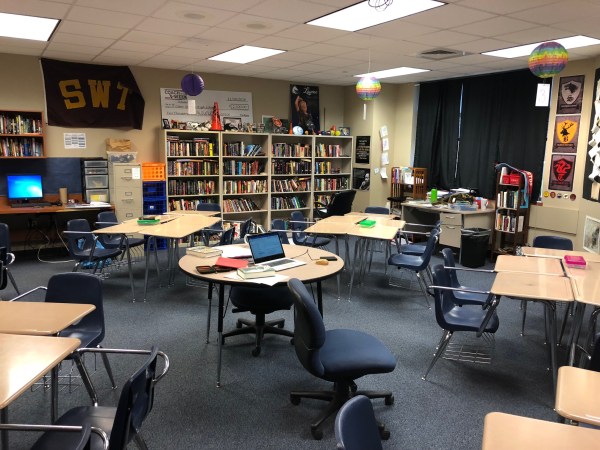
I made the decision to shove my teacher desk against the wall; abandon it.  Like an anchor, its holding me back and I want it out of my way.  I don’t need it anymore, nor do I want it.  It’s a symbol of a bygone era.  It’s one of those things I cling to for my comfort at the expense of students.


IMG_3661 (1)

This is my big move to start 2018. I hope it makes my instruction more effective.  I need a change and so do the kids.

I think it’s important for teachers to encourage other teachers to innovate and throw away the practices or procedures that no longer reflect their teaching styles. Is anyone else making a big change in their teaching life?

New Year, New Classroom!!!


Charles Moore has succumbed to the creativity of his Student Council students and their aesthetic is now his. He can’t stop thinking about how to maximize his classroom space with design and decoration.  He recently lost to his 7-year-old daughter at Clue and catches up on reading in the parking lots of dimly lit soccer fields around League City, TX waiting for his son to finish practice. His almost daily musing can be found on his twitter page @ctcoach