Category Archives: Readers Writers Workshop

How to Confer Like a Ninja

NinjaConferring.

We all know it is the true Special Sauce in the workshop classroom.  Without conferring, it’s just Silent Sustained Reading, which ironically does little-to-nothing to actually SUSTAIN READERS.

However, we also all know #teacherlife.  When we get into the thick of things, it’s easy to lose our groove when it comes to consistently and effectively conferring with students about their reading lives. (Writing lives matter, too, but that’s another post.)

So, enter my new tutorial, How to Confer Like a Ninja.  I know many of you are imagining me in something resembling an all-black suit and stealthily skulking around whispering, “What are you reading? Why’d you abandon that book?”  I hate to disappoint you, but my students know I’m anything but graceful.  I regularly trip over Chad’s backpack with his tennis racket sticking out the top.  That thing is a weapon of mass destruction.

Instead of the stealthiness of a ninja in terms of moving about the room, I’m going to teach you how to ask questions that students would NEVER even know are conferring questions!!

For all other ninja-moves, please see Coach Moore, or maybe Lisa, or Shana’s daughter Ruthie.  They seem–stealthy.

Anyway.

Here are my four favorite questions for conferring like a ninja:

  1. How’s it Going?  I could write an entire book on this question alone.  Lucky for me–and you–Carl Andersen already did.  This is a completely low-stakes question that leaves room for the student understanding that you respect them as a reader–even if they are a struggling one–rather than feeling like they’re in the middle of a spotlight and interrogation room situation.  Ninjas are nice.  Ninjas are welcoming.  Ninjas just want students to become readers.  (Okay, so my analogy is breaking down a bit, but stay with me.)
  2. What’d you think?  This one I usually pull out in the hallway when a student runs to me in between classes to tell me they finished a book.  I usually get one of three responses: 1) “I’ll have to tell you later, I don’t have enough time!” 2) “Eh, it was okay.” 3) “Ugh!  Mrs. Paxson, I’m so mad!!” All three of these are great because it gives you an entrance–like a ninja–into a larger conversation.  Yes, even the “eh” response is perfect ground for finding them their next great read.
  3. Would you recommend this to a friend?  The answer to this question tells a lot about the journey of a reader.  If they would recommend it to a friend, that means they really do like it and they would risk being ridiculed by said friend if they thought it was boring, weird, etc.  Students don’t often risk that for just anything.  Also, if you can get a student to recommend a great book to one of your holdouts, they are scientifically about 83% more likely to actually read that book.  Yep.  That’s right.  I said SCIENTIFICALLY.
  4. Would you read it again?  Okay, be careful with this one.  I can feel you getting a little eager over there, and you can’t just pull it out of nowhere.  This is the perfect question to test the true level of a book in a reader’s mind.  But, THAT’S the ticket.  This question is for readers.  I would not pull this question out at the beginning of the year, or with one of my reading holdouts.  If I asked one of those students this question, they would stare at me, appalled that I would suggest such a thing.  However, real readers re-read.  It’s a true test of love for a book.  So use this one sparingly, but it will allow you to examine if a reader liked a book, or truly developed an undying love and will miss the characters long after the fact.  Our biggest nemesis in workshop teaching is time, and everything else that is competing for it in our students’ lives.  If they volunteer the information that they would be willing to spend MORE time reading something they’ve ALREADY READ, that means we’ve got ’em.  Take that, cat videos on YouTube.

All of these questions are part of my favorite aspect of a workshop classroom–the in-between.  Its difficult to quantify the leaps and bounds made within any given reading and writing workshop, but don’t let that distract you from the magic of the inconspicuous–or some people call it “normal”–conversation.  Getting to know our students, their reading tendencies, and their journey is part of what shows them that we are different.  We care about teaching them how to learn instead of just what to learn, and we are willing to support them on that journey as often as we can.  Even in the hallways, in transition time, and everywhere in between.

Happy teaching!


Jessica Paxson teaches English IV, AP Lang, and Creative Writing in Arlington, TX.  She runs on coffee and exaggeration, a deadly combination at 7 in the morning. Her students frequently describe her as “an annoyingly cheerful person who thinks all her students can change the world.”  Yep, pretty much. 

Why It Matters

An enormous part of my teaching philosophy is centered around teaching students to question the “why” of what we learn. Not necessarily why are we learning, but why does what we learn matter? How does what we do in our classroom apply to their lives? I sincerely believe that if students cannot walk away from my class each day able to answer those questions, then I need regroup and question the purpose of my lessons.


pasted image 0Kelly Gallagher, a high school teacher in California, is an advocate for getting students to think critically, read deeper into various texts, and along with several other educational rockstars, structures his classroom according to the workshop model.

In his book, Deeper Reading, he discusses the “Say/Mean/Matter” chart as a way to make any text relevant to students in addition to helping them become critical readers and thinkers.

 I regularly use this strategy in several ways in my classroom which consistently provides me with opportunities to keep my lessons meaningful to my students. What I love most about using it is that it provides students with an opportunity to focus on what they are learning and why/how it matters. This also shows them that EVERYTHING we read, write, discuss, etc., has a purpose.


I recently completed novel studies with my students and was able to implement the “Say/Mean/Matter” concept with all 3 of my grade levels. In my experience,  I learned that I needed to provide more scaffolding for my younger students versus my Juniors who were more equipped to take the concept and run with it. It seems like the older they get, the more eager they are to share their opinions and challenge what they read.

For my Freshmen

Earlier this school year, I was fortunate to have the opportunity to attend a professional development session that centered around Kelly Gallagher’s Say/Mean/Matter strategy. I was able to scaffold this lesson by targeting specific pieces of the novel, To Kill a Mockingbird, a few at a time in order for students to focus on examples of social injustice. Over a series of impromptu class discussions and informal reading/writing responses to various texts about inequity, I broke each section of Say/Mean/Matter down so that students were familiar with applying this idea to various forms of literature. Once we reached the pivotal point in the novel, we completed this with partners they chose (and some they didn’t), using sticky notes to frame discussion.

This slideshow requires JavaScript.

From there, we completed our graphic organizer together using our stickies from the day before. Students were asked to expand on the ideas they came up with together. After modeling my discussion notes and conferencing with students, their responses clearly showed that these examples of social injustice meant something to them. It became more than just an assignment to them, it was a chance for them to safely explore, discuss, and write about opinions that mattered to them.

This slideshow requires JavaScript.

Eventually, this led to a Socratic Seminar that took us 2 full class periods to complete. Every student was engaged and ready to share their ideas and ask questions because it was relevant to them. Not only was this a chance for their voices to be heard, but they truly cared about what each student had to say and remained open-minded throughout the process.

A Small Snapshot

This was just one of the incalculable ways to foster relevance and meaning to students that perfectly aligns with the benefits of teaching through the workshop model. Now more than ever, what we do as educators is of the utmost importance. By building these moments of discovery into our lessons, we allow students to create and develop meaning for themselves. The students are our purpose. Our profession centers around helping them develop and unleash their potential. Once students realize what we teach has applicability and value, there is no limit to what they can accomplish.

I would love to know other ways you make your lessons meaningful and relevant to students in your classroom in the comments!

Gena Mendoza currently teaches Freshmen, Sophomore PreAP, and Junior English in Texas. She is passionate about teaching her students to use their powers for good and not evil in her classroom. When not pouring over any written or spoken word by Jason Reynolds, or preparing her family for their next Disney adventure, you can catch her Tweeting/Retweeting at @Mrs_Mendoza3 on Twitter. 

What Does it Mean to Read like a Writer?

It’s a startling reality, but many of my seniors do not know how to read like writers. I spend a good part of the beginning of a semester helping students look at how an author crafts a text.

This still surprises me.

The seniors I have in class this spring have all passed their state mandated English exams. A big chunk of these Texas state exams, both English I and English II, ask questions in the reading portion about author’s craft. (I haven’t explicitly studied the question stems in a few years, but I am guessing at least half.) In trying to get students to talk about the writer’s moves, most of my students get stuck talking about meaning.

Of course, meaning is important — but not when we are using a text to help us move as writers. In workshop lingo, we call this using mentor texts.

How do we learn to write anything well if we don’t study the work of writers who write well?

When I was first asked to write recommendation letters, I studied well-written recommendation letters. When I begin to write a grant proposal, I study how to write an effective grant proposal. When I need to write a speech, I study well-written inspiring speeches. There are solid examples for every kind of writing.

I want my students to know this. If they learn anything from me this spring, I hope it is this:

We learn how to write well by studying effective writing. To quote Kelly Gallagher: “Before you can film a dogfight, you have to know what one looks like. Before our students can write well in a given discourse, they need to see good writing in that discourse”. (Read Gallagher’s “Making the Most of Mentor Texts” for an excellent detailing of how.)


Yesterday Charles wrote about scaffolding a reading lesson. The same type of lesson, but with an eye toward reading like a writer, worked recently with my seniors.

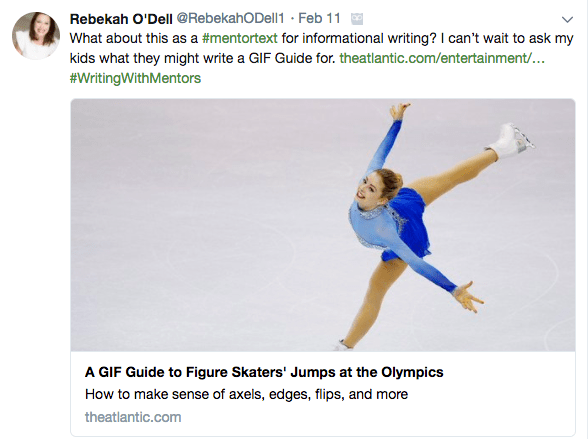
It all started when I saw this tweet: TweetofGIFGuide

I thought: “Okay, this may be a relatively painless way to get my writers into writing. We will use this text as a mentor and write our own GIF guides.” (Quick change in lesson plans on the drive to work.)

First, we started with a conversation about GIFs. This NY Times Learning Lesson has some good questions. We wrote our thinking in our notebooks and shared in table groups. Then, not quite as planned, the conversation shifted to how to pronounce GIF. “Um, it’s JIFF, Mrs. Rass, the creator of them said so.”

In case you are wondering:  I think the creator is wrong. But, does it really matter? I just wanted my students to use GIFs as an entry point into writing using mentors.

To help students understand how to study a text for a writer’s moves, I copied the text into a document, and removed the images, so students would focus on the language. Then I crafted a list of questions. Taking a cue from Talk Read Talk Write by Nancy Motley, I cut the questions up and gave a set to each small group. They spent the better part of a class period studying the text and using the questions as a guide.

Later, we brainstormed topics we thought would work, eliminating some that were too broad, and discussing ones that would lend well to a how-to or informational type of writing. Students then completed this document, so they could see my expectations for the writing task, and I could approve their topics.

Students talked. They wrote. I taught mini-lessons on introductions and sentence structure. Students revised. Some taught themselves how to make GIFS.

Most surprised me with their finished GIF guides. Here’s a sampling of a few. (Disregard the citing of sources — that’s still on the Need-to-Learn list.)


Students, no matter their age, will write when we give them the tools and the time they need to be successful writers.

Sure, not all of my students produced solid writing — yet. But I am hopeful. We are only a about a month into the course, and most students now have a writing success story.

That confidence matters.

For a great read on helping students write, read “Children Can Write Authentically if We Help Them” by Donald Graves.

I’d love to know the fun or interesting mentor texts you use to get your students to take a chance on writing. Please share in the comments.

Amy Rasmussen teaches English IV and AP Language at a large senior high school in North Texas. Go, Farmers! When she’s not skimming the news or her Twitter feed for mentor texts, she’s reading books to match with her readers or thinking about the rest she might get during spring break. Eight days, but who’s counting? Follow Amy @amyrass and @3TeachersTalk, and she invites you to follow this blog if you aren’t already.


Making the Leap: How one text supports another.

cactus2

This past summer I took advantage of an extraordinary opportunity. I mentioned it in my first ever blog post and my thoughts about that experience are unwavering.  The Summer Institute reinforced some of my already held readers/writers workshop beliefs and clarified many others.

One experience was particularly profound.  Meggie Willner and I found it so evocative that we based an entire professional learning presentation around it that we presented at our district  Profession Learning Day in August and even submitted a similar presentation for consideration at TCTELA this year.  Unfortunately, we weren’t selected for TCTELA, but Meggie and I still talk about how much this lesson taught us and how we still reach back to that lesson as this year moves forward.

On Day 7 of the institute, Amy presented us with a piece called “The Cactus,” by O’Henry.  I’m not intimately familiar with O’Henry’s works, but Meggie is and her opinion is a favorable one.  Amy took us through the exercise of discovering the beautiful language and writer’s moves that exist in the piece and we shared our thoughts and “workshopped” the text the way we should with our students.

At some point, Amy stated that this was a text we needed to present to our STAAR Camp students and Meggie and I simultaneously turned to each other in fear.

Meggie 2

Our initial thoughts were identical.  We knew our students very well and we knew that this text was far too difficult for them to conquer.  Meggie and I weren’t sure that we could shepherd them through this text and as soon as the session ended, we hustled up to our classroom to find something with which we were more comfortable and something we felt would engage the kids.

We quickly found a story called “Checkouts,” that was both easier to dig through and thematically similar to “The Cactus,” and away we went.  The lesson went beautifully, the students engaged with the story and we were able to guide them through discovering the writer’s moves and the thematic ideas in the text.  Meggie and I both agreed that we made the right decision for our kids.

Early on Day 8 Amy said something to the effect of: “I noticed many of our teacher teams chose not to use “The Cactus” in their lessons yesterday and went with texts that were less complex.” (I’m paraphrasing this because I don’t remember the exact words Amy used, but I remember feeling my face turn red and Meggie and I slow-turning to each other with matching looks of horror.)

Meggie1

Amy continued her thought by telling us how important the complexity of the text was to our readers and how texts that our kids would encounter on the STAAR test would match the complexity of “The Cactus.”

As soon as that morning’s session ended, we scurried up to our classroom with our tails between our legs and sat down to develop a plan to present “The Cactus” to our students.

We planned the activities that are typical of workshop to go with this piece. We drafted  questions that we thought might prompt their thinking and help them engage the text.  We looked at the text with an eye towards anticipating the places they would struggle with the language.  Looking back, we prepared well for this lesson.

Our preparation paid off when the students dug into the text. If you haven’t read “The Cactus,” please take my word for it that there are many difficult to understand words and this is what made us feel apprehensive. To our great joy, a piece that we thought would stump them turned out to be accessible and engaging and they found insight and nuance in its words. They floored us!!!

We discovered something too: our idea to present them first with “Checkouts” provided a scaffold to “The Cactus.”  They were able to digest the complexity of the more difficult text because they were comfortable and familiar with its thoughts and themes.  They trusted us because we built that relationship with the more easily accessible text. They learned that they don’t have to have understanding of every single word in the text to experience mastery of the text.  They can still engage in the nuance of theme and voice and other important skills. Once they found success engaging “The Cactus,” we could see their confidence build and they were able to enjoy the text in the same way as the adults in the room; as readers.

This is such an important lesson for me to learn.  Often, I take for granted that the students will engage with a text or just assume that they won’t.  My thinking, instead, should be about I can move them into a text by using what they already know or what they are interested in.  This may be obvious to other teachers, but I’m not a trained reading and writing teacher and I still have many lessons to learn.

Charles Moore still can’t figure out how to stay off of Amazon.com on snow days.  He is currently reading Warcross by Marie Lu and Truly Devious by Maureen Johnson and keeps his eyes open for suggestive cacti. His almost daily musing can be found on his twitter page @ctcoach

Creating Community One Story at a Time

My son started Grade 6 this year at a brand new school. This was a nerve-wracking shift for us as he had been attending his previous school since preschool. His fears were largely centered around finding new friends and fitting in, but as a teacher/parent my fears centered more around the learning environment and if his new teacher would conduct the class in a way that fostered inquiry and creativity.

After the first few weeks of school, it became clear that this teacher had a different style of teaching than the ones at my son’s previous school and  I fretted that he wasn’t learning enough and that he was going to be bored with this new style of instruction. In one of my particular moments of panic and after just finishing a lengthy text to rant to a teacher friend of mine about my fears in regards to the way my son was learning, my wise sage of a friend responded with a simple response – yeah, but how much do you really remember what you learned in Grade 6 content wise anyways? What you should really be asking yourself is what type of classroom community is being fostered.

Just that one simple question quelled the storm of concerns and made me reflect. What was my son’s new classroom community like? So, when he came home from school each day, I stopped listening for what he learned and focused more on the tidbits he shared with me about how he is learning. Once I started listening for the how, I realized the gift that his new teacher was sharing with him was the gift of story. I soon saw that my son who so often answered questions of “what did you do at school today?” with a shrug and an “I don’t remember” was now answering the question by sharing the stories he learned.  You see, his new teacher has created a classroom steeped in story and story is a powerful community builder. Every day he tells the students stories of his life, stories of the past, and stories of his hopes for the future. He also surrounds the students with stories with a huge classroom library that the students are free to access at any time. Most importantly, however, is the culture he has created by one simple habit- everyday he reads aloud to his Grade 6 class. I soon began to realize that my son was excited to tell me the stories that were being read to him and his classmates and recounted them with a verve and detail he has never had before when talking about school. Will my son remember the content of his Grade 6 Social Studies lessons? Maybe not, but he will remember the power of those stories being read aloud to him and what they made him feel.

In her blog and in her book Passionate Readers: The Art of Reaching and Engaging Every Child, Pernille Ripp discusses the importance of reading aloud to our students and the importance of providing joyful reading experiences. When we read aloud to our students, we model our own enjoyment of reading, tap into the inherent human love of story, and provide a joyful reading experience for our students. Why then do we stop reading aloud to our students as they get older? This was the question that came to mind when I thought about my own teaching practice. Do I read aloud to my students? In reflection, I realized I do read the practice sample reading paragraphs to prepare for the Provincial Exams to my Honours English 11 class and I occasionally read out samples of strong essays, but this would hardly count as joyful reading. I quickly realized that I had fallen into the mindset of the senior English teacher – the one that does not see reading aloud to her senior English students as a valuable use of time.

For more detail on techniques to bring read alouds alive in your senior classes, please read Amy’s post on the topic.

Once this realization hit, I went straight to my senior English department colleagues and started to brainstorm ways that we can bring the joy of storytelling into our senior classes and these are the first steps we took.

Besides integrating daily reading time to each class, we also focused on how we can bring storytelling into their lives. Our school is a K-12 school and our senior students are fortunate enough to have many connections with the junior students. One program we have is a Kindergarten/Grade 12 buddy program where our Kindergarten students and our Grade 12 students meet once a month. Right away, I knew this was a perfect opportunity to allow my Grade 12 students to share stories. Prior to our next buddy meeting, I took the Grade 12 students down to the library and set them free in the picture book section with one simple task – find a story to read to your buddy. Off they went and magic quickly happened. As they were searching the shelves, stories started to present themselves to them. They found their favorite picture books they read as a child or ones that were tied to special reading memories. These were the books they choose to share with their buddies – the stories of their childhood. As they read the stories to their buddies the pride and the joy of sharing stories was evident.

IMG_0458

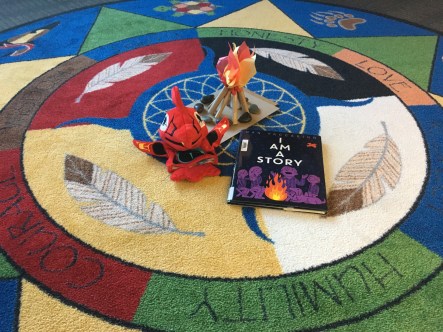
Before starting our living library, I read my Honours English 11 students the amazing picture book I Am A Story by Dan Yaccarino to get them in the story telling mood. We also made little campfires to tell the stories around to further create the atmosphere of sharing stories around a campfire. Some of my Grade 11 students were a little shy to tell their stories, so they enlisted the help of our school library puppet collection.

Another storytelling initiative I took on was having my Honours English 11 students create a living library for the Grade 3 and 5 students at our school. A living library is where students become living books with a story to tell. The Grade 3 and 5 students circulate around the library and “check out” an Honours 11 student and listen to the story the Grade 11 has prepared to tell. The purpose of the living library is not to ask questions or to engage in conversation with your audience, but simply to share your story. My Honours students have recently been studying how authors create voice in their writing and what better way to study voice than to create story using our own voices. When I first proposed the idea to my Honours students, I presented it as an exciting opportunity in storytelling and I was met with less than enthusiastic groans. They wanted to know if they really had to do this (the answer being yes, I want you to try) and “are we being marked on this” (the answer being no, but it will help you develop voice in your storytelling). Despite their reservations, they all actually showed up on the living library day and ended up having a blast. Upon reflecting on the experience afterwards, my students talked about how they had to change their stories to suit the different audiences that were listening to them. In some cases it was because they had an older or a younger audience, but in many cases it was because of the way the audience was reacting to the story. At the end of the experience, all of the Grade 11 Honours English students could agree on one thing – they loved telling their stories and they wished they could do this every class.

While running a living library every class is not really possible, this experience reminded me how I need to weave story into my daily classes more because story is a powerful tool. By reading aloud to my senior students, by giving them opportunites to read aloud, by sharing my stories, and by allowing them to share theirs I can help foster a class community that is steeped in the joy of story and storytelling.


Pam McMartin teaches Senior English, is the English Department Head, and the Senior School Teacher Librarian at a school in Tsawwassen, British Columbia Canada. When not trying to balance her many teaching roles, she loves sharing stories with her students, her son, her dogs, or anyone who will listen. She tweets at @psmcmartin.


Five Ways to Publicly Celebrate Student Reading

Once our students start reading, start setting personalized goals, and start to develop healthy reading lives, it’s important to acknowledge their progress. Big, culminating classroom celebrations are a fun way to do it, but there are also ways to celebrate that don’t take a ton of precious class time, and can mark the smaller moments worth celebrating along the way.

1. Penny Kittle encourages the book stack. Students gather the books they’ve read over the last semester, quarter, or other period of time that they’ve been reading. They stack the books up, which gives a visual representation of what they’ve accomplished with their reading. My ninth grade students recently did the book stack, and their smiles and pride were inspiring.

  1. While some students loved the book stacks, I had a couple of students who had done much of their reading on e-readers, so the book stack wasn’t such a great option for them. Our solution was the digital collage. Students gathered images of their book covers and collected them on a document, creating a digital quilt or collage. They then printed them on our color printer, and we made a patchwork mural in the hall with them.

This visual representation celebrates not only what individual students have been reading, but also serves as a hallway meeting place and inspiration for conversation about books. It’s a great way to build a reading community.

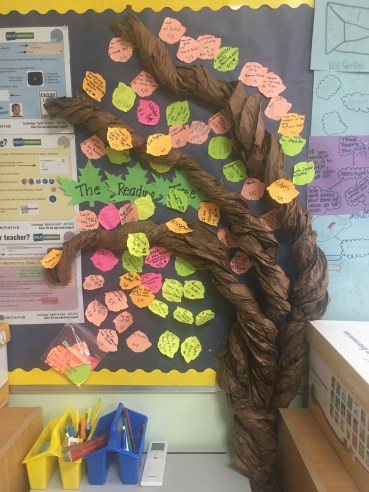
  1. Our learning support teacher encourages her readers with a creative, ongoing visual representation. She has a paper “tree” on a wall in her classroom, and as students read books, they add “leaves” to the tree. On each “leaf” the students write the title and author of the books, and it serves as both a reminder and inspiration for future reading. IMG_61004. That same teacher also keeps a quote wall on her white board. The words we read can reach us in beautiful ways, and when students experience that kind of moment, they are encouraged to share those lines on the white board. It’s another public display of a healthy reading life. It’s a conversation starter, and it helps build a sense of community within the classroom.
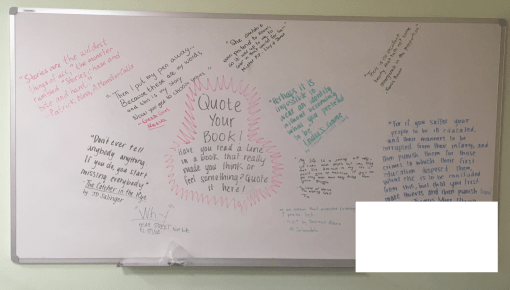
 

quote-wall.png5. Another teacher in our department keeps poster paper on her walls. Students add titles to the lists as they complete their books. Because names are attached, students can reach out to one another with questions or when they want to talk to each other about a book that they read, too. It’s another public acknowledgment and conversation starter, which is part of what we need when we build reading communities.

Books Read room 225

The common thread with all of these ideas is that they are public, they are deliberate conversation starters, and they help to build our precious reading communities.


I think it’s important to create opportunities for students to celebrate their reading accomplishments in a risk-free, nonthreatening way. Time is precious, so creating these opportunities in a relatively quick way within our classroom communities can be found time. Our classroom walls should reflect the needs and values of our classroom communities, and I find that these five strategies help move students forward with the development of their healthy reading lives.

How do you enable and encourage your students to publicly celebrate their reading lives and reading communities? I’d love to hear about it in the comments below.

Julie has been teaching secondary language arts for nineteen years, spending the first fifteen in rural Central Oregon, and the last four in Amman, Jordan. She’s thrilled to report that she and her family will be moving across the agua to Managua, Nicaragua next year, where a new adventure will begin.

Follow her on twitter @SwinehartJulie

Follow her blog https://adventuresinhighschoolworkshop.wordpress.com/

Everyday Activism: Enacting Change in Your Classroom

I’ve waged a war between sadness and hope this week in my teaching life. Sadness that yet again, another mass shooter took the lives of students and teachers. Hope that this time, the response would be different.

This is the first mass shooting I’ve followed news coverage of since becoming a mother, and accordingly, my sadness is magnified a thousandfold. I cannot imagine losing one of my precious children; I could imagine it even less before I had them.

But, my hope is greater after this tragedy, too. I’ve been so warmed by stories of students who survived the shooting mobilizing to enact change, like this one from NPR. “This kind of activism feels really different, compared with past mass shootings,” says journalist Brian Mann.

These passionate students-turned-survivors have spurred me toward activism, too. I don’t think there’s a simple solution to this complex, multilayered problem–and I don’t think our national conversation should attempt to polarize the issues of gun control and mental illness. I don’t know the right way to deal with either of those issues, but I do know a place where we, as teachers, can begin to enact change.

That place is in our classrooms, where students like Nikolas Cruz can sometimes go unseen for so long that they transform from lonely teenagers to angry gunmen before our eyes.

Our classrooms, where so often we have students so busy working toward meeting standards that they barely have time to meet our eyes, or one another’s.

Our classrooms, where, yes, great learning happens–but where teen realities like bullying, rejection, and failure happen, too.

Are you seeing these layers to your students’ identities? Seeing beyond who they are as readers and writers, and into who they are as friends, sons, daughters, boyfriends, and girlfriends? Who they are as social beings outside our classrooms?

We must see our students this way. We must make every effort to foster conditions of inclusivity, to teach in culturally responsive ways, to, simply, see our students as people and not just learners. When we do, we transform from spectators to activists.

Desiring to build community is no longer just a nice goal to have in addition to covering content standards. The ramifications of leaving students alienated are becoming more and more significant.

Inclusivity is no longer just a buzzword–it has become a matter of life and death.

Our teens are unhappier than ever, bombarded by apps that promise connection but in reality deliver isolation. They feel so lonely that they are spurred toward violence–toward themselves or others–in alarmingly increasing numbers. Nikolas Cruz is just the most visible product of this horrific trend.

There is so much we can do to see our students, to help them feel seen. Glennon Doyle writes here about a way her son’s teacher thoughtfully fosters inclusivity and interaction in her classroom by “breaking the codes of disconnection” she unravels when she really sees her students.

img_6983

I must have felt that message keenly when I planned my classes this week, since I packed in as many small-group or partner talk- and feedback-filled activities I could. My students wrote to one another–about having patience with and faith in our students–in their notebooks. They got into groups to talk about ways to individualize curriculum, and created anchor charts with their takeaways. They formed different groups to devise a list of creative alternatives to traditional tests, so every student could feel successful, on a Google doc.

My students also wrote their autobiographies this week, and workshopped them with a partner they don’t usually talk to. As I scanned through their comments on one another’s work, I was filled with joy:

“This makes my heart happy!” one student wrote in her response to a classmate’s heartfelt description of his fiancee.

“I feel sorry for anyone who will be Alex’s colleague–in a good way! She’ll be one of the best teachers at her school and will push her colleagues to be the best that they can be.”

“I’d love to work with a teacher like you.”

I watched my students read their peers’ comments, and little smiles stole over their faces.

A huge, happy grin stole over mine.

In response to violence, I drew my students closer–to one another, to our subject, to me. I wanted them to have the chance to see one another, to feel seen, and for me to see them more clearly as people and not just students. Workshops like these bring students together. They work, and if you’re skeptical, here are five reasons you’re wrong. When we teach into our students’ needs–both academic and personal–we make a difference. We enact change–every day.

And maybe, we save lives.

Please comment and share ways you help your students see one another and feel seen. We’d love to know how you do this important work.

Shana Karnes loves her work with preservice teachers at West Virginia University, with practicing teachers through the National Writing Project at WVU, and with her amazing thinking partners here at Three Teachers Talk. She is hopeful that this generation of students and teachers will be better, kinder, more open–and she will never stop trying to make that hope a reality. Connect with Shana on Twitter at @litreader.

Coffee spoons and Google forms – Measuring a Year

Five hundred twenty five thousand six hundred minutes.

Five hundred twenty five thousand moments so dear.

five hundred twenty five thousand six hundred minutes.

How do you measure,

Measure a year?”

Ah.. the opening lines of “Season of Love.” Go on, take a minute, and listen to it here. (Hi, young, pre-Frozen Idina Menzel! You’re amazing!) These lines -especially the “spoons of coffee”- have become so cliche, so tired, so parodied. Yet, even knowing all of that, those opening chords still tug at my heart. And I still find a little (ok, a lottle) truth and joy in the question the song poses: how do we measure a year?

For a teacher, of course, the question of why we measure anything is obvious: we need to know where we are so we know how far we need to go, where we need to go. So, the why is easy – we want our students to leave our classrooms as better readers, writers and thinkers, comfortable “playing” with ideas and using their own voices. However, the question of how we measure a year is a powerful one and, maybe, a more difficult one. How do we measure our successes? How do we measure our students’ growth as learners? How do we know that we’re making progress? How do we know what steps to take next?

Feedback is a big, recurring topic on 3TT. Here are some of ways feedback has been tackled on this site before: from Amy Estersohn, from Amy Rasmussen, from Lisa Dennis.

For me, the answer came in combining some National Writing Project best practices ideas with my love of Google Forms/Sheets. The result? Each week students are asked to use Google Forms to answer three questions based on a modified version of the writing project model of bless, press, address (BPA).

Now, BPA was  originally meant to guide students in asking for and giving advice when reading their peers’ writing. So, directions for BPA would like this in class:

Do you want your piece BLESSED, ADDRESSED, or PRESSED?

        o Bless: If you want your piece blessed, you’re not ready to hear criticism yet (however constructive it might be). You want only to hear about what’s working so far.

         o Address: If you have chosen the address option, what one problem or concern do you want your readers/audience to address? Be as specific as possible.

         o Press: You’re ready to hear constructive criticism and give the readers/audience the freedom to respond in any fashion. This, of course, can include “Bless” and “Address.”

However, I thought the questions would work well as a weekly thermometer of where my classes are, So I modified them to look like this:

  1. What are your positives from this week? (Bless)
  2. What concerns do you have about the ideas/skills we covered this week? (Address)
  3. Is there anything else I need to know? (Press)

Here’s what this looks like in my class. Every Friday I ask students to fill out the form (see what it looks like here). Google Forms automatically collates the data into a spreadsheet, and then a code I created allows me to email all 116 students about their responses individually from the spreadsheet. Easy, peasy, right?

The way this simple give and take has changed my classroom has been astonishing.

For example, here’s a response from a shy student:

Positive Concern Anything Else? My Response
I greatly enjoyed discussing a modest proposal in class and learning and discussing satires. I don’t think there is anything specific I need help with. I really enjoy satires, considering I am very sarcastic in all aspects of my life. Awesome. Keep up the good work. I appreciate you volunteering multiple times in class; I know that’s been a struggle this year.

This feedback allowed me to compliment a student who wouldn’t contribute to class discussions at the beginning of the year for contributing multiple times this week. Our entire conversation about her participation nerves and my suggestions happened via email. And, honestly, that reinforcement might never have happened in our day to day interactions in class. We would have wasted time frustrated with each other: I would have been frustrated that she wasn’t participating, she would have been frustrated because she wanted to participate but didn’t know how, and neither of us would have grown or moved forward.

The form also helps me adapt lesson plans to students’ needs more thoroughly. For example, here’s some feedback from last week’s in class timed practice:

      I need more practice connecting my sources in a timed synthesis writing because my essay felt very choppy when moving between sources.

      Not necessarily with this. I just need to work on doing everything quickly. I’m always running out of time.

      I don’t think I need help with that, I just need to pay attention to the clock more.

      Even though we talked about framing our evidence with our own voice, I struggled including warrant to frame the evidence in the synthesis due to the time limit. I know the warrant and “so what” of a claim are typically the most important parts and I know how to include them but I just never have the time so I tend to just skim a topic and move on so I can address all my points. What other part of my paper would be the best to shorten to leave time for warrant?

This feedback tells me that I need to spend a little time next week emphasizing the value of brainstorming before a timed write.

And what do the students think of the process? Here are a few thoughts:

      It’s nice to have an easy way to regularly discuss the issues as well as the positives with a teacher. Not often to teachers inquire about the good things the class is doing for you and your successes. I also enjoy hearing back from a teacher and feeling like my opinions and concerns are heard 🙂

      Also, I think especially in an environment like Central, students (myself included) are nervous to say they don’t understand things in class because they don’t want to look stupid, but weekly feedback makes it easier to get help.

       Some weeks, it doesn’t seem all that helpful, but others it helps me keep track of all that we have done in that week and keep track of what I need to focus on. It isn’t hard.

        It’s an interesting system. I’m running for governor for this upcoming YIG conference, and we’ve discussed about implementing a system that is quite similar statewide to streamline teacher-student feedback in attempt to improve K-12 education so each individual teacher can cater to his/her classes’ specific needs. I think it works pretty good and there’s not really much of a negative from the student standpoint.

So, how do I measure a year? In emails, and google forms, and excel spreadsheets. My version isn’t quite as catchy as the RENT version, to be honest. But this weekly format works for me; it’s how I measure my year. I value the conversations it starts, the way it allows my classroom to extend beyond the school hours, the relationships it deepens, and how it informs my practice. What works for you?


Sarah Morris teaches AP Language & Composition and Film as Literature in Murfreesboro, Tn. Born with a reading list of books she’ll never finish, she tries to read new texts but often finds herself revisiting old favorites: Name of the Wind, The Stand, Harry Potter and the Methods of Rationality. She tweets at @marahsorris_cms.

The Upside Down of SparkNotes

My ninth period class sometimes feels like the Upside Down, you know, the terrifying parallel universe kids get sucked into in the Netflix series Stranger Things. They seem to keepcalm_shutupfunction in perpetual chaos. Every day I whack-a-mole them into their current book, notebook work, mentor text, draft, or just away from their phones.
In another teaching universe, I might anticipate 9th period with fear and loathing. But I don’t. Despite the daily ruckus, there is no malice in their behavior. In the universe of RWW, we can muddle through these chaotic moments together, (mostly) with humor and (mostly) without the rank-pulling that commands student compliance. And sometimes, these moments even provide a portal to the universe of important conversations.

This class has a number of self-proclaimed non-readers. Luke considers reading a “hobby” that some people enjoy and others don’t (and shouldn’t have to do). Lani regularly describes herself as “not much of a reader.” Miles’s stance is more ambivalent. He wants to know stuff, but sees reading as inefficient for doing so. I ask, “What ruined reading for you?” He answers without hesitation: “SparkNotes.” He elaborates, “It’s just a faster way to get the information.” Classmates nod their heads in agreement.

INFORMATION?!? I recoil.

By “information,” they mean what they will be held accountable, by quiz or discussion. When I remind them that we don’t do that in RWW, they explain — gently, mercifully — that now it’s just a habit. They look genuinely sorry for me, as if they just told me there is no Santa Claus. Or that SparkNotes is Santa Claus. Which maybe it is: the Santa Claus of the Upside Down, that parallel universe where reading resides for many of our students.

In their practice-revolutionizing book Disrupting ThinkingKylene Beers and Robert Probst distinguish between “aesthetic” and “efferent” reading. The former is about how a text affects our thoughts and emotions and the latter about the information we can extract from it. In classrooms where the efferent is favored over the aesthetic, SparkNotes is a useful substitute. Miles and his classmates have learned to reside here, to the extent that efferent reading is their natural stance in their English classrooms.

Beers and Probst do not discount efferent reading out of hand. It certainly has its place when information or efficiency is the goal. SparkNotes is a means to this kind of extrinsic end that drives so much of how we measure “success.” Can we blame our students for using a resource to reach that end more efficiently?

Aesthetic reading doesn’t lend itself to extrinsic reward, making it incompatible as a means to the end of racking up points toward the reward of an A. But here is the very reason why we must stand by its importance: the aesthetic stance is what invites the emotion and empathy that brings qualitative value to students’ reading experience, that honors the power and the beauty of the written word, that opens a window into the lives of others. And, which encourages the “compassionate thinking” that Beers and Probst define as so critical to our students’ reading lives.

My 10th-grade RWW students were given the option of book circles. In planning for rolling out their choices, I tried constructing elaborate lessons to reveal the beauty of a text so that students would have to admit to its aesthetic power. What I should have realized sooner is that a lesson like this was beside the point.

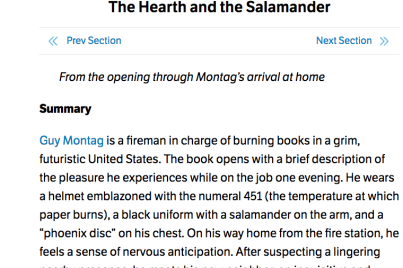
SparkNotes_F451_screenshotThat day, the SparkNotes summary of the first chapter of Fahrenheit 451° (one book circle choice) was their writing prompt. There was some confusion: Were they supposed to write about whether they were going to choose that book? Or to predict what the book might be about? This prompt is like any other daily writing, I told them. Just write what it brings to mind.
I’m not creative enough to make a lesson into a mystery. When students finished writing to this (rather uninspiring) prompt, I told them straight up: Now, here’s the source text for this SparkNotes summary. Please, just listen.

And I read aloud the beginning of Fahrenheit 451°. 

It was a pleasure to burn. 

By the time I reached the description of Guy Montag as a “conductor” of the symphony of flames that silenced the voices of the books he burns, there was also silence in the room. More students than I expected opted for the book circle, reading Fahrenheit 451°. I don’t know whether these choices resulted from an aesthetic reading of the book’s opening, but isn’t it pretty to think so?

Kathleen Maguire teaches Sophomore English, Senior Advanced Writing, and AP Language & Composition in Evanston, a suburb just north of Chicago. When she’s not grading papers or reading books to recommend to students, she tries to keep up with her yoga and her 10-year-old son, Jude (not in that order). She tweets at @maguireteach.


To the Woods: The Importance of Stopping to Reflect While on the Journey

In a recent twitter chat for AP Literature teachers hosted by Talks with Teachers Brian Sztabnik, he opened the chat with a prompt: identify a poem befitting of the weather conditions. Robert Frost’s “Stopping by the Woods on a Snowy Evening.” Too on the nose, my husband would say. Yet for me–given weather conditions and classroom conditions–it felt natural, not as a text to teach but as a text to prompt the kind of introspection I needed. As a teacher, I am at a stopping point, a midway point in the year where I gain new students (I teach on the block schedule). I have miles to go before I sleep (#Englishteacherlife). But before I try to fulfill those promises to my new students, I need to go to the dark places, to the woods of my mind. And stop. Stop moving from one thing to the next. My teacher life desperately needs this stillness. In the woods of my mind, I can truly reflect and determine how to keep moving forward on the miles ahead, discovering the ways I can uphold my responsibilities to my students and to myself.

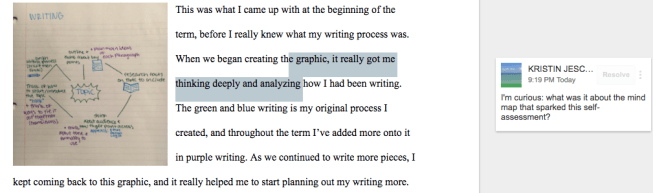
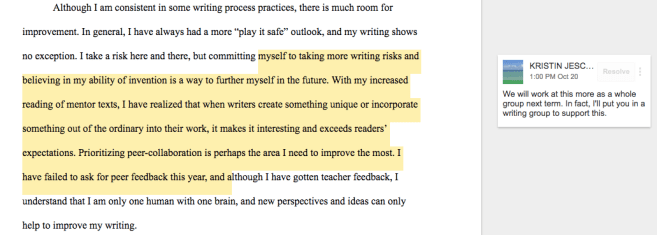
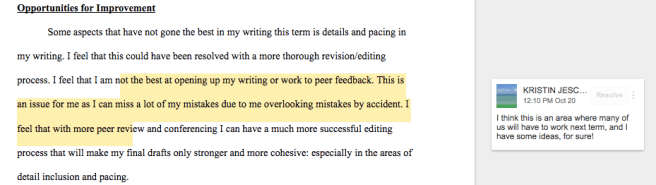
As I paused, visiting my own woods, I reflected and wondered yet again: do my students have enough opportunities to go their dark places, their woods? I don’t mean social-emotional dark places. Instead, I mean the darkness and woods of their learning journey as writers where they must ponder thickets and brambles and branches–the very things that trip them and rip them up as writers. No, they don’t. As a teacher who regularly pushes students to reflect because of its impact on self-regulation skills, this year I’ve gotten buried under new content and new approaches. It seems I’ve let my commitment to reflection on not just product but also process get covered up by the deep snow of other stuff. Yes, my students reflected at the end of each essay, but what were my students missing by not pausing for more profound reflection in the midst of their journeys? What chances to directly impact their writing processes did I miss?

My students’ end-of-the-term portfolios, where they presented artifacts and reflected on their writing process journey, certainly carried me deeper into the woods–theirs and mine–and I learned about what we missed.

Screen Shot 2018-02-04 at 9.43.03 PM

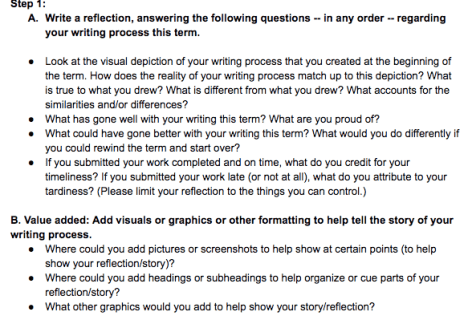
These are the end-of-the-term reflection questions with which we asked students to engage.

Students not only narrated how their writing processes changed and what went well with their writing but also what could have gone better and what they would do differently if they could rewind and start over. Their reflections were lovely, dark, and deep. Here are a few samples.

Student A’s reflections: 

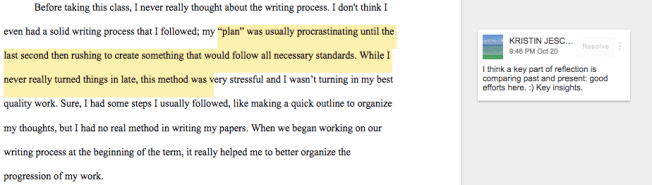
Screen Shot 2018-02-04 at 9.47.05 PM

Screen Shot 2018-02-11 at 9.19.13 PM

Student B’s reflections:

Screen Shot 2018-02-11 at 7.33.43 AM

Student C’s reflections:Screen Shot 2018-02-04 at 9.59.26 PM

As I re-read their end of Term 1 reflections and then later really paused to consider their Term 2 reflections, I recognized why I need to force those pauses in the midst of the journey more often. Yes, many of my students, like Student A, pondered their processes overall and showed improvement in self-regulation. But, Students B and C are far more indicative of missed visits to the woods. I could have mentored Student B more to take calculated risks throughout the process, and both Students B and C could have benefitted from more coaching regarding peer collaboration. There are, it seems, so many more opportunities for learning if I create the conditions for true pauses during the process. Sharon Pianko’s “Reflection: A Critical Component of the Composing Process” from 1979 (when researching the relationship between composing and reflection was new) speaks to this:

It is reflection which stimulates the growth of consciousness in students about the numerous mental and linguistic strategies they command and about the many lexical, syntactical, and organizational choices they make–many of which occur simultaneously–during the act of composing. The ability to reflect on what is being written seems to be the essence of the difference between the able and not so able writers from their initial writing experience onward.

I have a responsibility to help my students become “able” writers. And, now I’m all too full of eagerness to move, bells of expectation ringing, full of purpose toward that responsibility.

This term my colleague and I intend to schedule deep reflection time–true pauses to reflect on process not product–on a regular basis. We must prioritize this. Sure, at first, my new students might think it strange to stop. And to stop where we do. They might even think it’s a mistake. But I know better now. I’m inviting them to the woods, empowering them first to reflect and then to find their way onward, ably, through the snow.

For resources on reflection, check out two of my recent “go-to’s”:

Angela Stockman’s Blog Post “Ten Reflective Questions to Ask at the End of Class”: I appreciate question 7: it’s all about the journey. Allison Marchetti and Rebekah O’Dell’s Writing with Mentors: their checkpoint questions provide a systematic approach to the kind of reflection we’re after.


Kristin Jeschke teaches College Prep English (senior English) and AP Language and Composition at Waukee High School in Waukee, Iowa. She doesn’t mind the snow, enjoys the woods, appreciates the poetry of Robert Frost, prizes reflection, and loves her students. Follow her @kajeschke.